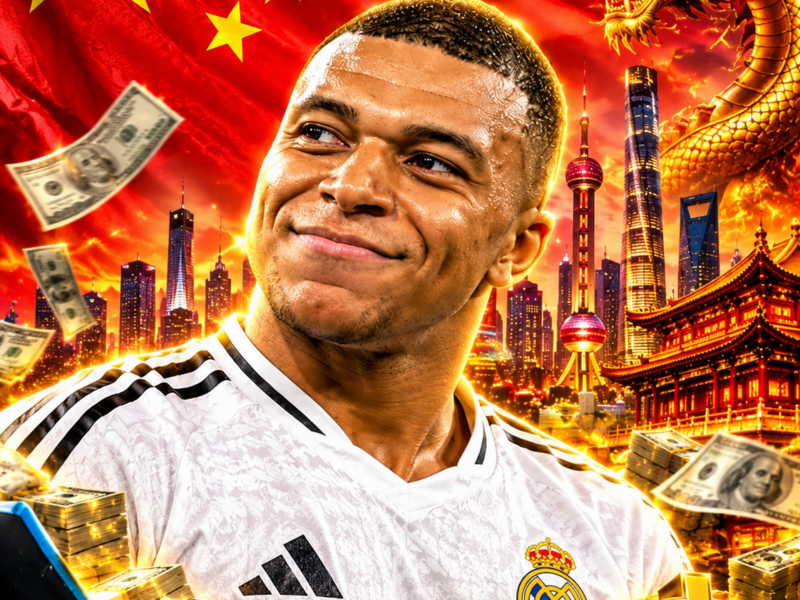
THE IMPACT OF THE MBAPPÉ–CHINA CONTROVERSY ON REAL MADRID
There are weeks in football when the pitch goes quiet and the noise gets louder. This is one of them. Real Madrid has no match to prepare for until Sunday, the Copa del Rey is carrying on without the clubs involved in the Spanish Super Cup, and yet the Bernabéu is anything but calm. A podcast joke, a Chinese broadcaster, a league president with a very large amount of money at stake and a refereeing review that left plenty of people scratching their heads have combined to produce one of the busiest news cycles of the season.
The account that follows comes from a Madrid-focused commentator who recorded his update on a Tuesday evening, just before settling in to watch the club’s basketball side, and who set out to cover everything that had happened in the previous few hours. His summary is, by his own admission, one man’s reading of events. Where others see things differently, that is noted too.
He began with a promise to viewers. In a separate video he plans to publish a conversation with Carles Fité, a journalist from Barcelona, about his impressions of El Clásico and the aftereffects it might leave on the Catalan club. The logic, as he put it, is that Madrid and Barcelona often work like communicating vessels: what happens to one inevitably spills into the other. Beyond the result itself, he said, Fité raised something in their chat that leaves him a little worried, and it has to do with the situation surrounding Lamine Yamal.
That tease aside, the main business of the day was Madrid, and it started with a very quiet calendar.
While the rest of the teams not involved in the Spanish Super Cup are busy with their Copa del Rey ties, Madrid has no commitment on the schedule. The next match is on Sunday at 4:15 against Racing de Santander. For the club, this is a stretch of days to recover strength and to rebuild the team a little after a demanding spell that culminated in the visit to Barcelona.
The breathing space arrives at a convenient time. Squads that have just played a Clásico, with all the physical and emotional wear that comes with it, rarely complain about a few extra days of training without a fixture hanging over them. Coaches tend to use these windows to repair small ailments, reset tactical details and give tired players a mental rest. Whether Madrid will do exactly that is up to the staff, but the opportunity is there.
The most encouraging piece of news concerns Fede Valverde. The Uruguayan had been carrying discomfort in his hamstrings even before the game against Barcelona, and he has now undergone tests. According to the commentator, nothing has shown up. There is no tear, no visible injury and nothing noticeable on the scans.
That does not mean he can be counted on at one hundred percent for the next match, and the commentator was careful to say so. The medical staff will have to wait and see whether the pain disappears and whether the discomfort that forced the player to push himself in recent games has gone. Forcing him back before he is ready, he argued, would not be worth the risk, especially at a time when Valverde is turning into such an important figure in the team.
The cautious approach is one that most supporters would endorse. A hamstring that is merely sore is a very different problem from one that is torn, but it can become the second if mishandled. The club has every reason to give its midfielder the time he needs, and a quiet week is the ideal moment to do it. Those who prefer a more aggressive approach would counter that a clean scan is a clean scan, and that elite players routinely play through some discomfort. Both positions are common in dressing rooms, and the final call will come from the medical team and the coach rather than from anyone commenting online.
The week also brought the usual post-match analysis from the refereeing side, and two incidents from the Clásico drew particular attention. One was a handball by Balde. The other was a challenge by Cancelo, whose studs landed on the calf of Diomande.
On the handball, the verdict delivered during the review period was that it was not a handball and therefore not a penalty, because plays of that type are not called that way. The commentator said he agreed with that reading. He added that Tristante Oliva, who analyzes refereeing decisions on the channel, had reached the same conclusion, and that he shared his colleague’s view. In his opinion, the play simply does not warrant a penalty.
The second incident was more complicated. The explanation offered was that Cancelo’s action was not a red card either, because there was no excessive force. In other words, the officials measure the force with which the studs met the calf. By that measure, the impact was judged not to be strong enough to merit a dismissal, despite the fact that Diomande was clearly shaken after the contact. The commentator noted, with a hint of sarcasm, that the studs were very far from the ball, though the ball, as he put it, was elsewhere.
The contrast that struck him was with another type of offense. A hair pull, he pointed out, is a straight red card. Studs on the calf, something that he considers far more dangerous, turn out not to be. From now on, he suggested, it seems the punishment for driving your studs into an opponent’s calf will be a yellow card at most, and in this case the referee did not even show one.
It is worth pausing on how this kind of discussion works. The commentator was reporting what he understood to be the committee’s reasoning, not delivering a ruling of his own, and he was careful to separate the handball, where he agrees with the verdict, from the challenge, where he finds the logic strange. Defenders of the officials would say that the laws of the game call for a judgment on intensity, that the line between a careless challenge and a reckless one is often thin and that the review process exists precisely to explain decisions with consistency. Critics would say that a framework based on measuring force is difficult to apply in real time and sits uneasily with how other offenses are punished. Both views have their adherents, and the debate is unlikely to end any time soon.
For Madrid supporters, there is also a practical question. If the same logic is applied in future matches, the club’s own players could be on either side of such a ruling. That, perhaps, is the most honest reason to want the criteria to be clear and evenly applied, whoever benefits in a given weekend.
The heavier subject, however, was Kylian Mbappé. The day before, the commentator had published a video explaining what the problem was and what Chinese television had decided to do. He returned to it with the latest developments.
According to his account, Chinese television has stopped broadcasting Madrid matches, and in a concrete sign of that decision, it has removed the match between Real Sociedad and Real Madrid from its schedule. As things stand, that game will not be seen in China. For a club with a huge following in that country, and for a league that sells its product abroad, it is a significant step.
The reaction from La Liga came quickly. Javier Tebas, the league’s president, later posted a message after meeting with the Chinese ambassador in Madrid. The commentator imagined that the purpose was to smooth things over and calm the atmosphere, because, evidently, La Liga has a great deal of money at stake. He also drew a parallel with the NBA, which, according to something he had read from the journalist Pepe Brasín, had a very serious problem of its own with China at one point and lost quite a few millions as a result.
He was careful to say that he did not want to enter the geopolitical dimension of the matter, and repeated that he did not want to get into it. His interest, he said, lay elsewhere, in the way Tebas had handled the apology.
The argument he made is one that has become familiar among Madrid-leaning commentators. Tebas, he said, apologized in the way he apologized, with all the sensitivity one could ask for toward China, but still has not done so, for example, over his comparison between Real Madrid’s communication style and the techniques of Nazi propaganda associated with Goebbels. The commentator called the combination quite incoherent. In his words, there is a great deal of sensitivity when it comes to apologizing to China and very little when it comes to apologizing, even if only for the comparison, to a club over the communication strategy and the ideology it was compared with.
The league’s side of the story is not hard to imagine. Its president has a duty to protect the competition’s commercial relationships, and a diplomatic meeting with an ambassador is a normal tool for doing so. He would say that the two situations are not equivalent, that one concerned a foreign partner whose cooperation affects every club in the league, and that the other was a matter of opinion in a domestic dispute. The commentator, for his part, does not accept the distinction, and many Madrid supporters share his view. Whether the comparison ever deserves an apology is something on which the club and the league remain far apart.
Mbappé himself has now spoken. He published an apology in which, according to the commentator, he said he was aware that his words had been inappropriate and that he had made a mistake. The remarks referred to a meme in which he is compared to a Chinese dictator, a meme that, in the original conversation, he had said he found very funny.
The commentator took care to separate the apology from what he thinks Mbappé truly believes. Beyond the player’s private opinion, he said, the remark turned out to be a blunder, and the damage is already real. Several advertising contracts with Chinese companies have reportedly been canceled. The footballer, whom the commentator considers a very smart person, evidently did not calculate that a joke, or rather the reaction to it, would end up affecting the agreements he has with companies in China.
There is a detail in the timeline that makes the episode even more curious. The joke was made in April, in an interview on a podcast. The excerpt was only rescued and published the day before the commentator recorded his video. In other words, a remark from months ago was suddenly pulled out of its original context and placed in front of a wide audience at precisely the moment when it could do the most harm.
That raises a question that the commentator did not answer, and that no one outside the story can answer with certainty: why now? Some viewers will see a coincidence of the kind that happens constantly on social media, where old clips resurface for reasons nobody can trace. Others will wonder whether the timing was deliberate, perhaps meant to put pressure on a player at a moment of high visibility. Nothing in the account supports either explanation, and responsible reporting has to leave the matter open.
One of the most notable details of the whole saga is who has not spoken. Real Madrid, the commentator said, has said nothing. He was recording at nine in the evening, shortly before the club’s basketball match, and when he looked at the club’s website there was nothing published on the matter.
He knows that Madrid has been weighing whether or not to issue a statement. According to what he understands, the club has been in contact with Mbappé to work out how to handle the situation. For now, the decision has been that it should be the player himself who adopts whatever position he wishes to take.
The reasoning is straightforward. The remark was a personal act. It did not happen at a press conference organized by Real Madrid, nor in an interview after a match with the club, but in an environment entirely unrelated to Real Madrid. From the club’s point of view, that makes it a matter for the individual rather than the institution.
That approach has a clear logic, and it is also a risky one. Silence can be read as prudence, as a refusal to be dragged into a dispute that the club did not start, or it can be read as a lack of support for a star player under pressure. Supporters who favor firmness will say that a club of Madrid’s size does not need to react to every controversy, and that a statement could escalate matters by giving them an official status they do not currently have. Others will say that when a broadcaster pulls a match and sponsors walk away, the club has a duty to say something, if only to protect its commercial partners.
The commentator does not take a firm side on that question. What he does say, plainly, is that the matter has consequences for everyone involved. It has repercussions for the league. It has repercussions for Mbappé, as he had already explained. And it has repercussions for Real Madrid.
The first and most visible impact is on merchandise. The sale of jerseys is very important within the Chinese community of fans, and Mbappé, in the commentator’s words, was the player who sold the most. If the damage to his image in that market is lasting, the effect on shirt sales could be felt across the club’s international business.
The second impact is less obvious but arguably larger. Beyond jersey sales, Real Madrid keeps a percentage of Mbappé’s image rights from the contracts he signs after joining the club. Some of the contracts that have now been canceled were signed since he arrived in Madrid. That means the cancellations have a direct economic cost for the club, and not only for the player.
The commentator did not put a figure on any of this, and nothing in his account allows a precise estimate. It would be speculative to suggest how large the losses might be, and he did not try. What he did say is that he does not know how reversible the situation is. He also said that he does not even know whether it needs to be reversed, because in his judgment everything has been blown way out of proportion.
That last point deserves attention, because it frames the way he sees the whole affair. The exaggeration, he said, seems crazy to him. In his view, the remark was a joke, the kind of thing that people say among friends, and the scale of the reaction is out of all proportion to the original comment.
He was, however, quick to add a note of cultural context. There are cultures, countries and political regimes, he said, that are much less open, even to humor. In China, the commentator explained, what Mbappé did is considered an offense because it is seen as a humiliation to legends of the country, or to former heroes of the nation. It is a delicate subject, he said, and many people have interpreted it in a certain way.
This is the part of the story where two reasonable positions collide. One holds that a joke is a joke, that nobody should lose a contract over a remark made in a relaxed chat, and that the response is a sign of excessive sensitivity. The other holds that a global public figure who earns money from a worldwide audience cannot treat all audiences as identical, and that a gesture which looks harmless in one country can be deeply hurtful in another. The commentator leans toward the first view while acknowledging the second, and that mix of skepticism and understanding is probably as balanced as the debate allows.
Perhaps the most telling line of the whole report is its conclusion. The commentator said he does not think Mbappé is happy with the effect that this has caused, and that he does not think Real Madrid is either. That, he said, is the impression he has.
It is hard to argue with that assessment. A player who has just lost sponsorship contracts has little reason to celebrate. A club that has lost part of its image-rights income and watched a broadcaster pull one of its fixtures has little reason to be pleased either. And a league that has had to send its president to meet an ambassador is not likely to describe the week as a success.
The commentator also took a small, pointed swipe at the way the story has been received in some quarters. He remarked on how great it is, with obvious irony, that Mbappé is the one who has disrupted the league. The comment reflects a long-running feeling among Madrid supporters that the club and its players are held to a different standard from other members of the competition. Supporters of other clubs will naturally disagree, pointing out that every big club generates its share of controversy and that Madrid’s status makes it a lightning rod for attention, whether it wants that or not.
The immediate questions are simple enough to list. Will Real Madrid break its silence? Will the Chinese broadcaster reverse its decision, or will it extend the ban to more fixtures? Will more sponsors follow the ones that have already left? And will the league’s efforts, including the meeting with the ambassador, be enough to calm the situation?
None of those questions has an answer yet, and the commentator did not pretend otherwise. What is certain is that the story will keep developing over the coming days, with no match on the calendar to push it off the front pages. A quiet week on the pitch, in other words, has become a loud week everywhere else.
On the pitch itself, the next test is the trip to face Racing de Santander on Sunday at 4:15. The squad will use the days in between to recover, and Valverde’s progress will be watched closely. If his hamstrings settle, he is likely to play a significant role. If they do not, the coaching staff will have to decide whether the risk is worth it, and the commentator’s advice on that point could hardly be clearer.
Beyond that fixture lies the match with Real Sociedad, the one that Chinese viewers will not be able to watch for the moment. It is a small detail in the grand scheme of the season, but it is also a reminder of how quickly the commercial and the sporting sides of the game can become entangled. A football club is no longer only a team. It is a global brand whose fortunes depend on the goodwill of audiences who may never set foot in its stadium.
That is the real lesson of the episode, whichever side of the argument one favors. For Madrid, the cost of a few seconds of banter on a podcast has turned out to be measured in broadcasts, sponsorships and shirts. For the league, it has been a test of how far its leadership will go to protect a market. For Mbappé, it has been a hard reminder that in modern football a joke never stays in the room where it was told.
As for the commentator, he ended the video in the same relaxed tone in which he began it. He thanked viewers for watching, asked for their comments and invited them to leave a like, share the video and subscribe to the channel if they had not already. Then he signed off with a big hug, and headed off to watch his basketball game.









