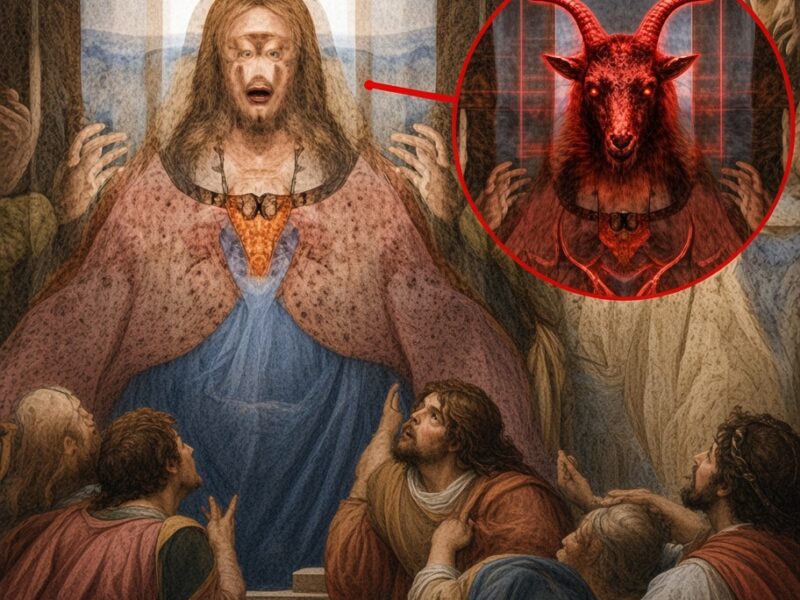
The Face Da Vinci Painted Into The Last Supper By Accident
For 528 years, one painting has refused to be solved. You have seen it before: a long table, 13 men, a quiet meal painted onto a monastery wall in Milan.
It looks simple. It looks finished. It looks like nothing more than a religious scene you have scrolled past a hundred times without stopping.
But researchers have stood in front of this wall for five centuries, and they still cannot agree on what Leonardo da Vinci actually hid inside it. Some see a code. Some see a confession. Some see a warning aimed at people who were not born yet.
And a few of those who studied it the longest walked away convinced the painting contains a date. Not a date from the past, but one that has not happened yet.
That date is the strangest thing any researcher has ever pulled out of this wall, and it is why some have called The Last Supper a prophecy instead of a painting. Others call it wishful decoding. More on that shortly.
First, it helps to understand why this painting has resisted every attempt to crack it. The most unsettling thing about it may not be what Leonardo painted in the center. It may be what he left in a half-moon of space above it, a place almost nobody looks.
Start with the wall itself. The Last Supper is not on canvas. It is painted directly onto the dining hall wall of the convent of Santa Maria delle Grazie.
It is enormous, about 15 feet tall and 29 feet wide. Leonardo began it around 1495 and finished around 1498. Do the math forward and you land on 528 years of people staring at it.
Almost from the moment he finished, it began to die. Here is the original sin. True fresco is painted fast onto wet plaster, so the color soaks into the wall and becomes part of it forever.
Leonardo hated working fast. He wanted to blend, to layer, to go back and revise for months. So he refused to paint a true fresco and invented his own method: dry plaster, with a mix of tempera and oil.
It failed. Within about 20 years, the paint was already flaking off the wall. Leonardo lived long enough to watch his masterpiece begin to peel.
Then it got worse. In 1652, monks decided the hall needed a bigger doorway, so they cut one straight through the bottom of the painting. They sliced off Christ’s feet to make room for a door.
Napoleon’s troops reportedly used the room as a stable and threw objects at the apostles’ heads. In 1943, a British bomb collapsed part of the building. The wall survived only because someone had stacked sandbags against it.
Here is the killer fact. After the last major restoration, experts estimated that only a fraction of what you see today is Leonardo’s actual brushwork. Centuries of decay, amateur repainting and touch-ups mean large parts were finished by later hands, guessing hands.
Think about what that does to every theory you are about to hear. How do you decode a secret message when half the letters have fallen off the wall? How do you read an artist’s hidden intentions in a face a restorer repainted 300 years after he died?
This is exactly why the painting became a magnet for obsessives. When a masterpiece is this damaged and this famous, every missing piece becomes an invitation, and every gap becomes a place to hide a theory.
Look at the moment Leonardo chose to freeze. Other painters who tackled this scene usually showed the calm version: the blessing, the bread, the wine, with Judas shoved off to one side, small and obvious, sometimes without a halo.
Leonardo threw that out. He painted the worst second in the room, the instant after Christ says six words: “One of you will betray me.” And the table detonates.
Twelve men recoil in the same breath. Hands fly up, bodies twist. You can almost hear the noise.
Look closer, because the first mystery is what he did not paint. There are no halos, not above the apostles, not even above Christ. Every earlier version used a golden disc to mark the holy from the human. Leonardo erased them all.
He lit Christ with a window instead, a soft natural glow behind his head, and left everyone else as ordinary, frightened men. Strip away the halos and you strip away the labels. You can no longer tell the saint from the traitor by looking.
Which means you have to search for Judas. And that is the point.
Find him now. He is not off to the side. He is pulled into the group, leaning back, his face dropped into shadow. In his right hand he clutches a small bag, the 30 pieces of silver, hidden in a fist at a dinner table.
Watch his elbow. He has knocked over a small dish of salt. In Leonardo’s time, spilled salt was an omen: bad luck, a broken bond, a covenant coming apart. A few grains on a tablecloth hold the whole story in one accident.
Then look at the bread. Judas and Christ reach toward the same dish at the same moment. Many read that as Leonardo staging the scriptural prophecy of the one who dips his hand in the dish with Christ. He froze it mid-reach.
He hid the villain inside the crowd, with no mark, no horns, no halo of shame, and forced the viewer to hunt for him among faces that look like everyone else. Betrayal does not announce itself. It sits at your table and reaches for the same bread you do.
But Leonardo was not finished, because there is a hand in this painting holding something it should not. In the cluster of figures just left of Christ, a hand grips a knife, the blade bare, pulled back low and turned away from the light.
For a long time, people could not agree whose hand it was. From some angles it looks disconnected from any body, floating, and early viewers called it the phantom hand. Restoration settled the argument: the knife belongs to Peter.
Peter is the disciple who, later that same night, draws a blade in the Garden of Gethsemane and cuts off a servant’s ear. Think about what Leonardo is doing with time. Nobody has been arrested, nobody has been named, and he has already armed the man who will commit violence hours from now.
The weapon is out, under the table, pointed roughly toward the side where Judas leans. This is not just a room full of shock. It is a room where one man is stunned, one is hiding silver and one is already reaching for steel.
Most people see a sacred, peaceful scene. Leonardo painted a powder keg and lit the fuse. And that is still only the surface, because underneath the human drama, researchers found something colder and more deliberate: a structure, a design, numbers.
Step back from the faces and look at the shape of the whole. Everything points at Christ, and not by accident. Leonardo used one-point perspective, building the room’s ceiling beams, wall panels and tapestry edges so that every line races toward a single vanishing point.
That point sits just behind Christ’s right temple. He did not aim the geometry at the heart, the hands or the bread, but at the side of the head, the place behind the eyes. It is a room whose every straight line drills toward the spot where thought happens.
Now look at Christ’s body. His arms spread down and out, his head at the peak, forming a near-perfect triangle, a stable, sealed shape in the dead center of the chaos. In Christian symbolism, a triangle can stand for the Trinity, three in one.
The number three keeps returning once you start counting. There are three windows on the back wall. The 12 apostles are broken into four groups of three. Three is the divine number, four the earthly one, the four corners, the four seasons. Heaven and earth fused in a seating chart.
Then there is the ratio. Researchers who measured the composition claim it is threaded with the golden ratio, roughly 1 to 1.618, the proportion found in seashells, flower heads and galaxy spirals. Leonardo knew it intimately, having drawn the illustrations for a whole book about it.
Some push further and trace the Fibonacci sequence through the layout. Is all of this deliberate? That is the honest question, and it deserves a hard answer later. But whether Leonardo planned every ratio or not, the effect is undeniable: a scene of pure panic with a silent order buried underneath.
And hidden inside that order is an absence, something that should be on the table and is not. This is the first supper, the night Christians believe the cup of wine became sacred forever. So look for the cup.
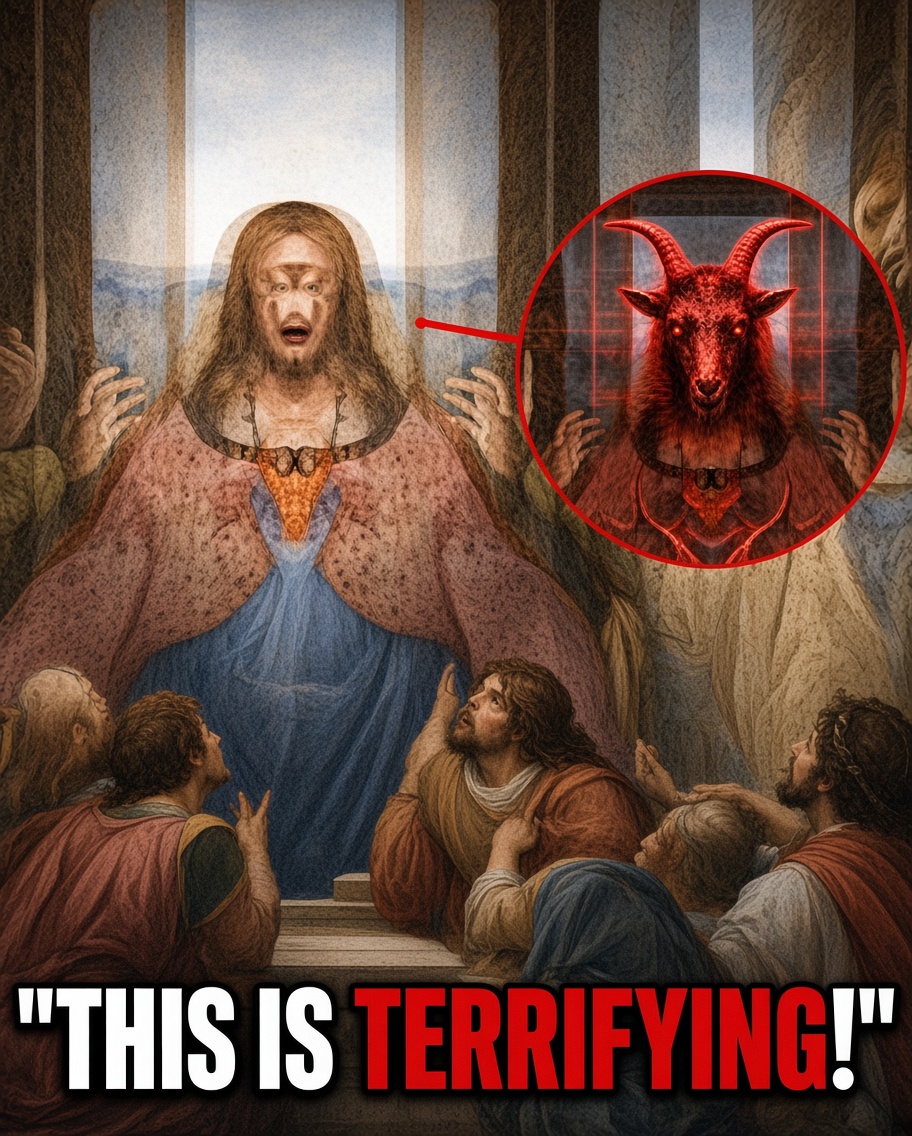
It is not there. There is no single, central, glowing chalice at the heart of the scene. There is wine, and small glasses scattered along the table. But the one object you would expect at dead center, the Holy Grail itself, is simply missing.
For most of history, people barely noticed. Then a question started spreading. Why would a man who calculated the angle of every beam forget the most important object in the whole story? The obvious answer is that he did not forget.
If the Grail is not on the table, where is it? One reading, the one that launched a thousand books, goes like this: maybe the Grail was never a cup at all. Maybe the vessel that carried the sacred blood was a person, a bloodline, seated right next to Christ in plain sight.
Which brings us to the most argued-over figure in Western art, the one at Christ’s right hand. Soft features, long hair, a slender neck, hands folded gently, leaning away from Christ, calm in the middle of all that shouting.
Tradition has a simple answer: that is John, the youngest apostle, the beloved one. In Renaissance painting, young men were routinely given soft, beardless, almost feminine faces. Art historians will tell you it was a convention, nothing more.
But over the centuries, viewers kept asking a different question. What if that is not John? What if Leonardo seated a woman at Christ’s right hand, and her name is Mary Magdalene?
This is the theory Dan Brown turned into one of the best-selling novels of all time. The visual argument is hard to unsee once you notice it. The two figures lean apart, and the gap between them forms a clean letter V.
In this reading, the V is an ancient symbol of the sacred feminine, the shape of a chalice, a vessel. Together, the two figures trace the shape of an M. M for Magdalene, some say. M for marriage, say others.
Supporters point to old texts outside the official Bible, like the Gnostic Gospel of Philip, which described Magdalene as the companion Christ loved most. If you accept those texts, a married Christ and a woman of sacred authority would not be a scandal Leonardo invented but a secret he inherited and smuggled onto a wall.
Here is why the theory refuses to die. If true, it would challenge an institution built on a celibate Christ and male authority. That is a heavy thing to hang on the tilt of a neck and an empty triangle of space.
Most scholars push back hard. They say it is John, and always was. The feminine look is period style, and the V is just two people leaning away from a shock. They are probably right.
But remember that figure: the softness, the calm, the way this one person does not seem to react like everyone else. That stillness will return, because it connects to the darkest reading of the painting.
The hidden woman is not the only code people claim to have found. Some of them are not symbols at all. Some of them are sounds.
Look at the table again, at the food. There is a fish, and people cannot even agree what kind. Some say eel, some say herring. In the wordplay of Leonardo’s Italy, that distinction carried weight.
One word for eel could hint at religious instruction. A word for herring could hint at denial and the renouncing of faith. A single fish, two opposite meanings, depending on which one you think he painted.
There is a deeper layer to the fish, older than Leonardo. In the earliest days of Christianity, when believers were hunted, they could not wear a cross openly. So they used a secret sign: a simple fish.
The Greek word for fish, ichthys, worked as an acronym for Jesus Christ, Son of God, Savior. It was a password you could scratch in the dirt and wipe away. So when Leonardo places a disputed fish at a table of people about to be scattered and persecuted, some researchers read it as a nod to that hidden history.
Then the reading goes cosmic. One theory holds that the 12 apostles are not just 12 men but the 12 signs of the zodiac, 12 figures around a central sun, and the sun is Christ.
The panic on the wall becomes a clock, and the four groups of three become the four seasons, three months each. In this version, Leonardo painted not a dinner but the wheel of the sky, with Christ as the source of all light and the disciples orbiting him like constellations.
It sounds like a stretch, and maybe it is. But keep the idea in mind: signs, stars, a calendar hidden in a religious scene. It will matter when a Vatican researcher claims to have used exactly this kind of astrological code to pull a specific date out of the painting.
And then there is the theory that Leonardo did not hide a picture at all. He hid a song.
In 2007, an Italian musician named Giovanni Maria Pala said something that sounded impossible: The Last Supper is playable. His claim is that if you lay a musical staff across the painting, the loaves of bread and the hands of the figures sit almost exactly where notes would sit, their heights mapping onto pitches.
But you cannot read them left to right. You have to read them right to left, which is how Leonardo wrote in his private notebooks. He wrote backward, in mirror script, so his notes could only be read with a mirror.
Read the painting his way, Pala said, and the notes line up into an actual sequence. When played, it lasts only about 40 seconds, and it is not triumphant. It is slow, solemn, hymn-like. People who have heard it describe it as mournful, almost a requiem.
Think about where that music would be hiding: in the bread and the hands, the very objects Christ is about to name as his body on the last night of his life. A funeral song buried in the loaves at the meal before the death.
Is it real? Skeptics say you can find music in anything if you are willing to place the staff where you want it. That is a fair objection. Yet even they concede the odd part: when you follow Leonardo’s own backward writing and read the painting as he read everything, the notes resolve into something that sounds intentional rather than random noise.
If a hidden song is the eeriest thing in this painting, wait. When one researcher folded the painting onto itself, faces appeared that Leonardo never seems to have painted at all.
A researcher named Slavisa Pesci tried a simple experiment. He took a transparent copy of The Last Supper, flipped it into a mirror image and laid it back over the original, so that the painting and its reverse overlapped in the same frame.
What appeared was not a blur but new figures. At the two far ends of the table, where the mirrored versions overlap, shapes emerge that look like two figures in armor, described as knights or Templar-like guardians framing the scene.
Near the center, beside Christ, something stranger: a figure that appears to hold a small bundle. To many eyes, it looks like a person cradling an infant, a child at the Last Supper that no one painted and that only appears when the painting meets its own reflection.
Be careful, though. This is almost certainly a trick of symmetry. Overlap any roughly symmetrical image with its mirror and your brain starts assembling faces and bodies out of coincidence. We are built to find people in noise.
Still, you can see why the image haunted people: a hidden knight, a hidden child, a whole second scene sleeping inside the first. And whether Leonardo intended it or not, the mirror is how he thought. He wrote in mirror script his entire life.
So we have a hidden traitor, a hidden weapon, a hidden woman, a hidden song and hidden faces in the reflection, every one argued over for centuries. And every one, it turns out, is a warm-up.
Because there is one more claim, and it is the reason serious researchers have used the word prophecy. It does not come from the table at all. It comes from the half-moon of space above it.
Above the scene, arching over the whole wall, there is a lunette, a half-moon panel. It holds painted garlands and coats of arms, and for five centuries almost everyone treated it as pure decoration.
Then a Vatican researcher named Sabrina Sforza Galitzia said she had spent years studying that lunette and that it was not decoration at all. It was, she said, a mathematical and astrological puzzle, and she claimed to have solved it.
According to her, Leonardo used the signs of the zodiac, the same cosmic clock discussed above, and the 24 letters of the Latin alphabet to stand in for the 24 hours of a day. A code built from stars, letters and time.
Working it through, she said, produced a specific span of dates. She claimed the painting encodes the end of the world. According to her reading, Leonardo marked a universal flood beginning on March 21 in the year 4006 and ending on November 1 of that same year.
A global catastrophe, with a start and end date, hidden above a dinner scene and waiting almost 2,000 more years to arrive. In her reading, Leonardo did not see it as pure destruction but as a reset, the end of one humanity and the start of another.
He lived in a time when the wrong idea could get you destroyed, the theory goes, so he hid it, not in a book that could be burned but in a painted room the church itself would protect for centuries without knowing what it guarded.
Look back at the whole painting with that in mind: a meal that is really about betrayal, a missing cup, a woman who might have been erased from scripture, a funeral hymn in the bread, and above it all a hidden countdown to the end of the world.
In this reading, the panic on those 12 faces is not just shock at a traitor in the room. It is the human race meeting its own ending. Leonardo did not paint one bad night in Jerusalem. He painted the Last Supper of everyone.
That is the claim that has kept this painting dangerous for 528 years. But before you let it swallow you, there is an honest question to face: what if none of it is real?
There is a powerful case that almost every secret above is a story we told ourselves. Start with the biggest name of all, the Priory of Sion, the supposed secret society guarding the bloodline of Christ, with Leonardo as one of its grandmasters.
It is the backbone of a hundred conspiracy books, and it is a documented hoax. It was invented in the 20th century by a Frenchman named Pierre Plantard, who forged documents to build himself a fake lineage. There is no medieval priory. That foundation was fabricated within living memory.
Turn the same cold eye on the rest. The hidden woman? Art historians say the soft face is simply how young men were painted in Leonardo’s time, and that his own notes refer to that figure as John. The missing chalice? Plenty of versions of the scene leave it out.
The spilled salt, the knife and the traitor’s hand were common visual shorthand any Renaissance viewer would recognize, not a private code.
The hidden hymn, the zodiac and the doomsday date lean on the same weakness. If you are allowed to choose where to lay the staff, or which letters map to which hours, you can pull almost any pattern out of a complex image.
That is a real feature of the human mind, called pareidolia. We see faces in clouds and meaning in coincidence. Show a person a rich, chaotic image and tell them a secret is hidden inside, and they will find one, whether or not it was ever put there.
Then there is the fact this story opened with: only a fraction of the painting is still Leonardo’s own brushwork. Some of the details people decode may not be his at all. You might be reading the secret intentions of a restorer from the 1700s.
So most of the codes probably are not codes. The doomsday date is one researcher’s disputed reading, not a proven prophecy. The knights in the mirror are almost certainly symmetry playing tricks on willing eyes.
Yet the real mystery survives all of it, because you do not need a single hidden code to explain why this painting has held the world hostage for 528 years.
Leonardo did the deepest thing an artist can do. He stripped away the halos, erased the line between the holy and the human, and painted 12 faces at the exact instant they learn that one of the people they trust most is a traitor.
He did not hide a secret in the pigment. He hid it in the faces. Who reacts? Who hides? Who reaches for a weapon? And who, at the very center, sits perfectly still, because they already know?
That is what you cannot restore away and cannot debunk: not a code, not a conspiracy, but a portrait of the exact moment trust breaks.
The next time this painting appears in front of you, you may not start with the cup, the woman or the date above the frame. You may start with the faces, the fear, the fist around the silver and the stillness in the middle of the storm.
A quiet scene you scrolled past a hundred times becomes the loudest room in the history of art. That is what 528 years of researchers keep circling, and it is what still refuses to be solved.









