The Entire ER Missed It — Until the Quietest Nurse Heard the Silence That Almost Killed Him
The sound that ended everything was not a crash, not a scream, not a monitor alarm.
It was nothing.
A pocket of wrong quiet inside a room full of all the right noise, and the only person who noticed it was standing with her back to the bed, refilling a supply tray, shoulders curved inward the way they always were when she walked through those halls.
Her name was Joanna Calloway, and to everyone at Pemberton Regional Trauma Center, she was simply the nurse who kept her eyes on the floor.
They didn’t know about the other name.
The one that had belonged to a different version of her, in a different uniform, in years she was no longer permitted to fully discuss.
Seven years earlier, that version of her had answered to a call sign that made operators go quiet in briefing rooms.
Birch.
Nobody at Pemberton had ever heard that name, and nobody ever would, she had decided, unless something went very wrong.
Something went very wrong on a Tuesday afternoon in March.
Pemberton Regional sat on the south end of the city, three blocks from the railyards, and it caught everything the north end hospitals were too full to manage.
By mid-afternoon, the emergency department smelled like coffee and antiseptic, and the low-grade stress of a building that never fully powered down between crises.
Doctor Harlan Prentice moved through it the way he moved through everything, loudly, efficiently, and with the absolute conviction of a man who had never once doubted whether the room agreed with him.
Joanna had worked under Prentice for fourteen months.
She knew the shape of his disapproval the way you knew weather in a city with no surprises, because the warning signs arrived early, gave you enough time to brace, and then landed exactly as hard as you expected.
This morning he had pulled her aside near the triage station and told her, in the voice he reserved for nurses he had already written off, that she moved too slowly, that she second-guessed herself too visibly, and that a hesitant nurse was a liability in a real trauma environment.
She had said nothing, because she had learned to say nothing.
Her hands, which had a habit of trembling faintly when Prentice raised his voice near them, had trembled exactly on schedule.
He noticed, because he always noticed, and it seemed to satisfy something in him.
What Prentice didn’t know, what nobody at Pemberton knew, was that those same hands had once maintained a stable airway on a critically injured man for eleven minutes inside a moving vehicle, in the dark, without monitors, without backup, in a country whose name she was still not cleared to say out loud.
But that was another life.
She had folded it up and put it away, the way you put away a coat too heavy for the season, and she had spent fourteen months being the nurse who kept her eyes down and her shoulders forward and her past somewhere it couldn’t follow her.
By 2:30 the department was running loud.
A multi-vehicle accident on the perimeter highway had pushed six patients through the bay in under twenty-five minutes, and the noise level had climbed to that particular pitch where everyone was moving fast and nobody was watching anything they didn’t absolutely have to watch.
The patient in bed seven had arrived twenty minutes earlier on a flagged federal transfer.
No name on the board, just a referral number and a notation requesting minimal documentation.
He was broad-shouldered even lying down, wrapped at the ribs, a bandaged forearm resting across his stomach, and his vitals read stable enough on paper that two techs had already walked past without a second glance.
He had the stillness of someone trained to hold still under pressure, not someone in the peaceful sleep of a stable patient.
Joanna had noticed that difference when he first rolled in, filed it quietly, and kept working.
She almost missed it anyway.
She was three feet from his bed, back turned, when the absence of something registered in the part of her brain that had been trained to catalog the specific texture of silence.
Not a gasp, not a monitor change, just an absence where a presence had been a moment before.
She turned back before she had consciously decided to turn back, because some part of her had cataloged that exact silence before, in the back of a vehicle, in a stairwell, in a corridor she could not name, and it had never once signified nothing.
His lips were edging toward gray, his chest was not moving, and no alarm had sounded.
The heart monitor was still showing a rhythm because his heart was still beating, but his airway was gone, and in the noise of the department managing six active traumas, not one other person in that room had looked at bed seven in the last forty-five seconds.
Joanna’s hands stopped trembling.
Most people imagine choking as a loud emergency, because something in us expects the noise, the coughing, the gasping, the hands thrown toward the throat.
But a complete airway obstruction does the opposite.
When an object fully blocks the trachea, nothing moves in either direction.
There is no cough because there is no air to cough with, there is no call for help because the vocal cords need airflow to function, and the body goes into a terrible stillness.
Without someone specifically watching for the subtle signs, the color change beginning at the lips and fingertips, the instinctive hand moving toward the throat, the chest that rises too shallowly and then not at all, a person can be minutes into a fatal emergency before anyone in the room understands what they’re looking at.
This is what makes silence the actual emergency, not the noise, the silence.
The technique that addresses it was introduced to the medical community in 1974 by Dr. Henry Heimlich, an American thoracic surgeon who spent years studying what happened mechanically in the airways of choking victims.
The accepted treatment at the time was forceful back strikes, based on the assumption that impact would dislodge an object the way you’d shake something loose from a bottle.
Heimlich challenged the assumption entirely.
He understood that the lungs, even in someone with a fully blocked airway, always contained residual air trapped below the obstruction, and his insight was that this trapped air could be weaponized.
By applying firm, inward, and upward pressure just above the navel, a rescuer could compress the diaphragm enough to send that trapped air shooting upward through the windpipe, creating an artificial cough with enough force to physically eject the obstruction.
It was a complete reconceptualization of how to fight a blocked airway, and it was so effective, so learnable, and so portable, requiring no tools, no medication, no training beyond a single afternoon, that it spread through communities across North America before health organizations even formalized it into official protocol.
It remains one of a very small number of medical procedures named directly after the person who developed it, a distinction that reflects both the elegance of the idea and the extraordinary number of lives it has extended since.
Joanna moved around the stretcher before the decision had fully surfaced in her conscious mind.
Her arms wrapped around his torso from behind, hands finding their position just above the navel with a certainty that did not belong to nursing school muscle memory alone.
Her fist formed on instinct, her second hand locked over it, she planted her weight forward, and she drove inward and upward in one firm, controlled thrust.
Nothing.
She adjusted her grip slightly and drove again, harder, jaw set, breathing steady, the chaos of the room reduced to white noise she had already filtered out.
A second tech stopped walking mid-step somewhere behind her, and a junior resident looked up from a chart and went silent.
Third thrust.
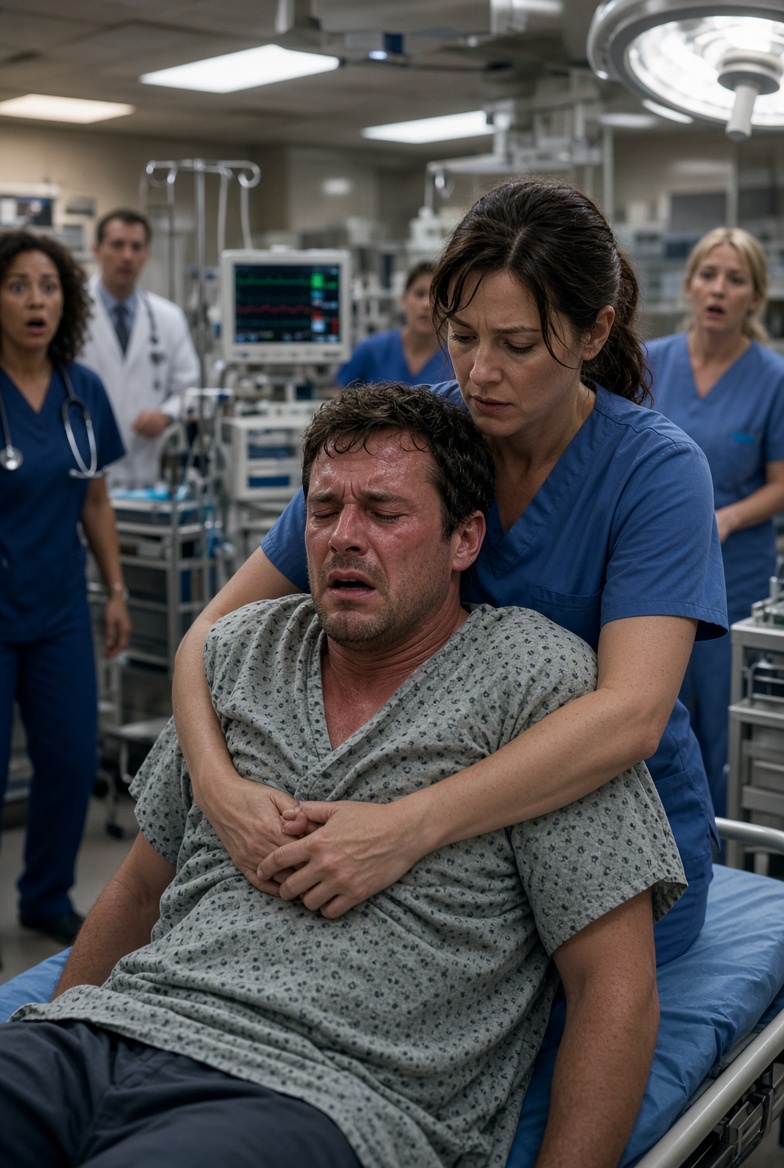
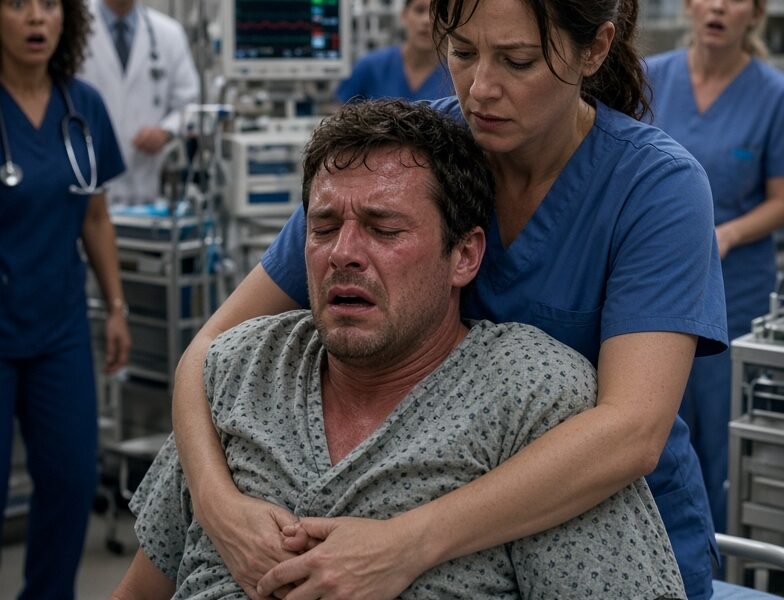
His body lurched forward against her arms, and something small came clear of his throat.
His chest expanded in one sudden, violent pull of air, and color rushed back into his face in real time, the gray-blue retreating from his lips like a tide pulling back from shore.
His eyes opened, unfocused at first, then sharpening, landing on the ceiling, then moving to the small woman still braced behind him with her arms wrapped around his rib cage.
The room went quiet in an entirely different way.
Dr. Prentice stood near the nurses’ station with a chart open in his hands, his mouth slightly parted, not yet having found the words that fit the last fifteen seconds.
Joanna straightened, stepped back, and reached for the call button.
Her voice was clipped and steady as she relayed instructions to the nearest tech, like she’d done it ten thousand times before, because in a different life, she had done something very much like it ten thousand times before.
Her hands, moments earlier locked around a dying man’s ribs, were perfectly still.
Nobody in that corridor said a word for several seconds.
Prentice found his voice eventually, and it came out thinner than usual, stripped of its easy authority.
“You should have called for assistance first.”
“There wasn’t time,” Joanna said. “He’s breathing now. Let’s make sure it holds.”
She turned back to her patient and did not wait for a response.
The man in bed seven, whose name according to a transfer sheet nobody in the department had been cleared to fully read was Sergeant Cole Rafferty, though the team around him called him something else entirely, lay watching the ceiling with the particular focus of someone remapping their current situation from scratch.
After a moment, he turned his head toward her, and his voice came out rough and faint, not yet reliable.
“You moved like you’ve done that before.”
“Everyone on this floor has,” Joanna said, pulling her stethoscope from around her neck. “Let’s check your lungs.”
He studied her with eyes that were sharper than his color would have suggested possible two minutes ago.
He was cataloging her, she could feel it, the same way she had cataloged him when he first rolled in.
Operator instinct, and it ran both directions.
“Everyone on this floor,” he repeated slowly, “but not like that.”
She pressed the stethoscope to his chest and did not answer.
Within forty-five minutes, word of what happened in bed seven had moved through the department the way things always moved in hospitals.
Quietly, quickly, distorted slightly in each new version, gaining detail it hadn’t originally contained.
By the time the charge nurse heard it, it had already been told twice, and by the time it reached the administrative floor, the timing had compressed from two minutes to thirty seconds, which was not accurate, but was somehow also not inaccurate in the way that actually mattered.
A younger nurse named Celeste, three years out of school, the kind of earnest that hadn’t yet been worn smooth by enough difficult shifts, found Joanna near the end of the corridor, refilling the same supply tray she had been refilling when everything happened.
“That was you,” Celeste said, half question and half statement. “The man in seven. That was you.”
“Standard intervention,” Joanna said. “The training covers it.”
“I’ve done the training,” Celeste said. “On the mannequin in the skills lab. I’ve never seen anyone do it like that for real. You didn’t even look at the room. You just moved.”
Joanna folded a stack of gauze packets into the tray.
“You learn to move faster than you think,” she said. “That’s all it was.”
Celeste didn’t look entirely satisfied with that answer, but she let it go, the way most people at Pemberton would eventually let things go about the nurse with the low shoulders and the quiet voice, choosing the easier comfort of incuriosity over the unsettling work of revising an assumption they had been living comfortably inside for over a year.
Prentice, by contrast, was unusually subdued for the remainder of the afternoon.
He signed off on charts without his customary running commentary, and he took a different route between the nurses’ station and the supply room, one that avoided the stretch of hallway where he had stood frozen, chart in hand, while a nurse he had dismissed as a liability saved a man’s life in front of him.
It was not guilt, precisely, because guilt required a willingness to accept fault, and Prentice had not arrived at that threshold with himself.
It was something closer to the disorienting sensation of a hierarchy that had always held his weight suddenly refusing to support him, the way ice sounds before it gives.
Joanna had almost convinced herself the incident might simply dissolve into department gossip by the end of the week, the kind of story that gets exaggerated at the nurses’ station for a few days before the next crisis washes it aside.
She came close to believing that clocking out and walking to her car in the March cold would mark the end of it.
She was wrong, and some watchful part of her, the part that had never fully stopped scanning rooms for exits and sight lines even fourteen months into civilian life, already suspected as much.
The two men who arrived at Pemberton’s ambulance bay just after five moved the way men who were not hospital visitors moved.
Unhurried and precise, eyes sweeping the room on entry, bodies angled to keep the most distance from the largest wall.
“Federal identification,” the charge nurse would later report to administration, though she could not remember exactly what agency the credentials had identified.
The taller one asked for the nurse assigned to the federal patient in Bay 7, using not Joanna’s name but her badge number, a detail that put every trained instinct she owned on alert before he had finished the sentence.
His name was Warrant Officer Von Decker, though he introduced himself only as Decker, and the man behind him didn’t offer a name at all.
Decker had the jaw of someone who spent considerable time outdoors in weather that didn’t cooperate, and eyes that registered everything in a room before he had said a single word.
“Walk me through what happened at 14:37,” he said to Joanna, not unkindly, but with the particular directness of someone who had no interest in the social buffer of small talk.
“Complete airway obstruction,” she said. “Abdominal thrusts, three applications, obstruction cleared. He is stable.”
Decker studied her the way operators studied things, directly, without pretending not to.
“That’s the what,” he said. “I’m asking about the how. The speed you moved, the position of your hands on the first approach, the way you controlled your breathing through three thrusts on a man forty pounds heavier than you. That’s not something nursing school produces.”
Joanna kept her eyes on the chart in her hands. “Some people are quick under pressure.”
“Some people are trained to be quick under pressure,” Decker said. “There is a measurable difference. I’ve spent twelve years learning to tell them apart.”
Her pen moved across the chart without pausing, and she did not look up.
“You’ve got a nursing degree from Lakehead,” Decker continued, his voice quieter now. “Two years at a regional hospital in Thunder Bay before transferring here fourteen months ago. Clean file, no commendations, no flags. For someone who moves the way you just moved, that file is remarkably quiet in all the wrong places.”
Joanna finally looked up.
She met his eyes for the first time, and something old and careful passed through hers before it was replaced by the calm exhaustion of a nurse eight hours into a shift.
“I need to finish this charting,” she said. “Is he being transferred?”
Decker looked at her for a long moment.
“Tomorrow morning,” he said. “Before he goes, he asked specifically to see the nurse who noticed what nobody else noticed.”
“I’m sure the rest of the floor noticed,” Joanna said.
“No,” Decker said. “Just you. In a room full of trained medical professionals, monitors running, not one person looked at that bed for forty-five seconds. You heard a silence that none of those machines caught. That is not instinct, that is conditioning. And I intend to understand where that conditioning came from, one way or another.”
He left her with that, which was the precise kind of exit that left no door open except the one he wanted her to walk through eventually.
By the following morning, the department had reorganized itself around what happened in bed seven, the way water reorganizes around an obstacle, smoothly, quietly, with no official acknowledgement that anything was different, and yet everything slightly rerouted.
A tech who normally looked through Joanna held a door open, and a resident who had laughed along with Prentice’s remarks about her last month was now finding reasons to work on the far side of the floor.
Nobody said anything directly, and everything changed anyway.
Prentice found her in the medication room before the morning briefing.
He closed the door behind him with slightly more force than necessary, and Joanna recognized the shape of what was coming before he said a word.
“What you did yesterday was not within your designated scope of practice in this facility,” he said, his voice carrying the careful precision of a man who had rehearsed the sentence. “Intervention on a federal patient without a physician present is a protocol violation. I could have this reviewed.”
Joanna did not stop counting the medication trays in front of her.
“He wasn’t breathing,” she said. “There was no time to locate a physician.”
“There is always time to follow protocol,” Prentice said, sharpening slightly. “What you did was reckless. It was presumptuous. And it puts this department in a difficult position with the federal liaison team.”
She set down the tray she was holding and turned to face him fully.
Her expression was the same quiet, unremarkable calm she had been wearing for fourteen months, but something behind it had shifted, something that Prentice, who was good at reading rooms, registered without quite being able to name.
“He is alive,” she said simply. “That was the job.”
Prentice opened his mouth to respond.
The door opened first.
Decker stood in the frame, arms loose at his sides, eyes moving from Prentice to Joanna and back with the unhurried patience of a man who had walked into considerably more difficult rooms.
“Doctor,” he said, his tone pleasant in the specific way that made pleasant sound like a warning. “I’d think carefully about the position you want on record here. Because the position my team has on record is that your department’s protocol did not save that man’s life yesterday. She did. And I’d recommend letting the two of those things coexist without making them a conflict.”
Prentice’s jaw tightened.
He looked at the federal identification on Decker’s belt, made the calculation that men like him always made when genuine authority entered the room, straightened his coat, and left without waiting for anything further.
Decker waited until the door clicked.
“You still haven’t answered my question,” he said.
“I answered it,” Joanna said.
“You didn’t accept my answer.”
“No,” Decker agreed. “I didn’t. Because your answer was incomplete, and both of us know it.”
He studied her for a long moment, the way he’d studied the room when he first arrived, cataloging, measuring, deciding.
“Cole asked to see you before transfer,” he said finally. “He used a specific phrase when he described you. He said you moved like someone who knew exactly how much silence was worth. I haven’t heard that phrase from anyone in seven years, not since a debrief I’m not cleared to fully discuss. And the person who used it then doesn’t work anywhere near this hospital.”
He left it there, clean, no pressure attached, just the weight of a thing said aloud that could not be unsaid.
Joanna stood alone in the medication room for a long time after he was gone, a paper tray in her hands, going nowhere.
Cole Rafferty was sitting upright when she found him forty minutes later, arguing mildly with the cardiac tech about whether the oxygen clip was medically necessary at this point or just protocol for protocol’s sake.
He had the specific dry humor of someone who had survived enough genuinely bad situations to refuse to treat a Tuesday afternoon in a Winnipeg hospital as anything more than a minor administrative inconvenience.
He went quiet when Joanna came in.
“My team is going to want to talk to you,” he said, not a question.
“They already have,” she said, reaching for her stethoscope.
“Not like that.” He watched her check his lungs with that same measuring focus she had clocked the moment he arrived. “There are about four people alive who moved the way you moved yesterday. Two of them are still active. One of them retired to Nova Scotia and coaches junior hockey. I don’t know who the fourth one is.”
Joanna pressed the stethoscope to his back and said nothing.
“I’m not going to push,” Cole said. “Whatever you left behind to be here, that’s yours. I just want you to know that when I came around, the first thing I could see clearly was a woman in blue scrubs standing over me like she’d already decided I wasn’t going anywhere. That wasn’t nothing. For what it’s worth.”
Joanna lowered the stethoscope.
She met his eyes for a moment, directly and without deflection, the first time she had done that with anyone at Pemberton in fourteen months.
Something in the quiet between them settled into a shape that required no further explanation.
“Your lungs sound clear,” she said. “The transfer team arrives at six.”
He nodded once, the kind of nod that carried the weight of a whole conversation neither of them had spoken out loud.
She was almost at the door when he said quietly, “Birch.”
She stopped, her hand still on the frame.
“Decker said the name,” Cole said. “Not to me. He didn’t know I could hear him from the corridor. But I’ve run with people who knew that name and what it meant in the rooms where it mattered.”
Joanna did not turn around.
She stood very still for one measured breath.
“Get some rest before the transfer,” she said. “You need it.”
And she walked out before the moment could become anything larger than what it already was.
The incident report that administration filed three days later described the event in bed seven as a timely and appropriate nursing intervention following rapid clinical assessment.
It mentioned no names beyond badge numbers, and it made no reference to federal patients or federal liaisons or the two men who had arrived in the ambulance bay and spent the following forty-eight hours asking questions.
Nobody on the floor had been officially told, and nobody asked.
Joanna read the report, signed off on it, and put it in the folder with everything else she was not expected to fully discuss, which was a folder that had been getting heavier for fourteen months.
What the report did not capture was Dr. Prentice, who showed up outside the break room two days after the incident and waited there with the particular discomfort of someone who had rehearsed an apology enough times to know they still weren’t ready to deliver it.
“I said things to you last week that I shouldn’t have,” he said when she came out with her coffee. “And for the past fourteen months, to be honest.”
Joanna looked at him.
He was not meeting her eyes, which was a reversal significant enough that she noticed it immediately.
“The things I said didn’t become wrong because of what you did in that room,” she said carefully. “They were already wrong. What I did in that room just made them harder to ignore.”
Prentice absorbed that, jaw working slightly in the way of a man chewing on something that tasted worse than he expected.
“Fair,” he said finally.
It came out without decoration, without the verbal buffer he usually placed between himself and accountability.
Just the word.
Joanna respected that.
“If you want to do something with it,” she said, “talk to Celeste the same way you talked to her on Thursday, and every other nurse on this floor you’ve spoken to like that. That’s where it actually matters.”
He didn’t answer, but he didn’t deflect either.
He simply nodded once and walked away, and Joanna filed that as the best possible outcome from a conversation she hadn’t expected to have at all.
Decker returned on the fourth day with the quieter of the two men and a third person she hadn’t seen before, a woman in civilian clothes who moved through the hospital with the particular ease of someone who had spent a great deal of time moving through buildings that were not meant to be comfortable.
She introduced herself only as Deputy Director Croft, and the way she said it communicated clearly that the title was real, the name was sufficient, and nothing further would be offered.
They talked in the same conference room where administration had debriefed her about the incident report, and Joanna sat across from all three of them and felt the old familiar shape of a briefing room settle around her like a coat she had not worn in years.
“Your discharge classification gives us limited access to the full record,” Croft said, opening a folder she clearly had no intention of sharing across the table. “What we do have tells us you led a joint special operations medical unit that operated under classified task force parameters for four years. Your team’s call sign is still redacted from most accessible records. Yours specifically appears in three separate operational summaries under a name that is not the one on your nursing badge.”
Joanna said nothing.
“Cole identified you,” Croft continued, “not intentionally. He used a phrase in his transfer debrief that cross-referenced against a flag in our system. It was not his fault, and it is not a security breach. It simply means that someone at this hospital has a background that intersects with an active investigation in a way that warrants a direct conversation.”
“I left that life,” Joanna said, “officially, completely, and permanently. That is documented.”
“It is,” Decker agreed. “This isn’t a recall. This is a conversation.”
Croft leaned forward slightly.
“The investigation connected to Cole’s transport flagged something in the forty-eight hours before his arrival here. His movement manifest was altered in the federal system during a specific window that corresponds to a known surveillance pattern from a private intelligence contractor we’ve been tracking for eight months. Someone knew he was coming here, and the same contractor has an interest in the operational intelligence Cole is carrying.”
Joanna sat very still.
“You’re saying it wasn’t accidental.”
“The throat obstruction was likely induced,” Decker said. “A substance on the wrapper of something in his transfer kit that would cause mild mucosal swelling on its own, minor enough to go unnoticed on a standard intake assessment, but sufficient to create a vulnerability in an airway already compromised by recent field injuries. It required someone who understood his medical profile and had access to his transfer documentation.”
“Someone wanted him vulnerable,” Joanna said.
“Someone wanted him dead,” Croft said. “In a building full of people trained to save lives, with enough chaos to provide cover, and a specific nurse assigned to his bay who our records suggested would not notice quickly enough to matter.”
The room went quiet.
“They pulled my file,” Joanna said.
“They pulled your file,” Decker confirmed. “And based on what was available in the public clinical record, they determined your bay was the lowest-risk location in the building. No commendations, no standout performance flags, a profile that read as unremarkable.”
“They were working from the version of me I built to be invisible,” Joanna said, and something in her voice was flat and clean and entirely without self-pity. “That’s almost funny.”
“It is somewhat,” Croft allowed. “It is also why Cole is alive.”
Prentice attended the emergency security briefing that administration called the following morning with the expression of a man trying to quietly revise his entire understanding of a person he had spent fourteen months underestimating.
He sat near the back and did not speak, which was unusual enough that the charge nurse leaned over to Celeste halfway through and raised her eyebrows.
Celeste, who had been watching Prentice try to fold himself smaller in a room for the first time in her memory, simply shook her head once and looked back at the front of the room.
Joanna stood near the whiteboard with the hospital’s security coordinator and two members of Decker’s team, delivering a protocol briefing on emergency lockdown procedures with the same quiet efficiency she brought to restocking supply carts and updating patient charts.
Except that the information she was delivering was not something any of them could have sourced from a standard training module, and the way she delivered it, clipped, precise, moving through the material with no wasted motion, belonged to someone who had briefed rooms far less forgiving than a Winnipeg hospital conference room on a Wednesday morning.
After the meeting, Celeste waited outside the door.
“Did you know,” she asked when Joanna came out, “that it wasn’t an accident? When you moved on him, did you know?”
Joanna considered the question honestly.
“I knew he wasn’t breathing,” she said. “I knew no one else was watching. I knew what would happen if I waited for someone with more seniority to notice and decide what to do about it.”
Celeste nodded slowly.
“But how did you notice when no one else did?”
Joanna looked at her for a moment.
“Silence,” she said. “You learn to listen for it instead of past it. Most emergencies announce themselves. The ones that don’t, those are the ones that actually kill people.”
Celeste wrote that down in the small notebook she carried everywhere, the one she had already half filled with things that hadn’t been covered in any of her training.
The contractor’s operatives arrived on the sixth day, which was two days later than Croft’s team had estimated and three days later than Joanna had quietly prepared for.
She had spent the intervening days working her regular shifts and reviewing the hospital’s emergency response documentation at home in the evenings, identifying three procedural gaps that she had written up anonymously and submitted to the security coordinator four months earlier under a concern number that had been logged and not acted upon.
She pulled those notes back out on the fourth evening and made some additions.
When the two men in technician uniforms came through the surface entrance on Thursday morning, Joanna was at the nurse’s station and clocked the earpiece on the taller one within four seconds of their entry.
The specific make, the specific ear, the specific way a person moves when one side of their hearing is occupied by something nobody else in the room can hear.
She reached for her radio before she had consciously decided to, keyed a sequence that should not have existed in a civilian nursing credential, and said three short words that sealed wing B.
The department locked down in a controlled cascade, doors clicking along the corridor in sequence, and a voice came over the hospital intercom that was steady and precise and entirely without panic, directing ambulatory patients to interior rooms, directing staff away from the corridor wall, directing a frightened second-year resident who had frozen in the open hallway to get into the nearest room, lock the door, and stay low.
Decker’s team converged from the parking structure and the service corridor simultaneously, but the man heading for the records room, Cole’s transport documentation still improperly retained in a cabinet that the security coordinator had not yet moved to a secure storage floor because the action item from Joanna’s four-month-old anonymous concern report had still not been completed, found the cabinet in a different location than his intelligence had indicated.
Because it had been quietly moved the previous evening by a night-shift nurse who had stayed forty minutes late and said nothing about it to anyone.
He was standing in the empty records room holding a folder that contained nothing relevant when Decker’s team came through the door.
The second operative had better situational awareness and a cleaner exit route, moving toward the ambulance bay with the confidence of someone who had mapped the building from the outside and knew where the blind spots were.
What he did not know was that the blind spots had been quietly adjusted over the preceding twelve hours, and what he walked into instead was a corridor that ended sooner than his map suggested, with no exit he had accounted for, and a woman in blue scrubs standing at the far end of it in a stance that had nothing to do with nursing.
He hesitated for half a second.
She had already closed half the distance before he finished hesitating.
The encounter lasted approximately eight seconds, and it ended with his back against the wall, his arms secured behind him in a grip that used his own forward momentum rather than her strength, and the specific controlled pressure of someone who knew exactly how much was necessary and applied no more than that.
He was on his knees and disarmed by the time Decker’s second agent reached the corridor entrance, and the expression on his face suggested that his briefing about the nurse in Bay 7 had contained significant gaps.
“How long until this is officially contained?” Joanna asked Decker afterward, standing in the radiology corridor with her back to the wall and her breathing as steady as if she had just finished a supply run.
“Forty-eight hours for our end,” he said. “Your end is already done.”
“My end of what?”
Decker looked at her.
“Of whatever you’ve been quietly doing to this hospital security infrastructure for the past six months,” he said. “The amended blind spots, the resequenced lockdown protocol, the moved cabinet, the override code and the nursing credential that doesn’t correspond to any IT access level this hospital has on record. You’ve been preparing for a scenario exactly like this one since before anyone else in this building knew a scenario like this one existed.”
Joanna folded her arms and looked at the wall.
“The hospital’s emergency documentation had gaps,” she said. “I flagged them anonymously. Nobody acted on the report, so I did what I could do without being asked about it.”
“You fixed the building,” Decker said.
“I did what I was trained to do,” she said, “in the only way available to me with the identity I currently have.”
Decker was quiet for a moment.
“There’s a formal process available,” he said eventually, “for people in your classification, if you ever wanted to.”
“I know,” she said. “I don’t.”
He accepted that without argument, because he had known enough people in her situation to recognize when the decision had been made so thoroughly that no amount of structural encouragement would move it.
“One more thing,” he said. “Cole asked me to pass something along when I saw you next.”
He reached into his jacket and produced a small folded paper, the kind you tore from a notepad in a hospital room.
“He said he couldn’t say it in the moment and it was bothering him.”
She took it, opened it, and read it standing in the radiology corridor with Decker pretending to examine something on the opposite wall.
The note said, “I’ve been pulled out of three situations I should not have survived. Each time, the person who noticed in time was someone the room had already written off. I don’t know what you left behind to be here, but I’m glad the version of you that showed up that afternoon was the one they forgot to worry about.”
She folded it back up and put it in her pocket.
She did not speak for a moment.
“Tell him I said the feeling runs both ways,” she said, her voice even, her hands steady, and something behind her eyes that was neither the guarded exhaustion she had been wearing for fourteen months nor the total erasure of everything she had been before that, but some third thing, quieter than either, that she did not yet have a name for, but was already learning to carry without flinching.
The weeks after were ordinary in all the ways she had originally hoped ordinary would feel.
The department settled, Prentice began arriving ten minutes earlier and leaving less noise in his wake, and Celeste mentioned once, quietly, as if afraid to jinx it, that he had corrected her IV documentation in private rather than at the nursing station.
Small, real, the kind of change that holds.
Hospital administration quietly implemented a revised emergency response protocol, co-developed with a federal liaison team, and a nurse whose full background remained classified, but whose competence was now part of the institutional record in every way that mattered.
Decker came by once more, on a Tuesday evening as she was finishing a shift, to confirm the contractor case had been formally handed to the relevant federal authority and that Cole’s transfer had completed without further incident.
He stayed long enough for one cup of bad coffee from the break room machine, and told her before he left that there was a name in three separate classified operational summaries that would never be declassified in her lifetime, but that the people who had worked alongside it would remember it exactly the same way whether it appeared in a document or not.
“That’s enough,” she said, and meant it.
On a Saturday morning in April, she drove to a small community center in St. James and stood at the front of a room that held nineteen people.
Parents, a retired postal worker, two teachers, a teenage boy who had come with his mother and spent the first ten minutes looking at his phone.
She had arranged the session herself on her own time through the community health outreach program she had quietly joined three months into her transfer to Pemberton.
She stood at the front of that room in civilian clothes, not scrubs, and she began the same way she began everything now, without preamble, without ceremony, with only the thing that actually mattered.
“The emergency I am going to teach you to respond to today does not make noise,” she said. “That’s the part most people don’t know. That’s the part that costs lives before anyone in the room understands what’s happening.”
She walked them through it the way she walked through everything, with the patience of someone who understood exactly what the distance was between not knowing and knowing, and exactly how small that distance actually was.
The signs, the position, the commitment of the motion, the willingness to act without waiting for someone else in the room to give you permission, because in the moments that actually counted, permission was a luxury the silence could not afford.
The teenager put his phone away after the first demonstration.
At the end, a woman in the back row raised her hand.
“How do you know when to move before you’re sure?”
Joanna looked at her for a moment.
“You learn to trust what you notice,” she said, “not what the room is telling you to notice. What you actually notice before you’ve talked yourself out of it. That’s the whole skill. The rest is just mechanics.”
She drove home in the April light with the windows down, the cold off the river cutting through the car, and for the first time in a very long time, she did not feel the need to be smaller than the road she was driving on.
There were more sessions after that, more rooms, more people who left knowing something they hadn’t known when they walked in.
Something portable, something theirs, something that asked nothing of them except the willingness to look up when everyone else was looking away, and to trust what they saw when they did.
Celeste came to the third session and sat in the front row with her notebook and did not write anything down, because this time she didn’t need to.
She just listened.
Joanna taught the mechanics slowly, clearly, the way she had learned to teach everything in two different lives.
And when she finished, she looked out at the room full of ordinary people who now carried something with them that they hadn’t carried in the morning, and she allowed herself something she had not allowed herself in a very long time.
She let it be enough.
Because that was the whole thing in the end.
Not the call sign, not the classified file, not the debriefs in rooms with no windows, or the years she had spent trying to fold herself into a shape small enough to disappear inside a Winnipeg hospital.
It was this.
A room of people who could now hear silence differently than they had heard it the day before, who knew what to do when everyone else was looking away.
That was worth the weight of everything she had ever carried to get here, and she had already decided, quietly and completely, that she was exactly where she was supposed to be.
The silence was the thing, and the thing was the silence, and the silence was a pocket of wrong quiet inside a room full of all the right noise that only one person in fourteen months had ever been trained to hear.
The silence was the thing.
The silence is always the thing.









