The Egyptian (1954) – 20 Hidden Facts Nobody Knows
It was the 1954 20th Century Fox epic that lost its star days before shooting. It saw that star sued for $2 million. And it still ended up selling props to Cecil B. DeMille.
It was also a film built on a finished bestseller about an Egypt its author never once visited. Every claim here comes from the record.
Michael Curtiz directed. Darryl F. Zanuck produced. Shot in CinemaScope, it starred Jean Simmons, Victor Mature, Gene Tierney, Peter Ustinov, and a last-minute replacement for Marlon Brando. The budget came to a little under $4 million, and at the box office the picture disappointed.
The story starts with the making of the film: the actor who walked out, the actors who stepped in, the writers, the director, the composers, and the research department that rebuilt the ancient world. Then it turns to the novel and the astonishing speed at which it was written. Then to the real history of Akhenaten and Horemheb, which the film bent considerably. It ends with the aftermath, including a sequel that never got made.
Along the way there is a prince, a pharaoh, a Finnish novelist who claimed his hero dictated the book to him, and a composer who liked to say that eagles fly alone. But first, the moment the production nearly collapsed.
Brando walked out, and Fox sued for $2 million. Marlon Brando was supposed to be Sinuhe. Zanuck bought the rights in 1952 with Brando set for the lead and Casey Robinson set to write. Then, in early 1954, only days before shooting, Brando quit.
Philip Dunne, who had come aboard as a writer, later recalled how it happened. Brando read the part very well at a script reading, but Curtiz raised doubts about casting him, and Dunne went home to write Curtiz a memo. Before it could be delivered, word came that Brando was gone.
Brando’s own explanation was mental strain, and his psychiatrist backed him. The American Film Institute catalog adds that modern sources say he disliked the script and the casting of Bella Darvi, a Zanuck protégé.
Fox refused to take it quietly. Location filming in Egypt had already begun, so the studio sued for $2 million for breach of contract. Hedda Hopper reported it in the Los Angeles Times on February 5, 1954, and the New York Times carried it on February 17.
The suit ended when Brando agreed to play Napoleon in Désirée, another Fox picture, with Jean Simmons as its heroine. She was one of the stars of The Egyptian. So the actor who walked away spent mid-June to mid-August of 1954 working for the same studio, opposite a member of this cast, in exchange for Fox dropping its claim.
Then came the final irony. On March 30, 1955, On the Waterfront won Best Picture and Brando won an Oscar for it. The Egyptian lost its only nomination the same night.
The replacement was borrowed for $300,000. Edmund Purdom, a British actor under contract to MGM, took Brando’s place. MGM lent him to Fox for $300,000, while Purdom himself earned $500 a week, according to Hopper’s column at the time.
His road to Hollywood had been unlikely. Born in Welwyn Garden City in 1926, he was educated by Jesuits and then Benedictines before acting in repertory theater, where Laurence Olivier spotted him and offered a chance to tour America. By his own account he was so broke he could not afford his daughter’s doctor’s bill.
A twist of fate made him available. When MGM fired Mario Lanza from The Student Prince, Purdom was tested, won the part, and lip-synced to Lanza’s recorded voice. Hopper called him the most surprising and notable figure in Hollywood that year. Dore Schary later said Lanza’s recordings were the prime ingredient in the film’s success, and that the success went to Purdom’s head.
Purdom was far from Fox’s first idea. The studio looked at Dirk Bogarde, who would have been borrowed from J. Arthur Rank, and Hopper floated John Cassavetes. Cameron Mitchell and John Derek were screen tested. Farley Granger turned it down. The AFI catalog adds Montgomery Clift, Richard Conte, and Rock Hudson to the names reportedly considered.
It was no launch pad. The Egyptian disappointed, and his next three MGM pictures, Athena, The Prodigal, and The King’s Thief, flopped. A Broadway play, Child of Fortune, closed after 23 performances. A British television series, Sort of Freedom, followed in 1958.
Purdom asked MGM for a release and got it. He settled in Italy, worked there for the rest of his life, and even directed a film of his own in 1984.
The actress whose name was built from two first names. Bella Darvi was born Bajla Wegier in Sosnowiec, Poland, in 1928, and her family moved to France when she was one. War shaped her early years. During the German occupation the Vichy government jailed her along with her brother Robert, who later died in a concentration camp. Her mother secured her release in 1943.
In 1952 she moved in with Darryl and Virginia Zanuck in Los Angeles, after meeting them on the French Riviera. Her screen name, Darvi, combined their two first names. She signed a long-term Fox contract in February 1953, and that December she was cast as Nefer, the Babylonian courtesan, ahead of Ava Gardner.
Zanuck’s devotion was plain to see. Dunne recalled that he was so besotted he went to the film stills department just to see her in costume, though he had run the studio for 25 years. Biographical accounts describe her as his mistress.
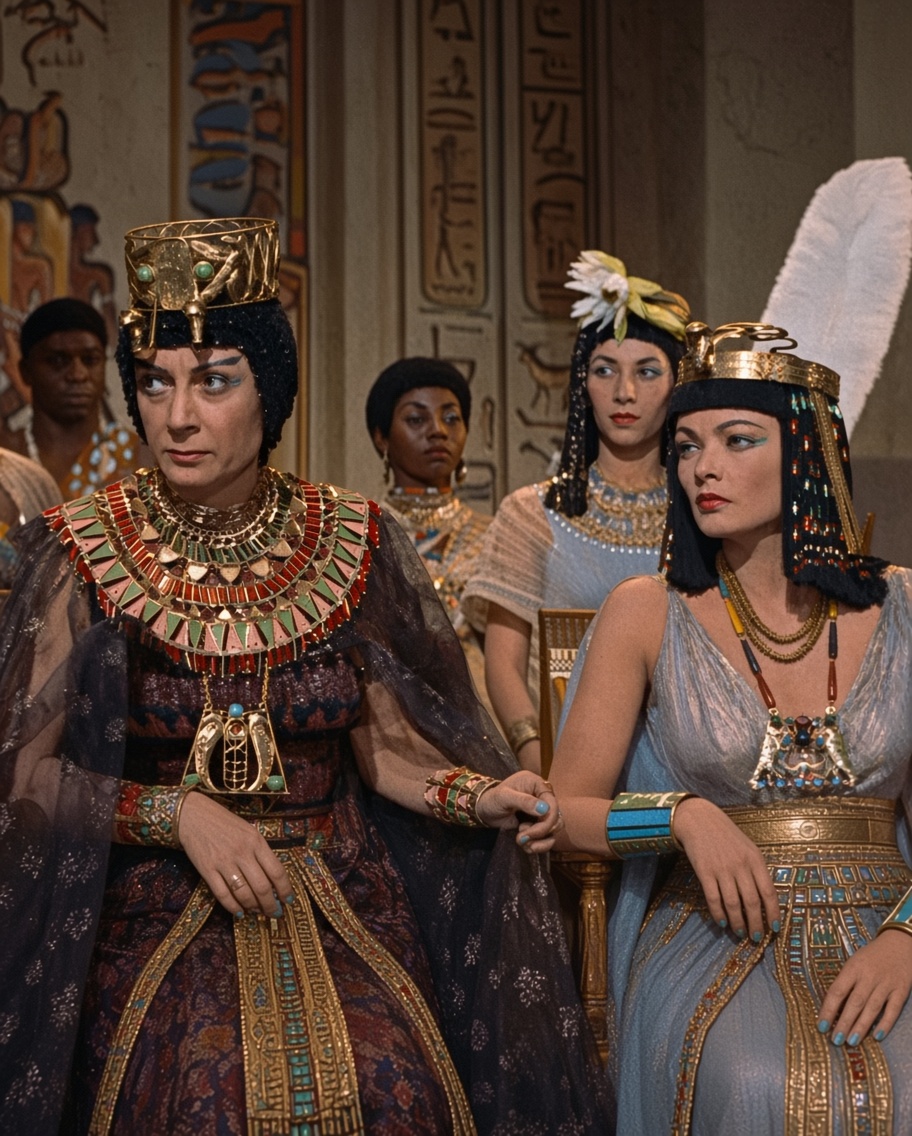
Her Hollywood career was short. She starred opposite Richard Widmark in Sam Fuller’s Hell and High Water and left for Paris in November 1954. Film historian Ephraim Katz later called her three Hollywood films disappointing and her French and Italian work undistinguished.
Her later life was painful. She reportedly lost a thousand dollars in two minutes at a casino in 1956, then $65,000 in two days. Zanuck was still paying her debts as late as 1970. She died in Monte Carlo in September 1971, aged 42.
The casting list kept changing. In November 1953 the Los Angeles Times reported that Victor Mature, Jean Peters, and Kirk Douglas had been announced, and the AFI catalog says late-1953 news items had Douglas first cast as Pharaoh Akhenaten. By January 1954, Peters was out and Jean Simmons was in.
Gene Tierney was once considered for Merit before she ended up as Princess Baketamon. Merit went to Simmons. The Pharaoh went to Michael Wilding, borrowed from MGM and married at the time to Elizabeth Taylor.
Wilding had been a British star, ranked second among box office names by exhibitors there in 1949. He married Taylor in February 1952, and they divorced in January 1957. Hitchcock had earlier cast him in Under Capricorn, one of the director’s few flops, and in the more popular Stage Fright.
There was a reason so many nobles were British. Dunne said Zanuck believed all kings, emperors, and nobility should be played by English actors. Dunne’s own choice for Nefertiti was Dana Wynter, and he wanted Cassavetes as the Pharaoh. Zanuck refused the second request.
Dunne’s verdict was telling. He said Casey Robinson wrote a pretty good script and that casting is what ultimately did it in. That is a striking admission from the man who acted as unofficial producer.
Jean Simmons arrived with a history of her own. Her contract had been sold to Howard Hughes in 1951, and a court case freed her in 1952. Under the settlement she would make three more films under RKO’s auspices, one of them for Fox, while RKO received the services of Victor Mature for one film.
Two writers with unusual backgrounds. Casey Robinson was born in Logan, Utah, in 1903 and graduated from Cornell at 19. He wrote many of Bette Davis’s films, including Dark Victory and Now, Voyager. Critic Richard Corliss called him a master of adaptation. A Washington Post report credits him with three weeks of uncredited rewrites on Casablanca. His Egyptian script was finished in March 1953.
Philip Dunne joined in October 1953, having just signed a new three-year Fox contract. His father was Chicago humorist Finley Peter Dunne. His mother, Margaret Ives Abbott, was the first American woman to win an Olympic medal.
Dunne started at Fox as a reader earning $35 a week. He was fired in a 1931 cost-cutting move, returned in 1937, and stayed about 25 years. In 1947 he helped found the Committee for the First Amendment with John Huston and William Wyler, protesting the House Un-American Activities Committee hearings.
He had also written The Robe, the first CinemaScope picture, which he called a chore done as a favor to Zanuck. On The Egyptian, he described his role as that of an unofficial producer.
Both men shared screenplay credit. Robinson married the ballerina Tamara Toumanova, eventually moved to Sydney, and died in 1979. Dunne went on to direct ten films and died in Melbourne in June 1992, a week after the Writers Guild gave him a lifetime achievement award.
The director had a famous past and a John Wayne future. Michael Curtiz was born Manó Kaminer in Budapest in 1886. He directed Hungary’s first feature in 1912 and made 64 films in Europe before Warner Brothers brought him to Hollywood in 1926. A further 102 followed there, and he won the Best Director Oscar for Casablanca.
He spent 28 years at Warner and became an American citizen in 1933. Jack Warner called him the studio’s greatest director. Actress Fay Wray said she felt he was not flesh and bones but part of the steel of the camera.
His English was another matter. David Thomson wrote that it was always a joke on the set, yet his dialogue was wonderfully directed. Curtiz himself said the chief work of directing was preparing a story for the screen. For Angels with Dirty Faces, he spent a week in jail.
Zanuck borrowed him from Paramount, according to trade reports of the time. Curtiz had broken with Warner and begun freelancing in 1954, the year he made both The Egyptian and White Christmas, the highest-grossing film of that year.
He was absent for two days of the shoot. According to the AFI catalog, Richard Talmadge directed the battle scenes in his place. Talmadge was born Sylvester Metz in Munich and began as a stuntman alongside Douglas Fairbanks.
Curtiz’s last film was The Comancheros, released in 1961. On the days he was too ill to work, John Wayne stepped in to direct. Curtiz died the following April, aged 75.
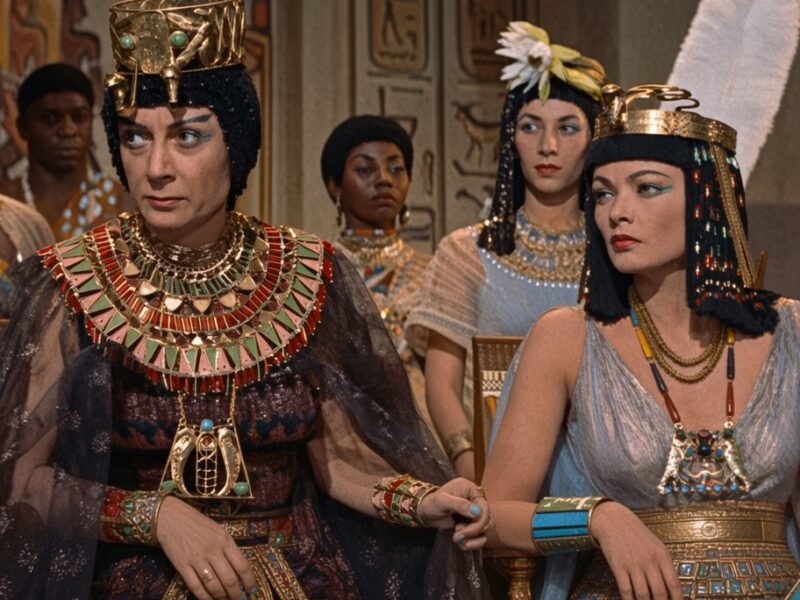
Sixty-seven sets and a technical advisor. The Egyptian was sold on authenticity. According to the AFI catalog, Fox’s researchers consulted more than 260 historical volumes, 20 museums loaned items for copying, and technical advisor Elizabeth Reifstahl authenticated 67 sets. Research credits went to Frances Richardson and Gertrude Kingston. The catalog also records thousands of props, costumes, and pieces of jewelry.
A Film Forum program note adds more than 5,000 extras and over a million objects, which Fox’s research department certified as authentic. Those are studio claims, so the totals deserve care.
A more specific number comes from set decorator Walter Scott, who said his department made 5,000 different items. Charles LeMaire designed the costumes. Lyle Wheeler and George W. Davis were the art directors.
Critic Dennis Schwartz gave the film a mediocre grade, yet wrote that it delivers the goods on spectacle and praised the recreated sets.
DeMille wanted the props, not the cast. Fox was not the only studio building ancient Egypt in 1954. DeMille was preparing The Ten Commandments, and his crew bought props from The Egyptian, including the hounds and jackals game, according to a contemporary trade item cited on the Wikipedia page for his film. Walter Scott said four DeMille men had already come to see what they could use.
The actors got different treatment. DeMille was reluctant to cast anyone from the rival production. The exceptions were John Carradine, who played Aaron, and child actress Mimi Gibson.
DeMille sailed from New York on September 23, 1954, reached Cairo on October 6, and began filming eight days later. He called it the greatest production of his life, and he met Egypt’s Prime Minister Gamal Abdel Nasser, a fan of The Egyptian.
His Per-Ramesses set near Cairo covered 60 acres. Its pylon stood 107 feet high and cost more than $250,000. In November he had a heart attack after climbing it to watch a special-effects shot, then went back to work against medical advice.
When filming ended, the Egyptian government offered to turn the gates into a museum. DeMille refused and ordered them demolished, since otherwise other studios would have used the set.
The lion hunt was filmed in California. Very little of the film was shot in Egypt. The AFI catalog says only background footage and the prologue were filmed there, while the famous lion hunt was shot at Red Rock Canyon in California. Ray Kellogg directed the second unit, with Leo Tover handling photography.
James Steffen of Turner Classic Movies noted that Egyptian locations were used mainly for the prologue and some second-unit work. Howard Hawks, by contrast, shot much of Land of the Pharaohs at Giza and at quarries near Cairo and Aswan.
Bethany Latham, in the Historical Novels Review, suggests Fox made the picture partly to beat two rivals: MGM’s Valley of the Kings and Warner’s Land of the Pharaohs. Steffen puts The Egyptian only a few months ahead of Hawks. It was a close race.
Two great composers shared one score. With post-production time short, the score was split between Alfred Newman and Bernard Herrmann, two composers with very different styles. Reviewer Rob Barnett called Newman a priest of the swooning string choir.
Herrmann was known for resisting collaboration. His philosophy was that eagles fly alone and sparrows fly in flocks. In 1973 he said he had the final say or he did not do the music. One commentary on the recording noted he was notoriously reluctant to mix his work with anyone else’s, which makes the partnership unusual.
The two had history at Fox. Recalling the electronic instruments on The Day the Earth Stood Still, Herrmann remembered Newman saying all they needed was an electric hot water bottle, which Newman then supplied.
Reviewers of the modern recording credit the hymn to Aten and Valley of the Kings to Newman, and the Prelude, The Chariot Ride, and Dance Macabre to Herrmann. Barnett wrote that the music is complementary and the seams are not obvious.
The score had a long afterlife. Newman conducted a re-recording for Decca. John Morgan later boiled a score of about 100 minutes down to 71 for a reconstruction, which William Stromberg recorded with the Moscow Symphony Orchestra and Choir for Marco Polo in 1998. Film Score Monthly released the original film performance in 2001. Songs by Newman reported for the film never reached the final cut.
The film lost its Oscar to Three Coins in the Fountain. The Egyptian earned a single Academy Award nomination, for color cinematography, and it went to Leon Shamroy. According to a Film Forum program note, the picture was the first shot in an improved version of CinemaScope. Critic Foster Hirsch calls it the high point of first-wave Fox CinemaScope.
Shamroy was one of Fox’s great cameramen, with 18 Oscar nominations and four wins: The Black Swan, Wilson, Leave Her to Heaven, and Cleopatra. He had been nominated for The Robe the year before, and he stayed at Fox about 30 years. He was described as gruff, short-tempered, and a perfectionist.
His opinions were blunt. Of Marilyn Monroe’s screen test, he said she had something he had not seen since silent pictures. He later shot South Pacific in Todd-AO and The King and I in CinemaScope 55.
His rivals that year were Rear Window, Seven Brides for Seven Brothers, and The Silver Chalice. At the March 30, 1955 ceremony, the winner was Milton Krasner for Three Coins in the Fountain.
Not everyone loved the widescreen look. Jonathan Rosenbaum wrote that the film illustrates the limitations of most early CinemaScope features, and called Victor Mature a fixture of early scope pictures.
The cast’s second lives were stranger than the film. Tommy Rettig played Thoth, son of Merit. That same year he became Jeff Miller on television’s Lassie, chosen from about 500 boys. Earlier, his work with a dog in The 5,000 Fingers of Dr. T, a film written by Dr. Seuss, led trainer Rudd Weatherwax to suggest him. Later he worked as a database programmer at Ashton-Tate and wrote several books on the software. He died in 1996, aged 54.
Michael Ansara played a Hittite commander. Born in a Syrian village, he later played the Klingon Kang on Star Trek. He was a taskmaster in DeMille’s film, voiced Mr. Freeze in the Batman animated series, and married Barbara Eden after Fox arranged a publicity date between them.
Peter Ustinov played the one-eyed servant Kaptah. Born in London in 1921, he won two supporting actor Oscars, for Spartacus and Topkapi. He was knighted in 1990 and died in Switzerland in 2004, aged 82.
Victor Mature played Horemheb. He had served in the Coast Guard during the war, on the icebreaker Storis, and was promoted to chief boatswain’s mate after 14 months. In 1949, DeMille borrowed him from Fox for Samson and Delilah, which earned more than $12 million and was the most popular movie of the 1940s. Mature was frightened of the animals on set, which infuriated DeMille.
When a country club turned him down because he was an actor, he joked that he was not an actor and had 64 films to prove it.
Gene Tierney arrived with a prince in her life. Tierney had earned an Oscar nomination for Leave Her to Heaven, Fox’s most successful film of the 1940s. In 1953, while filming in Europe, she began a romance with Prince Aly Khan, and they became engaged while he was divorcing Rita Hayworth. His father, Aga Khan III, strongly opposed the match.
That same year she left Mogambo, and Grace Kelly replaced her. Tierney struggled for years with manic depression, and in 1955 she relapsed during The Left Hand of God, where Humphrey Bogart encouraged her to seek help.
The Egyptian sits in the middle of that period. She played Princess Baketamon, who reveals to Sinuhe that he is the half-brother of the Pharaoh. Tierney later became an outspoken critic of shock therapy, which she said destroyed large portions of her memory. She died in Houston in November 1991, aged 70.
The novel was written in about three and a half months. In April 1945, Mika Waltari sat down in the attic of his mother-in-law’s cottage in Hartola, Finland, and began writing Sinuhe the Egyptian. He finished in about three and a half months, on some days producing as many as 27 sheets. The manuscript ran to nearly 1,000 pages. When publisher WSOY received it in early August, the editor needed to cut very little.
His mother died during the writing. He attended the funeral and resumed work the next morning. Later he said the novel had been dictated to him by Sinuhe himself.
Waltari never went to Egypt. His interest began at 14 with the 1922 discovery of Tutankhamun’s tomb, and he wrote a play about Akhenaten in 1936. In 1938 he saw the bust of Nefertiti in Berlin, and said it transformed his image of her.
He said he feared a visit would ruin his mental image. He declined an invitation from President Nasser, saying Egypt no longer resembled the ancient one. As he once put it, he had lived in Egypt without ever visiting it.
One line recurs through the book: so it has been, and so it will be. The story sets Akhenaten’s idealism against Horemheb’s realism. According to accounts of its themes, the biblical Book of Ecclesiastes shaped both its style and its thesis. One reading takes the Hittites as stand-ins for Nazi Germany, tying an ancient war to the one that had just ended.
The book sold a million copies and was called obscene. The first two Finnish editions sold out before 1945 was over. Within five years, the novel had sold about a million copies in Europe, with estimates of its translations running to 40 or 41 languages.
A Swedish edition appeared in late 1946, abridged with Waltari’s approval. Complete French, Danish, and Norwegian versions followed in 1948. The English edition arrived in 1949, translated by Naomi Walford from the Swedish rather than the Finnish, and abridged so that roughly a third of the text was lost.
Even so, it was the Book of the Month Club selection in September and reached American bestseller lists in October. About 550,000 copies sold in the United States within two years. For a long time it was the best-selling foreign novel in the country, until The Name of the Rose.
Bethany Latham notes that many American critics labeled it obscene. At home the reaction was mixed. Historical novelist Maila Talvio tried to stop it being printed after hearing excerpts read aloud, and it was denied the 1946 State Literature Award. Even so, it was voted Finland’s most beloved book in 2008 and named Finnish Book of the Century in 2017.
In 1955 an unlicensed Arabic translation, made from the English, appeared in Egypt, with a preface by Taha Hussein praising it. Foreign editions paid Waltari so well that his later writing slowed. He no longer had to write to live.
Scholars were generous too. The Cairo Egyptological Congress and French Egyptologist Pierre Chomel praised its research, and Richard Parkinson of the British Museum called it a serious intellectual achievement. Not everything held up, though. Scholar Rostislav Holthoer doubted its trepanation and river-boat scenes.
For the Czech edition of 1965, translator Marta Hellmuthová learned Finnish to translate it directly. The job took her nine years.
Sinuhe was named after a story older than Akhenaten. Waltari did not invent the name. It comes from the Story of Sinuhe, an ancient Egyptian tale composed early in the 12th Dynasty, with the oldest known copy dating to the reign of Amenemhat III, around 1800 BC. That is many centuries before Akhenaten.
At least five papyri and about 30 ostraca of the story survive, more than for any other ancient Egyptian narrative. James Quibell found one copy in 1896 in Middle Kingdom tombs behind the Ramesseum at Western Thebes, written in hieratic and dating to the late 13th Dynasty. Another duplicate turned up in a museum in Buenos Aires.
The ancient tale follows an official who flees Egypt after the king’s sudden death, lives abroad, and returns to die at home. Waltari kept the name. His own Sinuhe is likewise an exile, telling his life story by the Red Sea, and the film kept that framing of an old man writing his life in exile.
The novel even has Sinuhe’s mother naming her son after that ancient story, which, as Wikipedia points out in its article on the film, predates the 18th Dynasty by many centuries. The name is far older than his world.
The ankh was a 1950s invention. The film uses the ankh as the symbol of Akhenaten’s religion. According to the Wikipedia article, citing the World History Encyclopedia, that reflects a popular 1950s belief that Atenism was a kind of proto-Christianity.
Historically, the ankh is not the ancestor of the Christian cross. The pharaoh’s main symbol was a sun disc whose rays often ended in hands, and those hands sometimes held ankhs. In the film, the disc appears only twice: once painted on a rock in the desert, once in a wall painting above the throne.
The ending pushes the Christian reading further. According to Latham, the moment where Akhenaten realizes he should have worshipped the son of God has no basis in the book or in history. The closing card says these events happened 13 centuries before Jesus Christ, and Latham calls the plot ahistorical.
A Cinemateca Portuguesa program note describes the Christian reading as the one the film points toward, and observes that Atenism was popularly reinterpreted that way around the middle of the 20th century.
The real Horemheb tore down the pharaoh’s temples. In the film, Sinuhe warns Horemheb that his wine is poisoned. Horemheb survives, marries Baketamon, becomes pharaoh, and later exiles Sinuhe for preaching Akhenaten’s ideals. The real story is different.
The real Horemheb was probably a commoner who rose through the army under Akhenaten and commanded it under Tutankhamun. He even built a tomb at Saqqara while still an official, showing his titles as army commander and the king’s messenger. When Ay succeeded Tutankhamun, Ay named Nakhtmin as heir and sidelined Horemheb. After Ay’s reign of a little over four years, Horemheb seized power.
What he did next was erase Akhenaten. He demolished the pharaoh’s monuments and reused the rubble. At Karnak he built the second, ninth, and tenth pylons from recycled talatat blocks taken from Akhenaten’s buildings. He also had the Gempaaten temple pulled down.
At the foot of the tenth pylon he set up the Edict of Horemheb, a decree meant to restore order and curb abuses of state authority, though about a third of its text is missing. His royal tomb in the Valley of the Kings, KV57, was found by Edward Ayrton in 1908 and had been left unfinished.
How long he reigned is still argued. An analysis of wine dockets from his tomb supports about 14 years, while an older view of 27 years rested on a graffito. A secure date in his 16th year has since turned up.
He presumably had no surviving sons, so he named his vizier Paramessu as successor. Paramessu became Ramesses I, founder of the 19th Dynasty. That ended Horemheb’s own line.
The pharaoh who was erased, and the DNA that brought him back. Akhenaten reigned about 17 years in the 14th century BC. He abandoned traditional polytheism for the worship of the Aten. Around his fourth regnal year he decreed a new capital, Akhetaten, on an uninhabited site between Thebes and Memphis.
The boundary stelae said the site belonged to no god or goddess. The city rose so quickly, using talatat blocks, that by his eighth year it could house the royal family.
After his death, his monuments were dismantled and hidden, his statues destroyed, and his name removed from the king lists. Later records called him the enemy of Akhetaten. Traditional religion was restored under Tutankhamun, who changed his name from Tutankhaten.
In 1907, Ayrton found a mummy in tomb KV55. Genetic testing by Zahi Hawass’s team between 2007 and 2009 showed the man was Tutankhamun’s father. Whether he is Akhenaten has been questioned, and other scholars have proposed different parents for Tutankhamun.
Even his family tree is argued over. Some scholars reject any co-regency with his father Amenhotep III, while a 2014 inscription was called conclusive evidence of an eight-year co-regency by Egypt’s Ministry of Antiquities. Other Egyptologists dispute that claim. They also disagree on whether his religion was truly monotheistic.
Scholars and the public have called him enigmatic, revolutionary, heretic, and mad. In the film, the dying Akhenaten accepts his fate, believing his faith true but imperfectly understood, and expecting later generations to spread it better than he did.
The film disappointed, and its planned sequel never happened. That covers the real history. What remains is how the film fared once it opened, and the numbers tell a mixed story.
By Aubrey Solomon’s account, the budget was a little under $4 million. The film returned $4.25 million in US rentals and $9.25 million worldwide, which is the studio’s share rather than the gross. Even so, it was widely described as a box office disappointment.
The AFI catalog says, citing a modern source, that the disappointing gross meant the film did not recoup its costs, and that a planned sequel with Victor Mature and Gene Tierney was abandoned. In June 1954, Zanuck had intended to go to Egypt to inspect new archaeological discoveries at the tomb of Cheops to help prepare that sequel.
An intermission had also been planned. The studio arranged its biggest trailer campaign, including a short subject narrated by Zanuck himself.
The reviews were cool. Bosley Crowther of the New York Times said the production was three times as big as the substance of its story justifies. Rosenbaum later called it a slow-moving blockbuster. Schwartz found it overlong and plodding, though he admired the spectacle.
The picture has survived on DVD and on Blu-ray from Twilight Time in the United States, plus several overseas labels in France, Denmark, and Japan. One 2010 American disc has a heavily revised color scheme, while the earlier 2005 transfer is described as more accurate.
The original trailer boasted three years in preparation and two years in production. The calendar tells a shorter story. Zanuck bought the rights in 1952, Robinson finished his script in March 1953, and cameras rolled in March 1954. As of this recording, the film stands at 61% on Rotten Tomatoes, from only three reviews.
Those are the 20 hidden facts about The Egyptian. A film that began with a star who walked out, a lawsuit worth $2 million, an actor borrowed for $300,000, 67 sets, props sold to DeMille, and a sequel left unmade. Each of those threads is real.
Behind it stood a Finnish novelist who wrote the book in about three and a half months without ever seeing Egypt, and a real pharaoh whose own successors tried to erase his name.
Fox sold the picture on its spectacle. What lingers is the story behind the cameras: the star who left, the studio that sued, and the ancient king whose successors worked so hard to make everyone forget him. That, in the end, is the hidden story of The Egyptian.









