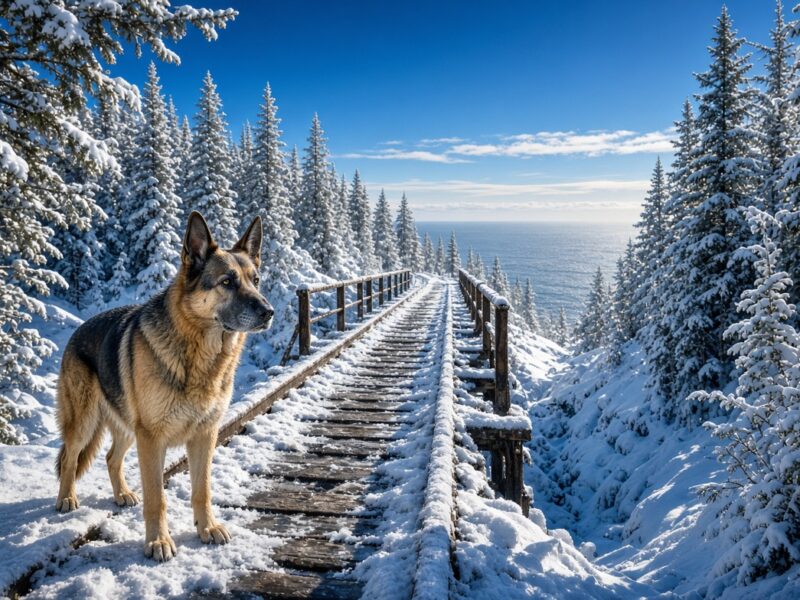
The Dog Who Walked 12 Miles Through Snow… Then Froze at One Bridge
The tracks crossed the county road at 7:40 on a Tuesday morning, deep and clean in the fresh powder, heading straight for a ferry landing that hadn’t seen a ferry in years.
Bennett Crossley Ward almost drove past them.
He was behind the wheel of a county utility truck with a gas-station coffee going cold in the cup holder and a weather alert from the National Weather Service still glowing on his phone.
Northern Wisconsin. Late January. Lake Superior lying flat and gray as hammered steel beyond the pines.
He braked.
The truck idled in the road while he stared at the line of paw prints coming out of the trees.
Large dog. Moving with purpose.
He didn’t know yet that the animal had crossed 12 miles of winter to get here.
He didn’t know it was guarding a broken red rope.
And he had no idea that a few days later, that same dog would stop cold at the edge of one lonely service bridge and refuse to take another step.
Six years earlier, the dog had watched the man he loved disappear down that same road.
What the dog remembered would force a widow, a survivor, and Bennett himself to face the choices they had carried for years.
By the end of January, Silver Wake Bay had become a place made almost entirely of light.
Snow covered the roofs, the pine shoulders, the abandoned docks, even the dark stone edges of the lake.
The whole shoreline seemed brighter than it had any right to be in winter.
The sky was a hard, clean blue.
Bennett had been in town four days.
That was long enough to know where the coffee was tolerable, which roads the county plowed first, and which locals would answer a question with a sentence instead of a family history.
It was not long enough to belong.
That suited him.
At 44, Bennett had made a profession out of temporary places.
Six weeks here. Three months there.
A cold-weather safety contract in Montana. A wilderness medical assessment in Wyoming. An avalanche response course in Colorado.
This contract was six weeks.
Perfect.
He was a large man, a little under six-foot-three, built less like a gym athlete than someone who had spent years carrying equipment over bad ground.
His dark ash-blond hair was clipped short on the sides, with a narrow streak of silver cutting through the front.
A faint scar crossed the outer end of his right eyebrow.
His years as a Navy SEAL were still visible in the way he sat: straight without stiffness, alert without looking nervous.
But he no longer dressed like a man expecting a firefight.
His coyote-brown field jacket was zipped halfway over a forest-green wool layer.
Charcoal work pants covered the tops of weathered brown boots.
A dull silver carabiner hung from one belt loop and clicked softly whenever he shifted.
His job, at least on paper, was simpler than anything he’d done in uniform.
The county wanted to reopen North Bell Ferry Landing as a winter safety station.
The ferry had stopped running years ago, after a new highway made the route unnecessary.
But the landing still sat in a useful spot on the bay, and emergency management wanted it ready for storms, power failures, stranded drivers, and anyone unlucky enough to learn how fast winter could turn serious.
Bennett had been brought in to examine the service roads, shelters, navigation markers, radio repeaters, and old incident reports.
Mara Ellery, the county emergency management director, had summed it up during their first meeting.
“Find the things that fail before they fail.”
Bennett had liked that.
Machines were honest. Roads were honest. Ice was brutally honest.
People were more complicated.
The squall the night before had lasted less than three hours, but it had dropped several inches of powder across the North Bell access road.
Which was why the tracks bothered him.
He opened the door and stepped down.
Cold air cut through the warmth trapped in the cab.
He crouched beside the prints.
They didn’t wander. No circling, no zigzag, no sign of a dog chasing deer.
They ran in a straight line toward North Bell.
Bennett looked ahead at the empty landing.
“Know something I don’t?”
Only the wind answered.
He followed on foot.
The prints crossed the parking area, passed the old terminal, and ran toward a snowbank a county plow had shoved against the service fence.
Then they disappeared.
Bennett stopped.
For a few seconds he heard nothing but lake wind moving through frozen pine branches.
Then came a small metallic sound.
Clink.
He turned his head. Waited.
Clink.
Not loud. Not rhythmic. Something weak being dragged against metal.
Bennett climbed the snowbank.
On the far side, the ground dropped toward an old maintenance lane.
He saw black first. Then tan. Then two amber-brown eyes watching him from under a crust of blown snow.
“Ah, hell.”
A German Shepherd was pinned between the lower fence and a length of wire half buried in ice.
A weathered brown working harness covered its chest.
One strap had twisted around the wire near a post, and every attempt to move had cinched the dog tighter.
The animal was big. Or had been.
Its deep chest looked too narrow under the coat.
Snow clung to the black saddle on its back, and the golden-tan fur on its legs had frozen into dark, wet strands.
Gray showed around the muzzle.
One ear stood straight. The left ear had a small triangular notch along the edge.
The dog’s legs were trembling. Not shivers. Deep tremors that moved through its whole body.
Bennett didn’t rush in.
He lowered himself into a crouch several yards away.
The shepherd lifted its head. A growl rose from somewhere in its chest, weak and almost apologetic.
“Fair enough,” Bennett said.
The dog stared at him.
He pulled off one glove and rested his bare hand on his knee.
“I wouldn’t trust me either.”
Another growl. A little stronger.
“That’s actually encouraging.”
The dog shifted, and that was when Bennett saw it.
It was protecting something.
A length of old red rescue rope lay beneath its chest. About three feet long, weathered, frayed.
One end looked as if it had been torn or cut a long time ago.
The dog had planted itself over that rope while barely able to stay upright.
Bennett looked from the rope to the animal.
“Yours?”
The shepherd lowered its head over it.
That answered the question.
That was the moment the morning stopped being simple.
Bennett could have moved faster. He knew a hundred ways to control a bad situation.
But control wasn’t what this dog needed.
So he sat down in the snow.
Five minutes passed. Then ten.
He talked now and then, mostly so the dog could learn the shape of his voice.
“The heater in that truck is terrible, for the record.”
The dog watched.
“And the coffee in this town is overrated.”
Nothing.
“If you’re planning to freeze next to an abandoned ferry landing, you picked a really inconvenient morning.”
The shepherd did not look impressed.
But eventually, the growling stopped.
Bennett slid one boot forward. The dog’s head came up.
He stopped. Waited.
Some people believed patience meant doing nothing.
They had probably never sat ten feet from eighty pounds of frightened German Shepherd.
Little by little, the distance disappeared.
When he finally reached the dog, he didn’t touch its head. He laid one hand flat on the harness.
The shepherd went rigid.
“Easy.”
The wire hadn’t cut into the skin. Good.
It was just twisted badly enough that pulling would make it worse.
He took a multi-tool from his jacket. The dog tracked every movement.
One clean cut, and the strap fell away.
The tension released. The shepherd sagged.
For half a second, Bennett thought it would bolt.
Instead, it folded onto one foreleg.
Bennett caught it under the chest before it rolled.
The dog made a small sound. Not pain, exactly. Exhaustion.
He pulled an emergency blanket from his pack and wrapped it around the animal.
Then he slid one arm under its chest and the other under its hindquarters.
The shepherd’s head snapped toward the ground.
Toward the rope.
Even now.
Bennett froze. “You’re kidding.”
One paw scraped weakly through the snow, reaching for it.
Whatever that rope meant, it mattered more to this dog than warmth. Maybe more than food.
Bennett picked it up.
“All right. This comes too.”
He tucked the red rope inside the blanket.
The shepherd stopped struggling immediately.
That bothered Bennett more than it should have.
He lifted the dog. It was lighter than a healthy shepherd that size had any business being.
As he climbed back over the snowbank, its head rested against his shoulder.
Then, suddenly, it lifted.
Not toward the truck. Not toward the road.
Toward North Bell. The old terminal. The locked boarding gate. The rusted bell hanging under the overhang.
Nothing moved there. No ferry waited at the dock. No one stood under the eaves.
Still, the dog stared, ears up, its whole exhausted body suddenly attentive.
Bennett followed its gaze. There was nothing.
He looked back down.
“You came here on purpose.”
The dog kept watching the empty landing.
An injured animal was a simple problem.
A dog crossing miles of winter to reach a place nobody used anymore, carrying a piece of rescue rope it refused to leave behind, was something else entirely.
At Silver Wake Veterinary Clinic, Dr. Celia Norwood took one look at the dog in Bennett’s arms and abandoned whatever question she’d been about to ask.
“Exam two.”
She was 58, lean and sharp-featured, with deep auburn hair going silver at the temples and narrow glasses hanging from her scrub collar.
She moved fast without ever looking rushed.
Warm fluids. Blankets. A careful, quiet exam.
The dog’s temperature was low. He was dehydrated and badly worn down, but nothing seemed broken.
“That’s the good news,” Celia said.
Bennett leaned against the wall. “And the bad?”
She glanced at him. “You look disappointed there isn’t more.”
“I prefer complete lists.”
“So do accountants.”
“That sounded like an insult.”
“It was.”
Bennett almost smiled.
Celia checked teeth, joints, paws, heartbeat.
“Male. About eight. Older working-line build. He’s been outside long enough to be in trouble, not long enough that I expect lasting damage.”
She ran a microchip scanner over his shoulder.
It beeped.
Celia read the screen, and her expression changed. Not dramatically. Just enough.
Bennett noticed. “What?”
“Keel.”
On the table, the dog opened one amber eye at the sound of his name.
Celia looked at him, then back at the screen.
“Owner of record, Lenora Vale.”
Bennett waited.
Celia took off her glasses.
“You know her?” he asked.
“I know of her.”
“That usually means yes, with extra steps.”
Celia ignored that and picked up the phone.
The call took less than five minutes.
The first person through the door was not Lenora.
Joan Harker came in wearing a snow-dusted green quilted barn jacket.
She was 64, short and sturdy, with gray-brown hair tied low at her neck.
The second she saw Keel through the exam room door, she pressed a hand to her chest.
“Oh, thank God.”
Keel lifted his head. His tail thumped the blanket once.
Joan didn’t throw her arms around him. She knelt, let him smell her hand, then rubbed the side of his neck.
“You miserable old escape artist.”
Her voice cracked on the last word.
Keel closed his eyes.
She’d been caring for him, she explained, while Lenora recovered from a fall.
Keel had vanished from her farm almost two days earlier.
“A delivery driver didn’t latch the gate all the way. I went out twenty minutes later and he was gone.”
“You live close?” Bennett asked.
“Twelve miles from here.”
Bennett looked at the dog.
“Twelve?”
Joan nodded. “We searched the roads. Called the sheriff’s office. Animal control. Everybody.”
Then her eyes landed on the chair beside Bennett.
On the red rope.
She stopped talking.
The change in her face was immediate. Not fear. Recognition.
She walked over slowly but didn’t touch it.
“This important?” Bennett asked.
Joan took a breath.
“It belonged to Caleb.”
“Who’s Caleb?”
For several seconds, Joan said nothing.
Behind her, Keel slept under a warm blanket, one forepaw resting near the rope, as if even unconscious he needed to know where it was.
Finally, she looked back at Bennett.
“Caleb Vale was Lenora’s husband.”
Bennett waited.
Joan’s gaze drifted to the bright, snow-filled window.
“He was the last person to go down the road Keel was trying to get back to.”
Celia called the next morning before Bennett had finished his first cup of coffee.
“He’s awake. He’s eating. He’s complaining about confinement.”
“All good signs?”
“All very good signs. He’s also trying to unionize the cats in the back.”
By late morning, Bennett was cleared to take Keel for a short walk on a leash behind North Bell.
Partly to see how he moved. Partly because the dog was getting restless indoors.
Bennett expected Keel to sniff around the parking lot. Maybe pull toward the road back to Joan’s farm.
Instead, Keel turned toward the forest.
Immediately. With purpose.
Bennett followed.
The old service trail was narrow but visible under the snow, and within half a mile it was obvious that Keel knew it.
At every fork, he chose without hesitation.
Past a stand of white pine. Across an old maintenance clearing. Along a ridge where the lake flashed silver between the trees.
Bennett said very little.
The dog didn’t seem lost.
He seemed to be retracing something.
Nearly three miles from North Bell, the trail began to descend toward Marrow Point.
A bridge appeared between the trees.
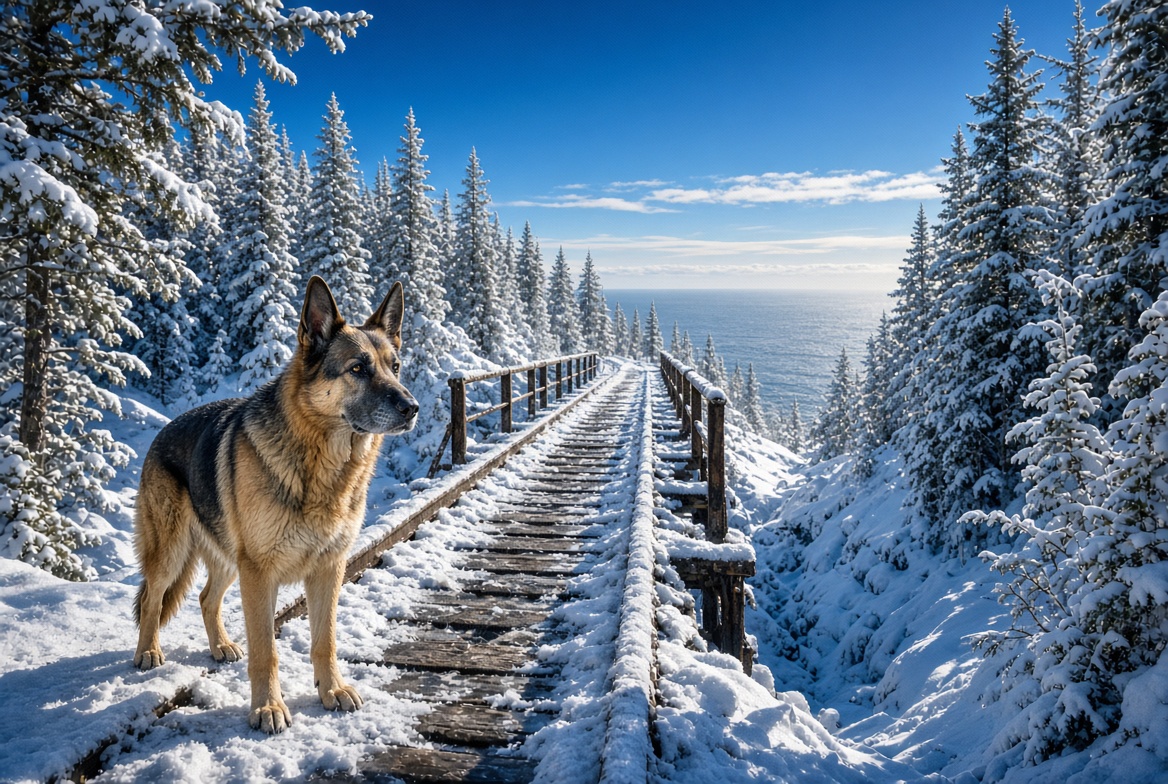
Nothing grand. An old steel-and-timber service bridge spanning a narrow ravine, its railings rimmed with snow.
Keel stopped so suddenly that Bennett almost walked into him.
The dog’s whole body changed.
His head dropped. His weight shifted back. The notched left ear folded slightly.
One front paw lifted off the snow and hung there, refusing to come down any closer.
Bennett looked at the bridge. Then at Keel.
“That’s it?”
The dog didn’t move.
Bennett walked a few steps onto the deck. The boards were solid under his boots.
He turned around.
“Come on.”
Keel backed away. One step. Then another.
Bennett came off the bridge, and the dog stopped retreating.
He just stood there, staring across to the far side. Not barking. Not pulling. Simply unable to go.
Bennett looked back at the trail behind them.
Twelve miles through winter to reach North Bell. Almost three more through the woods without a single wrong turn.
And now, nothing.
A dog strong enough to find his way home across snow, ice, and county highways was frozen in front of one ordinary bridge.
Whatever waited on the other side had been waiting for years, and Keel still could not make himself go back to it.
Lenora Vale did not look like a woman waiting to be reunited with her dog.
She looked like a woman trying very hard not to.
Bennett noticed that before Keel did.
The rehabilitation center sat on the east edge of Silver Wake, a low brick building with wide windows facing the pines.
Winter sun poured through the lobby so brightly that the polished floor reflected the snow outside.
Lenora stood near the end of the main hallway beside a tall window.
She was 72, slender, almost narrow through the shoulders, with a silver bob cut neatly at her chin.
A navy cardigan lay over a cream sweater. One hand rested on the grip of a walker. The other was clenched at her side.
Keel saw her, and everything changed.
For the first several yards, he hauled Bennett forward hard enough to snap the leash taut.
“Easy.”
Keel ignored him.
Then, strangely, the dog slowed.
His steps shortened. His ears softened. The urgency drained out of him.
By the time he reached her, he was walking carefully, almost gently, as if he understood that whatever had happened to her required it.
Lenora lowered one trembling hand.
Keel smelled her fingers.
Then he pressed forward and laid his silvering muzzle across her knee.
That was all. No barking. No jumping. No circus.
Lenora stared down at him.
“You stupid old fool.”
The words came out dry, almost teasing.
Then her mouth trembled. She laughed once, and she cried.
Keel didn’t move. He just leaned more of his weight into her leg.
Bennett turned toward the window. He’d never been comfortable inside a moment that so clearly belonged to someone else.
Behind him, Lenora whispered something too soft to hear.
When he looked back, her hand was buried in the thick fur behind Keel’s ears, and the dog’s eyes were closed.
Whatever bond Keel had shared with Caleb Vale, Bennett understood something now that he hadn’t understood at the bridge.
Keel had not spent six years loving a dead man alone.
He loved this woman, deeply. And her face made it just as clear that it had never been one-sided.
“You found him?” she asked.
Bennett nodded. “North Bell.”
Her fingers stopped moving for half a second. Then they continued.
“Of course.”
The answer bothered him.
Not because it sounded mysterious. Because it sounded tired.
As if North Bell was exactly where she’d been afraid he would go.
Joan, sitting nearby, filled in the rest.
Lenora had fallen on a set of icy outdoor steps several weeks earlier.
Nothing catastrophic, but it had left her with balance problems and a rehab plan that could take months.
She could walk. She simply couldn’t safely handle a ninety-pound German Shepherd who might lunge on ice.
“And I can’t pretend my farm is Fort Knox anymore,” Joan admitted.
“One delivery driver leaves one gate wrong, and apparently Keel decides he’s Lewis and Clark.”
Lenora looked down at the dog.
“Lewis and Clark knew where they were going.”
A pause.
“So did he, apparently.”
That quieted the room.
County Animal Services had already been contacted through Celia.
The simplest solution was a temporary foster until Lenora’s mobility improved or something longer-term could be worked out.
There was one practical problem.
Keel had already proven he could leave Joan’s property and cover 12 miles when he felt like it.
Joan couldn’t guarantee she could keep him safe. Lenora couldn’t take him home.
Which left Bennett standing in a rehab center listening to three women quietly organize his life without him.
“No,” he said.
Lenora looked up. Joan folded her arms. Keel opened one eye.
“No what?” Joan asked.
“No fostering.”
“You have a cabin.”
“That isn’t the definition of qualified.”
“You know dogs.”
“I removed one from a fence.”
The corner of Lenora’s mouth twitched. “An impressive résumé.”
Bennett looked at her. She looked entirely too pleased with herself for someone using a walker.
His phone rang before he could answer.
Mara Ellery.
He stepped into the hall. Mara didn’t bother with hello.
“Celia called.”
“Of course she did.”
“Animal Services has no problem with a temporary placement if you agree.”
“I don’t.”
“You rescued him.”
“That doesn’t mean I adopted him.”
A pause.
“Explain that to him.”
Bennett looked through the open doorway.
Keel was staring straight at him. Not at Lenora. Not at Joan.
At him.
Bennett closed his eyes.
“This is extortion.”
“No. Extortion usually involves money.”
The call ended.
Twenty minutes later, Bennett walked out with paperwork, a forty-pound bag of dog food, medication instructions, a leash, and a German Shepherd who had somehow acquired residence in his cabin without ever being consulted.
Lenora watched from the window.
Before Bennett reached the truck, she tapped lightly on the glass.
Keel turned. For an instant, his whole body pulled back toward her.
Then he looked up at Bennett.
Bennett opened the passenger door.
“Your choice.”
Keel hesitated.
Then he climbed in.
It was the first time Bennett saw him choose moving on over going back, and he had no idea yet how much that would matter.
Over the next several days, Keel recovered faster than Bennett expected.
Food helped. Warmth helped. Sleep helped most.
His ribs faded a little under the golden-tan coat. His gait steadied. The cautious stiffness in his shoulders eased.
His personality arrived in pieces.
Keel hated the vacuum cleaner. He approved of scrambled eggs.
He considered Bennett’s side of the couch an administrative error in need of correction.
And he could appear completely asleep right up until Bennett opened anything that sounded like food packaging.
“You’re recovering suspiciously well,” Bennett told him one night.
Keel stared at the slice of turkey in his hand.
“Yes. Your medical condition is tragic.”
The dog drooled on the floor.
But outdoors, something else emerged.
Whenever Bennett drove toward North Bell for work, Keel went alert long before the terminal came into view.
Not anxious. Interested.
The first time Bennett took the service road toward Marrow Point again, Keel walked out ahead with total confidence.
First fork, right. Second fork, left.
Bennett deliberately stopped at the third junction and waited.
Keel looked back at him with an expression that could only be described as disappointment.
“I’m testing you.”
Keel turned away.
“Apparently I failed.”
They kept walking.
White pine gave way to birch and spruce. Faded orange county route markers stood up out of the snow.
Then the bridge came into view.
Keel stopped. Exactly like before. Not gradually. One second walking, the next second stone.
His breathing changed first, short and fast.
The left ear flattened. His head dropped. One front paw rose a few inches off the snow and stayed there.
Bennett didn’t pull the leash. He waited.
In daylight, the bridge was unremarkable. Steel beams, a timber deck, a shallow ravine. Snow collecting on the rails.
Nothing moved.
Bennett stepped sideways. Keel’s eyes tracked him instantly.
“Not going to make you.”
The dog stayed tense.
Bennett took one step back, away from the bridge.
Keel’s lifted paw touched down.
Another step back.
Keel exhaled.
That detail stayed with Bennett.
Not because it was dramatic. Because it was physical.
The dog wasn’t making a decision about history.
His body was reacting before any decision could happen.
Celia confirmed it when Bennett brought Keel in for a follow-up.
“You keep wanting him to explain himself,” she said.
“I haven’t asked him anything.”
“You don’t have to say it out loud to anthropomorphize.”
Bennett leaned on the exam table. “That’s a big word for calling me stupid.”
“I’m a veterinarian. We have a specialized vocabulary.”
She checked Keel’s paws while he stood patiently.
“Dogs can tie a location to fear, noise, injury, separation. They don’t have to reconstruct an event the way we do.”
“So he remembers it.”
Celia tilted her head. “Maybe. But be careful with that word.”
She scratched Keel under the chin.
“His body recognizes something there as unsafe. That’s enough.”
Bennett thought of that paw, hanging in the air above the snow.
“So what do I do?”
“For now? Nothing heroic.”
“That sounds personal.”
“It is.”
She met his eyes.
“Don’t drag him across. Don’t turn that bridge into a test of courage. Let him decide how close he can get.”
That afternoon, Bennett called Lenora.
He didn’t start with Caleb.
He told her Keel was eating well, that his weight was coming back, that he’d stolen half a slice of toast despite showing zero previous interest in toast.
“He prefers butter,” Lenora said.
“Useful information. After the theft.”
Then he mentioned Marrow Point.
The silence on the line changed. Not long. Just enough.
“He knows the road,” Bennett said.
“Yes.”
Another silence. Bennett didn’t fill it.
Finally, she spoke.
“Caleb crossed that bridge the last time Keel saw him.”
Nothing more.
Bennett could have asked. He didn’t.
“All right.”
For the first time since he’d met her, Lenora sounded surprised.
“You’re not going to push?”
“No.”
“That seems unlike you.”
“You barely know me.”
“I’ve met military men before.”
“That isn’t the same thing.”
A pause.
“No,” she said quietly. “I suppose it isn’t.”
After the call, Bennett went back to the job he’d actually been hired to do.
North Bell’s records lived in two gray filing cabinets and a badly organized digital archive at the county operations office.
Most of it was dull. Generator maintenance. Plow schedules. Ice reports. Radio tests. A $212 invoice for a replacement door hinge.
Bennett liked dull records.
Dull usually meant nobody had gotten hurt.
Then he found the Marrow Point incident.
Six years earlier. Late winter. Snow squall.
County utility vehicle immobilized near the western bridge approach. Operator: Gideon Shaw.
Responding: maintenance supervisor Caleb Vale. Canine present: Keel.
Bennett sat up straighter.
The official narrative was unusually short.
Weather deteriorated unexpectedly. Vale and canine approached Shaw’s disabled vehicle. Shaw was moved from the exposed area. Additional units dispatched. Communications later failed.
Then one sentence.
Fatality occurred during rescue response.
Bennett read it twice.
It was the kind of sentence bureaucracies used when reality was too big to fit in a box.
Gideon Shaw survived.
Caleb Vale did not.
That evening, Bennett went to see Lenora again.
She was in the common room working a crossword with a wine-colored mechanical pencil.
She looked at his face once.
“You read it.”
“Yes.”
She set the pencil down. “Which version?”
“The official incident report.”
“That isn’t a version. That’s a skeleton.”
Bennett sat across from her.
“Caleb went back for Gideon.”
“Yes.”
“Keel went with him.”
“Yes.”
“Gideon survived.”
Her expression didn’t move. “Yes.”
Bennett hesitated, then asked the obvious question.
“Caleb died because he went back to rescue Gideon.”
Lenora looked out the window. Snow was falling again, light enough that every flake stood out against the dark pines.
“That,” she said, “is the story people tell.”
“It isn’t true?”
She picked the pencil back up and rolled it slowly between two fingers.
“I didn’t say that.”
“Then what did you say?”
Her steel-green eyes lifted to his.
“I said it isn’t complete.”
Bennett left without another question.
Not because his curiosity was gone. Because he recognized a boundary when someone drew one that clearly.
Back at the cabin, Keel slept in front of the woodstove, paws twitching in whatever world dogs went to when they dreamed.
Bennett made coffee and opened the archived North Bell technical logs on his laptop.
He wasn’t hunting for secrets. He was checking infrastructure. Radio coverage, timestamps, dispatch records, weather-station failures.
Near midnight, he found the original response timeline.
At 6:42 p.m., Caleb Vale reached Gideon Shaw.
At 6:56 p.m., Gideon was moving toward the designated shelter point.
At 7:07 p.m., the secondary crew confirmed physical contact with Gideon.
Gideon Shaw was safe.
Bennett scrolled down.
Caleb Vale’s last confirmed radio contact: 7:46 p.m.
Bennett leaned back.
Nearly forty minutes.
On the rug, Keel lifted his head.
The story everyone remembered said Caleb had gone back to save Gideon, and that was true.
But Gideon had already been out. Already safe. Nearly forty minutes before Caleb disappeared.
Bennett lowered the laptop lid halfway.
Wind brushed snow against the windows.
Across the room, Keel watched him in silence.
If Caleb had already saved Gideon, then whatever pulled him back toward Marrow Point had been something else entirely.
Bennett had no interest in becoming the kind of man who rolls into a small town, asks too many questions, and decides every old silence is hiding a conspiracy.
He’d met men like that. They usually carried folders. They always said things like, “Nothing adds up.”
Bennett preferred things that added up.
Unfortunately, Marrow Point didn’t.
Mara made that official the next morning when she dropped a county file on his desk.
“If North Bell is going back into service, I need to know why the old response system failed.”
He flipped it open. “You mean Caleb Vale.”
“I mean everything around Caleb Vale.”
She stood across the operations room in a charcoal rain shell, a yellow clipboard tucked under one arm.
Her salt-and-pepper hair was cut so short the wind never seemed to bother it.
“Road access. Radio coverage. Warning systems. Personnel decisions. Equipment. Weather. All of it.”
“So I’m auditing a six-year-old incident.”
“You were already doing that.”
“I was hoping you hadn’t noticed.”
“I notice most things I pay for.”
She tapped a page.
Gideon Shaw. Survivor. Retired county road maintenance, utility vehicle operator.
Current address: a small town almost three hours southwest of Silver Wake.
Bennett glanced out the window. Keel sat beside the truck, supervising a snowplow crossing the county yard.
Mara followed his gaze. “You planning to take him?”
“He doesn’t like being left alone.”
“So do you.”
Bennett looked at her.
Mara smiled without warmth. “Drive safe.”
Three hours later, Bennett found Gideon Shaw in a cedar-sided house at the edge of a town where the snowbanks hid most of the mailboxes.
The driveway had been cleared neatly. The porch had not.
Bennett knocked twice.
The man who answered had once been very large.
Gideon was 68, still broad through the shoulders but leaner now, with weathered hands and a face built out of square pieces.
Thick white hair. A short horseshoe mustache. A mouth that looked skeptical even at rest.
His first look at Bennett was cautious. His second was irritated.
“Can I help you?”
“Bennett Ward. Silver Wake County Emergency Management.”
“That supposed to mean something to me?”
“We’re reviewing the Marrow Point response.”
Gideon’s face closed like a door. The conversation was over before it had started.
“No.”
Bennett had expected resistance. He hadn’t expected an actual door swinging toward his face.
“I only need—”
“I said no.”
“Caleb Vale.”
The door stopped.
For half a second, Gideon looked as if the name had physically hit him.
Then his jaw set.
“That’s exactly why.”
He started closing the door again.
Behind Bennett, something shifted in the truck. Then came the soft scrape of claws on the porch steps.
Gideon froze.
Keel had climbed out through the passenger window Bennett had cracked for air.
For once, Bennett decided not to correct the behavior.
Gideon stared. His face emptied.
The German Shepherd didn’t rush him. Didn’t shrink away.
He simply stood at the edge of the porch, black saddle dark against the snow, amber eyes fixed on the older man.
Gideon slowly pulled off one glove and lowered his hand.
Several long seconds passed.
Keel stepped forward once. Stopped.
Gideon swallowed.
“He got old.”
“So did you,” Bennett said.
Gideon shot him a look. “That your idea of diplomacy?”
“No.”
Keel took another step. Gideon crouched with some difficulty.
The dog sniffed his fingers. No big recognition. No frantic wagging.
Keel just breathed in the scent of a man from another part of his life.
Then he sat.
Gideon looked at him for a long time.
When he stood back up, the anger hadn’t gone anywhere.
But the door stayed open.
“Coffee?”
“Black.”
“Good. I don’t keep anything to ruin it with.”
The house smelled like cedar, coffee, and machine oil.
Old road maps hung framed on one wall. A steel thermos, dented in three places, sat by the sink.
Keel settled by the woodstove. Gideon stayed standing.
He looked like a man who had spent six years deciding which memories were allowed inside and which had to wait on the porch.
“You want to know why Caleb went back,” he said.
Bennett didn’t pretend otherwise. “Yes.”
Gideon poured.
“I’ve been wanting to know the same thing.”
The squall had come in faster than forecast.
Gideon had been driving a county utility vehicle toward Marrow Point to check a drainage gate when visibility collapsed.
“The road didn’t disappear,” he said. “That would’ve been easier.”
He stared into his mug.
“You could still see just enough to believe you knew where it was.”
The truck slid off the packed route near the western bridge approach and settled against a snowbank.
No injury to speak of, but he couldn’t drive out, and the radio kept cutting in and out.
Caleb Vale was already nearby with Keel.
“He came back.”
Gideon remembered the dog first. A dark shape moving through white. Then Caleb.
“He was yelling something. Couldn’t hear him over the wind.”
Caleb had carried a red rescue rope.
The same kind Bennett had found under Keel’s chest.
He’d tied it off and used it to keep Gideon oriented as they worked back toward the safer side of the service route.
Keel stayed close.
“Too close,” Gideon said. “Caleb kept ordering him back. Dog ignored him.”
Bennett glanced at Keel. “That sounds familiar.”
The faintest smile crossed Gideon’s face. Then it was gone.
“Near the bridge approach, a tree came down somewhere ahead of us. Not on anybody. Close enough.”
The crack. The movement. The sudden explosion of snow.
“Keel panicked. Tried to go back, then forward. Didn’t know what to do.”
Caleb stopped.
Gideon could still see it with painful clarity.
Caleb knelt beside Keel and tapped the side of the harness twice. A familiar cue.
Keel locked onto him.
Caleb pointed back toward North Bell.
“Go home.”
The dog refused.
Caleb tapped the harness again and pointed.
“Lenora.”
Keel stayed.
Even through the storm, Gideon remembered the sound of Caleb’s voice. Not angry. Urgent.
Finally, Keel turned and ran.
“Did he cross the bridge?” Bennett asked.
Gideon shook his head. “No. We were still on the west side when the tree came down. Caleb sent him back before we crossed.”
Bennett looked at the dog by the stove.
That mattered.
Keel’s fear might not be about watching Caleb vanish across that bridge at all.
It might be tied to the storm itself. The falling tree. Being sent away. The chaos of that stretch of road.
A body remembered what language couldn’t explain.
“Caleb got me to the shelter point,” Gideon went on. “Another crew reached us there. Checked me over. Put me in a heated cab.”
He wrapped both hands around his mug.
“Caleb could’ve climbed in with me. He didn’t.”
“Why?”
Gideon looked at him. “I asked.”
Outside, snow slid softly off the roof.
“I watched him turn around. I yelled after him.”
Bennett waited.
“What did you say?”
“‘Caleb, don’t.'”
“And he answered?”
A long pause.
“‘Something’s still out there.'”
Bennett didn’t speak.
Gideon looked at Keel.
“For six years, I figured he meant a person.”
That one sentence rearranged the room.
Bennett felt the old operational instinct sharpen. Personnel. Vehicles. Routes. Accountability.
A rescue scene could be chaos, but eventually somebody counted heads.
“Was anyone missing?”
“I assumed there was.”
“You never checked.”
Gideon’s eyes hardened.
“I was half frozen and getting evacuated. By the time I heard Caleb didn’t come back, I wasn’t interested in paperwork. Later, I was interested in leaving Silver Wake.”
There was no self-pity in it. Only exhaustion.
“I spent enough years believing he died because he came for me.”
Keel lifted his head at Gideon’s voice.
“Maybe I didn’t want to find out there was someone else.”
Bennett understood that more than he wanted to.
Back in Silver Wake that evening, the first thing he pulled was the personnel list.
No one missing.
Every county employee assigned to Marrow Point that day, accounted for. Contractors, accounted for. Plow crews, accounted for.
No stranded civilian. No second vehicle. No unnamed person.
He checked twice. Then a third time.
Keel lay under the table while he worked.
Gideon had spent six years believing Caleb went back for someone, but according to every roster in the county, there had been no one left to save.
The next morning, Mara introduced him to Warren Pike.
Warren was 67 and lived in a narrow house near the old harbor communications shed.
He had the lean, weathered build of a man who’d spent decades climbing radio towers in bad weather and no longer saw the appeal.
Gray wool overshirt. Glasses thick enough to make his eyes look permanently skeptical.
“You’re the SEAL.”
“Former.”
“Everybody says ‘former’ right before telling you all about it.”
“I didn’t.”
Warren considered that fair.
Unlike Gideon, Warren had zero interest in the emotional history of Marrow Point.
He cared about equipment, which made him easy for Bennett to understand.
They sat side by side at an old county terminal while Warren scrolled through archived communication logs.
“Portable beacons are simple. Ugly. Heavy. Dependable until they aren’t.”
“Everything’s dependable until maintenance gets deferred.”
Warren grunted in agreement.
A few minutes later, he stopped scrolling.
“There.”
One portable emergency beacon had been assigned to the Marrow Point crew. Unit MP-4. A $1,400 box of metal and batteries.
It didn’t just track location in low visibility.
It broadcast a warning to county plows and service trucks approaching the western bridge sector.
“If that beacon went down,” Warren said, “what happened next depends on whether the drivers still had radio, whether they could see the closure markers, and whether the weather was bad enough to hide both.”
He pointed at the screen.
MP-4 had stopped transmitting minutes after Gideon reached the shelter.
Then Bennett saw something else.
A second road crew had still been approaching from the north. Not in the danger zone yet. But moving toward it.
“Would they know the bridge approach was compromised?”
Warren leaned in. “If radio coverage held.”
“And if it didn’t?”
Warren said nothing. They both knew.
Bennett sat back.
Gideon’s words came back to him.
Something’s still out there.
Not someone.
Something.
Caleb may not have turned back for a trapped person at all.
He may have gone back for the beacon.
Not to save a man standing in front of him, but to warn men he couldn’t even see.
The realization didn’t feel heroic. It felt worse, because Bennett understood exactly why a man like Caleb would make that call.
A broken beacon was just equipment. Equipment could be replaced.
But when equipment was the only thing standing between strangers and a bad road, it became something else.
“Do we know if Caleb got it working again?”
Warren shook his head. “Not from this log. The archive ends after the repeater dropped.”
“Paper backups?”
“Might exist.”
“Might?”
Warren gave him a tired look. “You ever seen county storage?”
Bennett sighed. “I was hoping for one miracle today.”
“That’s not in the budget.”
By afternoon, Bennett had enough to go back to Lenora.
She was packing personal things into a cardboard box. Her balance had improved enough that she now used a cane indoors instead of the walker.
Keel went in first.
She smiled at him. “Still eating you out of house and home?”
“Financially devastating.”
“Good.”
Bennett set the red rope on the table.
Lenora stopped. Not sharply. Just completely.
“I talked to Gideon.”
Her face didn’t change.
“He remembers Caleb saying something was still out there.”
Lenora sat down.
“There wasn’t another person,” Bennett said.
“No.”
“You knew.”
“I knew everyone was accounted for.”
“We found a portable beacon that failed near the bridge.”
Lenora looked up, and for the first time, Bennett saw recognition before she could hide it.
“Did Caleb go back for it?”
She didn’t answer.
Instead, she reached into the cardboard box.
Ordinary things. A framed photograph. A pair of old work gloves. A folded county map. A small metal flashlight.
Then she lifted out another length of red rope.
Old. Weathered. Cut at one end.
Keel stood up.
Bennett picked up the piece he’d found with the dog. Lenora laid hers beside it.
The ends didn’t snap together like some movie puzzle. They were frayed and uneven, the fibers stiff with time.
But the faded weave ran straight across both pieces.
The same red line.
Once, one rope.
Keel lowered his head and smelled them both.
Lenora ran her thumb along the frayed edge of Caleb’s line.
Bennett looked at her. “The night at Marrow Point.”
She nodded.
Keel stood between them.
One old dog, two broken lengths of rope, and a road none of them had ever been able to finish.
Lenora didn’t cry when Bennett told her about the beacon.
She looked at the two pieces of rope on the table, then folded her hands in her lap.
For once, Keel showed no interest in the rope at all.
Bennett had expected the discovery to matter more.
Maybe that was the problem. He’d spent days arranging facts as if enough of them might eventually turn into an answer.
And Lenora was looking at his evidence like someone being shown a photograph she already knew by heart.
“You knew about the beacon,” he said.
“Yes.”
“You knew that’s why Caleb went back.”
“Yes.”
“Why didn’t you say so?”
She raised an eyebrow.
“You never asked me why he went back. You asked if Gideon was the reason he died. I told you that story was incomplete.”
Bennett leaned back. “You enjoy making people work for information?”
“No. I spent thirty years in emergency communications. I enjoy people asking accurate questions.”
There it was again. That dry edge.
Bennett had started to notice that Lenora was funniest whenever the subject was least funny.
She reached toward the rope, then stopped short of touching it.
“Caleb always went back.”
This time, she kept going without being asked.
“If he forgot his gloves, he went back.”
A faint smile.
“If I forgot my gloves, he went back. Complained the entire way, then acted like he’d crossed the Arctic for me.”
Keel settled at her feet.
“If somebody slid into a ditch on the county road, Caleb stopped. Didn’t matter if we were late.”
“He sounds exhausting.”
“He was.”
The smile lingered half a second longer.
“Somebody forgot a tool, he went back. Somebody needed an extra pair of hands, he went back. A neighbor’s generator quit in January, and Caleb was halfway out the door before the poor man finished dialing.”
Bennett looked at the rope. “And you hated that.”
“I loved that.”
She met his eyes.
“And I hated it.”
There was no contradiction in the way she said it. Only marriage.
Six years earlier, Lenora had been sitting in the North Bell communications room when the squall hit Marrow Point.
She remembered the fluorescent lights, the dry heat from the wall vent, and a coffee mug Caleb had left on her desk that morning with a crack running down one side.
Outside, the wind was already pressing snow against the glass.
Inside, the radio came alive with broken voices.
“He called in when he reached Gideon,” she said.
Her voice had changed. Not softer. More precise. A professional voice returning to an old frequency.
“Gideon was cold but mobile. Vehicle stuck, not rolled. No major injury.”
“And Keel?”
“With him.” She glanced down. “Keel went everywhere Caleb could get away with taking him.”
She’d heard the tree come down over the radio. A deep crack, then static, then Caleb shouting at the dog.
She couldn’t make out every word. Only the command, over and over.
“Home.”
Less than twenty minutes later, she found Keel near North Bell. Snow packed into the fur under his chest. Leash gone. Eyes wide and frantic.
At the time, she hadn’t understood why he wouldn’t settle.
“He kept looking behind him,” she said. “Like he’d made a mistake.”
She tightened her fingers together.
“Maybe that’s me putting human thoughts on a dog. Celia would complain.”
“She usually does.”
For a moment, the room loosened.
Then Lenora continued.
Caleb got Gideon to the shelter point. The second crew confirmed contact.
Lenora ordered Caleb to withdraw. He acknowledged.
Less than a minute later, the beacon dropped.
“The North Road crew had already been rerouted,” she said. “I told him that twice.”
“What did he say?”
“That he didn’t trust they’d gotten it.”
“And you?”
“I told him I didn’t care.”
Bennett looked at her. Her face hardened at the memory.
“I said exactly that. I don’t care about the beacon. Get out.”
Caleb had answered that if the North crew lost radio in the whiteout, that beacon was the last warning they’d get before the bridge approach.
Lenora told him the equipment was replaceable.
He agreed.
Then he went back anyway.
“He always had the same line,” she said, shaking her head.
“‘If I can still help, then I’m not done.'”
It sounded less noble coming from her. That was the point.
To everyone else, those words had probably become something worth putting on a plaque.
To Lenora, they were the same words that made him late to dinner, late to appointments, late home from work.
The same instinct that made him generous.
The same instinct that killed him.
She had been the last person to hear his voice clearly. No speech. No goodbye. No sign that the next few minutes would split everyone’s life in two.
She told him again to leave.
Caleb said, “I’ll be right back.”
That was all.
The beacon came back online later. A crew approaching from the north saw the warning and turned around.
By the time conditions cleared enough for a real search, a falling tree had damaged the small shelter near the relay site, and the bridge approach was impassable from one side.
Caleb never made it back across.
He died of exposure before rescuers reached him.
Lenora didn’t describe the recovery. Bennett didn’t ask. Nothing useful lived in those details.
For a while, the only sound in the room was Keel breathing.
Then Lenora said, “Everybody told me I should be proud.”
Bennett looked up.
“The paper called him a hero. The county hung his picture in North Bell for a while. People brought casseroles. Flowers. Cards.”
“Sounds normal.”
“It was.”
That made the next part harder.
“They kept saying, ‘You must be so proud of him.'”
She stared at the window.
“No one ever asked if I was angry.”
Something inside Bennett shifted. Not because he was surprised. Because he understood the sentence before she explained it.
“I was furious,” she said. “At Caleb.”
The word didn’t shake.
“I was furious with a dead man for doing exactly what everyone loved him for.”
She laughed once, without humor.
“What kind of wife does that make me?”
Bennett answered immediately.
“A married one.”
She looked at him.
He shrugged. “You said you loved the same thing you hated.”
“That simple?”
“No.”
“Good.”
She looked down at Keel.
“I wanted one person to tell me I was allowed to wish he’d left that beacon broken.”
Her voice finally lost its edge.
“I wanted to say out loud that I wished he’d been selfish. Just once.”
The room went still.
That was the confession.
Not guilt. Not shame over a bad call. Something harder to admit.
She wished a good man had been a little less good, just once, for her.
But Silver Wake had turned Caleb into a story almost overnight.
The man who went back. The man who saved Gideon. The man who restored the beacon and protected people he never even saw.
And Lenora became part of that story, too.
Not Lenora Vale, the communications specialist who’d trained half the staff at North Bell.
Not the woman who could identify radio interference by ear.
Not the person who once won $30 off Warren Pike by proving he’d mislabeled a frequency map.
She became Caleb Vale’s widow.
People lowered their voices around her. Asked about Caleb. Remembered Caleb. Praised Caleb.
Every kindness made her life a little narrower.
“The first year, I stopped correcting people,” she said.
“About what?”
“When they introduced me as Caleb’s wife.”
She looked at him.
“I was still Caleb’s wife. But I was other things too.”
Bennett thought about the old reports. Caleb’s name everywhere. Lenora’s only where required.
“I understand why you never wanted the whole story turned into some public correction,” he said.
“No, you don’t.”
The sharpness surprised him.
Lenora leaned forward.
“You think Caleb was wrong.”
Bennett held her gaze. “Yes.”
No diplomacy. No softening.
She almost smiled. “Because he went back.”
“The beacon was equipment.”
“The beacon was warning people.”
“The warning could’ve been handled another way.”
“Could it?”
“Maybe.”
“Ah.” She sat back. “There it is.”
Bennett frowned. “What?”
“Maybe.”
He disliked the word instantly. She knew it.
“What if the crew never got the reroute?”
“They did.”
“After Caleb turned the beacon back on. You don’t know that wasn’t the reason.”
“No.”
A pause.
“Neither do you.”
Bennett said nothing.
Lenora’s eyes narrowed slightly.
“What if someone you left behind still needed you?”
The question hit harder than it should have.
For a few seconds, Bennett wasn’t in a rehab center in Wisconsin anymore.
He was on a mountain six years earlier. Not the Navy. Civilian search and rescue. Bad weather moving in.
A friend named Thomas Avery, leg injured, leaning hard against him.
Another team member farther up the slope.
Thomas had wanted to turn back for him.
Bennett refused. Conditions were degrading. He chose the descent.
Another team reached the man upslope later. He lived.
Thomas didn’t. Complications after the evacuation.
No investigation blamed Bennett. No one ever told him he’d chosen wrong.
That was almost worse.
He gave Lenora the short version. Not for sympathy. Because she’d earned the answer.
“When Thomas wanted to go back, I made him keep moving.”
She listened.
“The other man was rescued later. Thomas died after we got down.”
“I’m sorry.”
He nodded once.
She didn’t ask if he carried guilt.
She asked something worse.
“So were you wrong?”
Bennett stared at the floor.
“I don’t know.”
Lenora’s face softened. Not kindly. With recognition.
“That’s what you hate.”
He looked up.
“You don’t hate Caleb because he went back.”
“You don’t know me well enough to tell me what I hate.”
“No. But I know men who build rules after something hurts them.”
That irritated him, mostly because it was true.
Bennett had built one. Once a route is chosen, keep moving. Don’t reopen decisions. Don’t turn back because emotion suddenly makes the other road look better.
It sounded disciplined. It sounded rational.
It also made leaving easier.
Jobs. Places. People.
If he kept moving, he never had to come back and find out whether something could have been repaired.
Caleb had lived at the opposite extreme. Always back. Always one more person, one more task, one more chance.
Bennett had spent years treating forward motion like wisdom. Caleb had treated going back like duty.
Both could save someone. Both could cost someone.
Neither made a man immune to consequences.
When he left that afternoon, Keel came with him.
The dog paused at the door and looked back.
Lenora lifted two fingers. “Take care of him.”
Bennett glanced down. “Which one of us?”
“Dealer’s choice.”
Outside, light snow drifted between the parked cars.
Bennett drove straight to Celia’s clinic.
She was finishing paperwork. Keel walked behind the front counter like he owned the building.
Celia looked down at him. “You’re becoming entitled.”
“He learned from Lenora,” Bennett said.
“That tracks.”
Bennett leaned on the counter. “What happens if I keep bringing him to the bridge?”
She stopped writing. “Depends what you mean by bringing.”
“I don’t drag him.”
“Good.”
“He gets close, he stops, and I wait.”
Celia studied him, then set the pen down.
“If you actually want to help him, stop treating crossing as the goal.”
Bennett frowned. “The bridge is the problem.”
“No. Fear is the problem.”
“So what do I do?”
“Let him approach until he’s uncomfortable. Then turn around.”
Bennett stared at her.
Celia shrugged.
“Teach him that going back is safe.”
The words followed Bennett out to the truck.
Keel climbed in. Bennett stood by the open door a moment longer.
Going back is safe.
It was advice for a dog, and he knew that.
But it bothered him anyway, because for years he had built his entire life around believing the opposite.
The first time Bennett deliberately turned away from the bridge, Keel looked confused.
That was better than terrified.
Three mornings after Celia’s advice, he drove the service road toward Marrow Point under a pale winter sun.
He parked well short of the bridge. No challenge. No test. Nothing to prove.
Keel hopped down and recognized the trail immediately. Ears up. Pace quickening.
They walked until the old steel-and-timber structure showed through the trees.
Keel slowed.
Bennett stopped before the dog’s breathing changed.
“That’s enough.”
Keel looked toward the bridge, then up at him.
Bennett turned around.
The shepherd stayed put for a moment, visibly baffled. The routine felt incomplete. They had approached. They were supposed to keep going, or fail trying.
Instead, Bennett walked away.
After several seconds, Keel followed. No pulling. No panic. Just a quiet walk back to the truck.
The next day, they went a little farther. Then turned back.
The day after that, Bennett stopped at the same spot but stayed long enough for Keel to sniff a snowbank, inspect a birch trunk, and get interested in something besides the bridge.
Then they left.
Bennett started to understand what Celia meant.
He’d spent years treating hard ground as something to conquer. Measure it, commit, move.
Keel didn’t need another route forced into submission.
He needed proof that getting close didn’t trap him there. That he could leave. That going back was allowed.
A week passed.
Keel’s body changed before the distance did.
His left ear stopped flattening the moment the bridge appeared. His breathing stayed steady. The lifted paw still came sometimes, but not every time.
One morning, he walked close enough that Bennett could see the scratches in the steel rail.
Then Keel stopped. Bennett waited, expecting the familiar retreat.
Instead, Keel turned around on his own.
Not running. Not pulling. He simply pivoted and started walking back.
Halfway to the truck, he stopped beside a pine and jammed his nose into fresh snow with enormous concentration.
The dog had approached the thing that scared him, decided he’d had enough, and moved on to something else.
No trembling. No collapse. No dramatic breakthrough.
Just a German Shepherd investigating what was probably a rabbit.
Bennett smiled in spite of himself.
“You have no respect for symbolism.”
Keel sneezed snow onto his boots.
That afternoon, he told Lenora.
“So he turned around by himself,” she said.
“Yes.”
“And? You military people usually hand out medals for these things.”
“He smelled a rabbit.”
She nodded gravely. “A decorated rabbit.”
But when she looked away, something loosened around her eyes.
Relief.
A few days later, she asked to come along.
Bennett didn’t say yes right away. Not to keep her out. Because he’d learned enough to stop assuming every return was automatically brave.
“You sure?”
“No.”
“That wasn’t really the question.”
“It was the honest answer.”
So he took her.
She’d moved from the walker to a cane for short distances, but uneven ground still demanded care.
Bennett picked a stretch of packed trail and parked well back.
Keel walked between them, constantly adjusting his pace to hers.
They didn’t reach the bridge that first time.
Lenora stopped when the upper steel rail came into view. Her hand tightened on the cane.
No one said anything. After a minute, she turned around.
They went home.
On the second visit, she went farther. Not across. Not even to the near end.
She stood looking at it for several minutes while winter light slid along the rails.
“I thought it would look bigger,” she said.
Bennett understood. Places that shape a life usually do.
“You want to leave?”
“Yes.”
They left.
On the third visit, Keel reached the spot where he used to start panicking.
He stopped, looked toward the bridge, then back at Lenora.
She said nothing.
After a few seconds, he turned away and walked to her, and touched his nose to the back of her gloved hand.
Lenora stared at him.
“He came back,” she said.
“Yes.”
“No. I mean he knew he could.”
For six years, that bridge had been a place where only one direction mattered: Caleb going toward Marrow Point, and Keel being sent away.
Now, for the first time, turning around was becoming a choice instead of an escape.
It was the quietest victory Bennett had ever witnessed.
And because life rarely leaves a meaningful moment alone, Gideon Shaw came back to Silver Wake the following week.
He didn’t call Bennett. He called Lenora.
Bennett only found out because she asked him for a ride.
Gideon was waiting at North Bell, leaning against an old pickup with his dented thermos in one hand and his rust-brown work coat zipped to the throat.
Keel trotted over, sniffed his hand, and moved on.
Gideon watched him go. “Apparently I’ve gotten less interesting.”
Lenora stepped carefully out of the truck. “You always were.”
Neither of them smiled.
Neither seemed to know how two people were supposed to greet each other after six years of carrying the same dead man from opposite ends.
They drove partway toward Marrow Point and walked the rest.
Nobody suggested crossing.
Gideon stopped before the bridge. Lenora stood a few feet away. Keel wandered between them, nose to the snow.
Bennett hung back. This wasn’t his conversation.
Gideon broke first.
“Caleb died because of me.”
“No.”
“If I hadn’t gotten stuck—”
“He got you out.”
Gideon’s jaw tightened. “He wouldn’t have been there.”
“He was the maintenance supervisor. He was already there.”
“He came back for me.”
“Yes.”
Gideon stared at the bridge. “And then he went back again. For the beacon.”
“That doesn’t change the first part.”
Lenora rested both hands on top of her cane.
“No. It doesn’t.”
Bennett expected comfort. Lenora offered accuracy instead.
“Caleb came for you because that was his job. And because that was Caleb.”
Gideon’s voice dropped. “You don’t blame me?”
She breathed out slowly.
“I blamed everyone. The county. The weather. Gideon Shaw. God, on several particularly bad mornings.”
A pause.
“And Caleb.”
Gideon turned to look at her.
She gave a small, almost embarrassed shrug.
“He would’ve hated being left out.”
For a second, Gideon just stared. Then a laugh escaped him.
Not loud. A tired, cracked little sound that somehow carried warmth.
“Yeah. That sounds like something he’d call fair.”
Lenora laughed too.
Bennett noticed what didn’t follow. No sudden silence. No collapse into grief.
She laughed about Caleb and let the laughter stay laughter.
The bridge stayed exactly where it was.
Nothing had been defeated, but something had shifted.
Back at North Bell, Mara was waiting with the yellow clipboard under her arm, which Bennett had learned meant paperwork or trouble. Sometimes both.
“We have a schedule change.”
The county had approved a new $19,500 communications and weather relay near the old beacon sector at Marrow Point.
It would improve radio coverage along the service road and feed real-time wind and ice data before North Bell fully reopened.
A three-person maintenance crew was scheduled to install it ahead of the next big cold front.
“Window looks good?” Bennett asked.
“It did.”
She pointed at the newest forecast.
The front had sped up. The original model had given the crew most of the day. The new one cut the safe working window sharply.
Not enough to cancel. Enough to watch closely.
The crew had already left.
Their lead was Nolan Dwyer, 60, a veteran county electrician known for treating every equipment failure as a personal insult.
Two younger, fully trained maintenance workers were with him. All adults. All equipped for winter work.
Nothing about sending them had been reckless.
That mattered. Bad outcomes didn’t always need foolish beginnings.
For two hours, conditions held.
Then the wind shifted.
Nolan’s first report: visibility dropping, snow drifting across the service road.
Mara ordered them to secure the relay and come back early. They acknowledged.
Twenty minutes later: a tree down across the main return route.
Not a catastrophe. But enough. The crew couldn’t get their vehicle through.
They fell back to a sheltered position and called in their location.
Mara’s expression changed. Not panic.
Work.
North Bell transformed around her. Radios crackled. Maps came out. Weather updates filled the monitor.
Warren Pike slid into a communications seat without being asked twice.
Lenora stood near the back of the room.
For a second, Bennett wondered if she should be there.
Then he saw her eyes. Not distant. Not trapped six years in the past.
Focused.
Mara established incident command. Bennett checked his cold-weather gear, medical pack, radio, rope, route map.
Two county rescue techs and a route-marking specialist would go with him.
Outside, Keel watched him load the truck.
For a moment, Bennett considered him, then let the thought go.
Keel wasn’t a search-and-rescue dog. He was eight years old, barely recovered, and still working through his own history with Marrow Point.
Taking him into worsening weather would be irresponsible.
Bennett crouched.
“You’re staying.”
Keel looked at the open truck door.
“No.”
The shepherd looked at Bennett, then the truck again.
“Don’t negotiate.”
Lenora appeared behind them.
“I’ll keep him.”
Keel pressed closer to Bennett’s leg. The gesture tugged at something in his chest he hadn’t expected.
He handed her the leash. She took it without ceremony.
“Bring yourself back,” she said.
Not heroic. Not sentimental. Practical.
Bennett nodded.
Inside, Mara traced the primary route with one finger.
“If the service road holds, you go north and come in from the ridge.”
“And if it doesn’t?”
“Secondary access takes you toward the bridge sector.”
“I can use the bridge route. I know that terrain.”
“So does the weather.”
He looked at her. She held his gaze.
“The primary may disappear before you get there.”
“Then I take the bridge.”
“And if the bridge approach is bad?”
Bennett clipped the radio to his jacket.
“I’ll find a way through.”
Mara went very still.
“No.”
One word.
“If they’re trapped, I know where they are. Every minute I spend going around—”
“And I lose a rescue team if you force a bad route because you’ve already committed to it.”
That landed closer to home than Mara could have known. Or maybe she knew more than he thought.
She tapped the map.
“If the bridge route is unsafe, you turn back.”
Bennett said nothing.
Outside, snow began hitting the windows harder.
Across the room, Keel stood beside Lenora, watching Bennett through the glass.
The dog had spent weeks learning that turning back didn’t mean failing, and Bennett was starting to suspect his own version of that lesson would be harder.
By the time his team reached the first junction above Marrow Point, the weather had stopped resembling the forecast entirely.
The snow didn’t fall anymore. It moved sideways.
Wind drove it through the trees in white sheets, erasing tracks almost as fast as boots made them.
One moment Bennett could see fifty yards. The next, the world shrank to a few dark trunks and the reflective strip on the jacket ahead of him.
Nobody talked unless they had to.
The primary route was already gone. A tree had come down across the service road where clearing it wasn’t realistic, and wind was loading snow onto the exposed stretch beyond it.
So they shifted to the secondary route.
The bridge approach.
The route he had walked with Keel again and again. Only this time, there was no dog beside him and no option to stop because someone got uncomfortable.
He keyed the radio. “North Bell, Ward. Moving toward the bridge junction. Visibility poor but manageable.”
“Copy,” Mara said.
Behind her voice, he could hear Warren, weather updates, equipment checks.
Somewhere in that room, Lenora was listening too.
Bennett tried not to think about that.
Nolan’s crew was sheltered, but they’d been out for hours in dropping temperatures. Their portable heat was limited. One worker had reported numbness in both hands.
They needed out.
The bridge route was faster. Speed was something Bennett understood.
The first half went well. That was almost worse.
The trail stayed visible. The route markers hadn’t been buried yet.
The bridge itself appeared through the snow as a black horizontal line between pale trees.
Keel’s bridge.
The thought arrived uninvited. He shoved it aside.
This wasn’t about Keel. Or Caleb. Or Thomas Avery.
It was a route assessment. Nothing more.
Snow was piled heavily on the right side of the approach, but the timber deck was still visible. No obvious breaks. No movement in the steel.
“Looks passable,” one of the techs said.
“Probably,” Bennett agreed.
The word hung there.
The radio crackled.
“Ward, Mara. Hold where you are.”
Bennett looked across the bridge. “We have a line. Conditions are holding.”
“Not according to the latest wind reading. We’re getting cross-loading above the west approach.”
He looked up. Trees bending. Snow streaming through the branches.
“Still manageable. I can get across before it builds.”
A pause.
“Drone is launching.”
Bennett closed his eyes. “Mara, we’re more than halfway in.”
“I know exactly where you are.”
“Then you know the ridge route costs us time.”
“Yes.”
He looked at the bridge again.
He could cross it. He knew that.
The old part of him trusted movement more than information. Move first. Adjust on the other side.
Standing still felt worse.
The drone took several minutes to reach them.
Long enough for the bridge to look completely unchanged. Long enough for doubt to get impatient.
Long enough for his own instincts to start sounding more reasonable than the voice on the radio.
He could almost hear Thomas again, years ago, on that mountain.
We can go back.
And Bennett, refusing. Keep moving. One route. One decision. Finish it.
Now he stood in another winter landscape facing the mirror image of that temptation.
He’d already come this far. So he should keep going.
It was remarkable how easily stubbornness could borrow the vocabulary of discipline.
The radio came back, and Mara’s voice had changed.
“Ward. Drone visual is in.”
“Go.”
“Compromised tree above the outer approach. Leaning downslope. Snow load increasing.”
Bennett looked up. Branches. Nothing obvious.
“More important, there’s a partial washout at the base near the western support.”
His eyes dropped. Snow covered almost all of it.
“What size?”
“Unknown. Angle isn’t great. But it’s enough that I don’t want four people with gear crossing it.”
The solutions arrived instantly. Lighten the loads. Send one person first. Test the footing. Run a line.
Years of training generating methods faster than judgment could catch up.
“I can manage it.”
“No.”
His jaw tightened. “The crew is waiting.”
“And they’re sheltered. For now.”
“So every minute matters.”
“So does not creating four more patients.”
A gust slammed into them hard enough that one of the techs turned a shoulder into it.
Bennett looked across the bridge.
The shortest path. The path already under his feet. The path that justified every step it had taken to get here.
Mara’s voice came again.
“Turn back.”
For a second, Bennett said nothing.
Not because he hadn’t heard. Because he had heard it too clearly.
It was just a route. Professionals changed routes every day.
But his body reacted like something much bigger had been asked of him.
Turning around meant admitting the first plan was no longer the right plan.
It meant letting new information overrule momentum. Refusing the seductive logic that effort already spent has to be defended.
He thought of Caleb, always going back because someone might still need him.
He thought of himself, always pushing forward because going back felt too much like doubt.
Two men. Two rules. Both dangerous the moment you mistook them for virtue.
One of the techs looked at him.
“Your call.”
Bennett breathed once. Then he keyed the radio.
“North Bell, Ward. Copy. Turning back.”
Nothing in Mara’s tone changed.
“Copy that. Ridge access.”
No congratulations. No lesson. Just work.
Bennett turned back toward the junction, and the team followed.
Nobody questioned him. Nobody looked disappointed. Nobody treated it like failure.
They simply moved.
The ridge route added distance. The climb was worse. The wind hit harder on the exposed stretch.
But the ground stayed solid. No hidden washout. No loaded tree leaning over the trail.
Just slower ground.
Sometimes slower ground is the safer answer.
By the time Marrow Point came into view from the north, Bennett’s legs were burning.
The maintenance shelter sat low beside the relay station, a dim work light glowing through the blowing snow.
Nolan Dwyer came out first, face pale, beard crusted white.
“About time.”
Bennett looked at him. “You want us to leave?”
“No.”
“Then improve your greeting.”
Nolan almost smiled.
The other two were inside. One was stable but exhausted. The other was cold and increasingly frightened after losing feeling in his fingers.
No catastrophic injuries. The shelter had done its job.
Bennett’s team warmed them gradually. Checked circulation. Swapped wet outer layers. Got warm fluids into them.
The frightened worker kept asking about the road.
“Same way you came?”
“No,” Bennett said.
“What happened?”
“We found a better way.”
The answer surprised him.
Not a longer way. Not a fallback.
A better way.
For these conditions, that was exactly what it was.
They came back by the ridge. Slow. Careful. Nobody complained.
At North Bell, Lenora had spent the entire operation seated near the communications table with Keel beside her.
At first, he paced every time the radio crackled. Stopped. Listened. Paced again.
She didn’t grip the leash or order him down. She just rested a hand on his back whenever he passed.
A reminder, not a restraint.
When the wind rattled the windows, Keel’s head snapped toward the sound and his whole body tightened.
Lenora kept her hand where it was.
“Not everything is yours to fix,” she said softly.
Keel looked at her. Then he sat.
Whether he understood the words didn’t matter.
The hand stayed. So did he.
Hours later, the first rescue vehicle rolled into North Bell.
Nolan stepped down on his own. The second worker followed.
The third needed help. Cold and exhaustion had done more to him than any injury.
Inside, he lowered himself onto a bench by the wall. His breathing was too fast. His hands shook even in dry gloves.
People moved around him. Too many voices. Too many questions.
Keel watched from across the room.
Lenora didn’t send him. The dog chose it himself.
He crossed half the room, stopped several feet away from the man, and lay down.
No paw. No nudge. No forced contact. Just presence.
The worker noticed him. For several seconds, they just looked at each other.
Then the man’s shoulders dropped a little. His breathing slowed.
He pulled off one glove and reached down.
Keel waited until the hand came to him. Only then did he shift closer.
The man’s fingers came to rest in the silvering fur between Keel’s ears.
Lenora watched, and something in her face softened.
For years, Keel had poured all his loyalty toward a road that led backward.
Now he was doing something simpler. Sitting beside someone who had made it home.
The outer door opened again.
Bennett walked in last, snow caked on his shoulders, looking tired enough that Mara almost smiled.
Almost.
“You turned back.”
He pulled off a glove. “Don’t make a thing out of it.”
Lenora looked over from beside Keel. “Too late. I’m considering a statue.”
Bennett gave her a flat look. “If you build a statue, I’m leaving town.”
Lenora nodded. “Never mind, then. We’ll just fix up the office for you.”
Bennett paused. Only for a fraction of a second.
Mara suddenly became extremely interested in a weather display.
Lenora looked innocent. Poorly.
Bennett glanced around the operations room. The rebuilt radio station. Fresh maps. A small desk he’d used a few times during the audit.
No one said stay. No one asked him to make Silver Wake home.
But for the first time since he’d arrived, the idea didn’t feel like a trap.
The next morning, the storm was gone.
Winter had scrubbed the sky clean, and sunlight flashed off the snow so brightly that Bennett had to squint.
He took Keel back to the old service trail. No emergency. No equipment. No objective.
The bridge appeared through the trees. Keel slowed, then stopped.
Same place. Same steel rails. Same ravine.
Bennett stood beside him. He didn’t step forward. Didn’t test the bridge. Didn’t call.
Keel looked ahead, then up at Bennett.
For a moment, Bennett thought about every time he’d stood at a decision and treated forward motion like proof of strength.
Then he turned around.
Just turned, and started walking back.
Behind him, Keel stayed still. One second. Two.
Then came the soft crunch of paws in snow.
Bennett didn’t look back. He let the sound come closer.
Keel caught up and fell in beside him. No pulling. No flattened ears. No hesitation.
Together, man and dog followed their own tracks away from the bridge, and for once, neither of them needed the road ahead to prove anything.
North Bell reopened without a ribbon.
Mara had refused one.
“There are scissors in the supply cabinet if anybody feels strongly about it.”
Nobody did.
By mid-February, the old ferry landing had become something quieter and more useful than a memorial.
The waiting room had been stripped, insulated, and rebuilt into a small winter operations station.
Two radio consoles along the north wall. A generator humming in the utility room. Emergency blankets in one cabinet, medical supplies in another.
Winter road maps pinned under clear plastic. A battered coffee pot that lived permanently on the counter.
Above it, someone had hung a plain whiteboard with three words in black marker.
Come back safe.
That was all.
No bronze plaque. No portrait of Caleb Vale. No heroic paragraph polished until the man disappeared inside it.
Bennett preferred it that way.
So did Lenora.
On the morning she came back officially, as a communications adviser, she brought something in her coat pocket.
The two pieces of red rope.
She’d joined them with a plain square knot. Not hidden. Not pretty. The frayed ends still showed on either side of it.
She hung it on a hook beside the whiteboard.
Bennett looked at it for a long moment.
“No plaque?”
“It doesn’t need one,” she said. “Anybody who needs to know what it means will ask.”
Once, that rope had been a thing a starving dog guarded in the snow. Then it had been evidence on a rehab center table.
Now it was simply a line that had been broken and tied back together, hanging where everyone who went out could see it on the way back in.
Mara handed Lenora a visitor badge.
Printed under the county seal: Lenora Vale, Communications Consultant.
She read it twice and clipped it to her navy cardigan.
“No ‘widow’?”
Mara didn’t look up from her clipboard. “We ran out of space.”
Lenora smiled.
It was a small moment. Bennett noticed it anyway.
She came twice the first week, three times the next. Not every day.
That mattered. For years, other people had decided what Caleb’s memory required of her. Now she decided when she came, and when she didn’t.
People still remembered Caleb. Of course they did.
But North Bell slowly stopped behaving like a shrine.
Road crews came through for weather briefings. Plow drivers drank terrible coffee and argued about tire chains.
New volunteers learned where the radios lived and how to read a route closure.
Warren Pike complained loudly about everyone touching his equipment.
Gideon showed up every few weeks to teach younger road workers winter vehicle recovery.
He and Lenora never became friends in the sentimental way people like stories to end.
Sometimes they disagreed. Sometimes sharply.
But they could sit at the same table. They could say Caleb’s name. They could even argue about him without the room going cold.
That was enough.
Joan stayed exactly who she’d always been: Lenora’s friend, not a character in Caleb’s legend.
She brought soup nobody had asked for. She criticized the chairs.
She once arrived with a hand-knitted blanket for Keel, which the dog ignored completely in favor of Bennett’s jacket.
Joan regarded this as a personal betrayal.
Celia kept checking Keel’s weight and joints.
He’d regained most of what winter had taken from him. The black saddle gleamed again. The golden tan on his legs looked warm against the snow.
His muzzle stayed silver. That was age, not damage.
“He’s eight,” Celia reminded Bennett during one appointment.
“He thinks he’s four.”
“Most men do.”
Bennett looked at her. “Is that veterinary science?”
“Decades of observation.”
Keel leaned his whole weight against Bennett’s leg.
He was getting better at that. Not clinging. Choosing contact.
Bennett had started to understand the difference.
His six-week contract was almost up when Mara left a folder on his desk.
Not a temporary desk anymore. Someone had put his name on the drawer.
That irritated him more than it should have.
He opened the folder.
Winter Operations Coordinator. Permanent county position. North Bell. Full responsibility for winter response planning, route assessment, training, and interagency coordination.
He closed it.
Mara was standing in the doorway.
“No.”
“You haven’t read the salary.”
“No.”
“Benefits?”
“No.”
“Dental.”
Bennett looked at her. “You’re negotiating badly.”
“I haven’t started negotiating.”
“I don’t do permanent.”
“So you’ve mentioned.”
She stepped inside. “What do you do?”
“Contracts. Six weeks. Sometimes eight.”
“Riveting.”
He slid the folder back across the desk. “I have Montana next.”
She nodded. She already knew.
A private contractor outside Bozeman had offered him a six-week cold-weather assessment.
Exactly the kind of work Bennett had spent years choosing. New place. Defined problem. End date printed before he arrived.
Clean. Safe.
Mara picked up the folder. “All right.”
That irritated him too.
“You’re not going to argue?”
“No.”
“You usually argue.”
“I argue when I think it changes something.”
She walked to the door.
“Think about it.”
“I just did.”
“No. You reacted.”
Then she was gone.
Bennett sat alone in the office. Keel slept under the desk.
The folder was gone. Montana waited.
He’d always liked that word. Waited. It didn’t demand anything.
He could leave. He knew how to leave.
The harder question was whether he still wanted to.
Two days later, he packed.
Keel watched from the cabin rug.
The same duffel Bennett had carried to half a dozen temporary jobs lay open on the bed. Shirts. Cold-weather gear. Books. Radio accessories. A shaving kit.
Keel rested his head on his paws.
Bennett folded a sweater. “You’re judging me.”
Keel blinked.
“Lenora’s been talking to you.”
No response.
“You understand this is a job.”
Keel sighed. Loudly.
Bennett stopped folding.
The sound was ridiculous. So was the fact that it made him feel accused.
He sat on the edge of the bed.
Montana was a good contract. Good people. Good money. Nothing wrong with it.
That was the problem.
For years, he’d told himself he moved because the work was needed somewhere else.
Sometimes that was true. Not always.
Sometimes he moved because staying changed what responsibility meant.
A six-week job asked what he could fix. A permanent one asked what he would maintain.
A contract asked what he knew. A home asked who he planned to become after the useful part was over.
He looked at Keel.
“You don’t have any wisdom, do you?”
Keel rolled onto his side.
“Thought so.”
The next morning, Bennett loaded the duffel into the truck. Keel climbed into the passenger seat.
They drove south.
At the highway junction, Bennett stopped.
Left went to the interstate. Montana, eventually.
Right went back to North Bell.
Keel looked through the windshield.
Bennett rested both hands on the wheel.
There was no revelation. No sudden certainty.
Only a quiet realization that the road to Montana felt familiar for exactly the wrong reason.
He turned right.
North Bell appeared twenty minutes later under a bright blue sky.
Mara stood outside with a coffee cup and watched the truck pull in.
Bennett got out, opened the back, and pulled down the duffel.
Mara looked at it. “Montana?”
“No.”
“Then what’s in the bag?”
He unzipped it.
Folders. His personal field radio. Two books. A small toolkit. A bag of coffee significantly better than anything North Bell currently served.
A few personal things from the cabin he wanted in the office.
Mara looked inside, then at him.
“I thought you hated permanent jobs.”
“I’ve decided to try a temporary permanent one.”
“That sounds stupid.”
“That’s why I think it suits me.”
She took a sip of coffee. “When do you start?”
Bennett looked toward the station.
Warren was already inside arguing with someone about a radio cable. Lenora sat at the communications table reading a weather update. Joan had apparently delivered cinnamon bread.
Keel shouldered past Bennett and trotted to the door like he’d signed the paperwork himself.
Bennett watched him go.
“Apparently, ten minutes ago.”
Mara nodded. “Good.”
That was all. No handshake. No speech.
Bennett carried the duffel inside, past the whiteboard and the knotted red rope, and set it down by the desk with his name on it.
Weeks passed.
Winter still held Silver Wake, but its grip had changed.
The mornings were brighter. Snow softened on the south-facing roofs by noon and froze again after sundown.
North Bell settled into routine, and routine, Bennett discovered, had its own kind of courage.
Nothing dramatic happened most days. That wasn’t failure.
Sometimes the radio stayed quiet. Sometimes the most important task was topping off the generator or updating a road closure.
Sometimes Lenora spent a whole morning correcting trainees who thought talking louder fixed a weak signal.
Sometimes Gideon and Warren argued for an hour about a storm from twenty years ago that neither could remember accurately.
Keel slept under Bennett’s desk until someone opened food.
Life didn’t become less meaningful because nobody needed saving.
That lesson took Bennett longer than he’d ever admit.
One bright morning, Lenora asked if he wanted to walk.
Not train. Not test Keel. Walk.
The three of them followed the old Marrow Point route.
No storm overnight. No emergency call. No weather warning.
Sunlight filtered through the pines and laid long blue shadows across the snow.
Keel moved ahead on a loose leash. Not far. Just enough to investigate everything first.
Lenora used her cane on the uneven stretches, but her pace had improved. Nobody talked much. They didn’t need to.
Then the bridge appeared.
Keel slowed. Bennett felt it through the leash before he saw it: a slight loss of forward momentum. A change in posture.
The shepherd stopped.
The bridge stood exactly as it always had. Steel rails. Timber deck. Snow along the edges. The ravine below.
Nothing had changed.
That mattered too.
Healing hadn’t required the world to rebuild the bridge into something harmless.
Keel had simply had to become different in its presence.
Bennett stopped beside him. Lenora stayed a few steps back.
No one called. No one encouraged. No treat appeared from a pocket. No one tightened the leash.
Keel stared across. His breathing stayed steady, but his body was tense.
One front paw lifted. Hovered.
Then it came down on the first section of the approach.
He stopped.
Bennett said nothing.
Keel took another step. Then another.
At the edge of the deck, he paused again.
Every instinct in Bennett wanted to help. A word. A touch. A little forward pressure. Something.
Instead, he let the leash hang loose.
Keel looked up at him.
Bennett met those dark amber eyes.
“Your call.”
That was all.
Keel looked forward again.
Then he stepped onto the bridge.
One pace. Two. Slowly.
Halfway across, he stopped and turned around.
Bennett was still on the near side.
For a moment, man and dog just looked at each other across the boards.
Then Bennett stepped onto the bridge.
Not ahead. Beside.
Keel started walking again, and they crossed together.
Lenora followed at her own pace, one hand on the rail where the sun had melted the snow away.
On the far side, Keel stopped.
He sniffed the ground. A pine trunk. A patch of snow.
Then another scent caught his attention, and he wandered several yards into the trees.
That was it.
No hidden object. No sign from Caleb. No answer buried in the snow.
The other side of the bridge held exactly what Bennett should have expected.
More road.
Lenora reached them and watched Keel investigate a clump of brush.
“Took him long enough.”
Bennett looked at the shepherd. “He’s eight.”
Lenora glanced sideways at him.
“I was talking about you.”
Bennett laughed. A real one.
Keel looked back briefly, decided nothing important had happened, and kept going down the trail.
Bennett followed. Lenora walked beside him.
None of them turned to look back at the bridge.
They didn’t need to erase it. They didn’t need to pretend that what happened there no longer mattered.
Some roads are meant to be left. Some are meant to be revisited.
Some require turning back before you’re ready to admit the first direction was wrong.
And some bridges can only be crossed once you stop trying to become whoever once stood on the other side.
Ahead of them, Keel moved deeper into the winter light.
Bennett and Lenora followed.
The road continued.
So did they.
Sometimes healing doesn’t mean forgetting the road behind us.
It means reaching the place that once stopped us, and discovering we are finally free to keep walking.
Keel never forgot Caleb. Lenora never stopped loving him. Bennett never erased the choices that shaped his life.
But none of them had to stay trapped where the loss happened.
Maybe that’s one of God’s quieter gifts. Not taking away every painful memory, but giving us enough grace to carry it without letting it decide every step ahead.
If you’re standing at your own hard bridge today, may you find the courage to move at your own pace.
And may you know that turning back, resting, or trying again can all be part of moving forward.
Back at North Bell, the knotted red rope still hangs beside the whiteboard.
Broken once. Tied back together.
And right above it, three words for everyone who goes out into the cold.
Come back safe.









