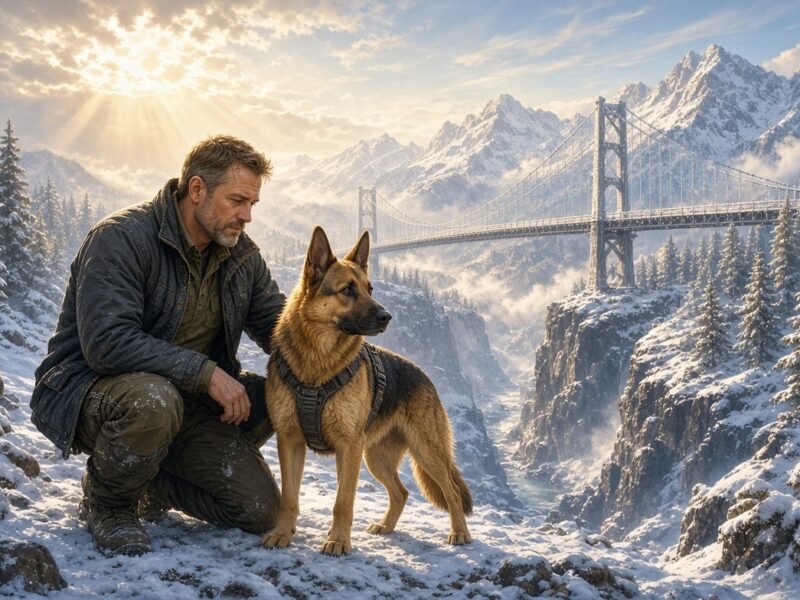
The Dog Who Refused the Bridge — and the Warning That Saved a Town
Greyhaven Ridge was quiet beneath the snow when Cinder stopped at the edge of Starlight Bridge and refused to take another step.
Nathan Vale had seen the German Shepherd freeze from fear before.
But this time, the dog wasn’t afraid.
He was listening.
Beneath the wind, the cables, and the old steel, something was moving where no one else could feel it yet.
For years, Nathan had believed courage meant pushing forward until the evidence forced you to stop.
Cinder was about to teach him that sometimes the bravest choice is to pause before something breaks.
And when the town had to choose between one more celebration and one warning they could not fully explain, everything changed.
Winter did not arrive in Greyhaven Ridge with a storm.
It arrived by taking things away.
First the color from the fields, then the sound from the roads, then the edges from roofs and fences, until the town seemed reduced to white plains, dark pines, and thin columns of chimney smoke rising into the Montana morning.
By late January, even parked cars lost their identities overnight.
Blue, red, gray, it hardly mattered beneath six inches of snow.
Nathan Vale had lived there for almost three years.
Long enough that people at the grocery store no longer called him the new guy.
Not long enough that he had stopped feeling like one.
At 49, Nathan still woke before dawn without an alarm.
His body did not care that he was no longer a Navy SEAL.
It did not care that there were no briefings waiting for him, no flight manifests, no coordinates written in grease pencil across a laminated map.
At 5:11 every morning, he opened his eyes.
At 5:13, he checked the back door, then the kitchen window, then the gas valve near the stove, then the weather display mounted beside the refrigerator, then the old emergency radio on the shelf.
Everything had a place.
Two pairs of boots beneath the coat hooks.
Heels aligned with the edge of the mat.
One ceramic mug beside the sink.
One chair pulled slightly away from the table.
The second chair pushed in.
Always pushed in.
Nathan stood in the kitchen wearing a faded olive-gray henley and charcoal work pants, watching snow collect against the lower half of the window.
His build had thickened with age rather than softened.
He was a little over six feet tall, broad through the shoulders and chest, the kind of man who looked built for carrying weight even when he was standing still.
His dark sandy-brown hair was cut short at the sides, longer on top, and usually left to fall slightly forward.
Gray showed around his ears and the back of his neck.
A close beard covered his jaw, more silver in it than there had been the year before.
The face in the window reflection looked older than 49.
Not tired, exactly.
Used.
His phone vibrated against the counter at 5:42.
Mara Quinn.
“Don’t pretend you forgot. 9:00, rescue station.”
Nathan stared at the message.
Two minutes later, another appeared.
“And don’t tell me the roads have snow. We live in Montana.”
His mouth almost moved.
Almost.
Mara had once served as a reserve military medic before becoming a counselor for the county veterans program.
She was 45 now, narrow-built, red-brown hair usually tied low, with a way of listening that made silence difficult to hide inside.
She had never told Nathan he needed to become normal again.
That was one of the reasons he kept showing up.
Once, during a session he had spent mostly staring at the floor, she had said, “Maybe the problem is that you keep trying to return to a place that doesn’t exist anymore.”
He had disliked the sentence immediately, which usually meant Mara had found something worth saying.
At 8:58, Nathan’s aging Ford Bronco rolled into the gravel lot of Greyhaven Mountain Rescue.
The station sat at the edge of town where the houses thinned and old pines began.
Behind the main building stretched a fenced training yard marked by packed snow, wooden obstacles, scent boxes, and several kennel runs.
The barking started before Nathan shut off the engine.
German Shepherds and Belgian Malinois moved behind chain-link fencing with the alert confidence of animals that understood exactly what was expected of them.
Nathan stepped out wearing his usual outdoor clothes, dark stone-brown tactical pants, weathered winter boots, and a fitted olive drab combat shirt beneath a slate-charcoal field jacket.
The shirt’s camouflage sleeves showed at the cuffs, faint horizontal bands crossing the upper arms.
A black square-faced analog watch with a worn moss-green nylon strap sat on his left wrist.
He checked the time without thinking, then disliked that he had checked it.
“Vale.”
The voice belonged to Owen Mercer.
Fifty-six.
Stocky through the chest, thick forearms, close-cropped silver hair, and a heavy salt-and-pepper mustache that made every expression look slightly more skeptical than it probably was.
Owen wore a weathered olive utility jacket over a dark work shirt, canvas pants, and winter boots stained white with salt.
Nathan nodded.
“Owen.”
“Mara said you were coming.”
“That sounds like her.”
Owen studied him for a second.
Then he looked at the empty passenger seat of the Bronco.
“You want protection?”
“No.”
“Competition?”
“No.”
“Search and rescue?”
Nathan glanced toward the training yard.
A shepherd was sitting perfectly still while a handler walked 20 yards away.
“Not professionally.”
Owen frowned.
“Then what exactly are we doing?”
Nathan put his gloved hands into his jacket pockets.
“I was hoping you knew.”
Owen gave him a look that suggested Mara owed him an explanation.
Still, he led Nathan through the kennel row.
They watched six dogs.
Kaiser, a broad-headed shepherd with clean black-and-tan markings, found a hidden scent pouch beneath snow in less than a minute.
A Malinois named Flint crossed a narrow balance bridge almost without slowing, landed lightly, then snapped into a down position the instant his handler signaled.
Another shepherd ignored two barking dogs while holding a perfect heel.
Nathan noticed everything.
Weight distribution, eye contact, recovery after noise, how quickly each dog shifted from drive to stillness.
He respected them.
He felt nothing.
That bothered him more than he expected.
“These are excellent dogs,” he finally said.
Owen stopped beside him.
“That sounded like a complaint.”
“It wasn’t.”
Then Nathan watched Kaiser stare at his handler, waiting for the next job.
“They already know what they’re for.”
Owen’s eyebrows drew together.
“That is generally considered desirable.”
Nathan almost smiled.
“Usually.”
By the end of the hour, Owen’s patience had thinned.
“Maybe you need a Labrador. Maybe something old.”
“Maybe.”
“With soft ears.”
Nathan turned toward the parking lot.
“That might be your best sales pitch so far.”
He had taken five steps when he heard it.
Not barking, not whining, a light metallic strike from behind the equipment shed.
Clink.
A chain moving against fencing.
Immediately after came the scrape of claws on concrete.
Nathan stopped.
The sound itself meant nothing.
The reaction did.
He looked toward the shed.
“What’s behind there?”
Owen’s face changed only slightly.
Nathan noticed anyway.
“Nothing you need.”
“That’s not what I asked.”
Owen released a slow breath through his nose.
“Cinder.”
Behind the shed was a smaller run, partly sheltered by the building.
A German Shepherd lay near the rear wall.
He was around two years old and lean without being underweight.
His coat was a deep honey-gold beneath an uneven black saddle that dropped heavily over the left hip while leaving more gold exposed on the right.
A small crescent of cream fur showed beneath the right side of his neck.
His left ear stood upright.
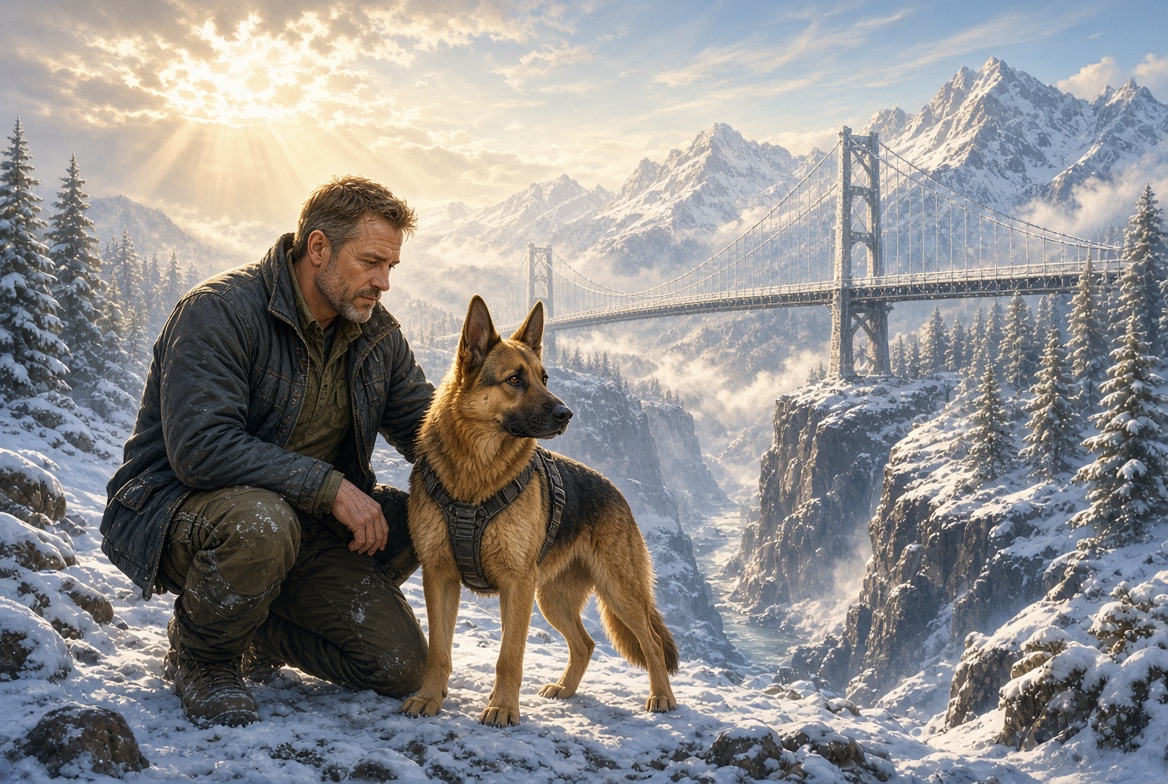
The right did too, mostly, except the tip leaned slightly outward.
When the dog shifted, Nathan saw the right rear paw turn a little away from the body.
But it was the eyes that held him.
Copper brown, still not pleading, not curious.
Cinder looked at Nathan the way a man looked at a door he wasn’t sure would stay open.
Nathan crouched several feet from the fence.
The dog immediately moved backward.
Nathan stopped.
“What happened to the leg?”
“Old injury,” Owen said.
“Healed. Doesn’t keep him from living normally, but professional work is different.”
Another gust pushed the loose chain.
Clink.
Cinder dropped low.
Not violently, not dramatically.
His chest lowered, his ears flattened.
His body seemed to reduce itself.
Nathan felt something inside him become very quiet.
“He’s afraid of metal.”
“Not all metal.”
Owen leaned against the fence post.
“Chains, steel ramps, aluminum loading platforms, anything that vibrates suddenly.”
“Why?”
“We don’t know all of it.”
Nathan looked at him.
Owen added, “He was in a snow rescue program. Good nose. Better than good, actually. He notices changes in terrain that other dogs walk past. But introduce the wrong kind of vibration, and he loses focus.”
“So you cut him.”
“We stopped forcing him into work he couldn’t do safely.”
There was defensiveness in Owen’s voice, but not cruelty.
Nathan understood the distinction.
“What happens to him?”
“Placement. If we find the right one.”
“And if you don’t?”
Owen’s mustache shifted with his jaw.
“We keep looking.”
Nathan turned back to the dog.
Cinder had not moved closer.
That interested him.
Most people wanted some sign that an animal had chosen them.
A tail movement, a cautious step, a nose through the fence.
Nathan found himself relieved that Cinder offered none of those things.
No performance, no bargain, just distance.
Nathan lowered himself fully onto the snow outside the run.
Owen stared.
“What are you doing?”
“Nothing.”
“You’re sitting in the snow.”
“Yes.”
Nathan kept his gaze angled toward the yard rather than directly at Cinder.
Five minutes passed, then ten.
The cold worked slowly through his pants.
Owen left, returned, and apparently decided Nathan had become somebody else’s problem.
Nathan stayed.
He heard the dogs in the main yard, a whistle, a gate latch, a truck starting somewhere beyond the trees.
Behind him, snow slid from the shed roof in a soft rush.
Cinder lifted his head.
Nathan did not look.
A few minutes later came the faint sound of a paw.
One step.
Pause.
Another.
Nathan felt rather than saw the dog approach.
Then something cold touched the knuckle of his glove.
Barely a touch.
A nose.
Nathan did not move.
Cinder retreated almost immediately, two quick steps backward, as though courage had consequences and he had remembered them too late.
Nathan looked at him then.
“Yeah,” he said quietly.
“I know.”
Owen was standing several yards away.
“How long are you planning to sit there?”
Nathan looked at the dog.
“I think I’m meeting someone who doesn’t like being pushed.”
Owen folded his arms.
“Sound familiar?”
Nathan gave him a flat look.
Owen shrugged.
“Just asking.”
An hour later, the Bronco pulled away from Greyhaven Mountain Rescue.
The passenger seat was no longer empty.
Cinder sat pressed near the door, graphite harness snug around his chest, muted teal edging visible against his coat.
His rear paw rested at that slight outward angle.
His eyes tracked telephone poles, snowbanks, passing fences.
Nathan drove with both hands on the wheel.
He did not tell the dog everything would be fine.
He had lived too long to make promises on behalf of the future.
At the first turn, Cinder looked at him.
Nathan glanced over.
“One day,” he said.
The dog watched him.
“We try. One day.”
Nathan returned his eyes to the road.
“Tomorrow can argue for itself.”
Outside, Greyhaven Ridge disappeared and reappeared through drifting snow.
Far to the north, the suspension cables of Starlight Bridge were faint against the white sky, stretched across Harlow Gorge like a pencil line someone had almost erased.
Nathan did not look toward it.
Cinder did, only for a second.
Then the bridge vanished behind the trees, and the Bronco continued toward home.
Cinder did not enter Nathan’s house.
He stood on the porch with snow clinging to the fur around his paws, the graphite harness dark against his honey-gold chest, and stared through the open doorway as if Nathan had invited him into a room full of rules written in a language he did not know.
Nathan waited.
The house sat near the northern edge of Greyhaven Ridge, where the paved road narrowed and the pines began crowding closer together.
It was a low timber place with a steep roof, a narrow front porch, a woodpile stacked under canvas, and windows that looked warmer from the outside than the rooms inside had ever felt.
Nathan stepped through the doorway first.
Cinder stayed where he was.
Nathan glanced back.
The dog looked into the living room, then toward Nathan, then over his shoulder at the road.
The choice was visible in the movement of his eyes.
Nathan understood that better than he wanted to.
Not because he knew dogs, because he knew how quickly a room could stop feeling like shelter once you believed the door might close behind you.
He unclipped the leash and laid it just inside the entry.
“No rules tonight.”
Cinder’s right ear tipped outward.
Nathan went into the kitchen and opened the refrigerator.
He did not coax.
He did not call the dog’s name.
He found leftover chicken, an old jar of mustard, half a loaf of bread, and a carton of eggs.
By the time he had decided none of those things constituted dinner, ten minutes had passed.
When he looked toward the front room again, there were four wet paw prints on the wood floor.
Cinder had crossed the threshold, barely.
He lay beneath the front window where he could see both the main door and the opening toward the kitchen.
Nathan noticed the position.
He also pretended not to.
He set a bowl of water several feet away.
Cinder watched his hands.
Nathan placed food beside it.
Cinder did not move.
“Fine.”
Nathan went back to the stove.
That first night, Cinder did not sleep.
Nathan knew because neither did he.
Every time the furnace pushed heat through the old pipes, the dog’s head came up.
When wind shook the gutter outside, Cinder stood.
When a pine branch brushed the siding, his muscles tightened beneath his coat.
Nathan had expected fear to be loud, whining, pacing, scratching at the door.
Cinder’s fear was quieter than that.
It looked like attention held too long.
By the second evening, Nathan understood something else.
The dog did not react equally to every noise.
The coffee grinder startled him once, but he recovered.
A cabinet shutting too quickly made him flinch but not retreat.
The old heater could click and Cinder would watch it with suspicion.
But when Nathan dropped his keys into the brass dish beside the door, Cinder flattened so abruptly that the movement stopped Nathan halfway through removing his jacket.
The keys had barely made a sound.
A short metallic rattle.
That was all.
Cinder lowered his chest toward the floor.
Nathan slowly picked the keys up again.
He looked at the brass dish, then at the dog.
The next morning, the dish disappeared into a drawer.
The stainless steel food bowl went next.
Nathan replaced it with a heavy ceramic one.
He wrapped a strip of rubber around the loose latch on the woodshed.
He tightened the metal bracket beneath the back steps where winter wind had made it vibrate.
None of it felt dramatic.
That was partly why he kept doing it.
A man could spend years telling himself he could not fix the past.
It turned out there were still screws he could tighten.
On the fourth morning, someone knocked on the porch rail instead of the door.
Nathan looked through the window.
Ruth Taland stood outside wearing a mustard cardigan beneath an open burgundy parka, charcoal wool pants, and snow boots that had probably survived three presidents.
A knitted hat covered most of her white bob, although several strands had escaped around her cheeks.
At 70, Ruth had the compact build and alert eyes of someone who had spent most of her life sitting near radios while other people got lost in mountains.
Retirement had done nothing to convince her she was no longer operational.
She raised a paper bag.
“I brought bread.”
Nathan opened the door.
“Thanks.”
“It isn’t for you.”
Ruth leaned slightly to one side.
Cinder was standing behind Nathan’s leg, not hiding completely, but considering it.
“Well,” Ruth said.
Nathan’s expression changed by less than an inch.
“What?”
“I expected tragic.”
She studied Cinder.
“He looks judgmental.”
“He’s been here four days. Plenty of time to develop standards.”
Nathan looked at the paper bag.
“What’s actually in there?”
“Dog biscuits.”
“You said bread.”
“I lied so you’d open the door.”
“That seems healthy.”
“I’m 70. I’m done applying for moral approval.”
Ruth lowered herself carefully onto the porch step.
She did not reach toward Cinder.
Nathan noticed that.
She placed one biscuit on the porch boards about three feet from her boot.
“I don’t know what you like,” she told the dog.
“But if you’re anything like Nathan, you’ll wait until nobody’s watching and then pretend you never wanted it.”
Nathan turned toward the kitchen.
“You hear this?”
Ruth called after him.
“I’ve figured you both out.”
A laugh escaped him.
Small, rusty, gone almost before he recognized it.
Cinder’s head came up.
The dog looked at Nathan, copper-brown eyes intent, as if the sound required classification.
Nathan stopped walking.
For a second, the room felt different.
Not happier.
That would have been too much to claim.
Just less arranged.
Ruth heard it, too.
To her credit, she said nothing.
When Nathan looked back toward the porch five minutes later, the biscuit was gone.
Ruth pretended not to notice that either.
By the sixth day, Cinder would eat while Nathan remained in the room.
By the eighth, he began sleeping on the faded rug near the wood stove instead of choosing bare floor.
Nathan did not reward those changes with praise.
He had started to suspect that attention itself could become a kind of pressure, so he let improvement pass quietly.
The strangest change was not Cinder’s.
It was his own.
Nathan began speaking, not conversations, announcements.
“Back door,” he opened it.
“Firewood,” he carried in a stack.
“Coffee grinder.”
He switched it on.
“Laundry.”
Cinder watched from the hallway.
“Do not eat my socks. I have very few principles left, but that’s one.”
The dog blinked.
Nathan pointed at him.
“I’m serious.”
It was ridiculous.
But the house started developing a rhythm.
Noise was explained before it happened.
Doors opened and closed.
Nathan left rooms and returned to them.
Morning became something Cinder could predict instead of endure.
On the tenth day, Nathan put on his field jacket and lifted his truck keys from the counter.
Cinder stood immediately, his posture changed.
Nathan saw it.
He hesitated.
For a moment, the simplest choice was to leave.
Just go to the store.
Twenty minutes, half an hour at most.
But he realized he had spent most of Cinder’s first week making the house understandable.
Disappearing without explanation would break the pattern.
Nathan crouched near the entry.
“Store.”
Cinder stared at him.
“I come back.”
The phrase felt foolish.
Nathan said it anyway.
He left.
At the grocery store, he bought coffee, eggs, dog food, a new ceramic water bowl, and three things that had not been on his list.
He was gone 23 minutes.
When he opened the front door, Cinder was not beneath the window.
Nathan’s stomach tightened before he could stop it.
Then he saw the dog standing in the middle of the living room, waiting, not relaxed, not panicked, just there.
Nathan shut the door behind him, hung his jacket, placed the keys carefully on the wooden counter.
“Told you.”
Cinder watched him.
Nathan lifted the grocery bag.
“You could look more impressed.”
The dog walked away.
Nathan stared after him.
“Fair.”
A few days later, Nathan was outside replacing the porch light.
The afternoon was pale and cold, sunlight reflecting sharply from the snow.
Cinder lay inside near the front window.
Nathan had one glove between his teeth and a screwdriver in his right hand when the dog rose suddenly.
Not startled, alert.
Cinder moved to the center of the living room.
Nathan lowered the screwdriver.
The dog placed both front paws squarely on the floorboards, his head tilted, his ears angled north.
Nathan listened.
Nothing.
Cinder remained still.
Then Nathan felt it.
Not heard, felt.
A faint tremor beneath one boot.
So small he might have dismissed it if he had not been watching the dog.
A second later came a low mechanical rumble from beyond the treeline.
Nathan stepped off the porch.
Through the pines, more than 300 yards away, the county snowplow crawled along the upper road.
The vibration reached the ground before the engine reached his ears.
Nathan looked through the open door.
Cinder was still standing in the same place.
“Vibration.”
The dog looked at him.
Nathan walked inside and crouched.
“Is that what you notice?”
Cinder’s right ear tipped outward.
Nathan almost laughed at himself.
Of course, the dog was not going to answer.
But from that afternoon on, Nathan started paying attention differently.
A delivery truck climbing the road.
The garage door shifting on its track.
A heavy branch falling in the woods after ice weighed it down.
Cinder often knew before Nathan heard anything.
He did not always react with fear.
Sometimes he simply planted his paws, listened through the floor, and waited.
That distinction mattered.
Nathan started writing the incidents on the back page of an old notebook.
Not because he knew what they meant, because he did not.
Two weeks after Cinder came home, Ruth arrived again.
This time she carried no food, only a bright folded flyer.
She placed it on Nathan’s kitchen table.
Winterlight Week, Greyhaven Ridge.
Nathan looked at the illustration.
Lanterns strung above Main Street.
Food stalls, music, families.
At the center was the town’s old suspension bridge, Starlight, spanning Harlow Gorge beneath rows of lights.
After two years of repairs, it was reopening to pedestrians for the festival.
“No.”
Ruth had not yet asked anything.
“That’s impressive,” she said.
“You’re refusing invitations before they exist now.”
“I know that flyer.”
“You know paper.”
“I know winter and crowds.”
“Yes. Humanity continues to be inconvenient.”
Nathan pushed the flyer back toward her.
Ruth did not take it.
“Cinder should see more of town.”
“He will.”
“When?”
“When he’s ready.”
Ruth looked toward the living room.
Cinder was sleeping beside the stove, his uneven black saddle rising gently with each breath.
Then she looked back at Nathan.
“And who decides when that is?”
Nathan’s jaw shifted.
“I do.”
“And that’s what I thought.”
He leaned against the counter.
“What exactly are you trying to say?”
Ruth’s voice softened.
“There’s a difference between making a place safe and making it small.”
Nathan said nothing.
She tapped the flyer once.
“For both of you.”
Then she put on her gloves and left.
The kitchen became quiet again.
Nathan stood at the table for a long time.
Eventually, he folded the flyer.
Not into the trash.
Into the top drawer beside the stove.
The next morning, when he opened that drawer for a pencil, he saw the corner of the paper.
He paused, then closed the drawer carefully.
He still had no intention of attending Winterlight Week.
But for the first time, that decision did not feel final.
Starlight Bridge had been standing over Harlow Gorge since 1958.
It was not a grand bridge.
No one traveled across Montana to see it.
No architect had ever called it revolutionary.
It stretched a little over 200 meters between two rocky shoulders above the gorge, narrow enough that people on opposite sides could recognize one another before meeting in the middle.
But Greyhaven Ridge loved it.
In summer, tourists stopped there for photographs.
In autumn, couples tied ribbons to the railing despite the town council putting up a polite sign asking them not to.
In winter, snow collected along the suspension cables until the entire structure looked like a thin silver line drawn between dark hills.
For nearly two years, Starlight had been closed for repairs.
Now it was scheduled to reopen during Winterlight Week.
Nathan still had the festival flyer in his kitchen drawer.
He told himself that had nothing to do with why he drove north on Tuesday morning.
He and Cinder were only walking, that was all.
The sky was pale and nearly colorless.
Fresh snow had settled during the night, softening the road edges and muffling the sound of Nathan’s Bronco as he pulled into a small turnout near the trailhead.
Cinder jumped down carefully.
His right rear foot landed slightly outward, as always, but he showed no discomfort.
He shook snow from his coat and immediately lowered his nose to a patch of brush beside the parking area.
Nathan clipped the leash onto the graphite harness.
“No mission,” he said.
Cinder sniffed the buried pine cone.
Nathan nodded.
“Exactly.”
They followed the trail toward the bridge.
The walk had become part of their routine over the past week.
Not this trail specifically, just walking beyond the house.
A mile through the pines one day, half an hour along the edge of town the next.
Nathan had stopped thinking of each outing as training.
The distinction mattered.
Training implied an outcome.
This was simply practice at being somewhere else.
Cinder seemed to understand that.
He moved easily that morning, stopping at tree trunks, testing old tracks under the snow, watching a raven hop from one roadside marker to another.
At one point, the bird dragged something from beneath the powder and flew off with it.
Cinder followed it with his eyes.
Nathan said, “You’re not catching that.”
The dog looked at him.
“Just managing expectations.”
The bridge appeared gradually through the trees.
First the upper cables, then the towers, then the deck stretching over the gorge.
Workers were still finishing small jobs around the northern approach.
A portable generator hummed beside a maintenance truck.
Somewhere farther across the span, a drill pulsed in short bursts.
Cinder kept walking.
Nathan noticed that first.
The generator did not bother him.
Neither did the drill.
At 40 meters from the entrance, however, the dog slowed, not enough for the leash to tighten, just enough that Nathan noticed the rhythm change.
He let him continue.
Cinder took five steps, stopped.
His front paws planted firmly in the packed snow.
Nathan looked ahead.
Two workers were attaching decorative light brackets to a railing section.
A wrench struck steel.
Cinder did not flinch.
That was important.
Nathan studied him.
“What is it?”
Cinder stepped forward again.
Seven or eight meters, then stopped completely.
His body was not folded low, no flattened ears, no attempt to retreat.
His neck extended slightly, both ears angled toward the bridge.
Nathan took one step.
The leash tightened.
Cinder leaned backward.
Nathan froze.
It was the first time the dog had actively refused to follow him since leaving the rescue station.
Nathan tested the moment rather than the animal.
He shifted his weight forward.
Cinder braced harder.
Not panic, resistance.
Nathan looked at the bridge, then at Cinder.
“Okay.”
He stepped backward.
The leash loosened instantly.
Cinder turned right.
That surprised Nathan.
The dog moved along the temporary fence bordering the northern anchorage, nose low, attention fixed not on the people or deck, but on the ground beside the concrete footing.
Nathan followed.
Cinder stopped beside a low steel utility cabinet partly surrounded by snow.
He sniffed the base, then lowered one paw onto the crusted surface.
Nothing happened.
Nathan waited.
Cinder pressed his weight down again.
Nathan crouched.
He removed one glove and placed his bare fingertips against the frozen ground near the cabinet.
Cold, solid, ordinary.
A worker laughed somewhere behind them.
The drill started again.
Nathan waited.
Thirty seconds, a minute.
He nearly stood.
Then, ting.
So faint he almost convinced himself it had come from the railing.
A small metallic note.
Not above them, below.
Cinder’s head lifted.
Nathan kept his hand against the snow.
Nothing followed.
Then a subtle tremor passed through the surface.
Gone almost before he registered it.
Nathan stood slowly.
A county SUV rolled into the turnout behind him.
The driver’s door opened.
Sheriff Lena Crowe stepped out carrying a pair of gloves and a paper cup she had apparently forgotten to drink.
At 46, Lena had the compact, balanced build of someone who still preferred walking a scene herself rather than receiving photographs afterward.
Her short brown hair was tucked behind one ear beneath a winter cap, and the heavy dark-brown patrol jacket made her tan uniform nearly invisible.
She looked from Nathan to Cinder, then to the fenced anchorage.
“Vale. You starting a new career ruining municipal events?”
“Considering it.”
“That would explain the expression.”
Nathan pointed toward the ground.
“There’s vibration under the north approach.”
Lena looked at the maintenance crew.
“The bridge is under repair.”
“Not from the tools.”
“You heard it?”
Nathan hesitated.
“Barely.”
Lena looked at Cinder.
“He heard it first. Felt it.”
Lena’s eyes moved to the dog again.
She did not smile.
Nathan appreciated that.
Most people responded to an unusual claim by deciding first whether they believed the person making it.
Lena preferred deciding whether the claim could be checked.
“What exactly did he do?”
Nathan explained.
No embellishment, no language about instinct, no suggestion that Cinder understood bridges.
Lena listened.
Then she walked to the anchorage herself.
Five minutes later, she called public works.
Two hours after that, Iris Bell arrived in a mud-spattered utility vehicle.
She stepped out already fastening a blue-gray work jacket.
Nathan had seen her around town before but never spoken to her.
Iris was 38, lean, dark-haired, and carried herself with the efficient impatience of someone whose profession involved objects that did not care about excuses.
Her black hair was tied low at the back of her neck, and a red-and-black laser meter hung from her belt beside a field notebook.
She did not ask Nathan whether he was certain.
She asked him where.
That earned his attention.
Cinder sat several yards from the fence while Iris checked visible bolts, measured small reference points along the concrete, and spoke with the maintenance foreman.
She attached a vibration sensor near the steel housing, then another farther down the footing.
Numbers appeared on the tablet.
Nothing dramatic.
Nathan watched her face instead.
“What?”
Iris did not answer immediately.
She knelt and brushed snow away from a narrow seam beside the concrete.
“There’s no obvious structural emergency.”
Nathan looked toward the bridge.
That sounded carefully phrased.
“It was.”
She stood.
“The visible components are within tolerance.”
“And the invisible ones?”
That made her glance at him.
Then toward the concrete anchorage extending into the hillside.
“That’s the part I don’t like.”
“Why?”
“Because the original documentation is incomplete.”
Lena folded her arms.
“How incomplete?”
Iris flipped through several scanned drawings on the tablet.
“We have the 1958 general plan. We have a repair package from the late ’80s. We have partial updates after a drainage project. But the internal anchorage revisions don’t line up cleanly.”
Nathan looked at Cinder.
The dog was sitting quietly now.
No distress.
That difference stayed with him.
A black SUV arrived beside the sheriff’s vehicle.
Adrien Pike stepped out.
Nathan knew the name before Lena said it.
Everyone in Greyhaven did.
Pike Construction had handled much of the recent Starlight rehabilitation, and Adrien had become one of Winterlight Week’s primary sponsors.
He was 52, tall without looking physically imposing, wearing a charcoal wool coat over dark trousers and black winter boots that had seen less snow than Nathan’s had that morning.
Thin titanium glasses sat low on his nose as he approached.
“Sheriff.”
“Adrien.”
He looked toward Iris.
“Problem?”
“Assessment,” Lena said.
Adrien’s gaze moved to Nathan, then Cinder.
A pause.
“Because of the dog.”
Iris closed the tablet cover.
“No.”
Adrien looked at her.
“We’re here because a 68-year-old suspension bridge sits on rock subjected to freeze-thaw cycles, and one of the north-side sensors is showing a small irregular oscillation.”
Nathan noticed Lena’s mouth twitch slightly.
Iris continued.
“The dog is why someone bothered checking today.”
Adrien removed his glasses and folded them.
A habit, Nathan guessed.
“I fully support checking.”
His voice was controlled.
Not defensive yet.
“But Winterlight starts this weekend. We’re expecting more than 2,000 visitors.”
Nathan looked at him.
“The bridge doesn’t know that.”
Adrien’s attention shifted.
“No, Mr. Vale, but local businesses do.”
Nathan did not answer.
That was fair, more fair than he wanted it to be.
Adrien was not arguing that safety did not matter.
He was reminding them that caution had a cost.
Nathan had spent enough of his life around difficult decisions to recognize the danger in pretending only one side was real.
Iris attached a third sensor.
They waited.
Wind crossed the gorge.
The bridge moved slightly.
It was designed to.
Numbers changed.
Settled.
Changed again.
Iris leaned closer to the screen.
Nathan saw the moment before she said anything.
A narrowing of the eyes, a stillness in the shoulders.
“What?” Lena asked.
“Probably nothing.”
Nathan looked at her.
She exhaled.
“I hate that phrase, too.”
She turned the screen.
One reading had drifted slightly outside the pattern of the others.
Not enough for alarm.
Not enough to order a closure.
Enough that Iris took a photograph of the data and reset the sampling interval.
By midafternoon, Lena ordered a temporary barrier around part of the north anchorage.
The pedestrian approach remained closed as it already had been during repairs.
Festival crews continued working farther back.
Adrien made two phone calls.
Iris stayed another hour.
Nathan eventually took Cinder home.
That should have been the end of the day.
It wasn’t.
That night, Nathan sat at his kitchen table with the Winterlight flyer lying beside his coffee.
He had taken it from the drawer without deciding to.
Cinder slept near the wood stove.
Nathan kept seeing the moment at the bridge.
Not the vibration, not the sensor reading, the refusal.
Cinder had not panicked.
He had known enough to stop.
Nathan had seen people do that before.
A pilot on a mountain strip saying the wind had shifted.
A corpsman asking for another minute to check equipment.
A young operator saying he did not like a route everyone else had already approved.
Nathan remembered the old version of himself.
You need a reason.
You need evidence.
We don’t stop because something feels wrong.
There had been a kind of pride in that man.
Discipline.
Momentum.
The ability to keep moving while other people hesitated.
Nathan had once believed hesitation was something professionals learned to defeat.
Cinder shifted beside the stove.
Nathan looked at him.
The dog’s head remained down.
One ear moved toward the faint groan of snow sliding from the roof, then relaxed.
Nathan looked back at the festival flyer.
For years, he had measured good judgment by how long a person could continue under pressure.
Now he found himself wondering whether he had misunderstood the skill entirely.
Maybe judgment was not only knowing when to move.
Maybe it was also recognizing the moment when going forward stopped being courage.
Nathan folded the flyer once, then set it beside his notebook.
Outside, wind passed through the pines.
Somewhere far north, beyond the dark roofs of Greyhaven Ridge, Starlight Bridge waited over Harlow Gorge.
Nathan could not hear it from the house.
That did not mean it was silent.
Three days before Winterlight Week, Walter Dayne disappeared.
By 10:30 that morning, the temperature had dropped six degrees.
By 11, the wind had started pushing snow sideways across Greyhaven Ridge.
Walter was 79 and had spent 40 years carrying mail through the town before retirement.
He still walked every morning with the same stubborn regularity he had once used to complete his route.
Same brown wool cap, same insulated boots, same old gloves with the leather worn smooth across the palms.
At 7:15, he had left his house.
By 11:00, he had not returned.
His daughter called Sheriff Lena Crowe.
By noon, the community hall had become a search base.
Maps were spread across folding tables.
Thermoses appeared from nowhere.
Volunteers came in carrying radios, snowshoes, extra gloves, and opinions.
Nathan stood near the back wall with Cinder beside him.
He had almost stayed home.
This was not his team.
Cinder was not a certified search dog, and Nathan had spent enough years entering rooms where everyone assumed experience meant obligation.
He no longer wanted every emergency to become his simply because he knew how to function inside one.
Then Lena handed him one of Walter’s gloves.
“His daughter brought this.”
Nathan looked at it, then at her.
“You asking me?”
“I’m giving you the option.”
That mattered.
Nathan crouched.
Cinder sniffed the glove once, then again.
No dramatic change, no sudden pull.
He simply lifted his head and looked toward the western windows.
Nathan followed his gaze.
West.
Cinder moved toward the door.
Deputy Sam Ortega stepped in front of them.
Sam was 31, athletic without being bulky, with warm olive skin, dark eyes, and black hair cut close at the sides.
His midnight navy patrol jacket was zipped to the throat.
Radio cord looped across his right shoulder.
He looked from Cinder to Nathan.
“The West Road.”
Nathan nodded.
Sam frowned.
“That goes toward the old pump station.”
“So?”
“Walter never walks that direction.”
“How do you know?”
“His daughter. Everyone who knows him. He takes Church Road or the River Path.”
Cinder leaned into the leash again.
Not hard.
Persistent.
Sam looked down.
“This dog trained for human tracking?”
“No.”
Sam blinked once.
“Excellent.”
Nathan looked at him.
“You have a better route?”
Sam opened his mouth, closed it.
Lena approached with a map under one arm.
“What’s the argument?”
“Cinder wants west,” Nathan said.
Sam added, “Walter doesn’t.”
Lena considered the map, then the windows, then Cinder.
“Take West.”
Sam looked at her.
“Sheriff—”
“You and Nathan, check the pump road and the low creek line. We already have two teams on Church Road.”
Sam gave a small nod.
Professional disagreement ended where assignment began.
Five minutes later, they were outside.
The wind had strengthened.
Snow moved low over the road, not falling so much as traveling sideways.
Cinder did not hurry.
That surprised Sam first.
“I thought search dogs moved faster.”
Nathan adjusted his gloves.
“He’s not a search dog.”
“You keep saying that like it helps.”
“It helps me.”
They followed the road west.
Cinder kept his nose low, but not constantly to the snow.
Every 30 or 40 yards, he paused, tested the wind, turned his head, moved again.
Nathan began noticing the pattern.
Cinder favored the low places, ditches protected by brush, shallow depressions in the terrain, the lee side of small rises where the wind dropped almost entirely.
“He’s not staying on scent,” Sam said.
“No.”
“Then what is he doing?”
Nathan watched Cinder choose a narrow strip between two stands of spruce.
“Maybe thinking like someone cold.”
Sam gave him a skeptical look.
Nathan pointed ahead.
“If Walter got turned around, he’d try to get out of the wind.”
“That’s not exactly canine deduction.”
“No.”
Nathan looked at Cinder.
“Could just be good terrain sense.”
They kept moving.
A hundred yards later, Sam stopped.
“No tracks.”
Nathan looked down.
Neither did Cinder.
Wind had combed the open ground smooth.
Nathan swept one boot across the snow.
“Anything from this morning would be mostly gone.”
Sam checked his watch.
“We’re losing daylight.”
Nathan did not disagree.
That was the problem.
Search work punished certainty.
Moved too slowly and time disappeared.
Moved too fast and people disappeared with it.
Cinder suddenly veered off the road.
Sam sighed.
“Of course he did.”
Nathan followed.
The dog moved through knee-high brush, angling toward a stand of darker pines.
Nathan felt the wind drop almost immediately.
The ground dipped there.
A person walking blindly through blowing snow could have followed the same line without thinking.
Protection first, directions second.
Nathan looked at Sam.
“You feel that?”
Sam did.
He stopped arguing.
The old pump station appeared 10 minutes later.
It was little more than a concrete utility building with a sloped roof and a rusted service door.
The town had stopped using it years ago after the water system was rerouted.
Snow had piled against one wall.
A narrow metal brace hung loose near the roofline.
The wind moved it.
Clink.
Cinder stopped.
Nathan felt the leash go slack.
The dog’s body changed.
Not the focused stillness from Starlight.
This was older, familiar.
His chest lowered slightly, his right ear flattened.
The metal brace moved again.
Clink.
Cinder’s breathing shortened.
Nathan looked at the closed door, then at the dog.
Sam had already reached for the handle.
Nathan lifted one hand.
“Wait.”
“What?”
“Give him a second.”
Sam looked at Cinder.
“We may have a hypothermic 79-year-old inside.”
“I know.”
That was the difference.
Nathan did not ask everyone else to wait for Cinder.
He stepped closer to the dog.
“You stay.”
Cinder looked at him.
Nathan loosened the leash and placed the handle gently on the snow.
“No job.”
He turned toward the building.
Then a sound came from inside.
Thin, almost lost beneath the wind.
“Hello.”
Sam’s head snapped toward the door.
Nathan called back.
“Walter?”
A pause, then, “Maybe.”
Sam exhaled something that might have been a laugh.
He pulled the door open.
Nathan stepped inside.
The room smelled of cold concrete, dust, and old oil.
Walter Dayne sat in the far corner, wrapped in a faded blue tarp.
His wool cap was crooked.
One bootlace had come undone.
He looked exhausted, pale, and deeply irritated with himself.
Nathan crouched several feet away.
“Walter.”
“That depends on what.”
“Whether my daughter is angry.”
Sam was already on the radio.
“Found him. Conscious. Old pump station, west side. Request medical team.”
Walter closed his eyes.
“She’s angry.”
“Probably.”
“Damn.”
Nathan almost smiled.
They checked him without rushing.
Cold.
Tired.
No obvious serious injury.
Walter explained in fragments that he had taken the river path, seen weather moving in, then tried to cut back toward town.
The blowing snow erased the trail.
He thought the pump station was closer than his house.
By the time he reached it, he no longer trusted himself to keep walking.
“Best decision you made today,” Nathan said.
Walter opened one eye.
“Not setting a high bar.”
A soft scrape came from the doorway.
Nathan turned.
Cinder stood there.
The dog had crossed the threshold on his own.
The metal brace still tapped outside occasionally.
Each sound tightened his posture, but he had come in.
Nathan did not call him closer.
Walter noticed him.
“That yours?”
Nathan nodded.
“Cinder.”
Walter held out a gloved hand, not reaching far, just offering it.
Cinder stopped, looked at Nathan.
Nathan said nothing.
After several seconds, Cinder moved closer.
Walter touched two fingers lightly against the dog’s chest.
Not his head, not his injured leg.
“Good boy.”
Cinder sat.
The metal outside struck again.
Clink.
His ear shifted.
He stayed.
Nathan looked away before the moment became too large.
By the time the rescue team arrived, Walter had started complaining about the tarp color.
Nathan took that as a promising sign.
Back at the community hall, the search operation collapsed into relief.
Walter’s daughter cried.
Walter protested the fuss.
Volunteers clapped Nathan on the shoulder.
He disliked that.
Cinder received a better response.
Someone gave him a biscuit.
Someone else produced cooked chicken.
A third person crouched 10 feet away asking whether photographs were allowed.
Nathan finally said, “He’s a dog, not a mayor.”
A voice behind him answered, “Give it time.”
Ruth Taland appeared carrying something knitted.
Nathan saw the color first.
Deep blue.
“No.”
Ruth held up the scarf.
“I haven’t asked anything.”
“No.”
“I made it last night.”
“No.”
“It took four hours.”
“That was your decision.”
Ruth looked at Cinder, then at Nathan.
“Some people are impossible to appreciate properly.”
Ten minutes later, Cinder was wearing the scarf.
One end hung three inches longer than the other.
He stood beside Nathan, looking profoundly betrayed.
Sam walked past, stopped, and looked at him.
“That dog just found Walter Dayne.”
Nathan nodded.
“And now he looks like he sells artisanal jam.”
Ruth pointed at Sam.
“I like him.”
Nathan laughed.
Not the short surprise sound from his kitchen.
A real laugh.
It came out before he could stop it.
Several people turned.
Nathan noticed.
For once, he did not care.
Cinder looked up at him.
The ridiculous blue scarf shifted against his chest.
Something in Nathan loosened.
Not healed, not resolved, just loosened.
That evening, the house felt quieter than usual.
Cinder slept near the stove with the scarf folded on the chair above him.
Nathan had just poured coffee he did not need when his phone rang.
“Iris Bell.”
He answered.
“Vale? I found another Starlight drawing.”
Nathan straightened.
“What kind?”
“Original anchorage plan, 1958.”
He glanced toward Cinder.
“And the anchor chambers extend farther into the north hillside than the set used during the recent rehabilitation.”
Nathan frowned.
“How much farther?”
“Enough that I went looking for the intermediate inspection records. And they’re missing.”
Nathan waited.
Iris continued.
“There was reinforcement work in 1987. According to the older plan, there should be two inspection cavities along the north anchorage. They’re not shown on the newer documentation at all.”
Nathan stared at the dark window above the sink.
“Could that be what Cinder felt?”
A pause.
“Could be.”
“Could it be dangerous?”
Another pause.
Longer this time.
“I don’t have enough data to tell you that.”
Nathan closed his eyes.
Not enough data.
He had heard those words in different forms for most of his adult life.
Sometimes they were responsible, professional, necessary.
You did not act on fear alone.
You did not turn suspicion into fact because uncertainty made you uncomfortable.
But sometimes, sometimes not enough data simply meant the world had not finished showing you what was wrong.
Nathan looked at Cinder.
The dog was asleep on his side.
One rear paw turned slightly outward.
No tension, no vigilance, just sleep.
Nathan looked down at the notebook on the table.
On one page were his observations about vibration.
On another, a grocery list.
Under that, a reminder from Ruth about replacing the loose porch hinge.
A life made of small evidence.
He picked up a pen.
At the bottom of the page, he wrote: “Two missing inspection cavities.”
Then beneath it: “Unknown does not mean safe.”
He stared at the sentence.
After a moment, he crossed out the last word and wrote instead: “Unknown means check again.”
That felt better, more honest.
Nathan closed the notebook.
Outside, Greyhaven Ridge settled into another cold night.
Three days remained before Winterlight Week, and somewhere inside the north anchorage of Starlight Bridge were two spaces no current map admitted existed.
The next morning, Nathan drove back to Greyhaven Mountain Rescue.
He did not call first.
He did not need to.
Owen Mercer saw the Bronco pull into the lot and stood waiting outside the kennel building before Nathan had shut off the engine.
Cinder stayed in the passenger seat for a moment after Nathan opened the door.
Nathan did not hurry him.
Eventually, the dog stepped down, graphite harness dark against his honey-gold coat, right rear paw turning outward slightly as it met the packed snow.
Owen looked at him, then at Nathan.
“You found Walter.”
“We did.”
“I heard half the town found him by lunchtime.”
Nathan ignored that.
“I need to ask you something.”
Owen’s expression changed.
Not surprise, recognition.
He opened the side door.
“Office.”
The room smelled of coffee, wet coats, and dog food.
Owen sat behind a scarred desk.
Nathan remained standing.
Cinder settled near the wall, not close to either man.
For a while, Owen said nothing.
Nathan let the silence stay.
He had learned that people filled empty space fastest when you did not rescue them from it.
Finally, Owen leaned back.
“There’s something I didn’t tell you.”
Nathan’s face stayed still.
Owen rubbed one thumb along the edge of the desk.
“When Cinder was about eight months old, we were still operating out of the old kennel on County 9.”
Nathan waited.
“Storm came through. Bad one. Wind, ice, power outage.”
Owen looked toward the window.
“Part of the roof skin started lifting. We moved the dogs into the heated main building.”
Nathan’s voice was quiet.
“Cinder?”
Owen swallowed.
“He was in the transition run.”
The room seemed to lose a degree of warmth.
Nathan said nothing.
Owen continued.
“Someone marked him as moved.”
“Someone?”
“One of the night staff.”
“Was he?”
“No.”
Nathan’s jaw tightened.
“How long?”
“About two hours.”
Cinder shifted near the wall.
Owen’s eyes followed him.
“He wasn’t seriously hurt.”
Nathan looked at him.
“That wasn’t my question.”
Owen nodded once.
“No,” he exhaled.
“There was an aluminum loading ramp beside that section. Chains on the service gate. Wind kept throwing both against the structure. The whole place vibrated.”
Nathan closed his eyes for one second.
That was enough.
He did not need Owen to describe darkness or cold or the repetitive metal striking again and again.
He did not need a reenactment.
Cinder had already shown him the aftermath.
Nathan opened his eyes.
“So he wasn’t afraid of metal.”
Owen frowned.
“He was.”
“No.”
Nathan looked down at the dog.
“He was afraid of what the metal meant.”
Owen did not argue.
The distinction seemed to land on him slowly.
“We didn’t do it on purpose,” he said.
Nathan looked back at him.
“I know.”
Owen waited.
Nathan could almost see the question sitting there, but Nathan turned toward the kennel window.
Outside, two handlers were walking dogs through the snow.
One of the younger Shepherds jumped at a gate sound, recovered, and kept moving.
Nathan said, “Not doing something on purpose doesn’t stop it from leaving a mark.”
Owen lowered his head.
Nathan had expected anger to come.
It did not.
That surprised him.
Years ago, he would have preferred anger.
Anger simplified the world.
Someone had failed.
Someone was responsible.
Someone should carry it.
But sitting there, Nathan could see the other truth.
Owen had not forgotten what happened.
He had simply placed it in a category called “accident” and hoped the word would make it smaller.
Nathan knew something about that.
He looked at Cinder.
The dog was watching neither man.
He was watching the door.
Nathan crouched and clipped the leash on.
Owen stood.
“If I’d known what it would turn into—”
“You didn’t.”
“That doesn’t make it better.”
“No.”
Nathan opened the office door, then paused.
“It does matter what you do after, you know.”
Owen looked at him.
Nathan left before the conversation could become an apology neither of them knew how to finish.
That evening, Greyhaven Ridge disappeared early into snow.
Nathan fed Cinder, checked the furnace, brought in wood, made coffee at an hour when coffee was a poor decision.
Then he stood in the doorway of his small office.
He had avoided the room since moving into the house.
Not completely.
Bills were paid there.
Insurance forms filled out.
Things requiring signatures got signed.
But the bottom cabinet beneath the desk had remained closed.
Nathan stared at it.
Cinder stood behind him.
He could hear the dog breathing.
Nathan opened the cabinet.
Inside sat a black plastic storage box.
No dust.
He had wiped around it often enough.
He had simply never moved it.
Nathan bent, lifted the box, and carried it into the living room.
Cinder followed.
The box was not heavy.
It felt heavier.
Nathan placed it on the coffee table.
He sat.
For a long time, he did nothing.
Cinder remained near the doorway.
Nathan rested his hands on his knees.
“There are people who tell you to get rid of this kind of stuff.”
The dog’s right ear shifted.
Nathan looked at the box.
“There are other people who tell you to make a display out of it.”
He ran one thumb over the latch.
“I did neither.”
The latch opened with a dull plastic snap.
Inside were things that would have meant nothing to almost anyone else.
A folded map sealed inside a sleeve.
An old digital watch with a cracked corner.
A photograph of six men standing in front of a helicopter.
A small black keychain.
A cloth name strip: Miles Voss.
Nathan picked up the photograph.
Cinder came one step closer.
Nathan stared at the man standing second from the left.
Miles had been smiling in the picture, not posing, laughing at something happening just outside the frame.
Nathan had forgotten that.
He remembered arguments, briefings, the hospital, the last phone calls, but not the laugh.
“Miles was on my team.”
His voice sounded unfamiliar in the room.
Cinder lowered his head.
Nathan kept looking at the photograph.
“The last time we worked together, weather was moving in.”
He paused.
“There was time to wait.”
That was the part he had spent years trying to rewrite.
Not much time, but enough.
A pilot had suggested holding.
Nathan had pushed for the movement.
Not recklessly, not carelessly.
That was what made it worse.
He had made a defensible call, a professional call, a call that made sense until it did not.
Weather closed faster than expected.
The approach was cancelled.
During the withdrawal, a vehicle lost traction on a mountain access road.
No gunfire, no enemy, no heroic last stand, just bad weather, limited visibility, a chain of decisions.
Miles survived, but his injuries ended his career.
Nathan looked down at the photo.
“He never blamed me.”
Cinder stepped closer.
“That almost made it worse.”
Nathan gave a humorless breath.
“Miles called after. Once from rehab, again three months later, then on my birthday.”
Nathan had watched the phone ring.
Each time he told himself he would call back when he knew what to say.
He never did.
The calls came less often, then stopped.
Nathan had turned silence into punishment and served the sentence himself.
Cinder moved beside the table.
The black keychain inside the box shifted against the plastic wall.
Clink.
The dog flinched.
Nathan saw the muscles in his shoulders tighten, but Cinder did not leave.
Nathan lowered one hand to the floor, palm down, not reaching, just there.
Cinder looked at it, then at the box.
Nathan did not call him.
After several seconds, the dog crossed the remaining distance and sat beside Nathan’s knee, not touching.
Close enough.
Nathan stared at the photograph again.
For years, he had treated memory like a locked room.
Open it and everything inside would spill out.
Leave it closed and at least the mess had boundaries.
But the room had been shaping the rest of the house anyway.
Cinder’s shoulder brushed Nathan’s pant leg, only lightly.
Nathan did not move away.
His phone rang.
He almost let it.
Then he looked at the screen.
Iris Bell.
Nathan answered.
“Vale?”
Her voice was tighter than usual.
“We got into the north anchorage cavity.”
Nathan sat straighter.
“And there’s movement.”
Cinder lifted his head at the change in Nathan’s tone.
“What kind?”
“Not catastrophic. Not yet. But the internal plate alignment isn’t where it should be.”
Nathan stood.
The photograph remained in his hand.
“Close the bridge.”
“Lena wants to.”
“Then why are you calling me?”
A pause.
“Because Adrien wants one more verification cycle before the entire festival plan is changed.”
Nathan looked toward the window.
Snow had begun to fall harder.
“He still thinks it’s safe.”
“He thinks the data is incomplete.”
“Is it?”
“Yes.”
Nathan’s answer came immediately.
“Then close it until it isn’t.”
Iris was quiet.
Nathan knew what he had said.
He also knew how the younger version of himself would have responded.
Incomplete data is not proof.
Keep moving.
Do not confuse uncertainty with danger.
Now he looked at the open box, at Miles smiling in a photograph taken before one decision became six years of silence.
“Iris.”
“I’m here.”
“How long until you know more?”
“By morning. We’re setting additional gauges tonight.”
Winterlight was scheduled to begin at five the next evening.
Nathan walked toward the window.
“Lena should keep it closed until then.”
“I agree.”
“Adrien?”
“He wants the final numbers.”
Nathan looked down.
Cinder had followed him from the table.
The dog stood beside his leg.
Nathan rested one hand against the back of the chair.
Not on Cinder.
Not yet.
“I used to think waiting for proof was discipline.”
Iris said nothing.
Nathan realized he had spoken aloud.
He almost took it back.
Instead, he continued.
“Sometimes it is. And sometimes the warning is the reason you still have time to get proof.”
Iris was silent for a moment.
Then, “I’ll tell Lena you support the closure.”
Nathan nearly laughed.
“My support doesn’t matter.”
“No.”
Iris sounded tired.
“But sometimes people need to know they’re not the only one willing to be unpopular.”
That Nathan understood.
They ended the call.
The house went quiet again.
Nathan returned to the coffee table.
The box was still open.
For the first time in almost six years, he did not close it immediately.
He set the photograph down beside it.
Cinder watched him.
Nathan picked up his phone.
Miles Voss was still in his contacts.
The number might no longer work.
Nathan did not know.
His thumb hovered above the name, then stopped.
Not tonight.
Not because he was afraid of calling, because if he called, he wanted to do it for Miles.
Not to use another man’s forgiveness as medicine for himself.
That distinction felt important.
Nathan sat the phone down.
Cinder sat beside him.
The small keychain inside the box shifted when Nathan moved the table.
A faint metallic tap.
Cinder’s body tightened, then slowly relaxed.
Nathan noticed.
He said nothing.
Outside, snow gathered on the porch railing.
Inside, the box remained open.
So did the office cabinet.
So did the possibility of one day making a call Nathan had avoided for years.
Nathan looked at Cinder.
“Tomorrow they decide what to do with Starlight.”
The dog held his gaze.
Nathan thought of the bridge, of Walter, of Owen, of Miles, of how easily people confused endurance with courage.
He leaned back in the chair.
This time, he said quietly, “We don’t wait for something to break before we start listening.”
Cinder lowered himself beside the table.
Nathan left the box open between them.
By 4:30 the next afternoon, Greyhaven Ridge looked like a town trying to convince winter it could still make its own light.
Hundreds of small bulbs hung above Main Street.
White and gold fabric streamed between storefronts.
Steam rose from paper cups of coffee and cider.
An acoustic trio played beneath a canvas canopy near the square while volunteers carried boxes of lanterns from one table to another.
Winterlight Week had begun, but Starlight Bridge remained closed.
Two sheriff’s vehicles blocked the north approach.
Temporary fencing had been extended around the anchorage.
Beyond it, the bridge waited above Harlow Gorge with none of the lanterns switched on.
Nathan arrived with Cinder shortly before 5.
He wore his slate-charcoal winter shell over the olive combat shirt, dark stone-brown pants, and the worn moss-green watch he had checked too many times that day.
Cinder walked beside him in the graphite harness.
No blue scarf.
Ruth had argued.
Nathan had won one battle.
Iris Bell stood near a folding equipment table, eyes fixed on a tablet displaying live readings from the bridge sensors.
Nathan stopped beside her.
“How bad?”
She did not look up.
“Define bad.”
“You know what I mean.”
“One auxiliary anchorage point is shifting with the wind cycle.”
Nathan glanced at the bridge.
“How much?”
“Less than a millimeter.”
“That sounds small.”
“It is.”
Iris finally looked at him.
“That doesn’t mean I like it.”
Sheriff Lena Crowe approached from the barricade, radio clipped high on her winter jacket.
“What would you do?” Nathan asked Iris.
“With what?”
“If nobody cared about the festival.”
Her answer came without hesitation.
“I would keep the bridge closed.”
Lena heard her.
“That’s enough for me.”
A few yards away, Adrien Pike ended a phone call.
He had traded the wool coat for a dark charcoal parka but still looked more like someone arriving from a board meeting than a construction site.
He walked toward them slowly.
“So that’s it.”
Lena said.
“For tonight, yes.”
Adrien looked at Iris.
“We’re canceling the centerpiece of the largest tourism weekend this town has because of a fraction of a millimeter.”
Iris kept her voice level.
“We’re keeping people off a 68-year-old suspension bridge because the rehabilitation package did not include two internal inspection cavities and one anchorage measurement is changing under wind load. The bridge passed inspection based on incomplete documentation.”
Adrien exhaled and looked toward the square.
More people were arriving.
Families, older couples, teenagers taking photographs beneath the lights.
Business owners who had ordered extra inventory for this weekend.
Nathan understood what Adrien saw.
Not numbers, consequences.
Adrien turned to him.
“And now the whole town is supposed to listen to a dog.”
Nathan did not take the bait.
“No.”
He pointed toward Iris.
“Listen to the engineer.”
Then to the sensor equipment.
“Listen to the measurements.”
Finally, he looked down at Cinder.
“And when something notices a problem before we do, maybe don’t punish it for being early.”
Adrien’s jaw tightened.
For a moment, Nathan expected another argument.
Instead, Adrien looked back toward the bridge.
When he spoke again, his voice had changed.
“So what happens to Winterlight?”
Lena answered.
“We move everything to the square and Main Street. The vendors near the bridge. Relocate the opening ceremony.”
“Cancelled.”
Adrien closed his eyes for a second, then nodded.
“All right.”
No grand concession, no apology, just acceptance.
Nathan respected that more than he expected.
Within 20 minutes, volunteers redirected foot traffic.
Signs went up.
Food stalls near the bridge were moved toward Main Street.
The acoustic musicians relocated beneath the courthouse awning and complained only about the extension cords.
There was disappointment, some muttering, but no panic.
The festival kept going, just somewhere safer.
Nathan stood near the edge of the square with Cinder.
For a strange moment, it almost seemed the worst part of the night had already passed.
Then Cinder rose.
Nathan felt the leash tighten.
The dog stared toward the bridge.
Not at the crowd, not at the lights, at the north tower.
“Cinder.”
The dog took two steps, stopped, his back tightened.
Nathan followed his line of sight.
Nothing.
Wind moved across the gorge.
A strand of decorative fabric snapped against a fence.
Then, ting.
Nathan barely heard it.
Iris did.
Her head came up.
She looked down at the tablet.
One green indicator had turned yellow.
“Lena.”
The sheriff was already moving toward her.
“What?”
“Displacement increased.”
“How much?”
Iris stared at the reading.
“Enough.”
Lena lifted her radio.
“All personnel, clear the bridge approach completely. Move everyone back beyond the secondary barrier. No exceptions.”
No sirens, no shouted stampede.
Volunteers raised their arms and redirected people.
Deputies walked the remaining workers back toward the square.
Nathan took Cinder with them.
A hundred yards, then another 20.
They stopped.
Wind crossed the gorge again.
This time the sound was deeper.
A low metallic groan traveled through the structure.
Cinder’s ears flattened.
Nathan placed one hand lightly against the side of his harness.
The north end of the bridge lowered.
Only a few centimeters, enough for snow to slide from the railing in a white sheet.
Iris stared.
“Anchor slip.”
Adrien stood beside her, his face lost color.
No one needed to say what all of them were thinking.
If the opening ceremony had gone ahead on schedule, people would have been standing there.
Hundreds of them.
Lena’s radio crackled.
“Sheriff.”
Static, then a voice.
“We still have one person below the deck.”
Iris turned sharply.
“Mason?”
Nathan looked at her.
“Who?”
“Mason Reed. Electrical technician. He went down to check the lighting conduit before the final closure.”
Lena grabbed the radio.
“Status?”
Another burst of static.
“Not injured, but the north maintenance ladder is too close to the shifting side. We told them to stay where he is.”
Iris pulled an older drawing from a waterproof folder.
“There’s another access point.”
“Where?”
“South side service stair.”
Lena looked across the gorge.
“Entrance?”
Iris traced the drawing.
“Under the slope. Old steel door.”
Sam Ortega jogged over.
“We can’t see it from the trail.”
Nathan felt the leash pull.
Not hard.
Cinder had turned toward the trees.
Nathan looked at him.
The dog was not focused on the bridge now.
His nose lowered toward the snow.
He moved toward a narrow break in the pines.
Nathan looked at Lena.
“Let me check.”
Lena glanced at Cinder, then at Sam.
“Go together.”
They left the lights behind.
The forest swallowed the festival noise within a minute.
Cinder moved at a steady pace, not tracking Mason.
Nathan knew that.
The man was under the bridge, nowhere near this route.
Cinder seemed to be following terrain again, depressions, cut banks, places where a service route might naturally run.
Sam used his flashlight along the snow-covered hillside.
“Anything?”
Nathan shook his head.
Cinder stopped, turned left.
They followed.
Eight minutes after leaving the square, Sam’s light caught a vertical edge beneath the snow.
“Here.”
They cleared enough powder to expose a low steel door built into the slope.
A chain secured the outer latch.
Wind moved it.
Clink.
Cinder stopped three yards away.
Nathan felt the change immediately.
The old fear.
The dog’s legs stiffened.
His breathing shortened.
Sam reached for the chain.
Nathan held up one hand, not to stop the rescue, only to settle the dog.
He crouched.
Cinder watched him.
Nathan could have called him forward, could have shortened the leash, could have turned courage into obedience.
Instead, he unclipped the lead.
“This is enough.”
Cinder’s ears shifted.
Nathan pointed toward the snowy ground beside the trees.
“You stay here.”
The dog did not move.
Nathan stood.
“Rest is ours.”
Sam looked at him.
“You good?”
“Yeah.”
They opened the door.
The service passage was narrow, concrete, and unheated.
Emergency lights cast pale strips along the wall.
Nathan did not think of the old days, not consciously.
He kept his attention on the present, on Sam’s boots, on Iris’s directions coming through the radio, on the distance to Mason.
They found him 17 minutes later.
Mason Reed was 42, narrow-faced, wearing insulated electrical coveralls and a headlamp that had begun to dim.
He sat on the maintenance platform with his back against a steel beam.
He looked at Nathan and Sam.
“You guys take your time.”
Sam laughed once.
“Sorry. Coffee stop.”
Mason pushed himself to his feet.
“I dropped my radio.”
“That’s your biggest problem?”
“It was a good radio.”
Nathan almost smiled.
The southern route remained stable.
They brought Mason out without rushing.
No injuries, no dramatic leap, just careful steps, radio updates, and one stubborn electrician complaining about municipal equipment.
When Nathan emerged from the service door, Cinder was exactly where he had left him, sitting in the snow, the chain still tapped lightly in the wind.
Clink.
Cinder flinched each time, but he stayed.
Nathan stopped in front of him.
For several seconds, neither moved.
Then Nathan crouched.
His hand went to Cinder’s neck.
Not hovering, not resting on the ground nearby.
He placed his whole palm against the thick fur beneath the dog’s left ear.
Cinder startled.
Nathan felt it, but the dog did not retreat.
Nathan rubbed once, slowly.
That was enough.
A voice behind them said, “Finally.”
Ruth Taland stood beyond the rescue barrier in her burgundy parka, arms folded.
Nathan looked at her.
“How did you get here?”
“I know roads.”
“That’s not an answer.”
“It has worked for 70 years.”
She looked at Cinder, then at Nathan.
“You know that dog didn’t have to go through the door to prove he was brave.”
Nathan said nothing.
Ruth’s eyes settled on him.
“Neither do you.”
For once, Nathan did not have an argument ready.
They walked back toward the square.
Behind them, utility crews shut down the electrical system on Starlight.
One row of lights went dark, then another, then another, until the bridge became a black shape suspended over the gorge.
In the square, Winterlight continued.
Coffee was still poured, music still played.
People still laughed under strings of lamps, but no one stood on Starlight.
Adrien Pike remained near the barricade for a long time.
Nathan passed him without speaking.
Adrien watched the dark bridge.
Finally, he said, almost to himself, “I wanted one more measurement.”
Nathan stopped.
Adrien looked at him.
“One more number before I was willing to lose the weekend.”
Nathan understood the confession for what it was.
Not absolution, recognition.
He said, “You got the measurement.”
Adrien looked back toward the bridge.
“Yeah.”
Nathan walked on.
Cinder moved beside him, not ahead, not behind.
At the edge of Main Street, Nathan looked back once.
The bridge lights were gone.
For years, he had thought darkness meant something had failed.
That night, it meant something had worked.
People had listened.
They had moved early.
No one had needed to be hurt before caution became legitimate.
Nathan rested his hand briefly against Cinder’s neck.
The dog leaned into it for less than a second, then kept walking.
Behind them, Starlight remained dark, and Greyhaven Ridge celebrated anyway.
Spring came late to Greyhaven Ridge.
It always did.
By the first week of April, snow still filled the shaded folds of the mountains and lay in gray-white banks along the north sides of houses.
But water had started moving again.
Roof edges dripped at noon.
Road shoulders reappeared beneath layers of dirty ice.
Small streams cut through fields that had looked frozen solid for months.
The town felt less like it was waking up than remembering how.
The investigation into Starlight Bridge ended without giving anyone the kind of answer people preferred.
There was no single villain, no hidden sabotage, no dramatic document proving someone had known the bridge would fail.
Instead, there were smaller things.
Old construction drawings that had never been properly integrated into later records.
Two inspection cavities missing from the rehabilitation package.
A north anchorage section that had received less scrutiny than it should have.
A schedule built around Winterlight Week.
Several measurements that had seemed too minor individually to justify delay.
And people who had believed there would always be one more chance to check.
Adrien Pike stood before the town council in March and accepted responsibility for pushing the schedule too aggressively.
Nathan watched the meeting from the back of the room.
Adrien did not make excuses.
He also did not perform remorse for the crowd.
He explained where the process had failed, what his company had missed, and which costs Pike Construction would help absorb during the reinforcement work.
Some people were angry.
Some wanted more.
Some thought he had already paid enough.
Nathan did not join any of them.
He had learned that accountability was not the same thing as public humiliation.
Adrien stayed in Greyhaven.
That mattered to Nathan.
It would have been easier to sell the company, blame an engineer, leave town, and allow distance to make the story simpler.
Instead, Adrien remained.
He attended construction meetings, answered questions, stood beside Iris Bell while she explained why sections of the anchorage would be opened and rebuilt.
He took criticism without pretending a single apology erased anything.
Nathan respected him more for staying than he ever had for being successful.
Starlight remained closed through spring and most of summer.
And while the bridge was being rebuilt, something else changed on the other side of town.
Greyhaven Mountain Rescue started a new program.
Owen Mercer called Nathan in late April.
Nathan answered the phone while repairing a section of fence behind the house.
“No.”
Owen was silent.
“I haven’t asked yet.”
“You were about to.”
“That’s irritating.”
“I’ve been practicing.”
“Oh.”
Inside.
“We’re starting a small pilot program.”
Nathan leaned against the fence post.
“What kind?”
“Dogs that don’t fit standard placements.”
Nathan looked toward the yard.
Cinder was lying in a patch of sun beside the porch, asleep on his side.
His right rear paw turned outward.
“What does that mean?”
“It means I’m tired of throwing away useful dogs because they’re useful in inconvenient ways.”
Nathan said nothing.
Owen continued.
“Terrain sensitivity, confined area work, noise discrimination, environmental changes. Stuff that doesn’t fit neatly into one certification track.”
“You want Cinder.”
“I want you both.”
Nathan frowned.
“For what?”
“Volunteer support. No command role.”
“I didn’t offer one.”
“No instructor title.”
“You really do think highly of yourself.”
Nathan almost smiled.
Owen added, “You’d work with dogs that need slower introductions. Help handlers stop treating hesitation like disobedience.”
Nathan looked at Cinder again.
The dog had opened one eye.
“Name?”
“What?”
“You gave the program a name, didn’t you?”
A pause.
“Second Watch.”
Nathan closed his eyes.
“That’s terrible.”
“Ruth likes it.”
Nathan opened them again.
“That explains everything.”
The name stayed.
So did Nathan.
Not full-time, not as a trainer in the formal sense.
He helped two mornings a week, sometimes three.
He worked with dogs who froze at unfamiliar flooring, dogs who needed longer recovery after noise, dogs who excelled at one task and failed spectacularly at another.
He did not try to turn them into Cinder.
That was the point.
Cinder became the first official dog in Second Watch.
Official, Nathan learned, was a generous word.
Cinder still disliked chains.
Sudden metallic vibration could tighten his body before thought caught up.
Metal bridges required patience.
On windy days, he sometimes paused at Nathan’s front door and reconsidered whether outside was worth the trouble.
But something fundamental had changed.
He now knew Nathan would not pull.
That knowledge did not erase fear.
It changed what fear meant.
By September, Starlight Bridge was ready to reopen.
This time, Greyhaven did not organize a spectacle.
No stage, no band, no fireworks, no sponsor banner stretched across the entrance.
Just a cold morning, perhaps 50 residents, a few officials, several engineers, and one simple wooden sign installed near the north approach.
“Stay curious. Listen early. Go home safe.”
Ruth Taland stood in front of it with her arms folded.
“I still think there should be a picture.”
Nathan stood beside Cinder.
“No.”
“One small one.”
“No.”
“Just his head.”
“No.”
“One ear.”
“Ruth.”
“What? His right ear is very distinctive.”
Nathan looked at her.
Ruth considered another option.
“Paw print.”
“No.”
She sighed.
“You have no appreciation for branding.”
“I’m trying to protect the town from joy. Mostly from you.”
Sheriff Lena Crowe heard that as she approached and shook her head.
“Are you two finished?”
Ruth answered, “No.”
Nathan answered, “Yes.”
Lena chose to believe Nathan.
There was no speech longer than two minutes.
Iris said a few words about the reconstruction.
Adrien thanked the crews and kept his remarks brief.
Then Lena cut a plain white ribbon.
People began walking.
Some crossed immediately, others stopped halfway to look down into Harlow Gorge.
Nathan remained at the entrance.
Cinder stood beside him.
The dog stared at the deck.
Wind moved gently through the suspension cables.
A low metallic hum drifted across the gorge.
Cinder stiffened.
Nathan felt it through the leash.
He did nothing.
Behind them, people quietly walked around.
No one complained.
No one told Nathan to move.
No one laughed at the dog.
A year earlier, Nathan might have hated being observed.
Now he barely noticed.
Cinder took one step, stopped.
Nathan stayed beside him.
A minute passed, then another.
Cinder put one front paw onto the bridge, then the second.
He stood there, half on the deck, half on solid ground.
Nathan did not encourage him, did not say good boy, did not shorten the leash.
Cinder looked up.
Nathan met his eyes.
“You don’t have to prove anything.”
The wind moved again.
A faint vibration traveled along the railing.
Cinder’s ears shifted.
He turned forward and stepped.
Three paces.
Pause.
Another two.
Nathan followed.
Not leading, not trailing, matching him.
At 20 yards, Cinder stopped again.
Nathan waited.
People passed on the left.
An older couple smiled but said nothing.
Sam Ortega walked by from the opposite direction, raised one hand, and continued without comment.
That silence was a kind of kindness Nathan had not understood when he was younger.
Not every difficult moment needed witnesses to become an event.
They reached the middle of the bridge 11 minutes after starting.
Below them, Harlow Gorge was changing seasons.
Water rushed around the last shelves of ice.
Brown rock showed through melting snow.
Pines climbed the opposite slope, dark and steady.
Cinder stood looking down.
Nathan rested one hand lightly against the harness.
Years ago, he had believed courage meant continuing.
Keep moving.
Finish the route.
Hold the line.
Push through uncertainty until someone gave a reason strong enough to stop.
He had built an identity around endurance.
Now he understood something he wished he had learned earlier.
Stopping was not surrender.
Listening was not weakness.
Checking again was not fear.
And uncertainty did not always need to be conquered.
Sometimes it only needed to be respected.
Cinder looked forward, then continued.
Nathan went with him.
When they stepped off the south end of the bridge, Ruth was waiting.
She checked her wristwatch.
“Eleven minutes.”
Nathan shrugged.
“It’s 200 meters.”
“That is not a defense.”
“No schedule.”
Ruth stared at him, then smiled.
“Well.”
Nathan raised an eyebrow.
“What?”
“You finally learned something.”
He looked back at the bridge.
Cinder was doing the same.
“No hurry,” Nathan said.
Ruth nodded.
“That the reopening made the local paper.”
Cinder’s photograph did not.
Ruth complained for three days.
That evening, Nathan drove home before sunset.
He opened the front door.
Cinder entered first.
That stopped Nathan.
The dog did not pause on the threshold.
Did not check the living room.
Did not glance toward the road behind him.
He walked directly to the wood stove, turned twice, and lowered himself onto the rug.
Nathan stood in the doorway holding the leash.
Something about the ordinary nature of it landed harder than the bridge had.
He closed the door, hung the leash on its hook.
Beside it hung another, new, dark green.
Tomorrow, a female German Shepherd from the rescue station was coming to stay for several weeks.
Owen had described her as intelligent, capable, distrustful of unfamiliar people, and currently incompatible with everyone’s expectations.
Nathan had said no, then asked what time she was arriving.
Owen noticed.
Nathan denied everything.
Two ceramic water bowls sat near the kitchen wall now.
Cinder’s, and another waiting empty beside it.
Nathan walked into the living room.
The black storage box from his office was still on the low table.
It had never returned to the cabinet.
The photograph of six men rested beside it.
Miles Voss stood second from the left, still laughing.
Nathan had finally called him one month earlier.
The number had worked.
Miles answered on the fourth ring.
There had been no dramatic forgiveness, no speech about the past.
Miles had simply said, “You took your damn time.”
Nathan had replied, “Yeah.”
Then neither man had known what to say for nearly 30 seconds.
The call lasted one hour and 53 minutes.
They talked about rehab, Miles’s second marriage, his daughter applying to college, Nathan’s house, Greyhaven, Cinder.
At one point, Miles asked if Nathan was calling to apologize.
Nathan had thought carefully before answering.
“Partly. And the other part to stop pretending not calling you changes what happened.”
Miles had gone quiet, then said, “Better reason.”
Nothing disappeared after the conversation.
Nathan still remembered the mountain road.
Miles still lived with the consequences.
Forgiveness had not reached backward through time and made the decision harmless.
Nathan no longer expected it to.
Healing, he had discovered, was less impressive than that.
It was calling again the next Sunday and the Sunday after.
It was leaving the box in the light.
It was walking a bridge in 11 minutes when other people could cross in four.
It was learning not to demand that fear disappear before life continued.
Outside, the first early snow of the season began drifting past the window.
Nathan dimmed the lamps.
Cinder sighed from the rug.
On the chair nearby lay the blue scarf Ruth had knitted months ago.
Cinder still hated it.
Nathan intended to keep it forever.
He looked around the room.
Two ceramic bowls.
Two leashes.
An open box.
A photograph that no longer needed to be hidden.
Tomorrow, another dog would stand on his porch.
She would not know Nathan.
She would not know Cinder.
She would not know whether the open door meant shelter, expectation, or another place where she might fail.
Nathan understood that feeling.
He understood it better now than when Cinder had first stood outside that same door.
He walked toward the stove and lowered himself into the chair beside it.
Cinder opened one copper-brown eye.
Nathan looked at him.
“Sleep.”
The eye closed.
Nathan leaned back.
The wind moved around the house.
A pipe clicked softly behind the wall.
Cinder’s ear flicked.
Nothing more.
For once, no one got up to check the door.
No one needed to stand guard.
The house was not safer because every frightening sound had disappeared.
It was safer because something had changed between the sounds.
There had been returns, promises kept without ceremony, doors left open long enough for someone to choose, and room made for things that had once been labeled wrong.
Nathan looked at the second leash hanging by the entrance.
Tomorrow would be complicated.
That was all right.
He had once believed broken things needed to be repaired before they were useful again.
Cinder had taught him otherwise.
Some things did not need to become what they were before.
Some never should.
Sometimes all a living thing needed was a place where nobody demanded proof that it deserved to stay.
Outside, snow gathered quietly along the porch rail.
Inside, Cinder slept, and Nathan Vale finally understood that beginning again did not look like returning to the person he had been.
It looked like making room for whoever came next.
Sometimes healing doesn’t mean becoming who we were before the loss.
It means learning that the past can remain part of us without becoming the place where we live.
Nathan and Cinder both carried memories they could not erase.
What changed them was not one dramatic miracle, but something quieter.
Patience, a door left open, a warning taken seriously, and someone willing to stay.
Maybe grace often looks like that in our own lives, too.
Not the removal of every scar, but the strength to take one more step without walking alone.









