The Dog the Flood Tried to Bury — and the Secret He Carried Back to Town
The creek was still roaring when Ranger started barking.
It was 7:40 on a Tuesday morning in northern Minnesota, and the snowmelt flood had finally begun to drop.
Caleb Rowan eased his old Ford F-150 onto the gravel shoulder of County Road 12, coffee sloshing in a dented Thermos from a Duluth gas station.
The ditches shone like spilled mercury. Patches of dirty snow still clung beneath the birches.
Everything looked peaceful. That was what made the bark so wrong.
Ranger never barked at deer. He never barked at floating trash.
He barked at things that needed a human being, right now.
And on the far side of the water, under a tangle of broken fence wire and a beam the flood had dragged down from somewhere upstream, something lifted its head.
A dog.
Old, gray-muzzled, trembling in the freezing current, as though someone had wanted him to disappear forever.
Caleb did not know it yet, but that dog was carrying a secret that had been buried for four years.
And around his neck, hidden beneath the mud, was the one thing somebody in Brightwater Falls had been praying would never come back.
Spring had come to Brightwater Falls the way it always did, in the sound of running water.
For months, the town had been locked under snow and ice.
Then the temperature climbed, slowly at first, and the white slopes began to loosen.
Water slipped beneath the last frozen layers. It ran through birch roots and across old pasture lines, then poured down toward the northern creek.
By the third warm morning, the creek had jumped its banks.
It carried pine branches, rotted fence posts, coils of dead vines, and mud so dark it looked almost black under the sun.
Now the water was falling back, leaving the valley scrubbed clean in some places and torn wide open in others.
Caleb had gotten the call from Mrs. Harlan just after sunrise.
She was seventy-eight, a widow who lived alone near the wooden bridge north of town.
Small and narrow-shouldered, with silver hair pinned under a dark green scarf and clear brown eyes that missed very little.
Since losing her husband twelve years earlier, she had learned to fix loose boards, split kindling, and haul groceries through snow without asking anyone for a thing.
That was exactly why Caleb listened when she did call.
“The fence near the creek is leaning,” she told him.
Her voice was steady, but he could hear the strain underneath it.
“I don’t need it fixed today, Caleb. I just need to know if it’s going to land in the road.”
“I’ll take a look,” he said.
He did not tell her to stay inside.
Mrs. Harlan hated being ordered around, especially by men young enough to be her sons.
So instead he said, “Do me a favor and stay off the lower pasture until I get there.”
“I’ll think about it,” she said, which was as close to yes as she ever got.
Caleb was thirty-five, six feet even, built with the compact strength of a man trained for endurance rather than show.
He had left active Navy SEAL operations behind, but the discipline had never quite left him.
Clean-shaven. Square jaw. Dark brown hair cut close, a little longer than regulations once allowed.
His gray-blue eyes had a steady, watchful quality that made people feel noticed without feeling judged.
He wore what he always wore for work around town.
An old gray tactical shirt, softened by years of washing and frayed at the cuffs. A dark red thermal underneath.
Earth-brown and moss-green cargo pants worn thin at the knees. Old military work boots. A scratched field watch on his left wrist.
People sometimes asked why he spent so much time fixing gates, checking bridges, and pulling stranded cars out of the mud.
Caleb never gave the full answer.
After years of serving in places where help always arrived too late, he had made himself one quiet promise.
Whenever he could, he would be early.
Ranger rode shotgun.
The six-year-old German Shepherd had a lean working frame, a cream-gray coat that darkened along the spine and ears, and amber eyes that measured every movement around him.
He wore a black harness with dark red trim.
Ranger was calm by nature, disciplined without being mechanical, and he rarely wasted energy on noise.
When he barked, Caleb listened.
So when Ranger’s head snapped toward the passenger window that morning, Caleb’s foot was already off the gas.
A low sound rolled through the dog’s chest. Then one sharp, focused bark.
“What is it, buddy?”
Ranger pressed against the glass, staring at a narrow side creek beyond a stand of young birches.
Caleb pulled over and opened the door.
Ranger was out before Caleb could grab the harness handle.
The Shepherd sprinted toward the water, not wild, not reckless, but with an urgency that made the hair on Caleb’s arms stand up.
“Ranger!”
The dog did not come back.
In six years, he had never once ignored that voice.
Caleb ran.
He followed through wet grass and around a cluster of rocks the falling water had just exposed.
The side creek was narrower than the main channel, but still fast and mean. Cold water curled around stones, dragging leaves and thin branches downstream.
Ranger stood at the near bank, barking across the current.
At first Caleb saw only gray wood, twisted wire, and mud.
Then the mud moved.
An old German Shepherd lay on a thin strip of muddy ground between the rocks and the water.
A heavy wooden beam had pinned one hind leg. Vines and a section of rusted fencing had wrapped around the limb and tightened as the flood shifted everything into place.
The water ran past his paws but did not cover his body.
His coat was gray-black, soaked, streaked with mud. His frame was painfully thin.
His pale amber eyes were clouded with exhaustion.
But he was still watching. Still waiting.
Caleb’s chest tightened.
He had seen that look before, and not only in animals.
He had seen it in people who had stopped expecting rescue, because hoping had started to hurt too much.
The old dog tried to move as Caleb stepped into the creek.
The beam shifted. The dog froze.
“Easy,” Caleb said. “Easy now.”
The water came up over his boots, colder than he expected, sharp enough to bite straight through the leather.
The current shoved at his legs. The stones underneath were slick with algae.
Ranger paced the bank, giving a short warning bark every time Caleb’s boot found a loose rock.
Caleb stopped a few feet away from the trapped dog.
“You don’t know me,” he said quietly. “That’s okay.”
He crouched sideways instead of facing the dog head-on, keeping his hands slow and visible.
Trust could not be demanded, especially from a frightened animal.
It had to be offered in small pieces.
No blood. No open wound. That was good.
But the dog had been out here long enough for exhaustion to turn dangerous.
Caleb reached for the beam.
The old Shepherd flinched.
Not toward him. Away.
He had not tried to bite. He had simply braced himself for pain.
Something inside Caleb went very still.
He knew better than to write a whole history from one reaction.
But the dog’s body seemed to remember something his mind no longer had the strength to fight.
“Nobody’s hurting you today,” Caleb said.
For a moment, the creek was the only sound between them.
Then the old dog’s eyes slid past Caleb, toward Ranger.
The younger Shepherd had gone quiet. He stood at the edge of the water, alert but not threatening.
The old dog’s breathing slowed, just a fraction.
It was not trust. Not yet.
But it was permission.
Caleb wedged both hands under the beam and lifted.
The soaked wood was heavier than it looked. Ice water ran down his sleeves as his shoulders locked under the weight.
He raised it just enough to take the pressure off, then kicked a thick branch underneath to hold it.
He drew his knife and cut the vines one at a time.
He peeled the rusted wire away slowly, making sure no sharp edge touched skin.
When the leg finally came free, the old dog didn’t move.
“You’re clear,” Caleb whispered. “You’re clear, old man.”
The Shepherd tried to stand.
His front legs straightened. His hindquarters rose halfway. Then his strength gave out.
Caleb caught him before his head hit the mud.
The dog went rigid in his arms, every muscle braced for something terrible.
And then nothing terrible happened.
Caleb just held him.
That was when Ranger stopped watching the creek.
The younger dog turned toward the wooded hillside and went perfectly still, ears forward, body low.
Caleb followed his gaze.
Pine trunks. Thin morning mist.
And for one brief second, a flash of sunlight on something dark beneath the trees. Glass, maybe. Or metal.
Then it was gone.
Ranger let out a low, controlled growl.
Whatever was up on that hill was not part of the flood.
And it was watching them.
Caleb forced his eyes back to the dog in his arms. Whatever waited on the hill could wait one more minute.
The hind leg was stiff but didn’t feel broken. The paws were worn down, the nails dulled from walking over hard ground.
Under the creek mud, a fine reddish dust clung to the lower coat.
Around the dog’s neck was an old leather collar, darkened by age and water.
No tag. No name. Nothing.
Just cracked brown leather that looked older than the flood, older than the winter, maybe older than the dog’s last good year.
Caleb would think about that collar a lot in the days to come.
Right now, it was just an old strap of leather on a lost dog.
It would turn out to be the most dangerous thing in Brightwater Falls.
Ranger crossed upstream where the water ran shallow and approached slowly, head low, shoulders loose.
He stopped several feet away and waited.
The two dogs looked at each other for a long moment.
Then the old Shepherd let out a long breath. His ears softened. His body stopped pushing backward.
He had not decided the world was safe.
He had only decided that, for this moment, these two strangers might not make it worse.
Caleb pulled off his outer jacket and wrapped it around the dog’s soaked body.
When he lifted him, the dog was shockingly light. Maybe fifty pounds. A healthy male Shepherd should have weighed closer to eighty.
At the truck, Caleb laid him on a folded blanket behind the front seats.
Ranger climbed in and settled close, near enough to protect, far enough to respect.
Caleb dialed the clinic.
“Whitcomb Veterinary.”
“Nora, it’s Caleb. I found an old Shepherd by the north creek. Maybe ten, eleven years old. Trapped after the flood.”
“Conscious?”
“Yeah. Cold, thin, exhausted. No open wounds I can see.”
“Breathing?”
“Shallow, but steady.”
“Keep him warm. No food yet. I’ll have the treatment room ready.”
“Ten minutes,” Caleb said.
He hung up and looked back at the hillside.
This time he saw it clearly.
A dark blue SUV, parked where the road curved behind the pines, almost invisible unless you were looking straight at it.
The windows were tinted too dark to see the driver.
Nobody got out to help. Nobody called across the water.
Caleb took one step toward it.
The SUV reversed. Slowly at first, then it swung behind the trees and climbed away up the muddy road.
Caleb memorized what he could. Dark blue. Broad rear frame. A Minnesota plate half buried under dried mud.
Ordinary people came closer when they saw an animal in trouble.
They didn’t hide.
On the drive back into town, the old dog stirred under the jacket.
As the truck passed the weathered sign that read WELCOME TO BRIGHTWATER FALLS, POP. 2,814, his pale eyes opened.
He wasn’t looking at Ranger. He wasn’t looking at Caleb.
He was staring out the window at the town, with an intensity that made the back of Caleb’s neck prickle.
As if those streets weren’t strange to him at all.
As if somewhere inside that worn-out body, an old path had just woken up.
The dog hadn’t been wandering, Caleb realized.
He had been trying to get home.
The doors of Whitcomb Veterinary Clinic swung open before Caleb had even put the truck in park.
Dr. Nora Whitcomb stepped into the morning light with a folded blanket over one arm and a stainless steel tray balanced against her hip.
She was forty, medium height, slim but sturdy, with pale northern skin and chestnut hair tied low at the back of her neck.
A few loose strands had escaped around her temples. Her gray-green eyes took in the truck, Ranger, Caleb, and the old dog in one sweep.
She wore a faded blue-gray clinic coat over a cream sweater, dark trousers, and rubber-soled boots built for long hours on wet floors.
Nora was known around town for speaking gently to animals and bluntly to people.
Years of treating injured working dogs had taught her that false comfort never helped anyone.
“Side entrance,” she said.
When she approached the truck, Ranger shifted just enough to put his body between her and the blanket.
Nora stopped. She didn’t reach in. She lowered her hand and let him study her.
“Protective,” she said.
“Careful,” Caleb corrected.
Nora glanced at him, then back at Ranger. “That, too.”
The treatment room smelled of disinfectant, wool blankets, and the faint metallic scent of equipment.
A heating pad was already waiting on the exam table. Caleb laid the old dog on it.
The Shepherd tensed at once. His head came up. His tired eyes went from Nora’s hands to the door, then to Ranger.
“Keep Ranger where he can see him,” Nora said.
Caleb gave a quiet command. Ranger settled beside the table.
Only then did the old dog let his head rest again.
Nora worked fast but never rushed. Heart. Gums. Ribs. The trapped hind leg.
“Dehydrated,” she said. “Moderately underweight. Mild hypothermia. Old damage in the rear joints, but I don’t feel a fresh fracture.”
“Can he recover?”
Nora didn’t answer right away. She lifted one paw, studied the worn nails, the cracked pads.
“He’s been walking a long time,” she said finally. “Not hours, Caleb. Days. Maybe weeks.”
She started fluids and wrapped him in warm towels.
“No food until his temperature comes up,” she said. “Then small amounts.”
The old dog watched every movement with a kind of weary patience. He didn’t snap. He didn’t struggle.
He just endured.
That bothered Caleb more than fear would have.
Fear still expected something from the world. Endurance expected nothing at all.
Nora took a damp cloth to the mud on the dog’s neck, and the old leather collar came into view.
Dark brown. Cracked. Softened by years of wear.
When she slipped two fingers beneath it, the dog stiffened. A deep sound formed in his chest. Not quite a growl.
Nora stopped instantly.
“I need to take it off,” she said softly. “But I’m not forcing him while he’s this weak.”
Caleb crouched near the dog’s head.
“You’re safe,” he said.
The words felt thin. Safety wasn’t something a stranger could hand over in a sentence.
It had to be proven, over and over, in every moment when harm could happen and didn’t.
Ranger rose and laid his muzzle near the edge of the blanket.
The old dog looked at him. Slowly, his jaw loosened.
Nora unbuckled the collar. It gave with a dry click.
When she turned it over under the exam light, her face changed.
Not much. Just enough for Caleb to notice.
“What?”
Stamped on the inside of the leather, half worn away, was a small symbol.
A triangle set inside the shape of a claw mark.
Beside it, three letters. NSK.
Nora ran her thumb over it.
“You know it,” Caleb said.
“I’ve seen something like it.”
“Where?”
She looked at the old dog before she answered.
“Years ago. A transfer record for retired working dogs. The outfit was called Northline Security K9.”
“Never heard of them.”
“They placed protection dogs with elderly property owners. Remote farms. Widows living alone out past the county roads.”
She paused.
“At least, that was the brochure version.”
“You don’t sound convinced.”
“I’m not saying anything yet.”
That was Nora. She refused to build certainty out of a single clue.
But Caleb noticed she didn’t set the collar on the counter.
She slid it into a clean, sealed evidence bag.
The front bell jingled.
Heavy footsteps crossed the waiting room, and Deputy Mason Vail filled the treatment room doorway.
Mason was forty-two, tall and solidly built, with broad shoulders that stretched his navy winter jacket tight across the back.
Long, angular face. Clean-shaven. Light brown hair cut short and kept neat.
Pale gray-brown eyes that seemed polite until you looked at them a little too long.
Fifteen years with the county sheriff’s office had earned him a reputation.
He knew everyone’s name. Remembered every property dispute. Stayed calm in every emergency.
People often mistook that calm for kindness.
Mason rested a hand near his duty belt.
“Heard you brought in a German Shepherd.”
Nora didn’t invite him in. “He’s receiving treatment.”
Mason’s eyes went to the old dog first. Then to the evidence bag. Only after that did they land on Caleb.
“Where exactly did you find him?”
Something sharpened inside Caleb. Not fear. Recognition.
The deputy hadn’t asked whether the dog was going to live.
“Off County Road 12,” Caleb said.
“Which stretch of creek?”
“Why?”
“Procedure.” Mason’s smile didn’t move. “Was there a leash nearby? Training gear? Anything personal?”
“No.”
“You didn’t bring anything else back with you?”
Nora folded her arms. “What precisely are you investigating, Deputy?”
“Possible ownership issue.”
“You got here awfully fast for an ownership issue.”
Mason’s gaze flicked to her.
“Someone called in. Said Rowan’s truck left the north creek with an injured dog.”
And there it was.
Whoever had been sitting up on that hill hadn’t just watched.
They had made a phone call.
Mason stepped closer to the table. The keys on his belt clinked together.
The old dog reacted like he’d been struck by lightning.
His whole body locked. His head came up. A low growl rolled out of him, the first real sound he’d made all morning.
Ranger was on his feet in an instant.
He moved between Mason and the table. No lunge. No bark.
He simply put his body where the deputy would have to go through him.
“Ranger,” Caleb said evenly.
Ranger held his ground.
For the first time, Mason’s smile slipped.
“Dogs react to uniforms,” he said.
Nora wasn’t looking at Mason. She was looking at the old dog.
“That wasn’t the uniform.”
“Excuse me?”
She nodded at his belt. “It was the keys.”
Mason glanced down as if surprised. “Same difference.”
Caleb didn’t believe that for a second.
The old Shepherd wasn’t staring at the jacket, or the radio, or the badge.
He was staring at Mason. When Mason shifted a step to the side, the dog’s eyes followed him. Not the movement. The man.
Then, with what little strength he had, the old dog dragged one front paw across the table toward the evidence bag.
His nails scraped the steel. Once. Twice.
As if he understood that old piece of leather mattered.
As if he was afraid Mason understood it, too.
Nobody spoke.
Nora stepped between Mason and the counter. The deputy noticed.
Whatever warmth had been left in his face drained out of it.
Then the smile came back, smoother than before.
“He’ll need to come down to the station. We can verify ownership there.”
“He can’t be moved,” Nora said.
“I can arrange transport.”
“You can bring me a court order.”
Mason held her eyes. Nora didn’t look away.
She had faced spooked horses, aggressive dogs, furious owners, and men who believed a badge or a big donation should outrank medical judgment.
None of them had taught her to back down.
“This dog is under veterinary care,” she said. “Until he’s stable, nobody takes him anywhere.”
Mason turned to Caleb. “You’re willing to get in the way of an official process?”
“I’m willing to follow the doctor’s instructions.”
The heating pad hummed in the silence.
Then Mason nodded, and his pleasant public voice slid back into place.
“Of course. I’ll get the paperwork started.”
On his way out, he looked at the evidence bag one more time.
Less than a second.
It was enough.
When the bell jingled behind him, Nora locked the treatment room door. Then she walked down the hall and locked the back entrance too.
“You were expecting trouble?” Caleb asked.
“No.” She pulled the blinds. “But I know when someone’s asking the wrong questions.”
She picked up her phone and called Evelyn Marsh at the Brightwater Falls Public Library.
Evelyn was fifty-eight, narrow-framed but sturdy, silver-brown hair pinned neatly back, reading glasses on a thin chain.
She had spent nearly thirty years in the county records office before taking a quieter job at the library.
Her memory for names, dates, and misfiled documents bordered on scary.
And life had taught her one thing above all. When records went missing, somebody had benefited.
Nora described the symbol.
The line went quiet.
“Give me twenty minutes,” Evelyn said.
They waited. Nora kept warming the old dog, offering a few laps of water as his temperature crept up.
Ranger lay by the table, eyes half shut, ears never fully off duty.
Twenty-two minutes later, the phone rang.
“Northline Security K9 used that mark,” Evelyn said. “They handled protection dog placements in this county between four and six years ago.”
“How many?” Caleb asked.
Paper rustled.
“Thirty-seven placements on file. Eleven of those dogs were listed as ‘sent for additional training.'”
“And then?”
“And then nothing. Their records just stop. Like they walked off the edge of the page.”
Nora and Caleb exchanged a look.
“There’s more,” Evelyn said. “One man filed complaints against them. Not one or two, either. Twenty-nine formal complaints in fourteen months.”
“Who?”
“Owen Hartley. Former K9 trainer. Lived out on the west slope.”
“What happened to him?”
“He disappeared four years ago. The case was closed. The report concluded he left town on his own because of debt and, quote, declining mental health.”
“Who signed the report?” Caleb asked.
Evelyn didn’t need to check.
“Deputy Mason Vail.”
The room felt colder, heating pad or not.
“One last thing,” Evelyn said. “Hartley owned a male German Shepherd. Black and gray coat. He’d be about eleven now.”
She paused.
“His name was Gideon. The file lists him as location unknown.”
On the table, the old dog opened his eyes.
His head shifted. One front paw moved under the blanket.
Nora looked at Caleb.
Caleb leaned in, just a little.
“Gideon?”
The dog’s ears lifted. Not all the way. Just enough.
Ranger stood and leaned closer.
The old Shepherd looked from Ranger to Caleb, and for the first time since the creek, something surfaced behind the exhaustion in his eyes.
Recognition. Faint and far away, but real.
“Gideon,” Caleb said again, softer.
The paw moved once more.
Nobody in that room called it proof. Not yet.
But all three of them understood the same thing.
The dog Ranger had pulled out of the floodwater wasn’t just a stray.
He had a name. He had a history.
And someone had already come looking for what he wore around his neck.
Gideon stayed at the clinic two more days.
Outside, the snow kept retreating from the fields. Water dripped off the clinic roof all day long, and the muddy roads turned silver in the morning light.
Inside, recovery came slower.
Nora measured it in small victories. A steadier heartbeat. Warmer paws. A few spoonfuls of soft food kept down. One full night without Gideon waking in a panic.
He was still thin enough for his hip bones to show under the faded coat.
But his eyes followed movement now. He knew Ranger.
And when Caleb walked into the room, Gideon no longer tried to drag himself toward the far wall.
Caleb didn’t confuse that with trust. It was only the absence of immediate fear.
Still, it mattered.
On the third morning, Nora stood beside the table with a clipboard under her arm.
“He can go,” she said.
“You’re sure?”
“No.”
Caleb raised an eyebrow.
“I’m sure he’s stable enough to recover somewhere quieter,” she said. “I’m not sure what’s following him.”
The clinic had taken two calls asking whether a stray Shepherd had been brought in. Neither caller left a name.
And a dark sedan had rolled past the front window twice that morning.
“I’ll take him to the cabin,” Caleb said.
Nora handed him a paper bag. Medication. Prescription soft food. A wide support sling designed to pass under Gideon’s hips.
“No long walks. Keep the floors dry. Let him eat without anyone hovering. If his breathing changes or that leg swells, you call me. Day or night.”
“What about Ranger?”
“Let Ranger decide how close to stay.”
That seemed to be Nora’s answer to most things involving the two dogs.
Gideon fought the sling at first. His front paws pushed weakly at the blanket.
Caleb stopped.
Ranger came around the other side of the table and touched his nose to the edge of the sling.
Gideon watched him. Then, slowly, the fight went out of him.
Caleb’s cabin sat at the edge of town under tall pines and white birches.
Weathered timber. A narrow front porch. A mudroom someone had tacked on decades after the original build.
Beyond the trees, the land sloped down to a pond just starting to thaw at the edges.
Caleb had set up a thick dog bed beside the stone fireplace, where Gideon could see both the front door and the kitchen doorway.
Gideon lowered himself onto it and spent several long minutes studying the room.
Front door. Back hall. Windows.
He wasn’t admiring the place. He was counting exits.
Caleb recognized the habit, because he had it too.
Years after his last deployment, he still clocked the strongest wall in a diner, the nearest door in a crowd, the sound of an engine slowing outside.
Some instincts outlive the reason you needed them.
Caleb put a small portion of food in the dish.
Gideon looked at it. Then at Caleb. He didn’t move.
Caleb understood. He picked up his coffee, walked into the kitchen, and turned his back.
A few seconds later, he heard the quiet sound of an old dog eating.
It shouldn’t have felt like a victory. It did.
Over the next few hours, Caleb learned the shape of Gideon’s fear.
A cabinet door closing too fast made him flinch. A floorboard creaking behind him made him freeze.
If Caleb stood between Gideon and the front door, the old dog’s breathing changed until Caleb stepped aside.
But he was never afraid of Ranger.
When Ranger drank, Gideon drank. When Ranger lay down by the fire, Gideon lowered his head.
When Ranger finally slept, Gideon let his own eyes close.
Near sunset, Caleb switched on the little radio above the kitchen counter.
The local AM station ran through road closures, bridge inspections, and flood cleanup.
Then an ad came on.
A warm, calm male voice talking about safety, trust, and peace of mind for rural families.
“Northline Security K9,” the announcer said. “Protecting northern families with trained dogs and dependable care. Ask about our senior protection package, now just seven thousand dollars a year.”
Gideon’s eyes snapped open.
His ears went up.
He didn’t bark. He didn’t growl.
He simply stopped breathing for one long, suspended second.
Ranger was on his feet.
Caleb turned the radio off.
Gideon stayed rigid, staring at the dead speaker as if it might speak again.
“You know that name,” Caleb said quietly.
The old dog didn’t look at him. His front paws dug into the bed.
Caleb wanted answers. And that wanting bothered him.
This dog had only just started eating in the same house as him.
If Caleb turned every flinch into evidence, he’d be no better than whoever had treated Gideon like a tool with a job to do.
So Caleb did nothing. He just stayed there, still and quiet, until the tension slowly drained out of the old dog’s shoulders.
Sometime after midnight, a single floorboard creaked.
Caleb’s hand went to the nightstand before his eyes were fully open.
Ranger stood in the bedroom doorway, staring not down the hall, but toward the front window.
Caleb moved through the dark cabin without a sound.
Gideon was already up.
Somehow, on those weak back legs, the old dog had forced himself to stand. He was facing the trees, trembling.
Not from cold. From recognition.
Out past the branches, a pair of headlights glowed. Not moving. Not coming closer.
Just waiting at the edge of the property.
Gideon didn’t bark. He made a sound much lower and more fragile. A breath caught halfway between warning and memory.
Whoever was out there hadn’t come looking for a random stray.
They had come to make sure Gideon was still alive.
Caleb hit the porch light.
The headlights died instantly.
He stepped outside. Wet bark. Thawing earth. And somewhere in the dark, tires rolling away over soft mud.
He didn’t chase them. Gideon could barely stand, and Ranger was inside with him.
Protection came before pursuit. Always.
At sunrise, Caleb found a folded sheet of paper tucked under the latch of his front gate.
No name. One sentence, in block capitals.
DON’T FOLLOW THE ROAD THE FLOOD OPENED.
Caleb read it twice.
It didn’t threaten the dog directly. It didn’t have to.
Whoever wrote it knew where Caleb lived. Knew Gideon was here.
And believed the flood had uncovered something that was supposed to stay buried.
Caleb slid the note into a plastic sleeve with work gloves on and carried it inside.
Gideon watched him from beside the fire.
“They’re not scared that I rescued you,” Caleb said.
The old dog’s ears shifted.
“They’re scared of where you came from.”
Before he called anyone, Caleb did something that had nothing to do with the note.
He drove out to Mrs. Harlan’s.
He’d promised to look at her fence, and between the creek and the clinic, three days had gone by.
That kind of thing mattered to Caleb.
The fence was leaning, all right, about fifteen degrees toward the road. He reset two posts and tamped the soil while she watched from the porch in her green scarf.
When he came up to wash his hands, she poured him coffee he hadn’t asked for.
“I heard you found a dog,” she said.
“Word travels.”
“It’s Brightwater Falls, Caleb. Word doesn’t travel. It’s just already here when you arrive.”
He almost smiled.
Then she said something that wiped the smile clean off.
“A man from Northline came by last fall. Very polite. Wanted to sell me one of those protection dogs.”
Caleb set the mug down. “What did he offer?”
“Seven thousand dollars a year. Dog, training, monthly security check. And if I ever got sick, they’d board the dog for free.”
She folded her hands in her lap.
“Then, a few weeks later, a different man came. From some development company. Offered to buy my land. Nineteen thousand five hundred dollars for the whole lower pasture. Said the creek frontage was a liability for a woman my age.”
“Nineteen-five,” Caleb repeated. “For lakeside acreage.”
“That’s what I told him. My Harold would have laughed him off the porch.”
She looked out at the creek.
“I almost signed the dog contract, you know. Not the land. The dog. It gets very quiet out here in January.”
Caleb didn’t say anything for a moment.
He was thinking about thirty-seven placements, eleven missing dogs, and a lonely woman doing the math on her own safety at a kitchen table in the middle of winter.
The scheme wasn’t about dogs, he realized.
It was about who was left alone when the dogs were gone.
“Do me a favor,” he said. “If anyone from Northline comes back, call me before you sign anything.”
“Is that an order?”
“It’s a request. From someone who’d like to keep drinking your coffee.”
Mrs. Harlan studied him over her glasses, then nodded once.
Evelyn Marsh arrived at the cabin less than an hour after Caleb got home.
In person she looked even narrower than she sounded, but she stood straight as a fence post, a canvas document bag pressed to her side like a shield.
She believed paper rarely lied on its own.
People lied by removing it, altering it, or filing it where no one would ever think to look.
The warning note gave her nothing. No watermark, no letterhead.
Then Caleb brought out the collar.
Nora had photographed the NSK stamp and returned the collar in its evidence sleeve. Caleb laid it under the window light.
Evelyn leaned in and went very quiet.
“This section was repaired by hand,” she said. “Look at the stitching.”
One line near the inner edge was darker than the rest. Like it had been opened and closed long after the collar was made.
With a seam ripper from Nora’s kit, Caleb loosened two stitches.
Tucked inside the leather was a thin strip of metal, no wider than a matchstick.
Tiny characters had been scratched into it by hand.
0417 1963. WEST CELLAR.
Evelyn took off her glasses.
“April seventeenth, 1963,” she said. “That’s Owen Hartley’s date of birth.”
“And the west cellar?”
“Owen’s house has two basement sections. He added the west side when he converted part of the house to keep his K9 training records.”
Caleb looked at Gideon.
The old dog wasn’t watching the people. He was watching the collar.
For four years, that strap of leather had ridden around Gideon’s neck through winters, strangers, and a flood.
And all that time, it had been carrying a dead man’s message home.
Nora came by to examine Gideon before anyone talked about a trip.
“He cannot walk any real distance,” she said flatly.
“He won’t have to. I’ll drive right up to the house.”
“If he won’t get out of the truck, you don’t force him.”
“I won’t.”
Owen Hartley’s place sat on the west slope of town, ringed by birches, with a field still patched in snow.
The house had gone gray with age. One shutter hung loose. The porch sagged east.
But it didn’t look like a house someone had packed up and left.
Through the dusty window, Caleb could see a coffee mug on the table and a work coat hanging by the door.
People who skip town over debt don’t leave their coffee mugs.
Gideon lifted his head. His breathing changed.
Caleb opened the truck door and didn’t touch him.
For almost a full minute, the old dog stayed still. Then he put one paw on the edge of the seat.
Inside, the house smelled of dust, old cloth, dry timber, and something faintly medicinal.
Gideon stopped at the threshold.
A wooden chair beside a cold wood stove. A faded coat on a brass hook. A canine training box under a shelf.
Nobody pulled him forward.
At last, Gideon stepped inside on his own.
He crossed the kitchen slowly, leaning into the sling, and stopped at the wooden chair.
He pressed his silver muzzle against the worn armrest and closed his eyes.
Caleb looked away. It felt like walking in on a private moment between the dog and someone who wasn’t in the room anymore.
Then Gideon turned toward the basement door.
At the bottom of a narrow staircase, behind the west wall, stood a reinforced door with a numeric keypad.
Caleb punched in 0-4-1-7-1-9-6-3.
The lock clicked.
Inside was a small records room.
Maps covered one wall. Photos of isolated farmhouses were pinned beside handwritten dates. Receipts stamped with the Northline name.
A list of working dogs that had been transferred, then vanished from every official record.
It was suspicious. It was important.
But Caleb could see right away it was mostly one man’s private research. Not enough, on its own, to prove a crime.
Gideon had moved back toward the stairs.
Near the bottom hung another of Owen’s old work coats. The dog took the sleeve gently in his teeth and pulled.
The coat slipped off its hook.
Caleb ran his fingers along the lining and found a narrow section stitched shut.
Inside was a folded scrap of paper with four words on it.
BELL THREE. UNIT NINE.
Caleb read it out loud.
Gideon turned toward the back door, toward the open field beyond the dusty glass.
He stood there, held upright by the sling, staring out at the pale grass and melting snow.
As if somewhere out there, another memory had started calling him home.
The field behind Owen Hartley’s house was barely a hundred yards across.
Caleb could have crossed it in under a minute.
For Gideon, it might as well have been a mountain.
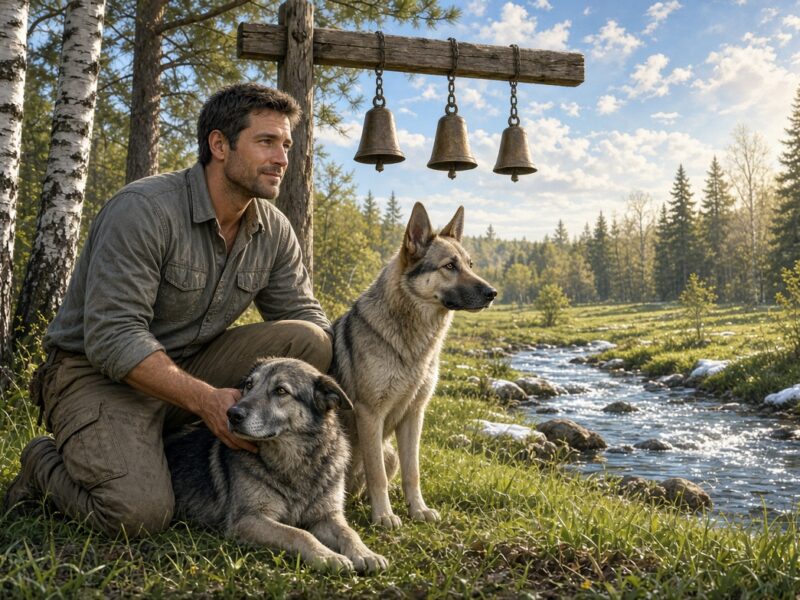
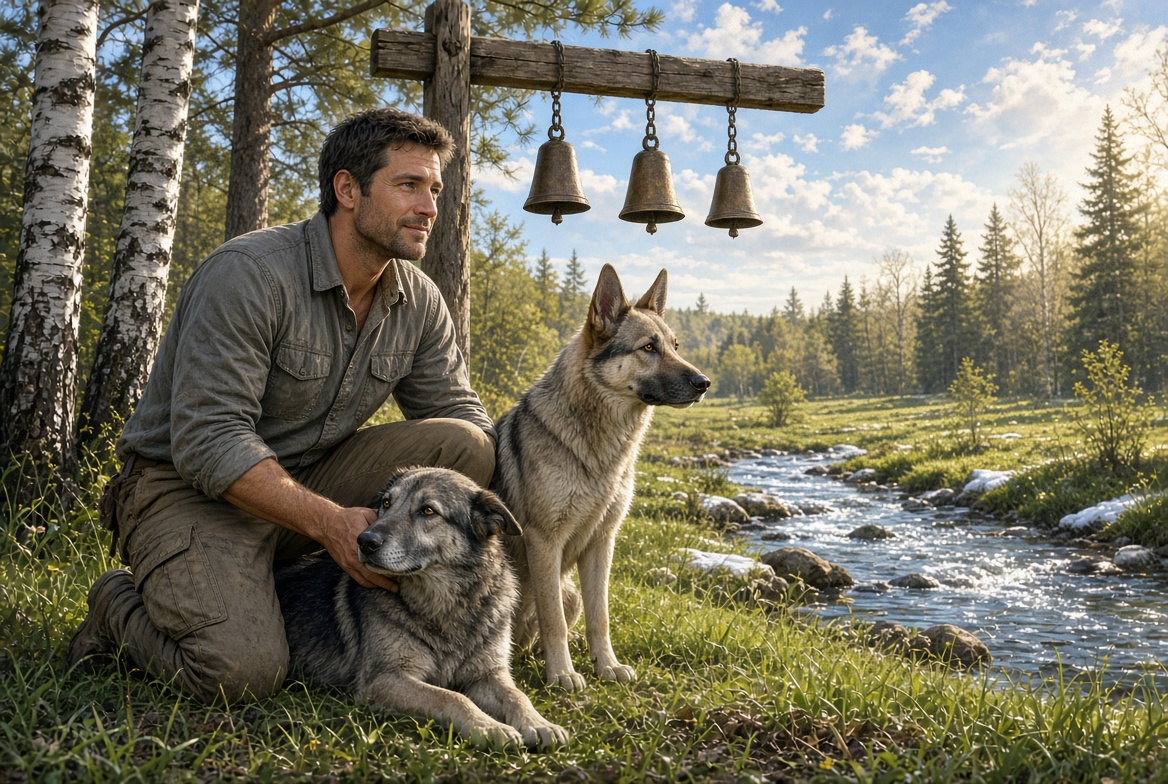
On the far side stood a weathered crossbeam on two old cedar posts. Three rusted cattle bells hung from it, dark shapes swaying against the bright spring sky.
Nora’s rule had been simple. Gideon walks only if Gideon chooses to.
No pulling. No testing his limits. No mistaking stubbornness for strength.
The sling was there to take weight off his hips, not to drag him anywhere.
Ranger waited at the bottom of the porch steps. He looked at the bells, then back at Gideon.
He didn’t hurry him.
People liked to think strength meant pushing through pain.
Ranger seemed to understand that sometimes strength meant slowing down for someone who couldn’t keep the old pace anymore.
Gideon put one paw past the threshold. Then another.
The three of them moved into the field.
Ranger on the left. Caleb behind and slightly to the right, holding the sling loose.
A quiet frame around the old dog, without boxing him in.
Gideon stopped by a fallen fence rail and lifted his nose.
Damp cedar. Old soil. Melting snow. The faint mineral smell of water moving underground.
Caleb wondered what the dog was smelling under all of it.
A person who comes home after years away is shocked by what’s changed.
Maybe for a dog, the bigger shock is what hasn’t.
Halfway across, Gideon’s back legs buckled.
Caleb took more weight in the sling. The old dog stopped and turned his head, and his pale eyes met Caleb’s.
“I’m not carrying you unless you ask,” Caleb said quietly.
Gideon held his gaze for a long moment.
Then he faced the bells again, and Ranger stepped in until their shoulders nearly touched.
Gideon walked on.
The wind picked up. The bells swung.
Two of them rang, low and uneven.
The third made no sound at all.
The first bell was narrow and deeply rusted, with a crack that gave its voice a broken edge.
The second was broad and dark and heavy.
The third swung right along with them. And stayed completely silent.
Gideon stopped directly beneath it.
He didn’t bark. He didn’t paw at the post.
He just lowered himself carefully into the wet grass and looked up at that silent bell.
Another gust came across the field. Two bells rang. The third moved without a voice.
Something tightened behind Caleb’s ribs.
Until this moment, “Bell Three, Unit Nine” had just been words on a scrap of paper.
Now it felt like a promise. One made by a man who had expected he might not be around when the message was finally delivered.
Caleb reached up and steadied the bell.
The cord tying it to the beam was newer than the rope around it.
Before he could untie it, Gideon got to his feet on his own.
His back legs shook. But for a few seconds he stood tall under the cedar beam, as if his body had remembered a strength it no longer owned.
Then he pressed his silver muzzle against the silent iron.
It was so gentle it almost looked like affection.
Ranger lowered his head. The other two bells rang around them.
Gideon closed his eyes.
Caleb didn’t know if the dog remembered Owen’s hands putting something inside that bell.
Or if he only remembered standing here, years ago, beside the man he loved.
But the field didn’t feel abandoned anymore. It felt occupied, by a bond that time had failed to erase.
Owen hadn’t trusted the bell because it was hidden.
He had trusted Gideon, because Gideon would remember where the silence belonged.
Caleb untied the bell and tipped it toward the light.
The clapper had been wrapped tight in waxed cloth. That was why it never rang.
He unwound the cloth.
A small brass key slid into his palm, slick with protective oil.
Stamped along the shaft: THREE BELLS COLD STORAGE. UNIT 9.
An hour later, Evelyn had the key on Owen’s kitchen table and her notebook open beside it.
“Three Bells Cold Storage shut down nearly nine years ago,” she said. “It was part of the old farmers’ co-op out on Bell Road.”
“Who owns it now?”
“The co-op dissolved. The management company went bankrupt. The county took the property for back taxes.”
She ran a finger down a printout.
“And Unit 9 was leased to Owen Hartley during the exact fourteen months he was filing complaints against Northline.”
“So Owen had legal access.”
“Had. Past tense. That doesn’t mean we can stroll in today.”
Evelyn believed rules mattered most precisely when someone wanted them ignored.
She’d seen too much good evidence ruined by people in a hurry.
“We need someone independent,” she said. “Not Mason.”
Nora pulled up a few minutes later and went straight to Gideon’s hind legs.
“You let him cross that whole field?”
“He chose to,” Caleb said. “I had the sling.”
Nora checked his joints. Gideon let her, though his eyes never left Ranger.
“Tired,” she said. “Not hurt. He rests the rest of the day.”
Then she looked at the key and listened while Evelyn explained.
“I know someone,” Nora said.
She called Agent Claire Donovan.
Claire was forty-five, a federal investigator who specialized in land fraud and schemes targeting elderly property owners.
Years earlier, she’d worked a case where a company talked lonely widows into signing away the mineral rights under their farms.
Polite people. Clean paperwork. Devastating results.
Since then, she treated a contract the way other agents treated a loaded weapon.
She listened to Nora’s summary without interrupting once.
Then she said, “Do not enter that unit alone.”
“We have a key,” Caleb said.
“A key proves someone once intended you to have access. It does not give you authority today.”
She asked for photos of everything. The key. The collar mark. Owen’s records. Evelyn’s county files.
“I’ll arrange an independent county witness,” she said. “Someone outside Mason Vail’s chain of command.”
The man she chose was Deputy Lucas Mercer from the neighboring county.
Fifty-one. Tall and strongly built. Square, weathered face, short gray hair, a neatly trimmed salt-and-pepper beard. Pale blue eyes that didn’t rattle.
Years ago, Lucas had watched a solid burglary case fall apart in court because nobody documented who’d handled the evidence.
Since then he photographed every door before opening it and logged every item he touched.
He agreed to meet them first thing in the morning.
Until then, the key would stay sealed in an envelope in Evelyn’s locked office at the library.
Mason showed up at Caleb’s cabin that afternoon.
He carried a thin folder and wore his navy jacket over a pressed uniform shirt.
“Got a complaint,” he said. “You’re keeping a dog without proof of ownership.”
Caleb stayed on the porch. Behind him, Ranger stood in the open doorway.
Farther inside, Gideon rested by the fire in the soft medical collar Nora had given him.
Mason’s eyes found it in a heartbeat.
The old leather collar was gone.
Something shifted in the deputy’s face. A tightening at the corners of his mouth. A quick calculation behind those pale eyes.
“You’ll need to surrender the animal,” Mason said.
“Show me the order.”
“This is a welfare matter.”
“He’s under a vet’s supervision. You know that. You were there.”
Mason opened the folder. No warrant. No seizure order. Just an unsigned complaint form.
Caleb handed it back.
“When you’ve got legal authority, Deputy, bring it with you.”
Mason held his eyes for several seconds.
Then he smiled. “Of course.”
And he left, without another word.
That scared Caleb more than any argument could have.
A man who stops arguing has usually decided to do something else instead.
After dark, a faint scraping came from the mudroom window.
Ranger was moving before Caleb was out of his chair.
The younger dog hit the mudroom first, body low, a warning growl vibrating through his chest.
Caleb slapped on the floodlights.
A shadow peeled off the side of the cabin and vanished into the trees.
He didn’t chase it. Gideon was inside, struggling to his feet.
In the mudroom, one drawer hung open. Papers had been shuffled.
Nothing was missing.
Whoever came in had walked right past cash on the counter, a box of tools, and Caleb’s old field watch on the shelf.
They had only searched where a man might hide documents. Or a collar. Or a key.
By the window lay a smear of reddish clay.
Gideon caught the scent from across the room and recoiled.
He backed straight into Ranger and pressed himself against the younger dog’s side, trembling.
Caleb thought of the reddish dust he’d seen on Gideon’s coat at the creek.
Nora came out that night and looked at the clay under a lamp.
“It matches the soil around the old Northline training grounds by the quarry,” she said. “It’s not proof by itself. But nobody tracks this stuff around here by accident.”
Claire called just before midnight.
She’d started digging into property records connected to one name that kept surfacing in Northline’s filings.
Silas Creed.
“He’s holding a groundbreaking ceremony for a luxury resort on Brightwater Lake,” Claire said. “Several of the parcels in that development used to belong to elderly people who lived alone.”
“How many?”
“So far I count twenty-three parcels. Roughly two-point-four million dollars in lakefront land, bought at a fraction of market value.”
Caleb did the math on Mrs. Harlan’s nineteen thousand five hundred dollars and felt sick.
“And more than half of those owners,” Claire said, “were enrolled in Northline’s protection dog program before they sold.”
Outside, two of Owen’s bells moved faintly in the night wind, far off on the west slope.
The third sat on Caleb’s kitchen table, silent even now.
The bell hadn’t been hidden to create a puzzle.
It was a last safeguard, left by a man who’d stopped trusting reports, uniforms, and locked offices.
Owen had put his faith in something simpler.
A dog who remembered. And someone patient enough to follow without forcing the way.
Morning came to Three Bells Cold Storage under a thin veil of mist.
The abandoned complex sat off Bell Road, past the last working farms, close enough to Brightwater Lake that the air smelled faintly of cold water.
Farmers used to store beef, dairy, and seasonal produce here.
Now the corrugated walls had faded from silver to dull gray. Rust bled down from the gutters. Tall reeds pressed against the loading dock.
Caleb parked outside Unit 9.
Ranger hopped down first and swept his eyes across the doors, the windows, the roofline, the empty lot.
He didn’t bark. Nothing had surprised him yet.
Gideon stayed on the blanket in back, looking smaller inside the truck than he had under Owen’s bells.
His coat had started to get some softness back after Nora’s care. But the silver muzzle and thin frame still told the truth about his age.
Caleb slid the sling under his hips. Gideon didn’t resist.
That small change meant more than Caleb could say.
Nora stood nearby with her arms crossed.
“Truck to unit,” she said. “Not one step farther unless he picks it.”
Lucas Mercer was already working.
County field jacket, tan trousers, heavy black boots. A body camera clipped to his chest. A digital camera in one hand, a notebook in a weatherproof sleeve in the other.
He photographed the building number. The door. The lock. The sealed envelope with Owen’s key inside.
He didn’t rush a single frame.
Agent Claire Donovan was on the screen of Lucas’s secure phone, joining by recorded video while she drove toward Brightwater Falls.
Dark brown hair tied low. Charcoal field coat. Cool gray-brown eyes moving across every image Lucas showed her.
“Confirm property status,” she said.
Lucas read from his file.
“Three Bells Cold Storage is held by the county after tax forfeiture. Unit 9 was previously leased to Owen Hartley. The county administrator has authorized inspection under the missing person review.”
“Log the key before use.”
Lucas opened the envelope, photographed both sides of the key, read the stamp aloud for the record, and handed it to Caleb with the camera still rolling.
The key wouldn’t turn at first. Rust fought it.
Then the mechanism gave, and the door opened with a long metallic scrape.
Stale cold air rolled out. Damp insulation. Old motor oil. Paper that hadn’t seen sunlight in years.
Gideon lifted his head.
“Easy,” Caleb murmured.
Inside, the unit was narrower than he’d expected. Empty metal racks. Water stains on the concrete. A dead ventilation fan hanging from the ceiling.
Gideon paused at the threshold. His nose worked once. Twice.
His ears swung forward.
He knew this place.
Ranger went in first, then turned and waited.
Gideon followed.
Every step was slow, but unlike in Owen’s field, he didn’t seem unsure of the way.
He passed a stack of broken plastic crates and stopped in front of a warped shelving unit against the back wall.
He sniffed along one rusty leg. Then he scraped the floor once with his front paw.
Lucas raised the camera.
“What’s under it?” Claire asked through the phone.
Caleb and Lucas eased the empty shelf away from the wall.
Beneath it was a rectangular maintenance hatch, nearly invisible under dust and rust stains.
The screws had already been removed.
Lucas photographed it, then lifted the cover.
Underneath sat a small waterproof case, sealed in heavy plastic.
Nobody said a word.
This was the box. The one Owen had hidden while the whole town decided he was broke, confused, and unstable.
It had been sitting in the dark for four years, waiting for someone to believe him.
Lucas knelt, photographed it in place, and lifted it out with gloved hands.
“Container recovered from maintenance compartment beneath rear shelving, Unit 9,” he said for the recording.
The plastic came away in layers. Inside was a hard-shell case. Lucas popped the latches.
Ledgers filled most of it.
Under them: memory cards, photographs of property contracts, lists of elderly clients, canine transfer records, and letters between companies with harmless-sounding names.
The Northline claw-and-triangle showed up on more than one page.
“How many dogs?” Nora asked quietly.
Lucas flipped one ledger to a tabbed page and ran his finger down the column.
“Eleven dogs pulled for ‘additional training.’ Every single one pulled within thirty days of a land offer to the same household.”
Nora closed her eyes for a second.
“And the households?”
“Twenty-three properties. Owen cross-referenced every one.”
Near the bottom lay an envelope, yellowed with age. OWEN HARTLEY was written across the front.
Gideon moved closer. Caleb tightened the sling so he wouldn’t lose his balance.
The old dog lowered his silver muzzle to the envelope.
He didn’t touch the words. He touched the paper itself.
His eyes closed, just for a moment.
Maybe it still carried the faintest trace of Owen’s hands. His work coat. The dry, papery smell of that basement room.
Gideon didn’t understand documents.
But he understood what was left of the man who’d held them.
Then Gideon’s head jerked away from the case. His ears swung toward the door.
Ranger reacted at the exact same moment, stepping in front of Gideon, body rigid, head low.
Outside, tires rolled slowly over wet gravel.
One vehicle. Then another.
They stopped. The engines kept running.
Lucas stood and turned his body camera toward the entrance.
Claire’s voice dropped. “Don’t move the evidence. Keep recording.”
A shadow crossed the doorway.
Deputy Mason Vail stepped inside.
And he hadn’t come alone.
But the real shock for Caleb wasn’t Mason.
It was the look on Gideon’s face.
The old dog didn’t look tired anymore. He looked like he was seeing someone he remembered.
Mason’s eyes went straight to the open case.
Behind him stood two men in black Northline field jackets.
Travis Reed, thirty-eight, thick-necked and broad-chested, blond buzz cut and a short pale beard, steel-toed boots. A man who used his size before he used words.
And Cole Vance, forty-four, leaner and taller, narrow face, sunken brown eyes, black hair cut close to the scalp. Thin leather gloves on a mild spring morning.
Travis stared at Caleb.
Cole never looked at anyone. His eyes kept going to the walls, the exit, and Lucas’s camera.
“This is private property,” Mason said.
“No, it isn’t,” Lucas answered. “It’s county-held property under authorized inspection.”
Mason looked at the body camera. “You’re outside your jurisdiction, Mercer.”
“I’m here at the request of the county administrator. And under federal review.”
Claire’s face glowed on the phone screen.
“Deputy Vail. This site is being recorded. Do not approach the recovered materials.”
Mason’s polite expression went tight. He turned to Caleb.
“You have no idea what you just opened.”
Caleb didn’t answer. Sometimes silence was the only answer a man like Mason couldn’t argue with.
Mason took a step forward. The keys on his belt clinked.
Gideon flinched hard, then lunged forward against the sling.
His front paw caught Mason’s trouser leg, and the fabric ripped just above the boot.
Underneath was an old crescent-shaped scar across Mason’s ankle.
The kind of scar a dog leaves when it’s defending someone.
Mason stumbled back. For one naked second, it was fear on his face. Then anger rushed in to cover it.
Caleb steadied Gideon at once. The old dog hadn’t attacked. His claw had snagged as he moved.
But Mason was staring at him like Gideon had just said his name out loud.
Travis moved toward the case.
Ranger stepped into his path and planted all four paws on the concrete. A low growl rolled out of him.
“Hold,” Caleb said.
Ranger held. He didn’t lunge. He didn’t bite.
He simply made it clear that Travis would have to go through him.
Cole, by the door, glanced down at Mason’s hand.
And Mason moved.
He lunged past the edge of the case, grabbed a thin bundle of loose papers, and spun toward the door.
Lucas went after him, but Mason shoved the rusted shelving unit into his path.
It crashed to the concrete with a sound like a car wreck.
Nora pulled Gideon clear while Caleb kept Ranger locked in place.
Mason bolted. Travis and Cole went right behind him.
In the chaos, a black radio slipped off Mason’s belt and clattered to the floor by the doorway.
It crackled.
Then a man’s voice came through. Calm. Cold. In complete control.
“If they’ve opened Unit 9, don’t let them walk out with those records.”
Nobody in the room moved.
Claire had heard it. Lucas’s camera had captured it.
The radio just lay there on the concrete, like something that had finally turned on its owner.
“Do not pursue,” Claire ordered.
Engines roared outside, already pulling away.
Every instinct from Caleb’s old life told him to go after them.
But Gideon was shaking against Nora’s legs. And the open case still held everything Owen had spent his last years trying to protect.
Caleb stayed.
Lucas bagged the radio and logged the missing bundle as carefully as everything else. It was a loss. But the main case was intact.
Working through it with Evelyn’s categories, they sorted the rest. Ledgers. Property transfers. Canine placements. Shell-company letters.
At the very bottom, Caleb found an old photograph.
A stone marker beside Brightwater Lake.
At its base, the same claw-and-triangle stamped inside Gideon’s collar.
Lucas turned it over. Four words on the back.
ORIGINALS BENEATH THE NORTH MARKER.
“Nobody goes near that marker without a warrant,” Claire said.
Gideon’s legs trembled, hard.
He had spent every ounce of strength he had.
Caleb knelt, slipped off the sling, and lifted the old dog into his arms.
This time, Gideon didn’t go stiff.
He rested his silver muzzle against Caleb’s shoulder.
Ranger walked close beside them out into the light, while Lucas locked Unit 9 behind them and sealed the door with evidence tape.
The mist had burned off Bell Road. Sunlight spread across the wet gravel.
For years, someone had treated Gideon as if age and silence had made him useless.
But the old dog had remembered the way. He had led them straight to Owen’s evidence.
And now, for the first time, he let another man carry him home.
Agent Claire Donovan rolled into Brightwater Falls a little after noon.
Her dark government SUV stopped outside the county records annex, where Lucas had transferred the sealed evidence from Unit 9.
She stepped out in her charcoal field coat and studied the building, the cars, and the people by the door before she said a single word.
Caleb noticed she looked at the exits first. He understood that habit too.
She accepted Lucas’s evidence log without small talk and checked every signature, timestamp, and seal before she walked into the room.
She trusted documents.
She did not trust the people who arranged them.
The Unit 9 materials covered two long folding tables. Ledgers. Property photos. Client lists. Transfer files. Memory cards.
Claire stood over them without touching anything.
“Start from the beginning,” she said.
Caleb kept the creek brief. What mattered now was Owen’s records, Unit 9, Mason grabbing those papers, and the voice on the radio.
Nora described Gideon’s condition and reactions, carefully.
“A reaction can suggest past experience,” she said. “It can’t identify a person on its own.”
Claire nodded, clearly approving.
Evelyn sat beside a tower of county land records in her burgundy cardigan.
“Northline shows up in several costumes,” she said. “Sometimes under its own name. Sometimes as a security contractor. Sometimes as a property management company.”
“Shell companies?”
“Almost certainly. Different names, same mailing addresses. Same accountant. Same two officers.”
Piece by piece, the pattern came together on the tables.
Northline approached elderly landowners with an offer that sounded generous. A trained protection dog for seven thousand dollars a year. Discounted security checks. Free boarding if the owner ever got sick.
It built trust. Then it built dependence.
Then the dog was taken away for “additional training.” And it never came back.
Within weeks, a different company would knock on the door. A security upgrade. A home repair loan. A quick cash offer for the land.
Some owners signed because they were scared. Others signed because they were alone.
A few complained. Most of those complaints disappeared into half-finished reports and administrative closures.
Eleven of them carried Mason Vail’s signature.
Caleb looked at the photos of the landowners. Gray hair. Careful smiles. Modest homes on land a developer would kill to own.
“They didn’t pick these people because they were weak,” he said.
Claire looked up.
“No,” she said. “They picked them because they were isolated. And isolation is a lot easier to manufacture than weakness.”
The sentence stuck with Caleb all afternoon.
He thought of Gideon refusing to eat if anyone stood close. He thought of Mrs. Harlan, alone by the bridge, determined never to bother anybody.
A town could be full of good people and still leave someone alone long enough to become a target.
By midafternoon, Lucas got the call.
Mason’s patrol vehicle had been spotted heading south on Highway 53. A traffic camera caught it passing an agricultural checkpoint. Data from the dropped radio put the unit on the same route.
Claire coordinated with deputies from two neighboring counties.
They stopped Mason forty miles short of the Wisconsin line.
He didn’t resist. He asked for a lawyer and refused to say why he’d fled an authorized evidence scene.
That silence lasted exactly until Claire sat down across from him with Lucas’s body cam footage, the recovered radio, and copies of every report he’d ever written about Owen Hartley.
Caleb wasn’t in the room. Claire told him afterward what Mason admitted.
He hadn’t started out as Silas Creed’s partner. He’d started out as a man drowning in debt.
His wife’s medical bills had grown faster than a deputy’s salary ever could. Silas offered help, and he never once called it a loan.
Then came the favors.
Delay this report. Redirect that complaint. Describe this elderly witness as “confused.”
Each one seemed small on its own.
Together, they became a chain Mason no longer knew how to break.
Claire didn’t accept hardship as an excuse.
“Hard circumstances can explain a choice,” she told Caleb later. “They can’t erase it.”
Then Mason told her the part that mattered most.
Owen Hartley had never skipped town.
Four years ago, Owen had confronted Northline men out near the old quarry. He left in his truck afterward and went off the road on the quarry property.
The accident was logged with incomplete identification. A John Doe file, with no name attached.
Mason knew who the driver was. And he buried that connection.
Then he wrote a neat little report saying Owen had probably left Brightwater Falls because of debt and a declining mind.
Claire ordered the old accident file and forensic records reopened the same afternoon.
Nobody needed to discuss the details.
What mattered was that Owen hadn’t vanished. He’d been mislabeled.
And a town that trusted its deputy had simply stopped looking.
News moves fast in a town of 2,814 people.
By suppertime, word was already at the Main Street diner that the feds were at the annex and that Mason Vail had been picked up on 53.
By eight o’clock, Evelyn’s phone at the library had rung fourteen times.
Not reporters. Widows. Widowers. Grown children calling on behalf of their parents.
A retired dairy farmer named Walt Pruitt drove in from the lake road with a shoebox full of Northline paperwork on his passenger seat.
“They took my Bessie for training in February,” he told Evelyn, standing at the circulation desk in his barn coat. “I called them nine times. Nine. Nobody ever brought her back.”
He set the shoebox down very gently, like it might break.
“Three weeks later, a fella showed up offering to buy my lake parcel. I said no. He said a man my age shouldn’t be out there alone without a dog.”
Evelyn photographed every page in that box and gave him a receipt with her own signature on it.
“Nobody is losing anything else tonight, Walt,” she said.
Caleb heard about it from Nora, who had heard it from Evelyn, who had stayed at the library until eleven.
The shame was the worst part, Evelyn said. Not the money. The shame.
Every one of them thought they’d been the only fool.
That evening, Claire and Caleb drove out to the north bridge, where Silas Creed was scheduled to speak at a public repair dedication.
Half the town had turned out around the temporary barriers and fresh timber.
Local reporters stood by the road. Elderly residents filled folding chairs under a canvas canopy.
Silas arrived in a polished black Escalade.
He was fifty-five, tall and lean, silver-gray hair combed neatly back from a clean, angular face.
His skin showed no sign of outdoor work. His pale blue-gray eyes rested on people with practiced attention.
And his smile never quite reached them.
Long charcoal wool coat. Black turtleneck. Tailored trousers. Expensive black boots with not a fleck of mud on them.
Thin leather gloves on both hands. An expensive watch flashed briefly beneath one cuff.
He worked the crowd as if he belonged to everyone.
He remembered first names. Asked about grandchildren. Rested one gloved hand gently on an old man’s shoulder.
He’d donated forty thousand dollars of equipment to the bridge repair, and people thanked him as if generosity were the same thing as character.
Caleb watched from the edge of the chairs.
Silas took the microphone and talked about safety. Responsibility. Protecting the people who built Brightwater Falls.
The words were chosen beautifully.
That made them worse.
As the applause rose, Silas turned slightly toward the road.
His eyes found Caleb.
The smile stayed on his face, but the rest of him went very still.
Then his gaze slid past Caleb, to the truck parked beneath the trees.
Gideon wasn’t in it. Nora had insisted he rest at the cabin.
But Silas kept staring at that empty rear window, as if he fully expected to see a silver muzzle pressed to the glass.
Then he looked back at Caleb, and the smile came back, all the way.
That tiny moment told Caleb something no ledger ever could.
Silas already knew exactly which dog had come home.
And he was afraid of what that dog remembered.
Claire had seen it too. She didn’t approach him. Not yet.
The Unit 9 materials showed a pattern of ugly property deals. But she still didn’t have the original signed contracts, or a clean recording tying Silas directly to the scheme.
Move too early, and every person connected to those shell companies would have time to start feeding a shredder.
Back at the annex, Mason gave her one last detail.
At the entrance to Silas’s planned resort stood an old fieldstone marker.
Owen had visited it again and again in the weeks before he disappeared.
Mason didn’t know what Owen had hidden there. But he knew Silas had tried twice to have that marker removed.
Both times, a property dispute and a missing demolition permit had stopped him.
The marker was scheduled to be moved right after the groundbreaking ceremony.
The next morning.
Claire laid the photo from Unit 9 beside the resort’s site plans.
The stone matched. So did its position by the north entrance.
She requested a limited federal search warrant that night. Silas was put under quiet surveillance. His accounts and travel documents were flagged.
She wasn’t waiting for the ceremony because she wanted a show.
She was waiting because the marker was still legally protected until morning. And tomorrow was the last chance before a bulldozer erased it.
Caleb got home late.
Ranger met him at the door, sniffed his sleeves, and walked back to the fire.
Gideon was stretched out on his bed under a light blanket, breathing slow and even. His food bowl was licked clean.
Caleb set the photo of the stone marker on the floor where Gideon could see it.
The old dog looked at it.
Nothing happened.
No spark of recognition. No dramatic movement.
Caleb felt something close to relief. Gideon was a dog, not a machine built to unlock every clue on command.
Memory didn’t take orders.
Nora came in from the kitchen with a clean steel water bowl. She’d stopped by to check his joints one last time.
As she set it down, the bowl slipped from her fingers.
Metal hit the hardwood floor and rang through the whole cabin.
Gideon’s head shot up.
His ears swung toward the door, and for one second he seemed to be looking beyond the walls, as if that ringing note had woken the memory of iron swinging in open air.
Then his eyes dropped to the photograph.
And stayed there.
A flat picture meant nothing to him.
But sound, smell, and movement could still open roads through his memory that nothing else could reach.
Nora checked him over and frowned.
“He’s fit for one short, supported walk tomorrow. That’s it,” she said. “Park close to that marker. If he hesitates, you stop.”
“I know.”
After she left, Caleb sat on the floor between the two dogs.
Ranger on one side, calm and watchful. Gideon on the other, silver muzzle resting on the edge of his blanket.
Caleb stared into the fading fire.
He used to believe battlefields announced themselves. Gunfire. Smoke. Shouted orders.
Brightwater Falls had taught him otherwise.
A battlefield could be a bright stage where a respected man talked about protecting the elderly while quietly taking away everything that made them feel safe.
It could be a desk, where one false report turned a missing man into someone a whole town stopped searching for.
It could be a signature. A closed file. A polite smile.
Caleb rested his hand near Gideon’s front paw.
“Tomorrow,” he said quietly. “If you still remember, we’ll finish the road.”
Gideon opened his pale amber eyes.
Caleb glanced over at Ranger.
“But this time, we’re not going alone.”
Morning broke clear over Brightwater Lake.
The last strips of mist lifted off the water and left it shining like hammered silver.
Little ceremonial flags snapped in the breeze along the resort entrance. Rows of white folding chairs faced a temporary stage trimmed with evergreen boughs.
More people had come than Caleb expected.
Reporters adjusting cameras. Town council members huddled over glossy site plans. Elderly residents in the front rows, some bundled in light coats against the spring chill.
They’d come to hear promises. Jobs. Safer roads. New money in a town that rarely saw any.
Silas Creed stood by the stage as if the whole morning belonged to him.
He shook hands with widows. Asked after grandchildren. Thanked volunteers by name.
Nobody watching would have guessed federal agents had been parked outside his lake house all night.
Claire stood among the officials, her expression unreadable, the signed warrant in a folder under her arm.
Lucas waited several yards from the stone marker with two evidence technicians.
One of them was Marla Keen. Fifty-two, broad-shouldered and powerfully built, close-cropped gray hair, weathered brown skin.
She’d spent years pulling evidence out of collapsed barns, burned houses, and flooded basements.
It had made her endlessly patient with objects, and not at all patient with guesses.
The marker stood near the north entrance. Waist-high, pale fieldstone around a dark central slab, moss packed into the cracks.
Near the base, almost hidden by dirt and lichen, was the faint outline of a triangle inside a claw.
Caleb parked on the north access path, as close as he could get.
Ranger jumped out and surveyed the crowd, the cars, the open ground. Then he turned back toward the truck.
Gideon lay on his padded blanket, coat brushed clean, silver muzzle catching the light.
His eyes were clearer than they had been at the creek.
Nora checked his breathing and adjusted the sling one last time.
“If he stops, you stop,” she said. “If he turns back, you let him.”
Caleb nodded.
Gideon’s eyes weren’t on the crowd. They were fixed on the marker.
Caleb laid a hand near the old dog’s shoulder.
“Your call, Gideon.”
Gideon shifted forward.
Caleb took the weight off his hips as he stepped down, and Ranger moved instantly to his left side.
They didn’t walk down the center aisle or past the stage. The marker was just a short stretch of grass away.
But people noticed anyway.
A murmur rippled through the chairs.
An old man in the front row leaned toward the woman next to him.
“That’s Hartley’s dog,” he whispered.
“It can’t be,” she whispered back.
It was Walt Pruitt. He was gripping the back of the chair in front of him with both hands.
The whisper spread row by row.
Owen Hartley had been gone four years. Most people figured his dog had disappeared with him, or died long ago.
On stage, Silas began his speech.
He thanked the council. Praised the resilience of Brightwater Falls. Promised the resort would protect the beauty of the lake while creating opportunity for generations to come.
Then his eyes landed on Gideon.
One word faltered. Just one.
Most of the crowd never caught it.
Claire did. Caleb did.
Silas recovered and kept talking, but his gloved hand tightened on the edge of the podium.
Gideon never looked at the stage.
He walked straight to the marker and stopped.
He lowered his head. The sling went slack as he leaned in and breathed along the mossy base. Once. Twice.
Then he moved to the north side, where dried mud filled a narrow seam between stone and ground.
He scraped it gently with one front paw.
The sound was almost lost under Silas’s amplified voice.
Claire closed her folder.
“Begin the search.”
Marla knelt and brushed the soil away. The claw-and-triangle came fully into view.
Gideon stared at it.
Then he did something Caleb had never seen him do.
He lowered himself beside the stone and laid one paw directly over the mark.
And he closed his eyes.
The flags snapped overhead. Silas was still talking in the distance, about progress, and moving forward, and leaving the past behind.
But Gideon lay there with his paw on that symbol like he was guarding it for someone who had once knelt in this exact spot beside him.
Ranger sat at his shoulder.
The younger dog watched the crowd. The older one watched the past.
And finally, Caleb understood.
Owen had never expected Gideon to understand evidence.
He had only trusted him to remember where they had stood together.
Marla photographed the symbol, the stones, and the undisturbed soil. Lucas read the warrant into the record.
Claire informed the site representative that the marker was now under temporary federal control.
Silas stopped speaking.
“What is this?” he called from the stage.
Claire didn’t answer him.
Marla slid a thin probe into a gap at the north base. It came back with a hollow knock.
She removed two outer stones, logging each one’s exact position before setting it on a tarp.
Behind them sat a sealed steel tube, wrapped in oiled canvas and tucked into a dry cavity above the ground line.
The crowd had gone completely silent.
Silas came down off the stage. The smile was gone.
“You have no authority to dismantle private property.”
Claire turned and held up the warrant.
“We have specific federal authority to search this marker and recover materials concealed inside it.”
Silas looked at Caleb. Then at Gideon.
The old dog stayed beside the stone, exhausted but alert.
Marla carried the tube to a portable evidence table. She photographed the seals, peeled back the canvas, and unscrewed the cap.
Inside were several tightly rolled packets.
The first held original property contracts, signed by Silas Creed and the officers of the shell companies.
The second was a complete list. Twenty-three elderly landowners. The exact dates their protection dogs had been taken. The exact dates the land offers arrived.
Then a sealed memory card, with a handwritten note: Recorded conversation, Owen Hartley and Silas Creed.
And last, a letter.
It was addressed simply: To whoever Gideon trusted enough to bring here.
Claire read only enough to confirm it was relevant.
Owen hadn’t asked for revenge.
He asked that the people named in those records be protected from shame and blame.
He wrote that their loneliness had been used against them. That working dogs had been treated like tools, to be removed the moment they became inconvenient.
And he asked whoever found the papers to remember one thing.
People and animals do not lose their worth because they grow old, or frightened, or need help.
Silas pushed through the edge of the crowd.
“This is fabricated,” he said. “Hartley was unstable. Everyone in this town knows that.”
“The signatures will be examined,” Claire said calmly. “The recording will be authenticated. The chain of custody is fully documented.”
“You built this entire circus around the behavior of a damaged dog.”
“No,” Claire said. “The dog brought us to the location. The evidence speaks for itself.”
A young reporter from the Duluth paper raised her camera.
“Mr. Creed, when was the last time you saw Gideon?”
Silas turned to her. “I never handled that animal.”
“Then how did you know he’d ever left Brightwater Falls?”
And Silas’s control cracked. Not all the way. Just enough.
“That dog was never supposed to make it back to this town.”
The words carried across the silent lot.
Every camera there caught them.
Silas seemed to hear what he’d said only after it had already left his mouth.
The sentence alone wasn’t the case. The case was in that steel tube, in Unit 9, in Mason’s altered reports, in the land transfers, and in the testimony already being typed up at the annex.
But it proved he knew something he’d sworn he didn’t.
And there was one more thing.
Lucas had been standing very still since the moment Silas raised his voice.
He stepped close to Claire and said quietly, “That’s the voice on the radio.”
Claire had heard it too. Calm. Cold. In complete control. Until now.
She gave the signal.
Two federal officers walked up to Silas Creed.
He didn’t resist.
He just looked around at the people who’d applauded him ten minutes earlier, as if waiting for someone to stand up for the generous man they thought they knew.
Nobody moved.
In the third row, Mrs. Harlan sat with her hands folded in her lap and her green scarf tied tight.
She didn’t look away.
The investigation spread fast after that.
Northline’s facilities were raided. Seven of the eleven missing dogs were found alive in a kennel compound behind the quarry, thin and frightened but alive.
They were transferred to licensed shelters under veterinary care. Nora drove out herself and examined every one.
Walt Pruitt got the call on a Thursday afternoon.
His Bessie was among them.
He drove to the shelter in his barn coat and sat down right on the concrete floor of the kennel, and the old Lab climbed into his lap like she was still a puppy.
Nobody there pretended not to cry.
Every land transaction tied to the shell companies was frozen pending federal review. Twenty-three parcels. Roughly two-point-four million dollars in lakefront property.
Three attorneys from Duluth volunteered their time to help the elderly owners understand exactly what they had signed, and what could still be undone.
Mason cooperated fully in exchange for consideration at sentencing. Nothing about that erased what he’d done.
And the old John Doe accident file was reopened.
Through archived records and forensic evidence, authorities formally confirmed Owen Hartley’s identity.
The false story was corrected on the public record. He had not abandoned the town over debt and confusion.
Brightwater Falls hadn’t lost a foolish old man.
It had failed to listen to a man who was trying to warn it.
The town held a small memorial for Owen at the Lutheran church on Main Street.
There was no casket. Just a framed photo of a weathered man in a work coat, kneeling in a field with a young gray-and-black Shepherd leaning against his shoulder.
Gideon lay at the front of the aisle on a folded blanket, Ranger beside him.
When people filed past, a lot of them stopped and said something quietly to the old dog.
Most of them said they were sorry.
A few of them said thank you.
Afterward, Mrs. Harlan helped start a volunteer network out of the library.
Fence repairs. Rides to the doctor in Duluth. Pet care for anyone living alone.
The first meeting drew thirty-one people. Walt Pruitt brought donuts.
When a reporter asked Mrs. Harlan why a seventy-eight-year-old widow would take on something like that, she didn’t hesitate.
“Because independence shouldn’t mean invisibility,” she said.
Then she added, “And because somebody offered me nineteen thousand five hundred dollars for my husband’s land, and I’d like to make sure nobody else ever gets a number like that.”
Two days later, Caleb brought Gideon back to Owen’s house.
The porch had been rebuilt by townspeople. Somebody had cleared the fallen branches and fixed the loose shutter.
The three old bells hung from the cedar crossbeam behind the house again.
The waxed cloth was gone from the third one.
This time, when the wind came across the field, all three rang.
Gideon stood beneath them, Caleb supporting his hips, Ranger at his side.
The old dog listened for a long time.
Then he turned away from the bells.
He walked slowly back to Caleb and rested his silver muzzle on the man’s knee.
Caleb laid a hand gently behind Gideon’s ear.
“You did it,” he whispered. “He knew you would.”
Gideon closed his eyes.
Not because he’d forgotten Owen.
Because the promise was finished.
Weeks passed.
Gideon lived at the cabin with Ranger now.
He still needed his medication. He still moved slowly. The jingle of keys still made his head come up too fast sometimes.
But he had a warm bed by the fire. His own food bowl. A patch of morning sun on the porch that everyone, including Ranger, understood was his.
And he ate now with Caleb standing right there in the kitchen.
Caleb took the old leather collar, the one that had ridden through four winters and a flood with a dead man’s message sewn inside it, and put it in a simple glass frame by the cabin door.
Beneath it, he hung a small brass plate.
SOME WITNESSES NEVER SPEAK. BUT THEY REMEMBER.
Every time Caleb walked out that door, he saw it.
It had started as a cracked strap on a lost dog. It had become the evidence that brought a whole scheme down.
Now it was simply a reminder.
That the forgotten often carry the truth the rest of us were too busy to hear.
One clear spring morning, Caleb opened the cabin door.
Ranger stepped out first, cream-gray coat bright in the sun.
Gideon followed in a soft new collar, silver muzzle lifted to the warm air.
Caleb watched the two of them cross the porch together, side by side, the young dog matching the old dog’s pace step for step.
He used to think rescue meant pulling someone out of danger.
Now he understood it could be something quieter.
Sometimes rescue just means offering enough safety, for long enough, that the lost can remember their way home.
Some truths seem destined to disappear under winter, water, and time.
But loyalty carries its own memory.
And love, given patience, can still lead justice back to the place where it has been waiting all along.
Sometimes miracles don’t arrive with thunder or bright lights or answers that change everything overnight.
Sometimes they come quietly. Through a chance encounter. A loyal animal. A small kindness done when no one else is watching.
Gideon couldn’t speak, but he remembered.
Caleb didn’t know where the road would lead, but he chose to stop, and listen, and help.
Together, they reminded an entire town that age does not erase worth. That silence does not erase truth.
And that being forgotten is not the same as being beyond saving.
The person, or the old dog, you help today may be carrying a story the rest of the world failed to hear.
And maybe they were placed in your path not only so you could rescue them.
But so they could wake up something good in you.









