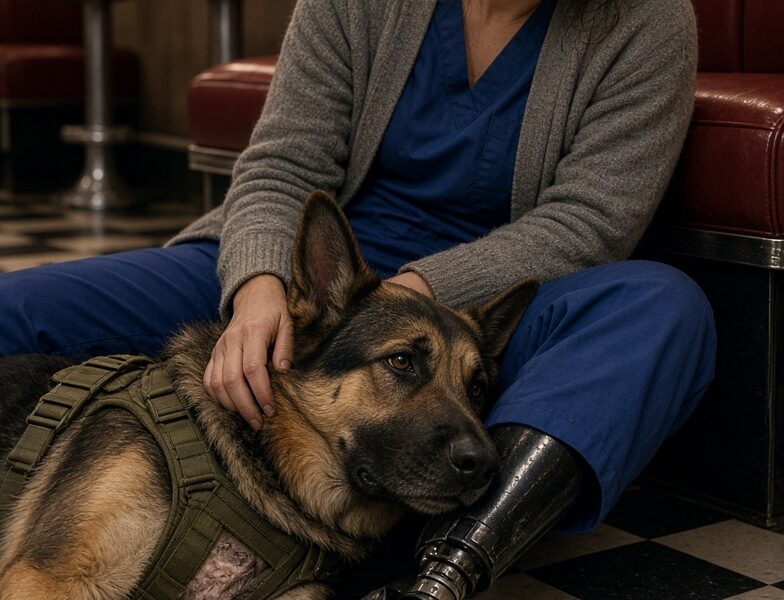
The Dog Barked at the Nurse With the Prosthetic Leg… Then Everyone Learned Why
After a brutal shift, an exhausted nurse with a prosthetic leg only wants a coffee and a place to sit.
A lone man in the diner nods at the empty side of his booth.
“Can I sit with you?” she asks.
But his K9, trained never to bark without a reason, lunges and barks at her.
The customers back away.
The whispers start.
Everyone stares at her as if she were the threat.
The dog’s owner, a hardened SEAL, cannot calm him.
The dog is not attacking.
He recognized her.
When someone in that diner starts to lose their life, the woman who wanted to stay invisible must decide.
Will she keep hiding, or let the truth come out?
“Control your animal, pal, or I will.”
The shout cracked across Starlight Diner like a gunshot.
Forks stopped.
Coffee cups froze halfway to open mouths.
Four minutes earlier, Cassidy Rowan had wanted only one thing.
A seat.
She had just finished 16 hours in the emergency department at St. Bridget’s Regional Hospital.
Two traumas.
One code.
One overdose that ended badly.
Her cobalt blue scrubs still smelled of antiseptic.
Her left leg ached where the socket met her skin.
She pushed through the diner door with her shoulders curved and her head low.
That was how she walked everywhere now.
Small.
Quiet.
Easy to overlook.
The place was packed.
Red vinyl booths.
Chrome stools.
A faded American flag on the wall.
A black-and-white photo of the Golden Gate Bridge above the pie case.
Every booth was full.
Every stool was taken.
Cass tightened her grip on her bag strap.
She had eaten one granola bar since dawn.
Her hands trembled, so she hid them inside her gray cardigan sleeves.
“Help you, hon?” D asked from behind the counter.
The waitress looked 60 and tired.
“Just coffee,” Cass said. “I can wait.”
“Wait—” Cass scanned the room.
Only one booth had a free seat.
A broad man sat there alone in a dark work jacket and a black ball cap.
His beard was trimmed and flecked with gray.
One big hand held a white mug.
On the floor beside him sat a German Shepherd.
The dog wore an olive-green tactical harness with a handle across the back.
He lay calm and still, like a statue carved from tan and black.
The man noticed her looking.
He nodded at the empty side of his booth.
“Seat’s open.”
“Can I sit with you?” Cass asked.
Her voice came out softer than she meant.
“Please. He’s friendly. Mostly.”
She managed a tired smile.
She took two steps toward the booth.
The dog’s head snapped up.
His ears locked forward.
His nose lifted and worked the air.
Then he barked.
Three hard, spaced barks, like a signal.
Cass stopped breathing.
The dog rose into a low crouch, chest close to the floor.
He barked again.
Three more.
His eyes never left her face.
“Atlas.” The man’s voice dropped into something quiet and firm. “Atlas, easy. Heel.”
The dog did not heel.
He did not even glance at him.
Chairs scraped.
A mother yanked her little boy against her side.
A man in a plaid shirt shouted, “Somebody do something.”
“Is that a service dog?” a woman whispered.
“It’s going to bite her.”
“Why is it only going after her?”
Cass wanted to disappear.
Her face burned.
Every instinct told her to turn around and walk out the door, but her feet would not move.
She looked at the dog.
Really looked.
A notch in his left ear, old and healed.
A thick line of scar tissue peeking out under the harness strap, high on his chest.
Her stomach dropped.
It could not be.
“Ma’am, back up slowly,” the man said.
His eyes flicked to her.
“In four years, he has never barked at a stranger. Not once.”
“He is not attacking,” Cass said.
Her voice shook.
“Look at his tail.”
It was low and sweeping.
Not a threat.
Something else entirely.
Nobody listened.
Heavy boots hit the checkered floor.
A big man in a tan polo shirt strode down the counter.
His hair was buzzed and gray, his neck thick and red.
A gold badge sat on his belt beside a holstered pistol.
“Off-duty,” he announced to the room, as if that settled everything.
“Deputy Wade Haskell. Everybody stay calm.”
Nobody felt calm.
Haskell planted himself six feet from the booth.
He pointed at the man.
“Pal, I said control that animal.”
“I’m trying.”
“Try harder.”
Haskell’s eyes slid to Cass.
They dropped to her left leg, to the black carbon prosthetic below her cropped scrub pants.
His lip curled.
“Look at that. Dogs sense weakness. She probably spooked him.”
The words landed like slaps.
Cass had heard worse.
In rehab.
In grocery stores.
In the stairs that followed her down hospital hallways.
She had learned to let it pass.
But not now.
Not with that dog watching her.
“Sir, I did nothing to him,” she said quietly.
“Did I ask you, sweetheart?”
The diner went silent.
Even the grill stopped hissing.
Atlas barked again.
Three sharp barks at Haskell this time, then three more at Cass.
He whined and crept toward her on his belly.
“That’s it.”
Haskell’s hand dropped to his hip.
His thumb flicked the retention strap on his holster.
“I am not letting a rabid dog near a room full of families.”
“He is not rabid,” the man said, rising slowly.
He stood well over six feet.
“Deputy, take your hand off that weapon, or—”
“Or what?”
A young deputy in uniform half stood at the counter.
His name tag read Alvarez.
He looked barely 24.
“Wade, come on. He’s not—”
“Stay out of it, Tommy.”
Alvarez sat back down.
His face went white.
The holster strap clicked open.
Cass heard her own pulse hammering in her ears.
Seven years.
Seven years of staying small, staying silent, staying hidden.
She looked at the dog.
The dog looked back.
And in his brown eyes, she saw something that broke her heart wide open.
He knew exactly who she was.
“Atlas,” Cass whispered.
She had never spoken the name aloud.
She had only read it, stitched in black thread on his harness patch, but her mouth shaped it like something she had said 10,000 times.
Her feet finally moved.
She stepped between the dog and the deputy.
“Ma’am, don’t!” the man called.
She did not hear him.
Her shoulders had straightened.
Her hands had stopped shaking.
Something old and disciplined came up through her tired body like water through dry ground.
She lowered her left hand, palm flat, and pressed it slowly toward the floor.
Then she raised two fingers.
“Atlas. Down. Stay.”
Her voice was low and even.
It did not sound like a worn-out nurse.
It had weight under it.
The dog dropped flat.
The barking stopped mid-breath.
He lay perfectly still, eyes fixed on her, tail brushing the tile in slow, hopeful sweeps.
Silence.
Nobody in Starlight Diner moved.
“That’s impossible,” the man whispered.
He stared at the dog, then at her.
“That is Danny’s hand signal. Atlas has obeyed exactly two people in his life. One of them is dead.”
Haskell let out a harsh laugh.
His hand drifted off the holster, but his eyes stayed hard.
“Cute trick, lady. A dog that knows a hand signal is still a dog that barked at a customer.”
“He’s calm now,” Cass said.
“Who do you think you are? The dog whisperer?”
Haskell looked her up and down.
“Pajamas and a plastic leg. Sit down before you hurt yourself.”
“I’m a nurse,” Cass said.
“A nurse.” Haskell smiled like she had told a joke. “Of course you are.”
Jack’s jaw tightened.
“Deputy, that’s enough.”
D hurried over with a coffee pot.
“Folks, let’s all breathe. Hon, please sit.”
Cass sat.
Her legs gave out the moment she touched the vinyl.
The man slid into the opposite side.
He kept his hands flat on the table, slow and open.
Atlas crawled forward, noiseless.
He laid his heavy head across her prosthetic foot.
Then he let out a long, shaking sigh.
Cass pressed her fingers to her lips, fighting tears.
Under the harness strap, just where she had known it would be, her fingertips found it.
Eight inches of old surgical scar.
Neat.
Even.
Healed.
She knew those stitches.
She had placed them herself.
“Jack Hale,” the man said softly.
He did not offer his hand.
He seemed to sense she could not take it.
“That’s Atlas. He’s nine.”
“Cass,” she managed.
“He was a military working dog. Retired after a bad night overseas.”
Jack turned his mug in a slow circle.
“His handler didn’t come home. I made a promise, and four years ago I brought Atlas home.”
Cass’s throat closed.
“He doesn’t bark,” Jack said. “Almost never. And when he does, it’s always three times. Danny taught him that signal for one reason.”
“Medic,” Cass said before she could stop herself.
“Medic now.”
Jack went very still.
“How do you know that?”
She looked down at her coffee.
“Lucky guess.”
For a heartbeat, the diner noise faded.
The hiss of the grill became a hiss of dust and wind.
A mountain valley in eastern Afghanistan, seven years earlier.
Three sharp barks over the roar of gunfire.
A dog standing over a fallen man.
Blood on fur.
A mortar round screaming down.
And a young Army staff sergeant crawling forward on her belly because the dog was calling for her.
Cass blinked hard.
The memory dissolved.
Her hands were shaking again.
“I should go,” she said.
She started to rise.
Atlas shot to his feet, whining, pressing his whole body against her good leg.
He would not let her pass.
“Easy, bud,” Jack murmured.
He looked at her hands.
“Ma’am, please stay. He clearly wants you here.”
She had no answer she could say out loud.
D set a slice of apple pie in front of her.
“On the house, hon.”
Then she heard it.
A wet, rasping breath from the counter.
She glanced over without meaning to.
Habit.
Training.
Seven years of civilian scrubs had never switched it off.
Haskell had returned to his stool.
He was red a minute ago.
Now his face was the color of old putty.
Sweat beaded along his hairline and ran down his temples.
The air conditioning was blowing.
Nobody else was warm.
His left hand rubbed his left shoulder in slow, restless circles.
His right hand pressed flat against his breastbone.
His jaw worked like he was chewing something he could not swallow.
Cass counted his breathing without wanting to.
Twenty-six breaths a minute.
Shallow.
Fast.
Not my problem, a small voice whispered.
He called you a joke.
He called you a freak.
Let him be.
Atlas whined and looked at Haskell, then at her.
Cass closed her eyes.
Then she pushed to her feet.
“Deputy Haskell,” she said. “How long has your chest been hurting?”
Haskell swung toward her.
“Excuse me?”
“You are gray, you’re sweating, and you keep rubbing your left shoulder. Sit still. Let me check your pulse.”
“My chest is fine.”
He waved her off with a shaking hand.
“Go back to your pie.”
“Sir, I think you are having a heart attack.”
Laughter, thin and uneasy, rippled across the diner.
“A heart attack?” Haskell sneered. “From a girl in pajamas who can’t even keep her own leg attached? Don’t touch me. You’re nobody.”
Cass reached into her bag and pulled out a small bottle of baby aspirin.
She shook four tablets into her palm.
“Chew these. 81 milligrams each, please. It could save your life.”
He slapped her hand away.
The tablets scattered across the checkered floor like tiny white beads.
“Get that freak and her mutt out of my sight,” Haskell roared.
He shoved to his feet.
For one second, he stood tall and furious.
Then his eyes rolled up, and the whole big man began to fall.
Haskell hit the floor hard.
His stool toppled and clanged against the chrome rail.
Screams broke out.
A woman grabbed her child.
A ketchup bottle rolled in a red arc across the tile.
Cass was already moving.
She dropped to her right knee beside him, her prosthetic leg swinging out stiff and awkward behind her.
The socket bit into her skin.
She ignored it.
“Deputy Haskell, can you hear me?”
She slapped his shoulder hard.
“Sir, open your eyes.”
Nothing.
His chest made a slow, ragged gasp, then nothing again.
That was not breathing.
That was the body’s last reflex.
Two fingers on his neck.
Ten seconds.
She counted.
No pulse.
“He’s in cardiac arrest,” Cass said.
Her voice rang flat and clear across the diner.
It was a voice nobody had heard from her.
“D, call 911 now. Tell them witnessed cardiac arrest. CPR in progress. Then get me the AED.”
D stood frozen, hand over her mouth.
“D.”
D ran.
“Deputy Alvarez.” Cass did not look up. “You have a radio. Call it in. Give your exact location.”
Alvarez fumbled his shoulder mic, hands shaking.
“Dispatch, cardiac arrest. Starlight Diner on Route 1.”
Cass pulled trauma shears from her bag and cut straight through Haskell’s polo shirt, collar to hem.
She laid the heel of one hand on the lower half of his breastbone.
She stacked the other hand on top.
She locked her elbows.
“One and two and three and four.”
She pushed hard and fast, two inches deep, at least 110 a minute.
His ribs creaked under her palms.
She let the chest recoil fully each time.
“Somebody count with me,” she said. “Out loud.”
A few voices joined in, shaky at first.
“One, two, three, four.”
“You.” Cass jerked her chin at Jack, who had already dropped to his knees across from her. “When I say switch, you take over. Same depth. Same rate.”
“Yes, ma’am.”
No question.
No hesitation.
He spoke the way a man speaks to someone who outranks him.
“Dispatch says there’s a tanker rollover on Highway 101,” Alvarez called, pale as paper. “Both nearest ambulances are tied up. ETA 17 minutes.”
Seventeen minutes.
A heart that stops beating has about four before the brain starts to die.
“Then we do this ourselves,” Cass said.
D came sprinting back, hugging a white box against her chest.
She slid it across the floor.
Cass flipped it open without breaking rhythm.
A calm recorded voice said, “Remove clothing from the patient’s chest.”
“Already done.”
Cass tore two pads from their packets.
“D, towel. Dry his chest.”
He soaked.
She dragged a bar towel across his skin.
Cass slapped one pad below his right collarbone and the other on his left side below the armpit.
The cord clicked in.
“Analyzing heart rhythm. Do not touch the patient. Hands off.”
Cass barked, “Everybody back.”
Jack lifted his hands.
Atlas lay flat behind her, watching.
“Shock advised. Charging.”
Three long seconds.
The diner held its breath.
“Clear.”
Nobody touching him.
“Clear.”
She stabbed the button.
Haskell’s body jerked once against the tile.
“Shock delivered. Begin CPR.”
Compressions back on.
Cass said, “Push, Jack. Push.”
Jack took over.
His rhythm was perfect.
She counted him down and corrected his depth with a touch on the wrist.
Her left leg screamed.
Something warm and wet seeped inside the liner.
Don’t think about it.
Keep him alive.
Two minutes.
Switch.
They swapped without a gap.
Her hands found the chest again.
“Analyzing heart rhythm.”
Silence.
Even Atlas stopped panting.
“Shock advised.”
“Clear.”
Another jolt.
Haskell’s body twitched.
Cass dropped two fingers to his neck.
Nothing.
Then, faint as a whisper, a flutter under her fingertips.
Pulse.
She breathed.
“I have a pulse. Weak.”
Somebody in the back began to cry.
“Don’t celebrate yet.”
Cass clipped a pulse oximeter from her bag onto his finger.
Heart rate 112.
Thready.
Oxygen 89%.
“He is breathing on his own. Barely.”
She and Jack rolled him onto his left side.
She tilted his chin to hold the airway open.
She kept both pads on his chest.
“Keep him on the AED,” she said. “If he arrests again, it will tell us.”
Four minutes passed.
Haskell’s color crept back from gray to pale pink.
Nine minutes since the collapse.
Heart rate dropping.
Cass murmured, “100. 90. 80.”
The AED chirped.
“Analyzing heart rhythm. Do not touch the patient.”
Cass felt her blood go cold.
“He is refibrillating. Roll him back. Now.”
They flipped him flat.
The machine charged.
“Shock advised.”
“Clear.”
The third jolt hit him.
Haskell’s whole body arched.
“Resume CPR.”
“Push, Jack. Pushing.”
Cass hovered above Haskell’s face, her knuckles white against his chest.
She was no longer a tired nurse on a diner floor.
She was a commander, and her whole battlefield was one man’s heart.
“Stay with me, Deputy,” she said fiercely. “Stay with me. Do you hear me? Stay with me.”
Jack’s hand stopped for half a second.
It was not a long pause, barely a breath, but Cass noticed.
She looked up.
Jack Hale was staring at her.
His face had gone the color of ash.
His lips moved without sound.
“What?” she said. “Say that again.”
“Count,” he snapped back to the compressions, but his eyes never left her face.
They were wet.
“Stay with me,” Cass said again, softer, to the man on the floor. “Stay with me.”
Cass reached down and pressed two fingers under Haskell’s jaw.
A pulse.
Slow.
Steady.
Strengthening.
“I’ve got him back,” she whispered. “I have him.”
Outside, a siren wailed, swelling closer.
Two paramedics burst through the door with a gurney and a monitor.
The lead was a lean man in his 50s.
His jacket read Moreno.
“What have we got?”
Cass stayed on her knees.
Her voice did not waver.
“Sixty-two-year-old male. Witnessed collapse. Chest pain and diaphoresis first, then ventricular fibrillation arrest. Bystander CPR started within 10 seconds.”
Moreno was already hooking up leads.
“Three AED shocks. Return of circulation after the second. Then he refibrillated at nine minutes. Third shock got him back. Last vitals: heart rate 88, oxygen 92%. He needs a cath lab.”
Moreno glanced at the monitor.
Sinus rhythm.
Slow but real.
“Ma’am, that is the cleanest handoff I’ve had in 20 years.”
“Check his pressure,” Cass said. “He’ll drop.”
He did.
Eighty-eight over 54.
They pushed fluids and rolled him out toward St. Bridget’s.
Then the adrenaline drained out of Cass all at once.
Her arms shook.
Her left leg buckled when she tried to stand, and she sat down hard on the floor.
Jack was beside her in an instant.
He looked at her pant leg.
A dark red stain had spread through the fabric at the knee.
“You’re bleeding,” he said quietly.
“It’s the socket. I’ll be fine.”
“Not alone,” Jack said.
Atlas climbed into her lap.
All 80 pounds of him.
He pressed his face into her neck and trembled.
Cass wrapped both arms around the dog.
Seven years of held-back tears finally broke loose.
“I never asked,” she whispered into his fur. “I never asked if he lived. I was too afraid of the answer.”
The diner was silent.
D wept at the counter.
“Who are you?” Alvarez whispered.
“Just a nurse,” Cass said.
“No,” Jack said.
He rose slowly and faced the room, speaking like a man reading orders.
“Seven years ago, I led a SEAL element in eastern Afghanistan. We were ambushed at dusk. Our K-9 handler, Staff Sergeant Danny Cole, died in the first minute. I took shrapnel and went down.”
Cass shut her eyes.
“Atlas took a round through the chest. He should have died where he lay. Instead, an Army animal care specialist ran 40 yards under fire. She sealed his wound with her bare hands and a plastic wrapper. A mortar round took her leg below the knee. She tied her own tourniquet one-handed and kept her other hand on that dog’s chest. The medevac crew had to pull her fingers away. I woke on the floor of that helicopter. She lay next to me, bleeding, and she kept saying the same thing over and over to him and to me.”
Jack’s voice broke.
“Stay with me. Stay with me. I never learned her name. The records were sealed. All I had were those three words and a dog who survived. I never stopped searching.”
He turned to her.
“Staff Sergeant Cassidy Rowan, United States Army, Special Operations, Animal Care and Combat Medicine. Bronze Star with Valor. Purple Heart.”
Nobody breathed.
Jack straightened his spine.
He raised his right hand to the brim of his cap.
He snapped a crisp salute to a woman sitting on the floor in cobalt blue scrubs.
“Senior Chief Jack Hale, Navy, retired. Reporting, Sergeant. Thank you for saving my life and his.”
One by one, people stood.
The mother with her boy.
The man in plaid.
D.
Alvarez rose last, hand over his heart.
Cass shook her head.
“I’m a civilian now. Just a nurse.”
“You’re both,” Jack said. “You always were.”
Atlas lifted his head and pressed his nose against her cheek.
Three soft huffs.
“Medic,” Jack murmured. “Danny’s signal. I thought he was only calling you for himself.”
He glanced at the door where the gurney had gone.
“Maybe he knew the room needed a medic, too.”
The next morning, Cass sat by a window in the cardiac unit at St. Bridget’s.
Her leg was freshly dressed.
Her scrubs were a bright, steady cobalt blue.
Deputy Wade Haskell lay in the bed, gray and tired, wired to monitors.
A stent now held open a 99% blocked artery.
The cardiologist had called it the widow-maker.
Haskell would not meet her eyes.
“They told me what you did,” he said.
His voice was rough.
“Everything. The shocks. The count. All of it.”
“Jack and the whole diner kept you alive until the ambulance came,” Cass said calmly.
“I called you a fraud. I made fun of your leg.”
He swallowed hard.
“I threatened to shoot that dog.”
“Yes, you did.”
He looked at the ceiling.
A tear slid sideways into his hair.
“My daughter is 12. She’d be at my funeral right now. I’m sorry. I was wrong about you. About everything.”
“Respect isn’t something you wear on your belt, Deputy,” she said gently. “It’s not a badge or a uniform. It’s what you show the person who looks weakest in the room.”
Haskell closed his eyes and nodded.
When she walked out, Jack waited in the hallway.
Atlas stood the instant he saw her and pressed against her good leg.
Jack smiled sadly.
“He picked Cass. I think he did the moment you walked in.”
“Jack, I can’t take your dog.”
“I’m not asking you to.”
He scratched Atlas behind the ear.
“I’m asking you to help me start something. A course for handlers, police K-9 units, and veterans who adopt retired working dogs. Teach them canine and human first aid.”
Cass looked down at the dog who had waited seven years to call her name.
She rolled her left pant leg up past the prosthetic, slowly, in front of everyone in the hallway.
For the first time in years, she let the world see it.
“Danny Cole would have liked that,” she said.
Atlas barked once, softly, and leaned his whole weight against her.
She was done hiding.
The end.
Cassidy Rowan reminded a whole diner that real strength never needs a badge, a uniform, or a loud voice.
It shows up quietly when someone else is falling.









