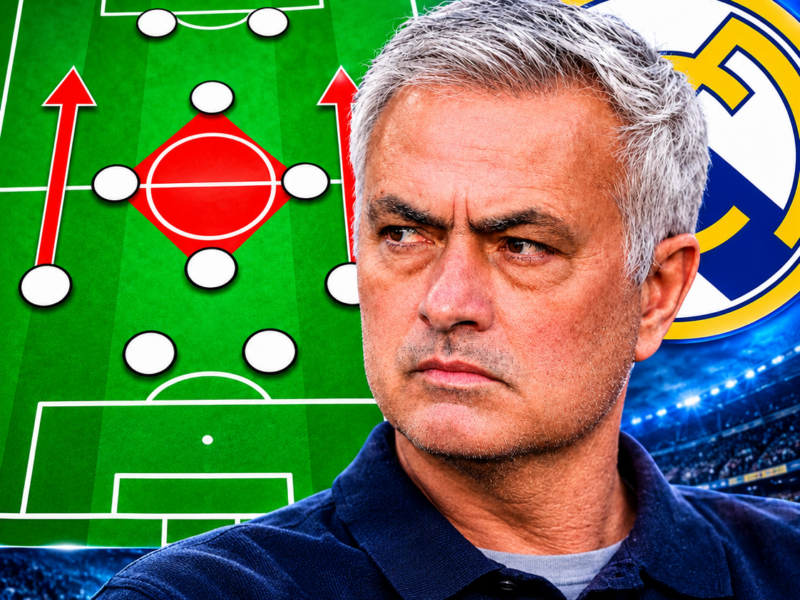
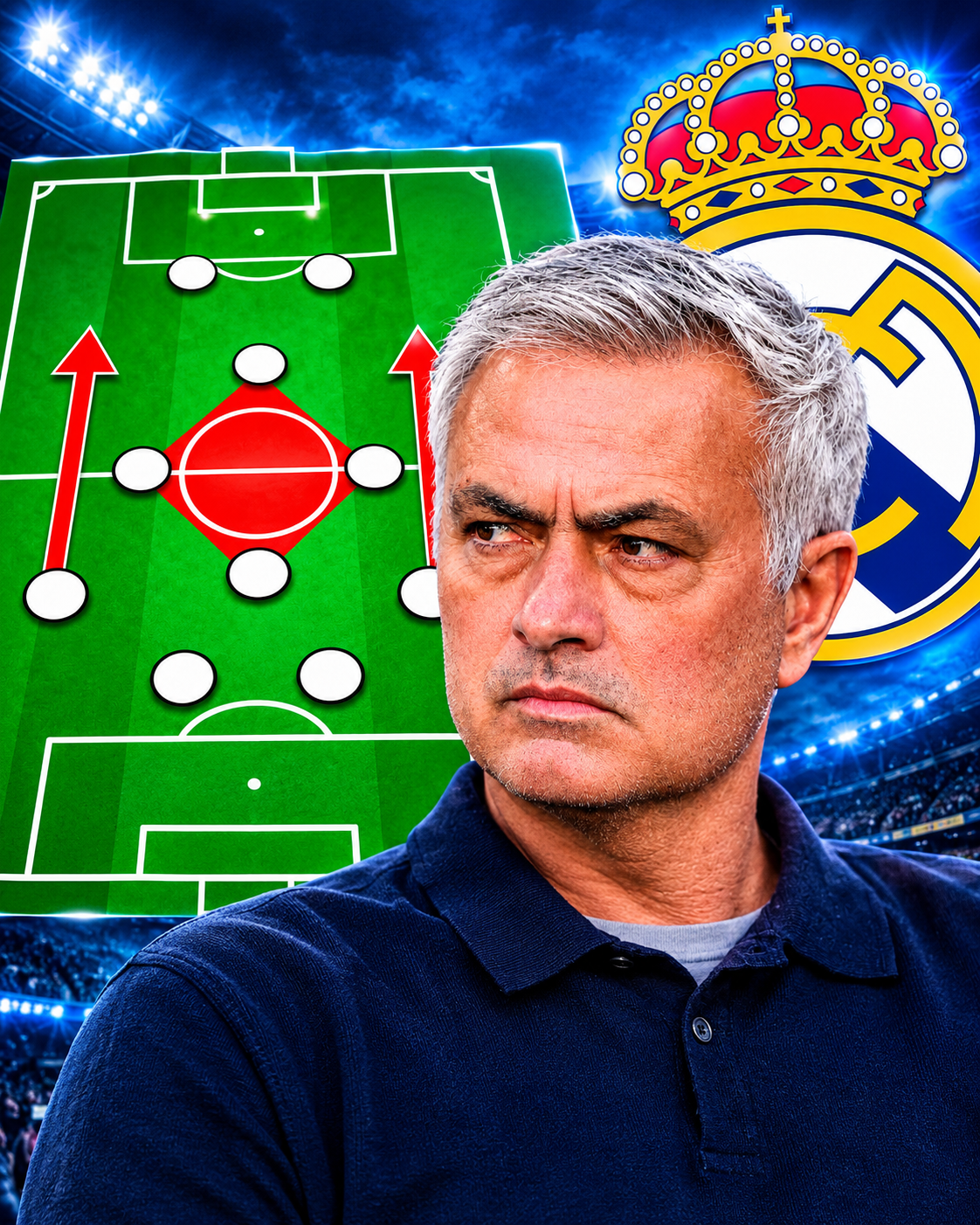
The Diamond That Could Save Mourinho’s Real Madrid Season: The Bold 4-3-1-2 Plan to Free Vinícius, Mbappé, Bellingham and Valverde
What if the answer to Real Madrid’s problems has been sitting in the club’s own history all along?
Not a new signing.
Not a new manager.
A shape.
A formation that many people have written off as a relic, and one that Madrid has not used since the 2024 team that won the Champions League.
The diamond.
One analyst believes it could be the plan that saves José Mourinho’s season, and the more you listen to the reasoning, the harder it is to dismiss.
But to understand why, you first have to understand what is really going wrong.
And it is not what most people think.
The Real Problem Is Not Vinícius and Mbappé
The usual explanation goes like this: Vinícius Júnior and Kylian Mbappé get in each other’s way.
Or maybe they do not run enough.
Those are surface problems, and they miss the point.
The real problem is how Real Madrid attacks when the opponent is organized.
Look at one of the many positional attacks from the start of this season, in the match against Málaga.
Madrid won that game, but the same flaw showed up there that has been repeating for two or three years.
When Real Madrid has the ball against a set defense, the team seems not to know what to do with it.
Even most of their goals come in open space, on the counterattack, in transition.
Watch how Huijsen gets the ball in that sequence.
He has no passing lanes of the kind big teams with great players should have.
There is no short option to the pivot, in this case Federico Valverde.
The other center-back is, in theory, hidden.
In other words, there are no short passes.
You could blame a lack of movement, players who should drop in to receive, others who should attack space to open lanes.
But that is the obvious answer, and everyone already knows it.
So the proposal is to change the plan.
Why the Diamond Isn’t Obsolete
Many people think the diamond is a dead system.
The analyst does not agree at all.
No system is obsolete as long as you have the players to execute it.
And Real Madrid happens to have exactly those players.
The goal of this shape is to solve two problems at once.
The first is the positional attack: how to make Madrid’s play with the ball better.
The second is the defensive load: how to defend well without Vinícius and Mbappé having to cover huge stretches of grass.
Think about the previous match against Atlético Madrid.
Atlético’s right-back was completely alone, because Giuliano Simeone was pinning Marc Cucurella back, and Cucurella could not step out to chase the winger.
If Vinícius or Mbappé have to drop back 40 yards to cover that flank, they will not do it with the same intensity as other kinds of players.
And when you pull your best players back that far, they burn out on the way up the pitch.
The diamond is meant to protect them, and to help the full-backs on both flanks.
It all comes down to who plays where.
The Back Line and the Full-Backs
Start with the players who are not up for debate.
Thibaut Courtois in goal.
Huijsen at left center-back and Ibrahima Konaté at right center-back.
Cucurella at left-back.
And on the right, either Denzel Dumfries or Trent Alexander-Arnold.
Either one could fill the role, and they could even rotate with Cucurella at certain moments.
The key point is that the diamond demands very attacking full-backs.
Not full-backs who stay home, but full-backs who push up almost like wingers.
Dumfries already does precisely that for the Netherlands, where he acts as a winger once his team has the ball.
Clearing the entire right flank for a player like that would be ideal.
Now compare it with what Madrid has been doing this season.
On the right, the team has used Arda Güler, and even Brahim Díaz, as a theoretical right winger who then drifts inside once Madrid has possession.
The result is that the right-back of the opposing team gets the whole width of that side to himself.
On the left, something different happens.
Vinícius usually sits there as a left winger and runs into Cucurella’s space, or Mbappé drifts into the same zone.
That is why people keep saying the two stars crowd each other.
The diamond helps fix that, at least partially.
The Midfield: Everyone in Their Best Position
This is where the system comes alive.
The diamond is built to strengthen Arda Güler’s place in the lineup and, finally, to give Jude Bellingham the freedom he has been missing.
At the base sits Aurélien Tchouaméni as the lone defensive pivot.
That is where he is happiest, being the boss in the middle of the field.
Next to him, on the right side of the midfield three, is Valverde.
And this may be the most exciting part of the entire plan.
Valverde would finally play in his ideal role as a right-sided interior, with a box-to-box job.
He would have the freedom to go forward and the freedom to track back.
Why does it work?
Because behind him there is always a more positional pivot.
Valverde would no longer be the player who stays back covering for everyone else.
He could drift to the flank again, and above all, he could arrive in the final third to do what he does best: unload that ferocious shot.
On the other side sits Güler.
And this is not a guess.
We have already seen him do well from there.
Look at the match against Betis, where Güler started as a right winger but moved into that left-sided interior lane during a particular play.
When the ball reached his left foot, he had a whole menu of passing options.
Vinícius on a run.
Mbappé on a run.
His left-footed passes would be amplified, because this is the ideal spot: not glued to the left touchline, but as an interior left-lane player.
And Güler would not have to initiate the play from deep, since Tchouaméni is behind him.
He would not need to arrive from the second line either, because Bellingham is there for that.
Güler would have just one job.
Filter passes into the final third, open to the left wing, or switch the play toward the run of the right-back.
It might be his best position: an intermediate role where he is not asked to score from the final third and not asked to start the attack, just to make those vertical, line-breaking passes that leave Vinícius and Mbappé facing the defense.
Bellingham in the Hole, Two Stars Up Top
Right behind the forwards sits Bellingham.
The attacking midfielder in the diamond would be free to appear as a false nine or, even better, to arrive from the second line.
That is the role in which he shone during the first season Madrid won the Champions League.
Up top would be Mbappé and Vinícius.
Now, the natural question is: does anyone really believe Vinícius and Mbappé would play as two strikers?
Of course not.
A team has several phases: with the ball, without the ball, and the transitions between the two.
The system would not be rigid.
It is a starting structure that changes shape as the game does.
With the ball, you would have to ask who creates the width.
Sometimes Valverde would occupy the wide zone while Dumfries stays a little deeper.
That would happen even more often with Alexander-Arnold at right-back, since Trent tends to move into interior zones.
Valverde would then have the freedom to push wide and become the false right winger everyone has been waiting for.
That is Valverde freed from the middle of the field once and for all.
And with the ball, Vinícius would not be the player who stands in front of the center-backs.
He would drift wide to the left.
How It Beats a Standard 4-4-2
Take a typical opponent, which usually plays a 4-4-2, especially if it defends in a mid-block or low-block.
Against that double pivot, Madrid would have four midfield players: Bellingham, Valverde, Tchouaméni, and Güler.
That is numerical superiority in the middle.
The opposing strikers would be busy with the center-backs, with Cucurella a little tighter and Dumfries covering the entire right flank.
Mbappé and Bellingham would have total freedom.
Güler would be in charge of the passes, and Madrid would have a surprise weapon in sending Valverde into the gap between the center-back and the full-back.
That kind of run is similar to what Fermín López does for Barcelona, and what we have seen in the passes from Lamine Yamal to Fermín, including recently with the Spanish national team.
Picture it.
Valverde breaks into that channel and drags a center-back with him.
Bellingham could then appear in the space behind him.
Or if that center-back stays with Bellingham because of a run from the second line, Valverde receives the ball and can float a cross into the box.
Suddenly Madrid has much more mobility.
And the most interesting part is not even the attack.
Defending With a Diamond
The common objection is that a diamond leaves you exposed on the flanks.
Not with these players.
Imagine the opponent attacking with two wingers, a center forward, and two players between the lines forming a box, which is the most common setup for a team that wants the ball.
Madrid would not be outnumbered.
Güler already helps the full-backs a lot, as we have seen on the right wing at the start of the season.
In this setup, he would help more on the left.
When the ball goes to one side, the whole team shifts with it.
Cucurella stays with the inside player who tries to slip between the center-back and the full-back, and the winger is left for Güler.
Then the entire midfield has to move across to close the space.
That is no problem for Tchouaméni and Valverde, two players who work enormously in defense.
It would not be strange to see Valverde sprint in from the flank to shut down the center, with Tchouaméni lending a hand so the opponent has no passing lanes.
Bellingham helps too.
If a stronger opponent forces Madrid into a low block, the attacking midfielder drops back to form a double pivot, turning the diamond into a flatter 4-4-2.
That is a very solid defense.
And the forwards would only have to help a little.
No more Vinícius running 40 yards.
Vinícius and Mbappé would keep more energy because they would face less defensive work.
Their main task would be to press the opposing pivots a bit more, so that Madrid does not sink too deep.
Where the Magic Happens
And the moment Madrid wins the ball, everything changes.
That is the version of Real Madrid that scares everyone.
Vinícius starting on the left and cutting inside.
Mbappé making the diagonal run from the right.
Valverde flying down the right wing, Dumfries alongside him, and Bellingham joining from the second line.
All of it against a defense that has been caught completely exposed.
This is where Madrid is strong: with space, with pace, and with stars who finally have the energy to use it.
What Would Change
Put it all together and the picture is clear.
The left side that Vinícius has not been able to cover this season would be protected.
Vinícius and Mbappé would be fresher and freer.
Bellingham would return to the role in which he shone in Madrid’s Champions League season.
Valverde would be back in his perfect position, a central midfielder with total freedom to cover every area of the pitch, in the final third and in his own half.
Cucurella and Dumfries would be deep, attacking full-backs again, the kind of role we have seen Cucurella play often with Spain.
And Tchouaméni would be in his ideal spot, with no partner beside him, growing into the lone pivot role.
Will Mourinho Do It?
The big question is whether he will.
The analyst believes that, to save the season in the short term, something very close to this system, or exactly this one, could be part of the solution.
Sticking with the system Madrid started the season with could still work out.
But the big games against Inter and Atlético did not go entirely well.
Sometimes the best new idea is an old one.
Madrid has the players for the diamond.
What it needs now is the nerve.
Your Turn
So what do you think of the diamond?
Are you buying it, or do you disagree?
What would you do if you were Mourinho?
Tell us in the comments.









