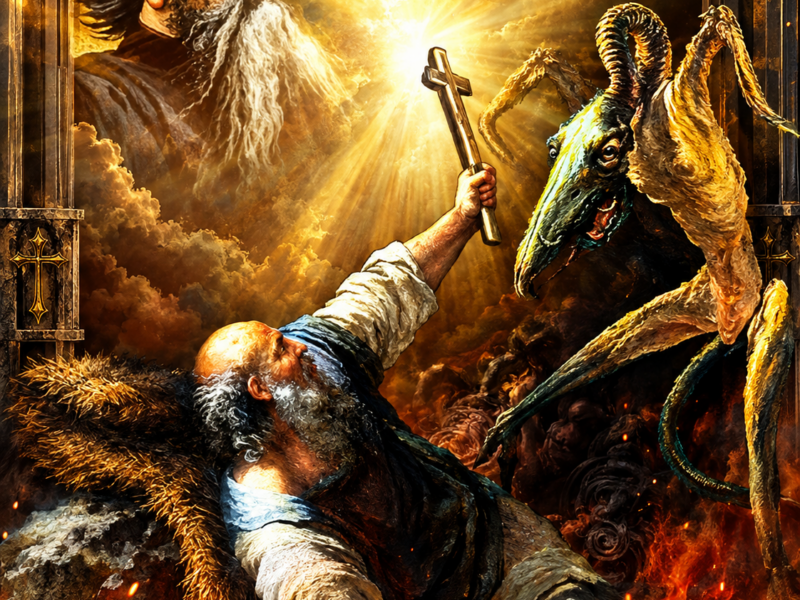
The Demon Who Killed Seven Grooms on Their Wedding Nights and the Monk Who Let Demons Beat Him Nearly to Death
You wake in the dark with your heart already racing.
The nightmare was vivid enough to feel real, and for a few seconds you lie there convinced that you are still inside it. Then you feel the hands.
They are rough, and they are cold, and they close around your ankles like iron cuffs.
You scream, but the sound dies in your throat as you are dragged off the mattress and slammed onto the floor. The room is empty. The door is locked. You saw nothing at all.
But you felt every second of it.
In the morning, the bruises are dark purple rings around both ankles. Across your shoulder are three long, fresh scratches, deep enough to sting under the shower.
No one else was in the house, and no one will believe you.
If you ask a certain kind of priest what happened, he will not tell you it was a bad dream.
He will tell you the enemy has stopped hiding.
When the Shadows Stop Whispering
In the old tradition of Christian demonology, there is a category of evil that behaves differently from all the others.
Most demonic activity works in secret. It plants a thought, stirs a craving, or leans on a weakness while you are not looking. But oppression is the moment the enemy walks out of the shadows and puts its hands on you.
It enters the physical world to attack you directly, along with the people and the possessions close to you.
Father Lucian Moretti, a veteran exorcist who spent four decades inside that world, kept a list of what it can look like.
There are bruises with no cause. Cuts and lacerations that appear overnight. Sicknesses that baffle every doctor who sees them. Accidents that strike a family again and again, as if the universe had picked a target.
The forms vary, but the goal never does.
Oppression exists to wear a person down. It is suffering applied patiently, with calculation, until the victim’s will finally gives way.
The demon is not trying to kill you, at least not at first. It wants you to bend, then break, and then bow.
It wants you to admit that you are powerless.
It wants you to look at your life, at the pain and the losses piling up, and conclude that nothing is left to fight with.
That is the real prize. Despair.
Moretti used to tell his students that the whole performance was a sadistic mind game. The demon wants you to believe it holds all the cards.
It does not.
And here is the strangest part of the doctrine, the part that makes oppression different from nearly everything else in the exorcist’s world.
In many forms of demonic activity, the victim’s freedom is under attack. In possession, a person can lose control of their own body. But in oppression, the will stays entirely intact.
Your mind is yours. Your choices are yours. The enemy can hurt you, but it cannot make you decide anything.
The demons, of course, would like you to forget that.
Two Stories Worth Telling
Every tradition of oppression has its famous case.
The oldest and most commonly cited is the tale of a righteous man who lost his property, his children, and his health in a single season, and still refused to curse the heaven above him. Exorcists call it the textbook example, because the man’s body was torn apart while his spirit stayed his own.
But that story has been told ten thousand times.
Tonight we are going to look at two cases that most people never hear about. Two stories of oppression that are stranger, quieter, and in some ways more unsettling.
One comes from an ancient scroll of wisdom that nearly every Christian tradition treats as sacred. It tells of a young woman, an archdemon, and a fish.
Yes, a fish.
The other comes from the sands of the Egyptian desert, where a wealthy young heir gave away everything he owned and was beaten almost to death for it. It is the story of the first man to learn how to make demons afraid.
Let us begin with the woman.
The Bride Who Buried Seven Husbands
Her name was Sera.
She lived in the town of Medara, a prosperous trading city beyond the great river, in the house of her father Gael. She was young, she was lovely, and she was, by every account, a good person.
She was also the most feared woman in the region.
Because Sera had been married seven times, and seven times she had been widowed on her wedding night.
Seven grooms. Seven weddings. Seven mornings when the household woke to find a dead man in the bridal chamber, cold in his bed, with no wound and no explanation.
Each of them died before the marriage could even begin.
Imagine how it must have felt to live inside that story.
The first death was a tragedy, and the town grieved with her. The second was a terrible coincidence. By the third, the whispers had started, and by the fifth, people were crossing the street when she walked by.
When the seventh young man was carried out of her bedroom, something broke in the community.
She was no longer the victim. She was the cause.
Nobody could see the thing that was really killing those men. All they could see was Sera, standing at the center of it every time, with a bridal veil and a house full of mourners.
So they blamed her.
The cruelest blow came from within her own household. One of her father’s servant women, a girl who had seen the funerals with her own eyes, looked Sera in the face one afternoon and said what everyone else was thinking.
“You are the one who kills your husbands. You have been given to seven men, and you cannot even carry the name of one. Why do you strike us, because they are dead? Go and join them.”
The words landed like a slap.
Sera fled to an upper room and locked the door. She sat there for days, wondering whether the servant was right.
She did not know what she had done. She only knew that the weight of it was unbearable. She believed, deep down, that she was being punished by God, though she could not imagine why.
Finally, in the quiet of that room, she did what desperate people have always done.
She raised her hands to heaven and begged.
She asked to be freed from the curse. And if that was not possible, she asked to be allowed to die.
It was a prayer from the bottom of the well.
And someone was listening.
The Demon in the Bridal Chamber
What Sera did not know, what no one in Medara knew, was that she had never been cursed at all.
She had been marked.
An arch-demon named Azmodan had fixed on her years earlier, and he had been killing her suitors one by one. He was no common spirit. He was powerful, obsessive, and possessive, a creature who treated her as his property and saw every marriage as a trespass.
So he waited in the bridal chamber on each wedding night, and he struck before any union could be completed.
It was a campaign of oppression, in the purest sense.
Azmodan did not need to touch Sera. He did not need to hurt her body. He only needed to destroy everything she loved, over and over, until the world turned its back on her, until her own household called her a murderer, until she begged to die.
He was not hunting her flesh. He was hunting her hope.
And for years, it had worked.
But the demon had made a mistake, one that every demon in the old stories makes sooner or later.
He had pushed her far enough to pray.
Far away, in the court of heaven, the prayer was heard.
The ancient text tells us that the answer was immediate, and that it was practical. Heaven did not send a miracle to Sera’s door. It sent a messenger across the world, to a young man who had never heard of her, to set a trap.
The Boy Who Needed a Guide
Tobin was the son of a blind and impoverished man named Tovan.
The family had once been respected. Now they were sick, hungry, and on the edge of ruin, and Tovan spent his days sitting in the dark, remembering a sum of money he had left with a distant friend many years before.
It was in the faraway region of Medara, several hundred miles from home.
One evening, he called his son to his side.
“Go and bring it back. We have nothing else left. But you cannot cross that country alone. Find someone who knows the road, and pay him whatever he asks.”
Tobin nodded and went out into the street.
He did not have to look long.
A tall stranger stood in the road as if he had been waiting for him all day. He had a calm, steady face, the kind that makes people trust a man before he opens his mouth.
The stranger said he knew the way to Medara. He had traveled it many times.
Tobin was relieved, and he never thought to ask who the man really was.
His name, the traveler said, was Ravel.
He was an angel of God. But Tobin would not find that out until the very end of the story.
The River and the Fish
They walked for days.
The country grew wilder as they went, with dry hills giving way to open plains and the long shine of a river in the distance. By the time they reached the banks of the Tigrel, the sun was low and both men were tired.
They made camp. Tobin knelt at the water’s edge to wash his feet.
Without warning, the river erupted.
A huge fish shot out of the current, mouth wide, and lunged straight at his foot. Tobin shouted and scrambled back, his heart slamming against his ribs.
Ravel’s voice cut across the noise.
“Seize it! Do not let it escape!”
Tobin did not stop to think. He lunged, grabbed the thing with both arms, and heaved it up onto the riverbank, where it flopped and thrashed in the mud until it finally went still.
Ravel stood over it with an odd gleam in his eye.
“Cut it open. Take out the heart, the liver, and the gall. Keep them safe. You are going to need them.”
Tobin obeyed, though he had no idea why.
They roasted the rest of the fish and ate it by the fire. As they ate, Ravel explained that the parts they had saved were not simply scraps. They could drive out evil spirits, and the gall could cure certain kinds of blindness.
Tobin looked at the little bundle, wrapped in leaves, and nodded politely.
It was, he thought, a strange thing for a traveling companion to know.
They slept beside the river. At first light, they rose, shouldered their packs, and continued toward Medara.
The Plan
As the city came into view, Ravel turned to his young friend with a strange look on his face.
“Tonight we will stay at the house of a man named Gael. He has a daughter, Sera. You will marry her.”
Tobin stopped walking.
He knew the name. Everyone knew the name. She was a distant cousin, and her story had traveled all the way to his own village. Seven grooms. Seven corpses.
“I cannot do that,” he said. “I have heard what happens to the men who marry her. I am an only son. My parents are old. I would be dead before the sun came up.”
Ravel did not argue. He laid out the facts.
By the law of their people, he explained, Sera belonged to Tobin’s family. She had a right to marry within the line, and he had a duty to claim her.
Then he said the thing that changed everything.
“It was never her fault. A demon is doing this, an arch-demon named Azmodan. He has been killing the men who approached her. But God has sent you here to end it.”
Tobin said nothing for a long moment.
Then something in his chest shifted. It is hard to say what. It may have been conviction, or compassion, or something simpler that he did not yet have a name for.
By the time they reached the city gates, he had made up his mind.
He would marry the woman the whole world feared, and he would set her free.
It is worth noting how quickly this happens in the old text. The young man hears the truth, and in an instant he is head over heels, willing to go to any length. Whatever the angel said to him that day, he said it well.
The Wedding Night
Everything unfolded exactly the way Ravel had predicted.
The family welcomed them. The match was arranged. Gael, who had buried seven sons-in-law, agreed with the weary air of a man who no longer expected anything but sorrow.
There was a banquet. There was music. There was wine, and laughter that rang a little too loud.
Then, as the night wore on, the guests drifted away, and the bride and groom were led to their chamber.
It was the hour Azmodan had been waiting for.
Tobin closed the door behind him. Sera stood in the lamplight, pale and rigid, bracing for the end of yet another husband.
He gave her a small, gentle smile.
Then he remembered the bundle in his bag.
He took out the heart and the liver of the fish, still wrapped in leaves, and set them on the embers of the incense burner by the bed.
For a moment, nothing happened.
Then a thin, strange smoke began to rise. It was not the heavy smoke of burning meat. It curled upward with a faint glow, as if something holy were hiding inside it, and it began to drift through the room.
It was looking for something.
The moment the arch-demon caught the smell, he bolted.
The text is blunt about it. He fled to the farthest reaches of Egypt, and there the angel Ravel caught him and bound him.
No battle. No speeches. Just a fish heart, a few coals, and a demon who could not stand the smell.
It may be the strangest exorcism in all of scripture. It is also one of the most effective.
Digging the Grave
While all of this was happening upstairs, Sera’s father was downstairs with a shovel.
Gael had done this seven times already. He was a practical man, and he did not trust hope. So, while the household slept, he quietly ordered his servants to dig a grave in the garden, just in case.
It was a small, bitter detail, and it says everything about how much pain the family had already endured.
At dawn, he sent a maid to the chamber door to check.
She cracked it open, peered inside, and froze.
Tobin was asleep in the bed, alive and breathing, with his new wife beside him.
The girl ran back downstairs.
Gael listened to her report, and for a long moment he said nothing. Then he shouted for the servants. Quickly, before anyone could wake up, they filled in the grave.
There was no need for an awkward conversation at the breakfast table about the hole in the garden.
When the couple came down, the household was already laughing and weeping at the same time. The family held a two-week feast. Sera, for the first time in years, was celebrated instead of feared.
And Tobin, having done what no one else could, was finally free to collect his father’s money and go home.
The Gall and the Gift
The journey back was joyful.
Tobin returned with his wife, his fortune, and an angel at his side. When they reached the old house, Tovan was waiting in the dark, exactly as Tobin had left him.
Ravel handed the young man the last item from the fish.
“Take the gall. Spread it on your father’s eyes.”
Tobin did as he was told. The old man blinked once, twice, then gasped, and the whole room rang with joy.
For the first time in years, Tovan could see his son’s face.
The family wept. They tried to thank the traveler. They begged him to take half of everything they owned.
And at last Ravel told them the truth.
“I am Ravel, one of the seven who stand before the throne of God.”
Then he rose into the sky and was gone.
Sera and Tobin lived long, peaceful lives. They raised children and grandchildren, and no demon troubled them again. It is the happy ending that most oppression stories never get.
What the Story Teaches
There is a detail in this tale that is easy to miss.
God heard Sera’s prayer instantly, but the rescue took a long road. A young man had to be sent across hundreds of miles. A fish had to leap out of a river. A father had to go blind, a family had to go hungry, and a bride had to survive seven funerals.
Everything had its moment.
The archangel’s arrival, timed to the day, shows us something about how heaven handles extraordinary evil. It does not hurry. It does not panic. It works on a schedule that no human can see.
For Sera, that schedule meant years of suffering.
But in the end, one soul was freed, one family was healed, and a story was written that would be told for two thousand years.
Some readers think it taught even the angel something about the strange dynamic between heaven, earth, and hell.
Whether or not that is true, the lesson stays the same.
Sera never lost her will. Even in her darkest room, she chose to pray.
And that choice, small and desperate and human, is what set the whole rescue in motion.
The Man Who Gave Everything Away
Now we leave the river and travel to the desert.
The second story is not a legend wrapped in myth. It is a biography, written by a man who knew its hero personally, within a few years of the hero’s death. It records one of the oldest documented campaigns of demonic oppression in all of Christian history.
Perhaps you have seen the paintings.
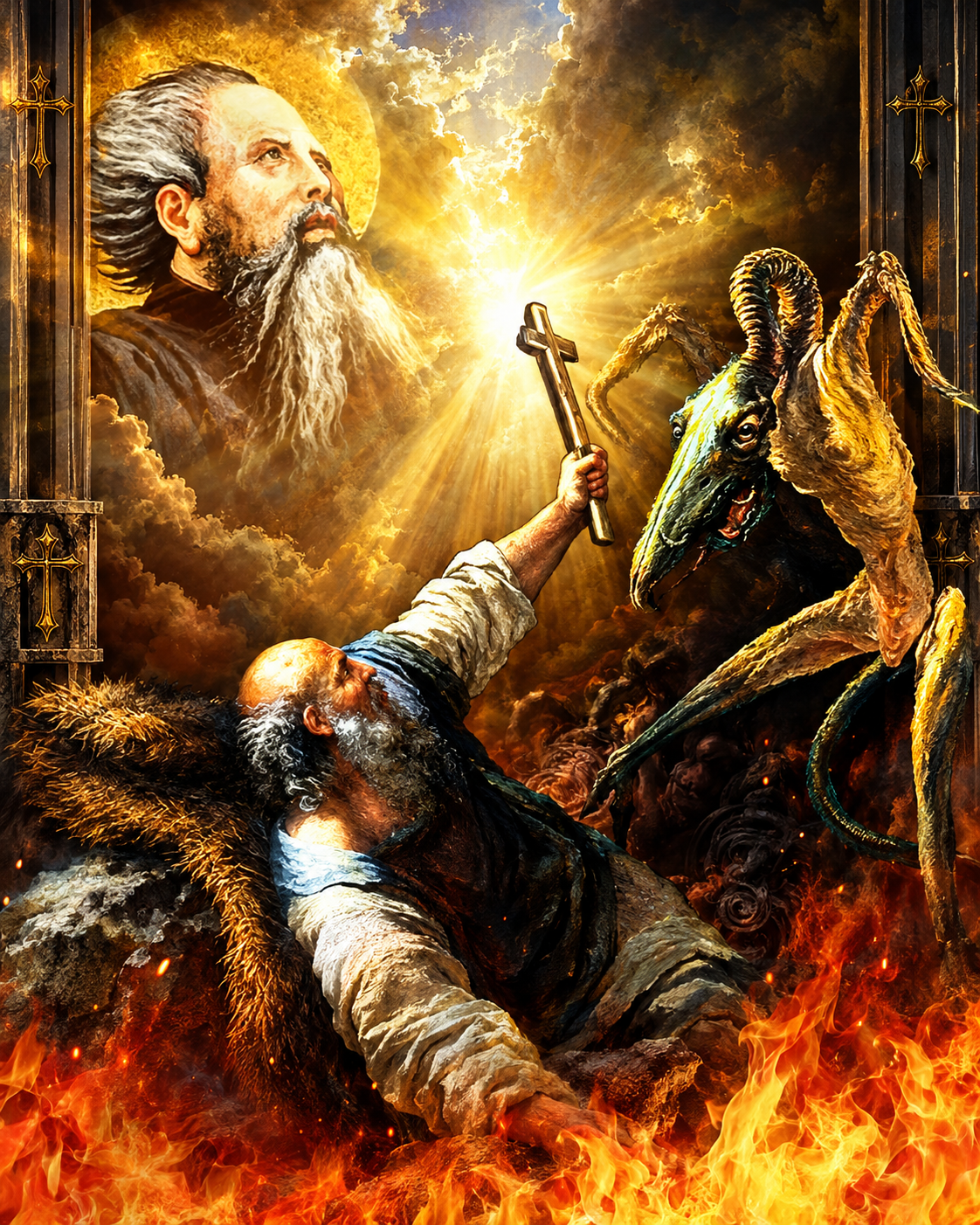
A lone man crouches in a barren landscape. Around him swarm a dozen grotesque creatures, tearing at his clothes and clawing at his flesh. And the man, bleeding and bruised, looks strangely calm.
His name was Anselm.
He was born into comfort around the middle of the third century, in a Christian village in Egypt. His family was wealthy and devout, and when his parents died, he inherited everything at the age of twenty.
He had land. He had money. He had a younger sister who depended on him.
And then, one morning, he walked into church and heard a sermon that changed the course of his life.
The Sermon
The reading that day was an old story about a rich young man.
The man comes to a teacher and asks him a question. He is respectable. He keeps every commandment. He gives to the poor and pays his dues, and still he feels a hollow space inside him.
“What else must I do?” he asks.
The teacher looks at him for a long moment and answers.
“Sell everything you own. Give the money to the poor. Then come and follow me.”
The young man’s face falls. He has many possessions, and he cannot bring himself to let them go. He turns around and walks away, sad and silent.
The teacher watches him leave and says to those standing nearby that it is easier for a camel to pass through the eye of a needle than for a rich man to enter the kingdom of heaven.
The sermon ended. The congregation shuffled out into the sunlight.
Anselm did not move.
Something about that story had gripped him like a hand around the heart. He sat very still, and the sound of the preacher’s voice seemed to ring in him like a bell.
He understood, suddenly and completely, that the story was about him.
He was the rich young man. And this time, the answer was going to be different.
Selling Everything
He acted at once.
Within weeks, Anselm had sold his land, his house, and his belongings. He gave the money to the poor, down to the last coin. He placed his younger sister in the care of a convent, a common arrangement for Christians of that time and place.
Then he walked out of his village with nothing but the clothes he wore.
He was heading for the desert.
He was not the first man to disappear into the wilderness. But he was the first to do it with such total commitment, and he would come to be called the father of a whole movement. Historians know the men and women who followed him as the desert fathers and mothers.
They were early Christians who rejected comfort and wealth entirely.
They lived in caves, ruins, and hollowed-out tombs. They fasted. They prayed. They gave up everything the world could offer, and they did it for two reasons.
The first was to draw closer to God.
The second was to pick a fight.
These monks believed that the empty places of the world were thick with demons, and that the only way to drive them out was to go in and face them. They wanted to confront evil, first within themselves and then wherever it nested.
Anselm, being the first, set the standard.
He chose an abandoned tomb outside the village for his home. His only possessions were a handful of rags and a chipped clay pot.
For a man who had been rich a month earlier, it was a shocking fall.
And somewhere far below the earth, it did not go unnoticed.
The First Night
Hell was disturbed.
The idea that a wealthy young man would simply walk away from everything, without hesitation, and live on bread and prayer alone, was an insult the underworld could not ignore.
A holy wild card had appeared in the desert, and he had to be crushed.
So on the first night of his solitude, as Anselm knelt in the dust of the tomb, the darkness began to move.
The biography describes it plainly.
“The enemy could not endure it. He came by night with a multitude of demons and scourged him so severely that Anselm lay on the ground speechless with pain.”
The beating was merciless. The demons battered him, whipped him, and cracked his ribs. When they finally withdrew, the young man was lying in a pool of his own blood, barely breathing.
If nothing else had happened, he would have died there before dawn.
But something did happen.
A friend, who had agreed to bring him bread every few days, arrived at the tomb the following morning. He found Anselm lying motionless and covered in wounds.
He was certain the man was dead.
He lifted the body onto his shoulders, carried it back to the village, and laid it down on the stone floor of the church. The neighbors began to gather. Mourners started to prepare the wake.
It was a sad end for a young saint who had bitten off more than he could chew.
Then, around midnight, Anselm’s eyes opened.
The Return to the Tomb
He sat up with a groan.
The friend, who had stayed awake beside the body, nearly fainted. The only sensible explanation, he later told people, was that God had kept the man alive.
But Anselm was not interested in being grateful. He was interested in going back.
“Take me to the tomb,” he said.
His friend stared at him.
Anselm was a human ruin. His ribs were broken. He could barely sit upright, let alone walk. Every breath was agony. The idea of returning to the place that had nearly killed him was insane.
The friend refused.
Anselm insisted.
He was not the sort of man who could be argued out of a decision, and eventually the friend gave in. He picked up the wounded monk, carried him through the night, and laid him down on the floor of the tomb.
Anselm asked him to close the door.
The friend hesitated, then did what he was asked. The heavy stone swung into place with a dull thud, and the monk was left alone in the dark.
He could not stand. He could not run. He could not defend himself.
That was exactly how he wanted it.
Here I Am
Anselm lay on the floor and prayed.
He prayed quietly at first, then louder, until his voice carried through the stone. And when he finished, he did something no sane person would have done.
He spoke to the darkness.
“Here I am! I am Anselm. I will not flee from your whips. Even if you give me more, nothing will separate me from the love of Christ.”
The silence after those words was the kind that makes the hair on your arms stand up.
Then the tomb began to shake.
It felt like an earthquake. Dust rained from the ceiling, and the walls groaned. And through the cracks, and out of the shadows, the demons poured in.
They took the shape of every beast of nightmare. Lions. Bears. Leopards. Bulls. Wolves. Serpents, vipers, and scorpions.
They circled the broken monk, snarling, their eyes glowing in the dark. The noise was unbearable, a shrieking and roaring and gnashing of teeth that tore at his wounds like knives.
And yet they did not attack.
Anselm noticed it at once.
The beasts surrounded him, with fangs bared and claws raised, but they could not reach him. They paced and snapped and strained, as if they were held back by invisible chains.
Even half-dead, he understood what he was looking at.
“If you are able, and you have been given power against me, why do you delay? Attack. But if you are not able, why do you trouble me in vain? For faith in the Lord is a seal and a wall of safety to us.”
It was a bold taunt from a man who could barely breathe.
And he was right.
The demons could not touch him in the way they wanted. They had been given a leash by heaven, and the leash was short.
All they could do was gnash their teeth at him, harder and harder, and inflict smaller injuries. They were not enough to maim him. They were enough to kill a dying man, slowly.
The Long Dark
The biography does not say how long it lasted.
The author skipped that part, which may be the most frightening omission in the whole story. It could have been an hour. It could have been the whole night. It implies a long, patient suffering, endured by a man who knew God was present and did nothing.
That is the hardest part.
Anselm was not suffering in an empty universe. He understood that God was there, watching, a witness to every blow. And still no help came.
Here is what is easy to miss.
Anselm had faith that God could save him. But he had no expectation that God would. He had given up hope of rescue. He did not pray for a miracle, and he did not plan an escape.
He had asked his friend to seal the door. He had returned with the intention of dying.
If the end came, he intended to meet it as a martyr, and perhaps to leave the demons with one last insult.
To Anselm, that would have been a complete victory.
He had already given away his wealth. Now he was giving away his life. And in the process he had stripped the demons of the only weapon they had ever really held, the fear of what they could take.
You cannot terrorize a man who has already surrendered everything.
The Light
And then the roof of the tomb split open.
A pillar of light came down like a spear. It was not the light of lamps or sun or fire. It was a blinding, roaring radiance, so bright that it seemed to burn through the closed eyelids of the monk.
It smashed into the floor of the tomb.
If hellfire is napalm, then heaven’s fire is a thermonuclear bomb.
The demons did not have time to scream. They tried to flee, but the light caught them in mid-shape, and the beasts dissolved in a flash of white. The snarling stopped. The darkness vanished. The whole tomb filled with a holiness so heavy it was almost impossible to bear.
Anselm opened his eyes.
Every bone in his body had been broken. He could scarcely breathe. And he looked up into the brilliance and thought that it was finally over.
He was wrong.
The pain disappeared. His ribs knit together. His wounds closed, and the blood on his skin dried to dust. In a single heartbeat, the monk was whole.
He lay there for a long time, trembling, trying to understand what had just happened.
Then he did something very human.
He grew a little angry.
“Where were you?” he demanded of the light. “Why did you not appear at the beginning, to stop my pain?”
The answer came from the brightness, calm and clear.
“Anselm, I was here. But I waited to see your fight. And since you endured and were not defeated, I will always be your helper.”
The Rules of the War
Step back from that scene for a moment, because something important just happened.
Before Anselm, the usual approach to evil was defensive. You protected yourself, you warded off demons, you stayed out of their way. Most Christians feared them, and, if we are honest, many still do.
The desert fathers turned that idea upside down.
They did not wait for demons to come. They went looking for them. They walked into the places where the enemy lived, mocked them, tested them, and studied their weaknesses.
They made the demons afraid of them.
Anselm was the first. About seventeen hundred years ago, he discovered how to beat the enemy at its own game.
And the lesson he learned in that tomb was simple, and brutal.
In spiritual warfare, survival is not the point.
What hangs in the balance is faith. Every demonic attack, whatever form it takes, has a single objective, to drive a person into despair. To convince them that God is absent, or worse, that God has turned away.
That is how evil wins.
It does not need your body. It needs your belief.
And that is why concerns about mortal life and safety can be turned against you. When a demon threatens your health, your family, your future, it is trying to make you value them more than your faith. The violence is only the lever.
So the first requirement for unbreakable faith is a certain fearlessness. Not recklessness, but a freedom from the terror of death that the enemy uses as a weapon.
Anselm had that freedom. He gave it to himself, one sacrifice at a time.
Why God Waited
Anselm’s question is the oldest one in the world. Where were you?
If God was present in that tomb, why did the beating last so long? Why did he wait until the monk was shattered before intervening?
The ancient answer is uncomfortable. God allowed it.
It was a test, not of strength but of trust. Anselm had to hold on to his faith even when he knew God was watching, and doing nothing.
That is the second thing we learn from the story of oppression.
In every case, the victim’s free will remains. Nobody can force you to give up your faith. Only you can choose that. And so the battle is fought on a single ground, whether you are willing to see past your symptoms, your pain, and your fear, and keep believing.
In the Abrahamic traditions, God’s plan is considered unknowable, except for what the prophets reveal.
We cannot judge when God acts, because we cannot see the whole picture. The moment we feel we need him most may not be the moment we actually do.
According to this tradition, God is never late. He is simply on a different clock.
It also explains why Christian theology gives suffering such weight. Pain is not valued for its own sake. But it can be a path to redemption, a force that forges the soul.
Anselm was beaten by demons, and it was part of the plan. He was being taught the final truths of spiritual warfare.
He learned that his faith was his only real defense, and his only real weapon.
The Demon Hunter
After the night in the tomb, Anselm’s reputation spread.
He became known across the desert as a man who had faced the enemy and won. He grew stricter in his discipline. He left the tombs and went deeper into the wilderness, searching for isolation and for more demons to confront.
He had become the demon’s own oppressor.
Eventually, he found a ruined fortress on a mountain, abandoned and notoriously infested with spirits. He moved in without hesitation.
The demons did what they always did. They tried everything.
They tempted him with visions of wealth. They sent illusions of beautiful women. They whispered doubts into his mind in the middle of the night, and they showed him terrible things.
None of it worked.
His weapons were prayer, fasting, and a nearly photographic memory of scripture. He used them with a skill that would have impressed a general.
Over time, his victories became so numerous that the devil himself grew curious.
The biography records a famous scene. Satan appeared to Anselm in person, and asked him why none of his schemes had ever worked.
The monk looked at him and called him weak as a child.
Then he rebuked him with scripture.
The devil, according to the story, shuddered at the words. He never dared to confront Anselm in person again. From that day on, he watched from a distance, while the old monk battled his servants for the rest of his life.
The Return
Anselm lived in the fortress for twenty years.
During that time, word of his deeds spread through the villages. Crowds gathered outside the ruins, and many wanted to follow his example. They begged him to come out. When he would not, they broke down the door.
The biography describes what they saw.
Anselm walked out of the fortress as if stepping out of a shrine. He was calm and strong, filled with something that the crowd could only call the spirit of God.
The people were stunned.
He had been a hermit for more than two decades. He should have been wasted and weak. Instead, he displayed more vigor than men half his age.
To the crowds, it was a sign. The old monk was the real thing.
He lived to a great age, and he died around the middle of the fourth century. His story was recorded by a man who knew him, and it shaped the idea of the holy warrior for the next two thousand years.
Artists painted him wrestling grotesque demons in the desert night. Some dismissed those scenes as symbols.
Anselm himself did not. For him, the battles were flesh and blood.
What He Told the Frightened
What stands out about the monk, after all these centuries, is not his courage in the tomb. It is his calm.
When younger monks came to him in terror of the demons, he gave them simple advice.
“Make the sign of the cross and walk out boldly. What demons fear above all is the Lord himself.”
It was his signature teaching, and it contains the whole philosophy of oppression in a single line.
Demonic power can cause pain. It can leave bruises, and cuts, and broken bones. It can ruin a family, and darken a life.
But in the end, it is an illusion. The enemy is a bully who wins only when you believe it can.
That does not mean that suffering is unreal. Sera’s grief was real, and so was Anselm’s blood. But the demons in both stories were working inside limits that heaven had set.
Azmodan could kill grooms. He could not touch Sera’s will.
The beasts in the tomb could tear at Anselm’s skin. They could not move beyond the chains.
Two Rescues, One Truth
Look at the two stories side by side, and a pattern emerges.
In one, a frightened young woman is rescued by a messenger, a fish, and a handful of coals. In the other, a stubborn monk is rescued by a pillar of fire from the sky.
The methods could not be more different. But the structure is the same.
In both, the victim chose faith when everything pointed toward despair. In both, the oppression seemed endless, and in both, the help arrived at exactly the right moment, neither a moment earlier nor a moment later.
And in both, the enemy lost, not because it ran out of strength, but because it failed to take away the one thing it was really after.
That is the quiet message of oppression.
You can be hurt. You can be isolated. You can be blamed for things that are not your fault, and left to wonder whether anyone is listening.
But the last decision is yours.
The demon wants you to bend, to break, and to bow. The saints in these stories refused. One did it in a locked bedroom, with her hands raised in prayer. The other did it in a sealed tomb, with a shout.
Neither of them knew when the rescue would come.
They only knew that they would not give in.
Oppression, in the end, is a test of whether you can hold on in the dark without knowing how long the night will last.
And if there is one thing these two stories agree on, it is that the dawn arrives. Not always when we want it, and not always in a form we expect.
But it arrives, right on time.









