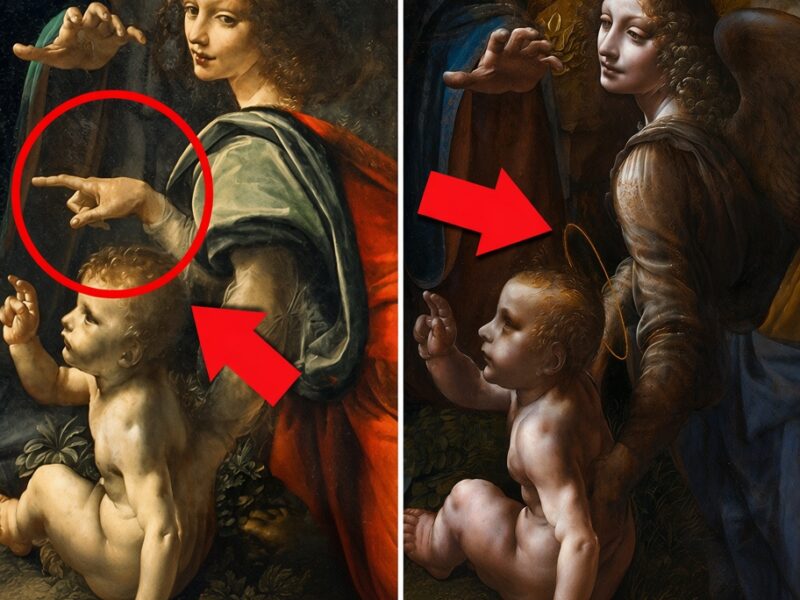
The Da Vinci Secret No One Can Explain
Among Leonardo da Vinci’s most mysterious works, one painting holds a special place: The Virgin of the Rocks, housed in the Louvre in Paris. On the surface, it looks like an ordinary religious scene with the Virgin Mary and the infant Christ. Now look at a second painting.
It is also called The Virgin of the Rocks, but this version hangs on the other side of Europe, in London’s National Gallery. Both were painted by Leonardo, and at first glance they seem almost identical. The same figures, the same rocky cave, the same composition.
A closer look reveals something unusual. Details vanish and reappear. Gestures change, facial expressions shift, and even the meaning of the scene seems different.
Most remarkably, Leonardo almost never painted the same subject twice. So why did he spend years creating two nearly identical versions of one painting? And what secrets hide in the differences between them?
The story begins in 1483, when Leonardo won a prestigious commission from the Confraternity of the Immaculate Conception in Milan. The brotherhood needed a central panel for an elaborate wooden altarpiece. The contract spelled out exactly what they wanted.
The Virgin Mary, the infant Jesus, God the Father, angels, prophets, and generous amounts of gold and ultramarine, the costliest pigments of the age. Leonardo ignored almost every part of it. The result was the Louvre version.
Instead of a crowded heavenly vision, he gave the brotherhood a dark, damp cave lit by an enigmatic glow. The painting held only four figures: the Virgin Mary, the infant Jesus, the young John the Baptist and an angel. There was no gold, no prophets and none of the conventional religious iconography.
Leonardo showed the meeting of the infant Jesus and John the Baptist in the wilderness. The painting’s greatest mystery, and its greatest problem, is its compositional ambiguity. Anyone viewing it, especially a contemporary of Leonardo, could easily mix up the two children.
In Renaissance art, Jesus was traditionally shown closest to Mary, often seated on her lap. John the Baptist usually appeared slightly apart, praying or showing reverence. Leonardo deliberately broke that convention.
On the left, a child kneels with his hands clasped in prayer. Above him, the Virgin’s protective hand extends like a sheltering canopy. On the right, another child sits supported by an angel, raising his hand in blessing.
Logic says the child beneath Mary’s hand must be her son. It is not. Jesus is the child on the right, and Mary is protecting John the Baptist.
This reversal carried a potentially controversial theological implication. Jesus, the son of God, appears to bless John, a mortal man. Yet Jesus sits lower than John, almost as if subordinate to him, while Mary directs her protection toward John rather than her own son.
For the Confraternity, such a reading came dangerously close to heresy. Whether Leonardo intended that effect is a question the surviving evidence cannot settle. What is certain is that the ambiguity was there for patrons to see.
The most enigmatic figure in the Louvre painting is the angel. Art historians generally agree he is the Archangel Uriel. According to tradition, Uriel saved the infant John from King Herod’s Massacre of the Innocents and led him into the wilderness, where he later met the Holy Family.
In the Louvre version, Uriel does two things that disrupt the otherwise closed composition. First, he looks straight at the viewer. His piercing, almost unsettling gaze breaks the fourth wall and makes us participants in a secret event.
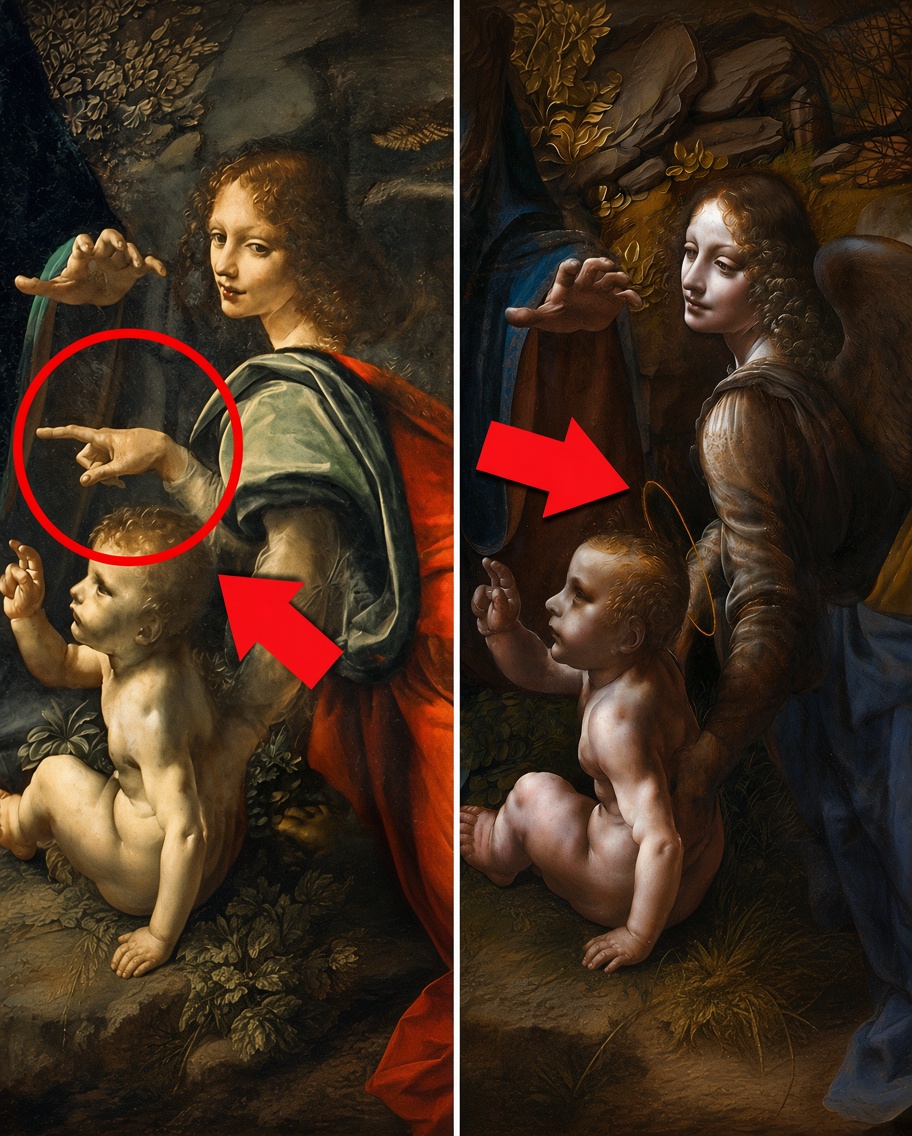
Second, his arm is extended and his index finger points firmly toward the infant John. It is a classic Leonardesque code. The angel seems to say, “Look at him,” as if John were the key to everything.
The gesture is far more emphatic than an ordinary religious scene would need. As a result, John comes across as a more significant figure than Christ or the Virgin, who are unintentionally pushed into the background.
So why did Leonardo make a second version? According to the most widely accepted theory, the answer lies in a long-running dispute between the artist and the Confraternity. Leonardo demanded higher payment, convinced he had made a masterpiece.
The Confraternity refused. It argued that he had broken the terms of the contract and included potentially heretical elements.
Unable to reach an agreement, Leonardo eventually sold the first painting to another influential buyer. The Confraternity still needed a painting for its altarpiece, and so the London version was born. Today this theory is considered the most likely explanation for why two versions exist.
The London painting is a remarkable example of artistic self-censorship. Leonardo, working with significant help from his pupils, as the cooler palette and sharper contours suggest, corrected every problematic element. Uriel’s pointing finger is gone.
His hand now rests calmly on his knee. His gaze is lowered, and he no longer looks at the viewer, which breaks the mysterious connection of the Louvre version. John the Baptist was given a long reed cross, his traditional attribute, so no one could mistake him for Jesus again.
Another key difference is the halos. In the Louvre version they are completely absent, an extremely unusual choice for religious painting of the period. Leonardo preferred to convey holiness through light, expression and atmosphere rather than conventional symbols.
In the second version, distinct golden halos crown all the figures, and the composition moves much closer to church tradition. The painting became theologically correct. It also lost some of its original, unsettling magic.
The most astonishing secrets of the London version surfaced only recently. In 2019, researchers at the National Gallery used advanced imaging technology to look beneath the upper layers of oil paint. What they found changed our understanding of Leonardo’s creative process.
Beneath the visible picture lay a completely different, unfinished composition. The Virgin Mary sat higher on the left side of the panel. Rather than looking at the children, her gaze turned aside, as if she were contemplating a divine vision.
One hand rested against her chest, while the other reached forward in a gesture art historians read as either worship or astonishment. In this hidden version, the angel was not merely supporting Jesus. He embraced him tightly with both arms.
The discovery showed that Leonardo never meant to simply copy the Louvre painting. He had started developing an entirely new and even more dynamic composition. Why, then, did he paint over it and return to a design so close to the original?
Most scholars believe the Confraternity, frustrated by years of delays, demanded a version resembling the one they had already seen, but with corrections. Leonardo, needing both money and a way out of an endless contract, gave in. He abandoned his new ideas, painted over them, and let his assistants help finish what became a compromise.
That explanation is widely held, though it remains an interpretation. No surviving record spells out his reasoning, and the hidden layer leaves open what he might have intended.
The landscape matters as much as the figures. Leonardo regarded painting as a science, and his deep knowledge of geology and hydrodynamics shows in both versions, though in different ways. In the Louvre painting, the grotto around the figures is rendered with remarkable geological accuracy.
He understood the processes that shaped the earth better than almost any contemporary. The cave is more than a backdrop. It is a powerful theological symbol.
In Christian tradition, a cave can be linked both to the nativity of Christ and to the themes of death and resurrection. For that reason, many scholars see it as a key symbolic element of the composition.
The darkness of the rocks contrasts with an otherworldly light that does not come from the sun. It looks instead like a mystical radiance bathing the figures, created through Leonardo’s famous sfumato, his technique of subtle, almost imperceptible transitions between light and shadow.
In the London version, the landscape looks more theatrical and flatter in execution. This is often cited as further evidence that Leonardo’s assistants played a bigger part in the background. They lacked the scientific vision and observational precision of their master.
Another mystery lies in the plant life. Leonardo was a passionate student of nature and paid extraordinary attention to botanical detail. Art historians and botanists have repeatedly tried to name every species in the foreground, yet some remain debated.
Some experts believe they are real plants painted from direct observation. Others argue that Leonardo deliberately altered their forms to create idealized versions of nature. The result is a landscape that feels both familiar and fantastical.
Many researchers believe the plants were chosen on purpose. In Christian symbolism, flowers and herbs often stand for purity, innocence, suffering and the promise of salvation. The more scholars study the Virgin of the Rocks, the clearer it becomes that this is far more than a religious painting.
Leonardo created a work of extraordinary complexity, weaving together theology, philosophy, scientific observation and personal artistic experiment. Centuries later, it remains a mystery that may never be fully solved.
Which version do you prefer? The mysterious, enigmatic masterpiece in the Louvre, or the more traditional painting in London? Share your thoughts in the comments below.









