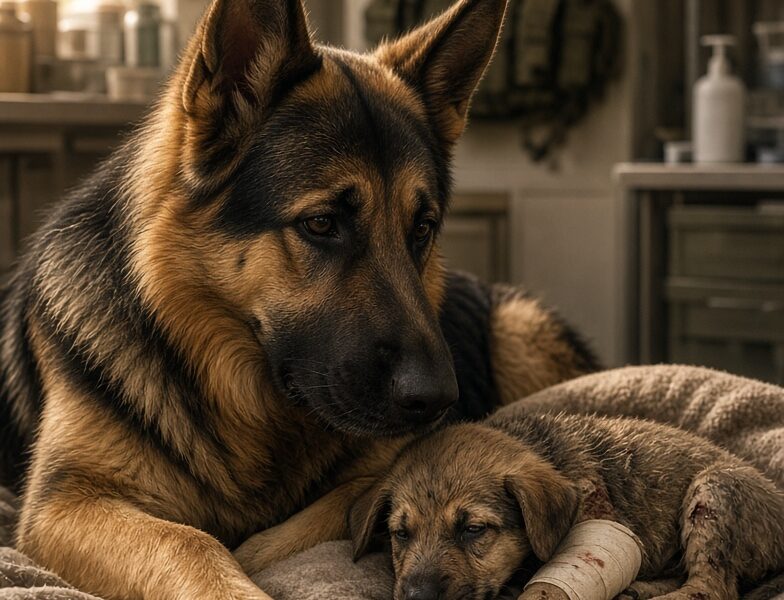
The Calmest K9 on Base Suddenly Barked at a Duffle Bag… What Was Inside Shocked Everyone
The moment K9 Ranger began barking at Private Faulk’s duffel bag, every soldier at Fort Ridgeway Air Base knew something was wrong.
Ranger was the calmest police dog on the force, a disciplined German Shepherd who had worked alongside Officer Grant through countless inspections, security checks, and emergencies. He never barked without a reason, and he never lost control without a cause.
Yet that October morning, beneath the golden sunlight of an American military base, Ranger strained against his leash as if the bag contained something he couldn’t afford to ignore.
“Easy, buddy,” Officer Grant murmured, tightening his grip.
Ranger refused to settle.
His ears pointed forward, his muscles stiffened, and another sharp bark shattered the quiet checkpoint.
Across the inspection table, a young soldier stood pale and trembling.
“Private Faulk,” Grant said carefully, “I need you to tell me what’s inside that bag.”
The soldier swallowed hard.
“Sir, please. Whatever you do, don’t open it.”
Those eight words changed everything.
Because when the zipper finally moved, the most disciplined soldiers on the base witnessed something none of their training had prepared them for.
Before that morning ended, a police dog would expose a desperate secret, a young soldier would risk his entire military career, and a commander would face a decision that challenged everything he believed about following orders.
And it all began with a worn canvas duffel bag.
The morning sun stretched across Fort Ridgeway Air Base, illuminating the metal hangars and painting the runway in warm shades of gold.
Transport vehicles rolled along designated routes while soldiers crossed the compound in neat formations. The familiar rhythm of boots against pavement echoed between buildings, accompanied by distant engine noise and the occasional command carried across the training grounds.
It was inspection day.
For most personnel, that meant checking identification, verifying equipment, and ensuring that every incoming soldier followed the same procedures.
Routine work.
Predictable work.
The kind of morning nobody expected to remember.
Officer Grant adjusted the leash in his hand as he approached the main checkpoint with Ranger walking confidently beside him.
The German Shepherd had spent six years working in military security. His record included locating hidden contraband, detecting suspicious packages, and assisting during emergency searches.
He had also helped locate a missing maintenance worker trapped inside a damaged storage building.
Grant had never forgotten that night.
Neither had Ranger.
The dog possessed an unusual ability to distinguish ordinary nervousness from genuine distress. Soldiers sometimes became anxious during inspections, especially new transfers, but Ranger rarely reacted unless something specific caught his attention.
That morning, he seemed perfectly relaxed.
His sable coat gleamed in the sunlight, his ears moved independently as he registered distant sounds, and his tail hung naturally behind him.
Grant rubbed his neck.
“Looks like another exciting day of paperwork, huh?”
Ranger glanced up at him.
Grant smiled.
“That’s what I thought.”
Neither man nor dog knew that, within the hour, the entire checkpoint would be gathered around a single bag.
Across the compound, a transport vehicle pulled to a stop.
Several soldiers climbed down, collecting their equipment before moving toward the inspection area.
Among them was Private Faulk.
He was young, perhaps twenty-two, with a freshly pressed uniform and a name tag that looked almost too new. His dark hair was neatly trimmed, his boots were polished, and his posture suggested someone trying desperately to appear confident.
But his eyes told another story.
They moved constantly, checking the checkpoint, the nearby officers, and the soldiers walking past him.
A large canvas duffel bag hung from his shoulder.
It was noticeably oversized, its fabric stretched tightly around an uneven collection of shapes. The bottom sagged more than a standard military bag should, and one of its straps appeared to be carrying far more weight than it was designed for.
Sergeant Miller noticed him first.
The older officer had served at Fort Ridgeway for nearly fifteen years and had developed a reputation for recognizing problems before they became serious.
He watched Faulk approach.
“Who’s the new guy?”
Another soldier checked the incoming transfer list.
“Private Faulk. Arrived last night.”
Miller narrowed his eyes.
“Looks nervous.”
“Wouldn’t you be? First inspection at a new base.”
“Maybe.”
Miller continued watching.
“But nervous doesn’t usually make a bag look like it’s carrying a cinder block.”
The other soldier chuckled.
Then Miller noticed something else.
Faulk wasn’t looking at the officers.
He was looking at the inspection table.
More specifically, he was looking at the space where he would have to place his bag.
His fingers tightened around the strap.
His pace slowed.
And when he noticed Ranger standing beside Officer Grant, he stopped for half a second before forcing himself forward again.
That small hesitation caught Grant’s attention.
He had seen thousands of soldiers pass through checkpoints. Most were impatient, distracted, or mildly irritated by the delay.
Faulk looked as though he were approaching a courtroom to hear a sentence.
Grant kept his expression neutral.
“Morning, Private.”
Faulk straightened immediately.
“Morning, sir.”
“First day at Ridgeway?”
“Yes, sir.”
“Welcome aboard. We’ll get you through the inspection, and you’ll be on your way.”
“Thank you, sir.”
Faulk’s voice sounded tight.
Grant gestured toward the table.
“Set your equipment down when you’re ready.”
The private nodded.
But he didn’t move.
For several seconds, he stood there with the bag hanging from his shoulder, staring at the tabletop.
Grant waited.
Behind him, Ranger’s ears suddenly lifted.
The dog raised his head and sniffed the air.
Once.
Twice.
Then his entire posture changed.
The relaxed German Shepherd became rigid, his attention fixed on Faulk’s duffel bag.
Grant felt the leash tighten.
“Ranger?”
The dog released a low sound from his throat.
It wasn’t an ordinary growl.
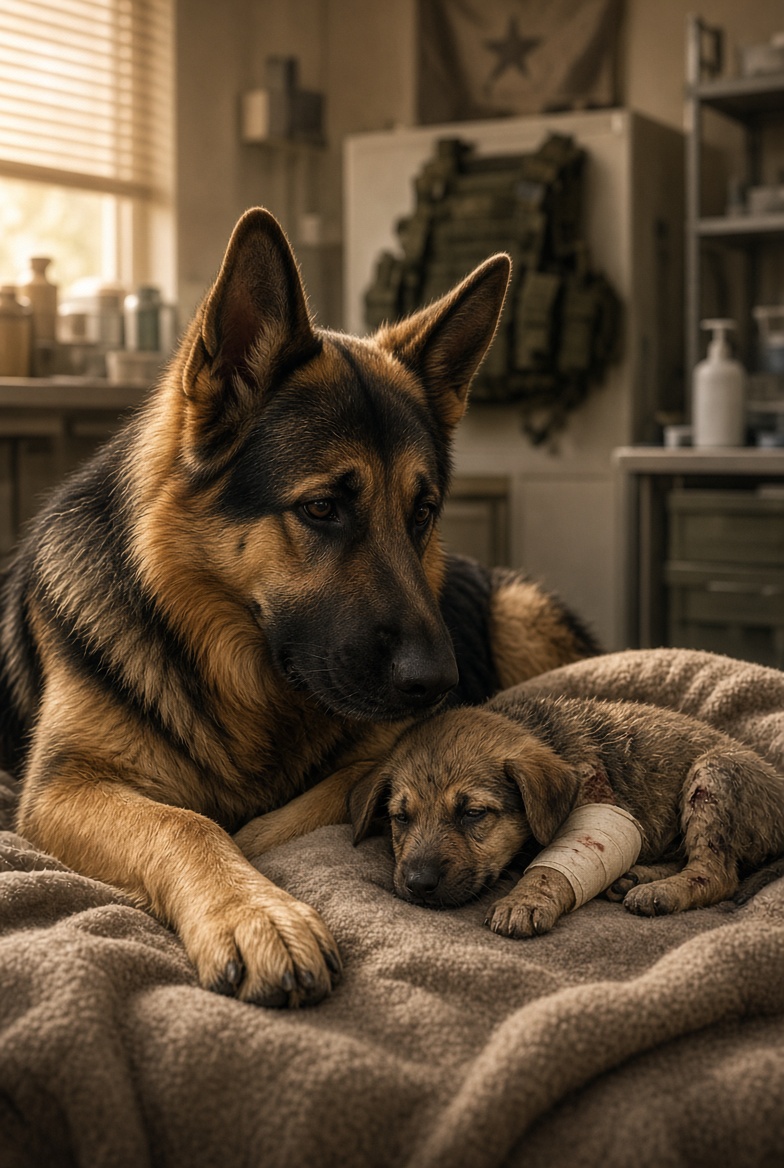
It was the kind of warning Grant had learned to respect.
Faulk noticed it immediately.
His face lost what little color remained.
“Sir,” he said, forcing a smile, “is your dog always like that?”
Grant studied him.
“Like what?”
“Nothing. I just—I’ve never been around military police dogs before.”
“Ranger’s usually pretty quiet.”
The private nodded too quickly.
“Right. That’s good.”
Ranger growled again.
This time, his eyes never left the bag.
Grant’s smile disappeared.
He had worked with Ranger long enough to understand the difference between curiosity and an alert. The dog wasn’t interested in the soldier himself.
He was focused on whatever the soldier carried.
Grant shortened the leash.
“Private Faulk, place the bag on the inspection table, please.”
Faulk’s fingers tightened around the strap.
“Sir, could I explain something first?”
“Of course. Set the bag down, and we’ll talk.”
“I’d rather not.”
The answer came too quickly.
A nearby soldier stopped walking.
Sergeant Miller turned toward them.
Grant’s voice remained calm.
“I’m sorry?”
Faulk blinked as if he had only just realized what he’d said.
“I mean, sir, it’s just personal equipment. Nothing important.”
Grant looked at the bag.
“Then placing it on the table shouldn’t be a problem.”
The private’s jaw tightened.
For one brief moment, fear gave way to something almost desperate.
“Please, sir. I really need you to trust me.”
Grant felt a chill move through him.
Trust was not something a soldier could demand at a security checkpoint. It was something earned through actions, and every action Faulk had taken so far had made the situation more suspicious.
“Private, I’m not asking you to do anything unusual. This is a standard inspection.”
Ranger barked.
The sharp sound echoed beneath the hangar roof.
Several soldiers turned around.
Faulk flinched so violently that the bag swung against his leg.
Ranger lunged half a step forward.
Grant braced himself, holding the leash firmly.
“Easy, Ranger.”
But the dog wasn’t interested in calming down.
His nose moved rapidly, drawing in scent after scent. His ears remained pointed toward the duffel, and his body leaned forward with an intensity Grant had rarely witnessed.
Something was wrong.
The question was whether the problem was dangerous, or whether someone inside that bag desperately needed help.
Grant had no way of knowing yet.
He only knew that Ranger had never reacted like this without a reason.
“Private Faulk,” he said, his tone firmer now, “put the bag on the table.”
Faulk’s shoulders sagged.
He looked toward the surrounding soldiers, then back at Ranger.
Finally, he lifted the strap from his shoulder.
The bag struck the metal tabletop with a heavy thud.
Ranger exploded into barking.
Not one bark.
Several.
Loud, sharp, urgent sounds that filled the checkpoint and silenced every conversation nearby.
Grant’s heart began beating faster.
Faulk stumbled backward.
“Please,” he whispered. “Please don’t open it.”
Grant stared at him.
“Why?”
The private opened his mouth.
Nothing came out.
And that silence was the first real crack in the secret he had carried all the way to Fort Ridgeway.
Within minutes, a crowd began forming near the checkpoint.
Soldiers whispered among themselves, trying to understand why a seasoned police dog had become so agitated over a duffel bag.
“Is it an explosive?”
“Maybe he brought something prohibited.”
“Then why does he look like he’s about to cry?”
Nobody had an answer.
Sergeant Miller approached the table, his expression serious.
“Private, step away from the bag.”
Faulk obeyed, although his eyes remained fixed on it.
Miller studied the swollen canvas.
“What’s inside?”
“My equipment, Sergeant.”
“Your equipment doesn’t usually make a K9 react like that.”
“I know.”
Miller paused.
“You know?”
Faulk closed his eyes briefly.
“I mean, I don’t know why he’s doing this.”
Ranger barked again.
The private’s hands began trembling.
Grant moved closer to the table, careful not to disturb the bag.
“Faulk, listen to me. If you’re carrying something dangerous, now is the time to say so.”
“It’s not dangerous.”
“Then what is it?”
The young soldier shook his head.
“I can’t explain.”
Miller’s expression hardened.
“You can explain, or we can open the bag and find out ourselves.”
Faulk’s eyes filled with tears.
“Please don’t do that.”
“Why?”
“Because you’ll scare it.”
The word stopped Grant cold.
It.
Not a weapon.
Not a device.
Not a package.
Something that could be frightened.
Grant looked down at Ranger.
The dog had stopped barking for a moment, but his attention remained fixed on the bag. His tail had lowered, and a soft whine replaced his earlier growl.
Grant recognized the change.
Ranger had moved from alertness to distress.
He had seen that behavior only a handful of times, including during the rescue operation when Ranger had detected a maintenance worker trapped beneath debris.
The dog hadn’t been responding to danger alone.
He had been responding to suffering.
Grant looked at Faulk again.
“Is there something alive inside that bag?”
The private’s face crumpled.
He said nothing.
But his silence was answer enough to make the checkpoint feel suddenly colder.
Miller turned toward Grant.
“We need to move this situation to secondary screening.”
Grant nodded.
“Agreed.”
Then he looked directly at Faulk.
“Private, you’re going to come with us. Nobody is going to hurt you, and nobody is going to damage your property unnecessarily. But we cannot leave an unknown living thing inside a closed bag.”
Faulk’s knees seemed to weaken.
“Promise me something first.”
Miller frowned.
“You’re not in a position to make demands.”
“I’m not demanding anything, Sergeant.”
Faulk wiped his face with his sleeve.
“I’m asking you not to treat it like a criminal.”
For several seconds, nobody spoke.
Then Grant answered.
“I promise we’ll find out what’s happening before we decide what to do.”
It was the only promise he could honestly make.
And it was the promise that would eventually change the way everyone at Fort Ridgeway understood the difference between a rule and the reason behind it.
The secondary screening room stood at the edge of the main hangar, separated from the inspection area by a glass wall and a reinforced door.
It was a plain room with white walls, bright overhead lights, a metal table, and several chairs. Security personnel used it for situations requiring additional privacy or closer examination.
That morning, it became the center of a mystery that seemed to grow more troubling with every passing minute.
Two officers carried the duffel bag inside and placed it on the table.
Faulk followed them, escorted by Sergeant Miller.
Grant brought Ranger through the door last.
The moment the German Shepherd entered, he pulled toward the table.
“Ranger, heel.”
The dog obeyed, but only barely.
His body remained tense, and his eyes never left the canvas bag.
Grant crouched beside him.
“What have you found, buddy?”
Ranger sniffed along the bottom seam, then moved toward one corner.
He stopped.
A low, mournful whine escaped his throat.
Faulk covered his mouth.
“Please,” he whispered.
Sergeant Miller sat across from him.
“Private, we’re going to give you one more opportunity to explain what’s happening.”
Faulk stared at his hands.
“I found something.”
“What did you find?”
“Something that needed help.”
“Where?”
“Behind one of the old storage sheds near the K9 training grounds.”
“When?”
“Three nights ago.”
Miller leaned forward.
“And why didn’t you report it?”
Faulk swallowed.
“Because I was afraid nobody would help.”
Miller’s expression didn’t change.
“You’re telling me you brought an unknown object onto a military base without reporting it because you were afraid someone wouldn’t help?”
Faulk shook his head.
“It’s not an object.”
Grant glanced toward Ranger.
The dog had lowered his nose to the canvas and was sniffing with intense concentration.
“Then tell us what it is,” Grant said.
Faulk looked at him, his eyes red.
“I can’t.”
“Why not?”
“Because if you take it away, I might never see it again.”
Miller sighed.
“Private, we don’t confiscate things simply because someone is concerned about them.”
Faulk gave a bitter, exhausted laugh.
“You haven’t met the people I talked to.”
The comment surprised everyone.
Grant pulled out a chair and sat beside him.
“Then tell us about those people.”
For the first time since arriving at the checkpoint, Faulk seemed to consider answering honestly.
His shoulders relaxed slightly, but his hands remained locked together.
“The first night, I thought I could handle it myself,” he said. “I thought I’d get it somewhere warm, find someone who knew what to do, and sort everything out before morning.”
“Why didn’t you?”
“Because morning came, and I realized I didn’t have anywhere to take it.”
Miller’s voice softened a fraction.
“Was it injured?”
Faulk nodded.
“Badly enough that I thought it might not survive the night.”
Grant glanced at Ranger again.
The dog had begun pacing slowly around the table.
“Did you contact the base clinic?”
“Yes, Sergeant.”
“And?”
“They told me they couldn’t accept an unauthorized animal.”
“That is standard procedure.”
“I know.”
“Did you contact animal control?”
Faulk hesitated.
“Yes.”
“What did they tell you?”
The young soldier looked down.
“They said they would assess the animal and determine the appropriate course of action.”
“That sounds reasonable.”
“Maybe to you.”
Faulk lifted his eyes.
“But when I asked what would happen if it was too weak to recover, the man said they sometimes had to make difficult decisions.”
Miller leaned back.
“That doesn’t mean they intended to put it down.”
“I know that now,” Faulk whispered. “But I didn’t know it then. I was scared, and every person I asked seemed more interested in getting rid of the problem than helping.”
Grant watched him carefully.
The private wasn’t speaking like someone inventing an excuse.
His fear was too immediate, his grief too close to the surface.
Still, the bag remained unopened.
And until they knew what was inside, nobody could assume the situation was harmless.
Grant stood and approached the table.
“We’re going to scan the bag.”
Faulk’s head snapped up.
“Will it hurt?”
“No. The scanner won’t touch whatever’s inside.”
“Can you keep the lights low?”
Miller frowned.
“Why?”
“Because it’s frightened. Loud noises make it worse.”
Grant considered that request.
Then he switched off the brightest overhead bank, leaving enough light for the officers to work safely.
“Better?”
Faulk nodded weakly.
Grant signaled to the screening technician, who brought over a portable scanning device used to examine suspicious packages.
The technician passed it slowly over the duffel.
At first, the display showed only ordinary shapes: folded fabric, straps, pockets, and several pieces of personal equipment.
Then the technician stopped.
“Hold on.”
Everyone turned toward the screen.
“What is it?” Miller asked.
The technician adjusted the angle.
“There appears to be movement.”
Grant stepped closer.
“Movement?”
“Very slight. Could be the contents shifting.”
He scanned the bag again.
The display changed.
Something inside moved.
The technician froze.
“That’s not just fabric.”
Ranger barked once.
The sound was so sudden that Faulk jumped to his feet.
“Please! He’s not trying to hurt anybody!”
Grant raised a hand.
“Private, sit down.”
Faulk obeyed reluctantly, breathing hard.
The technician checked the scan a third time.
The result was unmistakable.
Something small was curled inside the bag, and it was alive.
Miller’s face changed.
“Clear the room of unnecessary personnel,” he ordered. “Get a medic on standby, and make sure we have someone qualified to examine an injured animal.”
Grant nodded.
Then he turned toward Faulk.
“You knew it was alive.”
“Yes, sir.”
“How long has it been in there?”
Faulk’s voice broke.
“Since last night.”
Grant stared at him.
“You carried a living creature in a closed duffel bag for an entire night?”
“I had no choice!”
The words burst from Faulk before he could stop them.
He immediately looked ashamed.
“I mean, sir, I tried to make it comfortable. I put blankets inside. I left the zipper open whenever I could, and I checked on it every few minutes.”
Grant’s expression tightened.
“Did you give it food or water?”
“A little. But it was so weak I didn’t know how much it could handle.”
The room fell silent.
Grant looked at the bag again.
Whatever was inside needed help, and the longer they delayed, the greater the risk.
He turned toward Miller.
“We need to open it carefully.”
Miller nodded.
“Agreed.”
Faulk stood again, tears streaming down his face.
“Please don’t just unzip it and pull it out. Give it a second. Let it hear my voice.”
Grant studied him.
“Why?”
“Because it knows me.”
That answer carried more weight than any excuse could have.
Grant had spent years learning to read people under pressure. He knew when fear came from guilt, when it came from uncertainty, and when it came from the terrible possibility of losing something that mattered.
Faulk looked like someone who had spent three nights bargaining with a future he couldn’t control.
Grant turned toward the table.
“All right. We’ll do it slowly.”
Ranger stepped forward and sat beside him.
For the first time that morning, the dog was completely still.
His ears remained forward, his gaze fixed on the zipper, and his breathing settled into a steady rhythm.
Grant placed one hand on the canvas.
“Private Faulk, stay where the animal can hear you.”
Faulk moved beside the table.
“I’m here,” he whispered. “I’m right here. You’re safe.”
Grant pulled the zipper back an inch.
A faint sound emerged from inside.
It was so small that Miller initially thought it had come from the scanner.
Then it happened again.
A tiny whimper.
Everyone froze.
Faulk pressed a hand against his mouth.
“Oh, thank God.”
Grant continued opening the bag, moving slowly enough to avoid startling whatever lay inside.
The canvas flap folded back.
Beneath a worn blanket, a small shape trembled.
Miller inhaled sharply.
“That’s a puppy.”
Grant carefully moved the blanket aside.
A tiny German Shepherd lay curled inside the bag, its fur dirty and patchy, its body far too thin for its age.
The puppy appeared to be only a few weeks old.
Its ribs showed faintly beneath its skin, and one of its paws moved weakly as it tried to burrow deeper into the blanket.
Its eyes opened for a moment, clouded with exhaustion.
Then they closed again.
The room went completely silent.
Ranger approached the table.
His entire demeanor changed.
The rigid alertness disappeared from his shoulders, replaced by a cautious gentleness that made Grant’s throat tighten.
The older dog lowered his head and sniffed the puppy.
Then he released the softest whine Grant had ever heard from him.
The puppy stirred.
A tiny sound escaped its mouth.
Ranger touched his nose to the blanket beside it and remained perfectly still.
Nobody spoke.
The police dog who had barked so fiercely at the duffel bag was now behaving as if the smallest movement might frighten the creature he had spent the morning trying to reach.
Grant looked at Faulk.
“Tell me what happened.”
The young soldier wiped his face.
“I found him during perimeter duty three nights ago.”
His voice shook as he continued.
“It was raining hard. I was checking the area behind the old storage shed when I heard something.”
“What kind of sound?”
“A whimper. I almost missed it because of the storm.”
Faulk stared at the puppy.
“I thought it was a stray dog caught outside. I figured I’d call it in and keep walking if I couldn’t find anything.”
He swallowed.
“Then I heard it again.”
The memory seemed to pull him backward.
Three nights earlier, the storm had swept across Fort Ridgeway with enough force to send rain hammering against the barracks windows.
Thunder rolled over the training grounds, and the wind pushed water beneath the old storage shed’s warped door.
Faulk had been assigned perimeter duty.
It was a task he disliked, not because it was difficult, but because the long stretches of darkness gave his thoughts too much room to wander.
He had been halfway through his route when the sound reached him.
A thin, broken cry.
He stopped.
For a moment, he listened to the storm.
Then the cry came again.
Faulk turned toward the abandoned shed.
Its door hung crookedly from one hinge, rattling in the wind.
He approached cautiously, pulled his flashlight from his belt, and pushed the door open.
Inside, the air smelled of wet wood and old dust.
The beam of his flashlight swept across scattered equipment, broken shelving, and a collapsed section of roofing.
Then he saw the puppy.
A wooden beam had fallen across part of the debris, leaving the tiny animal trapped beneath it.
The puppy was soaked, shivering, and barely moving.
Faulk dropped to his knees.
“Hey, little guy. Can you hear me?”
The puppy made a faint sound.
Faulk carefully lifted the beam enough to free it, then wrapped the tiny body inside his uniform jacket.
“Easy. I’ve got you.”
The puppy’s head rested against his chest.
Its breathing was so shallow that Faulk kept checking to make sure it was still there.
He hurried back toward the barracks.
By the time he reached the building, his clothes were soaked and his hands were trembling.
He went straight to the common room, where several soldiers were still awake.
“Does anybody know who handles injured animals around here?”
One soldier looked up from his phone.
“Why?”
“I found a puppy.”
Another soldier laughed.
“You found a what?”
“A puppy. It’s hurt.”
The laughter faded when Faulk opened his jacket enough to show them the tiny animal.
One soldier leaned closer, then shook his head.
“Man, that’s rough.”
“Can somebody help me call the clinic?”
“They don’t treat strays.”
“Then what am I supposed to do?”
“Call animal control.”
“I will. But can we at least keep him warm?”
The first soldier shrugged.
“It’s probably not going to make it anyway.”
Those words stayed with Faulk long after the conversation ended.
He contacted the base clinic and explained the situation.
The person who answered was polite but firm. The clinic could not officially accept an unauthorized animal without the proper arrangements.
Faulk asked about emergency assistance.
He asked whether someone could examine the puppy.
He asked what would happen if it needed immediate care.
The answers were cautious, procedural, and frustratingly incomplete.
He then contacted the appropriate animal control service, but no immediate rescue arrangement was available that night.
Nobody had deliberately tried to hurt the puppy.
Nobody had promised to abandon it.
But nobody had given Faulk the certainty he desperately wanted.
So he made a decision.
He took the puppy to his room, found clean towels, and created a warm place for it to rest.
He followed basic guidance about keeping the animal warm and avoiding forceful feeding. Whenever the puppy stirred, he checked its breathing and tried to determine whether it needed urgent assistance.
He barely slept.
Every few minutes, he reached toward the blanket to make sure the tiny body was still moving.
By dawn, the puppy had survived the night.
That should have been a reason to celebrate.
Instead, Faulk realized he had another problem.
Animals were not permitted in the barracks, and he could not keep the puppy hidden indefinitely.
He had no reliable transportation off base, no confirmed appointment with a veterinarian, and no guarantee that the animal would receive the care it needed if he simply handed it over without explanation.
He had also made the mistake of assuming that asking for help would automatically lead to someone taking responsibility.
Now he was terrified of losing the only living thing that had made him feel genuinely needed since arriving at Fort Ridgeway.
Faulk’s voice returned to the present.
“I know I should have reported everything properly, sir. I know I shouldn’t have brought him through the checkpoint like that.”
Grant looked at him.
“Then why did you?”
Faulk stared at the puppy.
“Because I promised him I’d get him somewhere safe.”
The words settled over the room.
Miller’s expression softened, though his professional seriousness remained.
“A promise doesn’t eliminate your responsibilities, Private.”
“I understand.”
“And hiding an animal in a closed bag could have made its condition worse.”
Faulk’s face tightened.
“I know that now.”
“Do you?”
“Yes, Sergeant.”
He wiped his cheeks.
“I thought the blanket and the short trip would keep him safe. I thought if I could get him inside the base, I could find somebody who would help.”
He looked toward Ranger.
“I didn’t know he would react like this.”
Grant crouched beside the table.
“Ranger reacted because he noticed something we hadn’t.”
The puppy stirred.
Ranger immediately lowered his head.
The tiny animal lifted one paw, brushing the fur near Ranger’s muzzle.
The older dog remained motionless, allowing the puppy to make contact.
Faulk let out a broken laugh through his tears.
“He likes him.”
Grant smiled faintly.
“I think Ranger’s decided he’s responsible for him.”
For the first time that morning, Faulk’s expression shifted from fear toward hope.
Then the door opened.
Commander Hail stepped into the screening room.
The commander was a tall, broad-shouldered officer whose presence could silence an entire briefing room without requiring him to raise his voice.
His uniform was immaculate, his expression usually unreadable, and his expectations clear.
He believed that military discipline existed for a reason.
Equipment had to be accounted for. Procedures had to be followed. Security rules could not be ignored simply because someone had good intentions.
But he also believed that responsibility meant dealing with difficult situations rather than pretending they did not exist.
His gaze moved across the room.
The duffel bag.
The portable scanner.
The officers.
The trembling young soldier.
Finally, his attention settled on the puppy.
“What exactly is going on here?”
Grant straightened and saluted.
“Sir, K9 Ranger alerted on Private Faulk’s duffel bag during the incoming inspection. We conducted a secondary screening and discovered an injured German Shepherd puppy inside.”
Hail’s expression tightened.
“Inside a duffel bag?”
“Yes, sir.”
He turned toward Faulk.
“Private, is that accurate?”
Faulk stood at attention, though his eyes remained wet.
“Yes, sir.”
“You brought an unauthorized animal onto this base?”
“Yes, sir.”
“And you failed to report it?”
“Yes, sir.”
Hail regarded him for several seconds.
“Why?”
Faulk swallowed.
“I found him trapped beneath debris near the old storage shed during a storm. He was injured and barely breathing. I tried to get help, but I couldn’t find anyone who could take him immediately.”
“So you decided the solution was to conceal him in your personal equipment?”
“No, sir. I decided I couldn’t leave him there.”
“That wasn’t my question.”
Faulk lowered his eyes.
“No, sir. It wasn’t.”
Hail moved closer to the table.
The puppy’s tiny chest rose and fell beneath the blanket.
“Has anyone examined him?”
“Not yet, sir,” Grant replied. “We requested medical assistance and someone qualified to assess the animal.”
“Good. Get them here immediately.”
“Yes, sir.”
Hail looked at Faulk again.
“You understand that regulations exist for reasons beyond convenience. Unauthorized animals can introduce health concerns, interfere with operations, and create risks we may not anticipate.”
“Yes, sir.”
“You also understand that concealing something during a security inspection creates a serious problem.”
“Yes, sir.”
“Then help me understand why you believed this was the only option.”
Faulk’s hands trembled.
“Because I was afraid, sir.”
Hail’s eyebrows rose slightly.
“Afraid of what?”
“Of losing him.”
The commander’s expression remained firm.
“Private, you cannot assume that every person who asks questions intends to cause harm.”
“I know, sir.”
“Do you? Because from where I’m standing, you made a decision based on what you feared might happen rather than what you knew would happen.”
Faulk said nothing.
The words struck close to the truth.
He had been so frightened of the possibility that the puppy might be taken away that he had stopped considering the dangers of keeping it hidden.
His intentions had been compassionate.
His judgment had not been perfect.
Hail looked toward Grant.
“What’s your assessment?”
Grant chose his words carefully.
“Ranger’s reaction was unusual, sir. He remained intensely focused on the bag, and once we opened it, his behavior shifted immediately. He appears to be responding protectively to the puppy.”
“That tells me something about the dog. It doesn’t tell me whether the private followed regulations.”
“No, sir. It doesn’t.”
“Good.”
Hail returned his attention to the puppy.
“Then let’s deal with both problems separately.”
He pointed toward the doorway.
“Get the animal examined. Keep the area quiet, and make sure the puppy is handled by someone qualified.”
The officers moved immediately.
Faulk looked up, startled.
“Sir?”
Hail turned.
“What?”
“Are you going to take him away?”
The commander studied him.
“I haven’t made a final decision about the puppy’s placement, Private. Right now, the priority is determining whether he can be stabilized.”
Faulk nodded, but his fear remained visible.
Hail continued.
“And you will answer for the decisions you made. Compassion does not cancel responsibility.”
“Yes, sir.”
“But responsibility doesn’t require us to ignore a living creature in distress.”
The commander paused beside the table.
“Get him help first. We’ll deal with the rest afterward.”
It was not forgiveness.
It was not permission to disregard the rules.
It was simply a decision to put an urgent need ahead of an argument about blame.
For the first time since the inspection began, Faulk allowed himself to breathe.
Ranger’s tail moved once against the floor.
And Commander Hail, who had spent years believing that the strength of a military unit depended on discipline, began to suspect that discipline alone was not the quality he most needed to measure that morning.
The base clinic responded within minutes.
A veterinary specialist from a nearby military-supported animal care program arrived with a small team and the equipment needed to assess the puppy.
They worked carefully, keeping their movements slow and their voices quiet.
The puppy was transferred from the duffel bag onto a padded examination surface and wrapped in clean blankets.
Ranger followed every movement with unwavering attention.
When one of the specialists approached the table, the German Shepherd stood and moved closer.
“Easy there,” the specialist said gently. “We’re helping him.”
Ranger sniffed the person’s hand before returning his attention to the puppy.
Grant watched with amazement.
“He doesn’t usually let strangers get that close to something he’s guarding.”
“Maybe he understands we’re not trying to take the puppy away from him,” Miller replied.
Grant glanced at the older officer.
“Dogs don’t understand every situation the way we do.”
“No,” Miller agreed. “But sometimes they notice the part we’ve overlooked.”
The specialist began the examination.
The puppy was severely underweight and dehydrated, with a dangerously low body temperature and signs of exhaustion.
Its condition suggested that it had been struggling for some time before Faulk found it.
The specialist spoke quietly to the team.
“We need to warm him gradually, assess his hydration, and determine whether there are internal injuries. He’s extremely fragile.”
Faulk’s face went white.
“Is he going to die?”
The specialist looked at him.
“I can’t promise you anything yet. He’s in serious condition, but we’re going to give him every appropriate chance.”
Faulk nodded, gripping the edge of a chair.
“Please.”
The specialist returned to the examination.
Ranger settled beside the table, his chin resting near the edge of the blanket.
Every time the puppy made a sound, his ears lifted.
Every time the specialist adjusted the blanket, Ranger watched closely.
After several minutes, the puppy stirred.
Its eyes opened briefly.
It seemed confused by the unfamiliar surroundings, and its body trembled beneath the blanket.
Then it heard Ranger’s soft whine.
The puppy turned its head toward him.
Its trembling eased slightly.
The specialist noticed.
“That’s interesting.”
Grant stepped closer.
“What is?”
“The puppy appears calmer when the dog is nearby.”
Ranger lowered his muzzle until it rested beside the puppy’s paw.
The tiny animal moved one foot toward him.
The specialist checked the puppy’s breathing and continued monitoring its condition.
“We still need to treat the dehydration and low temperature,” the specialist explained. “The dog isn’t replacing medical care. But reducing stress can be helpful, and this puppy seems comforted by his presence.”
Grant nodded.
“Then Ranger stays, as long as you say it’s safe.”
The specialist smiled.
“I think we can make that work.”
Faulk sat down slowly.
For the first time in three nights, he no longer had to monitor the puppy alone.
There were trained professionals beside the table.
There were supplies, proper equipment, and a plan.
And there was Ranger, who had somehow recognized the puppy’s distress before anyone else had understood what the bag contained.
Faulk watched the German Shepherd lower himself to the floor.
“You knew,” he whispered.
Ranger glanced toward him.
“You knew he needed help.”
The dog gave a quiet huff.
Grant rested a hand on Faulk’s shoulder.
“You did the right thing by trying to save him.”
Faulk looked up.
“But I did it the wrong way.”
Grant didn’t pretend otherwise.
“Some parts of what you did were wrong. You should have reported the situation, and you shouldn’t have kept him hidden in that bag. But finding a helpless animal and refusing to ignore it wasn’t wrong.”
Faulk’s eyes filled again.
“I just didn’t want him to die alone.”
Grant looked at the tiny puppy.
“Then let’s make sure he doesn’t.”
Outside the clinic, the news began spreading.
At first, the story traveled through whispers.
A young private had tried to bring a puppy onto the base.
Ranger had barked so fiercely that officers thought the bag contained something dangerous.
The commander had personally ordered an examination.
By lunchtime, nearly everyone in the nearby units had heard some version of the incident.
Some soldiers laughed about the unusual discovery.
Others criticized Faulk for ignoring the rules.
A few wondered how a trained military police dog could have become so upset over a tiny puppy.
But those who had seen the animal emerge from the bag found it difficult to laugh for long.
The puppy was far smaller than anyone had expected.
Its fragile body made the oversized duffel look even more disturbing in retrospect.
One soldier who had initially suggested calling animal control came to the clinic that afternoon.
He stood near the doorway, watching Faulk prepare a warm feeding under the specialist’s guidance.
“Hey,” he said awkwardly.
Faulk looked up.
“What’s up?”
The soldier rubbed the back of his neck.
“I heard you found him in the old shed.”
“Yeah.”
“I was one of the guys in the common room the other night.”
Faulk recognized him.
The soldier’s expression tightened.
“I told you he probably wouldn’t make it.”
Faulk said nothing.
“I shouldn’t have said that.”
The apology hung awkwardly between them.
Faulk glanced at the puppy.
“He almost didn’t.”
The soldier looked down.
“I’m sorry.”
After a moment, Faulk nodded.
“Help out if you want to.”
The soldier looked surprised.
“You’re not mad at me?”
“I was.”
Faulk’s answer was honest.
“But being mad at you won’t help him.”
The soldier stepped farther into the room.
“What can I do?”
“Ask the specialist what supplies they need. Don’t touch him unless they say it’s okay.”
“Got it.”
The soldier left with a purpose he hadn’t possessed when he entered.
It was a small moment, but it marked the beginning of something larger.
The puppy’s survival was no longer a private struggle between one frightened soldier and an uncertain system.
People were beginning to take responsibility.
Still, the most difficult decision had not yet been made.
Commander Hail had authorized emergency treatment, but the puppy’s long-term placement remained unresolved.
The base could not simply ignore its animal policies because the story had touched people’s hearts.
There were legitimate questions about health, supervision, housing, and whether a military installation was an appropriate place for a recovering animal.
Faulk understood those concerns.
What frightened him was the possibility that the puppy would recover only to disappear into a system he could not follow.
That evening, he found Commander Hail outside the clinic.
The commander was reviewing a report on a tablet when Faulk approached and saluted.
“Sir, may I speak with you?”
Hail looked up.
“Go ahead.”
Faulk took a breath.
“I understand I’m facing disciplinary action. I understand I broke the rules, and I won’t argue about that.”
“Good.”
“But I want to ask what happens to the puppy.”
Hail set the tablet aside.
“The veterinary specialist will determine when he’s stable enough for transfer or placement. We won’t make that decision until we know what he needs.”
“Yes, sir.”
“If he requires extended care, we’ll work with an appropriate facility.”
Faulk swallowed.
“And if he recovers?”
“Then we’ll evaluate the options available to him.”
Faulk hesitated.
“Would I be allowed to adopt him?”
Hail studied the young soldier.
“Why do you believe you should be the first person considered?”
Faulk had prepared an answer, but the question unsettled him.
He could have said that he found the puppy.
He could have argued that he had already cared for it.
Instead, he looked through the clinic window.
“Because I know what happened to him before he got here,” he said quietly. “I know how scared he was. I know how hard he fought to stay alive.”
He paused.
“And because I know what it feels like to need help and not know whether anyone is going to notice.”
Hail’s expression shifted.
Faulk continued.
“I can’t promise I’ll never make another mistake, sir. But I can promise that if he comes home with me, I’ll take responsibility for him properly. I’ll follow every rule. I’ll get him the care he needs. I won’t hide him again.”
The commander remained silent.
Then he asked a question Faulk hadn’t expected.
“What would you name him?”
Faulk blinked.
“Sir?”
“The puppy. What would you call him?”
Faulk looked back through the window.
He had thought about names during the long night when he had held the puppy close and whispered encouragement into the blanket.
He had considered several.
But one seemed right.
“Hope, sir.”
Hail raised an eyebrow.
“Hope?”
“Yes, sir.”
“That’s an unusual name for a male German Shepherd.”
Faulk managed a small smile.
“I know, sir. But he gave me something to believe in when I thought I didn’t have anything left to offer.”
For a moment, the commander said nothing.
Then he picked up his tablet again.
“I’ll consider your request after the specialist provides a medical assessment and we review the available placement options.”
Faulk saluted.
“Thank you, sir.”
“Don’t thank me yet, Private. You still have to answer for your actions.”
“Yes, sir.”
As Faulk turned to leave, Hail called after him.
“One more thing.”
Faulk stopped.
“Sir?”
“Next time you find a problem you don’t know how to solve, you report it. You don’t make yourself the only person responsible for fixing it.”
Faulk nodded.
“Understood.”
Hail watched him return to the clinic.
He had spent years commanding people who believed strength meant carrying every burden alone.
Sometimes, that instinct produced extraordinary courage.
Sometimes, it produced avoidable mistakes.
The difficult part was teaching young soldiers when to endure, when to act, and when to ask for help.
Inside the clinic, Ranger lifted his head as Faulk entered.
The puppy lay curled beneath the blanket.
For the first time since the storm, its breathing seemed a little steadier.
Faulk sat beside the table.
“Hey, Hope,” he whispered. “We’re going to figure this out.”
Ranger rested his chin near the puppy’s paws.
And the promise made beside the inspection table began its slow journey toward being fulfilled.
The first twenty-four hours were difficult.
Hope needed careful monitoring, gradual rehydration, warmth, and frequent reassessment.
The veterinary specialist warned Faulk not to mistake small improvements for a complete recovery.
“His condition is serious,” she explained. “We need to take this one step at a time.”
Faulk nodded.
“What should I watch for?”
She explained the signs that required immediate attention and showed him how to assist with routine care without overwhelming the puppy.
Faulk listened carefully, asking questions whenever he was unsure.
He had spent years learning to follow instructions under pressure, but this felt different.
In the military, he was accustomed to clear objectives, measurable results, and procedures designed to keep people safe.
With Hope, there was no guarantee that doing everything correctly would be enough.
He could provide warmth.
He could follow the feeding schedule.
He could sit beside the table and speak softly when the puppy stirred.
But he couldn’t command the tiny body to recover.
That helplessness frightened him more than he wanted to admit.
During the first night, Ranger remained close.
Grant had initially planned to take the K9 back to his regular quarters, but the specialist approved a supervised arrangement that allowed Ranger to rest nearby without interfering with treatment.
The older dog seemed satisfied with that compromise.
He settled beside the puppy’s table, occasionally lifting his head whenever Hope moved.
At 1:17 a.m., a faint whimper woke Faulk from the chair where he had been dozing.
He immediately sat upright.
“What’s wrong, little guy?”
The specialist on duty checked Hope’s condition.
“His temperature is still low, but we’re monitoring it. Let me assess him.”
Faulk stepped aside.
Ranger stood.
His ears lifted, and his gaze followed the specialist’s hands.
“It’s okay, Ranger,” Grant murmured from the doorway. “They’re checking him.”
The dog looked at Grant, then returned his attention to Hope.
For several tense minutes, the room was filled with quiet instructions and the soft sounds of equipment.
Finally, the specialist nodded.
“He’s holding steady.”
Faulk released a breath he hadn’t realized he was holding.
“Thank you.”
“Don’t thank us yet. He has a long way to go.”
“I know.”
Faulk returned to his chair.
Ranger lowered himself to the floor.
Outside, the base continued its nighttime routine, unaware that one of its smallest residents was fighting a battle that had drawn the attention of an entire unit.
At 4:30 a.m., Hope stirred again.
This time, the puppy lifted his head slightly.
His eyes opened.
He looked toward Ranger.
The older German Shepherd gave a soft whine.
Hope made a tiny sound in response.
Faulk leaned forward, barely daring to move.
“That’s it,” he whispered. “Take your time.”
Hope tried to shift closer to the blanket’s edge.
His legs trembled, and he quickly settled again.
But the movement was enough to make Faulk smile through his exhaustion.
It was not a dramatic recovery.
It was not a miracle that erased the danger.
It was simply proof that the puppy was still fighting.
And for that night, it was enough.
By the second morning, several soldiers had stopped by the clinic to ask for an update.
They brought clean towels, approved supplies, and offers to help with tasks the veterinary team authorized.
One mechanic who had heard the story during breakfast left a small donation with the clinic’s staff to cover appropriate puppy-care supplies.
Another soldier offered to help contact a reputable rescue organization experienced in caring for young dogs.
The specialist accepted the assistance where appropriate but reminded everyone that Hope’s medical care had to remain under professional supervision.
“This isn’t a group project where everyone gets to improvise,” she told them with a faint smile. “The best way to help is to follow the plan.”
The soldiers laughed.
Then they followed the plan.
Faulk found himself surrounded by people who had barely known his name two days earlier.
Some had criticized him.
Some had doubted him.
Now they were asking how they could help.
The change was encouraging, but it also made him uncomfortable.
He had never wanted attention.
He had only wanted Hope to survive.
When a soldier asked whether the story could be shared on the base’s internal news channel, Faulk immediately declined to be interviewed.
“There’s nothing special about me,” he said.
The soldier shook his head.
“Maybe. But Ranger’s part in this is something people ought to hear about.”
Faulk glanced at the dog.
“Then talk about Ranger.”
The soldier smiled.
“Fair enough.”
The story eventually reached more people than Faulk could have imagined, but it did not spread because he had asked anyone to tell it.
It spread because a trained police dog had recognized a cry for help hidden beneath layers of canvas, and because the people who investigated that alert had discovered something far more human than they expected.
Still, not everyone approved of what had happened.
During an administrative review, one senior officer questioned whether the base’s response might encourage other personnel to ignore regulations whenever they believed their intentions were good.
The concern was legitimate.
Commander Hail agreed that the rules needed to remain clear.
But he also insisted that the review distinguish between the initial security concern and the emergency response that followed.
“Private Faulk made mistakes,” Hail explained. “We will address those mistakes. But once we discovered an injured animal, our responsibility was to ensure it received appropriate care.”
The officer folded his arms.
“And the message to the other soldiers?”
“The message is that they should report problems promptly, follow established procedures, and never assume that compassion gives them permission to conceal information.”
Hail paused.
“It is also that a person who makes a mistake while trying to help should still be expected to tell the truth and accept responsibility. We don’t improve a unit by teaching people to hide their mistakes out of fear.”
The review continued.
Faulk was assigned additional duties and mandatory instruction on reporting requirements.
He accepted the measures without complaint.
He also made sure to tell his fellow soldiers what he had learned.
“If you find something like this,” he said during a conversation in the barracks, “don’t do what I did. Don’t wait until you’re terrified of losing it. Report it immediately, and ask for the right people to help.”
One soldier nodded.
“Even if you’re afraid they won’t care?”
“Especially then.”
Faulk looked toward the window.
“I nearly made everything worse because I was convinced I had to solve it alone.”
Those words became another part of the story.
The puppy had not simply exposed a secret inside a bag.
He had exposed a problem that existed beyond the old storage shed: the way fear could make a person hide the very thing that needed help.
And that lesson would remain with Faulk long after the inspection was forgotten.
On the third morning, Hope began responding more consistently to the veterinary team’s care.
He was still weak, but he showed greater awareness of his surroundings.
His breathing remained under observation, his hydration continued to improve, and the specialist began cautiously adjusting his care plan as his condition allowed.
Faulk arrived before sunrise.
Ranger was already awake.
The German Shepherd stood beside the table, tail moving slowly.
Faulk approached.
“Morning, buddy.”
Ranger nudged his hand.
Then the dog turned toward Hope.
The puppy was lying on a folded blanket, his head resting against the edge of a soft towel.
When Faulk spoke, Hope’s ears twitched.
The movement was so slight that he almost missed it.
“Hey,” Faulk whispered. “Did you hear me?”
Hope lifted his head a fraction.
Faulk froze.
The puppy looked toward him, then made a faint sound.
Grant entered the clinic just in time to witness it.
“Would you look at that.”
Faulk laughed softly.
“He knows my voice.”
“Looks like it.”
Grant approached the table but remained outside the specialist’s working area.
“How’s our little recruit doing?”
The specialist looked up from her notes.
“Improving, though we’re not ready to declare him out of danger.”
Grant nodded.
“Understood.”
He looked at Ranger.
“You hear that, buddy? Your partner’s getting stronger.”
Ranger’s tail thumped against the floor.
Faulk rubbed his face.
“I haven’t slept properly in three days.”
Grant chuckled.
“Welcome to the world of worrying about somebody smaller than you.”
Faulk smiled.
Then the smile faded as he looked at Hope.
“Do you ever get scared that you’re not doing enough?”
Grant considered the question.
“All the time.”
Faulk looked surprised.
“You do?”
“Of course. The trick isn’t pretending you’re never afraid. It’s making sure fear doesn’t make every decision for you.”
He nodded toward Hope.
“You were afraid someone would take him away, so you hid him. I understand why. But now you have people who can help, and you’re learning how to trust them.”
Faulk was quiet for a moment.
“I’m trying.”
“I can see that.”
Grant rested a hand on Ranger’s shoulder.
“And if Ranger hadn’t reacted the way he did, we might have missed how urgent this was.”
Faulk looked at the dog.
“I thought he was going to get me thrown off the base.”
Grant laughed.
“Ranger doesn’t have that kind of authority.”
For the first time in days, Faulk laughed without feeling guilty about it.
The sound seemed to relax something in the room.
Even the specialist smiled.
Hope shifted beneath the blanket.
Ranger immediately looked toward him.
The puppy moved one paw, then settled again.
Grant shook his head in admiration.
“You know, I’ve worked with Ranger for six years. I’ve seen him track people, search buildings, and stay focused through situations that would make most of us lose our concentration.”
He paused.
“But I don’t think I’ve ever seen him this determined to stay beside something.”
Faulk watched the dog.
“Maybe he knows what it’s like to be the one everyone depends on.”
Grant looked at him.
“Maybe.”
The morning continued with examinations, notes, and cautious adjustments to Hope’s care.
Outside the clinic, the sun rose over the hangars.
The base returned to its familiar rhythm.
But inside that small room, time seemed to move differently.
Every improvement mattered.
Every quiet breath was a reason to keep going.
And the old canvas duffel bag, now empty and folded on a shelf, remained a reminder of how close the situation had come to ending differently.
Nobody planned to keep it.
Nobody considered it valuable.
Yet Grant found himself looking at it whenever he entered the clinic.
The bag had been the reason Ranger barked.
It had been the object Faulk feared would expose his secret.
And it had carried the tiny animal who would eventually change the lives of everyone who encountered him.
Three days later, Commander Hail returned to the clinic with a new report.
Faulk stood immediately.
“Sir.”
“At ease, Private.”
Hail looked toward the table.
Hope was awake, watching the room with brighter eyes.
His body remained small and fragile, but he was no longer the barely responsive creature the officers had discovered beneath the blanket.
Ranger lay beside the table, his head raised.
The commander approached slowly.
“How is he?”
The specialist answered.
“His condition has improved. He’s still underweight and needs continued care, but he’s responding well to treatment.”
“Any concerns?”
“We’ll continue monitoring him. Recovery takes time, and we don’t want to rush his progress.”
Hail nodded.
Then he turned toward Faulk.
“Private, your request regarding adoption has been reviewed.”
Faulk’s heartbeat seemed to stop.
“Yes, sir?”
“The veterinary team will determine when Hope is medically ready to leave supervised care. The appropriate animal-care authorities will also need to complete their assessments.”
“Yes, sir.”
“If he is cleared for adoption, and if you meet the requirements, you will be considered first among the applicants we have received.”
Faulk stared at him.
“Applicants, sir?”
Hail’s mouth twitched slightly.
“You aren’t the only person on this base who has become attached to the puppy.”
Grant laughed from the doorway.
“There’s already a waiting list for people who want to help.”
Faulk looked overwhelmed.
“I don’t know what to say.”
“Then don’t say anything yet,” Hail replied. “You have responsibilities to complete, and Hope has a recovery to finish.”
“Yes, sir.”
Hail glanced toward Ranger.
“And I suspect someone else will have an opinion about this arrangement.”
Ranger lifted his head.
The commander crouched and offered his hand.
The German Shepherd sniffed it, then leaned forward for a gentle rub behind the ears.
Hail smiled.
“That’s quite an endorsement.”
Grant crossed his arms.
“Ranger has always had good instincts, sir.”
“Let’s hope his judgment extends to keeping this little one out of trouble.”
The room filled with laughter.
For a few seconds, the military formality that usually defined the commander’s visits gave way to something warmer.
Then Hail stood and returned to business.
“Private Faulk, continue following the veterinary team’s instructions. Complete your assigned duties, and report any concerns immediately.”
“I will, sir.”
“Good.”
Hail started toward the door, then stopped.
“One more thing.”
Faulk straightened.
“Yes, sir?”
“The next time you feel that nobody will help, remember what happened here. You had a problem you couldn’t solve alone, and you were wrong to assume that meant you had to hide it.”
Faulk nodded slowly.
“Yes, sir.”
“You are responsible for your decisions. You are also responsible for learning from them.”
“Yes, sir.”
Hail glanced at Hope.
“And if that puppy eventually goes home with you, I expect you to remember that a promise to care for an animal is more than a promise to keep it alive. It’s a promise to give it a safe, healthy life.”
Faulk’s voice was steady when he answered.
“I understand, sir.”
Hail gave a brief nod.
Then he left the clinic.
Faulk remained at attention until the commander had disappeared down the hallway.
When he finally relaxed, Grant smiled.
“First in line.”
Faulk looked at him.
“I can’t believe it.”
“Believe it when the paperwork is complete.”
Grant pointed toward the puppy.
“Until then, your job is to help him get healthy.”
Faulk nodded.
Ranger stood and approached the table.
Hope turned his head toward the larger dog.
For a moment, the two German Shepherds simply looked at each other.
Then Hope lifted one tiny paw.
Ranger lowered his muzzle and touched it gently.
Faulk felt his throat tighten.
“Thank you,” he whispered.
He wasn’t sure whether he was speaking to Ranger, the commander, the veterinary team, or everyone who had chosen to help.
Perhaps he was speaking to all of them.
Because the truth was that he had arrived at Fort Ridgeway believing he had to protect Hope from an uncaring world.
Instead, the puppy had brought him into contact with people who were willing to care, provided he was willing to trust them enough to ask.
And that lesson was becoming as important as the rescue itself.
By the fifth morning, the clinic was filled with a quiet excitement that nobody tried to hide.
The veterinary specialist had warned everyone that Hope’s progress would not be perfectly predictable.
There would be difficult moments.
There would be setbacks to monitor.
But the puppy was stronger than he had been when he first arrived, and his increasing awareness was encouraging.
Faulk sat beside the table, fighting to keep his eyes open.
He had completed his assigned duties, attended his required instruction, and returned to the clinic whenever he was permitted.
Ranger lay nearby.
The room was peaceful.
Then the German Shepherd stood.
He approached Faulk and nudged his arm.
“What’s wrong, buddy?” Faulk whispered.
Ranger nudged him again.
Faulk followed the dog’s gaze toward the table.
His eyes widened.
Hope was standing.
Not securely.
Not confidently.
But standing.
The puppy’s legs trembled beneath him as he tried to balance his small body.
His paws shifted against the blanket.
He swayed.
Faulk rose so quickly that his chair scraped across the floor.
“Oh, my God.”
The specialist hurried over.
“Give him room. Let him try if he can, but don’t force him.”
Faulk held his breath.
Hope took one uncertain step.
Then another.
His hind legs wobbled, and he lowered himself awkwardly onto the blanket.
But he had stood.
He had moved under his own power.
Faulk covered his mouth, tears spilling down his cheeks.
“You did it, little guy.”
Ranger’s tail thumped softly against the floor.
Hope turned toward him.
Then, with all the determination his tiny body could manage, he crawled forward until his head rested against Ranger’s front leg.
The older dog lowered his muzzle.
A gentle whine escaped him.
The specialist smiled.
“That’s encouraging. He’s showing more strength and awareness.”
Faulk laughed through his tears.
“He’s going to be okay?”
The specialist gave him a careful look.
“He’s making progress. We still need to take things slowly, but this is a good sign.”
Faulk crouched beside the table.
“Did you hear that, Hope? You’re making progress.”
The puppy blinked at him.
Ranger remained close.
Grant entered moments later and stopped when he saw the scene.
“Well, I’ll be.”
Faulk looked up.
“He stood, sir.”
Grant approached with a broad smile.
“I can see that.”
He looked at Ranger.
“You’ve been waiting for this, haven’t you?”
Ranger wagged his tail.
For several minutes, nobody rushed to return to their work.
The specialist continued her examination, and Faulk followed every instruction.
But the mood had changed.
The puppy who had been found beneath a fallen beam during a storm had taken his first uncertain steps toward a future nobody could have promised him.
The discovery was small compared with the emergencies the base routinely handled.
There were no medals.
No dramatic speeches.
No official ceremony.
Just a tiny German Shepherd standing on unsteady legs, a young soldier crying with relief, and a veteran police dog who had refused to ignore the distress he sensed inside a bag.
Yet everyone who witnessed the moment understood that they were seeing something worth remembering.
Later that afternoon, Commander Hail returned.
This time, he did not bring a report.
He came to see the puppy.
“I’m told we have a development.”
Grant nodded.
“Yes, sir.”
Hail approached the table.
Hope was resting beneath a blanket, looking exhausted but alert.
The commander watched as the puppy lifted his head and sniffed the air.
“Well, look at you.”
Faulk stood nearby.
“Sir, he stood on his own this morning.”
“So I heard.”
Hail looked at the specialist.
“Does this change the prognosis?”
“It is encouraging, but we need to continue treatment and monitoring. We won’t know the full extent of his recovery until more time has passed.”
Hail nodded.
“Understood.”
He turned toward Faulk.
“Private, I’ve reviewed the situation with the relevant personnel. Assuming Hope completes his medical recovery and meets the adoption requirements, the base will support your application.”
Faulk’s breath caught.
“Sir?”
“You heard me.”
“Thank you, sir.”
Hail raised one hand.
“Don’t thank me for a decision you still have to earn. You’ll need to demonstrate that you can provide appropriate care, follow the requirements, and maintain your military responsibilities.”
“I will.”
“And if the specialist determines that Hope needs more time in supervised care, you will respect that decision.”
“Yes, sir.”
“Good.”
The commander’s expression softened.
“Then we have an understanding.”
Faulk saluted.
Hail returned the salute.
Then he looked toward Ranger.
“And you, Ranger, seem to have appointed yourself guardian of the new recruit.”
Ranger barked once.
Grant laughed.
“I think that’s a yes, sir.”
Hail reached down and patted the dog.
“Very well. But the new recruit will have to earn his place.”
Hope made a tiny sound from beneath the blanket.
The commander glanced at him.
“Apparently, he’s already got an answer.”
The room filled with laughter again.
And for the first time since the morning of the inspection, Faulk felt the weight on his shoulders begin to lift.
He still had duties to complete.
He still had consequences to accept.
Hope still had a long recovery ahead of him.
But there was a path forward.
Not a guarantee.
Not a shortcut.
A path.
Sometimes that was all a frightened person needed.
Over the following weeks, Hope continued to recover under professional supervision.
His strength returned gradually, and the veterinary team adjusted his care as his condition improved.
Faulk learned how to recognize the puppy’s needs, maintain an appropriate feeding schedule, and create a safe environment for him.
He also learned patience.
Hope could not be rushed simply because Faulk desperately wanted him to be well.
Some mornings brought visible progress.
Other days required nothing more dramatic than keeping him comfortable and following the treatment plan.
Ranger remained a steady presence whenever his duties allowed.
He no longer barked at the puppy’s blanket or paced anxiously around the table.
Instead, he would settle nearby, occasionally lifting his head when Hope moved.
As Hope grew stronger, he became increasingly curious about the older dog.
He watched Ranger walk across the room.
He followed the movement of the dog’s ears.
He began responding to Ranger’s quiet huffs with tiny sounds of his own.
One afternoon, Grant watched Hope attempt to follow Ranger toward the far side of the clinic.
The puppy managed three wobbly steps before sitting down.
Ranger stopped immediately.
He turned around and walked back.
Hope lifted his head.
Ranger lowered his nose to the puppy’s shoulder.
Then he waited.
Grant smiled.
“Looks like you’ve found yourself a patient teacher.”
Faulk sat nearby, reviewing the specialist’s instructions.
“He’s better at it than I am.”
Grant chuckled.
“Don’t tell Ranger that. He’ll start demanding a promotion.”
The puppy tried to stand again.
This time, he managed to remain upright a little longer.
Ranger stayed close without crowding him.
Faulk watched the interaction.
He had originally believed he was the only person capable of understanding Hope’s fear.
Now he was beginning to understand that care did not have to belong to one person.
It could be shared.
And when responsibility was shared properly, the burden became easier to carry.
The lesson reached beyond the clinic.
The soldiers who had once whispered about the incident began talking more openly about the importance of reporting concerns early.
The veterinary team helped establish a clearer contact procedure for personnel who discovered injured animals near the installation.
The procedure did not change the base’s restrictions or allow unauthorized pets in the barracks.
It simply made it easier for a soldier to know whom to contact and how to request assistance without guessing which office might respond.
Commander Hail approved the improvement after reviewing the incident.
During a briefing, he explained the reasoning.
“Rules work best when people understand how to follow them, especially under pressure. We cannot eliminate every difficult situation, but we can make sure our personnel know where to turn when one occurs.”
He paused.
“Private Faulk’s decisions created an unnecessary security concern. That is why we have procedures, and that is why he has been held accountable. But the incident also showed us where clearer guidance could help.”
Several soldiers nodded.
The commander continued.
“Never confuse compassion with permission to ignore your responsibilities. But never assume that a difficult problem becomes someone else’s concern simply because it falls outside your usual duties.”
That message became part of the story people told about Hope.
Not because the base had abandoned its rules.
Because it had learned how to respond when the rules met a situation nobody had expected.
Meanwhile, Faulk completed his additional duties and mandatory instruction.
He did not argue about the consequences.
He did not claim that saving Hope made him exempt from them.
When a fellow soldier asked whether he thought the punishment had been fair, Faulk considered the question before answering.
“I don’t think I should have hidden him,” he said. “I made things more complicated than they needed to be.”
“But you saved him.”
“I tried to save him.”
Faulk looked toward the clinic.
“Those are two different things. I had good intentions, but that doesn’t mean I made every decision correctly.”
The other soldier nodded.
“So you don’t regret bringing him in?”
Faulk thought about the storm.
He remembered the faint whimper inside the abandoned shed, the tiny body beneath the fallen beam, and the fear that had followed him through the night.
“No,” he answered. “I regret thinking I had to do it alone.”
That distinction mattered.
It was the difference between learning from a mistake and pretending the mistake had never happened.
As Hope’s recovery progressed, the adoption process moved forward.
The veterinary team completed its assessments and explained the remaining requirements.
Faulk prepared for the possibility of bringing the puppy home, making sure he understood the time, financial responsibility, and long-term care that would be necessary.
He arranged his schedule responsibly and sought guidance about appropriate housing and veterinary services.
The process was not automatic.
The base would not approve an adoption simply because the story had attracted attention.
Hope’s welfare had to come first.
Faulk accepted that.
He had spent too many nights worrying that the puppy’s future depended entirely on his determination.
Now he understood that giving Hope a safe home required more than love.
It required preparation.
It required patience.
And it required being willing to accept professional guidance, even when the answer was not the one he most wanted to hear.
One afternoon, the specialist called him into the examination room.
“Private Faulk, we have an update.”
He stood immediately.
“Yes, ma’am?”
“Hope has made encouraging progress. He still needs follow-up care, but his recovery is moving in the right direction.”
Faulk’s chest tightened.
“Does that mean—”
“It means we’re ready to move forward with the next stage of his placement assessment.”
He stared at her.
“Really?”
“Yes. Provided the remaining requirements are met, your adoption application can proceed.”
Faulk looked down, struggling to find words.
The specialist smiled.
“You’ve worked hard to learn how to care for him properly. Keep doing that, and remember that he will need consistent attention long after the excitement of this incident has faded.”
“I understand.”
“Good. A dog isn’t a temporary rescue project. He’s a responsibility for the years ahead.”
Faulk nodded.
“I won’t forget.”
When he left the room, Ranger was waiting near the clinic door with Grant.
Faulk crouched beside the German Shepherd.
“Hey, buddy.”
Ranger nudged his shoulder.
Faulk smiled through tears.
“We’re getting closer.”
Grant looked between them.
“Closer to what?”
Faulk took a breath.
“Closer to bringing Hope home.”
Grant’s smile widened.
“That’s good news.”
Ranger wagged his tail.
For a moment, Faulk remembered the first morning at the checkpoint.
The metal table.
The oversized bag.
The terrified silence.
The bark that had stopped everyone in their tracks.
He had thought that sound meant everything was about to be taken away from him.
Now he understood that Ranger’s barking had been the beginning of the help he had been too frightened to ask for.
The dog had not exposed Faulk to humiliate him.
He had exposed the truth because the puppy inside the bag could not speak for himself.
And once the truth was visible, the people around them had been given a choice.
They could respond with suspicion alone.
Or they could respond with discipline, judgment, and compassion together.
Fortunately, they had chosen the second path.
The final approval arrived after the required assessments were completed and Hope was cleared for placement.
Commander Hail asked Faulk to report to his office.
The private arrived on time, uniform neat, posture straight.
“Private Faulk reporting as ordered, sir.”
“At ease.”
Faulk relaxed slightly.
Hail had a document on his desk.
“Your adoption application has been approved, subject to the care requirements outlined here.”
Faulk stared at the paper.
“Sir, does that mean I can take Hope home?”
“It does.”
For a moment, Faulk couldn’t speak.
Hail continued.
“You will follow the veterinary team’s guidance, maintain his appointments, and ensure he has an appropriate environment. If your circumstances change, you are responsible for arranging suitable care rather than allowing him to go without it.”
“Yes, sir.”
“And you will not interpret this approval as a general exception to the base’s animal policies.”
“No, sir.”
Hail handed him the document.
“Do you understand everything I’ve just told you?”
Faulk looked down at the paperwork.
“Yes, sir. I do.”
“Good.”
The commander studied him for a moment.
“Private, I want you to remember something. You were right to recognize that the puppy needed help. You were wrong to assume that the only way to help him was to hide him.”
Faulk nodded.
“I understand, sir.”
“Your willingness to accept responsibility is what makes this outcome possible. Don’t forget that.”
“I won’t.”
Hail leaned back slightly.
“Now go get your dog.”
Faulk saluted so quickly that Hail almost smiled.
“Yes, sir!”
He turned toward the door, then stopped.
“Sir?”
“What is it?”
“Thank you.”
Hail looked at him for a long moment.
“Thank the people who cared for him. Thank the specialist who helped him recover. Thank Grant and Miller for handling the situation properly.”
He paused.
“And thank Ranger.”
Faulk smiled.
“Yes, sir. I will.”
When Faulk reached the clinic, Grant was waiting beside the door.
“Well?”
Faulk held up the approved paperwork.
Grant laughed.
“You did it.”
Faulk shook his head.
“We did it.”
He looked through the doorway.
Hope was resting on a blanket, his ears lifted as he heard their voices.
Ranger stood beside him.
The older dog approached Faulk first, nudging his hand as if checking that everything was in order.
Then Hope rose.
His movements were still a little awkward, but he was stronger now, his eyes brighter and his curiosity unmistakable.
He took several small steps toward Faulk.
Faulk knelt.
“Hey, Hope.”
The puppy reached him and pressed his nose against Faulk’s hand.
Faulk gently stroked his head.
“You ready to go home, little guy?”
Hope’s tail moved.
Ranger gave a soft bark.
Grant crossed his arms.
“I think that’s another endorsement.”
Faulk laughed.
Then he gathered Hope carefully into his arms, following the specialist’s instructions for the transfer.
The puppy settled against his chest.
For a moment, Faulk was back in the storm, carrying the tiny animal away from the collapsed shed.
But this time, he wasn’t running through the rain, terrified that he would lose the only life he had managed to save.
He was walking through the clinic doors with approval, support, and a plan for the future.
Outside, the late afternoon sunlight stretched across the pavement.
The hangars glowed gold.
The air carried the familiar sounds of an active military installation.
Grant walked beside Faulk, with Ranger moving calmly at his other side.
As they approached the clinic’s exit, Faulk glanced down at the puppy.
“You remember that bag?” he whispered.
Hope blinked at him.
Faulk smiled.
“I’m glad you don’t have to ride in it anymore.”
The old canvas duffel remained behind, folded neatly on a shelf in the screening room.
It had begun as a warning sign.
It had become evidence.
And now, in Faulk’s memory, it would always represent the moment when fear had nearly overwhelmed him, until a police dog refused to let the truth remain hidden.
Months later, the story of Ranger and Hope would still be told around Fort Ridgeway.
Some soldiers remembered the chaos at the checkpoint.
Others remembered Commander Hail’s decision to prioritize the puppy’s immediate care while holding Faulk accountable for his actions.
But the image most people carried with them was simpler.
A seasoned German Shepherd lying beside a tiny puppy.
A young soldier sitting nearby, no longer afraid to ask for help.
And a commander who had learned that enforcing the rules and showing compassion did not have to be opposing duties.
Hope grew into a lively young German Shepherd with bright eyes, oversized paws, and an enthusiasm that occasionally tested Faulk’s patience.
His early experiences did not define every day of his life.
Instead, they became part of a larger story about recovery, responsibility, and the people who had helped him reach a safe home.
Faulk kept up with his veterinary appointments and followed the care plan he had promised to maintain.
He also continued to serve at Fort Ridgeway, carrying out his duties with a greater appreciation for the importance of communication and trust.
He no longer believed that asking for help made him weak.
And when he saw another soldier struggling with a difficult situation, he tried to remember what it had felt like to stand alone at the checkpoint, convinced that every available choice would end in disaster.
Sometimes, he would tell the story of the night he found Hope.
He never described himself as a hero.
He spoke about the storm, the abandoned shed, the fear, and the mistakes he had made while trying to do something good.
He spoke about the veterinary specialist who had given Hope a chance.
He spoke about Grant and Miller, who had investigated the situation without allowing suspicion to become cruelty.
And he always spoke about Ranger.
Because without that dog’s refusal to ignore what he sensed inside the duffel bag, the story might have ended before anyone understood what was happening.
One afternoon, Grant visited Faulk and Hope outside the clinic.
Hope had grown considerably, his coat fuller and his movements more confident.
Ranger approached him with the calm familiarity of an older companion.
Hope immediately tried to play.
Ranger stepped aside, then returned when the puppy bounded toward him again.
Grant laughed.
“Some things never change.”
Faulk smiled.
“Hope still thinks Ranger is the most important dog in the world.”
Grant looked at the older German Shepherd.
“He might have a point.”
Ranger sat beside Hope.
For a few seconds, the two dogs watched the activity around them.
Then Hope leaned against Ranger’s shoulder.
The older dog remained still, allowing the younger one to settle beside him.
Faulk watched the scene quietly.
He remembered how Ranger had once stood rigid beside the inspection table, barking at a bag nobody else understood.
He remembered the fear that had nearly made him shut down.
He remembered the moment the zipper opened and a tiny, trembling puppy emerged from the darkness.
And he remembered the promise he had made when he thought he had no one else to turn to.
He had promised Hope that he would get him somewhere safe.
In the end, that promise had been fulfilled not because Faulk had managed everything alone, but because he had learned to accept help from people who wanted the same outcome.
Grant placed a hand on Ranger’s back.
“You know, buddy, you caused quite a commotion that morning.”
Ranger looked up at him.
Grant smiled.
“But I suppose you knew what you were doing.”
Faulk glanced toward the older dog.
“I think he knew someone needed him.”
Grant nodded.
“Maybe that’s the best way to put it.”
The afternoon sun stretched across the base, illuminating the hangars and the long rows of parked vehicles.
Somewhere in the distance, a training instructor called out an order.
A transport truck moved along the access road.
The familiar rhythm of military life continued.
But for Faulk, the meaning of that ordinary scene had changed.
He had arrived at Fort Ridgeway believing that strength meant protecting what mattered, even if he had to carry the burden alone.
He left the experience understanding that true responsibility sometimes meant admitting when he was wrong, accepting consequences, and trusting others enough to let them help.
Ranger had taught him that lesson without a speech.
He had simply refused to stop barking.
And inside the bag that everyone feared, the truth had been waiting for someone to notice.
A tiny life.
A frightened soldier.
A decision that could have gone very differently.
Sometimes the most important warning is the one nobody understands at first.
Sometimes the person who appears to be breaking the rules is trying, imperfectly, to protect something vulnerable.
And sometimes the strongest response is neither blind punishment nor careless forgiveness, but the courage to investigate, the discipline to act responsibly, and the compassion to recognize when a life needs help.
At Fort Ridgeway, that lesson began with an oversized canvas duffel bag.
It continued with a police dog who trusted his instincts.
And it ended with a young soldier keeping the promise he had made in the rain.
Hope had found a home.
Ranger had found a friend.
And Faulk had discovered that he did not have to face every difficult moment alone.
The next time Ranger barked during an inspection, the soldiers at Fort Ridgeway would listen a little more carefully.
Not because every bark meant danger.
Not because every suspicious bag contained a secret.
But because they had learned that sometimes the smallest cry for help could be hidden beneath the loudest confusion.
And the right response could change everything.









