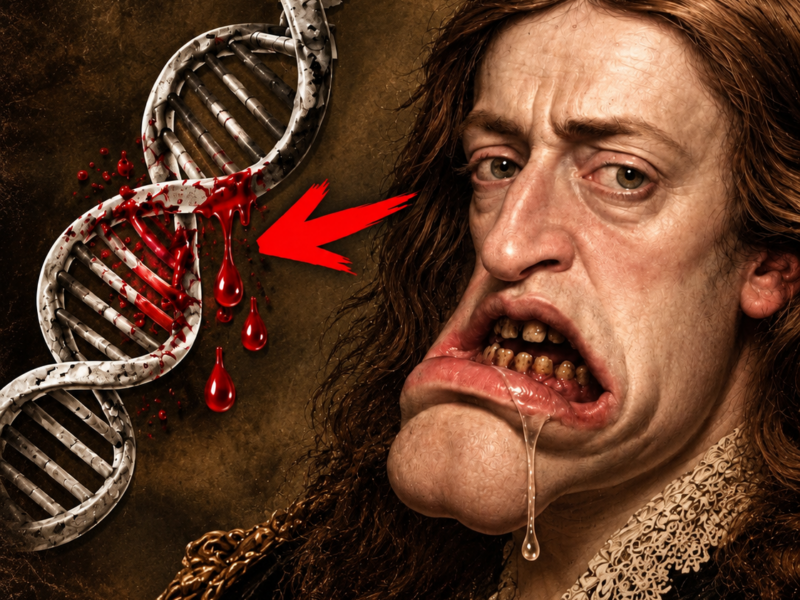
The Bewitched King: How Europe’s Most Powerful Dynasty Married Itself Into Extinction
In 1700, a king lay dying in Madrid.
And the doctors who opened his body afterward could barely believe what they found.
Charles II of Spain had never been able to chew his own food. He did not speak until he was four, and he did not walk until he was eight.
His jaw was so deformed that his upper and lower teeth could not meet.
His own subjects called him El Hechizado, the Bewitched. They were convinced that someone, somewhere, had cursed him.
And yet this was a man who ruled the largest empire on Earth, an empire the sun famously never set on.
He died at thirty-eight without a single living child.
And when he died, he wiped his family off the throne of Spain forever.
So how did the most powerful dynasty in European history end up destroying itself from the inside?
The story does not start with Charles. It starts with a single sentence the family lived by for two hundred years.
The Habsburgs had a motto, written in Latin: Bella gerant alii. Tu, felix Austria, nube.
Translated, it means: Let others wage war. You, happy Austria, marry.
And they meant it literally.
While the other great royal houses of Europe bled themselves dry on battlefields, the Habsburgs quietly conquered the continent inside wedding chapels.
A marriage here brought them Spain. A marriage there brought them the Netherlands and the wealth of the Low Countries. Another handed them the crown of the Holy Roman Empire.
Picture it as a map of Europe, with one arranged royal wedding after another spreading the family’s reach until it controlled more land than anyone alive.
You can trace the whole machine back to one man, Emperor Maximilian I, and his marriage to Mary of Burgundy in the late 1400s.
That single wedding pulled the immense wealth of Burgundy into the family. It worked so well that it became the blueprint for everything that followed.
Maximilian even planned his next moves like a chess player, arranging marriages for his grandchildren that would eventually deliver the crown of Spain, along with its new empire in the Americas.
Within two generations, a single Habsburg, Emperor Charles V, ruled Spain, Austria, the Netherlands, chunks of Italy, and vast territories across the Atlantic.
No family in Europe had ever assembled anything like it. And they had done most of it without drawing a sword.
But there was a catch built into the whole strategy.
If your power comes from marriage, and from inheritance flowing through bloodlines, then the last thing you want is to marry outside the family and let it all leak away to some rival house.
So the Habsburgs did the opposite. To keep the territory, the titles, and the wealth locked safely inside, they married inside the family.
Cousins married cousins. Uncles married their own nieces, over and over, generation after generation, for the better part of two centuries.
And these were not distant, technical relations.
Take just one example. Charles II’s own father, King Philip IV of Spain, married a teenage girl named Mariana of Austria.
Mariana was his niece, the daughter of his sister.
That uncle and that niece became the mother and father of the last Spanish king.
The pattern repeated across the family tree so many times that the same ancestors kept appearing again and again.
One woman in particular, the earlier queen history remembers as Joanna the Mad, shows up as an ancestor of Charles II not once, but through many different lines at the same time.
The Catholic Church technically forbade marriages between such close relatives.
So the family simply obtained special permissions from the Pope, called dispensations, again and again, to keep the strategy running.
At the time, it seemed like a brilliant piece of statecraft.
It was not. And you can actually watch the consequences appear, painted onto canvas.
Walk through a gallery of Habsburg portraits, the kind that hang today in the Prado in Madrid, painted by court masters like Diego Velázquez, and something strange starts to jump out at you.
A heavy, jutting lower jaw. A chin that pushes forward past the upper lip. A thick, drooping lower lip that seems to hang open.
Historians eventually gave it a name: the Habsburg jaw.
In the earliest generations, it was subtle. Just a slightly prominent chin on men like Emperor Maximilian and, later, Charles V, one of the most powerful rulers who ever lived.
But look at the portraits in order, decade by decade, and the trait does not fade.
It grows.
Each generation’s jaw is a little heavier, a little more pronounced than the last.
And here is the strangest part. The family did not hide it.
They treated that jaw almost as a badge of honor, a visible sign that you carried true, undiluted royal blood.
They were staring at a genetic warning sign in every mirror and every portrait, and they decided it was a family crest.
You would think that someone in three hundred years of court physicians would have connected the pattern.
Nobody did.
And then you arrive at Charles II, where the whole thing reaches its terrible conclusion.
Charles was born in 1661, the long-awaited male heir to the Spanish throne.
He was sick almost from the moment he arrived.
His version of the Habsburg jaw was so extreme that eating was a genuine struggle. He could barely chew, so he tended to swallow his food nearly whole, and he suffered constant stomach problems because of it.
He was frequently and seriously ill. He was slow to develop, both physically and in his speech. As an adult, he was almost certainly infertile.
To the people around him, none of this looked like biology.
It looked like a spell.
This was the seventeenth century, and the explanation they reached for was witchcraft.
That is how he earned his nickname, El Hechizado, the Bewitched.
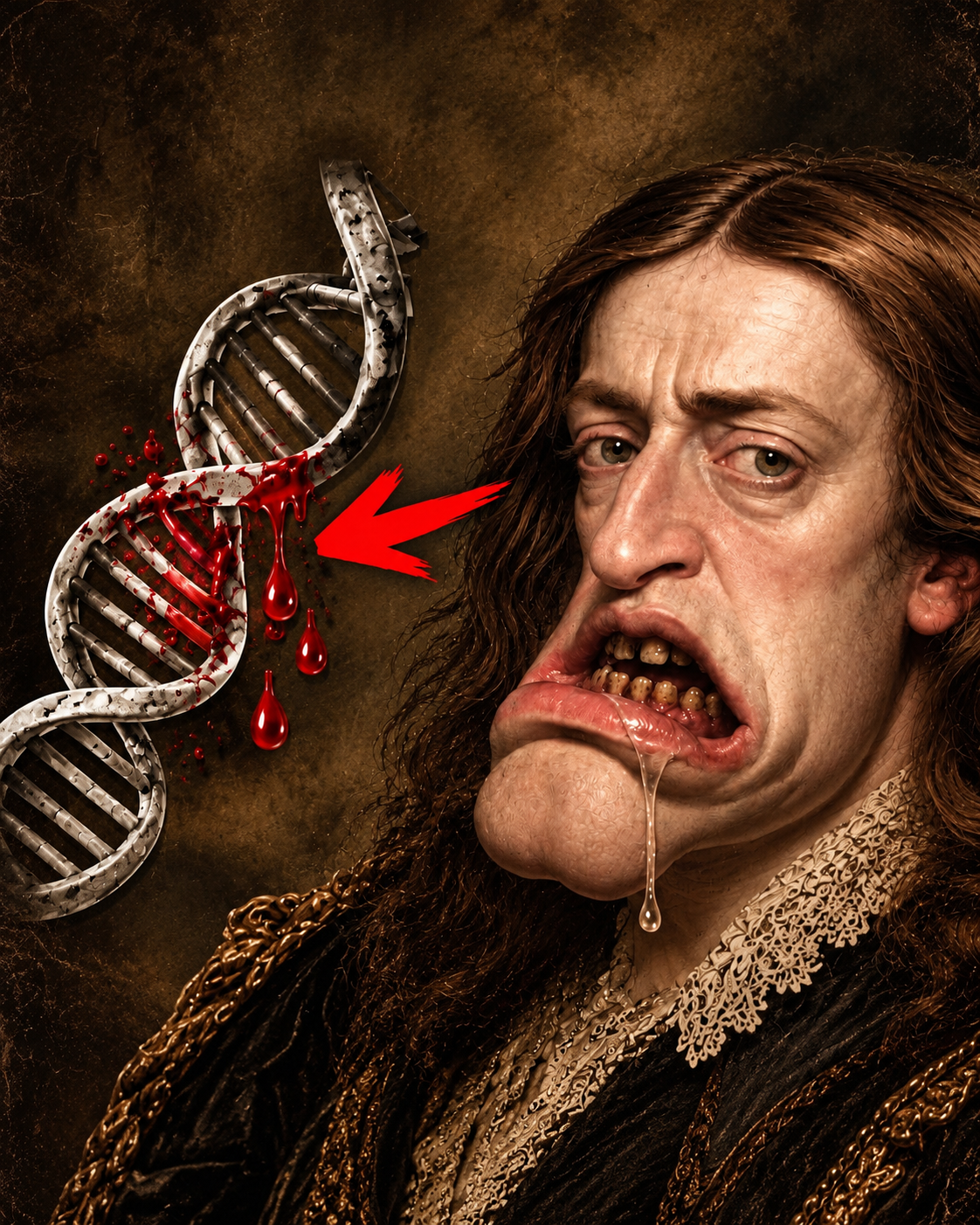
His court brought in priests to perform exorcisms on the King of Spain, sincerely trying to lift a curse they believed had been placed on his body.
He married twice, to two different queens.
He never fathered a child with either of them.
So when Charles II finally died in 1700, at just thirty-eight years old, he took the entire Spanish Habsburg line into the grave with him.
There was no heir.
And the moment that throne stood empty, the great powers of Europe went to war over who would sit on it.
On his deathbed, with no child of his own, Charles named a successor from a rival family. He chose a grandson of the French king Louis XIV, a young man who would become King Philip V.
But putting a French prince on the Spanish throne threatened to hand far too much power to France.
So England, the Dutch Republic, and the Austrian branch of the Habsburgs themselves all went to war to stop it.
That conflict, the War of the Spanish Succession, dragged on for more than a decade and redrew the map of Europe.
All of it flowed from one simple fact. The most powerful royal family on the continent could not produce a healthy heir.
If they had loosened their grip and stopped marrying relatives just a few generations earlier, this would be a very different story.
For nearly three hundred years, the curse was more or less the only explanation anyone had.
A tragic, unlucky, possibly bewitched king, and a royal family that had simply run out of luck.
But in the modern era, a team of geneticists decided to reopen the case.
They came armed with something the exorcists in Madrid never had.
Math.
In 2009, a group of Spanish scientists led by the geneticist Gonzalo Alvarez published a study that did something no one had attempted at this scale.
They reconstructed the entire Habsburg family tree, reaching back sixteen generations and mapping more than three thousand individuals.
For each person in that tree, they calculated a single number called an inbreeding coefficient.
In plain terms, that number measures how closely related a person’s two parents actually were, based on how many ancestors they secretly shared.
When they ran the numbers for Charles II, the result was staggering.
His inbreeding coefficient came out to roughly 0.25.
That is not a typo.
A coefficient of about 0.25 is the same result you would expect from the child of two siblings, a brother and a sister.
On paper, Charles II’s parents were only an uncle and his niece.
But because nearly everyone in that family had been marrying close relatives for two hundred years straight, the same handful of ancestors kept reappearing throughout his family tree.
All that hidden repetition stacked up until, genetically speaking, he was as related to himself as the child of a brother and sister.
So why does that actually cause disabilities and a deformed jaw?
The mechanism is simpler than it sounds.
Every one of us walks around carrying a few rare broken genes. Normally they cause no harm at all, because we inherit two copies of most genes, and as long as one copy works, the faulty one stays silent.
The danger appears only when a person inherits two broken copies of the same gene.
And when your parents come from the same small pool of shared ancestors, both carrying the same rare faults, the odds of a child inheriting two broken copies stop being a long shot.
They start becoming likely.
Based on his documented symptoms, the researchers proposed that Charles II probably suffered from not one but two separate rare inherited disorders at the same time.
The first was a hormone deficiency that stunts growth and development. That would explain his weakness, his late walking and speech, and his inability to have children.
The second was a disorder that throws off the acid balance in the blood. That fits his frequent illness, his digestive problems, and his fragile health.
Neither of those conditions is a curse.
Both are exactly the kind of rare recessive problem that surfaces when a family folds in on itself for two hundred years.
Put them together in one body, and you get a boy the seventeenth century could only describe as bewitched.
For three hundred years, people were sure they knew what had happened to him.
They were wrong.
And then, a decade later, another team went one step further.
This is the part that had been sitting in plain sight in museums the entire time.
In 2019, a group of researchers took sixty-six portraits of fifteen different members of the Habsburg dynasty, the same royal paintings tourists walk past every day.
They brought in a panel of maxillofacial surgeons, doctors who specialize in the bones of the jaw and face, and had them examine those painted faces the way they would examine a real patient.
The surgeons scored each royal for the severity of that famous jaw and the related facial features.
Then the researchers lined those scores up against each family member’s inbreeding coefficient.
Pay attention to this next part, because it is the detail that closes the whole case.
The two sets of numbers matched.
The more inbred the individual, the more severe their Habsburg jaw. The correlation was real and measurable.
Those portraits, hanging quietly in galleries for centuries, turned out to be a visual genetic record of a family slowly breaking down.
The art itself was the evidence.
Which brings us to the part that ties everything together.
The Habsburgs actually split into two branches, the Spanish line and the Austrian line.
The Spanish branch married the closest and the most relentlessly, doubling down on uncle-niece and first-cousin marriages. That branch was the first to collapse, gone entirely by 1700.
The Austrian branch still intermarried heavily, but slightly less intensely, and it survived for generations longer.
In fact, the Austrian line eventually produced one of the most famous rulers of the eighteenth century, Empress Maria Theresa. It lived on in one form or another for centuries after the Spanish crown had already died out.
Same family. Same starting point. Two different levels of inbreeding, and two very different endings.
The so-called curse was not supernatural at all.
It tracked almost perfectly with the genetics.
A dynasty that conquered half of Europe by carefully controlling exactly who married whom was brought down by that very same control.
There is something almost tragic in how avoidable it was.
Generation after generation, the Habsburgs could see the jaw getting heavier and the children getting frailer.
And yet the logic of holding onto power always won.
Marrying a cousin kept the empire in the family. Marrying a stranger risked handing it to a rival.
So they kept choosing the empire over the bloodline, right up until the bloodline gave out and the empire slipped away anyway.
It is not only a story about dead royalty, either.
The genetic risks that destroyed the Habsburg line are the same risks that close-relative marriage carries today. The Habsburgs are simply history’s clearest and most thoroughly documented example.
A warning that happens to have been painted in oil on the walls of Europe’s finest museums for three hundred years.
The doctors standing over that king’s body in 1700 were certain they were looking at the work of a curse.
They were actually looking at the answer.
It just took science another three hundred years to learn how to read it.









