The $300 Washout Puppy Who Saved a Broken Navy SEAL
He was a defective clearance rack puppy, a highly strung German Shepherd marked down to $300 and scheduled for euthanasia by sundown.
He was entirely unlovable until a battle-scarred Navy SEAL walked past his cage.
What happened next wasn’t just a rescue.
It was a violent, desperate collision of two shattered souls.
They called him Tag 42, but in the sterile, fluorescent-lit corridors of the Oak Creek County Animal Control in rural Georgia, he was known simply as the washout.
He was a purebred German Shepherd, genetically engineered for a singular purpose, to become an elite police K9.
His bloodline was supposed to be a lineage of fearless iron-willed protectors.
Instead, he was born into a nightmare.
His breeder, a man named Arthur Hayes, ran an unlicensed backwoods operation that promised high-drive tactical dogs to private security firms.
Hayes didn’t care about the animals.
He cared about the aggressive aesthetic.
The puppies were kept in pitch-black concrete runs, subjected to sudden, deafening noises to test their nerves.
For Tag 42, the harsh training methods didn’t forge a warrior.
They broke his mind before it had a chance to fully form.
When Detective Ray Donovan of the State Police raided Hayes’s property on a humid morning in August, he found 17 dogs in varying states of neglect.
Most were wildly aggressive, throwing themselves against chain-link fences with bared teeth.
But in the very last kennel, tucked away in the damp shadows, was a trembling 12-week-old puppy pressed so hard against the cinder block wall it looked as though he was trying to phase through it.
The puppy was transferred to Oak Creek, where a certified behavioral specialist, Officer Greg Tyson, evaluated him.
The assessment lasted less than five minutes.
Tyson dropped a metal clipboard onto the concrete floor.
At the loud clatter, the puppy didn’t just flinch.
He emptied his bladder, scrambled backward until he hit a corner, and let out a high-pitched, hyperventilating scream.
“His nerves are completely shot,” Tyson wrote in his official report.
“Severe generalized anxiety, fear reactive, zero working drive. He is a liability. Wash him out.”
Because of his purebred status, the county shelter placed a $300 adoption fee on him, hoping a civilian family might want a beautiful, if timid, German Shepherd.
But as weeks turned into months, Tag 42’s beauty faded into a portrait of severe psychological distress.
He was constantly shedding from stress, leaving his coat dull and patchy.
His rib cage showed.
Whenever a family walked down the main viewing aisle, children pressing their faces against the glass, other dogs would bark, wag their tails, and beg for attention.
Tag 42 would retreat to the back of his run, face the wall, and shake uncontrollably.
Nobody wanted a broken dog.
Families wanted a loyal protector, a playful backyard companion, a dog that would chase a tennis ball.
They didn’t want a cowering shadow that shrank away from a reaching hand as if expecting to be struck.
There was one glimmer of hope in early October.
A suburban couple, the Hendersons, decided to take a chance on him.
They paid the $300 fee and took him home to their sprawling four-bedroom house.
Less than 36 hours later, Richard Henderson was back in the shelter’s lobby, his face flushed with anger, dragging a heavily panting Tag 42 by a slip lead.
“The dog is unhinged,” Richard yelled at the receptionist, slamming the leash down on the counter.
“We left him alone in the laundry room for two hours to go to dinner. He chewed through the drywall. He tore up the doorframe so badly his gums were bleeding. You people sold me a defective animal. I want my money back.”
Tag 42 was shoved back into his concrete cell, but this time the shelter management had seen enough.
The facility was dangerously overcrowded.
Dogs were coming in every day, and a dog with a bite history, even if it was chewing a wall out of sheer panic, was deemed unadoptable.
A red sticker was placed on the top right corner of his clipboard.
Euthanasia date, Friday, November 12th, 5:00 p.m.
By the morning of November 12th, the $300 adoption fee had been crossed out in red ink, replaced with the word urgent.
But the shelter volunteers knew the truth.
Nobody was coming for the washout.
He sat in his corner, a five-month-old puppy with the haunted eyes of a ghost, waiting for a doom he didn’t understand, but could profoundly feel.
Thirty miles away, in a sparsely furnished cabin on the edge of the Appalachian foothills, David Caldwell woke up screaming.
His massive frame shot up from the mattress, sheets drenched in cold sweat, his hands instinctively reaching for a rifle that wasn’t there.
For a terrifying, disorienting ten seconds, the slow, rhythmic spinning of the ceiling fan sounded exactly like the rotor blades of a Black Hawk helicopter.
The smell of stale coffee from the kitchen registered in his brain as burning diesel and copper.
David squeezed his eyes shut, dug the heels of his hands into his temples, and forced himself to breathe.
Inhale for four, hold for four, exhale for four.
He was 34 years old, a former Navy SEAL who had served four deployments in some of the most unforgiving combat zones on Earth.
He had survived ambushes, firefights, and a grueling operational tempo that broke most men.
But it was a roadside IED outside of Ramadi that finally ended his career.
The blast had thrown his vehicle into a ditch, leaving him with a severe traumatic brain injury, shrapnel scars that spiderwebbed across his left shoulder, and a medical discharge he never asked for.
David had survived the war, but the war had followed him home.
Civilian life was a suffocating, alien landscape.
The silence of his cabin was deafening, leaving too much room for the ghosts of his fallen teammates to whisper in the dark.
He couldn’t go to grocery stores without mapping out the exits.
A car backfiring in a parking lot would send him into a violent panic attack.
The world felt entirely unsafe, a minefield disguised as polite society.
His VA psychiatrist, Dr. Aris Mitchell, had been pushing him for months to consider a service dog.
“You need an anchor, David,” Dr. Mitchell had said during their session earlier that week, adjusting his glasses and looking at the former operator with a mix of pity and professional concern.
“You’re drifting. A highly trained psychiatric service canine can detect your cortisol spikes before a panic attack hits. They can provide deep pressure therapy. They give you a mission, something to care for.”
“I don’t need a babysitter,” David had growled, crossing his heavily tattooed arms.
“And I don’t have 25 grand to drop on a custom-trained golden retriever.”
“Then just go to a shelter,” Mitchell had challenged gently.
“Just look. You don’t have to adopt. Just practice being around life again, David. You’ve surrounded yourself with ghosts.”
Those words echoed in David’s mind as he sat on the edge of his bed on Friday morning.
The crushing weight of his isolation was becoming unbearable.
The dark thoughts, the ones that whispered it would be easier to just end the pain, were growing louder.
Desperate to shut them out, David grabbed his keys, climbed into his beat-up Ford F-150, and drove toward Oak Creek.
He didn’t know why he was going.
He didn’t even like dogs that much.
But he had to move.
He had to execute a mission, no matter how small.
When David pushed through the heavy glass doors of the Oak Creek County Animal Control at 3:45 p.m., he immediately knew he had made a mistake.
The sensory assault was instantaneous.
The smell of industrial bleach, wet fur, and feces hit his nose.
But it was the noise that paralyzed him.
A hundred dogs barking simultaneously in an enclosed concrete space created a chaotic, deafening echo.
To David’s damaged brain, it didn’t sound like dogs.
It sounded like screaming.
It sounded like the chaos of a medevac landing zone under heavy fire.
His heart rate spiked to 160 beats per minute.
The edges of his vision blurred, tunneling into darkness.
His chest tightened as if wrapped in steel cables.
He couldn’t breathe.
A panic attack was imminent, and it was going to be a bad one.
Get out, his brain screamed.
Abort.
David spun around on the heels of his heavy combat boots, reaching for the door handle to escape.
At that exact moment, a shelter volunteer named Sara Jenkins was dragging a dog down the main hallway toward the medical wing.
It was Tag 42.
His time was up.
Friday at 5:00 p.m. was rapidly approaching, and Sara had been tasked with the heartbreaking job of bringing the washout to the euthanasia room.
The German Shepherd puppy was terrified.
The noise of the hallway was overwhelming him.
He had his belly plastered to the floor, his claws scraping uselessly against the linoleum as Sara gently but firmly pulled the leash.
“Come on, buddy. I know. I know,” she was whispering, tears in her own eyes.
As David turned to flee, his heavy boots pounded against the floor.
The sudden, rhythmic thud caught the puppy’s attention.
Tag 42 stopped resisting the leash and looked up.
Through the haze of his incoming panic attack, David looked down.
Time seemed to fracture and slow to a crawl.
The battle-hardened SEAL, suffocating in his own mind, locked eyes with the broken, death row canine.
In the puppy’s wide, amber eyes, David didn’t see an animal.
He saw the exact same paralyzing, inescapable terror that was currently crushing his own chest.
He saw a fellow soldier trapped behind enemy lines, knowing no rescue chopper was coming.
What happened next defied all logic and every note in the dog’s behavioral file.
Tag 42, the dog who was notoriously fear reactive to strangers, the dog who cowered from the slightest movement, suddenly lunged forward.
He ripped the leash out of Sara’s surprised hand, but he didn’t bolt for the door.
The 60-pound puppy crashed directly into David’s legs.
David froze, his hand still hovering over the exit handle.
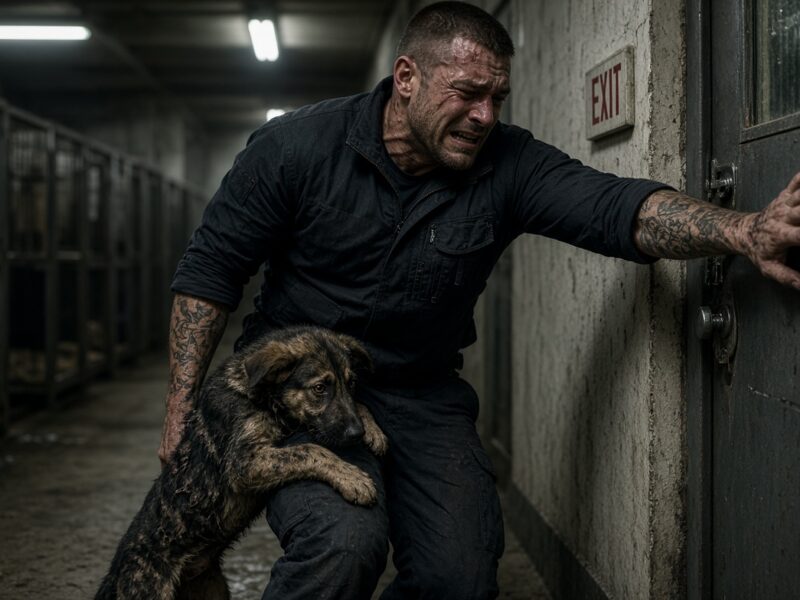
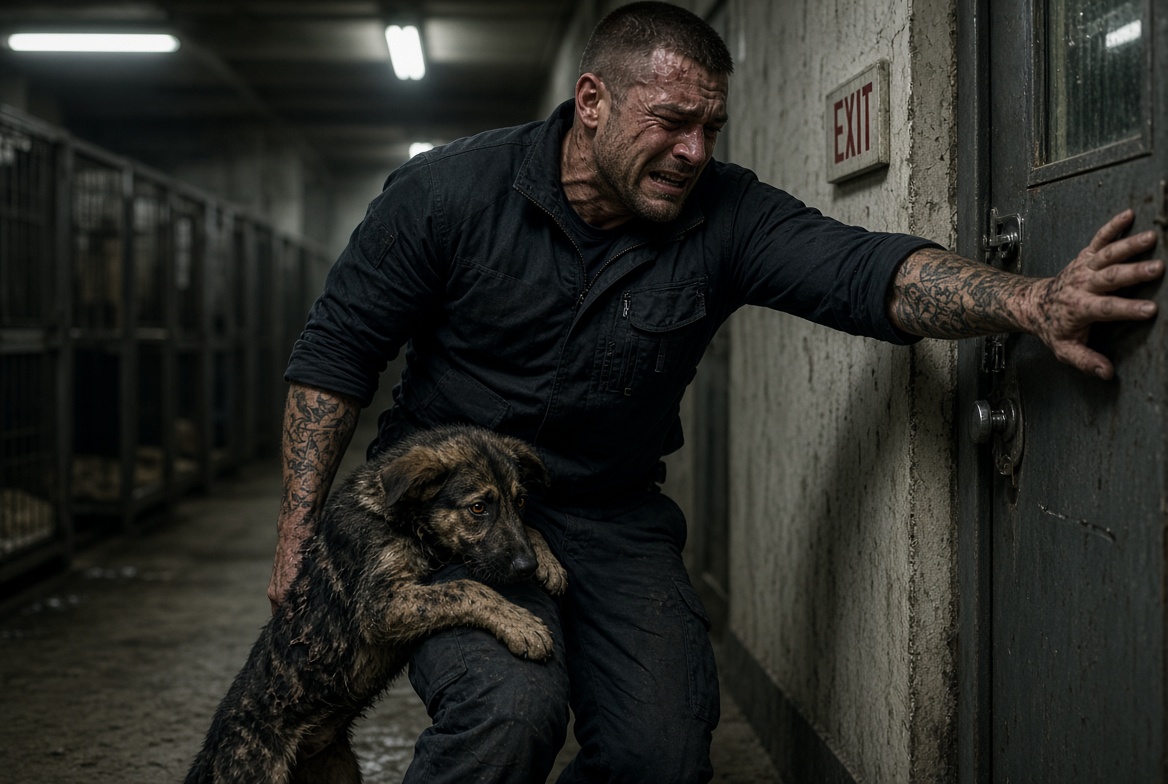
The German Shepherd wrapped his front paws tightly around David’s denim-clad calf, burying his snout deep behind David’s knee.
The dog pressed his entire body weight into the veteran’s leg and began to shake so violently it felt like a mild earthquake.
And then a sound ripped from the dog’s throat, not a growl, not a bark, but a low, desperate, human-like whimper.
It was a plea, a physical, undeniable begging.
Don’t leave me here, please.
Sara gasped, taking a step forward to grab the leash.
“Oh my god, I am so sorry, sir. He’s terribly fearful. He might bite.”
“Stop,” David commanded.
His voice was a low, gravelly rumble that instantly halted the volunteer in her tracks.
David slowly lowered his massive frame, dropping to one knee on the dirty linoleum.
The moment he did, Tag 42 scrambled up, abandoning the leg to press his trembling chest directly against David’s tactical jacket.
The dog buried his face into the crook of David’s neck, clinging to the man’s broad shoulders with desperate, gripping paws.
As the dog’s rapid, terrified heartbeat thumped against David’s chest, a bizarre physical reaction occurred within the veteran.
The grounding weight of the animal, the raw, undeniable reality of a living creature needing him in that exact second, short-circuited his panic attack.
The phantom helicopter blades faded.
The room came back into sharp focus.
The suffocating grip on his lungs released.
David wrapped his thick, tattooed arms around the trembling dog, pulling him tighter.
He buried his face in the coarse fur.
“Where were you taking him?” David asked quietly, not looking up.
Sara swallowed hard, wiping a tear from her cheek.
“To the back room, sir. His time is up today. He’s unadoptable.”
David slowly lifted his head.
His eyes, usually haunted and vacant, were now sharp, locked in, and burning with a terrifying intensity.
He looked at the red, urgent sticker on the clipboard, still clutched in Sara’s other hand.
“How much?” David asked.
“Sir, he has severe behavioral issues. He destroyed a house. He’s—”
“I asked how much,” David repeated, his voice leaving absolutely no room for debate.
“$300,” she whispered.
David didn’t let go of the dog.
He reached into his back pocket, pulled out his wallet with one hand, and dropped $300 on the counter.
“Get the paperwork. His name is Bravo.”
He thought he was saving the dog’s life.
He thought the dramatic rescue in the hallway was the end of the battle.
But as David carried the clinging, shivering German Shepherd out to his truck, he had no idea that the real nightmare was just beginning.
Bravo wasn’t just scared.
He was hiding a dangerous secret, one that would push the former Navy SEAL to the absolute edge of his sanity, and force him into a situation more dangerous than any combat zone he had ever faced.
The first 48 hours at the isolated Appalachian cabin were a master class in misery.
David Caldwell quickly realized that taking Bravo home was like bringing an unexploded ordnance into his living room.
The dog was completely unmoored from reality.
When David closed the front door, the click of the deadbolt sent Bravo into a blind panic.
The German Shepherd scrambled frantically across the hardwood floor, his claws gouging deep scratches into the oak before wedging himself beneath a heavy oak dining table.
He refused to eat.
He refused to drink.
He just stared at the walls, his body vibrating with a low, continuous tremor.
Most people would have returned the dog.
Richard Henderson, the suburbanite who had surrendered Bravo days earlier, had demanded a refund for much less.
But David wasn’t most people.
He didn’t see a nuisance.
He saw a casualty of war.
Drawing on the immense reservoir of tactical patience he had cultivated as a Navy SEAL sniper, David adapted his environment to suit his new, damaged teammate.
He didn’t force Bravo out from under the table.
Instead, David grabbed a sleeping bag, a bottle of water, and his own medication, and laid down on the floor ten feet away.
“We hold the perimeter, Bravo,” David whispered into the dark, empty cabin.
“Nobody comes in. Nobody hurts you here. You have my word.”
For three weeks, they existed in a strange, silent purgatory.
David suffered through his own night terrors, waking up gasping, his hands clawing at his chest.
Every time it happened, he would look over and see Bravo watching him from the shadows, his amber eyes reflecting the pale moonlight.
They were two shattered veterans silently guarding each other’s trauma in the dark.
Slowly, almost imperceptibly, the ice began to thaw.
Bravo started creeping out to eat from David’s hand.
Then, he started following David from room to room, pressing his shoulder against David’s thigh as they walked.
The bond that formed wasn’t one of a typical pet and owner.
It was a profound codependent alliance forged in the fires of mutual anxiety.
But as December brought freezing rain and biting winds to the mountains, David noticed something deeply unsettling about the dog’s behavior.
Bravo wasn’t just generally anxious.
His fear was violently specific.
It started on a Tuesday afternoon.
David was chopping firewood behind the cabin while Bravo laid on the porch.
The sudden, sharp crack of the axe splitting a log didn’t bother the dog at all.
But when a dark, gray diesel engine pickup truck drove down the distant mountain highway, its engine rumbling with a distinct heavy rattle, Bravo lost his mind.
The dog didn’t cower.
He went completely rigid.
The hair on his spine standing straight up.
A low, guttural snarl vibrating in his throat before he frantically tried to herd David back inside the cabin by grabbing the hem of his jeans.
David’s instincts, honed by years of surviving ambushes, flared.
He contacted Detective Ray Donovan, the state police officer who had originally raided Arthur Hayes’ breeding compound.
“Ray, I need everything you have on Hayes’ operation,” David said over the phone, watching Bravo pace nervously by the front window.
“This dog wasn’t just abused. He’s reacting to specific triggers. Diesel engines, the smell of ammonia, and he’s hyper-fixated on the northern ridge of my property line.”
There was a heavy pause on the line.
“David, Hayes wasn’t just running a puppy mill,” Donovan finally admitted, lowering his voice.
“We couldn’t prove it in court, but we strongly suspect Hayes was renting his property and his aggressive dogs to a local cartel outfit running a massive crystal methamphetamine operation in the Appalachian foothills. The dogs were used as biological alarm systems to guard the cook sites. If Bravo was there, he wasn’t a washout. He was a survivor of a cartel proving ground.”
The blood drained from David’s face.
He looked out the window toward the dense, unbroken wall of pine trees on the northern edge of his 50-acre lot.
It was hundreds of miles of deep, lawless wilderness.
“Ray,” David said slowly, a cold knot forming in his stomach.
“Hayes’ associates. Did you catch them all?”
“No,” Donovan replied.
“The main cook, a guy named Caleb Rollins, vanished the night before the raid. He’s extremely violent.”
“Why?”
David didn’t answer.
He hung up the phone.
He looked at Bravo.
The $300 washout wasn’t shaking out of irrational fear.
He was exhibiting a severe trauma response because he knew exactly what monsters lived in the woods.
And based on the way Bravo was staring at the northern ridge, teeth bared, those monsters were entirely too close to home.
The winter storm hit on the evening of December 14th.
A blinding wall of snow effectively cut off David’s cabin from the rest of Oak Creek County.
Power lines snapped under the weight of the ice, plunging the mountainside into pitch blackness.
David was sitting by the fireplace, cleaning his SIG Sauer P226 by the flickering light of the flames, when Bravo suddenly snapped to attention.
The dog didn’t whine.
He didn’t shake.
He stood perfectly square.
His ears swiveled forward.
His nose pointed directly at the heavy wooden front door.
Then, the dog did something he had never done before.
He let out a booming, concussive bark that rattled the windows.
It wasn’t a warning to David.
It was a warning to whatever was outside.
Before David could rack the slide of his pistol, the front door exploded inward in a shower of splintered wood and freezing snow.
Two men burst into the cabin.
They were heavily bundled against the cold wearing tactical vests over winter coats.
The first man carried a 12-gauge pump-action shotgun.
The second wielded a suppressed submachine gun.
They were Caleb Rollins and a hired enforcer, desperate men who’d been using the abandoned hunting blind on the edge of David’s property to move their product.
The storm had forced them to seek shelter and supplies and an isolated, supposedly easy target like a lone veteran’s cabin was exactly what they needed.
“Drop it. Drop the gun,” Rollins screamed leveling the shotgun directly at David’s chest.
At the deafening roar of the home invader’s voice combined with the sudden explosion of the door and the blinding sweep of their tactical flashlights, David’s damaged brain violently short-circuited.
The traumatic brain injury and severe PTSD collided in a catastrophic misfire.
David wasn’t in his living room anymore.
He was back in Ramadi.
He was trapped in the burning Humvee.
The sensory overload paralyzed him.
The SIG Sauer slipped from his numb fingers clattering onto the hardwood floor.
David collapsed to his knees, his hands flying to his ears as he gasped for air, completely defenseless, trapped in a waking nightmare.
“Easy money,” the second gunman sneered stepping forward to put a bullet in the kneeling veteran’s head.
They thought it was over.
They didn’t look at the $300 washout.
For his entire life, Bravo had been beaten, terrified, and broken.
He had been labeled a coward, a defective animal completely devoid of working drive.
But in that fraction of a second, as the gunman raised his weapon toward the only human being who had ever shown him mercy, who had slept on the floor beside him, and shielded him from the dark, 50 generations of elite tactical German Shepherd genetics violently overrode a lifetime of trauma.
Bravo didn’t just attack, he became a 70-pound kinetic missile.
With a ferocious, bloodcurdling roar, Bravo launched himself through the air.
He completely ignored the man with a shotgun, calculating the immediate lethal threat with terrifying precision.
Bravo struck the second gunman square in the chest, his jaws snapping shut on the man’s forearm with bone-crushing force.
The submachine gun discharged wildly into the ceiling as the man screamed, crashing backward into the snow-covered porch under the dog’s immense momentum.
“Get him off! Shoot the dog!” the man shrieked, thrashing violently as Bravo maintained a relentless, punishing grip, shaking his head side to side to tear muscle from bone.
Rollins panicked.
He swung the heavy barrel of the shotgun toward the dog, struggling to get a clear shot in the chaotic tangle of limbs.
The explosive sound of the shotgun blast ripping through the wooden floorboards inches from Bravo’s paws finally snapped David out of his flashback.
The scent of burnt gunpowder didn’t paralyze him this time.
It ignited the dormant Navy SEAL within.
Seeing his dog, his teammate taking fire, David lunged.
He didn’t reach for his gun.
There was no time.
He drove his shoulder directly into Rollins’s waist, tackling the man into the brick hearth of the fireplace.
A brutal, desperate hand-to-hand fight erupted in the dark, fire-lit living room.
Rollins was fueled by methamphetamine and adrenaline, clawing wildly at David’s face, desperately trying to bring the shotgun barrel up.
But David was a Tier One operator.
Operating on pure, lethal instinct, David trapped Rollins’ right arm, delivered a devastating elbow strike to the man’s jaw, and stripped the shotgun away.
In one fluid motion, David racked the pump and leveled the barrel at Rollins’ face.
“Don’t move!” David roared, his voice cutting through the howl of the blizzard.
Outside on the porch, the screaming had stopped.
David’s heart hammered against his ribs as he kept the shotgun fixed on the unconscious Rollins.
He slowly backed toward the doorway, his eyes frantically searching the darkness of the porch.
“Bravo!” he yelled, a terrifying knot of dread seizing his throat.
“Bravo, report.”
A shadow detached itself from the snowbank.
The second gunman was unconscious, bleeding heavily from his severely lacerated arm.
Standing over him, panting heavily, his muzzle stained with blood, was the washout.
Bravo limped into the light of the cabin.
He had a deep, jagged gash along his left flank where the shotgun blast had grazed him, and he was favoring his right front paw.
But his amber eyes were no longer wide with panic.
They were calm.
They were focused.
He looked at David, gave a soft, reassuring huff, and immediately sat down by David’s left leg, leaning his weight against the veteran’s thigh.
He was holding the perimeter.
Tears stung David’s eyes as he lowered his free hand, burying his fingers in the thick, blood-matted fur of the dog’s neck.
“Good boy,” David choked out, his voice cracking.
“Good boy.”
By the time Detective Ray Donovan and the county SWAT team navigated the treacherous snow-covered mountain roads four hours later, they found a scene that defied belief.
The two most wanted cartel enforcers in the county were zip-tied to the cabin’s structural pillars.
Sitting on the couch, wrapped in a tactical blanket, was David Caldwell.
And resting his head on David’s chest, receiving intravenous fluids from a tactical medic, was the dog the county had deemed entirely unlovable.
“I don’t understand,” Sara Jenkins, the shelter volunteer, stammered when she visited the veterinary hospital three days later.
She brought a bag of premium dog treats, staring in awe through the glass of the recovery room.
Inside, David was asleep in a plastic chair, his hand resting on Bravo’s bed.
The dog was alert, watching the door with a calm, protective gaze.
“He was completely broken, Mr. Caldwell,” Sara said softly when David woke up and stepped into the hallway.
“How did you fix him?”
David looked back through the glass at the German Shepherd.
He touched the faint scars on his own shoulder, feeling the deep, rhythmic pulse of his own heart, a heart that was beating far calmer than it had in a decade.
“I didn’t fix him, Sarah,” David replied quietly, a rare, genuine smile touching the corners of his eyes.
“Bravo was never broken. He was just waiting for something worth fighting for. Turns out, so was I.”
They had both been discarded by a world that didn’t understand their trauma.
They had both been scheduled for their own respective ends, one in a sterile shelter room, the other in the suffocating silence of a lonely cabin.
But in the violent collision of that fateful afternoon, the $300 washout and the scarred Navy SEAL hadn’t just saved each other’s lives, they had resurrected each other’s souls.
Today, Bravo wears a specialized harness.
He is not just a survivor, he is David Caldwell’s officially certified psychiatric service canine and personal protection dog.
When David walks into a crowded grocery store, the phantom helicopters no longer roar in his ears.
He doesn’t need to check the exits.
He just looks down at the loyal, fearless German Shepherd walking perfectly at his side.
And he knows, without a shadow of a doubt, that he is finally safe.
The bond between a damaged veteran and a discarded shelter dog proves that sometimes the greatest rescues are entirely mutual.
David and Bravo’s incredible journey from the brink of tragedy to a heroic fight for survival shows that no soul is ever truly beyond saving.









