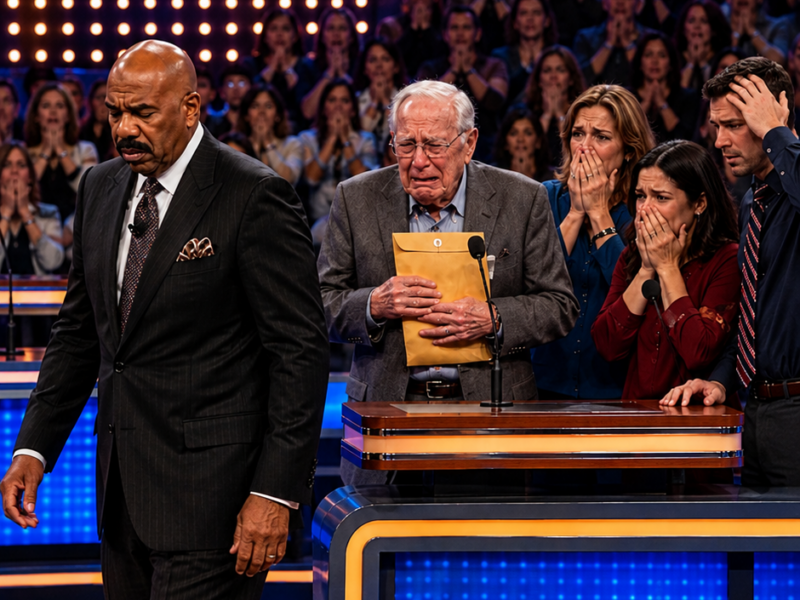
Steve Harvey WALKED OFF After an 88-Year-Old Confessed a Secret He Buried for 60 Years
Picture carrying a secret so heavy that only one other living person on Earth ever knew the truth of it. Now picture that person dying two months ago, and realizing for the first time in 60 years that you no longer have to carry it completely alone.
That was Emmett Alwood’s exact situation when he walked into a television studio in Bakersfield, California, on a Friday morning he believed would be a fun outing with his grandkids. He had no plan to say anything at all. He would tell you that himself if you asked him now.
By the time he finished speaking, Steve Harvey would walk off his own stage without another word.
The Alwood family arrived at the taping the way most families do, a little nervous and mostly excited. Emmett’s wife, Estelle, fussed over his collar in the hallway, the same way she had fussed over it through 55 years of Sunday mornings. Nobody watching them could have guessed that the quiet man in the pressed jacket was carrying something far heavier than a studio audience’s expectations.
Emmett, 88, took his place at the podium beside Estelle, his granddaughter Priya, and his grandson Elias. All four were laughing about something Elias had said in the van on the way over. It was the kind of easy, unguarded laughter that families share when nothing seems to be at stake.
Priya, 24, worked as a paralegal and had a habit of noticing details other people missed. Her grandfather liked to joke that she had inherited the trait from him, back when he still had a trade that rewarded careful attention. It was a joke that would take on a very different meaning before the day was over.
To every camera in the building, the Alwoods looked exactly like what they appeared to be. They were a warm, easy family enjoying a good day together. There was no hint of a locked room, a folded piece of newsprint, or a debt that had been quietly outstanding since before most of the audience was born.
Steve greeted the family warmly at the top of the show, the way he greets every family. He was immediately taken with Emmett’s sharp wit and easy laugh. “Eighty-eight years old and still quick as anybody up here,” Steve said, shaking his hand. “What’s the secret?”
“Oh, I’ve got a few of those,” Emmett replied.
He laughed as he said it, in a tone that sounded to everyone in that moment like nothing more than an old man’s harmless joke. The audience chuckled along. Nobody in that studio, Steve included, understood yet how literally true the sentence actually was.
Across the stage, the Delroy family from Bakersfield waited their turn. They were four cousins who had entered through the regular casting line, and they had no idea they were about to spend most of their taping day as quiet witnesses to something far bigger than the game. Like everyone else in the room, they were there for the points, the buzzers, and the chance at a good story to tell later.
They would get a story, just not the one they came for.
To understand what Emmett was carrying under that jacket, you have to go back 60 years. Emmett was 28, working the night shift at a textile mill outside a small town three states away from where he lives now. It was steady work, hard on the body and easy on the conscience, the kind of job where men learned each other’s habits by the sound of their footsteps on the floor.
His closest friend at the mill was a man named Roy Hrix. Roy was a co-worker two years younger than Emmett, with a wife and a newborn daughter at home and a mortgage he was barely keeping up with. The two men had worked the same line for three years by then.
They were close enough that Roy had asked Emmett to be his daughter’s godfather just months before everything fell apart. It was the sort of friendship that doesn’t need explaining in a small town. You simply knew who would show up for you, and Emmett was that man for Roy.
Then came the night that changed both their lives. Running behind on a rushed order, Roy made a shortcut decision on a piece of equipment, one that both men knew violated safety protocol. Within the hour, a fire tore through a storage section of the mill.
The blaze destroyed nearly a third of the building. It also seriously injured another worker who had been standing nearby, a younger man named Frank. Frank would recover fully within a few months, and Emmett says he thought about him often during the long stretch that followed, grateful at least that the injury had not been permanent and that the cost of the mistake had not been worse than it already was.
Before the investigators arrived, Roy came to Emmett. He was terrified. He was already imagining the wife and baby he would be leaving behind if he went to prison for negligence, already certain that his career and his family’s stability were over before either had really begun.
According to Emmett, Roy never asked him to lie. Emmett has always been clear about that part. Roy simply sat on the curb outside the mill, shaking, saying over and over that he did not know what he was going to tell his wife.
Emmett was single at the time, with no wife and no children depending on him. He made a decision in about 90 seconds that would shape the rest of his life. When the mill’s investigators asked what had happened, he told them he was the one who had made the shortcut, and that Roy had nothing to do with it.
He repeated the same story to the police. He repeated it to the insurance adjusters. Eventually, he repeated it in a small courtroom, to a judge.
Roy tried to argue with him twice that same night, and once more the morning after. He insisted he could not let Emmett do it. Emmett told him plainly that a baby needed her father more than a mill needed the truth.
Roy never brought it up again after that. Emmett says he could see, for years afterward, exactly how much it cost his friend to stay silent, too. It was a kind of bargain that left both men paying, just in different currencies.
Emmett was convicted of criminal negligence and served 14 months. He lost his job. He lost his standing in a town where everyone knew everyone, and he lost any realistic hope of finding factory work within driving distance ever again, since word travels fast in a small industry.
He still remembers the judge, an older man with tired eyes, who paused before sentencing to ask if he had anything to add. Emmett said no. He had rehearsed that single word for a week.
He was terrified that saying anything more might let the truth slip out in front of Roy, who sat three rows back, unable to look at him. One word was safe. A second word might have been a confession, and a confession would have undone everything.
When he got out, he left that town entirely and never went back. He started over three states away, under circumstances that nobody in his new life ever fully understood. The trade he had trained in his whole life was behind him now.
He met Estelle two years later at a diner where he had taken a job as a cook. He never told her the real story. He told her only that he had made mistakes in his twenties that he was not proud of and preferred not to discuss.
She married him anyway, fully aware that there was a locked room somewhere inside him she was not allowed to enter. At 24, she had decided that she trusted the man in front of her more than she needed the answer to a question he clearly did not want asked. In the early years she occasionally asked gently, and each time she watched him close a door behind his eyes. Eventually she learned not to knock on it anymore.
Roy, for his part, kept his job and kept his family. He built the stable life that Emmett had sacrificed his own reputation to give him. By every outward measure, the arrangement worked.

The two men spoke exactly twice more in 60 years, both times briefly. Both calls carried an unspoken debt that neither of them ever found the words to address. Some things, it seems, are too large to fit through a telephone line.
The first call came a decade later. Roy simply said, “Thank you,” his voice thick, and then hung up quickly, as if he could not trust himself to stay on the line any longer. Emmett held the receiver for a long time afterward.
The second call came 30 years after that. It was a birthday call that turned, without either man planning it, into 40 minutes of silence and half sentences that neither of them finished. Two old friends, breathing quietly across hundreds of miles, each waiting for the other to say the thing that could not be said.
Roy died two months ago. Emmett learned of it from an old co-worker’s obituary notice, forwarded by someone who did not even know the history between the two men. Something about seeing that name in print after 60 years of silence cracked something loose in him that he had not expected.
He was suddenly the last keeper of a story that had no other living witness. The one person who could have corroborated it, or corrected it, or simply understood it without explanation, was gone.
There was one thing Emmett had kept from that entire chapter of his life. It was a yellowed newspaper clipping from the week of the fire, folded into quarters and tucked at the bottom of a drawer in his workshop, a place where Estelle rarely looked. The headline was plain: a mill fire, one employee, negligence cited.
His own name appeared in the fourth paragraph. He had kept the clipping for 60 years without ever once being able to explain, even to himself, exactly why. Punishment, maybe. Proof, maybe, that the version of events he told the world had actually happened, even if it was not quite the truth.
Once a year, every year, on the anniversary of the fire, he took it out and read it alone in his workshop with the door closed. Estelle had noticed the ritual decades earlier. Like many spouses, she had learned the shape of things she was not invited to ask about, and she gave him the evening alone without comment.
This year, while packing for the trip to the taping, he slipped the clipping into his jacket pocket without fully deciding why. It was the same restless instinct that had been sitting in his chest since Roy’s obituary landed in his inbox two months earlier. He told himself, driving to the studio that morning, that he was simply bringing it along for no particular reason.
Some part of him, he admits now, already knew that was not true.
Round one went well. Priya answered two questions sharply, and Elias got the crowd laughing with an answer about the things people do at a car wash. Emmett played easily, present and sharp, giving no outward sign of the folded paper resting against his ribs.
Estelle noticed anyway. Fifty-five years of marriage teaches a person to read the smallest shifts in someone’s posture. She had caught the way his hand kept drifting toward his jacket pocket between rounds, the same gesture she remembered from every anniversary of a date he had never once explained to her.
Between rounds, Steve, always curious about the families he hosts, asked Emmett a casual question about his working life.
“What did you do before you retired, sir?”
“Cook, mostly,” Emmett said. “Diners, mainly. Forty years of it.”
“Always wanted to cook,” Steve said, making easy conversation.
Emmett paused, just slightly, in a way that might have gone unnoticed on any other day.
“No,” he said. “I trained for something else entirely. Life had other plans.”
Something in his voice had shifted. It was subtle, but unmistakable to anyone paying close attention. Priya glanced at her grandfather and caught the change too, though she could not have named what she was sensing any more precisely than that something in the air around him had gone quiet.
Steve has learned over the years exactly what that particular shift in a person’s voice usually means. He set his cards down.
“You want to tell me about it?” he asked quietly.
Emmett looked out at the audience for a long moment, then down at his own hands, weighing something the studio could not yet see the shape of. It was not the part of the morning that would end up mattering most. Not yet.
He looked at Estelle for a long moment. Then he looked at his grandchildren. Then, finally, he pulled the folded newspaper clipping from his jacket pocket.
“I’ve been carrying this for 60 years,” he said. “Never told a single living soul the whole truth of it. Not even you, Estelle. I think it’s time.”
Estelle’s face went pale, though she reached for his hand anyway, steady. It was the way 55 years of marriage teaches a person to meet uncertainty without flinching. Priya and Elias leaned in, unsure what they were about to hear.
Emmett unfolded the clipping carefully. The creases had worn soft from six decades of handling.
“This is from a fire at a mill I worked at when I was 28,” he said. “Says right here I caused it through negligence. Says I put a man in the hospital and cost the company a third of their building.”
He paused, his throat working.
“None of that’s true. I didn’t do it. My friend Roy did.”
The studio had gone completely silent. Even the crew, who usually keep moving quietly in the background no matter what is happening on stage, had stopped entirely. Somewhere in the rafters, a light hummed.
Emmett went on. Roy, he said, was a good man who made a careless mistake, the kind anybody could make on four hours of sleep. He had a wife and a new baby and everything to lose. Emmett had nothing waiting for him at home.
“So I told everybody it was me instead,” he said.
He described the 14 months he served for a mistake he says he never made. He described losing his trade, losing his name in that town, and starting his whole life over from nothing three states away. Roy, meanwhile, kept his family, kept his job, and built a whole life on the version of events Emmett had let the world believe.
Priya’s hand found her grandfather’s shoulder without her quite deciding to put it there. Elias sat frozen. At 16, he was abruptly understanding that the grandfather he thought he knew completely had an entire hidden chapter he had never once glimpsed.
What Emmett said next, nobody in that building was ready for.
“Roy died two months ago,” he said, his voice finally breaking. “And I realized I was the only person left alive who knew the truth.”
He took a breath that seemed to cost him something.
“I’ve spent 60 years wondering if I did the right thing, giving away my own name to save his. I still don’t fully know the answer. But I know I can’t carry it alone anymore. I wanted my family to hear it from me, not find some old article after I’m gone and wonder why I never said anything.”
He turned to his wife.
“I’m sorry I never told you,” he said. “I was ashamed of the conviction, even knowing the truth behind it. Shame doesn’t always care about the facts.”
Estelle, tears streaming freely now, brought his hand to her lips.
“Fifty-five years,” she said. “And you’re still the most honorable man I have ever known. This doesn’t change that. It proves it.”
She admitted that there had been nights she wondered what he was not telling her. She stopped asking, she said, because she trusted that whatever it was, he had his reasons. What she had never imagined was that the reason would be this big, or this good.
Priya, still gripping her grandfather’s shoulder, finally found her voice.
“Grandpa, this is the bravest thing I’ve ever heard anybody say out loud,” she said. “I don’t care what that article says. I know exactly who you are.”
Steve Harvey stood completely still for a long moment, staring at the folded 60-year-old clipping in Emmett’s hands. He did not say anything right away. When he finally spoke, his voice was quiet in a way the studio had rarely heard from him.
“I need a minute,” he said. “I mean that. Give me a minute.”
He set his cards down on the podium, turned, and walked off the stage entirely, disappearing through the wings without another word. He left 200 people and an entire crew watching a host who, in 15 years, had never once done anything like it.
For nearly 90 seconds, nobody moved. The Alwood family stood together at center stage, unsure whether to follow, unsure what came next, simply holding on to each other. It was a silence that no producer could have scripted and no editor would have dared to cut.
The Delroy family, watching from their own podium, had gone completely still too. One of the cousins whispered to another that she had never seen a host actually leave the stage before, not once, in years of watching the show. Nobody in the audience coughed or shifted in their seat.
Backstage, a producer found Steve standing alone near a prop cart, one hand braced against the wall, taking slow, deliberate breaths. It was the way a person breathes when they are trying not to fully lose composure in front of a room full of people who are relying on them.
“You good?” the producer asked quietly.
“Give me 30 more seconds,” Steve said. “I’ve just never had one hit me exactly like that before.”
Those 30 seconds felt much longer on the other side of the curtain. Out on the stage, the family waited. The crowd waited. A camera operator lowered his lens for the first time anyone could remember.
When Steve finally walked back out, his eyes were red, and he made no attempt to hide it.
“I had to step away,” he said, “because I did not want the first thing you all saw be me falling apart before I’d even had a chance to think about what to say to you.”
He walked straight to Emmett and took both of his hands.
“Sixty years,” Steve said. “You gave a man your whole life so his family could keep theirs. That is one of the most selfless things I have ever heard sitting in this chair. And I’ve heard a lot of things in this chair.”
Then he turned to address the whole room.
“This man was never guilty of anything except loving his friend too much to let him lose everything,” he said. “The system called it a crime. I’m calling it the most expensive act of love I have ever personally witnessed.”
He looked back at Emmett.
“You didn’t just save Roy’s family 60 years ago. You just gave your own family something they’ll carry the rest of their lives. Proof of exactly what kind of man raised them.”
The Delroy family, still standing at their own podium, had long since stopped thinking about the game. Several of them were wiping their eyes along with the rest of the room. Whatever they had come to win, it no longer seemed to matter.
The crowd rose slowly to its feet. The applause built, but not in the quick, excited way of a game show moment. It was steady and deliberate, the sound of 200 strangers who understood they had just witnessed something they would not be forgetting anytime soon.
A stagehand near the wings, normally invisible to the whole production, found himself openly wiping his face. He no longer bothered to hide it either.
The game resumed gently, though nobody’s heart was fully back in the trivia after that. Priya held her grandfather’s hand through the rest of the taping. Afterward, she told him she had never been prouder to share his name.
Elias asked quietly whether Roy’s family knew the truth now, too. Emmett said he intended to write Roy’s daughter a letter that very week. She was the same daughter Roy had been terrified of losing 60 years earlier, now a grown woman with grandchildren of her own.
He did write that letter. It took him three drafts and most of a weekend, the same careful deliberation he remembered from the one time in his life he had needed to choose exactly the right words at exactly the right cost.
Roy’s daughter, reached weeks later, said she had always sensed something unspoken behind her father’s occasional mentions of a debt he could never repay to a good man. Only now, decades after first hearing him say it, did she finally understand what he had meant. She had carried the sentence around for most of her adult life without ever knowing what it was attached to.
She told Emmett in her first letter back that she remembered her father crying alone in the garage every year around the same date. He never explained why. The family simply learned to give him that evening without questions.
It was the same way Estelle had learned to give Emmett his. Neither family, it turned out, had ever known that the other kept the exact same yearly ritual of quiet, unexplained grief. Decades and states apart, two households had been marking the same single night, each believing the silence belonged only to them.
She and Emmett have spoken twice since on the phone. Both calls ended in tears on both ends of the line. Both of them were filling in 60 years of a story that had only ever existed as half-truths on either side.
She is planning to visit him and Estelle this summer, bringing her own children along. It will be three generations meeting because of a fire that happened decades before any of them were born. For a story that began with a man sitting alone on a curb, that is a long way to travel.
Emmett keeps the newspaper clipping in a frame now instead of a drawer. It is no longer something to hide, but something to remember honestly, with the whole truth finally attached to it instead of just the printed lie. The yellowed paper has not changed, but everything around it has.
He says the anniversary of the fire feels different this year. It feels lighter, somehow, though he suspects some part of him will always mark that date quietly, out of habit if nothing else. Rituals, he has found, do not disappear just because the reason for them does.
Estelle, meanwhile, has started asking him gently about the other small, unexplained things from his twenties that he has mentioned in passing over 55 years. He tells her he has nothing left as heavy as that one. She is not sure whether to fully believe him yet.
She says she is willing to keep asking now that she knows he is finally willing to answer. It is a small shift, but anyone who has lived beside a closed door for half a century will tell you how large it feels from the inside.
Elias, 16 and still processing the whole afternoon in his own quieter way, told his grandfather a week later that the story had changed how he thought about courage entirely. He used to think courage looked loud. Now he understood it could look like 14 months of silence instead.
As with any story of this kind, the account rests on what the family says happened. The events at the mill took place six decades ago, in a small town, and the only other person who could have confirmed every detail has since died. The newspaper clipping shows what was printed at the time, and by Emmett’s own telling, what was printed was the version he chose to give investigators.
That leaves room for people to see it differently, and online, plenty of viewers have. Many describe the moment as the purest kind of loyalty, a young man with nothing to lose taking the fall so a friend with everything to lose could keep it. They point to the 14 months, the lost career, and the six decades of silence as the price of a promise that nobody ever asked him to make.
Others have raised harder questions, and they are worth hearing out. Some argue that a false confession, however loving, is still a false confession, and that it left a real injured worker and a real employer with an incomplete account of what happened that night. Others note that Roy made his own choice too, the choice to accept the sacrifice and keep quiet, and that his silence carried a cost of its own that no one can fully measure now.
Emmett himself does not claim to have settled the matter. He said so on that stage, plainly, in front of everyone. After 60 years, he still does not fully know whether he did the right thing.
That honesty may be the reason the moment landed the way it did. He did not ask the audience to declare him a hero, and he did not ask for forgiveness for something he insists he did not do. He asked only to stop carrying it alone.
Steve Harvey, for his part, offered his own verdict in the moment. In his view, the law had one name for what Emmett did, and love had another. Whether a viewer sides with the host, with the skeptics, or lands somewhere in between, it is hard to argue with what the room felt.
The studio, by every account, felt it together. Two hundred strangers, a crew that has seen everything, and a host who walked off his own stage all had the same reaction. They had come to watch a game, and they stayed to witness a man set down something he had carried since before many of them were born.
For the Alwoods, the taping day is now simply the day the locked room opened. Priya says she still notices the details other people miss, and now she notices them differently. She no longer sees her grandfather’s quiet as emptiness, but as something he was holding up on purpose.
Estelle says that when she looks at him now, she sees the same man she married at 24. The difference is that she finally knows what he was protecting, and who he was protecting it for. The question she stopped asking decades ago has an answer, and she says the answer was worth the wait.
As for Roy’s family, the letters and phone calls are still new, and nobody involved claims they will undo 60 years of silence overnight. But two families who each spent decades quietly guarding the same night have now spoken aloud about it. That alone has already changed what the next generation will inherit.
If today’s story reminded you that the truth sometimes takes a lifetime to find the right moment, you already know what to do with that feeling. Stay close. Somewhere on this stage, there is always one more story that has been waiting a long time to finally be told.









