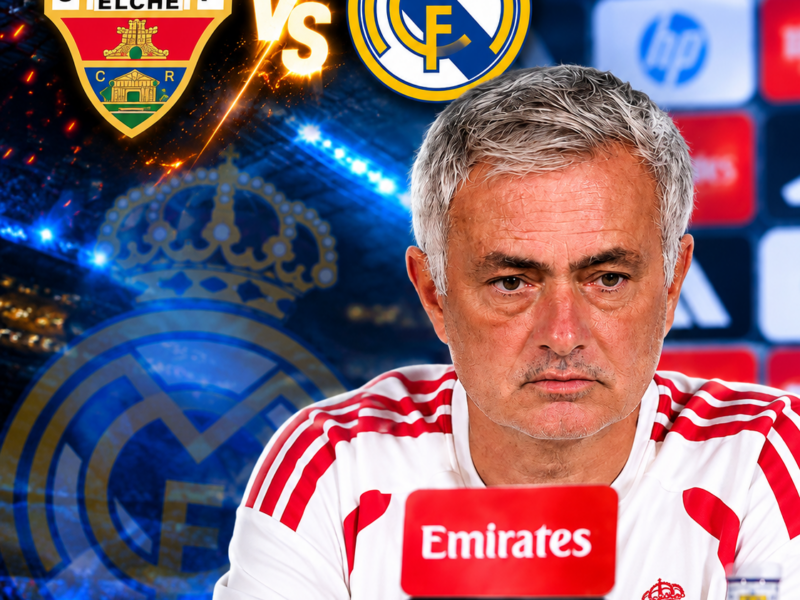
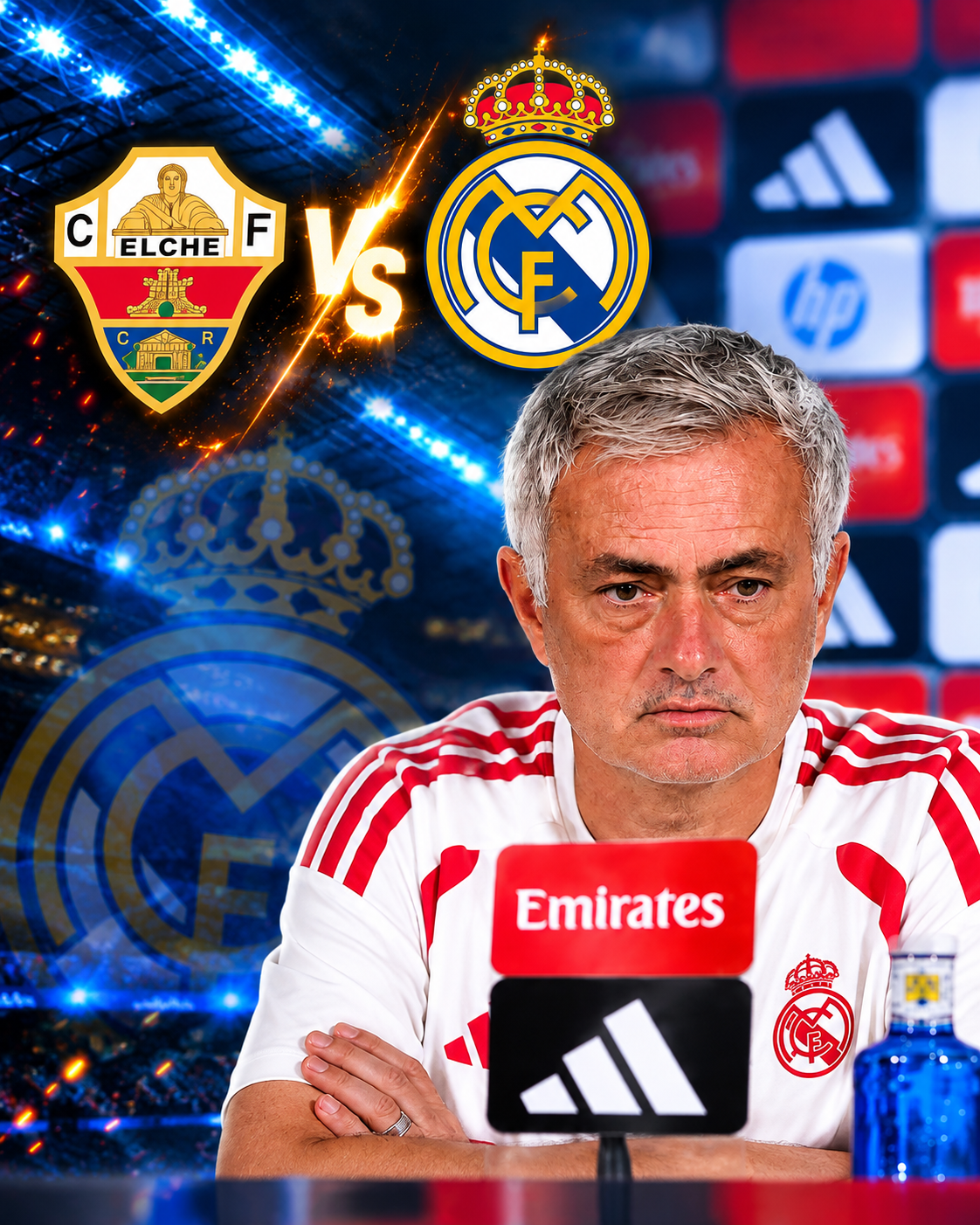
“Six Press Conferences in One Week” — Xabi Alonso’s Brutally Honest Rant Before Real Madrid vs Elche
The room went quiet the moment someone mentioned the word “penalties.”
Xabi Alonso had just spent the better part of twenty minutes fielding question after question about Vinicius, about Arda Guler, about an injury list that refused to grow, and about a rival’s bold claim to be the best player on the planet.
Then, as the press conference wound down, a reporter tried one more time to steer him toward the topic everyone in Madrid had been whispering about for days.
Alonso didn’t blink. “No questions about the penalties, then?” he said, almost daring the room to try. Nobody did.
It was that kind of morning at Real Madrid’s training ground, tense, sharp, occasionally funny, and packed with lines that will follow the club into Wednesday’s trip to Elche.
Here is everything the Real Madrid head coach said, and everything it tells us about a team trying to find its identity in the middle of a brutal September.
Real Madrid are in the thick of a stretch that would test any club: five matches in sixteen days, and Wednesday’s visit to Elche is only the fourth of them.
Elche themselves arrive off the back of a draw at San Mames, hardly the form of a team that plans to roll over for the league leaders.
Asked what he wants to see from his side in that fixture, Alonso kept it deliberately simple.
He said he wants his team to win, and to play well while doing it, and made clear he was not interested in dressing the answer up with anything more complicated.
It was a theme that ran through the entire session, a coach stripping every question back to its basics, even when journalists kept pushing for something juicier.
Nowhere was that more obvious than when the conversation turned to Vinicius Junior.
Alonso has repeated all season that he is happy with the Brazilian’s start, but has also been careful never to claim that Vinicius is playing at his absolute peak.
One reporter pressed him directly on it, asking when fans might see that best version return, and how Alonso himself would define it.
The answer he gave was layered, and it will likely be picked apart in Madrid for days.
Alonso explained that scoring matters, of course, but so does assisting, so does working for the team, so does the daily grind of solidarity and collective effort, and he said Vinicius does all of that well right now.
But then came the turn in the answer that mattered most.
He said there is another Vinicius, the one who single-handedly eliminated Benfica from the Champions League last season in tight, tense knockout football, the version capable of deciding a match with one chance and one finish.
That, Alonso admitted, is the level that has been missing so far this season.
He was quick to add that he remains happy with his winger, but the distinction he drew, between a Vinicius who does his job and a Vinicius who wins matches on his own, was unmistakable.
It is the kind of comment that will be read as both praise and challenge, a coach publicly asking his best attacker to find another gear.
From Vinicius, the questions shifted to a very different kind of player: Arda Guler.
A reporter reminded Alonso of an earlier remark he had made about Guler’s importance to the side, and asked him to go further, to say plainly whether the Turkish playmaker now belongs among Real Madrid’s elite.
The framing was pointed, comparing Guler’s midfield role to that of Aurelien Tchouameni, since the two can occupy similar territory on the pitch.
Alonso’s response leaned heavily on the technical side of Guler’s game rather than raw statistics.
He said he prefers to leave detailed physical development analysis to the specialists who work with the player every day, but that from a football standpoint, Guler’s vision, decision-making, and ability to organize play are, in his words, incredible.
He credited the young midfielder with giving stability and creative spark to Real Madrid’s build-up play, calling his overall potential fantastic.
Then came the moment reporters were waiting for.
Asked directly whether Guler now belongs in the club’s true top tier, Alonso hedged just enough to make it interesting.
He said he did not want to go as far as calling him top three, but conceded that Guler is now firmly in that upper bracket of Real Madrid’s most influential players.
It was a carefully worded compliment, generous but not reckless, exactly the kind of answer that will be replayed on Spanish radio all week.
The mood shifted again when a journalist brought up comments Alonso had made the previous day about needing more time.
The reporter suggested Alonso had specifically mentioned a three-month window before Real Madrid would look like the finished product he wants.
Alonso pushed back immediately, almost amused at how the quote had traveled.
“I ask for three months,” he said. “Other people ask for ten years.”
He clarified that he never meant three months would produce some magical transformation, only that he expects the team to be further along than it is today.
He explained his actual philosophy in more detail: that every match and every training session is measured against the single goal of improvement, that his staff studies what worked and what did not after every game, and that a team simply grows stronger the longer it stays together under one coaching setup.
It was less a promise of a fixed deadline and more a description of a process, patient, incremental, and deliberately unglamorous.
The topic then turned tactical, with a question about Real Madrid’s high press and their habit of winning the ball back deep in opposition territory.
The reporter wanted to know whether that aggressive recovery style is now the defining signature of Alonso’s Real Madrid, and how the coach hopes to sustain it for a full ninety minutes.
Alonso’s answer was unusually candid about the limits of that approach.
He said outright that he does not believe any team, including his own, can realistically press at full intensity for the entire match, and that very few sides in world football are built to do that.
What matters instead, he argued, is knowing how to behave in each phase, pressing hard when the moment calls for it, but also knowing how to defend in a deeper, more compact block when the situation demands something different.
He admitted a personal preference here too, saying flatly that he does not like a low defensive block, even while acknowledging that some players and some team profiles are simply better suited to it.
The key, he said, is never letting his own preferences override what his squad’s qualities actually allow, and instead searching for an identity that fits both.
For Alonso, that identity centers on pressing high, recovering possession quickly, and killing games in transition, something he said Real Madrid have already shown they can do in several matches this season.
But he was equally blunt about what happens against better-organized opposition, teams with the quality to build their own attacks even when Real Madrid sit in a lower block.
He said he refuses to let his team passively accept that role, banking everything on counter-attacking talent up front while surviving deep in their own half.
At the same time, he does not want his side suffering unnecessarily either, conceding two or three big chances that force his goalkeeper into repeated point-blank saves, or facing wave after wave of corner kicks.
Finding that balance, he said, is the real project.
From tactics, the questions moved to fitness, and specifically to Aurelien Tchouameni’s return from injury.
One reporter asked how Alonso assessed the Frenchman’s recent cameo appearance, and noted the awkward timing of an approaching international break just as training rhythms were being rebuilt.
Here, Alonso deferred, at least partly, to someone outside his own control room: French national team coach Zinedine Zidane.
He said he has no idea what Zidane’s plans are for Tchouameni during the upcoming international window, and that he has to respect whatever decision the French staff makes.
He acknowledged the dilemma honestly, saying he could not say for certain whether it would be better for the player to stay in Madrid and train with a smaller group, or to travel and get controlled minutes with the national team.
His hope, he said, is for exactly that: controlled, limited minutes, focused on progression rather than accumulating fatigue in a body part still vulnerable to the kind of muscular issues that can resurface after a heavy international tournament.
Alonso said he had not personally spoken with Zidane about it, but expressed confidence that the French coach, a man he described as having plenty of common sense, would manage the situation correctly and avoid jeopardizing Tchouameni’s long-term fitness.
It was a small moment, but a telling one, a coach openly admitting the limits of his own influence once a player leaves the building for international duty.
The conversation then pivoted to a subject that has quietly become one of the more interesting subplots of Real Madrid’s season: the club’s dramatic reduction in injuries.
A reporter from Marca noted that last season Real Madrid suffered more than sixty injuries, a staggering number for any club, and asked whether Alonso had been briefed on that history when he arrived, and what concrete steps had been taken to fix it.
The reporter also pointed out that, so far this season, Real Madrid have not suffered a single injury through the opening rounds, and asked Alonso to explain how.
Alonso’s answer painted a picture of a system rather than a single fix.
He said he knew the raw numbers from last season but not the day-to-day process behind them, and that his own approach is built around what he called a normal, professional, global plan rooted in strong communication across every department.
He listed the pieces: players themselves, since they matter most, a technical staff working closely with sports science specialists, targeted reinforcement work, individualized training for players with minor niggles, early detection of small warning signs before they become serious problems, and a medical department deeply embedded in the entire process.
Then he described something that sounded almost like a philosophy of invisible labor.
He said the real work happens in ways that never get seen publicly, and that asking players to arrive earlier at the training ground is not some personal whim of his, not a demand made just to prove a point.
By the time journalists watch the squad walk onto the pitch for the visible part of training, he explained, the players have often already completed thirty-five minutes of gym work and medical preparation that nobody outside the building ever witnesses.
He also credited a broader mindset shift: trusting players and using common sense in real time, not just following a rigid protocol on paper.
To illustrate, he brought up Federico Valverde, who was substituted at halftime in a recent match purely as a precaution after showing signs of a minor issue.
Alonso admitted that if the scoreline had been level, he likely would have kept Valverde on the pitch, pushing closer to the edge of acceptable risk.
But with the match already comfortably won at three goals to nil, he chose to protect his midfielder instead, calling it exactly the kind of judgment call his staff now makes constantly.
Still, he was careful not to claim total credit, or total control.
He acknowledged that luck plays an undeniable role too, particularly with traumatic injuries like knee damage, the kind of setback that can strike even a club with an excellent medical and prevention staff, and that no amount of planning can fully eliminate that risk.
It was a rare moment of humility from a coach otherwise laying out, in some detail, exactly why his methods seem to be working.
Naturally, the conversation circled back to Tchouameni, this time with a more pointed question from a reporter representing Diario AS.
The question was direct: is Tchouameni ready to start a match this week, whether against Elche or in Sunday’s fixture, or does his return have to wait until after the international break entirely.
Alonso’s answer suggested real, tangible progress.
He recalled that in Tchouameni’s earlier substitute appearance, everyone, including the player himself, had been uncertain whether he could handle even ten or fifteen minutes.
In his most recent outing, Alonso said, that number had already climbed to somewhere between twenty and twenty-five minutes, and he expects it to increase further in upcoming matches.
He described Tchouameni as improving steadily, growing stronger and more confident by the day.
Pressed on Wednesday’s match against Elche specifically, Alonso said he expects Tchouameni to play at some point in the game, though he stopped short of promising exactly how many minutes that would be.
It was cautious optimism, the kind of answer designed to manage expectations without dampening them entirely.
Then the questions took a sharp turn away from Real Madrid’s own locker room and toward a rival superstar.
A reporter brought up recent remarks attributed to Kylian Mbappe, in which the Frenchman reportedly said that he and Vinicius are the two best players in the world, but that he, Mbappe, is the one who truly deserves the Ballon d’Or.
The reporter asked Alonso directly for his reaction.
Alonso shut the door on the topic almost instantly.
He said flatly that he would not comment on another player’s personal declarations, adding only that he respects everyone’s opinions but has nothing further to say on the matter.
It was a short answer, but a deliberate one, the kind of non-answer that speaks volumes about how carefully Alonso is managing the noise around his squad this season.
From there, the questions moved into the engine room of the team, specifically the double pivot in midfield.
A reporter noted that Valverde has been essentially undroppable there so far, but that with Tchouameni still working his way back, it remains unclear who his regular partner in that deeper midfield role will be.
The question also referenced how, under previous coaches, both Valverde and Tchouameni had frequently been automatic starters together, and asked whether Alonso sees the pairing as viable, or whether using both simultaneously tilts the team too far toward caution.
Alonso used the question to explain his broader rotation philosophy, one that goes well beyond just midfield.
He pointed to his full-backs, naming the rotation between certain players in those wide roles, and to his central defenders, none of whom, he said, have played every single match this season, aside from one exception.
His stated goal, he explained, is to keep the entire squad engaged, to make every player feel genuinely useful and confident that their turn to start will come.
He called that sense of usefulness critical, arguing it directly affects daily motivation and the intensity players bring to training, not just to matches.
On the specific tactical question, he confirmed that his midfield setup can shift shape depending on personnel, sometimes leaning more attacking with an extra advanced midfielder, sometimes shifting to a more defensive double pivot behind a single attacking midfielder.
He said his staff is comfortable making that switch depending on the opponent and the players available.
He also drew a distinction between individual profiles within those roles, noting that Eduardo Camavinga and Tchouameni offer something different from Bellingham, and that Valverde and Jude Bellingham likewise bring contrasting qualities to a similar area of the pitch.
The overarching aim, Alonso said, is always to find balance without ever losing what he considers Real Madrid’s core identity, while staying mindful of the specific problems each upcoming opponent might create.
It was, in effect, a defense of squad rotation as a philosophy rather than a necessity born of injury or fatigue.
That theme carried directly into the next question, this time about the battle for a starting spot up front involving Diamand.
The reporter’s question focused on what Diamand still needs to do to lock down a regular starting role, following Alonso’s earlier hint that the player needed to improve tactically.
Alonso’s response was almost philosophical in tone.
He insisted Diamand lacks nothing specific, arguing that if the player were at a club with a thinner squad and less overall talent, he would likely be a guaranteed ninety-minute starter every single week.
But, Alonso pointed out, that same logic applies to virtually every attacking player in his squad right now.
He described Real Madrid’s roster as extraordinarily deep, and warned that any coach who fixates on only ten players while ignoring the rest risks losing motivation and competitive sharpness across the wider squad as the season wears on.
Asked to name the players competing for those same forward positions, Alonso rattled off a list: Diamand himself, Vinicius, Arda Guler, Brahim Diaz, and eventually, once he returns from injury in the new year, Rodrygo.
He said that is simply the reality of those two attacking positions right now, an embarrassment of options rather than a shortage of quality.
He added, almost wearily, that the very idea of an “undisputed starter,” a phrase he said reporters love using, is difficult to apply honestly to a squad this deep.
It was another example of Alonso deflecting individual pressure by reframing it as a squad-wide dynamic, a recurring rhetorical move throughout the entire press conference.
Eventually, a question arrived that let Alonso vent, gently, about the sheer grind of the football calendar itself.
A reporter referenced comments Alonso made after Real Madrid’s match against Rayo Vallecano, in which he described that game as effectively a forty-five-minute performance, with the team lacking the physical and mental sharpness to sustain a full ninety.
The reporter then noted the schedule ahead: another two matches inside a week, an away trip, and looming on the horizon, a derby against Atletico Madrid.
He asked how Alonso planned to manage his squad through all of it.
Alonso’s answer opened with a joke about his own workload rather than his players’.
He noted, with visible exasperation, that he was facing six press conferences in a single week, and mentioned that in other countries he had covered, coaches were sometimes allowed to skip one of those sessions.
He joked that he was tired of the media, and that the media was surely tired of him too, but that this is simply the job, his and theirs, and that six sessions in one week is simply what it is.
He extended the same logic to his squad, pointing out that Elche and Atletico Madrid face similarly congested schedules.
He noted that Elche had also played on Saturday, just like Real Madrid, and that Atletico, while enjoying one extra day of rest compared to Real Madrid, actually has one fewer day between their own recent match and the derby.
His conclusion was almost resigned: everyone is dealing with the same congestion, so complaining about it changes nothing.
He even offered, half-joking, that if reporters could find a way to trim one press conference from next week’s schedule, he would happily bring snacks to celebrate.
It was a rare flash of humor in an otherwise dense, tactical session, and it drew a laugh from the room.
The final major question of the day returned to one of the most sensitive topics in modern football: managing the workload of superstar attackers.
A reporter asked whether it might make sense, at some point, for one of Real Madrid’s headline attacking trio, Jude Bellingham, Vinicius, or Kylian Mbappe, to start a match from the bench.
The question referenced Alonso’s own postgame comments after the Rayo match, in which he had noted that Bellingham looked fatigued for roughly the final ten minutes.
The reporter wanted to know whether Alonso trusts his three stars to self-regulate and read the moments of a match correctly, or whether the accumulation of minutes across that trio genuinely worries him.
Alonso’s answer leaned heavily on trust, both in his players’ self-awareness and in his own medical and analytics staff.
He said he places significant faith in each player’s understanding of his own body, and noted the specific timing of the current fixture list, pointing out that teams typically get three full recovery days between matches, but this week offers only two.
He described the process his staff goes through in these tight windows: reading player-reported sensations, consulting the medical department, listening to the sports science team, and reviewing the data that comes out of every training session before making a final call.
His bottom line, though, was clear and almost immediate.
Assuming nothing unusual shows up in that data between now and matchday, he said, he intends to go with the same trio again for the trip to Elche.
And then, just as the room prepared to wrap up, came that final exchange about penalties, the one Alonso closed with a knowing, slightly amused deflection, leaving reporters to read into it whatever they wanted.
Taken as a whole, this was not a press conference built around a single headline.
It was a mosaic of smaller signals: a coach quietly challenging his best player to find another level, a measured but real compliment for a rising midfield talent, a refusal to engage with a rival’s Ballon d’Or claim, a detailed defense of a rotation policy some fans still question, and a genuinely striking explanation for why a club that suffered more than sixty injuries last season has not lost a single player to injury so far this year.
For a team navigating five matches in sixteen days, with a derby against Atletico Madrid already visible on the horizon, those details matter just as much as any single scoreline.
Wednesday’s trip to Elche will be remembered, win or lose, as just one data point in a much longer experiment Alonso is running: building a Real Madrid side that can press when it needs to, sit deep without suffering, rotate without losing its identity, and, eventually, coax that other version of Vinicius back out of hiding.
Whether that experiment produces the results Real Madrid expects may not be clear for another three months, exactly as Alonso himself predicted.
But if this press conference proved anything, it is that the head coach already has a very detailed answer for almost every question Madrid is asking, except, of course, the ones about penalties.









