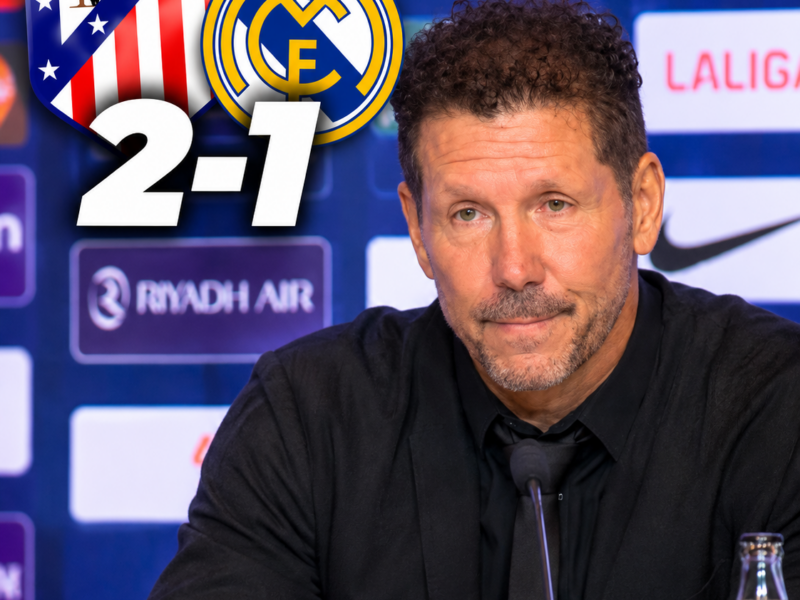
Simeone Responds To Mourinho’s Fury With One Devastating Line About Respect That Says It All
Picture this.
One dugout just spent nearly ten minutes accusing referees of ruining a football match, waving printed photographs in the air like courtroom evidence.
Fifteen minutes later, the man on the other side of that same rivalry walks into the exact same building, sits down in front of the exact same cameras, and says almost nothing about the referee at all.
Instead, he delivers a single line about respect that lands harder than any rant ever could.
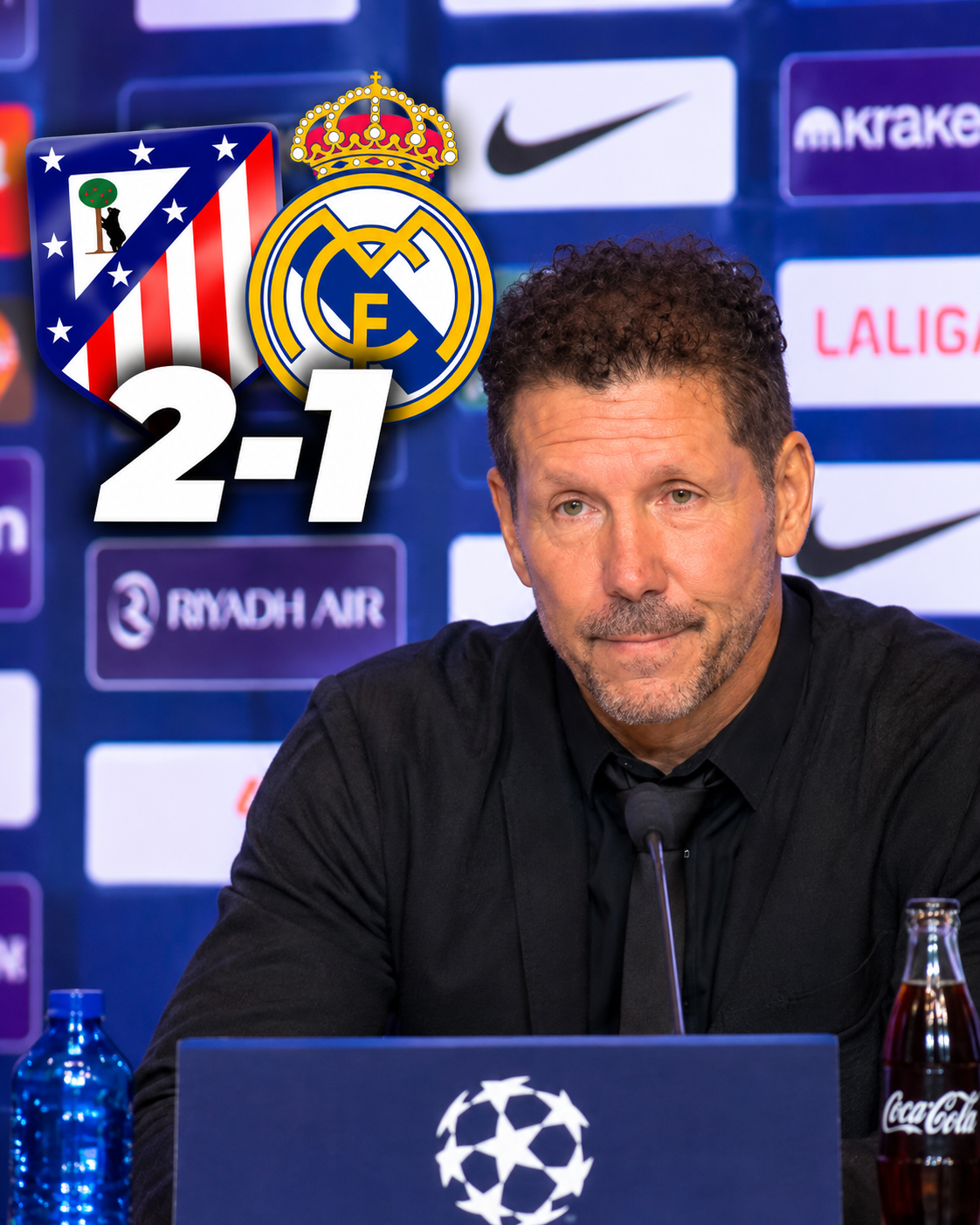
That contrast is exactly what played out at the Metropolitano after the derby, and it turned Diego Simeone’s press conference into its own separate story, one that in some ways said more than the fireworks that came before it.
Here is everything that happened when Atletico Madrid’s coach finally got his turn at the microphone.
Setting The Scene: A Very Different Kind Of Press Conference
By the time Simeone walked into the media room, everyone in that building already knew what had just happened next door.
Real Madrid’s manager had spent the better part of ten minutes tearing into the officiating crew, naming the referee directly, referencing a printed sheet of disputed tackles, and listing off a string of controversial calls from recent weeks across the league.
Reporters were understandably eager to see how the winning coach would react to all of that noise, and the very first question put it to him directly, asking whether this kind of outburst risked overshadowing his team’s win on the pitch.
His answer set the tone for everything that followed.
He said he tries to remain respectful of what other coaches say, acknowledging that everyone in that profession, whether it is Mourinho, Hansi Flick, Manuel Pellegrini, or himself, operates under intense public scrutiny that requires a certain level of care with their words.
He then made the point that mutual respect between coaches, officials, and colleagues is essential, and that everybody loses once that line gets crossed, regardless of which famous name happens to be the one crossing it.
It was calm, it was measured, and it was pointed in exactly the right direction without ever raising his voice or getting drawn into a shouting match through the media.
Refusing To Take The Bait On The Referee Talk
Reporters tried more than once to pull him deeper into the refereeing controversy that was dominating the narrative of the day.
One question referenced the specific claim that officials had shown favoritism toward Barcelona and Atletico Madrid throughout the season, essentially inviting him to either confirm or deny that accusation directly.
He sidestepped it entirely, choosing instead to talk about the match itself, describing an intense contest that he felt his team controlled from start to finish against an opponent packed with genuinely outstanding individual talent.
When another reporter pushed further, specifically naming the disputed Kang-in Lee and Cristian Romero incidents along with the penalty and Huijsen’s red card, and asking for his personal opinion on each one, he again declined to bite.
He explained that he generally avoids commentating on decisions that have already happened and are no longer changeable, adding that he had stayed silent in the past when penalty decisions went against his own team for that same reason.
He then dropped in one detail that quietly undercut a chunk of the outrage from the other press conference, mentioning that the head of the refereeing body had reportedly already stated after the match that the Romero incident did not merit a sending off.
His closing thought on the entire subject was simple and almost dismissive in tone, saying that if everyone wanted to keep relitigating decisions instead of talking about what actually happened on the field, then fine, that’s the game people wanted to play, but the match had been eleven against eleven, his team controlled it, and once it became eleven against ten, they went on to win it, and there wasn’t much more to say beyond that.
Did The Better Team Win
One of the more pointed questions of the day was refreshingly simple.
A reporter from a Madrid television station just asked him outright whether the better team had won that afternoon.
His response left no room for ambiguity, saying yes, the team that pushed harder and created more won the match, and that Atletico were the ones chasing a trophy, something he personally didn’t feel he needed anymore given everything he has already achieved in the game.
He then pivoted to praising the collective defensive effort his side put in against a Real Madrid roster stacked with individual quality, specifically singling out attacking talents like Vinicius, Mbappe, Julian Alvarez’s former teammates on the opposing side, plus key contributors like Jude Bellingham, Bernardo Silva, and Federico Valverde.
Containing that level of individual quality as a collective unit, he argued, was itself a mark of a strong team performance, regardless of any officiating storyline swirling around the result afterward.
He circled back to that same point again later in the session almost word for word, making clear he wanted that message about controlling elite opposing talent to be the headline people remembered from the day, not a debate about referees.
Addressing The Frustration Directly
Later in the session, a reporter asked something a little more emotionally pointed, essentially wondering whether it frustrates him when a strong team performance gets overshadowed by an entirely separate controversy generated by the opposing coach.
His answer avoided taking any obvious bait to criticize his rival personally.
He said he was clear in his own mind about what his team had done and about the game plan they had executed, and that he took genuine satisfaction in seeing his fans enjoy another positive result as the club continues building and growing as a team.
He framed the win not as some enormous statement victory, but as one incremental step forward in an ongoing process of development, something the club is actively working through match by match rather than treating any single derby win as a final destination.
That kind of restraint, choosing growth-focused language over triumphant chest-thumping after beating your fiercest rival, was very much in keeping with the calm tone he set from the very first question of the day.
A Quiet Redemption Story Involving Julian Alvarez
Not every question in the room was about controversy or tactics.
One reporter brought up a storyline that had been simmering for weeks around Julian Alvarez, asking whether the reception he received from the home fans during the match represented a kind of turning point in his relationship with the supporters.
Simeone’s response leaned emotional rather than tactical, describing the club’s fanbase as an incredible source of support throughout both his playing career and his time as a coach, and saying he feels genuinely grateful for everything they have allowed him to experience in both roles.
He acknowledged that Alvarez had a difficult match individually, using the word struggled more than once to describe his performance, but insisted the club would keep working with him because he remains a player they consider vital to what the team needs and wants going forward.
In the same breath, he made a point of praising Jonathan David, who scored in this match to extend his run to three goals in his last three appearances, framing that emerging competition for places up front as a genuinely positive development for a squad that will need scoring depth across a long campaign.
The Coke Story: A Small Moment That Captured Something Bigger
Perhaps the most human moment of the entire press conference came when a reporter asked about the significance of finishing the season’s first big derby ahead of Real Madrid in the table heading into the international break.
He downplayed the broader table implications almost immediately, pointing out that the league season is extremely long and that this result, while positive, is far from decisive on its own this early in the campaign.
But then he used the moment to tell a smaller story that clearly meant a great deal to him personally, referencing a veteran player in his thirties who had not started a match in what was described as the biggest game of his career since childhood.
That player was left out of the starting lineup, came on in the second half, and according to Simeone, completely changed the game with his introduction.
He used that example to make a broader point about squad culture, saying the club needs players willing to stay ready and engaged even when they aren’t selected to start, and expressed hope that this kind of example continues to be visible to teammates on a daily basis inside the club.
It was a small anecdote in the grand scheme of a heated derby day, but it revealed something about how he manages a dressing room, valuing patience and readiness just as much as raw individual talent.
Staying Grounded Heading Into The Break
The final question of the session tried to get him to frame the derby win as a genuine turning point, asking whether it might convince his players that the club can realistically compete for major honors this season.
True to the tone he had held throughout the entire press conference, he refused to get swept up in that framing.
He said the team doesn’t need grand turning point moments, and that what matters instead is the very next fixture against Alaves, approaching it with the same enthusiasm and focus the team has shown throughout this current run of matches, without losing sight of what their actual season-long objective and identity are supposed to be.
It was a fittingly understated way to close out a press conference that had, by design, avoided drama at every single turn, even when reporters clearly wanted him to lean into it.
Two Coaches, Two Completely Different Messages
Read side by side, these two press conferences from the same afternoon at the same stadium tell you almost everything you need to know about how differently two elite coaches can handle the exact same set of circumstances.
One used a prepared visual prop and a barrage of specific grievances to shift attention away from his own team’s underwhelming performance and squarely onto the officials.
The other, despite having every excuse to gloat after beating his club’s fiercest rival, chose restraint, redirected nearly every provocative question back toward football itself, and used his available time to praise his players, address a personal storyline about a struggling attacker, and highlight a veteran squad player’s quiet moment of impact.
Neither approach is inherently right or wrong, and both reflect the very different pressures each man is navigating this season, one trying to justify a difficult return to a giant club sitting outside the top two positions, the other trying to keep a talented but occasionally inconsistent squad focused on long-term growth rather than premature celebration.
But if you are looking for which press conference actually aged better in the days that followed, the calm, disciplined one that avoided feeding the controversy machine is generally the version that ends up looking wiser once the initial headlines fade.
Football fans will remember the printed photographs and the referee rant for a while longer, simply because drama travels faster than restraint.
Still, it was the quieter room down the hall, the one built around a story about a veteran substitute and a simple line about mutual respect between coaches, that offered the more genuinely instructive lesson from that entire afternoon at the Metropolitano.









