She Whispered “No” at 2 a.m. — and an Entire Amish District Would Never Be the Same
At two in the morning, Jacob Beichy stood in the doorway of his own bedroom with his arms folded across his chest, and he said the word decided in a voice I had heard a hundred husbands use.
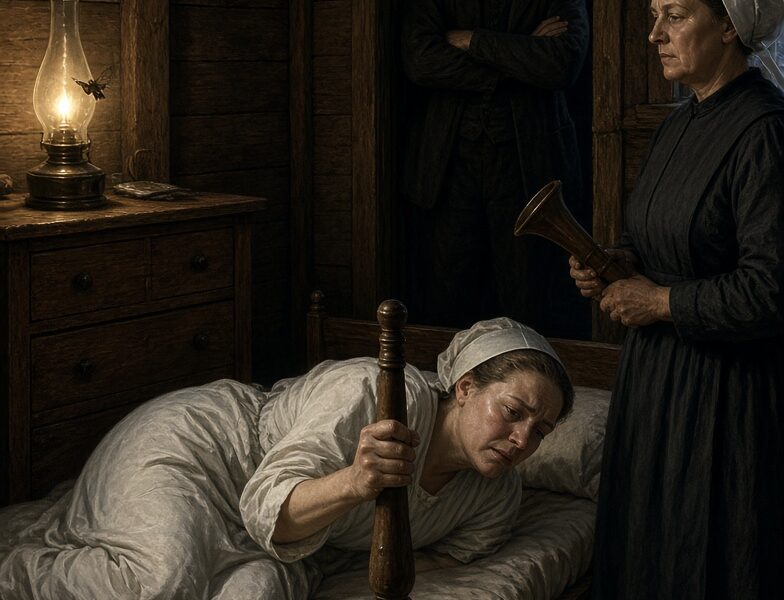
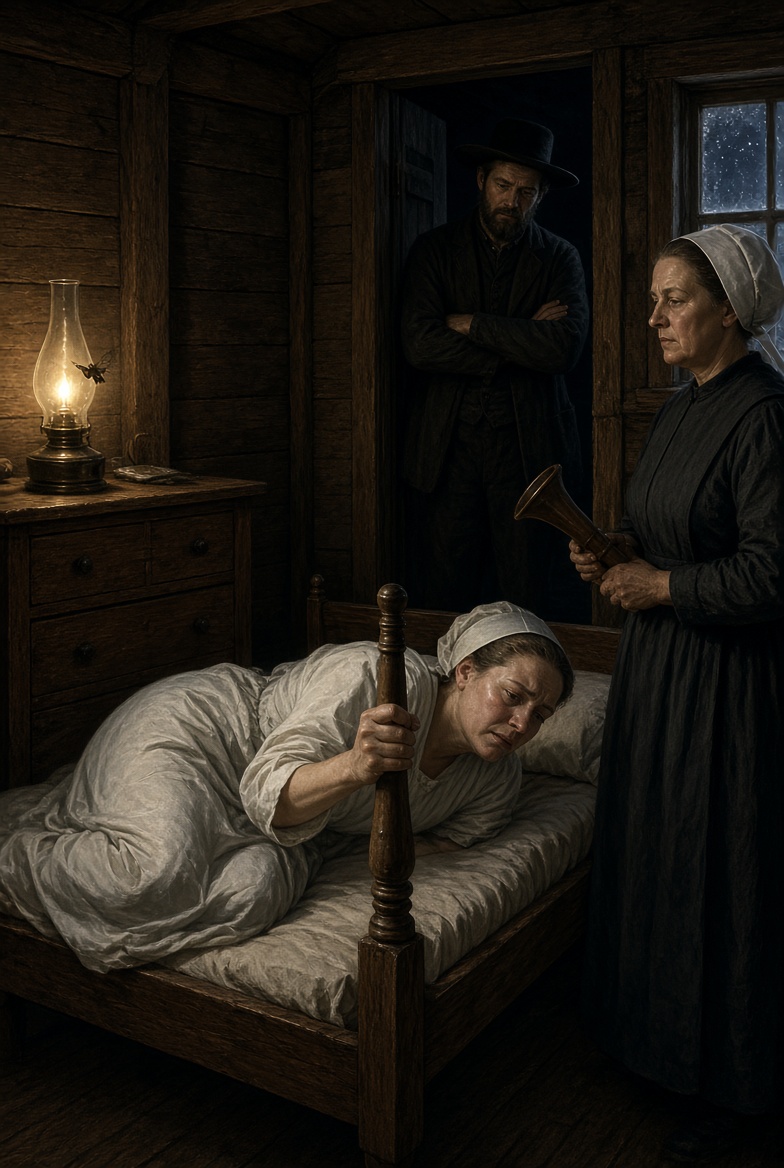
The lamp on the dresser burned steady.
The room smelled of sweat and camphor, and a moth was beating itself against the glass chimney with a small, dry sound like a fingernail on paper.
His wife lay on her left side with her knuckles white on the bedpost.
She was thirty-one years old and twenty-six hours into her fifth labor.
In my ear, through the wooden trumpet I held against her belly, the child’s heartbeat had begun to stumble, slow and then quick and then slow, like a man going down a staircase in the dark.
Jacob said, “The Lord will decide it, and I have decided that we wait.”
Nobody in that room moved.
I had watched a wife go quiet at that moment more times than I could count.
I set down the trumpet.
Hannah lifted her head from the pillow, and I saw something come into her face that I had never once seen on a laboring woman in twenty-seven years.
My name is Rachel, and this is Rachel, the Amish Midwife.
I was the district midwife for twenty-eight years in an Old Order settlement in Pennsylvania, and I caught more than a thousand children.
I finished the eighth grade and not a day more, and everything else I know I learned from my aunt Saloma and from the women in the beds.
Tonight is about a single word and how long it can take a woman to say it.
Before I go on, I should say that Jacob Beichy was not a cruel man.
He kept bees. He whistled through his teeth when he worked. He had carried his wife’s first child up the lane on his shoulders two hours after the birth to show the neighbors.
Hold on to that, because it is what makes the rest so hard to tell.
In this world, there are five things a husband may decide during his wife’s labor.
He decides who stands in the room.
He decides whether a driver is sent for, and when.
He decides whether she takes anything for the pain, even a cup of tea, from a woman with the good hands.
He decides whether the labor is to be given more time.
And he decides, sometimes before she wakes, what the child will be called.
None of it is written. None of it needs to be.
The bishop said it in a single line at every wedding I attended, in the flat, happy voice of a man giving directions to a picnic.
“It is the husband’s to decide and the wife’s to bear.”
I heard that sentence perhaps four hundred times.
I never once heard anyone ask what it would mean on the worst night of a woman’s life.
I want you to understand that it was not a way of ranking women below men.
The women of my district ran the farms, the money, the gardens, the church suppers, and the calendar of every birth and burial for forty miles.
Nobody in that place was foolish enough to think a woman was less capable than a man.
It was something else.
The decision was treated as a weight, and the husband was expected to lift it and to lift it alone, so that his wife would never carry it.
That was the theory. It was meant as love.
It was not cruelty. It was certainty.
It was the absolute conviction that a decision made for a woman was a gift, and that the gift was heavier than the woman knew.
Not because they thought she was weak, not because they wanted the power, because a man who had watched his own mother carry a decision had sworn in the privacy of himself that his wife would never have to.
The cost was a woman on a bed with her own life being weighed in the next room by a person she loved, who had never once been trained to ask her what she thought.
It was January of my twenty-seventh year as district midwife, the second week, with the ice so thick on the beachy lane that I walked the last quarter mile beside the horse.
Hannah Beichy was thirty-one and in her fifth labor, and her four earlier births had been easy.
She was a compact woman with steady brown eyes and a laugh that came out of her nose.
Her sister Lydia had come to help, a thin, careful woman of thirty-four who had lost her own child six years earlier, and who stood in the hall outside the bedroom door for most of that night with her hands wrapped in her apron.
The first twenty hours were ordinary.
I have never in my life been so certain that a birth would be simple.
Then around ten, the pains began to come one on top of another, and Hannah’s face lost its color from the edges inward, like frost coming up a window.
I put my ear to the wooden trumpet at every pain.
At the twenty-third hour, I heard the first stumble in the child’s heart.
I went to the top of the stairs.
Jacob and his brother Peter were sitting at the kitchen table below with a lamp between them and a Bible open at neither of their hands.
I said, “Jacob, I need the driver.”
He looked up. The lamplight made two small windows of his glasses.
He said, “I will decide when we need the driver, Rachel.”
I said, “The child’s heart is slowing.”
He said, “The Lord knows the hour.”
He did not raise his voice. He got up and went out onto the porch with his brother, and I heard the two of them murmuring in the cold.
Then I went back into the bedroom and picked up the trumpet, and I did what I had done more times than I can count.
I waited to be told.
That is the part I will never make anyone understand.
I was afraid. I had a child in trouble in my hands, and I had a husband who was not a monster on the porch.
And in twenty-seven years I had not once acted against the husband’s word in a birth room.
It was the one line I had never crossed.
I did not know that it was a line. I thought it was the floor.
That brings me back to two in the morning and the lamp and the moth.
Jacob had come back inside. He stood in the doorway with his arms folded.
He said, “The Lord will decide it, and I have decided that we wait.”
Hannah said, “No.”
She said it quietly. She did not sit up. She did not change her face.
The word came out of her the way a stone comes out of a field in spring, after being pushed up slowly through the ground for years, and it lay there in the middle of the room.
Jacob said, “Hannah.”
She said, “No, Jacob. I am going.”
Nobody in the house breathed.
I heard the moth stop.
In the hall, Lydia made a sound I have never forgotten. A small, high sound, like something tearing along a seam, and I saw her put her fist against her mouth.
Jacob looked at me.
He said, “Rachel, tell her.”
I said, “It is not mine to tell her anything, Jacob. It is hers to tell you.”
I did not plan the sentence. I had not known it was in me.
It was a thing that came out of twenty-seven years of standing beside a wall, and it came out flat and level and sounded like someone else’s voice.
He looked at his wife the way you look at a horse that has spoken.
Then he sat down slowly on the trunk at the foot of the bed and put his face in his hands.
I did not wait for him to lift it.
I took the barn lantern from the hook by the door and went out into the ice.
I have made that walk in my mind a thousand times.
The lane was blue with starlight, and my breath went up in front of me, and the lantern threw a small, warm circle that moved with me across the frost.
At nine that evening, when the labor first stalled, I had sent the Beichy’s hired boy across the fields to their English neighbor, whose kitchen had a telephone, and whose cousin drove for the Amish.
I had given the boy a folded note and a five-dollar bill, and I had told him to say nothing to anyone.
The note said that a van should wait at the end of the Beichy lane after midnight, and that a lantern would swing three times if it was needed.
I had told myself it was a precaution.
It was not a precaution.
It was the first decision I had made in a birth room in twenty-seven years, and I had made it in secret and left it lying in the dark where I could pretend it had not happened.
At a quarter to two, I stood at the end of the lane and swung the lantern in three slow circles, the signal we had agreed on, and a pair of headlights came around the bend.
Hannah went in the back of the van with her sister Lydia and a quilt over her knees.
Jacob walked behind them to the road with his hat in his hand. He did not speak.
He climbed into the front seat beside the driver and sat there with his big hands on his knees, and I have never seen a man look so entirely like a boy.
The hospital was forty minutes away, and the road unwound in the headlights like a gray ribbon, and I remember almost nothing of it.
I remember only the light at the end.
It came at me in white, hard planes as we went through the doors.
A nurse met us in the corridor. A woman in her thirties with a braid down her back and a plastic badge that read Denise.
She did not look at Jacob. She did not look at me.
She took Hannah’s wrist in her warm hand and fastened a paper band around it.
And she asked Hannah a question.
I will not tell you the question. It was a short one and plain.
She asked it looking straight into Hannah’s face, waiting for Hannah to answer, in the tone of a person who has never once considered that she might not.
Hannah answered her.
I stood in the corridor with the lantern still in my hand, and I understood that in twenty-eight years I had never been asked anything like it.
Not by my husband, not by Saloma, not by the bishop or my mother or my own daughters.
Not once in all that time had a person turned to me and waited for me to say what I wanted.
The child came at ten minutes past five by an operation, a girl, small and cross, and both of them lived.
I have thought since that it was the thinnest of margins, and that a quarter of an hour would have made no difference to anyone but her.
I did not go back to the district that day.
I sat in the corridor on a molded plastic chair, and Jacob Beichy sat on the chair beside me. We did not speak for two hours.
At seven, he said, without turning his head, “I did not know she could.”
I said, “No.”
That was the whole of it.
The next Sunday, I did not tell the story as advice. I told it as news.
I told it at the quilting, low, to the woman beside me with a needle in her hand, in the same eleven words I had used in the corridor.
I told it again on the Thursday at the wash line, and again after the closing hymn.
I did not say what anyone should do. I only said what Hannah Beichy had done.
It moved through the district the way a spring frost moves through an orchard, from one house to the next in the space of a night.
Within the year, three other women said no.
I did not counsel them. I want that clear. I told no one anything.
Each of them said it herself.
The ministers called Jacob Beichy in on a Tuesday. They called me on the Thursday.
There were five men in the room, and a lamp, and a glass of water for each of us.
And they asked me whether I had counseled a woman to disobey her husband.
I said, “I counseled no one, and I told her nothing. She told him.”
It was true, and it was the most dangerous true sentence I ever spoke.
Jacob, I heard afterward, had been asked whose decision it was.
He said, “My wife’s.”
The bishop asked again. He said it again.
I am told he said it three times, and that on the third his voice did not shake.
It cost what such things cost.
Two husbands stopped letting me into the house at first visits.
The bishop’s wife stopped sending eggs.
A minister stood up in the meeting and said that a midwife who carried words from house to house was a midwife who had lost her place.
Lydia left for Ohio that spring, and I never heard from her again, and I have never known whether it was because of what she saw or what she did not do.
I was not the hero of it.
I had stood behind a wall for twenty-seven years, and I had only stepped out from behind it because a woman on a bed had stepped out first.
I told myself I had helped her.
It was Hannah who had helped me.
I did not see the difference until a great deal later, in a small, warm room, in the presence of someone half my age.
I will not tell you that the district was only its rule.
When the ministers had finished with him, Jacob Beichy drove home in the dark, and he did not go to his own bed.
He went into the barn and stood beside the cows until the milking hour, and he was found there by his brother in the morning, with his hat in his hands and his forehead against the flank of the oldest one.
He kept bees for another thirty years.
Every spring, on the first warm day, he left a jar of clover honey on the step of the house where his sister-in-law used to live.
He never explained it.
I have thought that it was the only prayer he knew how to make for her.
I saw Hannah at the market once, a year later, with the girl on her hip, a solemn child with brown eyes.
She did not speak to me. She looked at me across the tables of pies and nodded once, the way you nod to someone who has held a door.
I should go back to the corridor, because I skipped something.
The night of the operation, at about six in the morning, the nurse named Denise found me sitting on the plastic chair with the paper band in my hand.
Hannah had asked her to give it to me.
She put a cup of tea into my other hand. She sat down beside me and asked whether I was the midwife.
And when I said I was, she was quiet for a moment.
Then she said something I have thought about every day since.
She said, “In here, it’s her decision. Not her husband’s, not yours, not mine. We call it medical autonomy. Everything I did tonight, I did because she said yes.”
I thought about that sentence for a long time afterward.
I had done a thousand things in twenty-seven years because someone else had said so, and I had called it obedience, and it had felt like a floor.
Here was a woman in a lanyard who had built her whole night on the opposite floor, the one under the woman on the bed, and she had never once needed to raise her voice to stand on it.
I sat there with the tea going cold and the band between my fingers.
The corridor smelled of floor wax and warm plastic, and somewhere behind a door a machine kept a slow green count.
Through a window at the end of the hall I could see Jacob standing with his back to the glass, very still, the way a man stands who has been told to wait and has never in his life been told it by a stranger.
The band was made of paper and had a name typed on it in black capitals. Hannah Beichy, in the same size of letters that any man’s name would have had.
I turned it over.
I had never seen a woman’s name printed on anything except a quilt and a page in a ledger.
I sat in that corridor and I was jealous of a woman in labor.
I was fifty-two years old and jealous of a woman half my age who had said one word in a hot room, and I did not have a word of my own.
Before that morning, I had thought of a name as the thing a husband said for a woman in a room when someone asked.
After it, I looked at the paper band and I saw a name put on the body of the person it belonged to, by someone who had waited for her to agree.
It was a very small piece of paper.
It was the largest thing I had ever held.
If you have ever said yes so many times that the word stopped meaning anything, I want you to hear me now.
I see you lying in a bed while a person you love weighs your life in the next room, and you can hear the scale.
I see you who has been decided for, so gently and for so long, that you have forgotten a decision could belong to you.
I see you standing beside someone else’s no, holding the lantern, wanting with your whole chest to say yours.
You are not selfish. You are not late. You are only someone who is never asked.
If you have a word that has been waiting years in your chest, you are allowed to say it in a small voice.
Hannah did. It was the quietest thing in that house, and it moved every person in it.
Not everyone gets a corridor. You may have only a kitchen and a Tuesday, and one person who is willing to hear it.
Say it there.
I am still learning to say mine. I have said it eleven times since I left.
And I write each one down on a card and put the card in a drawer, because a word that has been said out loud is a word that can never entirely be unsaid.
I do not hate the place that made me.
It gave me a man in a barn with his forehead against a cow.
It gave me a jar of clover honey left on a step and never explained.
It gave me twenty-seven years of learning to hold a lantern steady in the dark, and I would not trade that.
It gave me the sound of five men in a room, and a glass of water for each, and a bishop who asked the same question three times because he genuinely wanted to be sure of the answer.
I do not believe he was sorry for what he heard.
I believe he had never heard it before.
The lantern had swung three times in the dark, the paper band had carried a name the hospital had waited for her to accept, and the word no had come out of Hannah Beichy like a stone out of a spring field.
Where are you watching from tonight? Tell me in the comments. I read every single one.
Your no was always yours.









