
She Was Thrown Into the Storm With Nothing… Until a Powerful Man Made Her Untouchable
The rain hammered the roof like a judge’s gavel, each drop a verdict against the woman standing in the doorway with nothing but a worn suitcase and a broken heart.
Lagos high society didn’t do mercy, and neither did the man she’d called husband for seven years.
Obinna Okonkwo stood in the marble foyer of his mansion, his silk robe immaculate, his expression colder than the air conditioning that hummed through every room.
His mother, Mama Adaeze, clutched her designer purse like a shield, her eyes sharp enough to cut glass.
“You heard my son,” Mama Adaeze said, her voice carrying the weight of generations of entitlement. “This family belongs to Lagos high society, not to people who live off others.”
Ngozi Okonkwo—formerly Ngozi Bennett before she’d made the mistake of believing love could bridge impossible gaps—clutched the handle of her suitcase until her knuckles turned white.
“Obinna, please,” she whispered, her voice barely audible over the thunder that shook the windows. “The storm is terrible tonight. Where am I supposed to go?”
Obinna didn’t flinch. He didn’t even blink.
“You promised you would protect me,” Ngozi continued, each word a knife she was pulling from her own chest. “On our wedding day, you stood in that church and you promised.”
“Protect you?” Obinna laughed, but there was no humor in it—only the hollow echo of a man who had traded his soul for acceptance. “Look at what this marriage has become. I am a successful businessman. Important people visit my home, and you embarrass me.”
Ngozi felt the blood drain from her face.
“You no longer belong in this family,” Obinna said, reaching into his pocket and pulling out a folded document. “This marriage is finished. You’ll sign these tonight.”
He tossed the papers onto the marble floor at her feet.
“Nothing from my family belongs to you,” he added, his voice dropping to something almost cruel. “Do not come back here demanding anything.”
Mama Adaeze smiled—a thin, satisfied expression that made Ngozi’s stomach turn.
“Musa,” Obinna called toward the security station near the gate. “Close the gate behind her.”
The security guard, a tall man named Musa who had always offered Ngozi a respectful nod when she passed, stepped forward with obvious discomfort.
“I am sorry, madam,” Musa said quietly as he approached. “I was given an order.”
Ngozi looked at him—really looked at him—and saw the shame in his eyes.
“I understand, Musa,” she said softly, because she did understand.
She understood that in this world, orders came from the top, and survival meant following them.
She picked up the papers, not bothering to read them, and stepped out into the storm.
The gate closed behind her with a metallic clang that sounded like the end of everything.
—
Two hours later, soaked to the bone and shivering in a bus terminal that smelled of diesel and despair, Ngozi stared at the cracked screen of her phone.
Twenty-nine missed calls from her sister in Enugu.
She couldn’t go home—not like this, not with nothing to show for seven years of trying to become someone she was never meant to be.
“Free accommodation,” she muttered to herself, scrolling through job listings that all required skills she possessed but credentials she’d never been allowed to earn. “Right now, that sounds like a miracle.”
The listing that caught her eye had been posted just forty-eight hours earlier.
**WANTED: Live-in Caregiver for Young Boy**
**Private residence. High-profile family. Must be patient, consistent, dependable. Generous compensation.**
There was no name, no photograph, just a phone number and an address in the most exclusive part of Ikoyi.
Ngozi’s fingers trembled as she typed a message.
**Interested. Available immediately.**
The response came within minutes.
**Interview tomorrow. 10 AM. Come alone.**
She didn’t know it yet, but that single message would change everything.
—
The house sat behind gates that made Obinna’s mansion look like a starter home.
Ngozi had dressed in her best remaining outfit—a simple navy dress that had been elegant three years ago—and she’d done her makeup carefully in the bathroom of a McDonald’s.
She’d slept in a 24-hour laundromat, her head resting against a dryer that hummed through the night.
Now, standing before the massive iron gates, she felt like a fraud.
A guard checked her name against a list, then nodded her through.
The driveway alone was the length of a football field.
The house—a sprawling estate with columns and floor-to-ceiling windows—rose from the manicured gardens like something out of a movie.
A housekeeper met her at the door and led her through hallways that smelled of jasmine and old money.
“Sit here,” the housekeeper said, gesturing to a chair in a study lined with leather-bound books. “He will be with you shortly.”
Ngozi sat.
She waited.
And then the door opened, and she understood why the listing had been vague.
Odogwu Chifodugu was not what she expected.
He was tall—much taller than Obinna—with shoulders that spoke of physical labor in his youth and eyes that held the weight of something unspoken.
He moved with the quiet authority of a man who had earned his power rather than inherited it.
“You’re the applicant,” he said, not a question.
“Yes, sir,” Ngozi replied, standing. “Ngozi. My name is Ngozi.”
“Odogwu wants a mother for his son, not a wife,” he said flatly, studying her face. “Understand that clearly. Do not come here imagining anything else.”
Ngozi blinked.
“Honestly,” she said, before she could stop herself, “this job may be perfect. They need a high-level nanny. And the last thing I want is another husband.”
Something flickered in Odogwu’s eyes—surprise, perhaps, or amusement.
“Do not worry, madam,” he said after a pause. “I have no such intentions.”
He gestured for her to sit, and she did.
“I want a stable daily routine for my son,” he continued. “He needs someone patient, consistent, and dependable in this home. He has had difficulty trusting new people. He rarely enjoys going out.”
“Routine helps him feel settled,” Ngozi said, nodding. “I understand.”
Odogwu studied her for a long moment.
“I work long hours,” he said. “We can make everything clear with a marriage agreement, including finances, responsibilities, and personal space.”
Ngozi’s breath caught.
“Marriage agreement?”
“It does not have to be a legal marriage,” Odogwu said, his voice measured. “This is for my son. He needs something stable and lasting. Marriage gives him a family structure he can understand.”
Ngozi thought of Obinna—of the promises he’d made and broken, of the contract she’d signed without reading because she’d trusted him.
“My former husband and I also signed an agreement because our backgrounds were very different,” she said quietly. “When that marriage ended, I walked away with nothing.”
Odogwu’s expression didn’t change, but something in his posture shifted.
“So I understand why you want everything clearly defined,” Ngozi continued. “If what you need is someone here for your son, I can simply do the job.”
“It does not have to be a legal marriage,” Odogwu repeated. “But the arrangement will be real. My son deserves nothing less.”
Ngozi considered this.
She thought about the storm, about the gate closing, about the 29 missed calls she still hadn’t returned.
“All right,” she said finally. “We will do it your way.”
Odogwu nodded once.
“Your monthly allowance will be 100 million naira.”
Ngozi’s heart stopped.
“I’m sorry—how much?”
“One hundred million naira,” Odogwu repeated. “Approximately seventy thousand dollars at current exchange rates.”
Ngozi felt lightheaded.
“Now that part definitely matters,” she said, her voice faint. “If this arrangement ever ends, the money already paid to me remains mine?”
“Of course,” Odogwu said. “Anything already given to you remains yours.”
“Then all right,” Ngozi said, and for the first time in years, she felt something that might have been hope.
Odogwu stood.
“Just one condition before you sign,” he said. “We will respect each other’s private space. Separate rooms, clear boundaries, and no expectations beyond what we agreed.”
“Agreed,” Ngozi said.
She didn’t know that she would repeat that word—agreed—a thousand times over the coming months, each time meaning something different.
She didn’t know that the boy she was about to meet would become the son she’d never been allowed to have.
She didn’t know that the man standing before her, with his guarded eyes and his careful distance, would become the one person who would never throw her out into the rain.
But she would learn.
—
Somto was seven years old and small for his age, with eyes that seemed to hold the memory of something painful.
He didn’t speak when Ngozi was introduced to him.
He didn’t look at her.
He sat in the corner of his room, a tablet in his hands, watching a video of a cartoon warrior fighting a dragon.
“Somto,” Odogwu said gently, crouching beside his son. “This is Ngozi. She’s going to stay with us.”
The boy didn’t respond.
Odogwu looked at Ngozi, and she saw the helplessness in his eyes—the desperation of a father who loved his child but didn’t know how to reach him.
“May I?” Ngozi asked, gesturing toward the floor.
Odogwu nodded.
Ngozi sat down on the carpet, a respectful distance from Somto but close enough that he could see her screen if he looked up.
“I love that show,” she said, not to anyone in particular. “The warrior is my favorite. He’s brave even when he’s scared.”
Somto’s fingers paused on the screen.
“Sometimes,” Ngozi continued, “when I’m scared, I pretend I’m a warrior too. It helps me feel brave.”
Silence.
Then, so quietly she almost missed it, Somto spoke.
“He’s hungry.”
Ngozi leaned over slightly to see the screen.
“You’re right,” she said. “That warrior looks hungry. I think he needs breakfast before his next adventure.”
She stood and walked to the door.
“Jollof sounds like a very good choice,” she said over her shoulder. “A brave warrior needs plenty of energy.”
She left the room and went to the kitchen, where she found the ingredients she needed and began to cook.
Thirty minutes later, she returned with a tray.
“Would you like to join the warrior team?” she asked, setting the tray on the small table in Somto’s room.
For the first time, the boy looked at her.
“I can eat more than the warrior,” he said.
Ngozi smiled.
“I bet you can.”
—
Odogwu found her an hour later, wiping down the kitchen counters while Somto napped upstairs.
“You are very good with Somto,” he said from the doorway.
Ngozi looked up, surprised.
“He’s a wonderful child,” she said.
“Have you ever cared for someone in your family long term?” Odogwu asked.
The question was casual, but Ngozi heard the weight beneath it.
“No,” she admitted. “But I helped raise my former husband’s nephew for two years. I spent most of my time caring for him. I did most of the care.”
She paused, the memory bitter on her tongue.
“But I was rarely treated like family. It felt like my work was simply expected.”
Odogwu was quiet for a moment.
“Your file says you are divorced,” he said. “Why did the marriage end?”
Ngozi set down the cloth.
“He was embarrassed by where I came from,” she said, keeping her voice steady. “Over time, he made me feel as though I could never fit into his world.”
Odogwu’s jaw tightened.
“Someone who cares about you should not make you feel small,” he said.
Ngozi looked at him—really looked at him—and saw something she hadn’t expected.
Anger.
Not at her, but for her.
“I agree,” she said softly.
—
The weeks passed, and Ngozi found a rhythm she hadn’t known she was capable of.
She woke before dawn and prepared Somto’s breakfast.
She walked him through his morning routine—the same steps, in the same order, every day—until he began to anticipate them.
She read him stories at night, her voice soft and steady, until his eyes drifted closed.
And slowly, impossibly, he began to trust her.
“You read to him,” Odogwu said one evening, appearing in the doorway of Somto’s room as Ngozi closed the book. “He spent a long time listening to Madame read last night. He was calm and content the entire time.”
Ngozi smiled.
“He just needed the right story.”
“I will add another 50 million naira to your monthly allowance,” Odogwu said.
Ngozi’s eyes widened.
“That is far too much. I like Somto. He is a wonderful child. Reading stories with him is never a burden.”
“You deserve it,” Odogwu said. “The decision stands.”
He turned and walked away before she could argue.
—
Three months into the arrangement, Ngozi found herself unable to sleep.
She wandered downstairs at 2 AM, her bare feet silent on the marble floors, and found herself in the kitchen.
She was reaching for a glass when she heard footsteps behind her.
“What are you doing downstairs at this hour?” Odogwu asked, his voice rougher than usual.
Ngozi turned to find him standing in the doorway, still in his work clothes, exhaustion carved into every line of his face.
“I only came down for water,” she said. “I do not remember any clause saying I need permission for that.”
Odogwu’s lips twitched—almost a smile.
“I suppose not.”
Ngozi studied him.
“Have you eaten?”
“I’m not hungry.”
“You’re lying.”
She opened the refrigerator and pulled out a container of pepper soup she’d made earlier that day.
“Jollof is for growing boys like Somto,” she said, heating the soup in the microwave. “Pepper soup is for tired adults who have been carrying too much all day.”
Odogwu watched her in silence.
“Most people leave me alone when I come home this tired,” he said.
Ngozi set the bowl in front of him.
“Why did you stay?”
The question caught her off guard.
“My father was a farmer in Enugu,” she said slowly. “During difficult seasons, he would sit quietly in the kitchen after everyone else went to sleep. He never said much. He just… sat.”
She met Odogwu’s eyes.
“So when I look at you tonight, I do not see someone frightening. I see a tired man carrying responsibility for the people he loves.”
Odogwu was quiet for a long moment.
“Obinna was a fool,” he said finally. “He walked away from something rare.”
Ngozi felt tears prick her eyes.
“That rare thing spent a long time believing she was not worth much,” she whispered.
Odogwu reached across the counter and took her hand.
“You will not have to walk through that kind of hardship alone again.”
The words settled over her like a blanket.
She didn’t pull away.
—
Six months into the arrangement, Ngozi’s past came calling.
She was walking through the market, shopping for Somto’s favorite snacks, when she heard a voice that made her blood run cold.
“Ngozi?”
She turned to find Obinna standing behind her, his expensive suit rumpled, his eyes red-rimmed.
“Chineke,” he breathed. “Ngozi, you have a university degree and now you are working as a nanny. What are you doing?”
Ngozi’s spine straightened.
“It is none of your business.”
“It is my business,” Obinna said, stepping closer. “People still remember you as my former wife.”
“Stop worrying about what others think,” Ngozi said, her voice cold. “Stop involving my name in your choices.”
“Choices?” Obinna laughed bitterly. “Obinna, we are divorced. I am no longer connected to your family.”
“If you truly want to return, apologize to my mother,” Obinna said. “Then I may consider letting you come back.”
Ngozi stared at him.
“You threw me out in a storm,” she said quietly. “You closed the gate and left me with nothing. And now you want me to apologize?”
“I made a mistake—”
“You made a choice,” Ngozi interrupted. “Please leave us alone.”
She turned and walked away, her heart pounding but her steps steady.
—
That night, Odogwu found her on the terrace, staring at the stars.
“I heard you saw your former husband today,” he said, sitting beside her.
“His name is Obinna,” Ngozi said. “Yes. But that is old history now.”
Odogwu was quiet for a moment.
“If you want, my people can make sure he keeps his distance from you from now on.”
Ngozi turned to look at him.
“From now on, sir—don’t. No, that is not necessary. Let it end there.”
“Did I make you uncomfortable?”
“No,” Ngozi said. “But I don’t want to be someone who needs protection. I want to be someone who can stand on her own.”
Odogwu nodded slowly.
“There is an important Owambe tomorrow night,” he said. “I need someone to accompany me.”
Ngozi blinked.
“Will you come?”
“Me?” Ngozi asked. “Surely you could find someone else.”
“I do not have time to find anyone else,” Odogwu said. “Consider it extra work. I will compensate you for the evening.”
Ngozi hesitated.
“I do not know all the rules of those events. I do not want to embarrass you.”
Odogwu stood and extended his hand.
“Madam, you do not need to know the rules. Odogwu is the rule.”
—
The Owambe was everything Ngozi had feared and more.
Women in elaborate lace gowns and towering gele headwraps glided through the ballroom like peacocks.
Men in agbadas and diamond cufflinks spoke in the hushed tones of power.
And Ngozi, in a simple but elegant black dress Odogwu had arranged for her, felt like a fraud.
“Our forefathers were tall men,” Odogwu murmured as they entered, his hand resting lightly on the small of her back.
Ngozi looked up at him.
“You look remarkable.”
“Wow,” she breathed.
“Ngozi,” Odogwu said, his eyes meeting hers. “You look beautiful.”
Before she could respond, a voice cut through the crowd.
“Odogwu, who is the lady accompanying you tonight?”
Ngozi turned to find a group of businessmen approaching, their eyes curious and calculating.
Odogwu didn’t hesitate.
“My wife,” he said. “Ngozi Odogwu.”
The words hit Ngozi like a physical blow.
My wife.
For months, they had existed in a careful dance of separate rooms and clear boundaries.
But here, in this glittering ballroom, he had claimed her.
“Does being introduced as my wife embarrass you?” Odogwu asked quietly as the businessmen moved on.
“No,” Ngozi said. “I only did not want to embarrass you.”
“You do not need to be ashamed of standing beside me.”
—
An hour later, Ngozi was heading toward the restroom when a hand caught her arm.
“Ngozi,” Obinna’s voice was a hiss. “I almost did not recognize you.”
Ngozi yanked her arm free.
“Stay away from me, Obinna.”
“You cannot tell me what to do,” he said, stepping closer. “We still need to talk about this. You came here looking like this just to prove something to me, did you not?”
“I came here as a guest,” Ngozi said, her voice steady. “And I don’t need to prove anything to you.”
“Apologize to my mother,” Obinna said. “And perhaps we can discuss starting over.”
Ngozi stared at him—at this man she had once loved, once trusted, once believed was her future.
“I would rather begin my life again from nothing than return to your family,” she said.
She turned to walk away, but Obinna’s hand caught her wrist again.
“You think you’re better than me now?” he snarled. “You think Odogwu actually cares about you? You’re just a paid servant—”
“Let go of my wife.”
Odogwu’s voice was quiet, but it carried the weight of a thunderclap.
Obinna’s hand dropped.
“Odogwu,” he stammered. “I was just—”
“Odogwu,” Ngozi said, stepping between them. “I wanted to speak with you about the 5-year oil contract.”
Odogwu’s eyes didn’t leave Obinna’s face.
“If our company made mistakes, I am ready to correct them,” Obinna said, his voice desperate. “Ngozi, what do you think? Should I reconsider the partnership?”
Ngozi looked at Obinna—really looked at him—and saw him for what he was.
A small man who had traded his soul for acceptance.
“He told me not to involve myself in his business,” she said calmly. “So I will not.”
Odogwu nodded once.
“Then I have my answer. The partnership will not continue.”
—
In the car on the way home, Ngozi stared out the window at the Lagos skyline.
“Thank you,” she said quietly. “I appreciate tonight, especially how you handled Obinna.”
“It was my pleasure, Ngozi,” Odogwu said. “Ngozi, we are family now. You do not have to thank me for standing beside you.”
Ngozi turned to look at him.
“Sometimes I still think of us as a marriage on paper.”
Odogwu was quiet for a long moment.
“What if I want us to become something real?”
Ngozi’s heart stopped.
“Then perhaps we should stop pretending this is only an arrangement,” she whispered.
“Perhaps we should.”
The car pulled into the estate, but neither of them moved.
“What happened in the car changes things,” Odogwu said. “Our agreement was supposed to keep our personal lives separate.”
“I do not want our relationship to exist only because of a contract,” Ngozi said. “I want to ask you openly what you want.”
Odogwu reached for her hand.
“Ngozi, if you want this, too, I would like us to build a real family together.”
Ngozi felt tears stream down her face.
“Yes,” she said. “I want that, too.”
—
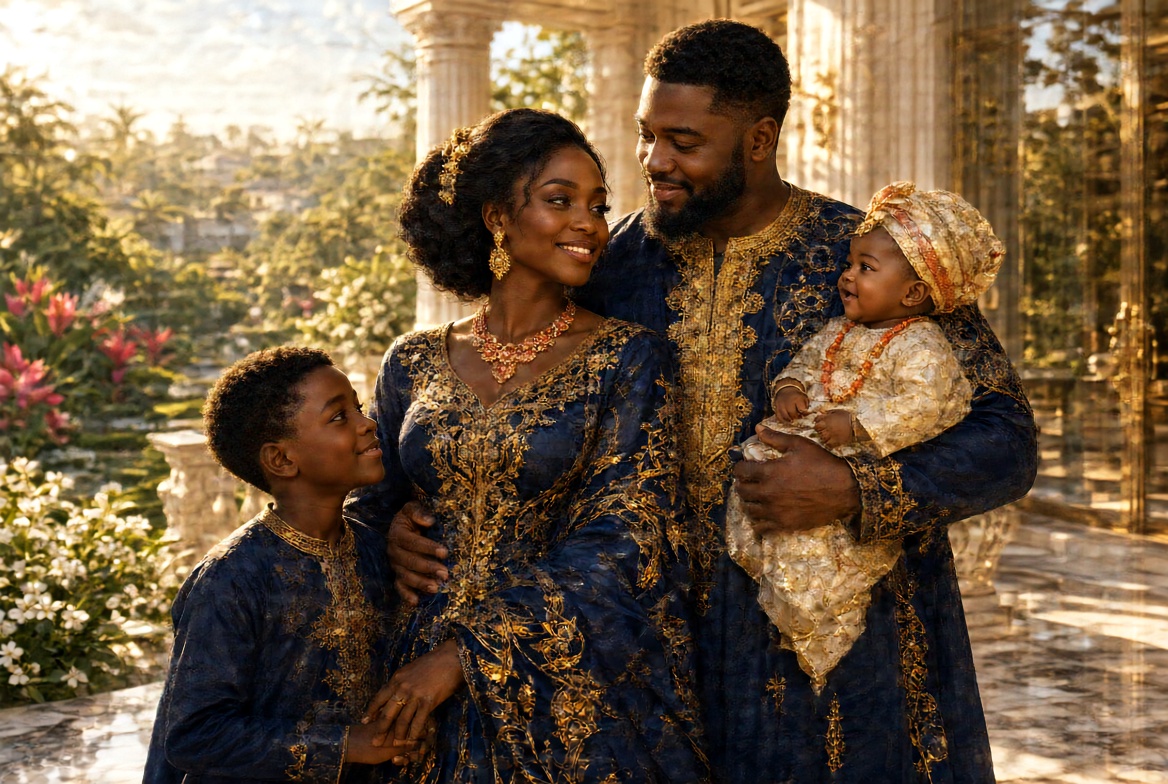
One year later, Ngozi stood in the doorway of the mansion that had become her home, watching her daughter play in the garden.
Adaeze Sophia Odogwu was three months old, with her father’s eyes and her mother’s smile.
“She’s beautiful,” Odogwu said, coming up behind Ngozi and wrapping his arms around her waist.
“She is,” Ngozi agreed.
She thought of the storm, of the gate closing, of the 29 missed calls.
She thought of the woman she had been and the woman she had become.
“What are you thinking about?” Odogwu asked.
“About how different things could have been,” Ngozi said. “About how grateful I am that they aren’t.”
Odogwu pressed a kiss to her temple.
“You will never have to walk through that kind of hardship alone again.”
And Ngozi knew—with every fiber of her being—that he meant it.
—
The past, however, had a way of returning.
Ngozi was in the study, reviewing documents for a business she’d started—a small consulting firm that was already making waves in Lagos—when the intercom buzzed.
“Madam,” the housekeeper’s voice came through. “There is someone here to see you. She says she is your mother-in-law.”
Ngozi’s blood ran cold.
“Which mother-in-law?”
“Madam Adaeze Okonkwo.”
Ngozi set down her pen.
“Please tell my daughter-in-law her mother is here,” came a voice from the intercom—Mama Adaeze’s voice, desperate and broken.
Ngozi stood and walked to the front of the house.
There, standing at the gate with nothing but a worn bag and hollow eyes, was the woman who had thrown her out into the storm.
“Ngozi,” Mama Adaeze said, her voice cracking. “We have lost everything. Our house, our cars, the bank has seized it all.”
Ngozi said nothing.
“Ngozi, come out here,” Mama Adaeze pleaded. “I know you’re in there. Please, put in a good word for me with Odogwu.”
Ngozi stepped forward.
“I was wrong, Ngozi,” Mama Adaeze continued, tears streaming down her face. “Ngozi, please save me. You’re the only one who can help me right now.”
Ngozi looked at this woman—this woman who had smiled when her son threw his wife out into a storm.
“Everyone reaps what they sow,” Ngozi said quietly. “Your sins, your garbage, you pay for them yourself. Nobody can save you now.”
She turned to the driver who stood nearby.
“Driver, let’s go. Drive right through that puddle.”
The car pulled away, and Ngozi didn’t look back.
—
That night, Odogwu found her on the terrace again.
“I heard about your mother-in-law,” he said, sitting beside her.
“Former mother-in-law,” Ngozi corrected.
Odogwu nodded.
“Do you want to talk about it?”
Ngozi was quiet for a long moment.
“When I was married to Obinna, I believed that if I just tried hard enough, I could become someone they would accept,” she said. “I believed that if I was perfect—if I never made mistakes—they would love me.”
She turned to look at Odogwu.
“But they never did. And when I finally understood that, I had nothing. No money, no home, no dignity.”
Odogwu took her hand.
“But you had yourself.”
Ngozi smiled.
“I had myself.”
—
Two years later, Ngozi stood in the boardroom of Meridian Financial, the conglomerate Odogwu had once offered to hand over to her.
She had refused then, wanting to prove herself on her own merit.
Now, under the name Ngozi Bennett—a woman can face any new challenge—she had built something extraordinary.
“Congratulations, Director,” her assistant said, setting a stack of files on her desk. “The acquisition is complete.”
Ngozi nodded, but her mind was elsewhere.
She was thinking about the woman who had walked into that first interview with nothing but a worn suitcase and a broken heart.
She was thinking about how far she had come.
—
The bullying started on her second day at Meridian.
“Chineke!” a voice exclaimed as Ngozi walked into the executive floor. “Look who it is. I thought headquarters was sending down some heavyweight executive, but it’s just you, Ngozi?”
Ngozi turned to find a woman she recognized from college—Chika, a girl who had always looked down on her for being poor.
“After all these years, you’re still dirt poor,” Chika laughed. “Back in college, you couldn’t even afford club dues. How did you even land a spot at Meridian? Who did you sleep with to trade for this position?”
Ngozi’s expression didn’t change.
“Newbies start with grunt work,” Chika said, dropping a stack of files on Ngozi’s desk. “Sort out this entire file stack before clocking out. Missing a single page and you’re in deep trouble.”
“Yes, director,” Ngozi said, her voice calm.
She would bide her time.
—
Chika, it turned out, was the daughter of a woman named Gozie, who had worked for Odogwu for ten years.
And Gozie, it turned out, had made a terrible mistake.
“Mom, please look at this,” Chika said, shoving a card into her mother’s hands. “You just need to forward my catering portfolio to the estate manager for tomorrow.”
Gozie’s eyes widened.
“Chineke! Are you out of your mind, Chika? That card is his personal security clearance. If Odogwu finds out, he’ll have me thrown into the Lagos Lagoon to feed the sharks.”
“Mom,” Chika scoffed. “I’m gunning for regional director. Those investors are massive snobs. If I bring them to Odogwu’s private estate, they’ll think I have powerful backers. They will sign contracts instantly.”
“Just one—I promise I’ll sneak it right back.”
Gozie hesitated.
“Remember your word, Chika. Only take them to the outer patio area. Absolutely no vandalism. You must return it to me by 5:00 p.m. tomorrow.”
“Thanks, Mom. Tomorrow, I’ll be the queen of the party.”
—
The party was everything Chika had hoped for.
Investors in designer suits marveled at the estate.
Chika’s colleagues whispered about her connections.
“Chika, director, you’re amazing,” one of them said. “Word is this estate is completely untouchable. Chief Odogwu must adore you to let us stay here.”
“Naturally,” Chika said, producing the clearance card with a flourish.
And then she saw Ngozi.
The woman was standing near the patio, wearing a simple dress and a coral diamond necklace that Chika recognized immediately.
“Isn’t that the coral diamond necklace Chifodugu bought for 30 million dollars at last year’s charity auction?” one of the investors whispered. “Word is he gifted it to his wife.”
“His wife?” Chika laughed. “Look at this peasant’s pathetic outfit. This is clearly a fake knockoff bought from Idumota market.”
She approached Ngozi with a sneer.
“A decent imitation, but totally weightless.”
She reached out and yanked the necklace.
It snapped.
Ngozi gasped.
“Oops,” Chika laughed. “My bad. But really, you shouldn’t wear cheap fakes around to humiliate yourself.”
The other women laughed.
“Good thing it broke,” Chika continued. “It saves us all from dirtying our elite eyes. Trash like this doesn’t deserve to sit inside Odogwu’s villa.”
“Mom!” a small voice called. “Mom, Gozie! I’m looking for you.”
Chika turned to see a young boy running toward them.
And behind him, a man.
“Odogwu,” Chika breathed.
“You,” Odogwu said, his voice cold. “Why are you here?”
“Mom, why did you fall?” the boy—Somto—asked, running to Ngozi’s side.
“Mom’s fine,” Ngozi said, her voice strained. “I just tripped clumsily.”
“You’re lying,” Somto said. “She did it on purpose and broke the necklace daddy gave her.”
Odogwu’s eyes turned to Chika.
“If I hadn’t come, how else would I have seen someone dare to torment my wife under my own roof?”
“His wife?” Chika’s face went pale. “Ngozi is Odogwu’s wife? Then that bracelet was real.”
She turned to Odogwu, desperation in her eyes.
“Odogwu, you must be joking, right? She’s just a poor nobody. She tricked you.”
Odogwu’s voice was ice.
“Shut your mouth.”
“Odogwu, I was wrong,” Gozie said, appearing at her daughter’s side. “I snuck the card to my daughter. I never imagined she would dare to—”
“Please give me one more chance.”
“A chance?” Odogwu repeated. “You worked for me for ten years, paid handsomely, and you betray me so your daughter can impersonate my family and assault my wife?”
He turned to Chika.
“You are fired immediately. And you, Chika, you are permanently blacklisted from the entire financial sector in Africa. Not a single soul will ever hire you again.”
Chika screamed.
Odogwu turned to the crowd.
“Everyone who laughed, everyone who shoved my wife, report to human resources for your termination letters. Anyone who just stood by and watched gets a one-grade demotion.”
He walked to Ngozi and took her hand.
“I’m sorry. I shouldn’t have let you come here alone.”
“Not your fault,” Ngozi said. “I just wanted to test myself. I never expected her to go this far.”
Somto tugged on Ngozi’s sleeve.
“Don’t worry, Mom. From now on, if anyone dares bully you, I’ll beat them to a pulp.”
Ngozi laughed.
“Princess Adaeze will protect you, too,” she said, thinking of her daughter at home.
—
That night, Ngozi sat in the nursery, watching Adaeze sleep.
Odogwu found her there.
“I want to tell you a secret,” he said, sitting beside her. “Somto is not my biological son.”
Ngozi turned to look at him.
“He is my late sister’s child.”
“What?”
“Three years ago, her happiness was destroyed in a hit ordered by a rival syndicate,” Odogwu said, his voice heavy with old grief. “I wiped that entire clan off the map. Afterward, I put Somto on my birth registry quietly, so no enemy could ever snatch him away.”
Ngozi reached for his hand.
“I used to think Somto and I were all alone in this world,” Odogwu continued. “But being an Odogwu’s wife couldn’t possibly be harder than being a maid for the Okonkwos.”
Ngozi smiled.
“I will protect you and your son,” she said. “Both of them.”
—
Six months later, Ngozi sat in a doctor’s office, staring at an ultrasound screen.
“Congratulations, Odogwu,” the doctor said. “Madam is 8 weeks pregnant.”
Odogwu’s face broke into a smile.
“Does something hurt?” he asked, seeing Ngozi’s expression.
“No,” she laughed. “I think I just heard our little princess calling me.”
“Why isn’t the baby calling me?”
Ngozi laughed harder.
—
The night Adaeze was born, Ngozi thought her heart might burst with joy.
“It’s a baby girl,” the nurse said. “3.2 kg, perfectly healthy. Adaeze Sophia Odogwu.”
Odogwu held his daughter for the first time, tears streaming down his face.
“From now on, I’m her hero,” he said. “She’ll be the princess.”
Somto peered at his new sister.
“She’s so small.”
“She’ll grow,” Ngozi said. “And you’ll be her big brother. Her protector.”
Somto nodded solemnly.
“I’ll protect her forever.”
—
But the past wasn’t finished with them yet.
One night, when Adaeze was three months old, Ngozi woke to the sound of breaking glass.
She sat up in bed, her heart pounding.
“Odogwu?”
He was already awake, reaching for the gun he kept in the nightstand.
“Stay here,” he said. “Lock the door.”
“Odogwu—”
“Lock the door.”
He slipped out of the room, and Ngozi grabbed her phone.
She could hear shouting downstairs, the sound of struggle.
And then—silence.
She waited, her breath held, her arms wrapped around Adaeze.
The door opened.
“It’s okay,” Odogwu said. “It’s over.”
“What happened?”
“A blood debt,” he said. “The clan I buried three years ago still had a few fangs left. They came to collect tonight.”
Ngozi’s blood ran cold.
“Is everyone safe?”
“Everyone is safe,” Odogwu said. “I made sure of it.”
He sat on the edge of the bed and took her hand.
“I should have told you sooner. I should have prepared you.”
“You couldn’t have known,” Ngozi said.
“I should have protected you better.”
Ngozi touched his face.
“You protected us tonight. That’s what matters.”
—
Time passed, as it always does.
Somto grew into a strong, kind young man.
Adaeze grew into a fierce, brilliant young woman.
And Ngozi and Odogwu grew old together, their love deepening with each passing year.
One evening, as they sat on the terrace watching the sunset, Ngozi thought about the storm.
She thought about the gate closing.
She thought about the 29 missed calls.
“What are you thinking about?” Odogwu asked.
“About how grateful I am,” Ngozi said. “For everything.”
Odogwu took her hand.
“You will never have to walk through that kind of hardship alone again.”
And Ngozi knew—with every fiber of her being—that he meant it.
—
The coral diamond necklace hung in a glass case in their bedroom, repaired and restored.
Ngozi looked at it sometimes, remembering the night it had been broken.
Remembering the woman who had laughed at her.
Remembering the man who had defended her.
“Mom?” Adaeze’s voice came from the doorway. “What are you looking at?”
“Just an old memory,” Ngozi said.
Adaeze walked to the case and studied the necklace.
“It’s beautiful.”
“It is,” Ngozi agreed. “Your father gave it to me a long time ago.”
“Was it expensive?”
“Very.”
Adaeze was quiet for a moment.
“Mom, can I ask you something?”
“Of course.”
“Were you ever afraid? When you first came here?”
Ngozi thought about the storm.
She thought about the gate.
She thought about the 29 missed calls.
“I was terrified,” she said. “But sometimes, the worst moments of your life lead to the best ones.”
Adaeze smiled.
“I love you, Mom.”
“I love you too, sweetheart.”
—
And so the story ended, as all stories do.
Not with a bang, but with a whisper.
A whisper of gratitude, of love, of hope.
A whisper that said: no matter how dark the storm, the sun will always rise.









