She Was Just a Night-Shift Nurse… Until the Soldier Whispered “Valkyrie”
The helicopter hit the roof at 11:47 p.m.
Not a landing. An impact.
The kind that rattled ceiling tiles loose and sent coffee mugs sliding off nurses’ stations three floors down.
Alarms detonated across Halverson Memorial Hospital like a chain reaction. Red lights strobing the corridors as the PA system cracked to life with something nobody had ever heard before.
“Trauma Bay. Military casualty. All senior staff.”
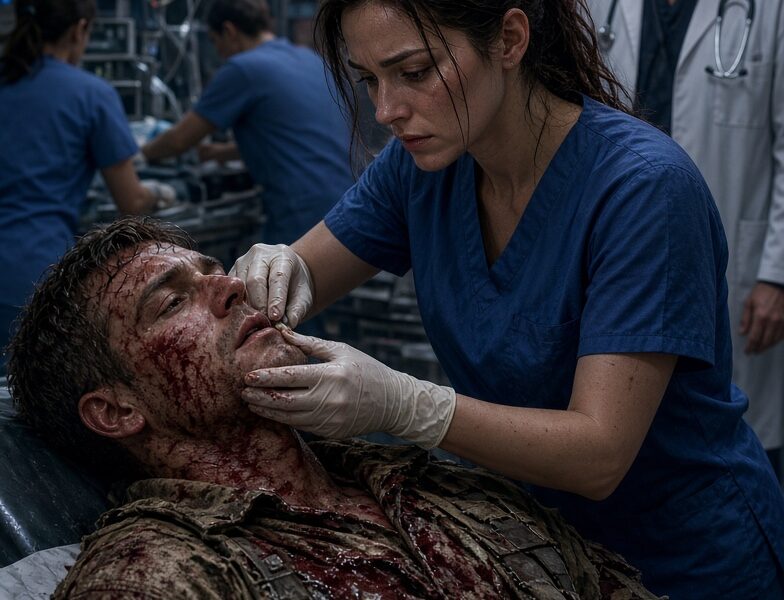
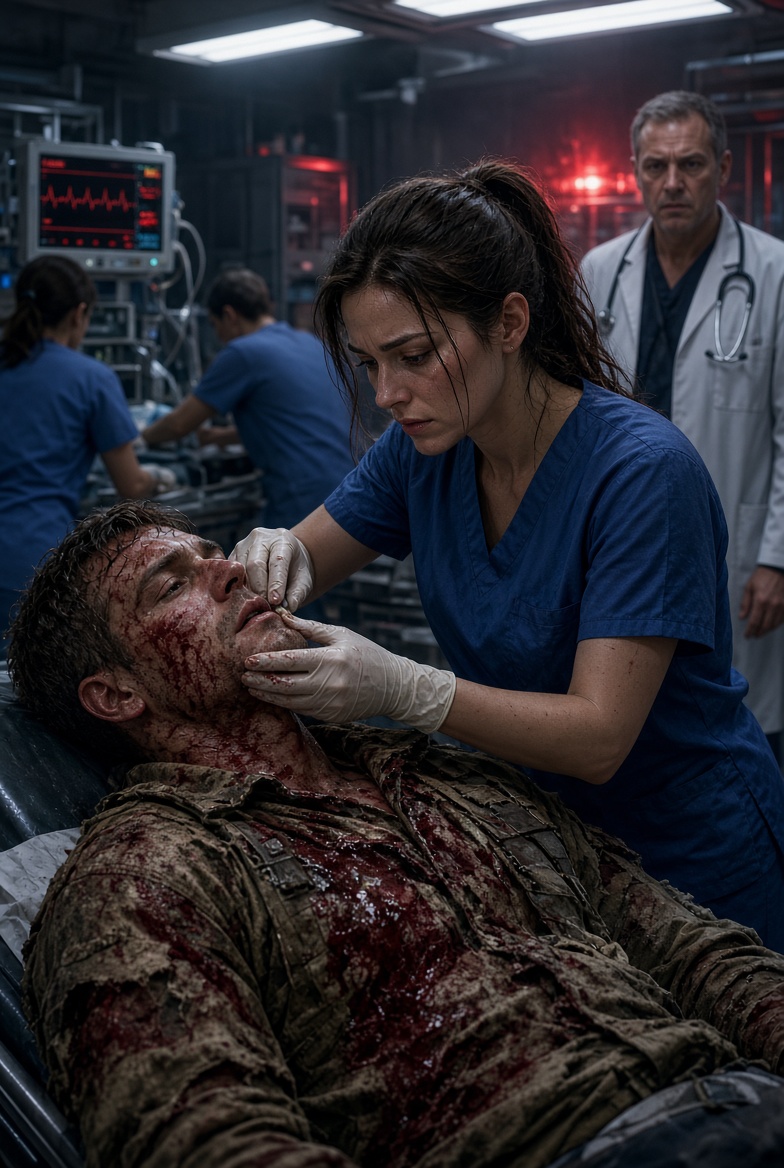
The man they wheeled in was bleeding from four places and barely conscious. His uniform was shredded. His dog tags were missing.
And when Emily Carter leaned in close to check his airway, his cracked lips moved.
One word. Just one.
“Valkyrie.”
Emily went completely still.
Because that name didn’t belong in this hospital. That name belonged to a different life. To dust and blood and decisions made in seconds that determined whether people lived or died.
A life she had buried carefully, quietly, and never once mentioned to anyone at Halverson Memorial.
The soldier who just crashed through their roof knew exactly who she was. And the doctor standing three feet away, the one who had spent six months treating her like she was barely worth the uniform she wore, was about to find out, too.
Emily Carter had learned early that the best way to survive a hostile environment was to make yourself small.
Not weak. Small.
There was a difference, though most people never bothered to understand it.
Small meant you took up less space, drew less fire, gave people fewer reasons to notice you, so they’d have fewer opportunities to use you as a target.
It was a skill she’d refined across three deployments in places that didn’t appear on the average person’s mental map of the world. Forward operating bases and terrain so unforgiving that the landscape itself seemed to be trying to kill you before the enemy got the chance.
She’d brought that skill to Halverson Memorial eight months ago when she’d applied for a night shift nursing position and listed her previous experience as military medical support without elaborating.
The recruiter had nodded politely and moved on.
Nobody asked follow-up questions. Nobody pushed.
And Emily hadn’t volunteered anything.
That suited her fine.
Halverson Memorial sat in the midsize city of Drefield, population around 400,000. The kind of place that was large enough to have a serious trauma center, but small enough that everyone in the hospital hierarchy knew exactly where they stood in the pecking order.
The ER ran 24 hours and saw everything from minor accidents to the occasional genuine emergency, and it was managed with the rigid territorial precision of a fiefdom by Dr. Victor Langford.
Langford was fifty-three, built like someone who had once been athletic and never quite accepted that time had rearranged things. Silver hair he wore slightly too long and a manner of speaking that made every sentence sound like a verdict being delivered from a bench.
He had trained at a prestigious program, published several papers that he referenced often and others rarely, and he had an absolute, unshakable belief in the hierarchy of medical authority that placed him at the top and everyone else at distances calibrated precisely to how useful they were to him.
Nurses existed to carry out instructions. The less they deviated from those instructions, the better. The less they spoke up, questioned, or offered observations beyond their assigned scope, the more smoothly his ER ran.
Emily had understood this within her first two weeks.
She had also understood within those same two weeks that Langford was not a bad doctor in the textbook sense. He was competent. He knew his protocols. He followed evidence-based guidelines with the consistency of someone who genuinely believed that adherence to procedure was itself a form of excellence.
What he lacked, and what the environment he’d created actively punished, was the capacity to recognize when the protocol was wrong for the patient in front of him.
That gap had gotten people hurt before.
Emily had seen the signs. She had kept her mouth shut, mostly because she was new, because she wasn’t a physician, and because she had promised herself when she left the service that she was done with conflict.
Done with being the person who stepped forward. Done with carrying weight that wasn’t officially hers to carry.
She had lasted about four months before she couldn’t hold it anymore.
The incident had been a sepsis case, a forty-year-old woman presenting with what Langford had categorized as a respiratory infection.
The numbers told a different story to anyone paying close attention, and Emily had been paying very close attention.
She’d flagged it quietly to the attending nurse practitioner, who had flagged it to Langford, who had looked at Emily with an expression that managed to combine dismissal and irritation into something almost impressive.
“I’ll thank the nursing staff to manage IVs and leave the diagnostic work to people with medical degrees,” he’d said loudly enough that the nursing station had gone quiet.
The patient had deteriorated two hours later and required ICU transfer.
Langford had ordered the correct treatment at that point, to his credit, but the delay had added complications that a faster response would have avoided.
Nobody filed a formal complaint. Nobody said anything official.
The patient survived, eventually, after a longer stay than she should have needed.
Emily had gone home that morning, sat on the edge of her bed in her apartment with its bare walls and secondhand furniture, and had a long, quiet argument with herself about whether to stay or go.
She stayed.
She wasn’t entirely sure why, except that she was stubborn, and she recognized something in the nursing staff at Halverson that she recognized from other difficult postings. People who were good at their jobs, who cared, who were doing their best inside a structure that didn’t always reward caring or competence.
Khloe Navaro, who worked the same night shift, could read a deteriorating patient from fifty feet away and had the fastest hands at an IV line that Emily had ever seen outside a field medic.
Marcus Webb, the charge nurse, had a quiet authority that kept the overnight team functioning on nights when everything seemed to be going sideways at once.
Priya Sethi, who was technically a nursing assistant, but operated more like a one-woman logistics operation, somehow always knew where the equipment was that everyone else had mislaid.
They were worth staying for.
So Emily stayed, and she made herself small, and she watched Langford run his ER like a personal domain, and told herself it wasn’t her problem.
Then came the night of the helicopter.
It started, like most bad nights, as a slow shift.
The overnight team had processed a steady but manageable flow through the first few hours. A construction worker with a hand laceration. Two car accident patients with injuries that turned out to be less severe than the initial call suggested.
An elderly man with chest pain that resolved to anxiety once his family arrived. A teenager with a broken wrist from what he described as falling off a bike, and what the bruising pattern suggested was something more complicated that social work would need to address in the morning.
Emily moved through these cases with the focused efficiency that Khloe had once described as a little bit robot, but the good kind.
She didn’t chatter between patients the way some nurses did. She didn’t complain about the pace or the hours. She documented carefully, followed up on things that needed following up on, and kept the kind of running mental tally of every active patient status that she’d developed across years of tracking multiple casualties simultaneously in environments where losing track of someone meant losing them entirely.
Around 11:30, Langford had made his nightly pass through the department, a performance he conducted with the air of a general inspecting troops, and had paused at the nurses’ station long enough to look over Emily’s shoulder at a patient chart she was updating.
“You’ve got the IV rate wrong on Bay 4,” he said.
Emily didn’t look up from the chart.
“It was adjusted at 2200 per the attending’s order. The note’s in the record.”
“I’m looking at the original order.”
“The order was modified. It’s documented.”
Langford made a sound that wasn’t quite a scoff, but occupied the same general territory.
“When I want the nursing staff’s interpretation of medication orders, I’ll ask for it.”
“It’s not an interpretation, Dr. Langford. It’s a documented adjustment signed by Dr. Reeves.”
The silence that followed was the particular kind that Langford was good at producing. The kind that suggested he was choosing not to respond because he found the conversation beneath him, rather than because the other person had a point.
He moved on.
Emily finished the chart entry and said nothing further.
Khloe materialized at her elbow approximately thirty seconds after Langford disappeared into his office.
“One day,” Khloe said very quietly, “he’s going to pick the wrong nurse to do that to.”
Emily said nothing.
“I’m serious. The man has never once in eight months said anything to you that wasn’t either an order or a criticism, and you just take it and take it.”
“Khloe.”
“I’m just saying.”
“I know what you’re saying.”
Emily set down the chart and looked at her coworker with the small, flat expression that Khloe had learned meant the conversation was being closed. Not dismissively, but firmly, the way you close a window before a storm.
“Some things aren’t worth the energy.”
Khloe opened her mouth to respond, and then the roof of Halverson Memorial Hospital shuddered.
The sound reached the ER before the alarms did.
A deep, percussive impact that translated through the building structure as vibration more than noise. The kind of thing your body registered a half second before your brain caught up.
Ceiling tiles shifted. The fluorescent fixture above the nurses’ station flickered. A crash from somewhere down the hall, something falling off a shelf.
Then the alarms.
Emily was already moving before the PA activated, which was not something she consciously decided to do. Certain things bypassed the decision layer entirely.
She was at the trauma bay entrance when the first word came through.
“Military casualty inbound. Rooftop emergency landing. ETA ninety seconds.”
The trauma team assembled with the controlled urgency that good ER staff manage in actual emergencies. No panic, no wasted motion. Just people moving to their positions with the economy of people who’ve rehearsed this.
Dr. Langford appeared from his office with his white coat slightly crooked and his expression set in the concentrated, authoritative mode he reserved for serious cases.
He was good in emergencies. Emily had to give him that. He was sharp and decisive when the stakes were clear.
What he didn’t have, what he’d never had, was familiarity with what was coming through those doors.
The gurney came fast, pushed by two men in military utility uniforms with the kind of controlled urgency that told Emily immediately these were not ordinary transport personnel.
One of them was talking into a radio. The other had his hand pressed against the patient’s right side with the deliberate, practiced pressure of someone who knew exactly how bad the bleed was and was doing everything in his power to keep it from getting worse.
The patient was male, mid-thirties, the kind of physical condition that only comes from sustained serious training. He was conscious, barely, with the specific quality of consciousness that Emily recognized as someone burning through their last reserves.
The eyes that are open but not quite tracking. The jaw set against pain that the body no longer has the chemistry to fully process.
His uniform was American military. The insignia were partially obscured by blood and damage, but not entirely.
Langford was already calling out the initial assessment protocol.
“Get me vitals. Get a line in. I want a chest X-ray.”
And Emily stepped forward and looked at the wound pattern.
She went very still for exactly one second.
It wasn’t the wounds themselves. They were severe but survivable if handled correctly.
It was the configuration. The entry points. The trajectory implied by the damage visible on the surface. The specific way the military transport medic had been applying pressure.
She had seen this before, not in a textbook, not in a simulation. She had seen this in the field, in real time, and she had learned the hard way that civilian trauma protocols, excellent as they were for civilian trauma, were built around civilian injury patterns.
What this man had was not a civilian injury pattern.
Before she could process whether to act on this or stay in her lane, the patient’s eyes opened further, scanning the room with the desperate focus of someone trying to orient in an unfamiliar environment.
His gaze moved across the faces above him. Langford. The trauma nurse. The resident. And landed on Emily.
And he said it. One word, barely above a breath, pushed out through whatever was left of his lung capacity.
“Valkyrie.”
Emily’s hand stopped moving.
Everything in her went quiet in a way that had nothing to do with calm.
The military transport medic standing at the head of the gurney heard it. He looked at Emily sharply, a fast assessment, the kind of look that soldiers give people they’re trying to quickly categorize.
His expression shifted in a way that was subtle enough that no one else in the room probably caught it.
Emily caught it.
“What did he say?” Langford asked, not really expecting an answer, already moving to the next item on his protocol list.
“Nothing,” Emily said. “Let’s focus.”
For the next six minutes, she did what she was supposed to do.
She ran the IV line. She pulled the vitals. She followed Langford’s orders with the precision that she was known for and stayed carefully, deliberately in her assigned space.
She was also running a parallel assessment in her head that was diverging from Langford’s protocol with every passing minute.
The chest injury was the obvious priority. Langford had correctly identified a hemothorax and was moving to address it.
But the man’s BP was dropping in a pattern that didn’t match a straightforward hemothorax. And there was something in his abdominal presentation that Langford wasn’t looking at because he was focused on the chest, which was where protocol directed attention first.
Emily knew what she was seeing.
She had seen the same presentation twice in field conditions. Once in a teammate who survived because they’d caught it. Once in someone they hadn’t caught it in time.
On the abdominal compartment. The pressure was building in a configuration that a chest tube alone wouldn’t address.
And every minute Langford spent successfully treating the primary injury while the secondary one progressed was a minute they wouldn’t get back.
“Dr. Langford.”
She kept her voice even.
“His abdominal pressure.”
“I’m managing the chest injury, Carter.”
“That’s what’s going to kill him in the next three minutes.”
“The chest injury is being managed.”
“I’m concerned about a secondary—”
“I didn’t ask for your concerns.”
He said it without looking at her. Hands busy. Attention locked on the procedure.
“If you’re not comfortable with your assigned task, I can have someone else take your position.”
The military transport medic was watching this exchange. Emily could see it in her peripheral vision. His jaw was tight.
She went back to her task.
The monitor beeped.
BP continued its slow, steady decline.
Chest tube in. That was right. That was necessary. That would help.
But the number on the monitor wasn’t responding the way it should have if the chest injury were the sole driver.
Langford frowned at the monitor.
“Adjust the fluids.”
“Already adjusted,” the resident said.
“Adjust them again.”
The number kept dropping.
Emily looked at the patient’s face. He was fading now. The specific fading that she had learned to read in conditions where there was no room for misreading it.
She looked at the abdominal wall. She looked at the rate of descent on the monitor.
She did the math she had been doing since he came through the door, the math she had been hoping she was wrong about.
And she came to the same answer she’d come to three minutes ago.
She stepped forward.
“Carter—”
“His abdominal compartment pressure is critical.”
She wasn’t asking permission. Her voice had changed, though she hadn’t consciously decided to change it. Something had shifted in the register, the pace, the authority of it.
“He has a secondary bleed you’re not seeing because you’re looking at the chest. If we don’t address it in the next five minutes, the chest tube won’t matter.”
The room went very quiet.
Not the silence of people who thought she was wrong. The silence of people who had just heard a night shift nurse speak with the absolute certainty of someone who had made calls like this before, in conditions where being wrong meant someone died, and were processing what that meant.
Langford turned from the patient to look at her directly for the first time in the conversation.
His expression moved through several things in quick succession. Surprise. Irritation. Authority reasserting itself.
“You are a floor nurse,” he said, with the deliberate emphasis of someone reminding a child of something they should already know. “You do not diagnose. You do not determine treatment priorities. You follow the orders of the attending physician, which is me. Are we clear?”
Emily looked at the monitor. She looked at the patient. She looked at the military transport medic, who was looking at her with an expression that was no longer ambiguous at all.
“Crystal,” she said.
And then she moved to the supply cabinet, pulled what she needed, and turned back to the patient with the economy of motion that comes not from training in any single skill, but from years of compressing the distance between assessment, decision, and action until it was effectively nothing.
“Stop.” Langford’s voice cracked across the bay. “Carter, I said stop. Do not touch that patient. Security.”
“His name,” Emily said, not stopping, “is Sergeant First Class David Mercer. He served four tours. The last one was Eastern Khost Province. And the injury pattern you’re looking at is consistent with fragment damage from a specific type of IED that creates a secondary abdominal bleed that presents late and quiet and kills people after they’ve already survived what killed them.”
She looked up at Langford.
“I have seen this before. You haven’t. And if you pull me out of this bay right now, he will die on this table while you wait for the surgical consult to tell you what I am telling you now.”
The room had gone entirely, completely still.
Langford stared at her.
The transport medic had taken one step closer to the table. His hand had moved almost unconsciously to a position that wasn’t threatening exactly, but was ready.
The monitor continued its soft, urgent alarm.
“How do you know his name?” Langford said.
Emily’s hands were already working.
“Because I know him,” she said. “Now let me save his life.”
Langford didn’t move.
That was the thing Emily clocked first. Not the silence of the room, not the alarm cycling on the monitor, not the weight of every pair of eyes in that bay pressing against the back of her neck.
Langford had gone very still in the specific way that men like him went still when something had happened that they hadn’t anticipated and hadn’t yet decided how to categorize.
He wasn’t processing the patient. He was processing her.
And the three seconds he spent doing that were three seconds that mattered.
Emily didn’t wait for him to finish.
She had already pulled the abdominal pressure monitoring kit from the supply cabinet, the specific one, the right gauge, the setup she needed, and her hands were moving with a muscle memory that had nothing to do with Halverson Memorial Hospital.
It had been built in places where the lighting was worse, the equipment was less reliable, and the people on the table had names she was responsible for remembering.
She didn’t think about the steps. She executed them. There was a difference.
“You are not authorized—” Langford started.
“Marcus.”
Emily didn’t raise her voice. She said the charge nurse’s name with the particular clarity of someone issuing a field instruction, not asking a favor.
“I need you on his left side. Watch his BP and call out every thirty seconds.”
Marcus Webb had been a charge nurse for eleven years. He’d worked under four different ER chiefs, survived two malpractice investigations that weren’t his fault, and developed a finely calibrated instinct for the difference between someone overstepping and someone who knew exactly what they were doing.
He looked at Emily for exactly one beat.
Then he moved to the patient’s left side.
“Carter—” Langford’s voice had dropped into a register she hadn’t heard from him before. Not the dismissive authority he used in daily operations, but something with actual edge to it. “If you touch that patient without my authorization, I will have you removed from this hospital tonight. I will make sure you never hold a nursing license in this state again. Do you understand what I’m telling you?”
She understood.
She also understood that Sergeant First Class David Mercer’s systolic was at 78 and dropping, that the chest tube had slowed the primary bleed but the monitor numbers were still going the wrong direction, and that the window for catching what she was seeing before it became uncatchable was measured in minutes she was currently burning through.
“Khloe,” she said, “I need a second line, left AC, and I need you to start a second liter of LR.”
Khloe Navaro had been standing three feet back from the table with the expression of someone watching a controlled detonation from a distance they couldn’t decide was safe.
She looked at Langford. Then she looked at Emily. Then she looked at the monitor.
She went for the IV supplies.
“Everyone in this room is now in direct violation—”
“The abdominal compartment pressure is going to hit critical inside four minutes,” Emily said, still not raising her voice. Still not stopping. “After that, the window for intervention closes. You can remove me after. Right now, I need everyone focused on this patient.”
The military transport medic, she still didn’t have his name, took another step closer to the table.
He wasn’t a threat, and everyone in the room knew it. He was a man watching someone try to save a person he’d carried a long way, and his presence at the table had the quality of a witness who had decided which side of the room he was on.
Langford took three steps toward the wall phone.
“I’m calling security.”
“Call them,” Emily said. “It’ll take them four minutes to get here.”
He picked up the phone.
Emily worked.
The abdominal pressure reading came back worse than she’d estimated, which meant her estimate had already been too optimistic.
She adjusted.
That was the thing about field medicine that no protocol fully prepared you for. You planned for what you expected and then you adjusted. And the adjusting was the skill, the real one, the one that took years to develop and couldn’t be found in any textbook because textbooks were written in hindsight and patients didn’t give you the luxury of hindsight.
“His pressure is dropping again,” Marcus said. “Seventy-four.”
“I see it. Khloe, how’s the second line?”
“Running.”
“Good. I need you to—”
“What do you need?” Khloe said, and her voice had shifted too. Less fear in it, more focus. Something about watching Emily work had apparently resolved whatever internal negotiation Khloe had been running, and she was now operating with the clean efficiency of someone who had made a decision and was sticking to it.
Emily told her. Khloe moved.
The resident, a second-year named Torres, who had been pressed against the wall since the moment Emily stepped forward, found his feet and moved to the other side of the table without being asked.
He didn’t speak. He watched Emily’s hands and then, after a moment, started anticipating what she needed before she called for it.
He was fast, smart, the kind of trainee who learned from watching, which was the best kind.
Langford came back from the wall phone. Security was coming. His face had the controlled, furious expression of someone who had committed to a course of action and was now waiting for the environment to catch up.
“The surgical consult is on their way down,” he said. “When they arrive, this intervention is over and you are done.”
“When they arrive,” Emily said, “tell them abdominal compartment syndrome, secondary hemorrhage, probable vascular involvement at the L3 junction. I’ll have him stabilized enough to transfer to the OR within the next eight minutes.”
She said it without looking up. Flat. Factual. The way you communicated in conditions where emotional register was a luxury.
Langford stared at her.
“You don’t know what you’re describing.”
She looked up at him then. Just briefly. Just long enough to make the eye contact deliberate.
“I know exactly what I’m describing.”
The monitor shifted.
Everyone heard it. The specific change in the alarm tone that meant the pattern was different, that something had responded.
It wasn’t good yet. It wasn’t anywhere near good yet. But the sharp accelerating decline had bent slightly.
And in a room full of people who knew how to read monitors, that bend meant something.
Torres exhaled through his nose.
Marcus called out the next BP reading.
“Seventy-six.”
Two points in the right direction.
Against the trend of the last twelve minutes, two points was significant.
“Keep calling it,” Emily said.
“Seventy-six,” Marcus repeated, holding steady.
Security arrived at eight minutes, not four.
Two of them, both big, neither of them particularly sure what they were walking into, given that the radio call had been something along the lines of unauthorized personnel performing medical procedures, which didn’t quite capture the full picture of what they found when they pushed through the trauma bay doors.
What they found was a nurse working with the concentrated calm of someone who had done harder things in worse places. A charge nurse and two other staff members running support around her with the coherence of a team that had been working together for years.
A military transport medic who looked at the security personnel with an expression that made both of them slow down involuntarily.
And a monitor showing numbers that were, against what had been the overwhelming trajectory of the last fifteen minutes, moving in a cautiously positive direction.
They looked at Langford.
Langford looked at Emily.
Emily didn’t look at anyone.
“He’s not stable enough to move yet,” she said to the room at large. “If someone tries to pull me away from this table right now, I need that to be documented, because I will not be responsible for what happens to him if the intervention is interrupted.”
One of the security guards, the older one, the one who had been doing this long enough to know when a room had a situation that wasn’t in the security manual, said, “Dr. Langford, do you want us to wait?”
Langford said nothing.
The word came out slightly differently than his usual words. Less certain of itself.
He was looking at the monitor.
Seventy-eight, then seventy-nine.
He was a doctor. Whatever else Victor Langford was, whatever complex of ego and authority and professional tribalism had built itself up over thirty years of practicing medicine at the top of a hierarchy he’d constructed around himself, he was a doctor.
And some part of him that was underneath all the rest of it was watching those numbers and doing the same math that Emily had done twelve minutes ago.
He didn’t call the security guards off, but he didn’t direct them forward either.
The surgical consult arrived five minutes later.
Dr. Ambrose Hail, vascular surgery, who had the slightly disoriented energy of someone who’d been called in from offsite and was assembling the situation from pieces as he walked through the door.
He took in the trauma bay. He took in Emily’s hands, the lines, the monitoring setup, the numbers on the screen.
“What’s the presentation?” he asked the room.
Emily answered.
Not because she was supposed to, but because she had the most complete picture, and because in a room full of people with competing authority structures, the person who answered first with accurate information in an emergency was functionally the one in charge, regardless of what the org chart said.
She laid it out in thirty seconds. Clear. Sequential. No wasted words.
Hail listened with the focused attention of a surgeon who had long since learned that the source of useful information was less important than the information itself.
He looked at the monitor. He looked at the patient. He asked two follow-up questions, both of which Emily answered without hesitation.
“OR two,” he said. “Get him prepped for transfer.”
He looked at Emily.
“You did the compartment intervention.”
“Yes.”
“That’s what stabilized him partially. The chest tube addressed the primary. The compartment intervention addressed the secondary. He needs the OR for the vascular component.”
Hail nodded. He turned to the team.
“Prep for transfer.”
“Dr. Hail—” Langford said.
“Victor. I’ll talk to you after,” Hail said, in the tone of someone who was not going to talk to anyone about anything that wasn’t directly relevant to keeping a patient alive in the next immediate window of time.
He was already moving, already assessing the transfer setup, already running the surgical plan in his head.
The security guards left.
Emily didn’t watch them go. She was focused on the transfer prep, on making sure the handoff was clean, on communicating everything Hail needed to know about the patient’s current state and the interventions already performed.
This was the part that mattered. The continuity. The handoff. Making sure that what she’d done in the bay translated correctly into what Hail would do in the OR.
David Mercer was transferred to the OR eleven minutes later.
His BP at transfer was 81 systolic. Not good. Survivable.
Emily stood at the trauma bay entrance and watched the gurney go.
Behind her, the bay was quiet in the sudden way it went quiet after a crisis. Not peaceful exactly, but emptied. The monitors were off. The supplies she’d used were cataloged and set aside.
Torres was writing up his notes with the careful attention of someone who understood that the documentation of the next hour was going to matter.
Khloe appeared at her side. Didn’t say anything. Just stood there.
“Thank you,” Emily said.
“Don’t thank me yet,” Khloe said. “Langford’s in his office, and he’s been on the phone for the last ten minutes.”
Emily nodded. She’d expected that.
“The military guys are still here,” Khloe added. “The transport medic and someone else who showed up while you were working. They’re in the waiting area.”
Emily looked down the hallway toward the waiting area.
She could see them through the glass partition. The transport medic and another man in uniform who she couldn’t quite make out from this distance, but whose posture alone communicated something she recognized.
Command posture. The specific way that people who were accustomed to being the most senior person in any room held themselves when they were waiting for something.
She needed a minute before she went over there.
She didn’t have one.
The man who had joined the transport medic was a colonel.
His name was stitched on his uniform. Reston. And he had the weathered, angular face of someone who had spent significant time in conditions that weren’t kind to faces. He was in his late forties, probably, though the service had a way of making age estimates unreliable.
He stood when he saw Emily coming through the waiting room door and extended his hand.
“Captain Carter.”
The title landed in the waiting room air and stayed there.
The transport medic, who was sitting in one of the plastic chairs with the coiled exhaustion of someone at the end of a very long night, looked up.
Emily shook Reston’s hand.
“I’m not captain anything anymore, sir. I’m a floor nurse.”
“You performed a battlefield abdominal compartment intervention in a civilian ER at—” he checked his watch “—approximately 0200 hours.”
“I performed a necessary medical intervention on a patient who was going to die without it. Using techniques specific to forward operating environments. Using techniques I know how to perform.”
Reston studied her. Not unfriendly. Not quite friendly either. Assessing. The way senior officers assessed people they were trying to understand the current operational status of.
“How’s he doing?”
“He’s in surgery. Dr. Hail is good. His odds are better than they were forty minutes ago.”
“Because of you.”
Emily looked at him steadily.
“Because a team of people responded appropriately.”
The corner of Reston’s mouth moved in a way that wasn’t quite a smile.
He glanced at the transport medic.
“She always liked that.”
“Worse,” the transport medic said, with a flatness that was clearly affectionate.
Emily looked at him properly for the first time. She’d been running too fast to really see him in the bay. She didn’t know him. He was younger than Mercer, early thirties, with the specific look of a combat medic, which was its own category of human being distinct from most others.
“I don’t think we’ve met,” she said.
“Specialist Gareth Van. I’ve heard about you.”
He paused.
“Mercer talked about you before this deployment.”
Emily absorbed that without responding to it directly.
“He’s going to need a good surgical team and a clean recovery environment. The compartment syndrome is going to complicate the post-op.”
“Understood,” Reston said.
“Captain Carter,” Emily said.
“Please.”
He accepted the correction without argument.
“Carter, there are going to be people here within the hour who are going to need a full account of what happened tonight. The intervention you performed. The circumstances. The hospital’s response.”
He said that last part with a careful neutrality that communicated more than the words themselves.
“I can give a full account,” Emily said.
“Good.” He paused. “Carter, what Mercer said when they brought him in?”
She waited.
“He talked about you,” Reston said. “Specifically, before this mission, he put your name on his emergency contact list. Which is technically irregular, since you’re no longer active. But Mercer has always been a regular about things he considers important.”
The assessment tone had softened slightly.
“He trusted you. Still does, apparently.”
Emily said nothing. There wasn’t much to say to that.
“How long have you been here?” Reston asked.
“This hospital? Eight months.”
Something shifted in his expression. A question forming behind his eyes that he apparently decided not to ask directly.
“Is it where you want to be?”
She almost said yes out of habit. The habit of eight months of making herself small, of occupying the least controversial position available, of insisting to herself that this was what she’d chosen and she was fine with it.
The habit of not examining the choice too closely.
“It’s where I am,” she said instead.
Reston nodded slowly. That apparently told him something, because he didn’t push it further.
“The general is being informed. He’ll want to speak with you.”
“General Briggs?”
“He’s the one who classified Mercer’s mission. He’ll be here.”
Emily processed that. Briggs. She hadn’t spoken to Nathan Briggs in over two years, not since the debrief after her last deployment, the formal one with the formal language and the careful documentation of everything that had led to her eventual decision to leave active service.
It had been professional. Correct. The kind of conversation that closed things properly without closing them personally.
“When?” she asked.
“Few hours. He’s traveling.”
Reston looked at her with the directness of someone who had decided to be straight.
“Things are going to get complicated in the next few hours, Carter. The hospital’s administration is going to have questions. We’re going to have questions. And based on what Van told me about what happened in that trauma bay—”
He glanced at the transport medic.
“There may be some institutional friction.”
“You could say that,” Van said.
“Langford,” Emily said.
“The attending physician who attempted to have you removed during an active intervention on a military casualty,” Reston said, in the tone of someone reading a charge sheet.
“Yes.”
Emily looked toward the ER, where she could see through the glass that Langford had emerged from his office and was speaking to someone she didn’t recognize. Someone in administration, probably, given the hour and the suit.
The call he’d made from his office was producing results.
She’d known it would.
“I should get back,” she said.
“Carter.”
Reston’s voice stopped her.
“Whatever happens in the next few hours, you did the right thing tonight.”
She nodded once. Not dismissively, but with the economy of someone who had learned that acknowledgment didn’t need to be elaborate to be genuine.
She went back.
The man in the suit was named Garrett, and he was the hospital’s on-call administrator, the one who got woken up when something happened that exceeded the authority of the night shift supervisor, which military helicopters crashing onto the roof and subsequent incidents apparently did.
He was somewhere in his fifties, with the slightly compressed expression of someone managing serious stress through professional courtesy, and he was standing outside Langford’s office door when Emily came back through the ER.
He saw her. And Langford, who was beside him, saw her at the same moment.
Langford pointed.
“That’s her. That’s the nurse I’m telling you about.”
Garrett looked at Emily with the careful, noncommittal expression of someone who was not yet sure what he was walking into.
“Miss Carter? Emily Carter?”
“Yes.”
She stopped walking. She didn’t fold her arms or shift her weight or do any of the things that could be read as defensive. She had learned a long time ago that the most powerful thing you could do when someone was trying to put you on the back foot was to stand flat-footed and look them in the eye.
“I’m assuming Dr. Langford has given you his account of tonight’s events.”
“He has,” Garrett said carefully.
“I’m happy to give you mine.”
“She performed unauthorized medical procedures on a patient,” Langford said. “She refused a direct order from the attending physician. She commandeered nursing staff and resources and endangered—”
“The patient is currently in surgery,” Emily said.
She wasn’t interrupting exactly. She was stating a fact that had direct relevance to what was being described.
“His prognosis when I intervened was poor. His prognosis now is significantly better. I performed an abdominal compartment pressure intervention that addressed a secondary bleed that was not identified in the initial assessment, and I did so using techniques specific to battlefield medicine that I am trained and qualified to perform.”
“Qualified,” Langford repeated, with a precision that made the word sound like it was in quotation marks. “You’re a nurse, Emily. A floor nurse with a nursing degree from—”
“I am a former Army medic and combat surgical technician with nine years of active service, including three combat deployments, certified in advanced trauma life support, battlefield surgical assistance, and emergency combat casualty care.”
She said it without drama. Without emphasis. In the same tone she used to read back vitals.
“I am also a registered nurse with current licensure in this state. My military credentials are available to anyone who requests them.”
The silence that followed was the kind that happened when information restructured a room.
Garrett’s expression had changed. He was looking at her differently. Not with respect exactly, not yet, but with the recalibration of someone who had walked in assuming one set of facts and was now having to update.
Langford’s expression had changed too, but his was harder to read.
There was the surprise of someone who hadn’t known, layered underneath something that looked almost like refusal. The refusal to let new information alter a position he’d already committed to.
“That doesn’t change the fact that she violated chain of command in my ER,” he said.
“Your patient is alive,” Emily said. “That’s what matters.”
“Don’t.” Langford stepped forward, and there was something raw in it, something that had gotten past the professional courtesy he normally kept his anger behind. “Don’t stand there and make this about the patient. I run this department. You work in my department. Whatever you did in the military, whatever training you have, this is a civilian hospital, and I am the attending physician, and you do not override my clinical authority. You do not give orders to my staff. You do not make unilateral decisions about interventions and then stand there looking at me like I should be thanking you.”
He was breathing harder than he should have been. Not shouting. He was too controlled for that. But something had broken through the surface.
Emily looked at him for a moment.
There were things she could have said. She chose one of the simpler ones.
“If I had followed your authority tonight,” she said, “David Mercer would have been dead before the surgical team arrived. You can audit that. The timeline is documented. The intervention is documented. The BP trajectory is documented. Anyone who wants to can look at it and draw their own conclusions.”
“I’ll be drawing my own conclusions,” Garrett said, in a tone that indicated he meant it in a way that probably wasn’t going to be comfortable for anyone.
“I’m going to need full statements from everyone who was in that trauma bay. Full documentation of every intervention, every order given and by whom, every deviation from protocol.”
He looked at Langford.
“Victor, I need you in your office.”
Then at Emily.
“Miss Carter, I’m going to ask you to stay available. Don’t leave the building.”
“I wasn’t planning to,” she said.
Garrett went into Langford’s office. Langford followed, and before he closed the door, he turned and looked at Emily one more time.
It wasn’t a clean look. It was the look of someone who had already decided the outcome of something and was angry that the situation wasn’t cooperating with that decision.
The door closed.
Emily stood in the corridor for a moment.
Khloe appeared from the direction of the nurses’ station and stopped beside her. Close enough that their shoulders almost touched, which from Khloe was a specific kind of solidarity.
“Nine years,” Khloe said very quietly.
“Nine years.”
“Three combat deployments.”
“Three.”
Khloe was quiet for a moment.
“Then you could have told us.”
“It didn’t seem relevant.”
“It seems pretty relevant right now.”
Emily almost said something. She stopped herself, because the truth was more complicated than the easy version. And the easy version, I just wanted to be a regular nurse, wasn’t entirely honest.
The real version involved things she hadn’t talked about with anyone at Halverson Memorial. Things that lived in the space between her last deployment and her first shift here.
And this was not the moment for that conversation.
“I know,” she said instead. And then, because Khloe deserved more than two words, “I wasn’t trying to hide it. I was trying to leave it behind.”
Khloe nodded slowly. She seemed to understand that this was as far as the conversation was going right now.
“Langford’s going to go after your license,” she said.
“I know.”
“He has friends on the state board.”
“I know that, too.”
“So what are you going to do?”
Emily looked toward the waiting room, where she could see Colonel Reston still standing, talking quietly on his phone. Through the glass, his expression was the careful, purposeful expression of someone conveying information that was going to produce movement.
“Wait,” she said. “And see.”
The next two hours moved the way the worst hours moved. Not quickly, not slowly, but with a dense, specific weight that made them feel both interminable and also somehow compressed, each moment pressing against the next.
Emily gave her statement to Garrett. Detailed, chronological, precise. And then gave a parallel statement to Torres, who was documenting everything for reasons that were partly standard procedure and partly, she suspected, because he’d made a decision about which side of this situation he was on.
Marcus Webb’s statement, Khloe told her later, had been meticulous. Marcus had documented every order, every response, every moment of timeline with the specificity of someone who had been composing the record in his head as events happened.
Van, the transport medic, had given a statement to Garrett as well, which apparently had included his observation that the attending physician had been on the wall phone while the patient’s BP was in active decline rather than at the bedside, and that the initial assessment had not identified the secondary bleed that had been correctly identified and treated by the nursing staff member.
Emily didn’t hear this directly. She heard it from Khloe, who had a network of information sources that was one of the most functional Emily had ever observed in a civilian environment.
What she did hear directly was Langford, at approximately 0310, coming out of the administrator’s office and walking through the ER with a posture that communicated everything without saying anything.
She was at the nurses’ station when he passed.
He looked at her once. Said nothing. Kept walking.
She noticed that he was carrying his keys.
She turned back to the documentation she’d been completing and kept writing.
At 0340, her phone buzzed.
She looked at it. The message was from a number she didn’t have saved, but the area code was one she recognized. The area code associated with a particular military installation three states away.
The message was four words.
Surgery done. He’s stable.
She set the phone down on the counter and looked at the wall for a moment.
The particular quality of the relief that moved through her was not the clean, unambiguous relief of a good outcome achieved cleanly. It was the complicated relief of an outcome that was good despite everything it had cost to get there, tangled up with the knowledge of everything that was still coming.
“Good news?” Marcus said.
“He’s stable,” she said.
Marcus nodded. He went back to his chart.
Khloe set a cup of coffee on the counter next to Emily’s elbow without comment.
Emily picked it up and drank. It was terrible coffee. She drank it anyway.
At 4:12, the ER entrance doors opened.
She didn’t look up immediately. The doors had been opening and closing all night. It was an ER. Doors opened.
But there was something in the change of air in the room, some shift in the atmospheric quality of the space that made her look up after a second.
The man who walked in was in his sixties, with the kind of build and posture and presence that took up more room than his physical size should have accounted for.
He was in uniform. A dress uniform, the kind you wore for significant occasions, the kind that meant something about what you thought the situation deserved.
His rank was on his shoulder. His face was the face of someone who had not slept and had traveled through the night to be here, and was not particularly interested in either of those facts being acknowledged.
He looked across the ER.
He found Emily.
And the thing that happened in that moment, the moment when General Nathan Briggs walked into Halverson Memorial Hospital at 4:12 on a November morning and looked at a night shift nurse standing at a nurses’ station, was that the two hours of administrative statements and the eight months of making herself small and the two years since she’d left the service all seemed to collapse into a single point of pressure.
And Emily felt it, and she didn’t let it show.
Briggs walked toward her.
Reston appeared from the waiting area behind him, having apparently been notified of the general’s arrival in a way Emily hadn’t been.
Briggs stopped at the nurses’ station.
He looked at her for a moment in a way that had nothing in it that was the authoritative assessment he gave to subordinates or the evaluative attention he gave to situations that needed evaluation. It was something more direct than that, and more personal.
And Emily had to work slightly harder than she was accustomed to working to maintain the flat, steady surface.
“Captain Carter,” he said.
“Sir,” she said. The word automatic. The title she hadn’t used in two years surfacing without effort. And then, “He’s stable. Surgery went well.”
Briggs didn’t respond to that immediately.
He was looking at her in a way that said he had more than David Mercer’s surgical outcome on his mind and was deciding where to start.
“I know,” he said. “I also know what happened in the ER tonight before the surgery.”
He paused.
“I know all of it, Emily.”
She looked at him.
“Then you know it needed to happen.”
“I know it needed to happen.”
He agreed with a quiet certainty that settled something in the room that had been unsettled.
“What I don’t know yet is exactly what’s been happening here for the last eight months.”
The directness in his eyes was the particular directness of someone who had been given information that made him angry in a way he was controlling carefully.
“I think I need to know.”
Emily opened her mouth.
Before she could speak, the door to Langford’s office opened, and Langford himself appeared in the doorframe with Garrett behind him and a third person Emily didn’t recognize. Someone with the specific look of legal counsel that hospitals kept on retainer for situations exactly like this one.
Langford looked across the ER, saw Briggs, registered the uniform, the rank, the presence.
Something moved across his face. Something complicated.
Briggs turned. Looked at Langford.
Then he looked back at Emily, and the question in his eyes had sharpened into something that was no longer just curiosity.
“Who is that?” he said.
Emily looked at Langford across the length of the ER, at the man who had spent eight months deciding exactly who and what she was, and she said the truest, most economical answer she had.
“The man who almost let David Mercer die tonight because I outranked him and he didn’t know it.”
The silence that followed was the loudest the ER had been all night.
And somewhere down the corridor, a door was closing behind Victor Langford, and from the sound of it, the weight of what was on the other side of that door had just gotten considerably heavier than he’d planned for when the night began.
Briggs held Langford’s gaze for three full seconds.
Not the evaluative look he’d given Emily. That had been personal, freighted with history and something approaching relief. What he gave Langford was the look of a man who had just been handed a file he hadn’t requested and was reading it fast.
Langford, to his credit, didn’t look away. He stood in his office doorway with the legal counsel at his shoulder and the particular posture of someone who had decided he was in the right and was going to need to be proven otherwise before he adjusted that position.
The problem, Emily knew, was that Langford wasn’t entirely wrong. Not legally. Not technically. Not by the framework of the institution he’d spent his career operating inside.
She had violated chain of command. She had performed an intervention without attending authorization. She had directed nursing staff against explicit instruction from the supervising physician.
Every one of those things was documented and accurate, and any licensing board in the country would hear them as exactly what they were.
What the licensing board would also hear was the BP trajectory, the timeline of intervention, the surgical confirmation, and the statement from a transport medic who had watched the whole thing from three feet away.
Briggs understood this without being told.
He turned back to Emily.
“Where can we talk?”
“Conference room down the hall,” she said. “Probably empty at this hour.”
It was.
They walked without conversation. Briggs, Reston, Emily, and Van, who had apparently decided he was part of this group without anyone formally confirming it. The administrator, Garrett, followed at a distance that was either respectful or uncertain. Hard to tell which.
The conference room had a long table with too many chairs and fluorescent lighting that was doing nobody any favors at 4:00 in the morning.
Emily sat. Briggs didn’t.
For a moment, he stood at the head of the table with his hands loosely at his sides, and she had the sense that he was composing something. Not rehearsing exactly. Composing. Finding the right entry point.
“How long,” he said, “has this been going on?”
Not a question. A request for information delivered in the form of a question.
“Langford?” Emily said. “The environment? The treatment?”
He sat down.
“Reston showed me the statement Van gave about the trauma bay. About what Langford said to you during the intervention.”
“That was one incident.”
“Van said it didn’t look like one incident.”
Emily looked at the table surface for a moment. There was a ring from someone’s coffee cup that cleaning had never quite gotten out. She looked at that instead of at Briggs, because there were things she didn’t particularly want visible on her face right now.
“Eight months is a long time to observe a workplace dynamic.”
“That’s not an answer.”
“No,” she agreed. “It’s not.”
Reston leaned forward slightly. He’d been quiet since Briggs arrived, occupying the specific silence of a senior officer who had briefed his general and was now letting the general run the meeting.
“Emily, we need to understand what’s been happening here. Not for the inquiry. There’ll be time for the formal record later. Right now, I’m asking you to help us understand what Mercer came into tonight.”
She looked up.
“He came into a good hospital with a good nursing staff and an attending physician who treats the people under him like equipment.”
“Specific incidents,” Briggs said.
“I can give you eight months of specific incidents.”
She heard the edge in her own voice and took one breath to flatten it.
“Sepsis case in March. Pediatric respiratory case in May, where the initial assessment missed a secondary infection because the attending didn’t want to hear the triage nurse’s observation. Two medication dosing errors that nursing staff caught and corrected before they reached the patient. Neither of which are in any official record, because the documentation got adjusted.”
She paused.
“That last one I can’t prove. But I watched it happen.”
Garrett, who had taken a seat near the door, had gone very still.
Briggs’s jaw was set.
“And you stayed?”
“I stayed.”
“Why?”
It was the same question Reston had asked her in the waiting room, and she gave it the same moment of honest consideration before answering.
“Because the nursing staff is good. Because the patients don’t have another hospital within forty miles. Because I thought I could do more good inside the system than I could by leaving and filing a report that might or might not go anywhere.”
She paused.
“And because I was trying not to be the person who charges in and blows things up.”
The silence that followed had a specific texture.
“How’d that work out?” Van said from the corner.
Despite everything, something moved across Emily’s face that wasn’t quite a smile, but occupied the same vicinity.
“Not as planned.”
The conversation ran forty minutes, and by the end of it, Garrett looked like a man who had aged incrementally over the course of a single night.
He was thorough. Emily gave him that. He asked the right questions and wrote down the answers with the careful attention of someone who understood that he was building a record that was going to be examined by people whose professional opinion of him would be shaped by how well he had done this.
He asked about the medication documentation. He asked about the sepsis case. He asked about the pediatric respiratory incident. He asked about the general pattern of staff interactions with Langford over Emily’s eight months at Halverson.
Emily answered everything flat, factual, without drama, without the emotional loading that would have made it easier to dismiss. She had learned that the most effective testimony was the kind that didn’t need to perform its own urgency, that let the facts carry the weight because the facts were heavy enough.
Briggs sat through most of it without speaking.
He asked two questions. Both were specific. Both were precise. And both went directly to the points that would matter most in a formal inquiry.
He had run investigations. Emily had seen that before. The way he moved through a fact-gathering situation with the economy of someone who already knew which threads were load-bearing.
At one point, Reston’s phone vibrated. He looked at it, showed the screen to Briggs, and the general’s expression shifted in a way that was subtle enough that Emily almost missed it.
Almost.
“What?” she said.
Briggs looked at her.
“The surgical team is requesting a consult. Post-op complication.”
Emily was on her feet before she’d consciously decided to stand.
“What kind of complication?”
“Vascular,” Reston said. He was already standing too, already moving toward the door. “Hail is handling it. They want your input on the field presentation. They have a question about the initial wound pattern that affects how they’re approaching the repair.”
They moved. The conference room emptied in seconds, and the walk back through the ER to the surgical consultation phone felt both very long and very short, the way distances did when you were running the numbers in your head and the numbers weren’t settling.
Hail was on the phone. His voice was the controlled, focused voice of a surgeon in the middle of something that required control and focus. And he had clearly asked for Emily specifically, because when Reston handed her the handset, Hail said “Carter” before she’d said a word and launched directly into the clinical picture.
She listened. Asked three questions. He answered. She asked a fourth.
The wound pattern she’d observed on initial presentation, the specific fragment trajectory she’d described to Hail when they were prepping Mercer for OR transfer, had a characteristic she’d seen twice before in field conditions.
In one of those cases, the vascular involvement had been complicated by a secondary fragment, smaller than the primary, that had lodged near the repair site and wasn’t visible on standard imaging until the primary repair was underway.
She described it. Where it would be. What it would look like.
Hail went quiet for approximately four seconds.
Then: “Stand by.”
She stood by.
Reston was watching her. Van was in the doorway. Khloe had appeared at the edge of the nurses’ station, not pretending she wasn’t listening.
Forty seconds. A minute.
“We see it,” Hail said. “Small. Four millimeters. You’re right about the placement.”
“Can you reach it?”
“Working on it.” His voice had the particular compression of someone doing something difficult while talking. “How do you know this pattern?”
“I’ve seen it before. In theater.”
“Yes.”
Another silence.
Then: “This is the second time tonight you’ve been right about something nobody else in this building would have caught.”
Emily didn’t respond to that. It wasn’t the moment.
“Give me twenty minutes,” Hail said, and the line went to hold.
She set down the handset and looked at the wall.
Briggs was watching her with the expression he got when he was thinking something he hadn’t decided to say yet. She knew that expression. She had been on the receiving end of it before, in briefings and debriefs and one very long conversation in a temporary command post in a location she wasn’t going to think about right now.
“You didn’t tell Hail any of this before surgery,” he said.
“I told him everything I could identify on external presentation. I didn’t know about the secondary fragment because I couldn’t know. It wasn’t detectable without surgical exposure.”
“But you knew to look for it.”
“I knew the mechanism of injury. I knew what that mechanism sometimes does.”
She paused.
“Sometimes. Not always. If it wasn’t there, it wasn’t there. But it was worth telling Hail to look.”
Briggs nodded slowly.
He had the expression now of someone who had been carrying a question for a while and was deciding whether this was the right moment.
“Emily. Why did you leave the service?”
She looked at him directly.
“You know why, sir.”
“I know the official reason. I want to know if it was the real one.”
The ER was quiet around them. 4:50. The slowest part of the overnight, the brief lull before the early morning cases started coming in. Khloe had moved back to the station but hadn’t gone far. Marcus was at the far end of the corridor.
The room had the quality of a held breath.
“I was tired,” Emily said. “Not physically. I was tired of making decisions that were the right decisions and then watching what those decisions cost. I thought if I came somewhere quieter, somewhere the stakes were lower—”
She stopped. Reconsidered the word.
“I thought I could do good without it costing so much.”
“And instead you found Victor Langford.”
“Instead I found Victor Langford.”
Something moved across Briggs’s face. Not amusement exactly. Something more rueful.
“The universe has a limited imagination when it comes to the lessons it tries to teach people.”
Emily almost laughed. It came out as something shorter and less complete than a laugh, but it was real.
“That’s one way to put it.”
Hail called back in eighteen minutes.
The secondary fragment was out. The vascular repair was holding. Mercer’s pressure was stable, and the surgical team was moving toward closure.
Hail’s voice on the phone had a different quality than it had twenty minutes ago. Not relieved exactly. Surgeons in the middle of cases didn’t let themselves feel relief until the case was completely done. But settled. The edge of controlled crisis was gone from it.
“He’s going to make it,” Hail said.
“I know,” Emily said.
Not arrogance. She said it the way you said things you’d been holding on to without letting yourself count on them. And then they turned out to be true.
She set down the handset.
Van, in the doorway, closed his eyes for one second. Just one. Then he opened them and looked at the middle distance with the expression of someone recalibrating to a world where a specific person was still in it.
Briggs put his hand briefly on Emily’s shoulder. One firm, brief contact, the kind that communicated things that military culture had never quite developed the vocabulary to say out loud.
She felt it land and didn’t look at him, and it was fine.
Then Garrett appeared from the direction of Langford’s office, and his expression was the kind that preceded information.
“Dr. Langford has contacted the state nursing board.”
He said it directly to Emily, which was either respect or guilt. She couldn’t tell which.
“He filed an emergency complaint. Unauthorized medical intervention. Insubordination. Practicing outside the scope of nursing licensure.”
He paused.
“His legal counsel filed it at 04:30.”
The room went very still.
Emily had known it was coming. She had known it in the conference room when she’d watched Langford’s legal counsel taking notes. She had known it the way you knew the weather was about to change when you’d spent enough time in environments where reading the air was a survival skill.
“Okay,” she said.
“Emily,” Garrett said, and the use of her first name was notable. He’d been calling her Ms. Carter all night. “I want you to understand the hospital’s position is not—”
“What’s the hospital’s position, Mr. Garrett?” Briggs said.
His voice had not raised. It didn’t need to.
“Because from where I’m standing, a decorated military medical officer performed a life-saving intervention on an active duty soldier in your facility tonight, and the attending physician spent a material portion of that intervention on the telephone rather than at the patient’s bedside. I would think carefully about what position the hospital wants to be seen as taking.”
Garrett absorbed this.
“The hospital’s legal counsel is also being contacted. I want to be clear. I’m not here to take sides. I’m here to make sure that everything that happened tonight is fully documented and that the appropriate oversight processes are followed.”
“Then follow them,” Briggs said. “All of them. Including the ones that apply to the attending physician’s conduct.”
He looked at Garrett in a way that was not threatening and did not need to be.
“I will be making a formal request to your administration for all available documentation of staff complaints, incident reports, and deviation-from-protocol records for this department for the past twelve months. That request will be followed by a federal inquiry, given that tonight involved an active military operation and an active duty soldier. Is that going to be a problem?”
Garrett said nothing for a moment.
“No, sir.”
“Good.”
The room let out a breath.
Emily looked at the floor. There was a complicated geography of emotions happening in her chest. Not the clean vindication that stories were supposed to deliver at moments like this, but something messier.
The relief about Mercer, tangled with the fatigue of eight months of small erosions. The grinding awareness that the nursing board complaint was real and would have to be answered, and that being right about the medicine didn’t automatically make the legal situation simple.
The strange, unfamiliar feeling of having been seen tonight after eight months of calculated invisibility.
She was tired. That was the most honest thing. She was very tired.
Khloe appeared at her elbow. She had a habit of materializing silently at important moments, and Emily was becoming grateful for it.
“There’s something you need to see,” Khloe said.
Her voice was quiet and had something in it that Emily couldn’t quite categorize. Not alarm. Not relief. Something more specific than either.
“What?”
“Security footage.” Khloe glanced at Garrett, then back at Emily. “From the trauma bay. The system automatically archives when a military or law enforcement case is flagged. The whole thing’s on record.”
A pause.
“All of it. Including what Langford said when he was on the phone.”
The air in the room changed.
Garrett had gone very still again.
“Who was he calling?” Reston asked.
Khloe looked at Emily for a moment with an expression that was doing something complicated.
“That’s the thing,” she said. “He wasn’t calling security. We checked the phone log.”
A beat.
“He called the chief of medicine. Dr. Harlon Voss.”
Another beat.
“Dr. Voss is on the hospital board. He and Langford have been—” She searched for the right word and settled for the honest one. “Close. For a long time.”
Emily looked at her.
“The call lasted four minutes,” Khloe said. “While Mercer’s BP was at 74.”
The implications of that settled into the room one by one, slow and heavy, like stones dropping into still water.
Not just a physician protecting his authority. Not just a man with an oversized ego defending his territory.
Four minutes on the phone to a board member while a patient deteriorated. Calling in a favor or a warning or both. Building the architecture of a defense before the crisis was even over.
Emily’s eyes moved to Garrett’s face.
Garrett looked like a man who had just understood something he was going to have to do something about and was not looking forward to any part of it.
From down the corridor came the soft, distant sound of a door opening. The side entrance that led to the administrative wing.
Footsteps. More than one person.
Reston’s phone buzzed. He looked at it. His expression shifted in a specific way.
“What?” Briggs said.
Reston held up the phone. On the screen was a message that Emily could read from where she stood. Short. Clear. From someone identified only by a military contact ID.
Federal oversight notified. Two agents on route. ETA 0530.
Emily looked at the clock on the wall.
It was 5:12.
Eighteen minutes.
She looked at the door to the administrative wing, where the footsteps had stopped.
She looked at Briggs, who was looking at the same door.
She looked at Garrett, who had the expression of a man watching a situation exceed the boundaries of what he had authority to manage.
The door opened.
Dr. Harlon Voss walked in.
He was sixty, heavyset, with the deliberate, measured manner of a man who had spent decades in rooms where authority was performed rather than earned. He wore a suit at 5:12 in the morning, which told Emily he’d been awake for a while. Long enough to dress. Long enough to think about what he was walking into and decide that looking like he was in charge of it was the first move.
He looked at the assembled group, at Briggs’s uniform, at Reston, at Emily.
His expression didn’t change very much, but his eyes made a rapid series of calculations that Emily could read as clearly as a monitor.
“General,” he said, extending his hand toward Briggs. “I’m Dr. Harlon Voss. I’m the chief of medicine here at Halverson Memorial. I want you to know that this hospital takes tonight’s situation extremely seriously, and we’re fully committed to cooperating with any inquiry.”
Briggs looked at the extended hand.
He shook it briefly.
Then he said, with the exact neutrality of someone who had spent forty years learning to weaponize neutrality:
“Dr. Voss, I understand you received a phone call from Dr. Langford at approximately 0117 this morning, during an active trauma intervention on a military casualty.”
Voss’s hand, returning to his side, moved slightly differently than it had going out.
“I received many calls.”
“This one lasted four minutes,” Briggs said, “while the patient’s blood pressure was in critical decline. We have the phone log.”
The corridor was absolutely silent.
Voss looked at Garrett.
Garrett looked at the floor.
And somewhere in the building, two floors up, behind a door that had closed twenty minutes ago, Victor Langford was sitting with his legal counsel, building a defense around a version of tonight’s events that was about to meet the security footage, the phone logs, the surgical record, and eighteen federal minutes that were counting down whether anyone in this building was ready for them or not.
Voss recovered faster than most people would have.
That was the thing about men who had spent decades at the top of institutional hierarchies. They developed a specific kind of resilience to being caught off balance. A capacity to absorb a hit and keep their feet that had nothing to do with honesty and everything to do with survival.
He didn’t flinch visibly. He didn’t look away from Briggs.
He recalibrated in real time the way experienced operators did, and what came out the other side of that recalibration was a version of the conversation he could manage.
“Victor called me because a serious incident was unfolding in my hospital,” Voss said. The reasonableness in his voice was practiced. Smooth. The product of years of board meetings and administrative reviews and the particular art of reframing a problem before anyone else got to frame it first. “As chief of medicine, I have a responsibility to be informed when—”
“He called you while the patient was in active decline,” Briggs said. “Before the intervention was complete. Before the patient was stable. Before, as far as Dr. Langford knew at the time, the patient was going to survive.”
A beat.
“What did he tell you?”
“General, I think this conversation should happen with legal counsel present.”
“The federal agents arriving in—” Reston checked his watch “—fifteen minutes will be happy to have it with legal counsel present. I’m giving you the opportunity to have it now, informally, so that when they arrive, your position is already clear.”
The offer was dressed as a courtesy.
It wasn’t a courtesy.
Emily recognized the structure. Briggs had used it before, in situations she’d observed. The strategic generosity of giving someone a chance to speak before the formal record opened, which was either the most valuable gift you could give someone or the most effective trap, depending entirely on what they did with it.
Voss looked at Garrett. A fast look. Assessing what the administrator had already said, what damage was already done to the version of events Voss had driven here to manage.
Garrett’s expression gave him nothing useful, which was its own answer.
“Victor told me there was a situation with a nursing staff member performing unauthorized procedures,” Voss said. “I told him to handle it through proper channels and that I would be available if needed.”
“Did he tell you the patient was military?”
A pause.
“He may have mentioned—”
“Did he tell you the nursing staff member in question had performed an intervention that had stabilized the patient?”
Another pause. Slightly longer.
“He expressed concerns about the intervention.”
“Did he tell you—” Briggs let the question stop there for a moment. The unfinished sentence hanging in the corridor air with more weight than any completed sentence could have managed. “—that his primary concern in that phone call was the patient? Or something else?”
Voss said nothing.
That nothing was the loudest thing that had happened in the corridor all morning.
Emily looked at the clock. She looked at the administrative wing door. She looked at Briggs, who had not moved, who was occupying his corner of the corridor with the immovable quality of someone who had decided this was the ground he was standing on and had done so before he walked in.
“Dr. Voss,” Garrett said, with the careful tone of a man who had made a decision about which side of this room he was on. “I think we should pull the full phone log. Both Dr. Langford’s and yours. For the record.”
Voss turned to look at Garrett with an expression that said very clearly that he had not expected that from that particular direction.
“I agree,” Briggs said. “For the record.”
The federal agents arrived at 5:33.
Three minutes behind the estimated time, which was close enough.
They were both women. Agent Dana Ferris and Agent Carol Nwen, both from the regional office, both with the compact, unhurried professionalism of people who had been woken early and were accustomed to it.
Ferris was the senior agent. She introduced herself to Briggs first, then Reston, then turned to Emily with a handshake that was brief and direct.
“Captain Carter.”
“Carter’s fine,” Emily said. She’d stopped correcting the title. It didn’t seem worth the energy at this hour.
Ferris nodded.
“We’ve been briefed on the basic situation. We’ll need full statements from everyone present, starting with the clinical personnel.”
She looked at the assembled group with the efficient attention of someone categorizing moving parts.
“Is Dr. Langford on site?”
“He’s upstairs,” Garrett said. “I can—”
“Don’t call him down yet,” Ferris said.
She said it pleasantly. The way you said things that weren’t actually requests.
“We’ll go to him.”
The next hour moved in several directions at once.
Ferris and Nwen split the work. Nwen took the clinical statements, starting with Emily and moving to Marcus and Khloe and Torres, the resident. Ferris went upstairs to the administrative wing with Garrett and, after a brief conversation that Emily wasn’t present for, apparently requested access to six months of incident reports, staff complaint records, and medication documentation.
Emily gave her statement to Nwen in the same conference room they’d used earlier. It was the third time she’d told the same story that night, and by this point, she had the precision of someone who has told a story enough times to know exactly which words to use and which to leave out. Not to simplify it, but to make it more accurate. The rehearsal of repetition burning away the imprecise edges.
Nwen listened without interrupting.
She asked four follow-up questions, all of them targeted, none of them the soft exploratory questions of someone who wasn’t sure what they were looking for. She was looking for specific things, and she found them.
“The secondary fragment,” Nwen said. “You identified the risk of that based on the wound pattern.”
“Based on the mechanism of injury and two prior cases I observed in the field with the same pattern.”
“Did you communicate that to Dr. Hail?”
“I communicated everything I could identify externally. The secondary fragment wasn’t something I could definitively identify without surgical exposure. I told Hail to look for it based on the mechanism. He found it.”
“And without finding it?”
“The primary repair would have held initially. The fragment would have caused complications within twelve to seventy-two hours, depending on placement and movement. The odds of a second surgical window being as successful as a first, given the patient’s overall state, are—”
She paused. Chose the honest word.
“Not good.”
Nwen wrote something. Looked up.
“Miss Carter, in your assessment, and I’m asking you to be direct, what would have happened to Sergeant Mercer if the intervention you performed had not been performed?”
Emily had known the question was coming. She’d been answering it in her own head since 0020.
“He would have died on the table before Dr. Hail arrived,” she said. “The primary bleed was being managed. The secondary bleed would have taken him. The window was approximately four minutes at the point I stepped in.”
Nwen held her gaze for a moment. Wrote something else.
“Thank you.”
Emily walked out of the conference room and found Khloe in the hallway outside, waiting with the particular quality of someone who had been trying not to pace and had mostly succeeded.
“How was it?” Khloe asked.
“Fine.”
“What did she ask?”
“Everything.”
Emily leaned against the wall briefly. The fluorescent light above them was doing the faint, irregular flicker that it had been doing for two months and nobody had fixed. She had submitted a maintenance request for it in September.
“How are the others?”
“Marcus is still in there. Torres went an hour ago. He looked like someone had used him as a stress ball.” Khloe paused. “He did well, though. From what I heard, he told them everything.”
“He was there. He saw it.”
“Yeah.”
Khloe was quiet for a moment. Then, with the directness that was her best quality:
“Emily, what Langford’s legal team filed. The nursing board complaint. That’s real. That doesn’t go away because the federal agents showed up.”
“I know.”
“Do you have a lawyer?”
Emily looked at her.
“Not currently.”
“You should probably get one.”
“Yeah.” She straightened off the wall. “I know.”
The shift technically ended at 7:00, though the concept of the shift ending had become somewhat theoretical given the circumstances.
The day staff arrived to a hospital that felt fundamentally different from the one they’d left the previous evening. The particular atmospherics of an institution in crisis. The kind that moved through a building via body language and hallway conversations and the unusual clustering of administrative personnel in places they didn’t normally stand.
Emily stayed. Nobody asked her to stay and nobody asked her to leave. And she stayed because David Mercer was still in this building and because leaving felt like a retreat she hadn’t earned.
At 7:20, Hail found her at the nurses’ station. He was still in his surgical cap, which meant he’d come straight from post-op without stopping. He looked the way surgeons looked after long cases. Rung out but held together by the specific satisfaction of a hard thing done.
“He’s in recovery,” Hail said. “Stable. Pressure’s been holding for the last hour. Barring complications, he should be extubated this afternoon.”
Emily nodded. Something in her chest eased slightly. Not all the way, but slightly.
Hail studied her for a moment. He was fifty, approximately, with the observant eyes of someone who spent his professional life reading bodies for information.
“You’ve been awake all night.”
“So have you.”
“I’m used to it.” A beat. “You did good work tonight. The compartment call. The secondary fragment tip. Good work.”
Emily looked at him steadily.
“You did good work. I gave you information.”
“Don’t do that,” Hail said mildly, but with some firmness behind it. “Don’t undersell it. I’ve been a surgeon for twenty-two years, and I didn’t catch the secondary risk. You caught it because you’d seen it before in conditions I’ll never see. That’s not nothing.”
She accepted that. It wasn’t easy. She’d spent eight months practicing the deflection, the diminishment, the making of herself small enough to fit in the space Langford had allocated for her. Accepting a direct, accurate acknowledgment felt slightly foreign. Like a garment she’d grown out of and was trying back on to see if it still fit.
“Thank you,” she said.
Hail nodded. He turned to leave, then stopped.
“For what it’s worth,” he said, “I gave my own statement to the agents this morning. About the handoff, the clinical picture, the intervention record.”
He looked back at her.
“I told them the truth.”
“I know you did,” she said.
He left.
Emily looked at the nurses’ station, at the monitor cycling through their patient data, at the ordinary machinery of the ER resuming its ordinary operation around the extraordinary thing that had happened inside it.
Marcus was at the far end doing chart reviews. Priya was restocking a supply cart with her characteristic organized efficiency. The dayshift was settling in.
Normal. Everything looked almost normal.
Then Khloe appeared at a half-run from the direction of the administrative wing, which was not normal, and her expression was the expression of someone carrying information that was moving faster than she’d anticipated.
“Garrett called an emergency administrative review,” she said, slightly breathless. “Langford’s been asked to step back from clinical duties pending investigation.”
Emily went still.
“Voluntarily?”
“Not exactly.” Khloe caught her breath. “The agents found something in the incident reports. Something from fourteen months ago. A patient death. Elderly male. Post-surgical complication. It was ruled natural causes.”
A beat.
“The nursing notes from that case were amended after the fact. The original version and the amended version are both in the system, because whoever amended them didn’t know how to fully purge the document history.”
The weight of that settled.
“What was in the original notes?” Emily said.
“A medication concern flagged by the floor nurse at the time. A dosing issue that the attending—Langford—was notified about and didn’t act on.”
Khloe’s voice was steady, but her eyes weren’t entirely.
“The original nurse isn’t here anymore. She left about ten months ago. Nobody officially connected the two things.”
Emily looked at the floor. That particular exhaustion, the kind that wasn’t about sleep, moved through her again. She’d known something like this was buried somewhere. She hadn’t known the specifics, but she’d known. The pattern of a man who didn’t hear corrections had consequences that extended further back than eight months and further than the incidents she’d personally witnessed.
“Who was the nurse?” she said.
“Her name was Sandra Park. She filed a complaint before she left. It went to Voss.”
Khloe held Emily’s gaze and stopped there.
At 8:50, Langford came down.
He walked through the ER with his legal counsel beside him and the specific quality of a man who had been told to do something he hadn’t wanted to do and was doing it while maintaining as much of his bearing as the circumstances allowed.
He was not in his white coat. Emily noticed that. He was in his regular clothes, which meant someone had asked for the coat, or he’d surrendered it in advance of being asked, which was a different kind of statement.
He stopped when he saw Emily. He couldn’t not. She was at the nurses’ station, the central point of the ER, and the path to the exit ran past it.
The legal counsel said something quietly at his shoulder. Langford didn’t appear to hear it.
He looked at Emily, and she looked back at him, and there was a complicated moment that was not triumphant. Not for her, because she was too tired for triumph, and because the man in front of her was a man who had genuinely believed he was right about everything. About his authority. About his competence. About the proper order of things. And whatever came next for him was going to be hard in ways that would probably feel disproportionate to him, even now, even with everything laid out.
She didn’t feel sorry for him. She also didn’t feel the satisfaction she might have expected to feel.
She felt tired, mostly. And clear.
“Carter,” he said.
“Dr. Langford.”
He opened his mouth. Closed it.
The legal counsel touched his arm. “Victor. Don’t.”
Langford looked at Emily for another moment. Something moved across his face that was too complex to name and too human to dismiss.
Then he walked past the nurses’ station and out through the ER entrance, and the door closed behind him, and the sound of it was ordinary. Just a door.
Marcus looked up from his chart review. Said nothing. Went back to his charts.
Priya stopped restocking for a moment, watched the door, then resumed.
Khloe appeared at Emily’s elbow.
“That’s it,” she said quietly.
“That’s not it,” Emily said. “That’s the beginning of it.”
She was right.
The next three hours produced a sequence of institutional events with the relentless momentum of a process that had been waiting for activation.
The incident report documentation went to the state medical board alongside the federal agents’ preliminary findings. Voss was placed on administrative leave pending review of his role in the suppression of Sandra Park’s original complaint, a phrase that Garrett used in the memo he sent at 9:15. The carefully constructed language of a man making sure the record reflected that he had acted when the information became available.
Whether that reflected well or poorly on Garrett depended on how long the information had actually been available to him, a question that would presumably be answered by the ongoing investigation.
Emily learned these things in pieces, through Khloe’s network and through Reston, who appeared periodically with updates in the clipped, informational style of someone managing multiple moving parts simultaneously.
She was not in most of these rooms. She was not part of most of these conversations. The machinery of institutional accountability, once engaged, operated on its own schedule and through its own people, and her role in it had shifted from active participant to documented source.
That was fine. She was past the point where she needed to be in the room for things to happen.
At 10:30, Briggs found her in the breakroom, where she had finally sat down with the intention of drinking a cup of coffee and had instead been staring at the untouched cup for approximately ten minutes while her brain quietly ran through the events of the past eleven hours in the background.
He sat across from her. He had removed his jacket. It was the first time she’d seen him without it since he arrived. He looked tired. Real tired. Not performed tiredness. The kind that lived around the eyes.
“How are you doing?” he said.
“I’m fine.”
“Emily.”
She looked up. He was looking at her with the directness that had always been the thing about Briggs that she’d most respected and occasionally most resented. The refusal to accept the efficient, maintenance-saving lie when the truth was more important.
“I’m tired,” she said. “I’m relieved about Mercer. I’m not sure what happens next.”
A pause.
“The nursing board complaint is still active.”
“My legal team is already in contact with your state licensing board,” he said. “The military’s formal position on tonight’s events. The clinical necessity of the intervention, the credentials involved, the outcome. It’s being submitted as part of the response to the complaint. That won’t make it disappear automatically, but it will make the context clear.”
“It could still go badly.”
“It could,” he said. He didn’t soften it, which she appreciated. “But you performed a medically necessary intervention using documented skills to save the life of an active duty soldier. The person filing the complaint is currently under federal investigation. Context matters.”
Emily looked at her coffee.
“You didn’t have to come.”
“Mercer is mine,” Briggs said simply. And then, “You were mine, too. For nine years. That doesn’t end because you left.”
She didn’t respond to that for a moment.
Outside the breakroom, the ER was audible. The ordinary sounds of a hospital processing the day. People and equipment and the background hum of systems keeping things running. The normality of it was strange after the night they’d had.
“Sandra Park,” Emily said.
Briggs’s expression told her he knew the name.
“Reston briefed me.”
“If her complaint had been addressed properly—”
“I know.”
“Fourteen months,” Emily said. “Voss sat on it for fourteen months.”
“I know,” Briggs said again.
His voice was the voice of a man who was angry and managing that anger with the practice of decades. Keeping it below the surface where it would be useful, rather than letting it run where it would just be noise.
“That’s going to be addressed.”
“By who?”
“The state board. The federal inquiry. The hospital’s own legal exposure is significant. Their counsel is already in conversation with Garrett about the scope of institutional liability.”
He paused.
“Harlon Voss is not going to be chief of medicine at this hospital or any other after this is finished.”
Emily absorbed that. The weight of it was different from what she’d expected. Not lighter exactly, but more complicated.
Fourteen months. One document. Two versions. A woman who had left because the system she’d tried to use had closed on her.
“I want to find Sandra Park,” Emily said.
Briggs looked at her.
“Not for the case,” she said. “Just—she should know that the original record is there. That it’s being looked at.”
A pause.
“That it mattered.”
He nodded slowly.
“I’ll see what we can do.”
At 11:15, Reston knocked on the breakroom door. He had the focused energy of someone who had just received information that had changed the shape of the day.
“Carter,” he said. “Mercer’s being moved to a private room. He’s asking for you.”
Emily looked at Briggs.
“Go,” he said.
She went.
The private room was on the third floor. Quiet, and slightly too warm in the way of hospital rooms that never quite found the right temperature.
Mercer was propped at a slight angle, the tube out and oxygen going by nasal cannula, the monitors cycling their patient data with the steady rhythm of someone who had come back from a long distance.
He looked terrible in the specific way that people looked when they had survived something significant. The color still not right. The face carrying the particular exhaustion of a body that had been running emergency protocols and was now trying to revert to something approaching normal function.
He looked better than he had at 0020, which was the only metric that mattered.
His eyes opened when Emily came in. He tracked her across the room with the slow focus of someone working through post-anesthesia fog.
“Hey,” he said. His voice was rough, the texture of a man who’d had a tube down his throat for four hours.
“Hey,” she said. She pulled the chair to the bedside and sat.
“You look terrible,” he said.
“You look worse.”
“Fair.”
He was quiet for a moment.
“Van told me.”
“Van talks too much.”
“He said you got there before my pressure bottomed out.” A beat. “He said the attending tried to pull you off me.”
Emily said nothing.
“He also said you didn’t move.”
“I knew what I was looking at.”
She said it wasn’t complicated.
Mercer looked at her with the expression of a man who had known her for a long time and had specific, documented evidence of how she minimized things.
“Emily.”
“David.”
“Thank you,” he said.
Just that. No elaborate architecture around it. No performance. Just the two words, direct and complete.
She nodded. The complicated geography in her chest shifted slightly.
“Briggs is here,” she said.
“I know. Reston told me.” He paused. “Briggs called my mom. She’s on her way from Oregon.”
Something moved across his face at that. Brief and unguarded. The emotion of a man who was very tired and very relieved and thinking about his mother driving toward him.
Emily looked at her hands for a moment.
“Why Halverson?” Mercer asked.
His voice was quieter now, the energy he’d used for the conversation starting to cost him. She knew what he was asking. Not the surface question. The deeper one underneath it. Why here? Why this place? Why a floor nursing position in a midsized city where nobody knew her name meant anything?
She gave him the same honest answer she’d given Briggs, slightly shorter.
He listened with his eyes half closed. Not sleeping. Just listening the way people listened when they were too tired to do anything else.
“Did it work?” he asked when she finished.
She thought about that. About the eight months. About making herself small. About Langford’s dismissals and the sepsis case and the two medication errors that weren’t in any official record and Sandra Park’s amended document and the particular, specific exhaustion of being capable of more than the space you were allowed to occupy.
“No,” she said.
He made a sound that might have been a laugh in a different condition.
“No, it didn’t seem like your best plan.”
“It seemed fine at the time.”
“Your best plans usually do.”
He was fading now, the conversation taking its toll.
“What happens next?” he asked.
“Inquiry. Licensing board. Probably several months of institutional process.”
She paused.
“Langford’s been removed from clinical duties. Voss is on administrative leave.”
Mercer opened his eyes more fully for a moment, looking at her with the clarity that sometimes came through exhaustion, when everything unnecessary had been burned off.
“And you?”
Emily looked at the window. Outside, Drefield was doing its ordinary Monday morning things. Traffic. People. The unremarkable machinery of a city that had no idea what had happened inside this building overnight.
“I don’t know yet,” she said honestly.
“That’s the most honest thing you’ve said all morning.”
“Probably.”
He was quiet for a moment, then his eyes closed again.
“Stay at the hospital, David.”
“Not for Langford. He’s gone. Stay because the nursing staff is good and the patients don’t have another hospital within forty miles.”
He was almost asleep.
“You said that earlier.”
She had said that, not to him. He must have gotten it from Van. The thought of Van faithfully relaying her own words back through the chain was briefly absurd, and she almost said so, and didn’t.
“Rest,” she said instead.
His breathing evened out.
Emily sat for a moment in the quiet room, listening to the monitor, thinking about Mercer’s question. What happens next. And the honest answer she’d given. And the fact that the honest answer was actually fine.
She’d operated in uncertainty before. She was capable of it. Uncertainty was not the same as danger, and not knowing the next step was not the same as having no ground under your feet.
She stood. She had started to move toward the door when her phone buzzed. She looked at it. A number she didn’t recognize. Local area code.
She answered.
“Miss Carter?” A woman’s voice. Professional. Careful. “My name is Sandra Park. I heard—someone told me there might be documents from my time at Halverson being reviewed.”
A pause.
“Is that true?”
Emily stopped walking. Outside in the corridor, she could hear the ER two floors below. The ordinary sounds of a hospital doing its work.
She thought about the amended document. The original version and its amended version, sitting side by side in a system that the person who changed it hadn’t known how to fully scrub. A woman who had filed a complaint and left because it had gone nowhere.
“Ms. Park,” Emily said. “Yes. It’s true.”
A breath.
“Where are you?”
“I’m—” A pause. The sound of someone recalibrating. Deciding whether to trust. “I’m in Drefield. Actually. I never left. I just—”
Another pause.
“I’m in Drefield.”
Emily looked at the closed door of Mercer’s room. She looked at the corridor. She looked at her phone.
“Can you come to the hospital?” she said. “There are federal agents here who need to hear what you know.”
The silence on the other end lasted four seconds. Not long. Long enough.
“I’ve been waiting fourteen months for someone to ask me that,” Sandra Park said.
And somewhere in the building, in the administrative offices where Garrett was managing the documentation of a crisis that had grown larger and deeper than anyone had anticipated when a helicopter hit the roof eight hours ago, a printer was running, and the pages coming out of it contained the kind of information that didn’t just end careers.
It ended arrangements. Understandings. The quiet, comfortable ecosystem of protection that powerful men built around themselves when they’d been unchallenged long enough to believe the protection was permanent.
Victor Langford had called Harlon Voss at 0117 because he believed Voss would handle it. Voss had handled things before. That was the arrangement. That was the understanding.
It had worked for fourteen months and counting. And when Langford picked up that phone, he believed it would work again.
What neither of them had accounted for, what nobody in the arrangement had factored in, because nobody in the arrangement had known she existed in the way she actually existed, was Emily Carter.
Not the floor nurse. Not the quiet woman who showed up for overnight shifts and didn’t cause trouble and could be spoken to in any tone without meaningful consequence.
The other one. The one who had been there all along.
Sandra Park was forty-one and looked like someone who had been carrying something heavy for a long time and had gotten so accustomed to the weight that she’d stopped noticing it was there.
She arrived at Halverson Memorial forty minutes after the phone call, wearing a gray jacket and the expression of a person who had rehearsed walking through these doors many times in their head and was now discovering that the real version was both easier and harder than the rehearsal.
Emily met her in the lobby. They shook hands. Sandra’s grip was firm. Slightly too firm. The grip of someone managing nerves through pressure.
“I didn’t think anyone would call,” Sandra said.
“I found your name in the documentation last night,” Emily said. “Or the agents found it. It surfaced during the review. The amended report.”
“Yes.”
Sandra looked at the ER entrance, at the desk, at the staff moving, the ordinary operation of the hospital she’d left ten months ago. Her jaw was set in a way that took effort to maintain.
“I amended it,” she said. “I want you to know that. I changed my own notes because Voss told me if I didn’t, the complaint I’d filed would be characterized as retaliation, and I’d face a board review of my own licensure.”
Emily looked at her.
“He threatened your license.”
“He was very calm about it. That was the thing. He wasn’t angry or loud. He just explained the situation to me like it was a fact of nature. Like gravity.”
Sandra paused.
“And then he said that if I cooperated, the matter would be handled internally and nothing would appear on my record.”
“So you amended the report.”
“And then I left anyway. Because I couldn’t—”
She stopped. Looked at the floor briefly.
“I couldn’t keep working in a place where I’d done that.”
Emily understood the specific weight in that. Not just the threat. The compliance. The moment of having been pressed into doing something that contradicted everything you were supposed to stand for, and then having to carry that along with the injustice that had produced it.
“The original version is still in the system,” Emily said. “Both versions are. The document history was never fully cleared.”
Sandra looked up. Something moved across her face that was not quite relief. It was more complicated than relief. Relief alloyed with something that had been waiting a long time for permission to exist.
“Come with me,” Emily said. “There are people you need to talk to.”
Agent Ferris took Sandra’s statement in the same conference room that had been running statements since 4:30.
And by the time Sandra finished, the picture that had been assembling itself through the night had its final piece placed.
The amended incident report from fourteen months ago connected to a patient death that had been ruled natural causes. That ruling was now under review.
The original nursing notes described a dosing concern flagged to Langford at 1830 on the date in question. The patient had deteriorated at 2200. Langford’s documentation of the evening showed no response to the nursing flag. Not a documented disagreement. Not a documented review. Simply nothing, as though the flag had never been received.
The patient’s family was contacted by federal investigators before noon. Emily didn’t learn that detail directly. She learned it from Reston at 13:40, standing in the corridor outside the administrative wing, which had become the operational center of a process that was generating paperwork at a rate that the hospital’s printer infrastructure was clearly not designed for.
“The family had questions,” Reston said, “about the timeline. They’d been told the deterioration was expected given his condition.”
“It wasn’t,” Emily said.
“No, it wasn’t.”
He was quiet for a moment.
“The state medical board has opened a formal investigation into Langford, separate from the federal inquiry. They’re looking at the full record. Tonight, the Park case, everything in between that surfaces during review.”
“How long does that take?”
“Months, probably. These things move at their own speed.”
He looked at her directly.
“His clinical privileges at Halverson are suspended effective immediately. The board won’t let him practice pending investigation at any licensed facility in the state.”
Emily absorbed that. Months of process, which was its own kind of frustration. The distance between the truth being known and the consequences being fully realized.
But suspended privileges were not nothing. They were the difference between Victor Langford walking into an ER tomorrow and not.
“And Voss?” she said.
“Terminated this morning. The board voted at an emergency session.”
Reston’s expression was even, but there was something underneath it.
“Turns out suppressing a nursing complaint in a case involving a patient death gets the board’s attention faster than most things.”
“It should have gotten their attention fourteen months ago.”
“Yes,” he said. “It should have.”
He didn’t offer anything further on that, because there wasn’t anything useful to offer. The gap between when things should happen and when they do was not a gap that could be explained, only acknowledged and used as a reason to build better systems, if anyone was willing to do the building.
At 15:00, Briggs found Emily on the third floor, outside Mercer’s room, where she had been sitting on a bench in the corridor for approximately twenty minutes, not doing anything in particular.
She was past the point of pretending to have a purpose. She was simply sitting, and her body was grateful for it.
Briggs sat beside her. He had his jacket back on. He looked like a man who had also been awake for a very long time and had made peace with it.
“The nursing board complaint,” he said.
“Yes.”
“Ferris submitted the formal federal position this afternoon. The military’s documentation of your credentials, your service record, the clinical necessity finding from the surgical team.”
He paused.
“Hail submitted a supporting statement.”
Emily looked at him.
“Hail doesn’t have to do that.”
“He did it anyway. He said—” Briggs paused, seemed to be considering whether to relay the exact words, decided to. “He said that in twenty-two years of surgery, he had never had a nurse correctly identify a secondary fragment risk based on mechanism of injury alone, and that he thought the board should understand the level of clinical knowledge they were dealing with.”
A beat.
“He was fairly pointed about it.”
Emily looked at the middle distance for a moment.
There was something in her chest that was different from the complicated, tangled relief of the early morning hours. It was cleaner than that. Still not simple. Nothing about this was simple, and she was too tired and too realistic to pretend the nursing board process was going to be easy or fast or guaranteed.
But cleaner.
“It might still go the wrong way,” she said.
“It might,” Briggs agreed. He wasn’t going to lie to her about odds. He never had. “But you have the surgical record, two federal agents’ preliminary findings, a supporting statement from a vascular surgeon, and the full weight of the military’s formal position on what you did tonight and why it was necessary.”
He looked at her.
“That’s a substantial record.”
“I performed procedures outside my license scope.”
“You performed procedures you are trained, qualified, and experienced to perform, in a situation where they were medically necessary and where the licensed physician on duty had either failed to identify the need or refused to act on it.”
He said it with the flat precision of someone reading a legal brief.
“The framing matters.”
“The framing always matters,” Emily said.
“Yes. And right now, the framing is working in your direction.”
She nodded. A long, slow exhale.
Outside the window at the end of the corridor, the afternoon light had gone flat and gray. The sky doing the thing it did in November in this part of the country. Not quite raining. Not quite clear. Occupying the undecided middle.
“I want to stay,” she said.
It came out more simply than she’d expected.
“At Halverson. I know that might seem—after everything tonight.”
“It doesn’t seem strange,” Briggs said. “Mercer told me the same thing. That you should stay.”
“Mercer needs to mind his own business.”
“Mercer is incapable of minding his own business. That’s part of his operational value.”
The thing near Briggs’s mouth that was almost a smile appeared briefly.
“But he’s right. This hospital needs what you have. The nursing staff here is good. You said so yourself.”
“They are,” Emily said. “Marcus. Khloe. Priya. They’re good at this. They’ve been working inside a structure that didn’t support them, and they kept the standard up anyway. That’s not nothing.”
“No,” Briggs said. “It’s not.”
They sat for a moment in the corridor, quiet. From inside Mercer’s room came the faint sound of a television. Some daytime program with a talking-head format. His mother had arrived from Oregon at noon. Emily had seen her briefly. A small woman with Mercer’s eyes and a compressed, fierce quality that explained a great deal about who Mercer had become. She had taken Emily’s hand with both of hers and said nothing at all, which was the right thing.
“There’s something I want to offer you,” Briggs said.
“Formally. Through the appropriate channels. Whenever you’re ready for that conversation.”
He paused.
“There’s a role being built. A hybrid position. Civilian-military liaison, focused on trauma protocol development and ER staff training, specifically around battlefield medicine applications in civilian emergency contexts.”
He looked at her.
“Cases like tonight happen more than people realize. Soldiers come home. They end up in civilian hospitals with civilian doctors who don’t know what they’re looking at. We’ve been trying to address that gap for three years and not finding the right person to address it.”
Emily was quiet for a moment.
“That’s not a recruitment pitch,” Briggs said. “I’m not asking you to reenlist or come back to active service. This would be civilian-based. You could stay in Drefield, if that’s what you want. It would just add a dimension.”
“Add a dimension,” she said.
“You’re too good at this to do only one version of it,” he said.
And it came out without ceremony. A plain statement of a plain fact, from a man who did not say things he didn’t mean.
“You know that. You’ve known it. That’s part of why the last eight months have been what they’ve been.”
She had known it. She’d known it in the specific, uncomfortable way that you knew things you weren’t ready to do anything about. The truth sitting in the corner of the room, patient and immovable, waiting for you to be ready to look at it directly.
“Let me think about it,” she said.
“Take the time you need.”
He stood. Extended his hand, which she shook. And then he did something he hadn’t done since she left the service. He held the handshake for a moment, looked at her with the directness that was his best quality, and said:
“You did well, Emily. Tonight. And before tonight. And in the decisions that led here. All of it.”
She held that. Let it land where it was supposed to land, instead of deflecting it or minimizing it or filing it away for later examination.
“Thank you, sir,” she said.
He nodded once and walked down the corridor toward the elevator, and she watched him go, and then she sat for another minute in the quiet before she stood up and went back to work.
The formal inquiry results arrived over the following weeks in stages. The way institutional processes delivered their findings. Not in a single, clean moment of resolution, but in a series of documented outcomes that accumulated into something whole.
Victor Langford’s clinical privileges were permanently revoked by the state medical board six weeks after the night of the helicopter. The formal findings cited negligence in the case of the patient who died fourteen months prior, failure to respond to flagged nursing observations in a documented pattern across multiple cases, interference with an emergency medical intervention on an active duty military patient, and conduct unbecoming a licensed physician.
The language was careful and formal and thorough, and it appeared in the official medical board record, where it would remain accessible to any credentialing committee in any state he might subsequently attempt to practice in.
He did not speak publicly. His legal counsel released a brief statement that said he disagreed with the findings and was exploring his options. Emily read it once and didn’t read it again.
Harlon Voss faced a separate board proceeding related to the suppression of Sandra Park’s original complaint and his role in the amended documentation. The findings were referred to the state attorney general’s office for review of potential obstruction. That process was ongoing.
These things took time. More time than felt just. But they were moving. Emily had learned in the months since November to distinguish between things moving slowly and things not moving, and to find the patience for the former without mistaking it for the latter.
Sandra Park filed for reinstatement of her nursing position at Halverson Memorial. The hospital’s new administration—Garrett had been elevated to interim chief executive while the board restructured, which was imperfect but functional—processed her reinstatement application with the speed of an institution that had learned something about what it costs to lose good people.
She started back on the floor in January.
Emily’s first shift alongside her was slightly awkward in the way that things were when two people had a complicated shared history they were still figuring out the language for. By the second shift, it was less awkward. By the third, it was just work, which was the best possible outcome.
Marcus Webb was asked to serve on the hospital’s newly formed patient safety review committee, a body that hadn’t existed before November and that was being built with the specific intention of creating the channel that should have existed for Sandra’s complaint and hadn’t.
He accepted with the quiet, precise manner in which he accepted most things, and he brought to that committee the same observational rigor he brought to the floor, which meant it was going to be run properly.
Khloe was made lead nurse for the night shift. She called Emily at 8:00 a.m. on the morning she found out, which meant she’d been awake all night and called the second she had the information, which was entirely characteristic.
“They gave it to me,” she said.
“I know,” Emily said. She’d been awake too, though she hadn’t told Khloe that.
“You’re good at it.”
“I’ve been good at it for four years,” Khloe said, with a flatness that was not bitterness but was also not not bitterness. “But yes. Thank you.”
“You earned it,” Emily said. “You earned it a long time ago.”
A pause on the line.
“Then so did you.”
Emily looked at the window of her apartment. The bare walls. The secondhand furniture. All the things she’d accumulated in eight months of making herself small and portable and ready to leave if leaving became necessary.
She was beginning to think she might actually put something on the walls.
“Yeah,” she said. “I know.”
Mercer was discharged on a Thursday, eighteen days after the helicopter.
He walked out of Halverson Memorial on his own feet, which his surgical team had considered unlikely as recently as day four, and which he had apparently decided was going to happen regardless of what the surgical team considered.
He had the specific stubbornness of a man who had survived things by refusing to accept the projected timeline of his own deterioration, which was the same quality that had made him both excellent at his job and frequently exhausting to manage.
Emily walked him to the hospital entrance. His mother was waiting outside with a rental car and the expression of a woman who had been holding herself together through three weeks of hospital waiting rooms and was now approximately thirty seconds from not holding it together anymore, which Mercer had clearly also assessed, because he moved toward her with the specific gentleness of a very large, very tough man who understood exactly who he was dealing with.
Emily stood at the entrance and watched.
Van was there too, slightly to the side, with the expression of someone who was not going to cry and was working at it. He caught Emily’s eye and nodded once. She nodded back.
Mercer turned from his mother and looked at Emily across the distance between the entrance and the car. The Drefield November had become Drefield January. Colder and clearer. The kind of air that made everything slightly more vivid than it needed to be.
He said something. It was too far for sound, but she could read it well enough.
“Thank you.”
She lifted her hand. Not a wave exactly. An acknowledgment. The kind that meant, I know. You’re welcome. Go.
He went.
She stood at the entrance for a moment after the car pulled away. In the cold air. In the ordinary morning of a city that didn’t know the specific shape of what had happened inside this building two months ago and didn’t need to.
The knowledge existed where it needed to exist. In the documents. In the board findings. In Sandra Park’s reinstated personnel file. In the security footage that had been archived as part of the federal investigation. In the surgical record that showed what had been necessary, and when, and by whom. And in the people who’d been there.
Emily turned and went back inside.
The nursing board issued its formal finding on a Wednesday in February.
Emily was on shift when her phone buzzed with the notification, in the middle of charting a respiratory case. And she finished the chart before she looked at it, because the chart needed to be finished, and because she had learned, was still learning, would probably always be learning, that outcomes happened on their own schedule and there was rarely any use in rushing toward them.
She looked at it in the breakroom.
Two paragraphs. The formal language of a licensing board delivering a determination.
No violation found. Complaint dismissed. The board found that the interventions performed were consistent with the respondent’s documented training and qualifications and were medically necessary given the clinical circumstances.
A notation was added to her file acknowledging her military medical credentials and their applicability to emergency clinical situations.
She read it twice.
Set the phone down. Picked up her coffee, which was bad coffee, the same bad coffee the breakroom had always produced and would presumably continue to produce regardless of everything that had happened.
She drank it anyway.
Khloe appeared in the doorway twenty seconds later.
“Well?”
Emily looked up.
“Dismissed.”
Khloe made a sound that was somewhere between a word and not a word. The kind of sound that happened when emotion exceeded the available vocabulary.
She crossed the breakroom in three steps and put her arms around Emily with the directness of someone who had decided not to ask permission for the gesture, which was the right call.
Emily, who was not particularly accustomed to being hugged, stood in it for a moment and let it be what it was.
“Okay,” she said after a moment.
“I’m not letting go yet,” Khloe said.
“Okay.”
She didn’t let go for another five seconds. Then she did, and stepped back, and her eyes were bright in a way she wasn’t trying to control.
“Priya made a cake,” she said.
“Priya made a cake?”
“She started it last night. She said she had a feeling.”
Khloe wiped at one eye with the back of her hand in a gesture that was entirely unself-conscious.
“It’s lemon. I don’t know why lemon.”
“Priya always knows things we don’t.”
“She really does. It’s slightly unsettling.”
Khloe looked at her.
“Are you okay?”
Emily considered the question the way it deserved to be considered.
She was tired. Still. The kind of tired that didn’t fully resolve in weeks or months. The accumulated fatigue of nine years of service and eight months of a different kind of battle and two months of institutional process, and the specific weight of being the person who had been right about something that mattered









