She Was Declared Dead — Until a Nurse Who Once Saved His Wife Refused to Stop
The time is 21:14.
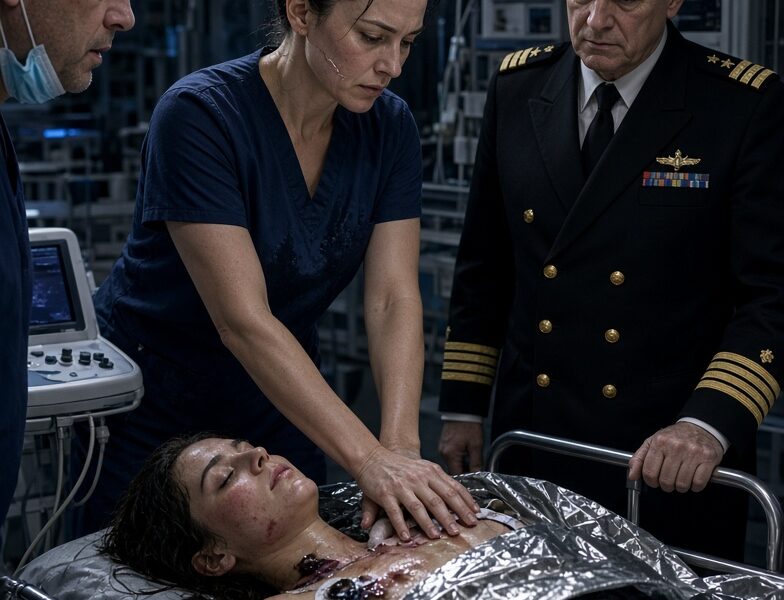
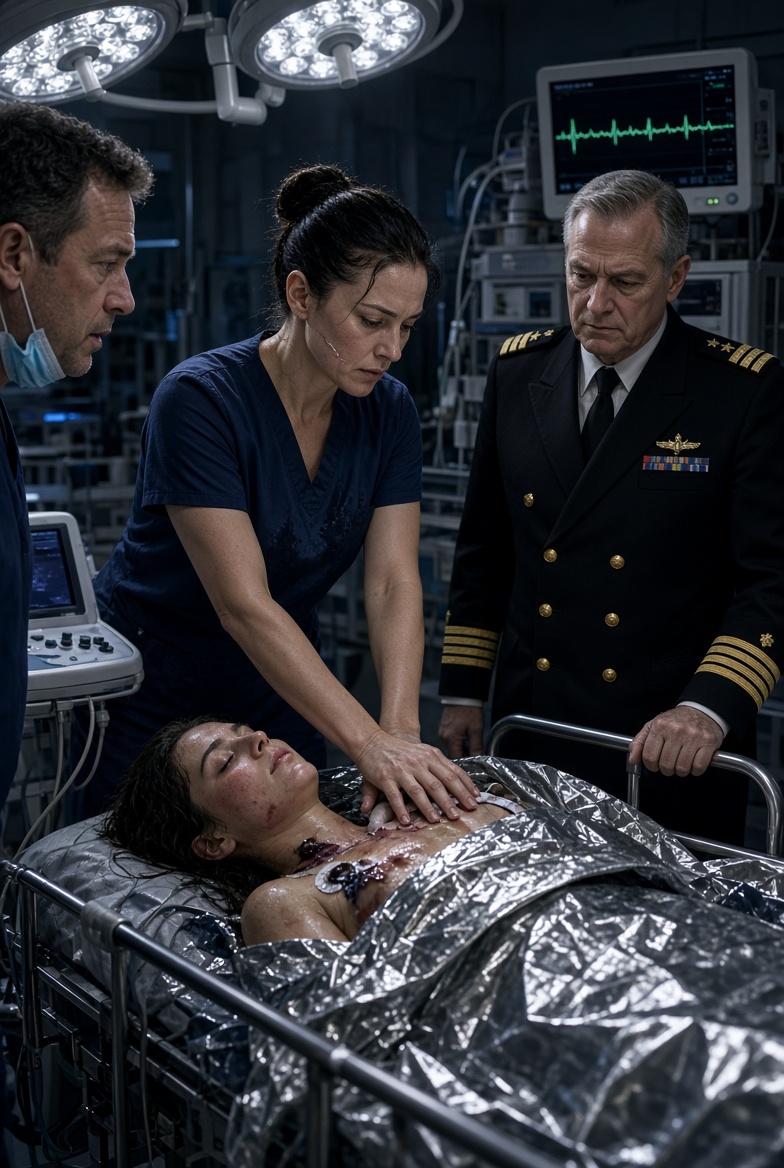
Dr. Malcolm Reed removed his gloves and stepped away from the motionless young woman on the trauma table.
The heart monitor showed a single unbroken line. No pulse, no spontaneous breathing, no cardiac movement on ultrasound.
“After thirty-two minutes of resuscitation, I’m calling it.”
Admiral Rowan Voss stared at him as though the surgeon had spoken in a language he refused to understand.
On the table lay Lieutenant Commander Avery Voss, his only daughter, a naval rescue pilot who had survived combat deployments, hurricane extractions, and night landings in seas that had swallowed larger aircraft.
Now she lay completely still beneath silver warming blankets.
“No,” Rowan said.
Reed lowered his voice. “Admiral, I said no.”
The four silver stars on Rowan’s black uniform flashed beneath the trauma lights as he stepped toward the surgeon.
“You will continue.”
“We have exhausted the protocol.”
“My daughter was alive when they pulled her from the water.”
“She was profoundly hypothermic and had been without a detectable pulse for too long.”
“Then warm her.”
“We did.”
“Do it again.”
“Sir, there is nothing left to restart.”
A voice came from the far side of the room.
“You never looked for what stopped it.”
Everyone turned.
A nurse stood beside the discarded rescue equipment.
Mara Quinn was thirty-five, with dark hair tied into a tight knot and a pale scar running from her left jaw to the edge of her collar.
Her navy scrubs were damp from helping transfer Avery from the Coast Guard stretcher, and she had remained almost silent during the resuscitation, recording medication times and studying the patient instead of the monitor.
Reed’s expression hardened. “Excuse me?”
“You checked whether her heart was moving,” Mara said. “You didn’t finish the army trauma sequence.”
“This is not an army aid station.”
“No. It’s a trauma bay with a patient who crashed into freezing water after a high-impact collision.”
Reed glanced toward two residents, embarrassed that a nurse had challenged him in front of the hospital staff and a four-star admiral.
“We completed advanced cardiac life support twice.”
“That treats the stopped heart,” Mara replied. “It doesn’t always identify what is physically preventing the heart from filling.”
Rowan looked between them. “What does she mean?”
Reed answered before Mara could. “She means she has watched too many battlefield videos and now believes she has found something every physician in this room missed.”
Mara stepped closer to Avery.
“The left side of her chest is barely moving. She was ventilated for more than twenty minutes.”
“Exactly. The airway pressure kept rising.”
“Her lungs were injured in the crash. Her neck veins are full despite no measurable circulation. Her left chest is silent. Her rescue harness crossed high under the arm, and the helicopter struck the water on that side.”
Reed crossed his arms. “You are suggesting a tension pneumothorax in a patient with no pulse and no visible heart movement.”
“I’m suggesting obstructive traumatic arrest.”
One resident quietly looked back at Avery’s chest. Reed noticed.
“Do not encourage this.”
Mara ignored him. “In the army, when a trauma patient appears dead, we restart from the beginning. Massive bleeding, airway, respiration, circulation, hypothermia. We don’t let a flat monitor become the diagnosis.”
Reed laughed once without humor. “You are a civilian nurse in my emergency department. You do not override a board-certified trauma surgeon because you remember an acronym.”
Mara looked directly at him. “I remember the people who died when physicians stopped looking too soon.”
The room went silent.
Reed’s face flushed. “That is enough. Step away from the patient.”
“No.”
The refusal was quiet, but it struck the room harder than the admiral’s shouting had.
Reed moved toward her. “Nurse Quinn, you are interfering with a death pronouncement.”
“You are pronouncing a reversible cause.”
“You have no authority to make that judgment.”
“I am asking you to repeat one assessment.”
“I said, step away.”
Mara reached toward the ultrasound machine, and Reed caught her wrist.
“Security.”
Two hospital officers appeared near the doors, and Rowan watched them move toward her.
Mara turned to him. “Admiral, your daughter may have trapped pressure around her left lung. If it is stopping blood from returning to her heart, she can appear lifeless even while the cause is treatable.”
Rowan’s grief sharpened into anger. “Are you certain?”
“No.” Reed pointed toward the door. “There. She admits it.”
Mara continued. “But I am certain he did not exclude it properly.”
The admiral looked at Reed.
The surgeon spoke with controlled confidence. “We used ultrasound. There was blood around the heart and no meaningful activity.”
“That is not what she asked,” Rowan said.
Reed hesitated.
Mara seized the moment. “Let me repeat the army assessment.”
Reed shook his head. “No. We are not turning this room into a battlefield experiment because a nurse cannot accept an outcome.”
Mara’s expression changed. “You think I can’t accept death?”
“I think you have confused persistence with competence.”
The words landed publicly and deliberately, and several staff members looked away.
Reed continued. “I know your history, Major Quinn.”
Rowan’s attention snapped toward her. “Major?”
Mara remained still.
Reed looked around the room, making sure everyone heard him. “Eight years in army flight medicine. Medically retired after the Archer Station attack. Investigated for abandoning the treatment shelter during evacuation.”
Mara’s face lost color, but her voice remained controlled. “That investigation cleared me.”
“It also ended your military career.”
“I was injured.”
“You left while other medical personnel stayed behind.”
Rowan stared at her. “The Archer Station attack. That was where my wife, Colonel Eliana Voss, died fourteen years earlier.”
His grief turned instantly into recognition. “You were there.”
Mara’s eyes met his. “Yes.”
“My wife stayed.”
“Yes.”
“And you left.”
Mara’s jaw tightened. “I was ordered onto the evacuation helicopter.”
“By whom?”
She did not answer.
Reed gestured toward security. “Remove her.”
Mara took one step toward Avery, and one officer blocked her.
She looked at Rowan, not Reed. “Your daughter does not need you to defend her memory. She needs you to let me check her chest.”
Rowan’s face hardened. “You were with my wife when she died?”
“Yes.”
“And you survived by leaving her behind?”
The accusation cut deeper than Reed’s humiliation.
Mara looked as though she wanted to answer, but something held her back.
“Get her away from my daughter,” Rowan ordered.
Security took Mara by both arms.
They were almost at the sliding doors when a man in a soaked naval flight suit stumbled into the trauma bay.
“Stop.”
Chief Petty Officer Daniel Pike, Avery’s rescue swimmer, had a bandage across his forehead and salt water still drying on his uniform.
A corpsman tried to pull him back, but he shoved past.
“Admiral, stop them.”
Rowan turned. “You should be receiving treatment.”
Pike pointed at Mara. “That’s Major Quinn.”
“We are aware.”
“No, sir, you are not.” Pike looked toward Dr. Reed. “She built the joint cold-water arrest protocol we use at Naval Rescue Command.”
Reed frowned. “That protocol was written by Army medical researchers.”
“She was the lead field instructor.” Pike limped closer. “Avery made every pilot in her squadron memorize Quinn’s reversible arrest sequence. She said if she ever came out of cold water without a pulse, we were not to let anyone stop until the chest causes were cleared.”
Rowan stared at his daughter. “She said that?”
“Every winter exercise.”
Pike reached into a waterproof pocket and removed a folded casualty card.
The paper was soaked, but one line remained visible in thick black marker.
No pulse after immersion. Repeat. Check chest. Clear obstruction before termination.
Below it was Avery’s signature.
Reed took the card, and for the first time, his certainty wavered.
Mara pulled free of the security officer.
“Her airway pressure rose after intubation,” she said. “That is not random. Her left chest stopped moving. That is not random. You have one reversible cause left.”
Reed looked at the monitor. The line remained flat.
Rowan’s voice lowered. “Doctor, perform the assessment.”
Reed did not move.
Mara stepped forward. “Every second you stand there protecting your authority makes the outcome harder to reverse.”
His eyes flashed. “You will not speak to me that way in my department.”
“Then give me a reason not to.”
The challenge hung between them.
A senior anesthesiologist, Dr. Priya Shah, approached the bed and listened again over Avery’s chest.
She frowned. “I have almost no air entry on the left.”
Reed looked at her. “You agree with Quinn?”
“I agree that it has not been excluded.”
The residents began exchanging glances, and the balance in the room shifted.
Reed felt it. “If we intervene after the death has been called and cause injury—”
Rowan moved until he stood directly in front of him. “My daughter signed a medical directive asking you to do exactly what that nurse is requesting.”
“Admiral, medical decisions are not made by rank.”
“Correct.” Rowan turned toward Mara. “Major Quinn, what do you need?”
Mara looked at him for a moment.
Five minutes earlier, he had ordered security to remove her.
Now everyone in the room was waiting for her answer.
“Emergency chest release kit. Ultrasound. Doppler. Continue active warming.”
Reed’s expression tightened. “I am still the attending surgeon.”
Mara met his gaze. “Then attend.”
Priya hid the briefest flicker of satisfaction.
A resident placed the equipment in Mara’s hands.
Reed remained at the foot of the bed. “If this fails, the responsibility is yours.”
“No,” Mara said. “The responsibility belongs to everyone the moment she arrived.”
She checked the left side once more.
Avery showed no movement, no pulse, no response.
Mara looked toward Priya. “Hold ventilation.”
The room became unnaturally quiet.
Mara performed the emergency pressure release procedure beneath the edge of the drape.
For half a second, nothing happened.
Then a sharp rush of trapped air escaped.
The ventilator pressure dropped instantly.
Priya’s eyes widened. “Resistance is falling.”
A single narrow spike appeared on the monitor.
Everyone froze.
Then a second spike.
The resident nearest Avery’s neck pressed for a pulse. “I don’t feel anything.”
“Use Doppler,” Mara ordered. “Cold patients lie to your fingers.”
The device was placed against Avery’s neck.
Static filled the room.
Then came a faint, rhythmic sound.
Slow, weak, but unmistakably present.
Blood was moving.
Priya placed the ultrasound probe against Avery’s chest, and her face changed. “I have cardiac motion.”
Rowan gripped the rail.
“A pulse,” Priya said. “Barely. But yes.”
The monitor produced another beat.
Then another.
Reed stared at the screen.
Mara did not celebrate. “Continue warming. Warmed blood only. Prepare a chest drain. Call cardiothoracic surgery and activate extracorporeal support.”
One resident looked toward Reed for confirmation.
The surgeon said nothing.
Mara raised her voice. “Move.”
The room exploded back into action.
A nurse contacted the operating room, another adjusted the warming machine, and Priya called for medication and blood products.
Dr. Reed remained still.
Mara turned toward him. “Doctor, she needs a formal chest drain and surgical evaluation.”
He looked at the people moving under her direction, then at the heart he had declared finished.
His voice was quiet. “You heard her. Follow Nurse Quinn’s orders.”
It was the first public reversal, but it would not be the last.
Dr. Soren Hale, chief of cardiothoracic surgery, arrived minutes later.
He studied the imaging and listened to Mara’s report.
“Traumatic tension physiology after immersion,” he said. “Good diagnosis.”
Reed adjusted his coat. “We were about to reassess.”
Priya looked at him. “No, we were not.”
The words were simple and devastating.
Hale turned toward Mara. “How long was she without detectable circulation?”
“Approximately thirty-five minutes with continuous support and severe hypothermia.”
“Then the cold may have protected her brain.”
Rowan stepped forward. “Can you save her?”
“We have a chance because Nurse Quinn found the obstruction.” He pointed toward the surgical doors. “We are moving now.”
The team began pushing Avery away, and Rowan followed.
A surgical nurse stopped him at the restricted line. “You cannot enter, Admiral.”
He looked toward Mara. “Stay with her.”
Reed spoke immediately. “She is not part of the operating team.”
Hale looked at him. “She found the diagnosis you missed. She is part of my team tonight.”
Mara walked through the doors without looking back.
Rowan remained outside, staring after her.
Three hours earlier, he would not have known her name.
Thirty minutes earlier, he had ordered her dragged from the room.
Now his daughter’s life depended on the woman he had publicly accused of abandoning his wife.
The operation lasted nearly four hours.
Avery had suffered a damaged lung and a torn vessel beneath the collarbone.
The cold had slowed her body enough to preserve what little circulation remained, but it had also made her heart dangerously unstable.
The surgical team repaired the vessel and placed her on temporary mechanical support while she was slowly rewarmed.
Mara stayed through every stage.
At 2:46 in the morning, Dr. Hale entered the waiting room.
Rowan rose.
“Your daughter is alive.”
The admiral closed his eyes.
Hale continued. “Her heart is beating independently. She remains critically ill and we cannot yet predict neurological recovery, but the surgery was successful.”
Rowan released a breath that trembled despite his effort to control it. “When can I see her?”
“Soon.” He looked behind the surgeon. “Where is Major Quinn?”
Hale’s expression became guarded. “Hospital administration has removed her from duty.”
Rowan stared at him. “For what?”
“Performing an invasive procedure outside her civilian nursing scope.”
“You authorized it.”
“Doctor Reed claims she acted before formal authorization was documented.”
“That is a lie.”
“It is also the version currently being sent to the medical director.”
Rowan’s face became cold. “Where is she?”
“In an administrative conference room.”
Mara sat alone at one end of a polished table, still wearing the scrubs in which she had saved Avery.
Across from her sat Dr. Reed, hospital administrator Gerald Wynn, and two legal advisers.
Wynn folded his hands. “Nurse Quinn, no one disputes that Lieutenant Commander Voss regained circulation.”
“That sounds like something you are about to dispute.”
“This is not the time for sarcasm.”
“It is nearly three in the morning. I have already been called incompetent, a deserter, and a danger to patients. Sarcasm is what I have left.”
Reed leaned forward. “You performed a procedure after I had pronounced the patient dead.”
“You pronounced her too soon.”
“You cannot override an attending physician.”
“I asked you to reassess. You refused.”
“You refused to leave because your patient still had a treatable condition.”
Wynn raised a hand. “The outcome does not erase the violation.”
“The outcome is a living woman.”
“The hospital cannot operate according to battlefield improvisation.”
Mara’s eyes hardened. “That battlefield improvisation is taught in military trauma programs because it works.”
“You are not in the military anymore.”
“No. The army retired me after I was injured saving people who later allowed men like Dr. Reed to call me a coward.”
Reed’s expression sharpened. “You were removed from Archer Station on the first helicopter.”
“Because Colonel Voss ordered it.”
Wynn exchanged a glance with the lawyers. “Regardless, your employment is suspended immediately. The nursing board will be notified, and termination is likely.”
Mara leaned back. “Dr. Reed declared a living patient dead. Will you notify the medical board about that?”
Reed stood. “You insubordinate—”
The conference room doors opened.
Admiral Rowan Voss entered.
He was no longer the frightened father from the trauma bay.
The four-star commander had returned.
Behind him stood Dr. Hale, Dr. Priya Shah, Chief Petty Officer Pike, and three uniformed officers from Naval Medical Command.
Wynn rose quickly. “Admiral, this is a confidential personnel matter.”
“No,” Rowan said. “This is an attempted cover-up involving the near death of a United States naval officer.”
Reed stood as well. “Sir, Nurse Quinn performed an unauthorized—”
“Sit down.”
Rowan did not shout.
He did not need to.
Reed slowly returned to his chair.
The admiral placed Avery’s signed casualty card on the table.
“My daughter carried written instructions based on Major Quinn’s joint service protocol. Chief Pike informed your staff of those instructions. Dr. Shah confirmed the missing clinical signs. Nurse Quinn requested reassessment repeatedly.”
He looked at Reed.
“You refused because accepting her concern would have required you to admit that a nurse might understand a battlefield injury better than you.”
Reed’s face reddened. “That is not what happened.”
Priya stepped forward. “That is exactly what happened.”
Wynn looked toward her. “Dr. Shaw, be careful.”
“I am being careful. I watched Dr. Reed order security to remove the person who identified the reversible cause. I watched him declare the patient dead without completing the trauma reassessment, and after circulation returned, I watched him pretend he had been about to reach the same conclusion.”
Reed looked around the room, and no one met his eyes.
Rowan turned toward Wynn. “If Nurse Quinn’s license is threatened, I will submit sworn testimony to the state board, Naval Medical Command, and every federal body that funds this institution.”
Wynn swallowed. “Admiral, threats are unnecessary.”
“It is not a threat. It is the sequence of events that will begin at sunrise.”
One of the uniformed officers placed a sealed folder on the table.
“Naval Medical Command has already initiated a clinical review,” she said. “Major Quinn is listed as the creator of the cold-water reversible arrest module currently used by rescue squadrons on both coasts.”
Reed stared at Mara. “Major?”
The officer nodded. “Her promotion was approved after her medical retirement. She never wore the rank because she left military service before the ceremony.”
Rowan looked at Mara. “You knew?”
“I received the letter and never used the title. I did not need it to treat patients.”
The answer humiliated Reed more completely than any insult could.
He had tried to reduce her to just a nurse.
She had possessed the credentials he respected and never felt the need to display them.
Rowan faced the administrator again. “Her suspension is over.”
Wynn hesitated. “Employment decisions are not yours to make.”
Dr. Hale stepped forward. “Then I will make mine. If Nurse Quinn is terminated, I resign as chief of cardiothoracic surgery.”
Priya moved beside him. “So do I.”
Two senior nurses who had appeared in the doorway added their voices. “Then you will need a new trauma nursing team as well.”
Wynn looked around the room.
The public reversal was complete.
The woman security had dragged away was now the person the hospital could not afford to lose.
Wynn removed his glasses. “The suspension will be withdrawn pending review.”
“No,” Mara said.
Everyone turned toward her.
She stood. “I will not return under a cloud created to protect Dr. Reed.”
Reed pushed his chair back. “This is absurd.”
Mara faced him. “You told a room full of people that I abandoned Colonel Voss. You used a dead woman and the worst day of my life to silence me.”
Rowan’s expression changed. “You still have not told me what happened at Archer.”
Mara looked at him, and for the first time that night, uncertainty entered her face. “Not here.”
The admiral held up the Army Medical Corps insignia that had been removed from Avery before surgery.
“My daughter has worn this since her mother’s funeral. The initials belong to Eliana.”
Mara stared at it.
Rowan continued. “You recognized it in the trauma bay.”
“Yes.”
“How?”
The room fell silent again.
Mara reached beneath her scrub collar and pulled out a second bronze insignia, scratched and darkened by age.
The initials on the back were MQ.
“Your wife had two made,” Mara said. “One for Avery. One for me.”
Rowan looked from one emblem to the other. “She gave you that at Archer Station.”
Reed began gathering his papers.
Rowan’s voice stopped him. “You wanted everyone to hear about Major Quinn’s history. You will remain and hear the truth.”
Reed froze.
Mara’s fingers closed around the insignia.
“The attack began before dawn,” she said. “We had thirty-two casualties and one evacuation helicopter. The treatment shelter had partially collapsed. I had fragments in my shoulder and face. I could barely see.”
She touched the scar along her jaw.
“Eliana placed me on the first aircraft.”
Rowan’s voice tightened. “She stayed behind.”
“Yes.”
“You could have refused.”
“I did.” Mara looked directly at him. “I tried to climb off the helicopter. Your wife struck my injured shoulder hard enough to put me back on the floor.”
A faint, broken smile crossed Rowan’s face. “That sounds like Eliana.”
“She told the crew chief I was carrying the casualty records. That was not true. She just knew they would not remove a conscious medic unless she made me mission essential.”
“Why did she choose you?”
“She said I was going to become a flight nurse and spend the rest of my career arguing with arrogant doctors.”
Priya glanced at Reed, and no one smiled.
Mara continued. “The helicopter was overloaded. Every other person aboard would have died within the hour without surgery. Eliana knew there was no room for her.”
Rowan’s voice became rough. “She could have ordered someone else off.”
“She could have.”
“Why didn’t she?”
“Because she was the only person on that aircraft who still had a reasonable chance of surviving until the second evacuation.”
“But the second aircraft never came.”
“No.”
Mara lowered her eyes. “Before the doors closed, she gave me these insignias. She told me one was for Avery. She made me promise to tell your daughter that courage was not being unafraid.”
Rowan gripped the back of a chair. “What was it?”
“Choosing what mattered more than your fear.”
His face tightened.
Mara looked at the insignia. “The official report said I abandoned the treatment shelter because the army did not want anyone asking why the only trauma surgeon remained behind while a junior medic was evacuated. Eliana’s order was omitted.”
“Why?”
“Because she had changed the manifest herself. On paper, it looked like I took her seat.”
Rowan stared at her. “You accepted that?”
“I was unconscious for most of the flight. By the time I could speak, the report had already been written.”
“You could have challenged it.”
“I did. Quietly.”
“Why quietly?”
Mara’s eyes filled, but her voice remained firm. “Because Eliana’s final message was for Avery, not for a military investigation. She did not want her daughter’s last memory to be a courtroom argument over who deserved the seat.”
Rowan lowered his head. “I told Avery her mother chose duty over her.”
Mara’s expression sharpened. “No. Eliana chose thirty-one wounded people while loving Avery every second she stayed.”
The words struck him visibly.
For years, Rowan had treated his wife’s final choice as abandonment.
That belief had poisoned every argument with his daughter.
He had tried to stop Avery from becoming a rescue pilot because he could not bear to watch her resemble the woman he had lost.
Now Eliana’s training had returned through Mara and saved Avery’s life.
Rowan looked toward Reed. “You called her a deserter?”
Reed said nothing.
“You used a false report to humiliate the woman my wife selected to carry her final message.”
“I did not know.”
“You did not ask.”
Reed’s face collapsed under the same truth he had denied in the trauma bay.
Mara picked up her jacket. “I am going to the ICU.”
Wynn stood. “Your employment can wait.”
No one stopped her.
Avery remained unconscious until late the following afternoon.
Rowan sat beside her holding the army insignia against his palm.
Mara stood near the doorway when Avery’s eyelids finally moved.
The ventilator had been removed, and oxygen flowed through a small mask.
“Avery?” Rowan whispered.
Her eyes opened.
They found her father first, then Mara.
Avery’s lips moved weakly. “Did they stop?”
Mara approached the bed. “They tried.”
Avery looked at her father. “Did she make them look again?”
Rowan nodded. “She made all of us look again.”
Avery’s fingers moved across the blanket, and Rowan placed the insignia in her hand.
“Your mother gave this to Mara at Archer Station.”
Avery looked toward Mara. “You finally told him?”
“He was unusually difficult to avoid.”
Avery almost smiled.
Rowan’s eyes filled. “I spent fourteen years believing your mother chose everyone else instead of us.”
Avery watched him.
“I used that belief to punish you for becoming like her.” His voice broke. “I called your courage recklessness because I was afraid. I made my fear sound like wisdom.”
Avery closed her fingers around the insignia. “I knew.”
The simple answer hurt more than anger would have.
Rowan bowed his head. “I am sorry.”
After a moment, Avery lifted her hand, and her father took it.
Three days later, Dr. Reed entered her ICU room.
Mara was adjusting the monitoring equipment, and Rowan sat beside the window.
Reed stopped several feet from the bed. “I came to apologize.”
Mara did not respond.
He looked toward Avery. “Lieutenant Commander, I ended your resuscitation too early. Nurse Quinn challenged me, and instead of examining the evidence, I defended my authority.”
Avery’s voice remained weak. “Would you have listened if she were a doctor?”
Reed hesitated.
“That hesitation is your answer,” Mara said.
He lowered his eyes. “I have requested temporary removal from trauma leadership while the review is completed.”
Rowan studied him. “Requested?”
“Dr. Hale informed me it was that or immediate resignation.”
Avery looked toward Mara. “Instant improvement.”
Reed accepted the humiliation. “I deserved that.”
He turned to Mara. “I used Archer Station against you because I wanted the room to stop questioning me. It was cruel, and it endangered the patient.”
Mara held his gaze. “An apology does not restore trust.”
“I know.”
“You rebuild it by listening the next time someone lower in the hierarchy sees something you missed.”
Reed nodded. “I will.”
She did not forgive him immediately.
That made the apology real.
Six months later, more than two hundred military and civilian clinicians gathered at Harbor Point Naval Medical Center.
A new training center had been created to teach teams how to identify reversible causes in apparently hopeless trauma cases.
Its first course focused on immersion injuries, chest obstruction, prolonged resuscitation, and hypothermia.
The program carried one name, the Colonel Eliana Voss Reversible Arrest Initiative.
Avery entered the auditorium using a cane.
She had not yet returned to flight duty, but her doctors expected a full recovery.
Rowan walked beside her.
Mara stood at the front in navy scrubs, refusing the formal uniform Naval Medical Command had offered for the ceremony.
Dr. Reed sat in the second row among the students.
He had returned to clinical work, but no longer introduced himself as the smartest person in the room, and during simulations he was often the first to ask nurses and medics what they saw.
Rowan stepped to the lectern.
“My daughter’s heart appeared to have stopped,” he said. “The most senior physician in the room accepted the first answer. Major Mara Quinn did not.”
He looked at Mara.
“I ordered her removed. I accused her of abandoning my wife. I allowed rank and grief to make me cruel.”
The room remained completely silent.
“She saved my daughter anyway.”
Rowan left the lectern and walked toward her.
Four silver stars still rested on his shoulders, but for once they were not the most important symbol in the room.
He raised his hand in a formal salute.
Mara looked at Avery, and Avery nodded.
Mara returned the salute.
The audience rose.
The applause began with the rescue swimmers, then spread through the nurses, medics, physicians, and officers until it filled the auditorium.
Mara had been dragged from a trauma bay as an insubordinate nurse.
Now the same institution stood because she had refused to let authority pronounce a living woman dead.
After the ceremony, Avery joined her near a large photograph of Eliana.
“My mother would have hated this picture,” Avery said.
“Why?”
“She said official photographs made her look like she was about to discipline someone.” A pause. “She usually was.”
Rowan approached them. “The Navy wants Major Quinn to direct the program.”
Mara folded her arms. “The Navy wants many things.”
“They included funding, a research team, and authority to rewrite joint trauma standards. That last part is suspiciously attractive.”
Avery smiled. “You should accept.”
Mara looked at Eliana’s photograph.
Fourteen years earlier, she had left Archer Station believing survival was a debt she could never repay.
Now the lesson Eliana had given her had crossed years, uniforms, and grief to save the woman’s own daughter.
“When do I begin?” Mara asked.
Rowan’s expression softened. “Monday.”
She nodded toward Avery. “Then make sure the admiral arrives early. He has a history of missing important signs.”
Avery laughed, and even Rowan smiled.
The monitor had shown no pulse.
The ultrasound had shown almost no movement.
The leading surgeon had said there was nothing left to do.
But one nurse remembered the army rule that had been taught to her by a physician who refused to accept easy answers.
When trauma makes a patient appear dead, start again.
Check what everyone believes has already been checked.
Search for the thing preventing life before deciding life is gone.
Mara Quinn did not bring Avery Voss back with a miracle.
She brought her back by refusing to let pride become the final diagnosis.
The insignia was the thing, and the thing was the insignia, and the insignia was a small bronze emblem with two sets of initials that a dying woman had pressed into a young medic’s hand so her daughter would know what courage actually was.
The insignia was the thing.
The insignia is always the thing.









