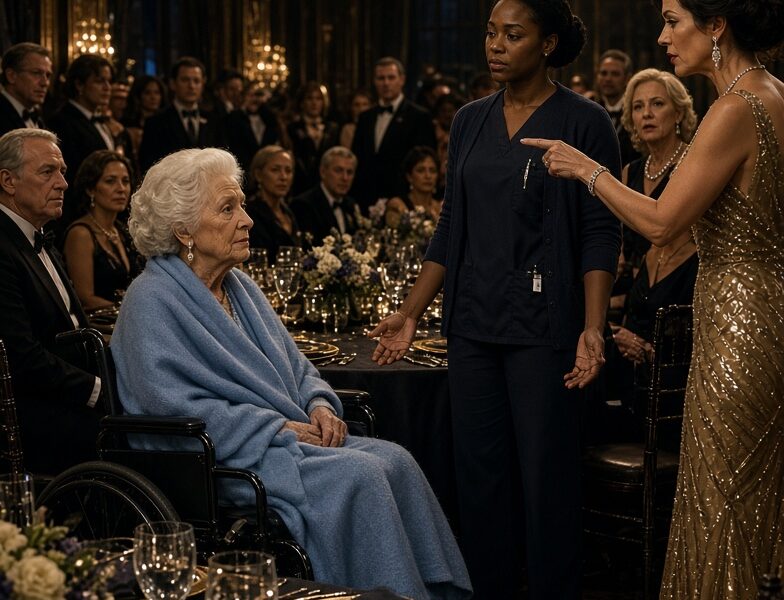
She Was Accused of Stealing Mama’s Emerald Ring at the Gala — Then the Old Woman Spoke
Before the toast, one small matter.
Mama’s emerald ring is missing.
The room went quiet the way a room does when the music stops and nobody has told the guests yet, and every head in the Ashcroft ballroom turned toward the woman in gold at the head table.
“Our night nurse was the last one in her room tonight,” Margo Ashcroft said, and she said it sweetly, the way you say a thing you have already decided.
“Mrs. Ashcroft, I have never taken anything from her,” Imani Wells said.
“Then turn out your cardigan pockets.”
“Of course.” Imani turned them out, one at a time, and there was nothing in them but a pen and a folded pair of gloves. “I have nothing to hide.”
“She gave it to me tonight,” Imani said. “She asked me to keep it safe for her family.”
“Mama,” Margo said, turning to the old woman in the wheelchair at the center of the table, “did you give this woman your ring?”
May Ashcroft looked up, and her eyes moved slowly across the room, and she said, “I—I do not remember.”
“It is all right, Mrs. May,” Imani said.
“She takes advantage of a confused old woman,” Margo said.
“Ask her in the morning,” May said, and her voice was clear and certain. “Mornings are hers.”
The ballroom laughed, a nervous little ripple of it, and Margo’s smile did not move.
“Now you finally look dressed for the gala,” she said to Imani, and somebody near the bar laughed louder than the joke deserved.
“Stop it,” May said. “Stop it.”
“Margo, that is enough,” Preston Ashcroft said, and his wife turned on him with a look that could have stripped paint.
“Hush, Mama. And you stay out of this, Preston.” She turned back to Imani. “Miss Wells, you are dismissed, effective tonight.”
“Yes, Dr. Voss,” Imani said, because Dr. Voss was standing right there, and Dr. Voss was the one who had signed the order.
“Dr. Voss, she has not missed one night in a whole year,” a nurse named Reyes said.
“Then she can miss this one, Nurse Reyes.”
“Good night, Mrs. May,” Imani said. “Your tea is on the second shelf.”
“Where are you going?”
“Kurt, see her out.”
“No need,” Imani said. “I know the way out.”
“And do not come back to this wing.”
“Imani.”
The old woman said my name, Imani thought, and she said it in the middle of a ballroom, and nobody heard it but me.
“Now,” Margo said, lifting her glass. “Where were we? Ah, yes. To family. To the Ashcroft family.”
“Kurt, please,” a young woman at the far end of the table said, and her name was Talia, and she was Preston and Margo’s daughter. “Let me go after her.”
“Orders, Talia,” Kurt said. “I am sorry.”
Imani walked out through the service door with her coat over her arm, and the cold hit her like a wall.
She was halfway down the granite steps when a small voice stopped her.
“Amara? What happened to you?”
It was a little girl in a blue dress, standing by the valet stand with her hands wrapped around the strap of her mother’s purse, and her name was Amara, and she was six years old.
“A woman in gold happened to me,” Imani said.
“The Ashcroft gala?”
“Ashcroft,” the girl’s mother said, and her name was Talia, and she had come down the steps after all. “Mrs. May gave me her ring, Daddy. And then she could not remember.”
“Then you remember for her,” said the man by the truck.
He was tall and broad with a short dark beard and a canvas coat, and his name was Desmond, and he was a mechanic, and he had the hands of a man who fixed things.
“She will not sleep without this tonight,” Amara said, and she held up a folded blue blanket.
“Who is Emma, Daddy?” the girl asked. “Mommy always said a stranger left it on our door.”
“Long story,” Desmond said. “Get some sleep, Mama.”
In the house on the hill, the party went on.
“Did you catch the nurse’s expression?” Margo said, laughing, to the woman beside her. “Priceless.”
“My mother was crying, Margo,” Preston said.
“Your mother was confused. That is the point.” Margo set down her glass. “Thursday night, Dr. Brandt signs her competency report. Friday, the will reading. And this is the will Mama is going to have signed.”
She slid a page across the table, and Preston looked at it, and his face changed.
“That is not her signature.”
“It will be.”
“And the nurse? You know she did not take that ring.”
“I watched Mama press it into her hand in the hallway,” Talia said quietly.
“I could not have planned it better,” Margo said. “And find out where that blue blanket is from. Mama will not close her eyes without it.”
“Why does it matter?”
“Because Mama looks at it the way she never looks at us.”
“What are we doing, Margo?”
“Winning, darling.”
Three million strangers think I am a thief, Imani thought, watching the video on her phone in her kitchen at two in the morning, and the comments scrolled past her eyes like a river she could not stop.
“Turn it off, sweetheart,” her mother said from the doorway.
“Dr. Voss moved me to days for defending a thief,” Imani said. “I’ll tell you what she said. She said, because of me. Because of her. Mrs. May keeps asking for her night nurse every single day, and they moved me off that wing.”
“I still have nights on Wednesday,” her mother said. “The garage elevator does not have a camera.”
“I will drive you. I will wait downstairs.”
“You never come up to the Aspen wing?”
“Downstairs, Imani. That is as far as I go.”
“Bring the blanket,” her mother said. “She asks for it, too.”
“It never leaves my bag.”
“Ten minutes. The boss checks cameras at six.”
“Ten minutes is enough.”
“Go. I will watch the elevator.”
The corridor was dim and smelled of lemon polish and old roses, and Imani walked it the way she had walked it for a year, every night, at the same hour, with the same soft knock.
“You found your way back,” May Ashcroft said.
“I promised I would read you the ending.”
The old woman laughed, and then she looked at the blue blanket in Imani’s hands, and her face changed.
“I knitted one like this once,” May said. “For a grandchild I never got to hold.”
“I gave you my ring, didn’t I?”
“Yes, Mrs. May.”
“I gave it to you because you are family. I just could not find the word.”
The room was quiet for a moment, and the old woman’s eyes were clear and steady in the lamplight.
“Thirty years ago, I sent my son away for loving a woman I thought was not good enough.” Her voice did not shake. “I was the one not good enough.”
“What was his name?”
“I have not said it out loud in thirty years. Second drawer. The note on top, not the letters underneath.”
She pointed, and Imani opened the drawer, and there was a bundle of letters tied with a purple ribbon, and on top of them a single sealed note.
“Take that to Lenora Vance,” May said. “Only to Lenora.”
“What is in it?”
“The morning I have been waiting for.”
The door opened, and Dr. Voss stood there with her clipboard and her thin, tired face.
“The quick one,” Dr. Voss said, looking at the note in Imani’s hand. “Where did this come from?”
“I knitted it,” May said.
“Of course you did.”
“I am not as confused as they want me to be.”
Dr. Voss laughed, and then she stopped laughing, because the old woman was looking at her with the clear eyes of a woman who had been playing a long game and had just decided to stop playing.
“Mrs. May, you had me fooled, too.”
“She sent me to a lawyer,” Imani said. “Lenora Vance.”
“Lenora? She is on her way down?”
“Talia called her. Six o’clock.”
“I need to check the other bay,” Dr. Voss said, and she left.
“She wants a new will,” Imani said. “Witnessed in the morning, before Friday. Mrs. Ashcroft has not trusted anyone like this in thirty years.”
“I only read her books at night,” a nurse said from the doorway, and it was Reyes, and she was looking at the blue blanket in Imani’s hands.
“Where did you get that?”
“I have had it since the day I was born. My mother said it was from a stranger.”
“Keep it close, Ms. Wells,” Lenora Vance said, and she had come in through the door behind Reyes with her coat still on and her briefcase in her hand.
“It cannot be,” Imani said.
“Mrs. Vance, is everything all right?”
“Nine o’clock upstairs, Ms. Wells. Bring the blanket.”
“Well, the thief is back for the rest,” Margo said from the corridor, and she had come down with Kurt and two of the board members behind her.
“Ms. Wells is here at my request, Mrs. Ashcroft,” Lenora said.
“Your request does not run this hospital. Dr. Voss does.”
“Hospital property? That is mine.”
“Nothing in this wing is yours.”
“That is enough,” Lenora said. “Nurse Reyes, you are suspended. Hand me your badge.”
“Worth it.”
“That is mine. Give it back.”
“You see?” Margo said, turning to the board members. “She thinks everything is hers.”
“She is right,” Lenora said. “Tonight it is hers.”
“Kurt,” Margo said.
“We will see you Friday, Mrs. Ashcroft,” Kurt said, and he took Margo’s arm and steered her toward the elevator.
“Bring a better lawyer,” Margo said over her shoulder.
The garage was cold and smelled of oil and old concrete, and Desmond was under the hood of the truck when the woman in the gray coat walked up.
“Someone said the mechanic here fixes anything,” Talia said.
“Depends what is broken.”
“My mother keeps asking for her night nurse. I think we did something wrong.”
“Then fix it.”
“My wife does not let me fix things.”
“Then you were never really trying.” Desmond straightened up and looked at her, and something in his face changed. “Have we met? You have my father’s hands.”
“Lot of men have hands like these.”
“Dad. Who made this?” Amara said, holding up the blue blanket.
“Your grandmother.”
“You told me we had no family.”
“I told you I left my family. That is not the same thing.”
“Was she kind? Is she still out there?”
“She was proud. Pride is not the same as cruel. It took me thirty years to learn that.” Desmond wiped his hands on a rag. “Ask me after Friday.”
“Mrs. Ashcroft will not pass your evaluation,” Margo said to Dr. Brandt on Thursday night, in the corridor outside the Aspen wing.
“I examine at nine in the morning,” Dr. Brandt said.
“Examine her at eleven at night. She’s never herself at night.”
The door opened, and May Ashcroft sat in her chair with the blue blanket over her knees, and she looked up at the doctor with eyes that were entirely present.
“Mrs. Ashcroft, what day is it today?”
“Is it the gala? Write that down, Doctor.”
“Do you know who these people are?”
“You are the one in gold. You are my youngest.” She turned her head. “Where is my night nurse? She knows where I keep my words.”
“Thank you, Doctor,” Margo said, and she took the clipboard. “Signed and dated. Not competent.”
“Preston, where is your brother?”
“Mama, he has been gone thirty years.”
“Then why do I hear his truck every night?”
They chose the hour she loses, Imani thought, standing in the doorway where nobody could see her, and she said it out loud before she could stop herself.
“Then they do not know her mornings.”
Friday at ten in the morning, the boardroom of the Ashcroft Foundation was full, and the long table was polished to a mirror, and every chair was taken.
“We are here for the last will and testament of May Ashcroft,” the chairman said.
“Before you begin, the board should read Dr. Brandt’s report,” Margo said, sliding a page across the table. “Mama was declared not competent on Thursday. Anything she signed this spring means nothing.”
“Noted, Mrs. Ashcroft.”
“Mrs. Ashcroft signed her new will on Wednesday,” Lenora Vance said, and she stood up with a folder in her hand. “At nine in the morning. Ten minutes after you left the ward. Two of Dr. Voss’s own nurses signed as witnesses.”
The room went quiet.
“To the woman who sat with me every night when my own family did not,” Lenora read. “Imani Wells, I leave the Ashcroft wing and my seat on this board.”
The collective gasp around the table was almost musical.
“Why me?” Imani said, and she was on her feet without knowing it. “She took the ring. Now she takes everything.”
“And this is Mama’s real will,” Margo said, slapping a second folder on the table. “Dated last Thursday. Signed in front of Dr. Brandt.”
The chairman opened it, and he looked at it for a long moment, and then he looked at Lenora.
“I do not want her money,” Imani said. “I only ever wanted her to sleep.”
“Pretty words.” Margo turned. “Kurt. She is done here.”
“Stand down, Kurt,” Lenora said, and Kurt stood down.
“Mama,” Margo said, turning to the old woman in the wheelchair at the head of the table, “tell them. Do you even know this woman?”
May Ashcroft looked at Imani, and her eyes were clear.
“I—”
“It is me, Mrs. May. Your night nurse.”
“She does not know you, Ms. Wells. She never did.”
The door at the back of the boardroom opened, and a man in a canvas coat walked in with a folded blue blanket under his arm.
“Daddy?” Amara said, and she was sitting on the bench by the window with her hands in her lap. “What are you doing here?”
“Who let the mechanic in?”
“The mechanic with father’s hands,” Talia said, and her voice was very quiet.
May Ashcroft turned her head, and she looked at the man in the canvas coat, and her face came apart and came together at the same time.
“Oh Lord,” she said. “Thirty years.”
“Preston, who is he?”
“I am here,” Desmond said.
“Daddy? You know her?”
“Desmond?” May said, and she said the name the way a woman says a word she has been keeping in a drawer for thirty years.
The boardroom went absolutely still.
“Grandma,” Amara said, and she stood up and walked across the polished floor with the blue blanket in her hands, and she held it out. “You made this.”
May took the blanket, and she turned it over, and she found the little crooked corner where the yarn had been tied off, and she began to cry.
“I knitted one like this once,” she said. “For a grandchild I never got to hold.”
“You held me,” Desmond said. “You held me every night until I was six years old, and then you sent my father away, and then you sent me away, and I have been parking my truck under this wing for eleven years because I did not know how to come inside.”
The room was silent.
“I am not as confused as they want me to be,” May said, and she looked at Margo. “I signed the will on Wednesday morning. I signed it in front of two nurses. And I signed it in front of Lenora, because Lenora is the only lawyer in this city who never once asked me what I wanted to hear.”
“Dr. Brandt’s report—” Margo started.
“Dr. Brandt examined me at eleven at night, when I am tired and my words go wandering,” May said. “He should have examined me at nine in the morning. Mornings are mine.”
The chairman looked at the two wills on the table, and he looked at Lenora, and he looked at the old woman in the wheelchair.
“The board will need time to review—”
“The board will need to read the note,” May said. “The one in the second drawer. The one I wrote thirty years ago and never sent.”
Lenora opened the sealed note, and she read it aloud, and it was three sentences long.
I was wrong about the woman my son loved. I was wrong about the way I said it. If anyone ever reads this, tell him his mother was the one who was not good enough.
“Mrs. Ashcroft,” the chairman said, and his voice had changed. “The board accepts the will of Wednesday morning as the valid instrument.”
Margo Ashcroft sat down slowly, and her face was the face of a woman who had played a long game and had just watched the board flip.
“Kurt,” she said.
“Mrs. Ashcroft,” Kurt said, and he did not move.
“Kurt.”
“I am not your security anymore, Mrs. Ashcroft. I am the foundation’s.”
The room emptied slowly, and the board members shook Imani’s hand one by one, and Talia sat down beside her father and did not say anything for a long time.
“I am sorry,” she said finally. “For the ring. For the video. For all of it.”
“The ring was never stolen,” Imani said, and she reached into her pocket and took it out. “She gave it to me. She asked me to keep it safe for her family.”
“You kept it safe,” May said. “That is all I ever asked of anybody.”
Desmond knelt beside the wheelchair, and he took his mother’s hand, and he was a large man and he cried the way large men cry, quietly and with his whole body.
“I parked under this wing for eleven years,” he said. “I fixed the elevator in the east garage. I fixed the boiler. I fixed the ramp on the south entrance. I did every repair this building needed because I did not know how to knock on the door.”
“You knocked,” May said. “You knocked every night at nine o’clock. I heard the truck. I heard it, and I told myself it was the wind.”
“It was not the wind.”
“No,” she said. “It was never the wind.”
The blue blanket was the thing, and the thing was the blanket, and the blanket was a square of blue yarn with a crooked corner that a proud woman had knitted for a grandchild she was not allowed to hold.
The blanket was the thing.
The blanket is always the thing.









