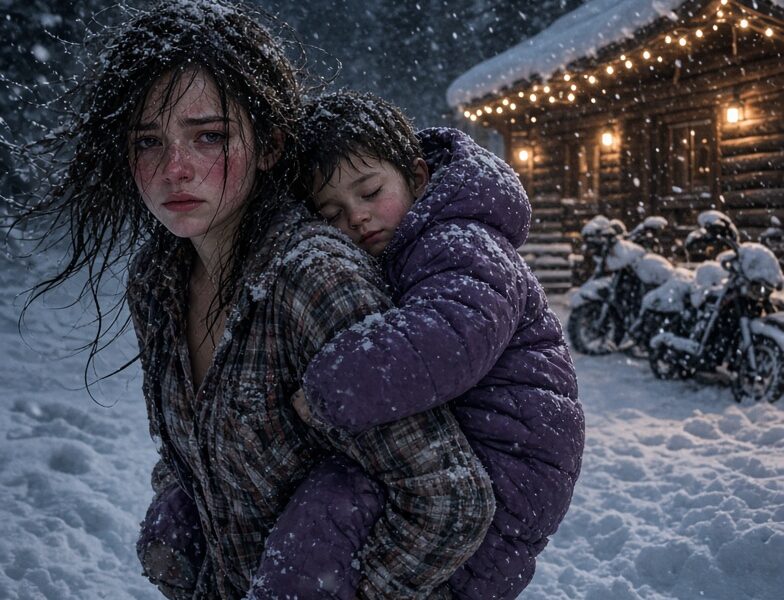
She Was 13, Homeless, and Carrying a Frozen 5-Year-Old Through the Blizzard — What Happened Next Brought 300 Bikers
She was 13 years old, and she had not eaten a full meal in days.
Every man in that lot wore the same cracked leather, the same ink up thick forearms, the same silence that made strangers cross the street.
Every one of them had already decided what a girl who smelled of woodsmoke and slept somewhere nobody could find was worth.
Every one of them was about to be wrong.
Two miles back, in snow deep enough to swallow a boot, she had found a 5-year-old boy who belonged to one of them, already past shivering, already circling the quiet that comes right before a small body gives up.
She carried him anyway.
What happened at that door in the next 4 minutes would bring 300 motorcycles up that highway.
But first, someone inside had to open it.
Frost had crept up the inside of the tent wall again, tracing the same crooked pattern above the place where Ivy Coulter slept, and she woke the way she woke every morning that winter—counting backward from the sound of her own breath to make sure it was still there before she let herself move.
4:30, maybe 5.
She didn’t own a watch that worked anymore.
But two winters of waking in the dark had taught her to feel the hour in her bones, the way other kids felt whether it was a school day.
She was 13 years old, and she had gotten very good at being quiet.
Beside her, under three sleeping bags zipped into one lumpy nest, her mother, Dela Coulter, still slept, one arm flung over her face like she was blocking out a sun that wasn’t there.
Dela had come in past midnight smelling of bleach and other people’s bathrooms, crying a little before she fell asleep—the kind of crying that tried hard not to be heard.
Ivy had lain still and let her mother believe it hadn’t been.
She eased out without waking her, pulled on the coat that had been a man’s coat once, and stepped into a cold that made her eyes water on contact.
The camp sat 300 yards back from the shoulder of Highway 55, hidden behind a fold of lodgepole pine, so ordinary that a hundred cars a day passed within a stone’s throw of it and never slowed down.
A blue tarp roof, a wood stove vented through a coffee can with the bottom cut out, a trench dug the first autumn and lined with plastic sheeting Ivy had carried in herself, piece by piece, from behind the hardware store on Mission Street—back before anyone there knew her face.
They had not always lived like this.
There had been an apartment once on Lenora Street with a landline phone and a refrigerator that hummed and a father who came home smelling of pine sap and diesel and something scorched that never quite washed out.
Holden Coulter had been a smokejumper out of the base at the edge of town—one of the men who threw themselves out of low, slow planes into places no road could reach.
And Ivy could still recite, without meaning to, the rhythm of the words he’d used to explain fire to her.
The way it breathed.
The way it lied about which direction it meant to go.
He had been dead two years that March.
She did not let herself finish thoughts that started with his name—not because she had stopped loving him, but because the thoughts had a habit of not stopping once they started, and there was wood to split and lines to check and a mother to keep from drowning quietly in her own bed.
She checked her rabbit snares along the deer trail behind camp—empty, the wire gone stiff with frost.
Then did what she did most mornings before the sun cleared the ridge: walked the long way into town along the tree line where the snow ran shallow, to see what the night had left behind.
The night had left behind a roadhouse full of motorcycles.
She’d known about the place for a year—the low log building with the tin roof and the string of bulbs along its porch that some part of her still thought looked almost pretty, strung up like that against the dark.
And she knew, in the vague way a kid knows things about a world she isn’t allowed inside, that it belonged to a motorcycle club—the kind with patches on their backs and a reputation that walked in ahead of them wherever they went.
Grown men in town lowered their voices when they talked about the place.
Mavis Corbett, who ran the little grocery on Idaho Street and who had once caught Ivy pocketing a sleeve of crackers and told her, in a voice cold enough to match the freezer case, that she knew Ivy’s kind and where they ended up—Mavis had a whole speech about the men who rode in and out of that roadhouse.
None of it kind.
Ivy didn’t know if any of it was true.
She only knew that on the coldest nights, hands jammed under her arms, the windows of that place glowed a color that looked from 200 yards off exactly like warmth.
This morning there were more bikes than she’d ever counted at once, parked in crooked rows off Warren Wagon Road, snow already ghosting their seats, and men in heavy canvas and leather hauling boxes out of a flatbed trailer.
Coats.
She realized children’s coats—dozens, still in plastic wrap—loading them into saddlebags like they meant to ride out with them somewhere.
A woman’s laugh carried across the lot, bright and unbothered by the cold.
Ivy watched for longer than she meant to.
Then the wind shifted, and something in it made the hair rise on the back of her neck before her mind caught up to why.
She had learned to read wind the way other people read faces.
Her father used to crouch beside her at the edge of a fire line and make her name it.
Swirling. Backing. Gusting. Dying.
Like it was a language she needed for her own life—which, it turned out, it was.
This wind was backing hard out of the northwest.
And underneath the cold rode a wet mineral smell that had nothing to do with woodsmoke—a smell she associated with trouble.
On the radio Dela kept wrapped in a plastic bag beside the stove, the man from the Valley County station had warned the night before of a system moving down out of Canada faster than the models liked, of the pass closing, of people staying off the roads after dark.
Ivy had only half listened.
Weather warnings were a thing that happened to people with houses to lose heat from.
But she stood a moment longer, looking at the coats going into the saddlebags, at the bright windows, and the ordinary, unafraid way the bikers moved through the cold—and some old instinct her father had planted in her without either of them meaning to made her think, with a small, unpleasant certainty:
Somebody’s going to be caught out in this before the day is done.
She didn’t know yet that it would be her.
She turned back toward the tree line, toward the thin smoke rising off her own hidden stovepipe, and toward a day she thought was going to look exactly like every other day that winter had given her.
Cold, quiet, careful, and entirely her own.
It would not be.
Inside the roadhouse, the club called the Ponderosa, the last Friday before the annual Coats for Kids run was always loud—and this one was louder than most, because half of Valley County’s chapter had shown up an hour early to beat weather nobody had expected to turn this fast.
Everett Broom stood by the window with a coffee mug he wasn’t drinking from, watching the sky the way he watched every sky, which was to say like it owed him an explanation.
He was 68 years old, built like a man who had spent 40 years being underestimated and had made peace with it.
Gray beard cropped close, a leather cut so old the patches had gone the color of tobacco.
Road captain. Second-longest member in the chapter.
The kind of man other men went quiet around without quite being able to say why—until you noticed the way his eyes moved.
Window. Door. Exits. Weather.
Always the weather.
And understood that whatever had trained him to watch a room like that, it hadn’t been the club.
“Plow’s shut by six,” said Deputy Odell Prince, stamping snow off his boots inside the door.
He was young for a deputy, knew enough of the county that he still said please when he told a room full of Hells Angels what to do.
“County will have the plows off the summit road by 5:30. After that, you’re on your own up here till morning.”
“Then we’d best have everybody in by 5,” Everett said, and went back to the window.
His son Rowan was across the room, wrestling a stack of children’s coats into cardboard boxes while keeping half an eye on the small, loud tornado that was his 5-year-old son, Levi—who had appropriated one of the donated coats, a puffy purple one several sizes too big, and was wearing it like a cape while he chased the club’s aging yellow dog, Diesel, in and out of people’s legs.
“Levi, quit running that dog,” Rowan called, not really expecting it to work.
And it didn’t.
Behind the bar, Griffin Pace was doing inventory on the kerosene lamps and grumbling about it to nobody in particular.
Griffin was 34, built like he’d once played football somewhere that mattered, and had a way of deciding what he thought about a person in the first 4 seconds and rarely revising the opinion afterward.
He’d been skeptical of the weather report, skeptical of the deputy’s tone, and—though nobody had asked him—skeptical in general of a winter that couldn’t seem to make up its mind.
“Man on the radio said this storm’s supposed to be the worst one since ’96,” Griffin said. “And we’re loading toys.”
“We’re loading coats,” Everett said. “Different thing. Kids still need them whether the sky is falling or not.”
Griffin had opinions about most things and rarely kept them to himself.
And one of his standing opinions was that Everett worried too much about weather for a man who’d survived worse things than weather.
He didn’t know what those things were.
Nobody did. Not really.
Only that Everett Broom checked the sky like other men checked a rearview mirror, and that whatever had taught him to do that had happened a long time before the Ponderosa, in a place none of them had ever heard him name.
Outside, the first real gusts had started walking sideways across the lot, rattling the string lights along the porch—and the temperature, 41 degrees an hour ago, had already dropped past 30 and was still falling.
The forecast that had promised snow by evening had apparently decided to arrive early and rude.
By 2:00 in the afternoon, it was snowing hard enough that the ridge above town had disappeared.
And by 3, the wind had teeth in it.
The bikers, who’d meant to ride the coats out to the elementary school in Cascade, abandoned that plan and started loading two pickup trucks instead—the only vehicles anyone trusted on the roads now.
And in the scramble of boxes and tie-downs and last-minute radio checks, nobody was watching Levi as closely as they should have.
Diesel bolted first, spooked by a slammed tailgate or the wind or nothing at all, squeezing out through a gap in the fence line at the lot’s edge and vanishing into the whiteout beyond the tree line.
Levi went after him without a second’s hesitation, the way 5-year-olds go after things—certain the world would simply pause and wait for him to catch up.
It was Rowan who noticed first, maybe 90 seconds later, that the purple coat wasn’t visible among the crowd of adults anymore.
Ninety seconds was nothing.
Ninety seconds in that wind was already a hundred yards.
The search that followed was fast, and it was disciplined.
These were men and women who knew how to move with purpose, who fell into a grid pattern along the fence line without needing to be told twice.
But the storm had teeth of its own now—visibility down to a few car lengths, the temperature in freefall—and Deputy Prince, radio pressed to his ear, had to be the one to say the thing nobody wanted to hear.
That going further into the trees blind in this risked turning one missing child into a search for two or three adults as well.
“We pull back to the tree line and hold a perimeter,” Everett said, and it cost him visibly to say it. “We are not losing anybody else out there tonight.”
The word else hung in the air a half-second longer than the sentence needed it to.
And nobody in the club asked what he meant by it, because in 20 years, nobody ever had.
By 4:30, full dark had come three hours early, smothered under cloud and snow.
And somewhere beyond the reach of the roadhouse lights, a 5-year-old boy in a coat built for someone twice his size was sitting down in the snow because his legs had simply stopped agreeing to carry him.
Too tired now even to call for the dog.
Curled, shivering against his side.
Two miles away, at the edge of the tree line behind her own hidden camp, Ivy Coulter felt the temperature fall through the floor of what her body could explain by weather alone, and stopped mid-step with an armload of kindling, listening to a wind that had gone from merely mean to something with real intent behind it.
Her father’s voice arrived the way it always did now—uninvited and exactly on time.
When the wind goes quiet like that, right before it isn’t anymore, somebody’s fixing to need finding.
She told herself it was nothing.
She told herself twice.
Then—faint under the wind, so faint she nearly convinced herself she’d invented it—she heard a dog bark.
Three short, exhausted barks from somewhere in the trees between her camp and the road.
And she was already moving before she finished deciding to.
She found the dog first, which was how she found the boy.
Diesel was pressed into a hollow at the base of a downed spruce, shivering so hard his whole body blurred.
And when Ivy dropped to her knees beside him, he didn’t growl or bolt—just pushed his head into her hands like he’d been waiting for someone with hands to arrive.
She followed the line of his body with her eyes and saw, half buried in a drift on the hollow’s far side, a shape that at first her mind refused to file under boy—because boys were not usually this still.
“Hey,” she said, and her voice came out smaller than she meant it to. “Hey. Look at me.”
He didn’t look at her.
That was the first thing that told her how bad it was.
Not the blue tint starting at his lips.
Not the way his small hands had curled in on themselves like something trying to close.
But the not looking—the sense that whatever was happening inside him had gotten too loud for her voice to compete with.
Her father again, unbidden, patient, from a hundred conversations she hadn’t known at the time she’d need to keep.
You look at her body and it quits shivering. That’s not it calming down, Ivy. That’s it running out. You don’t let it run all the way out.
He had stopped shivering sometime in the last several minutes, she guessed.
That put a number on how much time she didn’t have—though it was not a number she could have said out loud, only felt the way you feel a held breath start to burn before you consciously decide you need air.
She peeled off her coat—the man’s coat, too big for her the same way the purple one was too big for him—and wrapped it around him on top of what he already wore.
Then pulled her own sweater off over that, down to a flannel shirt that did almost nothing against the wind.
Because a father who is teaching his daughter to survive a mountain does not get to also teach her that her own comfort comes first.
Some lessons only make sense in the moment they’re needed.
“What’s your name?” she said, working her mittens onto his hands because his own gloves had come off somewhere in the trees and were nowhere she could find in the dark. “Come on. Tell me your name. You have to talk, or I’m going to think you fell asleep on me. And you can’t fall asleep, okay? That’s the rule tonight. No sleeping.”
“Levi,” he managed after a while, in a voice so thin it barely survived the distance between his mouth and her ear.
“Levi. Okay, Levi. I need you to help me. Can you put your arms around my neck?”
He could barely.
And that was the last easy thing about the next 40 minutes.
She had known, crouching in the hollow, that carrying him back to her own camp made no sense—three-quarters of a mile in the wrong direction, into a tent, with one stove barely big enough to keep two people alive, let alone four.
The roadhouse was farther as the crow flew—nearly two miles—but it was open ground along a fence line she knew, toward a building she’d watched glow warm on a hundred cold nights, full of adults who would know exactly what to do once she got him through the door.
It was also, she understood with a clarity that had nothing comforting in it, the single most dangerous idea she had ever had.
If she got caught out there exposed, with a stranger’s child and no coat of her own, there was no story she could tell afterward that a deputy or a caseworker would hear as anything other than a homeless girl who’d taken a biker’s kid into a blizzard.
Her mother’s face rose up in her mind—the exact exhausted terror it would wear if someone in a uniform came asking where exactly her daughter lived.
She thought about that for perhaps 4 seconds.
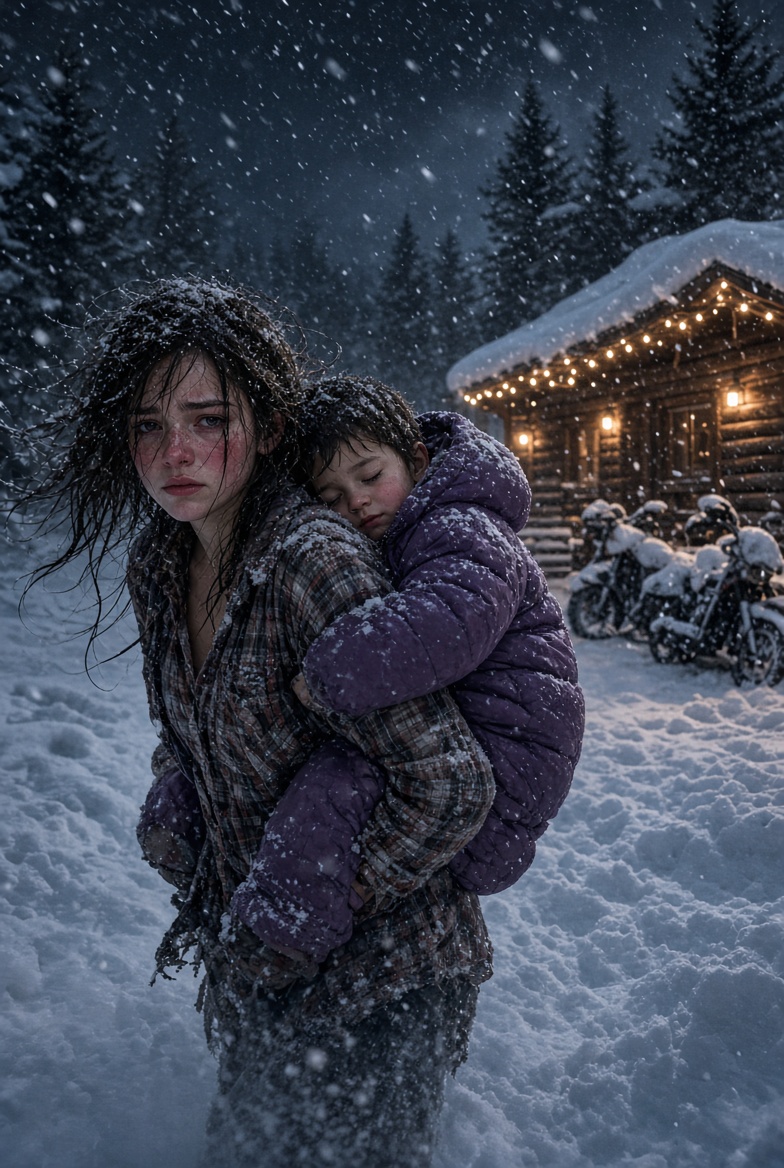
Then she got Levi onto her back, hooked her arms under his knees, and started walking.
Because whatever happened to her afterward, it would happen to a version of her that was still alive.
The first quarter mile was almost bearable.
The second was not.
The wind had found its full voice by then, a steady, shoving roar that erased the tree line into gray nothing every few seconds—and Ivy navigated less by sight than by things her body remembered without asking permission.
The slope of ground near the old fence posts.
The drop toward the drainage ditch before the Warren Wagon Road turnoff.
The blinking antenna light on the ridge above Brown Park, visible only as a faint red pulse through the white.
Her father had never let her trust a straight line in weather like this.
Straight lines are for people who can see where they’re going. You’re not one of those people tonight. Trust the ground.
Levi’s weight, slight as it was, became a different kind of weight with every hundred yards.
Not heavier, exactly—but more urgent, the way a held breath gets more urgent the longer it’s held.
He had stopped answering her questions by the halfway point.
She kept asking them anyway—a steady stream of nonsense to keep her own mind from doing the thing minds do in extreme cold, which is quietly, reasonably suggest that sitting down for just a minute wouldn’t hurt.
She sat down once.
It was such a small thing at the time—her legs simply folded without her permission into a drift beside what she thought was the fence line, but by then couldn’t be certain was anything at all.
And for four or five seconds that felt much longer, some very calm, very persuasive part of her brain informed her that resting here, just briefly, was a reasonable and even sensible plan.
It was Levi’s weight shifting against her back—a small, helpless motion that was almost a fall—that got her upright again.
She did not remember deciding to stand.
She only remembered standing furious at herself, in a way that had no time to be indulged, and walking again faster now—because some other part of her, the part her father had built on purpose, over years, out of fire lines and cold mornings and a hundred small lessons she’d resented at the time, understood exactly what had almost happened and exactly what it meant.
She did not sit down again.
She lost track after that of how many times she checked his breathing against the side of her own face.
How many times she said his name into the wind just to hear herself still able to form the shape of a word.
What she did not lose track of, because some animal part of her refused to, was the moment—she would never afterward be able to say how much later—when the gray in front of her broke apart into something with edges.
Something with a shape too regular to be a tree, strung with small, dim points of light that had to be, that were, the porch lights of the Ponderosa.
Closer than she had let herself hope.
And farther than her legs currently believed they could go.
She started toward them anyway.
There was nothing else left to start toward.
The clock above the Ponderosa’s bar read 6:47 p.m. on a Friday in the middle of January when the porch light caught a shape at the edge of the lot that was not, at first glance, a shape anyone inside recognized as human.
Griffin Pace was the one who saw her first.
Through the fogged front window—a staggering figure, half doubled under something bulky on its back.
And his first thought, he would be ashamed of this thought for a long time afterward, was that some drunk had wandered off the highway and was about to become the club’s problem on the worst possible night for it.
He hit the door already talking. “Hey—hey, you can’t be out here. Whatever you’re doing—”
Then the porch light found her face.
And the bundle on her back resolved into a shape with a purple coat and small boots.
And Griffin’s voice simply stopped working.
“That’s Levi—”
Rowan’s shout came from somewhere behind him, already moving, already past him.
And then the night dissolved into the particular chaos of a dozen adults discovering, all at the same instant, that the worst thing that could have happened had very nearly happened—and had just as narrowly not.
Ivy’s knees went first.
She remembered afterward getting Levi’s weight off her back and into someone’s arms—Rowan’s, though she wouldn’t learn his name until later.
And then the ground came up to meet her with a suddenness that felt almost like relief.
Like putting down something she had been carrying so long she’d forgotten it was possible to set it down at all.
It was Everett who took charge before anyone else’s instincts caught up to the moment, his voice cutting through the noise with a flatness that somehow commanded the room faster than shouting would have.
“Don’t rub his hands. Don’t rub hers either.”
He was already crouched over Levi, two fingers at the boy’s throat, his own coat coming off and going around the child in the same motion.
“You rub cold skin like that, you send it straight to the heart and it stops. Warm the core first. Chest, neck, groin. Not the arms, not the legs. Not yet. Somebody get every blanket in this building and get that stove open wide. And somebody call Cascade and tell them we need a rig up here now—weather or no weather.”
Nobody in the room asked how he knew that.
Griffin, wrapping a blanket around Ivy’s shoulders with hands that were suddenly, uncharacteristically gentle, glanced at Everett with the particular look of a man revising, in real time, 40 years of assumptions about somebody he’d thought he already understood.
“Everett,” Rowan said, low, not quite steady. “Is he—”
“He’s breathing. He’s cold as a February creek, but he’s breathing—and this girl kept him breathing for the better part of two miles, which is more than most grown men I’ve served with could have managed.”
Everett didn’t look up from what he was doing.
“So somebody find her a chair before she hits the floor, too.”
They found her a chair.
They also, within about 4 minutes, found Deputy Odell Prince—who had been coordinating the search from his truck radio and arrived at the Ponderosa’s door at almost the same moment the ambulance from Cascade, delayed 40 minutes by a road the county plow had barely opened, finally did.
The deputy’s questions started reasonably enough.
Where had she found him? How far had she carried him?
And then—because it was his job, and because something in her answers didn’t add up the way a normal kid’s answers would—they turned toward the questions Ivy had spent two years making sure nobody ever got to ask her.
Where did she live?
Who was her mother?
Why had a 13-year-old girl been alone in the trees at dusk in the first place, in weather like this, dressed like—
His eyes went, involuntarily, to what was left of her clothes.
The missing coat. The missing sweater.
Dressed like that.
“She gave him her coat,” Griffin said, before Ivy could answer or fail to.
He said it flatly—an interruption he clearly hadn’t planned on making.
And when the deputy looked at him, Griffin looked back without blinking.
“You’re asking why a kid was underdressed in a blizzard. Look at the kid you’re actually here about. She gave him everything she had on her, including the coat off her own back. And she carried him two miles doing it. Ask your questions tomorrow, when he’s not turning blue anymore. And she’s not either.”
It was such a small thing.
A bartender who, 4 minutes earlier, had opened the door assuming the worst about a girl he’d never seen before—now standing between her and a deputy’s badge.
And it was witnessed by perhaps a dozen people in that room, several of whom would mention it later as the moment they understood something in Griffin Pace had genuinely and permanently rearranged itself.
Levi’s eyes opened somewhere in the middle of all of it—unfocused, searching—and found, not his father’s face first, nor his grandfather’s, but the girl in the chair with the blanket around her shoulders and her hands wrapped around a mug someone had pressed into them.
“Cold,” he said, which was the first full word he’d managed since the tree line.
“I know,” Ivy said. “You’re allowed to be cold now. That’s the rule changing. You did good, staying awake for me.”
He reached for her—a small, uncoordinated motion—and she let him take her hand.
And something about the sight of that, a lost, half-frozen child reaching not for his own family but for the stranger who’d carried him out of the trees, seemed to settle a question in the room that nobody had quite finished asking out loud.
The ambulance took Levi—and, over her weak protest, Ivy as well—26 miles south to Cascade Medical Center, with Rowan following in his truck and half the parking lot’s worth of headlights trailing behind him.
Because nobody that night was willing to let either of them out of sight again.
Everett did not go.
Everett stood on the porch of the Ponderosa in the last of the wind, watching taillights disappear into snow, and said to Griffin, in a voice that carried further than he probably intended across the empty lot:
“She’s homeless. She is not helpless. I’d thank every one of you to remember there’s a difference—because I nearly didn’t. And it took a 13-year-old girl carrying my grandson two miles through the worst storm this valley’s seen in 30 years to teach it to me.”
Griffin didn’t answer right away.
When he did, it wasn’t much—just a nod, and a long look back down the dark highway.
But it was, everyone standing near enough to see it agreed afterward, the most honest thing either of them said all night.
Levi Broom spent two nights at Cascade Medical Center and came home wrapped in so many donated blankets that Rowan joked his son looked like a burrito with a grudge.
His core temperature had bottomed out at a number the ER doctor called, with visible relief, the low end of survivable rather than the high end of tragic.
And the same doctor told anyone who’d listen that another 20 minutes in that snow—maybe less—would have moved him from one category to the other.
Ivy Coulter spent one night under observation for exposure and frostbite that would, in the end, cost her nothing worse than numbness in two fingertips that lasted through March.
She spent most of that night answering careful questions from a nurse named Priscilla Lond, whose vowels still carried a soft Scandinavian lilt three generations after her family had settled in Idaho, and who asked about home and family in the gentle, circling way of someone who’d learned that circling worked better than aiming straight for the center.
Ivy told her the truth.
Mostly because she no longer had the strength left to build the careful half-truths she’d been maintaining for two years—and because some tired, stubborn part of her had decided that a system capable of nearly losing a 5-year-old to a blizzard could at least be tested on whether it was capable of not making things worse for her and her mother.
It did not make things worse.
What happened instead surprised nearly everyone involved—including, if he was honest about it later, Everett Broom himself.
He drove out to the tree line off Highway 55 two days after the storm broke, following directions from a deputy who, by then, had stopped treating Ivy’s address like evidence of a crime and started treating it like an emergency that hadn’t been responded to yet.
And he found the camp exactly as she’d described it: a blue tarp, a coffee-can chimney, a trench lined with plastic sheeting.
And Dela Coulter standing in the mouth of the tent with her arms crossed against the cold and her chin up in the specific way of a mother braced to defend the only home she had left to offer her daughter.
Everett did not offer pity.
He’d learned long ago, in a place he still didn’t talk about, that pity mostly just made the giver feel better and rarely fixed anything.
What he offered instead—hat in his hands like it was church—was work.
A trailer the club used for out-of-town runs, sitting idle behind the Ponderosa, that could be hooked to power and parked on a friend’s land by week’s end, if Dela was willing.
And a job keeping the Ponderosa’s books straight, because he’d noticed, in the hour they talked, that Dela Coulter did arithmetic in her head faster than anybody currently doing it for him on paper.
Dela said yes to both before he’d finished the sentence.
The rest moved the way word moves through a club like that—which is to say, all at once, and further than anyone plans for it to go.
By the following weekend, riders were arriving from Boise, from Twin Falls, from as far as Coeur d’Alene—drawn less by any single phone call than by the particular story that had already outrun its own facts by the time it reached them.
A homeless girl, 13 years old, had carried a chapter president’s grandson two miles through the worst storm the valley had seen in 30 years—and had nearly died getting him there.
Three hundred motorcycles came up Highway 55 that Saturday.
More than the Ponderosa’s lot had ever held at once.
Engines echoing off the ridge line in a sound Ivy would later say reminded her strangely of the wind the night of the storm.
Except this sound, unlike that one, meant only good things were arriving.
They came with lumber and tools to finish winterizing the trailer properly.
They came with groceries—enough to fill a pantry Dela hadn’t had in two years.
They came, some of them, simply to shake the hand of a girl half their size, who had done something most of them—veterans of considerably rougher roads than a snowy tree line—weren’t sure they’d have had the nerve to do themselves.
Mavis Corbett drove out from her grocery on Idaho Street with a box of the same crackers she’d once accused Ivy of stealing, and stood in the trailer’s half-finished doorway working up to an apology that came out clumsy and sincere in roughly equal measure.
And Ivy, who’d spent two years being ashamed of exactly the kind of scrutiny Mavis represented, found she didn’t need the apology as much as she’d once imagined she would.
It was enough that Mavis had come.
It was enough that she’d brought crackers instead of suspicion this time.
Griffin Pace showed up that Saturday, too—later than most, hauling a bag of dog treats out of his truck bed that he tossed to Diesel without much ceremony, before turning to Ivy with the particular awkwardness of a man who does not have a natural gift for saying sorry and has decided instead to simply keep showing up until the showing up says it for him.
“A kid’s dog needed treats” was all he offered by way of explanation—which was not an apology exactly, but which everyone standing near enough to hear it understood as one.
Levi—fully recovered, and apparently no worse for the whole ordeal beyond a healthy new fear of wandering fences—spent the afternoon following Ivy around the yard with the single-minded devotion of a small boy who has decided somebody has earned his loyalty permanently.
And at one point asked her, with the blunt clarity 5-year-olds specialize in, whether she was going to be his sister now.
“Something like that,” Ivy told him.
And found she meant it more than the joke deserved.
Everett watched all of it from the trailer steps, coffee mug in hand, the same posture he’d had at the Ponderosa’s window the morning the storm arrived.
Except this time there was nothing in the sky worth watching for.
He had told the club more than once that week the same thing he’d told Griffin on the porch the night of the storm—and it had traveled through Valley County by then, in the way true things sometimes do.
Repeated. Worn smooth. Arriving eventually at people who’d never heard it directly from him at all.
That a girl could be homeless without being helpless, and that the two words weren’t cousins the way people like to assume—and that it had taken him 68 years and one terrible night to finally get that straight in his own head.
He did not say any of it again that Saturday.
There was no need to.
The 300 motorcycles parked crooked across a half-finished trailer’s yard were already saying it for him, in a language considerably louder than words.
Late that afternoon, as the light went long and gold across Payette Lake and riders began the slow work of saying their goodbyes and pointing their bikes back down Highway 55, Griffin found Ivy sitting on the trailer steps with Diesel’s head heavy in her lap, and dropped down beside her without asking—the way people do once they’ve decided they’re allowed to.
“You’re going to need snow boots that fit,” he said.
Which was, of every possible thing a person might have said at the end of a day like that one, the smallest and most ordinary—and somehow exactly right.
“I’ll bring a pair by Tuesday. What size are your feet?”
Ivy told him.
And he wrote it on his hand in pen.
And that—more than the 300 motorcycles, or the trailer, or anything Everett had said on any porch—was the moment she let herself believe that this, whatever it turned out to be, might actually last.









