She Walked Alone in the Freezing Snow With a Puppy—Then a Former SEAL Turned His Truck Around
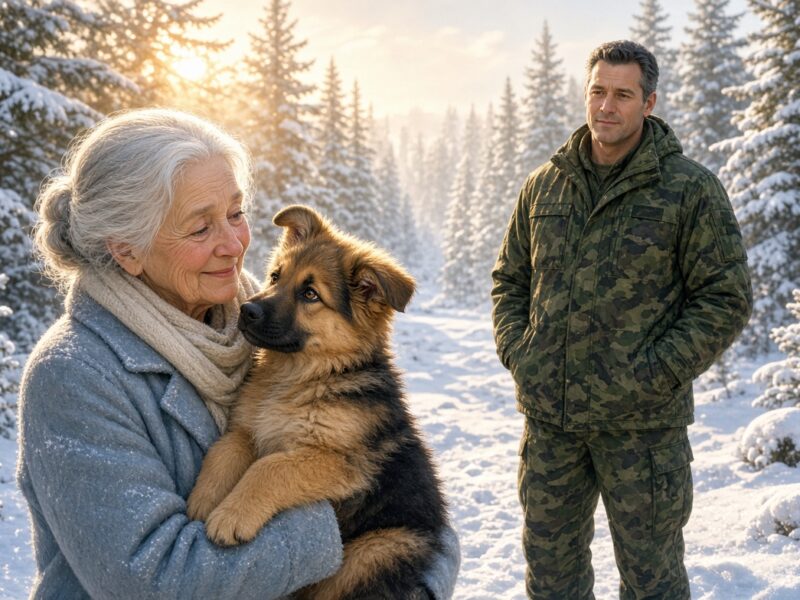
The old woman walked alone through the freezing Minnesota snow, holding a German Shepherd puppy tightly against her chest.
A former Navy SEAL drove past her, then saw her stumble in his rearview mirror and turned back, making a decision that would change all three lives.
When he offered to help, the old woman asked for only one thing.
“Please help the dog. I can take care of myself.”
But days later, the puppy suddenly refused to eat and spent every afternoon sitting silently by the window, staring outside as if waiting for something.
Then the former SEAL learned the woman had been rushed to the hospital, and the dog’s strange behavior became heartbreaking in a way he could no longer ignore.
Soon, a hidden truth was revealed.
The old woman and the German Shepherd were never meant to be separated, and their bond was stronger than anyone had understood.
The last week of January had turned Alder Haven, Minnesota, into a country of white silence.
Snow lay heavy across the shoulders of Alder Ridge, softening fences, burying forgotten mailboxes, and bending the lower branches of the pines until they seemed to bow toward the road.
Yet the afternoon itself was strangely beautiful.
The sky was a clear northern blue, and sunlight spilled between the trees in pale golden shafts, making the frozen landscape glitter as if someone had scattered glass across it.
Garrett Holloway drove his dark pickup slowly along the mountain road, one gloved hand resting on the wheel.
At forty, Garrett still carried himself with the disciplined posture of the Navy SEAL he had once been.
He stood six-foot-one, about 185 centimeters, with broad shoulders and a solid athletic build maintained through years of routine rather than vanity.
His face was handsome in a distinctly masculine American way, angular through the cheekbones with a strong jaw and square chin.
He was always clean-shaven, and his dark hair, lightly silvered at the temples, was cut into a neat undercut.
His deep gray-blue eyes had the calm watchfulness of a man trained to notice what others missed, though an old sadness lived behind them.
He wore the same practical clothing he favored almost every day: fitted long-sleeved green camouflage, matching trousers, and dark brown military boots.
No tactical vest, no weapon hanging from him.
Nothing about Garrett advertised what he had once done.
He preferred it that way.
Lengths of lumber and roofing supplies rattled quietly in the bed of the truck.
Garrett had spent the morning in town buying materials to repair the western edge of his cabin roof before the next storm arrived.
He was thinking about coffee, a hot stove, and silence.
Then he saw the woman.
She appeared between two rows of snow-draped pines, moving along the shoulder of the road so slowly that at first Garrett wondered if she had stopped completely.
She was elderly, small, and carrying something against her chest.
Garrett eased off the accelerator as he passed.
For half a second, he saw her clearly.
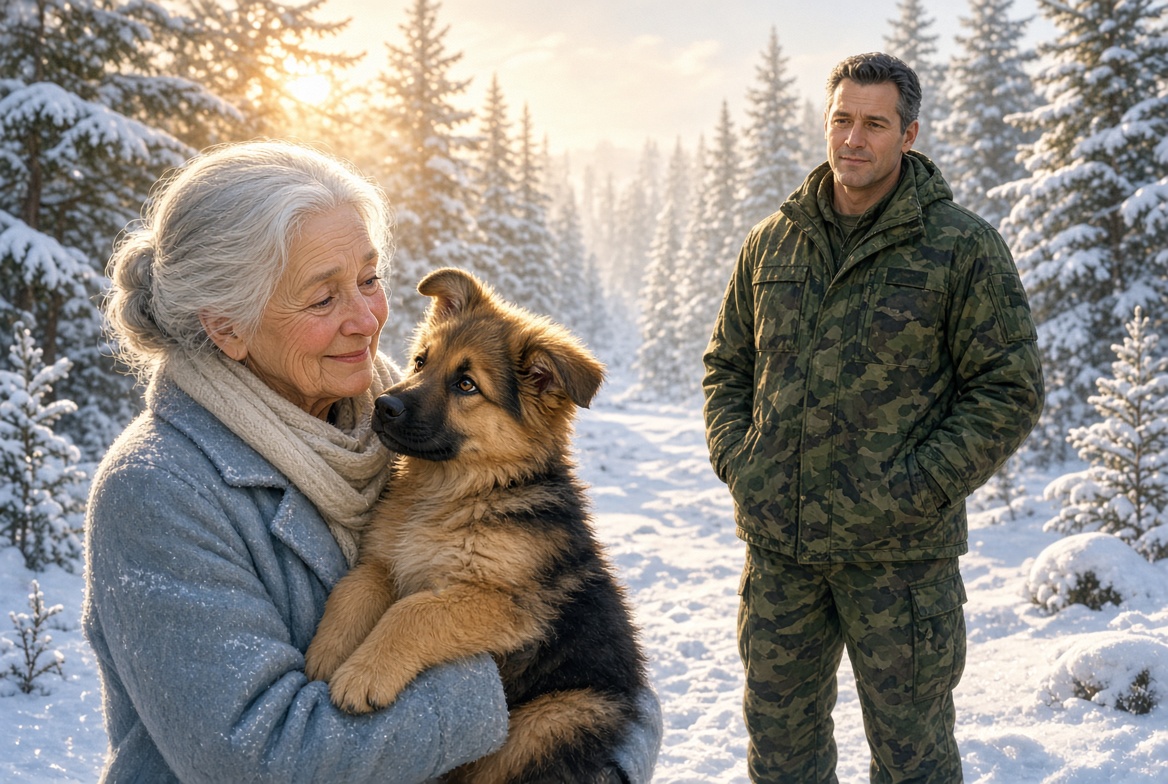
She was perhaps in her late seventies, barely five-foot-two, with a slim, fragile-looking frame beneath a pale blue-gray wool coat.
A cream scarf was wrapped around her neck, and a long brown-gray skirt brushed the tops of worn winter boots.
Wisps of silver-white hair had escaped from a low bun and clung to her cheeks in the wind.
Her pale blue eyes were narrowed against the cold.
In her arms was a German Shepherd puppy, yellow and black, young, very young.
Garrett passed them.
The truck continued another fifty yards.
His eyes lifted to the rearview mirror.
The woman stumbled, not dramatically, just one uncertain step sideways before recovering.
Garrett’s hands tightened around the wheel.
For an instant, another winter road disappeared beneath this one.
Another voice returned.
Luke’s voice.
“You coming this weekend?”
His younger brother had asked Garrett to join him on a climbing trip three years earlier.
Garrett had said no.
Work responsibilities.
There would always be another weekend.
There hadn’t been.
Luke’s accident had not been Garrett’s fault.
Every reasonable part of him knew that.
But grief was not reasonable.
It had spent three years whispering the same useless sentence.
If you’d been there.
Garrett hit the brakes.
The truck stopped.
He sat motionless for one heartbeat.
Then he shifted into reverse.
“No,” he muttered to himself. “Not this time.”
He turned the truck around.
The woman had made it perhaps another twenty yards.
Garrett pulled onto the shoulder and stepped out.
The cold struck immediately.
“Ma’am.”
The woman turned.
Up close, Garrett saw the signs he had noticed from the road were worse than he thought.
Her hands trembled around the puppy.
Her lips had lost much of their color.
Her steps left an uneven trail in the snow.
“I’m quite all right,” she said immediately.
Her voice was gentle but firm.
Garrett almost smiled.
People who were quite all right rarely announced it before being asked.
“Didn’t say you weren’t.”
“You were going to.”
The puppy lifted its head.
Garrett paused.
The German Shepherd was about four months old, with oversized paws and a compact puppy body that had not yet grown into them.
Warm golden fur covered the legs, chest, and sides of the face, while a defined black saddle stretched over the back.
The muzzle was dark, almost entirely black.
One ear stood confidently upright.
The other leaned slightly to one side as though it had not yet decided what kind of dog it intended to become.
Dark amber-brown eyes studied Garrett.
Not fearfully.
Curiously.
A simple brown leather collar circled the puppy’s neck, and a small metal tag rested against the fur.
North.
“That’s a young dog for a walk like this,” Garrett said.
The old woman’s arms tightened slightly.
“He’s tougher than he looks.”
Garrett glanced at her shaking fingers.
“I’m not worried about him.”
That earned him a look.
The kind teachers gave children who had attempted a particularly foolish excuse.
“My name is Juniper Bellamy,” she said at last. “June to anyone who isn’t angry with me.”
“Garrett Holloway.”
June’s expression shifted.
Recognition.
“Holloway. The man up on Alder Ridge.”
“Depends who’s asking.”
Despite the cold, June gave the faintest smile.
Garrett opened the passenger door.
“Get in.”
“Oh, I couldn’t.”
“Wasn’t really phrased as a question.”
Her eyebrows rose.
Garrett realized how that sounded.
“Sorry. Old habits.”
“I’m beginning to understand.”
He took an emergency blanket from behind the seat and unfolded it.
June’s expression softened a fraction.
“I only have another mile or so in this snow.”
“That’s not only.”
“I’m going to Eleanor Price’s house.”
Garrett knew the name vaguely.
Eleanor was an elderly widow living on the south edge of town.
“Then I’ll drive you.”
“No.”
Garrett studied her.
June looked away.
North shifted in her arms and pressed his nose beneath her chin.
That small gesture seemed to break something.
June closed her eyes.
“I left in anger,” she admitted.
Garrett waited.
“My son and his wife think I’ve become incapable of making sensible decisions.”
“Walking a mile through deep snow isn’t helping your argument.”
June looked at him sharply.
Then, unexpectedly, she laughed.
It was only one small breath of laughter, but it changed her whole face.
“You’re an irritating man, Mr. Holloway.”
“I’ve been told.”
Garrett helped her into the truck.
The heater blew warm air across the cab.
He wrapped the emergency blanket around June’s shoulders while North settled awkwardly across her lap.
For several minutes, neither spoke.
Then Garrett nodded toward the puppy.
“What happened?”
June stroked North’s head.
The puppy immediately closed his eyes.
“My daughter-in-law doesn’t want him in the house.”
There was no bitterness in the sentence, only exhaustion.
“Meredith has allergies,” June continued. “Nothing severe, but enough to make life uncomfortable. And her mother once fell after a large dog ran beneath her feet, broke her hip, never truly recovered.”
“So she’s afraid you’ll fall.”
“Yes. Reasonable fear.”
June turned toward him.
“I didn’t say it wasn’t.”
Garrett waited again.
“My son Wesley tries to keep peace. That usually means agreeing with whichever woman is angrier.”
This time Garrett almost laughed.
June looked down at North.
“They told me a German Shepherd would become too large, too energetic, too dangerous around an old woman.”
“That part isn’t entirely wrong.”
“No.”
June’s fingers moved slowly through North’s golden fur.
“But nobody asked me whether living without something I loved might also be dangerous.”
The words landed differently.
Garrett looked through the windshield.
He understood too well what happened when a life became organized entirely around avoiding loss.
North suddenly lifted his head.
The puppy stared at Garrett.
Then, without warning, he climbed awkwardly off June’s lap and placed both front paws against Garrett’s right arm.
Garrett stiffened.
“Hey. I’m driving.”
North ignored him.
The puppy pressed its black muzzle against the sleeve of Garrett’s camouflage shirt and began sniffing the fabric intently.
Then North gave a tiny whine.
Garrett glanced down.
There was nothing there.
No food, no treat.
Just an old strip of fabric sewn beneath the cuff, a faded piece cut from one of Luke’s climbing shirts, something Garrett had carried quietly for years.
North pushed his nose against it again.
June watched.
Her pale eyes moved from the puppy to Garrett’s face.
“Who did you lose?”
Garrett’s gaze snapped toward her.
June did not repeat the question, and Garrett did not answer.
But for the rest of the drive, North remained unusually quiet.
June eventually told him the rest.
North had arrived only several weeks earlier, brought by an old family acquaintance.
From the moment June held him, she had loved him.
Perhaps too quickly.
Perhaps because the house had been painfully quiet since her husband Harold died four years earlier.
When Meredith insisted North could not stay permanently, the disagreement became an argument.
Wesley sided with his wife.
June heard something in their voices she had increasingly heard since Harold died.
Concerns spoken like authority.
Advice delivered like permission.
She had packed nothing except a small cloth bag, put on her coat, taken North, and headed toward Eleanor’s house.
Halfway there, June knew she had made a mistake.
The snow was deeper than it looked.
Her knees hurt.
Her hands had begun to lose feeling.
But pride had kept her walking until Garrett stopped.
“I can go back,” June said quietly.
Garrett glanced at her.
“Back home?”
“Yes. And the dog.”
June’s composure finally cracked.
Tears gathered in her pale blue eyes.
She buried her face briefly against North’s head.
Then she looked at Garrett.
“Take him.”
Garrett frowned.
“What?”
“Keep him for me.”
“No.”
The answer came instantly.
June blinked.
Garrett shook his head.
“I live alone. I have work to do. I’m not set up for a puppy.”
“I’m not asking you to keep him forever.”
“Still no.”
North’s ears shifted between them.
June did not argue.
That surprised Garrett more than anger would have.
She only looked down and whispered, “I need to know he’s somewhere safe while I figure out what comes next.”
Garrett stared ahead.
“I don’t do dogs.”
North doesn’t know that.
Garrett parked briefly beside the road to clear snow from the windshield.
The moment Garrett opened his door, North wriggled from June’s arms.
“North.”
The puppy jumped into the snow.
He scrambled after Garrett, paws sinking into the powder, and stopped beside Garrett’s boots.
Then North sat.
Just sat, looking up at him.
Garrett stared down.
“You’ve got the wrong man.”
North tilted his head.
June remained inside the truck, watching them with tears on her cheeks.
Garrett sighed deeply.
“One week.”
June covered her mouth with one trembling hand.
“One week,” Garrett repeated. “Then you and your family figure this out.”
He drove June back to the Bellamy home.
Wesley opened the door before Garrett had fully stopped.
At forty-eight, Wesley Bellamy was a medium-built man with fairly broad shoulders, short dark brown hair graying at both temples, and his mother’s blue-gray eyes.
Clean-shaven and neatly dressed in a navy sweater over a white shirt with brown khaki trousers, he looked like a man who spent most of his life trying to keep every problem neatly contained.
Fear had deepened the lines around his eyes.
Behind him stood Meredith.
She was forty-five, slim and composed, with ash-blonde hair cut into a neat chin-length bob and gray-green eyes.
A burgundy sweater and black trousers gave her the polished appearance of someone who liked order.
Her face was not cruel.
It was frightened.
“Mom.”
Wesley’s single word held relief, frustration, and hurt.
June stepped from the truck.
No one shouted.
That somehow made the silence heavier.
Garrett noticed a small wooden workshop behind the main house.
Snow covered the roof.
Dust clouded the windows.
June followed his gaze.
“Harold used to work there,” she murmured.
Then she looked toward North.
Garrett lifted the puppy into the passenger seat.
June approached the window.
Her thin hand rested against the glass.
North immediately stood on his hind legs and pressed both front paws against the other side.
For several seconds, they simply looked at each other.
Garrett finally understood.
June was not abandoning North.
She was entrusting the creature she loved most to a stranger because at that moment she believed love meant letting him go somewhere safer.
Garrett started the engine as the Bellamy house disappeared behind the trees.
North remained turned toward the rear window.
Garrett glanced at him.
“Seven days. That’s it.”
North kept watching the road behind them.
Garrett sighed.
“Yeah.”
A faint smile touched the corner of his mouth.
“I don’t believe me either.”
By seven the next morning, Garrett Holloway had learned three things about living with a four-month-old German Shepherd.
First, North believed every object on the floor belonged to him.
Second, North believed several objects not on the floor also belonged to him.
And third, silence was suspicious.
Garrett discovered the third lesson when he stepped out of the shower and found the cabin unusually still.
He stopped in the hallway.
“North?”
Nothing.
Garrett moved toward the living room.
A single wool sock lay abandoned near the kitchen table.
He followed the trail.
Another sock.
One glove.
A dish towel.
Then North appeared from behind the old leather chair with the second glove hanging from his mouth.
The puppy froze.
Garrett froze.
North’s dark amber eyes narrowed with the unmistakable concentration of an animal deciding whether negotiations were still possible.
“Drop it.”
North turned.
Garrett pointed toward the floor.
“North. Drop it.”
The puppy ran.
Garrett closed his eyes briefly.
He had spent years in situations where a poorly timed decision could have consequences measured in seconds.
Now he was being tactically outmaneuvered by fifteen pounds of fur and oversized paws.
Nearly twenty minutes later, Garrett sat on the cabin floor holding one end of the glove while North held the other.
“This is embarrassing for both of us.”
North pulled harder.
Garrett eventually traded the glove for a small piece of kibble.
North released it immediately.
Garrett stared at him.
“So extortion. Good. We’ve established your skill set.”
North sneezed.
The cabin, which had once been almost aggressively orderly, changed quickly after that.
Garrett had always kept his life arranged with military precision.
Boots by the door, tools aligned in the shed, coffee made at the same hour, bed made before sunrise.
North had no respect for systems.
He slept on Garrett’s chair despite having a blanket of his own.
He dragged a boot halfway across the kitchen.
He tried to bite the loose end of a shoelace while Garrett was still wearing the boot.
He once carried a wooden spoon into the bedroom and stared proudly as though he had returned from a successful hunt.
Yet Garrett found himself irritated less often than he expected.
Maybe because North was never malicious.
Everything was discovery.
Every sound mattered.
Every smell deserved investigation.
Every closed door was a personal insult.
Garrett decided that if the puppy was going to stay for more than a few days, there had to be structure.
So he built one.
Breakfast at seven.
Outside immediately afterward.
A short walk around the cabin.
Then simple training.
“Sit.”
North sat.
“Stay.”
North waited almost two seconds.
“Come.”
North charged forward with such enthusiasm that he nearly collided with Garrett’s knees.
“Leave it.”
That one took longer.
North learned quickly, though.
Garrett noticed the puppy watched his face rather than his hands.
The slightest change in Garrett’s posture caught North’s attention.
He did not respond well to impatience, but he did respond to consistency.
Garrett lowered his voice instead of raising it.
The calmer Garrett became, the better North listened.
By the fourth day, North could sit on command, wait briefly before eating, and follow Garrett across the yard without tangling the leash around both of them.
Garrett began to understand something else.
North was studying him, too.
When Garrett stood, North stood.
When Garrett carried firewood, North followed.
When Garrett worked on the damaged edge of the roof, North sat below in the snow and watched every movement as if supervising construction.
And when Garrett returned inside, North always checked which room he entered before settling down.
Almost always.
At exactly around 4:30 each afternoon, the pattern changed.
The first day, Garrett barely noticed.
North left the kitchen while Garrett was preparing coffee and walked toward the large front window.
He sat there.
The window faced southeast, down the slope toward Alder Haven.
North stayed for almost twenty minutes.
The next afternoon, he did it again.
And the next.
By the fifth day, Garrett began checking the clock.
4:27.
North had been asleep beside the stove.
At 4:31, he stood.
He stretched.
Then he walked to the same window.
Garrett leaned against the kitchen counter.
North did not bark.
He did not scratch at the glass.
He simply sat with his ears slightly forward, staring at the winding road disappearing through the pines.
Garrett knew exactly who the puppy was waiting for.
The knowledge unsettled him more than it should have.
He picked up his phone and called Wesley Bellamy.
Wesley answered after several rings.
“Garrett?”
“Yeah.”
“How’s North?”
Garrett looked toward the window.
“Stealing things, ignoring boundaries, developing criminal tendencies.”
There was a pause.
Then Wesley laughed softly.
It was the first relaxed sound Garrett had heard from him.
“How’s your mother?”
Another pause.
“She’s home.”
“That wasn’t what I asked.”
Wesley exhaled.
“She’s still upset. Eating some. Sleeping. Not enough.”
Garrett rubbed a thumb along the edge of the phone.
“I can bring North down.”
Wesley hesitated.
Garrett heard it immediately.
“I’m not trying to start anything,” Garrett said.
“I know.”
“Then what?”
Wesley lowered his voice.
“Mom asked for space.”
Garrett glanced at North.
“From the dog?”
“No. From us.”
That answer made more sense.
A few minutes later, Wesley put June on the phone.
Her voice sounded tired but steady.
“Mr. Holloway.”
“Garrett.”
“Yes. Garrett.”
He waited.
June said, “Is he behaving?”
“No.”
A small laugh reached him.
“Good. That means he likes you.”
Garrett ignored that.
“I can bring him down.”
Silence followed.
Then June said quietly, “Give me a little time.”
Garrett frowned.
“You sure?”
“Yes. I can park outside. You don’t even have to—”
“No.”
Not harsh.
Just firm.
“I don’t want him brought back only to become another argument.”
Garrett understood.
“You call when you’re ready.”
“I will.”
He ended the call.
North was still at the window.
Garrett crossed the room and stood beside him.
“She knows you’re waiting.”
North did not move.
The next afternoon, Garrett decided to test something.
At 4:15, he closed the heavy curtains over the front window.
North was asleep by the stove.
Garrett went back to sorting tools at the kitchen table.
At 4:29, North woke.
The puppy looked toward the window.
The curtains were shut.
North stood.
He walked to the glass, nudged the curtain with his nose, then stepped back.
For a moment, Garrett expected him to give up.
Instead, North crossed the entire cabin.
He went to the back door, then to the side window, then to the bedroom.
One by one, he checked every place where he could see outside.
Finally, North returned to the front room and sat beside Garrett, not facing the window this time.
Facing him.
The puppy gave one quiet whine.
Garrett’s chest tightened.
It was not magic.
It was not some impossible message traveling through the snow.
North simply knew that at this hour something was missing.
Someone was missing.
But Garrett could not escape the thought that animals sometimes noticed absence more honestly than people did.
At the Bellamy house, June had fallen into a routine that looked orderly from the outside.
Wesley brought her tea each morning.
Meredith prepared lunch.
Medication was set out at precise hours.
Fresh towels appeared before June asked for them.
Everything was thoughtful, and yet June felt increasingly invisible.
Wesley checked whether she had eaten.
Meredith checked whether she had taken her tablets.
They both asked whether she was warm enough.
Neither asked what she wanted to do with the day.
Meredith tried.
She truly did.
She would stand in the doorway with her ash-blonde bob tucked neatly behind one ear and ask whether June needed anything.
June always said no.
That answer frustrated both of them.
At dinner, June ate very little.
She was not trying to punish anyone.
Food simply seemed to have lost its taste.
The chair beside the table where North had once slept was empty.
Wesley noticed her looking at it.
“Mom.”
“I’m fine.”
“You hardly touched anything.”
“I’m seventy-seven. I’m allowed to leave potatoes behind.”
Wesley rubbed a hand over his face.
He looked older when he was worried.
June knew that sometimes she wanted to reach across the table and tell him she understood his fear.
But understanding his fear did not make her want to live inside it.
That same night, Garrett found North somewhere he had not expected.
He had gone to bed early.
The cabin was quiet.
At around eleven, Garrett woke to a faint scratching sound beneath the bed.
He sat up.
“North.”
The puppy backed out slowly.
Dust marked the tip of his black nose.
Behind him was an old wooden box Garrett had pushed under the bed years ago.
Garrett stared at it.
He had not opened it in a long time.
North pawed the lid once.
“Leave it.”
North sat.
Garrett should have pushed the box back.
Instead, he pulled it toward him.
Inside were a few photographs, a climbing carabiner, a folded trail map, and an old phone.
Luke’s phone.
Garrett sat on the floor.
North settled beside him.
The device still powered on after Garrett connected it to a charger.
There was one voicemail Garrett had never listened to all the way through.
He had tried once, stopped after three seconds.
Three years had passed.
Garrett pressed play.
Luke’s voice filled the bedroom.
Light, casual, alive.
“Hey, man, you coming this weekend or what? Weather looks perfect. Call me back.”
That was it.
No final wisdom, no warning, no dramatic goodbye.
Just a brother expecting there would be another conversation.
Garrett lowered the phone.
The simplicity of it hurt more than anything grand could have.
North did not lick his face, did not whine, did not climb into his lap.
He simply remained beside him.
Garrett rested one hand on the puppy’s head.
For the first time in years, he allowed the memory to stay without running from it.
No repairing something, no splitting wood, no driving until exhaustion replaced grief.
Just silence.
And North.
By the end of the first week, Garrett realized he had stopped counting the days.
On the seventh evening, his phone rang.
June.
Garrett answered immediately.
“How are you?”
“I was about to ask you the same thing.”
“I’m not the one causing trouble.”
“That depends on who you ask.”
Garrett looked down.
North was stretched across the floor with his head resting on Garrett’s boot.
June was quiet for a moment.
Then she said, “Could you keep him a little longer?”
Garrett looked at North.
The puppy opened one amber eye.
There should have been hesitation.
A reminder about the one-week agreement, a practical discussion.
Instead, Garrett said, “Yeah.”
June exhaled slowly.
“Thank you.”
Garrett looked toward the dark window.
North had stopped waiting there for the evening.
He was already asleep at Garrett’s feet.
This time Garrett did not ask how long.
Nearly two weeks had passed since Garrett Holloway first brought North up to the cabin on Alder Ridge.
By then the puppy had become part of the place.
His brown leather collar hung from the same hook each night.
His water bowl sat beside the kitchen wall.
A folded blanket had migrated from the floor to the corner near the stove, though North still ignored it whenever Garrett’s boots were available.
Garrett had stopped thinking of those things as temporary.
Then, one cold morning, something changed.
North did not finish breakfast.
Garrett noticed because North usually treated food like a military objective.
The four-month-old German Shepherd would sit before the bowl, barely containing himself, then eat with focused enthusiasm once Garrett gave permission.
That morning, North ate less than half.
Then he walked away.
Garrett looked at the bowl.
“Not hungry?”
North glanced back, but did not return.
Garrett crouched beside him.
The puppy’s black and gold coat still looked healthy.
His amber-brown eyes were clear.
His nose was cool and damp.
He was not trembling.
Garrett ran a hand over North’s ribs and abdomen.
No obvious pain, no reaction.
Still, something was wrong.
North spent most of the morning lying near the window instead of following Garrett around the cabin.
He did not steal the rag Garrett dropped beside the toolbox.
He did not investigate the firewood basket.
He did not bark at the squirrel that crossed the porch rail.
By afternoon, Garrett tried food again.
North sniffed the bowl, then turned away.
He continued drinking water, but that did little to ease Garrett’s concern.
Garrett had learned long ago that waiting for a small problem to become a large one was rarely a good strategy.
By eight the next morning, North was in the passenger seat of the pickup.
The Alder Haven Veterinary Clinic sat near the eastern end of town in a low cedar-sided building with a blue sign and two snow-covered benches outside.
Inside, the waiting room smelled faintly of disinfectant, dog treats, and wet wool.
A middle-aged Labrador snored beneath one chair.
A gray cat in a carrier glared at everyone equally.
North sat close to Garrett’s boots.
A few minutes later, a woman stepped through the examination room door.
“North Holloway.”
Garrett almost corrected the name.
Then he stopped.
The veterinarian introduced herself as Dr. Rebecca Sloan.
She was forty-six, medium height, lean and straight-backed, with chestnut-brown hair threaded with a little gray and tied into a practical low ponytail.
Her face was narrow and intelligent, with warm hazel eyes and faint smile lines that suggested she had spent years reassuring nervous people as much as nervous animals.
She wore dark green scrubs beneath a light gray clinic jacket.
Dr. Sloan had the calm manner of someone who did not dramatize problems, but never dismissed them either.
She lifted North onto the examination table.
“He’s four months?”
“About that.”
“Any vomiting?”
“No.”
“Diarrhea?”
“No.”
“Still drinking?”
“Yes.”
“Activity level?”
“Lower than normal.”
Dr. Sloan checked North’s gums, temperature, hydration, abdomen, ears, eyes, and heart rate.
North tolerated most of it with dignity until she looked inside one ear.
Then he gave Garrett a betrayed expression.
Garrett folded his arms.
“You’ll survive.”
Dr. Sloan smiled.
“Nothing obvious is jumping out at me.”
“That good?”
“It’s reassuring. Not the same thing as saying ignore it.”
She explained that puppies could lose appetite for many reasons.
Stress, mild stomach upset, changes in routine, even teething discomfort.
But prolonged refusal to eat in a young dog needed attention.
“If he stops drinking, becomes weak, vomits, has diarrhea, seems painful, or continues refusing food, bring him straight back.”
Garrett nodded.
He did not need the warning repeated.
On the drive home, North rested his chin on the edge of the seat and watched the snowbanks pass.
Garrett glanced at him twice.
“Don’t make me get attached and then start doing this.”
North did not react.
Garrett immediately regretted saying it.
The words sounded too much like fear.
Back at the cabin, the afternoon slipped toward 4:30.
North rose from the rug.
He crossed the room.
He sat by the window.
Garrett looked at the clock.
4:31.
The behavior itself was no longer surprising.
What bothered Garrett was everything around it.
North had stopped eating.
His energy had changed.
And the person he always seemed to wait for had been unusually quiet.
Garrett picked up his phone.
He called June.
No answer.
He waited five minutes and tried again.
Nothing.
Then Wesley.
Voicemail.
Meredith.
No response.
Garrett stood in the middle of the kitchen, phone still in his hand.
A rational explanation existed.
People missed calls.
Phones died.
Families had lives.
Still, the uneasiness would not leave.
That evening, North did not sleep near the stove.
He carried no stolen glove to Garrett.
He did not even follow him into the bedroom.
Instead, he lay directly beside the front door.
Not curled comfortably.
Alert.
His head rested between his paws, but his eyes remained open.
Every time wind moved through the pines outside, North lifted one ear.
Garrett came into the room shortly before midnight.
“You waiting for someone?”
North raised his head.
Then he looked at the door.
Not the window.
The door.
Garrett stood there longer than he meant to.
For the first time, the thought came clearly.
Maybe North was not waiting for June to come back.
Maybe he was waiting for Garrett to go find her.
Garrett slept badly.
At sunrise, he made coffee but barely touched it.
North sniffed breakfast again and walked away.
That decided it.
Garrett pulled on his camouflage jacket, clipped North’s leash to the brown collar, and drove down toward Alder Haven.
The Bellamy house looked wrong before Garrett even left the truck.
No smoke rose from the chimney.
No car sat in the driveway.
The front curtains were closed.
Garrett knocked.
No answer.
He walked around the side.
Still nothing.
As he returned toward the truck, the front door of the neighboring house opened.
An older woman stepped onto the porch.
She was around seventy, short and round-faced, with curly white hair visible beneath a knitted red hat.
She wore a quilted brown coat over house slippers shoved hastily into winter boots.
“Are you looking for June?”
Garrett turned.
“Yes.”
The woman’s expression changed.
“Oh.”
That one syllable tightened Garrett’s chest.
“I’m Marjorie Hale,” she said. “I live next door. June was taken to Alder Haven Community Hospital.”
“When?”
“Six days ago.”
Garrett went completely still.
Six.
Marjorie nodded.
“She’d been coughing for several days. Wesley thought it was a cold. Then she got weak. Could barely stand.”
Garrett looked toward the truck.
North was sitting behind the passenger window, watching.
Garrett thanked Marjorie and left.
The hospital stood ten minutes away.
Inside the lobby, Garrett found Wesley near the elevators.
Wesley looked exhausted.
His navy sweater had been replaced by a wrinkled dark coat, and several days of poor sleep had deepened the shadows beneath his eyes.
Garrett walked toward him.
“Why didn’t you tell me?”
Wesley stopped.
“I tried.”
Garrett’s jaw tightened.
“When?”
“The day she came in. I called twice.”
Garrett remembered spending that day repairing the upper trail fence beyond the ridge, where phone service disappeared completely.
Wesley continued, “Then Mom told me not to keep calling.”
“Why?”
“She said you’d already done enough for her.”
Garrett looked toward the hospital corridor.
“What happened?”
“Pneumonia. Dehydration, too.”
“Serious?”
“It was worse when she arrived. She’s stable now.”
Stable.
Garrett hated that word.
It could mean many things.
“How long until she goes home?”
“They don’t know.”
Wesley rubbed his forehead.
“She’s improving slowly.”
Garrett looked at him, then asked the question that had been pressing against him since the night before.
“Did she ask about North?”
Wesley’s face changed.
His eyes dropped.
Garrett knew the answer before he spoke.
“Every day.”
Garrett exhaled.
“I’m bringing him in.”
Wesley shook his head.
“You can’t just walk a dog through the hospital.”
“Then tell me who I need to talk to.”
That person turned out to be Megan Price, the hospital’s patient advocate.
Megan was thirty-six, of average height and build, with warm brown eyes and shoulder-length copper-brown hair that fell in loose waves around a round, approachable face.
She wore an olive cardigan over a cream blouse with charcoal trousers.
Her calm voice carried the practiced steadiness of someone accustomed to frightened families, difficult rules, and people who wanted exceptions immediately.
She listened without interrupting.
Then she said, “North isn’t a certified therapy dog.”
“I know.”
“So he can’t simply visit inpatient areas.”
Garrett nodded.
“What can he do?”
Megan appreciated the question.
Not why not, but what can he do?
She contacted June’s physician.
A few minutes later, Garrett met Dr. Clara Vance.
Clara was forty-two, around five-foot-seven, with a balanced, athletic build and chestnut-brown hair tied low behind her neck.
Hazel-brown eyes gave her a thoughtful, measured expression.
She wore a white physician’s coat over navy scrubs, and her manner was direct without being cold.
She explained June’s condition clearly.
The pneumonia was responding to treatment.
The dehydration had improved.
The larger challenge now was exhaustion.
June was eating poorly and had little enthusiasm for the breathing exercises and movement that would help her regain strength.
“A dog won’t cure pneumonia,” Clara said.
“I’m not asking him to.”
“Good.”
Garrett respected her immediately.
After checking North’s vaccination records and contacting Dr. Sloan to confirm the puppy had been examined recently and showed no infectious symptoms, Megan and Clara arranged one brief visit in a designated family room beside a sheltered courtyard.
Not the ward.
Not free access.
One controlled meeting.
Garrett brought North inside.
The puppy moved quickly at first.
Then he saw June.
She was sitting in a cushioned chair near the window.
She looked smaller than Garrett remembered.
A pale hospital blanket covered her legs.
Her silver-white hair was loosely combed back.
And the sharpness of illness had softened her face into something fragile.
North stopped.
His whole body changed.
The excitement disappeared.
He approached slowly.
June looked down.
Her pale blue eyes widened.
“Oh.”
That was all she managed.
North reached her.
June lowered one trembling hand.
The puppy did not jump, did not paw.
He placed his chin gently across her fingers.
June’s mouth trembled into a smile.
“There you are.”
Garrett looked away for a moment.
Later that afternoon, Clara told him June had eaten noticeably more than she had at lunch.
She also agreed to complete a breathing session she had postponed earlier.
Clara did not call it miraculous.
Neither did Garrett.
Treatment was doing the medical work, but something inside June had clearly shifted.
That evening, Garrett drove North back up Alder Ridge.
The cabin was dark when they entered.
Garrett turned on the kitchen light.
North walked directly to his food bowl.
Garrett watched.
The puppy sniffed once, then began to eat.
Slowly at first, then steadily, until the bowl was empty.
Garrett remained standing beside the table long after North finished.
Finally, he crouched.
North looked at him.
Garrett ran one hand over the puppy’s black and gold head.
“How did you know something was wrong?”
North blinked, then walked toward the window.
Outside, Alder Haven glowed faintly below the ridge.
Garrett watched him settle there.
He still did not believe in magic, but that night he was no longer certain everything worth believing needed an explanation.
Four o’clock became a kind of promise.
Not a written one, not something Garrett Holloway and June Bellamy ever formally discussed.
But several afternoons each week, Garrett’s dark pickup came down Alder Ridge with North sitting upright in the passenger seat, the four-month-old German Shepherd already alert before the hospital came into view.
Megan Price handled the visits carefully.
She had made the rules clear from the beginning.
North was not a certified therapy dog.
He was not allowed to wander hospital corridors.
He could not visit other patients simply because they smiled at him.
Some days June was strong enough to meet him in the sheltered courtyard beside the family room.
Other days the visit lasted only ten minutes.
Garrett respected every restriction.
That surprised Megan less than it surprised everyone else.
A man who had spent years in the Navy SEALs understood rules when those rules existed for a reason.
North began understanding the routine, too.
The moment Garrett clipped on the brown leather collar with the small metal North tag, the puppy’s entire body changed.
His ears lifted, his oversized paws danced against the wooden floor, his black and gold tail swept everything within reach.
“Easy,” Garrett would say.
North rarely agreed.
At the hospital, though, he became different.
Quieter, more deliberate, as if even a puppy could understand that some places required gentleness.
June was improving, not dramatically, not magically, but steadily.
The pneumonia was responding to medication.
Her breathing had become easier.
Her appetite was returning in small increments.
Dr. Clara Vance continued to remind everyone that recovery was a collection of ordinary things done repeatedly.
Medication, food, rest, breathing exercises, movement.
“North isn’t treating her lungs,” Clara told Garrett one afternoon as June practiced standing with a walker nearby. “But motivation matters. People participate more when they believe they’re working toward something.”
Garrett watched June take three careful steps.
North sat ten feet away.
His entire body leaned toward her.
June looked at him.
“One more,” she said.
The fourth step shook, but she made it.
Garrett understood what Clara meant.
North could not cure June, but he could make four steps feel worth taking.
Over the next several visits, Garrett began learning who June Bellamy had been before she became the old woman he had found walking through snow.
She had taught third grade for thirty-eight years.
“Thirty-nine if you count the year they made me teach summer school,” June corrected.
Garrett sat beside her in the courtyard while North lay across her boots.
“That sounds like you count it.”
“I absolutely count it.”
She had taught hundreds of children in Alder Haven.
Some had become mechanics, nurses, store owners, police officers, parents whose own children later passed through classrooms in the same elementary school.
June remembered names Garrett would have forgotten in a week.
She remembered who hated multiplication, who cried on the first day, who once brought a frog to class inside a lunchbox.
“One boy released three mice during a spelling test,” June said.
“Accident?”
“No.”
Garrett nodded.
“Respect.”
June laughed.
It was becoming easier for her.
Her laughter no longer ended in coughing every time.
Garrett found himself waiting for that sound.
One afternoon, while North slept with his chin across June’s shoe, she began talking about Harold.
Her husband had been a carpenter.
Not the kind who built expensive houses.
Harold repaired barns, porches, cabinets, doors that no longer closed properly.
He liked old wood because he believed anything built well deserved more than one life.
“He could spend three hours repairing a chair worth twenty dollars,” June said.
“Sounds inefficient.”
“He would have liked you.”
Garrett raised an eyebrow.
“That sounded insulting.”
“It was.”
The old workshop behind Wesley’s house had been Harold’s favorite place.
June said he often worked there late into the evening, radio playing softly, wood shavings covering the floor.
Harold had always loved German Shepherds.
He had grown up with one for years.
He told June that after they retired completely, they should finally get one together.
“But we kept waiting for the right time,” June said.
Garrett looked down at North.
The puppy’s black muzzle rested peacefully against the hem of June’s skirt.
And then June’s expression softened.
Harold died.
Four years earlier.
A sudden heart attack.
There had been no long goodbye, no chance to finish the plans they kept postponing.
Garrett knew something about plans that assumed tomorrow was guaranteed.
He looked again at North.
“When did Caleb bring him to you?”
“A few weeks before I met you.”
“Four years after Harold died.”
June nodded.
Garrett frowned.
“You never asked why?”
“Of course I asked. And Caleb said he thought the time was right. That’s all.”
“That’s all?”
“That’s Caleb.”
Garrett filed the name away.
Caleb Foster.
An old friend of Harold’s.
A man Garrett had never met.
Something about the timing bothered him.
Not in a dangerous way, just enough to leave a question.
Why would a friend wait four years to bring June the exact kind of dog Harold had always wanted her to have?
June seemed to read his expression.
“Don’t interrogate the poor man if you meet him.”
“I don’t interrogate people.”
June stared at him.
Garrett reconsidered.
“Not anymore.”
The following afternoon, Meredith came to the hospital while North was in the courtyard.
She stopped behind the glass doors.
Garrett saw her before June did.
Meredith’s face went pale.
North had risen suddenly and was trotting toward June’s walker.
Nothing dangerous happened.
He stopped several feet away when Garrett gave a quiet command.
But Meredith’s hand shot toward the doorframe.
Her breath caught.
For one second, she was not looking at North.
She was seeing something else, something years away.
Garrett stepped into the corridor a few minutes later and found Meredith speaking quietly with Megan.
“I know he didn’t do anything,” Meredith said.
Her voice was trembling.
“I know that.”
Megan waited.
Meredith looked through the glass at North.
“My mother had a big dog.”
Garrett stopped before entering the hallway.
He had not meant to listen.
But then Meredith continued.
“One afternoon the dog ran through the kitchen, just excited. That was all. Mom turned, lost her balance, and went down.”
Meredith swallowed.
“She broke her hip.”
Megan’s expression softened.
“She never really got back to who she was after that.”
Meredith wiped quickly beneath one eye.
“When I saw North near June, I didn’t see him.”
Her voice cracked.
“I saw my mother on that floor.”
For the first time, Garrett understood.
Meredith had never been fighting a puppy.
She had been fighting a memory.
And memories, Garrett knew, rarely cared whether the present deserved their fear.
Garrett did not tell June what he had overheard.
It was Meredith’s story to tell.
But something changed afterward.
He stopped seeing her as the woman who had pushed North out of the house.
He began seeing another person who had allowed grief to write rules for the living.
The resemblance made him uncomfortable.
Later that week, Meredith sat beside June during one of North’s visits.
June remained polite.
Too polite.
Meredith asked whether June needed another blanket.
“No.”
Water?
“No.”
Had she eaten lunch?
“Yes.”
Every answer closed another door.
North looked between the two women.
Then, perhaps bored with human stubbornness, he walked over and dropped a rubber chew toy directly between their shoes.
June looked down.
Meredith looked down.
North stared at both of them expectantly.
For several seconds, neither woman moved.
Then June said, “Apparently, we’ve been assigned a task.”
Meredith gave a reluctant laugh.
It was not reconciliation.
But Garrett noticed June did not turn away afterward.
Wesley was changing, too.
One evening, he found Garrett beside the vending machines.
“I think I made things worse,” Wesley said.
Garrett waited.
Wesley shoved his hands into the pockets of his navy coat.
“After Dad died, Mom forgot things sometimes. Bills, appointments, nothing terrible.”
“So you helped.”
“At first.”
Wesley stared at the floor.
“Then I started handling everything. Driving, medication schedules, banking, doctor appointments, home repairs, even groceries.”
Wesley had convinced himself that if he controlled enough details, nothing else could go wrong.
“I kept calling it taking care of her,” he said. “Maybe eventually I stopped noticing when taking care of someone became deciding for them.”
Garrett leaned against the wall.
“You scared of losing her?”
Wesley looked at him.
“Yes.”
Garrett understood that answer too well.
June was not blameless either.
She admitted as much one afternoon.
“I should have told them sooner,” she said.
North was sleeping beside her walker.
“Told them what?”
“That I was angry.”
“You did eventually.”
“I marched into a snowstorm with a puppy.”
Garrett considered that.
“Hard to miss.”
June gave him a dry look.
“I let resentment grow because saying nothing was easier than having the argument. And Meredith—she let fear grow. Wesley, same.”
June looked down at North.
“And then this poor creature got stuck between three adults behaving like children.”
North snored softly.
Garrett almost smiled.
One quiet afternoon, June surprised him.
“What was your brother like?”
Garrett became still.
He could have avoided the question.
A month earlier, he probably would have.
Instead, he told her.
Luke was six years younger, louder than Garrett, funnier, always the first man to suggest a trip, and the last man to remember batteries.
He loved climbing because heights made the world seem uncomplicated.
Luke had once told Garrett that from the top of a mountain, problems finally look the correct size.
“And you didn’t go with him that day,” June said gently.
“No.”
“You believe you could have prevented what happened?”
Garrett stared across the courtyard.
“I don’t know.”
“That wasn’t my question.”
His jaw tightened.
“No.”
June waited.
Garrett finally admitted, “But I think about it.”
“Of course you do.”
No easy forgiveness.
No comforting lie.
Then June asked, “If Luke were sitting here now, would he ask you to spend the rest of your life punishing yourself because you missed one trip?”
Garrett said nothing.
North lifted his head briefly, then settled again.
June looked toward the winter light beyond the glass.
“Grief makes terrible rules for the living.”
The sentence followed Garrett all the way home.
That evening he stood outside his cabin while North explored the snow beside the porch.
Below the ridge, Alder Haven’s lights glowed against the dark.
Garrett thought of Meredith, Wesley, June, himself.
Four people who had all tried in different ways to protect themselves from losing someone again.
And one puppy who seemed completely uninterested in protecting his heart from anything.
North came bounding back through the snow and dropped a pine cone at Garrett’s boots.
Garrett looked down.
“That’s not a ball.”
North wagged his tail.
Garrett picked it up anyway.
Garrett waited two days before going to see Caleb Foster.
He told himself he was busy.
There was wood to split.
A section of gutter needed clearing.
North had discovered that snowdrifts were apparently meant to be attacked at full speed.
But the truth was simpler.
Garrett had not stopped thinking about the timing.
Harold Bellamy had died four years ago.
North had appeared only weeks earlier, and Caleb Foster had decided, for reasons no one had properly explained, that now was the right time.
So on a bright Saturday morning, Garrett loaded North into the pickup and drove west of Alder Haven.
Caleb’s place sat beyond the last cluster of houses, where the road narrowed between open fields and stands of pine.
A weathered wooden sign beside the driveway read Foster Shepherds.
The lower half of the lettering had faded almost completely.
The property was smaller than Garrett expected.
A red barn, a modest farmhouse, two long fenced exercise runs.
No rows of kennels packed with dogs.
No commercial feel.
Just quiet.
A broad-shouldered older man stepped out of the barn before Garrett had fully parked.
Caleb Foster was sixty-eight and still powerfully built despite the slight stoop age had begun to put into his shoulders.
He stood around five-foot-ten with a long, sun-weathered face, deep lines around his mouth, and thick silver-white hair cut short beneath a brown canvas cap.
A neatly trimmed gray-white beard covered his jaw.
His dark brown eyes were steady and observant, the kind that seemed to examine people without making them feel judged.
He wore a rust-red flannel shirt beneath a worn brown canvas jacket, dark jeans, and heavy work boots.
North erupted into excitement the instant he saw him.
The puppy whined, pawed at the window, then spun in a tight circle on the seat.
Caleb smiled.
“Well,” he said. “Guess he remembers.”
Garrett opened the door.
North jumped down and ran directly to Caleb.
Not recklessly.
Familiarly.
Caleb crouched and let the puppy bury his head beneath one weathered hand.
“There you are, little troublemaker.”
Garrett watched.
“You named him.”
Caleb looked up.
“For a while.”
That answer confirmed more than Garrett had expected.
They walked toward the barn.
Inside, the air smelled of clean straw, wood, leather, and dogs.
Two adult German Shepherds rested behind separate open gates leading into indoor sleeping areas.
Both were calm and attentive.
Caleb noticed Garrett watching them.
“I used to train more,” he said. “Family dogs, companion work, some service foundations. Never liked producing numbers just to produce numbers.”
“You retired?”
“Mostly.”
“Mostly?”
Caleb nodded toward North.
“Dogs keep making liars out of retirement plans.”
Garrett almost smiled.
They sat on an old wooden bench near the barn wall.
North lay between them, chewing the edge of a rope toy Caleb had given him.
Garrett did not waste time.
“Why June?”
Caleb’s expression did not change.
“Harold.”
“Why now?”
That did.
Caleb leaned back slightly.
“So she told you about him.”
“Enough to make me wonder.”
Caleb looked down at North.
For several seconds, only the sound of the rope toy scraping the floor filled the barn.
Then Caleb said, “Harold planned this years ago.”
Garrett remained silent.
Caleb was the kind of man who spoke better when no one rushed him.
“Harold loved Shepherds,” Caleb continued. “Had one as a boy. Thought every good home ought to have a dog smarter than at least one person living in it.”
Garrett glanced at North.
“That standard seems achievable.”
Caleb smiled briefly, then his face softened.
“Before Harold died, he came out here one afternoon.”
Caleb remembered the day clearly.
Harold had already begun talking about retirement as though it were a project he could schedule.
Repair the workshop.
Travel west.
Convince June to stop volunteering five days a week.
Get a German Shepherd.
But Harold knew his wife.
June would have refused if she believed the dog was expensive.
“She’d say there were better things to spend money on,” Caleb said.
“So Harold left money with you.”
“A small amount. Enough to cover the dog and basic care.”
Garrett frowned.
“And told you to wait four years.”
“No.”
Caleb’s eyes settled on him.
“He told me not to give her a dog just because he died.”
That answer caught Garrett off guard.
Caleb continued.
“Harold said grief would already put enough things in her life she hadn’t chosen. He didn’t want a puppy to become one more.”
Garrett looked at North.
The puppy had stopped chewing.
One ear tilted toward Caleb’s voice.
“What exactly did Harold ask?”
Caleb folded his hands.
“Wait until June needed companionship more than she needed protecting from change.”
Garrett absorbed that.
It was not a romantic gesture made for effect.
It was thoughtful, specific, very Harold from everything June had described.
“For the first couple years,” Caleb said, “she was fine. June had filled her calendar almost immediately after Harold’s death. Volunteer work, reading sessions for children at the library, church dinners, visits to elderly neighbors who were somehow older than she was.”
She remained surrounded by people.
“She was grieving,” Caleb said, “but she was still moving toward things.”
Then gradually she stopped.
First she gave up the library sessions.
Then the volunteer committee.
Then she stopped attending church every week.
Not because of illness.
Not because Wesley forced her.
June simply began shrinking her world.
Caleb noticed.
Wesley noticed, too.
“One day, Wesley came out here to pick up some lumber clamps Harold had left,” Caleb said. “He mentioned his mother barely left the house anymore.”
Around the same time, one of Caleb’s old breeding females produced what he expected would be her final litter.
One puppy caught his attention.
A yellow and black male.
Curious, quiet when the others were noisy, bold when the others hesitated.
Whenever a vehicle approached from the northern road, the puppy would sit at the edge of the run and stare in that direction.
“I started calling him North,” Caleb said.
Garrett looked at the puppy.
“So the name existed before June.”
“Before June ever met him.”
Caleb reached down and scratched North behind one ear.
“And one morning I looked at him and thought of Harold.”
Caleb stood without warning.
“There’s something else.”
He walked toward a metal cabinet in the corner of the barn.
Garrett watched him unlock the bottom drawer.
Caleb removed an old cream-colored envelope.
The paper had yellowed faintly around the edges.
A name was written across the front in blue ink.
June.
Garrett felt something shift inside him.
Caleb did not hand it over immediately.
“Harold gave me this the same day he left the money.”
Garrett looked at the envelope.
“You never gave it to her.”
“No.”
“Why?”
Caleb’s jaw tightened.
“Because Harold gave me conditions.”
Garrett waited.
Caleb finally held the envelope out.
“He said, ‘If she ever tries to give the dog away because she thinks she’s become a burden, then she needs this more than she needs my memory protected.'”
Garrett took the envelope carefully.
North stood and pressed his nose against Garrett’s hand.
For the first time, Garrett understood that Harold had not left behind a surprise.
He had left behind a decision, waiting for the right moment.
Caleb explained why the letter had remained with him.
When June first received North, she had been joyful.
Caleb saw no reason to interfere.
Then everything happened quickly.
The argument.
June leaving the house.
Garrett taking North.
June becoming ill.
By the time Caleb heard what had happened, June was already in the hospital.
“I should have brought it sooner,” he said.
“You’re bringing it now.”
Caleb gave Garrett a long look.
“No. You are.”
Garrett frowned.
“Why me?”
“Because right now you’re the one she trusts with North.”
That answer carried more weight than Garrett liked.
He slipped the envelope carefully inside his jacket.
That afternoon, Garrett brought North to the hospital.
June was sitting near the courtyard windows when he arrived.
Her color had improved.
She still looked thin and tired, but there was more life in her eyes.
Wesley sat nearby.
Meredith stood beside the window holding a cup of coffee.
Garrett did not speak immediately.
He took the envelope out.
June saw her name.
Her hand froze.
“That’s Harold’s writing.”
Wesley stood.
Garrett handed it to her.
“Caleb kept it.”
June opened the envelope slowly.
Inside was a single folded page.
Her eyes moved across the first lines, then stopped.
Garrett watched her mouth tighten.
June continued reading.
Harold’s letter was not long.
He wrote that he knew June would hate being treated as fragile.
He knew age might eventually make other people speak for her before asking what she wanted.
He knew she would sometimes mistake needing help for becoming helpless.
Then came the line that broke her.
“If you ever begin believing the world would be easier without needing anything from you, I hope this dog disagrees.”
June covered her mouth.
North rose immediately.
He crossed the floor and rested his head against her knee.
June bent forward, not dramatically, just enough to press her forehead against the top of his head.
Wesley turned away.
His eyes were wet.
Meredith stood perfectly still.
For a while, nobody tried to speak.
Then Wesley asked for the letter.
June handed it to him.
He read it once, then again.
When he finished, he sat beside his mother.
“I thought I was helping.”
June looked at him.
“I know.”
Wesley swallowed.
“I think I stopped asking.”
June nodded.
“That’s what hurt.”
Meredith moved closer.
Her voice was quiet.
“I owe you an apology, too.”
June looked at her.
Meredith did not say she had been wrong to worry.
That would have been false.
Instead, she said, “I let what happened to my mother decide what you were allowed to do.”
June’s eyes softened.
“And I frightened all of you by walking out.”
Meredith gave a sad half-smile.
“Yes, you did.”
“I’m sorry.”
“So am I.”
Nothing became perfect.
No one hugged and declared everything fixed.
But something more important happened.
They stayed.
They talked.
They listened.
For once, no one was trying to win.
Garrett sat quietly with North while the Bellamys spoke about fear, independence, and all the small resentments they had mistaken for facts.
Late in the afternoon, June leaned back in her chair.
She looked tired, but lighter.
“I want to go home,” she said.
Wesley reached for her hand.
“You are home.”
June looked at her son, not angrily, almost sadly.
“No.”
The room became quiet.
June glanced toward the window, toward the snow-covered town beyond it.
“I’m living in your home.”
Wesley did not answer.
Neither did Meredith.
Garrett looked at North.
The puppy was lying between June’s chair and Garrett’s boots.
For the first time, the problem was no longer North.
The problem was home.
By the beginning of the following week, Dr. Clara Vance was finally willing to use a word everyone had been waiting to hear.
“Discharge.”
June Bellamy looked up from her breakfast tray.
“Today?”
Clara smiled.
“Not quite that fast.”
June frowned.
Garrett Holloway, sitting near the window with North resting beside his boots, hid a smile.
June had recovered enough that oxygen was no longer required.
Her fever had been gone for days.
She could walk short distances with a walker, provided she did not rush, and her appetite had returned enough that the untouched hospital pudding had become a matter of preference rather than concern.
The remaining question was not whether June could leave.
It was where she would go.
Megan Price arranged a family meeting that afternoon.
June sat in a chair rather than the hospital bed.
Wesley sat beside her.
Meredith took the chair opposite them.
Garrett remained near the wall because technically none of the decisions belonged to him.
North was not present for the meeting.
That, Garrett thought, was probably wise.
The puppy had recently developed a fascination with shoelaces and might have weakened the dignity of the proceedings.
Megan placed several papers on the table.
“We need a plan that gives June support without taking away more independence than necessary.”
June nodded approvingly.
Wesley looked uncomfortable.
Meredith folded her hands in her lap.
The first possibility was returning June to the main Bellamy house.
June rejected it gently.
“I love both of you,” she said, “but I don’t want to spend the rest of my life feeling like a guest who happens to share your last name.”
Wesley flinched.
June reached over and touched his hand.
“That isn’t an accusation.”
“It sounds like one.”
“It’s an observation.”
The second option was assisted living.
There was a respectable residence fifteen minutes from Alder Haven.
It offered meals, medication support, housekeeping, and transportation.
But there was a problem.
Large dogs were not permitted.
North would eventually grow into a seventy-pound German Shepherd.
June looked down at the brochure.
“No.”
Meredith hesitated.
“June, maybe we shouldn’t dismiss it because of one—”
“One dog.”
Meredith stopped.
June’s tone was not angry.
That somehow made it stronger.
“I know what North will become,” June continued. “I am not pretending I can manage a young German Shepherd alone every hour of every day.”
Garrett looked at her.
That mattered.
June was not confusing independence with refusing reality.
She understood that North would need long walks, training, exercise, structure, and physical handling that might one day be beyond her.
June turned toward Garrett.
“I think North should live with you.”
The words landed harder than Garrett expected.
Wesley looked surprised.
Meredith looked relieved, then immediately guilty for looking relieved.
Garrett said nothing at first.
June smiled faintly.
“He already thinks your cabin belongs to him.”
“That feeling is mutual in the wrong direction.”
“He needs what you can give him.”
Garrett looked toward the empty doorway as though North might suddenly appear and settle the matter.
“And you?”
“He could visit.”
Garrett did not like the answer.
Not because he did not want North.
That was the problem.
He did.
Somewhere between stolen gloves, training sessions, hospital visits, and quiet evenings beside the stove, Garrett had stopped imagining the cabin without the dog.
But he could not call keeping North a good ending if June surrendered him, because every other option required surrendering something else.
“I’ll take care of him,” Garrett said.
June nodded.
“But we’re not finished talking about where you live.”
That earned him one of her teacher looks.
Garrett had learned to ignore those.
Mostly.
Two days later, Wesley asked Garrett to stop by the house.
He needed help checking a section of porch railing before June returned.
Garrett arrived in the late morning with North.
The main Bellamy house seemed different without June inside it.
Too tidy.
Too quiet.
North immediately trotted across the yard toward the back.
Garrett followed.
Then he saw the old workshop again.
It stood thirty yards behind the house beneath two tall pines.
Snow still clung to one side of its roof, but the building itself was larger than Garrett remembered.
He stopped.
Wesley noticed.
“What?”
Garrett pointed.
“That workshop.”
“What about it?”
“When was the last time anyone used it?”
Wesley glanced toward the building.
“Dad. Four years, more or less.”
Garrett walked toward it.
The door resisted at first, swollen by winter moisture.
He shouldered it gently.
Dust floated through the light.
Harold Bellamy’s workshop had been abandoned, not destroyed.
A heavy workbench ran along one wall.
Hand tools hung from wooden pegs, some still exactly where Harold had left them.
Shelves held old jars of screws and brass hinges.
The structure itself was surprisingly sound.
Garrett inspected the framing.
Then the floor.
He found an electrical panel.
Old but functional.
Behind the building, he discovered a capped water line that appeared to connect toward the main house.
Wesley watched him.
“What are you doing?”
Garrett stepped back into the center of the room.
“How attached are you to this being a workshop?”
Wesley stared, then his eyes widened.
“No.”
Garrett looked around again.
“Yes.”
“No.”
“Strong framing. Enough space for a bedroom, small kitchen, accessible bath.”
“Garrett—”
“Waterline is already nearby.”
“It would cost a fortune.”
“Maybe.”
Wesley shook his head.
“And who exactly is doing all this?”
Garrett looked at him, then at the workshop, then back.
“Your mother taught half this town.”
Wesley frowned.
Garrett said, “Let’s see what half this town remembers.”
North had wandered behind the old workbench while the two men argued.
Suddenly came the sound of wood scraping against wood.
Garrett turned.
North backed out from beneath the bench, dragging a narrow strip of cedar nearly as long as his body.
Something had been written on it in faded pencil.
Garrett took the board.
Wesley brushed the dust away.
There were several measurements in Harold’s handwriting.
Below them was a single unfinished note.
June. Window facing the ridge.
Wesley stared at it.
“What was he building?”
Garrett looked toward the wall opposite them.
There was no window there.
Not yet.
Neither man knew what Harold had intended.
Maybe a reading nook.
Maybe a cabinet.
Maybe nothing more than a sketch abandoned halfway through.
But standing inside the workshop Harold had loved, holding a board with June’s name written across it, the idea of turning the place into her home suddenly felt less like changing Harold’s space.
It felt like finishing something.
Megan made two phone calls.
Wesley made three.
Garrett made none.
He simply started measuring.
By the following Saturday, vehicles began arriving.
The first belonged to Daniel Mercer, fifty-two.
An electrician with a compact, sturdy build, thinning brown-gray hair, a weathered, clean-shaven face, and rectangular glasses that constantly slid down his nose.
He wore a dark work jacket and spoke with the practical bluntness of a man who preferred wires to conversations.
“Mrs. Bellamy taught me third grade,” Daniel explained while examining the old electrical panel.
“Good teacher?”
“She caught me cheating on a spelling test.”
Garrett waited.
Daniel looked offended.
“Best teacher I ever had.”
He replaced the panel at cost and refused payment for his labor.
The next person was Susan Avery, fifty-nine, owner of Alder Haven Building Supply.
Susan was a tall, broad-framed woman with short silver-blonde hair, clear blue eyes, and the brisk energy of someone who could price lumber while answering three phone calls at once.
June had helped Susan learn to read fluently when she was eight.
Susan sent insulation, drywall, and flooring.
Then came a carpenter, a retired plumber, a woman carrying curtains, a man who remembered staying after school twice a week because June refused to let him believe he was stupid simply because reading came slowly.
They did not arrive because June was helpless.
They came because long before any of them had been useful to her, she had been useful to them.
Garrett organized the work.
He drew up lists, assigned tasks, checked tools, made sure nobody worked alone on ladders.
He insisted the entrance have a gradual ramp rather than steps.
The bathroom received reinforced grab bars.
The flooring stayed level from room to room.
He rejected a polished tile sample because it would become slippery when wet.
A small enclosed yard was planned behind the cottage so North could visit safely.
Someone joked that Garrett had turned home renovation into a military operation.
Garrett glanced at the schedule taped to the wall.
“You’re forty minutes behind.”
Nobody made the joke again.
At least not where he could hear.
Meredith came one afternoon carrying a large box.
Garrett expected kitchen supplies.
It was an air purifier.
“For the dog,” she said.
Garrett looked at her.
“And me,” Meredith added. “Mostly me.”
A second box appeared the next morning.
Inside was a thick dog bed.
Meredith set it beneath the new window overlooking Alder Ridge.
No one had asked her.
Garrett said nothing.
He did not need to.
The gesture spoke for itself.
Wesley spent most evenings restoring Harold’s old workbench.
Instead of removing it, he shortened one end and refinished the surface so June could use it as a broad writing and reading table.
One evening, only Wesley, Garrett, and North remained.
Snow tapped quietly against the new windows.
Wesley rubbed sandpaper along the grain.
“My dad used to hate when I helped him.”
Garrett looked over.
“Bad at woodworking.”
“Terrible.”
“That’ll do it.”
Wesley laughed, then grew quiet.
“I thought if I controlled enough things, I could keep Mom safe.”
Garrett waited.
Wesley set down the sandpaper.
“Dad died without warning. One morning, he was complaining about the coffee. That afternoon, he was gone.”
His eyes remained fixed on the table.
“After that, every choice Mom made looked like another opportunity for something to happen.”
Garrett understood.
“I thought if I managed everything,” Wesley said, “I wouldn’t lose her the way I lost him.”
Garrett looked toward the newly framed doorway.
“And how’d that work?”
Wesley gave a tired smile.
“She walked into a snowstorm.”
“Not ideal.”
“No.”
For a moment, neither man spoke.
Garrett knew the pattern.
Wesley had tried to shrink June’s life until nothing dangerous could reach her.
Garrett had done the same thing to himself.
Fewer people, fewer attachments, fewer chances to fail someone.
Different methods, same fear.
Suddenly, North raced into the room with one of Daniel Mercer’s missing work gloves hanging from his mouth.
Garrett pointed.
“Drop it.”
North sat.
The glove remained firmly clenched between his teeth.
“North.”
The puppy’s tail thumped against the floor.
“Drop it.”
Nothing.
Wesley started laughing.
Not politely.
Really laughing.
The kind that bent him slightly at the waist.
Garrett stared at him.
“This isn’t funny.”
That made Wesley laugh harder.
North wagged triumphantly.
Garrett finally traded a biscuit for the glove.
“You’ve learned nothing.”
North swallowed the biscuit and looked entirely satisfied with his education.
Wesley ran a hand over the restored table.
His laughter faded, but the warmth remained.
For the first time in years, Harold Bellamy’s workshop no longer sounded abandoned.
There were tools, footsteps, a puppy’s nails clicking across the floor, and laughter trapped briefly among the rafters.
Garrett looked around the half-finished cottage.
It was not ready yet, but it was becoming something Harold himself might have understood.
Old wood, a second life, and a place where June could be close enough to be helped without being forced to disappear inside someone else’s idea of safety.
The last heavy snow of the season fell during the night.
By morning, Alder Haven looked newly washed.
The roads had been cleared.
The sky had opened into a bright northern blue, and sunlight flashed across the snowbanks with the hard silver brilliance that came just before spring began loosening winter’s grip.
June Bellamy was going home.
Not back to the main house.
Home.
Garrett Holloway arrived at the cottage before anyone else.
North rode beside him in the pickup, restless from the moment Garrett turned onto the Bellamy road.
The four-month-old German Shepherd had grown noticeably since the day Garrett found him in June’s arms.
His black saddle had darkened across his back.
The golden fur along his chest had thickened, and both ears now stood more confidently upright, though one still tilted slightly whenever he was curious.
The instant Garrett opened the truck door, North jumped down.
He raced toward the cottage.
“Easy.”
North ignored the first command.
Garrett raised his voice only slightly.
“North.”
The puppy stopped, looked back.
Garrett pointed toward the door.
“Walk.”
North walked.
Barely.
His whole body trembled with contained excitement.
Garrett unlocked the cottage.
North entered first.
The transformation still surprised Garrett.
The old workshop no longer felt abandoned.
Warm wood flooring had replaced the rough boards.
A small kitchen occupied one corner.
Handrails had been installed where June might need them.
The bathroom doorway had been widened.
The old workbench Harold once used had been refinished into a broad reading table beneath the wall.
Meredith’s cream curtains hung beside the large new window.
And below that window sat the thick dog bed she had quietly bought.
North inspected everything.
He sniffed the table legs, the kitchen cabinets, the corner where June’s reading chair had been placed.
Then he discovered the bed.
He stepped onto it, turned around twice, sat.
Garrett watched.
“Approved.”
North stood again, apparently not finished.
He crossed to the large window.
The view opened toward Alder Ridge, where Garrett’s cabin sat somewhere beyond the lines of dark pine.
North placed his front paws on the low sill.
Garrett stood behind him.
For a moment the image caught him strangely.
A dog who had spent weeks looking from the mountain toward town now stood in town looking back toward the mountain.
Garrett rested one hand on North’s shoulders.
“Different window.”
North’s tail moved once.
Garrett had deliberately placed the bed there.
He had not explained why to anyone.
He was not sure he could.
A vehicle turned into the driveway.
North heard it before Garrett did.
The puppy spun.
He sprinted toward the door.
“Wait.”
North stopped.
Not perfectly.
One rear paw shuffled.
His body leaned so far forward Garrett suspected gravity itself was helping him disobey.
“Wait.”
North sat.
The tail swept the floor.
Garrett opened the door.
Cold sunlight flooded the entryway.
Wesley’s car had stopped near the ramp.
Wesley stepped out first, then Meredith.
Finally, June.
She moved slowly, using a cane now rather than the walker for short distances.
She was still slender, still visibly recovering, but there was more color in her face.
Her white hair had been carefully pinned into its familiar low bun, and she wore the pale blue-gray wool coat she had worn the day Garrett first met her.
Garrett’s throat tightened.
June looked toward the cottage.
Then she saw North.
The puppy made a sound somewhere between a whine and a breath.
June’s face changed completely.
Garrett waited.
North waited too.
Barely.
“Okay.”
The puppy launched forward.
For the first half of the distance, he ran as though nothing existed between him and June.
Then something remarkable happened.
He slowed.
Perhaps Garrett’s training had finally taken root.
Perhaps North remembered that June moved differently now.
Perhaps dogs simply learned people in ways no one could measure.
Whatever the reason, North reduced his pace before reaching her.
June lowered herself carefully with Wesley supporting one elbow.
North pressed himself against her, not jumping, not pawing, just leaning his black and gold body against her chest.
June wrapped both arms around him.
Her face disappeared briefly into the thick fur behind his ears.
“There you are,” she whispered.
That was all.
No speech could have improved it.
As June stood again, North suddenly pulled away.
He ran back into the cottage.
Garrett followed, expecting another stolen glove or misplaced shoe.
Instead, North stopped at the old reading table.
He sniffed the lower drawer, then scratched once.
June entered behind Garrett.
“What is he doing?”
Garrett opened the drawer.
Inside lay something Wesley had placed there the night before.
A small wooden ruler.
Old edges worn smooth.
June stared.
Her initials had been burned into the side.
J.B.
June picked it up slowly.
Wesley smiled from the doorway.
“Dad kept it in the workshop.”
June turned the ruler over.
“He made this for my first classroom.”
Her voice became softer.
“I used it to draw lines on the chalkboard.”
North sat beside her.
June looked from the ruler to the restored table, then to the wide window beyond it.
For several seconds she said nothing.
Then she smiled through tears.
“Apparently, Harold still had better organizational skills than all of us.”
Garrett looked at North.
The puppy had no idea what he had found.
And somehow that made the moment better.
They showed June everything.
The kitchen shelves lowered enough for easy reach.
The handrail near the bathroom.
The wide doorway.
The small fenced yard where North could safely move without June having to manage a leash every moment.
Meredith stood near the air purifier.
“I checked the filter twice.”
June looked at her.
“Twice?”
“Three times.”
June smiled.
“That sounds more like you.”
Something relaxed between them.
Wesley showed his mother the restored workbench.
June ran her hand over the surface.
“You kept the burn mark.”
Wesley nodded.
Near one corner, a dark circular scar remained where Harold had once set down something too hot.
“I thought about sanding it out.”
“Why didn’t you?”
Wesley looked at the mark.
“Because it happened.”
June reached for his hand.
That answer mattered.
The cottage was not an attempt to erase grief.
It was a place built around it without allowing grief to own the room.
Later, when everyone had settled, June asked Garrett to sit.
North lay between them.
“I’ve been thinking about him.”
Garrett looked down.
“Dangerous.”
June ignored him.
“He should stay with you most of the time.”
Garrett said nothing.
June continued.
“You can give him the exercise I cannot. The training, the long walks. He can still stay here.”
“I know.”
June’s hand rested on North’s back.
“That’s the point.”
Garrett looked at her.
June smiled.
“He doesn’t need one home.”
The idea seemed obvious once spoken.
North would spend most active days with Garrett on Alder Ridge.
Garrett would bring him down regularly.
When June felt well enough, North could stay overnight at the cottage.
The fenced yard gave him space.
The cabin gave him distance to run.
June gave him history.
Garrett gave him structure.
Nobody had to lose.
North did not have to choose.
Garrett looked at the puppy.
“You hear that?”
North yawned.
June laughed.
“He agrees.”
By early spring, the snow began retreating from the roads.
Dark earth appeared beneath the trees.
Water ran in thin silver streams along the ditches.
June grew stronger.
She no longer needed the cane inside the cottage most days.
Then something else returned.
Children.
June began a small Saturday reading hour at the cottage.
At first only three came, then five.
Soon there were seven children sitting on cushions around her chair.
One of them was Evan Brooks, an eight-year-old boy with a narrow, freckled face, straight sandy-brown hair that fell into his eyes, and the permanently serious expression of a child who disliked reading because reading had never been kind to him.
Evan spoke softly, hated being corrected in front of others, and often pretended not to care when a word defeated him.
June recognized the behavior immediately.
She had seen it hundreds of times.
North lay beside her chair during the sessions.
He did not judge pronunciation.
He did not rush anyone.
Evan discovered that reading aloud to a dog felt easier than reading aloud to people.
One Saturday, Garrett arrived while Evan was slowly working his way through a story.
North rested his chin across the boy’s shoe.
June did not interrupt when Evan stumbled.
She waited.
Evan tried again.
This time he got the word.
His face brightened.
Garrett remained quietly near the doorway.
When the story ended, Evan looked at North.
“Is he your dog?”
June glanced toward Garrett, then toward the puppy.
North was asleep now, one ear twitching with every sound in the room.
June smiled.
“He’s family.”
Garrett felt something move inside him at the word family.
Once it had sounded like something fragile, something that could disappear.
Now it sounded different.
Something that could expand.
Later that afternoon, Garrett drove North back toward Alder Ridge.
Halfway up the mountain road, he slowed, then stopped.
It was the same stretch of road, the same line of pines, the same shoulder, where months earlier one decision had changed all of them.
Winter had almost surrendered the place.
Only small islands of snow remained beneath the trees where sunlight could not reach.
Garrett sat behind the wheel.
North sat beside him.
He remembered continuing down the road that first day, then looking back, then turning around.
For years, Garrett had allowed one absence to define him.
One trip he had not taken.
One brother he had not been beside.
One moment he could never correct.
But perhaps a life was not measured only by the moment someone arrived too late.
Perhaps it was also measured by the moments when there was still time to turn around.
North leaned across the seat and rested his head against Garrett’s shoulder.
Garrett looked at him.
“You knew, didn’t you?”
North stared solemnly for half a second, then sneezed directly into Garrett’s face.
Garrett shut his eyes, wiped his cheek.
“Very wise.”
North wagged his tail.
Garrett laughed.
Not the small, restrained laugh he gave other people.
A real one.
Then he started the truck again.
The road ahead still climbed toward the cabin on Alder Ridge, but it no longer led only to solitude.
It connected two homes now.
A retired teacher who had once feared becoming a burden.
A son who had learned that love could not be made safe by controlling it.
A daughter-in-law who had learned that fear was not always the same thing as truth.
A former Navy SEAL who had believed the best part of his life existed behind him.
And a young German Shepherd who understood none of those lessons.
North only understood something simpler.
When someone you loved disappeared beyond a window, you waited.
And when the road opened again, you went home.
Sometimes the greatest miracles do not arrive with thunder, signs, or answers we can immediately understand.
Sometimes God places a person, an animal, or even a single unexpected moment in our path to remind us that we are still needed, still loved, and still capable of beginning again.
June believed growing older meant becoming a burden.
Wesley believed love meant controlling every possible danger.
Garrett believed one painful absence had defined the rest of his life.
Yet North asked none of them to explain themselves.
He simply stayed, waited, and loved them until they were brave enough to find their way back to one another.
Perhaps that is one of the quiet lessons God gives us through animals.
They do not measure our worth by age, strength, mistakes, or the years we have lost.
They only know whether a heart is kind, whether a hand is gentle, and whether someone they love has come home.
In everyday life, we may not always recognize the moment that changes us.
It may be a phone call we decide to answer, a stranger we choose to help, an old wound we finally forgive, or a lonely soul waiting for us to notice.
So when life gives you the chance to turn back, to forgive, to help, or simply to stay beside someone who needs you, do not assume it is too small to matter.
What feels like an ordinary act of kindness may be the very place where God has hidden a miracle.
If this story touched your heart, please share it with someone who may need a little hope today.
Tell us in the comments where you are watching from and whether an animal has ever entered your life at exactly the right time.
And if you believe stories of loyalty, faith, second chances, and unexpected grace still matter, please subscribe to the channel and join us for the next story.
May God bless you, protect your family, comfort anyone carrying grief in silence, and guide every lonely heart toward the place where it is meant to belong.









