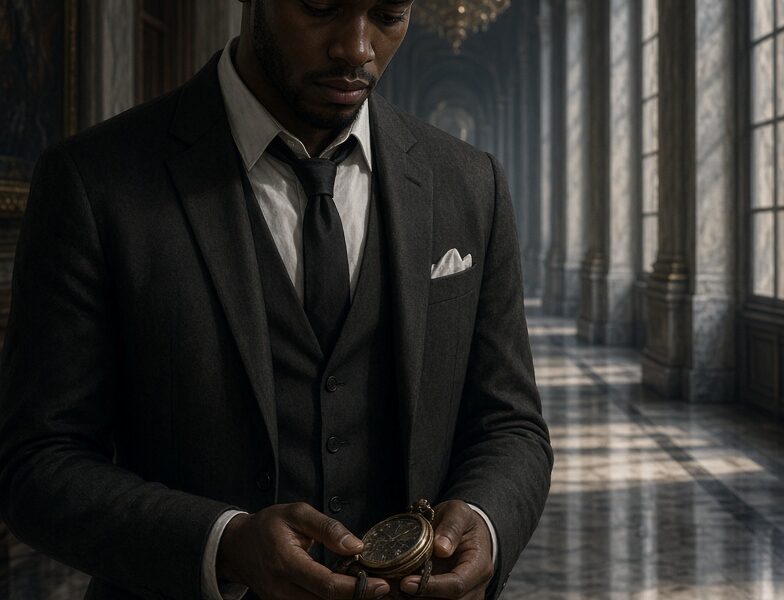
She Threw Him Out at the Funeral… Then the Empire Found Its Real Heir
## Part 1
The rain had stopped an hour before the funeral, leaving the estate driveway slick with moisture that reflected the black umbrellas like dark mirrors.
I stood at the edge of the crowd in a borrowed suit that didn’t fit right, watching strangers file into the mansion my father had supposedly owned for thirty years.
A woman in pearls glanced at my scuffed shoes and looked away.
That’s when I knew how this day was going to end.
My name is Malik Carter, and three weeks ago, I was replacing a cracked radiator hose behind a grocery warehouse in Trenton, New Jersey, for $17.50 an hour.
Grease under my fingernails, twelve-hour shifts, an old pickup truck that complained every morning, and bills that arrived faster than my paycheck.
That was my life.
The man being buried today was the only person who ever made me feel like I mattered, and I was about to find out I never really knew him at all.
My father, Elias Cole, used to tease me about my stubbornness.
“You know,” he said one Saturday, sitting beside my truck while I worked, “most men would accept help before the engine falls out.”
I tightened a bolt and didn’t look up.
“Most men didn’t raise me.”
He smiled at that, the kind of smile that reached his eyes and made you forget he was in his sixties.
To me, Elias was simply Dad.
Money never impressed him when we were together, which I always found strange for a man who ran a manufacturing company.
Whenever I complained about being broke, he repeated the same sentence like a mantra.
“Money can tell you what people want. Hard times tell you who they are.”
I thought it was just one of his sayings.
I didn’t know it was a warning.
Vanessa entered our lives when I was twenty-one, and from the beginning, she was impossible to ignore.
Elegant, polished, always dressed like she had stepped out of a magazine, she treated me warmly at first.
That warmth lasted exactly until the wedding photos were framed.
After she married Dad, the mask slipped in small ways that I pretended not to notice.
She stopped saying my name whenever they argued.
“Your son came by again. Your son refuses help. Your son has no ambition.”
Dad always corrected her with a quiet firmness that made me proud.
“His name is Malik.”
One night, I passed by the library and heard Vanessa’s voice through the door.
“He does not belong in decisions about your company. He belongs wherever I decide he belongs. You treat him like an heir.”
There was a long silence.
Then Dad said, so quietly I almost missed it, “Be careful with that word.”
I should have stopped and asked what he meant.
I didn’t.
Two years later, his health changed, and the world I thought I understood began to crack.
It started with small things.
He forgot meetings.
He tired faster.
Then, one rainy Tuesday afternoon, I found him gripping his desk, struggling to breathe, his face pale and slick with sweat.
I called 911 from the landline because my hands were shaking too badly to unlock my phone.
The paramedics arrived in eight minutes, but it felt like hours.
At the hospital, the diagnosis came with clinical detachment that made me want to break something.
Aggressive pancreatic cancer.
Six months if treatment worked.
Possibly less.
That night, I sat beside his hospital bed staring at the floor, unable to look at the man who had been my entire world.
“Malik.”
I couldn’t respond.
“Son, look at me.”
I forced myself to meet his eyes, and what I saw there wasn’t fear.
It was purpose.
He reached into the bedside drawer and placed his old brown leather watch in my palm.
The leather was worn soft from decades of use, the face scratched from years of honest work.
“Take it. You love this thing. That’s why I’m giving it to you.”
I turned it over, and beneath years of scratches, I noticed four tiny engraved numbers.
1104.
“What does that mean?”
“You’ll know when you need to.”
“Dad, I hate your mysterious old man nonsense.”
He laughed weakly, then squeezed my hand with surprising strength.
“If anything happens to me, don’t let anyone convince you that your life was small.”
I frowned.
“What does that mean?”
“Money can tell you what people want.”
I finished the sentence for him.
“Hard times tell you who they are.”
He nodded, his eyes holding mine with an intensity I hadn’t seen before.
“Remember who you are before anyone tells you what you own.”
Before I could ask another question, Vanessa entered the room.
Her eyes landed on the watch in my hand, and for one full second, all the color left her face.
Then she smiled, that practiced smile that never reached her eyes.
“That old thing?”
Dad held her gaze without blinking.
“Yes.”
She looked at me, her expression carefully neutral.
“You should keep it somewhere safe.”
Something in her voice made me close my fist around the watch and not let go.
Dad died seventeen days later.
I was beside him at 4:12 in the morning when his breathing changed, when the machine beside his bed began its steady, terrible alarm.
He opened his eyes once, and they found mine.
“Malik.”
“I’m here.”
His fingers searched for mine, and I took his hand.
Then he whispered, so faint I had to lean closer to hear.
“Not the house.”
“What?”
But he was already gone, his hand still warm in mine, his eyes closed, his face finally at peace.
I sat there holding his hand long after it turned cold.
Vanessa arrived at sunrise, dressed in black, already making phone calls.
The funeral was scheduled four days later at the estate, and I spent those days in a fog of grief and disbelief.
The morning before the funeral, I went to Dad’s study looking for one thing.
An old photograph of us repairing my bicycle when I was ten, his hands teaching mine how to fix a chain, both of us covered in grease and laughing.
The room had been stripped.
Files were gone, drawers were empty, and the books on the shelves had been rearranged by someone who didn’t know how Dad organized them.
Vanessa appeared in the doorway.
“What are you doing?”
“Looking for a picture.”
“Everything here is being inventoried.”
“I don’t want anything valuable.”
Her eyes slid toward the watch on my wrist, and something flickered in her expression.
“I’m sure you don’t.”
I found the photograph tucked inside an old book, and as I pulled it free, something slipped from the pages and landed near my shoe.
A black card.
No logo, no name, just four silver numbers.
1104.
My pulse jumped, and I felt the hair on my arms rise.
The exact numbers beneath Dad’s watch.
I turned the card over and read the words printed in small, precise type.
If Elias Cole is dead, give this to Rebecca Shaw only.
Vanessa’s heels clicked behind me.
“What is that?”
I closed my fist around the card, and for the first time in my life, I lied to her.
“Nothing.”
That night, I searched for Rebecca Shaw on my phone, expecting to find a local attorney.
Instead, the first photograph on my screen showed a composed woman in her forties, sharp-eyed and professional, standing in front of a glass building.
Beneath her photograph was a title that made no sense to me.
Rebecca Shaw, Chief Counsel, Cole Sovereign Holdings.
I had never heard of Cole Sovereign Holdings.
I searched it, and almost nothing appeared, just a single archived financial article from a decade ago.
The preview contained seven words that made my hands go cold.
One of the world’s largest private conglomerates.
Below the headline was a photograph.
My father, not smiling in our kitchen, not fixing my truck, not wearing his old watch.
He stood between presidents, bankers, and men I recognized from television, his expression calm and commanding.
The caption read: Elias Nathaniel Cole, founder and controlling principal.
I stared at the screen until sunrise, reading the article again and again, trying to reconcile the man in the photograph with the man who ate canned soup with me when money was tight.
The man who wore the same brown watch for twenty years.
The man who said luxury made people careless.
None of it made sense, and yet all of it was there, documented and undeniable.
I barely slept.
By dawn, my father’s photograph was still glowing on my laptop beside the headline I had read at least ten times.
At 9:00 AM, Vanessa called.
“Funeral starts at 11:00. Don’t be late.”
Her voice was flat, emotionless, like she was discussing a business meeting.
I wanted to ask why she had gone pale when Dad gave me the watch.
I wanted to ask what Cole Sovereign Holdings really was.
Instead, I said, “I’ll be there.”
At the estate, mourners filled the halls, and unfamiliar faces seemed to recognize me in ways that made me uncomfortable.
Mrs. Green, Dad’s longtime housekeeper, touched my arm as I passed.
“He talked about you every day.”
My throat tightened.
“Did he tell you what all this really was?”
Her eyes moved toward Vanessa across the room.
“Your father told me things that were not mine to repeat.”
Then she squeezed my hand, her grip firm and warm.
“But he was proud of you.”
That nearly broke me.
After the burial, everyone returned to the mansion for the reception, and I went upstairs toward Dad’s study.
The door was locked.
I tried the handle twice, then turned to find Vanessa standing behind me.
“I need to get something from his desk.”
“The study is closed.”
“I just need a photograph.”
“I said it’s closed.”
I pulled the black card from my wallet, and she froze mid-step.
“Where did you get that?”
“Dad’s study.”
“Give it to me.”
“No.”
“That belongs to the estate.”
“It has Rebecca Shaw’s name on it.”
Her jaw tightened, and I saw something dangerous flash in her eyes.
“You have no idea what you’re holding.”
“Then explain it.”
She stared at me for a long moment, then gave a small, cruel smile that made my stomach turn.
“You really think you’re part of this?”
Before I could answer, she turned and walked toward the staircase.
“Come downstairs.”
By the time we reached the main hall, dozens of mourners were still gathered, holding glasses of wine and speaking in hushed voices.
Vanessa walked to the center of the room and raised her voice.
“Everyone, may I have your attention?”
The conversations died.
“Vanessa, don’t.”
“No, this ends now.”
She faced the room, and I saw sympathetic expressions turn toward her.
“This young man has spent years using my husband’s kindness to attach himself to this family.”
Heat rose in my face, and I felt every eye in the room on me.
“That’s not true.”
“Unqualified, uneducated about this world, and now, hours after my husband’s burial, he is searching private rooms and taking estate property.”
“That card was left for me.”
“You don’t know that.”
“It says Rebecca Shaw.”
Vanessa smiled, the kind of smile that was meant to wound.
“And Rebecca Shaw is not here.”
A calm voice came from the doorway behind us.
“Yes, she is.”
Everyone turned.
The woman from my computer screen walked into the hall wearing a charcoal suit, her heels clicking with purpose on the marble floor.
Rebecca Shaw.
She looked at Vanessa, then at me, then at Dad’s watch on my wrist.
“Mr. Cole.”
Vanessa stiffened.
“He is not Mr. Cole.”
Rebecca met her eyes without flinching.
“I wasn’t speaking to you.”
The room went silent, and I heard someone gasp.
Vanessa stepped forward, her composure cracking at the edges.
“This is a private family matter.”
“Yes,” Rebecca said, “which is why I’m here.”
She held out her hand toward me.
“The card, please.”
I gave it to her, and she examined the silver numbers with an expression I couldn’t read.
“Did your father give you the watch?”
“Yes.”
“Did he explain 1104?”
“No.”
“Good,” Vanessa snapped. “Enough games. I am Elias’ surviving spouse. His residence, companies, accounts, board rights—your attorneys will receive the appropriate documents.”
“My attorneys are here.”
“I know.”
Vanessa pointed toward me, her finger shaking.
“He needs to leave.”
Rebecca’s eyes moved to my suitcase beside the front door, the old one I had packed my few belongings into before coming here.
Something in her expression hardened.
Vanessa turned to me, and her voice rose.
“Get out.”
No one moved.
She pointed toward the gates.
“Your father is dead, Malik. Whatever place you imagined you had in this family died with him.”
I gripped the framed photograph of Dad and me, the only thing I had taken from the house.
“I’m not asking for anything.”
“You come here in filthy clothes with a cheap suitcase and think sentiment gives you ownership.”
I felt the words land like blows, but I didn’t look away.
“He was the only man who ever made me feel like I mattered. And now he’s gone.”
She stepped closer, close enough that I could smell her perfume.
“This mansion, his companies, his accounts, every car outside, everything belongs to me.”
She paused, letting the words sink in.
“Take that picture and disappear.”
Rebecca finally spoke, her voice cutting through the tension.
“That would be a very expensive mistake.”
Vanessa turned sharply.
“What did you say?”
Rebecca pulled out her phone and tapped one number.
“Bring the cars. We found him.”
The iron gates opened, and three black Mercedes rolled into the courtyard in perfect formation.
Every voice in the mansion died.
Six men in dark suits stepped out, and the first one walked directly toward me.
“Mr. Cole.”
Vanessa snapped, “Stop calling him that.”
The man ignored her completely.
“Sir, we’re ready when you are.”
I stared at him, my mind struggling to process what was happening.
“Ready for what?”
Rebecca stepped beside me, her voice calm and steady.
“To take you somewhere your father prepared for this exact day.”
Vanessa laughed, but the sound was hollow and desperate.
“You expect him to leave with strangers?”
Rebecca’s expression turned cold.
“They are not strangers. They have been assigned to his protection since he was born.”
My chest tightened, and I felt the ground shift beneath my feet.
“Since I was born?”
“Yes.”
Several guests exchanged looks, and I realized with a start that it wasn’t confusion on their faces.
It was recognition.
Vanessa moved between us, her voice rising.
“Malik is not going anywhere until I know what Elias was doing.”
Rebecca opened her portfolio and removed a sealed envelope.
Across the front, in my father’s familiar handwriting, were four words.
For my son, alone.
My hands shook as I opened it, and I recognized the paper as the same kind Dad used for his letters.
Malik, if you are reading this, then I failed to tell you myself.
Forgive me.
Trust Rebecca.
Do not sign anything Vanessa gives you.
And remember what I taught you.
Money can tell you what people want.
Hard times tell you who they are.
Dad.
Rebecca gestured toward the cars.
“Come with me.”
The Mercedes took us downtown to a glass tower with no company name on it, just a number on the door.
We entered through a private garage, and the elevator required Rebecca’s fingerprint before it would move.
It carried us to the 58th floor in silence.
Twelve people were waiting in a conference room, lawyers and accountants and trust officers, and two men I recognized from international news.
When I entered, every one of them stood.
I almost turned around and walked back to the elevator.
Rebecca touched my shoulder.
“Sit.”
I did.
She sat opposite me, her expression serious but not unkind.
“Malik, what I’m about to tell you will be difficult to believe.”
I gave a tired laugh.
“Try me.”
She slid a folder across the table.
Inside was my birth certificate.
Under father, it read: Elias Nathaniel Cole.
“That’s not news.”
“The legal significance is.”
She opened another file, thicker than the first.
“Your father created Cole Sovereign Holdings before you were born. Over the next twenty-eight years, he placed nearly every controlling interest he owned into a private succession structure.”
“How much are we talking about?”
She didn’t answer directly.
“Vanessa owns assets your father gifted her personally. A residence trust, investment accounts, certain privileges. But she does not own the structure.”
“She said everything was hers.”
“She was wrong.”
“How wrong?”
One accountant lowered his eyes, and I saw him exchange a glance with the woman beside him.
Rebecca pushed another document toward me.
Cole Sovereign Succession Trust.
Below it, in bold letters: Primary beneficiary, Malik Elias Cole.
My hands went numb.
“What is this?”
Rebecca’s voice softened.
“Your father did not merely include you in his will.”
She turned the final page.
“You are his only legally recognized biological son.”
I stared at her, unable to speak.
Then she said the sentence that changed everything.
“And you are the sole primary heir to the Cole estate.”
I stared at Rebecca, my mind racing.
“Sole heir?”
“Yes.”
Everyone in the conference room stared silently at me, and I felt like I was drowning.
“There’s a mistake. Dad owned a manufacturing company and some property.”
Rebecca touched a remote, and a world map filled the wall.
Hundreds of lights appeared across North America, Europe, Africa, Asia, and the Middle East.
“Cole Manufacturing was never the empire,” she said. “It was the part Elias allowed people to see.”
Names appeared beneath the map.
Energy companies, banks, shipping terminals, data centers, medical patents, agricultural land, telecommunications networks, and private equity funds.
“How many companies?”
“Four hundred twelve significant entities directly or indirectly controlled.”
I stood up, my chair scraping against the floor.
“No. My father drove an old truck.”
Rebecca almost smiled.
“Your father enjoyed being underestimated.”
“How much was he worth?”
“The current conservative valuation inside the succession structure is six hundred eighty-seven billion dollars.”
My fingers went cold.
“And several private holdings haven’t been fully valued.”
“You’re saying he had almost seven hundred billion dollars.”
“I’m saying the final number could be much higher.”
I sat down because my legs wouldn’t hold me anymore.
“Why didn’t he tell me?”
Rebecca dismissed everyone except an older security officer named Samuel Price, who stood by the door with the quiet alertness of someone who had spent decades protecting people.
Then she placed a photograph on the table.
Dad was young, younger than I had ever seen him, standing beside a woman holding a baby.
My mother.
“You were eleven months old when someone sent Elias a photograph of you sleeping in your crib.”
“What?”
“Three days later, someone connected to an early business partner demanded voting control in exchange for keeping his family safe.”
My chest tightened.
“Months later, your mother died in a highway accident. Police ruled it an accident. Elias never found evidence connecting the two events, but he never stopped wondering.”
I stared at my mother’s face, at the smile I had only seen in photographs.
“So he hid me.”
“He protected you. To the financial world, Elias Cole had no acknowledged child. Your records stayed ordinary. Security watched you from a distance.”
Rebecca opened a laptop, and Dad appeared on screen, sitting in his study.
“Malik,” he said, “if you’re seeing this, you’re probably angry with me.”
My throat closed.
“When you were sixteen, you worked an entire summer to buy that terrible blue car. I could have bought you a thousand cars. But the morning you held those keys, you looked richer than most billionaires I knew.”
Despite myself, I smiled.
“I realized telling you too early could steal something money could never return. The chance to discover who you were without knowing what waited behind my name.”
Dad leaned toward the camera.
“I did not raise you poor, son. I raised you free.”
The recording ended, and I wiped my eyes with the back of my hand.
“I don’t want the money.”
Rebecca nodded as though she expected that.
“Then give it away. You can direct enormous resources toward good causes someday. But first, you have responsibilities.”
“What did Dad expect me to do?”
“Learn.”
So I did.
—
## Part 2
The first morning in the tower, I sat in a conference room with twelve strangers who used words like “liquidity” and “fiduciary” and “consolidated holdings” as if they were discussing the weather.
I understood maybe every third word.
A man named David from the accounting team slid a document toward me.
“This is the quarterly report from our European energy division.”
I looked at the numbers, then looked at him.
“I don’t know what any of this means.”
He blinked.
“I’m sorry?”
“I said I don’t know what any of this means. Explain it like I’m someone who fixed cars for a living.”
David glanced at Rebecca, who nodded slightly.
He took a breath and started over.
“Okay. Think of it like this. We own part of a company that makes electricity. That company sells electricity to homes and businesses. At the end of every three months, they tell us how much money they made. This document tells us that number.”
“Why didn’t you just say that the first time?”
“I assumed you knew the terminology.”
“Assume nothing.”
By the end of the first week, I had learned more than I had in four years of community college.
I learned that Dad’s empire wasn’t just about money.
It was about responsibility.
Every company he controlled employed people, thousands of people, people with families and mortgages and kids who needed braces.
Every decision he made affected lives I would never see.
On the tenth morning, Rebecca placed an updated valuation before me.
Nine hundred fourteen billion dollars.
I stared at the number.
“And there are still assets being valued?”
“Yes.”
A trillion dollars no longer sounded impossible.
That afternoon, Vanessa sued.
Her attorneys claimed Dad had lacked mental capacity when he amended the succession trust, that he had been manipulated by advisors who wanted to enrich themselves.
They asked the court to freeze transfers and expand her rights as surviving spouse.
Three days later, Vanessa requested a private meeting.
Rebecca advised against it.
I went anyway.
We met in a small conference room on neutral ground, no lawyers, no witnesses except Samuel standing by the door.
Vanessa entered wearing a cream suit, her hair perfect, her expression guarded.
“What do you want?” I asked.
“What should have been mine.”
She sat across from me, and for the first time, I saw the exhaustion beneath her polish.
“I spent fourteen years beside Elias. I hosted presidents, protected relationships, sat through board dinners while he disappeared to eat hamburgers with you.”
“And that gave you the right to tell me I wasn’t his son?”
Her anger cracked, and I saw something raw underneath.
“I watched him prepare an empire for someone who couldn’t read a balance sheet.”
“I never asked for it.”
“That’s what makes you dangerous.”
She stood, her hands trembling slightly.
“At least ask yourself why a man obsessed with protecting you never told you the truth.”
“What truth?”
At the door, she stopped.
“Ask Rebecca what happened on November 4th.”
“November 4th?”
“11:04.”
My eyes dropped to Dad’s watch on my wrist.
That night, I put the watch and the black card on Rebecca’s desk.
“What happened November 4th?”
She went still.
“Rebecca.”
“It was the day Elias executed the original succession declaration. The numbers are an access code. Half of one.”
She opened a safe and removed a black encrypted drive.
“The watch contained one authentication sequence. The card contained another. Together, they unlocked Dad’s private archive.”
Hundreds of records appeared on her screen.
Trust amendments, medical evaluations, letters, videos, and birth documents.
Dad had prepared evidence for almost every challenge Vanessa could make.
Almost.
At 6:10 the next morning, Rebecca called.
“Come immediately.”
When I reached the tower, three attorneys stood around the conference table.
Nobody sat.
Rebecca handed me a laboratory report.
Paternity analysis.
Elias Nathaniel Cole.
Malik Carter.
“What is this?”
“Evidence submitted by Vanessa’s attorneys.”
I read the final line.
Probability of paternity, 0.00%.
I laughed, but the sound was hollow.
“That’s fake.”
Nobody answered.
“It has to be.”
Rebecca placed another document beside it, older and yellowed at the edges.
It was twenty-three years old.
Dad’s signature was at the bottom.
A laboratory acknowledgement confirmed that Elias Cole had received the same result.
0.00%.
My hands shook.
“He knew?”
“Yes.”
“For twenty-three years?”
Rebecca swallowed.
“Yes.”
“You told me I was his biological son.”
“That is what Elias represented to everyone authorized to know about you.”
“But he knew I wasn’t.”
The doors opened, and Samuel hurried inside.
“Rebecca, we have a problem.”
Her phone rang, and she answered, listened, then slowly sat down.
“What happened?”
“Vanessa obtained an emergency injunction. The succession transfer has been frozen pending a hearing.”
“What does that mean?”
“You cannot assume control. And the estate is temporarily locked.”
Yesterday, I had been the only son of a man whose empire was approaching one trillion dollars.
Today, science said I was nobody to him.
Then Rebecca lifted the old report beneath the light, and her eyes narrowed.
“What?”
She pointed to a handwritten notation almost invisible along the bottom.
Four words.
Rebecca knows the second test.
Her face went pale.
“I’ve never seen this document.”
“Then what second test?”
Before she could answer, the encrypted drive flashed red.
Remote access detected.
Samuel grabbed the laptop.
“Someone is inside the archive.”
Files began disappearing.
Dad’s videos, trust records, medical documents.
Then a folder appeared that none of us had opened.
Its name was one word.
Malik.
Samuel reached for the keyboard, but the folder vanished before he could click.
Somewhere outside that room, someone had just stolen the secret my father spent twenty-five years hiding.
“Kill the connection,” Rebecca ordered.
Samuel ripped out the cable.
“Too late.”
“So that’s it?” I asked.
“No. Your father prepared for betrayal.”
“Then where is the backup?”
Her eyes dropped to Dad’s watch.
I remembered his last words.
Not the house.
Samuel opened the back plate, and inside was a brass key.
Rebecca froze.
“Elias kept a private deposit facility beneath the original coal manufacturing building.”
An hour later, we stood inside the old factory where Dad had begun, the building cold and empty, the machines long silent.
Locker 417.
Inside waited an envelope and a recorder.
The envelope read: For Malik. When blood becomes the question.
Rebecca pressed play, and Dad’s voice filled the empty room.
“Son, if you are hearing this, someone has discovered the first DNA test. That test is real. I am not your biological father.”
I felt the words hit me like a physical blow.
“You were born to my younger brother, Nathan Cole, and your mother, Amara.”
Nathan.
Dad’s dead brother.
The one who died before I was born.
“After he died, you became vulnerable to people who wanted leverage over our family.”
Dad paused, and I heard him take a breath.
“I chose to become your father before you could speak. Legally, emotionally, completely. Blood did not make that decision for me.”
My eyes burned, and I pressed my fist against my mouth to keep from breaking.
“The second test is not another paternity test. It proves Malik is Nathan’s biological son, and therefore a Cole descendant.”
Rebecca opened the envelope.
Inside was the original succession trust.
Wet signatures.
Twenty-three years old.
She read the controlling clause twice, then looked up.
“He named you individually.”
“What?”
“The trust does not say biological son. It says Malik Elias Cole, formerly Malik Carter.”
Dad continued on the recording.
“Anyone trying to break the trust by proving Malik is not my biological child is attacking the wrong foundation. He inherits because I named him. He is my son because I chose him.”
I covered my face with both hands and let the tears come.
Rebecca turned the pages.
“Attached are medical evaluations and notarized records created decades before Elias became ill. This destroys Vanessa’s incapacity argument.”
Samuel examined the recorder.
“There’s another file.”
It was a security log.
Any remote deletion created an external audit record.
Samuel read it.
“The access came through Vanessa’s law firm.”
Two days later, we entered court.
Vanessa sat across the aisle in a cream suit, composed but pale, her hands folded in her lap.
Her attorney argued that the succession plan depended on Dad believing I was his biological son.
Rebecca stood.
“My client made no such representation. Elias Cole knew the truth for twenty-three years.”
She submitted the original trust, Nathan’s records, the kinship report, Dad’s medical evaluations, and the audit log.
The judge read silently for what felt like hours.
“The beneficiary is identified by name,” she said finally. “The instrument predates the decedent’s terminal illness by more than two decades.”
Vanessa’s attorney stopped writing.
The judge looked toward him.
“I am also concerned by evidence of unauthorized access to protected estate records.”
The injunction was dissolved that afternoon.
Control returned to me.
The breach became a separate investigation, one that would eventually reach places I couldn’t yet imagine.
Outside the courthouse, reporters waited behind barricades.
“Statement?” Rebecca asked.
“No.”
I finally understood Dad’s preference for silence.
Three weeks later, Rebecca placed the final consolidated valuation on my desk.
One point four eight trillion dollars.
I stared at the number.
“A trillion?”
“In companies, land, infrastructure, and investments. Not cash in an account.”
I closed the report and thought of Dad eating cheap soup in my kitchen, laughing about my truck.
“What happens to Vanessa?”
“She keeps the assets Elias explicitly gave her, but she will not control Cole Sovereign. The archive investigation continues.”
“So I could remove her from the mansion?”
“You could.”
Take that picture and disappear.
Then another voice came back, Dad’s voice, steady and wise.
Money can tell you what people want. Hard times tell you who they are.
“I want to speak to her.”
Vanessa met me beneath Dad’s portrait in the main hall, the same spot where she had tried to destroy me.
No relatives.
No lawyers.
She noticed my old suitcase, the same one I had carried the day she threw me out.
“You came to throw me out?”
“No.”
I set the suitcase down.
“The day you kicked me out, I had four hundred twenty-six dollars in my bank account. I thought Dad owned one company. I never wanted your money.”
She looked away.
“You decided I was worthless because you thought I had nothing.”
“I was angry.”
“You were afraid.”
Her eyes returned to mine, and I saw the truth in them.
“You were afraid his love for me left less for you.”
Her face tightened, but she didn’t deny it.
“You humiliated me at his funeral and tried to take control through a lie.”
“I didn’t order that.”
“Then the investigation will prove it.”
She swallowed.
“What are you going to do to me?”
“Nothing for revenge.”
She looked surprised.
“But actions have consequences. You will never control his companies. The courts will handle the rest. And you will never again use my father’s name to make me feel small.”
Vanessa’s eyes filled with tears, and for a moment, she looked almost human.
“I loved him.”
“I believe you.”
“That doesn’t excuse me.”
“No.”
I turned toward the door.
“Malik.”
I stopped.
“He talked about you constantly.”
I looked back.
“He would return from meetings with presidents and CEOs and spend twenty minutes telling me, ‘You finally fixed that ridiculous truck.'”
I almost smiled.
“That sounds like him.”
—
## Part 3
Months passed, and I kept my old truck.
I learned to read balance sheets and quarterly reports, but I also learned to visit factories before boardrooms, to eat with employees and ask about pensions before profits.
Owning something and deserving to lead it were different things, and I refused to confuse the two.
My first major decision expanded Dad’s education fund for employees’ children, covering tuition for anyone who wanted to attend college or trade school.
The board expected a speech about growth and shareholder value.
I gave them one sentence.
“My father taught me that wealth matters only when it improves someone else’s life.”
The silence that followed was longer than any quarterly report.
Samuel became my closest advisor, a man who had watched me from a distance for thirty years and knew more about my life than I did.
“You know,” he said one afternoon, “your father used to call me every week when you were in high school. He wanted to know if you were eating enough.”
“He never told me that.”
“He didn’t want you to feel watched. He wanted you to feel free.”
I thought about all the times I had felt alone, not knowing that a man I would never meet was making sure I was safe.
One year after his funeral, I returned to the mansion alone.
The same gates opened, but there was no convoy, no reporters, no drama.
Just me and the framed photograph Vanessa had once ordered me to take away.
In Dad’s study, I placed it beside his watch on the desk, the two objects finally reunited.
For months, I had believed he hid his fortune because he didn’t trust me.
Now I understood.
He wanted me to meet myself before I met his money.
Rebecca had recovered one final recording from the private archive, a video Dad had made just weeks before he died.
I pressed play, and his face appeared on screen, tired but smiling.
“If you made it this far, son, then you finally know everything.”
I laughed softly.
“Not everything, Dad.”
“One last thing,” he said. “People say inheritance is what a man leaves behind. They’re wrong.”
His eyes softened.
“Inheritance is what remains inside you after everything else is taken away.”
I looked around the room, at the mansion, the empire, the gates I had once been thrown through.
None of it had made me his son.
He had done that years earlier, every time he chose me.
Dad smiled one last time.
“Money can tell you what people want. Hard times tell you who they are.”
The screen went black.
And standing there with a trillion-dollar empire behind my name, I finally understood that the greatest inheritance my father left me was the man he had taught me to become.
—
The investigation into the archive breach concluded six months later.
Vanessa’s law firm was cleared of direct involvement, but a junior partner had been bribed by a rival conglomerate hoping to acquire Cole assets at a discount.
The partner was disbarred.
The rival company paid a settlement that added another two hundred million to the estate.
Vanessa herself was never charged, but she moved out of the mansion that spring, taking only what Dad had explicitly given her.
She left a note on the kitchen counter, addressed to me.
I read it once, then folded it and placed it in the drawer with Dad’s watch.
It said: “You were right about me. I hope you’re wrong about yourself.”
I never responded.
Some doors, once closed, are better left that way.
Mrs. Green stayed on as housekeeper, and I made sure she knew she was family, not staff.
“You know,” she told me one evening, “your father used to say you were the best thing he ever built. Better than any company.”
“He said that?”
“He said it all the time. Usually while eating a hamburger and complaining about your truck.”
That sounded exactly like him.
I kept the truck, by the way.
It still complained every morning, but I had learned to fix it myself, and there was something satisfying about starting the engine with my own hands before stepping into a boardroom worth billions.
The world called me a trillionaire, but I still changed my own oil.
Some habits are worth keeping.
—
**THE END**









