She Stood Alone With 47 Rocks… Then 450 Bikers Showed Up
The door to the clinic opened at 7:58 on a Tuesday morning in October, and the woman behind the reception desk looked up just long enough to see the child standing on the yellow painted line at the edge of the parking lot facing the road.
She had been there since 7:40. The receptionist, Donna Hate, did what she had done the three previous Tuesdays. She pressed her lips together, reached for the phone, and then set it back down without dialing.
Something about the way the girl stood stopped her each time. Not afraid, not lost. Counting something under her breath with her chin moving slightly.
The way a person counts when the number matters and they are afraid of losing their place. Donna went back to her intake forms.
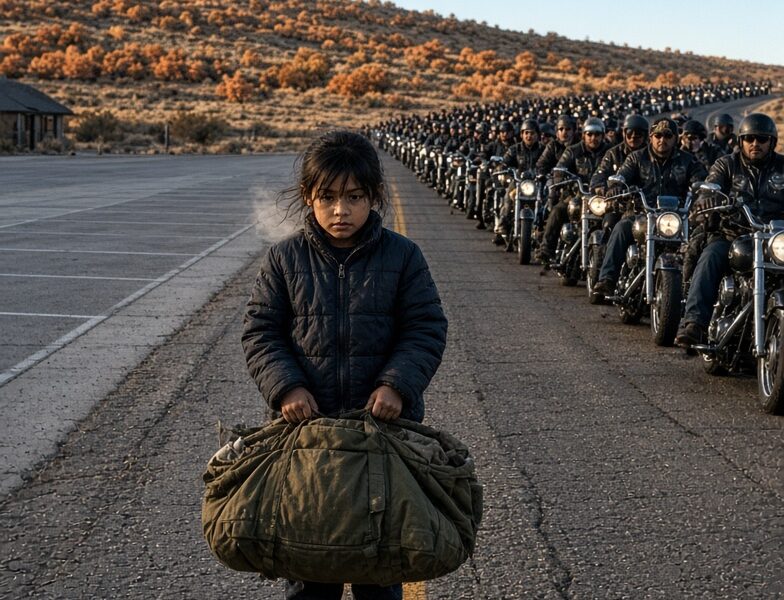
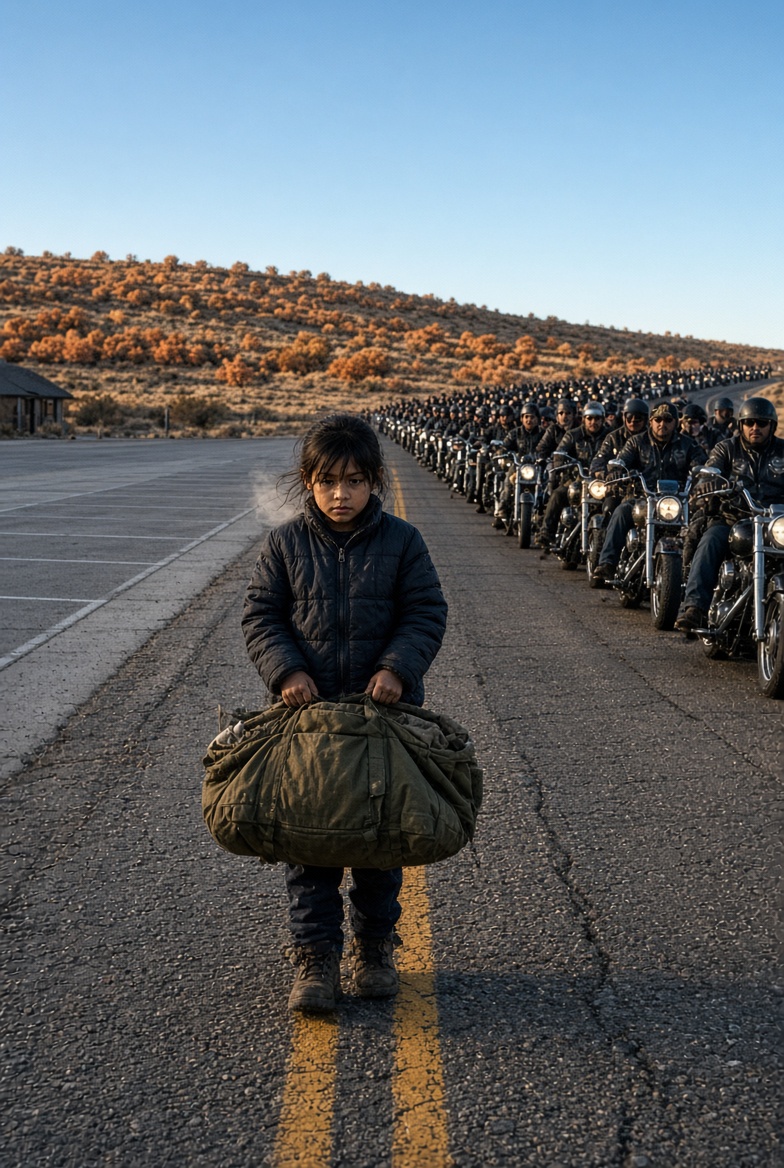
Outside, the child stood on the yellow line, and the cold came across the high desert floor in long, flat waves that pressed her dark hair against her cheek. She did not move it.
She had a canvas bag over her left shoulder, army green and clearly heavy, and she held the strap with both hands, the way you hold something you are responsible for. She was 8 years old and her name was Petra Voss and she was waiting for something most of the road did not know was coming.
Four and a half miles away on the other side of the ridge where the scrub oak turned copper in the first week of October, a man named Calhoun Dre heard his phone buzz against the metal surface of the workbench and ignored it the first time.
He was 61 years old, broad across the back in a way that had nothing to do with youth and everything to do with four decades of work that required it, and his hands were the color of old saddle leather from the knuckle down.
His beard had been gray since he was 53 and showed no interest in changing. He was the president of the Ash Creek Riders, the last founding member, still putting miles on a bike, and on most mornings he was in the shop by 6 because the shop was where he thought clearly, and the desert outside it was where he breathed.
The phone buzzed again. He picked it up and read the message from a man named Lobo Santair, his road captain. Three words long.
You need to come.
Calhoun set down the socket wrench. He pulled his cut on over his flannel and walked out into the copper morning, and the cold hit him across the jaw like a flat hand, and he did not know yet what it meant, that a child was standing on a yellow line 4 and 1/2 miles away, counting her steps in her head, and waiting for something she had never been able to name.
He would find out before 9:00, and when he did, what he did about it would take 450 men to answer properly.
Lobo Santair was leaning against his bike at the junction of Mill Cutoff Road and Route 89, which was not where he was supposed to be on a Tuesday morning, and the fact that he was there at all and had already texted told Calhoun everything about the register of the situation before he saw the child himself.
Lobo was a tall, loose-jointed man of 52 who had ridden with the Ash Creek Riders for 19 years and who handled most things with a quietness that bordered on indifference. He was not indifferent now.
He was watching the clinic parking lot from 20 yards back with his arms folded and his jaw set. And when Calhoun pulled up beside him and killed the engine, Lobo did not offer an explanation.
He just tilted his head toward the lot. Calhoun looked.
The child was still on the yellow line. She had not moved in the time it had taken him to ride over.
She was facing Route 89 with her feet together and her canvas bag gripped in both hands and her chin up, and the autumn light came across her from the east at a low angle that made her shadow long and thin on the asphalt behind her.
She looked, Calhoun thought, like someone posted at a station, like someone doing a job. He got off the bike.
He did not approach her immediately. He stood beside Lobo and watched her for 45 seconds because he had learned a long time ago that the first 45 seconds of watching told you more than the first 45 seconds of talking.
She was not crying. She was not scanning the lot for someone. Her eyes tracked traffic on 89, specifically northbound traffic.
And when a vehicle passed, she watched it all the way to where the road curved behind the ridge. And then she looked back to the near end of the road and started watching again.
Counting, Calhoun realized. She was counting vehicles.
He crossed the lot. His boots on cold asphalt made a sound like grain on a drum.
When he was 10 feet away, he stopped because children sometimes bolt and he was not a shape that reassured most people at close range, and he knew it and had made his peace with it years ago.
She turned and looked at him without flinching, which told him something.
“You waiting on somebody?” Calhoun said. His voice came out lower than he intended, the way it always did in the cold.
She looked at him with very dark eyes and said, “I’m waiting for 11:00.”
He looked at the clinic behind her. The sign on the glass read Yavapai County Rural Health Access Clinic and below it in smaller letters, Pediatric Oncology Outreach, Tuesdays.
“You’ve got a treatment today,” he said. It was not a question.
“My mom does,” Petra said.
She adjusted the strap on her canvas bag with the deliberate efficiency of someone who has carried the same thing the same way many times.
“She goes in at 9:00. I come out here after I check her in.”
He looked at the bag. “What’s in there?”
She looked down at it, then back up at him as if deciding.
“Rocks,” she said.
He waited.
“I count them,” she said. “While she’s inside.”
She said it the way you say something that is completely obvious once you know it. With no self-pity and no invitation for sympathy, just a fact about how Tuesday mornings worked.
Calhoun stood very still for a moment. The cold pressed against the back of his neck under his collar.
The scrub oak on the ridge turned in a gust of wind, and a few copper leaves came down across the parking lot and stuck against the clinic’s glass door.
He thought about asking another question and decided against it because the picture was already clear enough to be unbearable. The girl’s mother was inside receiving treatment.
The treatment was long. Petra came outside and stood on the yellow line and counted vehicles on Route 89.
And when counting vehicles was not enough, she counted rocks she had brought from somewhere. And she had been doing this every Tuesday for long enough that Donna Hate inside had stopped reaching for the phone.
The canvas bag was heavy because there were many rocks, which meant the Tuesdays were many, which meant the treatments had been going on for a while. Calhoun put all of that together in about four seconds.
And then he did what he had learned to do when a thing was true and could not be argued with. He accepted it.
“What’s your name?”
“Petra.”
“How many rocks?”
She considered him with those dark, steady eyes and said, “47.”
He nodded once. He looked back at Lobo, who was still by the bikes watching. He looked back at the child.
“Okay,” he said. “I’m Calhoun. I’m going to go make a phone call. You all right out here for a few minutes?”
She said, “I’ve been all right out here for four Tuesdays.”
He almost smiled. He walked back to Lobo instead.
“She’s been out here every week,” Calhoun said.
“Every Tuesday since September,” Lobo said. “My cousin Ranata works dispatch out of the substation on Mill. She’s driven past four times. Said the kid is always there when she comes by at 7:40 and always there when the mother comes out. Door to door is about two hours.”
Calhoun looked at the ridge. The sky above it was pale and sharp-edged, the kind of blue that meant the temperature was going to drop another six degrees before noon. He felt the cold in his knuckles the way he always felt it in October, a tightening like the skin was being taken in.
“She’s counting rocks,” he said.
“So she doesn’t think about what’s happening inside,” Lobo said.
“Yeah.”
Calhoun pulled out his phone. He called Dex Mahar first because Dex was the Ash Creek Riders communications officer and could put a message to every member’s phone inside of four minutes. And also because Dex had a talent for saying the exact right number of words.
Calhoun told him what he’d seen in three sentences. Dex was quiet for two seconds and then said, “I’ll send it out. What do you want them to know?”
Calhoun thought about it.
“Tell them it’s a girl with a bag of rocks waiting for her mother outside a cancer clinic on Route 89. Tell them it’s been four Tuesdays. Tell them I need anybody who can ride to meet me at Mill Cutoff by 8:30.”
He paused.
“Tell them it’s cold.”
Dex said, “That’ll do it,” and hung up.
Calhoun went back to the parking lot, but he did not go back to the yellow line. Instead, he went to the clinic’s front door and went inside.
The warmth hit him in the face. Donna Hate looked up from behind the desk and her expression did the thing that expressions did when a large bearded man in a leather cut walked into a place that was accustomed to sick people and their quiet families.
She did not reach for the phone, but she thought about it. He could see her thinking about it.
He stopped a respectful distance from the desk and said, “I’m Calhoun Dre, Ash Creek Riders. I’m not here to cause any problem. The child outside, the one on the yellow line. I’d like to know if it’s all right with the clinic if a few of us sit with her while her mother’s in treatment.”
Donna Hate looked at him for a long moment. Then she looked past him through the glass at Petra, who was still on the yellow line, still counting.
“A few,” Donna said. “How few?”
He considered being honest and decided it was the only option.
“I’m not sure yet,” he said. “15, maybe. Possibly more.”
She looked back at him, and he could see her doing the calculation that everyone did, the one about surface and intent, and he waited for it to finish.
“The child’s name is Petra,” Donna said. “Her mother is Sandra Voss. Sandra checks in at 9:00 and is usually out by 11:15. I’ve spoken to Petra twice. She won’t come inside and wait, even when I’ve offered.”
She stopped.
“She says the waiting room makes the time go wrong.”
Calhoun understood that completely.
He said, “We’ll keep the lot clear and the noise down. We’re not going to make a scene.”
Donna Hate looked at her phone. Then she folded her hands on the desk and said, “I’ll call Dr. Bream and let him know.”
Calhoun thanked her and went back outside. The cold met him again at the door, sharp and immediate, the way cold in northern Arizona announces itself in October without any of the softening that happens in lower country.
He stood on the step and looked at Petra on the yellow line and felt something shift in the bottom of his chest. Something that had been very still for a long time.
He knew what it was. He recognized it the way you recognize a smell from 20 years ago. Instantly, and with the full weight of what the smell belongs to.
He did not go toward it yet. He went to the parking lot’s edge where Lobo was and leaned against his own bike and watched the road.
By 8:23, the first four bikes turned off Route 89. He recognized the riders before the bikes stopped.
Moss Keller, who was the club’s treasurer, and also a man who had driven two hours in worse weather than this for less reason. Fe Brindllo, whose given name was Frederick, and who nobody called Frederick, an Ash Creek rider for 11 years, who worked a ranch off the highway, and arrived with his forearms red from the cold because he had not stopped to get a heavier jacket.
Two men Calhoun knew as Chalk and Terrence, who rode together on Tuesdays because they both happened to work the night shift at the same concrete plant and were always loose by 6:00 in the morning.
They killed their engines in sequence, and the quiet after was very complete. Petra had turned to look at the bikes.
She was not alarmed. She watched them with the same steady attention she gave to the northbound traffic, assessing without conclusion.
Fe walked to the edge of the lot, not too close, and crouched down to her level and said, “You got a favorite rock in there?”
She considered him.
“The one with the white stripe,” she said.
“Good choice,” he said.
He stood back up. He did not say anything else, and she did not say anything else. And that was the right amount of words for the moment.
By 8:50, there were 31 riders in the Mill Cutoff lot. Some leaned on bikes.
Some stood with their hands in their vest pockets, shoulders pulled against the cold, breath showing in the air. A few had brought thermoses and passed them around without comment.
The cold had changed the shape of the group three times already. First they spread out.
Then the wind came across the flat and they pulled in closer. And then someone produced a battered folding chair from a saddle bag and set it near the clinic step in case the child wanted it.
She did not use it, but she looked at it twice.
Calhoun stood apart from most of them and watched Route 89, which was what Petra was watching. And he thought about the 47th rock in that bag, and he thought about how long you had to stand on a painted line in a parking lot before 47 rocks started to feel like company.
He had not thought about Thomas in three years. That was not a boast.
It was just a number that had accumulated the way mileage accumulates, without intention and without celebration. Thomas had been his son and Thomas had been 9 years old and Thomas had died in the winter of a year that Calhoun no longer kept track of by its number because the number wasn’t the point.
The point was the hospital and the long drives and the waiting and the way Calhoun had eventually stopped going inside because inside the waiting room was a particular species of time that his body refused to metabolize.
He had sat in parking lots instead. He had leaned against his truck in weather colder than this and smoked cigarettes he didn’t want and watched the road because the road was the only thing that seemed to move at a normal speed.
And Sandra Voss’s daughter was doing the same thing. And she had found a better solution than cigarettes.
She had found rocks.
He had not told anyone in the club about Thomas. Not because he was ashamed and not because he was protecting himself, but because grief is not a credential, and he had never wanted it to function as one.
But standing in a parking lot outside a pediatric oncology outreach clinic on a Tuesday morning in October, watching 31 men arrange themselves respectfully around a child and her canvas bag of 47 rocks, Calhoun understood something.
He had spent years working around. He had sat alone in a parking lot because there had been no one to stand with him, not because no one would have come.
He had never asked. He had never let it be the kind of thing that could be answered with numbers and presence and thermoses of hot coffee passed around without ceremony.
He had treated his own parking lot vigil as a private shame. And in doing so, he had made it heavier than it needed to be, and he had carried that weight so long he had stopped noticing it the way a person stops noticing the pressure of a ring they’ve worn for decades.
He noticed it now. He felt it lift slightly just from standing in the same geometry as the girl.
He walked to where Petra stood.
“The rocks,” he said. “Where do you get them?”
“The arroyo behind the Brewer Road turnoff,” she said. “I picked them the day before.”
He nodded.
“Your mom know you come out here?”
“She thinks I wait inside.”
Her voice was level and without apology.
“But the waiting room makes the time go wrong.”
He had heard that already from Donna Hate and he had understood it then, but hearing Petra say it herself landed differently. It landed in the sternum.
He looked out at Route 89 and said, “Yeah, it does.”
She looked up at him.
“Does it do that to you, too?”
He looked down at her. The cold came across the lot in a long flat wave, and the copper leaves from the scrub oak settled against the clinic’s step.
He said, “Yeah, it does that to me, too.”
She returned to watching the road. He stayed beside her.
He did not count rocks. He counted the breath of 31 men showing in the morning cold, rising and disappearing.
31 small clouds that proved something was alive and present and not going anywhere.
Dex Mahar’s message had reached 214 phones by the time the sun cleared the ridge properly and the light went from pale to gold. Not everyone who received it could come.
Not everyone was close enough or awake enough or free of obligations that a Tuesday morning creates for working people. But enough people who received it were close enough and awake enough and understood that some obligations outweigh other obligations.
And by 9:45, the Mill Cutoff lot and the first quarter mile of Route 89’s shoulder were holding a count that Calhoun had not anticipated. He walked the line because he needed to understand the scale of what was assembling.
He walked it with his hands in his cut pockets and his breath showing, and he counted under his breath the way Petra counted vehicles. The bikes were parked too deep along the shoulder, facing north, engines quiet.
The riders stood beside them or sat on the asphalt or leaned on fence posts. Some had ridden since 5 in the morning from places that required it.
The cold had changed what they were doing again. At first they stood at the shoulder in singles and pairs, but the wind had shifted to come from the northwest, and the group had reorganized, not by instruction, but by the instinct of people who have ridden in weather and know that bodies in proximity stay warmer.
Clusters of four and five, shoulders closed, coffee shared, conversation in low tones. A woman named Bernal, who ran the tax supply in Ash Creek, and whose husband rode, had driven out with a truck bed full of paper cups and two urns, and was working her way down the line.
She had not been asked to do this. Nobody had been asked to do anything specifically, which was the point, which was what the message had conveyed without saying it, and which was one of the things Calhoun valued most in the people he rode with.
When the message said, “A child is standing in a parking lot in the cold waiting for her mother’s cancer treatment, and she has been doing it for four Tuesdays,” what it required did not need to be explained. You just came.
You brought what you had. You stood in a line.
When Calhoun reached the far end of the assembled riders, he stopped and turned and looked back toward the clinic and felt the number hit him like weather.
450.
He counted to 400 and then stopped adding because the shoulder curved south and he could not see the rest clearly. But Lobo, who had walked the length with a different method and a phone, had the number.
450 riders on a Tuesday in October on a state highway shoulder in northern Arizona in cold that had dropped to 38 degrees by 9:00. Not one engine running, not one voice raised.
The sound of Route 89 was the wind across the scrub and the occasional truck heading north and the faint sound, if you were close enough to the clinic parking lot, of a child counting under her breath.
Calhoun went back to the clinic step. He stood beside Petra Voss, who was now sitting on the folding chair.
Someone had produced her canvas bag in her lap. She had not opened it.
She was watching the line of parked bikes and the line of men and women standing beside them. And she had the look on her face of someone who has been presented with a fact they need time to process.
“How many?” she said.
“450,” Calhoun said.
She was quiet for a moment. Then she said, “That’s a lot more than 47.”
“Yeah,” he said. “It is.”
She looked at her bag.
“I don’t have that many rocks.”
“You don’t need them today,” he said.
She thought about that. She put the bag down beside the chair carefully so it didn’t tip, and she watched Route 89.
The line of riders stretched as far as she could see in either direction. The cold came off the desert floor and pressed against everything.
And in the low October light, the leather and chrome had a dull warm color like copper ore. And no one in that line moved enough to be noticed.
They were just present, just there. The way a ridge is there, the way the scrub oak is there, solid and not going anywhere, and needing nothing from you in return.
At 10:57, the clinic door opened. Donna Hate held it and Sandra Voss came out.
She was 43 years old, slight in the shoulders in a gray knit hat pulled down to her brows against the cold. She had the careful way of moving that belongs to a body that has been made careful by treatment, deliberate and measured, not slow from weakness, but slow from a learned respect for what it costs.
She came through the door and stopped. She saw her daughter first on the folding chair.
Then she saw Calhoun standing beside her. Then she looked past the parking lot to Route 89 and she saw 450 people standing quietly in the cold on the shoulder of the road she drove every Tuesday morning.
And the expression on her face was not one thing, but several things in sequence, too fast to follow completely. Her hand came up and pressed flat against her sternum.
That was all. She did not say anything for a moment.
Petra stood up from the chair and walked to her mother with the canvas bag over her shoulder and took Sandra’s free hand in her own.
“Mom,” she said. “There are 450 of them.”
Sandra looked down at her daughter. Her eyes were full, but her voice was very controlled when she said, “I can see that, Pete.”
“I counted,” Petra said.
“You always count,” Sandra said.
She held her daughter’s hand and looked out at the line of riders, and her jaw worked once and then went still.
Calhoun walked to her, not too close, and he said, “Sandra Voss, my name is Calhoun Dre. I’m the president of the Ash Creek Riders, and your daughter has been standing out here every Tuesday for four weeks, and we found out this morning, and we wanted you both to know you’re not standing alone.”
Sandra looked at him. She looked at the line.
She looked at her daughter.
“She told me she waited inside,” Sandra said.
“I know,” he said. “The waiting room,” he said, and left it there.
Sandra pressed her lips together and nodded once slowly. The way you nod when you understand something that explains many other things.
She looked back at the line.
“Is it always this cold out here on Tuesdays?” she said.
“Usually,” he said.
“We’ll bring heavier coats,” he said.
She looked at him.
“Next Tuesday,” he said.
She looked at him.
“And the one after that,” he said. “However many there are.”
She held his eyes for a moment, and he held hers. And what moved between them was not comfort exactly, and not pity exactly, but something older than either.
The recognition that the parking lot is real, that the cold is real, that the time inside the waiting room goes wrong in a way that is not fixed by being told it will be fine, and that presence is the one thing that cannot be argued with.
She looked away first, back at the line.
Lobo had sent the word down the shoulder quietly, the way a current moves through still water, and the 450 turned to face the clinic.
Nobody raised a fist or revved an engine. They turned and they stood and they were there.
450 people in the low October light. 450 sets of breath rising and disappearing in the cold air above Route 89.
And the sound of it was nothing. The sound of it was silence, which is the loudest thing 450 people can make when they have all decided to make it together.
There was predictably a problem. It arrived in the form of a county transportation officer named Dale Rudd, who pulled his white pickup onto the shoulder at 11:20 and got out with the resigned look of a man who understands his job requires him to do something he would personally rather not do.
Dale Rudd was 47, methodical and not unkind. He had a clipboard and a radio and he looked at the 450-person line on the highway shoulder with the expression of a man doing arithmetic.
Calhoun went to him. He did not hurry and he did not posture.
He just walked over and stood in front of the man and waited.
Dale Rudd said, “Sir, I’ve got to be straight with you. This many people on a state highway shoulder is a traffic obstruction under Arizona Revised Statutes 17-73. And I’ve had two calls in the last 20 minutes from northbound drivers who couldn’t see around the line going into the curve. I’m not looking for a confrontation. I’m asking for compliance.”
“Understood,” Calhoun said.
He said it without resistance because it was a legitimate concern stated by a man doing his job without malice. And fighting legitimate concerns stated without malice was not how he had run things for 23 years.
“What do you need from us?”
Dale Rudd looked at the line and then at Calhoun and said, “I need the bikes back off the shoulder and behind the Mill Cutoff lot fence. Riders can stay on foot single file back three feet from the white line. It’s a visibility issue, not a presence issue.”
“How long do you need to implement that?” Calhoun said.
“Half an hour,” Dale said.
He paused. He looked at Petra, who was standing with her mother near the clinic step watching.
He looked back at Calhoun.
“What is this for?” he said.
It was not quite a question. Calhoun told him.
Plain and brief. The child, the Tuesdays, the rocks, the 47.
Dale Rudd was quiet for a moment. He looked at the clipboard.
He said, “Half an hour to reorganize. After that, you can stay as long as you want, as long as sight lines are clear.”
He paused again. He was looking at Petra.
“My sister went through treatment up in Flagstaff,” he said. “14 months.”
He did not elaborate. He went back to his truck.
The reorganization took 22 minutes, which was eight minutes faster than requested, which was what happened when 450 people who understood logistics and physical space and the value of not causing problems were asked to do something specific.
The bikes moved, the line compressed and straightened. Moss Keller, who had done route management for club rides for nine years, walked the new formation and confirmed sight lines with a practicality that would have satisfied any inspector.
When Dale Rudd made his second pass in the white truck, he slowed, checked the line, and raised two fingers off the wheel in a way that was not a wave exactly, but was not nothing either.
Calhoun raised two fingers back.
Petra watched all of this from the clinic step with her canvas bag and her 47 rocks and the expression of someone who has observed adults solving problems and found the process educational.
Sandra had gone back inside at her doctor’s request for a brief follow-up. The cold had dropped another two degrees.
Calhoun brought the folding chair back to Petra and she sat in it without comment and pulled her knees up and looked at the line of 450 people reorganizing themselves on the shoulder of Route 89 with the steady cataloging attention of someone who will remember exactly what she saw.
Sandra Voss came out the second time at 11:51. The follow-up had taken longer than expected, and the cold had settled fully into the morning by then.
The kind of cold that lives in northern Arizona scrub in October with absolute authority. A cold that is not interested in the time of day or your plans for it.
The folding chair had been moved close to the clinic’s south-facing wall, where a half hour of low sun had warmed the concrete, and Petra was sitting in it with the canvas bag across her lap asleep.
She had fallen asleep sitting up, which is something that only the very young can do with complete dignity, and the bag was still held in both hands.
Calhoun was standing four feet away when Sandra came through the door and he saw her face do the same sequential thing it had done the first time. But the order was different now.
She saw her daughter asleep first and something in her shoulders released. A letting go that was visible from a distance.
The kind of release that belongs to a body that has been held tight for a long time without knowing it.
Then she looked at the line, which was still there, which had been there for three hours and 10 minutes, and she put her hand flat on her sternum again.
She walked to Calhoun.
“Three hours?”
“Little over,” he said.
She looked at the line.
“Don’t any of you have somewhere to be?”
“Not today,” he said.
She stood with him for a moment. Petra had woken at the sound of her mother’s voice and was sitting up blinking with the canvas bag still in her hands.
She looked at the line and then at her mother and said in the concrete literal way she said most things, “They stayed.”
“Yeah,” Sandra said. “They stayed.”
Calhoun crouched down to Petra’s level, which required more from his knees than it would have 10 years ago but he had stopped cataloging that sort of thing.
He said, “Petra, same time next Tuesday.”
She looked at him with those dark, steady eyes and said, “Mom’s appointment is at 9:00.”
“We’ll be here at 7:40,” he said.
She considered this seriously.
“You don’t have to count rocks if you don’t want to,” he said. “I can show you how, but you don’t have to.”
“I’d like to learn,” she said.
She looked at him for another moment and then she looked at the canvas bag and said, “The white stripe one is the best one to start with.”
He stood back up. Sandra was watching him with an expression he did not entirely know how to receive, so he looked at Route 89 instead, which was what he was good at.
The cold pressed against the back of his neck. The light had gone flat, the gold burned out of it, the sky above the ridge a deep pale gray.
That meant the temperature would hold where it was until dark. 450 people on the shoulder of the road and the sound of it was the wind and not much else.
“We’ll see you next Tuesday,” he said. “7:40.”
“7:40,” Sandra said.
He confirmed.
What happened next did not happen in a single morning. It happened across eight more Tuesdays and then the Tuesdays stopped because Sandra Voss completed her treatment protocol on the second day of December, which the oncology team at the Yavapai County Rural Health Access Clinic described in their notes as a response that had exceeded initial projections.
Calhoun did not know the clinical vocabulary for what that meant, but Petra explained it to him on the Tuesday it was confirmed, standing on the yellow line in the parking lot in 31-degree cold with her breath showing white in the air.
She said, “Dr. Bream says her numbers are going the right way.”
He said, “That’s the best kind of direction.”
She said, “Yeah.”
She looked at her bag.
She said, “I don’t think I’ll need the rocks anymore.”
He said, “You can keep them.”
She thought about that.
“I’ll keep the white stripe one,” she said. “The rest I’m going to put back in the arroyo.”
He nodded. She went inside.
He stood on the yellow line in her place for a moment and looked at Route 89 in the December cold and felt the tightening in his knuckles and the low clear sky above the ridge and the particular quality of silence that belongs to a finished thing.
By the spring of the following year, the Ash Creek Riders had established what they called the Route 89 Watch, a rotating schedule of club members available to sit with any family whose medical treatment at the clinic required a long wait, for anyone who needed a presence in the parking lot rather than no presence at all.
The schedule was Lobo’s work, and it was exact and reliable in the way that Lobo’s work always was. They kept a folding chair and a waterproof bag in the clinic supply closet at Donna Hate’s suggestion.
Donna Hate had by the time the Watch was formalized stopped keeping one hand near the phone when bikers came into the lot, which Calhoun took as a form of progress that had been earned rather than demanded.
The first annual Route 89 Watch Ride on a Tuesday in October the following year drew 451 riders, one more than the first time because Dex Mahar’s daughter had gotten her license in August and rode it on a borrowed bike with her dad’s number on a strip of blue tape on the tank.
Calhoun was there at 7:40. The cold came across the high desert floor in long flat waves, the same cold as the year before, the same low angle light, the same copper scrub oak on the ridge.
Petra Voss was there, too. Not because she needed to be, not because her mother was inside, but because she had asked if she could come, and Calhoun had said yes.
She stood beside him on the yellow line with her hands in her jacket pockets, no canvas bag, and she looked at 451 riders assembled on the shoulder of Route 89 in the October morning, and she said, “That’s more than last year.”
“By one,” he said.
“That’s still more,” she said.
He did not argue with that because she was right and because some arithmetic is just true and does not require commentary.
The cold came in again off the scrub, pressing against the back of his neck the way it had for every Tuesday of the previous October, and he let it, and he stood on the yellow line that Petra had shown him the proper use of, and he watched the road.
Some things are not fixed by being told they will be fine. Some things are only answered by presence, by numbers, by the sound of 450 engines going quiet all at once and then staying quiet because the quiet is the point.
The quiet is what you came to make. And the road is long and the mornings are cold and no one who waits in a parking lot should ever have to wait there alone.
—
The second year brought its own weather. The first Tuesday in October arrived with a wind that came down off the San Francisco Peaks and cut across the high desert like something with an opinion.
Calhoun was at the shop by 5:15, earlier than usual, because the cold had gotten into his knuckles overnight and he wanted to work the stiffness out before the ride. He had a 1972 Shovelhead on the lift that belonged to a man in Prescott Valley who wanted it ready for his son’s wedding in November.
The bike was in pieces. Calhoun liked it that way.
A disassembled engine was a problem with edges you could see. You put the parts back in the right order and it worked.
You did not have to wonder whether you had done enough or said the right thing or been present in the way that was needed. You just torqued the bolts to spec and moved on.
At 6:40, Lobo called.
“Donna Hate called the substation,” Lobo said. “She wanted to know if the Watch was coming today.”
Calhoun set down the torque wrench.
“Why wouldn’t we be coming?”
“She said there’s a new family. Mother and a boy. The boy’s been standing in the lot since 7:15.”
Calhoun looked at the clock. It was 6:43.
“What’s the boy’s name?”
“She didn’t say. She said he’s seven. He’s got a backpack with him. She thinks there are books in it.”
Calhoun closed his eyes for a second. Not because he was tired, though he was, but because the information had landed in a place that was still tender.
“Books,” he said.
“That’s what she said.”
“I’ll be there by 7:30.”
He hung up and pulled his cut on over the flannel he had been wearing since before dawn. He did not bother with a heavier jacket because he knew from experience that the cold would find his bones regardless, and the jacket would only delay the inevitable.
The ride from the shop to the clinic was 4 1/2 miles if you took Mill Cutoff, which Calhoun did. The road was empty at that hour.
The scrub oak on the ridge had turned copper again, the same copper as always, and the sky above it was that pale sharp blue that meant the day would be cold and clear and long.
He pulled into the lot at 7:28 and killed the engine. The boy was already there.
He was standing on the yellow line, just like Petra had, but his posture was different. Where Petra had stood with her chin up and her eyes on the road, counting, this boy was hunched slightly forward, his hands in his pockets, his backpack straps pulled tight over his shoulders.
He was not counting vehicles. He was watching the clinic door.
Calhoun got off the bike and walked over. He stopped at 10 feet, the same distance he had learned was close enough to talk and far enough not to loom.
“Morning,” he said.
The boy looked at him. He had dark hair and dark eyes and a face that was trying very hard to be older than seven.
“Morning,” the boy said.
“You waiting on somebody?”
“My mom. She’s inside.”
“What’s your name?”
“Miguel.”
Calhoun nodded.
“I’m Calhoun. I’m with the Ash Creek Riders. We’re going to be here this morning, same as every Tuesday. You want some company out here, or you want to be left alone?”
Miguel looked at him for a long moment. Then he looked at the line of bikes that were already starting to arrive.
Lobo was there, leaning against his bike. Fe was there, and Moss, and Chalk and Terrence, and a dozen others who had gotten the message or heard it through the phone tree that Dex had set up after the first year.
“I don’t mind company,” Miguel said. “But I have to read.”
He pulled one strap off his shoulder and swung the backpack around and unzipped it. It was full of books.
Not picture books. Chapter books, mostly, with cracked spines and library stickers on the covers.
“I have a test on Friday,” Miguel said. “So I have to read.”
Calhoun looked at the books. Then he looked at the boy.
“What’s the test on?”
“Charlotte’s Web. We have to know what happens. I’m on chapter 14.”
Calhoun had never read Charlotte’s Web. He had been 10 years old when it came out and he had been more interested in motorcycles than books, which was a fact he had never had cause to regret until now.
“Chapter 14,” he said. “What happens in chapter 13?”
“Charlotte writes ‘Some Pig’ in her web. It’s supposed to save Wilbur.”
“Does it work?”
“I don’t know yet. That’s why I have to read.”
Calhoun nodded.
“Okay,” he said. “You read. We’ll be here.”
He walked back to where Lobo was standing.
“Books,” Lobo said.
“Yeah.”
“That’s a new one.”
Calhoun looked at the boy, who had sat down on the cold asphalt with his back against the clinic’s south wall and his book open on his knees. He was reading with the focused intensity of a kid who had been told the test mattered and had decided to believe it.
“We need a chair,” Calhoun said.
“I’ll get one,” Lobo said.
By 8:00, there were 60 riders in the lot. By 8:30, there were 120.
By 9:00, when Miguel’s mother checked in and the door closed behind her, there were 280. The line stretched down the shoulder of Route 89 the way it had the year before, bikes parked deep, riders standing in clusters, coffee passing hand to hand.
Nobody asked Miguel what he was reading. Nobody tried to talk to him.
They just made a space for him. The folding chair appeared, and a blanket that Bernal had brought in the back of her truck, and a thermos of hot chocolate that Chalk had picked up at the gas station on his way over.
Miguel took the chair and the blanket. He did not take the hot chocolate until Fe crouched down and said, “It’s not coffee. It’s the kid kind.”
Then he took it.
At 9:45, Dale Rudd pulled up in the white truck. He got out and walked over to Calhoun.
“Same drill as last year?” he said.
“Same drill,” Calhoun said. “We’ll have the bikes behind the fence by 10:15.”
Dale Rudd looked at the boy in the chair with the book on his lap.
“Who’s the kid?”
“His name’s Miguel. His mom’s inside.”
Dale Rudd looked at the line of riders, which was still growing.
“How many this time?”
“Don’t know yet. More than last year.”
Dale Rudd nodded slowly.
“Alright,” he said. “I’ll do a pass at 10:30 to check sight lines. You know the rules.”
“I know the rules.”
Dale Rudd started to walk back to his truck, then stopped.
“My sister’s doing good,” he said. “She’s been in remission for 14 months now.”
Calhoun looked at him.
“That’s good to hear.”
“Yeah,” Dale Rudd said. “It is.”
He got in the truck and drove away.
By 10:30, the count was 512. Calhoun had not expected that.
The first year had been 450. The second year was 512, which was 62 more, which was a number that meant something even if you couldn’t say exactly what.
Part of it was that Dex’s daughter had told her friends. Part of it was that Dale Rudd had mentioned it to a couple of guys at the county yard.
Part of it was that the story had gotten out in a way that stories do, passed from person to person in grocery stores and gas stations and church parking lots, until it had become something that people knew about even if they had never seen it.
But most of it, Calhoun thought, was simpler than that. Most of it was that people wanted to be part of something that was not about them.
They wanted to stand in the cold for a few hours and know that it mattered. They wanted to be counted.
Miguel read his book. He read through chapter 14 and chapter 15 and chapter 16.
At some point, Petra Voss showed up. She was 9 now, and taller, and she walked up to Miguel’s chair with her hands in her jacket pockets and stood there until he looked up.
“Hi,” she said.
“Hi.”
“I’m Petra. I used to do this.”
Miguel looked at her.
“With the rocks?”
“Yeah. How’d you know about the rocks?”
“Everybody knows about the rocks.”
Petra nodded.
“Are you on chapter 16?” she said.
“Yeah.”
“That’s the one where Charlotte dies.”
Miguel looked down at his book.
“I know,” he said. “I’m not there yet.”
“You want me to wait with you?”
Miguel thought about it.
“Okay,” he said.
She sat down on the asphalt next to his chair and pulled her knees up and watched the road.
Calhoun watched them from where he stood at the edge of the lot. Two kids in the cold, one with a book and one with nothing, sitting together because sitting together was better than sitting alone.
He thought about Thomas. He thought about the parking lot at the hospital in Flagstaff, the one he had sat in for weeks, smoking cigarettes and watching the road because the road was the only thing that moved at a normal speed.
He had never had anyone sit with him. He had never asked.
That was the thing he had learned from Petra, and from Miguel, and from the 450 and then 512 people who had shown up in the cold because someone had told them it was the right thing to do.
You did not have to ask. You just had to be there.
At 11:20, the clinic door opened. Miguel’s mother came out.
She was younger than Sandra Voss, maybe 34, with dark hair pulled back and a face that looked tired in the way that faces look tired when they have been tired for a long time. She stopped when she saw the line.
She stopped for a long time.
Miguel closed his book and stood up and walked to her. He did not run. He walked the way Petra had walked, with the bag over his shoulder and his eyes on his mother’s face.
“Mom,” he said. “There are 512 of them.”
His mother looked down at him. She looked at the line. She looked at Calhoun, who was standing 20 feet away with his hands in his pockets.
She did not say anything. She just put her hand on her son’s head and held it there, and her shoulders shook once, and then she was still.
Calhoun walked over.
“Ma’am,” he said. “My name is Calhoun Dre. We’re the Ash Creek Riders. We’re going to be here every Tuesday your son needs to wait. You don’t have to do anything about it. You just have to know we’re here.”
She looked at him. Her eyes were wet but her voice was steady.
“Why?” she said.
It was not a challenge. It was a real question, the kind that deserved a real answer.
Calhoun thought about it.
“Because the waiting room makes the time go wrong,” he said. “And nobody should have to wait alone.”
She looked at him for a moment. Then she looked at the line of 512 riders, standing in the cold on the shoulder of Route 89, engines quiet, breath showing, not going anywhere.
“Okay,” she said.
She took her son’s hand and walked to her car. Miguel looked back once at Petra, who was still sitting on the asphalt, and raised his book in a small salute.
Petra raised her hand back.
Calhoun watched them drive away. Then he turned to the line and raised two fingers, and the 512 riders began to move, slowly and without noise, back to their bikes and their lives and the rest of their Tuesday.
Lobo came up beside him.
“512,” Lobo said.
“Yeah.”
“That’s a lot of people.”
“It is.”
“You think it’ll keep growing?”
Calhoun looked at the ridge, where the scrub oak was copper and the sky was pale and the cold was settling in for the afternoon.
“I don’t know,” he said. “But I know we’ll be here.”
He walked to his bike and got on and started the engine. The sound of it was the sound of one machine among many, all of them heading home, all of them carrying the same thing.
Not grief. Not pity. Just the knowledge that they had been present for something that mattered, and that they would be present again, for as long as the Tuesdays kept coming.
The road was long and the mornings were cold, and no one who waits in a parking lot should ever have to wait there alone.
That was the whole thing. That was the only thing.
Calhoun rode home with the wind in his face and the cold in his knuckles and the number 512 in his head, and he thought about the third year, and the fourth, and the year after that, and he knew that the number would keep changing, and the names would keep changing, and the only thing that would stay the same was the standing.
The standing was the point. The standing was what you came to do.
And the road stretched out ahead of him, long and straight and cold, and he rode it the way he had ridden it for 40 years, one mile at a time, one Tuesday at a time, until the miles and the Tuesdays ran together into something that looked like a life.
—
The third year was different in ways Calhoun had not anticipated.
It started with a phone call from a woman in Phoenix who ran a nonprofit that provided support services to families dealing with pediatric cancer. Her name was Andrea Kellerman, and she had heard about the Route 89 Watch from a nurse at the clinic who had mentioned it to a colleague at a conference in Flagstaff.
“I want to understand what you’re doing,” Andrea said. “And I want to know if we can help.”
Calhoun was in the shop when she called. He had the phone tucked between his ear and his shoulder while he worked on a carburetor that had been giving him trouble for three days.
“We’re not doing anything complicated,” he said. “We stand in a parking lot on Tuesdays.”
“I know,” Andrea said. “That’s what I want to understand.”
She drove up from Phoenix the following Tuesday. She was 48 years old, with short gray hair and a no-nonsense way of moving that Calhoun recognized from a lifetime of dealing with people who had spent their lives getting things done.
She stood in the lot and watched the riders assemble. She watched Miguel, who was now 8 and on his second round of treatment, sit in the folding chair with a different book and the same focused intensity.
She watched Petra Voss, who was 10 now and had started bringing her own books, sit down next to him and read in parallel silence. She watched the line grow from 60 to 200 to 512 and then past it, to 600, to 700, to a number that Lobo finally stopped counting because the shoulder curved south and the count became impossible.
At the end of the morning, she walked up to Calhoun.
“How many were here today?” she said.
“Lobo says 723.”
“That’s more than last year.”
“Yeah.”
“Do you have a budget?”
Calhoun looked at her.
“We don’t have a budget. We have bikes and thermoses and a folding chair that Donna Hate keeps in the clinic supply closet.”
Andrea nodded.
“I want to help with that,” she said. “Nothing fancy. Just a fund for coffee and gas cards and the folding chair. Maybe a heater for the winter months.”
Calhoun thought about it.
“I’ll have to talk to the club,” he said.
“Of course.”
He talked to the club. They talked about it for a week, and then they said yes, because saying yes was what they did.
Andrea set up a small fund through her nonprofit, and by the end of the third year, the Route 89 Watch had a budget of $7,000, which was enough to cover coffee and gas cards and a portable heater and a supply of blankets that Bernal kept in the back of her truck.
Calhoun did not know how to feel about the money. It felt like a thing that should not have been necessary, and it felt like a thing that made the standing easier, and those two feelings did not cancel each other out.
He talked to Petra about it on a Tuesday in November, when the cold had settled in for good and the sky above the ridge was the color of old iron.
“We have money now,” he said.
“I heard,” she said.
“Does that change anything?”
She thought about it.
“No,” she said. “It just means more people can stand.”
He nodded.
“That’s what I thought.”
She looked at him.
“You’re still counting,” she said.
“What?”
“You’re counting the people. I can tell. Your chin moves.”
He had not known that. He looked out at the line and tried to stop, and found that he could not.
“Yeah,” he said. “I guess I am.”
“That’s okay,” she said. “I still count the cars sometimes. When I’m waiting for something.”
“What are you waiting for now?”
She looked at the clinic door, where Miguel’s mother was inside, and then at the line of riders, which stretched down the shoulder of Route 89 into the distance.
“Nothing,” she said. “I’m just here.”
He stood with her and watched the road.
That was the third year. The fourth year brought the documentary.
A film student from Arizona State named Priya Ramaswamy had heard about the Watch from Andrea, and she wanted to make a short film about it for her thesis project. She came up to Ash Creek in October with a camera and a sound rig and a list of questions that she had prepared in advance.
Calhoun did not want to be in the film. He told her that directly.
“I’m not the story,” he said. “The story is the standing.”
“Okay,” Priya said. “Then let me film the standing.”
She filmed the standing for three Tuesdays in a row. She filmed the riders arriving in the dark, the coffee passing hand to hand, the boy in the folding chair with his book, the girl next to him with hers.
She filmed the line growing and the bikes parking and the engines going quiet. She filmed the moment when the clinic door opened and the mother came out and saw the line for the first time.
She filmed Dale Rudd making his pass in the white truck and raising two fingers off the wheel.
She filmed Calhoun standing at the edge of the lot, watching the road, his hands in his pockets, his breath showing in the cold.
At the end of the third Tuesday, she asked him one last question.
“What do you want people to know about this?”
Calhoun thought about it for a long time.
“I want them to know that it’s not special,” he said. “It’s just people standing in a parking lot. Anybody can do it. You just have to show up.”
“That’s it?”
“That’s it.”
She used that quote at the end of the film. It was a 12-minute short, and it screened at a student festival in Tempe in the spring, and then it got picked up by a local PBS station, and then it got picked up by a national outlet, and by the fifth year, people in other states had started calling Calhoun to ask how they could set up their own version of the Watch.
He told them the same thing every time. It’s not complicated. You find a clinic. You find a family. You show up on Tuesday and you stand in the parking lot. You don’t need permission. You don’t need money. You just need to be there.
Some of them listened. Some of them didn’t.
The ones who listened started their own watches, in their own towns, for their own families. By the end of the fifth year, there were 19 watches across six states, all of them doing the same thing, all of them standing in the cold, all of them counting.
Calhoun did not keep track of the numbers. Lobo did.
“Nineteen watches,” Lobo said one Tuesday in October, when the cold had come early and the line was longer than it had ever been.
“Nineteen,” Calhoun said.
“Plus ours.”
“Plus ours.”
They stood in the lot and watched the line. It was 812 riders that day, which was the most they had ever had, and the shoulder of Route 89 was full from the Mill Cutoff junction to the curve at the ridge.
Miguel was there, 10 years old now, finished with treatment and in remission for 18 months. He was sitting in the folding chair with a book, because he still brought books, because that was what he did.
Petra was there too, 11 years old, sitting next to him with her own book. They read in parallel silence, the way they had for three years now, and Calhoun had stopped thinking of it as strange.
The clinic door opened at 11:15. A woman came out. She was new, a mother of a girl who had started treatment in September, and she stopped when she saw the line.
She stopped for a long time.
Then she walked to where her daughter was sitting on the asphalt, reading, and she knelt down and put her arms around her and held her for a moment.
Calhoun watched from the edge of the lot. He did not go over.
He did not need to.
The standing was the point. The standing was what you came to do.
And the road was long and the mornings were cold and no one who waits in a parking lot should ever have to wait there alone.
He stayed until the last rider had gone and the lot was empty and the cold had settled into the asphalt like something that planned to stay. Then he got on his bike and rode home.
The sun was going down behind the ridge, and the scrub oak was copper, and the sky was pale and sharp-edged and full of nothing but cold. He rode the 4 1/2 miles back to the shop and put the bike on the lift and went inside and made a pot of coffee and sat in the chair by the window and looked out at the desert.
He thought about Thomas. He thought about the parking lot at the hospital in Flagstaff. He thought about the years he had spent sitting alone in that lot, watching the road, because the road was the only thing that moved at a normal speed.
He had never asked for help. He had never let anyone stand with him.
That was the thing he would have changed if he could. Not the grief, not the loss, not the long drives and the waiting and the way the time went wrong inside the waiting room. Just the alone part.
The alone part had been a choice. He had not known it was a choice at the time.
He knew it now.
He finished his coffee and set the cup in the sink and went to bed.
The next Tuesday was cold and clear and the line was 814 riders. He was there at 7:30, the same as always, and he stood at the edge of the lot and watched the road, and he counted.
Not the people. Not the bikes. Just the breath.
814 sets of breath rising and disappearing in the cold air above Route 89. 814 small clouds that proved something was alive and present and not going anywhere.
That was the number that mattered. That was the only number that had ever mattered.
And the road was long and the mornings were cold and no one who waits in a parking lot should ever have to wait there alone.









