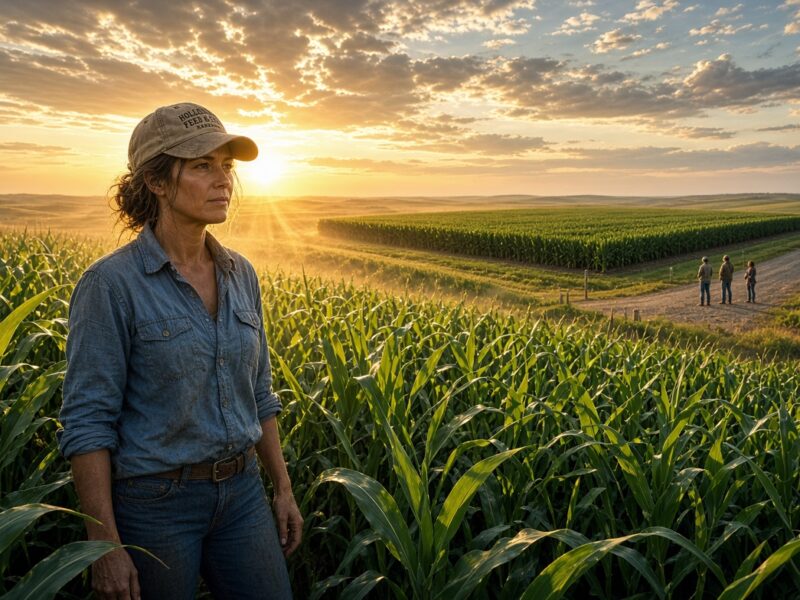
She Spent Her Last $4,000 on Corn in a Field Everyone Called Dead — Then the Whole Town Came to Stare
Nobody in Bellweather could understand why Marin Holloway spent the last money she had on seed corn for a field where even the weeds refused to grow.
Preston Blackwood leaned against her fence and laughed, telling her she ought to be calling a realtor instead of reading a seed catalog.
Three days later, the first green came up through the gray.
By the fifth morning, strangers were slowing their trucks on the county road to stare.
By sunrise on the seventh day, a deputy stood in the gravel waving cars past.
Because the whole town had come, not because the corn grew fast, but because of what was taking shape in the middle of that field.
Bellweather, Kansas, had come through two dry summers in a row, and everyone in the county had learned to measure their neighbors by how well they hid the damage.
The big operations survived the way big operations always do, with center pivots turning slow circles over 800 acres at a time.
The small places went quieter.
By the time the dust settled, there were maybe 11 family farms left inside the township line, and most of them ran on stubbornness and somebody’s off-farm paycheck.
The Holloway place sat at the end of a gravel road three miles south of the water tower, 38 acres of what had once been 400.
Marin Holloway was 36 and had worked that ground since she was 22, first alongside her husband Daniel and then, after the accident on the highway outside Hutchinson, alone.
He had been gone four years.
Her daughter Tessa was 13, read at the kitchen table with her feet on the heater vent, and had figured out that winter that her mother had started doing the arithmetic twice.
She still used his pliers.
She still parked on his side of the shed.
And she had never once described herself out loud as a widow, because the word always seemed to be asking for something she didn’t want.
The worst piece of the farm was an 11-acre field south of the house, and everybody in the county knew what it was called.
The soil there was the color of wood stove ash, so hard in August that a shovel rang against it.
And after a rain, the water sat on top in flat sheets for two days before it finally gave up.
Daniel’s father had tried alfalfa on it once and gotten nothing.
Daniel had tried milo and gotten less.
Somewhere along the way, the neighbors started calling it Dead 11, the way you nickname a bad dog with a little affection in it and a lot of warning.
Victoria Sterling drove out on a Tuesday in a silver sedan with the dealer plate frame still on it.
She was 45, handled agricultural lending for the regional bank out of Salina, and had delivered bad news so many times she had stopped hearing it herself.
The operating note was 90 days past due.
The bank had been more patient than policy strictly allowed, and Marin had until the end of the growing season to show the farm could generate revenue before the file moved to the recovery department, where nobody in Bellweather would have any say in it at all.
Then she said she hoped Marin would think about her options, because sometimes the kindest outcome was the one that let a person walk away with something in hand.
Conrad Blackwood arrived at 4 that same afternoon, which was not a coincidence, and both of them knew it.
He was 58, silver at the temples, dressed in the uniform of rural wealth, pressed jeans and a quarter-zip with a seed logo too small to read from a distance.
Blackwood Agricultural Holdings farmed somewhere north of 9,000 acres in three counties, ran its own trucking, and had a name on the elementary school gymnasium.
Conrad had a way of talking to small operators that sounded like concern and functioned like a hand on the back of the neck.
He said he hated to see a place like hers under that kind of pressure.
He said he was prepared to make it simple.
His offer was $1,100 an acre for the entire 38, roughly two-thirds of what decent tillable ground was bringing that spring, and he explained the discount without being asked.
The south field dragged the whole farm down, he said.
Nobody was going to pay for acres that wouldn’t produce.
He used the word unproductive twice and the phrase nearly useless once, and he said all of it kindly, the way a doctor describes an amputation.
Preston Blackwood had come along and spent the conversation leaning on the fence with his boot on the bottom wire, looking south.
He didn’t bother lowering his voice.
He said the only crop that field would ever raise was sympathy, and that it would make a fine place to park trucks.
Then he looked at Marin and grinned and delivered the line that would follow him for the next year and a half.
“If you can grow corn out there,” he said, “I’ll eat my boots.”
Marin didn’t argue, because arguing with the Blackwoods was a known waste of daylight and she had never had daylight to waste.
She told Conrad she wasn’t selling, in the flat voice she used for weather reports and vet bills, and she stood in the yard until both trucks were past the mailbox.
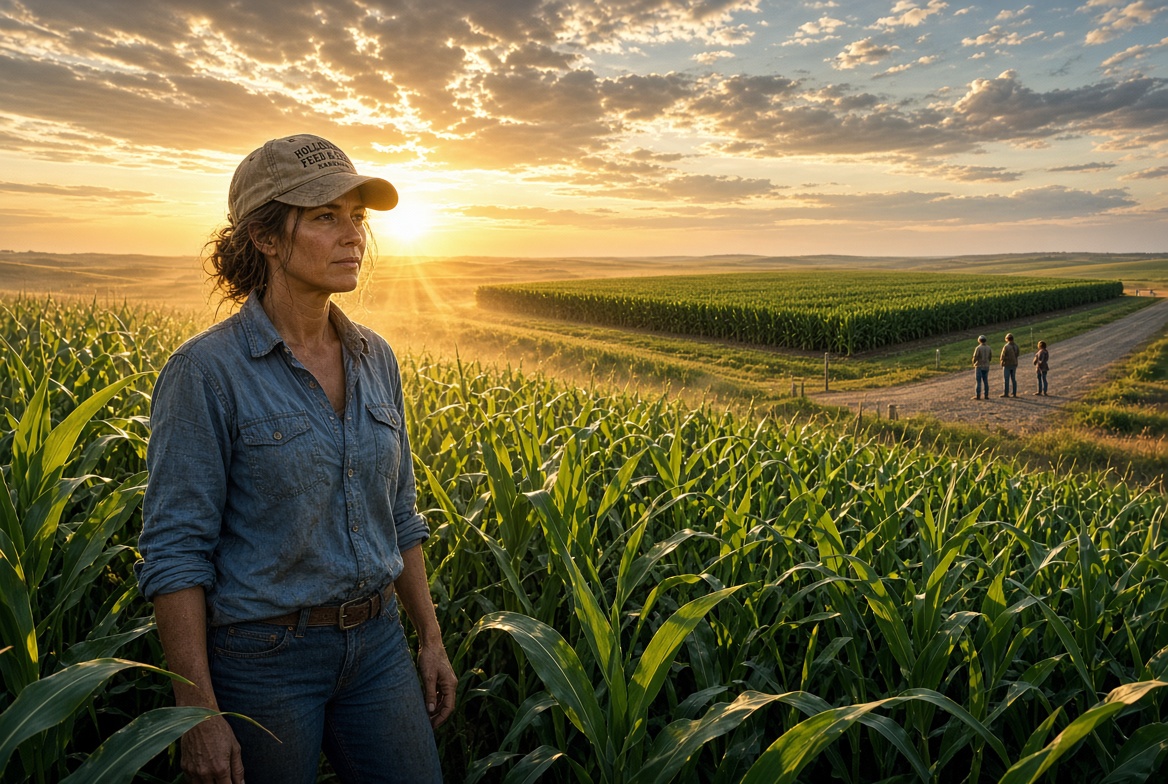
Then she went inside and sat down with the checkbook, a seed catalog, and the number that had been in a coffee can at the back of the pantry since Daniel died.
$4,200 and change, untouched because touching it had always felt like admitting something.
She spent most of it that night on a short-season hybrid bred for stress tolerance and on the rental fee for a deep tillage ripper from the implement dealer in Pratt.
What the town found impossible to understand when word got around three days later was the choice of ground.
She had 16 acres of honest dirt on the north end, tired but alive.
And she was going to put her last $4,000 into Dead 11 instead.
That was the part that turned her from a neighbor having a hard year into a story people told at the counter at the Fillmore Cafe.
That was the part that made Preston pull his phone out of his pocket.
But Marin hadn’t picked that field out of desperation, and she hadn’t picked it out of spite.
Three days earlier, while fixing fence in the heat, she had dug a hole out there and found something she had not told a living soul about.
It started with a shadow.
She was replacing a corner post on the south line, a job she’d been putting off since March, and she looked up to rest her back and saw a patch out in the middle of the field, a shade darker than everything around it.
Not green, not wet, just darker, maybe 40 feet across, with edges that were a little too even.
She had driven past that spot a hundred times without seeing it.
And she only saw it then because she happened to be standing in the exact place at the exact hour with the sun low enough to make the difference show.
She told herself it was a trick of the light, went back to tamping the post, and then set the tamper down and walked out there with the shovel.
The first eight inches came up the way Dead 11 always came up, in pale dry chunks that broke into dust in her hand.
At a foot, it was the same.
At about two feet, the shovel went through something, and the resistance changed, and the next blade she turned over came up black.
Not damp from recent rain, because there had been no recent rain.
Damp from the inside, the way a compost pile is damp.
She crumbled it between her fingers, and it fell apart into crumbs instead of clouds.
And it smelled the way the floor of the timber smells in April, rich and faintly sweet.
She stood in the middle of a field the entire county had declared finished, holding two handfuls of the best soil she had ever touched in her life.
She dug four more holes that evening, spaced wide, two of them 200 yards from the first.
Three hit the same black layer somewhere between 20 and 30 inches down.
The fourth, off toward the west fence, hit nothing but gray hardpan all the way to three feet.
And that negative result bothered her more than the others, because it meant the good layer had a shape and an edge.
Dead soil doesn’t have edges.
Weather doesn’t draw lines.
Whatever was under that field had been put there in a pattern, and patterns come from somewhere.
She took a coffee can of each sample into town the next morning to a man named Everett Shaw, who was 71, who had taught soil science at the state university for 30 years before retiring to a place with a windbreak and too many bird feeders.
He spread the samples on butcher paper.
He pressed them, wetted them, held one up to the window for so long that Marin started to feel foolish standing there in her work clothes.
Then he said the gray material on top was not what dead ground looks like.
When ground dies on its own, dying soil goes thin and sandy and sad.
He said it loses structure.
This was dense.
This had been pressed.
“Whatever happened out there,” he said, “it happened to that field. It didn’t happen in it.”
That changed the plan.
Marin had intended to put her money on the north 16 and pray for an inch of rain in July, which was the sensible play and the one that would have ended with the bank taking the farm in October.
Instead, she decided to find out.
She hired the ripper, and on a Saturday in the second week of May, she pulled it through Dead 11 at a depth that made the old tractor labor and lug and smoke, 16 inches, then 18, cutting slots down through the pressed layer into whatever was waiting underneath.
The ground came up in slabs the size of dinner plates.
It took her 11 hours, three shear bolts, and a blister that opened and closed and opened again.
She planted a trial piece first, about two acres across the middle where she had found the darker ground, because she was not a gambler and because that seed was all she was ever going to have.
She set the planter shallow and ran the rows north to south, straight as she could hold them, which out there was a point of pride nobody admitted to having.
Tessa rode in the buddy seat for the last two passes and asked whether this was going to work.
Marin said she didn’t know, which was the truth and which her daughter deserved.
And Tessa said okay and went back to her book, and that was the whole conversation.
Preston decided it was funny, and Preston had an audience.
He drove out, parked on the road, and recorded video of Marin’s planter crossing the gray dirt with the dust boiling up behind it, narrating in the voice of a man doing a weather forecast for the moon.
He posted it on the town’s online bulletin board, where it collected 41 replies before dinner.
Somebody called it the Holloway Space Program.
Somebody else started a pool at the bar over how many weeks would pass before she disked it under, and the money was heaviest on three.
A few people typed that the whole thing was mean and ought to stop, and then said nothing further, which is how that usually goes.
Marin never responded.
She did not defend herself at the counter at the Fillmore.
She fed her chickens, checked her oil, and drove past the pool board at the bar on her way to the parts store without turning her head, and the not responding was itself a kind of work performed daily, visible to nobody.
The night after she finished planting, it rained for about 20 minutes.
There was nothing remarkable about it.
A thin band off a dying cell that dropped maybe a quarter inch on half the county.
The kind of rain that settles dust and raises everyone’s hopes for no reason.
She stood on the porch in the dark and listened to it tick on the shed roof and then stop.
And she went to bed believing she had wasted the last money she had.
What she saw at 6:00 the next morning did not fit.
Dead 11, after any rain at all, had always held water on the surface in flat gray sheets for a day and a half.
That morning the field was dark and firm, and there was not one puddle in it.
The water had gone straight down, all of it, into ground that had been shedding rain like a parking lot for as long as anybody could remember.
She walked the whole 11 acres in her boots before breakfast and found two low spots holding a little moisture and nothing else, and the slots cut by the ripper had closed over damp instead of dust.
She stood at the far end with her hands on her hips and felt something she had not allowed herself to feel in four years, which was curiosity.
On the morning of the third day, she came out with a cup of coffee at first light and stopped so abruptly that she spilled it on her wrist.
There was a line of green across the field.
Not scattered, not patchy, a line running diagonally from the northeast corner toward the southwest, bright against the gray, and so straight that the eye followed it the way the eye follows a road.
She stood there with coffee running off her hand and understood that whatever was happening under her feet, luck had nothing to do with it.
The first shoots were not miraculous to look at, just ordinary seedlings, two leaves, three inches, the pale new green of everything that has recently started.
What was not ordinary was the stand count.
Marin walked 175 feet of row and counted emergence that any agronomist in the state would have called excellent on good ground.
And this was Dead 11, where her father-in-law had once put in alfalfa and raised a crop of bare dirt.
She counted three more stretches to be certain she wasn’t fooling herself and wrote the numbers on the back of a feed receipt with a carpenter’s pencil, because she had already begun to suspect she would need to prove things.
On the fourth day, Marin noticed the plants were not growing evenly.
Across most of the trial piece they were doing well.
Along a band perhaps 90 feet wide, running on that same diagonal, they stood half again taller and a deeper color.
And when she walked the band end to end, it carried across the whole field and kept going toward the west fence.
She drove two surveyor stakes with orange flagging where the band crossed her tire tracks so she would have something fixed to measure from, and she wrote the distances on the same feed receipt.
Everett came out that evening with a bucket auger, a cooler, and a notebook so old the cover had gone soft.
He pulled cores at six locations, three inside the band and three outside it, and sealed each in a bag with masking tape and a number.
Inside the band, the dark layer started at 22 inches and ran deeper than his auger could reach.
Outside it, the gray hardpan went down past three feet.
He sat on the tailgate afterward with the bags lined up beside him and told her the organic matter in that lower layer would come back high, maybe five times what the surface was carrying, and the biology would come back higher than that.
By the fifth day, there were cars on the road.
Not a crowd yet, four or five at a time, pulling onto the grass across the ditch, people standing with their arms folded, looking at a cornfield the way you look at a house fire.
They came for the contrast.
Nine days earlier, those 11 acres had been the standing proof in Bellweather that some ground is simply finished.
A flat gray rectangle children had been told to stay out of because it was ugly.
Now it was ruled with thousands of lines of green, startling and regular, like something drawn with a straight edge.
A reporter named Lena Cross came out on the fifth afternoon.
She was 28 and had learned to recognize the difference between a story and an item.
She shot footage of the rows and the gray edge where the planting stopped, and she interviewed Russ Dietrich, who gave her 11 words.
Then she interviewed Marin, who laid out the facts without a single adjective, which Lena found more interesting than anything else that happened that day.
On the sixth day, Everett called before 7 and asked Marin not to say anything publicly yet.
The lab had turned the samples fast as a favor to a man who used to sign their grant reports.
The lower layer wasn’t merely rich.
It carried a mineral signature he recognized, a blend of gypsum, crushed limestone, and a particular carbon-heavy char used in a handful of experimental land restoration programs in the late 1970s and then abandoned when the funding went elsewhere.
You did not get that combination from weather, and you did not get it from anything a farmer put down in a normal year.
More than that, he said the signature grew stronger with depth, which meant the source was not something spread on the surface decades ago and slowly sinking.
The source was below.
Something had been placed down there, and it was still, in some fashion, doing whatever it had been built to do.
He asked her to walk the field and mark the band’s edges with more stakes so they could map it properly.
He said he’d come Saturday with a tape and a friend who owned a drone, and he told her again, firmly, to keep it quiet.
Two mornings later, four of her six stakes were gone.
Not knocked over.
Gone, with the holes still open and a boot print in the soft dirt beside one of them at least two sizes bigger than hers.
Somebody had walked a quarter mile into her field in the dark, found markers she had set the previous afternoon, and carried them off.
Whatever was happening, it was no longer a town joke about a woman who couldn’t tell good dirt from bad.
Somebody wanted to know exactly where that band ran and did not want her to know they were looking.
She woke on the seventh morning to engine noise.
It was barely light, and there were already 11 vehicles on the road.
By 7, there were 40.
By 9:00, the shoulder was full for a quarter mile in both directions, and people were parking in the ditch and walking in.
Families, old men from the elevator, two church vans, a class of eighth graders whose teacher had decided this counted as a field trip.
A deputy named Cal Werner finally came out and stood in the middle of the gravel with his arms moving, telling people they could look but they couldn’t block the road, and failing entirely at the second part.
What had brought them was a photograph.
Lena Cross had sent her drone up on the sixth evening, 120 feet over the field, and what the camera saw from directly above was not a diagonal band at all.
It was a rectangle.
An enormous one, perhaps 400 feet by 900, its corners sharp, its sides running straight as a plumb line, picked out in darker, taller corn against the paler corn around it, with the band she had been following revealed as nothing but one edge of it.
There was a shape buried under Dead 11, and the corn had drawn it for everybody to see.
Preston came too, around 10:00.
He got out of a black SUV with mud on the rocker panels and walked up to the fence with the expression of a man arriving to enjoy himself.
And then he looked out at the field, and then at the printed photograph somebody was holding, and the expression came off his face in pieces.
He did not say anything about boots.
He did not say anything at all.
He stood there perhaps 90 seconds, walked back to the SUV, and made a phone call with the door open and one foot still on the ground.
Conrad Blackwood’s position reversed itself inside of 24 hours, which was in its own way the clearest evidence anybody could have asked for.
On a Monday, he had stood in Marin’s driveway and used the words nearly useless in a voice full of regret.
On a Thursday, he was in that same driveway offering $450,000 for the 11 acres alone.
Cash, no financing contingency, close in two weeks.
He explained that the offer reflected his desire to see the matter settled quickly and quietly for everyone’s benefit, and that she would be a fool to carry that kind of attention into a growing season she couldn’t afford.
Marin said no.
She said it without heat and without a speech, standing in her own gravel in a feed store cap.
And she watched what happened to his face when she did.
He didn’t get angry.
He got efficient.
He said $600,000.
And he said it fast, the way a man bids when he has already run the numbers and knows exactly how far above his comfort he is willing to go.
$600,000 for 11 acres he had publicly called worthless 11 days earlier.
$54,000 an acre in a county where the best irrigated corn ground had sold that spring for six.
She said no again.
And after he drove off, she sat on the porch step a long time.
Until that moment, she had believed she was dealing with a mystery.
Now she understood she was dealing with a secret, which is a different animal entirely.
Because a mystery is something nobody knows.
And a secret is something somebody has already decided you must not find out.
Conrad Blackwood had not bid $600,000 on a rectangle he had just learned about.
He had bid on something he had known about for a very long time.
Lena started pulling records the next morning, and she was good at it.
The Holloway quarter traced back cleanly to 1946.
And then, between 1976 and 1982, the chain did something odd.
The farm’s south 11 acres had been leased, not sold, to an entity called the Prairie Renewal Cooperative under an instrument filed as a research use agreement.
The same name appeared on four other parcels scattered across two townships.
And then, after 1983, the name appeared nowhere in the county at all, as though the whole organization had been wiped off with a wet rag.
What filled the hole was easy to find.
Beginning in the fall of 1983, an entity called Blackwood Land and Cattle, the predecessor of Blackwood Agricultural Holdings, had acquired three of the five former Prairie Renewal parcels plus 1,100 adjoining acres in six transactions over 14 months, at prices Lena ran through an inflation calculator twice because she thought she had made an error.
The purchases had been financed through the same small bank that had since grown into the regional lender holding Marin’s note, and the loan officer’s signature on two of the filings belonged to a young man named Harold Sterling, who had been Victoria Sterling’s father.
While Lena worked the courthouse, Marin and Everett worked the field.
Using the drone image gritted against two fixed fence corners, they located the northeast corner of the rectangle to within about six feet.
And on a Saturday morning, with a borrowed mini excavator and a neighbor named Russ Dietrich running the sticks, they opened a trench four feet deep and nine feet long.
At 31 inches, the bucket teeth struck something that rang.
Marin climbed down with a hand trowel and cleaned off a surface of orange-red clay tile, cylindrical, laid end to end with the socket still seated and the joints still tight after half a century underground.
It was not a vault.
It was not a bunker.
It was drainage tile.
And alongside it, exposed in the trench wall, was a trench of a different sort entirely.
A backfilled channel, perhaps three feet wide, packed with a dark, friable mixture of composted material, crushed stone, and black granular char, running arrow-straight into the earth in both directions.
Everett knelt at the edge of it a long time with his hands on his knees.
Then he said they were looking at a soil restoration system.
A deliberately engineered one, built to rebuild a dead subsoil from below instead of from above, and that he had read exactly two papers describing anything like it.
Both published before Marin was born.
The project’s designers had believed, correctly, as it turned out, that most exhausted prairie ground was not short of nutrients but short of structure and short of life, and that the real damage lay 18 inches down, where nothing a farmer sprayed would ever reach.
So they cut a grid of deep trenches across a test plot, packed them with organic material and charcoal and mineral amendments, ran tile to move water through the grid instead of off the surface, and let it sit.
Over years, the biology would spread outward from the trenches into the dead ground around them, and the dead ground would come back slowly, permanently, and nearly for free.
And the idea had worked.
That was the part that stopped Everett’s voice for a second.
Under 11 acres of what the entire county called dead ground, there was a functioning living soil, 40-some years old, richer than anything within 20 miles, sealed off from the sky by a pressed gray lid so dense that no water could get down to it and nothing it produced could come up.
The field had not been dead.
It had been shut.
Conrad’s lawyers moved within a week, which was how Marin learned what people with money do instead of arguing.
The claim was straightforward and ugly in its cleverness.
Blackwood Agricultural Holdings asserted that it had acquired the assets, materials, and intellectual property of the Prairie Renewal Cooperative in the 1983 dissolution, and that the subsurface installation was therefore an improvement belonging to Blackwood, located on Holloway ground by permission that had long since lapsed.
They were not claiming her land.
They were claiming the thing inside it and claiming a right to come and get it, which amounted to the same result arrived at politely.
Victoria Sterling applied the other kind of pressure and seemed genuinely uncomfortable doing it.
She said that nonetheless the note was now 120 days past due, that the attention the farm was receiving had made the file visible to people in Salina who had never heard of Bellweather, and that if a payment of $26,400 was not received before the end of the quarter, the recovery process would begin regardless of what was buried in the south field.
That was the cruelest arithmetic of Marin’s life.
She was standing on top of something two generations of the richest family in the county had wanted badly enough to chase for 40 years, and she was going to lose it in nine weeks over $26,000, because corn does not make ears in June and banks do not wait for October.
She sat at the kitchen table that night with a legal pad and could not make the columns reach each other no matter how she wrote them.
Preston found her at the co-op loading mineral tubs three days later and could not help himself, because for him the whole thing had become a wound.
She had gotten lucky, he said.
That was all.
She happened to rip a field at the right depth over the one spot in Kansas where somebody had buried a science project.
She had stumbled onto it.
He said it loudly enough for the two men at the counter to hear, because an audience had always been the point.
Marin set the tub down on the tailgate, straightened up, and spoke to him directly for the first time all summer.
She said, “Maybe so.”
Then she said it was strange how fast his father had come up with $600,000 for a field he had priced at nothing 11 days before.
And stranger still that somebody had walked out into her corn in the dark and pulled her stakes.
She said his grandfather knew where that rectangle was, didn’t he?
Not the general area.
The corners.
Preston’s mouth opened and then closed.
He got in his truck and left.
And the two men at the counter looked at the floor.
And that story got around town, too.
Lena called at 10 that night.
She had driven to the state historical archive in Topeka and spent six hours with boxes from a defunct extension program.
And in a folder labeled with a project number and nothing else, she had found the Prairie Renewal Cooperative’s 1981 annual field report, 40 pages of typed carbon with hand-drawn plot maps.
On the last page, under the heading of site supervision and permanent land grant, there was a signature.
It was not a Blackwood.
It was a Holloway.
The name on the document was Walter Holloway.
Daniel’s father.
Dead 16 years, a man Marin had met perhaps 20 times and remembered chiefly as somebody who smoked on the porch and did not talk much.
Nobody had ever told her he had worked on anything.
The family story was that Walter farmed, drank a little, lost most of the land in the ’80s like everybody else, and died of a stroke in the pickup at the end of his own lane.
The story had never included the sentence that he had been, at 26 years old, a field technician on an experimental soil restoration program, and that his own farm had been the test plot.
The report explained itself plainly in the flat institutional prose of 1981.
The cooperative’s purpose was not to produce a miracle amendment or a proprietary product.
Its purpose was to demonstrate that depleted land could be rebuilt by restoring its deep horizon, and that doing so would reduce a farm’s dependence on purchased fertilizer and on irrigation water drawn from an aquifer the authors described 45 years ago as being withdrawn faster than it recharges.
There were 11 test plots across three counties.
The south 11 acres of the Holloway farm, designated Plot 6, had produced the strongest subsoil response of any site in the program, and the report recommended it for extended study through 1990.
There was no extended study.
The funding vanished in a budget session.
The cooperative dissolved with its final report unpublished.
Blackwood Land and Cattle bought the ground around Plot 6, and Walter Holloway kept his 38 acres and never spoke of the work again.
The last piece came out of a different box, and Lena nearly missed it.
It was a drainage district complaint from 1986, filed by Walter Holloway against a contractor working for Blackwood Land and Cattle, alleging that in the course of regrading a half mile of adjoining road ditch and terrace, the contractor had hauled and spread approximately 9,000 yards of subgrade fill across the south 11 acres of the Holloway farm and had track-rolled it.
The complaint used the phrase destruction of a research installation.
The contractor’s response, three pages long, called it routine spoil placement with verbal permission from a party it did not name.
The county board took no action, and the file closed.
That was the whole of it.
And Everett was careful about how he said it out loud, because he had spent his life being careful.
There was no proof of a conspiracy.
There was a contractor who needed somewhere to put 9,000 yards of dirt, a neighbor who wanted the ground around him smooth and mechanized and uncomplicated, a 26-year-old technician who had become a farmer with no money and no lawyer, and a county board with other business.
Malice and convenience leave identical footprints once enough years pass.
The only thing anyone could state as fact was this.
The system underneath had not failed.
It had been covered.
And then, 40 years later, a woman with no money and no agronomy degree ran a ripper 18 inches deep because she noticed a patch of ground that was slightly the wrong color, and cut hundreds of narrow slots through that lid.
And 20 minutes of rain went down through those slots into 40-year-old trenches full of carbon.
And the water spread, and the biology came up to meet it.
That was all.
That was the entire miracle.
The corn grew because somebody finally opened a door that had been shut since before she was born, which meant the story the county had been telling itself all summer was backward.
People had been saying that a desperate widow threw her last dollars at dead ground and got rescued by a freak of fortune.
What had actually happened was that a woman everybody considered uneducated saw a shadow in a field a hundred educated people had driven past for four decades, and then did the only thing that mattered, which was to go find out.
The Blackwoods, with their agronomists and their satellite prescription maps and their 9,000 acres, had owned the ground on three sides of Plot 6 since 1983 and had never once put a shovel in it.
They hadn’t needed to.
They already knew.
The county board meeting on the second Tuesday of July was moved to the high school gymnasium because the courthouse room held 60 people and 210 came.
It was nominally about a drainage variance.
Everybody understood what it was actually about.
Conrad Blackwood arrived with two attorneys and a prepared statement regarding his company’s historic investment in regional soil stewardship and its ownership interest in certain subsurface improvements, and he read it well, because he had been reading statements well his entire life.
Lena Cross went second, and she did not editorialize, which made it worse for him.
She put the 1981 report on the overhead projector, page by page.
She put up the plot map with Plot 6 outlined, then the drone photograph of Marin’s corn beside it, and the two rectangles matched exactly.
She put up the 1986 complaint.
She put up the six Blackwood acquisitions with their dates and prices.
She said nothing at all about intent and let 210 people in folding chairs do that arithmetic themselves, which they did, audibly.
The legal question collapsed in about four minutes.
The 1981 agreement, signed by the cooperative’s director and by Walter Holloway, stated that all installed subsurface improvements on Plot 6 were conveyed permanently to the landowner at the conclusion of the study period in exchange for the use of the land.
The county attorney read the clause aloud twice.
Whatever Blackwood had bought in 1983, it had not bought that, because that had not been the cooperative’s to sell since before the cooperative dissolved.
The system under Dead 11 had belonged to the Holloway family for 43 years, and it belonged now to Marin.
Preston stood against the wall by the trophy case in the same gymnasium where, nine weeks earlier, video of a woman planting corn in gray dirt had been the funniest thing anybody in town had seen all spring.
A lot of the people who laughed at it were sitting in those chairs.
Nobody laughed now, and nobody looked at him either, which he discovered was considerably worse.
Marin was asked if she wanted to say anything.
She stood up at her seat rather than go to the microphone.
She did not call anybody a name, and she did not mention Walter or Daniel or the bank, and afterward people disagreed about whether that was grace or strategy.
She looked at Conrad Blackwood and said that three weeks ago he had stood in her driveway and told her the ground was nearly useless.
Then she took a folded paper from her jacket, walked to the front table, and laid down his written offer of $600,000 for those same 11 acres.
“Good thing I believed you,” she said.
The gymnasium was silent about three seconds.
Then one woman near the door laughed.
A single surprised bark, and the whole room went.
Two hundred people laughing in a high school gym on a July night, and it rolled a long time, and Conrad Blackwood sat through all of it with his hands flat on the table.
Nobody shouted, and nobody was humiliated in any way that could be pointed to later.
The man had simply been handed back his own opinion with the price tag still attached.
None of which paid the bank.
Corn in July is not money.
But a promise with 60 days of weather standing between it and a check, and $26,400 still came due at the end of September.
What changed that was a phone call 11 days later from the agricultural college at the state university, from a woman who had read Lena’s reporting and then read the 1981 report three times.
There was a regional soil health initiative with grant money and nowhere interesting to spend it.
What they wanted was a long-term study site with a functioning deep-horizon installation and a documented baseline.
And there was exactly one of those known to exist in the state, and it was growing corn in Bellweather.
They offered to lease research access to Plot 6 for five years at $31,000 a year, with Marin retaining ownership and retaining the crop and being paid separately as site cooperator for the labor of maintaining it.
The agreement included a restoration package for the remaining 27 acres, deep till, cover crop seed, and compost in exchange for data.
It was not a fortune.
It was a schoolteacher’s salary attached to a farm.
She signed it at her own kitchen table with Tessa across from her pretending to read, and the first payment cleared the past-due note with $4,600 left over.
She did not become rich, and the story is better for it.
She paid the bank.
She bought a used grain cart to replace one held together with a chain.
Fixed the north fence properly for the first time in six years, put $1,100 toward the heat pump that had been dying since January, and opened a savings account for Tessa with the rest, which came to about $1,400 and felt to both of them like an enormous amount of money.
The method went out to other farms that fall.
Five small operations around Bellweather agreed to try deep ripping with amended trenches on their worst 20 acres.
Two got dramatic results within a season.
One got a modest improvement that might have been the weather.
Two got nothing at all and said so.
And Everett made sure those results were published next to the good ones, because a technique that works everywhere is usually a technique nobody has tested.
Honestly, Plot 6 had conditions that could not be copied.
What could be copied was the question Marin had asked, which was simply, “What is under here?”
Conrad Blackwood withdrew his offer in August through a letter from counsel that managed four paragraphs without using the word sorry.
He kept farming 9,000 acres.
He kept his name on the gymnasium.
He also stopped coming to the Fillmore on Thursday mornings, and at the county fair in September, he judged the market steers as he had for 19 years.
And when he passed Marin at the rail, he nodded, and she nodded, and that was the whole of the war’s ending.
Preston took down the video of Marin planting quietly sometime in late July.
It had been up nine weeks.
Lena Cross had saved a copy on the first day, out of instinct rather than malice.
At the end of August, she put together a longer piece on the Prairie Renewal Cooperative that ran in four papers and got picked up by the state public broadcaster, and she opened it with 11 seconds of Preston Blackwood leaning on a fence in May, grinning into the sun.
“If you can grow corn out there,” he said, “I’ll eat my boots.”
The footage cut without narration to a slow pass over Dead 11 in the last week of August, over corn standing eight feet tall and so thick the rows closed over.
Tassels running to the fence line in every direction under a hot white sky.
Nobody had to make Preston eat anything.
Everybody in four counties understood the arithmetic of those two shots laid end to end, and understood it better for the silence between them.
Harvest came in the second week of October, cool and bright, with the leaves gone papery and the whole county running.
Marin was up before five.
She walked out to the edge of the field in the half dark while the combine warmed, and Everett came down the lane because he had said he would, carrying two cups of gas station coffee and wearing a jacket older than Tessa.
He reached into the first row, twisted off an ear, and handed it to her.
It was not the largest ear of corn in Kansas.
It was not record-setting, and it was not golden in any way that would have meant something in a photograph.
It was an ordinary ear of field corn from an ordinary dryland crop in a year with ordinary weather.
And that was exactly what made it worth standing out there in the cold to look at.
Something completely unremarkable had grown out of the place where everyone she knew had agreed nothing could live.
She pulled back the husk.
The silks came away damp, and the kernels underneath were full and even and set all the way to the tip in neat rows, the deep hard gold of corn that has finished what it started.
She turned it over once in her hands.
Then she smiled, which she had not done much that summer where anybody could see it.
“So it wasn’t dead,” she said.
Everett blew on his coffee and looked out at 11 acres of standing corn going bright in the first light.
“No,” he said.
“Nobody had looked deep enough in a long time.”
A year later, the sign at the end of the lane still said Holloway Farm in paint that had been fading since the ’90s.
There was no new house and no new truck, unless you counted the bedliner.
Marin still drove the pickup with the mismatched fender, still parked it on Daniel’s side of the shed, still got up at five, still did the books at the kitchen table with a pencil.
The difference was that nobody from Salina called anymore, and that when she opened the mail in the evening, her hands did not do anything in particular.
Every spring now, people came out.
Students in university vans, extension agents, and mostly just farmers standing around an open trench in their work clothes, looking at a wall of dirt with a seam in it.
Marin walked them out there herself and answered questions, and she had developed a way of saying she didn’t know that made people relax instead of lose interest.
She never once pretended to be a scientist.
When somebody introduced her as one, she corrected them immediately and said she raised corn and cattle and had gotten curious the one time it counted.
One evening in late September, with the light going long and orange across the roads, a neighbor leaned on the gate while Marin finished with the cattle and finally asked the thing he had wanted to ask for a year and a half.
Why that field?
Not why she fought the Blackwoods, not how the trenches worked, just that one thing nobody had ever gotten a straight answer about.
Why, with the last money she had on earth, had she put it into the one piece of ground the entire county agreed was finished?
Marin leaned her forearms on the top rail and looked out at the corn a while before she answered, the way she did when a question was worth doing properly.
“Everybody was looking at what wouldn’t grow on top of it,” she said.
“I wanted to know what was going on underneath.”
If you had been standing on the county road that evening and let your eye travel out past the fence line, out over 11 acres a town had once pointed at as proof that some things are simply done, you would have seen nothing remarkable at all.
Just corn.
Row after row of it going dark green to gold in the last of the light, moving a little the way a field does when the wind comes off the section line at the end of a hot day.
A year before, people had driven from four counties to stand at that fence because they believed they were looking at a miracle.
In the end, the thing worth remembering was not how fast the corn came up, or the rectangle the plants drew for everybody to see, or even the moment in a high school gymnasium when a woman laid a rich man’s own offer on the table in front of him.
It was that one person refused to accept that what everybody called worthless had to be worthless, and went and put a shovel in it to find out.
Sometimes a thing that looks dead is only buried under too many years of nobody bothering to check.
And sometimes the person the whole crowd is laughing at is the one person willing to dig a little deeper to find the truth.









