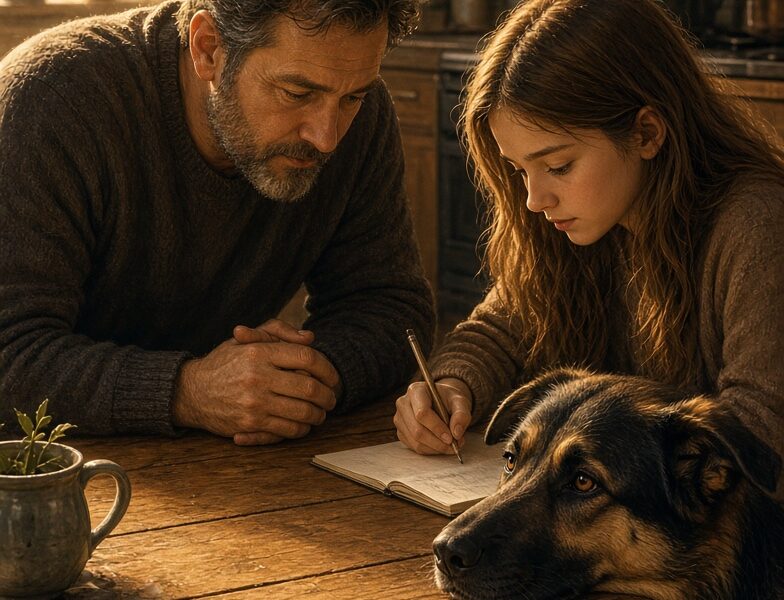
She Spent 847 Days Waiting… Then a Quiet Girl Doing Homework Changed Everything
For 847 days, Sadi watched families walk past her shelter kennel until a 44year-old Navy Seal arrived with his quiet 14-year-old daughter.
Emily didn’t reach for the German Shepherd.
She simply sat nearby and did her homework.
Weeks later, father and daughter brought Sadi home together.
But Sadi soon became strangely focused on Emily, watching her chair, waiting near the stairs, and noticing every time she was gone.
Then one afternoon, Sadi slipped through an open gate and returned to the shelter she had spent 847 days trying to leave.
Why had Sadi become so attached to the girl who asked nothing from her?
And why did she return to the shelter after finally finding a home?
How many times could a door open for someone before hope itself began to feel like a trick?
It was a cool Saturday morning in early autumn in Knoxville, Tennessee.
The kind of morning when thin clouds soften the sunlight and the first dry leaves collected along the edges of parking lots.
Matt Turner parked his dark pickup outside the Knox County Animal Shelter and kept both hands on the steering wheel for several seconds after shutting off the engine.
He had not come looking for a German Shepherd.
In fact, he had prepared a list specifically designed to prevent that sort of decision.
At 44, Matt still carried the unmistakable physical discipline of his years as a Navy Seal.
He stood a little over 6’2, broad through the shoulders and lean at the waist, with short, dark brown hair beginning to gray at the temples, and a neatly trimmed beard framing a strong angular jaw.
His blue gray eyes had an old habit of studying a room before allowing the rest of him to relax.
Friends considered him dependable.
His mother considered him exhausting.
Both opinions were fair.
Years of military service had taught Matt that uncertainty became easier when reduced to procedures, schedules, and manageable pieces.
That instinct had served him well in difficult places.
At home.
It sometimes made ordinary life feel like something being inspected rather than lived.
Beside him sat his 14-year-old daughter, Emily Turner, long-legged and slender, with straight chestnut brown hair falling past her shoulders, and the same gray blue eyes as her father, though hers had become more skilled at looking away.
Emily had once narrated nearly everything that happened to her, including minor injustices involving cafeteria pizza and people who walked too slowly in school hallways.
Lately, entire evenings passed with little more than fine, maybe, and I already did it.
Her mother had accepted a demanding position in Atlanta several months earlier, and Emily had begun living with Matt most of the time.
Nobody had presented the change as a tragedy.
Her parents remained civil.
Emily spoke with her mother regularly.
Matt had given her the larger upstairs bedroom, bought a new desk, learned which cereal she actually ate instead of merely requested, and reorganized his work schedule around hers.
He had done everything measurable.
That was part of the problem.
“You still have the list?”
Emily asked.
Matt reached into his jacket pocket and unfolded the paper.
Emily stared at him.
You actually brought it.
We agreed we weren’t making an impulsive decision.
We agreed we were looking at dogs.
Exactly.
That is not the same sentence.
Matt glanced at her and caught the smallest movement at the corner of her mouth.
It was not quite a smile, but lately he had learned not to waste those.
His list was practical, medium-sized, adult, reasonably calm, comfortable around teenagers, manageable exercise needs, no significant behavioral concerns.
Emily had wanted a dog for months.
Matt had resisted for nearly as long, not because he disliked dogs, but because he understood that liking an animal and building a life around one were different things.
His mother, Karen Turner, had laughed when he told her about the checklist.
Karen was 68, a compact woman with silver blonde hair cut just below her ears, lively brown eyes, and the unnerving ability to identify her son’s weak points without raising her voice.
After raising three children and spending 31 years as an elementary school librarian, she had acquired the patient ruthlessness of someone who could silence an entire room with one look.
Emily wants a dog, Karen had told him.
She doesn’t need you conducting interviews for a furry employee.
Matt had dismissed the comment.
Now, walking into the shelter with his list folded in his pocket, he was less certain.
The woman who greeted them was Rachel Brooks, a shelter adoption coordinator in her early 50s, with curly auburn hair threaded with gray, pale freckles across her cheeks, and practical sneakers that looked as if they had crossed the same hallway thousands of times.
Rachel had an easy manner, but there was nothing careless about her.
She asked Matt about their home, fenced yard, work schedule, Emily’s school hours, and previous experience with dogs before showing them a single kennel.
Matt appreciated her immediately.
Emily noticed.
You like her because she has forms, she whispered.
I like prepared people.
That’s what I said.
Rachel led them through the adoption wing.
Dogs responded to the visitors in every possible way.
Some bounced forward hopefully.
Some barked.
One small terrier spun in a circle so enthusiastically that Emily laughed aloud, and Matt almost stopped walking just to hear the sound again.
Then Emily slowed.
The kennel was near the end of the corridor.
A large female German Shepherd sat toward the back.
She was 6 years old, black and tan, perhaps 78 lb, with a deep black saddle across her back, a dark mask around her face, and an amber brown gaze that seemed unusually steady.
One [snorts] ear stood straight, while the other tipped slightly outward, giving her serious face one small imperfection.
Gray had begun dusting the fur around her muzzle.
She was neither thin nor neglected.
Her coat was clean and her posture was controlled.
She simply did not come forward.
The card attached to the kennel door read, “Sady, 6 years old.”
Below it in smaller lettering, 847 days in care.
Matt stopped.
847 days was no longer a waiting period.
It was part of a life.
What’s her story?
Emily asked.
Rachel did not soften the answer into something pretty.
Sades had three trial placements.
None lasted.
She isn’t aggressive, but she’s reserved, sensitive to sudden changes, and not especially demonstrative.
She needs time.
Some people expected a German Shepherd who would bond immediately.
“Did she do something?”
Matt asked.
“She had trouble settling.
She paced.
Sometimes she wouldn’t eat.
She doesn’t like strangers crowding her and she can shut down when she feels pressured.
Rachel paused.
One family said she just never seemed happy to see them.
Matt looked back through the kennel door.
That sentence bothered him more than he expected.
Not because he thought the family cruel.
He understood disappointment.
People often entered relationships carrying an invisible picture of how affection should look.
A dog approached the door, wagged, leaned into a hand, slept beside the bed.
Those behaviors were easy to recognize.
Sadi offered none of them.
Emily moved toward the kennel.
Matt instinctively raised a hand.
Give her space.
I know.
There was irritation in Emily’s reply.
But she did not approach the bars.
Instead, she spotted a plastic chair against the opposite wall, dragged it several feet away from Sades kennel, sat down, opened her backpack, and pulled out a mathematics workbook.
Matt stared at her.
What are you doing?
Homework at an animal shelter.
I have a quiz Monday.
You could do that at home.
Emily looked at him over the top of the workbook.
You said not to pressure her.
Rachel turned away, but Matt saw the smile.
For several minutes, nothing happened.
Sadi remained at the rear of the kennel.
Emily worked through equations.
Matt stood nearby, increasingly aware that he had no useful role in the situation.
That more than anything made him uncomfortable.
He glanced at other dogs, checked his phone, read Sades information card again.
He considered reminding Emily that they had come to see several suitable dogs, not spend the entire morning sitting outside the kennel of one who violated nearly every item on his list.
He said nothing.
10 minutes passed, then 15.
Emily erased an answer, frowned, and wrote it again.
At roughly 20 minutes, Sadi finally moved.
The German Shepherd rose without excitement, stretched her front legs, and walked slowly toward the kennel door.
Emily noticed, but did not look directly at her.
Sadi stopped several feet behind the bars.
Matt watched the dog watch his daughter.
There was no dramatic recognition, no tail wagging, no paw reaching through the kennel, nothing that could be turned into a sentimental claim that they had chosen each other.
Sadi simply lowered herself to the floor.

Then she turned around with her back toward Emily.
The German Shepherd settled against the kennel door and closed her eyes.
Matt almost laughed.
That seems personal.
Emily looked up from her workbook.
Rachel smiled.
Actually, that might be the nicest thing she’s done all morning.
Emily studied Sades back for a moment.
Then she returned to mathematics.
They stayed another 12 minutes.
When Emily finally packed her workbook away, she did not ask to adopt Sadi.
Matt had expected an argument, perhaps even prepared for one.
Instead, she stood, pushed the chair back against the wall, and quietly said goodbye to Rachel.
Matt found that more unsettling than pleading would have been.
They walked toward the exit.
Emily was already several steps ahead when Matt stopped and looked back.
At the far end of the corridor, Sadie remained on the floor with her back to them.
He could have left it there.
The sensible dog was probably in another kennel, the easy dog, the dog that would fit the list.
Matt turned toward the exit again.
The hallway door swung inward behind him.
Just before it closed, he heard the sudden quick rhythm of claws against concrete.
Sadi had run to the kennel door.
Matt did not turn around.
Not immediately, because somewhere beneath all his rules and careful decisions, he understood something he could not have put on a checklist.
Sometimes hope was easiest to show when nobody was looking.
2 days after leaving the shelter, Matt Turner discovered that certain decisions became more persistent when a person refused to name them.
Sadi had followed him home without leaving the kennel, not as a dog, but as a question.
By Monday morning, the question had survived a grocery run, two loads of laundry, an unfinished conversation with Emily, and a night in which Matt woke twice for no reason he wanted to examine.
The weather in Knoxville had turned warmer, sunlight breaking through thin autumn clouds and brightening the red maples along the roads.
Matt dropped Emily at school shortly after breakfast, watched her disappear through the entrance with her backpack hanging from one shoulder, and told himself he was going to the shelter only to gather information.
He had spent enough years making serious decisions to know that gathering information was sometimes a respectable name people gave to wanting permission.
Rachel Brooks looked only mildly surprised when he returned.
Her curly, auburn, and gray hair was pulled into a loose knot that morning, and a coffee stain marked the edge of the clipboard tucked against her sweater.
She did not greet him with a knowing smile, which Matt appreciated.
People who worked around animals long enough, he suspected, became familiar with humans, pretending they had come back for practical reasons.
“I want to see her records,” Mad said.
“All of them?
All of them.
Rachel studied him for half a second.
That answer usually means trouble.
For me or the dog?
Depends how much you enjoy paperwork.
That earned the smallest smile from him.
She led him into a modest consultation room away from the kennels.
A second shelter employee joined them a few minutes later.
His name was Daniel Price, a behavioral coordinator in his late 30s, tall and narrow shouldered with sandy hair cut close at the sides, rectangular glasses, and the calm manner of a man who had learned that raising his voice rarely improved either animals or people.
Daniel had worked with shelter dogs for nearly 12 years.
He spoke carefully, avoiding dramatic labels, and Matt trusted that almost immediately.
The file on Sadi was thicker than Matt expected.
He read everything.
6 years old, female German Shepherd, black and tan, approximately 78 lb.
Routine veterinary care current.
No recorded bite history.
No documented aggressive incidents toward people.
Moderate sensitivity to handling around the neck and shoulders.
Hesitant in unfamiliar indoor spaces.
Difficulty settling during environmental changes.
Guarding behavior observed once around a hood bowl when a previous adopter attempted to physically move her away from it.
Strong preference for predictable routines.
Low tolerance for prolonged restraint or hugging.
Matt turned a page.
A foster note described Sadi pacing near a closed bedroom door during her first several nights in a home.
Another reported that she had scratched at a curtain after being left alone longer than expected.
Nothing in the file suggested a dangerous dog.
Nothing suggested an effortless one either.
That distinction mattered.
Matt had known people who believed patience meant waiting long enough for another living thing to become convenient.
That was not patience.
That was expectation wearing softer clothes.
Daniel sat across from him.
You’re looking for something specific.
I’m looking for the part where everyone exaggerated.
Daniel’s expression barely changed.
They didn’t.
Matt looked up.
That’s important, Daniel continued.
Sadi isn’t secretly an easy dog who just needs the right heroic person to discover her.
She has patterns that will require work.
She may never like being hugged.
She may always need careful introductions.
She may never greet you at the door the way people imagine a German Shepherd should.
Matt leaned back in the chair.
It was not discouraging information.
Oddly, it was the opposite.
He had spent years distrusting promises built on sentiment.
Difficult things became manageable when their difficulty was admitted plainly.
What unsettled him was not the work Sadi might require.
It was how familiar her defenses sounded.
She has never bitten anyone.
No, ever.
Not in any record we have.
Children.
She hasn’t lived long term with young children here.
Teenagers are different, but we’d still supervise and take it slowly.
Matt nodded.
Daniel added, “Your daughter did something useful Saturday.”
Matt glanced at him.
She ignored Sadie.
That sounds like an insult.
It’s a compliment.
People keep trying to convince Sadi they’re safe.
Emily let Sadie decide whether she cared.
Matt remembered his daughter bent over algebra while the German Shepherd gradually moved closer.
Emily had done instinctively what Matt had spent half his adult life struggling to do with people.
Leave enough silence for someone else to choose what came next.
Before he left, Rachel took him past Sades kennel.
The German Shepherd was lying near the back again.
One ear lifted at the sound of his footsteps.
She recognized him or recognized something associated with him, but she did not stand.
Matt stopped several feet away.
Hello, Sadie.
One amber eye followed him.
That was all.
He drove home more troubled by that small response than he would have been by excitement.
That evening, Emily sat at the kitchen table with a history textbook open beside a bowl of cereal.
The kitchen was the oldest room in Matt’s house, centered around a heavy oak table inherited from his parents.
The wood had been refinished twice, but one round burn mark remained near the far edge from a Thanksgiving decades earlier, when Karen had set down a hot casserole dish without a trivet, and then spent years blaming Matt’s father for distracting her.
Matt had considered sanding the mark away.
Karen had threatened to disown him.
He placed Sades copied behavioral notes on the table.
Emily looked at them, then at him.
You went back.
I went for information.
You went back.
Matt sat opposite her.
Yes.
She closed the history book.
He explained what Rachel and Daniel had told him.
The guarded behavior around food, the difficulty with closed spaces, the pacing, the need for predictable routines.
He did not soften any of it because Emily was 14.
If Sadi came into their house, Emily deserved the truth.
When he finished, he expected excitement.
Instead, Emily frowned.
“So, what are you saying?
I think we could handle a trial placement.
Her expression barely moved.
Matt noticed immediately.
You wanted a dog.
I know you liked Sadi.
I do.
Then what’s the problem?
Emily studied him in a way that made him suddenly feel like the teenager.
Why do you want her?
He answered too quickly.
We have a fenced yard.
My schedule is flexible enough.
I’ve worked around trained dogs before.
You’re old enough to follow boundaries.
We can get professional help if we need it.
Emily waited.
Matt stopped.
That’s not what I asked.
What did you ask?
I asked why you want her.
You’re telling me why the house works.
The distinction landed with irritating precision.
Matt looked at the notes again.
He wanted to say that wanting something was not enough.
He wanted to explain that adults learned to trust practical reasons because feelings changed.
He wanted to point out that his approach kept mortgages paid, appointments remembered, groceries in the refrigerator, and teenage daughters delivered to school on time.
All true.
None answered her question.
I don’t know yet, he finally said.
Emily’s expression softened only slightly.
That answer, at least she seemed willing to accept.
Over the next 2 weeks, they returned several times.
They met Sadie in a quiet outdoor enclosure.
They practiced walking at a distance without demanding contact.
Matt learned not to reach automatically for her collar.
Emily learned that Sades stillness sometimes meant uncertainty, not calm.
Sadi learned that neither of them insisted on affection as payment for showing up.
Nothing cinematic happened that mattered.
There was no instant transformation, no moment when Sadie suddenly became the dog people had hoped for.
Some visits went well.
During one, she stayed so far from Matt that he wondered whether progress had vanished overnight.
Daniel reminded him that animals did not improve in straight line simply because humans preferred graphs that did.
At the end of the second week, Matt and Emily signed the foster to adopt agreement.
Rachel reviewed every condition with them.
If Sadi showed signs that the placement was not safe or appropriate, they were to call.
Returning for the right reasons would not be treated as failure.
Asking for professional help would not mean they had done something wrong.
Matt respected that more than any promise of a perfect match.
Sadi rode home in the backseat of his truck.
She did not press against Emily.
She did not look out the window with obvious delight.
She stood for several minutes, turned twice, then finally lay down with her head lifted, watching the road disappear behind them.
Matt saw her in the mirror and wondered whether she thought she was leaving or simply being moved again.
That night, the house felt different.
Sadi investigated only the rooms they left open.
She paused at thresholds.
She sniffed corners, the lower cabinets, the legs of the old oak table, and Emily’s sneakers abandoned near the stairs.
When Matt closed the pantry door, Sadi’s ears shifted toward the sound.
He reopened it without comment and reminded himself that observation was not the same thing as fear.
At dinner, he placed a stainless steel bowl of measured food near the kitchen wall.
Sadi remained nearly 6 ft away.
Matt waited.
She did not move.
He stepped into the living room, thinking privacy might help.
Still nothing.
Emily tried sitting on the floor several feet away.
Sadi watched her but ignored the bowl.
“Maybe she isn’t hungry,” Emily whispered.
“Maybe.”
But Matt remembered the file.
He sent Emily upstairs to finish homework and deliberately began cleaning the kitchen.
10 minutes passed.
The bowl remained untouched.
Eventually, Matt stopped trying to solve it.
He pulled out one of the oak chairs and sat down.
No commands, no coaxing, no eye contact.
He simply rested his forearms on the table and stared at the old circular burn mark his mother had refused to let him erase.
The house became quiet.
A minute passed, then another.
Soft claws moved across the floor.
Sadi approached the bowl.
She stopped once and looked toward Matt.
He kept his eyes on the table.
The German Shepherd lowered her head and began to eat slowly, carefully.
When the bowl was empty, Matt expected her to retreat.
Instead, Sadi walked toward him.
She did not lean against his knee.
She did not ask for his hand.
She stopped on the other side of the table and lifted her head until her chin rested against the edge of the old oak, almost exactly beside the faded burn mark.
Matt looked at her.
Sadi’s amber brown eyes met his for several seconds.
They were not grateful eyes.
They were not trusting eyes, not yet.
They looked like the eyes of a creature, measuring whether the room would remain the same long enough to sleep in it.
Matt did not reach for her.
For once he understood that staying still was something he could do.
The first weeks with Sadi taught Matt something he had spent most of his adult life resisting.
Repetition did not always produce progress, and effort did not guarantee cooperation.
Knoxville settled deeper into autumn, with colder mornings, copper leaves gathering against the backyard fence, and pale afternoon sunlight stretching across the kitchen floor.
From the outside, Matt Turner’s house probably looked calmer than it had in years.
Inside, however, three residents were learning one another’s boundaries with all the grace of strangers trying to dance without agreeing on the music.
Sadi had developed a routine, but not the one Matt would have chosen.
She slept on a folded blanket near the living room doorway instead of the expensive dog bed he had bought.
She followed Emily into the kitchen sometimes, but rarely followed Matt anywhere.
If he sat at the old oak table, Sadi might settle several feet away.
If he reached down to stroke her for more than a few seconds, she often stood and left.
She tolerated a hand along her shoulder better than one over her head, disliked anyone leaning above her, and seemed particularly suspicious of hands approaching her collar.
Matt tried not to take it personally.
He failed more often than he admitted.
He had worked with military dogs during his years in uniform, though never as a dedicated handler, and those experiences had left him with habits he barely noticed.
Clear command, immediate response, repeat until understood, reward, consistency, correct confusion by making instructions simpler.
Sadi did not appear impressed by his resume.
Sit.
Sadi looked toward the window.
Matt waited.
Sadie, sit.
Her ears moved.
The rest of her remained exactly where it was.
Emily, doing homework at the table, glanced over her laptop.
Maybe she thinks you said six.
Matt looked at his daughter.
Emily kept typing.
Sadi yawned.
There were moments when Matt suspected the dog and the teenager had formed a private organization with the sole purpose of reducing his authority.
The humor helped, but beneath it he felt something more uncomfortable.
He had believed that once Sadi understood the rules of the house, she would relax.
Instead, the more he tried to build predictable training sessions into every morning and evening, the more carefully she seemed to watch him.
She completed simple behavior sometimes, but her body became still when Matt repeated commands too quickly.
Her ears shifted backward.
Her attention moved toward exits.
He was asking for obedience.
Sadi was answering with information.
Matt simply had not learned to recognize it yet.
Clearest warning came on a Tuesday morning.
Emily was eating toast before school when a cloth napkin slipped from the edge of the table.
Sadi picked it up almost immediately and carried it toward the living room.
Matt reacted without thinking.
Leave it.
Sadi stopped.
Matt walked toward her, reached down, and took hold of one corner of the cloth.
The German Shepherd became completely still.
Then came a low growl.
It was not loud.
It was not a lunge or an attack.
It was a brief, unmistakable request for distance.
Matt released the napkin at once and stepped back.
Sadi remained where she was, eyes fixed on him, the cloth hanging loosely from her mouth.
Behind him, Emily’s chair scraped against the floor.
“Dad, I’m fine.”
Emily was no longer looking at him.
She was watching Sadi.
Matt knew enough not to punish the growl.
A warning was communication, and removing communication did not remove discomfort.
Still, knowing that professionally and hearing that sound in his own kitchen were two different experiences, for the first time since bringing Sadi home, he wondered whether he had underestimated the situation.
Sadi eventually dropped the napkin on her own and walked away.
Nothing dramatic followed.
That almost made the moment harder.
The rest of the morning continued as usual.
Emily went to school.
Matt washed the napkin.
Sadi slept near the window.
But the growl remained in his thoughts.
That afternoon, Matt called Rachel.
Rachel referred him to a certified canine behavior consultant named Clare Morgan.
Clare arrived 2 days later.
She was 46, medium height and athletic without appearing imposing with warm brown skin, dark curly hair pulled into a low ponytail, and soft hazel eyes that rarely stayed fixed on Sadi for too long.
She wore jeans, walking shoes, and a faded navy jacket with no company logo large enough to announce expertise from across the room.
Her mana was quiet and observational.
She had worked with anxious and transitional dogs for nearly 15 years.
First in shelters and later in private homes.
Clare explained that early in her career, she had made the mistake of valuing visible obedience more than emotional comfort.
A difficult foster dog had forced her to reconsider what successful training actually meant.
Clare spent the first 20 minutes almost completely ignoring Sadi.
Matt noticed immediately.
Sadi noticed too.
What happened with the napkin?
Clare asked.
Matt described it.
What did Sadie do before she growled?
She froze.
Before that, Matt paused, turned her head slightly.
Anything else?
He thought harder.
Ears back.
Clare nodded.
So, the growl wasn’t the first message.
It was the fourth or fifth.
Matt disliked how quickly he understood the implication.
He had not missed Sadi’s communication because it was invisible.
He had missed it because it had not arrived in the format he preferred.
Clare did not tell him to stop training Sadi.
She asked him to change the purpose.
Instead of using repeated commands to test whether the dog would comply, she wanted Matt to build predictable patterns and reward voluntary engagement.
Trade for objects rather than simply taking them.
Pause when Sadi moved away.
Leave the caller alone unless necessary.
Give her places where nobody would touch her.
Your goal isn’t to win every moment, Clare said.
Matt folded his arms.
I’m not trying to win.
Clare looked at him.
Emily, sitting nearby with a textbook open, made a small sound that might have been a cough.
Matt looked at her.
She became deeply interested in American history.
Clare continued gently, then make sure Sadi knows that.
The lesson stayed with Matt longer than he wanted.
Unfortunately, he did not apply it everywhere.
A week later, an email from Emily’s school arrived while Matt was checking the family calendar.
It mentioned the fall yearbook committee and listed the students who had withdrawn.
Emily’s name was among them.
Matt waited until dinner.
You quit yearbook?
Emily stopped chewing.
Yeah.
When?
Last week.
You liked your book?
Emily moved peas around her plate.
I changed my mind.
Matt immediately began constructing solutions.
If there’s a scheduling problem, we can change tutoring nights.
If someone on the committee is giving you trouble, I can email the adviser.
If it’s affecting another class, we can talk to your counselor.
You don’t have to just quit because something.
Dad,” he continued, softer, but no less determined.
“We should at least understand the problem before you walk away from something you enjoyed.”
Emily put down her fork.
“You don’t understand the problem.
Then tell me.
Maybe I don’t want to.”
Matt felt frustration rise, sharpened by concern.
“Emily, if something is happening at school, I need to know.
No, you want to know because then you can make a list.
That’s not fair.
Emily looked directly at him.
You don’t even know what happened and you’re already fixing it.
The sentence stopped him, not because it was entirely fair, because he had heard its shape before.
Clare standing in his kitchen.
What happened before the growl?
What came before that?
What was Sadi telling you before you decided what needed correcting?
Matt hated the comparison immediately.
His daughter was not a dog, yet the flaw belonged to him in both situations.
He often listened for the point where he could become useful instead of listening long enough to understand.
I’m trying to help, he said.
I know.
Emily’s answer carried no gratitude.
Somehow that hurt more.
She stood, carried her plate to the sink, and headed upstairs.
Matt followed as far as the hallway.
We’re not finished talking.
Emily turned.
That’s the problem.
You always decide when we’re finished.
She went upstairs and closed her bedroom door.
Not hard, not dramatically, just firmly.
The house became quiet.
Matt stood beneath the stairs, anger and embarrassment, competing with the knowledge that chasing after her would only turn the argument into another problem he intended to solve by force of persistence.
Behind him, Sadi rose from beside the kitchen.
The German Shepherd looked toward Matt, then toward the stairs.
Matt expected her to follow Emily.
She did not.
Sadie walked into the hallway and stopped at the point where the kitchen opened toward the staircase.
She circled once, lowered herself to the floor, and placed her head between her front paws.
From that position, Emily’s closed bedroom door was visible above.
The kitchen and Matt were behind her.
Sadi belonged to neither side of the argument.
She simply remained in the uncomfortable space between them.
Matt watched her for a long time.
Perhaps loyalty was not always choosing someone.
Perhaps sometimes it was refusing to leave the distance where two people had stopped knowing how to reach each other.
And for the first time that evening, Matt did not move to fix anything.
He stayed where he was.
So did Sadi.
There are silences that mean nothing, and there are silences that begin taking up furniture.
By the middle of November, Knoxville had turned colder at the edges.
Mornings carried a thin silver frost across porch railings, and the maples along Matt Turner’s street had nearly emptied themselves onto the sidewalks.
Inside the house, the most obvious change was not Sadi’s growing comfort, nor Emily’s unpredictable moods, nor even Matt’s gradual acceptance that a German Shepherd did not become cooperative simply because someone bought the correct treats.
It was the chair.
There were three chairs around the old oak table that were used most often.
Matt sat at one end.
Emily usually took the side nearest the stairs.
The third remained empty unless Karen visited.
Sadi had begun checking them.
At first, Matt thought it was coincidence.
He noticed the pattern because Clare had trained him to pay attention to what happened before behavior, not merely what happened after.
At dinner, Sadi would approach the kitchen, glance toward Matt’s chair, then Emily’s, then the empty one.
If Emily was upstairs or late coming home from school, Sadie lingered beside her chair longer than necessary.
Only after looking toward the staircase would she move toward her food.
Matt watched this happen four nights in a row.
On the fifth, Emily came downstairs 15 minutes late, earbuds in, carrying a notebook and looking irritated at the world in general.
Sadi immediately stood from beside the wall, followed her with her eyes, then went to her bowl.
Matt said nothing, but the observation stayed with him.
It was tempting to romanticize it.
Humans were very good at that, especially around dogs.
He could have decided Sadi missed Emily, worried about her, or was somehow attempting to reunite the family.
Clare would probably have told him not to assign an entire novel to a glance.
Still, whatever Sadi believed, the empty chair mattered to her.
Matt began wondering whether it mattered to him, too.
Their dinners had become increasingly inconsistent.
Emily sometimes ate upstairs while studying.
Matt occasionally worked late in the garage or reheated something after she had already finished.
They lived in the same house, slept under the same roof, shared a refrigerator, a dog, a Wi-Fi password, and a calendar covered in reminders.
Some evenings they barely shared 10 uninterrupted minutes.
Matt decided to change that.
Predictably, he turned the idea into a rule.
No phones at dinner, he announced on Monday evening.
Emily, standing at the refrigerator, froze with a carton of milk in her hand.
And no television.
20 minutes.
We sit down and eat together when you’re home.
Emily closed the refrigerator slowly.
Is this because of Sadie?
No.
Sadie, lying beneath the window, raised her head.
Emily looked at the dog.
She disagrees.
It’s 20 minutes.
That sounded exactly like a prison sentence.
Matt ignored that.
The first dinner under the new rule was roast chicken, potatoes, green beans, and nearly unbearable silence.
Matt tried first.
How was school?
Fine.
Anything interesting?
No.
How’s chemistry?
Chemical.
He looked at her.
Emily cut a potato in half with unnecessary concentration.
Matt tried again.
Any plans for the weekend?
I don’t know.
Sadi lay beneath a table with her front paws stretched forward, watching them both with the solemn expression of someone attending a meeting where management had lost control of the agenda.
Matt realized with some discomfort that he had spent years believing conversation was easy as long as people answered questions.
Emily clearly disagreed.
The next evening was not much better.
He asked about homework.
She answered.
He asked about school.
She answered less.
By the third night, Matt caught himself mentally preparing questions before sitting down and understood with quiet horror that he had turned dinner into an interview.
Emily noticed too.
You know you can just eat.
I am eating.
You’re waiting to ask me something.
I’m not.
You have your question face.
Matt had never known he possessed one.
Sadi sighed under the table.
Emily looked down at her.
Exactly.
Despite himself, Matt almost smiled.
The strange thing was that the failed dinners began doing something useful.
They exposed how little practice Matt and Emily had at simply being together without a task.
When she was younger, conversation had required no effort.
Emily had once spent 23 minutes explaining why a squirrel in their yard looked emotionally suspicious.
Matt remembered that because he had timed it.
At 14, she had developed privacy.
Matt had responded by becoming more efficient.
Neither approach had helped.
On Thursday evening, Karen Turner arrived carrying a glass baking dish and refusing to admit she had brought enough food for six people.
At 68, Karen remained small in stature, but difficult to overlook.
Her silver blonde hair curved neatly beneath her jaw, and her lively brown eyes still held the same sharp intelligence that had intimidated generations of children during her years as an elementary school librarian.
She wore a rustcoled cardigan, dark slacks, and the expression of a woman who believed closed doors were merely suggestions if family lived behind them.
“I brought macaroni and cheese,” she said.
“We have dinner.”
“That sentence and macaroni and cheese have never been enemies.”
Karen placed the dish on the table and immediately greeted Sadie without reaching for her.
She had listened carefully when Matt explained Clare’s advice, and unlike her son, rarely needed to be told twice.
Sadi sniffed Karen’s shoes and then retreated beneath the table.
Karen nodded approvingly, “Excellent judgment.
I’m suspicious of me, too.”
Emily laughed.
It was small, but Nat noticed.
Dinner changed almost immediately.
Karen did not ask Emily how school was.
She complained about a woman at the grocery store who had abandoned a cart sideways in the aisle and then began telling a story about Matt at 16.
Matt recognized danger three sentences too late.
No, Karen continued.
Emily’s attention sharpened.
What happened?
Your father decided he wanted lighter hair.
I was 16.
You were stupid.
I was experimenting with peroxide.
Emily stared at him.
Matt leaned back.
This story has been exaggerated.
Karen ignored him.
He left it on too long.
Emily’s eyes widened.
How bad.
Karen smiled.
He wore a baseball cap for a month.
Emily began laughing.
Not polite laughter.
Real laughter, the kind that folded her forward slightly and made her cover her mouth because she was trying to breathe and laugh at the same time.
Matt watched her.
For one second, he forgot to be embarrassed.
The sound hit him with a strange horse of memory.
He had heard Emily laugh recently, of course, at something on her phone, at a video upstairs once while talking to her mother.
But not like this.
Not across this table, not with him in the room.
He found himself laughing too, mostly because Karen was now describing the exact shade of orange his hair had become.
Sadi lifted her head from beneath the table, apparently concerned that everyone had lost their minds.
After dinner, Emily carried plates to the sink while Karen wrapped leftovers.
The 20inut rule had expired nearly half an hour earlier, but nobody had moved to leave.
Matt noticed that, too.
Later, after Emily went upstairs, Karen stood with Matt near the kitchen counter while Sadie slept beside the doorway.
“She’s angry with me,” Matt said quietly.
Karen wiped her hands on a dish towel sometimes.
“That helpful, huh?”
You asked.
I didn’t.
Karen looked at him.
Matt sighed.
She lowered her voice.
Emily isn’t pulling away because she stopped loving you.
I know that.
No, you know it intellectually.
That’s different.
Matt leaned against the counter.
Karen had the irritating habit of being most accurate when he least wanted precision.
She’s 14, Karen continued.
She’s testing whether she can disagree with you and still be safe with you, whether she can disappoint you and still belong here, whether she can say no without losing something.
Matt looked toward the staircase.
He thought of Sadi freezing when he reached for the napkin.
He thought of Emily quitting yearbook.
He thought of how quickly he turned uncertainty into action.
Karen touched his arm once.
Don’t make every disagreement into an emergency.
Then she picked up her purse, kissed his cheek, and left.
The house settled into quiet again.
About 10 minutes later, Emily came downstairs.
She had changed into an oversized gray sweatshirt and had tied her chestnut hair into a loose knot.
She went to the refrigerator, opened it, then stood there without taking anything out.
Matt remained at the table.
Sadi was beside him, chin nearly touching the yolk.
Emily closed the refrigerator.
I didn’t quit yearbook because I stopped liking it.
Matt said nothing.
That alone required effort.
Emily came to the table and sat down.
For several seconds, she traced one finger around the old circular burn mark in the wood.
Some girls in the club posted a picture of me in a group chat.
Matt felt his shoulders tighten.
Emily noticed.
It wasn’t anything terrible.
He forced himself to stay still.
It was from lunch.
I was making a stupid face.
They added a caption.
People passed it around.
Matt’s thoughts accelerated instantly.
Names: teacher, advisor, screenshots, school administration.
He nearly asked all four questions at once.
Emily continued.
I didn’t want to go back and sit with them like it didn’t bother me.
Matt inhaled slowly.
And I didn’t tell you because you would go into school and turn it into a federal case.
I would not.
Emily gave him a look.
Matt reconsidered, possibly a state case.
That earned the faintest smile.
Then his instincts returned.
He opened his mouth.
He could speak to the adviser.
He could call the counselor.
He could ask for a meeting.
There were appropriate processes for social harassment.
Emily should not have to abandon something she enjoyed because other teenagers had behaved carelessly.
All of those thoughts were reasonable.
Clare’s voice appeared in his memory anyway.
What happened before the behavior and Karen’s?
Don’t make every disagreement into an emergency.
Matt closed his mouth.
Across the table, Emily waited.
He looked at his daughter, not at the problem, at her.
What do you want me to do?
Emily seemed surprised by the question.
Her eyes dropped to the table.
Sadi rose quietly, stepped closer, and rested her broad head along the edge of the oak beside the faded burn mark.
The three of them remained there.
Emily thought for so long that Matt began to understand that the waiting was part of the answer.
Finally, she said, “Tonight?”
“Yes, nothing.”
Matt nodded.
Every instinct he possessed told him that doing nothing was irresponsible, but Emily did not look frightened.
She looked relieved.
So Matt stayed in the chair.
Sadi kept her chin on the table, and for one evening, the empty chair was the only thing in the room that needed filling.
Sometimes the place a frightened creature runs toward is not the place it loves most.
Sometimes it is simply the place it understands.
By late November, Knoxville had settled into short afternoons and cold evenings.
The trees behind Matt Turner’s house were nearly bare, their branches drawing dark lines against a pale Tennessee sky.
For almost 3 months, Sadi had been learning the geography of the house.
The kitchen meant dinner.
The living room doorway meant rest.
Emily’s chair meant someone might eventually come downstairs, and the old oak table had become the one place where nobody asked too much of her.
Progress was still uneven, but it was real enough that Matt had finally stopped measuring it every day.
That was why the open gate frightened him so much.
The afternoon had been ordinary.
Matt had spent part of it replacing a loose board along the backyard fence while Sadie moved between the porch and a patch of winter grass.
Emily was upstairs finishing homework.
Matt had stepped into the garage for less than 5 minutes to put away his tools.
When he returned, the side gate stood open by several inches.
Sadi was gone.
Matt stopped moving.
For a man who had spent years learning how to function inside uncertainty, the first response was embarrassingly human.
Disbelief.
He checked behind the shed beneath the porch around the opposite side of the house.
He called Sadi’s name once, then again, forcing himself not to turn panic into volume.
Nothing.
The latch had not fully caught after he carried lumber through earlier.
He knew that before he even touched it.
There was no mystery and no one else to blame.
Matt went inside.
Emily saw his face and immediately stood.
What happened?
Sades out.
The color changed in Emily’s expression.
What do you mean out?
The gate wasn’t secure.
She stared at him.
Matt could have explained that he had checked it.
He could have said the wind might have shifted it.
He could have defended himself before she accused him of anything.
Instead, he said, “It was my mistake.”
They searched separately at first, though Matt kept Emily within several blocks and insisted she carry her phone.
He drove the neighborhood slowly while she checked the streets Sadi knew from walks.
They called Rachel at the shelter.
Matt contacted nearby veterinary offices and sent Sades description to a neighborhood group.
A black and tan six-year-old German Shepherd, one ear slightly angled, wearing a plain collar, wary of strangers.
Every minute became its own small accusation.
Matt knew better than to assume Sadi would come when called if frightened.
He also knew chasing a nervous dog could send her farther away.
So they moved carefully, asking neighbors to call rather than approach if they saw her.
His training gave him structure.
It did not give him peace.
At one point, Emily climbed back into the truck and shut the door harder than necessary.
She wouldn’t just leave.
Matt started the engine.
She might if something startled her.
She knows the house.
She’s still adjusting.
Emily turned toward the window.
That’s not what I said.
Matt looked at her profile and understood.
Emily was not asking whether Sadi could physically leave.
She was asking whether Sadi had wanted to.
The question stayed between them.
An hour passed, then another.
Matt’s phone rang as they crossed a road nearly 2 mi from home.
Rachel Brooks, he answered immediately.
We have her.
Matt pulled into an empty parking lot before his mind fully caught up.
Rachel explained that someone passing the shelter had noticed a German Shepherd sitting near the outer fence and called the front desk.
One of the staff members recognized Sadi before approaching.
She had traveled close to 3 miles from Matt’s neighborhood.
There was no injury, no obvious distress, just exhaustion and nervousness, and she had gone back to the shelter.
Emily heard enough of the call to understand.
Her face went still.
Matt felt relief first, then shame.
It was an ugly combination.
The drive to the shelter was quieter than any argument.
Sadi was waiting in a familiar consultation room when they arrived.
She stood when Matt entered, but did not rush toward him.
Her ears shifted forward.
Then Emily stepped into the room.
Sadi took two uncertain steps toward her.
Emily stopped.
For a moment, Matt expected his daughter to kneel.
She did not.
“Why did she come here?”
Emily asked.
Rachel sat against the edge of the desk, keeping the atmosphere deliberately ordinary.
We don’t know exactly why.
Emily looked toward Sadi.
She had a home.
Yes, she left it.
Rachel’s pale, freckled face softened, but she did not offer a sentimental answer.
This was also home to her for a very long time.
Emily’s eyes narrowed.
A kennel was home.
For 847 days, this building was the most predictable place in her world.
Same smells, same routines, many of the same people.
That doesn’t mean she preferred it to you.
Matt remained near the door.
Rachel continued, “When animals get overwhelmed, they sometimes move toward what is familiar.
People do, too.”
That last sentence reached Emily differently.
Matt could see it.
He thought of old habits he still returned to when he was uncertain.
Lists, schedules, checking locks twice, turning emotion into logistics, because logistics had edges.
Perhaps no one ran only toward happiness.
Sometimes they ran toward recognition.
Emily finally crouched several feet from Sadi.
The German Shepherd approached slowly and sniffed the sleeve of her jacket.
Emily did not touch her.
“I thought she didn’t want us,” she said.
Rachel answered quietly.
You may have to give her time before you decide what this means.
Matt had heard some version of that advice many times lately.
He still needed it.
On the drive home, Sadi lay in the back seat while Emily sat beside her.
There was no dramatic reunion.
Emily did not wrap her arms around the dog, and Sadi did not rest her head in Emily’s lab.
They simply occupied the same space.
Back at the house, Matt fixed the gate latch properly.
Then he checked it three times.
On the third check, Emily stood behind him.
Dad, he stopped.
It’s closed.
I know.
You checked.
I know.
She hesitated.
I have something like that, too.
Matt turned.
Emily led him upstairs.
Her bedroom looked lived in at first glance, posters on the walls, books on the desk, a sweater over the back of a chair, a photograph of Emily and her mother beside the lamp.
Matt had painted the room a soft blue after she moved in most of the time, and bought shelves she had chosen online.
He had assumed that meant she felt settled.
Then Emily pointed beside the closet.
A navy duffel bag sat on the floor.
Matt had seen it hundreds of times without really noticing it.
The zipper was half closed.
Inside were several folded shirts, jeans, a phone charger, toiletries, and an old sweatshirt Emily usually wore at her mother’s house.
Why is that packed?
Emily sat on the edge of the bed.
I never completely unpacked it.
Matt stared at the bag.
She had been living with him for months.
Were you planning to leave?
I don’t know.
The honesty was worse than a yes.
Emily pulled one knee toward her chest.
I kept thinking mom’s job might change.
Or maybe I’d go back.
Or maybe this was just temporary.
Matt looked around the room differently.
He had purchased the desk.
He had selected better lighting.
He had organized storage and cleared closet space.
He had never once asked what would make the room feel like hers.
It is your room, he said.
Emily gave him a tired look.
I know you say that.
The sentence hurt because it was not accusing him of lying.
It was accusing the words of being insufficient.
Matt sat in the desk chair.
What would make it feel less temporary?
Emily looked surprised.
I don’t know yet.
He nodded.
Normally, he would have suggested paint, furniture, photographs, a new rug.
This time, he allowed the answer to remain unfinished.
Downstairs, Sadi had returned to the kitchen.
Dinner came and went untouched.
Matt sat at the old oak table.
He did not coax her.
Sadi stood several feet from the ball, watching the room.
Minutes passed.
Then Emily came down.
She pulled out the chair opposite her father and sat.
Neither spoke.
Sadie looked at Matt.
Then Emily, then the food.
Slowly she walked forward.
The first bite was cautious, the second less so.
Emily watched her.
When Sadi finished, she remained beside the table.
Emily rested her hands in her lap.
Maybe she needed to see both of us were still here.
Matt looked across the warn at his daughter.
He could not tell whether Emily meant the German Shepherd.
He was beginning to suspect that she did not know either, so he did not ask.
Sadi lay down between their chairs, and for that night, nobody packed anything.
Stories become dangerous when they grow smoother than the lives they are supposed to describe.
By early December, Knoxville had taken on the clean, gray stillness that comes before winter settles in for good.
Mornings were cold enough for breath to show briefly above the backyard grass, and Sadie had developed the habit of choosing the narrow strip of sunlight beside the kitchen door whenever it appeared.
Nearly a week had passed since she had slipped through the gate and somehow made her way back to the shelter.
The incident had left no visible scar on the household, yet Matt noticed its shape everywhere.
He checked the latch once instead of three times.
Now Emily watched Sadi more carefully during walks.
Sadi herself seemed unchanged, which Matt found strangely humbling.
Humans could spend days assigning meaning to an event, while the animal at the center of it simply ate breakfast, inspected the yard, and went back to sleep.
Rachel Brooks called one afternoon with an idea.
The shelter had received questions after Emily mentioned Sadi’s long stay to a teacher at school, and Rachel wondered whether Emily might write something for the student newspaper about animals who remained in shelters for long periods.
Emily had never written for the paper before, but the faculty adviser, Linda Parker, encouraged her to try.
Linda was 54, a tall, soft-spoken English teacher with shoulderlength silver brown hair, pale blue eyes, and the patient expression of someone who had spent 30 years reading first drafts without treating them like final judgments.
She believed teenagers often wrote more honestly when adults stopped telling them what lesson they were supposed to discover.
Emily surprised Matt by agreeing.
She wrote the first version in one evening.
Matt found her at the kitchen table the next morning, laptop open beside a halfeaten piece of toast.
Sadi lay beneath the window, one ear angled toward the sound of the keyboard.
“Want me to read it?”
Matt asked.
Emily hesitated, then turned the computer toward him.
The headline read, “847 days later.
Sadi finally found home.
Matt read quietly.
The article was good.
That was almost the problem.
Emily wrote about the shelter hallway, Sades long wait, the three placements that had not lasted, and the afternoon she returned to the shelter after escaping Matt’s yard.
She described how Sadi had changed their home by bringing them to the dinner table and teaching them patience.
The ending called her a miracle dog who never stopped believing someone would come back for her.
Matt read that sentence twice.
Emily watched his face.
You don’t like it?
I didn’t say that.
You made the face.
Apparently, he possessed several faces people had cataloged without his permission.
Matt chose his words carefully.
It’s well written.
That means you don’t like it.
I think it makes Sadie easier than she is.
Emily folded her arms.
It’s supposed to be inspiring.
She growled at me over a napkin.
You’re really putting that in.
I’m saying she isn’t a symbol.
She’s a dog.
Emily’s expression tightened.
Why do you always do this?
Do what?
Take something I’m excited about and find the problem with it.
Matt sat back.
He had not expected the conversation to turn toward him.
I’m not trying to ruin it.
You always say that right before explaining why something isn’t good enough.
She closed the laptop.
Matt felt the old urge to defend himself.
He wanted to explain that accuracy mattered, that responsible adoption required more than sentiment, that an article about Sadi could influence how people thought about dogs with complicated behavior.
All of that was true, but truth could still be badly timed.
Emily took the computer upstairs.
The article ran 2 days later with only minor edits.
It received more attention than anyone expected.
Students shared it.
Parents commented on the school website.
Rachel printed a copy for the shelter lobby.
Someone in Emily’s class began calling Sadi the miracle dog, and the name spread with the casual speed of a phrase nobody had intended to become permanent.
At first, Emily loved it.
For the first time since leaving yearbook, something she had created was being passed around because people admired it rather than mocked her.
Matt understood why that mattered.
He also watched Sadi asleep beneath the table and thought about how little she resembled a miracle.
She was still suspicious of delivery drivers.
She still moved away if someone leaned over her too quickly.
Some evenings she greeted Emily at the stairs.
Other evenings she barely lifted her head.
She had recently decided that one particular blue throw pillow was unacceptable and pushed it off the sofa every time Matt returned it.
None of that made her less valuable.
It only made her real.
A week later, the shelter held a small Saturday adoption event, and Rachel invited Emily to attend with Matt and Sadi for part of the afternoon.
The goal was not to present Sadi for adoption.
Her placement with Matt and Emily was continuing well, but to let Emily talk about longstay animals and responsible expectations.
That was where the article met reality.
A family approached them after recognizing Sades photograph.
The mother, Jennifer Cole, was in her early 40s with blonde hair tied into a ponytail, and a friendly, energetic manner.
Her 12-year-old son, Tyler, had round glasses, a red winter jacket, and the restless enthusiasm of a child who already imagined every dog as a future best friend.
“That’s the miracle dog,” Tyler said.
Sadi stepped closer to Matt’s leg.
Tyler stopped when his mother reminded him not to rush.
Emily explained that Sadi preferred space.
The boy nodded earnestly and crouched several feet away.
Sadi looked at him.
Then she looked toward the shelter entrance.
She did not approach.
A minute passed.
Jennifer smiled politely.
Maybe she’s tired.
Emily could hear the disappointment beneath the kindness.
Tyler looked at the German Shepherd again.
I thought she’d be more friendly.
He did not mean anything cruel by it.
That somehow made the moment more useful.
Emily stared at Sadi.
The German Shepherd was behaving exactly like herself.
Not hostile, not broken, not magical, just cautious.
Emily suddenly understood what Matt had been trying clumsily to tell her.
She had written Sadi into a shape strangers could love quickly.
Sadi had spent years being returned partly because people expected her affection to arrive on schedule.
Now Emily had accidentally created another expectation.
That evening, she reopened the article.
Matt passed the doorway and stopped when he saw her typing.
“I’m changing it,” Emily said.
He did not ask why.
The revised version appeared online several days later under a new title.
847 days does not make a dog simple.
Emily added the parts she had left out.
Sadi had growled once when uncomfortable.
She had run through an open gate.
She disliked being hugged.
She sometimes ignored people who wanted affection.
There were evenings when she still refused food until the room felt predictable, and mornings when she seemed interested in nobody at all.
Emily wrote that patience was not waiting for a difficult animal to become easy.
It was learning whether both sides could live honestly with what the other one was.
The second article received fewer excited comments.
The messages it did receive stayed with Emily longer.
One woman wrote that she had returned a dog years earlier after realizing her household had not been right for him and had carried guilt ever since.
Emily’s article helped her understand that a responsible decision was not always a romantic one.
A student from another grade wrote privately that he liked the sentence about not needing to be easy every day to deserve somewhere to belong.
Another girl wrote simply, “I think people do this to each other, too.”
Emily read that one three times.
Two days later, she went back to the yearbook room.
Linda Parker did not congratulate her dramatically.
She simply moved a stack of photographs from an empty chair and asked whether Emily wanted to help select candid shots for the winter pages.
Emily sat down.
Some of the same students were there.
The discomfort did not vanish.
Neither did Emily.
That distinction became important.
She did not return because Sadi had made her fearless.
Sadi had done nothing of the kind.
Emily returned because she had begun to understand that leaving once did not obligate her to keep leaving forever, and other people did not get permanent ownership over the meaning of an embarrassing moment.
Matt learned about it only when Emily mentioned yearbook casually over dinner.
He almost made too much of it.
He stopped himself.
Glad he went back, he said.
Emily nodded.
Me, too.
That was enough.
The following Saturday, Matt was carrying laundry toward the utility room when he heard footsteps on the stairs.
Emily came down holding the Navy duffel bag.
Matt stopped.
His stomach tightened before Reason could catch up.
The bag was zipped.
For one terrible second, he thought of Atlanta.
“You going somewhere?”
Emily gave him a puzzled look.
Then she opened the duffel.
She turned it upside down over the laundry basket.
Shirts, jeans, the old sweatshirt, toiletries, and the phone charger she had kept packed for months tumbled into the pile.
Matt stared.
Emily zipped the empty bag again.
I need this for the school trip next week.
Matt looked at the clothes, then at his daughter.
Then he laughed.
Not because anything was funny, because he had spent months waiting for some grand announcement that Emily finally considered his house home.
Instead, she needed a bag.
Emily frowned at him.
[clears throat] What?
Nothing.
Dad.
Absolutely nothing.
Sadie wandered in from the kitchen, inspected the pile of clothes, and stole one sock.
Emily pointed.
She has my sock.
Matt looked at the German Shepherd disappearing toward the living room.
“You want me to fix it?”
Emily smiled.
“No.”
And that time, Matt knew exactly what she meant.
Routine can become a kind of language long before anyone realizes they are speaking it.
By the middle of December, Knoxville had settled into cold, bright mornings and early blue evenings.
The kind that made porch lights appear before dinner and turned the windows into mirrors after 5.
Matt Turner had spent months learning that Sadi understood life through repetition more clearly than through commands.
The German Shepherd knew the sound of Emily’s backpack landing beside the stairs, the scrape of Matt’s chair against the old oak floor, the cabinet where her food was kept, and the small pause before the three of them settled around the kitchen each evening.
What Matt had not understood was how much those ordinary sounds had begun to matter until several of them disappeared at once.
Emily’s schedule had changed almost overnight.
Returning to Yearbook had led to extra afternoons at school.
The upcoming winter edition needed photographs selected, captions checked, and pages finished before break.
She also had rehearsals for a student presentation connected to the shelter adoption event, and two evenings that week she ate with classmates before coming home.
Nothing about the change was alarming.
In fact, Matt was quietly pleased that she had begun participating in things she had nearly abandoned a month earlier.
Sadi disagreed with progress delivered out of order.
The first evening she ate only half her dinner.
Matt noticed but said nothing.
The second evening she sniffed the bowl, walked away, and lay near the kitchen doorway.
By the third, Matt was counting.
That was always dangerous.
He began checking everything.
The amount of food, the expiration date, water intake, energy level, bathroom habits, whether Sadi seemed uncomfortable when standing, whether she was moving differently.
He told himself he was simply being responsible.
By breakfast the next morning, he had already built six possible explanations and disliked all of them.
Emily came downstairs wearing a gray sweater and carrying a yearbook holder under one arm.
She didn’t eat again.
Not much.
Emily looked towards Sadi, who was resting near the window with her chin on her paws.
She looks okay.
Looking okay isn’t a medical diagnosis.
Emily stopped at the refrigerator.
There had been a time when she would have rolled her eyes at that sentence.
Instead, she gave her father a measured look.
You’re doing the thing.
What thing?
The thing where one weird day becomes an investigation.
It’s been three meals.
That answer proves my point.
Matt ignored the observation and called the veterinarian.
That afternoon, Sadi sat beside him in an examination room at Cedar Ridge Veterinary Clinic.
Unhappy but composed.
Matt had chosen the clinic after reviewing credentials, hours, emergency policies, online reviews, and driving distance with enough thoroughess to make Emily accuse him of researching veterinarians the way some people researched colleges.
Dr. Rebecca Hail entered carrying a tablet.
She was 57, medium height, with a sturdy build, short salt and pepper hair tucked behind her ears, and warm brown eyes behind thin oval glasses.
Her hands were small and deliberate, and her voice carried the unhurried steadiness of someone accustomed to frightened animals and worried owners arriving in the same room.
Rebecca had practiced veterinary medicine for nearly three decades.
Early in her career, she had learned that people sometimes needed to be examined almost as carefully as their pets, not physically, but for the fear hidden behind practical questions.
Sadi watched her closely.
Rebecca did not immediately reach for her.
Instead, she spoke with Matt while letting the German Shepherd become accustomed to her presence.
When did the appetite change?
3 days ago.
Anything else change?
No vomiting, no obvious discomfort.
Energy is mostly normal.
Rebecca glanced toward him over the tablet.
I meant at home.
Matt paused.
That question irritated him because he had already checked the things that seemed medically relevant.
Emily’s been out more.
Emily is your daughter?
Yes.
Sadi attached to her.
Matt considered the word.
Not exactly.
Rebecca smiled faintly.
That usually means yes, but complicated.
After a careful examination and routine checks, Rebecca found nothing immediately concerning.
Sades weight was stable.
Her temperature was normal.
Hydration looked good.
There were no obvious signs of pain or acute illness.
Rebecca advised Matt to continue monitoring her and return if appetite loss persisted or other symptoms appeared.
Then she asked him to describe Sades evenings.
Matt explained the dinner routine.
Three chairs, Emily’s place, his place, Sades bowl, the way the German Shepherd often waited until everyone had settled.
Rebecca listened.
She may be responding to the schedule change, she said.
So, this is behavioral.
Behavior and physical health aren’t separate worlds.
Stress can affect appetite.
That doesn’t mean we assume every missed meal is emotional, which is why you brought her in.
Matt nodded.
Rebecca continued.
Dogs don’t understand why a teenager suddenly has more activities.
Sadi may simply know that the pattern she learned has changed.
Matt looked down at the German Shepherd.
Months earlier he had wanted a dog that would fit neatly into his established routine.
Now he was sitting in a veterinarian’s office discussing how to alter his evenings because the dog had built her own expectations around theirs.
The irony was not subtle.
Back home, Matt adjusted without making the change dramatic.
Sades meals remained at consistent times.
He stopped moving the bowl repeatedly to coax her.
On evenings when Emily would be late, he kept the kitchen calm and predictable rather than hovering over the dog.
Sadi improved somewhat.
She still left food behind.
Meanwhile, Emily had acquired a problem of her own.
Rachel had invited her to speak for five minutes at the shelter’s weekend adoption event.
The revised article about Sadi had circulated beyond the school website, and Rachel thought Emily could offer something valuable about longstay animals and realistic expectations.
Emily initially said yes.
Then she discovered there would be chairs facing her.
Apparently, this changed everything.
Matt found her one evening in a living room staring at a printed speech as though it had personally offended her.
I’m not doing it.
He sat in the armchair opposite her.
You already said yes.
I’m correcting an administrative error.
That’s one way to describe it.
There could be 80 people.
There could be 20.
That is not better.
Matt saw what his old instincts wanted to do.
He could explain preparation, breathing, practice, exposure.
He could remind her that she had survived harder things.
He could tell her confidence came after action.
Instead, he waited.
Emily looked suspicious.
You’re not going to tell me I can do it.
You probably can.
That sounded almost supportive.
I’m working on it.
She looked back at the paper.
Matt continued, “You don’t have to speak because Sadie needs you to.
Sadie has no opinion about public speaking.”
From the rug, Satie opened one eye.
Emily nearly smiled.
“If you want to try,” Matt said.
“I’ll sit in the last row.
And if I don’t, I’ll still sit somewhere, probably with coffee.
The decision remained Emily’s.
That mattered more than Matt realized.
Karen arrived the following afternoon with Christmas cookies and learned about the speech within 4 minutes, largely because Emily had inherited none of Matt’s ability to conceal anxiety from his mother.
Karen listened, then looked at her son.
So, your plan is to sit quietly in the back.
That’s the plan.
She placed a cookie on a plate.
Well, 44 years and he has finally learned how to stand still and be useful.
I’m sitting.
Even better, less chance of interference.
Emily laughed.
Matt took a cookie he had not been offered.
The night before the event, Emily stayed late at school for the final yearbook session.
Matt ate dinner alone at the oak table.
Sades full bowl sat several feet away.
She had taken perhaps two bites.
Matt did not coax her.
He had learned something about empty chairs.
Some absences could not be explained to a dog.
They could only be endured until the familiar sound returned.
Just after 8, the front door opened.
Emily stepped inside, cheeks pink from the cold, chestnut hair loose from its ponytail and backpack hanging low from one shoulder.
Sadi lifted her head.
Emily came into the kitchen and saw Matt’s plate.
You already ate mostly.
She opened a cabinet and took out another plate.
I’m hungry.
There was leftover chicken and vegetables on the stove.
Emily served herself and sat across from Matt.
Sadi stood immediately.
No command, no invitation.
The German Shepherd crossed the kitchen and went to her pool.
She began eating.
Matt watched without comment.
Sadi finished nearly everything, then walked toward the table and rested her broad chin against the familiar oak edge near the old circular burn mark.
Emily gently rubbed the fur between Sades ears, stopping before the dog could decide she had overstayed the gesture.
She really likes having full attendance.
Matt leaned back.
No, she’s conducting attendance.
Emily laughed, the nervousness about tomorrow briefly leaving her face.
Sadi remained between them, amber eyes moving from one person to the other.
The speech was still waiting.
The audience still existed.
Nothing had been solved.
But for that evening, all three places were occupied, and Sadi ate.
Belonging was never proved by the absence of difficult days.
It was proved by what remained after those days had passed.
The Saturday morning of the shelter event arrived cold and clear over Knoxville with pale winter sunlight settling across the parking lot and a thin frost still clinging to shaded patches of grass.
Emily Turner stood behind a folding table near the shelter entrance with both hands wrapped around a paper cup she had forgotten to drink from.
Her chestnut brown hair fell loose over the shoulders of a navy sweater, and the printed pages of her speech rested beside her elbow, covered in enough crossed out sentences to make the paper look wounded.
At 14, Emily had become better at recognizing nervousness without automatically obeying it.
That did not mean she enjoyed it.
Matt sat where he had promised, the last row.
At 44, the former Navy Seal still occupied a chair with the contained posture of a man accustomed to remaining alert in rooms that did not require alertness.
His broad shoulders filled a dark jacket.
His short brown hair showed more gray at the temples than it had the previous autumn, and his neatly trimmed beard framed the same angular face Emily had inherited in softer form.
Sadi lay beside his boots, the six-year-old German Shepherd black and tan against the pale floor, one ear standing straight and the other angled slightly outward.
Her amber brown eyes moved between the room and Emily without obvious enthusiasm.
That helped.
Emily did not need a miracle dog staring up at her.
She needed Satie to be Satie.
Rachel introduced her briefly.
Emily stood.
For the first few seconds, the room looked enormous.
There were nowhere near 80 people.
This did not help as much as Matt had predicted.
Emily unfolded the paper.
Looked at the first sentence, then looked toward the back row.
Matt did not give her a thumbs up.
He did not mouth encouragement.
He only remained where he had promised to be.
Sadi yawned.
Emily nearly smiled.
She began.
She spoke about 847 days, not as a tragedy, not as proof that everyone before them had failed.
She explained that some dogs stayed longer because their needs were harder to match with the household.
Some required quieter homes.
Some did not enjoy constant affection.
Some carried habits shaped by uncertainty.
And sometimes responsible people realized a placement was not right and brought an animal back rather than forcing a situation that worked for nobody.
Then Emily looked down at her notes.
There was one sentence she had rewritten more than any other.
Sadi didn’t save me.
Several people looked up.
Emily continued.
She didn’t fix my family either.
Matt felt something move through him.
Not hurt.
Exactly.
Recognition.
That was the truth.
Sadi had not repaired them like a broken machine.
Emily spoke more slowly now.
She explained that Sadi had done something less dramatic and, in her opinion, more important.
She had remained difficult in ways that could not be edited out.
She disliked hugs.
She sometimes ignored people.
She needed routines that could inconvenience everyone else.
She had once left the yard and returned to the shelter because perhaps familiarity had been easier than uncertainty.
And still she had a place.
Emily looked at the audience instead of the page.
She made me think about how often we expect people to be easy before we make room for them.
Easy to talk to, easy to understand, easy to forgive, always cheerful, always grateful, always strong.
Matt lowered his eyes briefly.
There were sentences fathers heard differently when their daughters said them aloud.
Emily went on.
Sadi didn’t become sweeter, so we would keep her.
We learned more about who she already was, and I think people deserve some of that, too.
The room remained quiet for a moment after she finished.
Then came applause.
Emily did not transform under it.
She did not suddenly become confident or love public speaking.
She simply exhaled.
From the back row, Matt smiled.
Sadi scratched one ear.
Afterward, people gathered around the information tables.
Emily answered questions beside Rachel, while Matt took Sadie outside for short breaks whenever the crowd became too much.
Near the end of the event, an older woman approached Emily.
Her name was Eleanor Hayes, 72, a slender widow with carefully curled silver hair, soft green eyes, and a burgundy wool coat buttoned neatly to the throat.
She carried herself with the straightbacked politeness of someone who had spent much of her life trying not to impose on others.
Elanor explained that her husband had died three years earlier.
Her house was quiet now, perhaps too quiet, and she had been looking at a 9-year-old mixed breed dog who had spent more than a year at the shelter.
“I think maybe I should take him,” Eleanor said.
Emily heard the uncertainty beneath the sentence.
“Do you want him?”
Eleanor hesitated.
“I feel sorry for him.”
A year earlier, Emily might have called that enough.
Now she glanced toward Sadi, who was standing beside Matt several yards away, ignoring a man who clearly wanted her attention.
Emily chose her words carefully.
Meet him more than once.
Eleanor listened.
Ask what he’s actually like at home.
Ask what scares him.
Ask what he does when he’s alone.
Ask what happens if he doesn’t want to be touched.
And think about what you need, too.
Eleanor smiled faintly.
That doesn’t sound very romantic.
No.
Emily smiled back.
I think that’s probably good.
She did not tell Eleanor to adopt the dog.
She did not tell her not to.
She had finally learned the difference between pity and commitment.
Commitment asked harder questions.
Almost a year later, Matt still asked too many of them.
He had changed.
He had not been replaced.
He still sometimes offered Emily solutions before she finished describing a problem.
Emily still occasionally told him, “I’m not asking for a plan.”
She still closed her bedroom door when angry, and sometimes stayed behind it long enough for Matt to become convinced civilization had ended upstairs.
Sadi remained equally unimpressed with personal growth.
She still objected when strangers crowded her.
She occasionally issued a low warning if someone reached too quickly for something she valued, and Matt respected the signal rather than turning it into a contest.
Some mornings she followed Emily everywhere.
On others she seemed to regard the entire household as a regrettable administrative arrangement.
Karen still arrived most Sundays carrying casserles large enough to feed six people.
There were only three humans.
Karen considered this irrelevant.
The family still irritated one another.
That Matt eventually understood was not evidence of failure.
It was evidence that nobody had to perform perfection to remain.
One early autumn evening, almost a full year after Sadi first came home, Matt returned from a veterans community gathering wearing an authentic Navy working uniform type 3 in green gray brown camouflage with soft fabric unarmored and without tactical equipment.
He changed out of his boots, but had not yet changed clothes when he sat at the old oak kitchen table with the remains of dinner in front of him.
Sadi stood opposite him.
Her muzzle showed a little more gray now.
Her broad head rested on the edge of the table beside the faded circular burn mark.
Her eyes were focused entirely on the chicken on Matt’s plate.
From the living room came Emily’s voice.
She was video calling her mother in Atlanta, laughing about something Matt could not hear.
The sound traveled easily through the house now.
Matt leaned back.
On the refrigerator, held beneath a plain magnet was the old shelter card.
847 days in care.
Emily had once suggested throwing it away.
Matt had kept it.
Not because those days defined Sadi, because they had ended.
He stood, took a pen from the counter, and wrote beneath the printed number 848, first day home.
He looked at it for a moment.
For months, people had told them Sadi changed Emily’s life.
Perhaps she had, but Emily had changed Sadi’s life, too.
And Sadi had changed Matt’s.
The more Matt considered it, the less useful the question became.
Sadi stared at the chicken.
Matt looked back at her.
No.
Sadi did not blink.
You already ate.
Still nothing.
Matt sighed.
He cut off a very small piece, stood, and placed it in Sadie’s bowl instead of handing it from the table.
From the living room, Emily called out immediately, “Dad, are you giving her your chicken again?”
Matt looked at Sadi.
Sadi looked at Matt.
Neither appeared interested in providing evidence.
“No,” Emily left from the other room.
That pause was suspicious.
Mad sat back down.
Sadie ate the chicken, returned to the table, and rested her chin against the wood once more.
The third chair beside them was no longer a symbol of absence.
Some nights Emily sat in it.
Some nights Karen did.
Sometimes it remained empty because life had carried someone elsewhere for the evening.
That was all right.
A family, Matt had learned, did not become permanent because every chair stayed occupied.
It became permanent when no one had to wonder whether there would still be a chair waiting when they came back.
And beside the old burn mark, beneath the quiet gaze of a German shepherd, who had once spent 847 days behind another door, there was always room.
Maybe the miracle in Satie’s story was never that she became easy to love.
Maybe the miracle was that a family slowly learned love was not supposed to be easy all the time.
People often ask others to prove they belong by being pleasant, grateful, strong, or simple to understand.
But real families are rarely built from perfect behavior.
They are built when someone has a difficult day and still finds a chair waiting at the table.
Sadi did not fix Emily.
And Emily did not fix Sadi.
Matt did not become a perfect father.
They simply learn to stay, listen, adjust, forgive, and try again.
Sometimes God’s grace arrives quietly like that.
Not as a dramatic rescue, but as patience we did not know we had, a second chance we almost missed.
Or someone who teaches us that being loved is different from being flawless.









