She Saved a Dying Navy SEAL — Then the Hospital Fired Her for Touching Him
The sliding doors of the trauma bay slammed shut, sealing her fate.
Sarah Jenkins, an ER nurse with ten years of spotless service, stood in the sterile hallway, her hands still trembling from the adrenaline of saving a man’s life.
Instead of thanks, she was handed a termination notice.
Her crime?
Laying hands on a highly classified Navy SEAL without security clearance.
But the arrogant hospital administrators had no idea that the ink hidden beneath Sarah’s scrub sleeve was about to change everything.
The torrential rain hammering against the reinforced glass of San Diego Memorial Hospital’s emergency department did nothing to drown out the chaos inside.
Friday nights in the ER were always a war zone, but tonight was different, and the air was thick with a frantic, suffocating tension that made even the veteran doctors edgy.
Sarah Jenkins adjusted the collar of her navy blue scrubs and scanned the triage board.
At thirty-four, Sarah had the kind of calm, steady demeanor that younger nurses gravitated toward when the blood started flowing.
She didn’t panic, she didn’t yell, and she moved with a mechanical precision that suggested she had seen much worse things than weekend car crashes and bar fights.
And she had.
But nobody at San Diego Memorial knew the details of her life before she walked into their HR department five years ago.
To them, she was just Sarah, reliable, quiet, and fiercely protective of her patients.
At 2300 hours, the red trauma phone rang.
It wasn’t the standard dispatch ring, it was the direct line from the naval base at Coronado.
The charge nurse, a jittery woman named Brenda Caldwell who cared more about hospital optics and liability than actual medicine, snatched the receiver.
Her face drained of color.
“Clear trauma bay one,” Brenda snapped, her voice shrill. “Move the MVC patient to bay three. I want this area completely locked down. We have a Level One coming in, classified military personnel. VIP protocols are in effect.”
Sarah frowned and tossed a soiled towel into the biohazard bin.
“What kind of VIP?”
“It doesn’t matter, Sarah,” Brenda hissed, already cordoning off the hallway with the help of two bewildered security guards. “Naval Special Warfare. A training accident offshore. They’re bringing his own surgical team, but he’s crashing and they need our facility to stabilize him. The orders from the top are absolute. No civilian staff without active security clearance touches this man. We provide the room, the equipment, and we stand back.”
“If he’s crashing, he needs hands,” Sarah said evenly.
“Not your hands,” Brenda retorted, pointing a manicured finger at her. “You are just a civilian registered nurse. You will fetch whatever the military surgeon asks for, and you will not cross the red line around that bed. Am I understood? The Department of Defense is breathing down the chief of medicine’s neck. One mistake, and this hospital loses its federal funding.”
Before Sarah could argue the sheer stupidity of letting a man die over bureaucratic red tape, the double doors blew open.
The gurney was surrounded by men in soaked tactical gear who moved like a phalanx, their faces grim, their eyes scanning the room for threats even in a sterile hospital environment.
In the center of the chaos lay Petty Officer First Class David Miller.
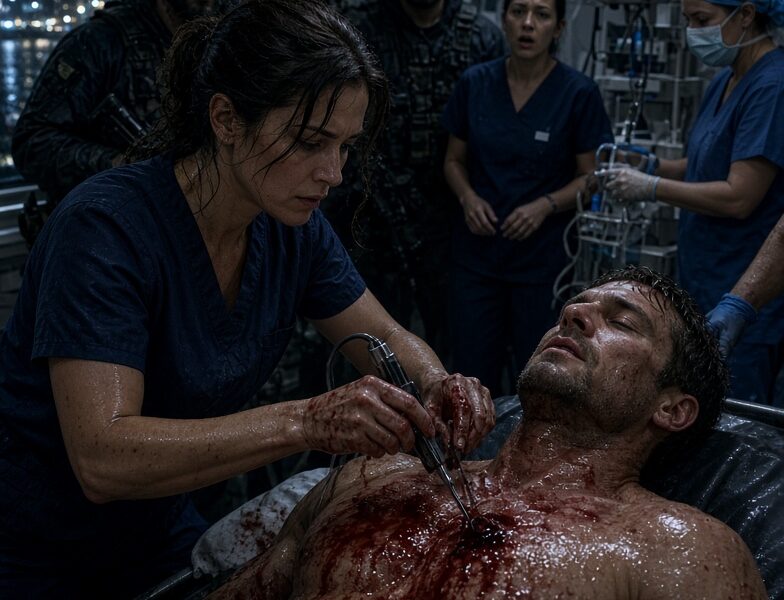
He was massive, his chest completely exposed and covered in salt water, blood, and sand, and his skin was a terrifying shade of cyanotic blue.
“Blunt force trauma to the chest,” yelled a Navy corpsman, breathless as he pumped a bag valve mask over David’s face. “Fifty-foot fall from a helicopter, fast rope gone wrong. Heart rate is dropping. Pulse ox is at 78 and falling. We suspect a massive tension pneumothorax, but we can’t get breath sounds.”
The military surgeon, a frazzled-looking lieutenant commander who had just rushed in from a different wing, sprinted to the bedside.
“I need a chest tube set up. Now. Scalpel. Kelly clamps. Thirty-six French tube.”
Sarah was already at the cart.
She grabbed the sterile tray, her hands flying over the equipment, prepping it in record time, and handed the tray to the surgeon just as David Miller’s monitor let out a long, high-pitched wail.
Asystole.
Flatline.
“He’s coding,” the corpsman shouted. “He’s losing his pulse.”
“I need to decompress his chest, but the tissue is too thick. I can’t find the landmark,” the military surgeon yelled, his hands slipping on the blood and seawater coating the SEAL’s massive pectoral muscles.
The surgeon was panicking.
He was a vascular specialist, not a trauma surgeon, and the chaotic environment was getting the better of him.
David’s chest was swelling dramatically on the right side, and the air escaping his punctured lung was trapped inside his chest cavity, crushing his heart.
He had seconds before irreversible brain damage or death.
“He needs a needle thoracostomy right now or his heart will never restart,” Sarah said, stepping forward.
“Get back!” Brenda screamed from the doorway. “Sarah, you are not cleared. Step away from the patient.”
“He is dying, Brenda!” Sarah roared, and a sudden fierce command in her voice stunned everyone in the room, because it wasn’t the voice of a quiet civilian nurse.
It was a voice accustomed to giving orders under heavy fire.
Without waiting for permission, Sarah snatched a 14-gauge angio catheter from the supply cart.
She shoved past the bewildered military surgeon and slammed her hand against David Miller’s chest, feeling for the second intercostal space, midclavicular line.
“Hey, what the hell are you doing?” one of the armed SEALs shouted, stepping forward to physically pull her away.
Sarah ignored him.
With brutal, calculated force, she drove the three-inch needle directly into David’s chest.
A loud, audible hiss filled the room as the trapped, pressurized air rushed out through the needle.
Almost instantly, David’s trachea, which had been pushed off to the side by the pressure, shifted back to the center.
“Push one milligram of epinephrine now!” Sarah ordered the frozen corpsman.
The corpsman, operating purely on military reflex to an authoritative command, slammed the drug into David’s IV line.
Five seconds passed.
Ten.
Then the monitor beeped.
Beep. Beep. Beep.
Normal sinus rhythm.
His blood pressure spiked, and his skin began to lose its horrifying blue tint.
The tension in the room snapped like a cut wire.
The military surgeon exhaled a ragged breath and stepped in to quickly insert the chest tube now that the immediate pressure was relieved.
Sarah took a step back and tossed the plastic needle sheath into the sharps container.
She looked down at her hands, exhaling softly, because she had saved him.
But as she looked up, she didn’t see gratitude.
She saw Brenda Caldwell’s face, flushed purple with bureaucratic rage.
“Security,” Brenda whispered, her voice trembling with fury. “Escort Nurse Jenkins to my office, right now.”
The hospital director’s office was freezing, the air conditioning cranked up so high it felt like a meat locker.
Sarah sat in the rigid leather chair opposite Brenda Caldwell’s massive oak desk.
To Brenda’s right stood Lieutenant Harris, a Navy liaison officer who looked like his uniform was ironed with a laser, and he was staring at Sarah with a mixture of disbelief and utter contempt.
“Do you have any concept of what you have just done?” Brenda’s voice was dangerously low as she paced behind her desk, her heels clicking aggressively against the hardwood floor.
“I saved a man’s life,” Sarah replied smoothly, her hands folded in her lap.
She wasn’t intimidated, because she had been interrogated by much scarier people in much worse places.
“You assaulted a classified military asset,” Lieutenant Harris barked, leaning forward. “You laid hands on a Tier One operator without a security clearance, overriding the orders of a commissioned military medical officer. Do you know the sheer amount of operational security tied to Petty Officer Miller? His blood type, his physiological data, his very presence in this city is classified.”
“With all due respect, Lieutenant,” Sarah said, keeping her tone completely flat, “when a patient’s heart is being crushed by a tension pneumothorax, their security clearance doesn’t matter to physiology. If I hadn’t decompressed his chest, your highly classified operator would be leaving this hospital in a highly classified body bag.”
Brenda slammed her hands down on the desk.
“That is enough, Sarah. I warned you. I gave you a direct, unequivocal order to stay behind the red line. We have protocols. We have contracts with the Department of Defense that keep this hospital’s lights on. You are a civilian nurse, not a cowboy.”
“I did my job.”
“No. You violated hospital policy, insubordinately breached a federal security cordon, and exposed this hospital to millions of dollars in potential liability.” Brenda sneered and opened a manila folder on her desk, pulling out a preprinted form.
Sarah recognized it immediately.
It was a pink slip.
“I spoke with the chief of staff and the hospital’s legal counsel while you were washing the blood off your hands,” Brenda said, her eyes flashing with vindictive triumph. “Effective immediately, your employment at San Diego Memorial is terminated. You are stripped of your nursing privileges in this facility. Furthermore, we will be reporting your gross insubordination and breach of protocol to the state nursing board. You will be lucky if you ever work in an urgent care clinic again, let alone a Level One trauma center.”
Sarah stared at the piece of paper.
Ten years.
She had spent ten years building a quiet, normal life for herself here, and after the dust and the blood of her past, this hospital was supposed to be her sanctuary.
Now this pencil-pushing administrator was taking it away because she cared more about a DOD contract than a beating heart.
“You’re firing me for saving a patient,” Sarah stated, not as a question, but as a grim fact.
“We are firing you for being a liability,” Brenda corrected sharply. “Clean out your locker. Security will escort you to your vehicle. And Ms. Jenkins, do not ever set foot on this property again, or you will be arrested for trespassing.”
Sarah didn’t beg.
She didn’t cry.
She stood up slowly, her face an unreadable mask, and she looked at Lieutenant Harris, who smugly adjusted his tie, and then at Brenda.
“You’re making a mistake,” Sarah said softly.
“The only mistake was hiring you,” Brenda replied. “Get out.”
The walk to the staff locker room felt like a funeral march, with two burly security guards trailing five feet behind her, a deeply humiliating escort that made the other nurses in the hallway stop and stare.
Whispers rippled through the ward.
“Fired.”
“She touched the SEAL.”
“Brenda finally got her.”
Sarah opened her rusted metal locker.
Inside were the meager contents of her civilian life, a spare stethoscope, a box of granola bars, a faded photograph of a golden retriever she used to own, and a heavy olive drab canvas duffel bag she used for the gym.
She stripped off her stethoscope and dropped it onto the bench.
As she reached up to grab her duffel bag, her scrub top shifted, pulling the sleeve up her right arm.
There, etched into the pale skin of her inner wrist, was a tattoo.
It wasn’t large, but it was striking: a pitch-black Navy SEAL trident, shattered down the middle, and wrapped around the broken trident was a combat medic’s cross, dripping with red ink.
And underneath, written in a jagged military stencil, were the words Valkyrie, Extortion 17, see you in Valhalla.
She quickly pulled her sleeve down, hiding the ink.
It was a ghost from a past she had buried, a past where she wasn’t just Sarah Jenkins, civilian RN.
She packed her bag, slung it over her shoulder, and walked out into the pouring San Diego rain, leaving her career behind.
Three hours later, the storm had worsened, but the sleek black SUV that pulled up to the emergency entrance of San Diego Memorial ignored the weather entirely.
It parked illegally in the ambulance bay, the doors opened, and four men stepped out.
At the center was Lieutenant Commander Richard “Rick” Hayes.
Hayes was a legend in the Naval Special Warfare community.
At forty-two, he possessed a physical presence that seemed to suck the oxygen out of whatever room he entered, and his face was a map of combat deployments.
A jagged white scar ran from his jawline up to his ear, a souvenir from a close-quarters firefight in the Korengal Valley.
He didn’t wear a crisp uniform like Lieutenant Harris, he wore a heavy waterproof tactical jacket over a black T-shirt, and his eyes were cold and dead set as he walked through the sliding hospital doors.
Brenda Caldwell, having been alerted to the arrival of the SEAL team commander, was waiting in the lobby with a plastic smile plastered across her face.
Lieutenant Harris stood stiffly beside her.
“Commander Hayes,” Brenda gushed, stepping forward and extending a hand. “I am Brenda Caldwell, director of nursing. We are so honored to have—”
Hayes walked right past her extended hand without breaking stride.
“Where is my man?” His voice was like grinding granite.
“Petty Officer Miller is in the intensive care unit, Commander,” Lieutenant Harris quickly interjected, falling into step beside Hayes. “He is stabilized. The military surgical team successfully placed the chest tube and he is out of danger. He’s heavily sedated but expected to make a full recovery.”
Hayes stopped in the middle of the hallway, forcing Brenda and the lieutenant to awkwardly halt around him.
“I read the preliminary sitrep on the drive over. The report said Miller coded, flatlined. It said the primary surgeon couldn’t get the chest tube in because of swelling and loss of landmarks.”
Brenda puffed up her chest, eager to show she had handled the situation.
“Yes, Commander. It was a very chaotic scene. Unfortunately, one of our civilian nurses breached protocol and violently intervened. She shoved the military surgeon aside and performed an unauthorized procedure.”
Hayes slowly turned his head to look at Brenda, and his pale blue eyes were terrifying up close.
“She performed an unauthorized procedure.”
“Yes,” Brenda said, completely misreading his tone as anger at the nurse. “But do not worry, Commander. We take the security of our military assets very seriously. We have a zero-tolerance policy for insubordination. I personally fired the nurse on the spot. She has been removed from the premises and will be reported to the state board. Your team’s operational security is completely intact.”
Hayes stared at her in dead silence for a full five seconds.
“Give me the chart,” Hayes demanded, holding out a massive hand.
“Sir?” Lieutenant Harris asked, confused.
“The medical chart. Give it to me. Now.”
Brenda hurriedly signaled a nearby clerk, who handed her the digital tablet containing Miller’s emergency charts, and she handed it to Hayes.
Hayes tapped the screen, scrolling through the frantic notes jotted down by the medical scribe during the trauma response.
His eyes scanned the vital signs, the timeline of the crash, and then the specific medical intervention.
“23:14 hours. Patient in PEA arrest. Tension pneumothorax suspected. Unsuccessful placement of 36 French chest tube by attending. Civilian RN intervened. 23:14:30 hours, RN performed emergency needle thoracostomy, 14-gauge angio-catheter, second intercostal space, right midclavicular line. Immediate rush of air. Tracheal deviation resolved. 23:15 hours, ROSC achieved. Patient stabilized.”
Hayes stopped reading and looked up, his brow furrowed deeply.
“A 14-gauge needle thoracostomy on a man Miller’s size,” Hayes muttered, almost to himself. “Miller is 240 pounds of muscle. Hitting the pleural space perfectly with a standard hospital catheter on a chest that thick under extreme duress.”
He looked at Brenda.
“That isn’t a lucky guess. That’s combat medicine. That’s a battlefield maneuver.”
“As I said, she was acting recklessly,” Brenda sneered.
“I want to see the security footage of trauma bay one,” Hayes ordered.
“Commander, that really isn’t necessary,” Brenda started to say, but Hayes stepped into her personal space, and the sheer intimidation factor of the man made Brenda physically shrink back.
“Show me the tape, Brenda,” Hayes said quietly.
Minutes later, they were crammed into the hospital’s small security control room, and the overweight guard nervously pulled up the digital feed from trauma bay one at 23:00 hours.
Hayes watched the screen intently.
He watched his man, Miller, dying on the table.
He watched his vascular surgeon freeze up.
And then he watched her.
He watched the female nurse step out of the periphery.
She didn’t panic, she didn’t hesitate, and her movements were incredibly fluid, brutally efficient.
She snatched the needle, found the landmark by touch alone through the blood, and drove it home to save Miller’s life.
“Pause it,” Hayes commanded.
The guard hit the space bar, and the footage froze on the nurse pulling her hand back after inserting the needle.
“Zoom in on her right arm. Maximize the resolution.”
The guard manipulated the software, drawing a box around the nurse’s right wrist.
As the image pixelated and then sharpened, the sleeve of her scrubs was visibly pulled back due to her reaching motion.
There, clear as day on the high-definition security camera, was the tattoo.
The broken trident.
The medic cross.
Hayes felt a physical punch to his gut.
He knew that tattoo.
There were only four people in the world who had that exact ink done in a filthy basement parlor in Kabul after the worst night of their lives.
Three of them were dead.
“Valkyrie,” Hayes whispered, the color draining from his weathered face.
“Excuse me, Commander?” Lieutenant Harris asked.
Hayes spun around, his eyes blazing with a sudden ferocious intensity.
“What did you say her name was?”
“Jenkins,” Brenda said, stammering slightly, suddenly realizing something was terribly wrong.
“Sarah Jenkins.”
“Her name is Sergeant First Class Sarah Jenkins,” Hayes roared, his voice shaking the small room. “She was the lead trauma medic for the Army’s Cultural Support Team attached to SEAL Team Six in Afghanistan. She has a Silver Star. She has two Purple Hearts. And seven years ago, she dragged my bleeding body out of a burning helicopter in the Hindu Kush while taking enemy fire, saving my life, and the lives of three of my men.”
Brenda’s mouth opened, but no sound came out.
She looked like a fish gasping for air.
Lieutenant Harris turned pale.
“Sir, she was a CST?”
“She is the best combat medic the United States military has produced in a decade,” Hayes snarled, stepping toward Brenda, his finger pointing squarely at her nose. “And you fired her for saving my best sniper?”
“I—I didn’t know,” Brenda choked out, terrified. “The protocols, she didn’t have clearance.”
“She has a top secret SCI clearance that outranks the hospital director’s,” Hayes bellowed. “She has security clearance so high she doesn’t even exist on your civilian databases. Where is she?”
“She—she left,” Brenda whimpered. “I had security escort her to the parking lot.”
Hayes didn’t say another word.
He shoved past the hospital administrator, nearly knocking her to the floor, and bolted down the hallway.
He hit the emergency exit doors at a dead sprint, bursting out into the pouring rain.
The San Diego storm had turned the hospital parking lot into a shallow, freezing lake.
Lieutenant Commander Rick Hayes ignored the deluge soaking through his tactical jacket, his combat boots slamming into the asphalt as he sprinted through the rows of parked cars.
The sodium vapor streetlights cast long, distorted shadows, but his eyes were trained on the exit gates.
He saw the taillights flare, an older model, beat-up Jeep Cherokee shifting into gear near the back of the lot.
“Sarah!” Hayes roared over the thunder, waving his arms as he sprinted into the lane directly in the path of the headlights.
The Jeep’s brakes locked.
The tires hydroplaned slightly on the wet pavement, squealing in protest before the vehicle skidded to a violent halt just inches from Hayes’s knees.
Through the windshield, obscured by the frantic sweeping of the wipers, Hayes saw her.
She was gripping the steering wheel, her eyes wide with shock.
For a second, the years melted away.
She wasn’t the quiet, unassuming civilian nurse he had just watched on the security feed.
She was Sergeant First Class Jenkins, the combat medic who had pulled him from the flaming wreckage of a CH-47 Chinook in the Shock Valley seven years ago, screaming at him to stay awake while she packed his severed femoral artery with combat gauze under a hail of machine gun fire.
Sarah killed the engine.
The rain hammered against the roof of the Jeep like gravel as she pushed the heavy door open and stepped out into the storm.
She stared at the massive SEAL commander standing in her headlights, and her breath caught in her throat.
The jagged scar on his jaw was exactly as she remembered it, the wound she had sutured in the dirt while waiting for the medevac.
“Commander,” she whispered, the title slipping out through sheer muscle memory.
Hayes closed the distance between them in two massive strides.
He didn’t salute, he didn’t offer a handshake.
He grabbed her by the shoulders and pulled her into a crushing embrace.
For a moment, the hardened Tier One operator squeezed his eyes shut against the rain, the ghosts of their past howling in the wind around them.
“I thought you were dead,” Hayes said, his voice thick with an emotion his men had never heard. “When they disbanded the cultural support teams, when the files were sealed after the crash, they told me you didn’t make it out of Walter Reed.”
Sarah stepped back, her eyes dropping to the wet pavement, and she crossed her arms over her chest, shivering in her thin scrubs.
“I made it. Mostly. The brass gave me a quiet medical discharge, a Silver Star I can’t talk about, and a new civilian identity. I just wanted to disappear, Rick. I wanted to fix people instead of watching them get torn apart.”
“And tonight?” Hayes asked, his eyes locking onto hers, burning with fierce intensity. “Tonight you saved my best man, David Miller. He’s my point man, Sarah. He has a wife and a six-month-old daughter in Coronado. The fleet surgeon panicked. If you hadn’t put that needle in his chest, Miller would be in a body bag right now.”
“I did what I was trained to do,” Sarah said softly, wiping rainwater from her eyes. “But it doesn’t matter anymore. Brenda made it very clear. I breached protocol. I don’t have clearance. I’m fired, and they’re going to try to take my nursing license.”
Hayes let out a dark, dangerous laugh that sent a chill down her spine.
“A hospital administrator thinks she can fire the woman who saved a Navy SEAL’s life on a classified operation. She thinks her little HR handbook applies to the United States Special Operations Command.”
“Rick, she’s the director of nursing. I am a civilian.”
“You are a ghost who just stepped out of the shadows to save a Tier One asset,” Hayes corrected her sharply. “Do you know what operation Miller was on tonight? It wasn’t a training accident. We were boarding a rogue freighter twenty miles off the coast, seizing a shipment of stolen sarin gas headed for a cartel in Sinaloa. Miller didn’t just fall. He was thrown from the helo strut by a hostile combatant. The intel on this op is so highly classified that the president of the United States was briefed on it an hour ago.”
Sarah’s eyes widened as the realization of what she had stepped into began to crystallize.
“Your intervention didn’t just save a life, Sarah. It preserved a critical witness and the lead operator of a national security mission,” Hayes continued, stepping closer, his voice commanding and absolute. “You aren’t driving away from this. You’re coming back inside with me.”
“I can’t,” Sarah protested, shaking her head. “Security will arrest me for trespassing. Brenda has already called hospital legal.”
“Let her call whoever she wants,” Hayes growled, pulling a heavy satellite phone from the tactical pouch on his chest. “I’m about to call the admiral of Naval Special Warfare Command. We’re going to see whose authority carries more weight in this city, a bureaucratic pencil-pusher or the Department of Defense.”
He reached out, his large calloused hand gently but firmly gripping her arm.
“You belong with us, Valkyrie. We don’t leave our medics behind. Never again. Now get the hell out of the rain.”
The atmosphere in the emergency department lobby was electric with whispered gossip.
Staff members huddled at the nurses’ station trading rumors about the violent firing of Sarah Jenkins and the terrifying SEAL commander who had nearly taken the head off the director of nursing.
Brenda Caldwell was standing near the triage desk flanked by two armed hospital security guards.
She was on her cell phone with Jonathan Carmichael, the hospital’s CEO, frantically spinning the narrative.
“I assure you, Jonathan, the liability is contained,” Brenda said, pacing nervously, her manicured fingernails tapping against her tablet. “The nurse has been escorted off the property. Yes, she assaulted the patient, but the military team is handling his care now. I have Lieutenant Harris right here and he agrees that—”
The automatic sliding doors at the entrance blew open, letting in a violent gust of wind and rain.
The entire lobby went dead silent.
Walking through the doors, dripping wet and completely unbothered by the cold, was Lieutenant Commander Hayes.
And walking right beside him, her duffel bag slung over her shoulder, was Sarah Jenkins.
Brenda dropped her phone, and it clattered against the linoleum floor.
“Security!” Brenda shrieked, her voice cracking in panic. “I gave you strict orders. That woman is legally barred from the premises. Apprehend her immediately.”
The two security guards, both retired local cops who looked thoroughly out of their depth, hesitantly stepped forward, unbuttoning the straps on their tasers.
“Hold it right there, folks,” the older guard said, holding up a hand. “Miss Jenkins, you need to turn around and—”
Hayes stepped smoothly in front of Sarah, shielding her completely with his massive frame.
He didn’t raise his voice, but the low, predatory rumble in his chest echoed through the quiet lobby.
“If either of you lay a hand on this woman, I will consider it an assault on a federal military asset, and I will physically dismantle you before you can draw a breath,” Hayes stated with absolute, terrifying conviction.
The guards froze.
They looked at the scars on Hayes’s face, the dead-eyed stare of a man who had killed more people than they had ever given parking tickets to, and they wisely took a step back, raising their hands in surrender.
“Lieutenant Harris!” Brenda screamed, turning to the Navy liaison officer, who was shrinking against the wall. “Do your job! Arrest this man for insubordination! Get this woman out of my hospital!”
Harris swallowed hard, his Adam’s apple bobbing in his throat.
“Ma’am, Commander Hayes is a Tier One operator. I don’t have the authority to—”
“I have the authority!” Brenda yelled, her face flushed dark crimson.
She stormed toward Hayes and Sarah, pointing a trembling finger at Sarah’s face.
“You arrogant, insubordinate little—”
“Director Caldwell,” Hayes interrupted, his voice slicing through her hysteria like a razor blade.
He held up his satellite phone, and the screen was illuminated, displaying an active call.
“I have Vice Admiral Thomas Collins, Commander of Naval Special Warfare, on the line. He has Jonathan Carmichael, your CEO, patched through on a secure conference call.”
Brenda stopped dead in her tracks, the color draining from her face so fast she looked like she might faint.
Hayes pressed the speaker button on the heavy, ruggedized phone.
The crisp, authoritative voice of the admiral boomed into the quiet hospital lobby.
“Director Caldwell, this is Admiral Collins. Am I speaking to the woman who fired the combat medic that saved my petty officer’s life?”
Brenda’s mouth opened and closed silently for a moment.
“Admiral, sir, with all due respect, Nurse Jenkins does not possess the requisite security clearance to interact with—”
“Shut your mouth, Director,” the admiral barked, and the military command brooked zero argument. “The operation Petty Officer Miller was participating in falls under the National Security Act of 1947. Due to the classified nature of his injuries and the biological hazards involved in tonight’s raid, the Department of Defense is officially invoking immediate federal jurisdiction over your intensive care unit.”
Brenda gasped, her eyes darting around the room as the hospital staff watched her world crumble.
“You—you can’t do that. This is a private medical facility.”
“We just did,” a second voice chimed in.
It was Jonathan Carmichael, the CEO of San Diego Memorial, and he sounded absolutely furious.
“Brenda, what the hell is wrong with you? The Pentagon just threatened to pull every single cent of our military Tricare funding and place our hospital under federal lockdown because you fired a decorated war hero over a paperwork technicality.”
“Jonathan, I was protecting the hospital from liability,” Brenda pleaded, tears of utter humiliation finally welling in her eyes.
“You are suspended, Brenda, effective immediately,” Carmichael’s voice was icy. “Hand your ID badge to security and vacate the premises. Human Resources will contact you on Monday regarding the termination of your contract.”
Brenda staggered back as if she had been physically struck.
The mighty director of nursing, the terror of the wards, had been unceremoniously fired over a speakerphone in front of her entire staff.
Hayes reached out and ended the call, slipping the phone back into his pouch.
He looked down at Brenda, who was staring at the floor, sobbing quietly in shock.
“Clearance granted,” Hayes whispered to her.
He turned back to Sarah.
The ER staff, doctors, nurses, and techs who had worked alongside her for five years, were staring at her in stunned awe.
They had known her as the quiet girl who always took the extra shifts and ate lunch alone in her car.
None of them had known they were working beside a ghost of Naval Special Warfare.
“Sergeant Jenkins,” Hayes said formally, his voice carrying clearly across the lobby. “As of this moment, you are formally reinstated to active status as a civilian military contractor. You are the lead medical liaison for Petty Officer Miller. His life is in your hands.”
Sarah looked at the badge Brenda had forced her to leave on the desk.
She looked at the faces of her friends.
And then she looked at the man she had saved all those years ago in the dirt of the Shock Valley.
She reached down, grabbed the hem of her wet scrub sleeve, and deliberately pushed it up past her elbow.
The stark black ink of the shattered trident and the bloody medic cross was suddenly visible to everyone in the room.
“Lead the way, Commander,” Sarah said.
The transition was instantaneous and absolute.
As Sarah Jenkins walked back through the double doors of the intensive care unit, the atmosphere had fundamentally shifted.
The chaotic, gossipy energy of the civilian hospital had been completely erased, replaced by the cold, hyper-efficient discipline of a military forward operating base.
Armed Navy personnel in tactical gear stood at every entrance, the hospital’s standard security cameras in the wing had been covered or disconnected, replaced by portable, encrypted surveillance feeds monitored by a SEAL communications specialist sitting at the nurses’ station.
Sarah walked down the corridor, her wet scrubs clinging to her skin, the heavy canvas duffel bag still slung over her shoulder.
The civilian nurses parted for her, their eyes wide with a mixture of reverence and shock.
None of them said a word, because they didn’t know how to address the woman they had worked beside for five years, a woman who had just effectively commandeered the entire floor alongside a legendary SEAL commander.
When she reached room 412, Commander Hayes pushed the heavy glass door open for her.
Inside, Petty Officer First Class David Miller lay in the center of the room, dwarfed by the massive array of life support monitors and fluid pumps surrounding him.
The rhythmic hiss-click of the mechanical ventilator was the only sound in the sterile room.
Standing at the foot of the bed was the military vascular surgeon who had frozen in the trauma bay, Lieutenant Commander Evans.
When Sarah entered, Evans immediately stood at attention, his face pale and drawn tight with professional shame.
“Sergeant Jenkins,” Evans said, his voice clipped but heavily laced with respect. “I—I owe you a profound apology. I lost my situational awareness in the bay. The anatomical distortion from the pneumothorax threw me off. If you hadn’t stepped in, we would have lost him.”
Sarah dropped her duffel bag onto a nearby chair.
She didn’t offer a polite civilian absolution, she looked at the surgeon with the cold, evaluating eyes of a combat veteran.
“You’re a vascular specialist, doctor. You’re used to a controlled environment, an anesthetized patient, and clear margins. Trauma doesn’t give you margins. It gives you chaos. You panicked because you tried to perform surgery instead of performing a rescue.”
Evans swallowed hard, nodding slowly.
“Yes, ma’am. You’re absolutely right.”
“Is his chest tube secure?” Sarah asked, stepping up to the bedside and immediately inspecting the drainage unit on the floor.
The fluid levels were stabilizing, and the bubbling had ceased, indicating the massive air leak in Miller’s pleural cavity was sealing.
“Yes, output is minimal. Vitals are holding strong,” Evans replied, stepping back to give her room. “We have him on a propofol drip to keep him intubated and comfortable until the lung re-expands fully.”
“Good. Monitor his hemoglobin every two hours. I want to know the second his blood pressure dips even a fraction. The sheer blunt force of hitting the water from that height could have caused micro-tears in his spleen that haven’t manifested yet,” Sarah ordered, her hands moving expertly over Miller’s IV lines, double-checking the drip rates.
Commander Hayes stood by the window, watching her work.
For the first time in seven years, the heavy invisible weight that he always carried in his chest seemed to lighten.
He was watching Valkyrie do what she was born to do.
“I’ll leave you to it,” Evans murmured, excusing himself from the room and leaving Sarah and Hayes alone with the hum of the machines.
Sarah finally stopped moving.
She stood at the head of the bed, her fingers resting gently on David Miller’s thick tattooed forearm.
She traced the edge of the SEAL trident inked into his skin, mirroring the broken one hidden beneath her own sleeve.
“He’s young,” Sarah said softly, her voice barely carrying over the ventilator.
“Twenty-six,” Hayes replied, stepping up beside her. “He’s my best point man, lightning fast, eyes like a hawk. He’s got a wife, Chloe, and a little girl, six months old. They’re on their way from Coronado right now in a transport vehicle.”
Sarah closed her eyes, a sudden wave of exhaustion hitting her.
“I hate this part, Rick. The waiting, the families. It’s why I left. It’s why I came here to hand out ibuprofen and stitch up drunk college kids. I didn’t want to hold the hands of crying wives anymore.”
Hayes reached out, wrapping a massive arm around her shoulders.
He pulled her close, pressing a kiss to the crown of her head.
It was a fiercely protective gesture, devoid of romance, but filled with a profound, unbreakable brother-in-arms bond.
“Seven years, Sarah,” Hayes whispered, his voice thick with gravel and old grief. “Seven years I thought you burned in the Hindu Kush. The official after-action report stated that the fuselage collapsed before anyone else could be extracted.”
“It almost did,” Sarah said, opening her eyes, staring blankly at the heart monitor.
The memories she had suppressed for half a decade came rushing back, tasting like ash and copper in her mouth.
“The Taliban hit the tail rotor with an RPG. We dropped out of the sky like a stone. When I came to, I was hanging upside down in the troop compartment. The pilots were dead. Half the team was gone. You were pinned under the transmission housing, bleeding out from your femur.”
“You dragged me fifty yards through the snow,” Hayes recalled, his eyes dark with the memory.
“You took a round in the shoulder, two in your vest. You packed my leg while returning fire with a sidearm until the quick reaction force arrived. By the time they loaded you onto the medevac bird, I was bleeding out internally from the shrapnel,” Sarah continued, her voice trembling slightly.
“I coded twice on the flight to Bagram. They flew me straight to Landstuhl in Germany, and then to Walter Reed. I was in a coma for a month. When I woke up, the cultural support team program was being quietly dismantled. The mission was highly classified. They gave me a medal in a closed room, handed me my discharge papers, and told me to have a nice life.”
“Why didn’t you reach out to me?” Hayes asked, the pain in his voice undeniable. “Why didn’t you let me know you were alive?”
Sarah finally turned to look at him, and a tear slipped down her cheek, cutting a clean line through the exhaustion on her face.
“Because I couldn’t look at you, Rick. I couldn’t look at any of the guys. Every time I closed my eyes, I heard the screaming in that helicopter. I felt the heat of the fire. I thought if I just walked away, if I just became the civilian nurse, the ghosts would stop following me.”
“Did they?” Hayes asked softly.
Sarah looked back down at David Miller, at the rhythmic expansion of his chest, the only proof that she had outrun death tonight.
“No,” she whispered. “They never stop following. You just learn how to make room for them.”
The door to the ICU room clicked open.
A young woman stood in the doorway, her hair soaked from the rain, her eyes red and swollen from crying.
She was clutching a baby wrapped in a thick pink blanket tightly to her chest, and she looked terrified, utterly overwhelmed by the armed guards and the sterile, terrifying environment of the intensive care unit.
Hayes immediately stepped away from Sarah, his posture softening as he approached the young woman.
“Chloe.”
“Commander,” Chloe choked out, her voice breaking as she looked past him to the bed. “Is he—is David—”
“He’s going to be fine, Chloe,” Hayes said gently, taking her by the elbow and guiding her into the room. “He had a rough fall and a collapsed lung, but he is stable. He’s resting.”
Chloe rushed to the bedside, falling into the chair Sarah had just vacated.
She buried her face in the mattress next to David’s hand, sobbing uncontrollably.
The baby in her arms squirmed, but remained asleep, completely unaware of how close she had come to growing up without a father.
After a few moments, Chloe lifted her head, wiping her eyes.
She looked across the bed at Sarah, noticing the wet scrubs and the exhausted, intense look in the nurse’s eyes.
“Who are you?” Chloe asked, her voice raspy.
Commander Hayes stepped forward.
“Chloe, this is Sarah Jenkins. She’s the trauma medic who saved his life tonight. She stabilized him when the doctors couldn’t.”
Chloe’s eyes widened.
She stood up, shifting the baby to one arm, and reached across the bed to grab Sarah’s hand.
Her grip was astonishingly strong.
“Thank you,” Chloe wept, her tears falling onto Sarah’s hand. “Thank you for giving my daughter her father back. I don’t know how I could ever repay you. I owe you everything.”
Sarah looked at the young mother, and then down at the sleeping baby.
For five years, she had run from the heavy, suffocating weight of life and death.
She had let administrators like Brenda Caldwell treat her like a cog in a corporate machine because it was easy.
It required no emotional investment.
But looking at Chloe Miller, Sarah felt something inside her snap back into place.
The shattered pieces of her past aligned.
She wasn’t just a civilian nurse.
She was a Valkyrie.
She pulled people back from the gates of Valhalla, and she was done apologizing for it.
“You don’t owe me anything, Chloe,” Sarah said, gently squeezing the woman’s hand. “We take care of our own.”
By dawn, the torrential storm had finally broken, leaving the streets of San Diego washed clean and glittering in the pale morning light.
The hospital, however, was still reeling from the aftershocks of the night before.
At 0700 hours, the elevator doors at the end of the ICU hallway chimed open, and Jonathan Carmichael, the CEO of San Diego Memorial, stepped onto the floor.
He looked haggard, his expensive Italian suit slightly wrinkled, and he was flanked by the hospital’s lead counsel.
Carmichael approached the glass wall of room 412.
He saw Sarah sitting in a chair beside the bed, reviewing a digital chart, while Commander Hayes stood by the door, drinking black coffee from a Styrofoam cup.
Hayes saw the CEO approaching and stepped out into the hallway, pulling the door shut behind him.
“Commander.” Carmichael extended a hand that Hayes flatly ignored.
Carmichael cleared his throat, withdrawing his hand awkwardly.
“I wanted to come down here personally to assess the situation and, more importantly, to offer a formal, unreserved apology on behalf of this institution.”
“Your apology is noted, Carmichael,” Hayes said, his voice cold. “But you aren’t the one who needs to hear it.”
Carmichael nodded quickly.
“Of course. I need to speak with Ms. Jenkins. I want to assure her that Brenda Caldwell has been formally terminated. We are dropping all disciplinary actions. Furthermore, we are prepared to offer Ms. Jenkins a substantial promotion. We want to make her the head nurse of the entire emergency department, complete with a six-figure salary increase and a retroactive bonus for her heroism last night.”
Hayes took a slow sip of his coffee.
“You’re trying to buy her silence so the DOD doesn’t pull your military contracts.”
“I am trying to retain an incredibly talented medical professional who was treated appallingly by my staff,” Carmichael countered, trying to maintain some semblance of corporate dignity.
Before Hayes could respond, the door to the ICU room opened.
Sarah stepped out into the hallway.
She had finally changed out of her wet scrubs, wearing a fresh set of dark gray military-issue tactical pants and a black T-shirt that Hayes had procured from the SEAL transport vehicle.
The broken trident tattoo on her wrist was fully visible, bold and unapologetic.
“Mr. Carmichael,” Sarah said smoothly, crossing her arms.
“Sarah.” Carmichael beamed, stepping forward. “I was just telling the commander here how deeply sorry we are for the unacceptable behavior of Brenda Caldwell. We want to make this right. We want you to run the ER.”
Sarah looked at the CEO.
She thought about the endless bureaucratic meetings, the liability forms, the constant pressure to prioritize insurance payouts over patient care.
She thought about the five years she spent hiding in the shadows of this building, pretending to be someone she wasn’t.
“I appreciate the offer, Jonathan,” Sarah said, her voice perfectly calm and devoid of anger. “But I respectfully decline. San Diego Memorial doesn’t need a combat medic running its ER. It needs administrators who actually care about medicine. I don’t fit into your spreadsheets. I never did.”
Carmichael’s face fell.
“Sarah, please. Be reasonable. What are you going to do?”
Sarah looked over at Hayes, and a faint, genuine smile touched the corners of her mouth for the first time in years.
“I’m going back to work,” she said.
Carmichael opened his mouth to argue, but the hospital lawyer put a hand on his arm, shaking his head.
They had lost.
The military had reclaimed their asset.
Carmichael sighed in defeat, nodded stiffly, and walked away down the corridor, his footsteps echoing in the quiet ward.
“Head of the ER,” Hayes mused, tossing his empty coffee cup into a nearby bin. “That’s a nice title. Good pension.”
“I prefer the field,” Sarah replied, turning back to look through the glass at David Miller.
The SEAL was finally stirring.
The propofol drip had been reduced an hour ago, and the heavy sedatives were wearing off.
Chloe was leaning over the bed, holding his hand, whispering softly to him as his eyes fluttered open.
Sarah and Hayes stepped back into the room.
David Miller blinked against the harsh fluorescent lights, groaning as the pain in his chest flared.
He looked at his wife, a weak, confused smile crossing his pale face.
Then he looked past her and saw his commander.
“Boss,” Miller rasped, his voice barely a whisper around a dry throat. “Did we—did we secure the package?”
“The siren is at the bottom of the ocean, kid,” Hayes smiled fiercely. “Mission accomplished. You did good.”
Miller let out a long breath, relaxing back into the pillows.
He then turned his head, his hazy eyes locking onto Sarah.
He recognized her.
Even through the fog of trauma and sedation, he remembered the cold, terrifying moments in the emergency room.
He remembered the incompetent vascular surgeon, and he remembered the fierce, unyielding eyes of the woman who had shoved the doctor aside and slammed a needle into his chest, letting the air back into his crushed lungs.
“You,” Miller breathed, trying to lift his hand.
Sarah stepped up to the bed, taking his large hand in hers.
“Welcome back to the land of the living, petty officer.”
Miller looked down at her wrist.
His eyes focused on the black ink, the broken trident, the bloody combat medic cross, the word Valkyrie.
The young SEAL’s eyes widened in profound understanding.
He knew the legends.
Every operator in Naval Special Warfare knew the story of the cultural support team medic who had dragged Commander Hayes out of hell and disappeared.
Miller squeezed her hand, his eyes shining with unshed tears of gratitude.
“Thank you, sister.”
Sarah felt a hard lump form in her throat.
She gripped his hand back, nodding slowly.
“Rest up, Miller. You’ve got a lot of physical therapy ahead of you.”
An hour later, the official military medical transport arrived to transfer Miller to the secure Naval Hospital in Balboa for his remaining recovery.
Sarah stood in the ambulance bay, the morning sun finally breaking through the heavy clouds, warming her face.
Hayes stood beside her, watching the transport pull away, flanked by heavily armed security vehicles.
“So, you declined Carmichael’s offer?” Hayes said, looking down at her. “What exactly did you mean when you said you were going back to work?”
Sarah hoisted her olive drab duffel bag over her shoulder.
“I mean I’m tired of hiding, Rick. I have skills that are being wasted on drunk drivers and twisted ankles. I want to be useful again.”
Hayes pulled a thick, sealed manila envelope from inside his tactical jacket and handed it to her.
“What is this?” Sarah asked, taking the heavy package.
“Naval Special Warfare Command is launching a new, highly classified joint trauma training program in Coronado,” Hayes explained, his eyes locking onto hers. “We are tired of losing operators because conventional combat medics don’t know how to handle Tier One field trauma under extreme duress. We need an instructor. Someone who has been in the absolute worst of it and brought people back.”
Sarah looked down at the envelope.
Printed on the front were the words Department of Defense, Top Secret SCI, Eyes Only.
“The admiral signed off on it this morning,” Hayes continued. “You wouldn’t just be an instructor. You’d be the director of special operations medical readiness. It’s a civilian contractor billet, but you answer directly to me and the admiral. Nobody else.”
Sarah traced the edge of the envelope.
It was a lifeline, a bridge back to the world she belonged in, built on her own terms.
“When do I start?” she asked.
Hayes grinned, the jagged scar on his jaw stretching into a terrifying, beautiful smile.
“Monday, 0500 hours. Don’t be late, Jenkins.”
“I’m never late, Commander,” Sarah replied.
She turned and walked toward her beat-up Jeep Cherokee, the morning sun catching the dark ink on her wrist.
She wasn’t just an ER nurse anymore.
The ghosts of her past hadn’t vanished, but they were no longer haunting her.
They were marching beside her.
The shattered trident was the thing, and the thing was the trident, and the trident was a broken symbol of a whole life that a quiet nurse had hidden under a scrub sleeve for five years.
The trident was the thing.
The trident is always the thing.









