
She Said Yes to a Black Single Dad With an Old Truck — Then Her Father Learned Who He Really Was
They laughed when she said his name.
Saraphina Whitmore stood at her family’s dinner table and announced that she would marry Malcolm Veyron, a Black single father with an old truck, a quiet job, and nothing her family considered a future.
Her sister smirked.
Her mother stared.
And her father, a man who had built a fortune on judging people correctly, said, “You are destroying this family’s name.”
No one in that room knew who Malcolm really was.
But when her father secretly dug into his past, he found a name from the biggest deal of his life, and he realized he had insulted the wrong man.
The Whitmore estate sat on a hill above the Connecticut shoreline, and on that October evening, every window glowed gold.
Candles burned along a dining table long enough to seat twenty, though only five people sat at it.
Silver gleamed.
Crystal caught the light.
At the head of the table sat Alistair Whitmore, sixty-seven years old, chairman of Whitmore Capital, a firm his grandfather had founded, and he had turned into one of the oldest investment houses on the East Coast.
He cut his steak with slow, precise strokes, the way he did everything.
To his right sat his wife, Odessa, sixty-two, pearls at her throat, a woman who could read a guest list the way a general reads a map.
Beside her was their elder daughter, Cresa, thirty-eight, sharp-featured and sharper-tongued, who had never met a stranger she could not price within thirty seconds.
Across from them sat Saraphina, thirty-four, the younger daughter, the one who had always asked too many questions at dinner.
And beside Saraphina, in a gray suit that had clearly been bought off a rack and pressed with great care, sat Malcolm Veyron.
He was thirty-nine.
He was Black.
He was the only person at the table who had not been born into a room like this one, and everyone at the table knew it.
Saraphina set down her fork.
She glanced at Malcolm and he gave her the smallest nod.
Then she looked directly at her father.
“Malcolm asked me to marry him,” she said.
“And I said yes. I’m going to marry him.”
Silence fell over the table like a dropped curtain.
One second.
Two.
Three.
Then Cresa laughed.
It started as a short, disbelieving breath and grew into something louder, something she did not bother to hide behind her napkin.
“I’m sorry,” Cresa said.
“Not sorry at all. I just want to make sure I understand. You’re marrying the bookkeeper from the lumberyard.”
She turned to Malcolm with a bright, poisonous smile.
“Do they give you a discount on plywood, Malcolm? That could be useful for the house you’ll never be able to afford.”
Odessa reached across the table and touched her daughter’s wrist, the way one might touch a child about to step into traffic.
“Sweetheart,” she said softly.
“Do you truly want to marry a man like that?”
“A man like what, Mother?” Saraphina asked.
Odessa did not answer.
She did not need to.
Her eyes moved over Malcolm’s suit, his plain steel watch, his hands folded calmly on the white tablecloth, and the answer was written in every inch of that look.
Malcolm said nothing.
He picked up his water glass, took a slow sip, and set it down without a sound.
Only one person at the table did not laugh at all.
Alistair Whitmore had stopped eating.
He laid his knife and fork side by side on his plate and looked at Malcolm for a long time.
He had spent four decades across tables from senators, bankers, and billionaires.
And he had learned that most men reveal themselves in the first ten seconds of silence.
They fidget.
They smile too much.
They look away.
Malcolm did none of those things.
He simply looked back.
And that, more than anything, was what Alistair could not stand.
The man did not lower his eyes.
“Saraphina,” Alistair said at last, his voice quiet and cold.
“If you marry this man, you will no longer be considered a fitting heir to this family.”
“Not in my will, not on my board, not in my house.”
He paused.
“You are destroying this family’s name.”
Saraphina’s face went pale, but she did not look away.
Then Malcolm spoke for the first time that evening.
“I don’t need your money, Mr. Whitmore.”
Six words.
Calm.
Almost gentle.
Cresa burst into fresh laughter.
Odessa covered her mouth.
“Of course you don’t,” Cresa said.
“Nobody at a lumberyard needs money.”
Malcolm did not react.
He did not flush.
He did not argue.
He did not explain.
He placed his napkin beside his plate, folded once, and rested one hand lightly on Saraphina’s back.
Alistair kept studying him across the candlelight, and something strange began to stir in the old man’s chest.
It was not anger.
It was something quieter and far more unsettling.
Those eyes, the steadiness in them, the way Malcolm held himself as if he had stood in rooms far larger than this one and had not been impressed.
Alistair had the sudden, irrational feeling that he had seen this man somewhere before, somewhere important, and he could not, for the life of him, remember where.
To understand why Malcolm Veyron did not lower his eyes at that table, one had to understand the life he had chosen.
He lived in a narrow two-story house in New Haven with a porch that needed paint and a maple tree that dropped its leaves into the gutters every fall.
He drove a pickup truck with nearly two hundred thousand miles on it and a dent in the passenger door he had never bothered to fix.
Five days a week he kept the books for Dawson Lumber and Supply, a family business on the edge of town where he balanced ledgers, negotiated with suppliers, and helped load two-by-fours into customers’ trucks whenever the yard was short-handed.
The owner, an old man named Earl Dawson, liked to say Malcolm was the best hire he had ever made and the worst at accepting a raise.
Malcolm was also a father.
His daughter Nora was the center of everything he did, though she spent most of the year at a boarding school in Vermont that she had chosen herself.
A place with horses, snow, and a science program she adored.
Her mother had left when Nora was very small.
Malcolm’s former wife had loved a version of him he no longer wanted to be, a man in tailored suits who flew to Zurich on a Tuesday and back on a Thursday and measured his days in signatures.
When she left, she took nothing from him but his certainty.
And after that, Malcolm made a decision.
He would live small.
He would live quietly.
He would raise his daughter to know her father by what he did, not by what he owned.
Saraphina had met him two years earlier at a fundraiser for an adult literacy program.
She had been the guest of honor.
He had been the man stacking folding chairs after everyone else went home.
She offered to help, and he handed her a chair without a word.
And together they stacked forty more in comfortable silence.
Then he asked her which book had made her fall in love with reading, and he actually listened to the answer.
No one in her world listened like that.
Men in her world waited for their turn to speak.
She fell in love with the small things.
The way he learned the names of waiters and used them.
The way he held doors without making a show of it.
Malcolm never bragged.
He never dropped an important name.
He never tried to prove anything to anyone.
In Saraphina’s eyes, those were the marks of a man at peace with himself.
In the eyes of the Whitmore family, they were the marks of a man with nothing worth mentioning.
Two days after the dinner, Saraphina’s phone buzzed with a message in the family’s group thread.
Cresa had sent a photograph of Malcolm, taken without his knowledge in the parking lot of the lumberyard.
He was wearing a canvas work jacket and carrying a sack of cement over one shoulder.
Beneath it, Cresa had typed a single line.
“Meet the future son-in-law, everyone. I hope the wedding registry includes a forklift.”
Odessa wrote nothing at all, which said everything.
Saraphina drove to Cresa’s townhouse in Greenwich that same afternoon.
She did not knock.
“Delete it,” she said.
“It was a joke, Sarah.”
“It was cruel. He works harder in a day than you have in a year.”
Cresa laughed.
“That’s exactly the problem, darling. People like us don’t have to work hard. That’s the whole point of being people like us.”
Saraphina left without another word.
Her hands trembled on the steering wheel all the way back to New Haven.
That night, she sat on Malcolm’s porch steps with a cup of tea going cold in her hands and told him everything.
She expected him to be angry.
Instead, he sat beside her, quiet, watching the streetlight flicker through the maple leaves.
“Don’t fight them for me,” he said at last.
She turned to him.
“Why not? Someone should.”
Malcolm looked out at the dark street.
“Because one day they’ll find out for themselves that they were wrong,” he said.
“And that will hurt them far more than anything you could say.”
She stared at him.
There was something in his voice she could not place.
It was not hope.
It was certainty.
What neither of them knew was that the reckoning had already begun.
On the night of the dinner, as Malcolm’s old truck rattled down the long gravel drive of the Whitmore estate, Alistair had stood at his study window and watched the taillights disappear into the trees.
He stood there for a long time.
Then he picked up his phone and called his chief of staff, Julian Marsh.
“I want to know everything about Malcolm Veyron,” Alistair said.
“Everything. And I want it quietly.”
Julian Marsh had worked for Alistair for eleven years, long enough to know the difference between a request and an order.
The next morning, he arrived at the Whitmore Capital offices on Park Avenue with a legal pad and a pen.
Alistair dictated the list standing at the window, his back to the room.
Assets.
Employment history.
Every company Malcolm had ever worked for.
Investments, business relationships, legal records, lawsuits, liens, bankruptcies.
And every name.
Every single name Malcolm Veyron had ever done business with.
“You think he’s after the money,” Julian said.
It was not a question.
Alistair did not turn around.
“I think a man who says he doesn’t need my money is either a liar or a fool. And he didn’t look like a fool.”
Julian hired Theodora Banks, a forensic investigator who had spent fifteen years at the Securities and Exchange Commission before going private.
For the first week, she found almost nothing.
Malcolm Veyron owned one house.
Mortgage paid off.
One truck, eleven years old.
A checking account with a modest balance, and a retirement account that looked like any careful middle-class man’s.
No yacht, no vacation homes, no luxury cars, no trust funds.
His credit was spotless, and his life was, by every measure she could find, profoundly ordinary.
Alistair read the first report in his study with a glass of bourbon and a thin, satisfied smile.
“There it is,” he said.
“A bookkeeper with a paid-off house marrying into the Whitmore fortune. It practically writes itself.”
He tossed the folder onto his desk.
Julian hesitated.
“Theodora asked for one more week, sir. She says something in the employment history doesn’t add up.”
Alistair waved a hand.
“Give her the week. It won’t change anything.”
But it did.
Theodora found the gap first.
Malcolm’s employment records were clean from the age of thirty-one onward.
Steady and unremarkable work at the lumberyard and two small accounting firms before that.
But between the ages of twenty-two and thirty-one, there was almost nothing.
Nine years.
A man with a master’s degree in finance from the Wharton School had simply vanished from the visible economy.
And yet a single line buried in an old commercial real estate disclosure listed him as the managing principal of an entity she had never heard of.
She pulled the thread.
That entity led to another.
That one led to three more.
Small companies registered in Delaware, Wyoming, the Cayman Islands, and Luxembourg, layered one inside the next like nesting dolls.
Each one owned another.
None bore Malcolm’s name directly, but every chain of ownership, every tangle of trusts and nominees, eventually pointed back to the same parent.
One name appeared again and again in footnotes, in wire transfer memos, in the signature blocks of agreements worth sums that made her count the zeros twice.
Veyron Strategic Holdings.
When Julian read that name aloud in the study, the old man froze with the bourbon glass halfway to his lips.
He set it down very slowly.
Veyron Strategic Holdings.
He knew that name.
Every serious investor on the East Coast knew it.
The way sailors know the name of a storm they have never seen.
It was a private fund that had never advertised, never taken outside money, never given a single interview.
Years ago, Alistair had spent the better part of eighteen months trying to get a meeting with the people behind it.
He had called in favors.
He had never once gotten past a soft-spoken lawyer in Geneva who politely declined everything.
“Mr. Whitmore,” Julian said carefully.
“Do you know who runs this fund?”
Alistair’s voice came out rough.
“No. Nobody does.”
Julian opened his briefcase and drew out a thick folder, its edges soft from handling.
He placed it on the desk and stepped back as though it might be hot to the touch.
“Theodora found this in a filing that was supposed to stay sealed,” he said.
“I think you should look at it.”
Alistair turned the pages one by one.
Clauses, schedules, figures.
Then the final page.
There at the bottom, in dark blue ink, was a single signature, clean, unhurried.
M. Veyron.
Alistair sat with that page for nearly an hour after Julian left.
Then he poured the bourbon back into the decanter, untouched, and called Theodora himself.
“It’s a coincidence,” he told her.
“Veyron isn’t a common name, but it isn’t unique. There could be a cousin, a father, someone using his name as a front, a forgery.”
Theodora was quiet on the line.
“Do you want me to stop, sir?”
Alistair closed his eyes.
“No,” he said.
“I want you to go deeper. I want to know for certain.”
Meanwhile, the wedding was taking shape, though not the way the Whitmores imagined.
Saraphina and Malcolm chose a date in late spring and made a guest list that fit on a single sheet of paper.
And every few days, a new wave of pressure arrived from the family.
Cresa invited Saraphina to lunch at the club and spent two hours describing in loving detail every man of good family who was still available.
Saraphina set down her napkin.
“I’m getting married, Cresa.”
“You’re making a mistake. Someone has to tell you before it’s legal.”
A week later, Odessa arrived at Saraphina’s apartment unannounced, carrying a garment bag from the designer who had dressed every Whitmore bride for three generations.
She laid the gown across the sofa like an argument.
“I’ll pay for all of it,” she said.
“The Plaza, the flowers, the orchestra. Everything you’ve ever dreamed of. All you have to do is choose the right man.”
Saraphina did not touch the gown.
“I already chose the right man, Mother.”
Odessa’s face tightened.
“Sweetheart, listen to me. A man without standing will drag you down slowly. You won’t even notice until you’re at the bottom.”
Saraphina looked at her for a long moment.
“You only see what he doesn’t have,” she said quietly.
She paused.
“I see what he does.”
Neither woman had noticed that the kitchen door was open.
Malcolm had come over that morning to fix a leaking faucet, and he had been lying on his back beneath the sink with a wrench in his hand for the entire conversation.
He heard every word.
When Odessa left, her heels clicking sharply down the hallway, he slid out from under the cabinet, wiped his hands on a rag, and said nothing about it.
He did not defend himself.
He did not complain.
He finished the faucet, tested it twice, and placed his tools back in their box one by one.
Later that night, they walked along the harbor, the water black and still beneath the lamps.
Malcolm stopped at the railing.
“Saraphina,” he said, “if you want to walk away from this, I won’t blame you. Not for one second. Your family is your family. I know what it costs to lose that.”
She turned to him, startled.
“Is that what you think I want?”
“I think you’re being asked to choose between the people who raised you and a man they’ve decided is beneath them,” he said.
“That isn’t a fair thing to ask of anyone.”
She studied his face in the dim light.
“Malcolm, are you ever afraid of losing me?”
He was silent.
The water lapped against the pilings.
A ferry horn sounded somewhere far out in the dark.
One second.
Two.
Three.
“Yes,” he said.
Only that, but his voice caught on that single word, and it was the first time in two years she had ever heard it do that.
She took his hand and held it until the ferry passed.
At that same hour, across the state, Alistair Whitmore was opening a second envelope from Theodora Banks.
Inside was a confidential memo, twelve years old, recovered from the archives of a Boston law firm that had long since dissolved.
It described a rescue financing deal.
A major American investment firm on the brink of collapse had been saved at the last possible moment by an anonymous injection of capital structured through a chain of private entities.
The memo noted that the principal investor had demanded total anonymity.
His name had been scrubbed from every press release, every public record, every regulatory filing.
Only one internal reference remained.
A handwritten note in the margin.
“Per MV. No attribution under any circumstances.”
Alistair read the name of the firm that had been rescued.
His hand began to shake.
It was Whitmore Capital.
Twelve years earlier, in the coldest winter Alistair could remember, the firm his grandfather had built came within days of dying.
A string of bad bets on mortgage securities had hollowed out the balance sheet.
The banks froze his credit lines, and a rival, a smiling predator named Harlan Price of Price Meridian Partners, had begun buying Whitmore shares through a dozen proxies, preparing a hostile takeover that would strip the firm for parts and send four thousand employees home with nothing.
Alistair had not slept for four days.
The board was ready to surrender.
Then, on the fifth night, his phone rang.
It was a lawyer in Geneva, the same soft-spoken man he would later chase for eighteen months.
An investor, the lawyer said, was prepared to commit $1.2 billion to Whitmore Capital within seventy-two hours.
The terms were absurdly generous.
No board seat.
No management control.
No publicity.
Only one condition was non-negotiable.
The investor’s identity would never be revealed.
The deal closed through an entity called Hion Bridge Partners, a name that meant nothing to anyone.
Price Meridian withdrew within the week.
Whitmore Capital survived, and Alistair, the proudest man on Park Avenue, wrote a letter of thanks to a stranger he would never meet and sent it through the Geneva lawyer.
It was never answered.
Now, twelve years later, Alistair spread the old memo across his desk beside a second document.
Theodora had included it almost as an afterthought.
It was a restructuring plan Malcolm had drafted two years ago for Dawson Lumber and Supply, filed with a small business lender in New Haven.
Alistair put on his reading glasses.
He studied the two documents side by side, and his breathing slowed.
The same three-tiered liquidity ladder.
The same unusual habit of stress-testing every scenario at precisely a 47% drawdown, a number almost no one in the industry used.
The same terse margin notes written in the same clipped phrases.
It was like hearing a voice he knew speaking from two different rooms.
He did not wait for morning.
At one in the morning, Alistair Whitmore drove himself to Park Avenue, woke the night security guard, and descended into the basement archive where the firm kept its sealed records.
Then he found it.
The original closing binder for Hion Bridge Partners, bound in faded blue leather.
He opened it to the signature page, and there it was.
Not initials this time.
A full name, signed as managing principal on behalf of the ultimate parent, Veyron Strategic Holdings.
Malcolm Veyron.
Alistair sat down heavily on a filing box.
The man he had called a nobody.
The man he had threatened to disinherit his daughter for.
The man he had looked at across his own dinner table and found wanting.
That man had saved his family, his firm, and four thousand jobs, and had asked for nothing.
Not a thank you, not a seat, not even his name on a single page anyone would ever read.
And there was more.
As Alistair turned the pages, he found a clause he had forgotten in the chaos of that winter.
The financing had included a conversion right.
At any point within five years, Hion Bridge could have converted its investment into 51% of Whitmore Capital.
Total control.
And when the five years ended, the right had simply been allowed to expire.
Malcolm could have owned the entire firm.
He had done neither.
Alistair stared at the clause.
Why?
Tucked into the inside back cover of the binder was a small cream-colored envelope, unsealed, addressed to no one.
Alistair opened it with trembling fingers.
Inside was a single index card.
The handwriting was the same clipped, careful hand from the margin notes.
It said only this.
“Paid in full for the coat pocket. M.”
Alistair did not sleep that night.
At seven on Saturday morning, he did something he had not done in twenty years.
He sent his driver home and drove himself.
The roads were wet with a gray October rain.
By eight, he was standing in the gravel lot of Dawson Lumber and Supply in a cashmere overcoat that had never been rained on before.
Through the office window, he could see Malcolm at a cluttered desk, reading glasses on, a mug of coffee beside a ledger.
Alistair knocked on the open door.
Malcolm looked up.
If he was surprised, it showed only in the slight stillness of his hands.
He set down his pen.
“Mr. Whitmore.”
Alistair stepped inside, rain dripping from his coat onto the worn linoleum.
There was no contempt in his face now.
There was no armor at all.
“Are you the man behind Veyron Strategic Holdings?” he asked.
Malcolm did not answer right away.
He took off his glasses, folded them, and placed them on the ledger.
He looked at Alistair for a long time.
One second.
Two.
Three.
“You had me investigated,” he said.
It was not an accusation.
It was simply a fact laid on the table.
Alistair did not flinch from it.
“Yes,” he said.
“I did.”
Malcolm nodded slowly, as if confirming something he had expected for weeks.
“I didn’t want you to know,” he said.
“Why?” Alistair asked.
“You saved my company. You saved my family. You could have walked into my house that night and ended every word my daughter’s mother and sister said with a single sentence. Why didn’t you?”
Malcolm leaned back in his chair.
“You don’t remember me,” he said quietly.
“Do you?”
Alistair opened his mouth and closed it again.
Malcolm reached into the drawer of his desk and took out a small, faded business card, its corners softened by years.
He slid it across the desk.
It was Alistair’s own card from a time when Whitmore Capital still had an office in Boston.
On the back, in Alistair’s younger handwriting, were four words.
“Call me anytime.”
“Twenty-one years ago,” Malcolm said, “I was eighteen years old and parking cars at the Belmont Hotel in Boston. Night shift. My mother was in the hospital, and every dollar I made went to her bills.”
One night, a man in a dark overcoat came back from dinner and couldn’t find his watch.
A gold watch.
His father’s.
The night manager looked around the lobby, and his eyes landed on the only Black kid in a red valet jacket.
He called security.
He picked up the phone to call the police.
In about two minutes, I was going to be arrested in front of everyone I worked with.
Alistair’s face had gone very still.
Malcolm continued in the same even voice.
“I’d just been accepted to Wharton on a scholarship. An arrest would have ended it.”
The man in the overcoat stopped the manager.
He said, “Wait.”
He reached into his own coat pocket, and there was the watch.
It had been there the whole time.
Malcolm paused.
“Then he did something I’ve never forgotten. He made that manager apologize to me out loud in front of the whole lobby. And before he left, he handed me that card and said, ‘Don’t ever let anyone decide what you’re worth by where you’re standing.'”
The old man sat down slowly in the cracked vinyl chair across the desk.
His eyes were wet.
“There was a boy,” he whispered.
“My God. There was a boy.”
Malcolm nodded.
“There was a boy. He grew up. He made more money than he knew what to do with. And when he read in the papers that the man from the hotel was about to lose everything, he decided to empty the coat pocket back.”
The rain drummed softly on the tin roof.
Alistair wiped his eyes with the back of his hand.
“Then why not tell me at dinner? When I said those things, why let me humiliate you?”
Malcolm was quiet for a moment.
“Because I didn’t want Saraphina to ever wonder whether I married her because of her family,” he said, “or whether I was paying off a debt to her father. I wanted her to choose a bookkeeper from a lumberyard. If she could love that man, she could love the real one.”
He looked down at the old card on the desk.
“And I wanted to see whether you’d remember what you told that boy on your own.”
For a long time, neither man spoke.
This was the man Alistair had dismissed as a failure, a man with money enough to buy Whitmore Capital twice over, power enough to have owned it outright, and he had chosen, deliberately and patiently, to live as an ordinary man in a house with peeling paint.
Alistair finally looked up and asked the only question that still mattered.
“Does my daughter know who you really are?”
Malcolm met his gaze.
“No,” he said.
On Sunday afternoon, Alistair Whitmore called his family together in the library of the estate.
Odessa sat stiffly in a wingback chair.
Cresa perched on the arm of the sofa, staring at her phone, visibly bored.
Saraphina arrived last, wary, because her father had not summoned the whole family to one room since her grandmother’s funeral.
And then Malcolm walked in behind her in the same gray suit he had worn to the dinner, and Cresa let out an audible sigh.
“Oh, wonderful,” she murmured.
“Is he joining the family meetings now?”
“Sit down, Cresa,” Alistair said.
Something in his voice made her obey.
He stood by the fireplace, his hands clasped behind his back, and for a moment he looked older than any of them had ever seen him.
“I owe this family the truth,” he said.
“And I owe this man an apology that I will spend the rest of my life trying to make. Malcolm Veyron is not who we believed he was.”
Malcolm is the founder and sole principal of Veyron Strategic Holdings, a private investment network that operates in eleven countries.
Twelve years ago, when Harlan Price was hours away from taking this firm apart, it was Malcolm who saved it.
Every dollar of it.
The room went silent.
Then Cresa laughed again, but the sound came out thin and uncertain this time.
“That’s ridiculous,” she said.
“Daddy, you’ve been fooled. He’s a bookkeeper. I have a picture of him carrying cement.”
She turned to Malcolm with a flash of her old contempt.
“Show us proof. Go on, show us.”
Malcolm did not move.
He did not speak.
He simply looked at her with that same unbothered calm.
And somehow that silence was worse than any argument.
It was Alistair who answered.
He set the blue leather binder on the library table and opened it to the signature page.
Beside it, he laid Theodora’s report, the old memo with its margin note, and finally the faded business card with his own handwriting on the back.
Odessa leaned forward and read the signature.
Her hand went slowly to her pearls.
She opened her mouth, but no words came.
For perhaps the first time in her life, Odessa Whitmore had nothing to say.
Cresa read the documents twice.
Then a third time, her face changing by degrees from disbelief to confusion to something raw and painful.
She remembered the plywood joke.
The forklift photograph.
“Nobody at a lumberyard needs money.”
She looked up at Malcolm.
He was not smiling.
He was not gloating.
He was simply standing there, exactly as he had stood at the dinner table, and that was the most humiliating thing of all.
She lowered her eyes.
For the first time that afternoon, she was the one who could not hold his gaze.
But the person who had not moved at all was Saraphina.
She sat perfectly still, staring at the signature on the page.
Then she turned to Malcolm, and her voice came out barely above a whisper.
“Why didn’t you ever tell me?”
Malcolm stepped closer, but he did not reach for her.
“Because I wanted you to love Malcolm,” he said softly.
“Not Malcolm’s money.”
Tears spilled down her cheeks before she could stop them.
But she did not run into his arms.
She stood up and walked out through the French doors into the cold garden.
He found her by the stone fountain, her arms wrapped around herself.
She did not turn around.
“Two years,” she said.
“Two years, Malcolm. I defended you at every dinner. I fought my sister. I fought my mother. I would have given up everything in that house for you. And you let me believe you had nothing.”
He stood beside her, close but not touching.
“I know.”
She turned to face him, her eyes red.
“Do you know how my family treated you? Do you have any idea what they said when you weren’t in the room?”
He held her gaze.
“I know,” he said again.
“And you still stayed.”
Malcolm’s voice softened.
“Because I love you.”
She looked at him for a long, searching moment.
The anger in her face did not vanish, but something beneath it began to give way.
“You should have trusted me,” she said.
“Maybe,” he answered.
“But I needed to know you’d choose me with nothing. And you did. Every single time.”
She let out a shaky breath that was half a laugh and half a sob.
Then she stepped forward and rested her forehead against his chest.
It was not forgiveness.
Not yet.
But it was close.
When they returned to the library, Alistair was still standing by the fireplace.
He looked at Malcolm with an expression none of his family had ever seen on his face before.
It was humility.
“An apology is not enough,” he said.
“Not after what I said. Not after what this family did.”
He drew a breath.
“So I’m going to do more than apologize. I want to offer you a controlling share of Whitmore Capital, a seat at the head of the board, part of the empire you saved. It should have been yours from the beginning.”
Odessa gasped.
Cresa stared at her father as though he had lost his mind.
Malcolm did not react at all.
He looked at the old man for a long moment, and then he shook his head once.
“No,” he said.
Alistair blinked.
“I don’t think you understand what I’m offering.”
“I understand perfectly,” Malcolm said.
“I don’t need your company, Mr. Whitmore. I didn’t need it twelve years ago, and I don’t need it now.”
“Then what do you want?” Alistair asked.
His voice was almost pleading.
“Tell me what I can give you.”
Malcolm turned his gaze to Saraphina, standing beside him with her hand in his.
Then he looked back at her father.
“I only want your family to understand one thing,” he said.
“A person’s worth is not measured by the color of his skin or his bank account or the title on his business card.”
He paused, letting the words settle into the quiet room.
“That’s all. That’s the only thing I’ve ever wanted from this house.”
The words hung in the air like smoke.
Alistair lowered himself into a chair.
His mind went back, unbidden, to the first moment he had seen Malcolm walk into his home.
The off-the-rack suit, the old truck in the drive, the calm, steady eyes.
He remembered exactly what he had thought in that first instant, before Malcolm had said a single word.
He had looked at a Black man in an inexpensive suit and decided he already knew everything worth knowing.
Forty years of judging people, and he had gotten the most important judgment of his life completely wrong.
Cresa stood up from the sofa.
Her chin trembled.
She was not a woman who apologized easily, and it showed in every halting syllable.
“Malcolm,” she said, “I said terrible things. I sent that photograph. I mocked you in front of everyone.”
She swallowed hard.
“I was wrong. I’m sorry.”
Malcolm regarded her for a moment.
Then he nodded once.
“Thank you,” he said.
“That’s it?” Cresa asked, almost bewildered.
“You’re not going to tell me what you think of me?”
Malcolm’s expression did not change.
“I don’t need any of you to bow your heads to me,” he said quietly.
He looked around the room at each of them in turn.
“I just need you to stop looking down on people. The waiter, the valet, the man carrying cement. You never know who they are, and it shouldn’t matter if you did.”
No one in the library said a word.
That evening, Saraphina called The Plaza and canceled the reservation her mother had made without asking.
She called the orchestra and canceled that, too.
When Odessa protested, Saraphina was gentle but firm.
“We’re not getting married in a ballroom, Mother. We’re not getting married for an audience.”
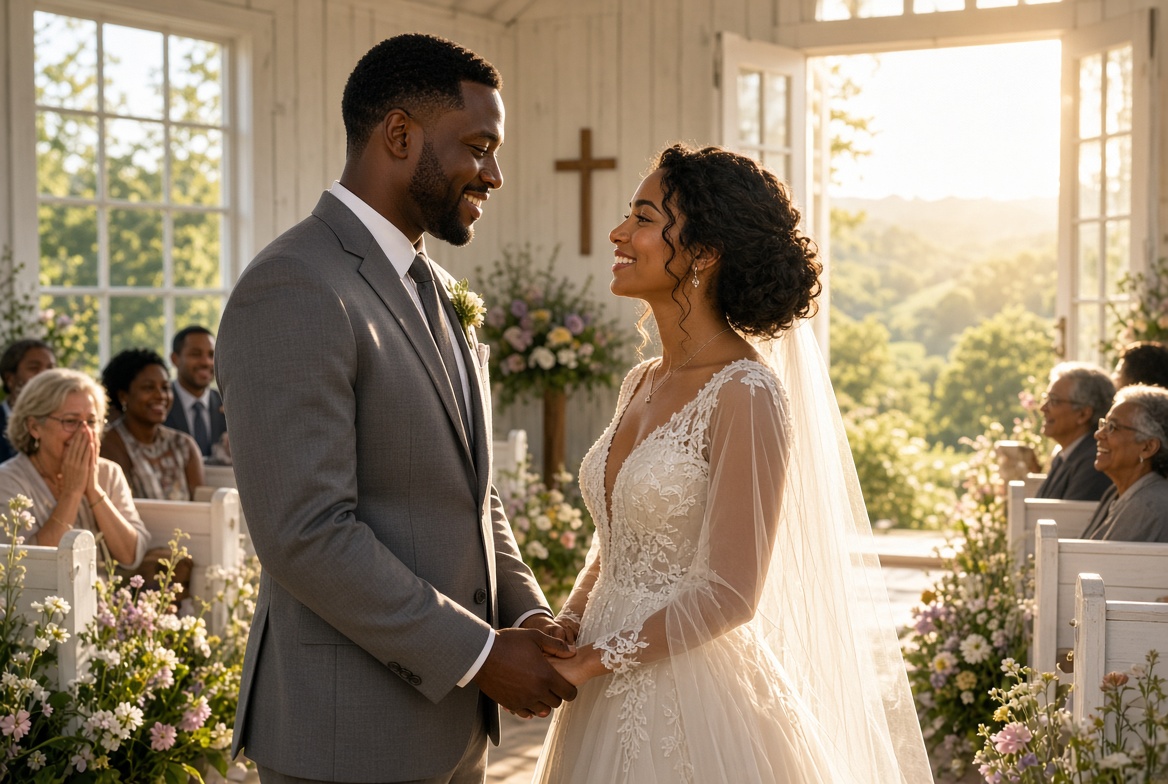
Instead, she chose a small white chapel on a hill outside New Haven, a nineteenth-century building with creaking pews, wildflowers by the door, and room for no more than sixty guests.
It was the kind of place where people would come for love, not to be seen.
Odessa looked at the photographs of the chapel for a long time.
Then, to everyone’s surprise, she nodded.
“It’s lovely,” she said softly.
“Your grandmother would have liked it.”
The wedding was set for the first Saturday of May.
For a few weeks, a fragile peace settled over the Whitmore family.
But on the Thursday night before the wedding, at 11:45, Alistair’s phone lit up on his nightstand.
It was the chief financial officer of Whitmore Capital, and his voice was shaking.
“Sir,” he said, “we’re under attack.”
By the time Alistair reached Park Avenue, a little after one in the morning, the executive floor was blazing with light.
The firm’s share price had collapsed 31% in after-hours trading on a flood of rumors that Whitmore was hiding massive losses.
Someone had been quietly accumulating huge positions through derivatives and offshore funds.
Two of the firm’s three major lenders had already sent notices that they were reviewing Whitmore’s credit lines, and the third would certainly follow by morning.
If the lenders pulled their credit before Monday, the firm would default, and a familiar predator would be waiting to buy the remains at pennies on the dollar.
Harlan Price.
He had waited twelve years for this.
He knew exactly who could help him.
He took out his phone and stared at the name in his contacts for nearly ten minutes.
Pride rose up in his throat like bile.
Two days before Malcolm’s wedding, after everything he had said, after everything his family had done, how could he possibly ask?
He set the phone down.
He picked it up again.
At 2:15 in the morning, Alistair Whitmore swallowed the last of his pride and pressed call.
Malcolm answered on the second ring.
Alistair said only two words.
“It’s Price.”
There was a brief silence on the line.
“I’m on my way,” Malcolm said.
He arrived at three.
No entourage, no lawyers, no reporters.
Just Malcolm Veyron in a navy sweater and jeans, carrying a worn laptop bag and a single manila folder.
The board members on the conference screen fell silent as he sat down at the end of the long table.
One director leaned toward the camera.
“Alistair, who is this man?”
Alistair did not hesitate.
“The only person in this building who has ever beaten Harlan Price,” he said.
Malcolm worked without speaking.
His fingers moved steadily across the keyboard.
Trading records, ownership filings, swap agreements, wire transfers.
By 4:30, he had found it.
He turned the laptop around so Alistair could see.
“Price isn’t buying your stock,” Malcolm said.
“He’s faking a collapse. Seven funds, all linked to Price Meridian through nominees in Bermuda, trading the same shares back and forth to each other. Wash trades. They’re driving your price down artificially to trigger the covenants in your credit agreements.”
Alistair stared at the screen.
“Can you prove it?”
Malcolm slid the manila folder across the table.
“I already have.”
By six in the morning, the evidence had been delivered to the enforcement division of the Securities and Exchange Commission and to the chief risk officers of all three lenders.
Then Malcolm made three phone calls, each less than four minutes long, to men in London, Singapore, and Toronto, whose names Alistair recognized from the financial pages.
By seven, a standby liquidity facility large enough to cover every one of Whitmore’s obligations had been arranged.
There were no strings attached.
Malcolm did not take a single share.
He did not ask for a seat on the board.
By noon on Friday, all three lenders had withdrawn their notices.
Trading in the seven Bermuda funds had been frozen pending investigation, and Harlan Price, according to Julian, had canceled every meeting on his calendar and stopped answering his phone.
Late that afternoon, the office finally emptied out.
Malcolm closed his laptop and began to pack his bag.
Alistair stood at the window, watching the ordinary Friday traffic below.
Then he turned around.
“Why?” he asked quietly.
“After everything I said to you, everything I did, why would you help me?”
Malcolm zipped the bag and set it on the chair.
He looked at the old man for a long moment.
“Because you’re the father of the woman I love,” he said simply.
Alistair lowered his head.
His shoulders, which had stayed rigid through forty years of boardroom wars, finally sagged.
When he spoke, his voice was rough with something he had not felt in decades.
“Thank you, son.”
Malcolm went completely still.
One second.
Two.
Three.
“I never thought I’d hear you call me that,” he said softly.
Alistair crossed the room and placed a hand on Malcolm’s shoulder, a gesture so foreign to him that it felt almost clumsy.
“Tomorrow,” he said, “there will be people in that chapel who still don’t know the whole story. Friends, partners, family. Some of them have heard the rumors my daughter spread. Some of them laughed.”
His jaw tightened.
“Tomorrow, in front of all of them, I’m going to tell them exactly who the man they laughed at really is.”
The morning of the wedding broke clear and gold over the hills outside New Haven.
The little white chapel stood among the wildflowers like something from an old photograph.
There were no camera crews, no valet stands.
Just sixty wooden chairs set out in the grass for the overflow, a string trio of local college students, and a breeze carrying the smell of fresh-cut lilacs.
Earl Dawson arrived in his only suit, which was older than some of the guests.
A few men in plain dark suits, who had flown in from London and Toronto without telling anyone, took their seats near the front and said nothing at all.
Before the vows, Alistair Whitmore rose from the front pew and walked slowly to the altar.
The murmuring stopped.
His hands were unsteady.
“Most of you know me,” he began.
“Some of you know what I said about the man my daughter is marrying today. I said it at my own table. I said it in front of my family. I want to say something different now, and I want to say it where everyone can hear.”
He told them all of it.
The hotel in Boston twenty-one years ago and the frightened eighteen-year-old in the red valet jacket.
The winter twelve years ago when Whitmore Capital nearly died and the anonymous stranger who saved it.
The control he could have taken and chose not to.
The night that had just passed, when the same man had once again saved the firm and asked for nothing.
“He did not save us for money,” Alistair said.
“He had more than enough of that. He saved us out of gratitude. For a few seconds of decency I showed a stranger once and then forgot.”
He turned to look directly at Malcolm, who stood at the front of the chapel with his hands folded.
“I once looked at this man and saw only what I thought he was missing,” Alistair said.
His voice cracked.
He waited a moment, then went on.
“Today, I understand that the one who was missing the most was me.”
In the second row, Odessa pressed a handkerchief to her eyes.
A low murmur moved through the pews and then fell silent.
Cresa rose next, her face pale, her voice small.
She did not make a speech.
She simply walked to where Malcolm stood and said, loud enough for everyone to hear, “I mocked you. I was cruel, and I’m ashamed of it. I’m sorry, Malcolm.”
Then she did something no one expected.
She held out her hand.
Malcolm took it without hesitation, and for the first time since anyone could remember, Cresa Whitmore smiled without a trace of mockery.
Behind her, Odessa crossed the aisle and wrapped her arms around Saraphina, holding her daughter the way she had not held her since she was a little girl.
“You were right,” Odessa whispered.
“You saw him. We didn’t.”
Then the trio began to play, and Saraphina walked toward the altar alone in a simple ivory dress she had chosen herself.
She stopped in front of Malcolm and took both his hands.
The chapel fell so quiet that the birds outside could be heard.
“Malcolm,” she said, “I didn’t fall in love with the man behind billions of dollars. I didn’t even know he existed.”
She tightened her grip on his hands.
“I fell in love with the man who made me believe that a man never has to prove his worth to anyone. The man who stacked chairs after everyone else went home. That’s the man I’m marrying today.”
Malcolm smiled.
It was not the guarded half-smile he had worn through all those cold dinners.
It was open, unguarded, the smile of a man who no longer had anything to hide.
“I spent a long time building walls,” he said quietly.
“You walked through every one of them without even knowing they were there.”
“I don’t have a speech, Saraphina. I only have this. Whatever I own, whatever I am, it’s yours. But the only thing I ever really wanted to give you was me.”
The minister spoke the old words.
They answered.
And when he pronounced them husband and wife, the little chapel rose to its feet with a sound that was half applause and half quiet weeping.
After the ceremony, as the guests drifted out into the sunlight, Alistair stopped Malcolm at the chapel door.
He reached into the breast pocket of his coat and drew out a small, worn velvet box.
“I thought about giving you shares,” he said.
“Money. A title. But you’d only refuse them.”
He opened the box.
Inside lay an old gold watch.
Malcolm stared at it.
He knew it instantly.
It was the same watch that had once been missing in a hotel lobby in Boston.
The watch that had been sitting in a coat pocket all along.
“It belonged to my father,” Alistair said.
“He gave it to me the day I took over the firm. I was going to give it to whoever ran Whitmore Capital after me.”
He placed the box in Malcolm’s hands and closed the younger man’s fingers around it.
“My family once believed you weren’t worthy to walk through our door.”
He paused, and the silence stretched between them.
“Today, I want you to know something. You didn’t enter this family because of your fortune.”
His voice softened to almost nothing.
“You entered it because you had already become family.”
Malcolm looked down at the watch for a long time.
When he finally looked up, his eyes were bright.
He did not say anything.
He did not need to.
He simply nodded, slipped the watch onto his wrist, and embraced the old man who had once called him nothing.
That evening, as the sun sank low over the Connecticut hills, Malcolm and Saraphina walked hand in hand down the gravel path from the chapel to his old pickup truck, still with its dent in the passenger door.
Someone had tied a string of tin cans to the bumper.
Earl Dawson, without a doubt.
Saraphina laughed as she climbed in.
Malcolm started the engine, and it coughed twice before it caught.
The guests waved from the hilltop as the truck rattled away into the golden light.
It was no longer the story of a man scorned by the family of the woman he loved.
It was the story of a man who never needed power to prove what he was worth.
Never judge a person by the clothes they wear, the money in their pocket, the color of their skin, or the work they do with their hands.
You never know what they have survived, what they have built, or what they have quietly given away.
And sometimes the quietest person in the room is the one who has the power to change the entire story.









