She Ripped Out My Wind Gauge — Then the Airport Inspector Showed Up Asking One Simple Question
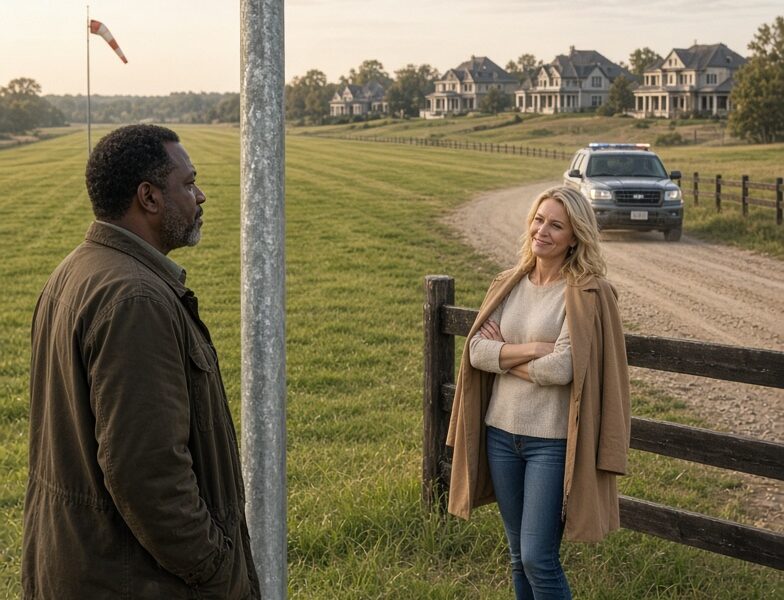
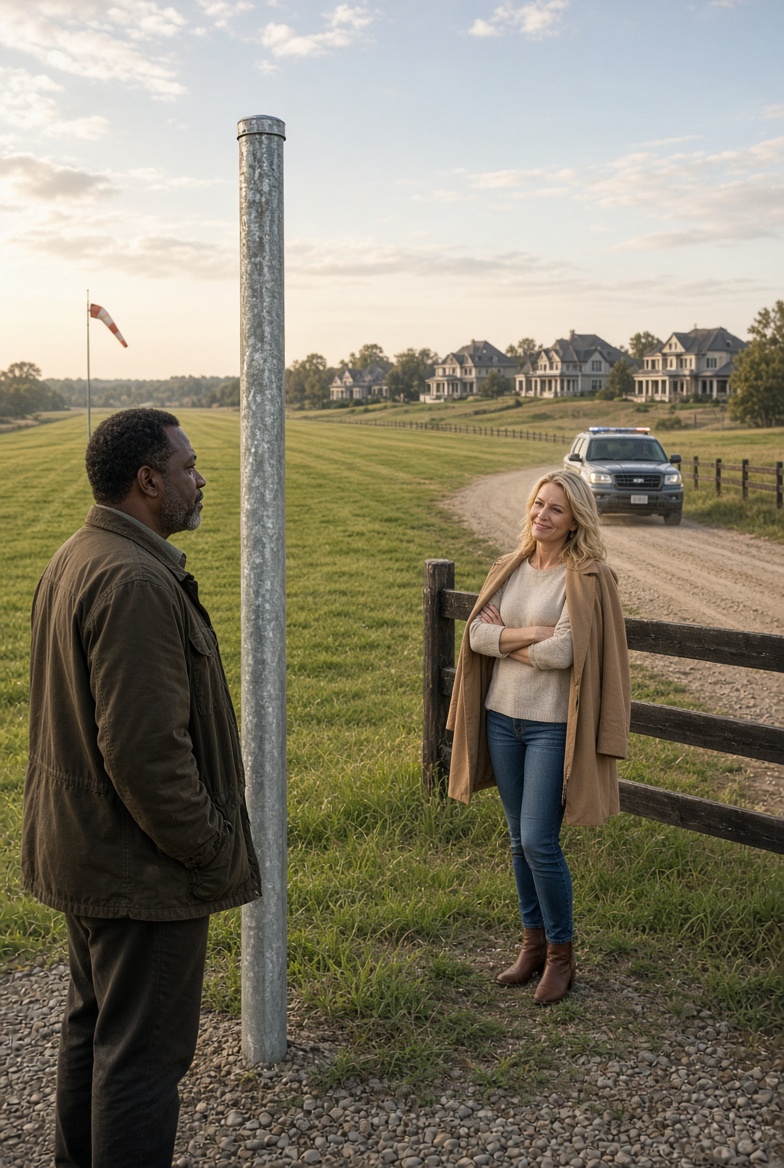
Vanessa Hallbrook stood at my fence line, staring at the empty post where my wind gauge used to sit, smiling like she had just won a war.
She told me the neighborhood finally wouldn’t have to look at my pile of scrap metal anymore.
I didn’t argue with her.
I didn’t call the police.
I didn’t even ask her to bring it back.
I just watched the state inspector’s truck rolling slow up the gravel road behind her, tires crunching in the quiet.
The man stepped out, opened a folder, looked at the bare mounting bracket, and asked her exactly one question.
The smile on Vanessa’s face disappeared before he finished saying it.
My name is Calvin Rhodes.
I’m 48 years old and I own 42 acres of land that my father bought in the 1970s with money he saved working nights at a machine shop.
It sits at the eastern edge of the county where the ground rises just enough to catch a clean crosswind.
And for most of my life, that has been the most valuable thing about it.
My father cut a grass strip into the long flat section on the north end when I was still small enough to ride on his shoulders while he paced out the length.
He wasn’t a rich man, and it wasn’t a rich man’s runway.
Just packed soil and mowed turf and a wind sock on a pipe, but he flew a little taildragger off it every clear Saturday for 22 years.
When he passed, I resurfaced the strip, regraded the drainage, filed the paperwork the state asked for, and kept it registered and current, the way you keep a promise current.
I spent 19 years as a maintenance technician on civil aviation systems, so I know exactly what a piece of paper is worth when somebody decides they’d rather not believe you.
The wind gauge sat on the high ground near the departure end of the strip, mounted on a galvanized post about 18 feet up where nothing shadowed it, and the readings came in honest.
It fed a small logger that recorded speed and direction continuously, and that data tied directly into my operating records.
Anybody who flies knows that a strip without reliable wind information is a strip you’re guessing on.
And I have never been comfortable guessing when the ground is coming up to meet me.
The unit wasn’t pretty.
It was gray, functional, slightly weathered, and it turned in the wind like a small metal flower that had given up on being decorative around the time I was in high school.
To me, it looked like competence.
To Vanessa Hallbrook, it apparently looked like a violation.
Silver Crest Estates showed up in 2014, better than four decades after my father put the first blade to that grass.
They built it on the old Coleman pasture directly west of my line.
Sixty-some houses to start.
All of them with stone accents and three-car garages and lawns cut in those diagonal stripes that take a special mower to make.
I didn’t object to it.
I’m not the kind of man who thinks a place stops being good the moment somebody else likes it, too.
I went to two of the county hearings, listened, said nothing, and went home.
What I did not know at the time, and what I would not fully understand for another 11 years, was that the developer had signed something in order to build next to me at all.
I met Vanessa the first spring after she and her husband moved in.
She came down my driveway in a white SUV, parked crooked across my gravel like the space belonged to her, and got out with a clipboard she never once wrote on.
She was in her early 40s, blonde, expensively casual, and she had the specific kind of smile people use when they’ve already decided how a conversation is going to end.
She introduced herself as the president of the homeowners association and then she said she wanted to talk to me about the old farm behind Silver Crest.
I told her politely that Silver Crest was built beside my property and not the other way around.
She laughed like I’d made a joke I didn’t know I was making and that was the whole relationship in one exchange.
After that, she found reasons.
She asked me to repaint my fence a darker stain because the current one read as agricultural from the clubhouse patio.
She asked me to keep my grass shorter along the shared line, which is genuinely funny to anybody who understands that a turf runway is mowed to a specific height for a reason.
She suggested I park my pickup behind the barn instead of in my own driveway.
She once handed me a printed sheet about elevating landscape standards to protect property values in the surrounding area.
And she used the phrase surrounding area like it was a legal boundary instead of a direction.
She never raised her voice.
She never had to.
She simply spoke to me the way certain people speak to the man they assume was hired to be there.
Here is the part she never checked and it’s the part everything else hangs from.
I am not a member of the Silver Crest Homeowners Association.
My parcel predates the subdivision by decades.
It was never platted into their development.
It is not bound by their covenants.
And no document anywhere gives them a single inch of authority over my dirt.
I knew that.
My attorney knew that.
The county knew that.
Vanessa either didn’t know it or had decided that knowing things was a formality other people were responsible for.
She behaved as though the entire ridge fell under her jurisdiction, and for years, the only cost of that behavior was my patience.
The wind gauge became her project in the spring of last year.
The clubhouse patio at Silver Crest faces east, which means every resident sipping something cold at 4:00 in the afternoon is looking directly across the pasture at my post.
Somebody must have mentioned it, or she noticed it herself.
But by April, she had a whole vocabulary built around it.
She called it an eyesore.
She called it industrial.
She said it made the eastern view read as utility rather than estate, which is a sentence I have thought about many times since and still can’t fully translate.
She said new buyers were asking questions about aircraft, and she said the word aircraft the way you’d say the word termites.
I explained it to her once.
Standing at the fence with my hands in my pockets, and I kept it short because long explanations to people who aren’t listening are just a way of arguing with yourself.
I told her the instrument served the runway, that it recorded wind data I was required to have available, and that it wasn’t decorative and wasn’t going anywhere.
She tilted her head and gave me the smile again.
Then she said the sentence that told me everything about how she saw me.
She said, “Calvin, that is a field with a strip of grass on it, so please don’t call it an airport like you’re running Kennedy out there.”
She said it in front of two of her board members.
And one of them had the decency to look at his shoes.
I didn’t argue the point.
Arguing the point would have meant accepting the frame, and the frame was the problem.
I just told her plainly and without heat.
Don’t touch it.
Four words.
She heard them as bluster.
I watched her hear them as bluster.
Watched the small tightening at the corner of her mouth.
That meant she had filed me under difficult rather than serious.
And I remember thinking that people who mistake calm for weakness generally only make that mistake once.
She said she’d be in touch through the proper channels, which was the first time she’d ever mentioned channels to me, and she drove back up the hill.
The proper channel turned out to be a letter.
It arrived nine days later on Silver Crest letterhead with a border of little embossed pine trees, and it was titled a courtesy notice.
It informed me that an unapproved structure exceeding permitted height was visible within the community’s designated view corridor and it requested removal within 14 days to avoid escalation.
There was a line about maintaining the aesthetic integrity of the neighborhood and a line about compliance with the architectural standards committee.
There was no citation to any recorded covenant, no legal description of my parcel, and no signature from anybody but Vanessa herself.
It was, in the most literal sense, a letter from a stranger telling me what to do with my own property.
I answered it in one sentence, typed, printed, signed, and sent certified so there’d be a record of receipt.
I wrote, “Your covenants do not apply to my parcel.”
That was the entire body of the letter.
I didn’t explain the chain of title.
I didn’t attach the survey.
I didn’t lecture her about the difference between a subdivision plat and a meets and bounds description.
I gave her a true statement and an opportunity and what a person does with an opportunity like that tells you who they are.
Vanessa did not take it as information.
She took it as defiance.
The truck came on a Tuesday morning at 7:12.
I know the exact time because I checked my phone the second I heard the engine.
And I have been checking times and writing them down since I was 23 years old.
A supervisor told me once that a technician without a time stamp is a technician without a defense.
It was a diesel working hard coming up the service track that runs along the north edge of my property toward the departure end of the strip.
That track exists so I can get a mower and a fuel can to the far end of the runway.
It is on my land.
There is a gate at the county road end of it, and the gate was open, which meant somebody had opened it.
I put on my boots and walked out.
Two hundred yards up near the high ground, I saw a white flatbed with the logo of a landscaping outfit on the door, a bucket lift already extended, two workers in green shirts, a foreman I recognized as Travis Boone, and Vanessa Hallbrook standing about 15 feet back with her arms folded, directing.
The wind gauge was already off the post.
It was lying on the flatbed on its side with the vane bent and a length of conduit still hanging from the mounting collar.
The whole assembly had taken me a full weekend to install and calibrate.
It took them, I’d guess, under 10 minutes to take down.
I did not shout.
I did not run.
I want to be honest with you about why because I think people assume restraint comes from fear and in my experience it usually comes from arithmetic.
I was one man walking up on four people on a property boundary they’d already decided was theirs.
If I put a hand on anybody or even raised my voice enough that somebody could describe it as aggressive later, the entire story changes shape and I become the angry man who confronted a work crew.
I have spent my whole life understanding exactly how quickly that reframing happens and exactly who it happens to.
So I took out my phone and I started recording.
Vanessa saw me filming.
That’s important.
She saw the phone.
She saw the red dot and she did not stop or hesitate or ask the crew to hold up for a second.
She walked toward me and said the association was removing an unapproved structure located within the Silver Crest landscape maintenance zone.
She said it the way you’d read a line off a card.
I asked her one question and I made sure the phone caught it clean.
I asked whether she had a boundary survey.
She did have something.
She had an iPad and she turned it around and showed me a colored map with the neighborhood drawn in soft greens and tans, lot numbers in a serif font, a legend in the corner, and a dashed line running east of the last row of houses out past my fence.
It looked official to somebody who wanted it to look official.
It was a developer marketing site map, the kind that gets printed on a sales brochure and folded into a welcome packet.
And the dashed line was a conceptual landscape buffer, not a recorded boundary.
There was no surveyor’s seal on it.
There were no bearings, no distances, no monument references, no recording data, no date of fieldwork.
I have read enough real surveys to know what one looks like from six feet away and that was not one.
I asked her who gave her the right to come onto my land.
She said, and this is a direct quote from the recording, “I don’t need a lecture about property from you.”
Then she turned back to the crew and told them to load everything, including the logger housing and the mounting hardware and the section of conduit that had come loose.
Travis hesitated.
I watched him hesitate.
He looked at the post, then at the fence line about 90 feet west of us, then at Vanessa, and he said something I couldn’t hear that ended with the word survey.
She told him the association had it handled and to finish up.
He finished up.
The first thing I did after the coffee was open the file cabinet in the back room.
It’s a four-drawer steel unit my father bought at a government auction and it holds everything the airfield has ever generated.
The top drawer is title and survey.
The second is registration, correspondence with the state aviation office, and inspection history.
The third is operations, meaning approach diagrams, obstruction data, maintenance records, mowing and grading logs, and the annual wind summaries the gauge produced.
The fourth is what I think of as the neighbor drawer, and it holds every scrap of paper connected to anything anybody has built within a mile of my line since 1981.
In the neighbor drawer, in a folder my father labeled Coleman Pasture in pencil, I found the development file for Silver Crest.
My father’s habit, which became mine, was to request the public record on anything built adjacent to the airfield because obstructions near an approach path are not a hypothetical concern to a man who flies over them.
That folder held the preliminary plat, the county planning commission minutes from 2012 and 2013, the drainage study, the traffic study, and the conditions of approval.
I had skimmed it when it came in.
I had never had a reason to read every page.
That morning, I read every page.
The condition I was looking for was on page four of the approval, and it was written in the flat, unmemorable language that important things always hide in.
Because the proposed subdivision lay adjacent to an existing registered public use airfield, approval was conditioned on execution and recording of an airport compatibility agreement between the developer and the airfield owner of record with the obligations running with the land and binding on successors, including any homeowners association subsequently formed.
There it was in 11-point type signed and stamped and recorded in 2013.
I sat back in my chair and I said something out loud that I won’t repeat here.
The agreement itself was two folders back and my father hadn’t filed it because it postdated him.
I’d filed it myself in 2013 and I remembered signing it in a county conference room with a developer representative who seemed bored and a notary who seemed hot.
Six pages.
Navigation easement over the adjacent parcels for aircraft operations.
Height restrictions within a defined approach and transitional surface.
A requirement of written notice to the airfield owner of record before construction, planting, or installation of any structure or vegetation within the designated compatibility zone.
And in paragraph nine, a prohibition on interference with, alteration of, or removal of any navigational, meteorological, or operational equipment associated with the airfield.
I read paragraph nine three times.
Then I laid the whole thing out on the kitchen table alongside the recorded survey, the current registration certificate, my operations log for the past six years, and the photographs I’d taken an hour earlier.
And I understood that Vanessa had not committed a trespass with a landscaping crew.
She had directed the removal of operational equipment from a registered airfield on behalf of an entity that was a bound successor to a recorded agreement expressly forbidding it.
And she had done it on video in daylight while identifying herself and her office.
So I called the state aviation office.
Not the sheriff, not my attorney, not the association.
I got a woman in the airfield compliance section who sounded like she’d been at her desk since six.
I did not perform for her.
I did not tell her about the letters or the fence stain or the years of being spoken to like hired help.
I said equipment belonging to my registered airfield was removed by a third party this morning without authorization and I have documentation.
She asked me to repeat the registration number.
I repeated it.
Then she was quiet for what I’d guess was four or five seconds and I could hear a keyboard.
The reasonable thing for Vanessa to do at that point was nothing.
Take the win, put the gauge in a storage shed, and let the whole business go quiet.
Instead, three days later she escalated.
I found out because a neighbor of hers, a woman named Karen Doyle, who has bought eggs from me for six years and who has always been decent, drove down and handed me a printout of an association-wide email with a look on her face like she was delivering bad medical news.
The email announced that the board had successfully removed a hazardous, unpermitted structure from the community’s eastern perimeter.
It thanked the landscape committee for prompt action.
And then it went further than that.
It stated that the adjacent landowner had been operating an incompatible airstrip beside a residential community.
That the board was exploring options to address ongoing safety and nuisance concerns, and that residents with questions about aircraft activity should direct them to the association office rather than to the landowner directly.
My name wasn’t in it.
It didn’t need to be.
There’s exactly one adjacent landowner.
On Friday, Vanessa came to my gate with a board member I didn’t recognize, a younger man in a quarter-zip who carried a leather portfolio and never made eye contact with me once.
She had a two-page document and a pen, and she offered it across the gate like she was doing me a favor.
It proposed that I voluntarily cease flight operations, remove all aviation signage and markings, including the threshold markers and the segmented circle, and refrain from reinstalling meteorological equipment visible from the community.
In exchange, the association would agree not to pursue the matter further and would consider the compliance issue resolved.
I read it standing up in the cold, taking my time because there was no version of this where I signed anything.
And every extra minute she stood there was a minute she wasn’t doing something smarter.
When I got to the bottom, I laughed.
It wasn’t cruel and it wasn’t planned.
It just came out because the document was functionally a request that I surrender the use of my own land in exchange for a promise that she’d stop doing a thing she had no right to do in the first place.
Vanessa’s jaw set.
She asked me whether I actually understood what I was being asked to sign.
I told her I understood it fine.
I said I was just looking for the part that gave her ownership of my property because I must have skipped a page.
The board member in the quarter-zip looked up for the first time.
Vanessa took the document back and told me in the flat, pleasant voice she used for her worst sentences that a man with a field and an old airplane should think very carefully before setting himself against a community with $40 million of assessed value behind it.
She meant it as arithmetic.
She thought she was explaining leverage to somebody who’d never had any.
Elliot Vance arrived on a Monday driving a gray SUV with a small state seal on the door and a longer antenna than a civilian vehicle needs.
He was maybe 60, thin, with reading glasses pushed up on his forehead and a canvas folder case that had clearly outlived several administrations.
He shook my hand, said seven words of introduction, and then asked to walk the field before we talked about anything.
I have worked around inspectors my entire career and I recognized the type immediately.
He wasn’t unfriendly.
He simply had a sequence he followed and conversation came after observation, not before.
We walked the strip end to end.
He paced the threshold, checked my markers, looked at the segmented circle, and photographed the wind sock.
He spent 11 minutes at the base of the empty post.
He photographed the sheared bolts, measured the height of the remaining stub, and knelt to look at the concrete pier, running his thumb along a crack in the collar where the bucket had put lateral force on it.
He photographed the tire ruts.
He asked whether I had cameras, and I told him I had one on the barn covering the service track, and he asked for the footage from that morning, which I had already exported.
Back at the truck, he opened the folder case and started laying documents on the hood.
My registration, the airfield diagram with the approach surfaces drawn in.
A printout of the compatibility agreement, which he had pulled from the county records himself before driving out.
He asked me short questions and wrote short answers.
When was the instrument installed?
What model was the data used in operational decision-making?
Had I ever received any notice of construction from the association or its predecessor?
That last one made me pause because until that moment I hadn’t thought to ask it of myself.
Then he asked where the equipment went.
I said Silver Crest Homeowners Association.
He didn’t react.
He wrote it down, capped his pen, and looked west across the pasture toward the back row of houses.
And I remember thinking that he had the settled expression of a man who has watched a lot of people confidently walk into something.
And right then, because the universe occasionally arranges these things itself, a white SUV came down the service track from the county road with its lights on, moving faster than the ruts really allow.
Vanessa got out about 40 feet away and came toward us with purpose.
I understood immediately what she was seeing.
A strange vehicle, a man in a work jacket, papers spread on a hood, and me standing near the post that no longer had anything on it.
She had concluded before her second step that I had hired a contractor to reinstall the gauge.
She didn’t say hello to Elliot.
She didn’t ask who he was.
She walked up to a state aviation inspector standing beside his own government vehicle and said, “If you’re here to put that thing back up, you’re going to need approval from the association first.”
Elliot looked at her for a moment over the top of his glasses.
Then he said in a completely neutral voice, “Association approval.”
He didn’t say it as a question exactly.
He repeated it the way you’d repeat a number somebody just read you off a form to make sure you’d heard it correctly before you wrote it down.
Vanessa took that as an invitation.
She began explaining that the area fell under the architectural and landscape standards of Silver Crest Estates, that the community maintained a designated view corridor, and that unapproved installations along the eastern perimeter were subject to committee review.
She gave it to him with something close to pride.
Vanessa Hallbrook, president of the Silver Crest Homeowners Association.
She said the title the way people do when they expect it to change the temperature of a room.
Elliot wrote it down.
Then he asked, still perfectly neutral, whether she was the person who had directed the removal of the equipment from this location.
And she said yes.
She said yes immediately without hesitation, without a lawyer, without asking a single question about who she was speaking to because she was still under the impression that she was the one applying pressure.
There is a specific kind of quiet that happens in an open field when the wind drops.
That’s what it was like.
Elliot capped his pen a second time, which I’d learned was his tell, and reached into the folder case for something he hadn’t put on the hood yet.
It was a large-format airfield chart, the kind with the approach surfaces and transitional slopes drawn in overlapping shaded polygons, and the property boundary in a heavy black line.
He unfolded it fully and laid it flat on the hood of his SUV, smoothing it with the side of his hand.
Taking his time, he put one finger on a small red mark near the northeast corner of the diagram.
He said, “That’s the primary wind reference for this facility, and it’s a documented component of the operating record.”
Then he looked up at Vanessa and he asked the question that I have replayed in my head more times than I’d like to admit.
“Who authorized you to remove equipment from an active registered airfield?”
Vanessa didn’t answer.
She looked at the chart and then at me and then back at the chart.
Her mouth moved before her voice did.
When it came, it came out as two words with a question mark stapled to the end.
“Registered airfield?”
Elliot didn’t help her.
He said that was the question.
And then he waited.
And the waiting was worse than anything he could have said.
I have watched men be told an aircraft was out of service on the morning of a delivery flight, and I have never seen a face go through what hers went through in those four seconds.
She turned on me.
That was the part I expected.
She said I had never told her the field was registered.
And she said it with real grievance, as though I had laid a trap by not volunteering information she had spent three years refusing to accept.
I said the only thing that was true.
I said, “You never asked.”
I said, “You told me it was a field with a strip of grass. You told me not to call it an airport and then you sent a crew to take my equipment off a post. Not once in three years did you ask me a single question about what this place is.”
She regrouped fast.
I’ll give her that.
She said the post was located within the association’s maintenance area, that the community’s plan clearly showed the buffer extending east, and that whatever the field status was, the equipment had been on land the association was responsible for.
Elliot asked to see the boundary survey.
She said she had it and pulled out her phone and scrolled and handed it to him with the confidence of a person who has never had a document examined in front of them.
It was the same marketing site map from the flatbed morning photographed off a printed page.
He looked at it for under five seconds.
Then he handed the phone back and said, “This isn’t a boundary survey.”
Vanessa said it was the community’s official plan.
He said it might well be, but it had no surveyor’s seal, no bearings, no distances, no monuments, and no recording information, and it therefore established nothing about where anybody’s line was.
He said it the way a man reads a checklist with no pleasure in it at all, which somehow made it land harder than if he’d been enjoying himself.
Then he said he’d need the recorded survey and the association’s development file, and he’d be requesting them through the county.
Renee Whitaker from the county land records office came out two days later with the recorded documents and she is the sort of public employee who makes you feel better about public employees.
Mid-50s, cardigan, tote bag full of plat books, and a memory for parcel numbers that borders on unsettling.
She brought the recorded survey of my parcel prepared in 1996 and remonumented in 2009 along with the Silver Crest plat, the compatibility agreement, and the association’s transfer packet from when the developer handed control to the homeowners in 2017.
We walked the line with a locator and found the original iron pins, which my father had set concrete collars around because he did not trust the future.
The result was not close.
The wind gauge post had stood 111 feet east of the property line, entirely on my parcel, on ground my family has held since before Silver Crest’s developer was old enough to drive.
The dashed line on Vanessa’s site map, the one she had shown me as proof, sat roughly 130 feet west of where the actual boundary ran.
She had not been mistaken about a foot or two.
She had been wrong by the width of a football field’s worth of somebody else’s property.
Elliot asked when the improvements along the eastern edge of the subdivision had been constructed.
I hadn’t paid enough attention, honestly.
Over the previous year, Silver Crest had put in an ornamental fence along the back of the last row of lots, taller than the old split rail with brick columns every 30 feet.
They had planted a run of mature trees, not saplings, but 15 and 18-foot nursery stock trucked in on a lowboy.
And at the secondary gate, they had installed a stone monument sign lit with the community name in raised metal letters and a landscaped berm built up beneath it to give it presence from the road.
All of it sat inside the compatibility zone described in the recorded agreement.
Not near it.
Inside it.
Elliot traced the polygon on the chart with his finger and then pointed west through the windshield glare at the fence line.
And even I could see the two things were the same thing.
The berm alone had raised the ground four feet in a spot where the agreement fixed a maximum height.
The trees at planting height were already close.
And trees do the one thing that structures don’t, which is keep going.
When he asked Vanessa about it, she lost the thread completely.
She said the improvements had been approved by the board.
He asked approved by whom and she said the board.
He said he understood that and asked which agency had reviewed them against the recorded agreement.
She said she wasn’t sure that was required.
He asked where the written notice to the airfield owner of record was, the notice required by paragraph six before any construction, planting, or installation within the zone.
She said she didn’t know anything about a notice requirement.
There wasn’t one.
I checked my own files that night.
All four drawers, and there was no notice from Silver Crest about the fence, the trees, or the monument because none had ever been sent.
Vanessa’s first instinct was to blame the previous board.
She said out loud that these agreements were signed by the developer years before she was involved, which is when I said the only thing I said during that entire conversation.
I said quietly, “You’ve been president for three years.”
She had signed the association’s acknowledgment of the transfer packet in her first month.
Graham Bellamy called on a Thursday evening.
He’d been the civil engineer on the original Silver Crest submission back in 2012 and he’d left that firm in 2019 and now consulted out of an office two counties over.
He’d heard about the wind gauge from somebody at the county and he said he’d thought about it for three days before calling me.
His voice had the particular carefulness of a man who has decided to say something and is not sure yet how much of it he’ll say.
He asked whether the compatibility agreement had come up.
I said it had.
He said good.
And then he told me about a meeting about seven months earlier.
Vanessa had contacted him.
Not the association, not a board, her directly, asking to consult informally about a proposed expansion.
Silver Crest owned an undeveloped tract on the northeast corner, 13 acres the developer had held back, and the association had been working up a plan for it.
Twenty-eight premium lots, a secondary clubhouse, four pickleball courts, and additional parking.
It was a serious project, the kind that raises assessed values across an entire community and makes the person who delivers it locally famous forever.
The trouble was location.
That tract sits directly under the northeast approach to my strip.
Graham told her in that meeting that any submission would have to address the compatibility agreement, that height and use restrictions would apply across a meaningful part of the parcel, and that the review would involve the state aviation office rather than just the county planning department.
He said the project was buildable, but that it would need redesign, a lower profile on the north end, and a longer timeline.
That was his professional advice given honestly and he told me she didn’t like it.
Then he told me what she asked him next and this is the part that reorganized the entire story in my head.
She asked whether there was a process by which the airfield could be classified as inactive.
She asked whether a facility that was, in her words, barely used could be treated as dormant for planning purposes.
Graham told her that was not how registration worked, that the determination wasn’t the association’s to make, and that an inactive designation generally follows a period without operations, without maintenance, and without an operating record.
She thanked him and did not hire him.
Barely used.
Graham said she used a phrase in that meeting that he remembered clearly.
He said she told him, “He barely flies. That field is basically abandoned.”
And when I heard that, I finally understood what had been standing on that post for 11 years.
It wasn’t scrap metal.
It was a continuous, timestamped, machine-generated record that the airfield was maintained and operational, running every hour of every day, feeding a log that would appear in any review of the facility’s status.
It was the single hardest piece of evidence against the word abandoned that anybody could possibly have.
I want to be careful here because this is the point where a story like mine can go wrong.
I do not know what was in Vanessa Hallbrook’s head.
I cannot prove she took the gauge down to build a record of dormancy.
And I have never said that to an agency, an attorney, or a neighbor.
It’s possible she genuinely just hated the way it looked and the timing is a coincidence.
What I did was assemble every email, every notice, every dated photograph, the recording from the service track, Graham’s written statement, and the expansion concept plans that the association had already circulated to residents, and I handed the whole thing to the people whose job it is to draw conclusions.
Vanessa called an emergency association meeting for the second Tuesday of the month in the clubhouse, 7 in the evening.
The stated agenda was community perimeter and adjacent land use concerns.
What she intended, and I know this from three separate people who were copied on her preparation notes, was to reframe the whole business as an outside landowner using state agencies to intimidate a residential community.
She had slides.
She had a printed handout.
She had a headline on the first page about protecting Silver Crest families.
I was invited because a boundary question was on the agenda and the affected owner has a right to be there.
I did not prepare remarks.
I did not bring an attorney.
I brought a document box, the plain white cardboard kind with a lift-off lid, and I set it on the floor beside my chair in the second row and left the lid on.
Vanessa looked at it twice in the first 10 minutes.
I think it bothered her more than anything I could have said.
She opened confidently.
She was good in a room, that was never in question.
She talked about stewardship and property values and the responsibility of a board to act decisively.
And throughout she referred to me by a rotating set of titles designed to make me smaller, the neighboring landowner, the hobby pilot, the gentleman with the private field.
Not once by name, though I’d been buying feed from the same store as half that room for two decades.
It was so consistent that people started to notice, and I could feel the noticing move through the folding chairs like a draft.
Then the door at the back opened and Graham Bellamy came in and sat down.
A minute later, Renee Whitaker came in with her tote bag.
And two minutes after that, Elliot Vance came in in the same work jacket and took a seat at the end of the back row without speaking to anyone.
Present as an observer on the aviation questions.
Vanessa’s slide advanced automatically to the next bullet point.
And she did not read it.
She asked, and she almost pulled off making it sound light, whether the board had invited additional guests.
Renee said she’d been asked by the county to bring the recorded documents and asked whether she could use the display.
Vanessa could hardly say no in front of 90 of her own residents.
And that is how the evening stopped being hers.
The recorded survey went up first, my parcel outlined, the iron pins marked, and the post location plotted at 111 feet inside my line.
Renee said one sentence about it.
The equipment was located on the Rhodes parcel.
Somewhere in the middle rows, a man said out loud, “Oh, come on.”
The original development agreement went up second.
Page four, condition seven, with the compatibility requirement highlighted.
Then the recorded agreement itself with the paragraph about successors and the paragraph about equipment and the paragraph about notice.
Then last, an aerial with the compatibility zone overlaid and three photographs beside it.
The ornamental fence, the row of mature trees, and the lit stone monument on its berm.
Renee didn’t editorialize once.
She just put things on a screen in order, which is the most devastating thing anybody can do to a bad argument.
Vanessa said the sentence that people say at that moment and she said it with real feeling, which is what made it hard to watch.
She said nobody ever told her these documents existed.
And Renee, without any edge in her voice at all, said the acknowledgment of receipt for the full development file is in the association’s transfer packet from 2017.
A board member asked from the front row who signed it.
Renee looked at the page.
She said, “Vanessa Hallbrook.”
There is no sound quite like 90 people deciding something at the same time.
Vanessa still tried.
She stood up straighter and said that whatever the paperwork showed, the real issue was a community’s ability to manage risk from an airstrip it never asked to be next to.
And that’s when Elliot Vance spoke for the first and only time that night from the back without standing up.
He said the facility predates the subdivision by four decades and is registered and current.
He said the owner is not required to seek association approval to maintain a system that existed before the association did.
He said the obligation runs the other direction.
Then he explained what the state’s position actually was and the room went very still.
Because of the removal, his office had opened a compatibility review of the entire Silver Crest development file.
That review had identified improvements constructed within the compatibility zone without the required notice and a berm and plantings that appeared to encroach on a protected surface.
Pending that review, the association’s submission for the 28-lot northeast expansion was suspended.
It would remain suspended until the boundary was certified, the removed equipment was restored or replaced, the approach surfaces were evaluated, and the existing improvements were inspected for conformance.
Vanessa said, and I could hear the disbelief cracking her voice, “Are you telling me 28 homes are being held up over a wind gauge?”
Elliot said, “No, ma’am.”
He said they’re being held because you treated a recorded agreement like it didn’t exist.
He didn’t raise his voice and he didn’t look pleased.
He put his pen in his jacket pocket and that was the end of the meeting functionally, though it took another 20 minutes for people to stop asking questions and file out into the parking lot.
The truck came back nine days later.
Same landscaping company, different energy entirely.
Travis Boone called me first at 8 in the morning and asked whether it would be all right to come down and asked where I wanted him to park.
He stopped at the gate and waited until I walked out to meet him.
He’d brought the assembly in a plastic bin with the bent vane wrapped in a moving blanket, and he’d brought the conduit and every one of the sheared bolts, which somebody had gone to the trouble of collecting.
The instrument itself was finished.
The vane was bent.
The bearing housing was cracked from the way it came down.
And the calibration was meaningless after that kind of impact.
The association paid for a new unit and the installation.
And they paid for the pier repair where the outriggers had cracked the collar.
And there was no argument about any of it because by then they had counsel and their counsel had read the same six pages I had.
Vanessa did not come with the truck.
I didn’t expect her to and I didn’t need her to.
The board met privately the following week.
I know the outcome because it was published to the residents and Karen Doyle brought me a copy the way she’d brought me the first one.
Only this time she was smiling.
The board suspended the president’s authority to approve or direct any work independent of a full board vote.
It required a certified boundary survey before any activity within 200 feet of my property line.
It retained independent counsel to review the association’s compliance with the compatibility agreement and to conduct a full audit of the improvements already built.
Three months after that at the annual election, Vanessa did not stand for another term.
I put the new gauge up on a Saturday in the same spot on a new pier poured beside the old one.
It’s a slightly better model with a heated sensor for winter and a cleaner data feed and it stands about three feet taller than the last one did.
I want to be honest that I thought about whether that would look like a provocation from the clubhouse patio.
Then I checked the specification, which calls for additional clearance above surrounding obstructions for accurate readings, and I stopped thinking about it.
The height is in the manual.
Everything I do out here is in a manual somewhere.
I thought about the mistake Vanessa made because it’s a common one and it isn’t really about airfields.
She looked at me and she took an inventory.
A Black man living outside the gates of an expensive neighborhood.
A 20-year-old pickup with a dented tailgate.
A plain house with a metal roof and a barn that needs paint.
A runway made of grass instead of concrete.
From that inventory, she calculated that I had less power than she did.
And she was so satisfied with the arithmetic that she never checked a single number in it.
She never asked what I owned.
She never asked what documents existed.
Or who had been standing on that ridge first.
Or what the law actually required of her.
She never asked why a man might keep a meteorological instrument on a pole for 11 years, or what the data might be used for, or whether an agreement her own community signed might have something to say about it.
In three years, the woman had never asked me one question.
She had only ever issued instructions, and eventually she issued one to a landscaping crew that she could not take back.
Vanessa thought power was walking onto somebody else’s land and saying loudly enough that you had a right to be there.
I learned a long time ago that real power is usually much quieter than that.
Sometimes it’s just a line on a recorded survey, a signature in an old file that nobody bothered to read, a maintenance log kept faithfully for reasons that seemed unnecessary at the time, an inspector who knows exactly which question to ask.
The engine caught on the second blade that morning and settled into that low, steady rumble I have known my whole life.
I taxied out past the new pier with the gauge turning above it, held short, checked the wind sock, and then checked the readout, and lined up on the grass my father cut by hand.
Silver Crest sat off to the west in the early light, roofs and chimneys, and a clubhouse patio with the chairs still stacked.
It’s a nice place.
I have nothing against it.
But since that spring, not one association vehicle has come through my gate without a phone call first.
And the wind gauge turns.
It turns the way it has always turned, the way it turned before Silver Crest existed, the way it will turn after whatever comes next has been built and torn down and built again.
Because the wind doesn’t care about property lines or covenants or the assessed value of anything.
The wind just blows.
And somebody has to measure it.
I am the person who measures it.
I always have been.
My father taught me that the only things worth keeping are the things you maintain whether or not anybody is watching.
The gauge turns.
The data logs.
The record stays current.
And somewhere in a county file, in a folder nobody reads until they have to, a single paragraph in 11-point type says that a man on the eastern edge of the county has a right to know which way the wind is blowing.
That right was recorded in 2013.
It runs with the land.
It binds successors.
And it will outlast every single person who ever looked at my post and saw only scrap metal.
The wind blows.
I measure it.
That’s the whole story.
That’s always been the whole story.









