She Returned a $7,400 Dress—and Found Her Billionaire Father
Good afternoon. How can I help you?
I want a refund for this dress.
I’m sorry, but this dress has already been worn.
It’s already been worn?
I can exchange it, but I can’t approve a refund.
Do you even know who you’re talking to? I will not tolerate this.
Where did you get that pendant?
Where did you get that pendant?
It belonged to my mother.
She gave it to me before she died.
Lila.
I need to ask you something about your mother.
It belonged to my mother. She gave it to me before she died.
My mother gave it to me before she died.
Nakia. What was your mother like?
She was a woman of great strength.
She always had a smile for everyone.
She raised me by herself.
She worked hard for everything we had.
This relationship cannot continue.
What was your mother like?
What was your mother like?
My mother gave this to me before she died.
She raised me by herself.
She worked hard for everything we had.
This relationship cannot continue.
The fate is writing.
You two need to stay apart.
Lila, please wait.
He must never see this.
She raised me alone. She did everything for me.
I need to know the truth. Arrange a private DNA test.
I need you to take one private test.
Why do you need me to take a test?
I have arranged a DNA test involving Nakia.
You think she could be your daughter?
We can’t keep avoiding this DNA test.
Malik.
Nakia could be my daughter.
If she is his daughter, everything could change.
Nakia, the test confirmed it. You are my daughter.
Your daughter?
Nakia is my daughter. And she is part of this family.
I’ve never had a room like this.
How quickly Nakia has become part of our household.
Are you sure you’re ready for all of this?
She is my daughter, Serena. She deserves her place here.
I’m worried about this family. Everything is changing since she arrived.
I want to earn it. I want to earn it myself.
I want to give you an opportunity at the company. Then prove what you can do.
I focused on combining traditional patterns with modern silhouettes.
These designs are really impressive. Your idea is strong.
Refine this part. I want you to lead this collection.
You earned this success.
You own Nunu. Tonight, we celebrate family.
This necklace has belonged to our family for generations.
Thank you, Dad. I will treasure it.
That necklace changes everything.
Where is the necklace?
I didn’t take the necklace. I left it in the room after dinner.
I left it in the room.
I left it in the room after dinner.
You see what this one has seized. Please believe me. I don’t know how it disappeared.
I want to know exactly what happened.
After dinner, I went straight to my room.
That was when I last saw the necklace.
Sir, you should look at this.
Why were you near that room?
Why were you near that room?
I was only passing through the hallway.
This doesn’t match what we were told.
Then someone isn’t telling us everything.
The necklace was moved. Amara, I don’t think you did this.
We’re going to find out the truth.
This evidence changes what we thought happened.
I never took that necklace. I had nothing to hide.
Your explanation doesn’t match what we found.
Nia, tell me what really happened.
I know now that you were telling the truth.
I’m sorry I doubted you.
Jealousy can never come before family.
I don’t want revenge. I just want peace.
Amara is my daughter. And she belongs here.
I should have protected you from all of this.
I spent my whole life wondering where my father was.
Welcome to the family, Amara.
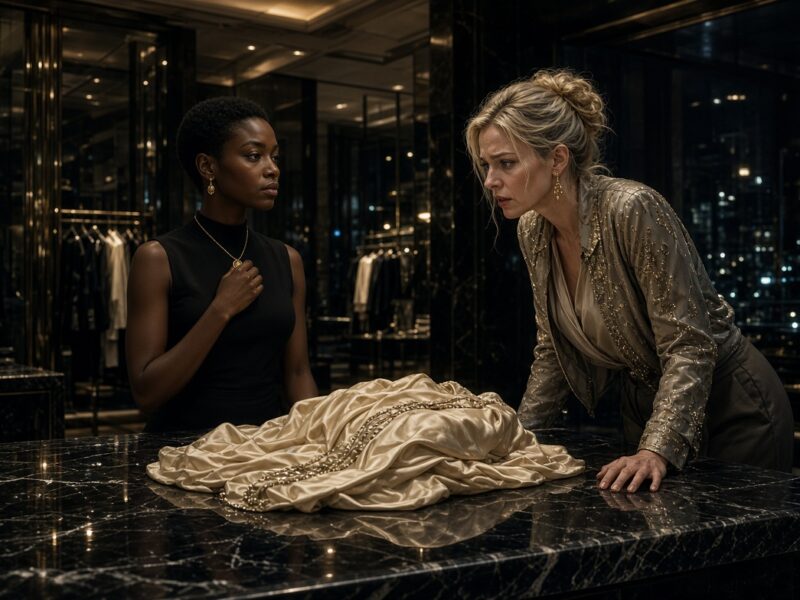
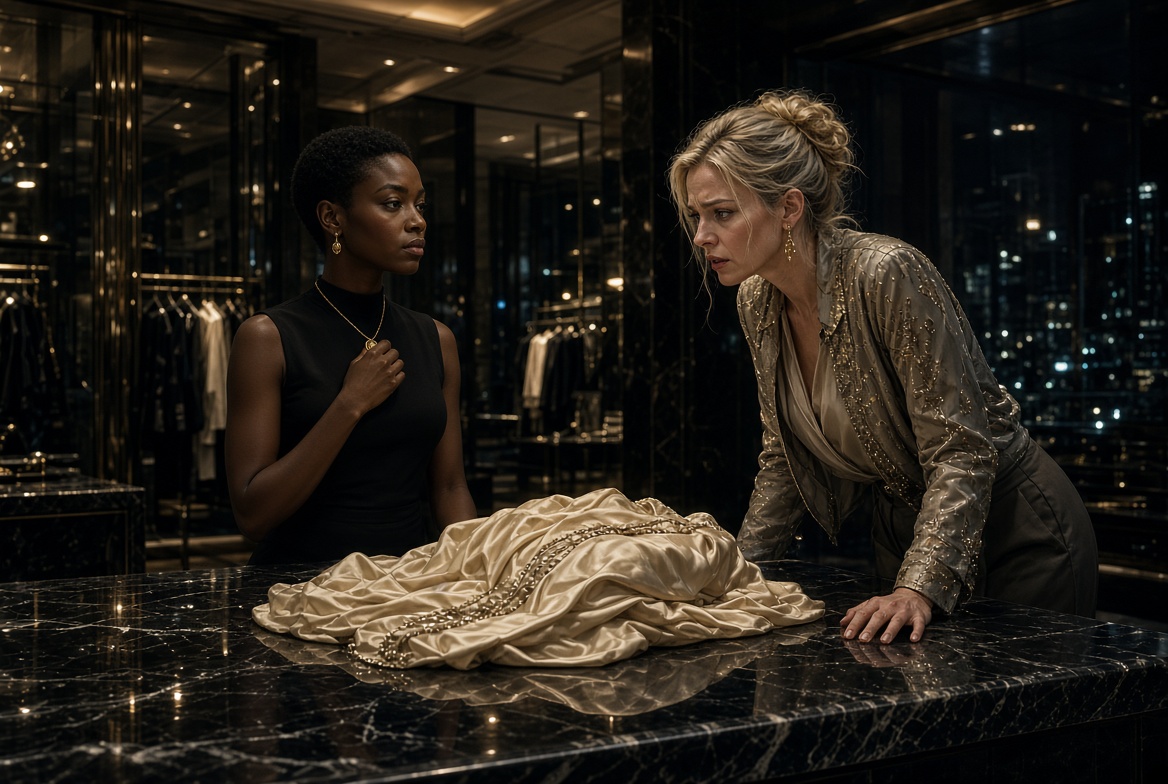
The dress was a cream-colored silk gown with hand-stitched beading along the bodice.
It cost seven thousand four hundred dollars.
It had been worn exactly once, to a charity gala three weeks earlier, and it had been returned to the boutique in a garment bag that still carried the faint scent of expensive perfume and the particular desperation of a woman who had made a mistake she could not afford.
The woman standing at the counter was named Serena Ashford.
She was twenty-nine years old, with highlighted blonde hair, a designer handbag, and the specific entitlement of someone who had never been told no by anyone whose opinion mattered to her.
The clerk behind the counter was named Amara Okafor.
She was twenty-six, with dark skin, close-cropped natural hair, and the particular stillness of someone who had spent her whole life being underestimated and had learned to save her energy for the moments that actually mattered.
She had been working at Maison Belle for eleven months.
She was the best sales associate in the store.
She had also, though no one in the building knew it, spent the last six years searching for a father she had never met.
That search had led her, three weeks earlier, to a name she had found in a box of her mother’s belongings.
The name was Malik Ashford.
He was the founder and CEO of Ashford Industries, a conglomerate with holdings in fashion, hospitality, and real estate.
He was worth approximately four billion dollars.
He was also, according to the documents she had found, the man her mother had met in Lagos in 1996, the man her mother had never told her about, the man who had no idea she existed.
Amara had not contacted him.
She had not known how.
She had simply taken the job at Maison Belle, a subsidiary of Ashford Industries, because it was the closest she could get to the world he lived in without having to explain why she wanted to be there.
She had told herself it was a coincidence.
It was not a coincidence.
It was the beginning of a story that would end with a DNA test, a stolen necklace, and a family that had been hiding its own secrets for twenty-six years.
But that was still to come.
Right now, there was a woman at the counter with a dress that had been worn and a receipt that had been folded and unfolded so many times the creases were soft.
“I want a refund for this dress,” Serena said.
Amara looked at the dress.
She looked at the receipt.
She looked at Serena.
“I’m sorry,” she said, “but this dress has already been worn.”
Serena blinked.
“It’s already been worn?”
“Yes. I can see the alterations at the hem and the faint mark on the bodice where the beading has been slightly compressed. I can exchange it, but I can’t approve a refund.”
Serena’s face changed.
It was not anger exactly.
It was something more practiced.
The particular expression of a woman who had learned, somewhere along the way, that the fastest way to get what she wanted was to make the person in front of her feel small.
“Do you even know who you’re talking to?” she said.
“I will not tolerate this.”
Amara held her gaze.
She did not flinch.
She did not apologize.
She simply stood there, her hands folded on the counter, her expression calm, her voice steady.
“I know who you are,” she said.
“You’re Serena Ashford. Your father owns this company. That doesn’t change the return policy.”
Serena’s mouth opened.
Then closed.
She had not expected that.
She had expected the clerk to fold.
She had expected the usual scramble, the apologies, the manager summoned, the refund processed with a smile.
She had not expected a woman with close-cropped hair and a calm voice to stand in front of her and tell her no.
It was then that Serena noticed the pendant.
It was a small gold piece, an oval shape with a single inset stone, hanging from a thin chain around Amara’s neck.
It was not expensive.
It was not designer.
But it was old, and it was specific, and Serena recognized it immediately because she had seen it before.
She had seen it in a photograph.
A photograph that had been hidden in her father’s study for as long as she could remember.
A photograph of a woman in Lagos.
A woman wearing that pendant.
“Where did you get that pendant?” Serena said.
Her voice had changed.
The entitlement was gone.
In its place was something smaller and more frightened.
Amara’s hand moved to the pendant without thinking.
“It belonged to my mother,” she said.
“She gave it to me before she died.”
Serena stared at her.
The room went very quiet.
The music playing overhead, the distant hum of the city outside, the soft click of the register, all of it seemed to fade into a background hum that neither of them noticed.
“What was your mother’s name?” Serena said.
“Her name was Lila.”
Serena’s face went pale.
She took a step back.
She looked at Amara the way you look at a ghost.
“I need to ask you something about your mother,” she said.
“Did she ever mention my father?”
Amara did not answer.
She did not need to.
The answer was written on her face.
Serena turned and walked out of the store without another word.
She left the dress on the counter.
She left the receipt on the floor.
She left Amara standing there with her hand on the pendant and the particular feeling of a door opening that had been closed for twenty-six years.
Serena called her father that night.
She did not tell him what she had seen.
She did not tell him about the pendant or the clerk or the photograph she had found in his study when she was fifteen and had never mentioned to anyone.
She simply asked him a question.
“Dad, did you ever know a woman named Lila?”
The silence on the other end of the line lasted long enough that Serena knew the answer before he spoke.
“Why are you asking me this?” Malik said.
“I met someone today.”
“Who?”
“A woman. Her name is Amara. She works at Maison Belle.”
Another silence.
Longer this time.
“Serena,” Malik said, “I need you to tell me exactly what happened.”
Serena told him.
She told him about the dress, about the argument, about the pendant.
She told him about the photograph she had found in his study when she was fifteen and had never asked him about because she had been afraid of what the answer might be.
Malik was quiet for a long time.
When he finally spoke, his voice was different.
Not angry.
Not defensive.
Something softer and more broken than either of those things.
“Arrange a private DNA test,” he said.
“I need to know the truth.”
The test was arranged within the week.
Amara was contacted by a lawyer representing Malik Ashford, who explained, in careful and professional language, that Mr. Ashford wished to establish whether there was a biological relationship between himself and Ms. Okafor.
Amara agreed.
She did not ask why.
She did not ask what it would mean.
She simply said yes, because she had spent her whole life wondering, and she was not going to refuse the answer when it finally arrived.
The results came back three weeks later.
Amara was sitting in her apartment when the email arrived.
She opened it.
She read it twice.
Then she sat very still for a long time.
The test confirmed it.
Malik Ashford was her father.
She was his daughter.
She had a family she had never known.
And a sister who had stood across from her at a counter and looked at her like she was a ghost.
Malik called her that evening.
He did not call her Amara.
He called her by her mother’s name first, softly, as if he were speaking to someone who was no longer there.
Then he said, “Amara.”
“I am your father.”
She did not know what to say.
She had spent her whole life imagining this moment.
She had imagined anger.
She had imagined accusation.
She had imagined a hundred different versions of the conversation she would have with the man who had left her mother alone to raise a child he had never known about.
But what she felt, sitting on the edge of her bed with the phone pressed to her ear and her mother’s pendant in her hand, was not anger.
It was grief.
Grief for her mother, who had carried this secret alone.
Grief for herself, for the years she had spent wondering.
Grief for the family she had never had.
“I’m sorry,” Malik said.
“I did not know. Your mother never told me. I would have—”
He stopped.
He did not finish the sentence.
There was no version of the sentence that could undo the past.
“There is nothing to be sorry for now,” Amara said.
“There is a lot to be sorry for,” Malik said.
“Let me make it right.”
He invited her to the house the following weekend.
It was a house in the hills above the city, a sprawling modern estate with floor-to-ceiling windows and a view of the valley that made the city below look like a model.
Amara had never been in a house like it.
She stood in the entryway with her duffel bag in one hand and the particular feeling of being in a place that was not hers and might never be.
Malik met her at the door.
He was older than she had imagined, sixties, with silver hair and the same dark eyes she had seen in the mirror her whole life.
He did not hug her immediately.
He simply looked at her for a long moment, his eyes filling, and said, “You look like her.”
“I know,” Amara said.
“She gave me this.”
She held up the pendant.
Malik took it in his hand, gently, the way you hold something that has been lost and found.
He did not say anything.
He simply stood there, holding the pendant, and for a moment, the whole house was quiet.
The family gathered that evening.
Serena was there, subdued, avoiding Amara’s eyes.
Serena’s mother, a woman named Yara, was there, watching Amara with the careful attention of someone who was calculating exactly what her arrival would mean.
A younger brother, Daniel, was there, seventeen and curious and the only one who seemed genuinely happy to meet her.
And there were others, aunts and uncles and cousins, all of them looking at Amara with the particular expression of people who had been told something they did not know how to feel about.
Malik raised a glass.
“Tonight,” he said, “we celebrate family.”
He looked at Amara.
“This is my daughter. She is part of this family. And she deserves her place here.”
Amara did not know what to say.
She stood there, holding a glass of water, surrounded by strangers who were suddenly supposed to be her family, and felt the particular overwhelm of a life that had changed in ways she had not asked for and did not fully understand.
The next few weeks were a blur.
Malik gave her a room in the house.
He gave her a car.
He gave her a position at Ashford Industries, in the design division, because she had told him she had studied fashion design in college and had never been able to afford to pursue it.
She worked hard.
She stayed late.
She learned the business from the ground up.
And she did not ask for anything she had not earned.
Yara watched all of it.
She did not say anything directly.
She did not need to.
She simply watched, and waited, and made small comments that were not quite cruel and not quite kind.
“How quickly Amara has become part of our household,” she said one evening at dinner.
Malik did not respond.
Serena did not respond.
Daniel looked uncomfortable.
Amara pretended not to hear.
She told herself it did not matter.
She told herself she was not there for Yara’s approval.
She was there for her father.
She was there for the truth.
She was there for the version of herself she had never been allowed to be.
Then came the necklace.
It was a family heirloom.
A piece that had been passed down through generations of Ashford women, a necklace of gold and emeralds and diamonds that was said to be worth more than a million dollars.
Malik presented it to Amara at a family dinner, in front of everyone, with the particular gravity of a man who was trying to make up for lost time.
“This necklace has belonged to our family for generations,” he said.
“I want you to have it.”
Amara looked at the necklace.
She looked at Yara, whose face had gone very still.
She looked at Serena, whose expression was unreadable.
She did not want the necklace.
She did not want anything that would make the room colder than it already was.
But she took it, because refusing it in front of everyone would have been its own kind of statement.
“Thank you, Dad,” she said.
“I will treasure it.”
That night, the necklace disappeared.
Amara had left it in the room after dinner, on the dresser, next to her mother’s pendant.
She had gone to bed early, exhausted by the effort of being in a family that did not quite want her.
In the morning, the necklace was gone.
The house erupted.
Yara was the first to speak.
She did not accuse Amara directly.
She simply said, loudly enough for everyone to hear, “This is what happens when you bring strangers into a family.”
Malik called a family meeting.
He did not accuse Amara either.
He simply asked, in the careful tone of a man who was trying to be fair, whether anyone had seen the necklace.
“I left it in the room after dinner,” Amara said.
“That was the last time I saw it.”
“You left it in the room?” Yara said.
“Yes.”
“Unattended?”
“Yes.”
“How convenient.”
Amara looked at Yara.
She did not raise her voice.
She did not defend herself with heat.
She simply said, “I did not take the necklace.”
The investigation lasted three days.
The staff were questioned.
The security cameras were reviewed.
The room was searched.
And on the third day, Malik’s head of security brought him a piece of evidence that changed everything.
A photograph.
A photograph from a security camera in the hallway outside the room where the necklace had been left.
The photograph showed Yara, at 11:47 p.m., entering the room and leaving eleven minutes later with something in her hand.
Malik looked at the photograph for a long time.
Then he called Yara into his study.
He did not shout.
He did not accuse.
He simply placed the photograph on the desk and said, “Tell me what happened.”
Yara looked at the photograph.
She looked at her husband.
She looked at the door.
Then she sat down and told him everything.
She had taken the necklace because she was afraid.
She was afraid that Amara’s arrival would change everything.
She was afraid that Malik would love Amara more than he loved Serena.
She was afraid that the family she had built for twenty-nine years would be dismantled by a woman who had appeared out of nowhere with a pendant and a DNA test.
She had not planned to keep the necklace.
She had planned to hide it, to make Amara look guilty, to make Malik see that bringing a stranger into the family was a mistake.
She had not planned for the security camera.
She had not planned for the truth.
Malik listened to all of it.
When she finished, he was quiet for a long time.
Then he said, “You will return the necklace. You will apologize to Amara in front of the family. And you will begin therapy, because this jealousy cannot come before family.”
Yara nodded.
She did not argue.
She did not have anything left to argue with.
The apology happened the following evening.
Yara stood in front of the family, her face pale, her hands trembling, and said the words she had never thought she would have to say.
“I took the necklace. I am sorry.”
Amara looked at her.
She did not feel triumph.
She did not feel satisfaction.
She felt tired.
“I don’t want revenge,” she said.
“I just want peace.”
Malik looked at her.
His eyes were wet.
“You are my daughter,” he said.
“And you belong here. I should have protected you from all of this. I should have protected you from the beginning.”
Amara nodded.
She did not say anything.
There was nothing to say.
The family was not fixed.
It would never be fixed.
But it was, at least, honest.
And that was something.
Serena came to Amara a few days later.
She stood in the doorway of Amara’s room with her hands clasped in front of her and the particular awkwardness of someone who was trying to apologize for something she had not done but had benefited from.
“I’m sorry,” she said.
“For what?”
“For the dress. For the way I treated you. For everything.”
Amara looked at her.
“I spent my whole life wondering where my father was,” she said.
“I didn’t know I had a sister.”
Serena’s eyes filled.
“I didn’t know either.”
“I know.”
They stood there for a moment, two women who had been raised in different worlds and connected by the same man.
Then Serena said, “Welcome to the family, Amara.”
And Amara, for the first time since she had walked into the house with a duffel bag and a pendant and a DNA test, smiled.
The story did not end there.
It never does.
Amara stayed at Ashford Industries.
She built a career in the design division, not because she was Malik’s daughter, but because she was good at what she did.
She launched a collection two years later that combined traditional West African patterns with modern silhouettes, and it was the most successful line the company had ever produced.
Malik attended every show.
Serena attended most of them.
Yara attended none of them, but she sent flowers.
The flowers were a start.
The pendant stayed around Amara’s neck.
She never took it off.
It was the only thing she had left of her mother, and it was the thing that had brought her to a family she had never known she had.
The necklace, the heirloom, the one that had caused so much pain, was returned to the family vault.
Amara did not want it.
She had never wanted it.
What she wanted was what she had always wanted.
A father.
A family.
A place to belong.
She found all three.
Not perfectly.
Not easily.
But she found them.
And that, in the end, was enough.









