She Pound on the Doors of Westminster Abbey While Her Husband Was Crowned Inside — The Disturbing Truth About 10 Royal Marriages That Destroyed Kingdoms
She pounded her fists on the doors of Westminster Abbey, screaming to be let in.
Her own husband, the king of England, had ordered the guards to turn her away from his coronation.
Three weeks later, she was dead.
That is not a movie plot.
That is Queen Caroline of Brunswick, and she is not even the most brutal story on this list.
One queen on this countdown spent thirty years locked in a single house by her husband.
Another king was almost certainly murdered on his wife’s orders, and she got away with it for thirty-four years on the throne.
Here is the thing nobody tells you about royal history.
The crown jewels were real.
The palaces were real.
But the love was mostly theater.
For centuries, royal marriages were not about romance.
They were cold business mergers sealed with a wedding ring.
And when two strangers get forced into a lifetime contract, things go wrong in ways you will not believe.
Stick around, because couple number four ends in a coup.
Couple number six ends in a sixteen-year imprisonment.
And the last one on this list might surprise you the most.
Let us start at the very bottom of royal marriage hell.
Here is a question.
How do you reject a queen without losing your head?
Literally.
Anne of Cleves found the answer, and it is the strangest royal survival story you will hear today.
By 1539, Henry VIII had already buried one wife, divorced another, and executed a third.
When advisers proposed Anne of Cleves, Henry commissioned a portrait from Hans Holbein before agreeing.
He liked what he saw on canvas.
Then he met her in person.
Accounts from the period describe Henry as visibly repulsed.
The famous line that he called her a Flanders mare may actually be later embellishment, historians note.
But his disgust was undeniably real and witnessed by his own court.
The marriage went ahead anyway.
For politics.
It lasted six months.
Henry told his physician he physically could not bring himself to consummate it, and the marriage was annulled on those exact grounds.
Now here is the twist nobody expects.
Anne did not fight it.
She accepted a generous settlement, earned the title the king’s beloved sister, and walked away.
In a court where saying the wrong thing got you beheaded, she played the only winning hand.
And she outlived every other wife Henry VIII ever had.
This next one starts with an eleven-year-old girl refusing to marry a man she had never met.
I will not marry the pig snout, she reportedly said, a nickname her cousin George had earned for his looks.
She lost that argument.
In 1682, Sophia Dorothea of Celle was married off to George Louis of Hanover anyway.
And it unraveled exactly how you would expect a forced marriage between two people who already hated each other would.
George’s own mother despised her.
George followed suit.
So Sophia Dorothea did what desperate people in impossible situations sometimes do.
She fell for someone else, a Swedish count named Philip Christoph von Königsmarck, who helped her plan an escape.
It did not work.
In 1694, Königsmarck vanished, almost certainly assassinated, though historians still argue over who gave the order.
And here is where it gets genuinely disturbing.
George did not just divorce his wife.
He had her imprisoned.
Not for a year.
Not for five.
Sophia Dorothea spent roughly thirty years locked inside Ahlden House, banned from seeing her own children, erased from official court portraits like she had never existed.
She died there in 1726, still a prisoner, still just a cousin he had never wanted.
What if I told you one of history’s most powerful empresses started out as a fifteen-year-old girl in a marriage so broken it reportedly was not even consummated for years?
That is Catherine the Great.
In 1745, she was married to Peter III, a man more obsessed with toy soldiers and Prussian military drills than with his own wife.
For seventeen years, Catherine watched, learned, and quietly built alliances while her husband made enemy after enemy.
Then, in January 1762, Peter finally became tsar and immediately started destroying his own support.
He pulled Russia out of a war its allies thought they were winning, sided with Prussia instead, and openly discussed replacing Catherine with his mistress.
That was his fatal mistake.
In July 1762, Catherine struck first.
With military backing and her lover, Grigory Orlov, at her side, she staged a near bloodless coup, forced her own husband to abdicate, and took the Russian throne for herself.
Eight days later, Peter was dead at a country estate, officially from colic.
Nobody at the time believed that for a second.
Catherine faced zero consequences.
She ruled for thirty-four years.
History remembers her as Catherine the Great and barely remembers him at all.
She was fourteen years old on her wedding day.
By the time she was done, she had dethroned a king.
Her own husband.
Isabella of France married Edward II of England in 1308 to seal a political alliance, and it fell apart almost immediately.
Not because of another woman, but because of Edward’s intensely close relationships with male court favorites.
First Piers Gaveston, then Hugh Despenser the Younger, men Edward showered with land, titles, and influence while sidelining his own queen.
Isabella was publicly humiliated.
At one point she was even stripped of her household and estates.
For years she endured it.
Then, in 1325, she was sent to France on a diplomatic mission.
She simply did not come home.
She took a lover, Roger Mortimer, raised an army, and in 1326 invaded her own husband’s kingdom.
His regime collapsed within weeks.
Edward was captured, forced to abdicate to his teenage son, and imprisoned.
He died in custody in 1327 under circumstances historians still genuinely dispute.
The gruesome legend involving a hot poker is now considered unreliable propaganda.
What is certain is this.
A fourteen-year-old bride grew into a woman chroniclers nicknamed the She-Wolf of France.
And she earned it.
Here is a marriage that started as one of the great power partnerships of medieval Europe and ended with the wife in prison for sixteen years.
Eleanor of Aquitaine was already one of the most powerful women on the continent before she married Henry II of England in 1152.
And for years it genuinely worked.
Eight children.
Real political influence.
Then came the 1170s, and everything curdled.
Henry’s affairs.
His tightening grip over their sons’ inheritances.
Eleanor’s own ambitions for her children’s futures.
So Eleanor did something almost unthinkable for a medieval queen.
She backed her own sons in open rebellion against her husband’s rule.
It failed.
Henry had his wife captured.
And what followed was not a slap on the wrist.
Eleanor spent the next sixteen years essentially confined under guard, shuffled between English castles while Henry continued ruling.
She was only freed the moment Henry died in 1189, when their son Richard the Lionheart took the throne and released his mother immediately.
Eleanor outlived Henry by fifteen years, stayed politically active into her seventies, and never remarried.
Sixteen years is a long time to wait for your husband to finally die.
But she waited.
This story was almost a completely different marriage entirely.
In 1853, Emperor Franz Joseph I of Austria was supposed to marry Elisabeth’s older sister, Helene.
That was the plan.
Then he met sixteen-year-old Elisabeth instead and insisted on marrying her, defying his own mother’s wishes.
Romantic start.
Here is where it goes wrong fast.
Elisabeth found Habsburg court life suffocating.
And her formidable mother-in-law seized control of raising Elisabeth’s own children, sparking years of bitter conflict Elisabeth could never fully win.
So she ran.
Not literally, but constantly, traveling across Europe for most of each year, sometimes spending only weeks in Vienna.
Historians researching Franz Joseph’s medical record have found evidence he transmitted a venereal infection to Elisabeth early in the marriage, a betrayal that deepened the damage permanently.
By most accounts, the marriage had cooled into a distant formal friendship by the 1860s.
Not a partnership.
Barely even a relationship.
Then in 1889, their only son died in a murder-suicide at Mayerling, a tragedy that devastated them both and pushed Elisabeth further away.
In 1898, she was assassinated in Geneva by a man who, by his own confession, did not even care which royal he killed.
Now we are back to where we started, and this time you get the full story.
George, Prince of Wales, was already secretly and illegally married to Maria FitzHerbert when debt forced him into an arranged marriage with his cousin Caroline of Brunswick in 1795, just to unlock a bigger parliamentary allowance.
The moment they met, George reportedly turned to an aide and asked for brandy because he felt sick.
Caroline thought he was overweight and nothing like his flattering portraits.
They separated almost immediately after their only child was born and lived apart for the rest of their lives.
George parading mistresses.
Caroline living abroad in Italy, rumored to be involved with her courier.
Then George became king in 1820, and instead of quietly tolerating the estrangement, he did something almost unthinkable.
He pushed a bill through Parliament to publicly try his own wife for adultery and strip her of the title of queen.
The bill failed.
So the following year, he settled for barring her from his own coronation at Westminster Abbey’s doors.
Caroline died nineteen days later.
Her last request was a coffin plate reading, Here lies Caroline, the injured Queen of England.
George refused to let it be attached.
This one starts with a father forcing his son to watch something no father should ever make a son watch.
Frederick II of Prussia, later Frederick the Great, had a close, intense bond with a young officer named Hans Hermann von Katte.
When the two attempted to flee together, Frederick’s own father forced him to witness Katte’s execution as punishment.
Shortly after, in 1733, that same father forced Frederick into marriage with Elisabeth Christine of Brunswick-Bevern, a union Frederick had explicitly opposed.
You can probably guess how that turned out.
The moment Frederick became king in 1740, he quietly but completely stepped away from the marriage.
Giving Elisabeth Christine her own separate residence and visiting, by most accounts, roughly once a year, strictly for formal occasions.
No children.
No real partnership.
But here is the part that breaks the pattern of everyone else on this list.
Frederick never humiliated her publicly.
He ensured she kept her title, her comfort, and public respect for over five decades, right up until his death in 1786.
It was not a loving marriage.
It was something almost stranger.
A lifelong silent truce neither of them ever broke.
Every couple so far happened centuries ago behind closed castle doors.
This one happened on live television in front of the entire world, which is exactly why we know precisely how bad it got.
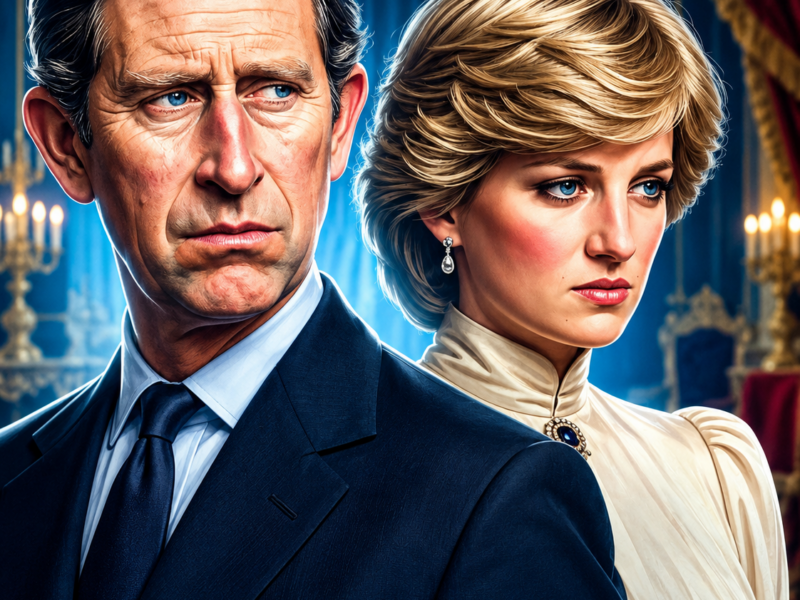
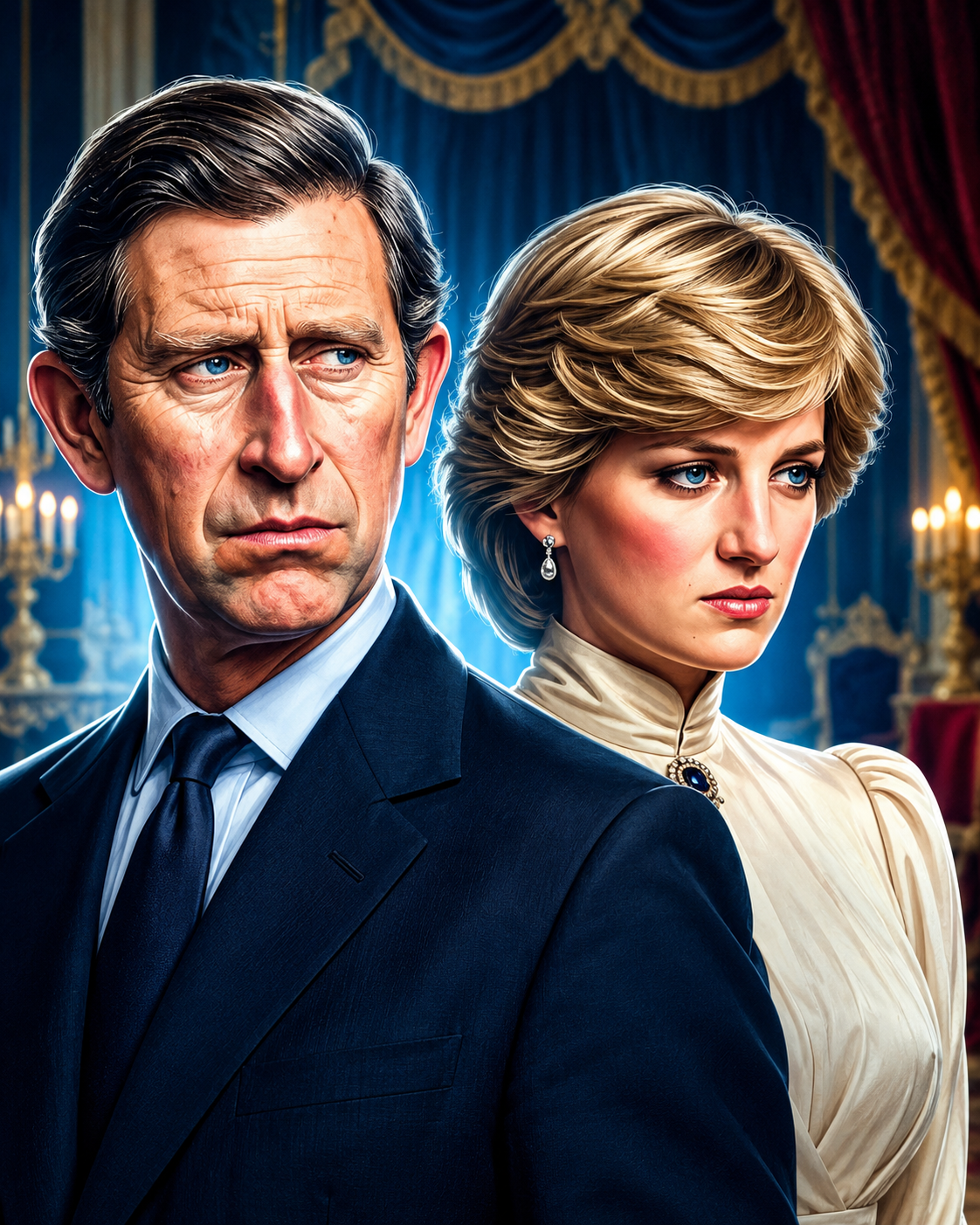
Charles and Diana married in 1981 in front of a global audience estimated in the hundreds of millions.
What almost none of them knew was that Charles maintained a long-standing relationship with Camilla Parker Bowles that predated the wedding and continued straight through it.
Diana, isolated inside rigid royal protocol and struggling publicly with bulimia and depression, grew more and more unhappy.
Until 1995, when she sat down for a BBC Panorama interview and said the line that detonated the entire monarchy’s public image.
There were three people in her marriage.
The couple separated in 1992 and divorced in 1996.
Decades later, in 2020, a BBC-commissioned inquiry led by Lord Dyson revealed that journalist Martin Bashir had used fabricated documents to manipulate Diana into that interview in the first place.
A scandal that rocked the BBC all over again, decades after the fact.
None of it changed what Diana had revealed.
She died in a Paris car crash in 1997.
Charles married Camilla in 2005 and became king in 2022.
For decades, this looked like the one royal marriage on this list with a happy ending.
Juan Carlos I and Queen Sofía married in 1962, and Juan Carlos became a genuine international hero in 1981 when he personally helped defend Spanish democracy during an attempted military coup.
The image was golden.
Behind palace walls, though, Spanish and international media had long reported ongoing extramarital affairs that strained the marriage for years.
Then came 2012, and the image shattered completely.
Juan Carlos was photographed on a lavish elephant hunting trip in Botswana, reportedly with a close female companion, while Spain was drowning in one of its worst financial crises in modern history.
The public backlash was immediate and brutal.
Two years later, in June 2014, Juan Carlos abdicated in favor of his son, now King Felipe VI.
Sofía never left the marriage, but royal watchers and Spanish media have long described it as two separate lives under one roof, not a genuine partnership.
In 2020, Juan Carlos left Spain entirely for the United Arab Emirates amid financial corruption investigations, a self-imposed exile that put even more distance between him and the country and the wife he left behind.
Before we get to the pattern connecting every single story on this list, three more deserve thirty seconds each.
Louis XV of France married Marie Leszczyńska in 1725, and it actually started warm until Louis filled his court with a long parade of mistresses, most famously Madame de Pompadour, while Marie quietly retreated into religious devotion and watched from a distance.
Philip II of Spain married Mary I of England in 1554 as pure political strategy.
Mary was reportedly genuinely devoted to him, but Philip spent most of the marriage abroad, and historians describe his feelings toward her as at best indifferent.
A one-sided marriage, if there ever was one.
And Umberto II of Italy, the country’s very last king, married Marie-José of Belgium in 1930 in a union biographers describe as emotionally distant for most of its duration.
The couple lived largely separate lives even before Italy abolished its monarchy entirely in 1946.
None of these three exploded into open warfare like our main ten.
But look closely, and you will notice they are all running on the exact same broken engine.
Which brings us to the real question behind every story you just heard.
Here is the pattern hiding underneath every single one of these marriages.
And once you see it, you cannot unsee it.
Almost none of these people chose each other.
For most of European history, royal marriages were not love stories.
They were treaties negotiated by diplomats, locked in years before the bride or groom ever met face to face, built to merge territories and produce heirs, never to create happiness.
Brides as young as eleven or fifteen were sent alone into foreign courts, foreign languages, and in-laws who often despised them on sight.
We saw that exact pattern with both Sophia Dorothea and Elisabeth of Austria.
Men raised from birth to expect total obedience rarely developed the emotional tools for an equal partnership.
And mistresses were not just tolerated at these courts.
They were practically built into the system.
And here is the part that made it so much worse.
Royal women had almost no way out.
Divorce required an act of Parliament or the church.
Annulment could ruin a woman’s reputation forever.
And defiance, as Eleanor of Aquitaine and Sophia Dorothea both learned the hardest way possible, could end in literal imprisonment.
When love happened at all in these marriages, it was an accident.
Never the point.
Here is what nobody tells you.
These were not just ten sad love stories tucked away behind palace walls.
Each one left a scar on actual history.
Sophia Dorothea’s imprisonment poisoned her son’s relationship with George I so badly that legend says he never forgave his father.
Catherine’s coup against Peter III did not just end a marriage.
It reshaped Russia for the next thirty-four years.
Isabella and Mortimer’s invasion did not just end a marriage either.
It ended a king’s entire reign and destabilized the English crown for a generation afterward.
Caroline of Brunswick’s public humiliation turned British public opinion against George IV at the most fragile moment of his reign.
And the collapse of Charles and Diana’s marriage, playing out live on global television, permanently changed how the public views the private conduct of the British royal family.
Arguably clearing the path toward the far more transparent, more scrutinized monarchy we see today under King Charles III.
Every single failed marriage on this list did more than break two hearts.
It bent the direction of a nation.
That is the part historians rarely put in the headline.
But it is the part that actually matters.
Ten couples.
Eight centuries.
Three continents’ worth of dynasties.
And almost every possible way a marriage can go wrong.
Imprisonment, assassination, public trials, invasions, and a television interview that brought down a royal reputation decades after it aired.
Here is what actually connects Eleanor of Aquitaine locked in a tower to Diana sitting across from a BBC camera in 1995.
When marriage is a political tool instead of a personal choice, the resentment always finds a way out eventually.
A coup.
A rebellion.
An interview.
A headline.
The good news is that modern monarchies have largely walked away from forced dynastic marriages, which is exactly why these stories feel like they belong to a different planet entirely.
So now you know the truth behind ten crowns that looked perfect in the portraits and were falling apart behind them.
Which one shocked you the most?
I am willing to bet it is the coup.
And if you want more real royal history dug up from actual historical record, not palace PR, subscribe and turn on notifications.
Because next week’s story is even darker than this one.









