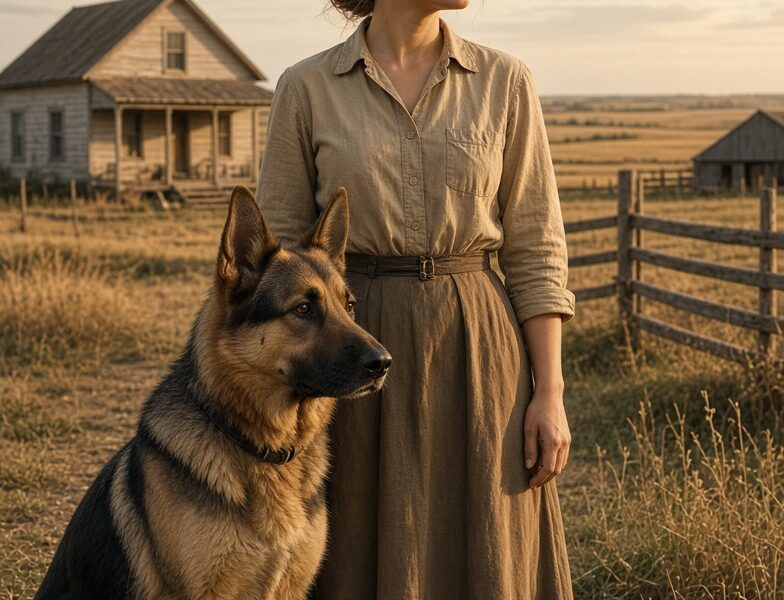
She Paid $45 for the Dog Everyone Called Dangerous… Then He Became the Champion That Saved Her Farm
The dog cost forty-five dollars at a farm auction outside Fremont, Nebraska, on a rainy Saturday in May of 1953.
That was less than half of what a properly bred German Shepherd should have brought, and still more than most people standing around the livestock shed were willing to risk.
He was three years old, ninety-two pounds, black and tan, registered, and according to nearly everybody at the sale, impossible to handle.
His registered name was Faulk von Ritterhoff.
The auction sheet described him as a German Shepherd male from imported working lines with a broad head, deep chest, strong rear movement, full dentition, and papers showing two titled dogs in his immediate pedigree.
Nobody at the auction cared very much about the papers.
They cared about the fact that Faulk had bitten one farmhand badly enough to require twelve stitches.
They cared that he had broken a leather lead two months earlier.
They cared that the previous owner had stopped letting strangers near the kennel.
And they cared about the story that Faulk had once chased a delivery driver halfway across the yard.
By the morning of the auction, the story had improved with repetition.
Some people said the dog had attacked three men.
Others said four.
One man claimed Faulk could not be safely fed without a pitchfork between the handler and the kennel gate.
That was not true.
But by ten-thirty that morning, truth was no longer setting the price.
Reputation was.
The auctioneer opened the bidding at a hundred dollars.
Nobody raised a hand.
He dropped to eighty, then sixty.
Still nothing.
Faulk stood inside a temporary wire pen at the edge of the shed.
His ears were upright.
His mouth was closed.
His eyes followed every person who moved close to the gate.
He did not bark.
That was the first thing Margaret Ellis noticed.
Aggressive dogs often had a great deal to say.
Faulk said nothing.
He simply watched.
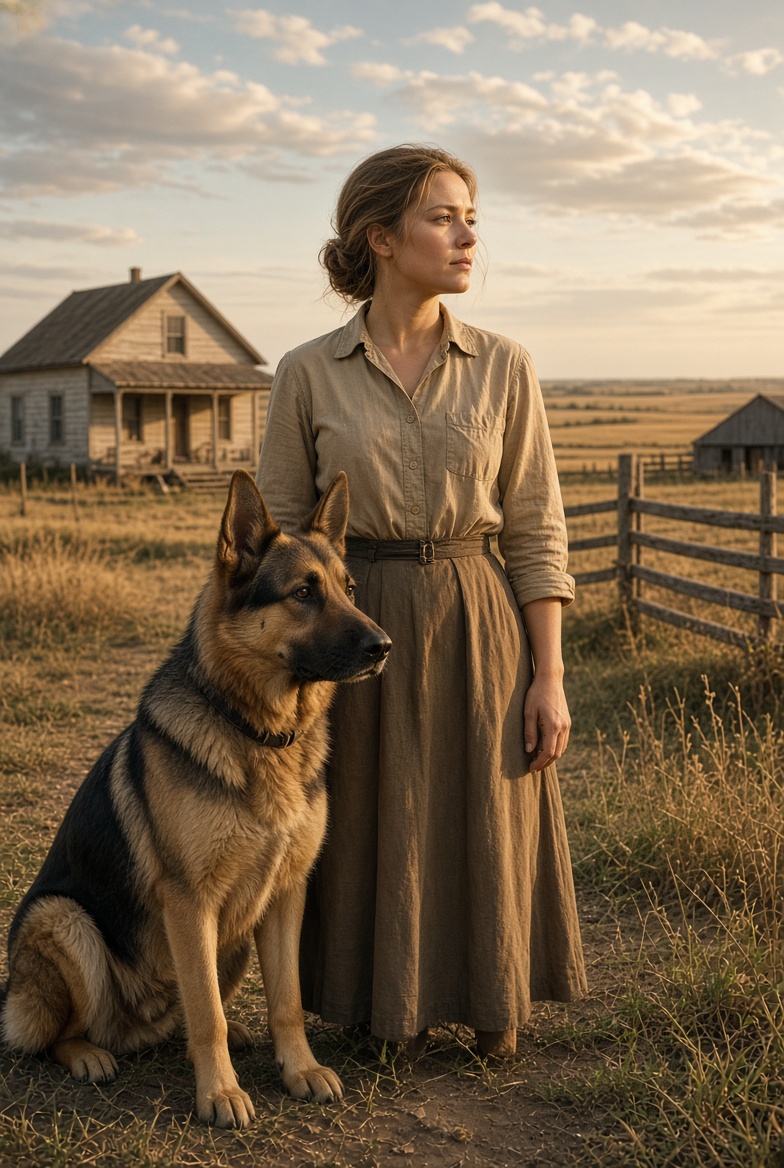
Margaret was twenty-nine years old and lived on eighteen acres six miles north of Wahoo with two hundred forty laying hens, two milk goats, a vegetable garden, and a mortgage balance of twenty-seven hundred sixty dollars.
Her father had died in November of 1951.
Her mother had moved to live with Margaret’s older sister in Kansas the following spring.
People assumed Margaret would sell the place.
She did not.
People assumed a woman by herself would not keep up with the mortgage.
So far, she had barely.
The bank payment was ninety-six dollars every three months.
Feed prices mattered.
Egg prices mattered.
A bad laying month mattered.
Everything mattered.
Margaret had gone to the auction that Saturday because she needed a replacement chicken brooder and had heard the Henderson Farm was selling equipment.
She had not gone there to buy a dog, but she had read Faulk’s name before.
Three weeks earlier, the auction notice had appeared in the county paper.
Margaret had written the registered name down, mailed a letter to the breeder listed on the paperwork, and received a reply eleven days later.
The breeder remembered the dog.
Faulk had been sold as an eighteen-month-old to a farmer who wanted a watchdog.
The breeder’s letter included one sentence Margaret read three times.
He was strong-minded, but never unstable.
That mattered.
Strong-minded was not the same thing as vicious.
Neither was frightened.
Neither was badly handled.
Margaret had worked with dogs since she was a teenager.
Not professionally.
There was no sign on the road advertising a kennel, no trophies, no certificates hanging on the wall.
But her father had always kept farm dogs, and Margaret had learned early that a dog could become almost anything people repeatedly taught it to become, including dangerous.
At fifty dollars, the auctioneer looked around the crowd.
Then Margaret raised her hand.
A few heads turned.
The auctioneer pointed at her.
Forty-five?
She nodded.
Nobody bid against her.
The hammer fell.
For forty-five dollars, Margaret Ellis bought the dog everybody else at the auction had already decided was worth less than the trouble attached to him.
Then came the more difficult question.
How was she going to get him home?
The former owner handed her a chain lead.
Margaret looked at it, then at Faulk, then back at the man.
“Does he always wear this when he’s out?”
“Why?”
“He’ll snap leather.”
Margaret crouched ten feet from the kennel gate.
Faulk looked at her.
She turned slightly sideways instead of facing him directly.
Then she waited.
After a minute, she tossed a small piece of cooked liver through the wire.
Faulk smelled it.
He ate it.
She tossed another one, then another.
The former owner crossed his arms.
“We could just put a catch pole on him.”
Margaret shook her head.
“No. He’ll come out fast. Then everybody needs to move back.”
People moved back.
That part did not require much persuasion.
Margaret opened the gate.
Faulk did not rush.
He stood.
She waited.
He took one step forward, then another.
She did not reach for his collar.
She dropped another piece of liver beside her boot.
He came close enough to take it.
Only then did she attach the lead.
Faulk stiffened.
Margaret felt it immediately.
The dog’s entire body changed.
His neck hardened.
His weight shifted backward.
His eyes went to her hands.
Somebody had taught him that pressure on a lead meant a fight was coming.
Margaret did not pull.
She loosened the lead.
Faulk looked up at her.
Then she walked toward the truck.
He hesitated.
She stopped.
He moved one step.
She moved again.
Eight minutes later, Faulk climbed into the wooden dog crate secured in the bed of Margaret’s 1948 Chevrolet pickup.
No snapping, no barking, no catch pole, no fight.
The people standing around the shed watched her close the crate.
One man laughed and said, “Wait till you try getting him back out.”
Margaret shut the tailgate.
“We’ll see.”
She put Faulk in a fenced run behind the barn.
For the first three days, she asked nothing from him.
Absolutely nothing.
She fed him at seven in the morning and five in the evening.
Fresh water twice a day.
She cleaned the run.
Then she left.
But she watched.
She watched what happened when a truck came down the road.
Faulk stood and looked.
He did not bark unless the truck turned into the driveway.
She watched what happened when one of the goats walked near the fence.
He followed it with his eyes but did not lunge.
She watched what happened when she touched the food bowl.
That was more interesting.
The first morning, Faulk froze.
Not growled, not snapped, froze.
His head lowered slightly.
His eyes became still.
Margaret stopped moving.
She left the bowl where it was.
The next day, she walked past the bowl while he ate.
The third day, she dropped a piece of meat into it from three feet away.
The fourth day, from two feet.
By the seventh day, she could stand beside him while he ate.
By the ninth, she could touch the side of the bowl.
No reaction.
Margaret wrote everything down in a school notebook.
May 23, 1953.
Food tension reduced.
No growling.
Recovers quickly.
The lead was harder.
The first time Margaret clipped a leather lead to Faulk’s collar, he immediately backed away.
She did not follow.
She did not jerk him forward.
She simply held the line steady.
Faulk pulled.
Margaret waited.
Five seconds, ten, fifteen.
Then the dog shifted one front paw toward her.
Margaret immediately let the lead go loose.
Faulk looked at her.
She waited another moment, then applied the slightest pressure again.
He resisted, then stepped forward.
Loose lead again.
By the end of that session, Faulk had walked fourteen steps with her.
The following morning, thirty-seven.
Three days later, they made a full circle around the barn.
On the sixth day, Faulk walked from the barn to the mailbox and back.
Margaret wrote that down, too.
June. Quarter mile. No lunging. Two corrections. Calm return.
The important thing was not that Faulk learned quickly.
The important thing was that he stopped expecting conflict.
That took longer.
Margaret began introducing visitors one at a time.
Her neighbor, Mr. Tate, was first.
He was sixty-one and had no interest in proving anything to a dog.
That made him useful.
Margaret told him to ignore Faulk.
No eye contact, no reaching over the head, no talking to him.
Mr. Tate sat on an overturned milk can near the barn and discussed corn prices with Margaret for fifteen minutes.
Faulk circled twice, smelled his trousers, then lay down six feet away.
The next visitor came two days later, then another.
By the third week of June, six different people had entered Margaret’s yard without Faulk doing anything more dramatic than watching them.
On June 24, Margaret took him into town.
She parked behind the feed store.
At first, Faulk remained inside the truck crate.
He watched bicycles, cars, children, men carrying feed sacks.
Then Margaret took him out.
He stood beside the truck with his ears high and his body tight.
She waited.
Five minutes later, his mouth opened.
His breathing slowed.
They walked half a block, then back.
The next visit, they walked around the block.
By July, Margaret could take him through the center of town on a loose lead.
The same dog people had been afraid to stand beside at an auction.
Margaret had not fixed him.
She disliked that word.
Faulk had not been broken.
What she had done was much simpler.
She had made his world predictable.
Good behavior produced one result.
Bad behavior produced another.
Pressure stopped the moment he made the correct choice.
Nothing arrived unexpectedly.
Nothing became a fight unless it absolutely had to.
And in six weeks, Faulk became a dog whose behavior made sense.
That was when Henry Lawson first saw him.
Henry was thirty-three years old and worked for a veterinary supply company out of Lincoln.
His territory covered seven counties.
He sold vaccines, worming medicine, livestock disinfectants, and enough other things that his truck always smelled faintly of cardboard, leather, and antiseptic.
He came to Margaret’s farm on July 16, 1953.
He was supposed to deliver poultry vitamins.
He arrived at nine-forty in the morning and found Margaret behind the barn with Faulk.
She was teaching the dog a long-distance down.
Faulk stood twenty yards away.
Margaret raised one hand.
“Down.”
The dog dropped.
Henry stopped beside his truck.
Margaret called.
Faulk ran toward her.
At six feet, she said, “Heel.”
The dog curved around her left side and sat.
Henry stayed where he was.
“That’s Faulk von Ritterhoff.”
Margaret looked at him.
“You know him?”
“I was at the Henderson auction.”
That made her smile.
“You didn’t bid either.”
“No. Nobody did. I remember.”
Henry looked at Faulk again.
“He looks different that day.”
“No. He looked exactly like this.”
Henry glanced at her.
“Fair enough.”
He walked closer.
Faulk watched.
Margaret gave the dog no command.
Henry stopped ten feet away.
“Can I let him come to you?”
Henry turned slightly.
Faulk approached, smelled his hand, then stepped back.
Henry nodded.
“That’s not the dog I heard about.”
“It is the same dog.”
“You know what I mean?”
“I do.”
Henry had grown up with German Shepherds.
His uncle had bred them before the war.
He knew enough to look at Faulk differently from most people.
He examined the dog’s back, the shoulder, the rear angulation, the head, the feet.
Then he asked for the pedigree.
Margaret brought the papers from the house.
Henry read them twice.
“You know what his sire is? Ritterhoff Arno. And the dam, Greta von Waldheim.”
Henry tapped the page.
“There are working titles on both sides.”
“I know.”
“You thinking about breeding him?”
Margaret had been thinking about exactly that.
Faulk had cost forty-five dollars.
His feed did not cost much more than any other large farm dog.
His registration was valid.
His temperament, once handled correctly, was proving sound, and his structure was better than she had expected.
“What would you charge?” Henry asked.
“Twenty-five.”
Henry thought for a moment.
“Too low.”
Margaret looked at him.
“That was quick.”
“I’ve seen males with weaker pedigrees charging thirty-five. They don’t have his reputation.”
“They also don’t have him standing there.”
Faulk sat beside Margaret’s leg.
Henry looked at the dog.
“Thirty.”
Margaret considered it.
“Thirty.”
That conversation changed the next year of her life.
Henry knew a dairy farmer near Ashland who owned a registered female.
He knew another family outside Lincoln with two.
He did not promise anything.
He simply gave them Margaret’s name.
The first woman called four days later.
She came to the farm on July 23 with a five-year-old female named Elsa.
She looked at Faulk.
She watched Margaret handle him.
She checked the pedigree.
Then she paid thirty dollars.
Margaret wrote the amount in the same notebook where she kept the mortgage figures.
July 23, 1953. Stud fee thirty dollars.
One week later, another female came.
Then another in August.
By September 1, Faulk had been bred to five females, one hundred fifty dollars.
That was more than one entire quarterly mortgage payment.
Margaret paid the September bank payment of ninety-six dollars.
She had fifty-four dollars left.
She bought three hundred pounds of chicken feed and put the remaining eighteen dollars in the farm account.
Henry returned the following Thursday.
This time, he had poultry disinfectant.
The Thursday after that, he had information about a German Shepherd owner near Columbus.
The week after that, he did not have much of anything.
Margaret noticed.
“You driving all the way out here to tell me you don’t have a delivery?”
“I was nearby.”
“How nearby?”
Henry looked toward the road.
“About twenty-eight miles.”
Margaret folded her arms.
“That’s not nearby.”
“It is in my business.”
She looked at him for a moment.
Henry smiled.
Margaret went back to filling the water bucket.
After that, Thursdays became regular.
Sometimes Henry had a reason.
Sometimes he had something resembling a reason.
By October, he had mostly stopped trying.
Faulk bred two more females before winter.
Seven total, two hundred ten dollars.
The number was not enormous, but it mattered.
Everything on Margaret’s farm worked that way.
Small amounts that mattered.
Six dollars saved here, twelve earned there, ninety-six to the bank every three months.
A dog purchased for forty-five dollars had paid his purchase price back more than four times in five months.
Then December brought something more important.
The first owner called Margaret.
Elsa was confirmed pregnant.
In January of 1954, she delivered seven puppies.
Six survived.
Strong heads, good bone, healthy.
Two were black and tan like Faulk.
Four were darker.
The owner sent Margaret a photograph.
She placed it inside the cover of Faulk’s notebook.
Three weeks later, another female produced eight puppies.
Word began moving.
People who had dismissed Faulk’s pedigree because of his reputation started asking about the puppies.
A breeder outside Omaha wrote to Margaret, then another in Iowa.
By March, Margaret had four breeding reservations for spring.
She raised the stud fee to thirty-five dollars.
Nobody complained.
That was also when Margaret mailed an entry form to the Nebraska Working Dog Association’s Autumn Obedience Trial in Omaha.
Open class. October. Entry fee seven dollars.
She did not tell Henry.
She did not tell Mr. Tate.
She did not tell anyone.
It was not superstition.
Margaret simply disliked discussing plans before they had become work.
And this one was going to require a lot of work.
In April of 1954, Margaret began training before breakfast.
Twenty minutes every morning.
Heel, sit, down, stay, recall, finish, stand for examination.
Then again in the evening.
Faulk learned quickly, too quickly sometimes.
German Shepherds were observant dogs.
If Margaret repeated a pattern four times, Faulk began anticipating the fifth.
That created problems.
On a recall, he sometimes sat before reaching her.
On a heel pattern, he would turn before she did.
So Margaret changed everything.
Different sequences, different distances, different locations.
She trained in the chicken yard, the pasture, behind the feed store, near the school after classes ended, at the railroad crossing, anywhere Faulk might see something unexpected.
By June, she could place him in a down-stay, walk fifty yards away, disappear behind the barn for a minute, and return to find him exactly where she had left him.
Henry saw that one Thursday evening.
He had begun staying for supper occasionally, not every week, enough that Margaret noticed which evenings he did not.
They were standing near the garden.
Margaret left Faulk on a down-stay and walked into the barn.
Henry looked at the dog.
Faulk looked back.
Neither moved.
Margaret returned after ninety seconds.
“Come.”
Faulk ran straight to her.
Front sit.
Finish.
Heel position.
Henry stared at her.
“You’re training for something.”
Margaret clipped the lead on.
“Am I?”
“You’ve been working competition exercises for two months.”
She looked at him.
“How do you know competition exercises?”
“My uncle.”
Henry waited.
Margaret began walking toward the house.
He followed.
“Where?”
“Omaha.”
“When?”
“October.”
Henry stopped.
“You entered him in March. And you’re telling me in June?”
“You didn’t ask.”
He laughed.
“You do that on purpose.”
“Sometimes.”
Henry looked back at Faulk.
The dog was walking beside them.
“You think he can win?”
Margaret answered immediately.
“I think he can qualify.”
“That’s not what I asked.”
“No.”
Henry waited.
Margaret finally said, “Yes.”
Henry nodded slowly.
“So do I.”
She looked at him.
“I’ll be there,” he said.
She did not tell him he did not have to come.
By then, she knew better.
The summer of 1954 became Faulk’s busiest season.
Nine females came between April and August.
At thirty-five dollars each, the dog earned three hundred fifteen dollars.
Added to the previous year’s two hundred ten, Faulk’s direct breeding income had reached five hundred twenty-five dollars.
Margaret’s mortgage balance dropped from twenty-seven hundred sixty dollars when she first brought him home to twenty-two hundred eighty by September of 1954.
Faulk had not paid all of that.
Eggs paid some, vegetables paid some, Margaret’s sewing work during winter paid some.
But the dog had changed the margin.
That was what mattered.
For the first time since her father died, Margaret was no longer calculating every bank payment with less than two weeks to spare.
She had room.
Not much, but room.
And room changes the way a person sleeps.
On September 18, Margaret drove Faulk to Lincoln for a practice obedience match.
Twenty-three dogs entered.
Faulk scored one hundred eighty-eight points out of two hundred.
Second place.
Margaret brought the score sheet home.
She did not hang it anywhere.
She put it inside the notebook.
October 9, 1954. Air clear and cold.
Margaret left the farm at five-twenty in the morning.
Faulk rode in the crate behind the cab.
The trial was held at a county exhibition building outside Omaha.
By eight, the parking lot was full.
Collies, Dobermans, boxers, German Shepherds, golden retrievers, handlers in clean jackets, dogs in polished collars, people who had been doing this for years.
Margaret had not.
Faulk had never seen that many dogs in one place.
When she opened the crate, he stepped down and immediately scanned the grounds.
His ears went forward, his body tightened.
A Doberman barked twenty feet away.
Faulk turned.
Margaret said one word.
“Here.”
He looked at her.
That was enough.
She walked.
He followed.
Henry arrived at eight thirty-five.
Margaret saw his truck before she saw him.
He stepped out wearing a brown jacket and carrying two paper cups of coffee.
“You came?”
“I said I would.”
He handed her one.
Faulk smelled the cup.
Henry moved it away.
“This isn’t for you.”
Margaret smiled.
There were seventeen dogs entered in the open class.
The judge was a woman from Missouri named Evelyn Carter.
She had been judging obedience trials for eleven years.
The exercises were simple on paper.
Heel free.
Figure eight.
Drop on recall.
Retrieve on flat.
Retrieve over high jump.
Broad jump.
Long sit.
Long down.
Simple things.
Until there were people watching.
Until another dog barked.
Until a door slammed.
Until the handler’s hands began sweating.
Margaret’s number was twelve.
She entered the ring at eleven-fourteen.
Faulk walked on her left side.
No lead.
The judge said, “Forward.”
Margaret moved.
Faulk moved with her.
Fast pace, slow pace, normal pace, right turn, left turn, about turn, halt.
Faulk sat.
The figure eight came next.
Two stewards stood eight feet apart.
Margaret and Faulk moved around them.
Close.
Wide.
Close again.
Faulk never touched her leg.
The judge made a mark on the sheet.
Margaret did not look.
Drop on recall.
She left Faulk at one end of the ring, walked away, turned.
“Faulk, come.”
He ran halfway down.
He dropped so fast his chest hit the floor.
A few people near the rail reacted.
Margaret waited.
“Come.”
He finished the recall.
Front sit straight.
Then the retrieves.
The dumbbell landed cleanly.
Faulk went out, picked it up, returned, no chewing.
Over the jump, back over.
Then the broad jump.
No problem.
The individual exercises were finished.
Margaret left the ring.
Her hands were shaking.
Henry handed her the coffee.
It was cold.
She drank it anyway.
“You missed something,” he said.
“What?”
“He never looked anywhere else.”
Margaret looked toward Faulk.
The dog was sitting beside her.
Henry was right.
That afternoon came the group exercises.
Long sit, three minutes.
Margaret left the ring with the other handlers.
Faulk remained.
Then the long down.
Five minutes.
Out of sight.
Margaret stood behind a partition.
She could hear people moving outside.
A dog whined.
Somebody coughed.
Five minutes had never been so long.
Then the steward opened the door.
Handlers returned.
Faulk was still down.
Same position.
Head up, watching for her.
When Margaret reached him, his tail struck the floor once.
The judge completed the score sheets.
Awards were announced at four-thirty.
Third place scored one hundred ninety-one.
Second place scored one hundred ninety-four.
Margaret stopped breathing normally.
Then the steward called number twelve.
Faulk.
First place.
Score one hundred ninety-seven out of two hundred.
For a moment, Margaret did not move.
Henry touched her elbow.
“That’s you.”
She walked forward.
The judge handed her a blue ribbon and a small silver trophy.
Margaret looked at the score.
One hundred ninety-seven.
Three points lost.
That was all.
The dog people had once said could not safely be led across a yard had just completed an off-leash obedience performance in a building filled with strangers and dogs and scored one hundred ninety-seven out of two hundred.
Faulk sat beside her, calm, alert, waiting.
The applause was not enormous.
It did not need to be.
Margaret knew what the number meant.
Henry knew, too.
After the photographs, Margaret took Faulk outside.
The afternoon sun was low.
Cars were leaving the grounds.
Someone was loading folding chairs into a truck.
Faulk walked beside her with the blue ribbon clipped temporarily to his collar.
Henry came through the door behind them.
He looked at the ribbon.
“Three points?”
Margaret nodded.
“Sloppy.”
Henry laughed.
“They were real points.”
“I know.”
They walked toward the truck.
Then Henry stopped.
Margaret took two more steps before she noticed.
She turned around.
Henry had one hand inside his jacket pocket.
Margaret looked at him.
“Henry, I had a speech.”
“That sounds dangerous.”
“It was worse this morning.”
He took out a ring.
Small gold, a single round stone.
Margaret stared at it.
Henry looked suddenly less comfortable than he had around any dog she had ever seen.
“I’ve been driving out to your place on Thursdays for fifteen months. I know some of those visits were business. Some were not.”
“I know that, too.”
Henry looked at Faulk, then back at her.
“I’ve watched you take a dog everybody had already decided was bad and treat him like the answer wasn’t going to come from being stronger than he was.”
Margaret said nothing.
“You gave him rules. You gave him time. You gave him a fair chance to understand what you wanted.”
He paused.
“I like the way you do things.”
Margaret’s expression softened.
Henry continued.
“I like the farm.”
“I hope so. You’ve seen enough of it.”
“I like the chickens less.”
“Reasonable.”
“I like Thursdays.”
She looked at the ring.
Henry took one step closer.
“I’d like them to stop being Thursdays.”
Margaret raised her eyes.
“What does that mean?”
“It means I’d like to wake up there.”
He took a breath.
“It means I’d like to help make the bank payments and complain about the chickens and fix the south gate you keep pretending doesn’t sag.”
“It does not sag.”
“It absolutely sags.”
Margaret nearly smiled.
Henry held the ring out.
“Margaret Ellis, will you marry me?”
Faulk stood between them for a second, then moved to Margaret’s left side and sat.
Henry looked down.
“Even he’s waiting.”
Margaret looked at the dog, then at Henry.
“Yes.”
That was all, one word.
Henry placed the ring on her finger outside an exhibition building near Omaha on October 9, 1954.
The blue ribbon was still clipped to Faulk’s collar.
They married on February 12, 1955.
The ceremony took place at the Saunders County Courthouse.
Eleven people attended.
Mr. Tate was there.
Henry’s younger brother was there.
Margaret’s mother came up from Kansas.
Afterward, everybody returned to the farm for sandwiches, coffee, and a cake Margaret’s sister brought in the backseat of her car.
Faulk spent most of the afternoon lying near the kitchen door.
By then, nobody called him dangerous.
Not seriously.
People called him champion sometimes, although Margaret never did.
To her, he was simply Faulk.
In the spring of 1955, Margaret raised his stud fee again, forty-five dollars.
Fourteen females were booked before June.
If every breeding held, that would mean six hundred thirty dollars.
Combined with the five hundred twenty-five he had already earned, Faulk’s direct breeding income would pass eleven hundred dollars.
Then there was the trophy, the reputation, the puppies, and the people who began driving from two counties away because they wanted pups from the dog who had scored one ninety-seven.
Margaret kept the numbers.
She always did.
Purchase price: forty-five dollars.
Stud income: eleven hundred dollars.
Competition entry fees: seven dollars.
First place trophy: no meaningful cash value.
Mortgage balance when Faulk arrived: twenty-seven hundred sixty dollars.
Mortgage balance by spring: nineteen hundred forty dollars.
Margaret once wrote the numbers down on one page.
Then she stared at them for a while.
Henry came into the kitchen.
“What are you doing?”
“Arithmetic.”
“Good arithmetic?”
Margaret closed the notebook.
“Mostly.”
He looked toward the back door.
Faulk was lying on the porch.
Henry nodded toward him.
“Ever think about what would have happened if somebody else had raised a hand at forty-five?”
“No.”
“Why not?”
“They didn’t.”
That was Margaret.
She had little interest in alternate versions of things that had already happened.
The county had been wrong about Faulk, but not in the simple way people later like to tell the story.
They had not been wrong that he could be dangerous.
Any ninety-two-pound German Shepherd with enough fear, confusion, and bad handling could be dangerous.
They had been wrong about why.
They saw resistance and assumed bad character.
They saw suspicion and assumed aggression.
They saw a dog pulling against pressure and decided he needed more pressure.
Margaret had looked at the same dog and asked a different question.
What has he learned?
That question changed everything.
Faulk had learned that hands near his food meant something might be taken.
So Margaret changed what hands meant.
He had learned that a tight lead meant a fight.
So Margaret changed what the lead meant.
He had learned strangers entering the yard were something to control.
So Margaret taught him strangers could enter and nothing bad would happen.
No magic, no secret technique, no single dramatic moment when the dog suddenly became different.
Just repetition.
May, food bowl.
June, quarter-mile walk.
July, first meeting with Henry.
July, first stud fee.
January, first litter.
September, practice score one eighty-eight.
October, official score one ninety-seven.
And somewhere between all those numbers, the animal everybody had written off became the most reliable dog Margaret had ever owned.
Years later, when people asked her when she knew Faulk was going to be all right, she never mentioned the trophy.
She never mentioned the first litter.
She never mentioned the day he walked into the obedience ring.
She always remembered the auction.
The lead had gone tight.
Faulk had leaned backward.
Ninety-two pounds of dog preparing for the fight he expected.
Margaret did not pull.
She waited.
And after fifteen seconds, Faulk moved one foot forward.
The lead went loose.
That was it.
One step.
But it was the first time someone had given him a way to win without fighting.
Everything else came later.
The breeding fees, the puppies, the mortgage payments, the one-ninety-seven score, the blue ribbon, Henry, the ring, a house with two people in it instead of one.
All of it began with a forty-five-dollar dog standing at the end of a lead.
While everybody else had already decided what he was, they were wrong about his value.
And in a quieter way, a lot of people had been wrong about Margaret, too.
After her father died, people looked at a twenty-nine-year-old woman with eighteen acres, two hundred forty hens, a mortgage, and no husband, and assumed they understood the ending.
They did not.
Margaret did not need everyone to believe in her.
Neither did Faulk.
They only needed enough time for the evidence to become impossible to ignore.
The years that followed did not arrive all at once.
They came the way farm years always come, in seasons and payments and small repairs that turned into larger ones.
Faulk lived to be eleven years old.
He sired forty-one puppies across eight years, and Margaret kept a record of every one of them in the same school notebook, though by 1957 she had graduated to a ledger with a green cover and a column for everything.
Henry moved in that February of 1955 with two suitcases, a box of veterinary catalogs, and a preference for coffee that was stronger than Margaret’s.
He fixed the south gate in March.
It had sagged.
Margaret admitted this only once, and only because he had already fixed it.
They bought a second truck in 1956, a Ford with a bed long enough to haul feed and fence posts.
The mortgage came down to twelve hundred dollars by the fall of 1957, and then, in a way that felt almost rude in its ordinariness, it was gone.
Margaret wrote the final payment in the ledger, closed the cover, and sat at the kitchen table for a long time without moving.
Henry found her there when he came in from the barn.
He did not ask what was wrong.
He knew the difference between a woman who was crying and a woman who was finished.
He poured two cups of coffee and sat down across from her.
“Paid?”
“Paid.”
They drank the coffee.
Faulk scratched at the door and Henry let him in.
The dog lay down under the table with his chin on Margaret’s foot, which was where he had lain every evening for four years, and which was where he would lie for seven more.
Nobody said anything for a while.
There was nothing to say that the quiet did not already say better.
The puppies went to farms and to families and to a police department in Iowa that wrote Margaret a thank-you letter she kept in the ledger.
One went to a boy in Fremont who had been afraid of dogs since a bite when he was six.
His mother wrote Margaret a letter two years later saying the boy and the dog were inseparable.
Margaret read that letter three times, the way she had read the breeder’s letter in 1953.
She did not cry.
She put it in the ledger.
She had learned, somewhere between the auction and the mortgage payment and the blue ribbon, that the small evidence mattered more than the large noise.
People remembered the story of the dangerous dog.
They forgot the twelve stitches were a single afternoon and the years of calm were everything else.
Margaret never corrected them.
She had better things to do.
There were hens to count and eggs to gather and a garden to put in and a man in the barn who could not find his gloves and a dog on the porch who lifted his head every time a truck came down the road, then lowered it again when the truck did not turn in.
That was the whole of it.
The whole of it was enough.
And on the evenings when the light went long and gold across the eighteen acres, and Faulk walked the fence line with Margaret the way he had walked it since the summer of 1953, slow and certain and unafraid, she sometimes thought about the auctioneer and the crowd and the chain lead and the man who had laughed about getting him back out of the crate.
She had gotten him out.
She had gotten him all the way home.
It had taken fifteen seconds at the end of a lead, and then every day after that.









