She Ordered the Mechanic Thrown Out of Her Luxury Launch — Then Her Father Saw the Name on His Invitation
The night Kade Mobility unveiled its most ambitious electric vehicle, the renovated Union Hall looked like something out of a magazine spread.
Champagne caught the light beneath crystal chandeliers. Investors moved through the crowd in tailored suits that cost more than most people’s monthly rent, while photographers positioned themselves beneath enormous banners celebrating the future of American automotive engineering.
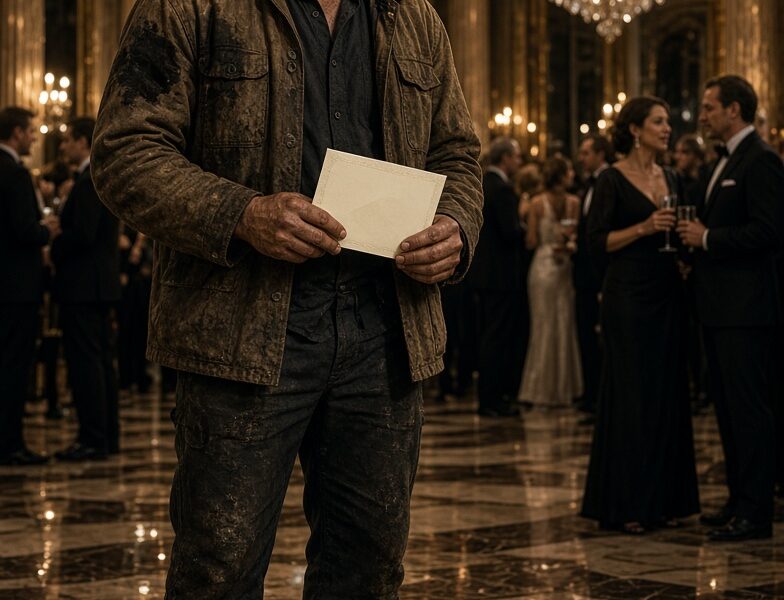
Then Bennett Raines walked through the front doors.
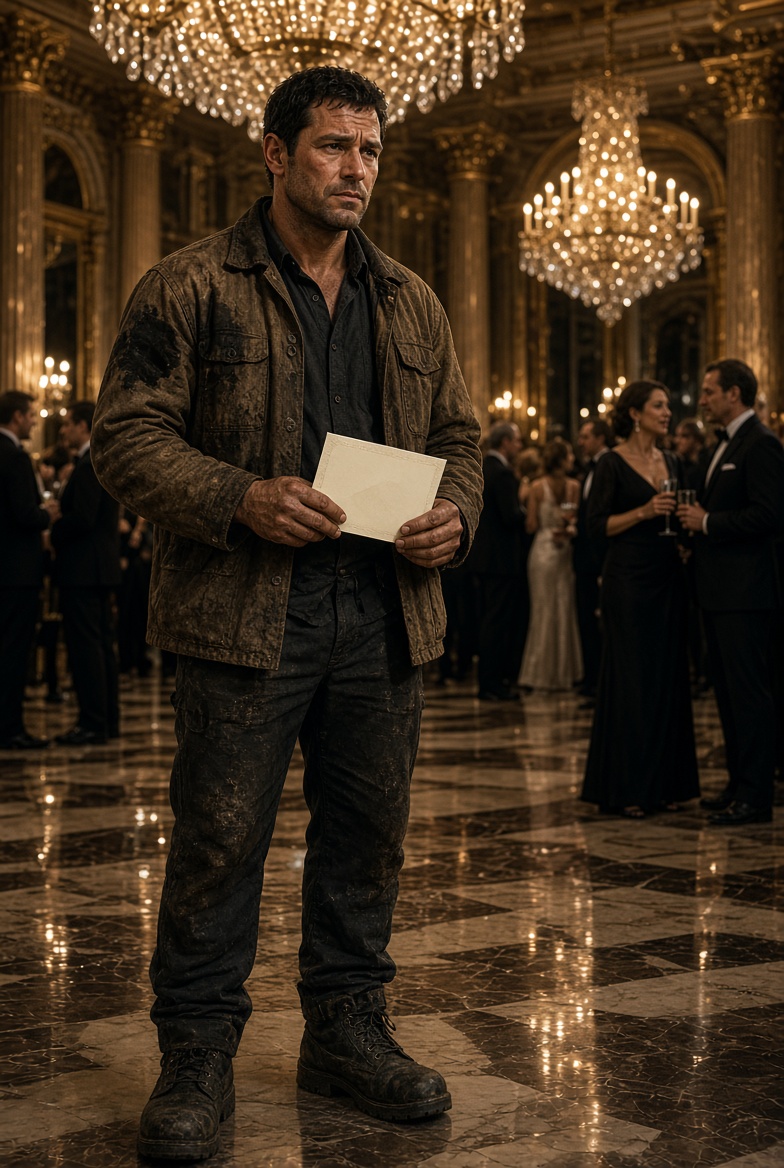
He wore a worn canvas jacket with a grease stain across the left shoulder, steel-toed boots that had seen a thousand better days, and an expression that suggested he would rather be beneath a car than surrounded by people discussing one.
Someone near the bar laughed.
A woman in a backless gown leaned toward her companion and whispered behind her champagne flute.
Across the room, Serena Kade, the thirty-one-year-old CEO who had spent six months perfecting every detail of the evening, spotted him and made a decision in less than five seconds.
Three words to her event director.
“Get him out.”
Bennett placed his invitation card on the counter and walked away without an argument.
But when her billionaire father arrived forty minutes later, picked up that card, and read the name printed across it, the color drained from his face.
“Where is this man?” Gideon Kade demanded.
And when Bennett was brought back into the room, the founder of one of America’s most powerful automotive groups did something nobody in that ballroom had ever seen him do.
He crossed the floor, wrapped both arms around a grease-stained mechanic, and held on as though he had been given back a part of his life he had spent ten years believing he might never see again.
Serena had thought she was protecting her company’s image.
She was about to discover what that image had nearly cost her.
Harborvale was the kind of coastal town that rarely made the news unless something went wrong.
It sat between a stretch of gray Atlantic water and a highway most drivers used to reach somewhere else. The marina had seen better decades, the old mill had closed years earlier, and the diner on Clement Street still displayed its daily specials on a chalkboard that had probably been there longer than some of its customers had been alive.
On the eastern edge of town, past the abandoned railyard and a row of storage units, stood a low concrete building with a hand-painted sign above the roll-up door.
Raines Craft & Motor Works.
Bennett Raines had owned the garage for eleven years.
At thirty-nine, he was broad across the shoulders, quiet by nature, and permanently marked by the work he did. His knuckles carried old scars, his hands were stained at the creases no matter how carefully he scrubbed them, and his canvas jacket had been repaired twice at the elbows because he refused to replace something that still had useful life left in it.
People who knew Bennett well understood that he rarely explained himself.
He fixed things.
That was how he apologized, how he showed affection, how he solved problems, and occasionally how he answered questions he didn’t want to discuss.
A customer might arrive with a failing transmission and leave with a vehicle that ran better than it had in years.
A neighbor might mention that his brakes were making a strange noise, only to discover that Bennett had already inspected them while the neighbor was inside paying for coffee.
And sometimes, when a family couldn’t afford the repairs necessary to keep its only vehicle on the road, Bennett would quietly cross out the amount due and write two words in their place.
Paid in full.
He had not always lived this way.
Before Harborvale, before the garage, and before the long evenings spent rebuilding old engines while his daughter completed homework at a folding table beside the window, Bennett had studied mechanical engineering at a state university.
He had graduated with honors and spent four years working in drivetrain system design for a midsize automotive firm in Detroit.
He was good at his job.
Not the kind of good that depended on polished presentations or impressive titles, but the kind that made other engineers stop arguing long enough to ask him a question.
Bennett could hear an irregular vibration in a drivetrain and begin narrowing down its cause before a diagnostic computer finished loading.
He understood how heat changed tolerances, how moisture altered the behavior of electrical components, and how a tiny delay inside a complicated system could become a major problem when several small failures happened together.
His former supervisor once told him that Bennett had an unusual gift.
“You don’t just understand how machines work,” the man had said. “You understand what they’re trying to tell you when something starts going wrong.”
Bennett had laughed at the compliment.
Machines weren’t trying to tell anyone anything, he had replied.
They were simply doing what the laws of physics required.
But he remembered the conversation years later, because sometimes the smallest sound in a machine could make the difference between a safe journey and a very bad day.
Then his marriage fell apart.
His wife left, and the details of their separation became a collection of conversations neither of them knew how to finish.
There was no single dramatic moment that explained everything. There were missed dinners, postponed weekends, arguments about schedules, and the gradual realization that a household could contain two people who were technically present while spending most of their lives somewhere else.
Their daughter, Lena, was nine when Bennett finally admitted that something had to change.
He remembered coming home after another late night at the engineering firm and finding her asleep at the kitchen table, a half-finished school assignment beneath one cheek.
Her lunchbox sat beside her backpack.
A small drawing she had made of the two of them stood upright against a glass of water.
In the drawing, Bennett wore a blue shirt and held a wrench. Lena stood beside him with a smile large enough to occupy half the page.
Above them, in uneven letters, she had written, MY DAD FIXES EVERYTHING.
He had stood in the kitchen for a long time.
The next morning, he began making plans to leave Detroit.
He returned to the coast, bought the garage from a retiring widower who cried a little when he handed over the keys, and started building a different life.
He didn’t become wealthy.
He didn’t appear in industry magazines or receive invitations to speak at engineering conferences.
He learned how to keep an aging compressor running through another winter, how to stretch a parts budget, and how to explain to a nine-year-old that sometimes the right repair required waiting until the next paycheck.
But he came home every night.
And Lena never again had to fall asleep wondering whether her father would make it back before morning.
For Bennett, that was a trade worth making.
Lena Raines had inherited his patience and none of his reluctance to speak her mind.
She was nine years old and had strong opinions about almost everything.
Her homework occupied a folding table near the garage’s side window, close enough to hear the radio and smell the oil, but far enough from the work floor that she could insist she wasn’t helping unless she chose to.
She had grown up around the garage.
It was where she learned to read silences, recognize when her father was concentrating, and identify the difference between the quiet that meant he was thinking and the quiet that meant he was worried.
She could hand him the correct socket before he asked for it.
She could tell when he was pretending not to be tired.
And she had a particular talent for asking the question every adult in the room was trying to avoid.
One afternoon, while Bennett worked on a stubborn starter motor, Lena looked up from her math worksheet.
“Why do rich people always think they’re smarter than everybody else?”
Bennett glanced at her.
“That’s a big question for a Tuesday.”
“It’s a big problem for every day.”
“Some rich people are smart.”
“I didn’t say they weren’t.”
He tightened a bolt.
“Then what’s the question?”
“Why do some of them think money tells you everything about a person?”
Bennett considered that.
“Because money tells you something about a person.”
“What?”
“How much money they have.”
Lena stared at him.
Then she laughed so hard that she nearly knocked her pencil off the table.
Bennett smiled and returned to the engine.
He didn’t know that, a few weeks later, his daughter would ask the same question in a different way, after watching a powerful woman judge him by a stain on his jacket.
He didn’t know that the answer would eventually change the course of several lives.
At that moment, all he knew was that the starter motor had finally turned over, his coffee was getting cold, and Lena was supposed to be finishing her homework.
“Are you going to check my answers?” she asked.
“After I wash my hands.”
“You said that twenty minutes ago.”
“And now I’m saying it again.”
“That doesn’t make it more believable.”
He laughed, wiped his hands, and sat beside her.
That was their life.
It wasn’t glamorous, but it was theirs.
And Bennett had spent eleven years protecting it from the kind of ambition that had once convinced him a missed dinner was a reasonable price for professional success.
The Mercury Cougar was the one exception to his otherwise practical relationship with old cars.
It was a 1968 model he had purchased in pieces, with a seized original 428 engine, faded paint, rust beneath the rear quarter panels, and a history its previous owner couldn’t fully explain.
Most people would have called it a project.
Bennett had called it an opportunity.
For three years, he rebuilt it one component at a time.
He sourced original parts from collectors, rebuilt the engine, polished the chrome by hand, and spent long evenings correcting problems that would have been easier to ignore.
He refused shortcuts that would have made the car look finished without making it right.
When Lena asked why he was so particular about a vehicle that would never be as efficient as a modern electric car, he explained that efficiency wasn’t the point.
“Some things are worth understanding before you decide whether they still have a place in the world.”
“Like old cars?”
“Like anything.”
She considered that answer, then pointed toward the passenger-side door.
“The chrome strip is crooked.”
Bennett looked.
It was.
He corrected it before dinner.
The Cougar eventually earned quiet admiration from collectors across the coast. Its restoration was not famous, but people who knew classic cars understood what they were looking at when Bennett opened the hood.
There was no theatrical perfection.
There was craftsmanship.
That distinction mattered to him.
So when Kade Mobility contacted him about displaying the Cougar at the launch of its new Aurora electric vehicle, he agreed.
The event’s theme was mechanical legacy meeting an electric future.
Someone on the company’s event team had found photographs of the restoration and decided the Cougar would make an effective centerpiece for the presentation.
Bennett liked the idea.
He wasn’t interested in networking with investors, and he had no desire to become a public figure.
He simply thought the car deserved to be seen by people who understood what it had taken to bring it back to life.
When the invitation arrived, he placed it on the workbench beside his toolbox.
Lena picked it up while he was checking the Cougar’s tire pressure.
“They want you to go to a fancy party?”
“They want the car to go.”
“You’re the one who built it.”
“The car will get most of the attention.”
She turned the card over.
The lettering was elegant, the paper thick, and the Kade Mobility logo embossed in silver.
“Do they know you’re a mechanic?”
“I imagine they’ve figured that out.”
“Do they know you’re the mechanic who built their display car?”
Bennett looked at her.
“That’s the idea, kid.”
She examined the invitation again.
“You’re sure these people deserve it?”
He tightened the last lug nut and stood.
“It’s just a display.”
“That’s not what I asked.”
He had no immediate answer.
He climbed into the truck, and on the drive toward the city, he thought about her question.
He didn’t need the room to be impressed by him.
He didn’t need anyone to know how many hours he’d spent rebuilding the engine or how often he’d stayed awake after midnight because one measurement didn’t make sense.
He wanted the car to stand in a room where people understood that innovation didn’t begin with a marketing campaign.
It began with somebody who cared enough to learn how a machine worked.
That was enough.
At least, he thought it was.
Across the state, Serena Kade was preparing to welcome several hundred of the most influential people in the automotive industry.
At thirty-one, she had spent two years running Kade Mobility Group, one of the fastest-growing automotive businesses in the country.
She had an MBA from Wharton, a reputation for precision, and a track record of restructuring two divisions that had been losing money for years.
Her board called her decisive.
The press called her composed.
Her employees knew she arrived before most of them and frequently remained after the last office lights had gone dark.
She had built her professional identity around a simple principle: preparation eliminated surprises.
Every presentation was reviewed.
Every major decision was documented.
Every public appearance was planned with enough detail that the people around her could anticipate what she would need before she asked.
The Aurora launch represented six months of work.
The Union Hall had been renovated specifically for the evening. The press list had been reviewed repeatedly. The lighting design had been tested. The investor seating had been arranged according to a carefully negotiated hierarchy of importance.
Serena had approved every name on the guest list.
She wanted the evening to demonstrate that Kade Mobility could honor its past without becoming trapped by it.
The company had begun as a two-bay repair shop, founded by her father, Gideon Kade, and grown into a national automotive group with engineering facilities, manufacturing partnerships, and a rapidly expanding electric vehicle division.
The Aurora was supposed to represent the next chapter.
It was also supposed to establish Serena as more than the daughter who had inherited a successful business.
She knew what people said when she wasn’t in the room.
That her father had built the company.
That her surname had opened doors she hadn’t earned the right to walk through.
That she had been handed a position that would have taken someone else decades to reach.
Some of those comments were unfair.
Others contained enough truth to hurt.
Serena had worked relentlessly to prove that she could do the job. She had made difficult decisions, reduced costs, improved production schedules, and pushed teams that had become comfortable with old procedures.
But she had also developed a habit of treating uncertainty as a threat.
Anything that disrupted the plan seemed to challenge not merely the event or the business, but her own authority.
She told herself it was discipline.
Some nights, she wondered whether it was fear wearing an expensive suit.
Her father, Gideon Kade, had spent forty years building the company.
At sixty-seven, he was a broad-shouldered man with silver hair, a weathered face, and hands that still looked more natural holding a wrench than holding a champagne flute.
He had begun working in repair shops in his twenties, earning eight dollars an hour and learning every system he could understand before he ever touched a balance sheet.
He knew the smell of overheated brakes.
He knew the sound of a failing bearing.
And he understood something Serena sometimes forgot: a person could spend years learning how to make a machine look impressive without ever learning how to make it dependable.
Gideon had recently undergone a second heart procedure, and his cardiologist had instructed him to slow down.
He had not taken the instruction particularly well.
He still attended major company events and still had opinions about everything, but he had gradually begun allowing Serena to run the room.
He was proud of her.
He was also worried about the way she sometimes confused control with competence.
They had argued about it twice in the preceding month.
On both occasions, Serena had reminded him that the company could no longer operate like a neighborhood repair shop.
On both occasions, Gideon had responded that a company was still made up of people who could be treated well or treated badly, regardless of its size.
Neither had convinced the other.
Gideon was running late on the night of the Aurora launch.
His heart had been uncooperative that week, and his driver was taking the longer route into the city on the doctor’s orders.
Meanwhile, the company’s communications director, Dorian Sutter, was making sure the evening unfolded according to plan.
Dorian was forty-two, trim, impeccably dressed, and possessed of the quiet efficiency that came from twenty-two years of managing a company’s public image.
He had built Kade Mobility’s brand from the ground up.
He understood press relationships, investor expectations, visual presentation, and the subtle mechanics of a public narrative.
He believed that a company’s image was inseparable from its substance.
A successful launch could create confidence.
A careless photograph could undermine it.
A story told badly could overshadow years of excellent work.
Dorian had watched brands struggle because they had failed to control the way their achievements were presented.
He had made himself indispensable by preventing that from happening to Kade Mobility.
He was not a cartoon villain who took pleasure in humiliating strangers.
That would have been easier to recognize.
Dorian sincerely believed he was protecting the company whenever he removed something inconvenient from the frame.
A badly placed banner.
An unscripted question.
A guest whose presence might distract from the product.
He didn’t think of those decisions as cruelty.
He thought of them as professional judgment.
And when Bennett Raines walked into Union Hall, Dorian saw a problem before he saw a person.
It was 6:47 p.m., forty minutes before Bennett had originally expected to arrive.
He was driving along Route 9 when his phone connected to the truck’s speakers.
The number was unfamiliar, but he answered because the call came from Harborvale.
The caller was Roy, a sixty-three-year-old school bus driver who had pulled onto the shoulder of the Harbor Bridge overpass.
Roy had a full bus of children behind him, an engine that had stopped running, and a narrow strip of road between his vehicle and passing traffic.
He had already called dispatch.
Someone was on the way, but the estimated wait was forty-five minutes.
Roy was trying to keep the children calm, but Bennett could hear the strain in his voice.
“Tell me what happened,” Bennett said.
“Lost power without much warning. I got it onto the shoulder, but now I can’t get it started again.”
“Any smoke?”
“No.”
“Warning lights before it quit?”
“A couple flickered. Then everything went quiet.”
Bennett looked at the clock on his dashboard.
The city exit was coming up on the right.
He could continue toward the launch, arrive on time, and deliver the Cougar exactly as promised.
Or he could take the bridge exit and look at a bus full of children waiting on a dangerous shoulder.
He didn’t hesitate long enough to call it a decision.
“Stay with the kids,” he told Roy. “I’ll be there in a few minutes.”
He took the exit.
The problem turned out to be a failed fuel relay, the kind of fault that could leave a perfectly serviceable vehicle looking completely dead.
Bennett had the right replacement in his roadside tool case.
He worked beneath the hood while headlights swept across the asphalt and cars passed close enough to make the bus tremble.
Roy stood beside him holding a flashlight and apologizing every few seconds.
“I’m sorry to drag you into this. Dispatch said someone was coming.”
“Stop apologizing,” Bennett said. “Hand me the other relay in the red case.”
A little girl in the third row pressed her face against the bus window.
“Is that mechanic a superhero?”
Her friend shook his head.
“No. Superheroes don’t need toolboxes.”
Bennett heard them.
He kept working.
Fifteen minutes later, the engine turned over.
Roy climbed into the driver’s seat and checked the dashboard while Bennett stood beside the front wheel, listening to the idle.
“Everything looks good,” Roy called through the open door.
“Let it run another minute. Then check it again before you pull out.”
Roy climbed down and shook Bennett’s hand.
“You saved me a terrible evening.”
“You got the kids home. That’s what matters.”
Bennett checked the engine one last time and packed his tools.
The grease stripe across his left shoulder had grown darker, and his hands were black to the wrists.
He looked at the clock.
He was now forty minutes late.
There was no time to drive home, shower, and change.
He sat in the truck, glanced at his reflection in the rearview mirror, and considered the situation.
Lena had ironed his shirt that morning after declaring that his first attempt had looked like he had slept in it.
He could already imagine what she would say about the jacket.
But the invitation had his name on it.
The car was waiting.
And he had done nothing wrong.
He drove to Union Hall.
The lobby hit him with a wall of sound and light.
Crystal chandeliers hung above elaborate floral arrangements. Guests moved through the space in evening wear, holding champagne and discussing investment opportunities in voices carefully pitched to sound casual.
A string quartet played in the corner.
Photographers stood beside the display arch, waiting for the Aurora to make its entrance.
Bennett approached the check-in table.
The young woman behind it searched the guest list, found his name, and handed him a printed invitation card.
“Mr. Raines? Welcome. The display is through those doors, and the VIP area is to your left.”
“Thank you.”
Her smile flickered when she noticed the condition of his jacket, but she recovered quickly and pointed him toward the main hall.
Bennett walked through the entrance.
He made it about ten feet before he noticed the room noticing him.
It happened gradually.
A glance from a man in a charcoal suit.
A whispered comment behind a champagne flute.
A woman turning away from the display arch to inspect his boots.
Someone near the bar laughed, and Bennett couldn’t tell whether the sound had anything to do with him.
That uncertainty was its own particular kind of weight.
He had spent eleven years working in a town where a man was judged by whether his work held up, whether he kept his word, and whether he showed up when somebody needed help.
Here, before anyone asked what he had built, the room had already decided what he was worth.
Dorian noticed him almost immediately.
He leaned toward Serena, who was speaking with two investors near the main display.
“The man in the work jacket,” he murmured. “He’s entered the VIP corridor. We have three photographers in the room, and one has already looked at him twice.”
Serena followed his gaze.
She saw the worn jacket, the grease on the shoulder, the steel-toed boots.
She saw a cluster of guests turning their attention away from the polished Mercury Cougar and toward the man standing beside it.
She thought about the photographs that would appear in industry publications the following morning.
She thought about the months of preparation, the carefully selected guest list, and the message the event was supposed to convey.
Her assessment took less than five seconds.
“Handle it,” she said.
Dorian moved toward Bennett.
“Sir,” he said smoothly, positioning himself in the man’s path, “this section is reserved for confirmed guests. Can I direct you toward the registration desk?”
“I’m a confirmed guest.”
Bennett held out his invitation.
Dorian glanced at the card without taking it.
“There may have been a mix-up. Why don’t we step over to the reception area and verify your credentials?”
“I already checked in.”
“Of course. We just need to make sure everything is in order.”
Bennett nodded toward the display arch.
“My car is in that room. The Mercury Cougar. I rebuilt it. Your company invited me because of it.”
Dorian’s expression remained polite.
But his eyes had changed.
He was no longer trying to help a guest find the correct section.
He was trying to determine how much trouble it would take to move him.
Before he could answer, Serena arrived.
She crossed the floor with the controlled speed of someone accustomed to having conversations end when she reached them.
“Sir,” she said, “do you understand that this is a private VIP event? This area is for invited guests and authorized personnel.”
“I understand.”
“Then you’ll understand why I’m asking you to confirm your invitation with our event coordinator.”
“I already did that at the entrance.”
Bennett extended the card.
“My name is Bennett Raines. It’s on your list.”
Serena didn’t take it.
She looked at his jacket again.
Then she glanced toward the room, where several people had begun watching the exchange.
She had a choice.
She could take the card, verify the information, and discover whether there had been a mistake.
Or she could remove the visible problem and return to the event she had spent six months preparing.
She chose the second option.
“I’m going to need you to step away from this area,” she said. “Someone from our team will review the invitation and follow up with you.”
Bennett stared at her for a moment.
He wasn’t angry in the way she expected a dismissed guest to be angry.
He looked disappointed, and somehow that made the encounter more uncomfortable.
He glanced toward the Cougar, its chrome reflecting the warm light above the display.
Three years of work stood beneath that spotlight.
Three years of late nights, carefully sourced parts, corrected mistakes, and patient craftsmanship.
The car had been welcomed.
Its builder had not.
Bennett placed the invitation card on the counter.
“The card deserves to be here,” he said quietly, “even if I don’t.”
He turned and walked toward the exit.
Serena watched him leave.
For a moment, she felt relieved.
The crowd returned to its conversations.
Dorian adjusted his jacket and moved toward the next item on his schedule.
The photographers turned their attention back to the Aurora.
Within ninety seconds, the room had absorbed the incident and continued as though nothing important had happened.
But the invitation card remained on the counter.
It was a small, ordinary piece of paper, printed for a man nobody in the room had bothered to know.
And it was about to become the most consequential object in the building.
Bennett sat in his truck in the parking structure longer than he intended.
He wasn’t someone who liked to sit with a disappointment once he could do something useful instead.
But that evening, he couldn’t quite bring himself to start the engine.
He watched guests cross the structure toward waiting cars, their laughter echoing between concrete pillars.
Then he called Lena.
She answered on the second ring.
“How’s the car?”
Bennett looked through the windshield toward the Union Hall entrance.
“It looked good.”
“Good lighting?”
“Very good lighting.”
“Did people stop to look at it?”
He was quiet.
“Some.”
“Did you get to see them looking?”
He looked down at his hands.
“Maybe not tonight.”
Lena didn’t ask another question.
She understood the shape of his answer.
“I left the kitchen light on,” she said. “There’s soup on the stove. Don’t forget to turn the burner off. You forgot last time.”
“I didn’t forget. I was keeping it warm.”
“You were forgetting.”
Bennett almost smiled.
“Go to sleep, Lena.”
“I’m already in bed.”
That was almost certainly untrue.
He hung up, placed the phone on the passenger seat, and reached for the ignition.
Then he stopped.
During the Aurora demonstration, he had heard a sound.
It had been faint, barely more than a brief harmonic vibration as the electric vehicle rolled slowly across the hall.
Most people would have heard nothing at all.
Bennett had spent years learning to recognize the small differences between a machine operating normally and a machine compensating for something it shouldn’t have to compensate for.
The sound had been brief.
But it had lodged in his mind.
He couldn’t explain why he had stayed in the parking structure.
He told himself he wanted to be certain the Cougar had been secured properly before leaving.
That was part of it.
But beneath that explanation was another thought, quieter and harder to dismiss.
Something about the Aurora had not sounded right.
He remained in the truck.
At 8:47 p.m., Gideon Kade arrived.
His driver pulled up beside the Union Hall’s side entrance, and Gideon stepped out slowly.
The second heart procedure had changed the way he moved. He no longer crossed a room in a hurry, and he had learned to conserve his energy rather than pretend he still possessed unlimited reserves.
But his presence remained substantial.
People recognized him immediately.
He nodded to the guests who greeted him and made his way toward the main hall, intending to join Serena before the Aurora presentation concluded.
Then he noticed the check-in counter.
The invitation card was still there.
Someone had moved it to the edge of the counter, but no one had thrown it away.
Gideon glanced at it without particular interest.
Then he saw the name.
Bennett Raines.
For a moment, the noise of the room seemed to recede.
He picked up the card.
His fingers tightened around its edge.
He read the name again.
Then he looked at the event coordinator.
“Where is this man?”
The young woman hesitated.
“I believe Mr. Raines was asked to leave, sir. There was a concern about his access to the VIP area.”
Gideon stared at her.
“Asked to leave?”
“Ms. Kade handled the situation.”
He turned toward the main hall.
Dorian appeared beside him almost immediately.
There had been a concern about an unauthorized individual, Dorian explained. Serena had addressed it. The gentleman had been asked to leave, and the matter had been resolved.
Gideon listened without interrupting.
When Dorian finished, Gideon held up the invitation.
“His name is on this list for a reason.”
Dorian nodded.
“Of course. We can review the registration issue tomorrow.”
“No.”
Gideon’s voice was quiet.
“Find him. Right now.”
Dorian hesitated.
“Mr. Kade, the program is underway.”
“Then the program can wait.”
He looked at the invitation again.
“If he’s still in the building, bring him back. If he’s in the parking structure, send someone out there. If he’s already on the highway, call him.”
Dorian had worked for Gideon for twenty-two years.
He knew the difference between the founder’s ordinary displeasure and the rare moments when something had reached a place deeper than anger.
This was the latter.
Dorian turned and moved.
They found Bennett sitting in his truck with the engine running.
When the event coordinator approached and explained that Gideon Kade wanted to see him, Bennett looked at her for a moment.
“Is there a problem with the car?”
“No, sir. Mr. Kade specifically asked us to bring you back.”
Bennett glanced at the dashboard clock.
Then he turned off the engine.
He returned to Union Hall in the same jacket and the same boots.
The invitation card was handed back to him.
Inside, the crowd had thinned slightly, but enough guests remained to turn the encounter into an audience.
Gideon saw Bennett enter through the doors.
He stepped down from the stage platform.
He didn’t move quickly. His body no longer allowed for that.
But the determination in his face made the movement feel larger than the distance he crossed.
Bennett stopped near the entrance.
For a moment, neither man spoke.
Then Gideon reached him and wrapped both arms around him.
It was not a formal greeting.
It was not a polite embrace between two people who had met at a business function.
It was the way a man held someone he had spent ten years believing he might never see again.
Bennett stood still for a second.
Then he returned the embrace.
Gideon stepped back.
His eyes were wet, and he made no effort to hide it.
“Ten years,” he said.
“Ten years,” Bennett answered.
Gideon turned toward the room.
He didn’t reach for a microphone.
He didn’t need one.
“Ten years ago, I was driving along North Break Road during a flash flood. A temporary bridge had taken more water than anyone expected. My car slid off the road and went into the channel.”
The room grew quiet.
Gideon paused, gathering himself.
“Water was coming through the door seals. My phone was dead. I couldn’t get the door open, and the current was pulling the car away from the road.”
He looked at Bennett.
“This man was driving a parts delivery truck in the opposite direction. He didn’t know who I was. He didn’t know anything about me.”
Gideon swallowed.
“He stopped anyway.”
A few people shifted in their seats.
“He tied a tow line to his truck, broke the window glass with his bare hands, and pulled me out before the car went under.”
Bennett looked toward the floor.
He had never liked hearing the story told in public.
Gideon continued.
“When I tried to pay him, he refused every dollar. I offered him a reward. I offered to help him find work. I tried to get his name so I could thank him properly.”
He looked directly at Bennett.
“He told me that if it had been his daughter in that car, he would have hoped somebody stopped.”
The hall was silent.
Serena stood beside the stage, unable to move.
She had spent less than five seconds deciding what kind of man Bennett Raines was.
Her father had just explained that this same man had saved his life.
And he had done it without knowing his name, his position, or his bank balance.
Gideon rested a hand on Bennett’s shoulder.
“I looked for him afterward,” he said. “I asked the county police whether anyone had filed a report. I contacted the local towing companies. I even sent letters to repair shops in the area.”
He smiled faintly.
“He was apparently very good at disappearing.”
“I wasn’t disappearing,” Bennett said. “I had a garage to run.”
A few guests laughed softly, relieved to have permission to breathe again.
Gideon shook his head.
“You left before I could thank you.”
“You thanked me that day.”
“Not properly.”
“You were alive. That seemed pretty proper to me.”
Gideon looked at him for a long moment.
Then he turned toward Serena.
His daughter had never seen that particular expression on his face.
It wasn’t the look of a father preparing to scold his child.
It was the look of someone watching another person discover a truth that should have been obvious long before the moment arrived.
“Serena,” he said, “this is Bennett Raines.”
She looked at the grease on Bennett’s jacket.
Then she looked at the invitation card in his hand.
“I know,” she whispered.
Gideon shook his head.
“No. You know his name. That’s not the same thing.”
The distinction landed harder than any accusation could have.
Serena opened her mouth.
Nothing came out.
Bennett looked at her, then at Gideon.
“I don’t want to make a scene,” he said.
“You aren’t making a scene,” Gideon replied. “You never did.”
He turned toward the display arch.
“Would you at least stay long enough to tell me how the car is running?”
Bennett glanced at the Aurora.
“I was going to ask you the same thing.”
Gideon’s expression changed.
“What do you mean?”
Bennett looked toward the electric vehicle.
“During the demonstration, I heard a vibration that didn’t sound right.”
The room shifted again.
This time, the attention was not directed at his jacket.
It was directed at the possibility that the man they had just learned to respect might have noticed something about the company’s newest vehicle that its engineers had missed.
Bennett didn’t raise his voice.
“It could be nothing. I would want to hear it again under controlled conditions.”
Gideon stared at him.
Then he glanced at the Aurora.
“Let’s make sure it’s nothing.”
For the first time that evening, Serena looked at Bennett without trying to decide whether he belonged in the room.
She looked at him as a person who might know something she didn’t.
It was a beginning.
It was not yet an apology.
And it was certainly not the end of the lesson.
Three days later, Serena drove herself to Harborvale.
She left her driver at home, ignored two calls from her assistant, and took the coastal road toward the eastern edge of town.
She told herself that the visit was necessary.
Gideon had asked her to make things right, and the company had every reason to maintain a good relationship with a restoration specialist who had helped her father.
But those explanations sounded thin even inside her own head.
The truth was less comfortable.
She had seen Bennett leave the gala with the dignity she had tried to take from him.
She had watched her father embrace him.
And she had spent three nights remembering the look on Bennett’s face when he placed the invitation on the counter.
Not anger.
Disappointment.
She knew how to handle anger.
Anger could be negotiated with, redirected, or answered with a carefully prepared explanation.
Disappointment left no such openings.
Raines Craft & Motor Works looked exactly as it had in the photographs Serena had seen online.
The roll-up door was open.
A country music station played somewhere inside.
A pickup truck with a cracked taillight sat on the lift, and the air smelled of oil, metal, old coffee, and the faint salt carried inland from the harbor.
There was no reception desk.
No framed corporate mission statement.
No decorative arrangement intended to make a visitor feel that money was being spent.
Everything in the garage had a purpose.
Serena stood at the entrance for a moment.
Bennett was beneath the truck, working on the exhaust system.
When he heard her, he rolled out on a mechanic’s creeper and looked up.
“Mr. Raines,” she said.
He sat up.
“Ms. Kade.”
He didn’t appear surprised.
He didn’t appear pleased.
He looked at her the way a person looks at weather that has been expected for several days but hasn’t yet decided how to feel about.
Serena had rehearsed the apology during the drive.
She had written a version with Dorian’s help, discarded it, and written another one in her head.
Every version sounded increasingly like a corporate statement.
Standing in the garage, she realized that she didn’t need polished language.
She needed to say what she had done.
“I owe you an apology,” she said. “A real one. Not the version I drafted with Dorian’s help.”
Bennett stood and wiped his hands on a shop rag.
He waited.
“I looked at you and made a decision about who you were in approximately four seconds. I didn’t verify your invitation. I didn’t ask why you were there. I didn’t even give you a chance to explain.”
She took a breath.
“I saw your clothes, decided they didn’t fit the room, and treated you as if you were the problem. I was wrong, and I was wrong publicly. I’m sorry.”
Bennett listened without interrupting.
When she finished, he folded the shop rag and set it on the workbench.
“I appreciate the apology,” he said. “I do.”
Serena felt a small measure of relief.
Then he continued.
“But an apology doesn’t change what you saw when you looked at me. It doesn’t change the fact that you looked at a room full of people waiting for me to be humiliated and decided to give them what they came for.”
She didn’t flinch.
“No,” she said. “It doesn’t.”
“I wasn’t expecting anyone to treat me like a prince. I came because your company invited me. I thought the car deserved to be seen.”
He gestured toward the far side of the garage, where a photograph of the Cougar hung above a cabinet.
“I’ve spent three years on that vehicle. I know what it is, what it isn’t, and what it took to rebuild it. I don’t need every person in a room to understand that.”
He looked back at her.
“But if you invite somebody into a room, you ought to have enough respect to find out why they’re there before you throw them out.”
Serena nodded.
“You’re right.”
“I’ll accept the apology,” Bennett said. “I’m just not going to pretend it fixes everything. That wouldn’t be honest, and you’ve probably had enough people being dishonest with you.”
She had expected him to be angry.
She had even prepared herself for him to demand something in return.
Instead, he had given her a boundary.
He wasn’t asking her to feel terrible.
He wasn’t offering to make her feel better.
He was simply refusing to pretend that the damage had vanished because she had finally acknowledged it.
For the first time in a long while, Serena found herself in a conversation she couldn’t manage with a prepared response.
“Is there anything I can do?” she asked.
Bennett looked toward the Cougar.
“Start by listening when somebody tells you something you don’t already know.”
She stood quietly.
Then she asked if she could stay and watch him finish the repair.
He shrugged.
“There’s a stool over there. Just don’t put your purse on the parts bench.”
She almost smiled.
“I can manage that.”
She sat down.
For the next forty minutes, they spoke very little.
Bennett finished the exhaust repair, checked the fittings, and started the engine to listen for leaks.
Serena watched him work.
He explained what he was doing without trying to impress her.
When she asked a question, he answered it.
When she didn’t understand something, he explained it differently.
Nothing about the process seemed designed to establish authority.
He simply believed that if someone was standing beside him while he worked, they deserved to understand what was happening.
It was unlike any meeting Serena had attended in years.
No one was presenting a case.
No one was trying to win.
There was only a machine, a problem, and the patient process of finding a solution.
When she left, Bennett didn’t promise that everything would be different.
He simply nodded and returned to his work.
Serena drove back to the city with no dramatic reconciliation to report.
But she returned the following week.
And the week after that.
At first, she told herself she was trying to repair the damage caused by her decision.
By the third visit, she had stopped explaining it to herself.
The garage offered something her professional life rarely did: a place where competence didn’t need an introduction.
She began noticing details.
The equipment was old but carefully maintained.
A board beside the workbench displayed hand-drawn diagrams, parts numbers, and notes about engine configurations.
A coffee maker on the shelf looked as though it had survived several decades of neglect, yet the coffee it produced was excellent.
The place had the peculiar order of a workshop in which everything could look disorganized to a stranger while remaining perfectly understandable to the person who used it.
Bennett moved through the garage without hurry.
He treated cars as objects with histories, not simply as units waiting to be processed.
He explained repairs to customers who had no mechanical knowledge, never making them feel foolish for asking basic questions.
When someone needed a little more time to pay, he didn’t humiliate them by discussing the matter in front of other customers.
He handled difficult situations quietly.
Serena had seen generosity before.
She had approved philanthropic grants, funded community programs, and attended ceremonies where executives handed over oversized checks beneath banners bearing the company logo.
Those programs had done real good.
She didn’t dismiss that.
But Bennett’s generosity operated differently.
It wasn’t arranged around a camera.
It wasn’t designed to tell the world what kind of person he was.
It was simply part of the way he did business.
One afternoon, Serena was looking for a pen on the workbench while Bennett took a phone call outside.
She opened the wrong drawer.
Inside was a folder of completed work orders.
She intended to close it immediately, but the top invoice caught her eye.
The total due had been crossed out.
In its place, in Bennett’s handwriting, were two words.
Paid in full.
She glanced at the payment column.
It was empty.
She opened the folder a little farther.
There were twelve invoices from the preceding four months.
A transmission replacement.
A complete brake overhaul.
A head gasket repair.
Several safety inspections and smaller jobs.
The customers were families from Harborvale and the surrounding county, people whose names she recognized from the town’s lower-income neighborhoods.
Every invoice carried the same handwritten note.
Paid in full.
The total value was substantial.
Serena had spent years reviewing budgets and financial statements.
She could recognize the difference between a business absorbing an occasional loss and a business owner systematically giving away his time.
She heard the garage door move.
Bennett returned, saw her standing beside the open drawer, and glanced at the folder.
“These invoices,” she said.
“They’re closed out.”
“The payment column is empty.”
“They’re closed out,” he repeated.
“Bennett, you did more than twelve hundred dollars’ worth of work for people who didn’t pay you last month.”
He took the folder from her and closed it.
“That’s my business.”
“Why mark them paid? Why not write them off as charitable work?”
He looked at her for a moment.
Then he placed the folder back in the drawer.
“Because if I write ‘charity,’ they know I felt sorry for them.”
He closed the drawer.
“If I write ‘paid,’ they can leave thinking they got a good price. One of those things lets them walk out with their head up.”
Serena stared at him.
“Doesn’t that make it harder to keep the garage running?”
“Sometimes.”
“Then why do it?”
Bennett looked toward the truck on the lift.
“Because people need their cars. They need to get to work, get their kids to school, pick up medicine, take their parents to appointments. Sometimes a transmission fails at exactly the wrong time.”
He shrugged.
“I can’t fix every problem in Harborvale. But if I can keep somebody’s car on the road, I can do that.”
Serena thought about the charitable programs she had overseen.
She remembered the carefully arranged photographs, the branded envelopes, the speeches about community responsibility.
She had never once asked whether the way assistance was delivered might add another burden to the person receiving it.
She had considered the amount given, the measurable impact, and the visibility of the program.
Bennett had considered how someone would feel walking back through the door.
That difference stayed with her.
It was the first time she understood that doing something good and making someone feel small could happen in the same transaction.
The afternoon Lena met Serena properly came three weeks after the gala.
Bennett was beneath the Mercury Cougar, inspecting a component he had wanted to check since the vehicle returned from the event.
Lena sat at her folding table, ostensibly doing homework.
She had been watching Serena since she arrived.
Serena was examining one of the diagrams on the wall when Lena spoke.
“You’re the one who kicked my dad out of the party.”
It wasn’t a question.
Serena turned.
Lena looked back at her with the expression of a child who had decided to have a conversation and had no intention of softening it for an adult’s comfort.
“Yes,” Serena said. “I am.”
“He didn’t tell me.”
“I imagine he didn’t want to upset you.”
“I figured it out.”
Lena looked down at her notebook, then back up.
“He came home late that night. His eyes were red. He said it was because of the drive, but he always drives that road, and his eyes are never red.”
Serena felt the words settle somewhere beneath her ribs.
She could have explained the pressure of the launch.
She could have mentioned the investors, the photographers, and the months she had spent trying to prove herself.
She could have told a nine-year-old that decisions sometimes had to be made quickly.
But none of those explanations would have answered what Lena had actually said.
“I’m sorry,” Serena replied. “That was my fault. I handled it badly, and your dad didn’t deserve it.”
Lena studied her for several seconds.
“Okay.”
Then she returned to her homework as if the matter had been entered into the record and filed.
From beneath the car, Bennett said nothing.
But his hands slowed for a moment before he resumed working.
Serena remained near the workbench.
She had expected forgiveness to feel like relief.
Instead, she realized that the apology had been accepted without erasing the truth.
Lena had not decided that Serena was a bad person.
She had simply made sure Serena understood what her actions had done.
For a nine-year-old, it was an extraordinary distinction.
For Serena, it was a lesson she would remember long after the conversation itself had faded.
Unfortunately, not everyone at Kade Mobility was learning the same lesson.
Dorian Sutter had noticed Serena’s visits to the garage.
At first, he treated them as a temporary response to an embarrassing incident.
Then the visits continued.
She began leaving the office earlier on certain afternoons.
She asked questions about the engineering team’s testing procedures that she had never asked before.
She spoke with Bennett about technical matters and listened to his observations without demanding that he first present a list of qualifications.
Dorian found the pattern unsettling.
For twenty-two years, he had built the company’s image around predictability.
He understood how investors responded to a controlled message and how quickly an uncontrolled event could become a story that the company did not know how to tell.
Now Serena was spending time with a local mechanic who had no formal title, no corporate position, and a personal connection to Gideon that had been hidden from almost everyone.
Dorian did not invent a direct accusation.
He didn’t need to.
He began mentioning Serena’s visits to board members in conversations framed as concern.
He described Bennett as a local restoration specialist.
He noted that Gideon had a personal history with him.
He suggested that Serena’s judgment might be influenced by a relationship that had begun under unusual circumstances.
Every individual statement was technically defensible.
Together, they created a misleading impression.
Dorian told himself he was protecting the company.
But beneath that justification was something he was reluctant to examine.
He had spent two decades believing that presentation and substance were inseparable.
If Bennett could enter the company without a title, identify a problem that credentialed engineers had missed, and earn Serena’s trust simply by being right, then Dorian’s understanding of how authority worked might be incomplete.
That possibility threatened the world he understood.
So he did what he had always done when a situation resisted his preferred narrative.
He tried to control the narrative.
The opportunity arrived when Bennett began consulting at Kade Mobility’s engineering facility.
Gideon had quietly arranged the agreement.
Three days a month, Bennett would have access to the technical floor, walk through ongoing projects, and offer observations when he noticed something worth examining.
He would have no executive title.
He would not manage anyone.
He would not be required to produce polished presentations.
Gideon wanted another experienced set of eyes on the company’s engineering work, someone who had spent enough time solving practical problems to notice when a theoretically sound design behaved differently in the real world.
Bennett had initially tried to negotiate the consulting rate downward.
Gideon refused.
“You’re not doing me a favor,” he told him over the phone. “You’re doing the company a favor. We’re paying you for your time.”
“I don’t need much.”
“That’s not the point.”
Bennett had finally accepted the original arrangement.
He came to the facility, walked the floor, asked questions, and wrote down anything that concerned him.
Some engineers welcomed his presence.
Others treated him as an outsider whose experience was useful only when it confirmed what they already believed.
Bennett didn’t argue with them.
He was there to look at the work, not to win a popularity contest.
Then, on a Wednesday morning, he heard the vibration again.
He was passing through the technical bay on his way to the parts archive when the Aurora prototype began a low-speed systems check.
The sound lasted less than two seconds.
A faint harmonic vibration.
Brief enough to escape notice.
Distinct enough to make Bennett stop walking.
He stood at the edge of the bay, head slightly tilted, listening as the vehicle completed another cycle.
The technicians running the test didn’t react.
Either they hadn’t heard the sound, or they had heard it and concluded it was insignificant.
Bennett waited for the next cycle.
The vibration returned.
He approached the nearest technician.
“Could I take a look at the moisture sensor data from the last three road tests?”
The technician, a woman named Erin Walsh, looked at him with polite caution.
“I’d need sign-off from the systems lead.”
“That’s fine. Who’s the systems lead?”
“Patrick O’Rell.”
Bennett nodded.
“Can you tell him I heard something during the low-speed check? I’d like to compare the sound with the sensor readings.”
Erin looked toward the Aurora.
“Was it the rear assembly?”
“I think so. I want to verify it before I say anything definite.”
She appreciated that answer enough to call Patrick’s office.
Patrick O’Rell was forty-four, held a doctorate from Carnegie Mellon, and had fourteen years of experience in electric drivetrain development.
He was an accomplished engineer.
He had also spent several years defending his team’s work against executives who changed priorities without understanding the technical consequences.
That history had made him protective of his decisions.
When Bennett entered his office, Patrick listened to the initial explanation with an expression of practiced patience.
“The Aurora has completed four hundred hours of systems testing,” he said. “Our regenerative braking algorithm is within specification across every wet-surface scenario we’ve modeled.”
“I’m not questioning the whole program,” Bennett replied. “I’m asking about a specific data gap.”
Patrick folded his arms.
“What data gap?”
“The moisture sensor. Where is it positioned relative to the brake modulator?”
Patrick answered.
Bennett considered the distance.
“That’s approximately a seventeen-inch signal path. What’s your latency tolerance on the regenerative braking response?”
“Four-tenths of a second.”
“And the sensor refresh rate under high humidity?”
“It’s within operational parameters.”
“I know that’s what the documentation says. I’m asking what it actually runs at.”
Patrick’s expression changed slightly.
The question was specific.
It wasn’t the kind of vague challenge he could dismiss with a summary of the certification process.
“We’ve modeled the relevant conditions,” he said.
“Have you run a sustained wet-road test lasting more than eight minutes?”
Patrick paused.
“Why eight minutes?”
“Because that’s how long it took the vibration to appear in the demonstration. I don’t know whether the two things are connected, but I want to find out.”
Patrick leaned back.
“I’ll have the team review the data.”
It was not an answer.
Bennett recognized that, but he didn’t push.
He left the office and wrote down his observations in a notebook.
Two pages.
A description of the sound, the conditions under which it appeared, the sensor location, and the specific test results he wanted to examine.
He brought the notes to Serena that afternoon.
She was reviewing production projections when he entered.
“You found something,” she said.
“I found something I want checked.”
He placed the notebook on her desk.
Serena read the first page, then the second.
When she finished, she looked up.
“You think the regenerative braking system has a wet-surface latency problem?”
“I think there’s a gap between what the sensor reports and when the modulator responds under sustained humidity. I think the gap could be small enough to pass controlled testing and still become a problem on a wet public road.”
“How serious?”
“I don’t know yet.”
She studied him.
“That’s not a reassuring answer.”
“It’s the honest one.”
He leaned forward.
“If I’m wrong, you’ve lost a day of testing. If I’m right and nobody checks, you’re looking at a recall at best and a serious safety event at worst.”
Serena glanced at the notes.
Patrick’s team had reviewed the system repeatedly.
The vehicle had passed its scheduled testing.
The launch had been celebrated publicly, and the company had already begun discussing production targets with investors.
She could see the risks of acting on Bennett’s warning.
She could also see the risks of ignoring it.
“Did you tell Patrick?”
“Yes.”
“And?”
“He said he’d have the team review the data.”
Serena picked up her phone.
“I’m going to ask him directly.”
The conversation did not go well.
Patrick was measured but immovable.
The system had been certified.
The test results were documented.
The engineering team had modeled wet-surface conditions.
The suggestion that a restoration mechanic had identified a flaw that four rounds of professional review had missed was difficult for him to accept.
He recommended that Bennett’s facility access be reviewed.
Serena ended the call with no clear resolution.
She sat quietly at her desk.
Bennett had not demanded that she believe him.
He had asked her to check.
That distinction mattered.
But before she could make a decision, a different problem arrived.
On Wednesday evening, a twelve-second video appeared in the inboxes of several senior executives.
The footage showed the Aurora prototype during a wet-road test three weeks earlier.
The vehicle entered a curve, its rear end stepped out sharply, and it began sliding toward a barrier before the driver corrected its path.
The test driver brought the car under control.
Nobody was injured.
But the footage was unsettling.
The file had come from an internal track facility.
It was the kind of recording that normally remained on a restricted shared drive for engineering review.
Eleven people had accessed it in the weeks before it surfaced.
Dorian’s name was among them.
So were nine engineers and Patrick O’Rell.
Nobody could establish who had leaked it.
That uncertainty became part of the problem.
By Thursday morning, four board members, two major investors, and a journalist at an automotive trade publication had received copies.
The journalist contacted the company’s press office for comment.
Dorian went directly to Serena’s office.
“The working theory in the building,” he said, “is that Raines accessed the prototype during his consulting visits and introduced a variable that affected the sensor calibration.”
Serena looked up sharply.
“Who says that?”
“People are asking questions.”
“That isn’t an answer.”
“There is no proof that he did it, but there is no proof that he didn’t.”
Serena closed the report she had been reading.
“You’re constructing a narrative.”
“I’m telling you what people are saying.”
“You’re telling me what you want people to believe.”
Dorian’s expression barely changed.
“The board wants a statement by the end of the day. They want Bennett removed from all facility access and company activities immediately. They want the matter contained before the journalist publishes.”
“And if I refuse?”
“Then the story becomes about a CEO who compromised her company’s safety certification process by giving an unvetted outside consultant unsupervised access to a prototype.”
He paused.
“That will be the story, Serena, whether it’s true or not.”
She stood and walked to the window.
Below her, the Aurora prototype sat in the technical bay beneath the work lights.
The car was beautiful.
Its lines had been designed to communicate speed, confidence, and the promise of a different kind of automotive future.
She thought about the guests who had applauded at the launch.
She thought about the investors who had trusted her.
She thought about the people who would eventually drive the vehicle in rain, on highways, and through the ordinary weather of ordinary lives.
Then she thought about Bennett’s handwritten notes.
If I’m wrong, you’ve lost a day of testing.
If I’m right and you don’t check.
She had already ignored one warning because of the way its messenger looked.
She would not make that mistake twice.
“Get me Patrick,” she said.
Dorian remained still.
“Serena—”
“Get me Patrick O’Rell. And get me the raw sensor data from every wet-road test we’ve run in the last six months.”
“All of it?”
“Every test. Every run. Every timestamp. I want the unfiltered data, not a summary.”
She turned from the window.
“And don’t remove Bennett’s access until we know what happened.”
Dorian watched her for a moment.
Then he left.
The board meeting was scheduled for Friday morning at seven.
Serena didn’t sleep.
She spent Thursday night in the facility’s data room with two junior engineers who were young enough to feel uncomfortable challenging their systems lead but experienced enough to recognize a discrepancy when they saw one.
They began with the raw recordings.
They compared sensor refresh rates against modulator response times.
They examined humidity readings, exposure duration, and the conditions under which the Aurora’s rear assembly had become unstable.
At first, the numbers seemed to support Patrick’s conclusions.
The system was within specification during the controlled runs.
The modeled scenarios showed no major problem.
Then one of the junior engineers noticed that the longest wet-surface test had ended just before the eight-minute mark.
She pulled up another recording.
Seven minutes and fifty-two seconds.
Another.
Seven minutes and forty-nine seconds.
A third.
Seven minutes and fifty-six seconds.
The team had run hundreds of hours of testing, but the relevant wet-road scenarios had repeatedly ended before the condition Bennett had described could fully develop.
They examined the sensor refresh rate under sustained humidity.
The numbers changed.
At first, the discrepancy appeared small enough to be dismissed as measurement noise.
Then the engineers compared the refresh rate with the brake modulator’s response tolerance.
The gap was real.
Under sustained wet conditions, the sensor’s refresh rate could reach 0.62 seconds.
The modulator’s tolerance was 0.40 seconds.
The difference was 0.22 seconds.
A fraction of a second.
Small enough to disappear inside a polished presentation.
Large enough to matter when a vehicle was decelerating on a wet road and its control systems needed accurate information at the right moment.
By two in the morning, Serena understood what Bennett had been trying to tell her.
By four, she had reviewed enough evidence to know that the problem could not be dismissed.
By six, she had made her decision.
She called Bennett at 6:15 a.m.
He answered after several rings.
“Everything all right?”
“I need you at the facility at nine.”
A brief pause.
“What happened?”
“We reviewed the raw data. All of it. You were right.”
She heard him sit up.
“The refresh rate reaches 0.62 seconds under sustained humidity. The modulator tolerance is 0.40. There’s a 0.22-second gap that appears after more than eight minutes of wet-road exposure.”
“That’s what I was worried about.”
“Every controlled test they ran ended before the condition could fully develop.”
Bennett was quiet for a moment.
“Then we need to find out whether the sensor placement is causing the delay.”
“Can you walk the engineering team through your findings?”
“I can explain what I heard and what the data suggests. The team will need to verify the fix.”
“That’s exactly what I need.”
“I’ll be there at nine.”
Serena hung up and looked at the data spread across the conference table.
She had been offered an easy way out.
Remove Bennett.
Issue a statement.
Describe the leaked footage as an example of rigorous testing.
Allow the company’s reputation to survive another day without requiring anyone to admit that something had gone wrong.
Instead, she was going to tell the board the truth.
Not because she was certain it would protect her position.
Because she was no longer willing to protect her position at the expense of the truth.
At seven, the boardroom filled.
Dorian arrived with a prepared statement and a recommended sequence of announcements.
The plan was elegant.
Serena would acknowledge the footage, emphasize the company’s testing procedures, announce a review of consultant access, and distance herself from Bennett’s involvement.
The company would retain control of the story.
The board would be reassured.
The launch would remain the central narrative.
Dorian placed the document in front of her.
Serena didn’t open it.
Instead, she carried a forty-page data printout into the room and set it on the table.
“I want to begin with the engineering findings,” she said.
The room grew quiet.
She described the sensor’s position, the measured latency, the testing conditions, and the discrepancy between the controlled runs and the sustained wet-road exposure.
She explained when Bennett had first reported the vibration.
She explained that he had submitted a written warning and that the systems lead had initially dismissed the concern.
She described the leaked video without assigning a source that the investigation had not established.
Then she addressed her own decision.
“I ignored a valid safety warning for approximately thirty-six hours because the person who delivered it didn’t have the credentials my team recognized.”
She let the words sit.
“That decision was mine.”
A senior board member looked at the data.
Another turned toward Patrick, who had joined the meeting remotely.
Serena continued.
“The consequences of that delay, including the leaked video, investor concern, and press inquiry, are a direct result of our failure to investigate the warning immediately.”
Dorian shifted in his chair.
Serena looked around the table.
“I’m not asking you to protect me from those consequences. I’m telling you that the correct next step is to fix the vehicle, verify the solution, and make sure the people who drive it are protected.”
She placed a hand on the report.
“The person who can help us do that fastest is Bennett Raines.”
For several seconds, nobody spoke.
Then one of the senior board members turned to the engineering diagram.
“Show me the sensor position.”
That was the turning point.
Not a dramatic announcement.
Not an emotional speech.
A request to examine the evidence.
Bennett arrived at nine with a notepad and the original two pages of handwritten observations.
He went directly to the technical bay rather than the boardroom.
That was where the work needed to happen.
Patrick was already waiting.
The two men regarded each other with the particular attention of people who had been on opposite sides of a professional disagreement and now found themselves facing the same problem.
Patrick looked tired.
He had spent the night reviewing data that contradicted conclusions he had defended for weeks.
He could have continued arguing.
He could have blamed the test schedule, the calibration procedures, or the conditions under which the footage had been recorded.
Instead, he pulled up the sensor data on the bay monitor.
“The gap is real,” he said.
Bennett nodded.
“Then let’s figure out why.”
Patrick looked at him.
“Walk me through what you heard.”
What followed was four hours of work conducted almost entirely in the language of systems, tolerances, calibration sequences, and measurements.
Bennett described the sound.
Patrick explained the architecture.
The technicians reproduced the relevant conditions.
They examined the moisture sensor’s location and the signal path between the sensor and the modulator.
They ran the system under sustained humidity and compared the response time with the vehicle’s recorded behavior.
Bennett did not claim to know everything.
Patrick did not pretend that his qualifications made him incapable of missing something.
For the first time, the two men were working from the same starting point.
The solution was not simple, but it was manageable.
The moisture sensor cluster needed to be repositioned from the chassis midpoint to a location twelve inches closer to the rear wheel assembly.
That would shorten the signal path and bring the real-world latency below the modulator’s tolerance threshold.
The regenerative braking algorithm also needed a secondary humidity input from the repositioned sensor to eliminate the delay that appeared after eight minutes of sustained exposure.
The changes would require four days of retesting under wet-road conditions before the vehicle could be cleared.
Bennett wrote the repositioning specification by hand on three pages of the facility’s engineering notepad.
He handed it to Erin Walsh, the technician who had first spoken with him.
She read the document, checked the measurements, and looked up.
“This is clean.”
“Test it,” Bennett said. “Don’t take my word for it.”
She did.
The team modified the sensor placement, recalibrated the system, and began the extended testing sequence.
The first run showed improvement.
The second confirmed it.
The third reproduced the conditions that had caused the original discrepancy.
The 0.22-second gap was gone.
They continued testing.
Four days later, the Aurora passed every wet-road scenario on the revised schedule, including six additional tests designed specifically to probe the latency problem.
The instability shown in the leaked footage could no longer be reproduced under the same conditions.
The engineering team documented the changes and completed the required verification.
The Aurora was ready to proceed, but the company’s leadership had a different kind of work ahead.
The journalist at the trade publication published a story about the engineering issue.
It was not the cover-up piece Dorian had feared.
It was an account of how an outside consultant had identified a calibration flaw that internal testing had missed, how the company had verified the warning, and how the system had been corrected before the vehicle entered regular production.
The article was not flattering.
It raised legitimate questions about the testing process and the company’s response time.
But it was accurate.
Investors wanted explanations.
Employees wanted to know why the warning had not been investigated immediately.
Several people who had attended the launch remembered Bennett’s dismissal and began discussing the incident among themselves.
The public story had changed.
The company could no longer present itself as an organization that never made mistakes.
It had to demonstrate that it could recognize a mistake, correct it, and learn from it.
For Serena, that was the real test.
She had spent years believing that strong leadership meant preventing uncertainty from becoming visible.
Now she was beginning to understand that leadership also meant admitting when uncertainty had been mishandled.
Gideon summoned Dorian to his office on the fifth day.
He had placed the engineering report on one side of his desk and a collection of internal communications on the other.
Dorian entered, closed the door, and sat down.
Gideon studied him for a long moment.
“You built something real,” he said.
Dorian waited.
“The brand, the story, the way this company presents itself to the world. That’s yours. I mean that.”
He tapped the papers.
“But somewhere along the way, you started believing the presentation was the thing itself. You began treating the image as though protecting it were the same as protecting the company.”
Dorian’s jaw tightened.
“I was trying to prevent a damaging narrative from taking hold.”
“You were willing to let a safety problem go uninvestigated because the truth was inconvenient.”
“I didn’t know the full extent of the problem.”
“Neither did Serena. Neither did Patrick. That’s why people investigate warnings instead of dismissing them.”
Gideon leaned back.
“You were willing to let suspicion fall on a man who had identified a genuine problem, without evidence that he had caused it.”
Dorian looked down at the papers.
“I was trying to protect the business.”
“From what?”
Dorian didn’t answer.
Gideon continued.
“From an uncomfortable story? From the possibility that our engineers had missed something? From the fact that a man without an impressive title had noticed a problem the rest of us didn’t?”
He shook his head.
“That’s not communications work. That’s something else.”
For a moment, Dorian looked genuinely uncertain.
He had spent twenty-two years being the person who knew how to protect the company.
He had believed that his instincts were valuable because they prevented crises before other people could recognize them.
Now he was being asked to consider whether those same instincts had helped create one.
“I’m not going to fire you,” Gideon said.
Dorian looked up.
“You’ve earned more than a dismissal. But you’re going to spend the next six months reviewing our external communications and identifying which parts are supported by the truth and which parts have been arranged to create an impression.”
Gideon paused.
“You’re going to do it honestly. If you can’t tell the difference anymore, you aren’t useful to me.”
Dorian stood.
He did not argue.
He left the office and remained in the hallway with one hand on the door handle.
For the first time in twenty-two years, he had no prepared response.
He walked to the elevator without speaking.
And for the first time in a long time, he began to wonder whether the most damaging story about Kade Mobility had been the one he had been trying to prevent.
The relaunch took place three weeks later at Union Hall.
This time, there were no crystal chandeliers arranged to create a sense of grandeur.
Serena requested work lights, a simple platform, and a smaller reception area.
The Aurora stood in the center of the room.
The press list remained unchanged.
She did not prepare a speech designed to make the event sound flawless.
She stood before the assembled guests and explained what had happened.
She described the warning, the testing gap, the investigation, and the correction.
She acknowledged the company’s failure to investigate the concern immediately.
Then she looked toward the back of the room.
Bennett stood near the wall in the same canvas jacket.
The stain on the left shoulder had faded slightly, but the jacket remained unmistakably the same one he had worn three weeks earlier.
“There’s something else I need to acknowledge publicly,” Serena said.
She paused.
“Three weeks ago, I removed this man from this building because of what he looked like.”
The room was silent.
“I made assumptions about who belonged in a room and who didn’t. I treated those assumptions as facts, and I used my position to act on them without checking whether I was right.”
She looked at Bennett.
“He identified a problem that could have put people in danger. I almost didn’t listen because I had already decided what kind of person he was.”
Her voice tightened slightly.
“I was wrong. I’m saying that publicly now, the same way I was wrong publicly then.”
She did not ask the audience to applaud.
She did not attempt to make the apology into a story about her own personal growth.
She simply acknowledged what she had done.
Gideon stood beside the platform.
“Technology moves a company forward,” he said. “Character determines whether it deserves to go.”
The room remained quiet.
It was a different kind of silence from the one that had greeted Bennett’s arrival.
Nobody was waiting for him to leave.
Nobody was wondering whether his clothes fit the room.
For once, the people gathered inside Union Hall were being asked to consider the work rather than the appearance of the person who had done it.
After the relaunch, Serena began reviewing the company’s community programs.
She did not announce a sweeping initiative or schedule a series of publicity events.
Instead, she asked a small team to examine the financial pressures faced by families in Harborvale and the four surrounding counties.
They studied transportation costs, repair bills, missed workdays, and the practical consequences of losing access to a reliable vehicle.
The findings were unsurprising to the people who lived there.
A broken car could mean a missed shift.
A failed brake system could mean a family had to choose between paying for repairs and covering another household expense.
A parent might have to turn down extra work because the only vehicle in the family was no longer safe to drive.
For some households, a relatively modest repair could set off a chain of problems that took months to resolve.
Serena remembered the invoices in Bennett’s drawer.
She remembered the words he had written beside the empty payment column.
Paid in full.
She began working on a fund to cover essential vehicle repairs for families who could not afford them.
The program would be called the North Break Fund, named after the road where Gideon’s car had gone into the water ten years earlier.
It would cover transmission work, brake repairs, safety inspections, and other necessary services that kept vehicles roadworthy.
The fund would not require public ceremonies.
It would not feature photographs of executives handing oversized checks to grateful recipients.
Its website would contain four short paragraphs, an application form, and a phone number answered by a real person.
When Gideon saw the proposal, he read it twice.
Then he nodded.
Serena had chosen the name without consulting him.
He understood why.
The North Break Road incident had once been a story about a man being rescued.
Now it would become a way for other people to receive help without having to explain their circumstances to an audience.
Bennett learned about the fund at the diner on Clement Street.
A regular customer mentioned it while waiting for a sandwich.
“Looks like the Kade people are finally doing something useful around here,” the man said.
Bennett asked a few questions, finished his coffee, and drove back to the garage.
The next morning, he called the fund’s intake coordinator.
He offered to become a preferred repair provider at cost.
He didn’t ask for a photograph, a mention on the website, or a plaque on the wall.
He asked about the intake process.
“Do families have to provide documentation of financial hardship?” he asked.
“At the moment, yes.”
Bennett considered that.
“You might want to reconsider it.”
The coordinator paused.
“Why?”
“Because the people who need help most aren’t always the people with their paperwork in order. Some of them work two jobs. Some have moved three times in a year. Some don’t know where half their documents are.”
He was quiet for a moment.
“If you make the process too difficult, the people who need the fund most might decide it’s not worth asking.”
The coordinator made a note.
Two weeks later, the documentation requirements were revised.
It was a small change.
It was also the kind of change that rarely appeared in a press release but mattered to the person standing at a service counter with a failing car and a worried child beside them.
Gideon offered Bennett a position as director of mechanical integrity.
The role would have included a substantial salary, a formal title, and authority over a new internal review process.
Bennett declined in a single phone call.
Gideon tried again.
“What if I make it a consulting position with fewer hours?”
“No.”
“What if we increase the rate?”
“That isn’t the problem.”
“What is the problem?”
Bennett looked across the garage.
Lena was working on a school assignment, her pencil tucked behind one ear.
“I have a life here,” he said. “I have customers who depend on me. I have a daughter who expects me home for dinner.”
“You could bring her to the city.”
“She’d hate it.”
Gideon laughed despite himself.
“You’re probably right.”
He offered Bennett an equity stake in the company.
Bennett declined that, too, this time in writing.
He appreciated the gesture, he explained, but it wasn’t what he had come to do.
He accepted the original arrangement.
Three days a month.
Independent consultant.
No title.
He would walk the engineering floor, inspect the work, and report what he found.
The company would pay him for his time.
He would go home when the work was done.
It was an arrangement that frustrated several executives who believed that authority should always come with a title.
It worked because Bennett had never needed a title to tell him what a machine was doing.
The engineering team changed after the Aurora correction.
Patrick O’Rell did not become an entirely different person.
He remained demanding, analytical, and protective of his team’s work.
But he became more willing to acknowledge what he didn’t know.
He began sending Bennett calibration questions between visits.
Sometimes the questions concerned a specific sensor placement.
Sometimes they concerned a vibration that had appeared under unusual conditions.
Bennett answered when he could.
He never billed for the time.
Patrick noticed.
One afternoon, he called Bennett directly.
“Why don’t you charge me for these consultations?”
“Because most of them take five minutes.”
“Five minutes here and five minutes there adds up.”
“Then ask better questions.”
Patrick stared at his phone for a moment.
Then he laughed.
It was the first time Bennett had heard him laugh without the careful reserve he usually carried into a conversation.
Over time, Patrick began encouraging younger engineers to spend more time examining physical systems rather than relying exclusively on models.
He did not tell them that the software was unreliable.
He told them that models were tools, not substitutes for observation.
“Numbers can show you where to look,” he said during one internal review. “But you still have to understand what you’re looking at.”
He never publicly described Bennett as the person who had rescued the Aurora program.
He didn’t need to.
The technicians who had worked through the four days of retesting knew what had happened.
So did the engineers who had initially dismissed the warning.
The respect that followed was not ceremonial.
It appeared in the questions they asked Bennett and the care with which they examined his answers.
That was the kind of recognition he valued.
At home, life continued much as it had before.
Lena still did her homework at the folding table.
Bennett still listened to the radio while working on the Cougar.
The garage still smelled of oil, cold coffee, and the occasional pizza she persuaded him to order when she decided that cooking was an unnecessary distraction from a more important project.
The difference was that Serena began spending more time there.
She visited after work.
Sometimes she brought documents she needed to review.
Sometimes she came because she wanted to understand a problem the engineering team had been discussing.
Increasingly, she came without an explanation.
Bennett never asked her to justify the visits.
He simply made room.
Serena found that she liked the absence of performance.
In the city, she was constantly aware of how her decisions would be interpreted.
A pause could be mistaken for uncertainty.
A question could be interpreted as weakness.
A change of mind could become a headline.
At the garage, she could admit that she didn’t know how a torque wrench worked without worrying that someone would question her ability to lead a company.
She could ask Bennett why a repair required a particular sequence and receive an answer that began with the actual problem rather than a defense of his expertise.
One afternoon, she watched him replace a worn component on a truck.
“How do you know when a part can be repaired and when it needs to be replaced?” she asked.
“Depends on what failed.”
“That sounds obvious.”
“It is.”
She waited.
Bennett continued working.
“Sometimes you can restore something without compromising its safety. Sometimes you can’t. You have to know the difference.”
Serena looked toward the Cougar.
“And how do you learn that?”
“By being wrong sometimes. By paying attention to what happened. By not making the same mistake twice.”
He glanced at her.
“That’s true for more than cars.”
She nodded.
She was beginning to understand that the most valuable lessons at the garage rarely arrived as speeches.
They came as observations, made while someone was doing something else.
Three weeks after the relaunch, Serena found herself helping Lena sort a box of trim pieces for the 1972 Chevelle Bennett had purchased in pieces from an estate sale.
Lena had claimed partial ownership of the project by being present when the vehicle arrived and correctly identifying that the passenger door had been replaced with a door from a different trim level.
“The chrome strip is wrong,” she had announced.
Bennett examined it.
“You’re right.”
“The gauge is different.”
He checked again.
“You’re right about that, too.”
Lena nodded as though this confirmed something she had known about herself for years.
The Chevelle had become her project.
She had opinions about the order in which it should be restored, the finish it should receive, and which parts were worth searching for rather than replacing with modern alternatives.
Bennett listened to her reasoning.
Sometimes he disagreed.
Sometimes she was right.
Serena watched their discussions with growing fascination.
They could argue over a small piece of trim for ten minutes without either person treating the disagreement as a personal insult.
Lena expected to be heard.
Bennett expected her to explain herself.
When she made a mistake, he corrected it without making her feel foolish.
When he made a mistake, she pointed it out without hesitation.
It was an ordinary relationship built around an extraordinary amount of trust.
One Thursday evening, Lena was working on the Chevelle’s driver-side door panel when Bennett leaned over to inspect her progress.
“You’re going too fast.”
“I’m going the right speed.”
“The clip is going to break.”
“It’s not going to—”
The clip snapped.
Lena stared at the broken piece.
Then she looked at her father.
“That was the clip’s fault.”
“Of course,” Bennett said.
Serena laughed before she could stop herself.
Lena turned toward her, looking faintly surprised that the moment had acquired an audience.
For a second, she considered whether to remain serious.
Then the corner of her mouth moved.
“There’s more pizza,” she told Serena.
It was the closest Lena came to issuing an invitation.
Serena took another slice.
And for the first time, the garage felt less like a place she had been allowed to visit and more like a place where someone had made room for her.
That distinction mattered more than she expected.
She had spent much of her adult life being welcomed into rooms because of her surname, her position, or the company’s need to maintain a relationship with her.
The garage offered no such guarantees.
She was there because Bennett had chosen not to ask her to leave.
And because Lena had decided there was enough pizza to share.
Over the following months, Serena’s relationship with Bennett changed slowly.
There was no single declaration.
No dramatic moment when either of them announced that their feelings had become something different.
There were evenings when she stayed later than planned.
Conversations that wandered from mechanical problems to childhood memories.
Moments when Bennett made a dry observation that caught her off guard and made her laugh harder than she had expected.
There were also disagreements.
Serena sometimes slipped back into the habit of trying to control every detail.
Bennett sometimes withdrew when he was tired rather than explaining what was bothering him.
Neither of them handled every situation perfectly.
But they learned to recognize the patterns.
One evening, after a difficult board meeting, Serena arrived at the garage with a stack of documents and a headache she had been trying to ignore for hours.
Bennett looked at the papers.
“You’re working.”
“I have to finish these tonight.”
“You said that last Thursday.”
“I did finish them last Thursday.”
“And now you have more.”
“That’s generally how work operates.”
He nodded.
“Then I guess you’d better get started.”
She looked up, expecting advice.
He offered none.
He returned to the workbench and continued repairing a carburetor.
After twenty minutes, Serena realized she had been reading the same paragraph repeatedly.
She closed the folder.
“I don’t know how you do it,” she said.
“Do what?”
“Work all day and then come home and actually live your life.”
Bennett set down the tool in his hand.
“I don’t always do it well.”
“You seem to.”
“That’s because you don’t see me when I’m arguing with the coffee maker.”
She smiled.
He leaned against the workbench.
“There’s always another problem. Another deadline. Another person who needs something. If you wait until everything is finished before you let yourself live, you’re going to be waiting a long time.”
Serena looked down at the papers.
She had built her career around the belief that the next achievement would finally give her room to breathe.
The next successful launch.
The next quarterly report.
The next approval from a board member who had once doubted her.
But the room never arrived.
There was always another thing to prove.
Bennett had not solved that problem for her.
He had simply built a life in which it was no longer the only problem worth solving.
She put the documents back in her bag.
“Do you have any coffee left?”
“Probably.”
“Is it any good?”
“Depends on your standards.”
She laughed.
He reached for the coffee maker.
It was a small moment.
No one else witnessed it.
But Serena would remember it because it was the first time in years she had deliberately chosen to leave something unfinished without feeling that she had failed.
In October, she stayed later than she intended.
She had a call scheduled for eight, a board preparation document to complete, and a full calendar waiting for her the following morning.
But Bennett had put on an old record, and the sound filled the garage with the warm crackle of music played on equipment that required patience.
Lena had gone home with a neighbor after finishing her homework.
The Chevelle sat beneath the work lights.
The Mercury Cougar rested near the far wall, its hood reflecting the late autumn light coming through the high windows.
They talked about ordinary things.
A difficult repair.
A funny comment Lena had made at school.
The way the light changed across the Cougar’s hood at a particular time of day.
At some point, the conversation faded.
Not because either person had run out of things to say, but because the silence that followed felt as natural as the conversation itself.
Bennett was at the workbench.
Serena sat on the metal stool, her jacket across her knees.
He moved a tray of parts along the bench, making room beside him.
Then he looked at her.
It was a question without words.
Serena looked at the jacket in her lap.
She thought about the office waiting for her.
She thought about the document she had promised herself she would finish.
Then she stood, hung her jacket on the hook beside the door, and sat back down.
Bennett returned to the workbench.
Neither of them said anything.
The record continued turning.
Outside, the evening settled over Harborvale.
And Serena stayed.
The Mercury Cougar won its class at the Harborvale summer car show the following June.
The show was held in the fairgrounds parking lot, between a funnel cake stand and a display of vintage farm equipment.
There was no red carpet.
No celebrity presenter.
No carefully arranged backdrop for photographs.
There were people who knew what they were looking at, standing in the sun with their hands in their pockets and circling the car slowly.
They examined the engine.
They asked about the restoration.
They admired the chrome and the paint.
Bennett answered their questions without embellishment.
When someone asked how long the work had taken, he told them the truth.
Three years.
When someone asked whether he would ever sell it, he said he hadn’t decided.
Lena stood beside him for most of the afternoon, correcting a visitor who claimed that the passenger-side trim looked original.
“It isn’t,” she said.
The visitor blinked.
“Excuse me?”
“The door was replaced. The chrome strip is from a different trim level.”
She pointed out the difference.
The visitor examined the car again.
Then he looked at Bennett.
“She’s right.”
Bennett nodded.
“Usually is.”
Lena tried not to look pleased.
She failed.
When the class winner was announced, she accepted the ribbon from the organizer and carried it back to the garage herself.
She hung it on the wall beside the photograph of the Cougar’s original condition.
Two pieces of tape.
A borrowed level.
Three adjustments.
Then she stepped back.
“Straight,” she declared.
Bennett examined it.
“Looks good.”
Serena stood beside the workbench, watching the two of them.
Lena turned toward her.
“Do you know how to use a torque wrench?”
Serena considered lying.
“No.”
Lena nodded thoughtfully.
“Dad should teach you. It’s not hard.”
She said it as a statement of fact, not an offer and not a question.
As though the future she was describing was simply the one that made the most sense.
Then she walked back to the Chevelle and picked up where she had left off.
Serena looked at Bennett.
He stood near the Cougar with his hands in his pockets, looking at the ribbon, the car, and the garage that smelled of oil, cold coffee, and whatever Lena had brought for lunch.
He didn’t need the world to find him.
He had never needed it.
But now the world had begun to understand something he had known all along.
A person could be overlooked without becoming less valuable.
A man could walk away from a room without losing his dignity.
And the quietest person in a crowd could be the one who had done the most important thing.
The North Break Fund continued operating without much public attention.
Families received help with essential repairs.
Cars that might otherwise have remained parked for weeks returned to the road.
Parents made it to work.
Children made it to school.
Older residents kept appointments they had been afraid they would have to cancel.
Bennett’s garage became one of the program’s preferred repair providers.
He continued marking completed invoices as paid in full when the fund covered the work.
He never added a special notation to identify the families who received assistance.
He never displayed their names on a board.
And when the fund’s coordinator asked whether the company could feature his garage in a community newsletter, he declined.
“There’s nothing wrong with telling people the program exists,” he said. “Just don’t make somebody’s bad week into a picture for the website.”
The coordinator took the advice seriously.
The fund’s communications became more practical.
Clear information.
Simple instructions.
A phone number answered by someone who could explain the process without making callers feel as though they were asking for a personal favor.
Serena reviewed the changes and approved them.
She also changed the way the company evaluated its community programs.
Instead of focusing only on the amount distributed and the number of people served, the team began examining whether the programs were accessible to the people they were intended to help.
They reviewed forms that required unnecessary information.
They shortened applications.
They removed steps that created delays without improving accountability.
The changes were not revolutionary.
They were practical.
That was why they worked.
At Kade Mobility, the Aurora program became a case study in a different kind of engineering lesson.
The problem had not been caused by a single careless person or one obviously defective component.
It had emerged from the interaction of a sensor’s location, a response-time tolerance, a testing schedule, and a set of assumptions that had gone unchallenged because the available data appeared reassuring.
The solution required more than a technical adjustment.
It required a change in how the team listened.
Patrick introduced a review procedure requiring engineers to document not only why a system had passed testing, but also the conditions that had not yet been adequately tested.
The team began treating unexpected observations as reasons to investigate rather than inconveniences to explain away.
Bennett contributed to the process during his monthly visits.
He didn’t lecture the engineers about humility.
He asked questions.
What would happen if the temperature changed?
What would happen if the vehicle remained in wet conditions longer than the current test allowed?
What was the system assuming about the information it received?
What would the driver experience if those assumptions proved wrong?
The questions were simple.
The answers were not always easy.
But the team became better at distinguishing between a system that had passed its tests and a system whose limits were genuinely understood.
Serena began attending some of the engineering reviews.
At first, the engineers were cautious around her.
She was the CEO, after all, and nobody wanted a technical discussion to become a performance review.
But she learned to ask questions without demanding that every answer support her preferred conclusion.
When she didn’t understand a term, she asked for an explanation.
When someone presented a concern, she asked what evidence would help resolve it.
When a problem remained uncertain, she stopped demanding that uncertainty disappear before the meeting ended.
It made the work slower in some places.
It made the decisions better.
Gideon noticed the change.
One afternoon, he found Serena reviewing a test report with Patrick and two junior engineers.
She was listening while one of the younger engineers explained why a particular scenario needed additional testing.
Serena asked three questions, wrote down the answers, and approved the additional time.
After the engineers left, Gideon stood beside the table.
“You’re getting better at this.”
Serena looked up.
“At running a company?”
“At knowing when you don’t know something.”
She smiled faintly.
“I had a good teacher.”
Gideon glanced toward the hallway.
“Bennett?”
“Among others.”
He nodded.
Then he became serious.
“There’s something I want you to understand about that night at Union Hall.”
Serena waited.
“I was angry when I saw that card. Not just because you had asked him to leave.”
“I know.”
“No. I don’t think you do.”
Gideon sat down.
“I was angry because I knew exactly why he would never have argued with you. He could have told you about North Break Road. He could have told you what he’d done for me. He could have listed every qualification he ever earned and every vehicle he’d restored.”
He looked at his daughter.
“But he didn’t believe he had to prove his worth to you. He thought the invitation should have been enough.”
Serena lowered her eyes.
Gideon continued.
“That’s what I want you to remember. People shouldn’t have to produce a résumé before you treat them with basic respect.”
She was quiet for a long moment.
“I understand that now.”
“I hope so.”
He stood and placed a hand on her shoulder.
“Because one day, somebody will walk into one of your rooms wearing something that doesn’t fit your expectations. And you won’t know what they’ve done, what they’ve survived, or what they might know.”
He paused.
“Your job isn’t to guess their value in five seconds. Your job is to give them a fair chance to show you.”
Serena thought about the invitation card.
She thought about the way Bennett had placed it on the counter.
The gesture had been so quiet that most of the people in the room had barely noticed it.
Yet it had carried more dignity than anything she had said that night.
“I won’t forget,” she said.
Gideon nodded.
“Good.”
He left her office.
Serena remained seated, looking at the test report.
For years, she had believed that leadership meant being the person who saw problems before anyone else.
Now she understood that it also meant creating an environment where people could point out the problems she had missed.
The distinction changed the way she ran the company.
It also changed the way she treated the people around her.
Dorian’s six-month review proved more difficult than he expected.
He had to examine years of press releases, investor presentations, and internal communications.
He had to distinguish between claims supported by evidence and descriptions designed to create a favorable impression.
He found examples of both.
The company had genuine accomplishments.
Its manufacturing processes had improved.
Its service network had expanded.
Its engineering teams had developed systems that performed well under demanding conditions.
But the language surrounding those accomplishments had sometimes implied certainty where there had only been promising early results.
In several cases, the company had described testing as comprehensive without clearly identifying the conditions that remained untested.
Dorian had approved the language.
He had believed it was standard practice.
Now he was forced to consider what those words meant to someone who read them as a promise.
He began revising the company’s communications standards.
Claims about safety and performance had to be traceable to specific findings.
Unresolved limitations could not be hidden behind broad assurances.
When a product was still undergoing testing, the language had to reflect that fact.
He also changed the way the communications team handled internal concerns.
Instead of treating an unexpected problem as a threat to the company’s image, the team would first establish what had happened and what the company was doing about it.
Only then would they determine how to explain the facts publicly.
The process was slower.
It was also more trustworthy.
Dorian did not become a different man overnight.
He remained protective of the company and attentive to how its decisions were presented.
But he began to understand that the most damaging public narrative was often the one created by trying too hard to prevent the truth from being seen.
One afternoon, he visited Bennett’s garage.
Bennett was working on a pickup truck when Dorian appeared at the entrance wearing a dark suit that looked out of place among the tools and spare parts.
Bennett rolled out from beneath the vehicle.
“Can I help you?”
Dorian hesitated.
“I wanted to speak with you.”
“About what?”
“The Aurora.”
Bennett stood and wiped his hands.
“If you’ve got a technical question, you should talk to Patrick.”
“This isn’t a technical question.”
Bennett waited.
Dorian looked around the garage.
He had expected the place to feel smaller.
Instead, it seemed to have a kind of order he hadn’t anticipated.
Every tool had a place.
Every part belonged to something.
The old equipment had been maintained rather than replaced simply because newer models existed.
Nothing had been arranged to create an impression.
The impression came from the work itself.
“I owe you an apology,” Dorian said.
Bennett raised an eyebrow.
“That’s becoming a popular phrase.”
Dorian accepted the remark without defending himself.
“I helped create the suspicion that you might have caused the problem with the Aurora. I didn’t have evidence that you had done anything wrong.”
“No, you didn’t.”
“I told myself I was protecting the company.”
Bennett looked at him for a moment.
“And were you?”
Dorian’s mouth tightened.
“I thought I was.”
“That’s not the same answer.”
“No,” Dorian said quietly. “It isn’t.”
Bennett picked up the shop rag and wiped a streak of oil from the workbench.
Dorian waited.
“I can’t change what happened,” he said. “But I can make sure I don’t repeat it.”
Bennett nodded.
“That’s probably the part that matters.”
Dorian looked relieved, but Bennett wasn’t finished.
“Just remember something. If you spend all your time deciding how a problem is going to look, you might miss the part where somebody gets hurt.”
Dorian looked down.
“I understand.”
“Good.”
Bennett turned back toward the truck.
“Do you need anything else?”
Dorian shook his head.
“No.”
He started toward the door, then paused.
“Your daughter seems very smart.”
Bennett smiled faintly.
“She knows it.”
Dorian laughed, surprised by the answer.
Then he left.
Bennett returned to the truck.
He didn’t tell Serena about the visit until several days later.
When he did, she asked whether he had forgiven Dorian.
Bennett considered the question.
“I don’t know if forgiveness is the right word.”
“What is?”
“He came here, admitted what he did, and said he’d try not to do it again. That’s a start.”
“Do you trust him?”
“Not yet.”
Serena nodded.
“That seems fair.”
Bennett looked at her.
“Trust isn’t a prize you hand somebody because they said the right words. It’s something you build by watching what they do afterward.”
She smiled.
“You should put that on a company poster.”
He gave her a look.
“Don’t you dare.”
She laughed.
And because she knew him better by then, she didn’t.
By the following summer, Bennett’s garage had become a place where people from Kade Mobility occasionally appeared without a formal appointment.
Engineers came to ask questions.
Technicians brought photographs of unusual wear patterns.
A project manager once arrived with a box of old components and asked Bennett whether they were worth restoring for a training demonstration.
Bennett examined the parts and told him which ones were useful.
He didn’t turn the visits into a business opportunity.
He didn’t offer to expand the garage or hire a team to serve the company full-time.
He continued doing the work he knew how to do.
Lena continued growing up around it.
She became more confident with tools, more precise in her observations, and increasingly interested in the reasons behind the mechanical systems she saw every day.
Bennett encouraged her curiosity without deciding what she should become.
When she asked whether she ought to study engineering, he told her she should study whatever interested her enough to keep asking questions.
“What if I want to be an astronaut?”
“Then you’d better get comfortable with math.”
“What if I want to design cars?”
“Same answer.”
“What if I want to own a bakery?”
He looked at her.
“Then you’ll need to learn how to make good bread.”
She laughed.
He returned to work.
Serena listened to these conversations from her stool and found herself thinking about the pressure she had once placed on her own ambitions.
She had spent years believing she needed to be exceptional at everything to justify her position.
Bennett didn’t demand that Lena prove she deserved to become whatever she wanted.
He simply expected her to take the work seriously.
It was a quieter form of confidence than Serena had ever known.
And it was stronger than she had imagined.
One evening, Lena asked Serena why she had wanted to become CEO.
The question arrived while they were sorting a box of fasteners for the Chevelle.
Serena considered giving the answer she had given interviewers over the years.
She wanted to build something lasting.
She wanted to lead innovation.
She wanted to honor the company’s legacy.
All of those statements were true.
But they weren’t the whole truth.
“I wanted to prove I could do it,” she said.
Lena looked up.
“Prove it to who?”
Serena paused.
“People who thought I couldn’t.”
“Did they say that?”
“Some did.”
“Then why do you care what they think?”
Serena laughed softly.
“That’s a good question.”
Lena returned to sorting the fasteners.
“You could just do the job.”
Serena watched her for a moment.
It was such a simple answer.
Not easy, perhaps.
But simple.
She had spent years treating other people’s doubts as a challenge she had to answer.
She had made decisions partly to demonstrate that she could not be dismissed.
At Union Hall, that impulse had taken the form of removing a man who didn’t fit the image she wanted to project.
She had thought she was protecting her authority.
In reality, she had been allowing the opinions of strangers to determine how she treated someone who had done nothing wrong.
Lena had reduced the problem to its essential question.
Why do you care what they think?
Serena looked at the box of fasteners.
“You’re going to make a very difficult adult someday,” she said.
Lena shrugged.
“Probably.”
They continued sorting the parts.
The following week, Serena brought a small tool kit to the garage.
She had purchased it herself, after asking Bennett which tools a beginner should learn to use properly.
The kit was practical rather than expensive.
A torque wrench.
A set of sockets.
A ratchet.
A pair of safety glasses.
Bennett examined the contents.
“Who recommended this?”
“You did.”
“I don’t remember recommending this particular set.”
“You said I should start with something reliable and not buy more than I needed.”
He nodded.
“That’s reasonable.”
Lena appeared beside them.
“Do you know how to use any of it?”
“Not yet,” Serena said.
“Then we’d better start with the torque wrench.”
Bennett set the tool on the workbench.
He explained what torque meant, why the correct force mattered, and how overtightening a fastener could damage a component that appeared perfectly sound.
Serena listened.
Lena interrupted twice to correct his explanation.
Bennett accepted both corrections.
At the end of the lesson, Serena tightened a fastener under his supervision.
She checked the setting, positioned the tool, and applied force until the wrench indicated that the required torque had been reached.
She looked up.
“Did I do it right?”
Bennett checked the work.
“Yes.”
Lena nodded.
“See? Not hard.”
Serena smiled.
“No. Not hard.”
She knew that the tool itself was not the lesson.
The lesson was that she had entered the garage knowing nothing about a particular task, asked for help, and been allowed to learn without anyone making her feel foolish.
She had once believed that admitting ignorance would undermine her authority.
Now she was beginning to understand that the willingness to learn was one of the things that made authority worth trusting.
Later that evening, after Lena had gone home, Serena and Bennett sat beside the Cougar.
The garage door was open.
The air smelled of salt and cooling metal.
Serena looked at the invitation card, which Bennett had kept in a drawer beside the workbench.
She had noticed it several times but never asked why he still had it.
“Can I ask you something?”
“Sure.”
“Why did you keep the card?”
Bennett looked toward the drawer.
For a moment, he didn’t answer.
“At first, I suppose I kept it because I was angry.”
Serena nodded.
“That makes sense.”
“Then I kept it because Gideon came back for me.”
He took the card from the drawer and turned it over in his hands.
“And after that, I didn’t really know what to do with it.”
“Does it still upset you?”
“Sometimes.”
She looked down.
“I’m sorry.”
“I know.”
Bennett placed the card on the workbench.
“But I don’t want it to be the only thing I remember about that night.”
Serena looked at him.
“What else do you remember?”
“The car looked good.”
She laughed softly.
He smiled.
“I remember hearing something wrong with the Aurora. I remember your father walking across that room. I remember him telling the story about North Break Road.”
He looked at the invitation again.
“And I remember that the next morning, I went back to work.”
Serena waited.
“I think that’s what matters most. Something bad happened. It mattered. But it didn’t become the whole story.”
He returned the card to the drawer.
She understood why he had kept it.
Not as a trophy.
Not as proof that he had been wronged.
As a reminder that the moment a person was judged unfairly did not have to define everything that followed.
The card had begun as an invitation.
It had become evidence of an insult.
Then it had become the object that brought Gideon and Bennett together again.
Now it sat quietly in a drawer, no longer demanding attention.
Serena thought about that for a long time.
She had spent years trying to control how every moment would be remembered.
Bennett seemed more interested in what people did after the moment had passed.
It was a different way of measuring a life.
And she was beginning to prefer it.
The next Aurora production review took place several months later.
This time, Serena began the meeting by asking the engineering team what they had learned from the testing process.
Patrick presented the updated procedures.
Erin described the extended wet-road scenarios.
Two junior engineers explained how they had identified the gap in the original test schedule.
Bennett sat near the back of the room, listening.
When the discussion reached the question of future testing, one engineer suggested adding a requirement that all safety-critical systems be examined under sustained conditions beyond the current standard test duration.
Another proposed a review of the assumptions built into the company’s simulation models.
Patrick supported both recommendations.
Serena asked whether the changes would delay the next production milestone.
They would, the team explained, by approximately two weeks.
She looked at the revised schedule.
Then she approved it.
Nobody applauded.
There was no reason to.
The decision was simply the correct one.
After the meeting, Gideon walked beside her toward the elevators.
“You didn’t even ask whether the delay would affect the announcement.”
Serena glanced at him.
“I already know it will.”
“And?”
“And if the additional testing matters, we do it.”
Gideon smiled.
“You’re learning.”
She shook her head.
“Don’t sound so surprised.”
“I’m not surprised.”
He paused.
“I’m relieved.”
She looked at him.
For years, she had believed that her father was reluctant to let go of the company because he didn’t trust her to run it.
Now she understood that he had been afraid she would inherit the business without inheriting the judgment that had helped him build it.
She had spent years trying to prove that she could make the same kinds of decisions he had made.
She was finally beginning to understand that she needed to make her own decisions for the right reasons.
That afternoon, she drove to Harborvale.
Bennett was working on a customer’s truck.
Lena was standing beside the Chevelle, examining a replacement trim piece.
Serena entered the garage and placed a paper bag on the workbench.
“What is that?” Bennett asked.
“Dinner.”
He looked inside.
“Pizza?”
“Pizza.”
Lena appeared beside him.
“What kind?”
“Pepperoni and mushrooms.”
Lena considered this.
“Acceptable.”
Bennett laughed.
Serena hung her jacket on the hook beside the door.
Then she rolled up her sleeves and joined them at the workbench.
The invitation card remained in its drawer.
The Aurora continued moving through the company’s testing program.
The North Break Fund continued helping families keep their cars on the road.
And at Raines Craft & Motor Works, a billionaire’s daughter learned how to use a torque wrench while a nine-year-old explained why the Chevelle’s trim needed to be replaced.
It wasn’t the kind of scene that would have impressed the guests at Union Hall.
There were no chandeliers.
No photographers.
No speeches about the future of American innovation.
There was only the sound of tools against metal, the quiet hum of the radio, and three people learning how to make room for one another.
That was enough.
And for Bennett, enough had always been a more useful measure than impressive.
By the end of the year, the story of the Aurora had become part of Kade Mobility’s internal training.
New engineers learned how a small discrepancy in sensor timing had escaped the original test schedule.
Managers learned how a warning could be lost when the messenger was judged before the evidence was examined.
Communications staff learned that an uncomfortable fact could not be made less important by presenting it carefully.
And new executives heard about the night Serena Kade had removed an invited guest from Union Hall because his clothes didn’t fit the picture she wanted the company to present.
The lesson was not that every outsider was right.
It was not that experience and credentials didn’t matter.
It was that no title, reputation, or polished presentation could replace the obligation to examine evidence honestly.
Sometimes the person with the least impressive résumé in the room had noticed something important.
Sometimes the person with the most impressive title had missed it.
The only way to find out was to listen.
Gideon never stopped telling the story of North Break Road.
He told it to friends over dinner.
He told it to a few people who asked why Bennett had been given access to the engineering facility.
He told it to his grandchildren when they were old enough to understand what had happened.
But the story changed slightly each time.
In the beginning, he had told it as a story about a man who saved his life.
Later, he told it as a story about a man who refused payment.
Eventually, he began telling it as a story about what happened after the rescue.
Bennett had never used the incident to gain an advantage.
He hadn’t sought out Gideon to ask for a job.
He hadn’t tried to turn a moment of courage into a business relationship.
He had simply continued living the life he had chosen.
When Gideon finally found him again, Bennett was still repairing cars in Harborvale.
He was still raising Lena.
He was still helping people who needed their vehicles to work.
The rescue had mattered.
But it had not made Bennett a good person.
It had revealed the kind of person he already was.
That distinction became important to Gideon.
He had spent decades building a company that measured success through revenue, growth, market position, and technical achievement.
Those measures still mattered.
But after the Aurora incident, he began asking a different question during leadership reviews.
“What happens when the numbers look good but somebody on the floor says something doesn’t feel right?”
Sometimes the answer was that the concern had already been investigated.
Sometimes the answer was that more information was needed.
And sometimes the answer was that the company had made a mistake.
Gideon learned to accept the third answer without treating it as a personal defeat.
Serena learned to do the same.
The company became more careful about what it promised.
Its leaders became more willing to admit uncertainty.
Its engineers became more willing to challenge assumptions.
And its communications team began treating accuracy as a foundation rather than a limitation.
None of those changes made Kade Mobility perfect.
No company was perfect.
But they made it more capable of recognizing when something was wrong.
That was the kind of progress Gideon had wanted all along.
On a cool evening the following spring, he visited the garage.
He arrived without an entourage and stood at the open door for several seconds, watching Bennett work on the Cougar.
Lena was beside the Chevelle, holding a small flashlight while she checked the alignment of a trim piece.
Serena sat on the metal stool, reading a document on her tablet.
Nobody noticed Gideon at first.
He didn’t mind.
He watched the scene for a moment before speaking.
“Am I interrupting something?”
Lena turned.
“Yes.”
Gideon blinked.
Then she smiled.
“But there’s pizza.”
He laughed.
Bennett rolled out from beneath the Cougar and sat up.
“You’re early.”
“I thought I’d stop by.”
“That’s dangerous. People will think you’re becoming a regular.”
Gideon looked around the garage.
“I could do worse.”
He walked toward the workbench and noticed the framed photograph of the Cougar in its original condition.
Beside it hung the ribbon from the Harborvale summer show.
And beneath the photograph, almost hidden behind a box of parts, was a small card.
Gideon recognized it immediately.
The invitation from Union Hall.
He picked it up.
“You still have this.”
Bennett glanced at the card.
“Apparently.”
“Why?”
Bennett considered the question.
“Because it reminds me that people can get things wrong.”
Gideon looked at him.
“And what does it remind you to do?”
Bennett took the card from his hand.
“Keep working.”
He returned it to the drawer.
Gideon smiled faintly.
He understood.
The invitation had once represented a door that had been closed in Bennett’s face.
Now it represented something else.
A reminder that a person’s worth was not determined by whether a particular room welcomed them.
A reminder that the most important work often happened away from the rooms where people competed to be seen.
And a reminder that the right response to being judged unfairly was not necessarily to demand recognition.
Sometimes it was to continue doing the work that mattered.
Lena set down the flashlight.
“Grandpa Gideon, do you know how to use a torque wrench?”
Gideon looked at her.
“Of course.”
Bennett raised an eyebrow.
Gideon hesitated.
“Well, I used to.”
Lena handed him the tool.
“Then you can help.”
Gideon looked at the wrench, then at Bennett.
Bennett smiled.
“Better do what she says.”
For the next twenty minutes, the founder of Kade Mobility stood beside his granddaughter’s unofficial assistant, learning how Lena wanted the Chevelle’s trim fasteners checked.
He made one mistake.
Lena corrected him.
He made another.
She corrected that one, too.
Gideon accepted both corrections without complaint.
Serena watched from the stool, laughing quietly.
The room had become a place where people could be wrong without being diminished.
That, more than any public statement, was what had changed.
Later, after Gideon had left and Lena had gone home, Serena and Bennett stood beside the Cougar.
The light from the high windows had turned gold.
She looked at the car’s polished hood.
“Do you ever wish you had stayed in Detroit?”
Bennett considered the question.
“Sometimes.”
She looked surprised.
“Really?”
“I miss parts of the work. I miss some of the people. I don’t miss being on call every night.”
He glanced toward the office where Lena’s homework still sat on the folding table.
“I made a choice. It wasn’t perfect. But I got to raise my daughter.”
“Do you regret anything?”
He thought about that.
“I regret some of the things I didn’t understand at the time. I regret the years when I thought I could fix everything if I just worked harder.”
He looked at her.
“But I don’t regret coming home.”
Serena nodded.
She understood that answer more than she would have a year earlier.
She had spent much of her life believing that the best decision was the one that produced the greatest visible result.
Bennett had taught her that a good decision could be measured in quieter ways.
A child who knew her father would be home for dinner.
A family whose car was safe enough to drive to work.
A machine repaired properly instead of merely made to look finished.
A warning investigated before somebody got hurt.
A person given a fair chance before a judgment was made.
Those things rarely made headlines.
They still mattered.
Serena reached for Bennett’s hand.
He took it.
Neither of them said anything for a moment.
Then she looked toward the open garage door.
“I should probably get home.”
“Probably.”
She didn’t move.
Bennett smiled.
“Your jacket’s on the hook.”
“I know.”
She remained beside him.
The garage was quiet except for the faint hum of the radio and the ticking sound of the Cougar’s cooling engine.
Outside, the evening settled over Harborvale.
Somewhere down the road, a car passed the old mill and continued toward the highway.
Inside the garage, the invitation card rested in its drawer, its printed name no longer requiring an explanation.
It had begun as an ordinary piece of paper.
It had become the evidence of a public humiliation.
It had brought Gideon back to a man who had once saved his life.
And it had become a reminder that a single decision could reveal the difference between the image a person wanted to project and the character they actually possessed.
Serena had once looked at Bennett and seen a stain on a jacket.
Gideon had looked at him and seen the man who had pulled him from a sinking car.
The engineers had looked at him and seen an outsider.
Then they had looked at the data and seen someone who had noticed a problem they had missed.
Lena had looked at him every day and seen something much simpler.
Her father.
The man who repaired her school projects when she used too much glue.
The man who taught her how to handle tools without hurting herself.
The man who came home at night.
The man who sometimes forgot the soup on the stove but never forgot to ask how her day had gone.
The man who had taught her that being right didn’t give you permission to be cruel, and being wrong didn’t mean you had to stop learning.
Bennett had never tried to prove himself to the world.
He had simply continued being the person he was when nobody was watching.
He fixed the school bus because children needed to get home.
He marked invoices paid because people didn’t need more weight to carry.
He walked away from Union Hall without making a scene because his dignity was not something a room full of strangers could take from him.
And when he heard a faint vibration in a machine, he stopped to investigate because that was what the work required.
He had not saved Gideon Kade to earn a favor.
He had not identified the Aurora’s flaw to gain a title.
He had not helped Serena because he expected her to become a different person.
He did those things because, when something needed to be done, he did what he could.
That was the part Serena had missed at Union Hall.
And it was the part she would remember long after the launch, the controversy, and the engineering reports had become old news.
Most people have stood in some version of that room.
A place where they didn’t look the part.
A place where someone decided what they were worth before learning their name.
A place where the clothes they wore, the car they drove, the job they held, or the neighborhood they came from seemed to matter more than what they could actually do.
Sometimes the judgment is obvious.
Sometimes it arrives in a polite voice, behind a carefully arranged smile.
Sometimes it takes the form of an invitation that suddenly no longer seems to apply.
And sometimes it leaves a person standing outside a door, wondering why they were ever asked to enter in the first place.
Bennett understood something Serena had to learn the hard way.
Character isn’t what you perform in the right room.
It is what you do on a dark shoulder of the road when a school bus breaks down and nobody is watching.
It is how you treat a customer who cannot afford a repair.
It is whether you investigate a warning even when the person delivering it doesn’t fit your expectations.
It is whether you can admit that you were wrong without demanding that the person you hurt make you feel better.
And it is whether you keep doing the right thing when nobody promises you recognition for it.
The invitation card had carried Bennett’s name into Union Hall.
But it had never been the source of his worth.
The room had failed to recognize him.
That was the room’s failure, not his.
And when Gideon finally saw the card, he didn’t restore Bennett’s dignity.
He recognized the dignity that had been there all along.
That was the difference.
The Aurora went on to become one of Kade Mobility’s most carefully tested vehicles.
The North Break Fund continued helping families in Harborvale and the surrounding counties.
The engineering team continued asking questions.
Dorian learned that protecting a company’s reputation required more than controlling the way its story was told.
Serena learned that leadership was not the ability to make every room obey her expectations.
It was the willingness to change those expectations when the evidence demanded it.
And Bennett continued repairing cars.
He still wore the canvas jacket.
He still worked with his hands.
He still came home for dinner.
On some evenings, Lena sat at the folding table beside the window, completing homework while the radio played.
On others, Serena stayed late, learning how to use a torque wrench or listening to Bennett explain why a particular engine sounded different from the one he had repaired the week before.
Sometimes Gideon stopped by.
Sometimes Patrick sent a question from the engineering facility.
Sometimes a family arrived with a car that wouldn’t start and a worried look on the face of a parent who needed to get to work the following morning.
Bennett never asked what kind of people they were before deciding whether they deserved his attention.
He asked what was wrong with the car.
Then he got to work.
And in a garage on the eastern edge of a coastal town, beneath the photograph of a restored Mercury Cougar and the ribbon it had won, the invitation card remained in a drawer.
Not as a reminder of what Bennett had lost.
As a reminder of what he had never needed to lose in the first place.
His self-respect.
His patience.
His willingness to help.
His belief that the right thing was worth doing even when nobody was watching.
The world had taken a little while to learn how to look at him.
But Bennett had never needed the world to tell him who he was.
He had known all along.
And in the end, that was worth more than every chandelier in Union Hall, every tailored suit in the ballroom, and every title printed beneath a person’s name.
Because a title could open a door.
Money could buy a seat at the table.
A polished image could persuade a room full of people to pay attention.
But none of those things could tell you what a person would do when somebody needed help and there was nothing to gain by stopping.
For that, you had to look beyond the jacket.
You had to listen beyond the first impression.
And sometimes, you had to be willing to admit that the person you had asked to leave was the very person you should have invited to stay.
The invitation card was only paper.
The name printed on it belonged to a man who had never needed permission to be decent.
And the most important lesson Serena Kade learned was not that she should have recognized Bennett Raines sooner.
It was that she should never have required a reason to treat him with respect in the first place.
Tighten the middle and final thirdClarify the romance between Serena and Bennett









