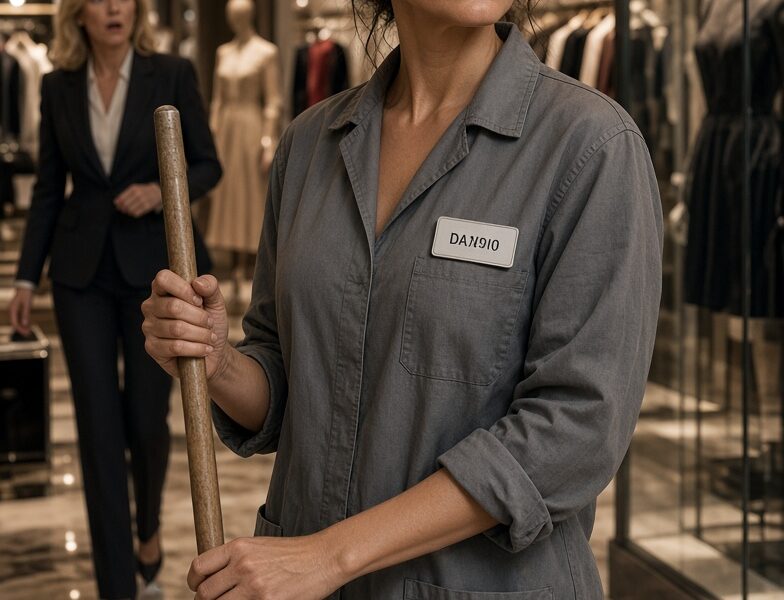
She Mopped Floors at Her Own Flagship Store… Until the Manager Tried to Fire the Wrong Girl
You embarrassed this store in front of a premium client.
She asked for another size. I was getting it when—
“Did I ask for a story?”
The floor manager, Miriam Cole, stood with her arms crossed, her heels planted on the polished marble like she owned the building. She didn’t. She just managed the flagship.
“People come here expecting excellence. If you cannot provide it, there are a hundred people outside who would be grateful for your job.”
She pointed at a smudge near the fitting rooms.
“Why is that glass still there?”
“Because you’re standing on it.”
The silence that followed was sharp enough to cut glass.
“Clear it. Now. And learn some respect. Lena, sales staff do not clean floors.”
Lena Marray lowered her eyes, took the cloth, and knelt.
She was twenty-four, with dark hair pulled into a tight knot and the kind of quiet that people mistook for weakness.
She had been at Laurent House for six weeks. Three of those weeks had been spent pretending to be someone else.
Not that anyone on that floor knew.
Miriam Cole had been with Laurent House for seven years. Historically strong sales. Historically feared. And recently, something had changed.
The numbers told a story no one at headquarters had bothered to read.
Revenue down six percent.
Turnover almost triple the company average.
One hundred eighty-seven customer complaints in eight months.
Internal staff complaints? Seven.
One hundred eighty-seven customers complain, half the employees leave, and only seven staff complaints exist.
Miriam tapped her clipboard and moved on.
That evening, across the city, a woman in a private office on the top floor of Laurent House headquarters looked at the same numbers on her screen.
Her name was Vivienne Laurent. She was forty-one, composed, and the chairwoman of a publicly traded fashion group with eleven billion dollars in annual revenue.
She had inherited the company from her mother and grown it into a global brand.
She had also, three weeks earlier, applied for a temporary facilities position at her own flagship store.
Her assistant, Daniel Mercer, had spent the entire time trying to talk her out of it.
“We send an audit tomorrow,” he said. “They notify the branch first.”
“Twenty-four hours.”
“Enough time to smile.”
“No.”
“I haven’t said anything.”
“You have the face.”
“What face?”
“The one preceding administrative chaos. Temporary facilities employee, agency placement. Nobody at branch level knows.”
Daniel pinched the bridge of his nose.
“You are the chairwoman of a publicly traded fashion group.”
“Exactly.”
“People generally consider that incompatible with cleaning bathrooms.”
“People behave perfectly when I enter a store.”
“Again, usually considered positive.”
“Not if the perfection disappears the moment I leave.”
She picked up a plain gray work shirt from the back of her chair.
“Name?”
“Aria Lane.”
“Subtle.”
“I need to remember when someone yells at me.”

Two days later, Vivienne Laurent—known on the floor as Aria Lane—walked through the employee entrance of Laurent House on Michigan Avenue carrying a mop, a spray bottle, and a cover file that said she was a temporary agency worker with no prior retail experience.
Her watch cost more than the annual salary listed on her cover file.
She had already decided to leave it at home.
She forgot.
The first person to notice was Lena.
“Those are limited edition,” Lena said, glancing at the sneakers.
“They’re just shoes.”
“They are three thousand dollars.”
Vivienne looked down at her feet.
“This is why billionaires should not disguise themselves unsupervised.”
“I am not a billionaire personally.”
“Much better.”
The shift supervisor, a wiry man named Tomas, handed her a clipboard.
“New cleaning staff. Is it obvious?”
“Only because nobody else walks in here smiling.”
“Should I stop?”
“Give it an hour.”
Her first assignment was the second-floor fitting rooms. The floor was immaculate. The mirrors were spotless. And yet, by the end of her first hour, she had found three things Miriam Cole’s daily checklist claimed had been done.
The bathrooms had not been cleaned since the day before.
The stockroom floor was sticky with something no one had reported.
And the employee break room trash had been emptied into a closet instead of the dumpster.
Vivienne documented all of it.
She also met Lena.
“Aria Lane?”
“Yes.”
“Agency sent you late.”
“I’m twelve minutes early.”
“Then you’re twelve minutes early to learning not to correct me.”
Lena’s voice was flat. Tired. The voice of someone who had learned that arguing cost more than it earned.
She handed over a laminated list.
“Bathrooms every hour. Fitting rooms every forty-five minutes. Floors, mirrors, employee areas, loading dock, and stockroom.”
“How many cleaners?”
“One.”
“Me?”
“Currently.”
“Currently implies history.”
“There were two.”
“What happened?”
“He quit.”
“Why?”
“Because he was sitting.”
“Training?”
“Standing people learn equally well.”
Vivienne filed that away.
Over the next three days, she watched.
She watched Miriam Cole humiliate a junior sales associate for offering a customer a dress that was on sale instead of the newer, more expensive one.
She watched her cut Lena’s Saturday shift after Lena asked for more hours to cover her mother’s medical bills.
She watched her pocket a customer complaint before it could reach the corporate inbox.
She watched her take a personal phone call in the middle of a premium client appointment.
And she watched Lena.
Lena, who had spent two years studying fashion merchandising before dropping out when her mother got sick.
Lena, who knew every seam, every fabric blend, every cut that flattered a body instead of fighting it.
Lena, whose customer satisfaction score was the highest in the store and whose return rate was the lowest.
Lena, who still smiled at the elderly woman who came in just to touch the silk.
“You looked beautiful in it,” Lena told a customer trying on a rehearsal dinner dress.
“Thank you.”
“She can help you check out.”
“Lena, I’m with someone.”
“Sophie can finish.”
“It’s fine now.”
Miriam appeared at the counter.
“The trousers are essential.”
“I only need the jacket.”
“And the cashmere coat completes it.”
“The jacket works beautifully with straight black trousers. You probably already have some.”
“I do.”
“Perfect. Just the jacket.”
The customer left happy. Miriam was not.
“Why did you talk her out of a larger transaction?”
“She didn’t want the rest.”
“Your job isn’t to protect her wallet.”
“My job is to help her leave happy.”
“Your job is whatever I tell you it is.”
Lena went quiet.
Miriam turned to Vivienne, who was mopping near the fitting rooms.
“Were you listening?”
“I was cleaning.”
“Then clean somewhere else.”
That night, Vivienne sat in her rented studio apartment in River North and opened a notebook.
She wrote down seven names.
Miriam Cole. Tomas Reyes. Sophie Patel. Marcus Webb. Two former employees who had quit in the last month. And Lena Marray.
Under Lena’s name, she wrote:
Two years fashion merchandising. Dropped out when her mother became ill. No disciplinary issues until Miriam took over. Development reviews repeatedly denied. “Not leadership material.” “Too customer focused.”
That sentence should embarrass this company.
She made copies.
The next morning, she was back on the floor.
Lena found her in the break room at lunch, eating a granola bar over the sink.
“You’re eating that like it’s a crime.”
“It’s not my lunch.”
“Then what is it?”
“Breakfast. Lunch was optional today.”
Lena hesitated, then held out half a sandwich.
“Here.”
“You don’t have to.”
“I know.”
Vivienne took it.
“When I was little,” Lena said, “my mom took me through the mall because it was free and air-conditioned. There was a fashion store with enormous windows. I’d stand outside staring at every mannequin and imagine wearing everything.”
“Did your mother let you?”
“We couldn’t afford socks in those places. But she always said one day I’d have a closet full of beautiful things.”
“Did you believe her?”
“I started reading about fabric, tailoring, designers. I learned clothes can change how somebody walks into a room.”
“What happened?”
“Life got expensive.”
Vivienne looked at her for a long moment.
“Then why are you still here?”
“Because I love it.”
“Not Miriam.”
“The place. The clothes. The moment somebody sees themselves the way they hoped to.”
Vivienne set down the sandwich.
“At Laurent House, what would you do if you could do anything?”
Lena blinked.
“Anything?”
“Anything.”
“Train sales teams. Not scripts. Fabric. Fit. How to listen when someone says they feel terrible in everything.”
“One good salesperson can make someone love a store.”
“A hundred good salespeople could change a brand.”
Vivienne nodded slowly.
That is a very good answer.
That afternoon, Miriam fired a junior associate for taking too long with a customer.
The associate cried in the stockroom.
Vivienne watched from the doorway.
Then she went upstairs, sat in a borrowed office with a borrowed phone, and made three calls.
The first was to the head of HR.
The second was to the head of loss prevention.
The third was to the company’s general counsel.
By the end of the day, she had copies of every altered time record, every withheld bonus, every falsified review, and every customer complaint Miriam had suppressed.
She also had the resignation letters of four former employees who were willing to speak.
She had, in three weeks of mopping floors, assembled a case file that two years of audits had failed to catch.
The collection launch was set for Friday.
Every employee would be on the floor. Every district manager would attend. Every camera would be on.
Miriam had already sent out a memo.
“The store will be flawless. That includes maintenance and people whose performance has become distracting.”
She meant Lena.
Vivienne read the memo twice.
Then she called Daniel.
“Move now.”
“You’re sure?”
“Friday. Every employee will be there.”
“Why does that matter?”
“Because Miriam humiliated them publicly. The truth can be public, too.”
Friday arrived.
The store glittered. Champagne was poured. The mannequins wore the new collection like armor.
Miriam stood near the entrance, greeting executives with a smile that looked borrowed.
Lena was on the floor, helping a customer who had traveled ninety minutes by train.
Vivienne was polishing the glass doors.
At 2:00 p.m., Miriam approached Lena.
“This is the fourth time this week you’ve spent more than twenty minutes with a customer.”
“She was deciding.”
“She bought one jacket.”
“She was deciding whether she could afford it. She could.”
“She could have bought more.”
“She didn’t need more.”
Miriam’s expression hardened.
“You know, I’ve been patient.”
“I know.”
“I gave you a chance. You’re from a background where chances don’t come often.”
“Excuse me?”
“You heard me. Girls from your background don’t get endless opportunities. You should be grateful.”
Lena’s hands trembled.
“I am grateful. For the job. Not for how you treat me.”
Miriam stepped closer.
“Careful.”
“Why? Because you’ll cut my hours? You already have. Because you’ll take my bonus? You already did. Because you’ll fire me?”
She swallowed.
“I’ve done nothing wrong.”
“I’ll tell you what you’ve done. You’ve made this branch look bad. You’ve undermined me in front of customers. You’ve refused to upsell. You’ve talked clients out of purchases. You’ve encouraged others to do the same.”
“That’s not true.”
“It is true. And I have had enough.”
She turned toward the district manager, who was watching from across the floor.
“I’d like to initiate a termination.”
“For what cause?”
“Insubordination. Failure to meet sales targets. Unprofessional conduct.”
Lena’s face went white.
“I arrive early. I stay late. I take every shift you give me. I treat every customer the same whether they spend fifty dollars or five thousand. You cut my hours to force me out. You took my bonus. You humiliate me because I won’t pressure people into buying things they don’t need. And now you’re firing me because you promised my job to your niece.”
The district manager’s head turned.
“Your niece?”
Miriam ignored him.
“You have no idea what I can do to your career.”
Lena’s voice shook.
“I know exactly what you can do. That’s why everyone is afraid of you.”
“Then be afraid.”
“I’m not. I’ll tell Chairwoman Laurent exactly what kind of employee you are.”
Miriam laughed.
“You’ll tell Chairwoman Laurent? You couldn’t get within a hundred feet of her.”
“I can hear her.”
The voice came from behind them.
Vivienne Laurent set down the mop.
She was still wearing the gray work shirt. The clipboard was still in her hand. But something in her posture had changed.
Lena stared.
“Miss Lane?”
“No.”
Vivienne walked toward them.
“Say that again. The part about Chairwoman Laurent.”
Miriam’s face flickered.
“This has nothing to do with you.”
“You said you’d tell her. I’m standing right here.”
She picked up the mop and set it against the wall.
Miriam’s mouth opened. Closed.
“I think I have,” Vivienne said.
She turned to the district manager.
Sophie, have her removed.
Sophie Patel stepped forward.
Did you hear me?
“Yes,” Sophie said.
“Then call.”
“No—” Miriam spun. “What? Have you all lost your minds?”
“Actually,” Vivienne said, “your timing is excellent.”
She reached into her pocket and pulled out a phone.
“Mr. Mercer. Chairwoman Laurent.”
Miriam went pale.
“What—”
“You’re a cleaner.”
“For two weeks. Before that, I founded the company whose name is on this building. For two weeks, you showed me what happens here when you believe the person standing in front of you has no power.”
“Chairwoman Laurent—”
“Don’t. You never called me that when you thought I cleaned your floors.”
Vivienne’s voice was calm. That was the worst part.
“Retaliatory scheduling. Unpaid overtime. Customer profiling. Manipulated bonuses. Threats against employees.”
“You misunderstood.”
“Did I misunderstand when you told Lena girls from her background don’t get endless chances? Because I was close enough to hear every word.”
Miriam’s jaw worked.
“We verified unauthorized bonus reclassification, altered time records, falsified performance reviews, and repeated violations of employee retaliation policy. I gave them the records.”
“You?” Miriam stared. “After everything I did for you.”
“You taught me to be afraid. That is not the same thing as helping me.”
“I made this branch profitable.”
“You produced revenue.”
“Exactly.”
“And turnover. Refunds. Customer complaints. Fear.”
“Retail requires pressure.”
“Pressure is not humiliation.”
“They’re too sensitive.”
“No. They were trapped.”
Lena stepped forward.
“She changed my schedule after I complained. She threatened my reference. She told me I should be grateful anyone hired me.”
Vivienne turned to Miriam.
“You kept telling us there were a hundred people outside who could replace us. Maybe you should have wondered why so many people inside wanted to leave.”
She paused.
“Miriam Cole, your employment with Laurent House ends today.”
“You can’t throw away seven years because these people are emotional.”
“I am terminating you for falsifying records, withholding compensation, retaliatory scheduling, and repeated abuse of authority. The reasons are documented. Every one of them.”
She looked around the floor. At the sales associates. At the stockroom staff. At the maintenance crew.
“Everyone who lost wages through altered time records will be repaid. Every improperly withheld bonus will be restored. No branch manager will be able to close employee complaints without independent review.”
She turned to Lena.
“Your termination is void.”
Lena’s knees nearly gave out.
“Are you okay?”
“You’re the CEO.”
“That was not the question.”
“I don’t know.”
“That’s fair.”
Lena laughed once, shakily.
“You own a luxury fashion company and still bought that granola bar.”
“It was excellent.”
“I complained about my manager to the owner.”
“Extremely useful.”
“Did you know who I was the whole time?”
“I knew your employee file. I didn’t know you.”
She paused.
“You showed me.”
Miriam was escorted out by security. The district manager followed, already on his phone with HR.
The floor went quiet.
Then, one by one, the associates went back to work.
Lena stood in the middle of the showroom, looking at the mannequins, the racks, the glass doors she had walked through every morning for six weeks.
“Why am I here?” she asked.
“Your termination has been voided.”
“I know.”
“Your missing compensation has been restored.”
“I know.”
“There’s a part you don’t know.”
Lena looked up.
“Management development assessment. For you. Unless there’s another Lena Marray who works here.”
Lena stared.
“You checked.”
“I enjoy accuracy.”
A week later, Lena Marray was promoted to assistant manager of the flagship store. Six months after that, she was running it.
Vivienne Laurent returned to the top floor, where she belonged. But she kept the gray work shirt hanging in her office closet.
Not as a reminder of what she had done.
As a reminder of what she had learned.
The controls at Laurent House changed. Sales metrics were no longer measured faster than people were. Customer satisfaction and employee retention were weighted equally. Every complaint, internal and external, was logged, reviewed, and answered.
The phrase “too customer-focused” was removed from every evaluation form in the company.
Lena hired Sophie Patel as her assistant manager. She promoted two stockroom employees into sales. She started a training program built not on scripts but on listening.
One year later, the flagship store’s revenue was up eleven percent.
Turnover was down by half.
And the fitting room mirrors were spotless.
Not because someone was watching.
Because someone finally cared.
Vivienne stood outside the flagship one afternoon, watching customers move through the glass doors.
A young woman stopped on the sidewalk, staring at a mannequin in the window.
Vivienne recognized the look.
She had worn it once.
A staff member stepped outside.
“Would you like to come in?”
“I’m only looking.”
“That’s allowed.”
The woman hesitated, then walked through the doors.
Vivienne smiled.
That was the whole point.
Some people learn the value of a thing by what it costs.
Lena Marray learned it by what it lets somebody feel.
And Vivienne Laurent learned that the most important measurement in retail isn’t revenue.
It’s whether the people inside the building are glad to be there.
Everything else follows.









