She Left With One Suitcase After Her Stepmother Took the House — Then the Will Changed Everything
Late autumn winds swept through the apple orchards outside Gettysburg, Pennsylvania, scattering copper-colored leaves across the narrow country road like discarded memories.
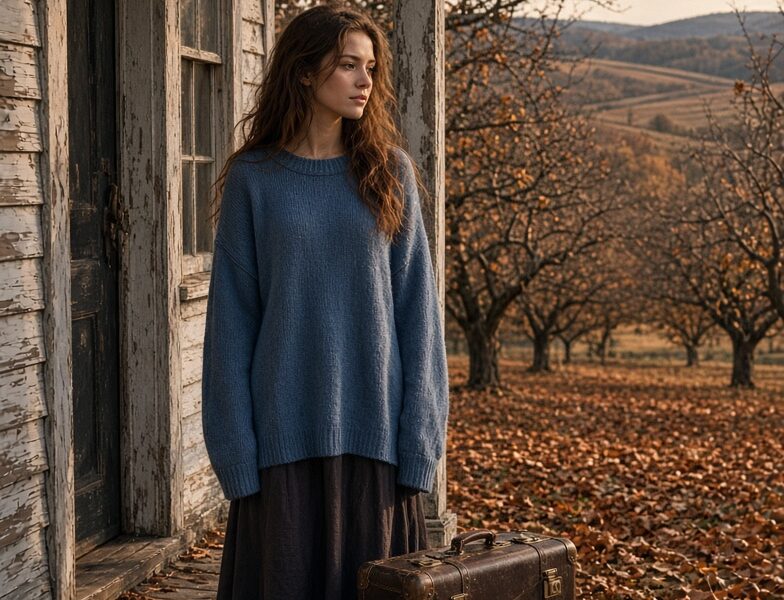
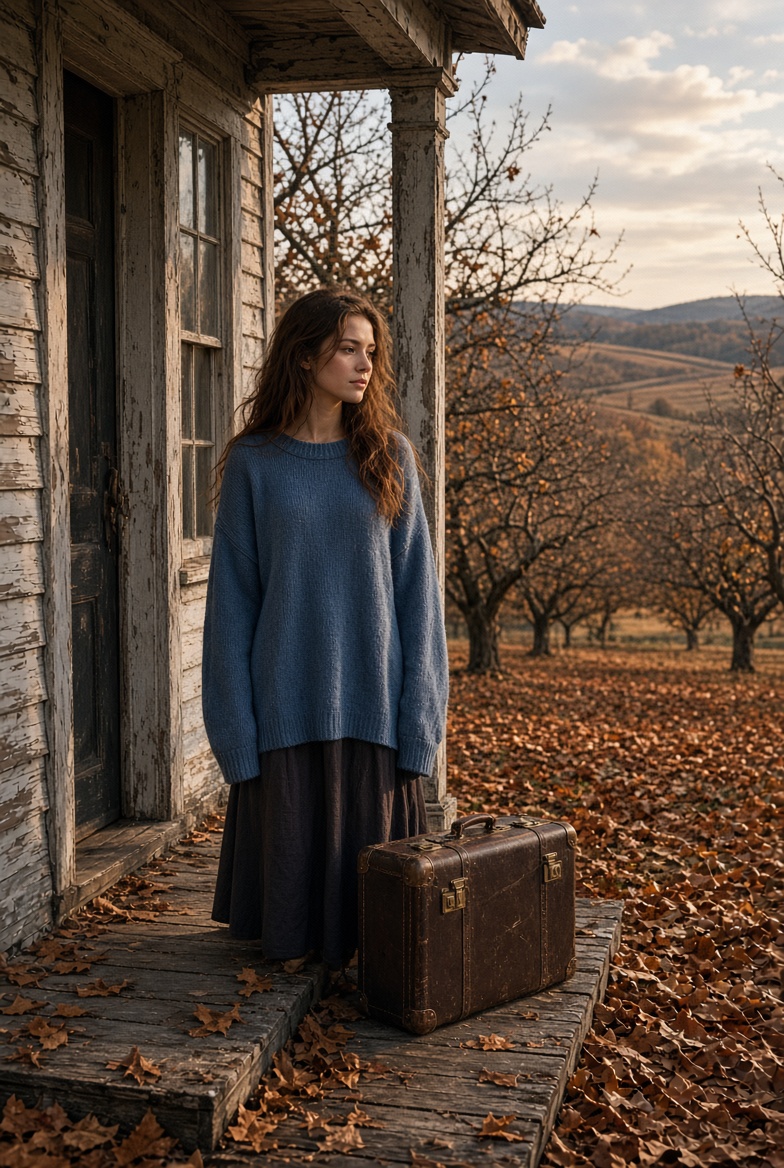
Beneath a pale November sky, Rosalie Merritt stood on her father’s porch with a single suitcase beside her and absolutely nowhere to call home.
At twenty-seven, she was a strikingly beautiful young woman with long chestnut-brown hair that caught the weak sunlight, clear blue-gray eyes that held both exhaustion and defiance, and fair skin lightly dusted with freckles across her nose and cheeks.
Her slender frame looked almost fragile beneath her faded blue sweater, the wool worn thin at the elbows from years of careful use, but there was a quiet resilience in the way she held herself—shoulders back, chin lifted, even as her world crumbled around her.
She had once worked as an accountant for an agricultural supply company in Harrisburg, building a promising career with benefits and a retirement plan before her father’s illness brought her home to Adams County.
For nearly two years, she had measured her days in medication schedules, hospital appointments, and sleepless nights spent listening for the sound of her father’s breathing from the next room.
Now Arthur Merritt was gone, buried beneath the cold Pennsylvania earth beside her mother, and the house where she had cared for him no longer welcomed her.
Her stepmother, Vivien Merritt, stood in the doorway behind her like a sentinel guarding territory she had already claimed.
At fifty-five, Vivien was tall and thin, with carefully styled ash-blonde hair that never dared move out of place, pale skin stretched tight over sharp cheekbones, and sharp green eyes that missed nothing and forgave even less.
Vivien possessed the controlled elegance of a woman who considered emotional restraint a form of superiority, someone who could attend a funeral without shedding a single tear and consider it a victory of willpower over weakness.
She had never been openly affectionate toward Rosalie, not in the twelve years since she had married Arthur, but since the funeral, her politeness had hardened into something colder—a glacial courtesy that made every word feel like a warning.
“The house belongs to me now, Rosalie. Your father made his wishes perfectly clear.”
Three photocopied pages of Arthur’s will lay on the hallway table, their edges slightly curled, the text blurry from repeated copying.
Vivien had shown them to Rosalie that morning after the younger woman questioned why surveyors had been walking through the orchards with clipboards and measuring tapes, marking boundaries that had never mattered before.
“Dad told me he wanted me to look after part of the orchard,” Rosalie answered quietly, her voice steady despite the tremor in her hands. “He said we’d talk about it when he got better.”
“But he didn’t get better, did he?”
The words struck harder than Vivien seemed to realize—or perhaps exactly as hard as she intended.
Rosalie remembered her father as a broad-shouldered man with weathered hands that knew every tree by touch, thinning silver hair that she had gently combed during his final weeks, and a gentle patience that illness had never entirely taken from him.
Arthur had taught her to recognize apple varieties by their leaves alone—Macintosh from Winesap, Golden Delicious from Granny Smith—and to believe that keeping one’s word mattered more than owning anything valuable.
During his final months, when the pain made it difficult for him to speak, he had often squeezed her hand and apologized for the opportunity she had sacrificed, for the career she had set aside, for the life she had postponed.
“Promises aren’t property,” Vivien continued, her voice clipped and precise. “I cannot keep this place running on sentiment. The buyers are interested in the entire property, and I intend to listen.”
“Then let me see the complete will.”
Vivien’s expression tightened, the muscles around her jaw contracting almost imperceptibly. “You’ve questioned everything I’ve done since the funeral. I won’t live under my own roof being treated like a criminal. You need to leave.”
Rosalie could have argued. She could have demanded more time, threatened legal action, called the police to force a formal eviction process.
But the woman standing before her had already decided that grief was an inconvenience, and Rosalie refused to beg for kindness from someone who had none to give.
She packed her father’s old jacket—the worn brown corduroy one that still smelled faintly of woodsmoke and apples—a framed photograph of her parents on their wedding day, a few clothes, and the documents she personally owned.
Her savings would cover several nights in town. Beyond that, she had no plan.
At the bottom of the porch steps, she looked back once. For a terrible moment, she wanted her father to open the door and tell her everything would be all right, that this was all a misunderstanding, that he was still there and still loved her.
The door remained closed. The curtains didn’t even twitch.
Nearly an hour later, Rosalie was walking toward the main road, pulling her suitcase over uneven gravel that threatened to tip it with every step.
The orchard stretched beside her, its bare branches reaching toward the gray sky like supplicating hands.
She had almost reached a wooden fence when a sharp metallic crash erupted from a nearby barn—the sound of something heavy falling, of metal striking wood, of chaos breaking the silence.
Inside the adjoining pasture, a young chestnut horse startled violently and lunged toward a partly unlatched gate, its hooves thundering against the frozen ground.
A powerful bark split the air.
Beside the fence stood Bastion, a seven-year-old retired military working German Shepherd with a thick black-and-tan coat that gleamed even in the weak autumn light, intelligent amber-brown eyes that seemed to assess everything and everyone, and the disciplined bearing of an animal accustomed to demanding work.
Once trained to detect explosives in combat zones, to alert on the faintest trace of danger, he had been legally adopted after retirement by Staff Sergeant Callum Vance.
Although his working days were over, his alertness had never faded, not for a single moment.
“Bastion, stay.”
The command came from a tall man working beside the gate.
Callum Vance was thirty-two, a handsome, rugged Marine Corps Reserve Staff Sergeant with broad shoulders that strained against his denim work shirt, a lean, athletic build honed by years of physical training, neatly trimmed dark brown hair that showed just a hint of gray at the temples, and a clean-shaven face defined by a strong, square jaw.
His gray-blue eyes were watchful without being unkind, the eyes of someone who had seen too much but refused to let it harden him completely.
Years of military service had strengthened his instinct to protect others, sometimes making him assume responsibilities that were not his to carry.
Today, dressed in a worn denim work shirt with the sleeves rolled up to reveal forearms corded with muscle, dark jeans stained with grease, and scuffed leather boots, he was repairing fencing between civilian machinery jobs.
Bastion held his position while Callum swung the gate shut and secured the latch with practiced efficiency.
“Ma’am, step back from the fence.”
Rosalie stumbled backward, dropping her handbag into the dirt.
The horse struck the wooden rails once more before retreating toward the barn, its eyes wild with fear.
For several seconds, she could barely breathe, her heart pounding against her ribs like a trapped bird.
Callum checked the latch again before approaching, his boots crunching on the frozen gravel. “Are you hurt?”
She shook her head, unable to find words.
“No, just frightened.”
“That’s understandable.” He glanced toward Bastion, who stood quietly beside him, watching Rosalie with an intensity that was somehow reassuring rather than threatening. “He heard trouble before I saw it.”
The German Shepherd stood quietly beside him, watching Rosalie without approaching, his ears forward, his tail relaxed.
Callum picked up her handbag and handed it back, brushing off the dirt with a quick, efficient motion.
“Thank you,” she whispered.
“Where are you headed?”
“Gettysburg. I’m trying to reach the bus stop.” She gestured vaguely toward the road ahead. “It’s about another mile along this road.”
When she introduced herself, something changed in his expression—a flicker of recognition, then something softer, something that looked almost like sorrow.
“Merritt? Are you Arthur Merritt’s daughter?”
Rosalie nodded cautiously, her defenses rising instinctively.
“My grandfather worked with your father years ago. Orchard access roads, equipment, that sort of thing.” His voice softened, losing its official edge. “I heard about Arthur. I’m sorry.”
The unexpected kindness nearly undid her, threatened to crack the fragile composure she had maintained since leaving the house. Her eyes burned, but she refused to let the tears fall.
“He was a good man,” she managed.
“Granddad always said so.”
Callum noticed the suitcase, but asked no uncomfortable questions. He didn’t ask where she was going or why she was walking alone on a country road with everything she owned in one bag.
Instead, when Rosalie mentioned her accounting background, he explained that his agricultural equipment repair business needed help organizing invoices and expenses—that he was drowning in paperwork and needed someone who understood numbers.
He offered her a business card, slightly greasy at the edges from his pocket. “No obligation, but if you’re looking for work, give me a call.”
Rosalie studied the card before slipping it into her pocket—Vance Agricultural Repair, with a phone number and a Gettysburg address.
For the first time that day, someone had offered her an opportunity without asking her to surrender anything in return.
“Thank you, Callum.”
He gave a small, reassuring smile that crinkled the corners of his eyes. “Take care, Rosalie.”
She continued toward the bus stop, her suitcase wheels rattling on the gravel.
Behind her, Bastion remained beside the fence, watching until she disappeared around the bend, his amber eyes tracking her until she was nothing but a memory.
That evening, Callum mentioned the encounter to his grandmother, Agnes Vance, as they sat in her warm kitchen while rain tapped against the windows.
At seventy years old, with silver hair gathered into a loose bun, warm brown eyes that had seen both joy and sorrow, and work-worn hands that had planted and harvested and healed, Agnes possessed the practical kindness of a woman who had spent her life caring for family and farmland.
“Arthur’s daughter,” she repeated, setting down her teacup with a soft clink. “Good heavens, I haven’t seen that girl in years. She used to run through the orchards with her hair flying behind her, always laughing.”
Callum explained what had happened—the suitcase, the stepmother, the closed door.
Agnes grew thoughtful, her eyes distant. “Your grandfather and Arthur kept records of their orchard arrangements. There was an old storage compartment in the barn—behind the rear shelving. I haven’t looked inside it since we renovated.”
“Probably nothing important now,” Callum said, though he didn’t sound convinced.
“Perhaps.” Agnes hesitated, her fingers wrapping around her teacup as if seeking warmth. “But I remember something else. Those papers included the name of the attorney Arthur trusted with his property matters. He was very particular about who handled his affairs.”
Callum looked up, his attention sharpening.
Agnes stared toward the darkened window, searching her memory. “And if I remember correctly, Arthur was very particular about what he wanted that attorney to protect.”
A cold November rain had washed the dust from Gettysburg’s streets, leaving the old brick sidewalks shining beneath a pale morning sky like polished stone.
Inside a modest roadside motel, Rosalie Merritt sat beside the window, staring at a business card she had carried in her coat pocket for four days.
The room was small and anonymous—a bed with a faded floral bedspread, a television bolted to the wall, a bathroom so narrow she had to turn sideways to close the door.
But it was warm, and it was hers, paid for with her own money.
She had applied for six accounting positions since leaving her father’s house. Two employers had acknowledged her applications with form letters that began “We regret to inform you.” The others remained silent, their rejection implicit in their absence of response.
Her savings were disappearing into motel charges and meals she barely had an appetite to finish—$89.50 per night, $12.75 for a sandwich and coffee, the numbers ticking down in her notebook like a countdown to disaster.
What frightened her most was not the possibility of running out of money, though that fear gnawed at her constantly. It was the thought of becoming someone who waited helplessly for another person to decide her future—someone passive, someone pitied, someone who had lost not just her home but her agency.
She turned Callum Vance’s card over once more, running her thumb over the embossed letters, then dialed Vance Agricultural Repair.
“Callum, this is Rosalie Merritt. We met by your fence.”
“I remember.” His voice warmed, and she could hear the smile in it. “How are you doing?”
“I’m looking for work. You mentioned needing help with your accounts.”
“I did. Would you like to come see what needs doing before either of us makes a commitment?”
The question surprised her. He wasn’t offering charity. He was offering a choice.
By ten o’clock, Rosalie stood inside a small office adjoining Callum’s equipment workshop, surrounded by the organized chaos of a business that had grown faster than its systems.
Repair orders occupied one filing cabinet, their edges frayed and their dates inconsistent. Supplier invoices filled another, some paid, some pending, some duplicated in ways that made her accountant’s brain ache.
A cardboard box beneath the desk contained receipts whose dates stretched back several months, some crumpled, some stained with coffee, some barely legible.
Callum admitted that he could rebuild a damaged tractor transmission more confidently than he could reconcile a bank statement.
Rosalie examined the records, asked about his payment procedures, and noticed that several invoices appeared in both a paper ledger and an electronic expense report.
“Are these two separate payments?” she asked.
“That’s what I need someone to tell me.”
She looked up, meeting his eyes directly. “I’d like to propose a paid trial week. We agree on the hours and rate, and afterward we decide whether this arrangement works.”
Callum nodded without hesitation. “Fair enough.”
For the next several days, Rosalie worked methodically through the accounts.
She matched supplier invoices against bank transactions, identified duplicated entries that had inflated recorded expenses by nearly $7,000, and discovered two pending payments that could have resulted in actual overpayment.
She verified the amounts before Callum contacted the suppliers to correct them.
By Friday, she had established a straightforward tracking system and prepared a list of outstanding questions.
Callum studied her report for a long moment, his expression unreadable.
“You’ve done more in five days than I’ve managed in three months.”
“You were busy keeping people’s equipment running.”
“That doesn’t make the paperwork disappear.”
“No,” she replied, allowing herself a small smile. “That’s why you need an accountant.”
He offered her continuing part-time work at the agreed rate with regular hours and payment dates.
Rosalie accepted. The relief was considerable, but the pride mattered more. She had earned something again—not been given, not been pitied, but earned.
When Agnes learned that Rosalie was still staying at the motel, she mentioned a cottage at the far edge of the Vance property. It had previously been rented to seasonal workers and was currently vacant.
Rosalie inspected it carefully before agreeing to anything.
The little house had a narrow kitchen with a window overlooking the meadow, a bedroom just large enough for a bed and a dresser, and a porch with weathered wooden steps that creaked in the wind.
Its heating worked, the windows closed properly, and the rent was within her budget—$650 per month, utilities included.
Agnes provided a written lease, and Rosalie paid the security deposit and first month’s rent from her savings and wages.
That evening, she placed her father’s photograph on the bedroom windowsill—Arthur and her mother on their wedding day, young and hopeful and alive.
The room was small and nearly everything in it belonged to someone else. Yet when she turned the key in the front door, she felt an unfamiliar sensation.
Nobody had given her permission to remain out of pity. She had paid for the right to be there.
The following week settled into a rhythm she hadn’t realized she missed—the structure of regular hours, the satisfaction of problem-solving, the quiet companionship of shared work.
Rosalie arrived at the workshop each morning, sometimes finding Callum already outside with grease on his hands and an engine component spread across his workbench like a surgical patient.
He never asked why she had left her father’s property, although his occasional silences suggested he understood there was more to her circumstances than she had shared.
One afternoon, when Agnes needed help bringing an elderly gray mare named Hazel back to her stall, Callum showed Rosalie how to hold the lead rope without wrapping it around her hand.
“She’s gentle,” he explained, “but she weighs enough to remind you who’s stronger.”
Rosalie glanced at Hazel’s broad, patient face and laughed nervously. “That’s reassuring.”
“She responds better when you don’t try to fight her.”
Rosalie guided the mare through the barn doorway, astonished when Hazel followed her calmly, her hooves soft against the straw.
“Apparently, we understand each other,” she said.
Callum smiled. “I think she likes you.”
Bastion was less immediately demonstrative.
The retired German Shepherd watched Rosalie during her first days at the cottage, remaining close to Callum whenever they crossed the yard, his amber eyes tracking her movements with professional suspicion.
Gradually, however, he began greeting her with a relaxed tail and carrying his worn rubber ball toward her porch, dropping it at her feet with hopeful expectation.
One clear afternoon, Callum invited her to join their daily obedience exercises.
He demonstrated a simple retrieve game, hiding the ball behind a large flower pot while Bastion waited for permission, his body quivering with barely contained excitement.
“Keep your cue short,” Callum said, “and give him a moment to understand what you’re asking.”
Rosalie repeated the signal. Bastion glanced toward Callum, who remained silent. After a pause, the dog moved around the flower pot, located the ball, and returned it to her feet.
“You did it!” she exclaimed, kneeling to praise him.
Bastion leaned briefly against her shoulder, accepting the attention before settling beside her, his tail sweeping the ground in slow, contented strokes.
Callum watched from a few steps away. He had seen Rosalie smile politely before, but this was different. Her laughter was spontaneous, unguarded, almost youthful.
For a moment, the worry she carried seemed to loosen its grip.
Later, over supper with Agnes, Rosalie found herself speaking about ordinary things—a recipe she wanted to try, a customer who had mistakenly ordered the same replacement part twice, Hazel’s apparent preference for apples over carrots.
It was only afterward, walking back to her cottage beneath the darkening sky, that she realized an entire evening had passed without her thinking about Vivien.
But grief did not disappear simply because life became gentler. It waited in quiet moments, in the smell of woodsmoke, in the sound of wind through bare branches.
One evening, Agnes brought a small folder of old orchard records to the workshop. She had remembered their conversation about Arthur and thought Rosalie might appreciate seeing something connected to her father’s earlier years.
Most pages concerned shared access road maintenance and equipment expenses between the Merritt and Vance properties.
Rosalie examined them carefully, recognizing her father’s precise handwriting in the margins—his neat columns of numbers, his brief notes about weather and yield and repairs needed.
Then she found an unfamiliar reference beside his signature: a partial property file number and the name of an attorney’s office.
The notation concerned an old land access agreement, not Arthur’s will.
“Agnes, do you remember what this refers to?”
Agnes adjusted her glasses, peering at the document. “Not exactly. Your father and my husband handled several arrangements together. Some records were kept elsewhere.”
Rosalie stared at the reference. Vivien had shown her only three photocopied pages of the will. She had never seen the original, nor had she asked an independent attorney to examine it.
For the first time, that omission troubled her more than Vivien’s accusations.
She carefully copied the reference onto a clean sheet of paper.
“I think I need to find out what my father actually left behind.”
Agnes rested a gentle hand on the folder. “Then you should begin with the proper records, dear, not anyone’s version of them.”
Rosalie looked again at Arthur’s signature, remembering his hands, his voice, his promises.
She had spent weeks wondering whether he had forgotten the promise he made beside the orchard. Now, sitting beneath the workshop’s quiet yellow light, she considered another possibility.
Perhaps she had never been told the whole story.
The first breath of winter settled over Gettysburg, Pennsylvania, leaving frost along the orchard fences and a thin veil of mist above the fields.
Inside the Vance workshop, Rosalie Merritt studied a handwritten reference number that refused to leave her thoughts.
For three days, she had been making inquiries during her lunch breaks, learning how estates were administered in Adams County and how an interested beneficiary could request information about a deceased parent’s will.
The Register of Wills office had explained that she could check whether Arthur Merritt’s estate had been opened and what records were available.
The clerk, a patient woman with reading glasses and a kind voice, had walked her through the process without making her feel foolish for asking.
Rosalie understood that the old agreement Agnes had shown her proved nothing about inheritance. Still, the attorney’s name beside her father’s signature suggested a path she had never been given the chance to follow.
Agnes joined her at the desk, carrying a yellowed photograph of her late husband beside Arthur—two young men in work clothes, standing in front of a barn that no longer existed.
“I remember something about those records,” she said. “My husband kept the original correspondence and road surveys in a storage recess behind the barn’s rear shelving, but Callum rebuilt that section after a storm damaged the roof. We never found the compartment again.”
That afternoon, Callum cleared time between repair appointments to help.
He moved heavy tool boxes while Rosalie checked labels and Agnes directed them from the doorway. Bastion followed quietly, occasionally settling near Callum’s boots with a sigh.
They examined the loft, the cabinets, and the rear wall without finding anything beyond old equipment manuals and rusted fittings.
“We’ve checked everything accessible,” Callum said eventually, wiping dust from his hands.
Bastion suddenly lifted his head. A faint scratching sound came from behind a wooden rack. The German Shepherd approached, ears forward, and gave two sharp barks.
“Easy, boy.”
Callum listened. Another weak scrape followed.
He shone a flashlight through a gap and discovered a small stray cat trapped between loose boards. The animal was thin, with matted gray-and-white fur, one torn ear, and frightened yellow eyes.
Callum secured Bastion at a distance, then carefully removed the lower boards while Rosalie held the flashlight.
Once the opening widened, the cat slipped free and disappeared through the open barn door.
“Good catch, Bastion,” Rosalie whispered.
As Callum replaced a damaged board, his flashlight illuminated an unusual seam behind the rack.
“Rosalie, look at this.”
He pulled aside a warped panel, revealing a shallow wooden recess built into the wall.
Inside lay a canvas document pouch, several folded survey drawings, and a bundle of letters tied with faded string.
Agnes stepped closer. “That’s his handwriting,” she said, recognizing her husband’s labels.
Rosalie opened the pouch with trembling fingers.
The documents described the shared orchard access road, drainage responsibilities, and several property discussions between the families.
One letter referred to Arthur’s later estate planning and included the complete legal file reference, the attorney’s name, and the office’s updated contact information.
Unlike the incomplete land access notation Rosalie had found earlier, this correspondence directly connected Arthur to the attorney who had prepared his will.
It contained no hidden deed or proof of ownership, but it gave Rosalie the information she needed to direct her inquiries properly.
She held the letter against her chest for a moment.
“He was planning something,” she murmured.
“Perhaps,” Agnes answered gently. “But let the records tell you what it was.”
The following morning, Rosalie contacted the attorney’s office named in the correspondence and asked about the procedure for obtaining information concerning Arthur’s estate. She also arranged an initial consultation with an independent estate attorney.
A brief telephone response confirmed that the office had previously represented Arthur, although confidentiality and estate procedures limited what could be discussed immediately.
Rosalie wrote down every instruction, determined not to confuse hope with certainty.
Life at the farm continued around her questions.
Callum repaired a hay baler’s hydraulic system, his hands black with grease and his brow furrowed with concentration. Rosalie prepared monthly expense reports, her fingers flying over the keyboard.
Bastion resumed his afternoon walks, patrolling the property with the same vigilance he had brought to combat zones.
Yet something between Callum and Rosalie had quietly changed. Their conversations lingered after work, stretching into evenings that neither seemed eager to end.
She found herself listening for his footsteps outside the office, recognizing the particular rhythm of his walk—confident, measured, unhurried.
One evening, heavy rain swept across the property, knocking out power at Rosalie’s cottage. She checked the lights and called Callum when she noticed the circuit breaker would not remain set.
He arrived with a flashlight, rain streaming from his jacket, and inspected the panel.
He traced the problem to a faulty exterior outlet affected by moisture. After isolating the circuit safely, he restored power to the unaffected rooms and advised her to have the damaged outlet professionally replaced.
Rosalie made tea while rain tapped against the windows. Bastion settled beside the table, his head resting on his paws.
“You didn’t have to come out in this weather,” she said.
“You called because something was wrong.”
“That doesn’t make it your responsibility.”
Callum considered her words, his hands wrapped around the warm mug. “I’m learning there’s a difference.”
She looked at him across the table. “Between what?”
“Helping someone and deciding they need saving.”
For a while, neither spoke. The rain filled the silence, a steady percussion against the glass.
Then Rosalie admitted how frightened she had been when she left Harrisburg to care for Arthur. She had loved her father without reservation.
But somewhere between hospital visits and unpaid leave, she had begun believing her own future no longer mattered.
“I thought going home meant giving everything up,” she said. “Now I’m not even sure I want the life I left behind.”
Callum turned his cup slowly, his eyes thoughtful.
“I lost someone once because I kept trying to solve problems she wanted to face herself. I thought I was protecting her. She felt I didn’t trust her.”
“Did you?”
“Not enough.”
The honesty touched Rosalie more deeply than reassurance would have.
She reached toward Bastion, gently stroking the fur behind his ears, grateful for the quiet companionship that asked nothing of her.
Two days later, however, Callum repeated the very mistake he had confessed.
Hearing from a longtime equipment customer that Vivien was accelerating negotiations with a land buyer, he telephoned a business acquaintance to ask about the proposed sale.
When he mentioned the conversation to Rosalie, she grew still.
“You contacted someone about my father’s property.”
“I wanted to know whether she was moving ahead before you could get answers.”
“You should have asked me.”
Callum opened his mouth, then stopped.
Rosalie’s voice was controlled, but her disappointment was unmistakable. “I spent weeks being told what I could and couldn’t question. I can’t start over if everyone makes decisions for me.”
“You’re right,” he said quietly. “I crossed a line. I’m sorry.”
She searched his face, expecting an explanation. None came.
“I won’t do it again without your permission,” he added.
That evening, Rosalie received a call from her newly retained attorney. The preliminary estate records indicated that Arthur’s will contained provisions directly concerning her interests, but the complete documents still required formal review.
Before Rosalie could absorb the news, her phone vibrated again. A message from Vivien appeared.
I know you’ve been asking questions. Stop before you make things worse for everyone.
Rosalie stared at the words, then looked toward the dark orchard beyond her window.
For the first time, she understood that discovering her father’s wishes might require more courage than leaving his house ever had.
A bitter December wind swept across the Vance farm outside Gettysburg, rattling the workshop windows beneath a sky heavy with approaching snow.
Rosalie Merritt was reviewing supplier accounts when a familiar silver sedan pulled into the gravel driveway.
Vivien stepped out carrying a leather folder. She entered without greeting Callum, who was repairing a tractor near the open workshop doors, and placed the folder before Rosalie.
“We need to settle this nonsense.”
Rosalie closed her ledger. “What nonsense?”
“Your inquiries. Your lawyer. The accusations you’re encouraging.”
Vivien opened the folder, revealing a prepared agreement. “Maintaining that property cost more than you understand. The buyer is offering a reasonable price, and I cannot afford endless delays. Sign this acknowledgment that you won’t pursue a claim against the estate, and I’ll arrange a payment for you.”
Rosalie read the first paragraph. It described a release of potential inheritance rights.
“Why would you need my signature if Dad left me nothing?”
Vivien’s carefully maintained composure faltered. “I’m trying to help you avoid an expensive disappointment.”
“Then you won’t mind if my attorney reviews it.”
“Must you make everything difficult?” Vivien leaned closer. “People are already talking about you living on an unmarried man’s property. Your father would be ashamed of the attention you’re attracting.”
The accusation stung, but Rosalie recognized its purpose.
Her stepmother wanted her embarrassed enough to surrender the one question she had finally found the courage to ask.
Across the room, Callum set down his wrench. He remained where he was, his jaw tightening, but he did not interrupt.
Bastion rested beside the office doorway, alert yet quiet.
Rosalie closed the folder and pushed it back. “I won’t sign anything without independent legal advice, and you don’t get to use my father’s memory to frighten me.”
Vivien stared at her. “You’ll regret turning against your family.”
“I’m trying to understand what my family left me.”
Vivien gathered her papers and departed. Only after her car disappeared did Rosalie notice her hands shaking.
Callum approached slowly. “Do you want me to say something?”
“Not yet.”
He nodded and returned to his work. Somehow, that small act of restraint meant more than any promise to protect her.
Two days later, Rosalie met with her attorney, Margaret Ellery, a fifty-one-year-old estate lawyer with short iron-gray hair, thoughtful brown eyes, and a composed, deliberate manner.
Margaret had spent decades helping families navigate inheritance disputes and had learned that grief often made ordinary disagreements painfully personal.
She laid a complete copy of Arthur’s admitted will across her desk.
“Your father made a specific provision for you, Rosalie.”
The words seemed to stop the room.
Margaret pointed to a legal description identifying a separate section of the Merritt apple orchard. “The will directs that this parcel passes to you, subject to the estate’s proper administration. The main residence and other specified assets are left to Vivien.”
Rosalie stared at the description. For weeks, she had wondered whether Arthur’s illness had changed his feelings toward her.
“He remembered,” she whispered.
Margaret allowed the silence to settle before continuing.
Vivien had been appointed executor of Arthur’s estate, giving her responsibility for administering its assets, but not the right to disregard the will’s specific gift to Rosalie.
The will did not mean Rosalie could immediately take possession or ignore estate obligations. Title and administration still required attention.
Margaret would formally assert Rosalie’s interest and ensure the proposed purchaser understood that Vivien could not simply promise the entire property as though she owned every parcel outright.
Later that week, the purchaser suspended negotiations for the combined property, pending clarification of the estate’s title and authority to sell.
Rosalie should have felt victorious. Instead, she sat in her cottage holding a copy of the will, crying for the father who had tried to leave her something lasting.
With permission arranged through the estate’s representative, Rosalie visited the orchard parcel to assess its condition. Callum accompanied her, bringing Bastion along the old service path.
The trees stood bare beneath the winter sky, their branches stretching above fallen leaves and neglected irrigation lines.
Near a drainage ditch, Bastion suddenly stopped.
The damp soil shifted slightly beneath his paws, sending a few loose clumps tumbling into the ditch. He backed away from the path’s edge.
Callum noticed the dog’s hesitation and examined the soil ahead.
“Rosalie, don’t step there.”
She froze.
A narrow crack ran along the track, almost hidden beneath wet leaves. Callum approached from firmer ground and saw that runoff had hollowed out the bank beneath the surface.
“That edge could collapse.”
They retreated and followed a safer route. Farther along the ditch, Callum found blocked drainage outlets and signs of prolonged erosion.
Rosalie looked across the orchard. “How much would repairing this cost?”
“I can’t give you a responsible number without someone inspecting the whole system. But it won’t be cheap.”
She studied the neglected trees. Arthur had left her something precious, but he had also left her a responsibility she could not afford to misunderstand.
That evening, Rosalie calculated possible repair costs against her income.
Her savings were limited, and even careful restoration would require money, time, and expertise—an estimated $19,500 for the drainage alone, with tree assessment and restoration potentially doubling that figure.
Meanwhile, Vivien’s threats had stirred uncomfortable rumors. Rosalie began wondering whether returning to Harrisburg would spare everyone further trouble.
She took her suitcase from beneath the bed. By nightfall, it stood beside the cottage door, partly packed.
Rosalie sat on the porch steps, staring into the darkness. She had spent so much of her life trying not to inconvenience anyone.
Leaving had always seemed easier than asking whether she was wanted.
A soft thump interrupted her thoughts. Bastion stood before her, his worn rubber ball resting beside her boot.
She picked it up, and the dog settled against her knee.
Rosalie remembered the afternoon he had first followed her command, the laughter that had surprised even her, the quiet meals when Agnes had made room for her without asking what she could offer in return.
“You’re making this difficult,” she whispered, scratching behind his ears.
Footsteps approached along the path. Callum stopped when he noticed the suitcase.
“Are you leaving?”
“I’ve been thinking about it. This is becoming complicated, and I don’t want your family dragged into my problems.”
He sat beside her, leaving a respectful distance. “You can choose to go, Rosalie. But you can’t decide for me that you’re a burden.”
She looked at him.
“I don’t want you staying because you feel you owe me something,” he continued. “And I don’t want you leaving because you think kindness comes with an expiration date.”
Her eyes filled. “What if I can’t save the orchard?”
“Then you’ll make the best decision you can with the facts you have. You don’t have to prove your worth by saving everything.”
For a long moment, Rosalie watched Bastion resting between them.
She realized that leaving would not protect Callum from anything. It would only protect her from the frightening possibility of being loved and still having something to lose.
She reached for the suitcase handle and carried it back inside.
“I’m staying,” she said.
Callum smiled, but made no attempt to turn her decision into a promise about him.
The following morning, Margaret called.
The purchaser had formally requested that Vivien revise the proposed transaction to exclude the orchard parcel designated for Rosalie, unless its ownership and any future sale were separately and lawfully resolved.
Rosalie stood beside her father’s photograph, listening.
For the first time since his funeral, the future was no longer something other people could decide without her.
Early spring arrived quietly in Gettysburg, Pennsylvania, softening the fields beneath pale sunlight and bringing the first green buds to the old apple trees.
Several months had passed since Rosalie Merritt discovered the truth about her father’s will, and the orchard that once seemed beyond her reach was finally becoming part of her future.
The estate administration had taken patience.
Margaret Ellery had worked with the executor’s counsel to confirm the orchard parcel’s boundaries, resolve outstanding estate obligations, and complete the documents needed to transfer ownership to Rosalie.
Vivien’s proposed sale had been revised to exclude the parcel, and the remaining estate matters had proceeded through the proper legal channels.
When the deed was finally recorded in Rosalie’s name, she held the confirmation for several minutes without speaking.
Arthur had kept his promise.
She visited the orchard alone that afternoon. The trees were still recovering from winter, their branches dark against the brightening sky.
Rosalie walked the narrow service path until she reached the place where her father had once taught her how to recognize healthy buds.
She remembered his rough hands, his patient explanations, the way he had always spoken about the orchard as something that would outlive them both.
“I found it, Dad,” she whispered.
The wind moved gently through the branches.
Vivien contacted her several days later. They met in a quiet café outside Gettysburg, away from the house where so much had gone wrong.
Her stepmother looked tired, the careful confidence she once carried replaced by something more uncertain.
“I was afraid,” Vivien admitted. “After Arthur died, I didn’t know how I would manage the property or the expenses. I thought selling everything was the only way.”
Rosalie listened without interrupting.
“That doesn’t excuse what I did,” Vivien continued. “I should have told you about the will.”
“No,” Rosalie said softly. “It doesn’t excuse it.”
Vivien lowered her eyes. “I don’t know whether you can forgive me.”
“I don’t know either. But I don’t want to spend the rest of my life being angry.”
It was not reconciliation, and Rosalie did not pretend otherwise. She made clear that any future relationship would require honesty and respect for boundaries.
When they parted, neither embraced the other.
Yet Rosalie walked away feeling that she had finally spoken without fear.
Owning the orchard did not make its problems disappear. The drainage system still needed extensive repairs.
Several trees required professional assessment, and restoring neglected sections would take more money than she currently possessed.
Callum helped her arrange an inspection, but Rosalie reviewed the estimates herself and developed a phased restoration plan.
She would begin with the most urgent drainage work, maintain the healthiest trees, and postpone expansion until the orchard could support it.
Her accounting experience, once something she associated with a life she had abandoned, became one of her greatest strengths.
A former employer in Harrisburg offered her a full-time position with better pay and familiar responsibilities.
Rosalie considered it seriously. A year earlier, she might have accepted immediately, believing financial security was the only sensible choice.
Instead, she compared her options.
She could continue working part-time for Callum, accept additional bookkeeping clients, and build the orchard gradually.
It would not be easy, and the income would be less predictable, but the decision would belong to her.
When she told Agnes, the older woman smiled.
“Your father would be proud.”
“I hope so.”
“He’d be proud that you thought it through, not just that you stayed.”
Rosalie laughed softly. “That sounds like something he would say.”
Bastion became her regular companion during orchard visits.
The retired German Shepherd followed the established paths, waited patiently while she inspected trees, and occasionally carried his rubber ball to the edge of her work area.
Callum continued managing his repair business, and Rosalie maintained the accounts under the same professional arrangement they had established months earlier.
Their relationship changed gradually through ordinary days rather than grand declarations.
Callum brought her coffee when she worked late, but never touched her financial plans without asking.
Rosalie learned which repair jobs left him frustrated and which quiet evenings helped him recover.
Sometimes they shared supper with Agnes. Sometimes they walked the farm with Bastion trotting between them.
One afternoon, the prospective buyer who had previously negotiated with Vivien contacted Rosalie through her attorney.
He expressed interest in discussing a future purchase agreement for apples once the orchard returned to production.
There was no immediate contract, and Rosalie made no promises. Still, the inquiry reminded her that the land might one day provide more than memories.
As spring strengthened, she began clearing a small planting area near the orchard’s upper fence.
The drainage repairs would take time, but a healthy section of ground had been assessed as suitable for a young apple tree.
Callum joined her there one evening, carrying a shovel, while Bastion wandered ahead.
“Are you sure about this spot?” he asked.
Rosalie examined the soil and the distance from the nearest mature tree. “Yes, I checked the spacing and sunlight.”
“Then I suppose my job is digging.”
“Only if you’re offering.”
He smiled. “I’m offering.”
Together they planted the young sapling in the softened spring earth.
Rosalie carefully spread its roots, checked the planting depth, and pressed loose soil around the base. Callum watered it while she secured a protective guard against wildlife.
Bastion investigated the disturbed ground, then settled nearby with his ball.
Rosalie stepped back to admire their work. “It looks small.”
“Most things worth growing start that way,” Callum said.
She glanced at him, recognizing the quiet affection in his voice.
Later, they walked toward the old fence where they had first met.
The repaired gate stood firmly on its hinges, and beyond it, the pasture stretched green beneath the evening sky.
Rosalie remembered arriving there with a suitcase, frightened and exhausted, convinced she had lost everything.
Callum stopped beside the fence. “There’s something I’ve wanted to tell you.”
She turned toward him.
“I love you, Rosalie.”
The words were simple, spoken without expectation. He looked toward the orchard before continuing.
“I don’t love you because you needed help. And I don’t want to be the person who decides what your life should look like. I just want to be part of it, if that’s what you want.”
Rosalie felt tears gathering, but this time they came without grief.
For months, she had been learning that independence did not mean refusing love. It meant being free to choose the people who stood beside her.
“I love you too, Callum.”
She stepped closer and kissed him.
A moment later, something struck Callum’s boot. Bastion had dropped his rubber ball between them.
Rosalie laughed, wiping her eyes as Callum bent to retrieve it.
“Apparently, he has an opinion.”
“He usually does.”
Callum tossed the ball across the grass, and Bastion bounded after it, his movements eager despite the gray beginning to appear around his muzzle.
Rosalie leaned against the fence, watching the dog return.
Beyond the pasture, the orchard waited beneath the fading sunlight. There would be difficult seasons, unexpected expenses, and days when she questioned her decisions.
The young tree might take years to bear fruit. Nothing about the future was guaranteed.
But the land was hers, her work was hers, and the love growing beside her had never asked her to surrender either.
When Bastion returned with his ball, Rosalie reached down to greet him, then slipped her hand into Callum’s.
For the first time in a very long while, she was not searching for somewhere she belonged.
She had chosen her home.
Sometimes God’s greatest miracles do not arrive with thunder or a sudden change of fortune.
Sometimes they come quietly—in a helping hand, a loyal dog’s gentle presence, or someone who reminds us that we are still worthy of love.
Rosalie’s journey reminds us that losing everything does not mean our story is over.
In everyday life, we all face moments of grief, uncertainty, and loneliness.
But perhaps God places certain people in our path, not to rescue us from every hardship, but to give us the courage to rise again.
Never lose faith in new beginnings.
The smallest act of kindness may be the miracle someone has been praying for.









