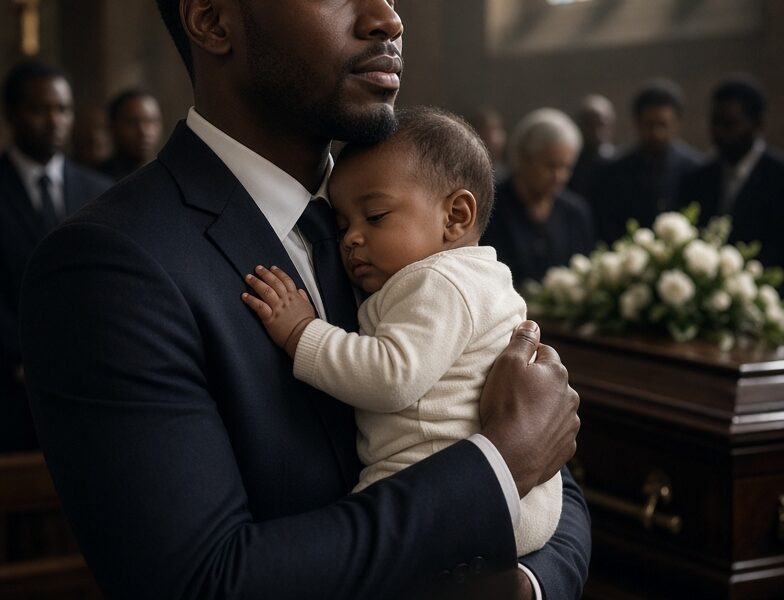
She Left Him at His Mother’s Funeral… With Their Six-Month-Old Son in His Arms
My name is Charles Jonathan, and I want to tell you about the day my wife looked me in the eye at my mother’s funeral and said seven words that rewired everything inside me.
She said, “I’m married below myself. I’m done.”
Not a whisper, not a trembling confession soaked in guilt.
She said it the way you read a bill you’ve already decided not to pay, flat, final, practiced.
And then she placed her funeral program neatly folded on the pew beside me, stood up, and walked out of the church while the pastor was still mid-prayer over my mother’s coffin.
My mother, Margaret Jonathan, the woman who cleaned hospital floors for nineteen years so I could have a future.
The woman who told me every single night when I was a boy, “Charles, a man who abandons his family in their darkest hour is no man at all.”
She was in a coffin ten feet in front of me, and Janet chose that exact moment.
Not the day before, not the day after, that moment, as if she had calculated it, as if she knew I would be too broken to chase her.
She was right.
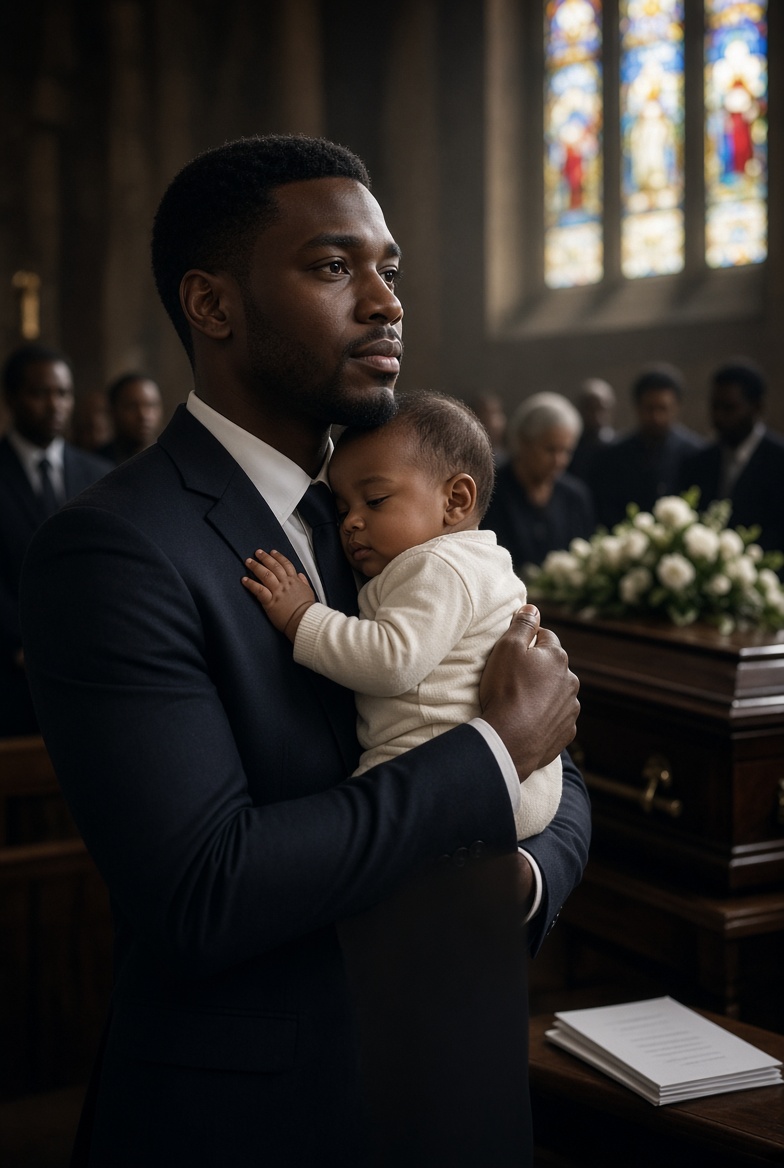
I stood there with our six-month-old son, Elijah, pressed against my chest, his small heartbeat against mine, staring at the empty seat beside me.
Her program was folded so cleanly it looked like origami.
She had planned this.
She had sat beside me for fifteen minutes, already decided, just waiting for the right moment to stand up.
I did not cry, I did not call her name.
I held my son tighter, looked up at my mother’s coffin, and I made a quiet, private decision that nobody in that church heard.
I decided I was done, too.
The weeks after the funeral are the ones nobody talks about when a marriage ends.
Everyone asks about the dramatic moment, the leaving, the door slam, the final words.
Nobody asks about two a.m. on a Tuesday when a six-month-old premature baby is screaming and there is formula powder on your funeral suit because you haven’t had time to change and your mother is dead and your wife is gone and you are standing in a kitchen that still smells like her perfume.
That was my life for four months.
Elijah had been born six weeks early, an emergency C-section, three days where I didn’t know if either of them would make it.
I slept in a hospital corridor on a plastic chair.
And when they finally let me hold him, this tiny, fragile, furious little person, I told him, “I’ve got you. I promise.”
Janet had struggled after he came home, I could see it, the distance in her eyes, the way she held him like he was borrowed.
I didn’t understand it then, I understand now.
It was postpartum depression that nobody caught because she kept insisting she was fine, and I kept believing her because I wanted to.
Her mother, Gloria, called every week with little surgical comments.
“You’re still in that small flat, Janet.”
I heard those calls, and I said nothing.
I thought Janet was stronger than her mother’s voice.
I was wrong.
Three weeks after the funeral, my friend Francis came by.
He stood in the doorway, looked at the formula tins, the laundry pile, the printed feeding schedule stained with milk, and he looked at me.
“Where is Janet?”
“She left.”
He stared, then said, “Can you help me figure out this car seat?”
“I have a meeting at nine.”
He picked up the manual without another word.
That was the moment I understood who my real people were.
Not the ones with the right words, the ones who pick up the manual.
The day after Janet left, her mother, Gloria, came to the house, not to apologize, not to check on Elijah.
She came to collect Janet’s things.
She moved through my mother’s house like she was reclaiming lost property, packing bags with the efficiency of a woman who had planned this too.
I stood in the doorway of the bedroom holding Elijah, still in mourning clothes, watching her fold Janet’s dresses with more tenderness than she had ever shown me in three years of marriage.
I said, “Gloria. She left with a six-month-old baby still here. My mother just died yesterday.”
She stopped, turned around slowly, the way people turn when they’ve been waiting for their cue.
“My daughter is not a house girl, Charles. She married you thinking you were going somewhere. You’re still in the same place.”
She picked up the bag.
“Be thankful she left the baby. That’s more than you deserved.”
Then she left.
I stood in the silence she left behind.
Elijah made a small sound against my chest.
I walked to the window and watched Gloria put Janet’s bags in a taxi, and she didn’t look back at the house, not once.
I want you to understand something.
It wasn’t Janet’s leaving that built me, it wasn’t the funeral or the sleepless nights or the empty side of the bed.
It was those words.
You’re still in the same place.
Gloria said them like a verdict, like my ceiling had already been measured and recorded.
I heard them every single morning for the next five years.
Every five a.m. alarm, every professional exam I sat alone, every site report I filed at midnight while Elijah slept.
Gloria’s voice was the most expensive fuel I ever used, and I never paid her a single cent for it.
Three years into Janet’s new life, I received a handwritten letter.
Her penmanship was always beautiful, looping, careful letters that looked like she’d practiced them in a journal somewhere.
I recognized it immediately and felt something shift in my stomach, not love, not anger, something older and quieter than both.
I opened it at the kitchen table while Elijah slept.
I read fragments.
I was drowning and didn’t know how to tell you.
I know what I did was wrong.
David is not what I thought.
Please let me see Elijah.
David Mensah.
I knew that name.
He had reappeared in Janet’s life eighteen months into our marriage, right when her father’s property business collapsed and shame moved into our flat like a third tenant.
He drove a G-Wagon, he never directly pursued her, he was too clever for that, he simply made himself available.
Generous, patient, he became the contrast to everything I was still becoming.
And Janet, exhausted, depressed, ashamed, with Gloria whispering in her ear every week, chose the finished product over the blueprint.
I folded the letter and read it once more.
Then I walked to the kitchen, turned on the gas stove, and held it over the flame.
I watched it burn with a completely calm face, and that detail matters.
I was not trembling, I was not crying, I was simply a man watching paper turn to ash, the way you watch a receipt burn after a transaction you’ve already closed.
The next morning, I called my lawyer.
“She hasn’t filed for custody,” he said.
“She will,” I said. “I want to be ready when she does.”
I had learned one thing from Gloria’s visit, from the funeral pew, from four years of two a.m. feeding schedules.
The people who leave always come back, and when they do, they come back expecting to find you still in the same place.
I intended to be somewhere else entirely.
Elijah was six years old when he asked me the question I had been rehearsing an answer to for two years.
It was bedtime, I was tucking him in, smoothing the blanket the way my mother used to smooth mine.
And he looked up at me with those quiet, serious eyes he had inherited from nobody I could identify, they were entirely his own.
“Daddy, why doesn’t my mommy live with us?”
I sat on the edge of the bed.
“Some mommies and daddies love their children from different houses,” I said. “She loves you.”
He considered this with a gravity only a six-year-old can bring to theology.
“Did she leave because of me?”
And there it was, the question underneath the question, the one I had known was coming since the day I first carried him home alone.
I had practiced this answer in the bathroom mirror at six a.m. three months ago when I felt it approaching like weather.
“No,” I said, “never. She left because of choices she made that had nothing to do with you. You’re the best thing in that house. You still are.”
He nodded and closed his eyes.
Children have a remarkable ability to accept truth when it is delivered without trembling.
I tucked the blanket in, walked calmly to the bathroom, closed the door behind me.
I sat on the edge of the bathtub and put my face in both hands.
I stayed there for four minutes.
Then I washed my face, looked at myself in the mirror for a long moment, and went back to finish the dishes.
Nobody saw that, nobody was supposed to.
That bathroom was the only place I allowed myself to be unfinished.
Everywhere else, the office, the school gate, the courtroom that was coming, I was going to be immovable.
I had made that decision at a funeral pew, and I intended to keep it.
The EFCC arrested David Mensah at his own real estate launch event.
I didn’t watch it live.
Francis sent me the video at eleven p.m. with no caption, just a link.
I watched it once.
Janet was standing at the podium in a gold dress beside David when the men in plain clothes came through the side door.
I watched David’s smile drop, not immediately, but one second later, when his eyes found the warrant.
The cameras were still rolling, phones were up across the room.
They took his arms, and he said nothing to Janet, not a word, not her name, not a look.
He was walked out of his own event, and she was left standing at the podium alone in the gold dress in front of every camera in the room.
Someone in the crowd photographed her standing there abandoned.
It went viral by midnight.
I closed the video.
I felt nothing cinematic, no satisfaction, no vindication, no quiet smile.
I felt the specific numbness of a man who had already grieved the ending of something long before it officially ended.
Janet’s life with David had been collapsing in slow motion for two years, the frozen investor accounts, the whispers in their social circle, the asset valuations that didn’t add up.
I had heard things through Francis, and I had filed them away without comment.
I poured a glass of water, checked Elijah’s monitor, and went to bed.
Some people wait for karma like it’s entertainment, I had stopped watching that channel years ago.
I had my son, my work, and my mother’s house, renovated now, quietly, on my own terms.
That was enough.
That had always been enough.
Five years after the funeral, a private primary school in Lekki, morning drop-off.
I pulled up in a Mercedes and Elijah launched out of the back seat the way he always did, bag bouncing, collar already crooked, entirely unbothered by the world.
I crouched down, straightened his collar, whispered, “Speak clearly in class today. Don’t mumble.”
He grinned and ran through the gate.
I stood up, and there was Janet.
She was standing near the gate in a way that was trying very hard not to look like waiting.
She looked tired in the specific way that expensive clothes can’t cover, the tiredness that lives behind the eyes and the set of the jaw.
She had been beautiful when I married her, she was still beautiful.
That had never been the point.
She took one step toward me.
“Charles—”
“His teacher’s name is Mrs. Ade,” I said. “She finishes at 2:30.”
I got back in the car and drove away.
I watched her in the rearview mirror for exactly three seconds, standing at the school gate, mouth slightly open, hand half raised, and then I rounded the corner and she was gone.
I want to be honest about that moment.
I was not cold because I hated her.
I was cold because I’d spent five years building a life that did not have a door for her to walk back through.
Not out of bitterness, out of architecture.
You cannot leave a man at his mother’s funeral, tell him he was never enough, and then expect him to stand at a school gate making conversation like it was a Tuesday.
I had Elijah at 2:30.
I had a site review at four.
I had absolutely nothing else for her.
A business journalist named Chinedu Achebe wrote a profile on me for a Lagos infrastructure magazine.
The headline read, “Charles Jonathan, the quiet giant rebuilding West Africa.”
There was a photograph, me on a construction site in Abuja, hard hat, mid-laugh at something an engineer had said.
I looked, according to Francis, who framed a copy without asking my permission, like a man who had never once been defeated.
Francis sent the article to six people.
One of those people sent it to Janet.
I found out three weeks later when Elijah mentioned, with the casual devastation only children can deploy, “Mommy cried when she saw your picture, Daddy.”
I was driving when he said it, and I kept my eyes on the road.
“Did she?”
“She said you looked different.”
“Different how?”
“Happy,” he said simply, and turned back to his window.
I gripped the steering wheel.
I had worked four certifications in five years, I had filed reports from hotel rooms in three countries, I had sat in boardrooms where men twice my age deferred to my judgment on two-hundred-million-dollar projects.
I had done all of it with one address in my head, my mother’s house, Elijah’s bedroom, the small kitchen where Gloria had told me I was going nowhere.
Happy.
My six-year-old son had summarized all of it in one word.
I did not reach out to Janet, I did not acknowledge the article, I did not perform my success for her benefit.
I simply kept driving.
Janet came to my office on a Wednesday afternoon in the middle of a site coordination meeting.
My assistant knocked and entered with the expression she reserved for situations she found professionally awkward.
“There’s a woman downstairs,” she said. “She says she’s your wife.”
The room had four engineers in it, and I felt them recalibrate silently.
“Tell her I’m in a meeting,” I said. “Ask if she has an appointment.”
She returned seven minutes later.
“She doesn’t have an appointment. She left her number.”
I read the note, folded it in half, and placed it under the edge of my keyboard, where it stayed for the rest of the day, untouched, like a footnote to a chapter one had already closed.
After the engineers left, she lingered.
“Should I add her to your contacts?”
“No,” I said. “Who’s my emergency contact listed as?”
“Mr. Francis, sir.”
“Keep it that way.”
She nodded and left.
I sat alone in the office for a moment.
Janet had walked into this building, glass and steel, my name on the lobby directory, and the system had asked her for an appointment.
She had been erased from my administrative life as cleanly as a closed account.
Not out of cruelty, out of accuracy.
She was not my wife, she had not been my wife for five years.
The paperwork had confirmed what the funeral pew had already decided.
I opened the Abuja files, I had a deadline.
The custody hearing was the day Gloria finally ran out of words.
She sat beside Janet on the left side of the courtroom, spine straight, chin up, wearing the expression of a woman who had never once been wrong.
I had not seen her since the day she walked through my mother’s house collecting Janet’s dresses.
She looked older, we all did.
My lawyer placed the folder on the table.
Inside, five years of medical records signed by me, school enrollment forms, me, vaccination history, me, a pediatric psychologist report confirming Elijah’s healthy, stable development, birthday photographs.
And a drawing Elijah had made in class that week.
His father, enormous and smiling, standing in front of a building, with a caption in his careful seven-year-old handwriting.
My daddy builds things that don’t fall down.
Janet’s lawyer argued the leaving had been postpartum related, temporary, that Janet deserved the opportunity to rebuild her relationship with her son under a shared arrangement.
My lawyer said, “Mr. Jonathan is not contesting visitation. He is contesting the narrative that a child should be removed from the only stable home he has ever known to satisfy an arrangement that serves the adults and not the child.”
The judge looked at the folder for a long time.
Then she looked at Janet, then at me.
Gloria leaned over and whispered something to Janet.
Janet did not respond, she was looking at the drawing.
My daddy builds things that don’t fall down.
I watched Janet read those words.
I watched something move across her face that I couldn’t name and didn’t try to.
The judge called a recess.
I looked straight ahead.
Janet came to Elijah’s school Christmas play without telling anyone.
I found out afterward, Elijah’s teacher mentioned that a woman had been sitting at the back crying quietly and had left before the lights came up.
I knew immediately.
Elijah had been the narrator, little suit, index cards, the intense concentration of a child who has rehearsed something until it lives in his bones.
He spoke every line clearly, without rushing, with a steadiness that made the other parents lean forward slightly.
When the curtain closed, he ran off stage and launched himself at me.
And I caught him, and spun him, and we laughed the way we always laugh, like it’s private, like it belongs only to us.
I had been in the third row.
She had been at the back.
She had watched the whole thing and not come over, she had slipped out before I could see her.
I don’t know what to do with that.
The image of her sitting alone in the back of an auditorium watching her son be everything she missed him becoming, and choosing to leave again before she could be seen.
Old habits, I suppose.
I didn’t mention it to Elijah, he didn’t need to carry it.
That night, I tucked him in and he asked me if I was proud of him, and I told him I had been proud of him since the day he was six weeks early and furious about it.
And he laughed his big laugh and fell asleep in four minutes.
I sat in the kitchen afterward.
I thought about the woman at the back of the auditorium.
Then I thought about the site report due Friday, and I opened my laptop.
I forgave Janet on a Thursday evening in a parking lot in the rain.
There was no music, there was no dramatic lighting, it was just water on concrete and the sound of a car engine somewhere behind us.
She had been showing up for supervised visitation consistently for four months, the first real consistency she had shown since Elijah was born.
He was warming to her slowly, carefully, the way a child warms to something he wants to trust but has learned to approach gently.
I watched it happening and I said nothing, because it was his relationship to build, not mine to architect.
I was walking to my car after pickup when she called my name.
I stopped, didn’t turn immediately.
“I know you don’t owe me anything,” she said. “I know that. I’m not asking for anything.”
Rain on the parking lot roof.
“I just need to say it once. I’m sorry. Not for a second chance. Just—I’m sorry.”
I turned around.
I looked at her for a long time.
This woman who had folded a funeral program like origami and placed it on a pew and walked away.
This woman whose mother had told me I was going nowhere.
This woman who had stood at a podium in a gold dress and been left by the man she had chosen instead.
I said, “I know.”
Not “it’s okay,” not “I forgive you,” not “now we can start over.”
Just “I know.”
Because I did.
I had known for years, I had known in the bathroom with my face in my hands, I had known on every five a.m. alarm, I had known when I watched her letter burn.
I got in the car.
Elijah waved at her from the back seat window, his small hand back and forth, completely uncomplicated.
She waved back.
I drove out of the parking lot without checking the mirror.
Some men forgive loudly so the person who hurt them can hear it.
I forgave quietly so I could finally stop carrying it.
My mother always said a man’s real character isn’t what he does in his best moments, it’s what he builds in his worst ones.
I built a son who waves at his mother even when he has every reason not to.
I think she would have been proud of that.
The funeral program was the thing, and the thing was the program, and the program was a folded square of paper placed neatly on a pew beside a man holding his six-month-old son while a pastor prayed over his mother’s coffin.
The program was the thing.
The program is always the thing.









