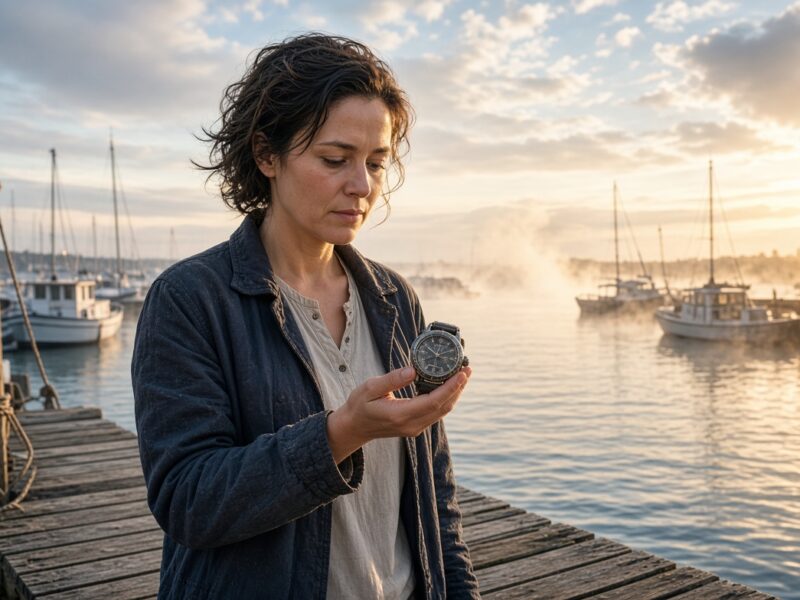
She Hid Her Past for 6 Years — Then Someone Left Her Dive Watch Stopped at 2:17
The pistol cracked against Mara Callaway’s cheekbone before the barrel found the underside of her jaw.
She tasted copper, and both hands stayed open, visible still.
“Try me,” he said.
Her grocery bag had scattered across the parking garage floor, and an orange rolled toward the drain.
Mara could have disabled him in four seconds, and she chose not to.
Jess was one elevator ride above them, and if Mara let herself become what she had spent six years erasing, her younger sister might walk out and see what happened to men who found the wrong woman.
So she let the second blow drop her to one knee.
Then the man said the wrong thing.
Quiet strength is still strength, but it always carries a price, one most people don’t calculate until someone they love is already in danger.
Gun beneath your jaw, the person you die for one floor above—would you hold still, or would you fight back?
Thirty-six hours before the parking garage, Tidmore, Virginia, population 31,000, give or take whatever the new apartment complex on Marsh Road had added to the census.
The kind of town that didn’t make the news unless a shrimp boat caught fire or a nor’easter took out the harbor road.
The kind of town where people knew which marina workers took their coffee black, and which ones had bad knees, and which ones were going through divorces, because there wasn’t quite enough else to pay attention to.
Mara Callaway preferred it that way.
She had worked the overnight maintenance shift at Tidmore Harbor Marina for four years, and she had built that tenure the way someone builds a retaining wall—solid, unremarkable, designed to hold something back without calling attention to the effort.
She knew every pump station, every rusted latch on every dock box, every circuit breaker panel in the covered slips that liked to trip when the humidity climbed past 70 percent.
She could diagnose a bilge pump failure by the pitch of its complaint.
She could rewire a dock light in the dark, in the rain, without a flashlight, without cursing, because she had done it twice in conditions that were genuinely worse than that, and preferred not to think about the context.
She got along reasonably well with her supervisor, a man named Gus Parr, who smelled of coffee and marine sealant, and who had the particular gift of managing people by mostly leaving them alone.
Gus had been running overnight dock operations at Tidmore Harbor for eleven years, and had a talent for recognizing competence without needing to examine it too closely.
He left Mara notes.
He stopped by twice a shift to check progress on whatever repair had priority.
He never asked her anything more personal than whether she wanted to trade a weekend.
She declined most shift trades, not because she disliked people, exactly, but because she had spent considerable effort constructing the life she currently occupied, and casual exchanges had a way of loosening things at the edges without anyone meaning them to.
Her co-workers knew approximately this much about her: she had served in the Navy for eight years and gotten out, which explained a certain practicality about physical discomfort and a certain comfort with darkness and salt air.
She ran occasionally at odd hours, which people attributed to veteran habits.
She kept a good toolbox and genuinely terrible taste in gas station sandwiches, which she ate without apparent shame at 3:00 in the morning while reading maintenance logs.
She had a younger sister in town named Jess, who taught elementary school, who stopped by the marina sometimes with homemade food in plastic containers, and who had the warm, slightly exasperated energy of someone doing her absolute best with a sibling who would not accept reasonable amounts of fussing.
That was what her co-workers knew.
Mara had engineered their knowing exactly that much and no more, with a patience that she never allowed to look like engineering.
She had declined the senior maintenance position when it opened two years earlier.
Everyone agreed she was the obvious choice. Gus had practically offered it with both hands.
The position required a more thorough background verification.
Mara had filled out the initial form, read the section requesting a complete service history, and set down the pen.
She told Gus she didn’t want the administrative overhead.
He accepted this, because Gus was not a man who looked too closely at things that weren’t broken, and Mara had never been broken, at least not in any way visible from the outside.
The truth she kept from everyone at the marina, from everyone in Tidmore, from almost everyone living, was that she had not served in anything resembling a logistics capacity.
She had been attached to a classified maritime special operations element for nearly seven years.
The nature of that element, the specific operations it conducted, the identities of the people she had worked beside—all of it sat behind access restrictions that would require clearance levels most senior federal employees would never approach.
She had requested those restrictions herself.
She had been twenty-nine years old, sitting across a desk from a Navy administrative officer in a building with no visible exterior signage, and she had said, with a flatness that she suspected surprised even herself, that she needed to not exist anymore.
Professionally speaking.
The officer had understood what she meant. There were procedures for this situation.
They were rarely used, because the people who did work like Mara’s rarely wanted out badly enough to formally request it.
The work had a pull to it, a terrible gravity, and most people who entered that world either stayed until their bodies forced them out, or they were consumed by it in ways that precluded clean exits.
Mara had wanted out badly enough.
She had come back from her final deployment, and she had sat in the administrative office, and she had requested the procedures, and three months later she had arrived in Tidmore under an identity that was partly her own—her name, her age, her genuine past before the classified years—and partly constructed.
And she had rented a second-floor apartment on Whitmore Street, and applied to work nights at the harbor marina, and begun the patient, methodical project of becoming someone whose existence didn’t require sealing.
She was not always successful.
There were nights, usually in November, for some reason she had never quite isolated, when she woke at two in the morning and lay still in the dark and felt the residue of things she had done and witnessed and failed to prevent with a vividness that made sleep impossible.
There were moments in crowds—parking lots, grocery stores, the ferry landing on weekends—when she clocked exits and evaluated angles before she was entirely conscious of doing it, and felt the familiar dissonance of those instincts surfacing in a life they no longer belonged to.
But mostly she fixed bilge pumps and ate bad sandwiches and had dinner with her sister on Tuesdays.
And the life she had built held—until the third week of September, when it began to show the very first hairline fractures.
The first thing she noticed was the locker.
It happened on a Thursday. She arrived for her shift at nine and found her marina locker slightly ajar.
The lock itself hadn’t been forced. The mechanism had been worked properly, which was a different and more interesting problem than a broken hasp.
She went through the contents carefully. Work gloves, two spare headlamps, a rain jacket, a small box of marine fuses, a laminated safety card she’d never used.
On the inside of the door, a photograph of her and Jess from last Christmas, taken at Jess’s kitchen table, both of them slightly blurred from laughing at something her sister’s neighbor had said.
Nothing was gone.
She stood in front of the open locker for longer than the situation required, working through the contents twice.
A theft she could have explained to herself without alarm.
An ordinary person in this situation would assume they had forgotten to engage the lock properly.
Mara had not forgotten. She remembered closing it the night before, the way she remembered most operational details—automatically, without needing to attend to it, the way someone might remember locking a car door.
She also knew that an open locker from which nothing was taken was not a theft.
It was a statement.
Someone had been there, and wanted her to know someone had been there, while making sure there was nothing concrete to report.
She told herself to leave it alone for now and went to work.
But she found herself returning to the photograph in her mind, still in its place, the image undisturbed, nothing wrong with it, and feeling uneasy about that ordinariness in a way she couldn’t entirely name.
Five days later, the second thing.
Jess called on a Sunday afternoon, using the tone she deployed when something was puzzling her and she was deciding whether to be amused or concerned.
She had been at the farmers market on Crestwood, she said, and a man had made conversation near the vegetable stalls.
Older, fifties maybe, well dressed in a way that didn’t quite fit the market crowd. The kind of clothes that suggested a different city.
The conversation had been ordinary enough at first, local small talk, the kind of thing you had at a farmers market and forgot twenty minutes later.
Then, before he left, he had asked whether Jess’s sister still went diving.
Which is strange, Jess said, because I’m fairly sure I’ve never seen you dive, and I didn’t tell him you were my sister.
He already seemed to know.
Mara kept her voice easy. “What did he look like, specifically?”
Jess described him: maybe fifty-five, light jacket, reading glasses pushed up on his head, no one she recognized from town.
He had walked away before she thought to ask his name.
“It’s probably someone from the marina,” Mara said. “Old coworker.”
“Maybe.” Jess sounded unconvinced. “You’re not secretly a mermaid, right?”
“Not that I know of.”
“Good. Come Tuesday. I’m making the pasta with the lemon thing you like.”
“I’ll be there.”
She hung up and stood at her kitchen window for a while.
Diving.
Not swimming, not sailing, not boating in any generic sense. Diving.
A word specific enough to be intentional, dropped into an otherwise ordinary exchange with enough plausible casualness that Jess would remember it but not be alarmed by it.
Someone had given that man enough context to approach Mara’s sister with a pointed question through a conversational screen door.
She made herself finish her coffee. She went over the logic carefully.
Six years was a significant record of silence. One odd encounter at a farmers market was not a crisis. The locker incident could still be explained technically as a coincidence.
Three days later, the explaining stopped feeling adequate.
The envelope arrived in her mailbox on a Wednesday morning. Standard size, no return address, postmarked from a Northern Virginia mail distribution center that handled a volume of mail that made tracking its specific origin essentially useless.
Inside was a single sheet: a photocopy of a photograph.
She and Maya Ellis on the deck of a Navy transport, both of them squinting against the sun.
Maya had her arms crossed and was laughing at something out of frame, the way she laughed when something genuinely caught her off guard rather than the polite version she used in briefings.
Mara was twenty-six in the photograph, maybe twenty-seven, shorter hair, looking like someone who had not yet spent six years constructing an exit from herself.
No message. No names written on the photograph. No demands.
She sat at her kitchen table with it for forty minutes.
She understood what it was doing. Not a threat in the ordinary sense. No instructions, no deadline, no explicit leverage.
It was a proof of concept. A door left open to show that it had been unlocked.
The content of the photograph mattered less than the fact of its existence in her mailbox, which communicated: I have found something you spent considerable effort hiding. I found it easily enough to mail it to your home. Consider what else I have found.
She called Owen Bride that evening.
Owen was sixty-one, retired Navy medic, living outside a small town in western Maryland with his daughter and three dogs he pretended not to love.
He had twenty-two years of service and had come out of it with the particular steadiness of someone who had seen enough bad situations to have developed a genuine sense of proportion.
Things that looked like emergencies often weren’t, and things that looked manageable sometimes weren’t either, and Owen had developed a reliable instinct for telling the difference.
He was also one of exactly two people alive who knew what Mara Callaway had once been paid to do.
He answered on the third ring and stepped outside without her asking him to. She heard the screen door, heard the ambient change of open air.
He had never needed reminding of the rules.
“I got a photograph,” Mara said.
She told him about the photograph. She told him about the locker and the farmers market question and the timeline between them.
Owen was quiet longer than she liked.
“The records from our last operation,” she said. “Owen, could someone access them? They’re sealed.”
“I know what they are.”
“Could someone access them?”
A pause that lasted three full seconds.
“Sealed isn’t the same as inaccessible. That depends on clearance level and whether they have the right contacts inside the right compartments. It’s not something that could happen casually, but it could happen with the right combination of access and specific knowledge of what to look for.”
“Yes,” he said. “It could happen.”
“Who would have that?”
“Defense-adjacent contractors with active clearances. Some current personnel with lateral access. Maybe a dozen people. Realistically fewer who would know what they were specifically looking for.”
“Someone knew enough to mail me a photograph of Maya.”
He exhaled a long, controlled sound. “I want you to leave Tidmore for a while. Go somewhere else. Give me forty-eight hours to contact some people quietly and find out whether any of our records have been accessed.”
“I can’t leave.”
“Mara—”
“If I leave, Jess becomes the obvious angle. She doesn’t know anything. She doesn’t know the right questions, let alone the answers. If whoever is doing this decides she’s leverage, she has no way to protect herself, because she has no idea what she’d be protecting herself from.”
Owen was quiet again, and she could hear him working through it—patient, methodical, the same way he had always worked through problems when other people were reacting.
It was one of the things she had trusted him for.
“Forty-eight hours,” he said at last. “Don’t make official inquiries. Don’t reach out to anyone from the old element. Don’t put yourself on any record that could confirm your location to someone running searches.”
“I know the protocols.”
“I know you know them. I’m saying it because knowing and doing are different things when you’re frightened.”
She almost told him she wasn’t frightened. She stopped herself, because Owen had known her since she was twenty-three years old and had been in the field with her, and he would have recognized the lie before she finished constructing it.
“Forty-eight hours,” she agreed.
She spent the following day doing three things, and she accomplished all of them without drawing visible attention to any of them.
First, she rerouted Jess’s path to Pemrook Elementary using a convincing text about construction on Heron Boulevard. Not a lie she was proud of, but quick and effective.
Second, she drove past Jess’s apartment building twice in a car borrowed from a marina co-worker under the pretense of running errands, noting the sight lines from the street, the parking structure camera positions, the number of seconds it took to move between the building’s two exits.
Third, she used the administrative access Jess had given her years ago—in case you ever need to reach me fast, they have strict phone rules during the school day—to update the emergency contact listing at Pemrook to a number that routed to Owen’s secondary line.
Then she went to work.
She replaced two cleats on the main dock, diagnosed a failing impeller on Slip 43’s bilge pump, and ate a gas station sandwich at 3:00 in the morning while Gus stopped by to tell her she’d done good work on the last month’s electrical logs.
She said thank you and meant it, and felt obscurely sad about it in a way she couldn’t fully explain to herself.
Jess called the next morning at eight, just as Mara was walking home from the marina.
“Can I ask you something?”
The particular sharpness Jess’s voice took on when she was preparing to say something she expected to be deflected.
“Of course.”
“The front office at Pemrook called me this morning. They said my emergency contact had been updated to a number I don’t recognize.”
Mara kept her stride even. The harbor was doing its early morning thing, flat silver and quiet, a pelican sitting on one of the far pilings with the air of something profoundly unimpressed.
“I changed it,” Mara said. “To someone who can reach me faster without asking me. It was a practical thing. I should have mentioned it.”
“Mara.” A pause, the kind that was doing work. “You’ve been acting strange for over a week. You told me construction on Heron. I drove past Heron. Nothing. You’ve called me more than you usually do, and somehow it’s added up to less information than usual, if that makes any sense. And now you’ve changed something at my workplace without telling me.”
Another pause.
“What’s going on?”
“I’m being cautious about something. When I understand it better, I’ll explain.”
“When you understand it better,” Jess repeated, and the flatness in her voice was its own answer. “So, in the meantime, I just— What? Adjust my route based on fake construction and let you update my information without knowing why?”
“It’s temporary.”
“That’s not the point.”
Jess’s voice lost the sharpness and became something quieter, which was in some ways harder to hear.
“You do this when something is wrong. You rearrange things around me without telling me what you’re rearranging them around. You’ve done it my whole adult life, and I’m twenty-nine years old, Mara.”
“I know how old you are.”
“Then talk to me like it.”
The pelican launched off the piling and glided out over the water without any visible effort, and Mara watched it and tried to find words for a situation that had no adequate words.
At least not words she could use yet.
“I’m trying to keep you away from something I don’t have a complete picture of,” she said.
“Away from what?”
“I genuinely don’t know yet.”
“Is it connected to—” Jess stopped. “You told me you did logistics. In the Navy.”
“I told you I served in the Navy. I’m asking whether logistics is the part that was true.”
Mara said nothing.
That silence said something.
“Okay,” Jess said after a moment. Quiet. Precise. Not angry exactly, but closed in a way that was worse than anger. “I need to think.”
“I love you.”
“I need to think.”
The call ended without drama. Jess had never been a door-slamming person.
She said what she meant and withdrew to process it, which had always been both more and less painful than a fight.
Mara put her phone in her jacket pocket and stood at the corner of Pier and Inlet for a moment before walking the rest of the way home.
Her apartment building was a converted 1970s insurance office on Whitmore Street that still carried the faintly institutional air of a building designed for transaction rather than habitation.
She had chosen it because the unit she rented was on the second floor with a view of the back parking lot rather than the harbor—less picturesque, considerably more practical in terms of approach visibility.
She took her boots off inside the door. She went to the kitchen to start coffee.
She registered as she crossed the small living room that the afternoon light was lying across the floor at its usual angle, and that nothing appeared out of place, and she was already reaching for a mug when she turned toward the table and stopped.
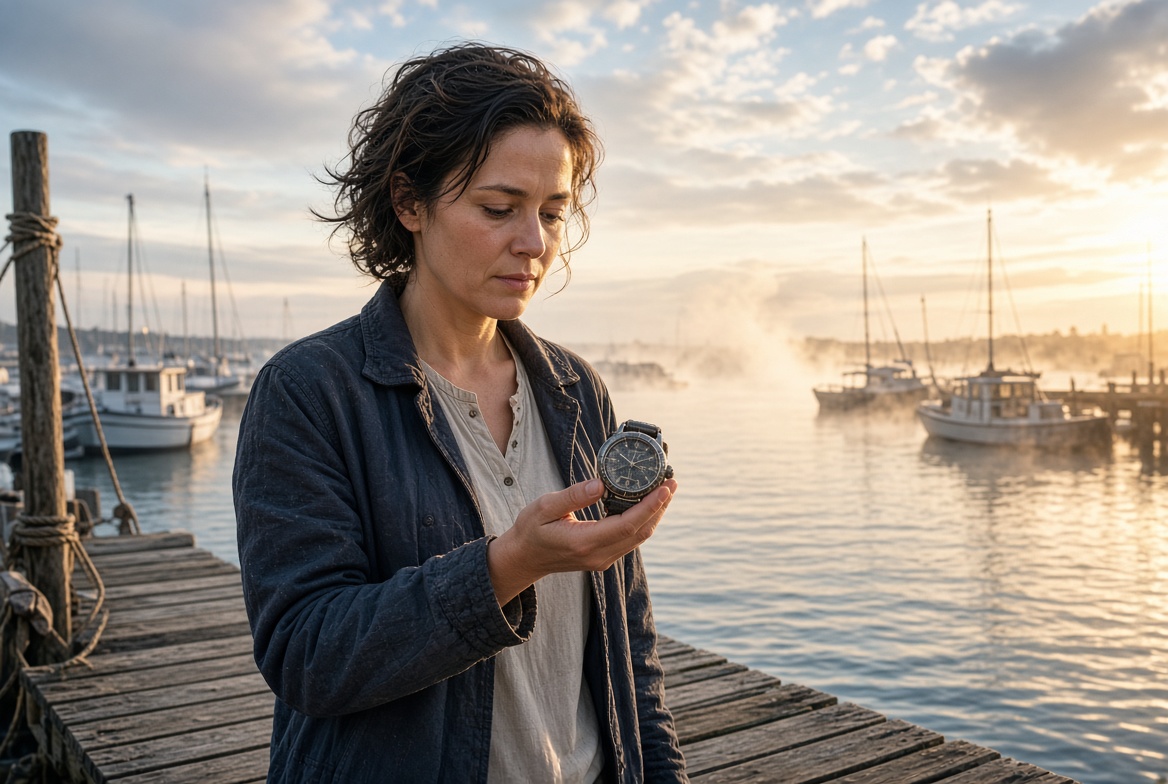
Her old dive watch was sitting in the center of the kitchen table.
She had not put it there.
She kept it in the drawer beside the refrigerator—a flat catch-all for miscellaneous items, the kind that accumulated objects without intention.
The watch was old, scratched in ways that documented years of hard use rather than carelessness, with a case she had stopped winding on a night six years ago. The crystal was intact. The hands were stopped at 2:17.
She stood completely still for several seconds.
The coffee maker cycled through its process. Morning light caught the scratched crystal at a shallow angle.
Then she moved through the apartment the way she had once been trained to move through unfamiliar spaces—methodical, quiet, checking each room before returning to the kitchen.
Nothing had been taken.
The thumb drive in the drawer was untouched. The shorthand notepad was exactly where it belonged. Her laptop sat on the desk at the same angle she had left it.
Only the watch had moved.
She sat down at the table, not touching the watch, just looking at it, and understood with the particular cold clarity she had spent years hoping never to need again what this communication was.
The photograph had been a proof of access.
The watch was a proof of intimacy—of research that went beyond operational records and into the interior architecture of why she had requested the sealed identity in the first place.
She had never written down 2:17.
She had never spoken it aloud to anyone—not to Owen, not to anyone in her current life, not in any context that could have been recorded or overheard.
It was not a detail. It was the thing the detail was standing in for.
The minute of Maya’s final transmission. The minute she had not gone back. The minute she had kept stopped as a private monument to a decision she had spent six years unable to fully accept.
Someone had found it, which meant someone had found the people who might know it, worked through the layers, reached the place where something that private lived.
That was not surveillance. That was dissection.
She reached out and moved the watch four inches to the right, off the exact center of the table where it had been positioned, and felt something settle in her chest.
Not fear exactly, but the recognizable arrival of a specific mode of thinking she had worked very hard to leave behind.
She needed to call Owen again. She needed to tell him about the apartment.
She also needed to think clearly about Jess—about whether Jess was safer in her current state of partial ignorance, or whether the person who had left the watch had already added Jess Callaway to their calculations as a variable to be managed.
She picked up her phone.
It rang before she could dial.
Unknown number. 703 area code, Northern Virginia. A prefix that could mean a hundred things and in this context probably meant one of them specifically.
She let it go to voicemail.
The notification arrived thirty seconds later.
She played it through once, then again—a man’s voice, unhurried, carefully modulated, with the faint polish of someone who had spent years in rooms where presentation mattered as much as content.
Not threatening in tone. Conversational, in the particular way that certain kinds of threat could afford to be conversational.
“My name isn’t important yet. What is important is that you have access to something I need to discuss, and I have information about the origin of that photograph that I suspect you’d find valuable. I’m not interested in causing problems. I’m also not someone it benefits you to ignore. I’ll be in Tidmore tomorrow morning. There’s a coffee shop on Prior Street, the Sandbar. Eleven o’clock. Come alone. If you don’t come, the conversation will take place in a less controlled environment.”
A pause.
When the voice returned, it was slightly quieter. Not threatening, but careful. The way someone is careful when they want you to understand they mean exactly what they’re saying.
“I know about 2:17. That’s a detail I have, which means it could become a detail others have access to as well. Think carefully about what else I might know, and what it would mean if it reached people you haven’t chosen to tell.”
The message ended.
Mara set the phone down on the table beside the watch and looked at both of them.
The man hadn’t threatened her. He had described access. He had described capacity. He had framed the meeting as an opportunity rather than a demand, which was a specific technique.
It gave her the impression of choice while making clear that the only meaningful choice was the one he had already decided on.
She noted the name of the coffee shop, the time. She noted that he had said “something I need to discuss” rather than “something you have,” which meant he either didn’t know exactly what he was looking for, or he wanted her to believe he didn’t.
She pulled a notepad from the kitchen drawer and wrote down the number, the location, and the time. Then she wrote Owen’s name and underlined it twice.
Eighteen hours until eleven o’clock on Prior Street.
She intended to spend all of them preparing.
What she didn’t know yet, sitting at her kitchen table in the afternoon quiet with a stopped watch and a stranger’s voice in her phone’s memory, was that the man who had left the message was not the center of the problem.
He was what she was supposed to be looking at, while the problem moved somewhere she wasn’t watching.
She didn’t sleep. She had known she wouldn’t.
There was a particular quality to the kind of alertness she was now operating under. Not anxiety exactly, which tended to be circular and exhausting, but something more like the body’s memory of a specific mode.
Her body had not forgotten, even if she had tried to convince herself otherwise.
She sat at the kitchen table for a while after the voicemail ended. Then she moved the watch back to the drawer beside the refrigerator—not because placing it out of sight changed anything, but because she didn’t want to spend the night looking at it.
She called Owen at nine in the evening and told him about the apartment in a level, sequential way—what was taken, what wasn’t, where the watch had been left, the angle of placement, the specific significance of the hands.
He was quiet in the way she had come to recognize as Owen absorbing information that alarmed him while disciplining himself not to react before he had finished absorbing it.
“He’s been inside your home,” Owen said.
“Someone has.”
“Yes. This is not intelligence gathering at that point. This is demonstration. He wants you to know he can reach the interior of your life.”
“I know what it is.”
“Then you know this is past the stage where staying put makes tactical sense.”
“I told you why I can’t leave.” She kept her voice even. “I need you to make the contacts you mentioned quietly. I need to know specifically whose access produced this. Not the contractor’s clearance level, not the department—the person.”
“That kind of query, Mara—I can’t run that through official channels without creating a record of the inquiry.”
“I’m not asking you to use official channels.”
A silence that was doing its own kind of work.
“Give me until morning,” he said finally.
She said she would. She meant it as she said it.
She spent the hours before dawn doing the things that her body remembered how to do—not a full operational preparation, not the kind she would have once conducted before a mission, but a version of it that fitted the life she was currently living.
She mapped the approaches to Jess’s building in her head for the third time, memorizing the variables that had changed since the last time she’d driven them.
The new streetlight on Barlow that extended visibility by roughly fifteen meters. The construction scaffold outside the Pemrook Savings Building that created a useful blind spot. The different cameras in Jess’s parking structure versus the ones on the street level.
She laid out what she knew about the Sandbar—a narrow converted storefront on Prior Street, two visible entrances, windows facing the street, limited rear access through a shared alley serving three adjacent businesses.
If she were running surveillance on someone going to that meeting, she would position one person inside the coffee shop as a timer, one person covering the street entrance with a line to the alley, and a vehicle within a half-block radius with camera capability.
That was a minimum. Three people minimum.
And the man on the phone had not sounded like someone operating on minimum, which meant she was not going inside the Sandbar at eleven o’clock.
What she was going to do instead took her most of the remaining darkness to arrange, because she did it slowly and without calling anyone who could generate a record and using only the resources her current life legitimately provided her.
She borrowed a rain jacket belonging to her harbor co-worker Palma that she’d had in her locker for two weeks, waiting to return it—different color from her own, slightly too large, unremarkable.
She reorganized her car, which she moved at five in the morning, two blocks east of its usual spot and three blocks west of Prior.
She went to work for three hours of her actual shift, because not showing up would generate conversation and questions she didn’t currently have the bandwidth to manage.
And she told Gus she had a medical appointment at 10:30 and would be back by one.
Gus looked at her without his usual incuriosity, which was notable enough that she registered it.
“You doing okay?” he asked.
“Fine. Routine thing.”
He nodded and didn’t push it, but she felt his eyes on her back for a few seconds as she walked toward the dock.
At quarter to ten, she was on Prior Street—not at the coffee shop entrance.
She had found a position that gave her clean sight lines to the storefront and both the eastern alley mouth and twenty meters of the parallel street, without putting her face visible from inside the Sandbar’s windows.
A recessed doorway of the picture frame shop two units north, half covered by a sandwich board advertising a sale on custom framing, and wearing Palma’s jacket with the collar up and her hair pulled back in a way that changed her silhouette without doing anything theatrical.
She had bought a paper cup of coffee from the cart near the harbor road and held it in both hands, which completed the texture of the composition.
The man arrived at 10:52.
He was exactly as Jess had described him—mid-fifties, unhurried, wearing a jacket that managed to be both practical and slightly too put-together for Tidmore on a Tuesday morning, reading glasses on his head.
He stood outside the Sandbar for a moment before going in. And in that moment, he did something that she noted without moving.
He checked the street in both directions, in the measured, unhurried way of someone accustomed to doing it without it looking like what it was.
Which confirmed that he was not just a contractor’s liaison or an information broker or whatever category might have made him less immediately significant.
She moved her attention to the street.
The vehicle she would have chosen if she were running the coverage. She found it in forty seconds.
A dark blue Nissan sedan. Partial view of the alley. Engine off. Driver visible as a shape rather than a person behind slightly tinted glass. Parked legally. Unmemorable.
A black gear bag visible in the back seat through the rear window.
She committed the plate to memory without looking at it twice.
At eleven o’clock, the man inside the Sandbar checked his watch.
At 11:17, he left without his coffee. He walked north on Prior at the same unhurried pace, paused at the corner, and the blue Nissan pulled up beside him.
A brief exchange through the window. The man got in. The car moved east on Tanner.
She didn’t follow.
She had the plate. Following would require getting into her car, which was too far to close the gap before they reached the harbor road, and she wasn’t willing to confirm her own vehicle to the person in the Nissan, who had presumably been tasked with identifying anyone conducting counter-surveillance.
She walked back to her car the long way through the back streets and sat behind the wheel for several minutes before starting the engine.
There is a particular kind of trap that doesn’t look like a trap because it’s built from materials the target would have chosen themselves.
The man had offered her a controlled meeting in a public space, exactly what someone with her training would identify as safer than the alternative.
He had given her time to prepare. He had named a specific risk—the information reaching others—that was precisely calibrated to the things she most needed to protect.
He had even left room for her to refuse, which made it feel like a choice rather than a demand.
The trap wasn’t the coffee shop.
The trap was the architecture of reasonable options that all led to the same place: Mara moving, Mara confirming, Mara solving his information problem by responding to it.
What Mara was only beginning to understand was that her instinct to contain the situation, her trained preference for intelligence over action, might be the very mechanism being used to hold her still.
Owen called at 12:43 while she was on the harbor road.
“His name is Evan Ror,” Owen said. No greeting. He had been running the contacts all morning, and she could hear it in his voice—the particular flatness that came after several hours of difficult conversations conducted on lines that weren’t entirely clean.
“He was a senior compartmentalization analyst at Hartwell Defense Solutions. Left the company six months ago. The circumstances aren’t public, but I spoke with someone who was adjacent to that situation, and the phrase used was ‘mutual agreement with specific confidentiality conditions,’ which tends to mean something was found that neither side wanted examined too closely.”
“His clearances were pulled when he left Hartwell, but clearances pulled after separation don’t retroactively eliminate what someone already knows. He spent nine years handling the administrative architecture of classified maritime operations, Mara. He knew which compartments existed even if he couldn’t necessarily open all of them.”
“That’s a map. You can work from a map.”
“What specifically did he access?”
“A record query was logged on a file cross-referenced to your operation. The query itself was run from inside Hartwell’s system four weeks before Ror left, which means he had legitimate access credentials when it happened. The query looked like routine file maintenance on the surface. The flag only triggered when someone ran a retrospective audit that your old administrative officer initiated.”
She was quiet for a moment. The harbor road opened up to her left. Gray water. A trawler heading out toward open water.
“What did the flag say specifically?”
“The query accessed the sealed cross-reference list. Not the content. The file is still sealed. He didn’t get inside the operational record itself, but the cross-reference index carries identifying tags. Names. One of those names was yours. Another was mine.”
A pause.
“Another was Maya’s.”
She made herself breathe out through her nose.
Even now, six years removed, the name still had a particular weight when she heard it spoken aloud rather than carrying it in her own head.
“The surviving source,” she said. “He’s looking for the source.”
Owen was quiet for exactly two seconds.
“Then what makes you say that?”
“He said he had something he needed to discuss, not information about me. ‘Something’s I supposedly have access to.’ The only thing connected to that operation that anyone would want badly enough to break into a sealed file for isn’t my identity, Owen. My identity is a tool. What Ror wants my identity for is leverage. He thinks I can give him something.”
“Mara—”
“He thinks I know where the source went.”
She turned off the harbor road into the marina parking lot and sat with the engine idling.
“The witness who was extracted. He thinks I personally arranged the relocation.”
The silence on Owen’s end was two seconds too long.
“I didn’t,” she said. “Obviously, I didn’t arrange anything after the extraction. I was separated within six weeks. I never knew what happened to the source after they left the element’s custody.”
She was listening to the texture of his silence now, the way she had once listened to frequencies in headset static—not for what it said, but for what it was working around.
“Owen.”
“You should go home,” he said.
“Owen.”
A sound that wasn’t quite a breath.
“The source isn’t in a government program,” he said. “The official protection program had already been compromised at the time of the extraction. We knew it within forty-eight hours of the operation’s completion.”
His voice was steady but careful. A man choosing each word the way you choose footholds on unstable ground.
“I made alternative arrangements through a private channel. A network I trusted. The source has been safe. Has been safe for six years.”
She sat with that for a long moment. The engine idled through the windshield. A pair of gulls were arguing over something on the dock.
“You’ve known where the source is for six years,” she said. “And you didn’t tell me.”
“I made a decision about what you needed to know in order to build a civilian life. If you had known, it would have been a thread. Something that connected you to the operation in a way that could have been pulled. I wanted you to be free of it.”
“That wasn’t your call.”
“I know that.” Quiet, direct, not defensive. Owen had never wasted energy on defensiveness. “I know that now. I’m telling you because it changes the picture. Ror isn’t using your identity to get to you. He’s using your identity to get to me. He assumes you’re the link because operationally you should have been the link. He doesn’t know I handled the relocation. Nobody does.”
She pressed two fingers against the bridge of her nose.
“So the people who came for me at the apartment were looking for confirmation that you could lead them somewhere.”
“Yes.”
“And the meeting this morning, the coffee shop—probably assessment. Whether I’d come, how I’d come, whether I was in contact with anyone who might indicate where else to look.”
She thought about the blue Nissan, the man watching from the driver’s seat, how long they had been parked before she arrived, what they had or hadn’t managed to photograph.
“I need you to do one more thing,” she said. “Not through your contacts directly.”
“What?”
“I need you to tell me whether the people watching the source have been alerted.”
Another pause.
“Not yet.”
“Alert them today. Now, if you can.”
“If I do that, I confirm to my contact network that something has moved. That creates its own exposure.”
“The alternative is that Ror figures out he’s been looking at the wrong person, pivots to the right one, and we’re having a completely different conversation in about seventy-two hours.”
She put the car in park.
“Alert them, Owen. Today.”
She heard him exhale.
“I’ll call you back within the hour.”
He didn’t call back within the hour. He called back in forty minutes, which meant the conversation had been short enough to worry about.
And when he spoke, his voice had the quality of someone reporting information they did not enjoy having.
“There was a car parked outside the source’s building for four days last week,” he said. “A neighbor mentioned it to my contact. They didn’t flag it immediately because the car moved before they could get a plate.









