
She Had Never Had Puppies… Until a Muddy Stranger Claimed Her as Mom
The puppy came out of the rain looking barely big enough to survive the wind.
Mud clung to his honey-colored fur.
A faded pink ribbon hung from his neck.
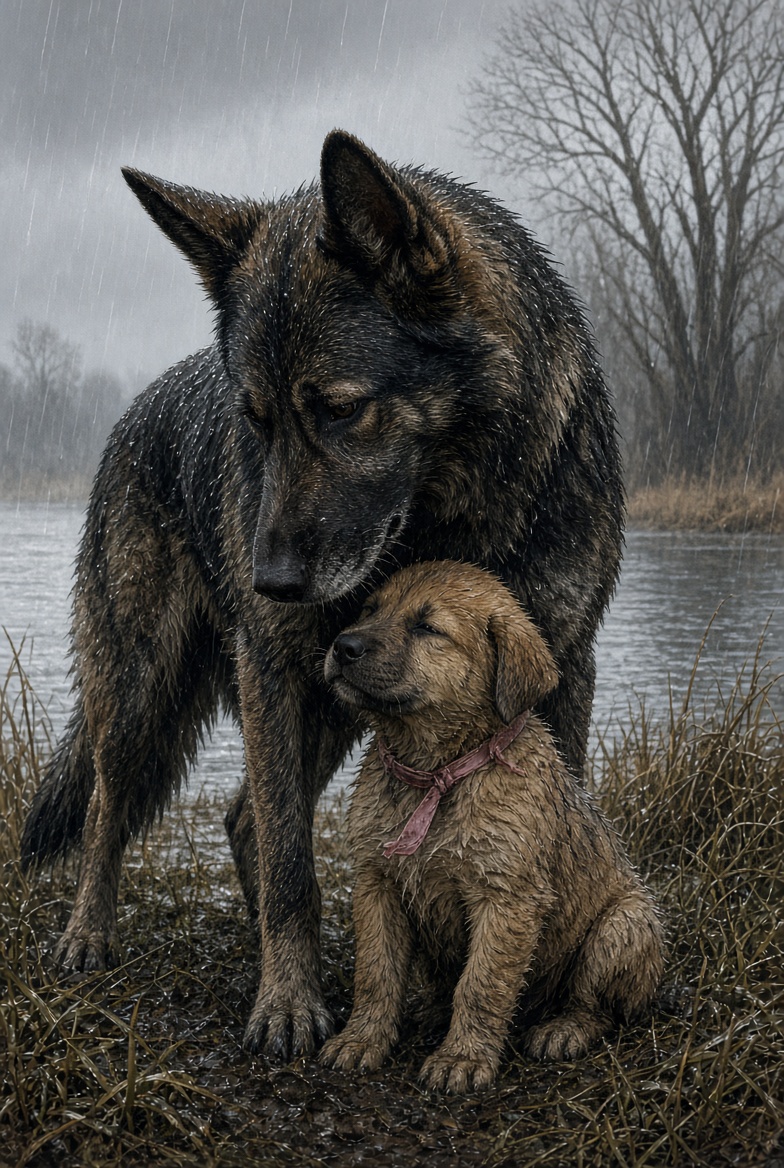
And instead of running to Garrett Linquist, the former Navy SEAL standing only a few feet away, he stumbled straight beneath Vesper, Garrett’s retired German Shepherd, searching for warmth as if he had finally found his mother.
Vesper had never had puppies.
But when Garrett reached down, she quietly stepped between them.
That single moment pulled him into a story far bigger than a lost dog.
The puppy belonged to seven-year-old Daisy, whose family had been forced from their home in a lakeside community where elderly residents were being priced out one by one.
Then an eighty-year-old woman opened a dusty box of records.
Inside was a forgotten document that could change everything.
But first, Garrett would have to face the one loss he had spent years refusing to touch.
At forty-five, Garrett Linquist had become a man who could measure his mornings without looking at a clock.
The old cabin creaked once when the temperature changed.
The coffee maker clicked twice before it began to drip.
And Vesper, his nine-year-old German Shepherd, always lifted her head from the braided rug beside the stove exactly three minutes before Garrett reached for the leash.
There were comforts in predictability.
There were also hiding places.
Garrett understood both.
His cabin stood back from Lake Erie, west of Sandusky, where wind came across the water with enough force to make the bare cottonwoods whisper against one another.
The house was small, square-shouldered, and weathered silver at the corners.
Garrett had repaired nearly every board himself.
He repaired boats, too. Sometimes cabinets. Sometimes rocking chairs that had belonged to somebody’s grandmother.
People around the lake knew that if a thing was made of wood and still had enough of itself left to save, Garrett could usually save it.
They knew less about the man doing the saving.
Five years earlier, Garrett had left the Navy after a career as a SEAL.
He did not display photographs from those years.
His medals lived in a metal box behind winter blankets.
The old dog tags remained around his neck, though most days they stayed hidden beneath a charcoal henley.
He still woke before dawn, still positioned himself where he could see a doorway, still noticed unfamiliar vehicles before he noticed flowers blooming beside a porch.
But the sharpest habit he carried had nothing to do with the military.
He avoided children.
Not obviously. Garrett was too practiced at appearing normal for that.
He simply took Harbor Road instead of Maple Street during school drop-off.
He chose the hardware store across town because the closer one shared a parking lot with a daycare center.
If a child laughed in a restaurant, Garrett did not flinch.
He just grew quieter.
Vesper knew all of his roots.
She never questioned them.
That was one of the reasons he loved her.
She had spent most of her life as a federal working dog before retirement brought her to Garrett.
Her coat was dark sable, almost charcoal across the shoulders, with smoky brown along her ribs and legs.
A narrow crescent of silver fur marked the center of her chest.
Her right ear stood perfectly straight.
The very tip of her left ear folded slightly forward.
It ruined the otherwise intimidating symmetry of her face.
Garrett considered it her one concession to comedy.
“You ready?”
Vesper rose. The brass tag on her deep burgundy collar gave a soft click.
Outside, early spring had arrived in Ohio without any enthusiasm.
Rain hung in the air rather than falling properly.
The lake was the color of old steel.
Patches of last year’s reeds stood brown and brittle along the shoreline, while the new green growth struggled underneath them.
Garrett pulled on his weathered field jacket.
Vesper waited beside the porch steps.
“Same route.”
Her amber eyes lifted toward him.
Garrett almost smiled. “Yeah, I know. Exciting life.”
They headed east along the narrow trail that followed the water.
Vesper walked at his left knee out of old habit, her pace measured and economical.
She did not pull at squirrels.
She did not bark at passing trucks.
Once, when a Canada goose flapped furiously from the reeds, Vesper merely looked at it with the mild disappointment of someone witnessing poor manners.
Garrett liked mornings like this.
There was no expectation in them, no conversation he might fail at, only boots on wet earth, cold air in his lungs, and the steady presence of an animal who had never once asked him to explain why some doors inside his life remained closed.
They had gone nearly a mile when Vesper stopped.
Not slowed. Stopped.
Garrett took one more step before the leash tightened between them.
He turned.
Vesper was staring toward the reeds.
Her ears had shifted forward.
“What is it?”
No movement.
Then something rustled low in the brown stalks.
Garrett expected a rabbit. Maybe a raccoon that had made a regrettable decision about being awake after sunrise.
Instead, a tiny shape stumbled out of the reeds.
Garrett stared.
It was a puppy.
Not the fluffy, clean sort printed on bags of dog food.
This one looked as though somebody had dropped a biscuit into a puddle and then rolled it through half of Ohio.
Warm honey-brown fur clung wetly to a round little body.
One front paw was white at the toes.
The right ear was trying bravely to stand upright, while the left had apparently abandoned the project.
Around its neck hung a faded pink ribbon.
The puppy took three uncertain steps.
Paused. Sneezed.
Then saw Vesper.
Garrett crouched slightly. “Easy, buddy.”
The puppy ignored him.
It gathered what little energy remained in its legs and hurried directly toward Vesper.
Vesper did not move.
The puppy collided softly with her chest, stumbled underneath her, then began nosing urgently along her belly.
Garrett blinked. “Oh no.”
The puppy kept searching.
Vesper looked down.
Then she looked at Garrett.
There was something so profoundly bewildered in her expression that a laugh almost escaped him.
“Don’t look at me,” he said. “This was not my idea.”
The puppy continued nuzzling beneath her, driven by an instinct older than understanding.
Vesper had never had puppies.
She had been spayed before entering full operational service.
Her adult life had been schedules, commands, vehicles, handlers, unfamiliar buildings, long waits, and precise work.
Motherhood had never been part of it.
Yet after several seconds, the old German Shepherd slowly lowered her head.
Her nose touched the puppy’s damp back.
She sniffed once, then again, and with one careful sweep of her tongue, Vesper licked the mud from the top of its head.
Garrett’s amusement disappeared.
Something tightened unexpectedly behind his ribs.
It was not sadness exactly. He knew sadness too well to mistake it.
This was stranger, softer, and therefore somehow harder to defend against.
The puppy leaned into Vesper as though the matter had been settled.
Garrett exhaled. “All right, that’s enough.”
He reached down.
Before his hand touched the puppy, Vesper stepped sideways.
Her body came between them.
Garrett froze.
Vesper did not bare her teeth. She did not growl.
She simply planted herself there and looked up at him.
“Vesper.”
Her eyes stayed on his.
“Leave it.”
Usually the command ended discussion.
Vesper knew it as thoroughly as Garrett knew his own name.
This time she hesitated.
One second. Maybe two.
It was almost nothing.
For Vesper, it was astonishing.
Garrett stared at her. “You cannot be serious.”
Behind her front legs, the puppy made a tiny sound and pressed closer.
Vesper’s left ear tipped toward it.
Garrett straightened slowly.
In nearly four years together, he had seen Vesper tired, annoyed, distracted, stiff with age, and once spectacularly offended by a plastic Halloween skeleton on a neighbor’s lawn.
He had never seen her deliberately postpone obeying him.
Not for food. Not for another dog. Certainly not for a mud-covered stranger who had known her less than a minute.
Something had changed.
Small as the creature trembling beneath her, but undeniable.
Garrett removed his jacket. “Fine,” he muttered. “You win.”
He wrapped the puppy carefully and lifted it against his chest.
Vesper immediately moved beside him.
“Not behind. Beside.”
She watched every step of the walk back.
By 8:30, Garrett was sitting in an examination room at Holt Veterinary Clinic in Sandusky, wondering exactly how his orderly morning had deteriorated into this.
The puppy sat inside a towel on the stainless-steel table.
Vesper sat underneath it.
Dr. Marin Holt pushed a pair of dark-red reading glasses onto the top of her head and studied Garrett with pale blue eyes.
At fifty-two, Marin had the compact, quick-moving build of someone who had spent decades stepping around nervous animals and slower humans.
Her blonde-gray hair was cut in a practical pixie, and her dark teal scrubs already had one mysterious paw print near the knee.
“So,” she said. “You went for a walk.”
Garrett nodded.
“And came back with an infant, temporarily.”
Marin made a thoughtful sound.
Vesper looked at Garrett.
He pointed at her. “Don’t.”
Marin smiled.
The examination was reassuring.
The puppy was a little chilled and mildly dehydrated, but otherwise in surprisingly good condition.
No serious injuries. No implanted microchip.
About seven or eight weeks old. Perhaps a mixed breed.
And very likely separated from a home recently rather than living outside for long.
“That’s good news,” Marin said. “Someone may be looking for this little one right now.”
Garrett watched the puppy chew experimentally on the corner of the towel. “Good.”
“Keep it warm. Small meals. I’ll write everything down.”
Marin lifted the puppy gently. “Male.”
Garrett looked at Vesper. “Congratulations. It’s a boy.”
Vesper blinked once.
Marin laughed. Garrett did not. At least, not completely.
By afternoon, the puppy had acquired a temporary feeding schedule, a clean towel, a cardboard box beside the wood stove, and a strict set of rules Garrett was fairly certain nobody planned to respect.
The first rule was that the puppy stayed in the box.
The puppy climbed out.
The second rule was that Vesper stayed on her own bed.
Vesper moved her bed six inches closer to the box.
The third rule was that Garrett was not getting attached.
This rule remained technically untested.
Rain tapped softly against the cabin windows after dark.
Garrett sat at the kitchen table with his coffee gone cold beside him and a small screwdriver in his hand.
He had been trying to repair an old drawer pull for twenty minutes.
He had also been watching the puppy for nineteen of those minutes.
The little dog slept with the determination of someone who had survived a very long day.
Garrett finally stood. “Bedtime.”
He carried the box into the living room and placed it near the stove.
Vesper settled on the rug beside it.
Garrett switched off one lamp.
The puppy woke.
It climbed over the edge of the box.
“No.”
It fell gently onto the rug.
Vesper lifted her head.
The puppy waddled toward her, climbed awkwardly over one large sable foreleg, and wedged itself against Vesper’s belly.
Garrett put both hands on his hips. “You’re both terrible at this.”
Vesper rested her chin beside the puppy.
Garrett shook his head and sat in his old chair.
A moment later, the puppy stretched one white-toed paw outward until it rested on the toe of Garrett’s boot.
That tiny touch held him still.
For a few seconds, the cabin seemed too quiet.
Not empty. Quiet.
There was a difference.
Garrett leaned forward and noticed the faded pink ribbon still around the puppy’s neck.
“Let’s get that wet thing off you.”
He loosened it carefully.
The ribbon was old cotton, soft from use.
One side was muddy.
The other had writing.
Garrett carried it closer to the lamp.
In uneven blue ink, clearly written by a child’s hand, were two words.
“Biscuit. Daisy.”
His thumb stopped over the name.
Daisy.
The room changed.
Not visibly. The rain continued. The stove ticked. Vesper breathed steadily on the rug.
But somewhere behind Garrett’s practiced calm, a door shifted on its hinges.
Years earlier, before his last deployment, there had been another name discussed at a kitchen table.
Another future spoken carefully, almost superstitiously, as though saying it too loudly might frighten it away.
There had been small sketches, measurements, a stack of maple boards.
Garrett stood.
He did not know why. Perhaps his body remembered the path before his mind agreed to take it.
He walked through the kitchen and opened the back door.
The rain had weakened to mist.
Ten steps away stood the small workshop where he repaired furniture and stored the things he did not want inside the house.
Garrett crossed the yard. He opened the door.
The smell of sawdust and cold wood met him.
Tools hung in precise rows. Boat hardware filled labeled drawers.
And against the far wall, beneath a gray canvas sheet, stood something he had not touched in years.
Garrett did not pull the cover away.
He did not need to.
He knew every inch beneath it.
Maple, rounded corners, small carved stars along one side, one rail still unfinished—a cradle he had begun building before leaving for his final deployment.
A cradle that had never been used.
Garrett stood there with the pink ribbon closed inside his fist.
From the cabin came one soft bark.
Vesper calling him back.
Garrett looked at the covered cradle one last time.
Then he stepped outside and pulled the workshop door shut.
His hand reached automatically toward the lock.
It stopped.
For years, he had always locked that door.
Garrett looked toward the warm square of cabin light through the rain.
Inside, an old German Shepherd who had never been a mother was curled around a puppy who had apparently decided otherwise.
Garrett lowered his hand.
Then he walked back to the house.
The workshop door remained closed behind him, but for the first time in years, it was not locked.
Garrett had not expected a seven-year-old girl to be the first person who could explain the puppy.
He had expected a phone call from a shelter, maybe a neighbor, possibly someone embarrassed enough to say the little dog had slipped through a fence.
Instead, the answer arrived through Dr. Marin Holt and a grainy photograph posted by Lakeside Animal Haven just before noon.
The picture showed Biscuit sitting in a motel parking lot two days earlier wearing the same faded pink ribbon.
Below it was a short message: Missing puppy. Name Biscuit. Belongs to Daisy Kowalski, age seven. Last seen near Lakeshore Pines.
Garrett read the post twice.
Vesper lay near the kitchen table while Biscuit attempted to climb onto her front leg and failed with considerable determination.
Garrett looked down at them. “Well,” he said. “Looks like you have an address.”
Biscuit sneezed.
Vesper did not react.
By early afternoon, Garrett was driving toward Lakeshore Pines with both dogs in the back of his truck.
The manufactured home park sat on a low stretch of land several miles inland from the lake, bordered on one side by old cottonwoods and on the other by a county road lined with drainage ditches.
At first glance, it looked ordinary.
There were small porches, plastic garden chairs, wind chimes, a faded American flag hanging from one awning.
Someone had painted a ceramic goose beside a front step and dressed it in a yellow raincoat.
But farther in, Garrett began to notice what ordinary places looked like when they were starting to come apart.
Several homes had empty driveways.
Two had plywood over windows.
A row of mailboxes leaned at slightly different angles, as if nobody had decided which one should be repaired first.
Bright orange notices were taped to three doors.
Garrett parked beside a beige manufactured home with dark green shutters.
A woman stood near the porch steps with a little girl beside her.
The girl saw Biscuit through the truck window before Garrett had fully opened the door.
“Biscuit!”
The sound came out half shout, half sob.
She ran forward.
Garrett barely had time to lower the puppy before Biscuit launched himself from his arms and stumbled toward her.
The girl dropped to her knees on the damp gravel.
Biscuit disappeared against her mustard-yellow hoodie as she wrapped both arms around him.
For several seconds, she said nothing.
She only held him.
Garrett looked away.
The gesture surprised him. He had spent years training himself not to look away from difficult things.
Yet tenderness had become harder to witness than danger.
Beside him, Vesper stood quietly.
The girl finally leaned back enough to inspect Biscuit. “You smell terrible.”
Biscuit licked her chin.
“That doesn’t make it better.”
Garrett heard a small laugh from the woman standing near the porch.
She was in her mid-thirties, with chestnut-brown hair tied low at the back of her neck and the tired posture of someone who had slept badly for too many nights.
A muted green utility jacket hung open over a cream sweater.
Around her neck was a thin silver chain with a tiny house-shaped charm.
She extended a hand. “Natalie Kowalski.”
“Garrett Linquist.”
Her grip was firm. “This is Daisy.”
Daisy looked up.
She had hazel eyes, light-brown hair tied loosely to one side, and two slightly separated front teeth that made her expression seem younger whenever she stopped trying to look serious.
“Thank you for finding him.”
Garrett nodded once. “Mostly Vesper.”
Daisy looked past him.
Vesper stood near the truck, dark sable coat still damp from the morning rain.
Daisy’s eyes widened. “She’s huge.”
“She knows.”
Daisy rose slowly, keeping one hand on Biscuit’s back. “Can I pet her?”
“Let her smell you first.”
Daisy held out her hand carefully.
Vesper stepped forward. She sniffed the girl’s fingers, then her sleeve.
Then, with the calm solemnity of someone completing an inspection, she allowed Daisy to touch the side of her neck.
Biscuit immediately wriggled free and hurried over.
He pressed himself beneath Vesper’s chest.
Daisy stared.
Biscuit circled once, then tucked himself against Vesper’s forelegs as if returning to a place he had briefly loaned to someone else.
Daisy frowned. Not hurt. Thinking.
Then she looked up at Garrett with the complete seriousness only children could bring to a ridiculous question.
“Biscuit thinks she’s his mom, doesn’t he?”
Garrett opened his mouth.
Nothing came out.
Natalie covered a smile with one hand.
Daisy waited.
Garrett looked at Vesper.
Vesper looked back at him.
The German Shepherd’s expression was unreadable, but Biscuit had already closed his eyes beneath her.
Garrett cleared his throat. “I think Biscuit has made several decisions without consulting anybody.”
Daisy considered this. “That means yes.”
Garrett decided not to argue.
The reunion should have felt like the end of something.
Instead, it became the beginning of an explanation Garrett had not known he was looking for.
Natalie invited him to sit for a few minutes on the small porch.
The home behind her was tidy but dark.
The curtains were drawn, and a new padlock hung near the entry hardware.
Garrett noticed it before he noticed anything else.
Natalie noticed him noticing.
“The house is ours,” she said.
Garrett looked at her.
“The land isn’t.”
She nodded toward the ground under their feet.
“My mother bought the home twelve years ago. When she passed, it came to me. I pay taxes on the home. I insure the home. I replace the roof.”
She paused.
“But the dirt under it belongs to someone else.”
Daisy sat on the lowest porch step with Biscuit in her lap.
Vesper lay nearby, head raised.
Natalie explained the rest without dramatics.
That made it worse.
The rent on the lot had once been manageable.
Then the park had been sold.
The rent went up.
Then came fees—trash, administration, infrastructure, annual adjustments.
Each notice was small enough to survive by itself.
Together, over more than two years, they became something Natalie could no longer absorb.
There had been payment plans, phone calls, notices, court paperwork, months of trying to stay ahead of something that kept moving.
“People hear ‘eviction’ and think somebody ignored the rent for six months,” Natalie said. “Sometimes it’s more like trying to climb stairs while somebody keeps adding another step.”
Garrett said nothing.
She did not seem to want sympathy, only accuracy.
“The last day we were moving things out, Biscuit got loose. A box slipped off the loading ramp. He got spooked, and he ran.”
Daisy’s fingers tightened slightly around the puppy.
“We looked until it was dark.”
Natalie’s voice changed there. Only a little.
“My cousin had already paid for two nights at a motel. Management wanted the lot cleared. We couldn’t stay.”
Garrett looked toward the locked home. “You’re living at the motel now, for the moment.”
Natalie tucked a strand of hair behind her ear. “It’s cheap. It’s also the kind of place where the ice machine sounds like it’s trying to escape.”
That pulled an unexpected breath of laughter from Garrett.
Natalie smiled faintly. “See? Luxury.”
Daisy looked over. “The waffles are bad.”
“They’re free.”
“They’re still bad.”
For the first time since arriving, Garrett felt the tension around the porch loosen, only slightly.
Then a dark sedan rolled slowly past.
It stopped twenty yards away.
The man who stepped out was neatly dressed in a pale blue shirt under a charcoal quilted vest, gray chinos, and black Chelsea boots too clean for the wet gravel.
He carried a thin black tablet.
His hair was dark blonde going silver at the temples, combed carefully into place.
He approached without hurry.
“Natalie.”
Her shoulders stiffened. “Trent.”
Garrett stood.
The man glanced at him, then at Vesper, then at Biscuit.
His expression did not change.
“Trent Meier. Regional property manager.”
Garrett gave his name.
Trent nodded once. “I understand there’s been some confusion about access.”
Natalie replied before Garrett could. “There isn’t confusion.”
Trent shifted his attention to her. “You were given the terms.”
“And I’m standing outside my own home.”
“You own the structure.” His tone remained calm. “The lot is under separate management.”
Garrett watched him.
No raised voice. No threats. No obvious cruelty.
Just language polished until every human consequence had disappeared from it.
Trent looked back at Garrett. “If you’re helping Miss Kowalski retrieve personal property, that’s fine within the approved window. But I need you to understand that interfering with management operations won’t help anyone.”
Garrett’s jaw tightened. “I brought back a seven-week-old puppy.”
“I can see that.” Trent glanced at Biscuit. “Then I assume the matter is resolved.”
Daisy looked down.
Garrett felt something cold settle in his chest.
Not anger exactly. More like recognition.
He knew men who could speak about difficult things as if the right terminology made them harmless.
“I don’t think the puppy was the only matter.”
Natalie shot him a quick look. Not grateful. Warning.
Garrett caught it. He stopped.
That, more than anything, prevented the conversation from becoming his.
Trent gave a small nod. “Good afternoon.”
He turned and walked back to the sedan.
Garrett watched him leave.
Natalie exhaled through her nose. “You don’t like him.”
“No.”
“You met him thirty seconds ago.”
“Long thirty seconds.”
That almost made her smile again. Almost.
But then Daisy stood.
Biscuit wriggled free from her arms and ran toward Vesper.
He ducked under the old German Shepherd’s neck and curled against her chest.
Daisy stared at them.
Her eyes went shiny.
For one terrible second, Garrett thought she was going to cry again.
Instead, she said quietly, “He missed her.”
Garrett looked at the two dogs.
Vesper rested her chin over Biscuit’s back.
Something shifted on Natalie’s face, too. Not jealousy. Understanding.
That was the moment Garrett realized returning Biscuit might not be as simple as handing over a leash.
Before they left, an elderly woman called Garrett’s name from across the lane.
“Mr. Linquist.”
He turned.
The woman walking toward him was small and slightly stooped, but she moved with purpose.
Her white hair was cut in a neat bob and pinned back on one side with a tortoiseshell clip.
A navy binder was tucked under one arm.
Her pale blue eyes were sharp enough to make age seem irrelevant.
“Agnes Puit,” she said. “I’ve lived here thirty-eight years.”
Garrett glanced at the binder.
Agnes noticed. “Good. You look at things before people tell you to.”
She opened it.
Inside were copies of rent notices arranged by year.
Not emotional letters. Numbers.
Garrett scanned them.
One increase, then another, then added fees, then another increase.
Across roughly two and a half years, the total monthly cost had climbed to nearly two and a half times what some residents had originally been paying.
Garrett looked at her. “How many people here are retired?”
“Enough.”
Agnes closed the binder. “I used to be secretary and treasurer of the Lakeshore Pines Residents Association. Used to.”
People get old. People move. People get tired of meetings where someone spends twenty minutes arguing about where to put the Christmas lights.”
Her mouth twitched.
“But I kept the records.”
“Why?”
Agnes looked past him toward the rows of homes. Some occupied. Some dark. Some waiting.
“Not because I thought they’d save us someday.”
She held the binder a little tighter.
“I kept them because I didn’t want anyone to come along later and say we were never here.”
Garrett did not know what to say to that, so he didn’t.
That evening, Natalie called while Garrett was making dinner.
Biscuit was asleep near the stove.
Vesper lay beside him with one foreleg curved slightly around his back.
Natalie had spoken to Marin.
The motel did not allow pets except under narrow conditions, and even if management bent the rules, the room was too cramped for a puppy who needed supervision, feeding, and regular care.
“We should be somewhere more stable soon,” Natalie said.
Garrett heard embarrassment beneath the practicality.
“I hate asking this.”
He looked at Biscuit. “Ask.”
“Would you keep him for a few weeks?”
Garrett closed his eyes.
There were at least six reasons to say no.
Puppies chewed things. Puppies woke people up. Puppies became dogs.
Dogs became responsibilities—and responsibilities had a way of becoming attachments before a man noticed the difference.
“A few weeks,” Natalie repeated.
Garrett looked down.
Biscuit shifted in his sleep.
One white paw landed on Vesper’s burgundy collar.
Vesper opened one amber eye, checked the puppy, then closed it again.
Garrett sighed. “A few weeks.”
There was relief in Natalie’s voice. “Thank you.”
“Don’t thank me yet.”
After the call ended, Garrett pointed toward Vesper. “This is your fault.”
Vesper did not move.
Biscuit snored softly against her.
Garrett stood there for another moment.
Then he went to the kitchen and added puppy food to tomorrow’s shopping list.
“A few weeks,” he muttered.
Vesper still did not look at him.
By the third Saturday, Biscuit had learned three things: Vesper’s food tasted better than his own, Garrett’s work boots had laces worth stealing, and Daisy Kowalski always arrived carrying something she had been told not to give him.
That morning, it was half a peanut butter biscuit wrapped in a napkin.
Garrett caught sight of it before Daisy made it across the porch. “No.”
Daisy stopped. She looked at the biscuit, then at Garrett. “It’s tiny.”
“So is he.”
Biscuit sat beside Vesper and stared at the treat with such concentrated longing that his entire body appeared to lean toward it.
Daisy lowered her voice. “He looks hungry.”
“He ate twelve minutes ago.”
“Maybe he’s emotionally hungry.”
Garrett looked at Natalie.
Natalie lifted both hands. “I had nothing to do with that sentence.”
Vesper turned her head away, which Garrett had learned was the canine equivalent of refusing involvement in an argument while secretly enjoying it.
The cabin no longer sounded like it had three weeks earlier.
There were puppy nails ticking over floorboards, a water bowl sliding across the kitchen because Biscuit had not yet learned that drinking did not require stepping inside it, Daisy’s laughter on Saturdays, occasional phone calls from Natalie, and—more than once—Garrett had caught himself speaking aloud in rooms where no human being was present.
He blamed Biscuit for that.
Biscuit accepted no responsibility.
Daisy crouched and held out an empty hand. Biscuit came running anyway.
He had grown a little since Garrett found him in the reeds. Not enough to stop looking absurd beside Vesper, but enough that his legs seemed less borrowed from four different animals.
“Sit,” Daisy said.
Biscuit sat—mostly. One back leg stuck sideways.
Vesper was beside him in a perfect working-dog sit, spine straight, ears forward.
Biscuit looked up at her, then adjusted himself, straighter.
Garrett noticed. So did Daisy. “He’s copying her.”
“Bad career choice.”
Daisy frowned at him. “Vesper had a good career.”
Garrett glanced down at the old German Shepherd. “Fair point.”
A car horn sounded outside.
Agnes Puit had arrived—not in a car exactly, in what looked like a beige Buick that had survived three presidents, two transmission rebuilds, and at least one argument with a shopping cart.
Agnes climbed out with her navy binder under one arm and waved toward the trunk. “Garrett. I have six boxes.”
He stared at the Buick. “You said two.”
“I found four more.”
“That’s not how numbers work.”
“It’s how closets work.”
Ten minutes later, Garrett was loading banker’s boxes into the back of his truck while Agnes supervised.
She had labeled each one in thick black marker: Association Minutes, Rent Notices, Correspondence, Misc. Important.
Garrett picked up the last box. “Misc. Important.”
“I was seventy-six when I labeled that one.”
“That explains nothing.”
“It explains that I was tired.”
They were headed to Toledo, where a nonprofit housing clinic had agreed to review the material Agnes had saved from Lakeshore Pines.
Natalie stayed at the cabin with Daisy, Biscuit, and Vesper.
Before Garrett left, Daisy pointed at him. “Don’t let Mrs. Puit carry the heavy boxes.”
Agnes was already in the passenger seat. “I heard that.”
Daisy smiled. “Good.”
The drive to Toledo took a little over an hour.
Agnes talked for most of it.
Not because she was nervous, because silence, in her opinion, was an underused place to insert information.
She told Garrett about the old residents association, potluck dinners, arguments over snow removal, a disastrous attempt to create matching mailbox posts, and the year someone’s nephew had installed decorative solar lights that blinked blue all night and made half the park look like an airport runway.
Garrett listened.
Somewhere between Sandusky and Toledo, the phrase “residents association” stopped sounding like paperwork.
It began to sound like people.
The housing clinic occupied the second floor of a brick building near downtown.
Nothing about it looked dramatic.
No polished marble. No walls of legal books.
Just a narrow reception desk, framed tenant-rights posters, a coffee machine making an alarming noise in the corner, and three people talking quietly over stacks of folders.
Priya Raman came out of an office carrying a yellow legal pad.
She was thirty-eight, dressed in a navy blazer over an ivory blouse, with dark hair cut in a straight long bob just brushing her shoulders.
Her expression was alert rather than warm, but not unfriendly.
She looked at the six boxes, then at Agnes. “You said you had records.”
“I do.”
Priya looked at Garrett. “You drove?”
“Apparently.”
Agnes pointed at him. “He complains recreationally.”
Priya’s mouth twitched. “Good. We have forms for that.”
They spent nearly two hours sorting.
Garrett had expected the meeting to be simple.
Find the important document. Determine whether Cardinal Ridge had violated something. Fix it.
Priya dismantled that idea within fifteen minutes.
“There is no law that magically hands this land to the residents because the rent became unfair,” she said.
Garrett leaned back in the chair. “I didn’t say there was.”
“You were thinking it loudly.”
Agnes nodded. “He does that.”
Priya slid an old photocopy across the conference table.
The paper was yellowed at the edges. A county stamp appeared faintly near the bottom.
At the top were the words: Memorandum of Right of First Offer.
Garrett read slowly.
The agreement had been executed more than twenty years earlier between Walter Puit, the former owner of Lakeshore Pines, and the Lakeshore Pines Residents Association.
If the property were offered for sale, the association was supposed to receive notice and an opportunity to make an offer before transfer to another buyer.
Garrett looked up. “So they had to offer it to the residents.”
Priya raised one finger. “Maybe.”
He frowned. “That’s a lawyer’s favorite word, isn’t it?”
“It’s how lawyers avoid lying.”
She turned the document around.
“The problem is not whether this existed. It clearly did. The problem is whether it was still enforceable when Cardinal Ridge purchased the park.”
Agnes sat very still.
Priya continued, “The association stopped holding formal elections years ago. It stopped collecting regular dues. We need to know whether it legally dissolved, whether this right expired, whether it was released, whether a successor entity inherited it, and whether Cardinal Ridge had actual or constructive notice.”
Garrett looked at the six boxes. “So this isn’t enough.”
“It’s a clue. A twenty-year-old clue. Some of my favorite kind.” Priya tapped the document. “But a photocopy alone doesn’t win anything.”
That sentence stayed with Garrett—not because it was discouraging, because it removed the fantasy that someone could discover one yellow page and rescue an entire neighborhood by lunchtime.
Real life apparently required more patience than that.
Garrett had always considered patience one of his strengths.
Priya was beginning to prove he had confused patience with waiting.
There was a difference.
That afternoon, Agnes took him back to Lakeshore Pines—not to inspect property, to meet people.
The first was Milton Avery.
Milton was seventy-two, broad through the chest despite age, with hands permanently marked by decades of electrical work.
He had retired from a manufacturing plant outside Sandusky nine years earlier and lived in a pale blue home with three bird feeders hanging from the porch.
“I bought this place after my wife died,” Milton said. “Didn’t want a big house anymore.”
He tapped one knuckle against the siding. “This was supposed to be simple.”
Inside, every lamp worked.
Garrett noticed that immediately.
Milton caught him looking. “Forty years as an electrician. If a lamp in my house flickers, I take it personally.”
They both understood that kind of pride.
Celia Boone lived two lots over.
She was seventy-six and wore a lavender cardigan despite insisting her furnace worked perfectly well.
Her kitchen contained enough casserole dishes to supply a church basement through winter.
For nearly twenty years, Celia had organized meals whenever someone at Lakeshore Pines came home from surgery, lost a spouse, had a baby, or simply looked like they needed feeding.
“I’ve delivered lasagna to people I didn’t even like,” she told Garrett.
“That’s generous.”
“It’s Midwest diplomacy.”
She wanted to stay.
Milton wanted to stay.
Agnes wanted to stay until, in her words, “somebody carries me out or installs central air good enough to kill me first.”
Then they met Hal Mercer.
Hal was different.
He lived in one of the smaller homes near the edge of the park.
He was seventy-four, thin through the shoulders, clean-shaven, with a careful way of moving that suggested he disliked asking his niece for favors.
He did not invite them inside.
He stood on the porch with his arms folded.
Agnes explained why Garrett was there.
Hal’s eyes narrowed. “I know why he’s here.”
Garrett said, “Then save us time.”
Hal looked at him. “I don’t want to join a campaign.”
Agnes sighed. “Nobody said campaign.”
“That’s what this turns into. Meetings. News cameras. People talking about community while somebody else decides what community means.”
Garrett leaned against the porch rail. “What do you want?”
Hal answered immediately. “Enough money to move.”
Agnes went quiet.
Hal looked toward the road. “My daughter lives outside Columbus. She’s got two kids and a husband who thinks fixing a faucet is a personality test.”
Garrett almost smiled.
Hal did not.
“I don’t want to move in with them. I don’t want my daughter taking out money she doesn’t have because I decided to die on this hill.”
“You don’t want the park saved?” Garrett asked.
Hal’s gaze sharpened. “I want people to stop deciding that staying is the brave choice and leaving is surrender.”
That landed harder than Garrett expected.
Hal continued, “I’m seventy-four. I don’t want to save the world. I want enough money to leave without becoming somebody else’s burden.”
No one answered for several seconds.
On the drive back toward Agnes’s lot, Garrett finally said, “I thought everyone wanted the same thing.”
Agnes looked out the window. “That’s because you’ve been listening to the problem instead of the people.”
Later, Priya called him.
Agnes had apparently given her his number without asking.
“You met Hal?” Priya said.
“Yes.”
“Good.”
“He doesn’t want what the others want.”
“Also good.”
Garrett frowned. “How is that good?”
“Because if you’re going to help, you need to understand this isn’t about making thirty people agree with you.”
“I don’t remember volunteering.”
“Agnes says you’re driving boxes.”
“That’s not volunteering. That’s transportation.”
Priya ignored him. “Some residents want cooperative ownership. Some want a fair buyout. Some want relocation assistance. Some are still undecided.”
Garrett looked through the cabin window.
Outside, Daisy was sitting on the porch steps with Natalie.
Biscuit stood beside Vesper.
Vesper sat perfectly straight.
Biscuit looked up at her. Then he planted his rear end on the boards and attempted the same posture.
He lasted three seconds before tipping sideways.
Daisy laughed.
Priya continued in his ear, “If you help them, don’t turn them into one story because it’s easier to understand.”
Garrett watched Daisy write “Biscuit” with both hands. “Yeah. That’s all.”
“I’m learning lawyers dislike short answers only when they come from men who are about to do something stupid.”
He almost smiled. “I’ll keep you updated.”
“That sentence worries me.”
After the call, Garrett stepped outside.
Daisy was tying one of his bootlaces into a knot because Biscuit had chewed the end.
“He’s improving,” she said.
“At what?”
“Everything.”
Garrett looked down at Biscuit.
The puppy had discovered Vesper’s empty water bowl.
He climbed into it, turned twice, and fell asleep.
Garrett stared.
Natalie covered her mouth.
Daisy whispered, “Don’t wake him. It’s a water bowl. Not anymore.”
Even Vesper seemed to regard the arrangement as acceptable.
The cabin was changing in small, ridiculous ways.
Garrett found puppy toys under the workbench.
Tiny paw prints appeared on the floor after rain.
Daisy had taped a drawing of Biscuit to the refrigerator.
In the picture, Vesper was twice the size of the cabin, and Garrett had extremely large eyebrows.
He had considered removing it. He had not.
A few days later, Garrett was sanding a cabinet door in the workshop when he realized Biscuit had gone quiet.
Silence and puppies, he had learned, should never occur simultaneously.
He set the sandpaper down. “Biscuit?”
Nothing.
Vesper stood at the workshop entrance. Her head turned toward the storage room.
Garrett’s chest tightened before he understood why.
The door was open.
He walked toward it.
Inside, afternoon light fell through one dusty window.
The gray canvas sheet had slipped partly to the floor.
The cradle was exposed.
Maple wood. Rounded corners. Small stars carved along one side. One unfinished rail.
And Biscuit was inside it.
The puppy lay curled against the bare wooden base, asleep as peacefully as if someone had built the thing specifically for him.
Garrett stopped in the doorway.
For a moment, he heard nothing. Not the lake wind, not the distant hum of a truck on the county road, not even Vesper behind him—only memory.
A pencil line marked on maple.
Elise laughing because Garrett had measured the same board four times.
His own voice saying he’d finish it when he got home.
The promise had been ordinary when he made it.
That was the cruel part.
The promises people regretted most were rarely dramatic. They were usually small enough to believe there would always be time.
Garrett stepped forward.
He lifted Biscuit carefully from the cradle.
The puppy barely woke.
“Not here,” Garrett whispered.
He did not know whether he was speaking to Biscuit or himself.
He carried the puppy out.
Vesper stood at the door.
Her amber eyes moved from Garrett to Biscuit, then back to the cradle.
Garrett returned inside alone.
He pulled the gray canvas up and covered the maple again.
His hands were steady.
That surprised him.
For years he had treated the cradle as something dangerous enough to require distance.
Now it was simply wood beneath cloth.
Not harmless, but not powerful enough to stop time.
Garrett walked back toward the door.
He reached for the handle, then paused.
Vesper was waiting outside.
Biscuit had fallen asleep between her front paws.
Garrett looked back once at the covered cradle.
He pulled the door until it was almost shut—almost—then left it open by a few inches.
Outside, Biscuit stretched in his sleep.
Vesper lowered her head beside him.
Garrett stood between the workshop and the cabin, listening to the ordinary sounds of a place that no longer felt quite as empty as it once had.
For now, that was enough.
The first useful thing Elliot Crames said was, “Never trust a clean title search.”
Garrett looked across the table.
Elliot was sixty-one, tall and narrow, with silver hair brushed straight back from a long face and a pair of thin rectangular glasses that seemed designed for judging fine print.
He wore a brown-gray tweed jacket, an Oxford shirt, and the expression of a man who had spent most of his adult life discovering that paper could lie by omission.
Priya Raman sat beside him with her yellow legal pad.
Agnes sat across from both of them with her navy binder closed in front of her.
Garrett had been placed near the end of the conference table, which he suspected was deliberate.
Priya had already told him twice not to interrupt.
He was developing a professional relationship with the instruction.
Elliot adjusted his glasses and slid a photocopy toward the center of the table.
“This reference appears in the chain of title from twenty-three years ago.”
The page itself was unremarkable.
No dramatic red stamp. No handwritten confession.
Just a typed notation tied to an older deed transfer.
But there it was—a reference to a recorded memorandum involving Walter Puit and the Lakeshore Pines Residents Association.
Elliot tapped the line with one finger. “The right existed.”
Agnes breathed in slowly.
Garrett leaned forward. “So that proves it.”
Elliot looked over his glasses. “No.”
Garrett leaned back again.
Priya said nothing. She did not need to.
Elliot continued, “It proves that at one point Walter Puit granted the association a right connected to the sale of this property.”
“And there’s no release?”
“None that I found.”
Garrett looked at Priya. “That sounds important.”
“It is important. But there’s always a ‘but.'”
Agnes said.
Priya nodded. “Cardinal Ridge’s position is that the residents association had effectively ceased functioning before they bought the park. No elections. No regular dues. No active board in the usual sense.”
Agnes bristled. “We had meetings.”
“Informal meetings,” Priya said.
“We had minutes. Sometimes we had a treasurer.” Agnes paused, then pointed at herself. “I was still alive.”
Elliot almost smiled.
Priya folded her hands. “The question isn’t whether the community existed. The question is whether the legal entity entitled to exercise that right still existed in a way a court would recognize.”
Garrett disliked the distinction—not because he failed to understand it, because he understood it too well.
A person could be standing in front of you breathing, talking, remembering forty years of neighbors and children and funerals and potlucks, and somehow the argument could still become whether on paper they counted.
“What do you need?” he asked.
Priya looked at Agnes. “Everything.”
Agnes brightened.
Garrett knew that expression.
It was the same one she had worn before revealing the six boxes.
By noon, the conference room looked as though a small archive had exploded inside it.
Agnes had brought more material.
Bank statements. Old newsletters. Membership lists. Handwritten minutes. Canceled checks. Receipts for snowplow services. A faded Christmas flyer announcing a residents association party in the community room.
Garrett picked it up.
At the bottom, someone had handwritten: “Bring a dish. No Jell-O this year. We mean it.”
He looked at Agnes.
She shrugged. “There was an incident.”
Priya did not look up. “Please don’t make me ask.”
“You’re the lawyer.”
“That is exactly why I know better.”
The work was slow. Not suspenseful. Nothing like the stories people told afterward, where one document appeared and everything suddenly became clear.
The truth was duller—and in its own way more moving.
A check written twelve years ago for landscaping.
A note from a resident who had paid dues late.
A newsletter reminding people to attend a meeting about drainage.
A bank statement showing a small association account had never actually been closed.
Each item meant almost nothing by itself.
Together, they began to say something.
The association had faded. It had become irregular.
But perhaps it had never fully disappeared.
That afternoon, Milton Avery arrived carrying a dented metal file box.
“I found these behind my furnace.”
Priya stared at him. “Why were legal records behind your furnace?”
Milton shrugged. “I didn’t say it was a good system.”
Inside were handwritten meeting notes from several years when Agnes had been caring for her husband and attending less often.
Some had signatures. Some had dates. Some recorded votes about shared repairs and snow removal.
Celia Boone came twenty minutes later with a grocery bag.
Garrett looked inside.
There were letters. Actual letters.
Typed correspondence from Walter Puit, the former owner, addressed to the Lakeshore Pines Residents Association.
One thanked the group for coordinating tree trimming.
Another discussed lot rent adjustments.
A third acknowledged the association by name in relation to a proposed sale years earlier that had never gone through.
Priya read that one twice, then handed it silently to Elliot.
His eyebrows moved.
For Elliot Crames, this appeared to qualify as shouting.
Garrett noticed. “So Elliot read the final paragraph again.”
“So someone may have considered the association active much later than Cardinal Ridge would prefer.”
Garrett felt the familiar impulse to move. Make a call. Push something forward. Use the moment before it cooled.
“There’s a reporter at the Sandusky paper who covered the marina rezoning last year.”
Priya looked up. “No.”
Garrett frowned. “You haven’t even heard what I was going to say.”
“I heard ‘reporter.'”
“If this goes public, Cardinal Ridge has to answer questions.”
“And the residents have to answer them, too. They have documents. They also have an unresolved legal position.”
Garrett’s voice hardened. “And Cardinal Ridge gets to control the clock.”
Priya put down her pen. “No. But neither do you.”
The room went quiet.
Agnes looked between them.
Milton found sudden interest in the carpet.
Priya leaned back. “You don’t get to kick in a legal door because you used to kick in real ones.”
Garrett stared at her.
The words landed with enough precision to irritate him—because they were accurate.
“I’m trying to help.”
“I know.”
“Then why does it sound like you’re telling me to do nothing?”
“I’m telling you to stop confusing action with control.”
Garrett’s jaw tightened.
Priya’s tone softened, but only slightly. “If these people go public, that should be their choice. Some may want cameras. Some may not want their finances, family situations, or housing history turned into a story. Hal certainly doesn’t.”
That stopped him.
Priya continued, “You’re useful here, Garrett. But useful is not the same as in charge.”
He looked down at the table—at old newsletters, bank statements, names written in blue ink by people who had never expected anyone outside Lakeshore Pines to care.
He thought about Hal. About Natalie’s warning glance when Garrett had started speaking for her in front of Trent. About how quickly his instinct to protect became an instinct to decide.
Garrett exhaled. “All right.”
Priya waited.
“That’s it?”
He looked at her. “I’m learning short answers.”
This time, she smiled. Only a little.
Two days later, another piece of the story arrived wearing work boots.
Dean Mercer met Priya and Garrett near the maintenance shed at Lakeshore Pines.
He was fifty-five, broad through the middle, with sandy-gray hair thinning at the front and a day’s stubble over a square face weathered red from years outdoors.
A heavy keyring hung from his belt, and a black pocket notebook bulged from the chest pocket of his dark blue work shirt.
He looked uncomfortable before anyone asked him a question.
“I’m not here to get anybody fired,” Dean said.
Priya glanced at him. “Including yourself?”
“That would be nice.”
Garrett stayed quiet. He was practicing.
Dean opened the maintenance shed.
Shelves held PVC fittings, old valve parts, grass seed, paint cans, and more kinds of tape than Garrett knew could reasonably exist.
Dean pulled out a folder.
Inside were work orders, drainage inspections, repair estimates, pump service requests, photographs of culverts clogged by years of sediment and root growth.
Garrett flipped through them. “These go back how far?”
“Eighteen months for the serious ones.”
Priya asked, “And you submitted them more than once. What response did you get?”
Dean rubbed a thumb along the edge of his notebook. “Delay it from Trent. Sometimes Trent. Sometimes regional budget approval above him.”
“Did anyone instruct you to damage anything?”
Dean looked offended. “No.”
“Did anyone instruct you to disable drainage systems?”
“No.”
Garrett watched his face.
Dean was not enjoying this. That made Garrett trust him more.
“So what happened?” Priya asked.
Dean looked toward the rows of homes beyond the shed. “They didn’t tell me to break anything.”
He paused.
“They just told me not to spend money on a place they might sell.”
No one spoke.
The sentence was quieter than an accusation. That made it worse.
Garrett looked through the open shed door.
A woman was shaking out a rug on a porch. Someone farther down the lane was repairing a bicycle. A wind chime clicked softly beneath an awning.
Nothing looked abandoned.
Yet someone somewhere had already begun treating the place as temporary.
Garrett understood then that neglect did not always arrive with cruelty on its face.
Sometimes it came as a postponed invoice, a budget line left blank, a maintenance request marked for later.
Enough people saying “not now,” long enough.
Priya took copies of the work orders. Dean kept the originals.
Before they left, Garrett asked him one question. “Why show us?”
Dean stared at the gravel, then at the homes. “Because I kept telling myself I was just doing my job.”
He looked back at Garrett.
“And lately I’ve been wondering whether not doing part of it counts, too.”
Garrett had no answer.
That evening, Daisy came to the cabin with Natalie.
Biscuit greeted them as though they had returned from a seven-year voyage instead of a six-day absence.
He spun in two full circles, collided gently with Vesper, recovered, then tried to carry one of Garrett’s gloves to Daisy as a gift.
“Is this yours?” Daisy asked.
“Yes.”
“Can Biscuit have it?”
“No.”
Biscuit ran away with it.
Daisy laughed and chased him toward the workshop.
Garrett followed more slowly.
By the time he stepped inside, Daisy had stopped.
The storage room door was open. The cradle was visible, only partly. The gray canvas had slipped again, exposing one rounded maple corner and three carved stars.
Daisy looked at it, then at Garrett.
He crossed the room faster than he meant to. He pulled the door almost shut—too quickly.
The movement changed Daisy’s face.
Not fear. Understanding. The kind children sometimes possessed before adults believed they should.
She did not ask what was behind the door. She did not ask why Garrett looked different.
She simply lowered her eyes. “Okay.”
Garrett stood there, one hand still on the handle.
Something about her not asking made him feel worse than a question would have.
A few minutes later, Daisy and Natalie left for the evening.
Garrett went to bring in firewood.
When he returned, he noticed something on the floor outside the storage room door.
A small dog biscuit shaped like a bone, placed carefully in the center of the threshold.
Garrett stared at it.
Daisy must have set it there before leaving—for Biscuit, or perhaps for whatever she had understood lived behind that door.
Garrett did not move it.
Vesper came to stand beside him.
Biscuit wandered over, saw the treat, and immediately tried to take it.
Garrett put one hand gently in front of his nose. “No.”
Biscuit looked personally betrayed.
“That one stays.”
Vesper sat down.
Garrett looked again at the almost-closed door.
He thought about Agnes keeping records because she did not want anyone to say they had never existed.
About old letters proving a community had once been recognized.
About Dean keeping work orders that showed what people had chosen not to repair.
Memory, Garrett realized, was not always sentimental.
Sometimes memory was evidence.
Sometimes it was responsibility.
Sometimes it was simply a small object left at a doorway because a child understood that something mattered, even if she did not know its name.
Garrett left the biscuit where it was.
The door stayed nearly closed, but not entirely.
By noon, the sky over Lake Erie had turned the color of wet concrete.
Dean Mercer noticed it before anyone else.
Not because he had a better weather app, because he had spent eighteen years at Lakeshore Pines, watching rainwater decide where it wanted to go.
He stood near the northern culvert with Garrett, one boot resting on the edge of a shallow ditch, and pointed toward a low stretch of ground where water was already beginning to gather.
“If we get what they’re calling for tonight,” Dean said, “this section’s going to back up.”
Garrett followed his gaze.
The drainage channel was not completely blocked, but it was close.
Sediment, dead leaves, and roots had narrowed the flow.
Dean had cleared what he could with the equipment available, but the larger work required approval, contractors, and money.
Three things the park did not currently have.
“You told them?”
Dean gave him a look. “I’ve been telling them.”
His keyring knocked against his work pants when he shifted.
“Cleaning this right would have taken a crew and a vacuum truck. I put in for it twice—and you’ve seen the work orders.”
Garrett nodded.
The answer sat between them. Delayed. Deferred. Not approved.
Priya called twenty minutes later.
Garrett stood under the awning of Agnes Puit’s home while rain began tapping softly against the aluminum roof.
“People need to think about safety first,” Priya said.
“I know.”
“I mean it, Garrett.”
“I said I know.”
“That tone is why I’m repeating myself.”
He looked down the lane.
Milton Avery was carrying plastic storage bins from his shed. Celia Boone stood on her porch giving instructions to someone about a box of canned food.
Priya continued, “This is not the night for a confrontation with management. Nobody blocks trucks. Nobody refuses emergency instructions. Nobody turns a flooding problem into a protest.”
“You think I’m planning something?”
“I think you have a spiritual allergy to standing still.”
Garrett almost smiled. “Noted.”
“Help Agnes. Help Milton. Help anyone who needs medication or documents moved. Then get out before the weather gets worse.”
“Understood.”
She paused. “And if Dean says a section isn’t safe, believe him.”
“I do.”
“Good.”
The line clicked off.
Agnes opened her front door. “You done being supervised?”
“Apparently not.”
“Good. You need it.”
Garrett stepped inside.
The next two hours were not dramatic.
That was what made them exhausting.
There was no single emergency—just dozens of small things that mattered.
Prescription bottles placed in waterproof bags.
Insurance papers moved from lower drawers.
Family photographs carried to higher shelves.
Flashlights checked. Phone chargers found. Blankets folded into plastic totes.
A portable oxygen unit belonging to a neighbor two lots down was moved closer to the door in case she needed to leave.
Milton insisted he could handle his own boxes.
Garrett let him handle two, then took the third without asking.
Milton glared. “You’re annoying.”
“I’ve been told.”
Celia appeared with a casserole dish wrapped in foil.
Garrett stared at it. “What is that?”
“Dinner.”
“For who?”
“For whoever forgets to eat.”
“It’s raining.”
“People still eat when it rains.”
He had no argument for that.
By late afternoon, water pulled along the lower edge of the park.
Dean moved from lot to lot in a burnt-orange rain jacket, checking drains and directing people away from the northern end.
No one was panicking. That mattered.
A county crew had already been notified.
Several residents had arranged to stay with relatives or at a church farther inland.
Natalie and Daisy were nowhere near the park.
Garrett had spoken to Natalie before noon. She and Daisy were staying with a cousin outside the immediate low-lying area until the weather passed.
Daisy’s only concern had been Biscuit.
“Is he scared of thunder?”
“Not yet. Vesper will take care of him.”
Garrett had looked across the cabin at Vesper, who had been watching Biscuit attack a cardboard tube.
“Probably.”
Daisy had lowered her voice. “Tell him I said not to be brave.”
Garrett had paused. “What?”
“Sometimes being brave makes you do dumb stuff.”
He had no idea where she had learned that.
He also had no argument for it.
Now, standing in ankle-deep runoff beside Agnes’s porch, Garrett wished Biscuit could understand instructions that complicated.
The rain strengthened after dark.
Not violent. Relentless. The kind that made gutters sound tired.
By eight, Dean told Garrett the worst thing he could do was stay and become another person somebody had to worry about.
Agnes had already left with Celia to spend the night farther inland.
Milton had gone to his brother’s house.
The residents who needed assistance were out.
Garrett finally climbed into his truck.
Dean stood beside the driver’s window, water dripping from his hood. “You did enough.”
Garrett looked toward the dark rows of homes. “That’s not usually how it feels.”
Dean gave him a tired smile. “Maybe that’s the problem.”
The road back toward the lake was slow.
Branches blew across the pavement. Standing water filled the shallow parts of the county roads.
Garrett kept both hands on the wheel.
The closer he got to the cabin, the more aware he became of how tired he was. Not physically. Somewhere deeper.
He had spent years believing the hardest kind of helplessness came from being far away when something went wrong.
Lately, he was learning there were other versions.
Being present and still not being able to fix it. Being useful and still not being enough.
He pulled into the cabin driveway a little after eleven.
Light glowed through the kitchen window. He had left one lamp on for the dogs.
Inside, Vesper met him at the door.
Biscuit did not.
Garrett noticed that only after he had taken off his wet jacket. “Where’s the troublemaker?”
Vesper glanced toward the back room.
A low roll of thunder moved across the lake. Then another.
Biscuit appeared from beneath the kitchen table, ears flattened, eyes wide.
“There you are.”
Garrett crouched.
The puppy came halfway toward him.
A crack of thunder sounded closer.
Biscuit turned and darted toward Vesper.
Vesper lowered her head and touched her nose to his neck.
“See,” Garrett said softly. “She’s got you.”
He was too tired to consider how much he meant it.
A few minutes later, he opened the back door to let Vesper outside.
The rain had eased slightly, but wind still pushed spray across the porch.
Vesper stepped onto the stone landing.
Biscuit hovered several feet behind her.
Garrett kept one hand on the door. “Stay.”
Biscuit froze.
For one second, he obeyed perfectly.
Then thunder broke overhead.
The sound filled the cabin.
Biscuit startled. He spun.
Garrett reached for him. “Biscuit—”
The puppy disappeared from view.
Garrett turned.
The kitchen was empty. The hallway empty.
The workshop door beyond the mudroom shifted in the wind.
Garrett saw it, registered it, then heard Vesper bark outside.
His mind made the wrong connection first. Open door. Storm. Lake.
He stepped into the rain. “Biscuit.”
Nothing.
Vesper was already moving across the yard, nose low.
Garrett followed. “Vesper, slow.”
She crossed the wet grass toward the side of the cabin.
Then her back foot hit the slick edge of the stone step.
She slipped.
Not far. Not violently. But enough.
Vesper stopped immediately. She tried to place weight on her rear leg, then lifted it again.
Garrett’s stomach dropped. “Vesper.”
He was beside her in seconds.
She looked at him. No panic. Just discomfort and confusion.
He ran one hand carefully along her side without forcing the leg. “Easy.”
Another rumble of thunder rolled over the lake.
Garrett looked toward the reeds, then back at Vesper.
Biscuit was somewhere. Vesper was hurt.
Every instinct in him screamed to choose both.
The world, as usual, did not care.
He called Marin.
She answered on the third ring. “Garrett.”
“Vesper slipped. Rear leg. She won’t put weight on it.”
Marin’s voice changed immediately. “Any open injury?”
“No.”
“Is she alert?”
“Yes.”
“Breathing normal?”
“Yes.”
“Bring her in.”
Garrett looked toward the dark yard. “Biscuit’s missing.”
Silence.
Then Marin said very calmly, “Garrett, listen to me. Vesper needs to be examined now.”
He shut his eyes. “I know.”
“You can call neighbors. You can leave a door open. You can search again after she’s stabilized. But if she won’t bear weight, don’t make her walk around looking for him.”
The logic was clean.
That did not make it easier.
Garrett lifted Vesper carefully, supporting her body without stressing the injured leg.
She hated being carried, usually. This time, she let him.
He set her in the back of the truck on a folded blanket.
Before leaving, Garrett propped the mudroom door open just enough for Biscuit to get inside if he returned.
He put a bowl of water near the threshold.
Then he stood in the rain and called the puppy’s name one last time.
No answer.
At the clinic, fluorescent lights made everything feel later than it was.
Marin met them in dark teal scrubs under a charcoal fleece.
Two staff members brought out a padded stretcher.
Garrett walked beside Vesper until the treatment room door closed.
Then he was alone.
He sat. Stood. Sat again.
The waiting room clock clicked louder than clocks had any right to.
He called the neighbor across the county road. No sign of Biscuit.
He called Natalie.
Her voice tightened. “Do you want us to come?”
“No.”
“Garrett—”
“Stay where you are. Daisy’s safe there.”
Natalie was silent.
He added, “I’ll find him.”
The promise came out automatically.
Garrett heard it after he said it.
Promises.
He had never learned to fear them soon enough.
Marin came out nearly forty minutes later.
Her expression was serious but not grim. “Closed fracture. Stable.”
Garrett stood.
“She needs surgery?”
“Not from what I’m seeing right now. We’ll immobilize it, manage pain, and recheck. She’s uncomfortable, but she’s not in danger.”
Garrett nodded.
The breath he had been holding left him slowly.
“She’ll walk?”
“That’s the expectation.”
“When can I see her?”
“Give us a little more time.”
The door closed again.
Garrett sat down.
They won’t let me in yet.
The thought arrived before the memory.
Then the memory arrived anyway.
A hospital corridor years earlier. A phone he had not answered quickly enough. A message relayed across an ocean.
Elise alone.
He had told himself for years that he had been deployed, that he could not simply leave, that there had been distances and rules and circumstances larger than either of them.
All true.
None of it explained what happened after he came home.
How little he asked. How badly he listened. How he mistook his own guilt for silence.
She was supposed to understand.
Garrett pulled out his phone.
He opened his contacts.
Her name was still there. Elise Linquist.
He had never changed it.
He stared at the screen for a long time, then pressed call.
One ring. Two. Three.
“Garrett.”
Her voice had changed. Or maybe memory had.
He looked at the treatment room door. “Vesper got hurt.”
The silence on the other end sharpened. “Is she going to be okay?”
“Yes. They think so.”
Garrett rubbed one hand over his face. “They won’t let me in yet.”
Elise said nothing.
Garrett looked down at the dark floor between his boots.
The words came slowly. Not rehearsed. Not graceful.
“You did this alone.”
Still nothing.
He swallowed. “I still don’t know what it was like.”
His voice lowered. “I know that.”
He stared at the closed door. “But I was wrong to leave you sitting there by yourself.”
When Elise finally answered, her voice was quiet. “Yes.”
Garrett shut his eyes.
“You were.”
There was no anger in it.
That was harder somehow.
No forgiveness either.
Only truth.
He let it stand.
After a few seconds, Elise asked, “Did Vesper cry?”
“No.”
“That sounds like her.”
Garrett almost smiled.
“She looked offended.”
“That also sounds like her.”
For one brief moment, something familiar moved between them.
Not marriage. Not reconciliation. Just recognition. A shared memory that had survived even when they had not.
Marin appeared at the far end of the hallway and nodded toward Garrett.
He stood. “I have to go.”
Elise was quiet.
Then she said, “Call me when Vesper’s home.”
Garrett did not answer immediately.
His hand tightened around the phone.
“Okay.”
He ended the call.
Then he followed Marin toward the treatment room.
Outside, rain continued against the windows.
Biscuit was still missing.
Vesper was still hurt.
Lakeshore Pines was still taking on water in places Dean had warned about months ago.
Nothing had been solved.
No one had won.
But Garrett had finally said one true thing he should have said years earlier.
For that night, it was the only thing he had managed to repair.
Garrett brought Vesper home just after sunrise.
The storm had moved east, but the world it left behind looked rinsed raw.
Water dripped from the cabin roof in slow, uneven rhythms.
The lake beyond the trees was still restless, iron-gray under a sky beginning to pale.
Broken twigs covered the yard.
One porch chair had somehow traveled six feet during the night and now leaned against the railing as if embarrassed by the whole thing.
Garrett noticed all of it.
He cared about none of it.
Vesper lay in the back of the truck on a folded blanket, her rear leg protected by a rigid splint and thick padding.
She looked deeply offended.
Garrett opened the tailgate. “You’re not walking.”
Vesper lifted her head.
“That wasn’t a question.”
Her amber eyes held his.
Garrett had spent enough years around working dogs to recognize resistance when he saw it.
He slipped one arm beneath her chest and another beneath her hindquarters, careful to keep the injured leg stable.
Vesper allowed him to lift her.
Allowed was the correct word.
Her expression suggested she had filed a complaint.
“You can tell Marin about it at your follow-up.”
Garrett carried her inside.
The living room was exactly as he had left it—the water bowl near the mudroom, the towel by the door, the small lamp burning beside the stove.
No Biscuit.
Garrett set Vesper carefully on the thick mattress he had dragged close to the wood stove before leaving the clinic.
She immediately looked toward the kitchen, then the hallway, then the back door.
Garrett pretended not to notice.
He had already made nine calls.
The nearest neighbor had checked his shed before dawn.
Lakeside Animal Haven had Biscuit’s description.
Marin had called a volunteer who lived closer to the shoreline.
Natalie had contacted people she knew.
Garrett had walked the edge of his property with a flashlight before returning to the clinic to bring Vesper home.
Nothing.
No tiny paw prints he could distinguish from rain. No pink ribbon—because the ribbon was still in the kitchen drawer. No bark. No movement in the reeds.
Nothing.
Garrett poured fresh coffee.
He forgot to drink it.
At 7:30, Natalie called.
“Any sign?”
“No.”
Garrett stood at the window looking toward the soaked yard.
“How’s Vesper?”
“Mad.”
“So, normal.”
“Pretty much.”
Natalie exhaled softly.
Garrett knew the next question before she asked it.
“Daisy wants to talk to you.”
His stomach tightened. “Okay.”
There was movement on the other end. Then Daisy’s voice came through.
“Mr. Garrett.”
He still had not convinced her that “Garrett” was enough.
“Hey, Daisy.”
“Mom said Vesper hurt her leg.”
“She did.”
“Is she going to get better?”
“Yes.”
He answered that one without hesitation. “Marin says she needs to rest for a while.”
“And Biscuit?”
Garrett looked at Vesper. The German Shepherd was watching him now.
“No sign yet.”
Daisy was quiet.
Garrett hated the silence immediately.
He knew what he should say. He should say that this was his fault. That he had opened the door. That he had failed to keep track of one small puppy for one terrible second.
Instead, he said, “We’re looking.”
It sounded smaller than the truth inside him.
Daisy took a breath. “I made a poster.”
Garrett closed his eyes.
“Yeah. Mom helped with the phone number. What does it say?”
Paper rustled near the phone. Then Daisy read carefully.
“‘Biscuit is small and thinks a big German Shepherd is his mom.'”
Garrett leaned one hand against the window frame. “That’s good.”
“I drew Vesper, too.”
“I bet she appreciates that.”
“She looks better than the last picture.”
“That’s a relief.”
A pause. Then Daisy said very seriously, “I made your eyebrows smaller, too.”
For the first time since midnight, something inside Garrett loosened.
Not enough to become laughter, but close. “Thank you.”
“You’re welcome.”
When Natalie came back on the line, her voice was gentler. “She doesn’t blame you.”
Garrett looked at the wet yard. “She should, Garrett. I lost her dog.”
“The puppy got scared during a storm at my house.”
Natalie did not argue immediately. When she spoke again, there was steel under the kindness.
“Don’t make guilt another way of making this about you.”
Garrett went still.
Natalie sighed. “That came out harsher than I meant.”
“No.” He rubbed a thumb against the edge of his old dog tags beneath his shirt. “It came out right.”
After they hung up, Garrett printed several copies of Daisy’s poster from the photo Natalie sent.
The drawing showed Biscuit as a round tan shape with four legs. Vesper was almost three times larger.
Above them, in uneven letters: “Please call if you see Biscuit.”
Underneath: “He is small and thinks a big German Shepherd is his mom.”
Garrett stared at it longer than necessary.
Then he taped one inside the front window of the cabin.
Not because anyone passing the isolated road was likely to see it. Because Daisy had made it.
Vesper shifted on the mattress, her nails scraping lightly against the floor.
“No.”
Garrett turned.
“You stay.”
She stopped trying to rise, but her attention was fixed on the hallway.
Garrett followed her gaze.
The hallway led past the mudroom. Beyond that, the workshop.
He looked back at her. “Biscuit isn’t there.”
Vesper kept staring.
“You checked the house with me.”
No response.
Garrett had checked every reasonable place. Under the bed. Under the kitchen table. Inside the bathroom. Behind the sofa. Even inside the pantry, after remembering Biscuit had once climbed into an empty laundry basket and fallen asleep.
Nothing.
He had not searched the workshop thoroughly after returning from the clinic.
He had looked from the doorway, called Biscuit’s name, shown a flashlight across the main room, then run outside again because he had believed the puppy had escaped toward the lake.
Vesper made a sound.
Very soft. Not a bark. Not the warning rumble she used when something bothered her.
A whine.
Garrett looked at her.
Vesper almost never whined.
She turned her head toward the workshop again, then back at him.
Something moved through Garrett’s memory. Biscuit asleep inside bare maple. A gray canvas pulled aside.
The cradle.
Garrett was already walking before the thought fully formed.
He crossed the mudroom.
The workshop door was not shut. It stood open three inches.
Wind had pushed rain against the lower edge during the night.
Garrett stopped.
There was mud on the floor. A small mark. Then another. Tiny. Round.
Leading inward.
His heartbeat changed. “Biscuit.”
Nothing.
Garrett stepped inside.
The workshop smelled of damp wood, old sawdust, machine oil, and rain.
Tools hung where they always hung. The workbench was undisturbed.
The storage room door stood open.
Garrett followed the prints.
They crossed the concrete floor, disappeared where the surface dried, then appeared again as faint brown smudges near the old gray canvas.
The canvas had fallen almost completely away.
The cradle was exposed.
And inside it, curled tightly against one unfinished maple rail, slept Biscuit.
Garrett stopped breathing for a second.
The puppy’s honey-colored side rose. Fell. Rose again.
One white front paw rested beneath his nose.
Garrett stood there so long that the first thing he felt was anger.
Absurd, useless anger. “You—”
His voice broke.
Biscuit did not wake.
Garrett pressed one hand over his mouth.
Then laughter came. One sharp, unbelieving sound.
He sat down hard on the workshop floor.
The laughter came again. And then, before he could prevent it, his eyes burned.
Garrett lowered his head.
He was not sure whether he was laughing because Biscuit was alive, or because he had searched the shoreline while the puppy slept thirty feet from his kitchen, or because all night he had imagined cold water, reeds, roads, loss—and Biscuit had done the simplest thing imaginable.
He had gone somewhere that smelled familiar. Somewhere he had slept before. Somewhere the wood held Garrett’s hands in every cut and sanded curve.
A place that smelled like sawdust. Like Vesper. Like home.
Biscuit stirred.
His eyes opened.
He saw Garrett.
His tail tapped twice against the wooden base.
Garrett laughed through the wetness in his eyes. “You are unbelievable.”
Biscuit yawned.
No apology.
“Of course.”
Behind Garrett came a light scraping sound.
He turned.
Vesper lay at the workshop doorway. She had managed to drag herself only far enough to see inside before Garrett noticed.
“Absolutely not.”
Her ears were forward.
Garrett went to her immediately. “You’re supposed to be resting.”
Vesper ignored him. Her eyes were on the cradle.
Biscuit heard her.
The puppy raised his head.
For one second, the room held still.
Then Biscuit scrambled upright.
Garrett caught him before he could attempt the jump from the cradle. “No heroic reunions.”
He carried the puppy to the doorway.
Biscuit wriggled as soon as he saw Vesper.
Garrett placed him gently beside her.
Biscuit went straight under her chin.
Vesper lowered her head over his neck.
Not licking. Not fussing. Just holding him there.
Garrett sat beside them on the floor. “Daisy was right,” he murmured.
Vesper’s left ear folded slightly at the tip.
Biscuit closed his eyes.
For the first time since the storm began, Garrett let himself be still.
Later that morning, he called everyone.
Natalie first. Then Marin. Then the shelter. Then three neighbors.
Daisy had to wait until after Natalie calmed down enough to stop laughing and crying at the same time.
By evening, Vesper was back beside the stove, exactly where she belonged.
Biscuit slept against the uninjured side of her body.
Garrett made the promised video call.
Daisy’s face filled the screen. “Biscuit!”
The puppy lifted his head.
Daisy waved both hands as if volume and movement could travel through Wi-Fi. “You scared everybody.”
Biscuit licked Vesper’s front leg.
Daisy narrowed her eyes. “He’s not sorry.”
“No.” Garrett adjusted the phone. “Not even slightly.”
Natalie appeared behind Daisy. “You found him in the workshop?”
Garrett nodded.
“In the cradle?”
Garrett hesitated.
He turned the phone slightly. The workshop door was visible from the living room. He had moved the cradle closer to the entrance while cleaning the muddy floor, though he had not yet covered it again.
Daisy saw the rounded maple rails, the carved stars.
Her face brightened with recognition. “That’s what I saw.”
Garrett said nothing.
Daisy looked from the cradle to Biscuit, then back. “Biscuit likes that bed.”
The word struck him. Bed.
Garrett nearly corrected her. It was not a dog bed. It had never been meant for a dog.
It had been measured for something else. Built for something else. Loved for something else before it had ever been finished.
He could have explained all of that.
Instead, he looked at Biscuit asleep beside Vesper. “Yeah,” Garrett said. “I think he does.”
Daisy smiled.
No one asked another question.
After the call, the cabin settled into quiet—a softer kind than before.
Garrett checked Vesper’s splint. Refilled her water. Measured Biscuit’s food.
Then he sat at the kitchen table with his phone.
A message appeared from Elise: “How is Vesper?”
Garrett stared at her name.
He had promised to call.
Instead, he took a photograph.
Vesper lay beside the stove, sable coat dark against the rug. Biscuit was curled against her chest, his white paw resting over the edge of her burgundy collar.
Garrett sent it.
A minute passed. Then another.
The reply appeared: “She was always softer than she pretended.”
Garrett read it twice.
His thumb moved. He typed: “So was I. Maybe.”
He stared at the words. They looked too exposed. Too hopeful. Too much like asking her to agree.
He erased them. Typed again.
“Yeah.”
He sent it.
The answer did not come immediately.
That was all right.
Garrett set the phone down.
Across the room, Vesper opened one amber eye. Biscuit shifted closer to her.
Garrett looked toward the workshop. The door stood open. The cradle inside was no longer covered.
He had not decided what that meant.
For once, he did not need to.
Some things did not have to be named the moment they changed.
Sometimes a frightened puppy ran toward the first place that smelled safe.
Sometimes an old dog knew where to look before a man did.
And sometimes home was not the place someone had intended to build.
It was simply the place a small, tired creature chose when the thunder became too loud.
The court order was only six pages long.
Garrett read it three times—not because he did not understand it, because he kept expecting it to mean more than it did.
Priya finally took the papers from his hand. “It doesn’t give the residents the park.”
“I know.”
“It doesn’t decide whether the right of first offer is valid.”
“I know.”
“It doesn’t force Cardinal Ridge to sell to them.”
Garrett looked at her. “I said I know.”
Priya folded the order and slipped it back into her file. “Good. Then stop looking at it like Moses just brought it down a mountain.”
Elliot Crames, standing beside the courthouse steps with one hand on his oxblood leather case, adjusted his glasses. “For the record, I would have objected to the font.”
Priya looked at him.
Garrett almost smiled.
The order did one important thing.
It stopped the property transfer temporarily.
No sale. No new developer. No closing date moving forward.
While the dispute over the old right of first offer was reviewed, the residents of Lakeshore Pines had not won.
But for the first time in months, nobody else could make a permanent decision about the land while they were still arguing over whether the residents had a right to speak.
That mattered.
Time, Garrett was learning, could be a form of leverage.
It could also be a burden.
By the following week, every folding chair in the old Lakeshore Pines community room had been taken.
Garrett stood near the back wall. Not at the front.
That part had been Priya’s idea. “You are not moderating.”
“I never said I was.”
“You stood next to the whiteboard.”
“It was empty space.”
“You uncapped a marker.”
Garrett looked at the marker in his hand, then capped it. “Happy?”
“Deeply.”
At the front of the room sat a woman named Rebecca Moss from the Lake Erie Community Land Cooperative, a nonprofit that helped manufactured-home residents explore resident ownership.
She was in her late forties, with short dark curls and a calm, practical way of speaking that made complicated financial terms sound less threatening.
Beside her sat a representative from Harbor County Credit Union, who had brought spreadsheets.
Garrett distrusted spreadsheets on principle.
Priya called that “an emotional response to rectangles.”
Rebecca explained the basics.
No one was going to pass a hat and buy Lakeshore Pines with bake-sale money.
A resident-owned cooperative would require structure, membership shares, a board, rules, long-term financing, professional property management—at least at first—reserves for maintenance, insurance, capital planning, and critically, enough residents willing to participate.
The room became very quiet when she reached the estimated monthly costs.
Milton Avery raised his hand. “What happens if the pump station needs $50,000 next year?”
Rebecca answered without softening it. “Then the cooperative needs reserves, financing, or both. Ownership doesn’t make expensive problems disappear.”
Celia Boone leaned back in her chair. “So we’d finally get to own the headache.”
A few people laughed.
Rebecca smiled. “That is one way to put it.”
Agnes, in the front row, said, “At least it would be our headache.”
That got more laughter.
But Hal Mercer did not laugh.
Garrett noticed.
Hal sat near the aisle with both hands folded over his cane, expression hard and tired.
When Rebecca finished, Hal raised one hand. “If people join the cooperative, are they locked in?”
“No.”
“If people don’t want to stay, we need to build that into negotiations.”
Hal looked toward Priya. “And if some of us want a fair buyout and a clean exit?”
Priya answered, “Then that has to be part of the plan, too.”
The room shifted—not loudly, but Garrett felt it.
For weeks, the phrase “saving Lakeshore Pines” had been used as if everyone agreed what saving meant.
Now the meaning broke open.
Celia wanted to stay.
Milton wanted to stay.
Agnes would probably have chained herself symbolically to the mailbox if someone suggested otherwise—though Priya had already forbidden anything involving chains.
Hal wanted out.
Two younger families wanted to know if they could afford to buy into the cooperative.
One widow wanted to stay but feared future assessments.
A retired couple wanted to move closer to their son in Indiana if they could recover enough from their home to do it.
Garrett listened.
That was all.
For once, he did not offer a solution.
After the meeting, Hal found him outside.
The rain had passed days earlier, but the ground remained soft near the drainage ditch.
Hal leaned on his cane. “You look uncomfortable.”
“I’m standing in mud.”
“That’s not what I meant.”
Garrett looked toward the community room. “No.”
Hal nodded. “You thought we were all going to hold hands and save the place.”
Garrett gave him a sideways look. “I never pictured the handholding.”
“Good. Milton’s palms sweat.”
Garrett let out a brief laugh.
Hal looked toward his small home at the edge of the park. “You know what I want?”
“You’ve been clear.”
“I want my daughter to visit me because she wants to, not because I’m living in her spare room and she’s checking if I remembered my pills.”
Garrett said nothing.
Hal continued, “I don’t hate this place. I’ve had twenty good years here.”
He tapped his cane against the gravel.
“But loving a place doesn’t mean you have to die defending it.”
The words sat between them.
Garrett thought about his marriage. About the cradle. About the years he had spent protecting memories by refusing to touch them.
He had once believed endurance and loyalty were almost the same thing.
They were not.
Sometimes staying was loyalty.
Sometimes leaving was wisdom.
And sometimes the kindest thing anyone could offer was a door that opened both ways.
“I get it,” Garrett said.
Hal looked at him. “Do you?”
Garrett nodded slowly. “I’m starting to.”
That afternoon, Priya rewrote part of the residents’ negotiation proposal.
The new language included pathways for people who wanted to join a cooperative, people who wanted to sell their homes, and people who needed relocation support.
Garrett read it once, then handed it back without suggesting changes.
Priya stared at him. “What?”
“Nothing.”
“You’re doing that thing.”
“What thing?”
“The thing where you make me suspicious by behaving.”
“I can go back.”
“Please don’t.”
Three days later, the county held a public hearing related to the property, infrastructure concerns, and the pending transfer.
Garrett arrived early.
So did Trent Meier.
Trent wore the same careful expression he always wore, but he looked more tired than before.
He nodded once to Garrett.
Garrett returned it.
Neither spoke.
This was no longer about winning an argument in a parking lot.
Inside the hearing room, residents filled two rows.
Priya sat with Agnes.
Elliot had documents stacked in front of him.
Dean Mercer sat alone near the aisle, his black pocket notebook in his lap.
Garrett took a seat behind them. Not beside the microphone. Not at the front.
When public comment began, Agnes stood.
She carried no prepared speech—only her navy binder.
At eighty, she moved slower than she once had, but the room waited for her.
“My name is Agnes Puit,” she began. “I have lived at Lakeshore Pines for thirty-eight years.”
She looked toward the panel.
“I am not here to tell you it is the prettiest place on Lake Erie.”
A few residents smiled.
“It is not.”
More smiles.
“The roads crack. People argue about trash pickup. Somebody puts out Christmas decorations before Thanksgiving every year, and I still consider that a moral failure.”
Even one of the county officials laughed.
Agnes waited.
Then her voice softened.
“But when my husband died, Celia Boone brought dinner every Tuesday for six weeks.”
Celia looked down.
“When Milton had his knee replaced, three people shoveled his walkway before he had a chance to complain that he could do it himself.”
Milton muttered, “I could.”
The room laughed quietly again.
Agnes continued, “We have watched children grow up there. Some left. Some came back. Some returned to fix roofs, replace steps, check on parents, and borrow tools they never returned.”
She closed the binder.
“I am not asking anyone to pretend Lakeshore Pines is perfect.”
Her pale eyes moved across the room.
“I am asking you to understand that imperfect places are still homes.”
The room became still.
Garrett felt something shift in him.
Weeks earlier, he would have wanted to follow that speech. Add weight. Add force. Make sure nobody missed the point.
Now he understood that doing so would only make it smaller.
Agnes sat down.
Garrett remained where he was.
Dean spoke later.
His testimony was shorter.
He submitted copies of maintenance requests, drainage inspections, repair estimates, and notices he had sent over the previous eighteen months.
He did not accuse anyone of sabotage. He did not exaggerate.
He simply stated dates, requests, delays, approvals that never came.
“I was told not to spend major money on property that might be sold,” Dean said.
One official asked, “Were you told to neglect safety?”
Dean shook his head. “No.”
“Were you instructed to disable anything?”
“No.”
“Then what are you saying?”
Dean looked down at his hands.
“I’m saying things still go wrong when everybody keeps deciding later.”
That sentence stayed in the room.
There was no dramatic collapse afterward. No sudden confession from Cardinal Ridge. No officials standing up to announce that justice had arrived.
Real consequences moved slower.
The title dispute complicated the planned sale.
The court order prevented immediate transfer.
The maintenance records increased scrutiny and potential costs.
The cooperative proposal gave the residents a credible alternative.
And litigation promised months—perhaps longer—of uncertainty.
Cardinal Ridge began negotiating.
At first through lawyers. Then through mediators. Then eventually through numbers.
Priya received the call late on a Thursday afternoon.
Garrett was at the cabin helping Vesper into her support harness when his phone rang.
Priya did not say hello. “They agreed to a formal purchase window.”
Garrett straightened. “For the residents?”
“For the association. With the cooperative structure, if they can make the financing work.”
He looked at Vesper.
Biscuit sat beside her, trying to chew the loose strap on the harness. Garrett gently moved his nose away.
“How long?”
“Long enough to try. Not long enough to relax.”
“So we won.”
Priya went silent.
Garrett caught himself. “No.”
“Good.”
“We got a choice.”
This time, Priya’s answer came softer. “Yes. A choice.”
Garrett understood now why that word mattered more.
A week later, Natalie and Daisy were allowed back into their manufactured home while the larger negotiations continued.
The lock was removed. Utilities were checked.
The place still needed work, but it was theirs to enter again.
That Saturday, Natalie drove Daisy to Garrett’s cabin.
Daisy arrived with her teal backpack and announced that Biscuit was coming home.
Garrett said nothing.
He had known this day would come.
Biscuit saw Daisy and ran to her so fast that his back legs nearly overtook the front ones.
Daisy dropped to the floor.
He climbed into her lap, licked her chin, pulled one of her shoelaces.
Everything was as it should have been.
Then Biscuit heard Vesper shift behind him.
He turned, walked back, and curled against the old German Shepherd’s front leg.
Daisy stopped smiling.
Not because she was hurt. Because she understood.
Natalie saw it, too.
She sat beside Garrett on the porch.
“Our place is open again,” she said. “But things still aren’t settled.”
Garrett nodded.
“And Biscuit needs stability.”
He looked through the open door. Daisy was sitting beside Vesper now, one hand stroking Biscuit’s back.
Natalie took a breath. “I think he chose.”
Garrett stared at the puppy. “I’m not good with puppies.”
Natalie looked at him. “I wasn’t asking just you.”
Garrett glanced at Vesper.
The German Shepherd rested her chin on Biscuit.
“Of course,” he sighed.
“That seems unfair.”
Natalie smiled. “You’re outnumbered.”
Daisy came outside.
Her face was serious. “Mom said Biscuit can stay here.”
Garrett nodded. “If that’s what you want.”
Daisy thought about it, then shook her head. “He’s still ours.”
Garrett raised an eyebrow.
Daisy continued, “He’s our dog who lives at Garrett’s house.”
Natalie laughed.
Garrett looked at Biscuit, at Vesper, at Daisy.
He had spent much of his life believing choices worked best when they were clean.
Stay or go. Keep or lose. Protect or let go.
Maybe that was another thing he had been wrong about.
Some choices did not divide love.
They simply gave it more than one place to live.
“All right,” Garrett said.
Daisy smiled. “Good.”
Biscuit ran outside at that exact moment, carrying one of Garrett’s socks.
Garrett pointed. “That part of the arrangement needs work.”
Daisy chased him across the porch.
Vesper watched from the doorway.
And Garrett, for once, let everyone choose where they wanted to be.
By early June, Lake Erie had changed color.
The iron-gray water of spring softened into blue-green beneath longer afternoons, and the cottonwoods around Garrett Linquist’s cabin finally looked alive instead of merely determined.
Vesper was walking again—slowly, carefully, with the dignity of someone deeply offended by the concept of rehabilitation.
Garrett had been told to keep her activity controlled.
Biscuit had not received the same instructions.
The puppy had grown enough to become faster, louder, and somehow less coordinated.
His right ear occasionally stood upright with great confidence. His left still folded over.
By evening, both usually gave up.
He raced around Vesper in circles, skidded across the porch, stole socks from Garrett’s bedroom, and hid them beneath the sofa with the solemn efficiency of a criminal who believed evidence storage was the same as concealment.
Garrett found three one morning—one black, one gray, one he did not remember owning.
He stood in the living room holding it. “Whose is this?”
Biscuit wagged his tail.
Vesper looked away.
Garrett narrowed his eyes. “You’re both involved somehow.”
Life had not become peaceful. It had become fuller.
There was a difference.
At Lakeshore Pines, the court order had created breathing room, but breathing room still required work.
The residents had voted to continue exploring cooperative ownership.
Then came the less romantic parts.
Budget meetings. Loan applications. Reserve projections. Insurance. Maintenance schedules. Arguments over whether the future board should have five members or seven.
Agnes favored five.
Milton favored seven.
Celia suggested six just to irritate both of them.
Rebecca Moss from the land cooperative had become a regular presence, carrying binders and patience in equal measure.
The credit union wanted financial projections.
Priya wanted accurate records.
Elliot wanted every document dated, signed, and stored in the correct order.
Agnes wanted everyone to stop stapling things crooked.
Garrett helped when asked.
That was new.
Months earlier, he would have looked at the confusion and stepped forward automatically. Organized the room. Assigned tasks. Found the fastest path through.
Now he carried folding tables. Fixed a broken cabinet hinge in the community room. Drove Agnes to two meetings. Helped Milton replace a porch rail.
Then went home.
He did not stand at the front unless someone asked him to.
Priya noticed. Naturally. “You’re becoming almost tolerable,” she told him after one meeting.
Garrett looked at her. “High praise.”
“Don’t get used to it.”
Some residents chose to stay.
Others did not.
Hal Mercer was one of the first to make his decision final.
His agreement allowed him to sell his home under terms that gave him enough money to move closer to his daughter without moving into her house.
Garrett helped him load boxes—not because Hal needed saving, because Hal had asked.
The distinction mattered.
Hal stood beside a rented trailer while Garrett carried out the last box of kitchenware.
“You packed six coffee mugs,” Garrett said.
“I own six coffee mugs.”
“You live alone.”
“I contain multitudes.”
Garrett set the box down.
Hal looked back at the small manufactured home where he had lived for twenty years.
For a moment, Garrett expected sadness.
It was there—but not alone. Relief stood beside it.
Hal sighed. “I thought leaving would feel like losing.”
Garrett leaned against the trailer. “And?”
“It feels like leaving.” He smiled faintly. “Turns out those are different things.”
Garrett remembered that.
He was collecting sentences lately. Not intentionally. They simply seemed to arrive when he was finally ready to hear them.
Agnes, meanwhile, remained exactly where she was.
Her navy binder had multiplied. She now had two.
The old one contained decades of records. The new one contained meeting minutes from the cooperative process.
Garrett saw her writing in it one afternoon. “What are you doing?”
“Keeping records.”
“You have lawyers now.”
“Lawyers die, too.”
Priya, standing three feet away, looked offended.
Agnes did not notice. Or pretended not to.
Garrett smiled.
The old records had once existed because Agnes feared someone might someday claim Lakeshore Pines had never mattered.
The new records felt different.
They were not proof of survival.
They were proof of continuation.
That distinction mattered, too.
At home, Vesper’s recovery became its own slow calendar.
First, she stopped needing help to rise.
Then she was allowed short walks. Then longer ones.
She still moved with caution on uneven ground, and Garrett watched her more closely than she appreciated.
One afternoon, Biscuit tore across the yard after a drifting cottonwood seed.
He came charging back toward the porch at full speed.
Vesper stepped sideways and blocked him before he could collide with Garrett’s legs.
Biscuit bounced off her chest, landed in the grass, and looked stunned.
Vesper stared down at him.
Garrett folded his arms. “Parenting.”
Vesper’s left ear tipped.
Biscuit sneezed and ran off again.
Garrett laughed.
The sound no longer surprised him as much as it once had.
That might have been the strangest change of all.
Elise and Garrett kept talking.
Not every day. Neither of them tried to manufacture closeness where none yet existed.
Some weeks they exchanged only two messages.
A photo of Vesper standing without the support harness.
A question about the weather near Cleveland.
A comment about Biscuit chewing one of Garrett’s pencils.
Slow things. Safe things.
Then, after several weeks, Elise asked if he wanted coffee.
Garrett drove to Cleveland on a Tuesday.
He arrived twelve minutes early. Of course, he did.
The cafe was quiet, tucked into a neighborhood of brick storefronts and leafy sidewalks.
Garrett chose a table near the window, then changed his mind and sat somewhere that did not face the door.
He noticed that, too.
Elise arrived five minutes later.
For one suspended second, Garrett saw the woman he remembered.
Then the memory corrected itself.
She was forty-three now. Her dark auburn hair fell to her shoulders in soft waves, with a narrow silver streak at her right temple she had not tried to hide.
She wore a camel-colored coat over a muted burgundy sweater and carried a cream canvas tote over one shoulder.
She looked familiar. She also looked like someone whose life had continued without him.
That was harder to absorb than he expected.
“Hi,” she said.
“Hi.”
They sat.
The first ten minutes were awkward.
Garrett was grateful for that. Anything smoother would have felt false.
They talked about Vesper. About Elise’s work as an occupational therapist. About Cleveland traffic. About how Biscuit had eaten the corner of a hardware catalog and apparently rejected only the plumbing section.
Then silence arrived.
Not hostile. Just honest.
Elise wrapped both hands around her coffee cup. “I’m glad you called that night.”
Garrett nodded.
“I should have called a lot earlier.”
“Yes.”
She did not rescue him from the statement.
He respected that.
Garrett looked down. “I thought if I apologized, I’d be asking you to forgive me.”
Elise watched him.
“And you weren’t ready for me to say no.”
He breathed out. “No.”
She nodded. “That sounds more like you.”
There was no cruelty in it. Only history.
Garrett looked at her. “I’m sorry.”
“I know.”
“No.” He shook his head. “I mean—I’m sorry. Not because I want anything back. Not because I think saying it fixes something.”
Elise’s expression softened. Only slightly.
Garrett continued, “I came home carrying my own shame and acted like that was the biggest thing in the room.”
Elise looked toward the window.
For several seconds, she said nothing.
Then she turned back. “I wasn’t waiting for an apology, Garrett.”
He listened.
“I learned to live without one.”
The words hurt.
He let them.
“I know.”
Elise held his gaze. “But I’m glad you finally understood why one mattered.”
Garrett nodded.
That was enough.
There was no dramatic reconciliation. No reaching across the table. No promise about next week.
They finished their coffee.
Outside, traffic moved through the intersection. People walked dogs. A delivery truck blocked half the street.
The world kept doing what it had always done.
When they stood to leave, Elise adjusted the strap of her tote. “Maybe we can stop being strangers.”
Garrett looked at her.
The old version of him might have asked what that meant. Would they talk more? See each other? Try again?
He did not.
“All right,” he said.
Elise smiled. Small. Real.
“Okay.”
Garrett drove home with the windows cracked open.
He did not feel healed.
He was beginning to distrust that word.
He felt honest.
That seemed more useful.
The next morning, he opened the workshop.
The cradle stood where it had stood for years—unfinished, uncovered, waiting without accusation.
Garrett pulled it into the center of the room.
He ran one hand along the maple rail.
The wood had dried beautifully.
One corner still needed sanding. One rail had never been secured properly.
Three carved stars along the side were complete.
The fourth was only a pencil outline.
Garrett stood there a long time.
Then he reached for his tools.
He did not cut the cradle apart. Did not turn it into something else. Did not erase what it had been meant for.
He simply finished it.
The work took most of the day.
Sandpaper over old edges. Fresh glue. A repaired joint. A small clamp tightened carefully.
Then the unfinished star.
Garrett traced the old pencil marks with his thumb.
He remembered drawing them years earlier—before the deployment. Before the hospital. Before silence became the language of his marriage.
His hand was steadier now.
He carved the final lines slowly.
Not to replace anything. Not to pretend the past had become beautiful because enough time had passed.
Some losses did not become beautiful.
They simply became part of the wood grain—present, permanent, no longer the only thing visible.
When the cradle was finished, Garrett carried it into the cabin.
He placed it near Vesper’s bed, then added a thick, soft cushion.
He stood back.
He did not call Biscuit.
That seemed important.
The puppy arrived anyway.
He walked into the room, saw the cradle, stopped.
Garrett watched.
Biscuit sniffed one leg, then another.
He stood on his hind feet, failed to climb in, tried again.
Garrett resisted helping.
On the third attempt, Biscuit scrambled over the side and landed on the cushion.
He turned in one circle, then another, and lay down.
Vesper approached more slowly.
Her leg was stronger now, though she still favored it after long walks.
She lowered herself beside the cradle, then rested her muzzle on the maple rail.
Garrett sat in the chair across from them.
No ceremony. No declaration. Just two dogs settling into a piece of furniture that had spent years representing only what never happened.
Garrett felt something inside him loosen.
Not disappear. Loosen.
That weekend, Daisy arrived.
She saw the cradle immediately. “You finished it.”
Garrett nodded.
Daisy ran her fingers over the carved stars. “They’re pretty.”
“Thanks.”
Biscuit was already inside, chewing thoughtfully on the edge of the cushion.
Daisy gasped. “No.”
Biscuit froze.
She pointed at the wooden stars. “You cannot eat those.”
Biscuit wagged his tail.
Daisy opened her teal backpack.
Garrett became suspicious. “What do you have?”
“Important materials.”
“That sentence has never ended well.”
She pulled out a piece of cardboard, two markers, and a length of string.
Ten minutes later, she tied a sign to the side of the cradle.
In large, uneven letters, it read: “Biscuit! No chewing the stars.”
Garrett stared at it.
Daisy folded her arms. “He needs rules.”
Garrett looked at Vesper. “You hear that?”
Vesper closed her eyes.
Garrett laughed.
A full laugh this time. Unhidden.
Later, as the sun dropped toward Lake Erie, the four of them sat outside.
Daisy had gone home with Natalie an hour earlier.
The porch was quiet.
Biscuit slept inside the finished cradle near the open door.
Vesper rested beside Garrett’s chair.
Her coat caught copper light along the edges.
The lake shifted from blue to gold, then slowly toward violet.
Garrett leaned back.
Years ago, he had imagined fatherhood one way. One child. One cradle. One house. One future.
That future had not happened.
Nothing sitting beside him now replaced it.
Vesper was not a substitute for a daughter or son.
Biscuit was not a second chance at the life Garrett and Elise had lost.
That mattered.
Love became cruel when people were forced to serve as replacements for the dead or the gone.
But care was different.
Care did not ask permission from the past.
Vesper had never given birth.
Still, when a frightened puppy came out of the reeds and pressed himself against her, something in her knew how to stay.
Garrett had never lived the life of fatherhood he once imagined.
Still, he knew how to warm a bottle, measure puppy food, carry an injured dog, listen when someone else chose a path he would not have chosen for them, finish a piece of wood he had once been too afraid to touch.
Maybe the heart did not lose its ability to care when a dream broke.
Maybe that ability simply waited quietly, patiently, for somewhere safe to go.
Inside the cabin, Biscuit shifted in his sleep.
Vesper raised her head.
Garrett reached down and rested one hand against the silver crescent of fur on her chest.
The evening breeze moved through the cottonwoods.
Nothing dramatic happened.
No revelation. No miracle.
Just an old working dog, a growing puppy, a man on his porch, and a house that no longer sounded empty.
Garrett looked toward the open door, at the finished cradle, at Biscuit asleep beneath the carved stars.
Some hearts, he understood, were never meant to stay closed forever.
Sometimes all they needed was one small, stubborn creature to come looking for home.
Sometimes healing does not mean getting back the life we once imagined.
Sometimes it means learning that love can still find us in a different shape.
Garrett could not change the past.
Vesper could never become the mother nature had denied her.
And Biscuit could not understand the grief that had lived inside that cabin for years.
He only knew where he felt safe.
Perhaps that is one of life’s quiet mercies.
When we think a part of our heart has closed forever, God may not replace what was lost.
Instead, He may gently show us that our ability to love survived.









