She Had $31, a Suitcase, and Her Baby—Then a Black SUV Stopped
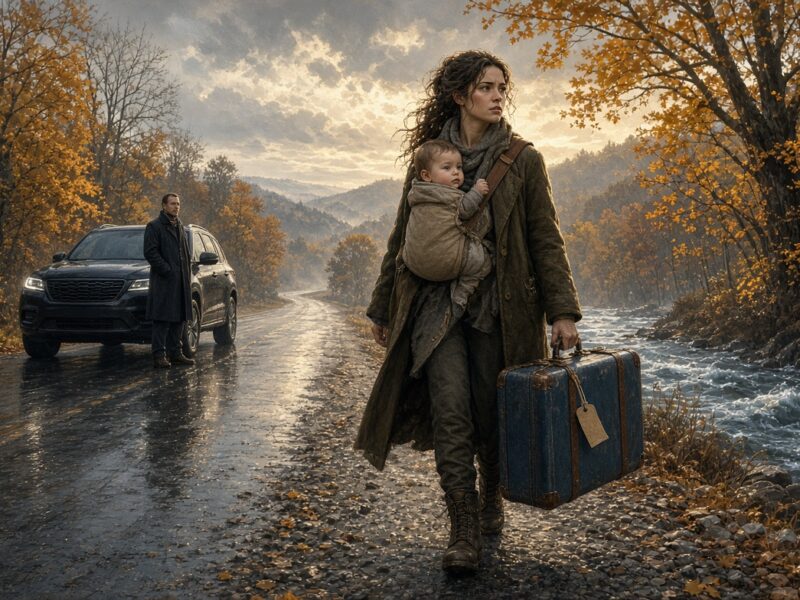
She walked down the road with her baby and one suitcase.
Unaware, a CEO’s SUV was slowing behind her.
The wheel caught again.
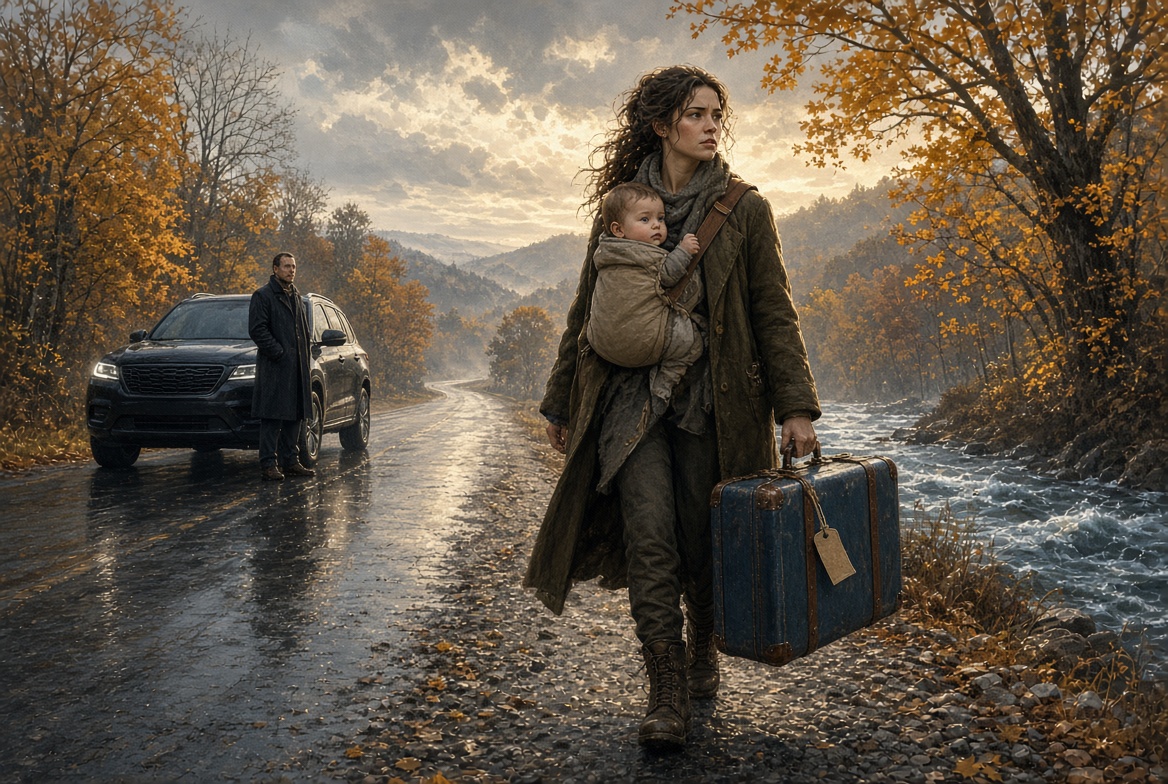
Thea Gallant stopped on the gravel shoulder, lifted the blue suitcase over a rut, and set it down without waking the baby.
Three steps later, it caught again.
It was late October in the Pemigewasset Valley, and the light was already going gray along the river.
The road out of Harlo was two lanes and no sidewalk.
The water ran fast and dark beside it.
Lark slept against her chest, ten months old and heavy in the carrier.
One small fist was wrapped in the collar of Thea’s coat.
The suitcase had been her grandmother’s.
A paper luggage tag still hung from the handle, soft as cloth now, covered in addresses.
Every one of them was crossed out.
Inside the suitcase were three changes of clothes, a pack of diapers, two bottles, and Lark’s immunization card.
In Thea’s pocket was $31.
In the diaper bag, folded small, was an address she had copied months ago and hidden.
Penny Valley Family Shelter, Plymouth.
The bus left Plymouth at 6:40.
Eleven miles.
She could make it if she didn’t stop.
She had not planned to leave today.
That morning, she had gone into Gloria Forton’s desk looking for Lark’s birth certificate.
A job application asked for documents.
Thea had never been allowed to keep them.
Gloria kept them in the safe at the dealership, so nothing gets lost, honey.
The birth certificate wasn’t in the desk.
A petition was.
Guardianship of a minor.
Lark’s name typed neatly at the top.
Gloria’s name beside it.
A yellow sticky note in Gloria’s handwriting said, “File Monday.”
Thea had read it standing up.
Mother has no residence of her own, no income of her own, no vehicle.
Emotionally overwhelmed.
The terrible part was not that it was false.
The terrible part was that every word of it was true.
Gloria had made it true, one kind thing at a time.
When Brody shipped out, Gloria said, “Move in with me. You shouldn’t be alone with a newborn.”
When Thea needed work, Gloria put her in the dealership finance office, and the paychecks went into the household account.
Simpler that way.
The car Thea drove was a demo registered to Forton Auto.
Gloria handled the daycare forms.
Gloria answered the pediatrician’s calls.
At church, Gloria held Lark up and said, “My granddaughter,” and then, “This is Thea, Brody’s friend.”
Each favor had sounded reasonable.
Ten months later, Thea owned nothing but a suitcase that had belonged to someone else.
So she had waited for the Saturday sale when Gloria would be on the lot until dark.
She had not left a note.
She had not called Brody, who was overseas and believed everything his mother told him.
She knew how an argument with Gloria would go.
Gloria never raised her voice.
She only explained gently until you forgot what you had walked in knowing.
If Thea was still in that house on Monday, the petition would be true.
So she was walking.
Her phone was off.
It was on Gloria’s family plan, and Gloria read the bill line by line.
Now the battery was nearly dead anyway.
A pickup slowed beside her.
A man leaned over.
“You need a lift?”
“No, thank you.”
Ten minutes later, a minivan slowed.
Thea shook her head before the window was even down.
Strangers frightened her.
So did every car that wasn’t a stranger’s.
The rain started softly, then didn’t stay soft.
Lark woke and began to fuss, a thin, unhappy sound.
Thea tucked the blanket higher and touched her daughter’s cheek.
Cold.
Too cold.
“I know, Bug. I know. Almost there.”
It wasn’t true.
They were barely halfway.
Then she heard an engine behind her.
It came slowly.
Too slowly.
Thea glanced back, and her whole body went still.
A black SUV.
Every black SUV in this valley could be Gloria’s.
Forton Auto sold them, serviced them, lent them out.
Gloria’s people drove them home at night.
Thea stepped farther onto the gravel.
She turned her face away and pressed one arm over Lark as if that could make them smaller.
The suitcase tipped against her leg.
The SUV slowed beside her.
Then it passed.
Behind the wheel sat Evan Corliss, thirty-eight, CEO of Corliss Hearth.
He had spent three days at his father’s lake camp packing a dead man’s life into cardboard.
He wanted a shower and silence.
He had seen the baby first, then the suitcase, then the sneakers soaked dark to the laces, and the way she had turned away.
Not from the rain.
From him.
“Not your business,” he told himself.
He had built a whole life on that sentence.
Half a mile on, he looked in the rearview mirror.
She was still walking.
At the next driveway, Evan Corliss put on his blinker, turned the SUV around, and drove back toward the woman who clearly did not want anyone to stop for her.
The black SUV came back.
It didn’t pull alongside her.
It rolled past slowly and stopped on the shoulder thirty yards ahead.
The driver got out.
Tall.
Dark coat.
No hat.
He did not walk toward her.
He stood beside his front bumper in the rain and kept his hands where she could see them.
Thea stopped walking.
“I don’t need a ride,” she called.
“Okay.”
That was all.
No smile.
No “Are you sure?”
No reasons she was wrong.
It unsettled her more than an argument would have in Gloria’s house.
No was never the end of a conversation.
It was the beginning of one.
“Rain’s supposed to get worse,” the man said.
“Is there someone I can call for you?”
Thea studied him.
Then she pulled the folded paper from the diaper bag.
“Can you call this number?”
He dialed, put it on speaker, set it on the hood, and stepped back.
Three steps.
Four.
He was letting her talk without him standing over her.
Thea walked to the hood and bent over the phone.
A tired, kind voice answered.
“Penny Valley Family Shelter.”
The family intake desk was closed for the weekend.
An advocate could meet her Monday morning.
Tonight there was no bed.
“I understand,” Thea said.
“Thank you. The bus still runs tonight, right? The 6:40?”
It did.
She ended the call and handed the phone back without touching his fingers.
“Thank you. I’ll be fine.”
“Okay,” he said again.
She turned, gripped the suitcase handle, and started walking.
She had gone maybe ten steps when she heard another engine slow, searching.
Thea looked back, and the cold went straight through her.
A second black SUV was cresting the hill behind them.
An Explorer.
She didn’t need to read the plate frame.
She knew the dent in the front bumper.
She had filed the repair order herself.
Dwayne Pelletier, Gloria’s service manager.
Dwayne, who did whatever Gloria asked.
Thea had about four seconds.
She turned back to the stranger.
“Let me see your driver’s license.”
He didn’t ask why.
He pulled it from his wallet and held it out.
Evan Corliss, Laconia, New Hampshire.
Thea grabbed a pen from the diaper bag, wrote his name and his license plate on the back of the shelter address, and shoved the paper in her pocket.
“I’m keeping this.”
“You should.”
She yanked open the back door, pulled the suitcase in after her, and curled down across the seat with Lark held tight.
“Please,” she whispered.
“Don’t tell him I’m here.”
The door shut softly.
Through the gap between the seats, she watched the Explorer’s headlights slide across the wet glass.
It slowed beside them.
A window hummed down.
“Hey there,” Dwayne’s voice, friendly, worried.
“You seen a girl walking? Young woman with a baby? Her family’s real worried about her.”
The stranger didn’t answer right away.
Lark squirmed.
Thea pressed her lips to the baby’s damp hair and prayed.
“I’ve seen a lot of rain,” Evan Corliss said.
A pause.
“Too long.”
Thea could picture Dwayne’s eyes moving over the SUV, the plate frame.
“Well,” Dwayne said finally.
“If you do, drive safe.”
The window hummed up.
The Explorer rolled on.
Thea didn’t move until the sound of it was gone.
The driver’s door opened.
Evan got in, started the engine, and turned the heat all the way up.
He didn’t turn around.
“Where am I taking you?”
“Plymouth. The bus stop on Main Street.”
“Okay.”
He pulled onto the road.
Thea sat up slowly.
She pulled the seat belt around both herself and Lark and kept the suitcase between her and the front seat.
She watched his hands on the wheel.
Steady.
Both of them.
She watched his eyes in the mirror.
They never once looked back at her.
When she said, “Turn left here,” he turned left.
He was obviously a man with money.
The quiet new SUV, the good coat, a watch that probably cost more than everything she owned.
None of it mattered to her.
She was only measuring one thing.
Whether he listened.
So far, he did.
Warm air filled the car.
With a small, shuddering sigh, Lark fell asleep.
For the first time in hours, Thea’s shoulders came down an inch.
“Can I ask you not to ask me anything?” she said quietly.
“Yes.”
He didn’t.
For the rest of the way, the only sound was the rain and the wipers and her daughter breathing.
Then the lights of Plymouth came up out of the dark.
Main Street.
The bus shelter.
Glowing in the wet.
Thea leaned forward to point and stopped.
A black SUV was parked beside the bus shelter.
A woman stood under the awning in a camel coat, hands folded, patient, calm, watching the road.
Gloria Forton was waiting for the 6:40.
Thea slid down in her seat.
Her voice came out barely above a whisper.
“Keep driving.”
Evan Corliss didn’t ask why.
He kept driving.
Plymouth slid past in the rain and was gone.
Thea stayed low until the last streetlight fell behind them.
Her hands were shaking.
She pressed them flat against her knees.
Evan drove for a mile without a word.
Then he spoke to the windshield, not to her.
“My father had a camp on Newfound Lake. Twenty minutes from here. There’s a bunkhouse separate from the main cabin. Its own door, its own lock, its own bathroom, a wood stove.”
“No.”
“Okay.”
He didn’t argue.
He simply kept driving away from Plymouth.
Lark’s cheeks had color again.
Somewhere behind them, Gloria was standing under an awning, waiting for a bus Thea would never get on.
Monday was two nights away.
“Can I use your phone?” she said.
He passed it back without turning around.
Thea called the crisis line printed under the shelter’s number.
She spoke slowly and clearly.
Her name.
Her daughter’s name.
Evan Corliss.
His license plate.
The camp on Newfound Lake.
“Can you give me the address?” she asked him.
He gave it.
And she repeated it into the phone.
“If I don’t call you by nine tomorrow morning,” Thea told the advocate, “please send someone.”
The woman on the line said she would.
Then she handed the phone back.
“One night,” Evan agreed.
The camp sat at the end of a dirt road, dark pines on every side and black water beyond.
The bunkhouse stood fifty feet from the main cabin, small and square.
Evan unlocked the bunkhouse, came back down the steps, and held the key out to her at arm’s length, standing in the rain.
“There’s one camera,” he said.
“Over the garage, facing the driveway.”
“None, not one.”
She took the key.
“I’ll leave some things on the porch,” he said.
“Lock the door behind you.”
Then he walked away.
Twenty minutes later, there was a soft knock, then footsteps leaving.
Thea waited a full minute before opening the door.
Two grocery bags from Market Basket sat on the porch.
Towels.
Bottled water.
A thermometer.
A pack of diapers in Lark’s size.
Bread.
Bananas.
Two cans of chicken soup.
Nothing fancy.
Nothing that said, “Look what I can do for you.”
Thea stood holding the paper bag, and for one terrible second, she almost cried.
Not out of kindness.
At how ordinary it was.
Her grandmother used to carry those same bags into a narrow kitchen in Berlin every Saturday.
Inside, Evan had already lit the wood stove.
The little room was warm and smelled of cedar.
Thea knelt to check the fire and saw a word cast into the black iron door.
Corliss.
She frowned at it for a moment.
Then Lark began to fuss, and she let it go.
She fed Lark, bathed her in the small sink, and laid her down in dry clothes circled by pillows.
Then Thea dragged the kitchen chair across the floor and wedged it under the doorknob.
She knew it wouldn’t stop anyone.
That wasn’t the point.
Across the yard, Evan was walking back from checking the woodpile when he saw the chair through the window.
He stopped in the rain.
He wasn’t insulted.
One decent evening didn’t earn anyone’s trust.
He went inside and left the porch light on.
Morning came pale and gold over the lake.
Lark woke warm and hungry and pulled Thea’s hair.
Thea laughed for the first time in days.
A small, surprised sound.
She plugged her phone into the outlet by the bed.
At 8:52, she called the crisis line.
“We’re safe,” she said.
Then she looked at the screen.
Seventeen missed calls.
Gloria’s messages were calm, loving.
That made them worse.
“Sweetheart, I’m not angry. I’m worried sick. Lark’s birth certificate is safe with me. Come home and we’ll talk like family.”
Then one more from a number with a long international code.
“Mom says you ran off in a storm with the baby. Thea, what are you doing?”
Brody.
Thea set the phone face down.
Footsteps crossed the porch.
When she moved the chair and opened the door, a cup of coffee sat on the railing.
Evan was already halfway back to the main cabin.
“Wait,” she called.
He turned.
She held the cup in both hands.
“What do you do?”
“I make stoves.”
Thea looked back at the black iron in the bunkhouse, then at him.
She almost laughed.
Then his phone rang.
Evan answered.
The morning was so still that the voice carried across the wet grass, warm, unhurried.
Thea knew it better than her own.
“Mr. Corliss, this is Gloria Forton from Forton Auto. Your father bought every truck he ever owned from me. Thirty years.”
A soft pause.
“My service manager recognized your SUV on the River Road last night.”
Evan’s eyes lifted to Thea on the porch.
“I believe you have my granddaughter.”
Evan didn’t hang up right away.
He turned his back to the porch and said a few quiet words, then lowered the phone.
He walked to the foot of the steps and told her everything, word for word.
“She asked if you were safe. I said yes. She asked me to put you on. I said, ‘She’s an adult, Mrs. Forton. You can talk to her.’ She said she’d be in touch.”
He paused.
“That’s all of it.”
Thea stared at him.
In fourteen months, nobody in Gloria’s house had ever told her what was said about her.
Conversations happened in the next room.
Decisions arrived already made.
“Thank you,” she said.
It came out rough.
On Monday morning, Thea asked him for a ride to the Bristol town office.
“Only a ride.”
At the clerk’s window, she slid a certified birth record request across the counter.
Lark Marie Gallant.
Mother: Thea Gallant.
The clerk pulled the record from the state system and asked for $15.
Thea counted it out in small bills.
Fifteen of her thirty-one.
The paper came off the printer warm.
Thea held it with both hands.
Gloria’s safe now held one less key to her life.
She had $16 left.
She had never felt so rich.
The rest of the week was arithmetic.
She opened a checking account in her own name and deposited the $16.
She called the state legal aid line and was connected to an attorney named Lynn Tibbetts who listened for twenty minutes and said, “Write everything down. Dates, names, what you can prove.”
She met the shelter advocate, who said a transitional apartment in Plymouth might open in two weeks.
Maybe.
She filled out job applications at the bunkhouse table.
One year in a dealership finance office, but no reference she trusted enough to use.
Every line of her work history seemed to lead back to Gloria.
On Tuesday night, Evan knocked and stayed on the porch.
“The weather’s turning. The shelter’s two weeks out. The bunkhouse is yours until then, if you want it.”
Thea thought about it.
“Only if we write it down.”
He looked surprised.
Then he went to his SUV and came back with a Corliss Hearth invoice.
They wrote the terms on the back at the porch rail under the light.
No rent for a short stay.
No entering without permission.
She can leave the moment she chooses.
Evan signed it.
Thea signed under him and folded it into the diaper bag beside the birth certificate.
It was only the back of an invoice, but it was the first agreement in fourteen months that she had helped write.
The days settled into something almost quiet.
Thea hummed Lark’s old French lullabies while she washed bottles.
Evan, carrying firewood past the window, slowed down every time.
She noticed he ate every meal straight out of the pan, sitting on the cabin steps.
“My dad did it,” he said when she raised an eyebrow.
“Fewer dishes. Fewer conversations.”
She noticed something else.
In the corner of the main cabin sat a cardboard box taped shut, marked in black letters.
Custody 1997.
Every other box had been opened, sorted, labeled.
Evan walked around that one like it was a hole in the floor.
She didn’t ask.
He had never asked her anything she hadn’t offered first.
On Wednesday evening, Evan nodded at the blue suitcase by the door.
“Can I ask about the tag?”
Thea touched it.
Soft paper, a dozen addresses, every one crossed out.
“It was my grandmother’s. She raised me in Berlin until I was nine. When she got sick, this suitcase carried me to my father’s house. He had a new family. I slept on the couch in the den for six years.”
She traced the lines.
“Every one of these is a place I was allowed to stay.”
The bottom line was empty.
“I’m not writing anything there,” she said, “until it’s mine.”
Evan was quiet.
Then he said, “That’s a good rule.”
Later, passing Lark’s bottle across the table, their fingers touched.
Neither of them moved away quickly.
Thursday afternoon, a car stopped at the camp gate.
Not black.
A dusty gray sedan.
A man in a windbreaker walked up the drive with a large envelope.
“Thea Gallant.”
Her heart was already pounding.
“You’ve been served, ma’am.”
Evan came out of the main cabin as the sedan pulled away.
Thea stood on the porch with the envelope open in her hands.
Gloria had filed.
Petition for guardianship of a minor.
Lark Marie Gallant.
The same lines Thea had read in the desk.
No residence of her own.
No income of her own.
No vehicle.
And one new line.
Currently residing with an unrelated man, Evan Corliss.
Thea turned the page, and her knees nearly gave out.
Clipped to the back was a single sheet.
A notarized form.
A familiar, careless signature at the bottom.
“I consent to the appointment of my mother, Gloria Forton, as guardian of my daughter.”
Brody Forton.
Lynn Tibbetts was in her sixties with reading glasses on a beaded chain and a canvas bag full of files.
She met Thea at a back table in the Bristol library on Friday morning.
Evan had driven Thea into town.
He hadn’t asked to come in.
He had gone to the hardware store across the street and stayed there.
Lynn read the petition twice.
Then she read Brody’s consent and set it down carefully, like something that might break.
“Here’s the truth,” she said.
“His signature doesn’t take away your rights. You’re Lark’s mother. A judge has to decide what’s best for her. And a grandmother doesn’t win just by asking.”
Thea let out a breath.
But Lynn said, “I won’t lie to you. A father’s consent. No home of your own. And a wealthy man you met a week ago.”
She tapped the page.
“On paper, that’s a picture. Judges look at pictures.”
“So what do I do?”
“You give them a better one. With proof.”
Lynn didn’t promise she would win.
She didn’t say, “Don’t worry.”
She explained the risks one by one in plain English.
Thea trusted her because of it.
That night at the bunkhouse table, Thea wrote at the top of a legal pad, “Things I can prove.”
The pediatric portal showed Thea’s name at every one of Lark’s appointments.
Every single one.
The daycare enrollment form listed Gloria as guardian.
Thea had never signed it.
The car she used to drive was registered to Forton Auto.
Her paychecks had gone into the household account.
Then she did something else.
Under each line of the petition, she wrote a second line.
No residence of her own.
Who made it true?
Gloria.
No income of her own.
Who made it true?
Gloria.
No vehicle.
Who made it true?
Gloria.
She looked at the page for a long time.
It didn’t look like a woman falling apart anymore.
It looked like a woman who had been taken apart, one kind favor at a time.
Saturday morning, she found Evan on the dock with a mug of coffee and told him her plan.
“Three things. When the shelter apartment opens, I take it. Same day. Then ‘no residence of her own’ stops being true.”
He nodded.
“Second, I reach Brody myself. Not through his mother.”
She had already texted him twice.
Nothing yet.
“And third, Lynn’s offering Gloria a visit. Supervised. One hour. So the court sees I’m not hiding Lark from anybody.”
Evan set the mug down hard enough that coffee jumped over the rim.
“No.”
Thea blinked.
In a week, he had never once said no to her.
“You don’t hand her the rope, Thea. She filed against you. She sent a man to find you on the road. You give her an hour, she’ll use it.”
“Maybe.”
“There’s no maybe.”
His jaw was tight.
He looked out at the gray water instead of at her.
“I know what it is to be the thing two people pull on.”
The words hung there.
Thea waited.
He didn’t say anything more, so she answered him gently, but she didn’t move an inch.
“Then you know Lark shouldn’t lose a grandmother because the grown-ups couldn’t share her.”
She held his eyes.
“I’m not handing Gloria anything. I’m setting the table.”
For a long moment, neither of them spoke.
Thea realized something standing on that dock.
For a week, his car had carried her.
His cabin had sheltered her.
His phone had made her calls.
Every good thing in her new life had passed through his hands.
However carefully, this one wouldn’t.
Evan seemed to understand it at the same moment.
She watched him fight it.
Then she watched him let it go.
“What do you need from me?” he asked quietly.
It was a new question.
She could tell it cost him something.
“Nothing on Saturday.”
He nodded once.
“Then that’s what you’ll get.”
Lynn called Gloria’s attorney that afternoon.
The visit was set for the following Saturday at the children’s room of the Plymouth Library.
One hour.
A staff member present the whole time.
All week, Thea practiced what she would say.
She checked her phone every hour.
Brody never answered.
On the day, the shelter advocate drove her.
Evan stayed at the camp, exactly as she had asked.
The children’s room was bright and smelled like crayons.
Thea sat on a small chair with Lark on her knee.
A librarian sat nearby with a clipboard, kind and watchful.
At ten o’clock exactly, the door opened.
Gloria came in first, in her camel coat, carrying a gift wrapped in pink paper with a white bow.
She smiled at Lark like nothing had ever happened.
But she wasn’t alone.
Behind her, ducking under the doorframe, was a young man in an Army uniform.
Short hair.
Tired eyes.
Brody.
Home on emergency leave.
His mother had arranged it without a word to Thea.
He didn’t look at Thea.
He didn’t say hello.
He looked only at his daughter.
“I’m here,” Brody said, “to take my daughter home.”
Brody didn’t take her.
The librarian stood up, clipboard in hand, and said, “Nobody’s leaving with anyone today.”
That was the end of it.
Gloria held Lark at the reading table, cooing softly while the librarian watched.
Thea and Brody went out to the stone steps.
Up close, he looked younger than twenty-six.
Jet-lagged.
Gray under the eyes.
The uniform made him look like a boy wearing his father’s coat.
“I flew twenty hours,” he said.
“Mom said it was an emergency.”
“It wasn’t.”
“You ran off in a storm with a sick baby, Thea.”
“She wasn’t sick. She was cold because I walked into some rich guy’s car.”
He rubbed his face.
“Mom says you met him that day. Now you’re living at his lake house. She says you’re trading Lark’s whole life for a millionaire.”
Thea’s throat closed.
Every word was almost true.
That was what made it so hard to answer.
“Did you read what you signed, Brody?”
He looked away.
“Mom said it was just paperwork in case something happened to me over there.”
“It’s a guardianship petition for our daughter.”
He didn’t answer.
Then he said, “I want to meet him.”
That afternoon, Brody’s rental car pulled up at the camp.
Thea was in the bunkhouse sorting Lark’s things into the blue suitcase.
The shelter had called that week.
The apartment might open early.
She had wanted to be ready.
Through the half-open window, she heard the two men on the porch of the main cabin.
“Did she leave for you?” Brody asked.
“She’d never met me,” Evan said.
“She was already walking when I drove that road.”
“Mom says you’re paying for her lawyer.”
“She won’t let me pay for coffee.”
A long silence.
Then Brody asked the real question.
“Would you tell a judge my mother is lying?”
Thea stopped folding.
She held one of Lark’s socks in her hand and waited.
“I don’t know your mother,” Evan said.
That was all.
Not “She’s lying.”
Not “Thea’s telling the truth.”
Just a careful, empty space where Thea had hoped her name would be.
She sat down on the bed.
It was a reasonable answer.
She knew that.
But reasonable answers were what she had lived with for fourteen months.
When Brody drove away, Thea finished packing.
She called the shelter advocate.
The apartment was ready four days early.
Could she come today?
She could.
She took the folded invoice out of the diaper bag and left it on the bunkhouse table.
Their terms.
Both signatures.
Then she carried the blue suitcase to the advocate’s car herself.
Evan came across the yard as the car started.
He saw the suitcase in the back seat.
He saw her face.
“Thea—”
“It’s ready early,” she said.
“And now it doesn’t say ‘unrelated man’ anywhere.”
He didn’t argue.
He only stood in the driveway and watched them go.
On Monday, Gloria Forton walked into the Corliss Hearth office in Laconia without an appointment.
Evan’s assistant tried to stop her.
Gloria smiled and walked past.
She sat down across from his desk as if she had sat there a hundred times.
Maybe she had, with his father.
“Cliff bought his trucks from me for thirty years,” she said.
“Every spring he’d drink my terrible coffee and talk.”
She folded her hands.
“He told me about 1997.”
Evan went very still.
“Your father waited twenty years for a boy who said one sentence in a courtroom.”
Her voice was soft, almost kind.
“Don’t help that girl teach my son the same lesson.”
She stood, buttoned her camel coat, and left.
Evan sat at his desk until the office emptied.
He picked up his phone twice.
He didn’t call Thea.
In Plymouth, Thea kept building.
A temp job at the credit union started Wednesday.
A daycare on Highland Street had one opening.
Thea enrolled Lark that morning.
The daycare asked her old center in Harlo for Lark’s records.
Thea signed the release at the front desk before work and hurried out to catch the bus.
The file arrived after lunch.
Along with immunization records and emergency contacts came the old authorized pickup form from Harlo.
Gloria Forton’s name was still on it.
No one called Thea.
She worked six hours at the credit union and did not look at her phone once.
At 4:30, she called the daycare to say she was on her way.
The director’s voice changed the moment she heard Thea’s name.
“Miss Gallant, I need you to stay on the line.”
Thea stopped walking.
“What happened?”
A pause.
Papers moving.
A door closing somewhere on the other end.
“Mrs. Forton picked Lark up at three. She was listed on the transferred file as an authorized pickup.”
For a second, Thea could hear nothing but traffic moving past her.
“You let her take my daughter?”
“The authorization came over with the Harlo records. We didn’t know there was a dispute.”
Then Thea understood.
The records request hadn’t just moved paperwork from one daycare to another.
It had told Gloria exactly where Lark was.
She stood alone on a Plymouth sidewalk as the streetlights flickered on.
No car.
Forty dollars in her account.
Lynn was too far away to get her to Harlo, and the shelter advocate had no car waiting at the curb.
Thea could make calls later.
Right now, she needed to reach her daughter.
There was one person who could get her there.
Her thumb was shaking when she pressed it.
He answered on the first ring.
He didn’t apologize.
He didn’t offer a plan.
He asked one word.
“Where?”
“Forton Auto.”
Thea swallowed.
“And this time, I need you to come inside.”
Twenty minutes later, his SUV pulled up at the curb.
The dealership lot was lit bright white.
Rows of black SUVs stood in perfect lines, rain beating on their hoods.
The same cars she had hidden Lark from on the river road.
Thea got out and walked between them on her own feet.
Evan stayed one step behind her.
The showroom door was unlocked.
Gloria’s office light was on.
Lark was asleep in an old wooden playpen in the corner.
Brody’s playpen, from when he was a baby.
Gloria sat behind her desk.
Brody stood by the window in jeans and a sweatshirt, looking like he hadn’t slept.
Gloria hadn’t run.
She had simply brought Lark home to make a point.
“I called Brody to come see his daughter,” she said calmly.
“Sit down, honey.”
Thea stayed standing.
Gloria slid a thick envelope across the desk.
Lark’s birth certificate.
Her Social Security card.
Everything.
“Move back in, and I withdraw the petition. I stay guardian on paper for the insurance. You get your job back.”
She smiled.
“Everything easy.”
Thea looked at the envelope for a long moment.
“You gave me a room,” she said quietly, “and made sure it was never mine. Every true thing in that petition, you made true.”
Her voice didn’t shake.
“I’m done living in sentences somebody else wrote.”
Gloria’s smile thinned.
“You don’t know what it is to lose a child.”
Then Evan spoke.
He didn’t raise his voice.
He didn’t take a side.
“When I was nine, I sat in a room at the courthouse with a box of crayons,” he said.
“A lady asked me where I wanted to live. My mother cried every time I came back from my father’s. So I said one sentence. ‘I don’t want to go there.'”
He looked at the playpen.
“My father heard it as the truth for twenty years. So did I.”
Nobody moved.
“Lark’s going to hear whatever you all decide tonight,” Evan said.
“Don’t make her the sentence.”
Brody turned from the window.
His eyes were wet.
“Mom, I need to tell you something.”
Gloria looked at him.
“At my basic training graduation, an old lady came up to me. She said, ‘You have your father’s chin.'”
He swallowed.
“It was Grandma Bernardet. Dad’s mother.”
Gloria went pale.
“You never let her see me after Dad died. Not once. I’ve called her every month since graduation.”
His voice cracked.
“You did to Dad’s mother exactly what you’re doing to Thea. Grandma waited twenty-three years to meet me, Mom. You want Lark to have that?”
Gloria pressed her hand flat on the desk.
“I’ll withdraw my consent tomorrow,” Brody said.
“Lark goes home with her mother tonight.”
For a long time, Gloria said nothing.
When she spoke, her voice was small.
“Lucien’s family wanted you every summer on the farm in Quebec. I thought if I shared you, I’d lose you.”
She looked at the playpen.
“I lost him so fast.”
She picked up the envelope.
Her hand shook.
She held it out to Thea.
Not to Evan.
To Thea.
Thea took it.
Then she lifted her sleeping daughter from the playpen and held her close.
At the door, she turned back.
“Sundays, two to five. My table, my rules. Starting this Sunday.”
Gloria stared at her.
“Why?”
“Because she should have more people,” Thea said.
“Not fewer.”
Behind her, Evan watched a woman offer the mercy his father never got.
In the parking lot, rain ticking on the cars, he finally said it.
“I’m sorry. Gloria came to my office Monday. She knew about my father. I froze. I was so scared of choosing a side again that I let you stand there alone.”
Thea buckled Lark into the seat he had borrowed from his foreman.
She didn’t forgive him on the spot.
“Next time,” she said, “call me scared. Don’t call me nothing.”
He nodded.
“Okay.”
The next morning, Gloria’s attorney withdrew the petition.
In January, a judge would approve the parenting plan Thea and Brody wrote together at her kitchen table.
That night, Thea sat on a secondhand couch eating microwaved macaroni while Lark slept in a donated crib.
It was the smallest place she had lived since Meme.
It was also the first door she had ever closed entirely by choice.
Out on Newfound Lake, Evan sat on the cabin floor beside the box he had walked around for weeks.
Custody 1997.
He cut the tape.
Inside, on top, was a typed transcript.
His own nine-year-old answer, in black and white.
And beside it, in the margin, a note in his father’s blunt handwriting.
Evan read it once.
Then he read it again, and he couldn’t stand up.
The note in the margin was two short sentences and an initial.
“He’s protecting her. Don’t make him say it twice. —C.”
Evan read it until the light went gray over the lake.
His father hadn’t stopped fighting because a nine-year-old had rejected him.
He had stopped so his son would never have to sit in that room again.
Evan wasn’t the boy who had pushed his father away.
He was the boy his father had protected.
He stayed at the camp that weekend alone and grieved Cliff Corliss properly for the first time.
Three weeks later, his phone rang.
Thea.
She wasn’t asking for a ride or a room or a witness.
“Would you come to dinner?” she said.
“My table.”
Winter came to the valley.
Thea’s temp job became a real one.
Loan processor at the credit union.
Earned on her own record.
In December, she rented a second-floor apartment over a hardware store on Plymouth’s Main Street.
It was small and drafty, and the radiator knocked all night.
Lark’s room had a door.
So did Thea’s.
She took the bus to work and walked home, and she didn’t mind at all.
Sundays from two to five were stiff at first.
Gloria brought casseroles nobody had asked for and rang the bell three times.
By the third Sunday, she knocked once and waited.
By the fifth, she brought nothing but herself.
On December 27th, Lark turned one.
Brody was home on leave, and Gloria made a phone call she had put off for twenty-three years.
Bernadette Forton drove down from Quebec.
She was eighty-four, tiny, with a red wool hat and Lucien’s chin.
The two grandmothers stood in Thea’s narrow kitchen and looked at each other for a long moment.
Then Bernadette held out her arms, and Gloria stepped into them.
The apartment was far too small, so everyone ended up on the floor around the cake, Lark in the middle with frosting in her hair.
The love between Thea and Evan grew slowly around ordinary things.
Grocery runs where Thea paid for her own cart.
Evan learning Meme’s French lullabies and singing them wrong on purpose just to make Lark laugh.
Evenings on the fire escape with his phone left inside on the counter.
Disagreements where Thea said no and nothing bad happened afterward.
Their first kiss was on the apartment stairs in January, in falling snow.
Neither of them hurried it.
Evan changed, too.
He started leaving the office by six.
In the fall, he opened the lake camp to the foundry’s retirees for supper the way his father used to.
He never asked Thea to prove she didn’t want his money.
She never asked him to pay for the life she was building.
They still misunderstood each other sometimes.
Thea went quiet when he offered something too fast.
Evan went still whenever a room asked him to choose a side.
They learned to name it instead of running from it.
In the spring, Lark’s daycare sent home a new authorized pickup form.
Thea sat at her own kitchen table with a pen.
Evan Corliss.
Then she paused for a long time.
And by her own choice, she wrote one more line.
Gloria Forton, grandmother.
It was the same kind of list Gloria had once used to take Lark away.
Now Thea held the pen.
One year after the walk, on a late October afternoon, Thea asked Evan to drive the river road.
The maples were bare again.
The water ran fast and dark.
Lark was walking now, and at the turnout she insisted on getting out.
Thea recognized the curve, the place where the suitcase wheel had caught again and again in the gravel.
She turned to Evan.
“Drive slow behind us. Just for a minute.”
He looked at her, then smiled.
“Okay.”
Thea took Lark’s small hand.
Together they walked the gravel shoulder, one slow step at a time, and behind them his black SUV rolled quietly along.
She wasn’t afraid at all.
After a while, she turned around, smiled, and waved.
The SUV pulled up beside them.
That night, after Lark was asleep, Thea took the blue suitcase down from the top shelf of her closet.
She didn’t pack it.
She sat on the floor with it in her lap and looked at Meme’s tag.
Soft as cloth now.
Every address crossed out.
Every house where she had been allowed to stay.
Below the last one, the line was still empty.
Thea uncapped a pen and wrote her own address.
Main Street, Plymouth, New Hampshire.
Her name above it.
She did not cross it out.
She put the empty suitcase back on the shelf.
She was keeping it, not because she expected to run again, but to remember the woman who once walked a river road carrying everything she could save.
That woman had a home now, and she would never be a guest in her own life again.









