She Found a Note Under Her Champagne: “Don’t Drink.” It Saved Her Life—and Exposed a Dynasty
The note was folded into quarters and tucked beneath the stem of her champagne flute.
Tanzi Kiral found it the way she found most things—by paying attention when no one expected her to.
She almost missed it.
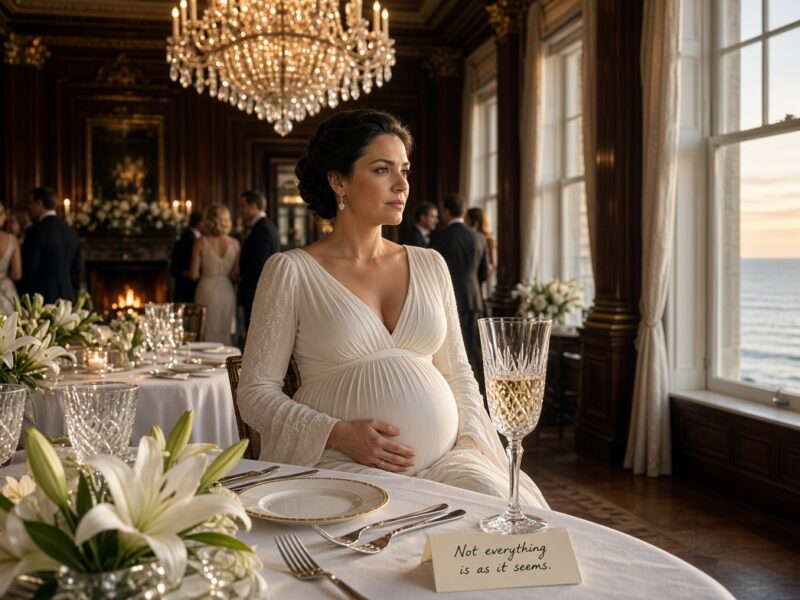
The ballroom at the Veland estate in Cape Elizabeth seated sixty-four people in a good year and seventy in a crowded one. Tonight, every chair was filled.
Chandelier light caught crystal and silver the way only serious money can arrange it.
The room smelled of white lilies and cedar smoke from the fireplace Leander Veland kept burning no matter the weather outside.
September in Portland, Maine, still carried a little summer off the water. But Leander believed in the symbolism of fire.
He had told Tanzi so once, at another dinner three years ago, before he understood that she was the kind of woman who filed things away.
She had been married to Caspian Veland for three years.
She had learned to dress for invisibility long before that—navy, charcoal, and that particular shade of ivory that reads as wallpaper in photographs.
Tonight she was seven months into a pregnancy she had carefully not announced to anyone outside the family physician.
The maternity gown she wore was ivory, too.
Leander had arranged the seating.
He had placed her at the far end of the table, beside the swinging kitchen door, between the company’s junior marine surveyor and an elderly aunt who had stopped reading lips two years ago.
Caspian changed the seating.
He walked in six minutes late.
He was always six minutes late. Tanzi had spent two years deciding it was deliberate.
He paused at the head of the table where his father sat.
Something passed between them—brief, cold, and unresolved.
Then Caspian crossed the length of the room, past the seated partners and their decorated wives, and stopped at Tanzi’s chair.
He touched the back of the empty seat at his right hand.
“Tonight, you sit beside me.”
Forty people watched her stand.
You should know what that room looked like right then.
Leander Veland’s expression did not shift. Both of his hands rested flat on the tablecloth.
Across from him, the company’s chief financial officer, a man named Bryce Oldgate, set down his water glass very carefully.
Three chairs over, Silana Rock—who ran public relations for Veland Marine and who had been eating at this table for eight months before Tanzi ever heard her name—turned her face toward the nearest window and kept it there.
Tanzi picked up her evening bag and walked the length of the room.
She was thirty-four years old and thirty-four weeks pregnant.
She had not sat at Caspian’s right hand once in three years of marriage.
The last time he had gestured toward a chair for her, he had been asking her to sign financial documents she hadn’t been given time to read.
She sat.
She found the note.
She opened it with two fingers below the edge of the tablecloth.
DON’T DRINK.
The letters were machine-printed. No signature. No date. No further instruction.
Two words on a square of cheap copy paper, folded so many times the creases had gone soft.
She set the note on her thigh and covered it with her palm.
Some warnings arrive as screams; the dangerous ones arrive folded small enough to hide under a glass.
The sommelier arrived and began to fill her flute with a pale sparkling wine—the vintage Leander ordered for every Founders’ Dinner because his father had ordered it before him, and his grandfather before that.
Tanzi pressed two fingers to the rim.
“Water, please.”
The sommelier hesitated.
He glanced toward the head of the table.
She kept her fingers exactly where they were.
“Water,” she repeated, softly, the way you speak to someone who already knows the answer.
He moved on.
Across the table, Bryce Oldgate was watching her.
He raised his own glass a fraction of an inch.
He did not drink from it.
Caspian leaned in, close enough that the words would not travel.
“You’re making the staff nervous.”
“I’m making myself comfortable.”
“Is there a difference, in this house?”
She almost smiled. “You tell me. You’re the one who moved my chair.”
He looked at her for a moment longer than he usually did.
Then he turned back toward the table and said something to the man on his left about tonnage rates, and the moment closed like a door.
Tanzi did not look down at her lap again.
She did not need to.
She could feel the paper under her palm the way you feel a heartbeat that isn’t yours.
She let her eyes travel the table the way she used to let them travel a general ledger: line by line, without hurry, looking for the entry that didn’t belong.
The junior surveyor she’d been meant to sit beside was stealing glances at her empty chair as if it had insulted him.
The elderly aunt was asleep with her eyes open.
The waitstaff moved in their usual pattern, out of the kitchen door, clockwise, back.
All but one.
A man in a gray jacket stood near the service alcove, not carrying anything.
Waiters always carry something.
She filed him away.
The first course came and went—scallops seared on one side, a sliver of pickled ramp, a sauce that tasted like the inside of a lobster shell.
Tanzi ate slowly.
She drank water.
She counted.
Forty people at the long table, twenty-four more at the round tables near the windows. Three servers per station. One sommelier. One man in gray, who did not belong to any station at all.
At the head of the table, Leander tapped a silver spoon against his glass, and the room went quiet in the practiced way rooms go quiet for men like him.
“A hundred and eleven years,” he said. “My grandfather started this company with one tugboat and a debt he wasn’t sure he could pay. Tonight, we carry the largest harbor contract in the history of the state of Maine.”
Applause, warm and expensive.
“To the people who keep the water moving,” Leander said, and lifted his glass.
Sixty-three people lifted theirs.
Tanzi lifted her water.
She saw Leander see it.
He smiled at her from forty feet away, a grandfather’s smile, and drank.
The last time a Veland smiled at her like that, she had lost her father.
She hadn’t known it at the time.
She knew it now.
She had not come to Portland to work for the Velands.
She had come home after her father’s funeral and found that the city had already rearranged itself around his absence.
David Kiral had been a marine safety inspector with the U.S. Coast Guard, assigned to the cargo terminal in South Portland.
He died on a Wednesday morning in October, eight years ago, when a crane hook gave way on Pier 9.
The official investigation cited a faulty load cell, operator error, and an inadequate maintenance protocol.
It was completed in eleven days.
“Faster,” one of her father’s colleagues told her afterward, in the parking lot behind the funeral home, “than any port fatality inquiry I have ever seen in thirty years.”
He had said it quietly, the way men say things they want you to remember and want to be able to deny.
At the time, Tanzi was twenty-six and finishing her CPA license.
She filed the death certificate.
She settled her father’s modest estate—a two-bedroom Cape on Broadway, a fishing boat with a cracked hull, a coffee can of quarters he had been saving for no reason anyone could name.
She moved her mother, Esther, into a memory and movement care facility in South Portland, because Esther’s Parkinson’s had progressed past what Tanzi could manage alone on a junior accountant’s salary.
Veland Marine Holdings owned the crane that killed her father.
Their legal team sent a condolence letter on cream-colored stationery.
Their insurer settled for $84,000.
Nobody from the family attended the memorial.
Tanzi kept the condolence letter in the same coffee can as the quarters.
She told herself it was for the record.
It was the first thing she ever filed away on the Velands.
She took the job at Veland Marine because it paid $31,000 more than the alternative, and because the alternative would not have covered Esther’s physical therapy.
“You’re going to work for them?” her mother had asked, the words slowed and softened by the medication.
“I’m going to work for a paycheck, Mom.”
“Your father would say those are the same thing.”
“Dad would say a lot of things.”
Esther had reached over, tremor and all, and straightened Tanzi’s collar.
“He’d also say you’re the only person he ever met who could walk into a room and leave it knowing more than the people who owned it.”
Tanzi told herself she would leave within a year.
That was eight years ago.
She met Caspian in her fourth year, when she was auditing the subsidiary accounts and he needed someone who would not ask questions about a line item labeled PORT FACILITATION CONSULTING.
She asked the question anyway.
She remembered the conference room—third floor, the one with the bad radiator that clanked every eleven minutes.
“It’s a standing retainer,” Caspian had said. “Harbor relations. Permitting. People who make the phone ring on the right desk at City Hall.”
“Then there should be invoices.”
“There are invoices.”
“There are invoice numbers,” she said. “That’s not the same thing.”
He looked at her then.
Really looked, the way people do when they expected furniture and found a person instead.
Then he asked her to dinner.
The marriage surprised everyone, including Tanzi.
Caspian was forty-one, twice divorced, and possessed of the particular certainty that comes from never once wondering whether a room wanted him in it.
He was not cruel to her.
He was not especially kind, either.
He was precise and contained, a man who folded his napkin into thirds before he stood and kept his phone face up only when he had nothing to hide.
Within the first year, she understood that he had married her because a woman who survived on invisibility made a convenient wife for a man with things to hide.
She stayed because Esther’s facility cost $9,400 a month.
She stayed because in year two, she found the first discrepancy.
And once you find the first one, you are no longer a wife.
You are an auditor who happens to sleep in the house under review.
It had started with something so small it almost insulted her.
A rounding error in a pension reserve reconciliation—forty-one cents that should not have existed.
Forty-one cents is nothing.
Forty-one cents, repeated across nineteen months of transfers, is a pattern.
She pulled the thread one quiet weekend while Caspian was in Boston for a maritime law conference.
She sat at the kitchen island with a legal pad and a mug of tea gone cold and two monitors connected to a laptop he did not know she owned.
By Sunday night she had a number.
$340,000.
Approved under PORT FACILITATION CONSULTING. Moved from the company’s employee pension reserve into a numbered account she had never heard of.
The approval line bore her name.
Not her handwriting.
Not her authorization.
Her name—typed, then signed in a looping hand that belonged to no one she had ever been.
She photographed every page.
She stored the images in three places Caspian did not control: a safe-deposit box at a credit union in Westbrook, an encrypted drive taped inside the battery compartment of her father’s old marine radio, and a cloud account opened under her mother’s maiden name.
Then she did nothing.
Nothing, for fourteen months.
Because she was pregnant, and because she had learned in three years of marriage to Caspian Veland that the person who moves too soon loses everything.
She had been waiting for the right thread.
Patience, it turns out, is just anger that has learned to do paperwork.
The main course arrived.
Saddle of lamb, the plates set down with the precision of a rehearsed service.
Tanzi watched the room, not the food.
She was looking for what she had trained herself across a decade of audit work to find—the detail that did not fit the pattern.
Silana Rock had not touched her wine either.
That was the detail.
Silana drank at every company function. Tanzi had seen her finish two glasses of the founders’ vintage before the scallops last year. Tonight her flute sat full, the bubbles long gone flat, as if she had decided it was furniture.
At the far end of the table, Leander steered the conversation toward third-quarter earnings and the Bowmont Harbor expansion contract.
The men around him performed their interest with practiced ease.
Leander was seventy-three and moved like a man who had never been contradicted to his face.
Silver hair, full and well kept. His left hand rested on the brass head of a walking cane he did not strictly need.
Eight years ago, he had been the one who managed the Pier 9 inquiry on behalf of Veland Marine.
Tanzi had known that for fourteen months.
She had not yet decided what to do about it.
Caspian leaned toward her.
“You look pale.”
“I’m fine.”
“You didn’t drink.”
It wasn’t a question, so she didn’t treat it like one.
“The doctor said sulfites,” she said, and held his gaze. “The baby.”
He measured something behind his eyes.
For one strange second she thought he was going to say something real.
Then he lifted his own glass and drank.
She watched his throat move and wondered—not for the first time—what exactly she had married.
A man who knew?
Or a man who simply never asked?
In her experience, the second kind did more damage. The first kind at least kept records.
Halfway down the table, Franklin Dench pushed back from his chair.
Franklin was Veland Marine’s director of operations. He had worked the South Portland terminal since the year David Kiral died.
The first sound was his glass hitting the bread plate.
The second was his shoulder striking the guest beside him.
The third was the chair going over, and then Leander’s voice, very quiet, very calm:
“Get Dr. Rena.”
The room erupted.
Someone shouted for 911. Someone else shouted that Dr. Rena was already coming. A woman in green silk knocked over a candle and a server smothered it with a napkin before it caught.
Tanzi did not move.
She watched.
Bryce Oldgate was on his feet, one hand braced on the table, his face the color of the tablecloth.
Silana Rock was not.
Silana sat with her arms folded and her eyes on the floor, holding the particular stillness of someone containing relief.
Not horror. Not shock.
Relief.
The man in the gray jacket moved toward the kitchen exit without appearing to hurry.
Tanzi fixed three details before he was through the door.
Gray jacket. Right-handed. A slight drag on the left foot, like an old knee that had never healed right.
Dr. Rena arrived from the adjacent sitting room in under two minutes.
Under two minutes meant she had been stationed there.
People do not station a physician in the next room for a dinner party unless they expect someone to need one.
Tanzi looked at her own place setting.
Her champagne flute was gone.
She hadn’t touched it after the sommelier left—she had pushed it a few inches toward the centerpiece, out of habit, the way you push away a plate you are done with.
Now there was only the water glass and a faint wet ring on the linen where the flute had been.
She looked down the table, at the space in front of Franklin’s overturned chair.
There was a second flute there.
A flute that had not been there at the start of dinner.
Franklin’s own glass lay shattered on his bread plate.
The one standing upright, still almost full, was hers.
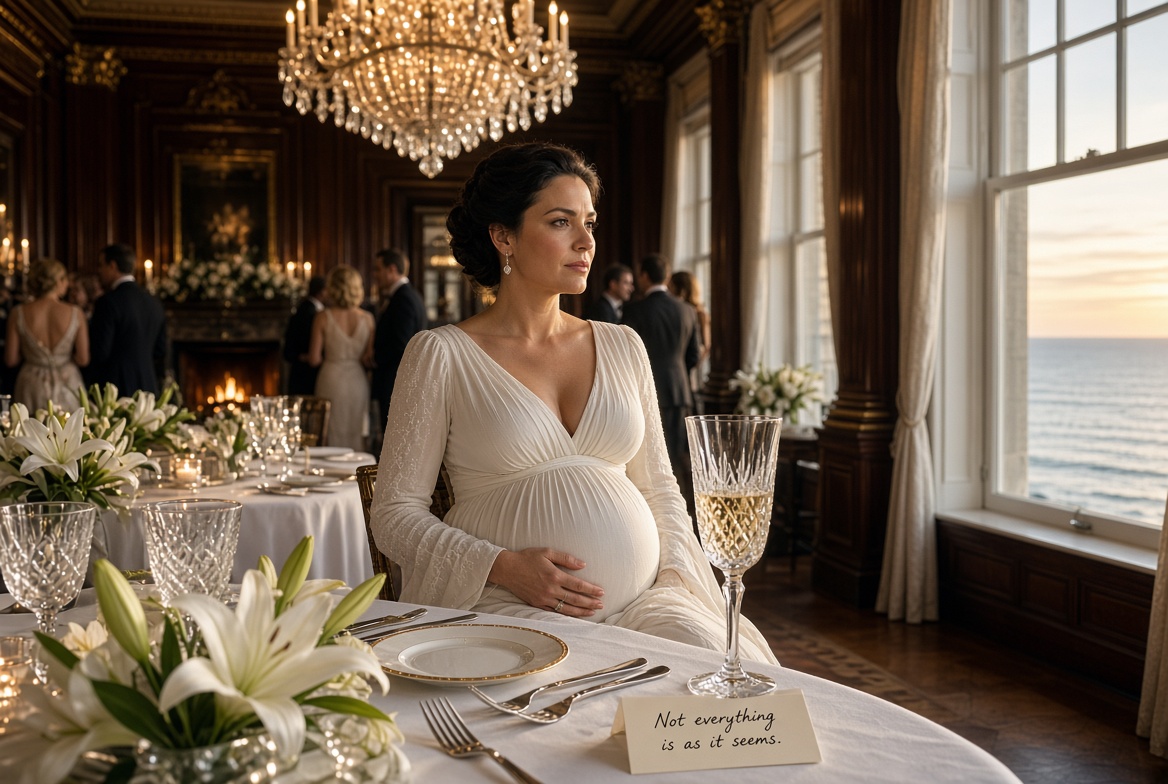
She knew it was hers because of the lipstick—or rather, because of the lack of it. Every woman at that table wore color tonight. Tanzi had worn nothing on her lips, the way she always did, and the rim of that glass was clean.
Someone had moved her glass to his place.
And somebody at this table had wanted her to understand that only after it was too late.
She folded the note smaller and slid it into her evening bag.
The paramedics came twenty minutes later, through the side entrance, sirens off as they turned onto the estate drive. Leander had made a call.
By then, the second flute was gone too.
Caspian took her home at eleven.
He was attentive in the specific way he became when he needed something from her.
Hand at the small of her back. Car door held open. Seat warmer turned on before she asked.
“Dr. Rena thinks it’s his heart,” he said as they pulled out of the gates. “Preliminary, but she’s confident.”
“Franklin is fifty-eight.”
“Fifty-eight-year-olds have heart attacks.”
“He had a clean physical three weeks ago. He mentioned it at the summer picnic. He said his cardiologist told him he had the arteries of a lifeguard.”
Caspian’s jaw shifted.
“You’ve been quiet,” he said.
“I’m tired.”
“Of course.”
He checked his phone, angled away from her.
“Franklin will be fine. These things happen.”
“What things?”
He glanced over. “Cardiac events.”
She looked out at the lights of the Casco Bay Bridge reflecting on the black water.
These things happen.
The same phrase, word for word, that she had found fourteen months ago on a memo stapled to the back of the PORT FACILITATION CONSULTING file.
Unexpected outflows are regrettable. These things happen. L.V.
She kept her face toward the window so he wouldn’t see it change.
A family is just a company that never had to file its minutes.
At home, Caspian went straight to his study and closed the door.
Tanzi stood in the dark kitchen with her shoes in her hand and listened.
His voice through the door, low and clipped.
“No. She didn’t. … I said she didn’t. … Then you tell him. I’m done telling him things.”
A pause.
“Because she’s carrying my daughter, that’s why.”
Tanzi’s hand went to her belly before she could stop it.
They had never discussed the sex of the baby. She had asked the ultrasound tech not to write it on anything. She had told no one.
Caspian knew anyway.
Which meant someone had read her chart.
She went upstairs and did not sleep.
At 2:14 a.m., she sat on the closed lid of the bathroom toilet with the shower running for noise, and she unfolded the note again under the vanity light.
DON’T DRINK.
The paper was thin and slightly gray, the cheap stock you find in office supply closets. Along the bottom edge, nearly invisible, ran a faint line of toner smear—a printer with a dirty drum, leaving the same ghost stripe on every page it printed.
She photographed the note against a white towel.
Then she photographed the stripe.
She did not know yet what it meant.
She only knew that a piece of evidence that small does not survive by accident.
She called Thomas Reck the next morning at seven, from the parking lot of a Dunkin’ on Route 1, with the engine running and her phone on speaker.
Thomas was a former FBI financial crimes investigator who had left the Bureau six years ago and now ran a small forensic consulting firm out of a converted bank building in South Portland.
He had been her father’s college roommate at Maine Maritime Academy.
He had sat with Tanzi for four hours after David’s memorial and told her that the Pier 9 inquiry report had gaps he could not explain on any legitimate grounds.
“If you ever find something concrete,” he had said, writing his cell number on the back of a funeral program, “you use this.”
She had sent him the pension documents over an encrypted line within an hour of getting home from the Founders’ Dinner.
“The champagne,” she said when he picked up.
“I heard about Franklin Dench.” Thomas’s voice was steady, gravel and coffee. “He’s stable. Cardiac unit at Maine Med. They’re calling it an arrhythmia of unknown origin.”
“The flute that ended up in front of him was mine.”
Silence.
“Someone moved it after I declined to drink,” she said.
More silence. She could hear him writing.
“Who saw you refuse?”
“The sommelier. Caspian. Bryce Oldgate.” She paused. “And whoever wrote the note.”
“So someone at that table doesn’t want you dead.”
“Or someone wants me to know they don’t want me dead,” Tanzi said. “Which is not quite the same thing.”
Thomas was quiet a moment.
“Tanzi. Listen to me carefully.”
“I’m listening.”
“I’ve been holding a thread on Pier 9 for three years. There was a second set of crane maintenance logs that never made it into the official file. Your father’s colleague—Walt Hennessey—kept a copy in his garage. Walt died last spring. His widow gave me the box in July.”
Tanzi closed her eyes.
“And the pension transfers go further back than fourteen months,” Thomas said. “I ran them overnight. Your name appears on approvals beginning three months after your wedding.”
She had expected that.
She found she needed to sit down anyway, even though she was already sitting.
“Three months,” she said.
“Three months. Thirty-one separate transfers. Each one under ten thousand dollars, so none of them trip an internal review. Total so far—”
“Don’t,” she said. “Let me.”
She did the math the way her father taught her to read a hull: from the waterline up.
“With the $340,000 I found,” she said slowly, “it’s over a million.”
“One point two,” Thomas said. “One point two million dollars out of a pension fund that sixteen hundred dock workers are counting on. And every signature says Tanzi Veland.”
She opened her eyes and looked at herself in the rearview mirror.
Tanzi Veland.
She had kept the Kiral name professionally. It was the only thing she hadn’t signed over.
They had built a woman out of her name, and that woman was a thief.
“If I die,” she said quietly, “the fraud dies with me. Clean.”
“Yes.”
“And if I lose the baby?”
Thomas didn’t answer right away.
“I don’t know yet,” he said. “But I don’t like how much this family seems to care about your due date.”
She drove to see her mother after that because she couldn’t think of anywhere else to go.
Seaview Care Center sat on a hill above the Fore River, a low brick building with a garden the residents were allowed to tend in good weather.
Esther was in the solarium, a blanket over her knees, watching a container ship ease out past Bug Light.
“You’re early,” she said. Her speech came slow, but her eyes were sharp today. “That means something’s wrong.”
“Nothing’s wrong, Mom.”
“You said that the day your father died. You said it in exactly that voice.”
Tanzi sat down beside her and took her hand. The tremor in Esther’s fingers was worse than last month.
“Has anyone come to see you?” Tanzi asked. “Anyone you didn’t know? Asking about me?”
Esther considered.
“A woman from the insurance. Two weeks ago. Very polite. Very nice shoes.”
“What did she want?”
“My records. The nurse—Dolores, the tall one—wouldn’t let her see them. Said she needed a form.” Esther’s mouth moved in what might have been a smile. “Dolores doesn’t like nice shoes.”
Tanzi wrote Dolores’s name in her phone.
She would need it later.
“That ship,” Esther said, nodding toward the window. “Your father would know where she came from. Just from the hull. The barnacles, the scraping, how she sits in the water.”
“I know, Mom.”
“He said every ship is carrying a story. You just have to be willing to read the parts nobody painted over.”
Tanzi watched the ship until it disappeared around the point.
By noon, the Portland Press Herald had a short item online.
Veland Marine Executive Hospitalized After Medical Emergency at Annual Gala.
The statement from the company was three sentences long. It thanked Dr. Rena for her quick response, asked for privacy for the Dench family, and noted that the Bowmont Harbor contract remained on schedule.
The statement was signed by Silana Rock, Director of Communications.
Tanzi read it twice.
When a company mentions its contract in the same breath as a man’s heart, it is telling you which one it’s worried about.
Her phone buzzed at 12:02.
An unknown number. A 207 area code.
She let it ring twice.
Then she answered.
“It’s Bryce Oldgate.”
His voice sounded like a man speaking from inside a closet.
“I have documents,” he said. “I won’t discuss them on the phone. I understand if you don’t trust me.”
“I don’t.”
“Good,” he said. “Then you’ll be careful.”
He suggested the top level of the parking garage at the Maine Mall, three o’clock.
She agreed because it was public, because it was ugly, and because Thomas would be watching a live feed from two small cameras she had clipped to her car’s side mirrors before leaving the house.
Three months ago, that level of caution would have seemed ridiculous.
It did not seem ridiculous now.
Bryce was sixty-two and had run Veland Marine’s finance division for eighteen years.
In the flat gray concrete light, he looked like a man who had not slept since Franklin hit the floor.
He didn’t say hello.
He handed her a manila folder through her open window and stepped back, hands in his coat pockets, as if the folder were hot.
Inside was a printed memo dated seven months ago.
RE: SUCCESSION PLANNING — KIRAL ESTATE TRANSFER.
She read it twice.
Under a provision buried in the Veland family trust, if Tanzi died during her pregnancy—classified in the document as “a recognized period of elevated medical vulnerability”—her share of the estate would revert to the family trust.
Not to her child.
To the trust.
The provision had been added by amendment fourteen months ago.
It had been authorized by Leander Veland, as sole trustee.
“He drafted it the week after Caspian mentioned the pregnancy at a board meeting,” Bryce said. “Leander was present. He congratulated you both. Then he went upstairs and called the trust attorney.”
She closed the folder.
“Fourteen months ago I wasn’t pregnant.”
“No,” Bryce said. “You were trying. Caspian mentioned that too.”
Tanzi felt something cold move through her, slow as tide.
They had been planning around her body before her body had anything in it.
“Why are you showing me this?” she asked.
Bryce looked at the oil-stained concrete.
“I typed the pension transfer memos,” he said. “All of them. I was told the signatures were pre-authorized. That you’d signed a blanket approval when you married into the family. I believed it for two years.”
He stopped.
“And then?”
“And then I watched Franklin go down last night, and I understood I was not looking at a cardiac event. I understood what was in that glass.”
He met her eyes.
“Your father filed a safety report three days before Pier 9. I processed the correspondence log that week. It went up to Leander’s office on a Tuesday. A notation in Leander’s own handwriting appeared two days later.”
He reached into his coat.
“Removed from file. Facilitation in progress.”
He held out a USB drive wrapped in a rubber band that had gone soft and gray from living in a pocket.
“I’ve had the original log for three years,” he said. “I scanned it the week I started to wonder. I didn’t know what to do with it. I have a wife. I have a mortgage in Falmouth. I told myself it was eight years ago and nothing would bring him back.”
Tanzi held the drive the way you hold something that should have existed long before now.
“It wouldn’t have brought him back,” she said. “It would have brought him justice. Those were never the same thing, Bryce. You just found it easier to confuse them.”
He flinched.
He didn’t argue.
“There’s more,” he said. “The man in the gray jacket.”
“Right-handed. Bad left knee.”
Bryce stared at her.
“Mateo Alvarez,” he said. “He’s Dr. Rena’s assistant. Has been for six years. He was told to put something in your glass. Not enough to kill you. Enough to bring on labor at thirty-four weeks.”
She put her hand on her belly without looking down.
“He decided he wouldn’t do it,” Bryce went on. “He printed the note at Dr. Rena’s office and slipped it under your glass when the servers set the table. Then he walked away.”
“And the glass?”
“He didn’t move it. Someone else did. After you refused, it sat there with whatever someone had already put in it. Franklin saw a hand reach for it. He tried to get to it first—he told me this in the ambulance, Tanzi, he could barely talk—he tried to switch it out so nobody would touch it.”
Bryce swallowed.
“He was too slow. Whoever moved it set it at his place. He thought it was his own glass. He drank.”
Franklin Dench.
Director of operations, who had worked the South Portland terminal the year her father died.
Who had perhaps known for eight years that the crane report was wrong.
Who had tried, clumsily, too late, to put his body between her and a glass of wine.
“Whose hand?” Tanzi said.
“He didn’t see the face.”
She sat with that.
The man who poisoned no one wrote the warning; the man who said nothing for eight years took the poison; and the hand that did the work still had no face.
Thomas met her that evening at his office, a converted Casco Bank branch with the old vault door still in the back wall.
He laid the evidence out on a long table under bright lights, like a man setting up a jigsaw puzzle.
The pension memos.
The trust amendment.
Bryce’s scan of the correspondence log—David Kiral’s safety report, received on a Tuesday, and two days later, in Leander’s slanted fountain-pen hand: Removed from file. Facilitation in progress.
And the note.
DON’T DRINK.
Thomas held it under a lighted magnifier and studied the ghost stripe along the bottom edge.
“You photographed this at two in the morning,” he said.
“I couldn’t sleep.”
“Good thing.” He pulled up a second image on his monitor. “This is a page from a prescription intake form issued by Dr. Elise Rena’s concierge practice on Exchange Street. A former patient of hers sent it to me this afternoon. I asked her for anything printed in the last month.”
He put the two images side by side.
The same faint stripe. Same width. Same slight hook at the left end where the drum had a nick.
“Printers have fingerprints,” Thomas said. “This one belongs to Dr. Rena’s office.”
The note under her glass had been a warning.
Now it was evidence.
Mateo Alvarez agreed to meet the next morning, in the chapel at Maine Medical Center, because he said it was the only place he still felt like he could think.
He was younger than she had expected. Early thirties. Gray jacket again, as if he owned only one.
He walked in with a slight drag on the left foot and sat in the pew in front of her without turning around.
“I came to see Mr. Dench,” he said. “They wouldn’t let me in. Family only.”
“He doesn’t have family in Maine,” Tanzi said. “His daughter lives in Phoenix.”
“Then they should have let me in.”
He was quiet for a long moment.
“Dr. Rena gave me a vial on Friday afternoon,” he said. “She said it was a uterotonic compound. She said it would be a scare. A hospital stay. A premature baby in the NICU, healthy within a few weeks. She said the family needed time and this would buy it.”
“Time for what?”
“She didn’t say. I didn’t ask. I’ve worked for her for six years.” His shoulders lifted. “You stop asking.”
“But you didn’t do it.”
“My sister lost a baby at thirty-three weeks.” He finally turned his head, just enough that she could see his profile. “I printed the note. I put it under your glass. I threw the vial in the harbor off the Maine State Pier on my way to the estate.”
“Then what was in my glass?”
Mateo looked at the altar.
“She had a second vial,” he said. “She always has a second.”
Tanzi asked him if he would say all of this to a federal prosecutor.
He asked her if she thought they’d believe him.
“I think they’ll believe the printer,” she said.
That afternoon, a text arrived from a number she didn’t recognize.
No message. Just a photograph.
It was a still from a phone video, slightly blurred, taken from low on a table at an angle. Candlelight. Crystal. A woman’s hand—manicured, a thin gold bracelet with a caduceus charm—setting a champagne flute down at a place card that read F. DENCH.
A second text arrived a minute later.
I was filming the toast for our social accounts. I didn’t understand what I filmed until I watched it at home. I’m sorry I didn’t look at you. I was afraid if I looked at you, they’d know I knew. — S.R.
Silana Rock.
That explained the relief.
Not relief that someone had fallen.
Relief that it wasn’t the pregnant woman she’d been told to keep her eyes away from.
The caduceus bracelet belonged to Dr. Elise Rena. Half the company had seen her wear it.
The hand had a face now.
Caspian was waiting in the kitchen when she got home.
He had not turned on the overhead light. Just the one over the stove, so half his face was in shadow.
“Bryce resigned his board seat this afternoon,” he said. “By email. No explanation.”
Tanzi set down her keys.
“Did he.”
“My father is calling an emergency board meeting for Monday. To review the Bowmont Harbor contract.” He studied her. “He asked if you’d be attending.”
“What did you tell him?”
“That you’re seven months pregnant and tired.”
She almost laughed.
“Caspian,” she said. “Why did you move my chair?”
The question landed somewhere he hadn’t armored.
For a moment he looked older than forty-four.
“Because I didn’t like where he put you,” he said. “Next to the kitchen door. Where the staff come and go. Where nobody important would be watching.”
“You knew something was planned.”
“I knew my father had asked Dr. Rena to attend. I knew he’d asked about your due date three times in one week. I’m not a fool, Tanzi. I’m just—” He stopped.
“Just what?”
“Used to not asking.”
She nodded slowly.
“You put me where you could see me,” she said. “That’s not the same as protecting me.”
“It was what I had.”
“No,” she said. “What you had was a phone and a conscience and three years. You chose a chair.”
She went upstairs.
He didn’t follow.
Over the next three days, Thomas built a forensic chain from the pension transfers to a numbered account in Delaware, and from that account to a holding company whose only officer was Leander Veland. Bryce’s sworn statement sat at every link.
An Assistant U.S. Attorney named Renée Castellano, who had worked with Thomas during his Bureau years, reviewed the file on Saturday in the old bank vault room.
She read for four hours without speaking.
Then she closed the last binder and looked at Tanzi.
“This is sufficient for charges,” she said. “Wire fraud. Pension fraud under federal law. Obstruction relating to the Pier 9 inquiry. And the dinner—I’ll coordinate with the state on that one.”
“When?”
“Monday, if we move fast. The FBI can execute warrants at the company offices.”
“Monday,” Tanzi said. “He’s called a board meeting for Monday at ten.”
Castellano and Thomas exchanged a look.
Tanzi asked for one thing.
“Let me be in the room.”
Thomas started to object.
She cut him off.
“I’ve been invisible in that room for three years. I know where the cameras are. I know which microphones Caspian disabled because he believed he was being careful. I know Leander puts his phone face down before every sensitive discussion—which means he’s recording, and he forgets he’s doing it.”
She looked at Thomas’s expression.
“Let me be useful on my terms. Not as a victim they read about in a press release Silana has to write.”
Castellano was quiet for a long moment.
“Agents in the hallway,” she said finally. “You don’t confront him. You enter the documents into the record and you stop talking. The second anything feels wrong, you walk out.”
“Agreed.”
Thomas sighed like a man who had lost this argument with David Kiral thirty years ago, and knew the daughter had the same wiring.
“Your father,” he said, “would have hated this plan.”
“My father,” Tanzi said, “filed his report through the proper channels. Look where it got him.”
On Monday morning, she dressed in a color she had never once worn to a Veland Marine board meeting.
Deep burgundy.
The shade of something chosen rather than inherited.
She stood in front of the bedroom mirror and turned sideways. Thirty-five weeks now. The baby kicked once, hard, under her ribs, as if to say: I’m coming with you.
“I know,” Tanzi told her. “Stay quiet. Watch everything.”
She slipped the note into the inside pocket of her blazer.
Not because she needed it.
Because it had come this far with her, and it deserved to see how things ended.
The Veland Marine headquarters occupied the top two floors of a renovated brick warehouse on Commercial Street, with windows that looked out over the ferry terminal and the gray-blue sweep of Casco Bay.
She arrived five minutes early.
She sat in the chair beside the east window, where the morning light came in flat and clear and fell across the table like a ruler.
The others filed in. Board members in quarter-zips and blazers. The trust attorney. Two vice presidents who would not meet her eyes.
Caspian came in six minutes late.
He saw her and stopped in the doorway.
For a moment she thought he would say something. Instead he took his usual seat, folded his hands, and looked at the table.
Leander entered at ten sharp, with his cane and his general counsel.
He saw Tanzi and produced a warm expression, the one he used for photographs with the governor.
“We weren’t expecting you.”
“I know.”
She opened her laptop.
“The corporate secretary is unavailable today,” she said. “I’ve been covering his function for the past two years without the title. So this isn’t a significant change.”
A few board members glanced at each other.
Leander smiled and lowered himself into the chair at the head of the table. He set his phone face down beside his right elbow.
Tanzi watched him do it.
She did not smile back.
The meeting began.
Leander spoke about the Bowmont Harbor contract—the berth extension, the new cranes, the federal infrastructure dollars that would carry Veland Marine into its second century.
He mentioned the pension shortfall in passing, the way you mention weather.
“An accounting irregularity,” he said, “which our auditors will review in due course. I’d propose a timeline of eighteen to twenty-four months, so as not to disrupt the Bowmont financing.”
Eighteen to twenty-four months.
Well past any active investigation. Well past her due date.
He was practiced and calm and entirely convincing to anyone who had not spent fourteen months photographing every document he had sent to her for signature.
Tanzi waited.
She waited through the harbor contract, through the insurance renewal, through a ten-minute discussion of parking at the new terminal.
She waited until Leander reached the item on the agenda labeled SUCCESSION AND TRUST MATTERS.
“Before we proceed,” she said, “I’d like to enter something into the record.”
The room turned.
She rotated her laptop toward the table and connected it to the wall display with a single click.
The pension transfer memos appeared first. Thirty-two of them, dated, each bearing a signature that looked like hers and was not.
Then the trust amendment, authorizing the reversion of her assets to the family trust upon her death “during a recognized period of elevated medical vulnerability.”
Then the correspondence log from Pier 9.
David Kiral’s safety report, flagging a failing load cell on Crane 4, arriving on a Tuesday.
And beneath it, two days later, in slanted fountain-pen ink:
Removed from file. Facilitation in progress. L.V.
Bryce had photographed it. Thomas had authenticated it against eighteen years of Leander’s signed documents.
The last slide was a single photograph.
A square of gray copy paper on a white towel.
DON’T DRINK.
And beside it, the toner stripe from Dr. Elise Rena’s office printer, matched mark for mark.
Someone at the far end of the table made a small sound, like a cough that changed its mind.
“The U.S. Attorney’s Office received copies of everything you’re looking at at eight o’clock this morning,” Tanzi said. “Along with a forensic accounting analysis prepared by Thomas Reck, whose contact information appears at the bottom of every page.”
She kept her voice level. Audit voice. The voice that reads numbers aloud and lets them do the shouting.
“The audio from this meeting is being recorded on two devices,” she said. “One is mine.”
She looked at the phone lying face down beside Leander’s elbow.
“One is yours.”
Leander did not move.
“You’ve been recording board meetings since 2019,” she said. “The files sit on your personal server in the basement of the Cape Elizabeth house. Your own IT director flagged that server in last year’s data security review.”
She paused.
“A review I administered.”
The room was very still.
Outside, a ferry horn sounded across the bay, long and low.
Leander looked at her with the cold, particular attention of a man recalculating something he had believed was already settled.
“You have a gift,” he said at last. “For remaining in rooms where you were never meant to have any power.”
“I’ve been in rooms where I had no power,” Tanzi said. “This isn’t one of them.”
The door opened.
Four FBI agents came in from the hallway, windbreakers zipped, IDs out. Assistant U.S. Attorney Castellano stood behind them in a navy suit, holding a folder she did not need to open.
Caspian did not move.
The general counsel began to say something about privilege and then, looking at the screen, decided not to.
Leander rose very slowly, both hands on the brass head of his cane.
It was the first honest thing Tanzi had ever seen him do.
He did not look at his son.
He looked at her.
“Your father,” he said, “was a very stubborn man.”
“Yes,” Tanzi said. “He taught me everything useful.”
The agents walked him out past the windows, past the ferry and the gulls and the cranes standing against the sky like question marks.
Dr. Elise Rena was arrested forty minutes later at her concierge practice on Exchange Street, still wearing the gold caduceus bracelet.
Agents seized the office printer.
It was the first time in eight years the Velands had lost a room—and they had lost it to a woman they had seated by the kitchen door.
Leander Veland was charged on eleven counts.
Wire fraud. Pension fraud. Breach of fiduciary duty. Obstruction of a federal investigation relating to the Pier 9 inquiry. Conspiracy.
And, on the state side, aggravated assault for the poisoning of Franklin Dench, who had spent four days in the cardiac unit at Maine Medical Center and was recovering.
There was one more count. Its legal language was precise and dry, and it described, without a trace of sentiment, what it meant to arrange for a compound to be placed in a pregnant woman’s drink with knowledge of the risk to her life and her child’s.
Dr. Rena faced six counts of her own and surrendered her medical license within the week.
Bryce Oldgate gave his full statement that afternoon. He pleaded guilty to concealment of records and resigned before the end of the day.
On his way out of the building, he stopped at Tanzi’s chair and set the soft gray rubber band on the table in front of her.
“I don’t need it anymore,” he said. “Nothing left in my pocket.”
Mateo Alvarez testified before the grand jury in December. The prosecutors called him a cooperating witness. He called himself the guy who threw a vial into the harbor.
The news broke on Tuesday morning.
By Wednesday, it was on the front page of the Press Herald and the Boston Globe’s business section, and by Thursday a cable network had a graphic with Leander’s photograph and the words HARBOR DYNASTY.
Silana Rock wrote the company’s statement this time, too.
It was four sentences long. It said that Veland Marine was cooperating fully with federal authorities, that the board had placed the company’s executive leadership on leave, and that the pension fund would be made whole.
The fourth sentence said: We owe this to the people who keep the water moving.
She sent Tanzi the draft before it went out.
Would you change anything? Silana wrote.
Tanzi read it twice.
No, she typed back. Just make sure you mean it.
Two hundred longshoremen gathered at the gates of the South Portland terminal that Friday. Not to protest. Just to stand there, in work jackets and hard hats, while the union president read the names of the four workers who had died on Veland property in the last twenty years.
David Kiral’s name was the third.
Nobody had told Tanzi it was happening. A dockworker’s wife sent her a video of it that night, shaky and full of wind noise.
She watched it six times.
Caspian did not fight the disclosure.
He hired a criminal defense lawyer, cooperated with the investigation, and was never charged—investigators concluded he had been, in Castellano’s words, “willfully incurious, which is a moral failing and not a federal crime.”
He signed his entire interest in the Veland family trust over to the pension fund’s independent trustee.
Three weeks later, he filed for divorce through lawyers, with no direct conversation.
He sent one handwritten line with the papers.
I should have asked. — C.
Tanzi signed the divorce papers at Thomas’s long table under the old bank vault.
She read every page first.
And for the first time in three years, she felt she was signing something she had actually read.
The pension fund recovered $1.2 million through the asset seizure, plus interest.
Sixteen hundred port workers kept their retirement accounts whole.
The Bowmont Harbor contract was reassigned to a consortium that included two former Veland operations managers and a union seat on the board.
Esther Kiral came down to the harbor in November, in a transport van with a wheelchair ramp and two nurses from Seaview—one of them Dolores, the tall one, who did not like nice shoes.
It was Dolores who had confirmed, in a sworn statement, that no authorized person had accessed Esther’s medical records in the weeks before the Founders’ Dinner—and that a woman claiming to represent an insurance company had tried twice.
They came for the public reading of the U.S. Coast Guard’s supplementary report on the Pier 9 incident.
It was not the formal exoneration Tanzi had wanted.
Formal exonerations required committees and hearings and the kind of time that moves like a glacier.
But it was a corrected record, entered into the public file.
It stated that maintenance logs had been deliberately altered before submission to the original inquiry.
It stated that a safety report filed by Inspector David Kiral two days before the incident had been suppressed by parties connected to the terminal’s operating company.
It did not say, in so many words, that he had died because someone decided his report was inconvenient.
It said enough that anyone reading it would understand.
Esther had her good days and her bad days.
This was a good day.
She held Tanzi’s hand at the end of Pier 9, a blanket over her knees, the wind coming off the water smelling of salt and diesel and the first edge of winter.
“He used to walk out to the end of this pier whenever a new ship came in,” Esther said. “He thought if you watched closely enough, you could tell how far she’d sailed just by looking at her hull.”
“He taught me that,” Tanzi said.
“He taught you everything useful.”
Esther squeezed her hand, the tremor briefly stilled.
“He would have been insufferable about this baby,” she said.
Tanzi laughed for the first time in weeks, a real laugh that surprised the gulls.
The baby—a girl—was born four weeks after the board meeting, nine days early and entirely healthy.
Six pounds, eleven ounces. A full head of dark hair and her grandfather’s habit, apparently, of watching everything.
Her name was not announced to the Veland family.
She was introduced to the world through a single photograph, shared only with the people Tanzi had chosen.
Thomas Reck.
Bryce Oldgate’s wife, Marianne, who had driven Bryce to every interview with the prosecutors and waited in the car.
Dolores and the other nurse from Seaview.
Mateo Alvarez, who replied with a single photo of his own: the Maine State Pier at sunrise, empty, the water flat as glass.
And the FBI agent who had carried Tanzi’s binder from the boardroom to the U.S. Attorney’s office without opening it first, because, he said, “some things you just carry.”
Franklin Dench returned to the South Portland terminal in January.
He moved slower than before, with a cane he resented, and he did not discuss what had happened at the dinner table.
In February, he sent Tanzi a short email from his work account.
I knew your father. He was right about the load cell. I should have said so sooner. I’m sorry.
She read it at her kitchen table with the baby asleep on her chest.
She wrote back four words.
You moved the glass.
Then, after a moment, three more.
That counts. Thank you.
Tanzi opened her own practice the following spring.
Forensic accounting and fiduciary auditing, with a focus on estate governance and pension fund compliance.
She rented an office on the third floor of a brick building near the waterfront that had been a ship chandlery in her grandfather’s time. The floors still smelled faintly of tar and rope when it rained.
The windows faced east.
On clear mornings, she could see the container terminal from her desk.
On her first day, she hung only one thing on the wall.
A small black frame, museum glass, a square of cheap gray copy paper inside it, its creases gone soft, a faint toner stripe running along the bottom edge.
DON’T DRINK.
Clients sometimes asked about it.
“It’s a reminder,” she would tell them.
“Of what?”
“That the most important document in a case is usually the smallest one. And that somebody always knows.”
She did not name the practice after herself.
She named it Pier Nine Forensic.
Because her father had known that if you paid close enough attention to a ship’s hull, you could tell exactly how far it had come, what it had carried, and what it had survived.
And because he had known that this kind of knowledge—quiet, precise, unglamorous—was not nothing.
It was, in fact, everything.









