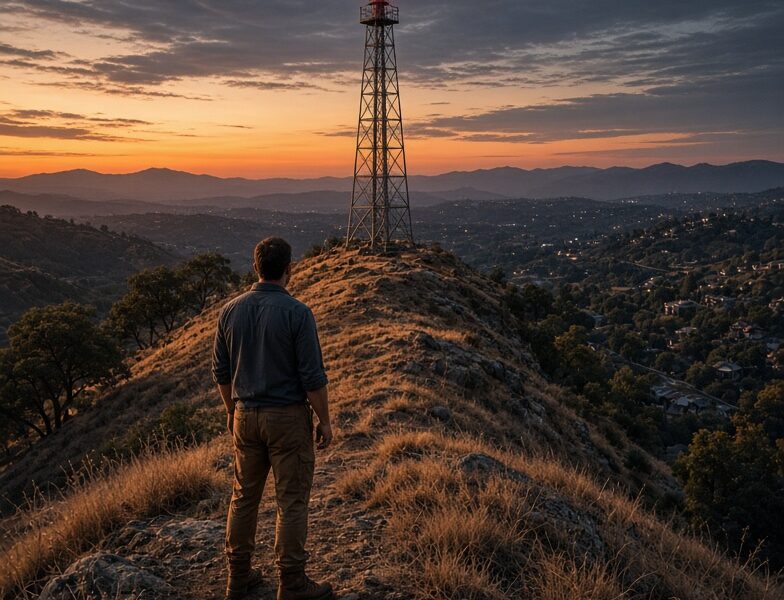
She Forced the Beacon Down for Her Perfect View — Then the Airport Called
Celeste Vardell stood on top of my hill, staring down at the steel tower lying broken in the dry grass, and she turned to me with the kind of smile that only comes from someone who thinks they have already won.
Finally, she said, “I have my view back.”
Behind her, the crew she had hired to tear it down was coiling up cable like the job was already forgotten, like the beacon that had stood on that ridge longer than her entire neighborhood had existed was nothing more than an old fence post.
I asked her one last time if she understood what she had just done.
She held up a folder of paperwork and told me there was nothing I could do about it now.
I did not argue with her.
My phone was already buzzing in my pocket, and the screen read Airport Operations.
My name is Grant Hollister, and before any of this happened, I lived a quiet life on a piece of land my family had owned since long before anyone had heard the name Silver Pines Estates.
I am an electrical engineer by training, though these days I run a small maintenance company that keeps industrial equipment running for people who would rather not think about how their lights stay on.
I wear work shirts and boots because that is what the job requires.
And I drive a truck that is older than some of the marriages in that neighborhood below my ridge.
None of that ever mattered to me until Celeste decided it meant something about who I was and what I understood.
The land itself sat above everything else in that valley, a stretch of dry grass and scattered oak running from the county road all the way up to a rocky spine that caught the first light every morning and held the last of it every evening.
My grandfather had grazed cattle up there once, and my father had strung the first stretch of fence I ever helped dig posts for, back when the whole hillside belonged to nobody but us and the deer that moved through it at dusk.
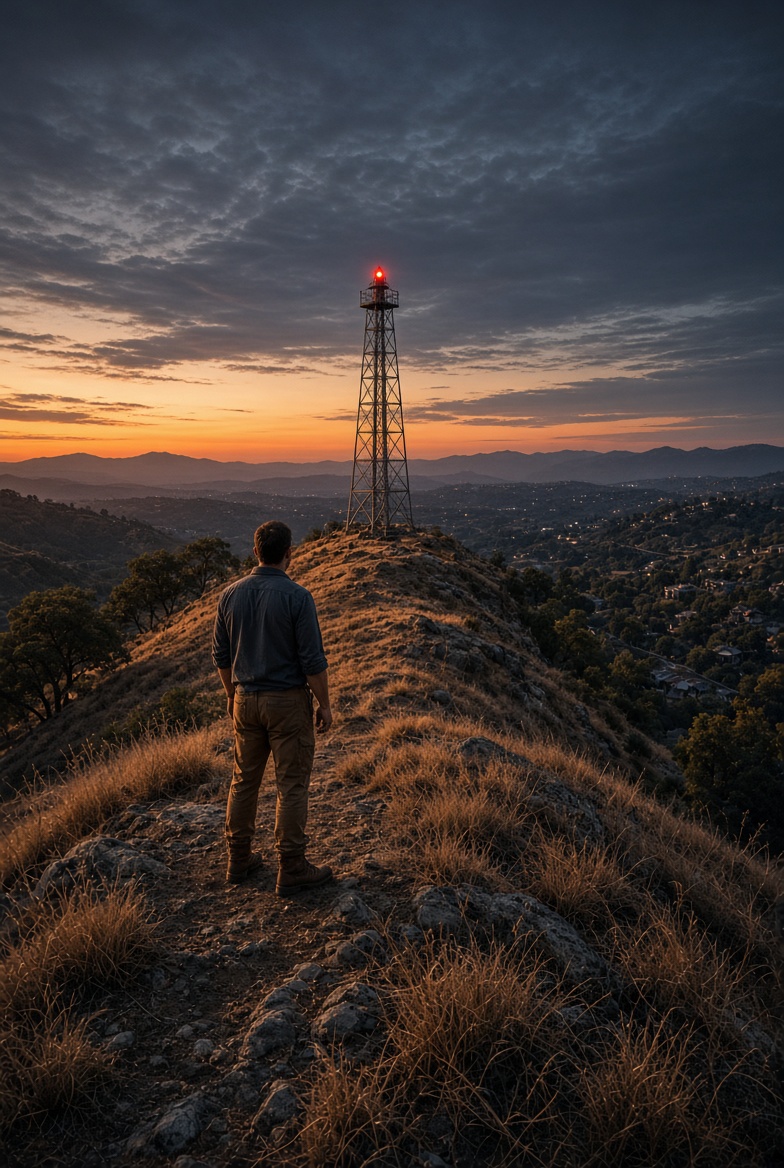
By the time I inherited the place, the cattle were long gone, but the quiet remained, broken only by wind moving through the grass, and at night the steady pulse of red light rising from the highest point on the ridge, like a slow heartbeat over the whole valley.
I had grown up under that light without ever thinking twice about it.
It was simply part of the landscape, the way the shape of the ridge itself was part of the landscape, something so constant that I had stopped noticing it, the same way a person stops noticing the sound of their own front door.
My father had shown me the small equipment shed at its base when I was young, had taught me how to check the connections and clean the lens housing, and had told me once in the plain way he told me most things that some jobs did not need to be understood to be respected.
I had carried that lesson with me longer than I realized, right up until the day a woman in sunglasses decided the lesson did not apply to her.
Silver Pines had been built maybe a dozen years earlier, carved into the hillside below my property, and the houses had gotten bigger and glassier as the development crept upward.
Celeste owned the highest one, a modern place with a wall of windows facing my land, and from the moment she moved in, she made it clear that something on my hill offended her.
Every night on a steady cycle, a red light blinked at the top of my ridge, not bright enough to shine into anyone’s living room, but visible enough from her terrace that she had apparently decided it was a personal insult aimed directly at her.
I remember the day her house finished construction, because the whole neighborhood seemed to hold its breath for it.
Glass and steel and a terrace that wrapped around three sides, built specifically, or so the rumor went, to capture every angle of the valley below.
She had paid a premium for the elevation, for the unobstructed sightline, for the version of the view that existed only in the architectural renderings her builder had shown her before a single shovel touched the ground.
What none of those renderings had included, curiously enough, was the small steel tower already standing on the ridge above her house, a structure that had been there decades before her builder had ever surveyed the lot.
I did not think much of her at first.
People moved into Silver Pines every year with the same look on their faces, the satisfaction of having arrived somewhere they believed set them apart from wherever they had come from.
Most of them never noticed me at all, tucked away on my parcel above the last row of houses, going about my work without asking anything of them.
Celeste noticed me almost immediately, and not in a friendly way.
She noticed my truck parked along the shared access road.
She noticed the beacon, and within a matter of weeks, she had apparently decided that both of those things needed to be handled.
The first time we spoke, she drove her sport utility vehicle up my access road without calling ahead, which told me most of what I needed to know about how she operated.
She asked me when I planned to take it down, and for a moment, I thought she meant the fence.
She pointed up at the ridge instead.
I told her I was not taking it down, and she laughed the soft laugh of someone used to getting a different answer, telling me she was not asking for permission, only for a schedule.
I told her she had already gotten my answer.
She called the beacon an eyesore, industrial junk, a relic that made the neighborhood look like it belonged next to a power plant instead of on a hillside worth what people were paying for those homes.
I told her it was not decoration.
She asked what it was then, if not decoration, and I told her it was something she should not touch.
She took that as a threat, which was not how I meant it, though I understood later why a woman who had never been told no in that neighborhood would hear it that way.
Three days after that conversation, a letter arrived from the homeowners association with a subject line calling my property an unsightly structure violation.
I read it twice, then looked out the window at the hill, where the red light was blinking exactly the way it had for more than three decades, long before Celeste Vardell had ever seen this valley, long before the first foundation of Silver Pines had been poured into the ground below me.
I went to the next association meeting because Everett Dayne, my attorney, told me that ignoring people like Celeste only made them louder.
The clubhouse smelled like fresh coffee and new carpet.
Folding chairs arranged in careful rows.
A projector humming at the front of the room, where Celeste stood already dressed for the occasion.
Blazer pressed, hair pinned back, a laser pointer in one hand like she was presenting a market forecast instead of arguing about a light on a hill.
She had prepared for the meeting the way some people prepare for a courtroom, putting up a photograph taken from her own terrace, the mountains behind it turning orange at sunset, and somewhere in the corner of the frame, small and distant, the beacon.
She told the room they were protecting property values, and I asked her which property the beacon actually sat on.
She said it was mine.
I asked what section of the covenants gave the association authority over it, and she cited language about visible structures and exterior nuisances and commercial equipment, none of which quite fit a beacon that predated the covenants themselves.
She spoke slowly when she answered me, the way a person speaks to someone they assume will need extra time to follow along, and I let her, because I had already learned that correcting her tone in front of an audience only made her dig in harder.
What she did not seem to understand, or did not care to, was that Hollister Ridge was not entirely inside the association’s boundary.
Only a shared easement along the eastern road fell under their authority, and the summit of the ridge sat on a separate parcel that had never been absorbed into the covenant map.
I explained this calmly, the way I explain most things, and she waved it off, telling me I always hid behind maps and paperwork instead of just doing the reasonable thing.
Then she said something I would not forget, that I clearly understood machines, and she understood property values, and each of us should stay in our own lane.
I did not raise my voice.
I only turned to Meredith Sloan, the association manager, and asked whether that comment had been entered into the minutes.
Celeste laughed and told her to go ahead and write it down, certain it made her sound clever rather than exposed.
Thomas Greer, a retired insurance executive who sat on the board, suggested they hire a surveyor before voting on anything, and Celeste dismissed the idea as a waste of association funds.
The board passed a motion giving me thirty days to remove the structure myself, and when I told them I would not, Celeste said the association would do it instead.
I looked at her and asked her to repeat that, to be sure I had heard her correctly, that the homeowners association intended to enter my land without my consent and dismantle a structure that predated their entire community.
She said yes, plainly, without any hesitation, the way a person speaks when they have never once had to live with the consequences of being wrong.
I asked her to put that in writing and send it to me directly, and for the first time that evening, something in her expression flickered, though she agreed anyway, too proud to back down in front of the room.
The next morning, I called Everett, and within a week, he had pulled records going back decades, uncovering a document titled the Ridge Obstruction Lighting and Access Agreement, signed in 1991 between the county, the regional airport authority, and the family who had owned this land before me.
When the airport had expanded its operations years earlier, the agreement had guaranteed the beacon’s continued presence, granted airport technicians a right of access when needed, obligated the landowner to maintain power to the fixture, and required that the airport be notified immediately if the light ever went dark.
I had inherited every one of those obligations the day I bought the parcel, and I had honored them without ever needing to explain why to anyone who had not asked.
Everett asked me whether the association knew any of this, and I told him I had only ever told them the beacon was not theirs to touch.
He told me that was different from telling them why, and that if they asked directly, I should not lie, but that I also had no obligation to hand them a legal education they had never bothered to request.
So I sent a formal letter instead, stating plainly that the beacon on Hollister Ridge was connected to an infrastructure agreement predating Silver Pines Estates, and that the association had no authority to remove it.
Celeste’s written response called the agreement outdated and said it could not be used to justify an unsightly structure standing indefinitely on a hillside people had paid a great deal of money to look at.
I sent a second warning telling her that any physical interference had to stop until ownership and third-party obligations were properly verified.
She wrote back that the association did not accept delay tactics, a phrase I saved because it told me exactly how she intended to proceed regardless of what I said.
I sent a third and final warning, spelling it out as clearly as language allows, instructing her not to alter, disconnect, remove, or damage the beacon or its power supply under any circumstance.
Her reply arrived within the hour, informing me that my red light was not untouchable simply because I said so.
I forwarded every message to Everett, and he told me only to keep the original safe, because people who write things like that rarely realize how much rope they have handed to the person on the other end.
The following morning, I noticed orange survey stakes near the access trail leading up to the ridge, planted by someone who had clearly already decided the outcome without waiting for a legal answer.
The association was not bluffing, and for the first time, I understood that no amount of documentation was going to stop Celeste from doing exactly what she had already decided to do.
She launched what she called a campaign to restore the Silver Pines skyline, sending an email to every homeowner describing the beacon as abandoned industrial equipment, an obsolete tower, a form of visual pollution that had gone unaddressed for far too long.
In her telling, I had become the stubborn holdout standing in the way of a community beautification project, and some neighbors, who had never spoken to me and never bothered to ask why the light existed, took her side without hesitation.
A few even left notes on my mailbox, polite but pointed, asking whether I might reconsider for the sake of the neighborhood, as though the request had come from genuine curiosity rather than a coordinated campaign designed to make me feel outnumbered.
I did not write long rebuttals or plead my case to strangers.
I sent one line to the board stating that the association had not yet verified any legal right to the beacon, and I let the silence do whatever work it could.
Some people mistook my quiet for guilt, the way people often do when someone refuses to perform their innocence loudly enough to satisfy an audience.
But I had learned a long time ago that explaining yourself to people who have already made up their minds rarely changes anything except your own peace of mind.
Celeste used that silence against me at the next gathering, telling the room I could keep playing the mysterious hermit if I wanted, but it would not make a rusted pole any more important than it looked.
I told her I had never claimed to be important.
I looked up at the ridge and told her the beacon was the important part, not me, and that distinction seemed to mean nothing to her.
She hired a small demolition outfit called Vantage Site Removal without waiting for further review, and it was Thomas who discovered, buried in the paperwork, that the contract had been signed without the association’s own attorney ever reviewing it.
He raised the issue at the next board meeting, and Celeste brushed it off, telling him they were removing a pole, not launching a spacecraft, a line that drew a few laughs from people who had no idea how wrong she was about to be.
Thomas voted against moving forward.
Meredith abstained, unwilling to take a side, even as the situation grew more serious.
Celeste used her authority as president to push the demolition through anyway, and by the following Monday, I had a voicemail from the contractor telling me they had been assured of legal access and would arrive at seven in the morning on Wednesday.
I called the number back and told the man on the other end only one thing, that if his crew touched that beacon, he had better be certain the people who hired him had told him the entire truth.
He did not understand what I meant, and I did not explain further, because some warnings only make sense after the fact.
Wednesday morning arrived cold and clear, the kind of stillness that usually meant a good day before I ever knew what it would bring.
By the time I walked out onto my porch, there was already a truck and a small crane parked at the base of the access road, with a crew unloading tools like this was any ordinary job.
Ratchets clicking, boots crunching over gravel, a radio somewhere playing quietly under all of it.
I did not block the vehicles or interfere with their equipment.
I stood at the edge of my own property with a camera in my hand and asked to see whatever authorization they believed they had.
The foreman was a heavyset man named Rey, who had clearly done this kind of work for years and expected it to go the same way it always went.
Quiet compliance, a quick job, a check at the end of the week.
I asked him plainly whether anyone had confirmed who actually owned the beacon itself, and he hesitated in a way that told me he had never been asked that question before, glancing back toward his crew as though the answer might be waiting somewhere behind him.
Celeste arrived a few minutes later, dressed like she was attending a ribbon cutting rather than a demolition, sunglasses on, clipboard in hand, clearly expecting this to be her moment.
She told me not to make a scene, and I told her I was not making anything, only recording what happened.
She asked if that meant I intended to sue her, and I told her it meant that someday people would ask who had given the order, and I wanted the answer on tape.
She looked directly into the camera and said the words herself, that she had given the order, certain in that instant that she had nothing to fear from saying it out loud.
I thanked her, and the crew began disconnecting the power lines.
Within minutes, for the first time in more than three decades, the top of Hollister Ridge went dark.
The red light that had blinked steadily through storms and summers and every season in between, finally extinguished by a group of strangers following instructions from a woman who had never once asked why it was there.
Celeste looked out over the valley from where she stood and told me it already looked so much better, and I told her she should enjoy it while it lasted, which she mistook for sarcasm rather than the warning it actually was.
The crane lifted the tower’s frame away from its base, the wiring severed, the foundation exposed and empty, and I simply stood there and watched, because there was nothing left to say that would change what had already happened.
Less than two hours later, my phone rang, and the caller identification read Airport Operations.
I answered, and a calm, measured voice introduced himself as Julian Cross, telling me they had just received a fault alert on something called Ridge 17, and asking whether I knew why the beacon had gone dark.
I looked over at Celeste, who was still standing near the empty foundation, admiring her restored view, and I told Julian that I was standing next to someone who might be able to answer that question better than I could.
He asked if there had been a power outage, and I told him no.
He asked about a tripped breaker, and I told him no.
He asked about a lightning strike or storm damage, and again I told him no, and I could hear the confusion building in his voice as each explanation was ruled out.
I finally told him the beacon had been physically removed, and there was a long silence on the other end of the line before he asked me who would do such a thing.
I told him the homeowners association had done it, and Celeste, overhearing enough of the conversation to grow uneasy, stepped forward and introduced herself, explaining that this was simply a private dispute over an unsightly structure on private property.
Julian’s tone shifted immediately, and he told her, politely but firmly, that this was not an association structure at all.
Celeste insisted the land belonged to me, and Julian agreed that the land did, but explained that the beacon itself was tied to an agreement with the airport authority that had existed long before her neighborhood was ever built.
I watched something shift in her expression as the certainty she had walked around with for weeks began to crack for the very first time.
She asked what the airport authority had to do with any of this, and I said nothing, letting the silence answer for me while Julian informed us that no further equipment could be moved or altered until an airport technician arrived to assess the situation.
Celeste tried to regain her footing, telling me I was making this bigger than it needed to be.
I told her that was not true, that I had not made anything bigger than it already was.
She had simply never asked the right questions before acting.
I explained calmly that Hollister Ridge appeared in the airport’s own records under the designation Ridge 17, and that while the beacon was not part of any landing guidance system, it served as a marker for a prominent piece of terrain that pilots relied on to orient themselves during low visibility approaches at night or in poor weather.
Julian’s voice came back over the speaker, informing us that until his team could evaluate the situation, he would have to report to operations that Ridge 17 was currently unlit.
Celeste asked what that meant in practice, and Julian told her it meant he now had to explain why a beacon his department had monitored for years had simply vanished overnight.
By the time the airport’s team arrived, Celeste had already tried several different explanations for why this was somehow my fault for not communicating more clearly.
Julian Cross turned out to be younger than his voice on the phone had suggested, dressed in a windbreaker with the airport’s logo stitched over the chest pocket, moving with the unhurried precision of someone who had spent years walking runways and never once needed to raise his voice to be heard.
Beside him was an infrastructure engineer named Clare Sutton, carrying a rolled set of survey maps under one arm and a laptop bag over her shoulder, her eyes already scanning the exposed foundation before either of them had said a word to us.
They walked the property with a folder of old maps, maintenance logs, and the original agreement itself, Clare crouching near the severed wiring to examine the cut ends while Julian paced off the distance from the foundation to the edge of the ridge, jotting notes on a small tablet.
As he went, Celeste argued that I had never explicitly told her the beacon belonged to the airport, and I reminded her that I had told her repeatedly that a third party was involved, which she had chosen to treat as evasion rather than fact.
Everett arrived shortly after with copies of every email, every certified letter, the parcel map, and the original agreement, laying them across the hood of his car for anyone who wanted to look, the pages fluttering slightly in the wind coming up off the valley.
Thomas showed up as well, and it was he who uncovered something even more damaging than the airport’s involvement.
Before the demolition had ever taken place, the association’s own attorney had sent a short memorandum advising the board not to remove anything until ownership and any aviation-related restrictions had been properly verified.
Celeste had never shared that memo with the full board, and Meredith, who had known it existed the entire time, had said nothing about it either.
Thomas asked Celeste directly whether she had received that warning, and for a long moment, she avoided answering entirely, until he asked a second time, and she finally admitted that she had.
That admission changed everything.
This was no longer a story about a woman who simply did not know better.
She had been warned in writing by her own legal counsel, and she had gone ahead anyway, because the warning had not come with enough weight attached to it in her mind.
Clare examined what remained of the beacon and explained that some components could likely be salvaged, but the wiring had been cut, the mounting hardware damaged beyond simple reattachment, and the entire alignment would need to be reviewed and recertified before it could legally be reactivated.
Celeste suggested they simply put it back the way it had been, and Clare told her, without any unkindness in her voice, that this was not the same as replacing a garden light, a sentence that landed heavier than anything else said that day.
Julian asked whether I had maintenance records for the past several years, and I walked into my workshop and returned with a full folder documenting every inspection, every repair, every note I had kept out of a sense of duty that had nothing to do with impressing anyone.
I set it down on the hood of the car in front of Celeste, and I told her simply that I had spent years keeping that beacon operating properly, while she had spent weeks seeing nothing in it but something ruining her view.
That evening, the weather turned.
Low clouds rolled in over the valley the way they sometimes did in that season, drifting up from the coast and settling into the folds of the hills until the ridge itself disappeared into a gray haze, visibility dropping fast enough that even I lost sight of my own fence line from the porch.
Wind began gusting hard enough across the ridge that the temporary work lights the airport crew had rigged earlier that day rattled against their mounts, and somewhere down in the valley, I could hear the association’s own emergency generator cycling on and off, as though the entire hillside had decided to hold its breath at once.
Julian explained that the beacon was not the only safeguard keeping pilots oriented in poor conditions, but its absence still could not be ignored, and the airport issued the appropriate notices, briefed pilots on the change, and increased caution around the sector while a temporary lighting solution was installed.
Clare and her team worked through the worsening weather with headlamps and a portable generator, running new cable up the same trail the demolition crew had used only days earlier, and I remember thinking that it was a strange kind of justice, watching people work twice as hard in the dark to fix something that had never needed fixing in the first place.
Celeste asked me, with real fear in her voice for the first time, whether this meant planes would be unable to land.
I told her no, and I watched her exhale in relief before I added that this had never been the standard she should have been measuring her decision against in the first place.
She asked what I meant by that, and I told her she did not need to cause a disaster for her decision to already have been wrong.
In the chaos of that evening, association records were leaked to residents who had never seen the full email chain, and people began reading for the first time the entire sequence of warnings I had sent, the memo from the association’s own attorney, and the final message in which Celeste had declared that my red light was not untouchable simply because I said so.
Thomas called for an emergency meeting, and before it took place, Celeste called me privately, her voice quieter than I had ever heard it, suggesting we could resolve this without turning it into a public spectacle.
I told her she had already turned it into a public spectacle the day she sent an email bragging that she had won.
The clubhouse was full for that meeting.
Every seat taken, people standing near the back wall because there was nowhere left to sit.
Celeste tried to frame the entire situation as an administrative misunderstanding, insisting the association had acted in the community’s best interest, that the airport agreement had never been clearly communicated, and that I could have made more of an effort to explain myself sooner.
I sat quietly at the back and let her speak, because Thomas had asked Meredith to prepare a full timeline, and the timeline was about to do more talking than I ever could.
The emails appeared on a projector screen in order, each one dated, each one impossible to argue with.
My first warning, telling the association it had no authority over the structure.
Everett’s formal notice a week later.
The association’s own attorney advising against removal five days after that.
Celeste’s signature on the demolition contract not long after.
My final warning sent days before the crew arrived, followed two days later by her own written words insisting that my red light was not untouchable.
And finally, the morning the beacon came down.
The room went quiet as the dates moved past one after another, the silence heavier than any argument anyone could have made out loud.
A resident near the front asked whether that meant the board simply had not known any better, and Thomas answered plainly that they had known, that everyone in that chain of emails had been given every opportunity to stop before it happened.
Somewhere behind me, I heard a woman whisper to her husband that she had voted for Celeste twice, and I understood then that this was not only about a beacon anymore.
It was about a version of leadership that had convinced an entire community it always knew better, right up until the moment it clearly had not.
Celeste turned to me and said I could have made things clearer, and something in me finally answered her the way I had been holding back for weeks.
I asked her what exactly I would have needed to be for her to have listened the first time.
A pilot, I asked her.
A lawyer, the director of the airport itself, or was a man standing in boots in front of her three weeks earlier simply never going to be enough, no matter what he said.
The room went still enough that I could hear the air conditioning cycle on somewhere behind the projector screen, and for the first time since I had known her, Celeste had nothing prepared to say back.
The financial consequences that followed were not dramatic in the way people sometimes imagine, but they were real and they mattered.
The association was responsible for the costs of restoration within its share of liability.
Insurance carriers were notified.
The demolition contractor filed its own claim over incomplete disclosures, and legal fees piled up from every direction at once, invoices arriving weekly from attorneys who had never once been consulted before the crew showed up with a crane.
Even Rey, the foreman who had hesitated on my property that morning, ended up submitting a formal statement distancing his company from any claim that the association had fully disclosed the situation before hiring him.
The board’s enforcement authority was suspended pending a full review, and Celeste lost the ability to authorize any future action without a legal sign-off from the entire board, not just her own signature.
She tried to argue that this was simply a matter of money, and Thomas told her plainly that money was covered by insurance, but ignoring their own attorney’s written advice was not something insurance could fix.
A motion was raised to remove Celeste Vardell as president of the association, and I watched the room as the vote was called, watched the same neighbors who had once nodded along with her campaign to restore the skyline now avoid making eye contact with her at all.
There was no shouting, no dramatic confrontation, only a secretary quietly recording the outcome as motion carried, and for a woman who had built her entire identity around control of that neighborhood, those two words landed harder than any accusation I could have made myself.
A few days later, she drove up my access road one final time without a clipboard, without any association letterhead, without the authority she had once carried so easily.
I was working alongside the airport technicians who had come to inspect the rebuilt beacon, and she stood beside me quietly watching them work before finally asking a question I had never once heard from her in the weeks before, how important the beacon actually was.
I told her it was not the single most important thing keeping anyone safe in the sky above us, but she asked, and I told her that aviation stayed safe precisely because people did not wait until something became the most important thing before deciding it deserved to be maintained.
She admitted quietly that all she had ever wanted was a clean view from her own home.
I told her she was allowed to want that, but she was never entitled to destroy something belonging to someone else in order to get it.
She said she thought I had simply been trying to make things difficult for her, and I told her that was exactly the problem, that she had decided who I was before I ever said a word, and everything I told her afterward had been filtered through that decision instead of judged on its own merit.
She looked up at the technicians finishing their work on the new mounting bracket, the late afternoon light catching the steel frame at an angle that made it look almost new again, and she asked whether I had ever considered simply moving it somewhere less visible, somewhere that might have spared both of us the entire ordeal.
I told her that was never mine to decide, that the location had been chosen decades earlier by people solving a problem neither of us had been alive to witness, and that the whole point of an agreement like that was to remove exactly this kind of argument from the hands of whoever happened to own the land at any given moment.
She nodded slowly, the way a person nods when they finally understand something they had spent weeks refusing to consider.
She did not offer some long tearful apology.
She only said that she had been wrong, and I told her that she had, and that was the end of it.
No theatrical forgiveness, no attempt at revenge, just the quiet conclusion of something that never needed to escalate as far as it had.
The beacon was fully restored within a few weeks, no grander than it had ever been, just a simple steel structure standing where it always had, though I noticed the crew that installed the new mounting hardware took extra care with the base, as though word of what happened to the last one had traveled faster than the equipment itself.
On the first night it came back online, I stood out on my porch and watched the light blink on, then off, then on again, the same steady rhythm it had kept for over three decades before anyone decided it was worth destroying.
I thought about Celeste standing beside its wreckage that first morning, telling me she finally had her view back, and I thought about how that same view now included the very light she had once fought so hard to erase.
Except this time, there were no complaints waiting for me in an inbox the next morning.
I still saw her occasionally from a distance, walking the shared road in the early evening the way half the neighborhood did, and she nodded to me now the way a person nods to someone they have finally learned to see clearly.
She never rejoined the board in any official capacity, though Thomas told me she had shown up to a few open meetings simply to listen, sitting in the back row where she had once stood at the front with a laser pointer and a photograph she believed proved her case.
I did not gloat, and I never once brought up that morning on the ridge again unless she raised it first, because there was nothing left to win by reopening a wound that had already closed the right way.
The association adopted new rules in the aftermath, requiring that any enforcement action involving structures outside the covenant boundary first verify ownership, existing easements, public utility involvement, and any agreements with outside government entities before a single tool was ever raised.
Thomas stepped in as interim president, steady and cautious in a way the neighborhood clearly needed.
Meredith kept her position but was required going forward to forward every legal warning to the entire board rather than allowing it to sit quietly in a single inbox.
I was asked whether I wanted a seat on that board myself, and I declined, because I had never wanted power over anyone’s decisions.
I only wanted to make sure no one would ever again show up on my land with a crane and a false sense of authority.
One evening, not long after, Julian called with no crisis attached to the conversation at all, only to let me know the beacon was performing exactly as it should.
I looked up toward the ridge while we spoke, and he joked that he hoped my neighbors had finally learned to appreciate the color red.
I told him I thought they had learned to live with it, which was close enough to the truth.
After we hung up, I watched a small aircraft cross the far edge of the valley, nowhere near the ridge itself, nothing dramatic about its path at all, just a distant point of light gliding steadily across the darkening sky.
I looked at that plane, then back at the beacon, still blinking its familiar rhythm above my home.
Celeste had once believed that winning meant removing anything that interfered with the picture she wanted to see from her window.
But some things were never built to be beautiful.
They were built for a reason that has nothing to do with how they look from someone else’s terrace, and her greatest mistake was never simply disliking a red light on a hillside.
It was believing that when a man like me told her not to touch something, that warning was not worth the effort of asking why.
The beacon blinked on again in the darkness.
Red, then dark, then red once more, exactly the way it always had.
And this time, no one on that hillside ever tried to make it go dark.









