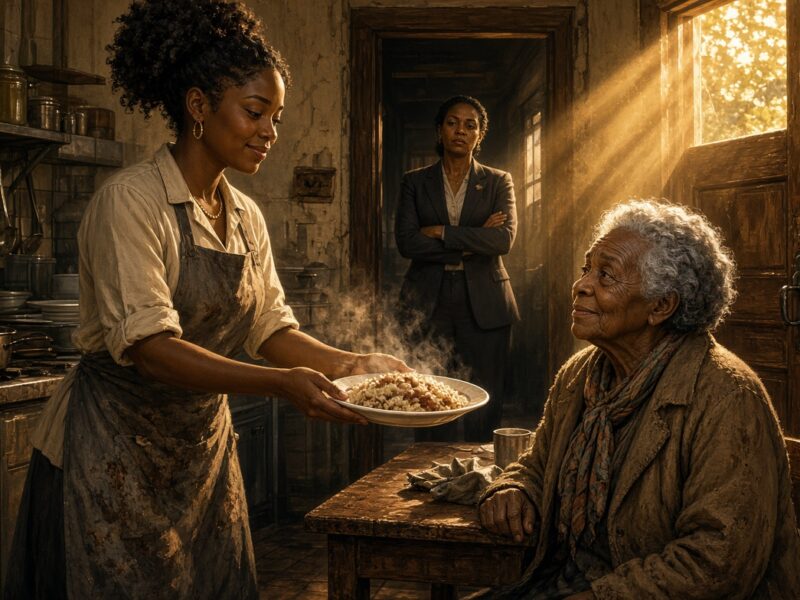
She Fed a Homeless Old Woman Against the Manager’s Orders — The Shocking Truth About Who She Really Was
The rain had stopped an hour ago, but the alley behind Abena’s Kitchen still smelled like wet cardboard and yesterday’s grease.
A small figure in a threadbare coat stood at the back door, clutching a plastic bag that held everything she owned.
Her shoes were held together with duct tape, and her gray hair escaped from a faded scarf that had once been blue.
She knocked once, twice, then a third time, her knuckles raw from the cold.
The kitchen door swung open, and a young waitress named Abena appeared, her apron stained with tomato sauce and her eyes tired from a double shift.
“Good morning, mama,” Abena said softly, her voice carrying the warmth of a southern grandmother. “Are you hungry?”
The old woman nodded, her eyes downcast as if asking for food was a crime she couldn’t quite confess.
“Come inside,” Abena whispered, glancing over her shoulder. “I’ll fix you a plate before the managers come down.”
—
The restaurant was called Abena’s Kitchen, named after the founder’s grandmother, a woman named Nana Akosa who had started with one pot and one folding table on a street corner forty years ago.
Now it occupied a corner lot in downtown Atlanta, with brass fixtures and white tablecloths and a menu that started at twenty-five dollars for an appetizer.
The current manager was a woman named Priscilla, who had been hired three years ago and had slowly turned the place into her personal kingdom.
She had a partner in crime, a floor supervisor named Derrick, who enforced her rules with the enthusiasm of a man who had never been told no.
Together, they had found ways to cut costs that would have made the founder weep.
They sold the free meal vouchers on the black market, pocketing forty dollars for every box meant for the hungry.
They charged servers for their uniforms and deducted “mistakes” from their paychecks.
They had turned a charity into a cash machine, and nobody had noticed because nobody was watching.
—
The old woman sat at a small table near the kitchen, her hands wrapped around a cup of coffee that Abena had poured without asking.
She ate slowly, savoring each bite of the rice and beans as if it were a five-course meal.
“Thank you, my child,” she said, her voice raspy but kind. “You have a good heart.”
Abena smiled, but before she could respond, the swinging door to the dining room burst open.
Priscilla stood there in her tailored blazer and heels, her face twisted with disgust.
“What is this?” she demanded, pointing at the old woman. “Who let this trash in here?”
“She’s just hungry, madam,” Abena said, stepping between them. “She wasn’t bothering anyone.”
“Hungry?” Priscilla laughed, a cold, sharp sound. “This is a restaurant, not a charity. She needs to leave. Now.”
—
The old woman looked up, her eyes meeting Priscilla’s for the first time.
“I only asked for a little food,” she said quietly. “I didn’t mean any harm.”
“Harm?” Priscilla grabbed the plate from the table and dumped it into the trash. “You’re costing us money just by sitting here. Look at you. You smell like the gutter.”
Abena’s hands trembled at her sides. “Madam, please. She’s an old woman.”
“She’s a beggar who won’t leave,” Derrick said, appearing behind Priscilla with a smirk. “Let me handle this.”
He walked over to the old woman and grabbed her by the arm, pulling her toward the door.
“Out,” he said. “And don’t come back.”
The old woman stumbled, catching herself on the doorframe.
She looked back at Abena, and something passed between them—a silent acknowledgment that the world was often cruel to those who had nothing.
“Remember this day, my daughter,” the old woman said, her voice steady despite her humiliation. “It will remember you.”
—
Abena ran after her, her apron still tied around her waist.
“Mama, please take this,” she said, pressing a warm container of food into the old woman’s hands. “I’m so sorry.”
The old woman looked at her with eyes that held centuries of wisdom.
“You have nothing to be sorry for, my child,” she said. “You are the only one who showed me kindness today.”
“Abena!” Priscilla’s voice shrieked from the doorway. “Back to work. Another word and you’re finished here.”
Abena watched the old woman disappear around the corner, her heart heavy with guilt and anger.
She didn’t know that the woman she had just fed was the one person who could change everything.
She didn’t know that Nana Akosa had been watching from the shadows for three days, testing the very restaurant that bore her name.
And she didn’t know that the free meal vouchers that Priscilla had been selling were part of a scheme that would soon unravel in the most public way possible.
—
The next morning, Abena arrived early, hoping to catch the old woman before her shift started.
She waited by the back alley, her breath visible in the cold morning air.
But the old woman didn’t come.
Instead, a sleek black car pulled up, and a man in a suit stepped out, holding a folder thick with documents.
“Is this Abena’s Kitchen?” he asked, his voice professional but not unkind.
“Yes, sir,” Abena said. “Can I help you?”
“I’m here to conduct an audit,” he said. “On behalf of the founder.”
Abena’s heart skipped. “The founder? Nana Akosa?”
The man nodded. “She’s been reviewing the operations for the past week. There are some… discrepancies.”
—
Priscilla arrived an hour later, her usual confidence shaken by the sight of the auditor in her office.
“What’s going on?” she demanded, her voice sharp. “Who authorized this?”
“I did,” a voice said from the doorway.
Everyone turned.
The old woman stood there, but she was no longer wearing the threadbare coat or the duct-taped shoes.
She wore a tailored suit that fit her perfectly, and her gray hair was styled elegantly under a silk scarf.
Her eyes, which had seemed tired and defeated, now held the sharpness of a woman who had built an empire from nothing.
“Nana Akosa,” Priscilla breathed, her face draining of color. “I… I didn’t know…”
“You didn’t know what?” Nana Akosa asked, stepping into the room. “That I was the woman you threw out? Or that I was the founder you’ve been stealing from?”
—
Derrick tried to slip out the back, but a security guard blocked his path.
“I think you should stay,” the auditor said, opening his folder. “We have some questions about forty free meal boxes that were sold on the black market.”
Priscilla’s hands shook as she reached for her phone. “I can explain everything. It was a misunderstanding.”
“Was it a misunderstanding when you took Abena’s coworker’s tips?” Nana Akosa asked. “Or when you charged servers for uniforms that were supposed to be provided? Or when you sold meals meant for the hungry to the highest bidder?”
“I was trying to cut costs,” Priscilla stammered. “The restaurant was struggling.”
“The restaurant was never struggling,” Nana Akosa said, her voice rising. “I built this place with one pot and one folding table. I know what struggling looks like. This was greed.”
She turned to Abena, who stood in the corner, her eyes wide with shock.
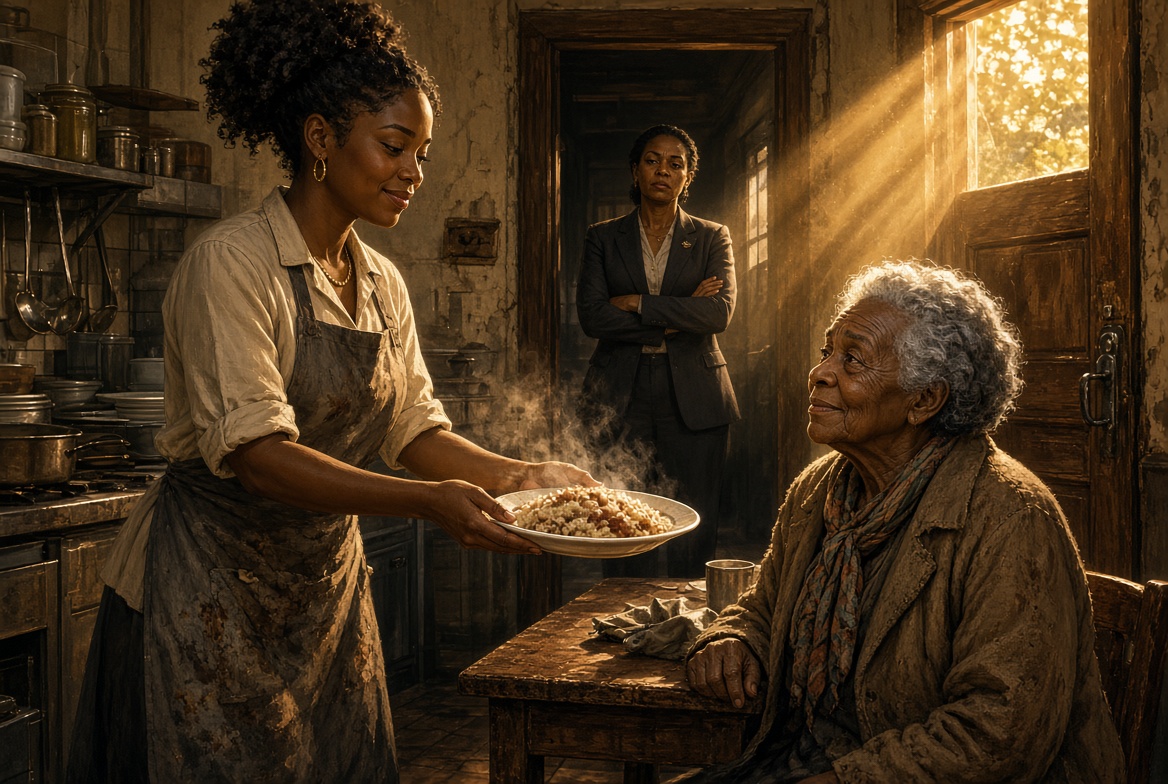
“You,” Nana Akosa said softly. “You are the only one who treated me like a human being.”
—
The auditor handed Nana Akosa a document.
“In the past two years,” he said, “Ms. Priscilla and Mr. Derrick have stolen approximately $47,000 from the charity meal program. They sold 1,175 boxes meant for the hungry, pocketing $40 per box.”
The number hung in the air like a verdict.
Priscilla sank into a chair, her face buried in her hands.
“We’ll pay it back,” she whispered. “Please, just give us a chance.”
“A chance?” Nana Akosa said. “You had a chance every time you saw a hungry person and turned them away. You had a chance when you dumped that plate in the trash. You had a chance when you humiliated me in front of my own employees.”
She turned to the auditor. “Call the police. And the lawyer. We’re pressing charges.”
—
Two weeks later, Abena stood in the restaurant’s dining room, now filled with people who had once been turned away.
The tables were covered with white cloths, and the smell of fresh bread and roasted chicken filled the air.
“I’m not sure I can do this,” Abena said, her voice trembling. “I’ve never managed anything before.”
“You fed a stranger when everyone else turned their back,” Nana Akosa said, standing beside her. “That’s more than most people do in a lifetime.”
“But I’m just a waitress.”
“You’re the manager now,” Nana Akosa said firmly. “You’re the only one who deserves it.”
Abena looked out at the crowd—families with children, elderly people with tired eyes, veterans with worn coats.
“Can I change the rules?” she asked.
“The rules are yours to make,” Nana Akosa said. “What do you want to do?”
Abena took a deep breath. “I want to open the doors to anyone who’s hungry. No questions asked. No conditions. Just food.”
Nana Akosa smiled, her eyes glistening with tears.
“That’s exactly what I wanted to hear.”
—
The first day under Abena’s management, the restaurant served 200 free meals.
The second day, 300.
By the end of the month, the line stretched around the block.
People came from all over the city, drawn by the rumor of a place where no one was turned away.
Abena hired former servers who had been fired for giving food to the hungry.
She partnered with local farms to donate surplus produce.
She turned the back alley where Nana Akosa had once been humiliated into a community garden.
And every night, before she locked the doors, she looked at the photograph on the wall—Nana Akosa and her husband at their first stall, smiling like they had nothing to lose.
—
Priscilla and Derrick were convicted of embezzlement and fraud.
They were sentenced to five years in federal prison and ordered to repay the $47,000 they had stolen.
At the sentencing, Nana Akosa stood before the judge.
“I don’t seek revenge,” she said. “I seek honesty. I hope they learn from this.”
Priscilla looked at her former boss, her eyes red with tears.
“I’m sorry,” she whispered.
“Sorry isn’t enough,” Nana Akosa said. “But it’s a start.”
—
A year later, Abena’s Kitchen was featured on the national news.
The reporter, a young woman with a bright smile, stood in the dining room as volunteers served plates of hot food.
“How does it feel to be a hero?” she asked Abena.
“I’m not a hero,” Abena said, shaking her head. “I just did what was right.”
“But you fed a stranger when everyone else turned their back,” the reporter pressed. “That’s brave.”
Abena looked at the photograph on the wall, then at the table where Nana Akosa sat, surrounded by children who called her “Grandma.”
“The truth is,” Abena said, “she fed me first. She taught me that love teaches late, but it always teaches.”
—
That evening, after the cameras had gone and the volunteers had left, Abena sat at the table where Nana Akosa had once eaten her first free meal.
The old woman joined her, a cup of coffee in her hands.
“How do you feel?” Nana Akosa asked.
“Full,” Abena said, smiling. “Not just from the food. From everything.”
“Good,” Nana Akosa said. “That’s how it should be.”
They sat in silence for a while, the sounds of the city drifting through the open windows.
“Mama,” Abena said finally. “Why did you come here that day? You could have revealed yourself at any time.”
“I needed to see the truth,” Nana Akosa said. “I needed to see who would treat me with kindness when I had nothing to offer.”
“And what did you learn?”
Nana Akosa looked at her, her eyes soft with wisdom.
“That the people who serve the poorest among us are the richest of all.”
—
The restaurant stayed open late that night, serving anyone who walked through the door.
A young man with torn jeans and a hungry look sat at a corner table, eating his third plate of food.
A mother with three children laughed as she told a story about her grandmother.
An elderly veteran sat by the window, watching the rain fall and smiling.
Abena watched them all, her heart full to bursting.
She thought about the old woman who had come to the back door three days before Founders Day.
She thought about the plate she had offered, the kindness she had shown.
She thought about how one small act of love could change everything.
—
The next morning, Abena found a note on her desk.
It was written in elegant handwriting, on paper that smelled like lavender and old books.
“You were the only one who served me,” it said. “Now you serve the world. I am proud of you, my daughter.”
Abena pressed the note to her chest, tears streaming down her face.
She looked out the window at the garden that had once been an alley.
She looked at the table where a stranger had become a friend.
She looked at her reflection in the glass and saw someone she had never known she could be.
The table was full again, and it was her job to keep it that way.
—
The story of Abena’s Kitchen spread across the country.
Other restaurants reached out, asking how they could help.
Other managers asked how they could change.
Other people asked how they could be like Abena, how they could feed a stranger and change a life.
Abena answered every email and every call.
She told them the same thing every time: “Start with one plate. Start with one person. Start with one act of love.”
And one by one, they did.
—
Five years later, Abena’s Kitchen had expanded to three locations across Atlanta.
The free meal program served 500 people a day.
The community garden had grown into a small farm that supplied fresh produce to the kitchen.
The photograph of Nana Akosa still hung on the wall, a reminder of where it all began.
Abena, now a confident and compassionate leader, stood in the dining room of the original location.
She looked at the table where she had first served a hungry old woman.
She looked at the door where Priscilla had once screamed at a beggar.
She looked at the kitchen where she had scrubbed floors as punishment for her kindness.
And she smiled.
—
The table was full again.
Not just with food, but with people who had found hope.
A young woman studying to be a nurse sat next to a retired teacher who volunteered every weekend.
A single father shared a meal with his daughter, laughing at a joke she had told.
A homeless man sat by the window, eating his first hot meal in days.
Abena watched them all, her heart overflowing with gratitude.
She thought about the old woman who had walked through the back door.
She thought about the plate she had offered, the kindness she had shown.
She thought about how one small act of love could ripple outward and touch thousands of lives.
—
“Mama,” a voice said behind her.
Abena turned to see Nana Akosa, now in her eighties but still sharp as ever.
“The table is full,” Nana Akosa said, smiling.
“Always,” Abena replied. “Just like you taught me.”
They stood together, looking at the people gathered in the dining room.
“So many faces,” Nana Akosa said. “So many stories.”
“And every one of them matters,” Abena said.
Nana Akosa nodded, her eyes glistening with tears.
“That’s the rule,” she said. “No one leaves hungry.”
—
That night, after everyone had gone home, Abena sat at the table by the window.
She thought about the journey that had brought her here.
She thought about the old woman who had been humiliated and thrown out.
She thought about the young waitress who had risked everything to show kindness.
She thought about the founder who had watched from the shadows and learned the truth.
And she thought about the table, the table that had been built for everyone.
—
She remembered Nana Akosa’s words: “How you treat someone who can give you nothing tells me everything about you.”
She remembered Priscilla’s cruelty and Derrick’s indifference.
She remembered the plate she had offered to a stranger.
She remembered the day she had been told to scrub the alley as punishment.
She remembered the moment she had chosen kindness over fear.
—
She pulled out a piece of paper and began to write.
“To anyone who has been told they don’t belong,” she wrote. “To anyone who has been humiliated for being hungry. To anyone who has been turned away from a table built for everyone. This is for you.”
She wrote about the old woman and the plate of food.
She wrote about the managers who had stolen from the poor.
She wrote about the founder who had watched and learned.
She wrote about the table that was full again.
—
She finished writing at dawn, the first light of morning spilling through the windows.
She folded the paper and placed it under the photograph of Nana Akosa.
Then she stood and opened the doors.
The line was already forming outside—men and women, young and old, rich and poor.
She welcomed them all.
“Come in,” she said. “Sit and eat. No one leaves hungry.”
—
The table was full again.
And it would be full tomorrow.
And the day after that.
And the day after that.
Because kindness, once planted, never stops growing.
—
**THE END**









