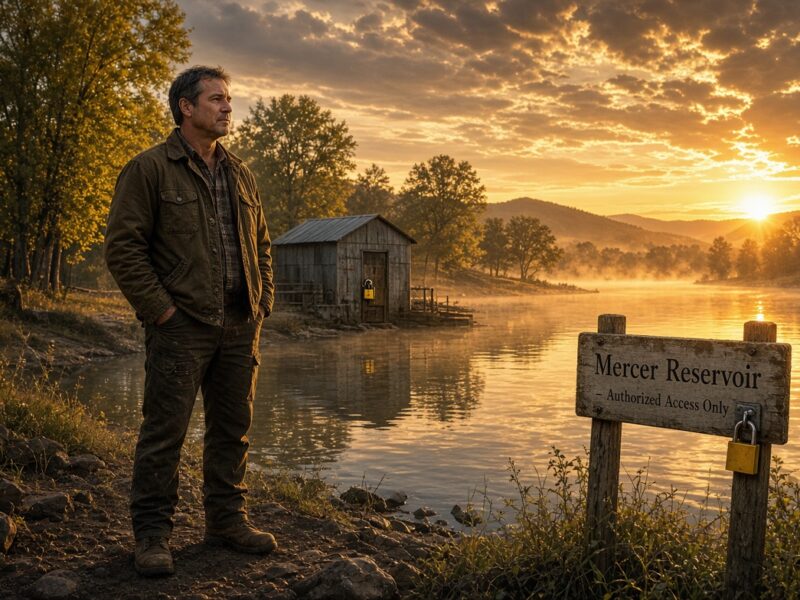
She Drained His $8 Million Reservoir While He Was Gone — Then Sent Him the Bill
“This reservoir is now under HOA emergency control, Mr. Mercer, so step back before I have you fined for interfering with community property.”
Victoria Harrove said it like she was reading weather, one manicured hand resting on a clipboard while three diesel pumps hammered beside my shoreline.
I had been gone 19 days.
That was all it took for somebody to turn my $8 million reservoir into a construction site.
The first thing that hit me was the smell.
Hot diesel mixed with wet clay and the sour edge of exposed lakebed.
Then came the sound, heavy, steady, mechanical, like somebody had parked three giant heartbeats on my land.
I drove my pickup down the gravel access road and saw the water line before I saw her.
It had dropped almost 10 feet.
Mud streaked the banks in dark bands.
Dock posts stood naked in the evening light, and the concrete intake tower showed a section that had not seen daylight in years.
Three thick blue discharge hoses crossed my fence line and disappeared toward Willow Creek Estates.
My yellow steel lock lay in the dirt near the pump house, cut clean through.
I picked it up.
The metal was still warm from the sun.
Victoria watched me with that polished suburban smile I had seen in every certified letter she ever sent, white slacks, cream blouse, expensive sunglasses, no mud on her shoes.
Behind her, a contractor in an orange vest checked a pressure gauge and avoided looking at me.
I asked one question.
“Who authorized this?”
She lifted the clipboard.
“The board did, and the county approved emergency drainage.”
Her voice stayed sweet.
“You were unavailable, so we acted.”
Then she handed me an invoice.
$18,400.
Emergency drainage assessment printed across the top in bold blue letters.
She had cut my lock, brought industrial pumps onto my property, drained my reservoir, and somehow decided I owed her money for the privilege.
I should have been yelling.
Instead, I looked past her at the small gray telemetry box bolted to the intake cabinet.
A green status light blinked once every two seconds.
Still alive.
Still recording.
My father used to tease me about that system when we installed it years ago.
Too fancy for a farm pond, he called it.
But this was never just a pond.
The reservoir fed irrigation lines, protected downstream acreage during storms, and carried its own flow sensors, gate logs, and pressure history.
Every gallon moving through those pumps was becoming a time stamp.
Victoria had no idea.
She thought she had found a quiet window while I was out of state.
What she had actually found was 19 days to manufacture evidence against herself.
I folded the invoice once, slid it into my jacket pocket, and walked toward the pump house.
Victoria followed two steps behind, explaining community safety, runoff liability, property values, all the phrases people use when they want trespassing to sound administrative.
I knelt beside the cabinet, brushed dried mud off the latch, and opened the telemetry panel.
The screen lit my face pale green.
Flow rate, runtime, volume, dates.
Nineteen days of numbers sat there in perfect order, and for the first time since I reached the ridge, I smiled very quietly.
The telemetry screen kept blinking while Victoria talked behind me, each sentence smoother than the last.
Community safety, emergency authority, temporary access.
She stacked those phrases like sandbags, hoping enough official language would keep me from noticing the mudline 10 feet below the dock.
I closed the cabinet gently.
My hands were steady, but my stomach was not.
That reservoir had taken eight years to rebuild, and every exposed foot of shoreline carried a memory.
The first summer, my father and I replaced the rusted intake gate ourselves, working from sunrise until mosquitoes drove us inside after dark.
He hated wasting anything, especially water.
He had spent 30 years repairing pumps, irrigation lines, and farm equipment, so he treated every leak like a personal insult.
I still remembered the smell of welding smoke trapped under that old canvas shade and the way he tapped each finished bolt twice.
“Solid enough,” he would say.
“Nothing on this property survives because somebody wished it would. You maintain it.”
Years later, after he was gone, I kept his black maintenance notebook in the pump house.
The cover had softened from grease, rain, and his hands.
Every repair mattered to me personally.
Eight million dollars was what the latest appraisal called the reservoir system after the dam reinforcement, shoreline stabilization, pumps, controls, access road, and water infrastructure were counted together.
But I never thought of it as $8 million.
I thought of Saturday mornings with Dad, coffee cooling beside a toolbox.
Victoria saw something else.
She saw an asset beside a growing subdivision.
Her interest had started politely two years earlier when she asked whether residents could walk my shoreline for exercise.
I said no.
A month later, she asked for a small emergency access gate through my fence.
I said no.
Then came the letters.
She called the reservoir standing water, then a drainage concern, then a shared watershed.
Each new phrase reached a little farther across my property line.
I answered every notice with the same survey, the same deed, and the same sentence.
Willow Creek Estates had no easement.
The morning she finally asked for temporary water sharing, I understood what she wanted.
New homes were rising on the east side of the development, their retention ponds shallow and ugly under a dry summer sky.
Victoria sold real estate there herself.
Water meant landscaping, reflections, photographs, and higher prices.
I refused again in writing.
She replied with one sentence I remembered now as clearly as the pump noise outside.
“Water affects everyone, Mr. Mercer. You do not get to keep it to yourself.”
At the time, I laughed.
Standing beside 10 feet of exposed clay, I did not laugh.
I turned from the telemetry panel and looked at Victoria.
She was still holding her clipboard, waiting for anger, an argument, something she could label obstruction.
Instead, I asked how long the pumps had been running.
Her mouth tightened for half a second.
“Nineteen days,” she said. “Authorized operation.”
Interesting choice of words.
I looked past her toward the blue hoses, then back at the green light blinking inside the cabinet.
Nineteen days meant 19 days of flow data, pressure changes, gate activity, timestamps, and volume records.
My father had called that telemetry system too fancy.
Victoria had made it essential.
Victoria had been testing that boundary long before those pumps.
She never started by asking for the reservoir itself outright.
People like her rarely begin with the thing they want.
They begin with something small enough to sound reasonable first.
Her first request came on a bright September morning, quietly.
She arrived wearing white sneakers and carrying printed neighborhood maps.
She asked whether residents could walk along my shoreline occasionally.
“Just for exercise,” she said, smiling like permission existed already.
I pointed toward the fence and told her plainly, “No.”
Private property was not a suggestion, especially around water infrastructure.
Two weeks later, another request arrived by certified mail.
Again, this one asked for a narrow emergency access gate nearby.
The language sounded official, but the purpose stayed conveniently vague.
Fire response, drainage inspection, community preparedness, all carefully packaged together.
I answered with the survey and denied that request, too.
After that, Victoria stopped pretending her interest was casual anymore.
Her letters became longer, colder, and much more expensive looking.
She hired consultants who had never stepped onto my property.
Their reports called my reservoir an unmanaged neighborhood water feature.
That phrase told me exactly where this argument was heading.
First, it was my shoreline, then access, then shared responsibility.
Finally, she started calling the reservoir our community watershed publicly.
She used the phrase at meetings, newsletters, and open houses.
Words mattered to Victoria because words could soften a takeover.
If she repeated our enough, ownership started sounding negotiable publicly.
The timing was not accidental, and neither were her motives.
Willow Creek Estates had begun expanding eastward that same year.
New houses appeared beyond the ridge and rose quickly.
Fresh sod curled brown under weeks of stubborn summer heat.
Their new retention ponds looked shallow, dusty, and painfully empty.
I could see why buyers might hesitate near them.
Victoria could see exactly the same problem from commission reports.
She was not merely HOA president.
She sold houses there.
Every green lawn and reflective pond improved her sales pitch.
Every dry basin reminded buyers that appearances depended on water.
Then came her most polished request of all that spring.
Temporary water sharing, she called it, strictly during drought conditions.
The proposal included flow estimates, schedules, and reassuring legal phrases.
It did not include any actual right to my water.
I refused in writing, attaching the deed again for clarity.
Her reply arrived before breakfast the very next business day.
“Water affects everyone, Mr. Mercer,” she wrote with confidence.
“You do not get to keep it to yourself forever.”
I saved that message because something about it bothered me.
It was not a request anymore.
It was a claim.
She had moved from asking permission to rewriting reality quietly.
That was when I started saving everything she sent me.
Emails, envelopes, maps, meeting notices, assessments, and every revision received.
I scanned each page and stored copies offsite as backups.
At the time, it felt like ordinary caution.
Standing beside those pumps, it felt more like foresight.
Now Victoria had spent two years building a story around water.
She wanted neighbors believing access had always belonged to them.
She wanted paperwork to arrive before anyone questioned the premise.
And while I was gone, she finally acted on it.
Victoria did not wait long after I left for Colorado.
The first morning of my trip, while I was standing inside a municipal pump station outside Fort Collins, my gate camera sent one final image.
Victoria stood beside the entrance in white slacks and a cream blouse, pointing down my access road while Cole Bennett listened beside a white service truck.
My yellow steel lock still hung from the chain.
Ten minutes later, the camera went dark.
I called the property, tried the backup connection, and got nothing.
The camera had dropped offline before during storms, so I logged the failure and kept working.
That assumption cost me 19 days.
Tom Bradley, the farmer west of me, was visiting his daughter in Arizona that week, which meant the one man who normally noticed every unfamiliar engine on our road was gone, too.
Victoria had picked her window perfectly.
Later, I would learn that Cole’s crew entered before sunrise that same morning, photographed the gate, cut the lock, and rolled three pump trailers down to the reservoir.
One of those photographs became more valuable than anyone standing there understood.
Centered behind Cole was my aluminum sign, private reservoir, Mercer property, authorized access only.
He had documented the warning before his crew touched anything.
The pump started that morning and kept running.
My telemetry system recorded the reservoir changing hour by hour while I was hundreds of miles away.
I did not see those records remotely because the same network outage that killed the gate camera also cut my external access to the monitoring system.
Locally, though, the system never stopped logging.
On the evening of my 18th day away, Tom returned from Arizona and called me before he had even unpacked.
“Ethan,” he said, “there are industrial pumps on your reservoir.”
The words turned the motel room cold.
I told him to stay on the public road, take photographs, and avoid confronting anyone.
Within 20 minutes, my phone filled with images of blue discharge hoses crossing the pasture, generators beside the pump house, and three diesel units pulling water hard enough to expose dark bands of shoreline.
Another photograph showed a Willow Creek maintenance truck following the discharge line toward the eastern retention ponds.
Tom drove farther along the public road and sent one final image.
Those ponds, dry and shallow when I left, were now full enough to reflect the new houses beside them.
That was when Victoria’s plan finally came into focus.
She had not been correcting drainage.
She had been moving my water toward the subdivision she was selling.
My scheduled flight home was the next morning.
I did not sleep.
I spent the night downloading every email Victoria had sent during the previous two years, backing up Tom’s photographs, and making a list of every question I wanted answered when I reached the property.
By sunrise, anger had burned down into something more useful.
Sequence, dates, names, proof.
I landed on day 19, picked up my truck, and drove straight from the airport without changing clothes.
The closer I got, the louder the diesel became.
When I reached the ridge above Mercer Reservoir, the eastern ponds shimmered blue beyond Willow Creek, while my shoreline lay scarred with exposed clay.
Victoria had used every day I was gone.
The sheriff arrived 20 minutes after I called, dust curling behind his cruiser as he came down the reservoir road.
Deputy Harris had known me for years, which made the look on his face worse when Victoria stepped forward with a thick county packet already open to a highlighted page.
She spoke before I could.
“Emergency drainage authorization approved by the county,” she said, holding the papers high enough for everyone to see.
Harris read the first page, then the second, while the pumps hammered behind us and blue hoses carried my water toward Willow Creek.
I showed him my deed, my survey, the photographs Tom had taken, and the cut yellow lock I had picked up near the pump house.
Victoria answered every fact with another phrase that sounded official.
Community safety, emergency authority, board approval, temporary access.
She made trespassing sound like maintenance.
Harris did not tell me she was right.
He told me he was not going to order industrial equipment shut down until the county confirmed exactly what the authorization covered.
That was careful policing, but standing there beside a reservoir dropping by the hour, caution felt expensive.
Victoria smiled as the cruiser rolled away.
“You should have answered your mail, Mr. Mercer,” she said.
I looked at the exposed shoreline instead of answering.
Mud pulled at my boots near the western bank.
The dock stood above water that had retreated yards beyond its lowest step, and brown streaks marked the intake tower like a ruler showing everything I had lost while I was gone.
I called County Public Works from the pump house.
An after-hours supervisor searched the permit system and finally found the authorization Victoria had been waving.
Willow Creek Estates emergency drainage, approved 11 days earlier.
For a second, even I felt my confidence tighten.
The document was real.
Victoria heard enough through the open door to smile again.
“I told you,” she said. “We did everything properly.”
Then she pointed toward my broken lock and added that none of this would have been necessary if I had cooperated.
I closed the door without responding.
The diesel vibration traveled through the concrete floor into my boots.
Dad’s black maintenance notebook sat beside the original engineering drawings in the metal cabinet.
I poured stale coffee from a thermos, opened the county file on my laptop, and started reading from the bottom instead of the top.
County seal, signature, approval date, drainage basin capacity, outlet elevation, overflow path.
Nothing looked wrong until I reached the parcel identification line.
I pulled my deed from the cabinet and set it beside the screen.
My parcel ended in 47.
The permit ended in 74.
I checked again slowly, then opened a county map and typed Victoria’s number into the search field.
A red boundary appeared three-quarters of a mile away, wrapped around Willow Creek’s eastern retention basin.
I leaned back and listened to the pumps through the wall.
The authorization was legitimate.
The property was not mine.
Two digits had just turned Victoria’s strongest defense into the first piece of evidence against her.
For the first time since I crossed the ridge, the noise outside stopped sounding like authority and started sounding like a clock counting down on her version of the truth already in writing.
Those two digits changed the temperature in the room.
I pulled my deed from the metal cabinet, spread the survey beside Victoria’s authorization, and checked every line under the fluorescent light.
My parcel ended in 47.
Her permit ended in 74.
Same county, same drainage district, different property.
I sat back and listened to the pumps through the wall.
Their vibration no longer sounded powerful.
It sounded documented.
I opened the county parcel map, typed the number from the permit, and watched a red outline appear over Willow Creek’s eastern retention basin, three-quarters of a mile away.
The authorization was real.
Victoria’s use of it was not.
That distinction mattered more than any argument I could have made beside the shoreline.
I photographed both parcel numbers, saved the county map as a file, and emailed everything to Rachel Sloan, a property attorney I trusted from past projects.
Rachel called nine minutes later.
Her first question was simple.
Had I touched the pumps?
I told her no.
She said, “Good.”
Then she told me to preserve everything and let Victoria keep talking.
No arguments, no threats, no gestures.
Paper, photographs, timestamps, witnesses.
Build the record before touching anything.
By midnight, my kitchen table looked like an engineering office after a storm.
Deeds, surveys, permit sheets, emails, maintenance logs, and printed telemetry reports covered every inch.
I exported the flow history first.
Three pumps had averaged just over 4,000 gallons per minute during their operating windows each day.
The system had logged start times, shutdowns, pressure changes, and total volume automatically.
Victoria had spent years complaining that my controls were excessive for private property.
Now those same controls gave me something memory never could, a minute-by-minute account of what happened while I was far from home.
Then I found the contractor photographs Tom had sent.
I enlarged the first image until the pixels softened around the edges.
Cole Bennett, the pump supervisor, stood beside my gate, holding his phone toward the property sign.
The words Mercer Property were centered in his frame.
There was no misunderstanding.
At 7 the next morning, I called Cole directly.
He sounded tired and cautious.
He said Victoria had represented herself as authorized by the board and county, and she told his company I had approved access.
I asked whether he had anything in writing.
He went quiet before answering yes.
That was the second crack.
The third came from Victoria herself.
At 8:15, an email landed in my inbox demanding HOA access to the reservoir and warning that further interference could trigger assessments.
Rachel told me not to debate her.
I replied with one sentence.
“Please identify your authority.”
Her answer arrived 12 minutes later.
“The board considers the reservoir part of the community water system,” she wrote.
I read that sentence twice.
It was not a misunderstanding.
It was not emergency language.
It was a declaration of ownership she did not possess, delivered voluntarily with her name attached.
I printed the email and placed it beside Dad’s notebook.
Outside, the pumps kept working under a pale Sunday sky, but the balance had shifted.
Victoria still had machinery, contractors, and a stack of official paper.
I had the correct parcel, recorded water data, photographs, and now her own words.
Rachel called before sunrise and told me the next move was simple.
Stop arguing and start preserving.
By 7, she had sent formal notices to Victoria, the HOA board, Cole Bennett, and the pumping company, ordering them to preserve emails, invoices, photographs, work orders, text messages, and every access record.
She also told me not to demand anything from Victoria except written authority.
That restraint felt unnatural while water kept leaving my property.
But Rachel understood something I was beginning to see.
Victoria needed to believe she was still winning.
Confidence made her careless, and careless people documented their mistakes.
By mid-morning, Mark Delaney, a forensic civil engineer Rachel trusted, was walking the shoreline beside me.
His boots sank into clay where water had stood the previous week.
He measured bank exposure, photographed the intake tower, checked slope movement, and marked every location where rapid drawdown had created damage.
A drone mapped the exposed shoreline from above.
Water samples went to a laboratory.
Telemetry files were copied twice and stored separately.
Even Dad’s old maintenance notebook was photographed page by page, because it showed years of normal operating levels.
Nothing dramatic happened.
That was exactly the point for us.
Victoria filled the silence herself.
By noon, she emailed a demand stating that I must grant permanent HOA access to the reservoir for community operations.
At 2:30, she added a warning that refusal could result in assessments, liens, and fees.
Rachel forwarded each message into the evidence file without comment.
That evening, Willow Creek held an emergency board meeting at the clubhouse.
I did not attend.
I did not need to.
HOA rules required recorded minutes, and one homeowner I trusted sent me the audio afterward.
Victoria sounded relaxed, almost triumphant, as she described the reservoir as a community asset.
Then she said the sentence Rachel had been waiting for.
“The people increasing property values around here deserve the benefit of that water.”
I listened twice.
No emergency, no drainage threat, no safety concern.
Just property values and benefit.
Rachel listened once and said, “Keep the recording where it is.”
Monday morning changed everything.
A county engineer confirmed in writing that Victoria’s authorization applied only to Willow Creek’s retention basin.
Rachel filed for emergency relief before lunch, attaching the deed, survey, permit map, telemetry records, contractor photographs, and Victoria’s emails.
By afternoon, the courthouse had enough to act quickly.
The order arrived at 4:17.
All pumping operations were to cease immediately pending further review.
I walked down to the shoreline with Deputy Harris as Cole read the order beside his trailer.
He looked relieved more than anything.
Victoria did not.
Her face went still behind her sunglasses completely.
Cole reached for the first control panel.
The nearest diesel engine dropped from a roar to a low shudder, then silence.
The second followed.
Suddenly, I could hear wind moving through cottonwoods across the pasture.
Victoria started telling Harris that the court had misunderstood the situation.
Nobody answered her there.
The third pump kept turning for another few seconds, its rhythm echoing across the lowered water line.
Then Cole shut it down.
Warm wind.
After 19 days, the reservoir was quiet.
Victoria still held her clipboard, but the sound behind her was gone.
For the first time, so was authority.
Six weeks later, the courtroom smelled like old paper, floor wax, and coffee that had been sitting too long.
Victoria arrived with two attorneys and the same polished expression she wore beside my pumps.
I carried one binder.
Rachel carried three.
Mark Delaney sat behind us with his engineering reports.
Judge Samuel Whitaker entered.
Everyone stood, and the room became quiet enough to hear pages turning.
Victoria’s attorney opened with emergency management, public safety, and community necessity.
Rachel let him finish.
Then she placed two enlarged parcel maps on the display.
“Same county,” she said. “Different property entirely here.”
The judge leaned forward.
A county engineer took the witness stand and confirmed that the emergency authorization covered Willow Creek’s eastern retention basin, not Mercer Reservoir.
Rachel enlarged the identification numbers until those final two digits filled the screen.
47 on my deed.
74 on Victoria’s permit application.
Victoria stopped taking notes.
Rachel next displayed the contractor photograph from the morning they entered my property.
Cole Bennett stood beside my gate, phone raised, with the aluminum private reservoir sign visible behind him.
Cole testified that Victoria told his company I had approved access and that county authority covered everything.
Rachel asked whether he had ever spoken to me before starting the pumps.
“No,” he said.
Had he seen any written permission signed by me?
No.
Had Victoria instructed him to proceed anyway?
Yes.
The word landed softly, but Victoria shifted in her chair.
Then Rachel brought up the telemetry.
My father had called that system too fancy.
Now its graphs covered the courtroom screen in clean blue lines.
Start times, shutdowns, pressure changes, total volume moved.
Mark explained the rapid drawdown, shoreline instability, intake stress, restoration requirements, and the cost of returning the reservoir to its documented condition safely.
Nobody needed dramatic language.
The numbers were dramatic enough.
Rachel then played Victoria’s recorded HOA meeting.
Her voice came through the speakers, smooth and confident.
“The people increasing property values around here deserve the benefit of that water.”
Victoria’s attorney objected.
Judge Whitaker overruled him and asked Rachel to continue.
She did.
The email followed.
“The board considers the reservoir part of the community water system.”
Then came sales records showing Victoria’s commissions tied to homes overlooking the newly filled retention ponds.
Her attorney called it coincidence.
Rachel called the county engineer back and asked one question.
Was Mercer Reservoir ever included in Willow Creek’s approved community water system?
“Never,” he said.
The word hung there longer than any speech.
By closing arguments, Victoria was no longer writing.
Her clipboard rested untouched on the table.
Judge Whitaker reviewed the evidence in silence, turning pages slowly before looking directly at her.
He said the case was not about a misunderstanding between neighbors.
It was about knowingly exercising control over private infrastructure without lawful authority, continuing after ownership had been disputed, and creating measurable damage for financial benefit.
He read the damages slowly.
Restoration costs, loss of use, professional expenses, consequential losses, and punitive damages supported by the documented conduct.
$12 million total.
The number did not explode through the room.
It settled into it.
Victoria stared at the table, expression empty, while Rachel closed our binder.
I thought about the cut yellow lock, the blinking green telemetry light, and silence.
The first morning after the judgment, I drove back to the reservoir before sunrise.
The pumps were gone, but their footprints remained in the mud.
Three dark rectangles pressed into ground that had once been underwater.
The air smelled cleaner without diesel exhaust, just wet clay, cold grass, and the faint mineral smell rising from the exposed banks.
Restoration did not happen with a check and a handshake.
It happened one survey stake, one truckload of stone, and one careful decision at a time.
Mark Delaney stayed involved through the entire recovery.
His team stabilized the worst sections of shoreline first, then rebuilt damaged drainage channels and inspected the intake structure for stress.
We replaced seals, recalibrated pressure sensors, and installed new security controls at the pump house.
I kept Dad’s black maintenance notebook beside the new reports, old handwriting next to fresh engineering stamps.
Somehow that felt right.
Willow Creek changed, too.
Victoria resigned from the board before the next election, and three other directors followed within a month.
Homeowners who had been quiet during her years in charge started requesting records, asking questions, and showing up to meetings with copies of the bylaws in their hands.
The new board sent me a letter acknowledging that the reservoir was private property and that the HOA held no easement, ownership interest, or operational authority over it.
I framed that letter, not because I needed proof anymore, but because I liked the simplicity of it.
One page, clear language, no pretending.
The eastern retention ponds were redesigned to function without my water, which should have been the plan from the beginning.
Proper drainage work cost money, but it cost less than arrogance.
By late fall, rain began returning naturally to the reservoir.
The first storm arrived after midnight.
Soft at first, then steady enough to drum against my roof until dawn.
I walked down to the shoreline in a jacket and boots.
Water slid through the repaired channels, carrying the smell of leaves and fresh earth.
The level had only risen a few inches, but I stood there longer than I expected.
Recovery is quiet when you watch it honestly.
It does not leap back into place.
It comes inch by inch.
By spring, the dock touched water again.
Fish returned to the western shallows.
Cottonwoods reflected along the edge where blue discharge hoses had once crossed my pasture.
I replaced the old aluminum sign at the gate, but kept the wording exactly the same.
Private reservoir, Mercer property, authorized access only.
Then I installed a new yellow steel lock on the pump house.
Same color as the one Victoria had cut.
Heavier body, better shackle.
I held it for a second before closing it.
Click.
That small sound carried across the quiet concrete pad more clearly than any diesel engine ever had.
I thought about the courtroom, the two digits on that permit, Cole’s photographs, the green telemetry light, and Victoria’s recorded voice talking about people who deserve my water.
None of those things had looked powerful when they first appeared.
A parcel number was just a parcel number.
A blinking light was just a blinking light.
A saved email was just another message in an inbox.
Together, they became the quiet kind of justice Victoria could never talk over.









