She Carried Food Into the Forest Every Morning… Then She Disappeared
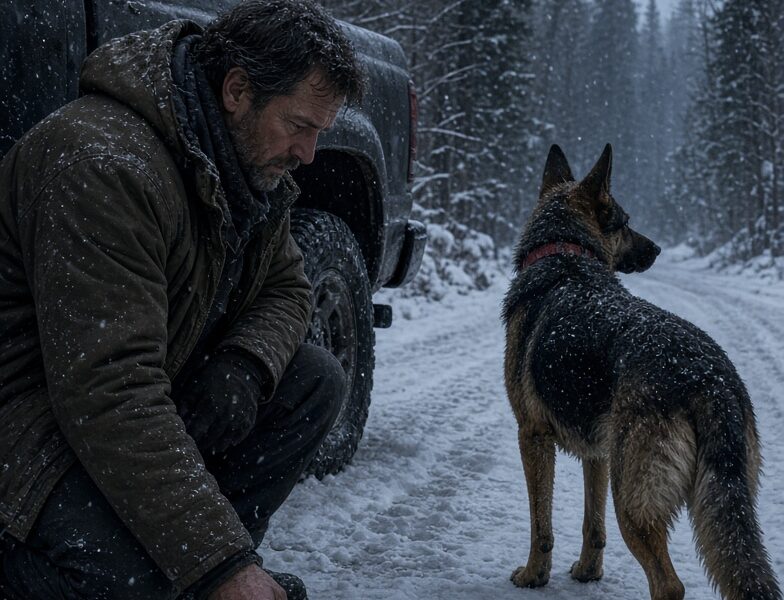
Every morning before sunrise, former Navy SEAL Luke Grayson stopped along a frozen road outside Duluth, Minnesota, to feed a starving German Shepherd mother.
She wore a faded red collar, walked with a slight limp, and carried half her food into the pine forest instead of eating it.
For eleven mornings, Luke watched her repeat the same strange ritual.
Then a winter storm arrived, and the dog disappeared.
On the twelfth morning, the blue plastic bowl remained untouched. By the second day, Luke had found her red collar lying in the snow, and a fourteen-year-old boy reported that his family’s husky had vanished from a locked yard.
Luke had spent years learning to recognize the difference between a coincidence and a pattern.
And somewhere beyond that frozen road, someone had made a serious mistake.
They had assumed that a hungry dog would never lead anyone to the truth.
At 5:57 a.m. on a January morning, northern Minnesota lay beneath a sky the color of old steel.
Snow covered the narrow roads outside Duluth, and the pine trees stood motionless beneath a fresh layer of frost.
Luke Grayson drove north in his old dark gray pickup, one hand resting on the steering wheel while the other held a thermos of coffee.
At forty-two, he was a former Navy SEAL combat medic, six feet tall, broad through the shoulders, with short dark brown hair beginning to gray at the temples.
A close-trimmed beard and a permanent crease between his eyebrows gave him a more intimidating appearance than he intended.
Military service had taught him to notice details other people overlooked.
It had also taught him to live with silence.
Since leaving active duty, Luke had settled into a small cabin outside Duluth, where his days followed a predictable routine.
He woke before sunrise, made strong coffee, checked the weather, and drove the same roads whenever he needed supplies.
He kept his home clean, his equipment organized, and his personal life uncomplicated.
There were no photographs of a wife on his walls, no children’s shoes beside his front door, and no dog waiting on the porch.
When people asked why he had never adopted one, he usually gave the same answer.
“My schedule was never reliable enough.”
The answer was true once.
These days, it was simply convenient.
That morning, something beside the road made him ease off the accelerator.
A German Shepherd stood near a snowbank at the edge of the pines.
She was perhaps four years old, black and tan beneath a dusting of snow, with long legs, intelligent brown eyes, and a small pale scar along the edge of her left ear.
An old red nylon collar circled her neck.
The fabric had faded almost pink in places, and the metal buckle was scratched from years of use.
She was far too thin.
Luke pulled onto the shoulder and switched off the engine.
The dog did not run.
She watched him through the windshield, shifting slightly away from one front paw.
He recognized the posture immediately.
Pain, fatigue, and caution.
Not necessarily aggression.
Luke remained inside for several seconds, studying the surrounding trees.
There were no houses nearby, no other vehicles, and no obvious sign of an owner searching for her.
Then he noticed the dog’s underside.
His expression changed.
She was nursing.
Somewhere in that forest, a litter of puppies depended on her.
Luke opened the truck door slowly.
“All right, girl. I’m not coming any closer.”
The Shepherd raised her head.
He stepped down, keeping his hands visible, and reached toward the back seat for a bottle of water.
Then he remembered he had no dog food.
“Of course,” he muttered.
He climbed back into the truck and drove to a small gas station several miles down the road.
Ten minutes later, he returned with a can of wet food, a bag of dry kibble, and an inexpensive blue plastic bowl purchased from the travel section.
The Shepherd was still there.
That surprised him more than he wanted to admit.
Luke poured food into the bowl, added a little warm water from his thermos, and placed it several yards from the truck.
Then he backed away.
For nearly a minute, nothing happened.
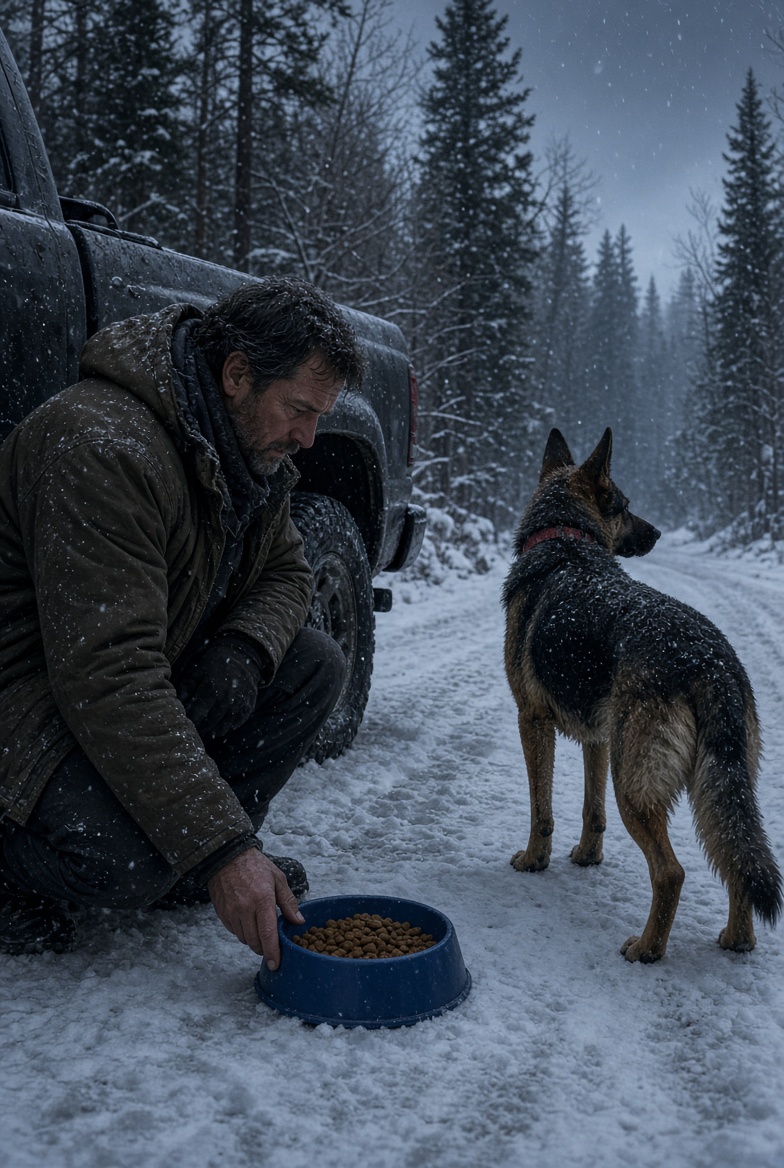
The dog studied the food, looked at Luke, and glanced toward the dark forest.
Finally, hunger overcame suspicion.
She approached and began eating.
At first, she swallowed quickly, taking large mouthfuls as if she had not eaten properly in days.
Then she stopped.
Her ears turned toward the trees.
She listened, looked over her shoulder, and took another mouthful.
After a few more bites, she lifted her head, seized a portion of food in her mouth, and walked away from the bowl.
Luke watched her carry it between the pines.
“Well, that’s different.”
She disappeared without looking back.
The blue bowl remained beside the road, still holding nearly half the meal.
Luke should have driven away.
Instead, he stood beside his truck, staring at the narrow opening between the trees.
He had seen frightened animals before.
He had also seen people make extraordinary sacrifices for someone who could offer nothing in return.
Whatever was happening in that forest, the dog had decided that someone else’s hunger mattered more than her own.
And Luke had a feeling he had not seen the last of her.
The following morning, he returned.
At 6:04 a.m., the German Shepherd emerged from the same section of pine forest.
Luke had brought twice as much food.
He placed the blue bowl on the snow and stepped back.
“Morning, girl.”
She ate.
She watched the trees.
Then she carried part of the meal away again.
The routine repeated on the third morning, and the fourth.
By the end of the week, Luke had stopped pretending his detour was accidental.
He bought larger bags of dog food, kept a thermos of warm water beside the passenger seat, and stored an extra blanket behind the driver’s seat.
Every morning, he stopped along the frozen road.
Every morning, the Shepherd appeared.
And every morning, she left some food behind.
Luke never followed her.
His years as a combat medic had taught him that urgency was not always the same as usefulness.
A frightened person could shut down when surrounded.
A frightened animal could disappear when chased.
Trust had to be earned before it could be used.
So he gave the Shepherd space.
He also began keeping notes.
6:04 a.m., appeared from northeast treeline.
6:11 a.m., returned to forest.
Next morning: 5:58 a.m.
Following morning: 6:07 a.m.
The times varied slightly, but the direction remained consistent.
She always arrived from the northeast and disappeared toward the same patch of woods.
Luke marked the locations on a folded road map.
He did not know why he was doing it.
He only knew that the pattern mattered.
On the eighth morning, the dog came closer than she ever had before.
She ate with one eye on Luke, then raised her head when he shifted his weight.
He froze.
“Easy. Take your time.”
The Shepherd lowered her muzzle.
Her red collar caught the faint morning light.
Luke noticed something about the buckle.
There was a cleaner patch of metal beneath the scratched surface, as if a tag had once hung there.
Someone had owned her.
Someone had put that collar around her neck, and someone had either lost her or allowed her to become this thin.
Luke found himself wondering which possibility was worse.
That afternoon, he met Margaret Ellis outside the small cedar-sided house across from his cabin.
At sixty-eight, Margaret was short and sturdy, with silver hair, an old green winter coat, and a shovel that seemed to accompany her everywhere.
She had volunteered at animal shelters for nearly two decades after losing her husband.
She possessed the unusual ability to recognize trouble before people finished explaining it.
Margaret watched Luke unload a large bag of dog food from his truck.
“You finally get yourself a dog?”
“No.”
She looked at the bag.
“Then either you’re feeding the neighborhood wildlife or you’ve started a very unusual hobby.”
Luke considered denying it.
Instead, he explained about the Shepherd.
Margaret’s expression softened when he mentioned the nursing.
“She’s feeding puppies,” she said.
“That’s what I thought.”
“How many?”
“I haven’t seen them.”
Margaret rested both hands on her shovel.
“Then you don’t know how far she’ll travel for them, either.”
Luke glanced toward the road.
“She doesn’t eat everything I leave.”
“Of course she doesn’t.”
“That’s not normal.”
“For a dog without puppies, perhaps not. For a nursing mother who’s trying to keep a litter alive, it makes perfect sense.”
Margaret studied him for a moment.
“Luke, she’s not coming back because she’s hungry alone. She’s coming back because she trusts you enough to take something away.”
He looked at her.
“That sounds like a very generous interpretation.”
“It sounds like you’ve never had to raise five hungry mouths with nothing but your own strength.”
Luke said nothing.
Margaret had not raised five puppies, either, but she had spent enough years watching abandoned animals to know that survival often looked strange from the outside.
She disappeared into her house and returned with three old fleece blankets.
“They’re clean. If you find the puppies, you’ll want these.”
“I haven’t found anything yet.”
“Then you’ll have them ready.”
Luke accepted the blankets.
It was difficult to argue with someone who had already prepared for a problem he was still trying to convince himself might not exist.
The next morning, the Shepherd appeared as usual.
Luke sat the blue bowl beside the truck.
She approached more quickly than before, ate, and paused to study him.
For the first time, she did not immediately turn toward the forest.
Instead, she stood several yards away and looked directly at him.
Luke slipped his hands into his coat pockets.
“I’ll be here tomorrow.”
The Shepherd’s ears moved.
For a moment, neither of them moved at all.
Then she turned and disappeared between the pines.
Luke picked up the empty food container, placed it in the truck, and drove home.
He expected to see her the next morning.
He had already bought enough food for another week.
He did not know that the promise he had made beside the road would soon become the only thing keeping him moving.
The storm arrived shortly after midnight.
By four in the morning, the wind had pushed fresh snow across the rural roads north of Duluth, covering tire tracks, fence lines, and the shallow ditch beside Luke’s usual stopping place.
Luke left his cabin shortly before six.
The temperature had dropped sharply, and the truck’s heater struggled to keep the windshield clear.
At 5:57 a.m., he slowed beside the familiar stretch of pines.
Nothing moved.
He parked anyway.
The blue bowl sat on the passenger floor beside a container of food.
Luke carried both to the usual spot, brushed loose snow away with one boot, and filled the bowl.
Then he waited.
Five minutes passed.
Ten.
The forest remained silent.
Luke told himself the Shepherd was sheltering with her puppies.
That was reasonable.
A storm could bury a trail, slow a hungry animal, or force a mother to remain beneath cover longer than usual.
At twenty minutes, he returned to the truck.
“Fine,” he said. “I’ll come back.”
He returned shortly after noon.
The food remained untouched.
Luke crouched beside the bowl, staring at the surface of the kibble.
For more than a week, the Shepherd had appeared with remarkable consistency.
Sometimes she arrived early.
Sometimes he waited several minutes.
But she always came.
Now the bowl sat exactly where he had left it, surrounded by snow.
Luke replaced the food and drove home.
Margaret was clearing the walkway between their properties when he arrived.
She noticed the bowl in his truck.
“She didn’t show?”
Luke shook his head.
“Not this morning.”
Margaret leaned on her shovel.
“After a storm, that doesn’t automatically mean trouble.”
“I know.”
“But you don’t believe it.”
Luke looked toward the northern road.
“No.”
Margaret went inside and returned with the blankets again, adding a folded dog coat to the pile.
“If you find her or the puppies, you’ll want something dry.”
Luke accepted them without argument.
The next morning, the Shepherd was still gone.
This time, Luke did not wait beside the truck for twenty minutes.
He moved toward the trees.
The storm had covered most of the older tracks, but beneath several low pine branches, the wind had deposited less snow.
Luke found faint paw prints.
They were partly filled with powder, old enough that he could not tell exactly when they had been made.
He followed them for several yards before noticing another impression.
A boot print.
Human.
Luke stopped.
The print proved very little.
Hunters, utility workers, property owners, or someone cutting through the woods could have left it.
But it was the first human track he had noticed along the Shepherd’s route.
Several yards farther on, something red caught his attention.
A narrow strip of nylon hung from a blackberry branch.
Luke carefully pulled it free.
He recognized the faded material immediately.
The color was almost pink, but the weave matched the Shepherd’s collar.
He placed it inside a clean plastic bag from his truck.
Then he called Dr. Emily Carter at Lakeshore Veterinary Clinic.
Emily was thirty-nine, medium height and slim, with dark auburn hair usually tied behind her head and calm green eyes.
Her years in emergency veterinary medicine had made her practical under pressure.
She did not dismiss worried owners, but neither did she encourage conclusions unsupported by evidence.
Luke explained the Shepherd’s condition, the missed mornings, and the strip of red nylon.
“She was definitely nursing?” Emily asked.
“There’s no doubt.”
“And she was eating?”
“Enough to stay upright. Not enough to regain the weight she’s lost.”
Emily paused.
“A nursing mother usually has a strong reason to return to dependent puppies. Weather can delay her, but being separated too long can create problems for both her and the litter.”
Luke looked deeper into the woods.
“What if I find the puppies first?”
“Call me. Don’t try to warm severely cold puppies too quickly, and don’t force food or water into their mouths.”
“Understood.”
“I’ll prepare a field kit and keep my phone on.”
By that afternoon, Emily had assembled blankets, warming packs, gloves, electrolyte solution, and basic veterinary supplies.
Luke placed the kit behind the driver’s seat.
He hoped he would not need it.
Then he learned about Scout.
Fourteen-year-old Owen Miller lived with his parents about five miles from the forest road.
Owen was thin, with sandy brown hair that fell across his forehead and the stubborn seriousness of someone who disliked accepting explanations that did not make sense.
His family’s five-year-old Siberian husky had disappeared three days earlier.
Scout was gray and white, with bright blue eyes, a thick winter coat, and the energetic confidence of a dog that treated every open doorway as an invitation to investigate something.
Owen’s parents believed Scout might have slipped out while they prepared for the storm.
Owen disagreed.
“The gate was closed,” he told Margaret when she mentioned the missing dog to Luke. “I checked it myself.”
“Could he have gotten through a gap?”
“No. I checked that, too.”
“Did you see anything unusual?”
Owen hesitated.
“A truck went past the house the night before Scout disappeared.”
Luke looked at him.
“What kind of truck?”
“Gray. It had a trailer behind it.”
“Did you see the driver?”
“No. It was dark.”
“Anything else?”
Owen frowned, searching his memory.
“The trailer had something on the back. A white shape inside a black circle. I thought it was a deer.”
Luke felt his attention sharpen.
“Did you tell the police?”
“My dad did. They said they couldn’t identify the vehicle.”
“That doesn’t mean the detail isn’t useful.”
Owen looked up.
“You think someone took Scout?”
“I think we don’t have enough information to know what happened.”
Luke crouched slightly so they were looking at the same level.
“But I think you were right to notice the gate.”
Owen’s shoulders eased.
It was a small change, but Luke recognized it.
Sometimes a person did not need someone to promise that everything would be fine.
They needed someone to admit that their concern deserved to be taken seriously.
That evening, Luke returned to the forest road.
Daylight was fading.
He walked farther along an old logging lane that branched behind the pines.
Snow covered most of it, but a pair of recent vehicle tracks crossed the road.
They appeared to belong to a pickup towing something heavy.
Farther along, an old wooden boundary post carried a fresh streak of white paint.
Nearby, Luke noticed several pieces of dry dog food scattered beside a flattened patch of snow where a vehicle might have stopped.
He crouched.
A dog collar.
Human tracks.
Vehicle marks.
Food beside an isolated road.
Each detail could have an innocent explanation.
Together, they began to tell a different story.
Luke continued until he reached the edge of a shallow clearing.
Something red lay partly buried beside the lane.
He brushed away the snow.
The Shepherd’s collar rested in his hand.
The scratched buckle.
The faded nylon.
The pale mark where a tag had once hung.
Luke examined the clasp carefully.
It had not snapped.
It had not torn.
The metal remained intact.
Someone had removed it.
He stood alone beneath the darkening pines, holding the collar while snow settled quietly around his boots.
For the first time, he allowed himself to consider the possibility that the Shepherd had not simply vanished.
Someone might have taken her.
And if that was true, the puppies could be in danger.
Luke placed the collar in the evidence bag beside the strip of nylon and called Emily again.
“I’m going back in the morning,” he told her.
“Then I’m coming with you.”
“You have a clinic to run.”
“I also have a veterinary field kit ready, a missing nursing dog, and a man who sounds like he’s about to walk into the woods without enough help.”
Luke almost smiled.
“I was a Navy SEAL.”
“That wasn’t a medical qualification.”
“No, ma’am.”
“Seven tomorrow morning. Bring the kit.”
When the call ended, Luke remained beside the truck for another minute.
He looked toward the dark forest.
Then he opened the passenger door and placed the old blue bowl on the seat.
He would bring it with him.
He did not yet understand why, but he had a feeling the bowl mattered more than the food it once held.
At seven the next morning, Dr. Emily Carter arrived in a dark green SUV.
She wore insulated boots, a navy winter jacket, and a knitted cap pulled over her auburn hair.
Luke showed her where he had found the collar.
Emily photographed the area and examined the ground without disturbing more snow than necessary.
“You were right not to keep walking last night,” she said.
“Today, I’m walking.”
“Today, we’re both walking.”
They followed the old logging route slowly.
Fresh snow had softened the edges of the vehicle tracks, but enough remained to show that something larger than a passenger car had recently traveled through the area.
Twenty minutes into the search, Luke found an overturned metal dog bowl beside a tree.
Farther ahead lay a short length of blue leash, partly buried beneath the snow.
Emily photographed both objects.
Neither proved anything by itself.
Still, neither belonged naturally in an unused winter logging lane.
They continued.
Nearly an hour after leaving the vehicles, Luke stopped.
“Wait.”
Emily froze.
At first, she heard nothing.
Then came a faint movement beneath a collapsed section of wooden fencing several yards down the slope.
A dead pine had fallen across the old fence, and snow had gathered around the broken rails, creating a shallow shelter beneath them.
Luke approached carefully.
Something small moved.
A German Shepherd puppy lay beneath the lowest rail.
It was around five weeks old, black and tan like the missing mother, but much smaller, with round dark eyes and ears that had not yet decided whether to stand.
Snow clung to its fur.
The puppy looked cold and exhausted.
When Luke crouched nearby, it tried weakly to push farther into the sheltered space.
Emily took over.
“Easy, little one. We’re not chasing you.”
She removed a fleece blanket from her pack and worked slowly until the puppy allowed itself to be lifted.
Luke watched her examine it.
“Dehydrated, a little cold, but responsive,” she said. “That’s encouraging.”
She checked the puppy carefully, keeping the process calm and brief.
Then her expression changed.
“What?”
Emily looked at Luke.
“This puppy has been nursing recently.”
Luke glanced toward the trees.
“How recently?”
“I’m not going to give you an exact hour. But not long enough for me to believe it has been completely separated from its mother for days.”
For the first time since finding the red collar, Luke felt something other than concern.
Hope.
“Sierra was here recently,” Emily said. “That’s the reasonable possibility.”
Luke stared at the puppy.
“Sierra?”
Emily glanced up.
“You need a name for him?”
“I suppose I do.”
“Finn.”
Luke raised an eyebrow.
“Why Finn?”
“Because he looks like a Finn.”
Luke looked down at the small animal.
Finn opened his eyes and gave a weak, uncertain sound.
“All right,” Luke said. “Finn it is.”
Emily wrapped the puppy securely and carried him toward her SUV, where the heater was running.
She called the clinic and arranged for a technician to prepare a warm recovery space.
Luke watched her place Finn inside a padded carrier.
“We need to find the others.”
Emily followed his gaze toward the fallen fence.
“Then let’s see what else is here.”
They searched the surrounding area.
Luke found several smaller tracks, difficult to distinguish beneath the fresh snow.
There were too many to belong to Finn alone.
Four, possibly five.
Some overlapped, while others disappeared beneath the trees.
“There were more puppies,” Luke said.
Emily studied the impressions.
“And something larger moving with them.”
The tracks continued deeper into the property.
Luke followed only far enough to identify their direction.
Along the way, he found a torn dog food bag caught beneath low brush and another section of old leash near a weathered post.
Then the trees opened.
An abandoned property stood ahead.
A low wooden building occupied the center of the clearing.
Behind it stood a larger barn-like structure with gray siding, a sagging roof edge, and two broad doors facing the forest road.
Fresh vehicle tracks crossed the snow in front of it.
Luke stopped well away from the buildings.
He saw paw prints, too.
Some were small.
Others belonged to larger dogs.
He did not continue.
Instead, he recorded the location and contacted the St. Louis County Sheriff’s Office.
Deputy Aaron Blake arrived later that morning.
Aaron was thirty-seven, medium height, strongly built, with close-cut black hair and a calm, deliberate manner.
He had spent eleven years with the county and was known for treating unusual calls exactly like ordinary ones.
Establish what was known.
Separate it from what was assumed.
Then work forward.
Luke showed him the tracks, the food bag, the leash, and the location where Finn had been found.
Aaron checked county property records from his vehicle.
The parcel had once been registered as a small breeding kennel.
The license had expired more than a year earlier.
“That doesn’t tell us what’s happening here now,” Aaron said.
Luke nodded.
“But it tells us what this place used to be.”
Aaron began making calls.
Emily departed for the clinic with Finn, leaving Luke to explain the search route in greater detail.
Before she drove away, she lowered her window.
“Don’t do anything reckless while I’m gone.”
Luke looked at the abandoned buildings.
“I’ll try to disappoint you.”
“Please do.”
That afternoon, Luke returned to the clearing with Aaron.
They remained outside the buildings while the deputy continued documenting the location and determining what steps were required for a lawful inspection.
Luke moved several paces along the outer wall.
One wooden board had warped away from the siding.
Through the narrow opening, he could see part of the dark interior.
He leaned slightly closer.
Rows of metal shapes stood against the wall.
For several seconds, he could not make sense of what he was seeing.
Then he recognized them.
Dog cages.
His jaw tightened.
The building did not look abandoned.
It looked unused only by someone who did not know what to look for.
Aaron approached.
“What do you see?”
“Cages.”
The deputy looked through the opening without touching the wall.
His expression became serious.
“Step back.”
Luke did.
Aaron documented the observation and continued coordinating with the sheriff’s office.
Luke knew enough not to enter merely because he wanted answers.
A good intention did not make an unlawful entry useful.
But as he stood beside the weathered building, he noticed something else.
Near the bottom of the warped board, a small piece of red nylon had caught on a splinter.
It was not the collar.
It was only a thread.
Yet Luke could not stop thinking about it.
He had promised a hungry dog that he would return.
Now he was standing outside a building full of cages, with her puppies scattered somewhere beyond the trees.
He did not know who had put them there.
He did not know whether Sierra was alive.
But he knew one thing.
He was not going to stop looking.
By the following morning, the abandoned kennel no longer looked like an isolated building Luke had happened to find.
Aaron had spent much of the night confirming property records, speaking with county officials, and documenting what Luke and Emily had observed from outside.
Once the necessary procedures were completed, the sheriff’s office returned with additional deputies and arranged for the buildings to be inspected.
Luke waited near the clearing while they entered.
Emily arrived shortly afterward, having left Finn safely at Lakeshore Veterinary Clinic under the supervision of her staff.
When Aaron finally waved them forward, Luke stepped through the doorway.
The metal cages were exactly where he had seen them.
Most were empty.
Some were small enough for puppies.
Others could comfortably hold adult dogs.
Folded blankets lay inside several of them, and water bowls stood on the floor.
Unopened food containers lined one wall.
A half-filled bag of kibble sat beside a plastic scoop.
Nothing about the building felt abandoned.
That bothered Luke more than anything.
A thin layer of ice had formed around the edges of one water bowl, but the center remained liquid.
Emily touched the outside of another container.
“This place was used recently.”
Aaron photographed everything before anyone moved farther into the room.
Luke walked slowly between the cages.
Near the rear wall, a faded brown towel had been pushed beneath a wooden table.
Dark fur clung to one edge.
Luke crouched without touching it.
Black and tan.
The same colors as Sierra.
Emily examined the towel carefully.
“It could belong to any German Shepherd or a similar dog.”
Luke nodded.
He understood.
Could was not the same as did.
Still, it was another reason not to leave.
In the far corner, they found a shallow area lined with straw and old blankets.
The surface contained several small depressions close together.
Emily studied them.
“Puppies were resting here.”
Luke looked at her.
“Finn?”
“Possibly. But there was more than one.”
That matched the small tracks he had found near the collapsed fence.
Sierra had not been traveling into the forest simply because she preferred it there.
There was now a reasonable possibility that this place had been connected to her puppies.
But Sierra was gone.
Behind the building, Aaron found fresh trailer tracks cutting across the snow.
Unlike the tire marks entering from the logging road, these continued along a second access route on the opposite side of the property.
Aaron pulled up a county map.
“That road joins a maintained route farther north.”
Luke followed the line with one finger.
“And after that?”
“Eventually, Highway 53.”
The search had changed again.
Back in Duluth, Margaret Ellis had spent the morning doing what she understood best.
Calling people.
She contacted animal shelters, rescue groups, veterinary offices, and community volunteers throughout the surrounding area, asking whether they had received recent reports of missing dogs.
Margaret kept everything organized in a yellow notebook.
Dog.
Owner.
Date missing.
Location.
Microchip, if known.
By noon, the list was longer than Luke expected.
Aaron compared it with official reports.
Some cases were easily explained.
One dog had already returned home.
Another had a history of escaping through an unsecured gate.
Three others were harder to dismiss.
Two were healthy adult dogs.
The third was an eight-month-old golden retriever named Daisy, a pale gold female known for carrying shoes around the house whenever visitors arrived.
All three had disappeared from properties near roads that eventually connected to the same northern corridor.
Owen Miller contributed something different.
He had watched the Pine Ridge Market camera recording several times.
The gray pickup was difficult to distinguish from dozens of others in northern Minnesota.
But Owen noticed a small detail near the rear corner of the enclosed trailer.
A sticker.
A white deer head inside a dark oval.
Aaron asked another business along the route to check its security footage.
That led them to Ray Holloway, the sixty-three-year-old gas station manager with a heavy gray mustache, broad shoulders, and a quiet habit of remembering unusual vehicles.
Ray had managed the station for nearly twenty years.
He rarely made a claim unless he felt certain about it.
His camera had recorded a similar enclosed trailer.
The image was clearer.
The same general size.
The same deer head sticker.
The trailer had been traveling north.
While Aaron worked on the vehicle timeline, Emily examined several old documents found inside the kennel.
Most were incomplete.
One torn veterinary form contained part of a microchip number and the words “female German Shepherd.”
Emily contacted the registry.
The partial number required several calls and comparisons before a possible match emerged.
The dog had once been registered in Wisconsin.
Her former owner was Daniel Harper, a fifty-eight-year-old retired high school maintenance supervisor with thinning brown-gray hair, a stocky build, and a careful way of speaking.
Daniel remembered the dog immediately.
“Sierra.”
Luke became still.
Daniel explained that Sierra had been a young adult when he owned her.
She was intelligent, observant, calm around children, and especially attached to Daniel’s wife before she died after a long illness.
After his wife’s death, Daniel’s circumstances changed.
He moved into housing where he could not keep a large dog and reluctantly placed Sierra with someone who claimed she would live on a small breeding property in Minnesota.
That had been almost two years earlier.
Luke looked at the red collar resting in its evidence bag.
For more than a week, he had called her nothing.
Now she had a name.
Sierra.
“Do you know who took her?” Luke asked.
Daniel hesitated.
“I dealt with a man who said he ran a small breeding operation. I met him through someone who knew the local dog community. He seemed legitimate.”
“Do you remember his name?”
“Martin Vale.”
Emily looked up from the documents.
“Did you ever receive updates about Sierra?”
“At first. A photograph every few months. Then the messages stopped.”
Daniel rubbed his hands together.
“I told myself she was probably fine. I had no way to check on her without traveling all the way up there.”
Luke heard the guilt in his voice.
He had heard it in countless forms during his years as a medic.
People could spend years punishing themselves for a decision made when they had no good choices.
“Mr. Harper,” Luke said quietly, “you made a decision based on what you believed at the time. We’re going to find out what happened after that.”
Daniel looked at him.
“You really think she’s still alive?”
Luke did not promise something he could not know.
“I think there’s enough evidence to keep looking.”
That evening, the investigation received its clearest directional lead.
A county traffic camera had captured a gray pickup towing an enclosed trailer matching the same general description.
The deer head sticker was visible.
Additional footage narrowed the route toward a rural property more than forty miles away.
Luke studied the location Aaron placed on the map.
A farm surrounded by snow-covered fields.
A gray farmhouse.
Several weathered outbuildings.
Far north of the forest where Sierra had first found him.
The search was no longer centered on the abandoned kennel.
It had moved forty miles away.
And for the first time, Luke knew exactly what name he hoped to call when they got there.
Sierra.
The farm sat beyond a long stretch of snow-covered road.
By the time the St. Louis County deputies reached the property, morning light had begun spreading across the fields.
An old gray farmhouse stood near the road while several weathered outbuildings stretched behind it toward a line of bare trees.
The gray pickup was there.
So was the enclosed trailer.
Luke recognized the small deer head sticker immediately.
He remained beside Emily while Aaron and the other officers secured the property and confirmed that it was safe to begin checking the buildings.
Luke had spent years learning how to wait.
That morning, waiting felt harder than anything else.
When Aaron finally returned, his expression remained controlled.
“There are dogs in the rear building.”
Luke looked past him.
“Sierra?”
“Not yet.”
Those two words landed harder than Luke expected.
He followed Aaron toward the barn.
Temporary pens had been arranged along one side, with transport cages farther inside.
Several adult dogs rested beneath blankets.
Others stood watching the unfamiliar people with cautious eyes.
There was no chaos.
The dogs were frightened and uncertain, but the deputies and animal care workers moved slowly, reducing noise and avoiding unnecessary handling.
Emily immediately began helping organize the animals for transport.
Luke walked the length of the barn.
A black Labrador.
A mixed-breed hound.
A small terrier.
A young golden retriever.
He stopped at the golden retriever’s pen.
“Daisy?”
A worker checked the identification details.
The microchip confirmed the match.
Daisy was alive.
Luke continued searching.
He checked the rear of the barn, then the side rooms.
Nothing.
For a moment, the same doubt that had followed him since the empty blue bowl returned.
Then a deputy near the far wall raised one hand.
“Luke.”
The voice came from a doorway partially hidden behind stacked feed containers.
Luke crossed the barn.
The room beyond was smaller and warmer than the main building.
Straw covered part of the floor.
A German Shepherd stood in front of it.
Luke stopped.
Sierra looked thinner than she had beside the roadside.
Her black and tan coat had lost some of its shine, and the old red collar was gone.
Her ears were forward.
Her body was tense.
Her eyes moved between Luke and the deputies behind him.
But she was standing.
Behind her, four small German Shepherd puppies were pressed together in the straw.
All alive.
Luke took one slow step.
Sierra lowered her head, not aggressively but protectively.
She shifted her body until she stood completely between Luke and the puppies.
It was the same dog he remembered.
Hungry.
Tired.
Uncertain.
Still placing herself in front of something smaller than herself.
Luke stopped moving.
“She doesn’t know it’s me yet,” he said.
Emily appeared behind him but remained near the doorway.
“Give her time.”
Luke slowly lowered himself to the floor.
He had brought something from the truck.
The blue plastic bowl.
The same inexpensive bowl he had placed beside the snowy road morning after morning.
Luke set it on the floor.
Sierra’s eyes moved toward it, then returned to him.
He did not reach for her.
He used the same calm voice he had used during their first meeting.
“Easy, girl. You don’t have to come any closer.”
One of Sierra’s ears shifted.
Luke waited.
The puppies stirred behind her.
Sierra glanced back at them, then looked at Luke again.
“That’s right,” he murmured. “Take your time.”
She took one step.
Stopped.
Then another.
Luke remained motionless.
Sierra came close enough to smell his hands.
For several seconds, nothing happened.
Then the tension in her shoulders began to ease.
She leaned forward and placed her head between Luke’s hands.
Luke closed his eyes briefly.
“There you are.”
Emily turned away for a moment, giving them the little privacy the room allowed.
Luke stroked the Shepherd’s head carefully.
He could feel how thin she had become.
He could also feel the quiet determination in the way she remained close to her puppies.
“You did enough,” he whispered. “You don’t have to carry everything anymore.”
Sierra rested her head against his knee.
For the first time since Luke had found her beside the frozen road, she did not look toward the nearest exit.
She stayed.
And Luke understood that finding her was only the beginning of bringing her home.
The rescue operation continued through the morning.
Veterinary personnel checked each animal, documented identifying information, and arranged transport to appropriate facilities.
Several dogs had microchips.
Others had no identification, requiring additional work to determine where they belonged.
Daisy was among the first confirmed matches.
Scout was another.
The gray and white Siberian husky had been found among the other dogs, his bright blue eyes unmistakable.
A microchip scan confirmed his identity within minutes.
Owen Miller’s family received the call before the dogs had even finished arriving at Lakeshore Veterinary Clinic.
By late afternoon, the clinic had become a quiet center of examinations, reunions, and paperwork.
Sierra and her four puppies were given their own recovery space.
Finn was brought in shortly afterward.
The five-week-old puppy had grown stronger since Luke and Emily found him beneath the collapsed fence.
His appetite had improved, and he had begun attempting to climb out of his bedding whenever he heard someone approaching.
But the moment he entered Sierra’s room, he began searching.
Sierra lifted her head.
Finn moved toward her.
She immediately leaned down, gently cleaned his face, and pulled him toward the other puppies.
Emily watched closely.
“That answers one question.”
Luke looked at the six dogs together.
“They’re all hers?”
“All five puppies appear to be hers, yes. We’ll continue monitoring them, but the reunion is a very encouraging sign.”
Luke crouched beside the enclosure.
Finn pressed against Sierra’s front legs.
The mother dog settled around the puppies, positioning herself so that all five could reach her.
Luke watched for a long time.
The blue bowl sat beside his chair.
It was empty now.
He thought about all those mornings when Sierra had carried food away from it.
He had initially assumed she was simply taking what she could find.
He had not understood how carefully she had been rationing every mouthful.
He had not understood that each visit was a journey between two worlds.
One world offered a little food.
The other held everything she was trying to protect.
Emily sat beside him.
“She’s exhausted,” she said. “But she’s responding well to rest, food, and water.”
Luke nodded.
“Can she stay here?”
“Of course. We’ll keep her and the puppies together.”
He looked through the glass.
“Good.”
Across the clinic, the other recovered dogs were being examined and scanned.
Several matches were found quickly.
Owners were contacted.
Some animals would return home once medically cleared.
Others would temporarily enter shelter care while staff continued searching for their families.
Scout’s reunion happened that evening.
Owen entered the clinic with his parents but was asked to wait until the veterinary staff finished confirming everything.
He stood near the doorway, hands buried in the pockets of his winter coat.
Scout was still in the treatment area when Owen called softly.
“Scout?”
The husky’s head rose.
His ears turned toward the voice.
Owen called again.
“Scout, buddy. It’s me.”
The dog moved toward the doorway.
The moment Owen appeared, Scout pulled forward, his tail sweeping rapidly behind him.
Owen dropped to his knees.
Scout pressed against him.
For several seconds, the boy said nothing at all.
He simply held on to the dog he had insisted had not run away.
His mother knelt beside them, one hand covering her mouth.
His father placed a hand on Owen’s shoulder.
“We’ve got him,” his father whispered.
Owen buried his face in Scout’s thick fur.
“I told you he didn’t just leave.”
His father swallowed.
“Yes, you did.”
Luke watched from the hallway.
He did not interrupt.
Some reunions belonged entirely to the people and animals involved.
Later that night, the clinic grew quieter.
Luke remained outside Sierra’s enclosure.
The puppies had finally fallen asleep around her.
Finn lay against her front legs.
Sierra rested her head beside him, her eyes half closed.
A veterinary technician approached Luke.
Megan Price was twenty-six, short and energetic, with curly brown hair tied behind her head and the patient manner of someone who had learned that exhausted animals responded better to calm voices than hurried hands.
“You can go home,” she told him gently. “We’ll call if anything changes.”
Luke looked through the glass.
Sierra was asleep.
All five puppies were close around her.
“I’m staying.”
Megan glanced at the chair beside the enclosure.
“You’re sure?”
Luke kept his eyes on Sierra.
“I let her wait once.”
He pulled the chair closer.
“I’m not doing that again.”
Megan studied him for a moment, then brought him a fresh cup of coffee.
She did not argue.
For the next several weeks, Lakeshore Veterinary Clinic became the safest place Sierra had known in a long time.
Six bowls sat outside the recovery room each morning.
One for Sierra.
Five smaller ones for her puppies.
At first, Sierra still lifted her head whenever footsteps entered the hallway.
She ate carefully, slept lightly, and checked each puppy before settling down again.
But gradually, the tension left her.
Her ribs became less visible.
The dull black and tan coat began to regain its shine.
And every afternoon, shortly before Luke Grayson usually arrived, Sierra started watching the parking lot through the clinic window.
She learned the sound of his pickup before anyone realized she had.
One afternoon, Emily Carter was updating medical charts when Sierra suddenly stood.
Nothing had happened inside the clinic.
Thirty seconds later, Luke’s old truck entered the parking lot.
Emily smiled.
“You have a schedule now.”
Luke looked through the recovery room glass.
“I don’t think it’s mine.”
Sierra was already waiting beside the door.
When Luke entered, she walked directly to him and leaned against his leg.
He scratched behind her ears.
“Morning, girl.”
Emily folded her arms.
“It’s three in the afternoon.”
Luke looked at the clock.
“Then we’re both running late.”
For the first time in a long while, his smile reached his eyes.
The puppies changed quickly.
Finn, the smallest one Luke and Emily had found beneath the collapsed fence, developed into an energetic black and tan puppy with one ear beginning to stand before the other.
He followed Emily through the clinic whenever allowed and had developed the habit of falling asleep beneath her desk.
Emily eventually stopped pretending that arrangement was temporary.
“I think he already decided,” she told Luke.
“Decided what?”
“Who his person is.”
Luke looked beneath the desk.
Finn was asleep with his chin resting on one of Emily’s shoes.
“Congratulations,” Luke said. “You’ve been adopted.”
Emily laughed.
“Apparently.”
When Finn reached the appropriate age, Emily completed the adoption paperwork herself.
Two of Sierra’s other puppies were placed with families who had previous experience raising German Shepherds.
The placements were careful rather than fast.
Home checks were completed.
Veterinary references were reviewed.
The families met the puppies more than once before taking them home.
Margaret Ellis approved of that process.
She had begun volunteering at a local rescue again, something she had not done regularly in several years.
Losing her husband had once made shelter work difficult because every departure felt like another goodbye.
Helping with Sierra’s family reminded her that leaving could also mean going home.
One of the puppies showed a different kind of potential.
At ten weeks old, the young male displayed unusual interest in following scent trails and recovering hidden objects.
Nathan Cole, a forty-five-year-old volunteer search-and-rescue trainer, was tall and lean, with sandy hair, a weathered face, and the patient personality of someone who never expected a young dog to understand something on the first attempt.
After observing the puppy several times, Nathan believed he might eventually be suitable for wilderness search work.
Nothing was guaranteed.
For now, he was simply a healthy puppy learning about the world.
That was enough.
Scout had already returned home with Owen Miller.
On the first night back, the husky ignored the dog bed his family had carefully placed beside Owen’s dresser.
Instead, he stretched across the floor directly beside the boy’s bed.
Owen woke twice during the night just to make sure Scout was still there.
Both times, the husky lifted his head, saw him, and went back to sleep.
The next morning, Owen told Luke about it while Margaret helped him put up new missing-dog flyers that were no longer needed for Scout but might help another family.
“I kept thinking I’d hear his collar outside,” Owen said. “Every time a car went past, I thought it might be him.”
Luke nodded.
“That feeling takes a while to go away.”
“Did you ever feel like that?”
Luke looked toward the road.
“More times than I can count.”
Owen seemed to consider the answer.
Then he asked the question he had probably been holding for days.
“Do you think Sierra was trying to tell you something?”
Luke thought about the blue bowl.
“I think she was doing the only thing she knew how to do.”
“Taking food to her puppies?”
“Yes.”
Owen looked down at Scout.
“Then you helped her without knowing what she needed.”
“That’s one way to look at it.”
The boy nodded slowly.
It was an answer he seemed able to carry.
Deputy Aaron Blake continued working through the administrative side of the case.
Investigators reviewed the recovered dogs’ records, the kennel’s former registration, the vehicle footage, and the information supplied by previous owners.
They worked to determine who had transferred animals, where the dogs had been kept, and which records could be independently verified.
The findings raised serious questions about the operation at the abandoned kennel and the farm.
Authorities continued reviewing the evidence and pursuing the appropriate legal steps.
Aaron never described it as a dramatic change.
He simply considered the work unfinished.
The immediate rescue had ended.
Preventing another situation mattered, too.
Several weeks after the dogs were recovered, Luke received a call from Aaron.
“We’ve confirmed additional owners,” the deputy said. “The information you and Margaret gathered helped connect several reports that originally appeared unrelated.”
“How many?”
“Seventeen reports are now part of the wider review. Not all of them involve confirmed removals from the same operation, but the connections are significant enough that we’re checking each one.”
Luke leaned back in his kitchen chair.
Seventeen.
He thought of seventeen people checking empty yards, calling shelters, and walking along roads in the cold.
Seventeen families who might have spent weeks believing their animals had simply disappeared.
“Any more dogs found?”
“Two additional animals were located through follow-up work. Both are receiving care.”
Luke closed his eyes briefly.
“Good.”
Aaron paused.
“There’s something else. We found references to the previous owner of Sierra’s collar and an earlier microchip registration. It helped establish part of her history.”
“Daniel Harper?”
“Yes. His records were useful.”
Luke looked toward the drawer where he had placed the red collar.
“He’s been worried about her.”
“We’ll make sure he receives an update.”
When the call ended, Luke remained at the table.
For most of his adult life, he had believed that doing a job properly meant understanding the mission before acting.
Assess the situation.
Identify the objective.
Determine the risks.
Then move.
Sierra had taught him something different.
Sometimes the mission began before the objective was clear.
Sometimes it started with an animal standing beside a snowbank, too thin to survive the winter alone.
And sometimes the right decision was simply to return the next morning.
Through all of it, Sierra remained at the clinic.
There were inquiries about her.
None became an adoption.
Some families wanted younger dogs.
Others worried about taking an adult German Shepherd with an uncertain recent history.
Luke visited every day.
Sometimes he stayed twenty minutes.
Sometimes two hours.
He took Sierra on short walks once Emily approved them.
He sat beside her while the puppies played.
And when individual puppies began leaving with their new families, he watched Sierra adjust to each absence.
She searched briefly, then settled again.
Finn remained close because Emily brought him back frequently.
One evening, Margaret saw Luke returning from the clinic.
She was standing beside her mailbox, wearing the same green coat she had worn the morning she handed him the blankets.
“How long are you going to pretend she isn’t your dog?”
Luke stopped.
“She’s not my dog.”
Margaret looked toward the truck.
A black and tan strand of dog fur was stuck to the passenger seat.
Luke followed her eyes.
Margaret raised an eyebrow.
“Of course she isn’t.”
He shook his head.
“You’ve been waiting to say that for weeks.”
“Longer than that.”
Luke laughed quietly.
Margaret’s expression softened.
“You know, you don’t have to keep every good thing at a distance just because you’re afraid you won’t have enough time for it.”
He looked at her.
“I never said I was afraid.”
“No. You just keep explaining why you can’t have a dog.”
She adjusted her coat.
“Those aren’t always the same thing.”
Luke had no immediate answer.
Margaret returned to her house.
He remained beside his truck, thinking about the conversation long after she had gone inside.
Three days later, Luke signed Sierra’s adoption papers.
He did not make an announcement.
He simply arrived at the clinic with a leash, a new identification tag, and the old blue bowl sitting on the passenger floor.
Emily handed him the paperwork.
“You understand adult German Shepherds need structure, exercise, and consistency.”
Luke looked at her.
“I was a Navy SEAL.”
Emily nodded.
“That wasn’t my question.”
He almost smiled.
“I understand.”
She handed him a final sheet.
“And you’ll need to bring her back for follow-up appointments.”
“Understood.”
“And no letting her roam the property alone until we’ve completed her adjustment plan.”
“Understood.”
Emily studied him.
“Do you understand that I’m going to keep giving you instructions?”
“Starting to.”
She laughed.
Then she opened the enclosure.
Sierra walked out, paused at the doorway, and looked toward Luke.
He held out his hand.
“Ready, girl?”
She crossed the room.
When they reached the truck, she paused beside the passenger door.
Luke opened it.
Sierra climbed inside without hesitation.
The old blue bowl rested on the seat.
She sniffed it, looked at Luke, and settled beside it.
Luke stood outside the open door for a moment.
He had bought that bowl for less than the cost of a decent lunch.
He had never expected it to become the most important object in his truck.
Now he understood why he had carried it everywhere.
It was a reminder of the first promise he had made to Sierra.
He had returned.
And he would keep returning.
Luke’s cabin changed slowly.
The old blue bowl was washed and placed near the kitchen wall beside two newer bowls, one for food and one for water.
Sierra chose the floor beside Luke’s bedroom door rather than the expensive dog bed he had purchased.
Within a week, she had claimed a spot near the living room window where she could see the driveway.
Luke began waking to the soft sound of her moving around the kitchen.
At first, the unfamiliar routine disrupted his sleep.
Then he found himself listening for it.
The house no longer seemed quite so large.
He started taking longer walks.
He bought a second leash, better food, and a thick winter coat that Sierra regarded with considerable suspicion.
He learned that she disliked the sound of the coffee grinder but tolerated the vacuum cleaner.
He learned that she preferred lying near a window to sleeping in a closed room.
He learned that she checked every door before settling down for the night.
He did not try to change everything at once.
Emily had explained that Sierra needed time, predictable routines, and the freedom to choose when to approach.
Luke understood the value of giving someone control over the things they could reasonably control.
So he let Sierra choose where to sleep.
He let her decide when she wanted attention.
And every morning, he placed food in the blue bowl.
At first, Sierra ate half and walked away.
Luke worried that she was still trying to carry food to the forest.
Emily reassured him that her appetite would likely change as she recovered and adjusted.
“She’s learning that food will be there tomorrow,” Emily said during a follow-up appointment. “That can take time.”
Luke nodded.
He knew something about learning to trust tomorrow.
Spring eventually reached northern Minnesota.
Snow withdrew from the edges of the forest.
The trails softened.
Sierra regained her strength, and the pale scar along her left ear became easier to see beneath her healthy coat.
Luke began introducing basic tracking exercises during their walks.
Not because Sierra needed to prove anything.
He simply noticed how quickly her focus changed when given a scent to follow.
She moved carefully, nose low, ears attentive, following trails with an intensity that reminded him of the animal he had first seen beside the road.
Nathan occasionally helped them with beginner wilderness search exercises.
Sierra seemed to enjoy having a purpose.
Luke enjoyed watching her discover one.
Nothing happened overnight.
Some days, Sierra lost interest after a few minutes.
Other days, she followed a scent across the training area and found a hidden cloth without needing a second attempt.
Nathan never pushed her beyond what she could comfortably handle.
“She’s not a machine,” he reminded Luke. “She’s a dog. Let her enjoy it.”
Luke smiled.
“I’ve heard that before.”
“Then maybe you’ll finally listen.”
By May, Sierra could move confidently through the forest without constantly looking over her shoulder.
Luke still watched her closely.
He could not help it.
He had seen how quickly a quiet morning could change.
But gradually, his vigilance became less about expecting danger and more about appreciating what stood beside him.
One warm morning, Luke opened the cabin door.
Sierra ran into the yard.
A vehicle pulled in near the fence.
Emily stepped out.
Finn jumped down beside her, larger now, but still immediately recognizable by the uneven ears he had never entirely grown out of.
Sierra saw him.
She crossed the yard quickly.
Finn met her halfway.
The two dogs circled each other, sniffed, and began moving through the grass together.
Luke remained near the porch.
After greeting Finn, Sierra stopped.
She looked toward Emily, then toward Luke.
For months, survival had meant choosing where to go next.
Food or forest.
Safety or distance.
Her own hunger or the puppies waiting for her.
Not anymore.
Sierra returned to Luke and sat beside him while Finn waited only a few yards away.
The puppies had families.
Sierra had one, too.
And for the first time since Luke found her beside that frozen road, she did not have to leave one home in order to protect another.
Both were already there.
Emily watched the dogs from the yard.
“She looks different,” she said.
Luke looked down at Sierra.
“She is different.”
“More relaxed.”
“She doesn’t have to keep checking whether everyone else has enough food.”
Emily nodded.
“Neither do you.”
Luke glanced at her.
“What makes you say that?”
She smiled.
“You’ve spent years acting as though you have to earn the right to keep anything good in your life.”
He looked toward the forest.
Emily did not press him.
Some truths were easier to accept when no one demanded an immediate answer.
Later that afternoon, Luke drove to the same stretch of road where he had first met Sierra.
He parked beside the snowbank, now reduced to a narrow strip of damp earth.
The pine trees stood green beneath the spring sunlight.
Sierra sat in the passenger seat, watching him.
Luke took the old blue bowl from the floor.
He had considered leaving it beside the road as a kind of marker.
But the idea no longer felt right.
The bowl did not belong there.
It belonged to the story of how Sierra had found him, and how he had learned to recognize what she was trying to tell him.
He placed it back in the truck.
Then he opened the passenger door.
“Come on, girl.”
Sierra stepped down and stood beside him.
They walked a short distance along the edge of the forest.
Luke found the place where the first bowl had sat.
He could still picture the Shepherd approaching cautiously, stopping every few bites to look toward the trees.
He could still see her carrying food away.
For days, he had wondered why she never finished her meal.
Now he knew.
She had been trying to keep five small lives alive.
She had been hungry enough to tremble, yet she had carried food through the snow rather than eat it herself.
And when she vanished, Luke had followed the signs she left behind until he found her.
He crouched beside Sierra.
“You know,” he said quietly, “I thought I was the one helping you.”
Sierra tilted her head.
Luke scratched behind her ears.
“Turns out we both needed the same thing.”
She leaned against him.
He remained there for several minutes, listening to the wind move through the pines.
Then he stood.
“Come on. Let’s go home.”
Sierra walked beside him.
She did not look back toward the forest.
That evening, Luke prepared dinner while Sierra rested near the kitchen window.
The blue bowl sat on the floor.
He filled it with food and stepped back.
Sierra approached, sniffed the bowl, and began eating.
Luke watched from the counter.
She finished the meal.
Then she drank some water, turned around, and settled on the rug beside his feet.
No food carried into the woods.
No anxious glance toward the trees.
No urgent journey into the dark.
Luke lowered himself into the chair beside her.
Outside, the last light faded over the pines.
Inside, the cabin felt warm and lived in.
Sierra closed her eyes.
Luke rested one hand against her back.
He had spent years learning how to respond when someone needed help.
He had learned how to remain calm when circumstances changed, how to work through uncertainty, and how to keep moving when the outcome was beyond his control.
But Sierra had taught him something no training manual had ever explained.
Sometimes helping someone did not mean solving every problem immediately.
Sometimes it meant showing up at the same place, at the same time, day after day, until trust became stronger than fear.
And sometimes the person who needed saving was not the one anyone expected.
Luke had thought he was feeding a hungry dog.
He had not realized that he was building a connection with a mother who would eventually lead him to missing animals, frightened families, and an entire rescue effort he never could have planned.
He had not realized that the empty blue bowl would become the beginning of a new life.
Most of all, he had not realized how much he had been waiting for someone to give him a reason to return home.
Sierra had not asked for much.
A little food.
A little patience.
A reason to believe that the next morning might be different.
Luke had given her those things.
In return, she had given him something he had not known how to ask for.
A home that no longer felt empty.
A purpose that did not end when the day’s work was finished.
And a quiet reminder that even after years of carrying the weight of other people’s troubles, it was still possible to welcome something good into his life.
Weeks later, Margaret stopped by with a small bag of treats.
She found Luke sitting on the porch while Sierra rested beside his chair.
“So,” Margaret said, “how’s the dog you don’t have?”
Luke glanced down at Sierra.
“She’s doing all right.”
“Just all right?”
“She’s healthy. She’s eating. She’s sleeping better.”
Margaret nodded thoughtfully.
“Sounds serious.”
Luke laughed.
Sierra lifted her head at the sound, then rested it on his boot again.
Margaret sat on the other chair.
For a while, neither of them spoke.
The forest stretched beyond the yard, green and quiet beneath the afternoon sun.
Finally, Margaret looked at Luke.
“You know what I think?”
“That I should have adopted her sooner?”
“Well, yes. But that’s not what I was going to say.”
Luke waited.
“I think Sierra came to you because you were the kind of person who would keep showing up.”
Luke looked down at the dog.
“She didn’t know anything about me.”
“Maybe not. But she knew what you did.”
Margaret gestured toward the yard.
“You stopped. You brought food. You came back the next morning. Then you came back again.”
Luke considered that.
“She did the same thing.”
Margaret smiled.
“Exactly.”
After she left, Luke remained on the porch with Sierra beside him.
He thought about the first morning.
The frozen road.
The pine trees.
The faded red collar.
The hungry dog who had looked at him as though she was deciding whether he was worth trusting.
He remembered promising to return.
At the time, it had seemed like an ordinary thing to say.
Now it felt like the most important promise he had made in years.
That night, before going to bed, Luke checked the front door and turned off the kitchen light.
Sierra rose from her spot near the window and followed him down the hall.
She settled beside his bedroom door.
Luke paused.
“You can sleep inside, you know.”
Sierra looked at him.
He left the door open.
She remained where she was, but her body relaxed against the floor.
Luke smiled faintly.
“Your choice.”
He went to bed.
For the first time in years, the silence inside his cabin did not feel like something he had to endure.
It felt peaceful.
Outside, the pine trees moved gently in the night wind.
Somewhere beyond the road, other animals were finding their way home.
And beside Luke’s bedroom door, a German Shepherd mother slept without having to keep watch over five hungry puppies.
She had done enough.
Tomorrow, someone else would take care of her.
And Luke would be there when she woke.
You know what stays with me most about Sierra’s story?
It wasn’t the blue bowl or the Minnesota snow.
It was realizing that she kept returning because five puppies were waiting for her in the forest.
Tired and hungry, she still carried food back to them.
She was never asking for help only for herself.
Luke could have driven past.
Instead, he stopped, came back, and kept searching when Sierra disappeared.
Because he did, Sierra and her puppies were saved.
Scout returned to Owen, and Luke discovered something he never expected.
Sometimes family enters your life before you realize you were waiting for it.
Maybe that was the lesson Sierra brought into his world.
Sometimes the smallest signs are the ones we are meant to notice.
A worn red collar.
Paw prints disappearing into snow.
A mother dog carrying food instead of eating it.
Kindness does not always begin with a heroic decision.
Sometimes it begins with stopping your truck, setting down a bowl, and deciding to come back tomorrow.
Tonight, I hope your home is filled with peace, that the difficult parts of your life grow lighter, and that you find the courage to notice someone who may be quietly waiting for help.
If Sierra’s story touched your heart, share what part stayed with you the longest.
And if you believe in loyalty, rescue, and second chances, remember that a small act of kindness can become the beginning of something much bigger.
Sierra’s story was not the last time a dog would lead a former warrior toward something no one else had noticed.
Another retired Navy SEAL would soon discover two nearly blind German Shepherds sheltering beneath an abandoned logging truck during a winter night in Idaho.
One dog refused to leave the other, even when help finally arrived.
What began as a simple rescue would lead to an old military identification tag, a forgotten training kennel, and a connection the SEAL never expected to find.
And when he finally learned why those two dogs had stayed together through everything, he understood that they had been waiting for more than rescue.
They had been waiting for someone to come back, too.









