She Calmed the Dog Everyone Said Would Bite — and Exposed the Lie Behind the Whole Program
“Stop walking, lady. That’s a working dog, not a petting zoo attraction. And you are about three feet from finding out what his jaw pressure feels like.”
Reese Vanour said it loud enough that the whole kennel yard heard him.
Loud enough that the two handlers hosing down the run benches stopped to watch, and he liked that they had stopped. He had a hand wrapped twice around the leather lead. And at the end of that lead, low and coiled on the concrete, a black-and-tan Belgian Malinois named Argo had dropped his front shoulders and gone silent—the way the bad ones go silent, right before they commit.
The dog’s hackles stood in a clean ridge from the base of the skull to the tail. The bystanders read that ridge and took a step back.
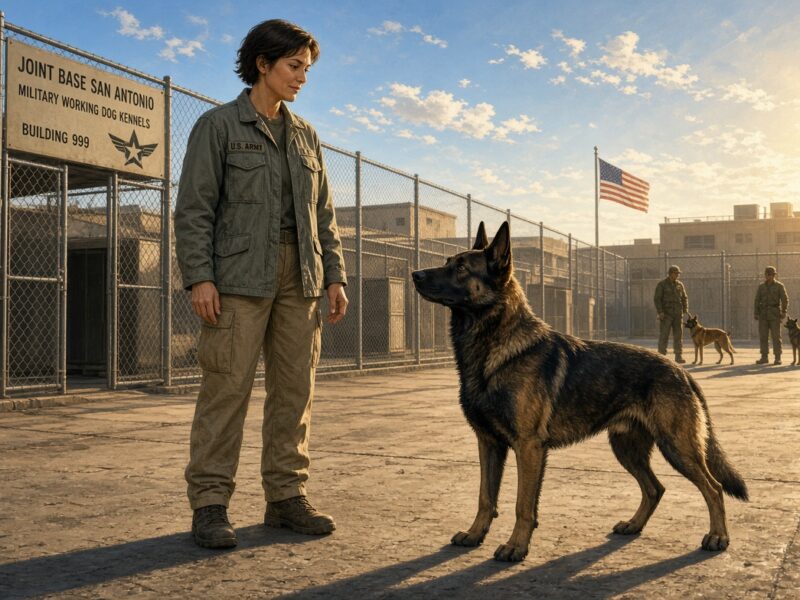
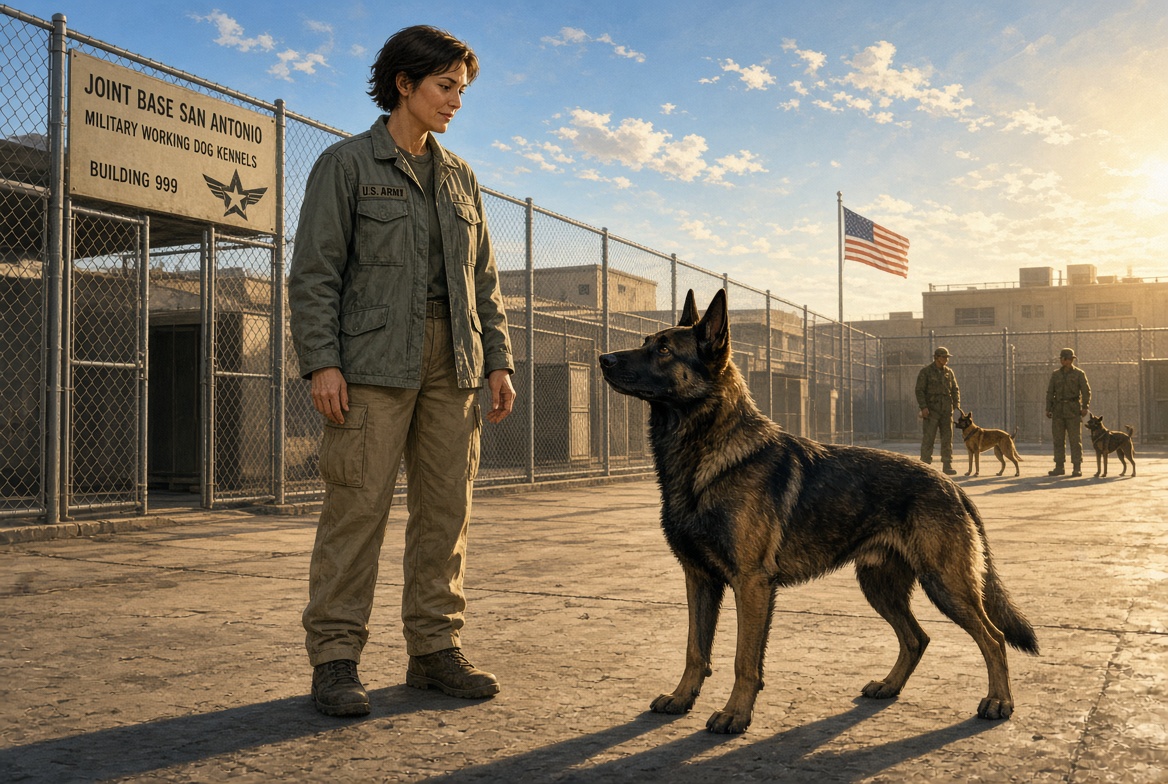
The woman in the gray field jacket—the one Vanour had already decided was a contractor or a tourist who had wandered in through the wrong gate at Joint Base San Antonio—did not take a step back.
She stopped at exactly the distance he had named. Three feet.
And she let her hands hang open and loose at her sides where the dog could see them.
The yard went quiet. Nobody moved to wave her off. Nobody told Vanour to ease the dog down. The two handlers at the run benches just looked, and the looking had a flavor to it. The flavor men get when they expect to watch someone get bitten and have decided in advance that she earned it.
She did not flinch. She did not pull her hands back. She did not even look at Vanour.
She looked at the dog—at the line of his spine, and the angle of his ears, and the place on his lip where it had started to lift. And she let her shoulders come down a quarter inch that nobody in that yard would have registered as anything at all.
To Vanour, the way she just stood there unbothered—taking his warning like it was weather—felt worse than if she had screamed.
A normal person flinched. A normal person backed off and apologized for being in the wrong place.
This one was reading his dog the way he read his dog. And that, he could not stand.
What Vanour did not know—what none of the eighteen handlers who worked that kennel knew—was that the silence Argo had gone into was not the silence before a bite.
And the woman in the gray jacket knew exactly which silence it was.
Her name was Fenna Walgrave, and she had not wandered in through the wrong gate. She had a visitor badge clipped inside her jacket and a folder under her arm and an appointment at 0900 that the kennel master had not bothered to tell his handlers about.
Which was the first mistake of a long morning. Though not the worst one.
It was 0847 when Vanour decided to teach her a lesson. And the lesson was going to belong to him for exactly thirteen more minutes.
Before any of that—before the appointment and the folder and the colonel who was already in the air over Texas—there was just a woman standing three feet from a dog that everyone else in the yard had already decided would bite her.
And not understanding why she wasn’t afraid is the only question that matters for the next hour.
So hold on to it.
Vanour jerked the lead. He did it to make a point—a short, hard snap of the wrist that any handler in that yard would have recognized as discipline aimed at the audience and not at the dog. Because Argo had done nothing wrong. Argo was just standing where he was told.
The dog took the correction and held the crouch.
And Fenna Walgrave, who had still not raised her voice, said one quiet thing. Not to Vanour. Not to the crowd. Just down toward the concrete, where the dog could feel it more than hear it.
She said, “You’re all right.”
She did not say it as a command. There was no German in it, no sharp consonant, no tone that anyone watching would have flagged as a working cue. It was the kind of thing you say to anybody having a bad morning.
But Argo’s ridge came down.
The hackles folded flat all at once, from skull to tail, the way a flag drops when the line is cut. His weight shifted back off his front shoulders. His ears swung forward—off Vanour, onto her. And his tail, which had been rigid and low, moved once.
Vanour felt the lead go slack in his hand and did not understand it.
He looked at his own dog like the dog had betrayed him.
One of the handlers at the run benches said, very quietly, “What?”
And it was not a question. It was just a sound a man makes when something he has built his whole identity on does something it is not supposed to do.
Fenna Walgrave bent, picked up her folder from where she had set it on the bumper of a kennel truck, and walked past Vanour toward the admin building like the dog and the man were both furniture.
She did not look back.
If she had, she would have seen Argo’s head track her the whole way across the yard.
The kennel master’s office smelled like burned coffee and floor wax. His name was Tobin Veland. He had run the military working dog detachment at Lackland for nine years, and he stood up too fast when she came in—which told her he knew exactly who she was and had been hoping she would not actually show.
“Miss Walgrave,” he said. “We weren’t sure you’d—”
“My flight got in at 2310 last night,” she said. “I drove down from Austin this morning. Your handler tried to set a dog on me in the yard.”
Veland’s face did a complicated thing. “Vanour’s a little protective of his dogs, is all.”
“He gave a forward-crouch dog a leash correction in front of an audience and called it discipline. That’s not protective. That’s a man who doesn’t know what his dog is telling him.”
She set the folder on his desk and did not sit.
“I’m here to do the eval. The Provost Marshal’s office ordered eighteen dogs, the imprint records, the bitework logs, the washout numbers. You have a thirty-one percent washout rate in this program over fourteen months. The Army baseline is eleven. Somebody upstairs wants to know why, and they sent me.”
Veland sat back down slowly. “And you’re qualified to assess that, are you?”
“I’ll let the dogs answer that,” Fenna said.
It was 0903.
Here is the thing Tobin Veland did know and was praying she had not figured out yet.
The protocol his whole kennel ran on—the imprinting sequence that every one of his eighteen dogs had been built on, the four-stage drive-and-recovery method written into the detachment standard operating procedure, the thing his handlers called the Veland method behind his back and to his face—had a name on the original research that was not Veland.
It had been developed at the Lackland Behavioral Lab six years earlier by a contract animal behaviorist who had been let go in a budget cut, and whose name had been quietly struck from the revised SOP when the method got formalized.
Veland had been the program officer who signed the revision. He had not written one line of the method. He had filed the paperwork that put his name where another name used to be.
He had spent six years hoping that woman never came back to Texas.
And she had just walked into his yard at 0847 and dropped his best dog’s hackles with two words in a tone.
Because of course she had. She had written the tone into the protocol herself.
Stage three. Recovery cue.
The dog learns that one particular human register means the threat is resolved and he can stand down. Every dog in that kennel had been imprinted on it.
Veland’s handlers thought it was magic. Veland knew it was a footnote with somebody else’s name scratched off it.
He did not tell her any of this. He told her she could start with the kennel logs after lunch, and that he would have someone walk her through the runs.
What he was actually doing was buying time to call a colonel he knew and find out how much trouble he was in.
He had until the inspection report landed on the Provost Marshal’s desk to make this go away.
He thought he had weeks. He had until 1600.
In the yard, Reese Vanour was not letting it go.
He had put Argo back in the run, and the dog had gone in fine—but the dog had looked back at the gate twice, toward the admin building, and Vanour had seen it both times.
By the time the morning bite-work session started, he had told the story three times, and it had gotten worse each time.
In the first version, she had gotten lucky. In the third version, she had done something to his dog. Slipped him something. Used some trick.
Because there was no honest way a stranger walks into a yard and takes a forward-crouch Malinois off the threshold with her voice.
Men like Vanour do not have a category for a woman knowing more than they do. So they reach for sabotage—because sabotage at least keeps the world the right way up.
Master Sergeant Dell Wickersgill had been standing at the rail during the whole thing in the yard, and had said nothing, and was still saying nothing now.
And that silence was its own event. Because Dell Wickersgill was the senior handler on the detachment. And when he had something to say, he said it. He had eleven years and four deployments on a leash.
And he had watched the woman in the gray jacket fold the dog’s hackles with the word “all right.”
And he had recognized the cue. Not the woman. The cue.
He had been taught that exact recovery register in his own handler course at Lackland years ago. Taught it as gospel. Taught it as the Veland method.
And he had just watched a stranger use it like she owned it.
He went very, very still at the rail—the way a man goes still when two facts he trusted have started arguing with each other in his head.
Then he walked off toward the admin building without telling anyone where he was going.
Fenna spent the late morning in the records room with the bitework logs, and the logs told her a story she had read before in other failing kennels. But this one had a particular cruelty to it.
The washout numbers were not random. They clustered.
Five of the six dogs washed out in the last fourteen months had washed out of the same stage—stage two, the drive-building phase. And they had all washed out under the same handler signature.
And the signature was Vanour’s.
He was burning them out. He was pushing drive without ever running the recovery cue. Building dogs into a fight they were never allowed to come down from, and then logging them as temperamentally unsuitable when they broke.
It was the exact failure her protocol had been written to prevent.
Stage three existed because of stage two. A dog you build up, you have to be able to bring down—or you do not have a working dog. You have a loaded weapon with no safety, and eventually it goes off on the wrong person, and you call it the dog’s fault.
She found one more thing in the logs and sat with it for a long minute.
Dog number 11. A four-year-old named Brasque, who had bitten a handler in the sallyport six weeks ago. A bite logged as unprovoked aggression. The dog flagged for evaluation and possible euthanasia. The eval scheduled for 1600 today.
She checked the handler on the incident report. Vanour.
She checked the dog’s imprint file. Stage three never logged as completed.
The recovery cue had never been installed in that dog.
He had built a weapon and never given it a safety, and then written up the dog when it did exactly what an unfinished dog does.
The clock on the records room wall said 12:00.
The eval that would end that dog’s life was at 1600. She had three hours and forty-eight minutes.
And she did not have the authority to stop it—because on paper she was a contract evaluator with a visitor badge, and the man who had scheduled the euthanasia was the program officer who had built his career on her stolen work.
She closed the log. She did not slam it. She set it down square on the desk and lined its edge up with the edge of the table. And that was the only thing her hands did.
Dell Wickersgill found her in the records room at 12:30. He stood in the doorway a while before he spoke. A big man not sure where to put his hands.
“You used the recovery cue on Argo this morning,” he said. “In the yard. I was at the rail.”
“I did.”
“We’re taught that cue. Whole detachment runs on it. They call it the Veland method.”
He watched her face when he said the name, and he saw it not change—which told him more than a flinch would have.
“But you walked in cold and used it on a dog you’d never met. And he took it first try off a forward crouch, which I have personally never seen anybody do. So I’ve got a question, and I think you already know what it is.”
Fenna looked at him for a moment. “Ask it.”
“Where’d you learn it?”
“I wrote it,” she said. Not loud. The way you state a fact you stopped being angry about a long time ago. “Six years ago, in the Behavioral Lab, two buildings from here. The four-stage drive-and-recovery sequence your detachment runs on. I built it. I tested it on the first cohort, and I wrote the SOP. Then the lab lost its funding. My contract didn’t get renewed. And when the method got formalized into the standing protocol, my name came off the document and a program officer’s name went on it.”
She paused.
“You don’t have to believe me. The dogs already do.”
Wickersgill stood in the doorway and did the arithmetic, and she let him do it. And the silence while he did it was the longest one of the day.
Then he said the thing she needed and could not say herself.
“Dog 11,” he said. “Brasque’s getting put down at 1600. I read the incident report. I never believed it was unprovoked. That dog never had stage three done. I’ve been saying it for six weeks, and nobody upstairs wants to hear that one of Vanour’s dogs failed because Vanour never finished it.”
He met her eyes.
“If you wrote the protocol, then you can prove Brasque was never finished to it. And if you can prove that, you can stop the euth.”
“I’m a contractor with a visitor badge,” Fenna said. “I can’t stop anything.”
“No,” Wickersgill said. “But the colonel coming in at 1500 can. And he’s going to ask one question when he lands. Same question I asked you. So you want to be standing in the right yard when he does.”
The colonel coming in. She had not known about a colonel. She filed it the way she filed everything, and felt the morning rearrange itself around the new fact.
Somebody above Veland had decided the washout numbers were worth a flight—not just a contractor.
It was 12:44. The eval was at 1600. And now there were two clocks running—hers and the colonel’s—and they were going to meet.
Vanour cornered her in the yard at 1310. He had three handlers behind him—not for backup exactly, more like an audience he had brought along—and he planted himself in her path with his chest out.
“I don’t know what you did to my dog this morning,” he said. “But I checked. There’s no contract eval scheduled through my chain. Nobody told me an evaluator was coming. So either you’re lying about who you are, or somebody upstairs went around the whole detachment to put a stranger in our kennel. And either way, I don’t have to give you the time of day.”
Fenna did not step back.
“Your dog 11 goes to eval at 1600 for an unprovoked bite,” she said, loud enough for the handlers behind him. “His imprint file shows stage three was never completed. You logged him as the aggressor. You built a dog you couldn’t bring down, and then you blamed the dog. That’s not a temperament problem. That’s a training problem. And the training was yours.”
The yard went very quiet. One of the handlers behind Vanour—a young one—looked at the concrete.
“You don’t know anything about these dogs,” Vanour said, and his voice had lost some volume.
“I know the cue dropped Argo’s hackles in two seconds,” she said. “I know it dropped them because somebody installed it in him correctly. Stage three. The recovery register. Before you got your hands on the program. And I know you never installed it in Brasque, which is in your own handwriting in his file.”
She let that sit.
“Respect in a kennel is a function of what the dog does when you speak, Sergeant. Not how loud you say it. Argo answered me. He stopped answering you. Sometime around stage two.”
She walked past him.
Behind her, she heard nothing—which, from Reese Vanour, was the loudest thing he had said all day.
She went back to the records room, because she needed the one document that would turn what she knew into something a colonel could act on.
And she knew exactly which document it was. And she knew it might not exist anymore.
The original imprint log book. Not the digital SOP, which had her name scrubbed off it. The handwritten field log book from the first cohort, six years ago. The one where she had recorded every dog in the founding group, every stage, every cue installed—in her own hand, dated in ink.
If that book still existed, it was physical proof that the four-stage method had been run, recorded, and signed off years before Veland’s name ever appeared on a typed page. And the recovery cue—the stage-three register—was described in it in her handwriting.
It was not in the records room. It was not in the active files. Veland had been the program officer. If anyone had made the founding log book disappear, it was him.
She stood in the records room at 13:52 with the clock against her and understood that the proof of who she was had probably been shredded six years ago by the man whose career depended on it being gone.
Then Dell Wickersgill came in carrying a battered green field log book, the corners gone soft, and set it on the desk in front of her.
“Archive room, Building 9,” he said. “Property and Records holds everything for seven years before they purge it. Veland scrubbed the digital file. He never thought about the paper. Nobody thinks about the paper anymore.”
He turned it to the first cohort page.
“That your handwriting?”
She looked down at her own hand from six years ago. Dog one, imprint date. Stage one, cue installed. Stage two, drive baseline. Stage three, recovery register. And beside it, in her own writing, the word. The register, the tone, described exactly the way she had said it to Argo that morning.
Her initials at the bottom of every entry. F.W. Dated.
“Yes,” she said, and her voice did one small thing it had not done all day, and she let it. The way the protocol she wrote let the dog let it. And then she put it away again. “That’s mine.”
It was 14:01. The colonel landed at 1500. The eval was at 1600. She had the proof. Now she needed the right room.
While she waited for the colonel, she did the one thing she had been not letting herself do all day—which was go look at dog 11.
Brasque was in the isolation run at the far end of the kennel, where they put the ones flagged for euth. And the run was a bad place. Concrete and a single drain and a dog who had been alone in it for six weeks, with nobody running the cue that would have told him the fight was over.
He came up to the gate hard, all front shoulders, the same forward crouch Argo had shown that morning. The ridge standing from skull to tail. A dog logged as a vicious animal. A dog logged as the aggressor. A dog who, by 1600, was scheduled to stop existing because the man who broke him needed it to be the dog’s fault.
She crouched outside the gate. Slow, hands open. And she did not say the cue right away—because the cue is stage three, and you cannot run stage three on a dog who never had stage one from you.
So she did what the log book in her own hands said to do first. She gave him a minute of nothing. She let him bark himself down to a growl, and the growl down to a stare. And she stayed crouched and open the whole time.
And only when his weight finally came back off his front shoulders—the smallest amount—did she say it, low, down toward the concrete where he could feel it.
“You’re all right.”
It took longer than Argo. Argo had had the cue installed correctly six years ago. Brasque had never had it at all, and a cue that was never installed cannot be recalled—only built fresh. One repetition against six weeks of isolation.
But the register is older than any one dog. It is the sound a settled human makes.
And on the fourth repetition, over the space of four full minutes, Brasque’s ridge came halfway down. Not all the way. Halfway. His ears came off her and swung once toward the yard and back, and he sat.
A dog logged for euthanasia for unprovoked aggression sat down on the wrong side of a gate from a stranger—because she had given him the one thing six weeks of paperwork had not, which was a person who knew how to tell him the threat was resolved.
This was the part she would not have said out loud to anyone.
She had spent six years telling herself the stolen protocol did not matter. That the work was the work, whether her name was on it or not. And it was true, mostly.
But she was crouched in front of a dog they were going to kill at 1600 for the crime of being trained by a man who skipped the chapter she wrote.
And the thing that moved through her chest then was not pride about the name on the document. It was the four other dogs in the washout logs—the ones already gone, who had broken in stage two and been written up as unsuitable. Every one of them missing the stage she built to bring them home.
She let it move through her. She did not suppress it, and she did not accelerate it.
Then she stood up, because it was 14:47 and she could hear a vehicle at the main gate.
Colonel Vraane came into the kennel office at 1503 with Veland a half step behind him, talking fast. And Vraane was not listening to Veland—which Fenna noted.
He was a lean, gray man with the look of someone who had read the washout numbers on the flight down and already decided he did not like them.
He saw Fenna, and the green log book on the desk, and Dell Wickersgill standing at parade rest by the wall—and he stopped.
“Somebody’s going to tell me,” Vraane said, “why a detachment with a thirty-one percent washout rate is about to euthanize a dog in under an hour. And somebody’s going to do it without making me read between any lines.”
Veland started. “Sir, dog 11 has a documented unprovoked bite. The report is clear—”
“I asked the room,” Vraane said. Not loudly. And Veland stopped.
Wickersgill spoke.
“Sir, Master Sergeant Wickersgill, senior handler. Dog 11’s imprint file shows stage three of the standing protocol was never completed on him. The bite he’s flagged for is the kind of bite an unfinished dog gives. He was logged as the aggressor by the handler who never finished his training.”
He paused.
“And the protocol everybody on this detachment runs on, sir. The one we call the Veland method. Was not written by anyone named Veland.”
The office went the kind of quiet the yard had gone that morning.
Vraane turned to Fenna. “And you are?”
“Fenna Walgrave. Contract behaviorist. I developed the four-stage drive-and-recovery imprinting sequence at the Lackland Behavioral Lab six years ago. Ran it on the first cohort and wrote the SOP. My contract wasn’t renewed in a budget cut. When the method was formalized into the standing protocol, my name was removed from the document and the program officer’s name was entered in its place.”
She did not look at Veland. She did not have to.
“I didn’t come here to relitigate that. I came to do the washout eval the Provost Marshal ordered. But you asked the room, sir. So the room is telling you.”
“That’s a serious allegation,” Vraane said.
“And on a contractor’s word, it’s just an allegation. It’s not on my word.”
She turned the green log book to the first cohort page and slid it across the desk.
“Property and Records, Building 9. Holds founding documents seven years before purge. This is the original handwritten imprint log book from the first cohort. Every dog, every stage, every cue, dated in ink, initialed, pressed. The stage-three recovery cue is described on this page in my handwriting. Three years before it appears in the typed SOP under another name. The digital file can be edited. This can be carbon-dated.”
Vraane read the page. He read it the way men read things when they already suspect the answer and are checking whether they have to act on it.
Then he looked up. “You said you can prove dog 11 was never finished to this protocol.”
“I can do better than prove it, sir,” Fenna said. “I can show you.”
It was 15:18. She asked for the yard.
The detonation when it came was not a shot and not a salute. It was eighteen dogs.
She had Wickersgill bring every working dog on the detachment out to the yard for what she called a “recovery cue verification.” And Vraane authorized it—because he wanted to see the thing the log book described. And Veland could not object, because objecting meant admitting he knew what the cue was.
The eighteen handlers brought their dogs out on lead and spaced them down the length of the yard. And the dogs did what eighteen working Malinois and Shepherds do in close quarters with strangers and tension in the air—which is build drive. Going up. Ridges coming up. Eighteen loaded weapons on eighteen leads, and the handlers feeling it, tightening the leads—which made it worse, the way it always makes it worse.
Reese Vanour was in the line with Argo, and Argo was forward and hard, the way the whole line was forward and hard. And Vanour had a grim little look, because he had decided that whatever this woman was about to try, eighteen wound-up dogs would make a fool of her.
Fenna Walgrave walked to the head of the yard, where every dog could see her and most could not yet hear her. And she stood the way she had stood that morning, three feet from Argo. Hands open. Shoulders down.
And she said one word.
She did not shout it. The whole point of the cue—the thing she had built and tested and written into a log book six years ago—was that it could not be a shout. Because a shout is stage two, and the dog is already living in stage two.
What the dog has never been given is the other thing. The settled register. The sound that means it is over.
She pitched it low and even and let it carry on the flat of the air down the length of the yard.
“Easy.”
And down the line, the ridges came down.
Not all at once, like a trick. But in a wave—the way it travels through animals. The nearest dogs first, and then the next, and the next. Hackles folding flat from skull to tail. Weight rocking back off front shoulders. Ears swinging forward and off their handlers and onto her.
Eighteen dogs coming down out of drive together—because every one of them had been imprinted correctly years ago on a cue she had installed in the first cohort and written into the founding protocol that the rest were built from.
Eighteen dogs sat, or stood loose, or lay down. The whole loaded line of them going soft in the space of a few seconds. And the handlers stood there holding slack leads and not understanding.
And the yard was so quiet you could hear the dogs breathing.
And one dog at the end of the line—dog 11, Brasque, brought out from isolation on Wickersgill’s lead, because Fenna had asked for every dog and Wickersgill had quietly made sure that meant every dog—Brasque came down too. Slower. Half the way he had at the gate.
But he came down in front of the colonel, fifty minutes before they were going to kill him for being a dog who could not come down.
He came down because she had built the thing into him that morning that nobody on the detachment had bothered to.
And Vraane saw it. And Vraane understood exactly what he was seeing—which was a death sentence falling apart in real time.
Reese Vanour was the only thing still standing rigid in the whole yard. He had a slack lead in his hand and Argo lying calm at his feet, looking up at the woman down the line. And he had run out of versions of the story.
There was no version where she had slipped the dog something. There was no version where she got lucky.
Eighteen dogs do not get lucky on a cue.
He had told a yard full of men that she was a fraud, and the dogs had just called him a liar in a language he had spent eleven years claiming to speak.
Vraane let the silence hold for a moment. Then he spoke—and he spoke loud enough for the whole yard, the way you do when you want a thing to be on the record in front of witnesses.
“Master Sergeant Wickersgill. Dog 11’s 1600 evaluation is canceled. The dog goes back into training. Stage three. Under a handler who can complete it.”
He turned.
“Sergeant Vanour. As of now, you’re relieved of independent dog assignments, pending a review of your imprint files and your washout signatures. You’ll attend a recertification course.”
He looked at the green log book, still open on the desk through the office window.
“And the standing protocol is going back to the legal office for an authorship correction. The name on it is going to match the name in the log book.”
He looked at Fenna.
“Yours.”
He did not salute her, because she was a civilian and there was no ritual for this. And that was almost better. Because what he did instead was turn to the eighteen handlers who had just watched their dogs answer a stranger, and say:
“These are her dogs. They have been her dogs for six years. You just didn’t know whose hands built them.”
And eighteen men who had spent a morning deciding she did not belong in the yard stood in the wreckage of that idea and could not say a word—because the dogs at their feet had already settled the argument.
That was the turn.
But the turn is not the end. And the end is the part that matters—because anybody can win a yard once, and a thing that wins once is just luck wearing a uniform.
The authorship correction took eleven weeks. These things move slowly through the legal office and the doctrine office and a records review that confirmed exactly as she had said: that the handwritten log book predated the typed SOP by three years, that the carbon and the ink and the Property and Records intake stamp all agreed, and that the name on the founding research and the name in the field log were the same name—and were not the name currently on the document.
Tobin Veland did not get to keep being the author of a method he had never written a line of. What happened to him after that was an administrative matter, and it was not the kind of dramatic ruin a story wants. It was quieter, and in some ways worse. He kept his rank and lost the one thing he had taken—and every handler in the detachment knew it. And he had to walk through that yard every morning knowing they knew. Shame in a man who built himself on someone else’s work does not come out as cruelty the way it does in a Vanour. It comes out as a man who stops looking people in the eye.
Reese Vanour went through the recertification course. Fenna Walgrave—who stayed on as the detachment’s consulting behaviorist once the Provost Marshal’s office saw what fourteen months of washouts had actually cost—taught part of it.
She did not make it hard on him, which surprised the handlers who expected her to. She ran him through stage three a dozen times on a dozen dogs. Made him feel the moment a built-up dog comes down off drive when you give it the register it has been starved for. Made him do it until he could feel the difference in the lead between a dog that has been brought home and a dog that has only been wound up.
About six weeks in, he came to her after a session and stood there the way Wickersgill had stood in the doorway that first day—not sure what to do with his hands.
And he said the thing it had taken him six weeks to be able to say. That he had washed out four good dogs because he never knew there was a way to bring them down. That he was sorry. That he had not understood until he felt it in his own hand that the cue was not a trick. It was the safety on a weapon he had been handing people loaded.
She told him the dogs would tell him when he had it right. They always do. That is the whole method. The dog is the proof.
Dog 11, Brasque, finished stage three eight months later and certified as a patrol explosive detection dog. And the handler who finished him, at Fenna’s recommendation and to the surprise of nobody who had been in the yard that day, was Dell Wickersgill.
Brasque worked four years and retired sound, and Wickersgill adopted him. And the dog logged once as a vicious animal scheduled for euthanasia for unprovoked aggression slept the rest of his life on a dog bed in a master sergeant’s living room in San Antonio—which is the only ending that particular dog’s file was ever actually heading toward, if anyone had bothered to finish reading him.
The thing Fenna Walgrave did with the correction—once her name was finally back on the protocol—was the thing that tells you who she was the whole time. She did not frame it. She did not put the corrected SOP on a wall.
What she did was rewrite stage three to be taught earlier in the handler course, before stage two instead of after it. So that no handler would ever again learn how to build a dog up before he learned how to bring one down. She made the recovery the first thing, not the last. She put the safety in their hands before she let them touch the trigger.
And she added one line to the top of the protocol—the only editorial thing in an otherwise clinical document—that read:
“A dog you cannot bring down is not a finished dog. And a handler, not the animal, owns the difference.”
There is a dog right now, in some kennel somewhere, being built up into a fight he has not been taught how to leave. And there is a handler who thinks the building is the whole job. And the only thing standing between that dog and a 1600 eval is whether somebody taught that handler.
The chapter Fenna Walgrave wrote—that chapter is being taught at Lackland now, under the right name. Whether it is being taught everywhere else is a different yard, and a different morning, and she had not finished walking that one yet.









