She Burned Her Hands Saving a Stranger — Then Discovered That Woman Owned Everything She Thought She’d Lost
The discharge papers were coming tomorrow, and Naomi Price had nowhere to go.
She sat on the edge of the hospital bed, staring at her bandaged hands, the white gauze wrapped so thick she couldn’t even see her own fingers.
The doctor had said second-degree burns on both palms, possible nerve damage, and the words kept echoing in her head like a bell she couldn’t unring.
Everyday things would be fine in a few weeks, but fine work—braiding, styling, the only thing she’d ever been good at—that could take months, maybe never.
A nurse practitioner with kind eyes and a clipboard asked if there was a family they could call, and Naomi shook her head so fast the scarf around her hair shifted.
“No, ma’am,” she said, her voice steady even though everything inside her was shaking. “There’s nobody.”
She’d been on her own since her father died three years ago, since her stepmother made it clear the house on that porch her daddy built with his own hands was no longer hers.
The stepmother had a daughter, Kayla, who needed the room, who needed everything Naomi had, who took and took until there was nothing left but a girl with a scarf and a gift for making other people beautiful.
So Naomi had been sleeping in her car, a 2007 Honda Civic with 187,000 miles on it, parked behind a Kroger on Moreland Avenue, and she’d been doing hair for cash under the table, building a little life out of nothing.
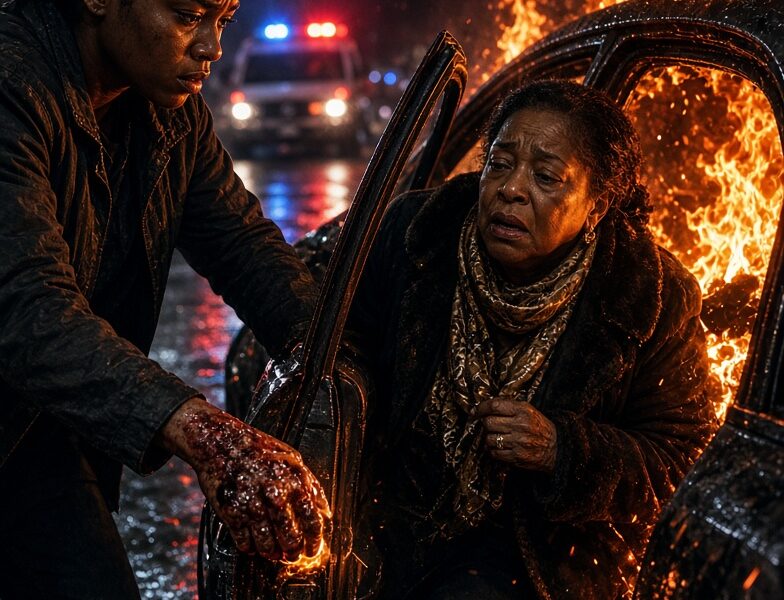
Then midnight came, and the car next to hers exploded into flames.
—
She didn’t think. She just moved.
The heat hit her like a wall, and the woman inside was screaming, and the door handle was so hot it melted the skin right off Naomi’s palms, but she pulled and pulled until the woman tumbled out onto the asphalt.
The woman was older, elegant even in her terror, wearing a silk scarf and a coat that cost more than Naomi’s car.
She kept saying thank you, thank you, and Naomi kept saying it’s okay, you’re okay, even as her hands throbbed and blistered and the ambulance came screaming down Moreland Avenue.
At the ER, they asked for her name, and she gave it—Naomi Price—and the woman gave hers too, something that sounded like a whisper of money and old Atlanta.
“Ellis,” she said. “Celeste Ellis.”
Naomi didn’t know that name. She didn’t know anything about the east wing of a house she’d never seen, about a woman who never showed her face, about a family that had been guarding secrets longer than Naomi had been alive.
All she knew was that her hands were ruined and her car was ash and the discharge papers were coming tomorrow and she had nowhere to go.
Then Celeste Ellis walked into her hospital room the next morning, still smelling faintly of smoke, and said the words that would change everything.
“You’re coming home with me.”
—
The house had two staircases, which Naomi thought was the most ridiculous thing she’d ever heard until she saw the east wing.
“We’re the help,” Celeste said, walking her through a kitchen big enough to feed a small army. “Cook, driver, laundry. You already think you’re Ellis. Keep it.”
She said it like it was nothing, like she was handing Naomi a coat instead of a whole new identity.
“Mrs. Lennox never shows her face anyway,” Celeste continued. “So she lives in the east wing. Nobody goes in.”
Naomi stood there in borrowed clothes, her hands wrapped in gauze, and tried to understand what was happening.
“You don’t even know me,” she said.
“I know your hands,” Celeste replied, and something in her voice made Naomi’s throat tight. “That’s enough.”
The house rules were simple. Work hard. Stay humble. Don’t break anything because everything costs more than you.
Mama cooked, Andre drove and fixed things, Julian drove the boss, and Naomi did laundry.
She did it loud, too, just to remind herself she was real, that she existed in this strange house with its two staircases and its invisible owner.
And every night, she left plates outside the east wing door and said good night, because her father had raised her right, even if he’d left her with nothing but a porch and a promise.
The first time the east wing said good night back, Naomi almost dropped her basket of towels.
She stood there in the dark hallway, her heart pounding, and realized she wasn’t as alone as she thought.
—
The therapy putty came next, a small container of gray clay that Celeste handed her with instructions to squeeze it a hundred times a day once the bandages came off.
“What if I can’t do a hundred?” Naomi asked.
“Then you do ten,” Celeste said. “Tomorrow you do eleven. I’ll count if you lose track.”
So Naomi squeezed, and Celeste counted, and somewhere in those small repetitions, something began to heal that had nothing to do with her hands.
She learned that Celeste had a son named Julian who ran operations for a hotel company, that Mama made the best greens in Atlanta, and that the house on West Paces Ferry was famous for its gates and its secrets.
She also learned that her stepsister Kayla had posted a video of her getting dye dumped on her head, and it had two hundred thousand views.
“People Google Kesler, they get a purple girl in a dish rag,” Kayla had complained to their stepfather, Grant Kesler, who was building a resort in Savannah and needed investors.
Naomi watched the video on her phone, watched herself get humiliated, watched Kayla lie about stealing her spiral pattern, watched Tyler say he wasn’t really looking when he’d watched the whole thing.
Nobody asked if she was okay. Not one of them.
Except Celeste, who found her crying in the laundry room and sat down beside her without a word.
“You’re the one who pulled me out,” Celeste said finally. “Your car was on fire, ma’am. What else was I going to do?”
“Walk past,” Celeste said. “Most people would.”
“Most people didn’t have a bus that never came,” Naomi replied, and that was the truth of it, the whole truth, the only truth that mattered.
She’d been waiting for a bus that never came when her father got sick, when her stepmother took the house, when Kayla stole her work and her name and her peace.
She’d been waiting her whole life for something that was never going to arrive.
Until a car exploded at midnight on Moreland Avenue, and she stopped waiting and started moving.
—
The shampoo assistant job at the salon in the Lennox Grand was supposed to be a fresh start.
“New girl,” the manager said, eyeing Naomi’s scarf. “Our VIP stylist called out. You’re on her blowout. Don’t embarrass me.”
Naomi recognized the VIP the moment she sat down in the chair.
Brooke Kesler. Kayla’s stepsister. The girl who’d lived with them, who’d watched Kayla pour dye on Naomi’s head, who’d never said a word.
“What happened to your head?” Brooke asked, staring at the scarf.
“I did it,” Naomi said, and she meant it as a declaration, not an apology.
The blowout was going fine until the dryer slipped, until Brooke started screaming that she’d been burned, until Mrs. Kesler stormed in and demanded Naomi be fired.
“Look at her hands,” Mrs. Kesler said, pointing at Naomi’s scars. “And you let those hands touch my daughter?”
Naomi stood there, her badge in her hand, her whole future crumbling, and thought about all the times she’d stayed silent, all the times she’d let people take from her because she had nothing left to give.
“I’ll apologize when I’ve done something wrong,” she said.
Then the security footage proved she hadn’t done anything wrong at all, and Julian—Celeste’s son, the one who drove for a lawyer—walked in like he owned the place.
He didn’t own the place, but his mother did.
“Mrs. Kesler, your daughter falsely accused my staff,” he said. “Tonight’s party is cancelled. The deposit stays with us. The guard will see you out.”
Naomi didn’t understand what was happening. She didn’t understand why Julian was defending her, why the manager was suddenly apologizing, why the whole room had shifted beneath her feet.
She didn’t understand that she’d been working for the Lennox Group the whole time, that the invisible Mrs. Lennox was the woman she’d pulled from a burning car, that the house with two staircases belonged to the woman who’d said she knew Naomi’s hands and that was enough.
“Miss Price, take ten,” Julian said. “Station 4 is still yours.”
And Naomi took ten, and then she took more, because her hands were healing and her life was changing and she still didn’t know the whole truth.
—
The truth came on the night of her licensing exam.
She’d been studying for weeks, squeezing her putty, braiding hair for Jada Rivers at a wedding, working nine hours on hands that still ached.
She’d been walking into that exam room believing every bit of her success was hers, and it was, but it wasn’t only hers.
“Naomi, there’s something I need to tell you about the house,” Julian said as he drove her to the test.
“Don’t,” she said. “If it’s bad, I’ll fail. If it’s good, I’ll mess up my parts. Tell me after.”
So he waited, and she took the exam, and when she walked out with her license in her hand, she finally learned the truth.
The house on West Paces Ferry belonged to Celeste Lennox, the woman she’d saved, the woman who’d been watching her through the east wing door, the woman who’d been saying good night back.
Celeste had been in the car that night because she’d been coming to find Naomi, to offer her a job, to give her a chance.
Instead, Naomi had given her a chance, had pulled her from a fire, had burned her hands saving a stranger who turned out to be the most powerful woman in Atlanta.
“I lied,” Celeste said. “You lied the most. You drove me to my exam in your own car and told me it was hers.”
“I said she’d survive,” Julian said. “She did.”
And then Julian, who’d been counting for her, who’d been practicing speeches in the mirror, who’d been raised humble by a mother who never showed her face, asked Naomi to dinner.
“Say yes or he’ll practice that speech again,” Celeste said. “I heard it nine times.”
Naomi said yes.
—
The Kesler house was being sold.
Grant Kesler had borrowed against it, had bought steel before the contract was awarded, had left out three OSHA violations that put a worker in the hospital.
Lennox Group rejected the bid, and the bank was selling the note, and Grant was begging Celeste to buy it, to save the house, to keep the family name intact.
“Whose name goes on the deed after?” Celeste asked.
“That’s her call,” Grant said, looking at Naomi.
Sweetheart, put it in my name,” Grant’s wife said. “We’re family.”
Naomi looked at the woman who’d put her out at midnight, who’d told her to go find her father, who’d never once called to see if she was alive.
“My father’s name goes on that house,” Naomi said. “Not yours.”
Because her father had built that porch with his own hands, had signed it over to her when he got sick, had trusted her to keep it safe.
And she hadn’t been able to keep it safe, but she could keep his name, could honor his memory, could make sure the house on that porch belonged to someone who deserved it.
“Mrs. Lennox, please,” Grant begged. “The safety stuff is paperwork. I’ll fix it.”
“Don’t beg me,” Celeste said. “The bank’s selling that note. Lennox can buy it.”
And Lennox did buy it, because Celeste Lennox was the kind of woman who paid her debts, who kept her promises, who showed up at midnight when someone she loved was in trouble.
Naomi paid her share too. Twenty-five thousand dollars of it, from Jada’s check, from her own chair at the salon, from every braid and every blowout and every hour she’d spent building something that was hers.
“The rest is a loan,” Julian said. “You pay it back from your own chair. Monthly with interest.”
“Don’t push it,” Naomi said, and Julian laughed, and Celeste laughed, and for the first time in three years, Naomi felt like she was home.
—
The scarf came off six weeks after the fire.
Naomi stood in front of the mirror in her room—her room, in the house with two staircases—and unwound the fabric that had hidden her for so long.
She’d been told there was nothing under there worth looking at. She’d been told it every morning while she did her stepsister’s hair. She’d believed it for years.
But Celeste had said something else, something that stuck like a burr.
“A girl like that is not ugly. A girl like that just never had a mirror that talked back.”
So Naomi looked in the mirror, and she talked back.
“You pulled a stranger out of a fire with those hands,” she said. “Anybody would have.”
“Nobody else did,” the mirror said, and the mirror sounded like Celeste, and the mirror sounded like Julian, and the mirror sounded like the truth.
She braided her own hair for the first time since her father’s funeral.
She did it slow, because her hands still ached, because the scars were still there, because healing wasn’t a straight line.
But she did it, and when she was finished, she looked at herself and saw someone who was gorgeous.
Not because of the braids, but because of the girl underneath them.
—
The email came on a Tuesday.
Naomi was at the salon, working on a client’s knotless braids, when her phone buzzed with a message from an unknown number.
“Mrs. Ellis, this is Jay from the wedding. Jada wants to book you for her tour. She needs a braider. Are you available?”
Naomi stared at the screen, her heart pounding, her hands steady.
She thought about the fire, about the hospital, about the discharge papers that had come the next day and the woman who’d said she was coming home with her.
She thought about the east wing, about the plates she’d left outside the door, about the good night she’d whispered into the dark.
She thought about the $37 she’d paid toward the light bill, the best money that family ever made, and the Georgia Power bill where someone had spelled Georgia wrong.
She thought about the porch her father built, the house that now bore his name, the family she’d found in the strangest place.
Then she typed her reply.
“Yes. I’m available.”
And she smiled, because she’d finally stopped waiting for a bus that never came.
She’d started moving instead.
—
The dinner with Julian was on a Friday.
He took her to a restaurant in Buckhead, a place with white tablecloths and candlelight and prices that made Naomi’s eyes water.
“I run operations for a hotel company,” he said, practicing the speech he’d rehearsed nine times.
“I know,” Naomi said.
“I’d like to take you to dinner Friday,” he continued.
“It is Friday,” she said.
“I know,” he said, and he blushed, and she laughed, and the whole restaurant turned to look at the girl with the braids and the scars and the smile that could light up a room.
“Say yes or he’ll practice that speech again,” Celeste had said.
Naomi said yes.
Not just to dinner, but to everything.
To the house with two staircases. To the family that had found her in a fire. To the future that was finally, impossibly hers.
She said yes to the girl who’d pulled a stranger from a burning car at midnight, who’d had no idea who she was saving.
And she said yes to the woman she was becoming.
Head up, Mrs. Lennox.
—
Six months later, Naomi stood in the east wing for the first time.
Celeste had invited her, had said it was time, had said there were no more secrets between them.
The room was beautiful, filled with light and art and photographs of a life Naomi had only glimpsed through headlines.
But it was the desk that caught her attention.
On the desk was a letter, handwritten, dated the night of the fire.
“To the girl who saved my life,” it read. “I don’t know your name, but I know your hands. I know you’re someone who runs toward danger instead of away from it. I know you’re someone who deserves more than the world has given you. I was coming to find you that night. I was coming to offer you a job, a home, a chance. Instead, you gave me one. You gave me a reason to keep going, to keep fighting, to keep believing that there are still good people in this world. I don’t know if you’ll ever read this. I don’t know if you’ll ever know who I am. But I want you to know that you changed my life. And I will spend the rest of mine trying to change yours.”
Naomi read the letter three times, tears streaming down her face.
Then she looked up at Celeste, at the woman who’d been watching her through the east wing door, who’d been saying good night back, who’d been waiting for the right moment to tell her the truth.
“You kept them,” Naomi said, her voice breaking.
“Every single one, baby,” Celeste said. “I kept them all.”
The letters. The notes. The good nights.
All of them.
Because Celeste Lennox had known from the moment Naomi pulled her from that car that she was someone special.
She’d just been waiting for Naomi to believe it too.
—
The tour started in the fall.
Naomi traveled with Jada Rivers, braiding hair in cities she’d only ever seen in movies, standing in rooms she’d never dreamed she’d enter.
She paid back her loan, month by month, from her own chair, with interest.
She bought a new car, a sensible sedan with heated seats and a backup camera, and she parked it in the driveway of the house on West Paces Ferry.
She put her father’s name on the deed, just like she’d promised.
And every night, before she went to sleep, she left a plate outside the east wing door.
Not because Mrs. Lennox needed feeding.
But because some habits were worth keeping.
Some good nights were worth saying.
Some families were worth finding, even when you weren’t looking for them.
—
The video of Kayla pouring dye on Naomi’s head was still online.
Two hundred thousand views, and counting.
But now, when people Googled Naomi Price, they didn’t find a purple girl in a dish rag.
They found a licensed stylist. A tour braider. A woman who’d pulled a stranger from a burning car and changed her own life in the process.
They found the Price Spiral, a pattern that was now credited to Naomi, not Kayla, because Tyler had finally told the truth.
They found a girl who’d been homeless, who’d been hurt, who’d been told she was nothing.
And they found a woman who’d proved them all wrong.
“Jealous much?” Naomi said to the mirror one morning, and the mirror laughed back.
Because she wasn’t jealous anymore.
She wasn’t angry anymore.
She was just Naomi Price, the girl who’d saved a stranger, the woman who’d saved herself, the braider who’d finally learned to braid her own hair.
And that was enough.
That was more than enough.
That was everything.
—
The wedding was in Savannah, at the resort Grant Kesler never got to build.
Naomi did the bride’s hair, a cascading braid that took four hours and made the bride cry happy tears.
“You’re amazing,” the bride said. “Where did you learn to do this?”
“I learned from my father,” Naomi said. “He taught me that everybody deserves to feel beautiful.”
She didn’t mention the stepmother who’d taken her home, or the stepsister who’d stolen her work, or the years she’d spent sleeping in her car.
She didn’t mention the fire, or the hospital, or the discharge papers that had come the next day.
She just smiled, and braided, and thought about how far she’d come.
From a Honda Civic with 187,000 miles to a life she’d never dared to imagine.
From a girl with nothing to a woman with everything.
From homeless to home.
—
Celeste Lennox never showed her face in public.
She still lived in the east wing, still kept her secrets, still let the world wonder who she was.
But every night, she left the door open a crack.
And every night, Naomi said good night.
And every night, the east wing said good night back.
Because some bonds couldn’t be broken.
Some families couldn’t be torn apart.
Some good nights were worth saying, over and over, until they became a ritual, a promise, a prayer.
Naomi Price had pulled a stranger from a burning car at midnight.
She’d had no idea who she was saving.
But she’d saved herself in the process.
And that was the real story.
The one that mattered.
The one she’d tell her children someday, when they asked how she’d become the woman she was.
“I pulled a lady out of a burning car,” she’d say. “The handle was hot. And it changed everything.”
Because it had.
It had changed everything.
—
The porch her father built was still standing.
Naomi had it restored, had it painted, had it made new again.
She sat on it every morning, drinking her coffee, watching the sun rise over West Paces Ferry.
She thought about her father, about the house he’d trusted her to keep, about the promise she’d made to honor his name.
She thought about the fire, about the hospital, about the discharge papers that had come the next day.
She thought about the woman who’d said she was coming home with her, who’d known her hands, who’d said that was enough.
And she thought about the girl she used to be, the one who’d slept in her car, who’d braided hair for cash, who’d believed she was nothing.
That girl was still inside her.
That girl would always be inside her.
But she wasn’t alone anymore.
She had a family. She had a home. She had a future.
And she had a porch, built by her father’s hands, restored by her own.
“Head up, Mrs. Lennox,” she whispered to the sunrise.
And the sunrise whispered back.
—
The Price Spiral was everywhere.
On Instagram. On TikTok. On the heads of brides and celebrities and little girls who wanted to feel like princesses.
Naomi had patented it, had licensed it, had turned her father’s name into a brand.
But she never forgot where it came from.
She never forgot the girl who’d been told she wasn’t worth looking at.
She never forgot the mirror that had finally talked back.
“Nobody’s ever said that to me,” Naomi had told Celeste, when Celeste told her she wasn’t ugly.
“Get used to it,” Celeste had said. “I talk a lot.”
And Celeste did talk a lot.
She talked about the past, about the secrets, about the family that had been hiding in plain sight.
She talked about the night of the fire, about the fear, about the relief when Naomi pulled her out.
She talked about the future, about the legacy, about the girl who’d become a daughter.
Naomi listened.
Naomi learned.
Naomi loved.
Because that was what family did.
That was what home was for.
—
The Kesler house was sold at auction.
Naomi bought it, because she could, because she wanted to, because it was the house her father had built and the house her stepmother had stolen and the house that was finally, officially hers.
She didn’t live in it. She didn’t need to.
She just wanted to own it, to prove that she could, to show the world that she wasn’t the girl they’d thrown away.
She rented it out to a family who needed it, a mother and daughter who’d been through hard times, who reminded Naomi of herself.
She charged them below market rent, because she remembered what it was like to have nothing.
She told them to take care of the porch.
Her father had built that porch.
And it was going to stand for a long, long time.
—
The dinner with Julian became a tradition.
Every Friday, they went somewhere new. A hole-in-the-wall barbecue joint. A fancy French restaurant. A food truck parked by the river.
He practiced his speeches, and she laughed at him, and they fell in love the way people do when they’re not looking.
“You finished a whole sentence,” she told him once.
“I’m proud of you,” he said, and she kissed him, and the whole restaurant turned to look at the girl with the braids and the boy with the blush.
Celeste approved.
She’d raised him humble, after all.
She’d raised him to see people for who they were, not what they had.
She’d raised him to love a girl who’d pulled a stranger from a burning car.
And he did.
He loved her.
And she loved him.
And that was enough.
That was more than enough.
That was everything.
—
The east wing door was open.
Naomi stood in the hallway, holding a plate of Mama’s greens, her heart pounding.
She’d never been inside. Not really. Not since the first time, when Celeste had shown her the letter.
But tonight was different. Tonight was special.
“Come in,” Celeste said, and Naomi walked through the door.
The room was warm, filled with light, filled with memories.
Celeste was sitting by the window, her face finally visible, her smile finally free.
“I want you to meet someone,” she said, and Naomi realized there was another person in the room.
A woman, older, elegant, with eyes that looked familiar.
“This is my sister,” Celeste said. “The real Mrs. Lennox. The one who never shows her face.”
Naomi stared, her mind racing, her heart pounding.
“You—” she started.
“I know,” the woman said. “It’s a long story.”
“I’ve got nothing but time,” Naomi said, and the woman laughed.
And then she told Naomi everything.
The secrets. The lies. The family that had been hiding for decades.
And Naomi listened, because that was what family did.
She listened, and she learned, and she loved.
And when the story was over, she said the only thing that mattered.
“Welcome home.”
—
The tour ended in Atlanta.
Jada Rivers played a sold-out show at the Lennox Grand, in the ballroom where Naomi had once been fired, where she’d once been accused, where she’d once been saved.
Naomi watched from the wings, her hands steady, her heart full.
She thought about the fire. About the hospital. About the discharge papers that had come the next day.
She thought about the woman who’d said she was coming home with her, who’d known her hands, who’d said that was enough.
She thought about the girl she used to be, and the woman she’d become, and the distance between them.
It wasn’t a straight line. It never was.
But it was a journey.
And she’d made it.
She’d made it.
—
After the show, Naomi went back to the house on West Paces Ferry.
She walked through the kitchen, past the two staircases, past the door to the east wing.
She left a plate outside the door.
“Good night,” she said.
And the east wing said good night back.
Because some habits were worth keeping.
Some good nights were worth saying.
Some families were worth finding, even when you weren’t looking for them.
Naomi Price had pulled a stranger from a burning car at midnight.
She’d had no idea who she was saving.
But she’d saved herself in the process.
And that was the real story.
The one that mattered.
The one she’d tell her children someday.
The one she’d tell the world.
The one that would live forever.
Head up, Mrs. Lennox.
Head up.









