
She Brought Him Breakfast Every Tuesday… Then the Coast Guard Knocked on Her Door
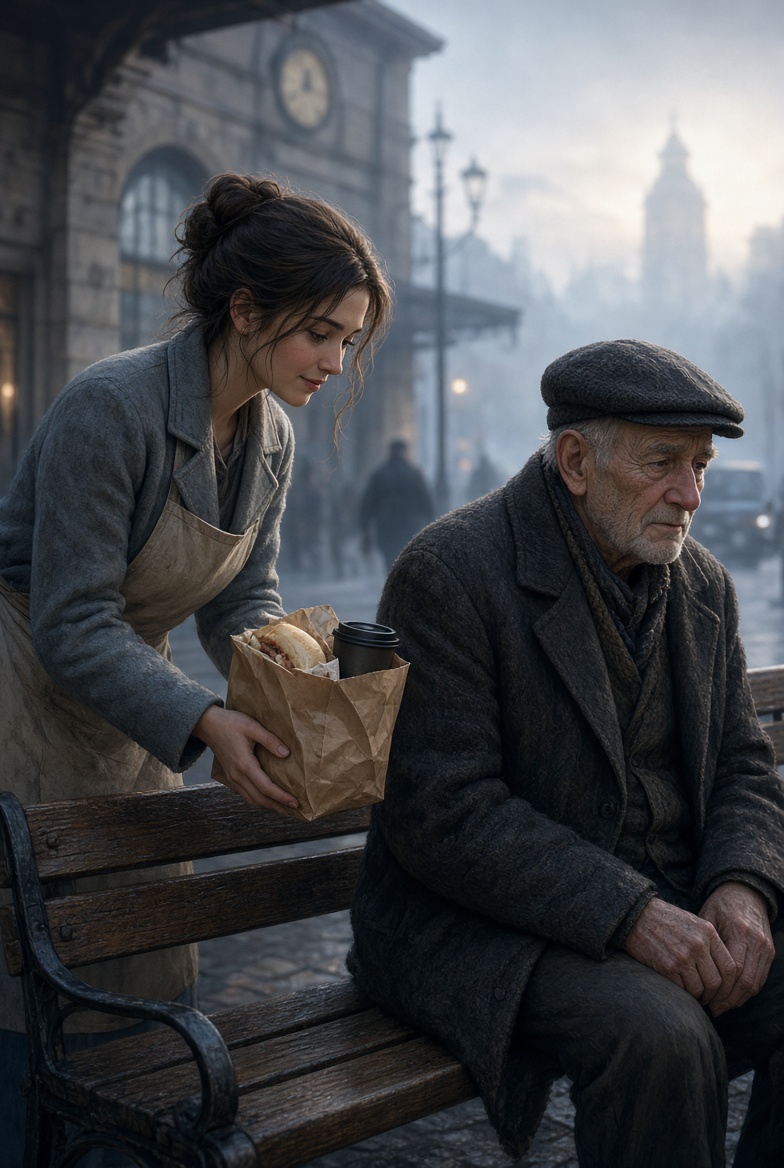
The bench outside Union Station had a way of collecting ghosts. Zorabel Bell noticed it every Tuesday morning when she stepped off the 5:47 bus, her apron still smelling of bacon grease from the diner, her nursing textbooks crammed into a canvas bag that had seen better days.
The old man was always there. Same bench. Same posture. Same wool cap pulled down to his eyebrows like he was bracing for a storm that never stopped.
She didn’t know his name for the first two weeks. He never asked for anything, never held out a cup, never muttered a thank-you. He just sat, eyes fixed on something far beyond the morning commuters, and ate whatever she set beside him.
Peanut butter on wheat. One banana. Black coffee.
The first time, she had been running late, her rent due Friday, her last semester of nursing school threatening to slip through her fingers like water. She had bought the sandwich on impulse, left it on the bench without a word, and kept walking.
The next Tuesday, the sandwich was gone. The wrapper was folded into a neat square, tucked under the bench leg like a tip.
That was six months ago. Now it was a ritual. A religion. A small, stubborn act of faith in a world that had stopped believing in anything.
“You’re four minutes early,” the old man said on this particular Tuesday, not looking at her.
Zorabel set the paper bag down beside him. “The bus driver likes me.”
“Did I ever tell you about the night we pulled forty-one people out of the Gulf?”
“Every Tuesday.”
“It is Tuesday.”
She laughed despite herself. The morning was cold for October, the kind of cold that crept through the soles of her shoes and settled in her bones. The old man’s hands were shaking as he reached for the sandwich. She pretended not to notice.
“You need a doctor,” she said.
“I need my coffee.”
She handed him the cup. He took a sip, grimaced, and nodded like the burn was a friend he hadn’t seen in years.
“There’s a clinic on Fifth,” she said. “They take walk-ins. Free until noon.”
“I’m not sick. I’m just old.”
“You’re not that old.”
He looked at her then, really looked, and she saw something flicker behind his eyes. Something sharp and sad and terribly lucid. “You don’t know how old I am.”
“You don’t know how old I am, either,” she said. “But I know you remember my name.”
“Zorabel.”
“That’s right.”
“Like the angel.”
“Like my grandmother.”
He nodded slowly, took another sip of the terrible coffee, and said nothing else. She stood there for a moment, the cold wind cutting through her thin coat, and felt something she couldn’t name.
Later, she would tell herself it was nothing. A feeling. A flutter. The kind of thing you dismiss because you’re young and busy and the rent is due Friday and you have forty-one reasons to walk away.
—
The diner was called Merson’s, and it had been on the corner of Fifth and Main since before Zorabel was born. The floor was checkered linoleum, the booths were red vinyl, and the coffee was terrible in a way that had become a point of pride for the owner, a wiry man named Duke who swept the sidewalk every morning at six and complained about the pigeons like they were personal enemies.
Zorabel had worked there for two years. She knew every regular by name, every order by heart, every complaint before it was spoken. She could have worked anywhere, but Merson’s had one thing no other diner had: a schedule that let her attend classes in the morning and study in the afternoon.
One semester left. That was what she kept telling herself. One semester, and she would be a registered nurse. One semester, and she would have a real job, a real paycheck, a real life.
She just needed the money.
“Table six,” Duke said, sliding a plate across the counter. “He’s a pig.”
Zorabel glanced at the man in the corner booth. He was middle-aged, red-faced, and already on his third cup of coffee. She knew the type. He would order the cheapest thing on the menu, complain about the eggs, and leave a nickel for a tip.
“He’s a regular,” she said.
“He’s a pig. There’s a difference.”
She took the plate. “It’s the only job near the nursing school.”
“I know.” Duke’s voice softened. “I know.”
She refilled the pig’s coffee, smiled at his complaints, and returned to the counter. Glenn, the fry cook, was watching her with a look she didn’t like.
“You’re feeding the bench man again,” he said.
“His name is Mr. Price.”
“His name is ‘that crazy guy who thinks he flew helicopters.'”
“Boats,” Zorabel said. “He thinks he flew boats.”
“That’s not better.”
She pulled a five-dollar bill from her apron pocket and set it on the counter. “I need an hour off tomorrow. I have a study group.”
“You have a study group every Tuesday.”
“I have a study group every Tuesday.”
Glenn shook his head, but he took the money. “You know, every bag that leaves my kitchen comes off your check. I pay for everyone. The receipts are in the jar by the register.”
“I know.”
“Then pay for this, too.”
She didn’t have to ask what he meant. She knew. They all knew. The sandwich, the banana, the coffee. Four dollars a day, six days a week, for six months. She had done the math more times than she cared to admit.
One hundred and forty-four dollars. It wasn’t much. It was everything.
—
The ambulance came at four in the morning.
Zorabel wasn’t there. She was at home, asleep, dreaming of a hospital ward where every patient had a name and every name mattered.
She found out when she arrived at Union Station, breakfast in hand, and saw the bench empty for the first time in six months.
Her heart stopped.
“What happened?” she demanded, grabbing the arm of a passing commuter. “The man who sits here—what happened to him?”
The commuter shrugged. “Ambulance took him. Around four. He looked bad.”
“Which hospital?”
“How should I know?”
She called 911. She called the police. She called every hospital within a twenty-mile radius, her voice rising with each one, her hands shaking so badly she could barely hold the phone.
No one had a patient named Haron Price.
No one had a patient matching the description she gave.
She sat down on the empty bench and cried for the first time in months. The tears came without warning, without reason, without any logical explanation except that the world had suddenly become a place she didn’t recognize.
“Hold on to this for me in case I miss a morning,” he had said, pressing something into her hand.
She looked down. It was a compass. Old, brass, the needle still steady, the glass scratched with age. On the back, engraved in a looping hand: Find the way home.
She didn’t know why she had kept it. She didn’t know why she held it now, pressing it to her chest like a talisman, like a prayer.
She didn’t know anything except that she had to find him.
Three days later, three men in Coast Guard dress uniforms knocked on her door.
Zorabel was in her apartment, surrounded by textbooks and unpaid bills, when she heard the knock. She opened the door, still in her pajamas, her hair a mess, and froze.
“Miss Bell?” the first man said.
“That’s me.”
“We’re here about Captain Haron Price.”
Her heart dropped. “Is he all right?”
“May we come in?”
She stepped aside. The men entered her apartment like they had entered a thousand other apartments, with the practiced ease of people who had delivered bad news before. They stood in her living room, their caps tucked under their arms, and looked at her with something that was almost respect.
“Miss Bell,” the first man said, “Captain Price is in our care at the base hospital. He is safe.”
“Then why are there three of you?”
“Because he asked for full dress.”
She didn’t understand. She said so.
The second man stepped forward. He was older, his face weathered by wind and sun. “Thirty years ago, Captain Price pulled forty-one people from the water in one night. The record still stands.”
“He told me every Tuesday,” Zorabel whispered. “Nobody believed him.”
“We did.” The man’s voice was quiet. “We never stopped looking.”
“He vanished from every record eight years ago. His pension untouched. We thought he was dead. Then someone—” He paused, cleared his throat. “Someone found him on a bench outside Union Station. Every morning. Feeding the pigeons.”
“He doesn’t feed the pigeons,” Zorabel said. “He feeds himself.”
The third man spoke for the first time. “He wants to know why you are late for breakfast.”
She laughed. It came out broken, jagged, more sob than sound. “Tell him the bus was late.”
“He would like to tell you himself. On Saturday, he receives the gold life-saving medal thirty years late. He listed one guest.”
She looked up. “Who?”
“You.”
—
The ceremony was held at the Coast Guard station, a sprawling complex of white buildings and gray water. Zorabel arrived early, wearing her best dress, a blue cotton thing she had bought on sale three years ago.
She didn’t own a hat. She didn’t own gloves. She didn’t own anything that felt appropriate for a national hero.
She was the closest thing to family he had.
The men in uniform escorted her to the front row. She sat in a plastic chair, her hands folded in her lap, and watched as Captain Haron Price was wheeled into the room. He was wearing his dress uniform, his medals gleaming, his face pale but composed.
He looked taller. Uniforms do that.
“In a storm thirty years ago,” the announcer said, “Captain Haron Price went into the water nineteen times. He came back with forty-one lives.”
The room was silent.
“I accept this for Margaret,” the captain said, “who was on the pier that night. And for the woman who found me on a bench.”
He turned to look at her.
“For six months, a young woman brought me breakfast. Peanut butter, a banana, black coffee. She did not know who I was. That is the whole point.”
Zorabel felt tears running down her face.
“Zorabel, will you stand?”
She stood.
“The Price Family Fund pays your last semester. And for the next forty-one students like you.”
She shook her head. “Captain, I can’t take this.”
“You pulled me out. Now let me throw the line back. Rule of the sea.”
She laughed. She cried. She said yes.
—
Later, after the cameras had gone, after the medals had been polished and put away, they sat in the hospital cafeteria and drank terrible coffee.
“I’m going to the pier,” the captain said. “Who is going to cook?”
“I owe you a breakfast.”
“You owe me the golf story. The long version.”
He smiled. It was the first real smile she had seen from him, unguarded and warm. “Margaret would have liked you.”
“Tell me about her.”
“She folded blankets corners first.” He paused. “She folded this the morning of the storm. I thought if I never came back, that morning would never have to end.”
“And now?”
“Now I would like to make breakfast in a kitchen.”
“You can cook?”
“Forty years of galley duty. Peanut butter, one banana, black coffee.”
—
The house on Shore Road had been empty for eight years. The door creaked when he opened it, the dust rising in motes of gold, the furniture draped in white sheets like ghosts waiting to be remembered.
Zorabel stood in the doorway, the compass in her pocket, and watched as the old man walked through his home for the first time in nearly a decade.
“Her chair,” he said, pointing. “She folded this the morning of the storm.”
The blanket was still there, folded corners first, the fabric faded but intact.
“I thought if I never came back, that morning would never have to end,” he said again.
“And now?”
“Now I would like to fill this house.”
He turned to her. “Nursing students need rooms near the hospital. Margaret’s house. The diner is for sale. You, me, and my partner.”
“You can’t afford this place.”
“Thirty years of pension. I never touched it. I could buy the block.”
She laughed. “And Miss Bell eats free for life?”
“Order up.”
—
The diner reopened three months later. Duke had retired, gone south to Florida with a woman he met online. Glenn had stayed, his apron still stained, his complaints still endless.
The captain sat at the counter every morning, drinking terrible coffee, reading the paper, talking to anyone who would listen.
“Did I ever tell you about the night we pulled forty-one people out of the Gulf?”
“Every Tuesday,” Zorabel said, sliding a plate of eggs in front of him.
“It is Tuesday.”
She looked at the clock. It was Wednesday. She didn’t correct him.
“Same bench,” he said. “Different view.”
“Same coffee.”
“Still terrible.”
—
Six months later, Zorabel graduated from nursing school. The captain sat in the front row, his uniform pressed, his medals gleaming, tears running down his face.
“Registered Nurse Zorabel,” the announcer said.
She walked across the stage, diploma in hand, and found him in the crowd.
“Request permission to be your first patient,” he said.
“Denied. You’re far too healthy.”
“Nurse Bell, the rescue station needs a medic on Mondays.”
“Is that a job offer with dental?”
“Ready.”
—
One year later, the diner was full. The house on Shore Road was full. The bench outside Union Station was empty, but no one noticed.
The captain came in every morning, same time, same order, same terrible coffee. Zorabel worked the counter, her nursing degree framed on the wall, her rent paid on time, her life full in a way she had never imagined.
“You still come?” she asked one Tuesday.
“Have it.” He pressed the compass into her hand. “Keep it. It works better in your pocket.”
“Why?”
“Because you never got lost.”
—
The three Coast Guard officers knocked on her door again on a Tuesday morning.
She opened it, already smiling.
“Nurse Bell, we’re here about Captain Price.”
“Is he all right?”
“He wants to know why you’re late for breakfast.”
She looked at the clock. It was 6:15. She was fifteen minutes late.
“Tell him the bus was late.”
“He wouldn’t believe that. The bus driver likes you.”
She laughed. “Tell him I’m coming.”
She grabbed her apron, her keys, the compass in her pocket. The morning was cold, the sky gray, the streets quiet. She stepped onto the bus, nodded to the driver, and sat in her usual seat.
The bench outside Union Station was empty.
But she knew where he was.
Same bench, different view. Same coffee, still terrible. Same family, found in the most unlikely place.
She walked into the diner, tied on her apron, and called out to the man in the corner booth.
“Order up, Captain.”
He looked up from his paper, smiled, and said, “Did I ever tell you about the night we pulled forty-one people out of the Gulf?”
“Every Tuesday,” she said.
“It is Tuesday.”
She poured the coffee, set the plate down, and sat beside him.
“Tell me the long version.”
And he did.
—
The compass sat on the counter between them, its needle still true, its promise still kept. Find the way home.
She had found it. In a diner. On a bench. In the stubborn, broken heart of an old man who had spent thirty years saving strangers and eight years forgetting how to save himself.
Forty-one strangers then one more.
Thank you for pulling me out.
—
The gold medal hung on the wall of the diner, next to a photograph of Margaret, next to a photograph of the bench. People came from miles around to see it, to hear the story, to meet the man who had forgotten who he was and the girl who had reminded him.
“Duke, you still have that broom?” the captain asked one morning.
“Yes, sir.”
“Good. Sweep the bench for the next man. Gently.”
The fry cook swept the sidewalk every morning at six. The pigeons still came. The commuters still passed. The bench still collected ghosts.
But now there was someone to feed them.
And that, Zorabel thought, was the whole point.









