She Arrived With Nothing… Until His Old Dog Chose Her First
Late one November afternoon in Lubec, Maine, Tessa Fairchild pushed open the door of a seaside community hall with a worn suitcase in one hand and another rejection letter folded in her coat pocket.
She had come looking for work, and the wind off Quoddy Bay had followed her all the way up the steps.
Inside, retired Navy SEAL Miles Westford stood in the kitchen doorway, staring at eighteen elderly neighbors who were waiting for dinner that did not exist.
He turned to the young woman dripping on the welcome mat and asked a question so simple it almost sounded like a joke.
“Can you cook?”
Tessa lowered her eyes to the scuffed linoleum.
“I can try.”
She waited for the polite no, the same one she had heard in nineteen different offices that fall.
But before Miles could answer, Flint, his aging German Shepherd, rose from a faded blanket by the fireplace and crossed the room one careful step at a time.
The old dog carried something in his jaws, and he laid it at her feet like a gift he had been saving for years.
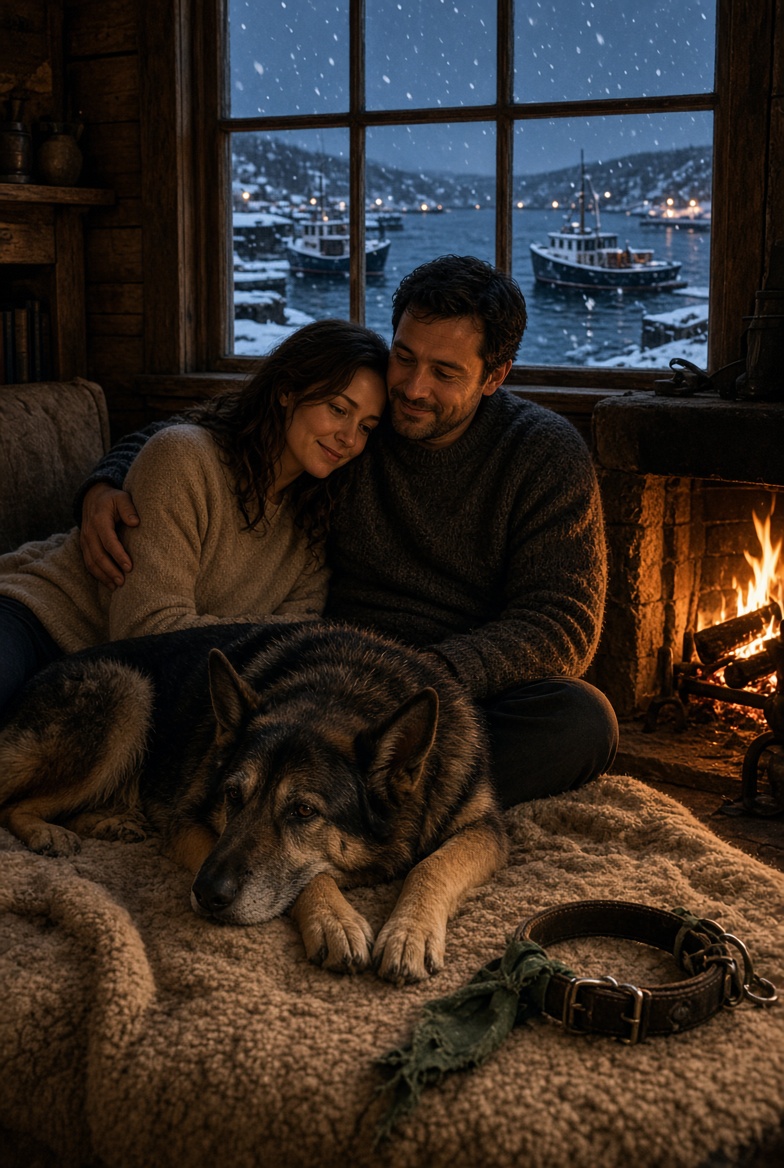
It was a worn leather collar with a strip of faded green fabric stitched along the inside.
Miles went completely still.
He was about to learn that sometimes the person who changes your life isn’t the one who promises to save you, but the one who quietly stays and tries.
Before we begin, tell us where you’re watching from in the comments, and if this story speaks to you, please like and subscribe to help us reach 1,000 subscribers.
Let’s step back to the hour before that collar touched the floor.
Tessa was twenty-eight years old, and she had spent three months sending applications into a silence that felt heavier with every week.
Funding cuts had erased her job at a family assistance center, where she had arranged rides and appointments for struggling families who had nobody else to call.
Her supervisor had once waved the whole thing away as “ordinary office work,” and the phrase had stuck to her like salt on a windshield.
She had seen the hall’s flyer taped inside a diner window two towns over, offering an administrative position, and she had driven the last forty miles on a quarter tank and stubbornness.
Now she stood in the entryway with her hand still tight around the suitcase handle.
“Excuse me,” she said carefully. “I’m here about the administrative position.”
Miles looked at her, then at the suitcase, and his expression softened in a way she had not expected.
“I’m sorry,” he said. “We had to suspend hiring. Budget problems.”
He was thirty-six, a broad man with tired eyes who had spent twelve years learning to stay calm when everything around him was falling apart.
Tonight, though, the volunteer cook was home sick with the flu, dinner was less than an hour away, and the refrigerator held little more than a bag of onions and some wilted celery.
He was beginning to suspect that the toughest mission of his life was a kitchen.
“I understand,” Tessa said, forcing a polite smile.
This was another closed door, and she had gotten very good at closing them gently behind herself.
She turned to go.
From the dining room came the scrape of chairs and the low, patient murmur of neighbors beginning to ask about supper.
Miles glanced toward the sound, then back at her.
“Wait. Can you cook?”
Tessa stopped with her hand on the door.
She looked at the vegetables scattered across the counter, then back at him.
“I can try.”
Miles held her gaze a moment longer than he meant to.
She looked exhausted, yet she hadn’t asked for sympathy, and she hadn’t promised anything she couldn’t deliver.
“That’s more than I can say for myself,” he admitted.
A small, surprised smile escaped her before she could stop it.
Then an elderly woman appeared in the doorway with her reading glasses pushed up into her silver hair.
Helen Bradock was seventy-six, a retired schoolteacher who had volunteered at the hall for nearly a decade, and she took one look at the counter and sighed.
“If we’re planning to feed everyone before Christmas,” she said, “we’d better start now.”
Miles turned to Tessa.
“I can pay you for tonight. Helen knows the kitchen, and I’ll help wherever you need me.”
Tessa looked past him toward the tables, where eighteen people sat with folded napkins and folded hands.
“All right,” she said. “But I should warn you. I’m better at organizing things than cooking them.”
“Then you’re already ahead of me.”
Helen pressed an apron into Tessa’s hands.
“Good. Now both of you stop talking.”
Within minutes the kitchen was alive with the clatter of pots and the hiss of a burner catching flame.
Tessa called out ingredients while Helen hauled down the largest stockpot in the cabinet.
Miles scrubbed potatoes and carrots with the focused intensity he had once saved for far more serious work.
His knife skills, unfortunately, did not match his focus.
Tessa leaned over the cutting board and examined his pile of onions.
“Are these for soup,” she asked, “or something we’re building outside?”
Miles looked down.
“They’re onions.”
“They’re practically whole onions.”
For the first time all afternoon, he laughed, a rusty sound that seemed to surprise him more than anyone else.
“Understood. Smaller.”
Tessa returned to the stove, still smiling.
She hadn’t expected a man like Miles to take teasing so easily, and his quiet confidence felt nothing like the arrogance she had learned to dread in her last relationship.
Miles, for his part, found himself watching the way she worked.
She dropped a spoon, cut her carrots unevenly, and nearly forgot to turn down the heat.
Yet every time something went wrong, she fixed it and kept moving, and she never once pretended to know more than she did.
Near the fireplace, Flint watched everything from his thick blanket.
He was ten years old, a retired working dog with a black and tan coat, a graying muzzle, and hind legs that stiffened whenever the temperature dropped.
He usually preferred his quiet corner to unfamiliar visitors, but his ears followed Tessa’s voice every time she spoke.
By six o’clock, eighteen bowls of vegetable soup were making their way to the dining tables.
Tessa had forgotten the salt until the last minute, and even then she hadn’t added quite enough.
Frederick Coulton, an eighty-one-year-old retired fisherman in a gray wool scarf, took his first spoonful and raised one bushy eyebrow.
“Well, young lady,” he said, “I’ve known seawater that needed less salt than this.”
Tessa froze with a bread basket in her hands.
Then Frederick reached for the shaker with a grin.
“But I’ve eaten worse aboard a fishing boat, and nobody complained, because we were too busy staying afloat.”
The room erupted in laughter.
Tessa covered her mouth and laughed along with them, and the embarrassment drained out of her as Frederick held up his bowl for seconds.
Miles saw her relief from across the room.
Later, he noticed something else.
Tessa remembered which woman needed help carrying her tray, and which gentleman liked his bread without butter.
When Frederick mentioned that the chair beside him had once belonged to his wife, she quietly set nothing there and left it undisturbed.
She had come to cook dinner, but somehow she was already making people feel seen.
After the meal, Miles found her at the sink beside Helen, her sleeves pushed to her elbows.
“You’ve done enough,” he said, picking up a dish towel.
Tessa nodded toward the stack of plates.
“There’s still work.”
“I noticed. That’s why I’m helping.”
Their hands brushed when he reached for a clean dish.
Tessa glanced up and realized he was closer than she had thought.
For a moment neither of them moved.
Then Miles stepped aside to give her room, and she turned back to the water with a faint smile she hoped no one had seen.
Outside, the wind rattled the windows in their frames.
When the last dish was dry, Tessa sat near the fireplace and rubbed her aching hands together.
Flint rose slowly from his blanket, waiting a moment for his hind legs to straighten.
He crossed to a low wooden shelf, lifted an old leather collar in his teeth, and carried it across the room.
Miles stopped folding a towel.
The dog placed the collar beside Tessa’s suitcase and looked up at her.
“Does he want me to put this on him?” she asked, puzzled.
“I don’t think so,” Miles said quietly.
He recognized the faded green fabric stitched inside the leather.
His mother had repaired that collar before she died three years ago, and Flint had kept it near his bed ever since, rarely bringing it to anyone.
Tessa did not touch it.
Instead she slid her suitcase aside to give the dog more room.
“You can sit here, sweetheart.”
The old German Shepherd lowered himself beside her chair and rested his muzzle on his paws.
Miles watched in silence.
He had seen people approach Flint with treats, toys, and loud, cheerful greetings, and every time the dog had retreated to his blanket.
Tessa had done none of that.
She had simply made room.
“He’s a special dog,” she said.
“He is.”
Miles looked at the collar, then at her.
For reasons he couldn’t explain, the hall felt less empty than it had that morning.
When Tessa stood to leave, Miles met her at the door with a manila folder.
“I can’t promise anything permanent,” he said. “But we have enough approved funds for two weeks of paid coordination work.”
Tessa blinked at him.
“You mean a real position?”
“Real hours, real responsibilities, real pay.”
She smiled, and this time it reached her eyes.
“Then I’d like to try.”
“I was hoping you’d say that.”
For a brief moment they stood facing each other while Flint slept peacefully by the fire.
Tessa felt something unfamiliar stirring beneath her exhaustion, not certainty and certainly not love, just the faint possibility that tomorrow might be worth looking forward to.
Then the front door opened and the cold came in.
Douglas Merik, sixty-two, a member of the hall’s management board who handled finances and building maintenance, stepped inside holding a brown envelope.
“Miles,” he said. “We need to talk.”
His expression erased Miles’s smile at once.
Inside the envelope was a building inspection report.
The kitchen’s ventilation system needed repairs, and unless the work was finished by the end of the week, the hall would have to stop using the kitchen entirely.
Miles studied the estimate at the bottom of the page.
19,500 USD.
He read it again, hoping the number would shrink, but the remaining maintenance fund held only 8,400 USD, less than half of what was needed.
Across the room, Tessa was thanking Helen and pulling on her coat.
Flint lay beside the fireplace, his old collar resting between his paws.
“We don’t have the money, Miles,” Douglas said, lowering his voice.
Miles kept staring at the report.
Only minutes ago he had offered a stranger a new beginning, and now he wasn’t sure he could keep the kitchen open long enough to give her one.
The next morning, Tessa arrived at the hall with a notebook, two sharpened pencils, and a promise to herself not to waste the chance Miles had given her.
The inspection report had left him unusually quiet the night before, but he had insisted they start organizing the dinner program while the board weighed its options.
He was already inside, counting cans of tomatoes and checking expiration dates.
Flint lay by the fireplace with his chin on the floor, watching the doorway.
When Tessa walked in, the old dog lifted his head and gave one slow wag of his tail.
“Good morning, handsome,” she said.
Miles looked up from his clipboard.
“I’ll assume you’re talking to him.”
Tessa grinned.
“He hasn’t complained about my cooking yet. Give him time.”
She settled at the small desk beside the dining room and opened her notebook, and Flint watched her for a moment before lowering his head again.
She spent the morning learning how the hall actually worked.
Rather than announcing new rules, she asked Helen about meal schedules, volunteer availability, and which neighbors came regularly.
She noticed that some guests arrived hours before dinner and stayed long after the dishes were cleared.
Frederick appeared fifteen minutes before the afternoon gathering, exactly as Helen had predicted.
He removed his cap, greeted everyone by name, and settled into his usual chair by the window.
The chair beside him stayed empty, and Tessa noticed that he turned toward it whenever someone said something funny.
Later, while they sorted napkins, she asked Helen about it in a whisper.
“His wife used to sit there,” Helen said. “Every Thursday for almost twelve years. She passed away four years ago.”
Tessa glanced across the room.
Frederick was watching the harbor through the glass, both hands wrapped around a cup of coffee.
“Should we move the chair?”
Helen shook her head.
“He likes it right where it is.”
Tessa left it untouched.
That afternoon she wrote down everyone’s usual arrival times and asked each person whether they needed a ride or help getting home.
She learned that most of the neighbors could cook for themselves, but they came because they hated eating alone.
The hall was never really about supper.
It was about the hour when the house stopped feeling quiet, and Tessa understood why its uncertain future weighed so heavily on Miles.
Over the next few days, Flint developed a new routine.
Whenever Tessa opened her notebook, he rose from his blanket, shuffled across the room, and settled beside her chair.
One afternoon she watched him struggle on the smooth tile, his rear paws sliding before he caught his balance.
She didn’t rush at him or fuss.
She waited until he settled, then asked Miles if she could borrow an old rubber-backed mat from the storage room.
“For Flint,” she said. “He seems to have trouble getting his feet underneath him.”
Miles looked toward the dog.
“I’ve noticed it more lately.”
Together they unrolled the mat beside her chair, and she moved Flint’s water bowl closer so he wouldn’t have to cross the slick floor.
The following afternoon, Flint walked straight to the mat and lowered himself with a relieved sigh.
Miles stood in the kitchen doorway, watching.
“You’ve made yourself a loyal assistant.”
“He works very hard,” Tessa replied.
“At what?”
“Supervising me.”
Miles smiled.
“He used to be much stricter.”
There was affection in his voice, and something quieter underneath it.
Tessa understood that Flint had once been a vital part of Miles’s working life, and that every slow step the dog took now reminded him of how much had changed.
Later that day, Flint surprised them both by lifting an oven mitt from a low shelf and dropping it beside her notebook.
“Well, that’s settled,” Miles said, laughing. “He trusts you with the kitchen more than he trusts me.”
Tessa held up the mitt.
“At least Flint has never complained about my soup.”
“He doesn’t know how to use a salt shaker.”
“Then we’re perfectly suited.”
Their laughter lingered after the joke had ended.
Miles realized he was enjoying the ease of talking with her, and Tessa had begun to notice how he always checked that the older guests had warm coats before they left.
He finished chores nobody had asked him to do, and he never made a show of it.
One evening, after Helen had gone home and the dining room was clean, Miles asked if Tessa wanted to join him on Flint’s short walk along the harbor.
The wind had finally settled, and the waterfront was unusually quiet.
Fishing boats rested against the docks, and the lights of nearby houses wobbled across the black water.
Flint walked between them at an unhurried pace, stopping now and then to investigate a familiar smell.
Miles kept the leash loose.
“He doesn’t go very far these days,” he said. “Especially when it’s cold.”
“He seems happy enough.”
Miles looked down at his old companion.
“I think he’s still learning that he doesn’t have to work anymore.”
Tessa considered that.
“And you?”
A small smile tugged at his mouth.
“Apparently I haven’t learned much faster.”
They kept walking, their footsteps knocking softly against the boardwalk.
After a while Miles told her about coming home to Lubec after the Navy.
His mother had been ill, and he had returned intending to take care of her, but even then he kept himself busy hunting for work and trying to decide what came next.
“I thought being useful meant always having something to accomplish,” he admitted. “I spent too much time worrying about tomorrow.”
Tessa listened without interrupting.
He explained that his mother had organized community dinners for years, often cooking the meals herself when volunteers fell through.
After she died, he had kept the program running because he couldn’t stand the thought of her work disappearing.
He paused while Flint sniffed a patch of grass.
“Sometimes I wonder whether she’d approve of how I’m running things.”
“Did she expect you to do everything alone?”
Miles gazed out at the water.
“No. She was usually telling me the opposite.”
Tessa smiled faintly, but she didn’t press him.
They walked a little farther before he asked what had brought her to Lubec beyond a flyer in a diner window.
Tessa hesitated.
Then she told him about the family assistance center, the funding cuts, and the months of unanswered applications.
She told him about the man she had once expected to marry.
“He thought my work was a waste of time,” she said. “When I lost the position, he told me I should have chosen something more impressive.”
Miles slowed his steps.
“What did you tell him?”
“That I wasn’t asking for his permission to care about my work.”
A quiet smile touched Miles’s face.
“Good answer.”
“It didn’t feel like one at the time.”
She explained that leaving him had been her own decision, but his words had followed her anyway, and every rejection letter made them harder to forget.
Miles did not tell her everything would be fine.
He didn’t offer to solve her problems or insist she ignore what had happened.
He simply waited until she was done.
“Someone else doesn’t get to decide what your work was worth, Tessa.”
She looked at him.
He had said it plainly, without trying to make the moment bigger than it was, and that was exactly why it landed.
For several seconds she said nothing.
She had spent so long defending her choices and proving she had something to offer, and Miles had just listened without asking her to become someone else.
When Flint stopped to rest, they stood together at the harbor railing.
Miles gently checked the dog’s collar, a newer nylon one, while Tessa watched the distant lights.
Neither of them hurried to end the walk.
Back at the hall, Miles offered to make coffee before she returned to her guest house.
She accepted, and they spent another half hour on the volunteer schedule, and this time the conversation came easily.
When Miles stepped out to make sure the rear entrance was locked, Tessa began straightening the receipts piled across the desk.
He had given her permission to review the program’s routine expenses, and several invoices still needed to go into the ledger.
One grocery receipt stopped her.
It had been paid with Miles’s personal debit card.
She found another from the previous week, then several more from earlier in the month.
Each one covered ordinary things, like vegetables, bread, coffee, cleaning supplies, and food for the community dinners.
Tessa opened the expense ledger to see whether he had been reimbursed.
He hadn’t.
She worked through the entire folder and discovered that Miles had been quietly covering shortfalls for fourteen months, and the total came to 11,300 USD.
Then she found a recent financial summary.
Most of the savings he had set aside for his future were already gone, spent to keep the lights on and the pots full.
Beneath the summary lay a preliminary inquiry from someone interested in buying his mother’s small fishing boat, with an offer of 6,800 USD.
Tessa stared at the page.
The boat was the same one he had mentioned on their walk, a family possession he still maintained even though he rarely took it out on the water.
Now she understood why he had spoken so carefully about protecting his mother’s work.
He was considering giving up one of the last things she had left him.
Footsteps echoed in the hallway.
Tessa closed the folder just as Miles walked back in.
“Everything all right?” he asked.
She looked at him, then at the folder under her palm.
For the first time since arriving in Lubec, she wondered how much of his quiet confidence was a wall built around a burden he had never let anyone else carry, and whether Miles Westford would let her help before there was nothing left for him to give.
The next morning, Tessa reached the hall before sunrise with the financial records tucked under her arm.
The kitchen was dark and silent, and the smell of yesterday’s coffee still hung in the air.
She spread the invoices across a long table, determined to understand how a place that meant so much to so many people had come so close to running out of money.
The ventilation repairs were only one piece of it.
Grocery purchases swung wildly from week to week, volunteer shifts went unfilled, and small expenses had piled up unnoticed until they became a mountain.
Whenever the program fell short, Miles had quietly covered the gap.
By eight o’clock, Tessa had built a simple budget showing what the hall could realistically afford.
Miles arrived carrying a bag of groceries, and Flint followed at his usual careful pace, pausing at the doorway before crossing to his blanket.
“You’re here early,” Miles said.
“I wanted to understand the numbers before we talked about them.”
He noticed the neat stacks of paper and pulled out a chair.
Tessa laid out her proposal.
The hall would stop using its kitchen when the inspection deadline arrived, arrange meal preparation through another approved facility, and organize volunteers to deliver food to neighbors who could no longer travel easily.
“We may need to serve fewer dinners each week until the finances improve,” she added.
Miles leaned back.
“Some of these people depend on those meals.”
“I know. That’s why I’m trying to make sure the program survives.”
He studied the figures without answering.
Tessa tapped the column of projected expenses.
“If we keep operating the same way, even selling the boat won’t solve this for long.”
Miles looked up sharply.
“That boat is my decision.”
“I understand. But the hall needs a plan, not another personal sacrifice.”
His jaw tightened.
For years, Miles had believed that responsibility meant standing firm when others couldn’t, and he had come home to Lubec determined to protect everything his mother built.
Hearing Tessa question that approach felt uncomfortably close to hearing that he had failed.
“You haven’t been here long enough to understand what this place means,” he said.
The words came out harsher than he intended.
Tessa went very still.
Only days ago he had listened to her talk about being dismissed and underestimated, and now his own sentence had dragged that old feeling back into the room.
She closed the folder carefully.
“You’re right. I haven’t been here long. But you hired me to help, Miles, and I can’t do that if every suggestion becomes something I have to defend.”
He looked away.
Neither of them spoke for several seconds, and the old kitchen clock on the wall ticked loud enough for both of them to hear.
Finally Tessa gathered her papers.
“I’ll finish the budget and make the calls we discussed. You can decide what you want to do with them.”
She returned to her desk and left him alone with the grocery bag.
For the rest of the morning they spoke only when they had to.
Tessa phoned nearby organizations about temporary meal preparation and asked whether any licensed kitchen might sit open during the repairs.
She also began a list of volunteers willing to drive or deliver, and several people offered limited help, though nothing was confirmed.
The work gave her something steady to hold on to.
Miles spent the morning checking supplies and making calls of his own.
He wanted to apologize, but each time he walked toward her desk he found another task that seemed easier than admitting he had been wrong.
Flint noticed neither the budget nor the argument.
He only knew that the familiar rhythm of the room had changed.
That afternoon the old shepherd stayed close to his blanket instead of following Tessa to her desk.
He shifted position several times, favoring his hind legs whenever he rose.
Tessa noticed and mentioned it.
“He’s having a harder time getting comfortable today.”
Miles glanced over.
“The cold does that sometimes.”
“He seems more uncomfortable than yesterday.”
Miles crouched beside the dog and rubbed his shoulders.
Flint leaned into his hand, but when he tried to stand, his back legs trembled.
Miles frowned.
He had seen the stiffness growing over the past few weeks, but the demands of the hall had kept him from giving it the attention it deserved.
Early the next morning, a car pulled into the parking lot while Flint rested near the kitchen doorway.
Recognizing the sound, the dog tried to rise too quickly, his rear paws skidded across a bare patch of tile, and he dropped awkwardly onto his side.
Miles was beside him in two strides.
“Easy, buddy. I’ve got you.”
Flint lay still for a moment before lifting his head.
Miles checked each leg with careful hands, then helped him settle onto the nearby mat, and the dog seemed uncomfortable but showed no sign of serious injury.
Tessa came over, keeping her voice calm.
“Maybe we should have him checked.”
Miles nodded.
This time he didn’t argue.
He called the veterinary clinic and booked an appointment for that morning, and Tessa offered to run the hall while he was gone.
He accepted with a grateful glance.
The vet examined Flint’s joints and watched him walk the length of the hallway.
There was no evidence of a serious injury from the slip, and the stiffness was consistent with age-related joint trouble.
She recommended continued monitoring, appropriate treatment, shorter walks, and better traction around the house and the hall.
Miles listened closely, asking questions about pain and about how he would know when Flint needed more help.
When they got back, Tessa had laid a second non-slip mat beside Flint’s favorite resting spot and cleared a wider path to his water bowl.
Miles noticed immediately.
“You didn’t have to do all this.”
“I know,” she said, still smoothing the blanket. “He shouldn’t have to struggle just because the rest of us are busy.”
Miles looked at Flint, now resting comfortably, and felt something in his chest give way.
He had been so consumed with keeping the hall open that he had missed what was changing right in front of him.
“Thank you, Tessa.”
She gave a small nod.
For a moment, the distance between them felt less certain.
Later that afternoon, Helen found Miles sitting alone near the fireplace while Flint slept at his feet.
She set a cup of coffee on the table beside him.
“Your mother used to sit right there when she couldn’t decide what to do about this place.”
Miles looked up.
“She always seemed to know.”
Helen smiled.
“Not nearly as often as you think.”
She told him about the winter two volunteers moved away and his mother nearly buckled under the dinners.
Instead of taking on their duties herself, she had asked the neighbors to build a rotating schedule, and the whole hall had grown stronger for it.
“She told me something that stayed with me,” Helen said. “If one person has to carry the whole place, then we haven’t really built a community.”
Miles stared into his coffee.
His mother had never wanted the hall to become a monument to her memory.
She had wanted it to stay a place where neighbors looked after one another, and somewhere along the way he had confused honoring her with refusing to let anyone else share the load.
Helen touched his shoulder.
“Tessa is trying to help you, Miles. That doesn’t mean you’re doing a poor job.”
He nodded, though admitting it still felt like swallowing a stone.
That evening he found Tessa at her desk, reviewing a revised budget by lamplight.
He stood beside her and studied the volunteer schedule she had drawn up, every shift color-coded in careful pencil.
“You’ve done a lot of work.”
“It’s what you hired me for.”
He hesitated.
“What I said yesterday. It wasn’t fair.”
Tessa closed her notebook.
“No, it wasn’t.”
Miles accepted the answer without flinching.
“I’ll look at your plan again.”
She wanted to believe him, but she had learned the hard way that listening and changing were not always the same thing.
Before she left that night, Tessa carried the completed expense folder into Miles’s office.
She meant to set it beside the inspection report so he would find it first thing in the morning.
A separate document lay near the edge of his desk.
She recognized the name of a local boat buyer printed across the top.
Beneath it was a preliminary sale agreement for the small fishing boat his mother had left him, with the price of 6,800 USD already typed in and a proposed signing date penciled beside it.
Tessa stood motionless.
She had believed him.
Flint’s hard morning and Helen’s gentle advice had seemed like enough to make Miles reconsider, yet while she searched for a way to save the hall without draining him, he was still preparing to sell another piece of his own future.
She set the folder beside the agreement and stepped back.
From the hallway came the familiar sound of Flint shifting on his blanket.
Tessa looked at Miles’s empty chair and wondered whether his promise to reconsider had meant anything at all.
The next morning, a cold November rain tapped against the office windows while Flint slept near the doorway.
Tessa found Miles alone at his desk, reviewing the repair estimates, and she placed the boat agreement on top of them.
Miles looked at the document, then at her.
“I haven’t signed anything.”
“But you’ve already chosen a buyer,” Tessa said. “You told me you would reconsider.”
Miles set down his pen.
“The boat belongs to me, Tessa. Selling it is my decision.”
“I’m not questioning that. I’m asking why you hired me to find a better solution if you’re going to ignore everything I suggest.”
He stood, struggling to keep his frustration from showing.
The boat held memories of his mother, but the hall held the last years of her life, and losing either one felt unbearable.
He had talked himself into believing that sacrificing one might save the other.
“It’s only a boat,” he said. “This place is all I have left of her.”
Tessa glanced toward the dining room.
“Then think about the people who come here, Miles. They’re the reason she kept it open.”
“You don’t understand what I’ve been responsible for all these years.”
The words silenced her.
Miles regretted them the moment they left his mouth, but Tessa had already stepped back.
She had spent days building a practical plan only to discover that he still saw her as someone who couldn’t understand the weight he carried.
“Maybe I don’t,” she answered quietly. “But I know I can’t keep working somewhere my judgment isn’t respected.”
She handed him the completed budget.
Then she spent the next hour sitting with Helen, walking her through the volunteer schedules, which contacts still needed confirmation, and where the transportation requests were recorded.
When Helen asked whether something had happened, Tessa only said that she needed to step away from the position for now.
Miles watched her walk out with the same worn suitcase she had carried in on her first afternoon.
Flint rose when the door closed.
He took several careful steps toward it, then looked back over his shoulder at Miles.
“She’s gone, buddy.”
The old dog stayed where he was until Miles gently guided him back to his blanket.
Over the next two days, Miles tried to run the dinner program himself.
The kitchen had closed under the inspection notice, and a nearby facility had agreed to prepare meals temporarily, but cooking food turned out to be easier than making sure everyone received it.
One volunteer misread the delivery schedule.
Another couldn’t drive after dark.
Three elderly neighbors showed up at the hall without knowing that dinner had moved across town.
Miles apologized and arranged rides, but each fix revealed another crack.
Tessa’s system had covered all of this.
He simply hadn’t followed it carefully enough.
Frederick missed the first relocated dinner.
Miles assumed the cold had kept him home, since the old man often complained about his aching joints.
At the next gathering, Helen approached him with a worried frown.
“Frederick hasn’t returned my calls. And he’s been worried about his house.”
Miles looked up.
“His house?”
“The landlord may sell it. Frederick got a notice last week. He doesn’t know whether he’ll have to move.”
Miles remembered Frederick laughing over supper, always leaving the chair beside him empty.
He had never once considered that the old fisherman might be facing a second loss on top of his wife’s passing.
That evening Helen tried calling again, and again nobody answered.
By nine o’clock, her phone showed 29 missed calls to the same number.
Miles drove to Frederick’s rented cottage.
The windows were dark and the front door was locked, and no one answered when he knocked.
He checked with two nearby neighbors, but neither had seen Frederick since lunchtime.
He pulled out his phone and called Tessa.
She answered after several rings.
“Miles, it’s Frederick. We can’t find him.”
Her voice changed instantly.
“Have you checked the waterfront?”
“Not yet.”
“He told me he sometimes walks there when he’s worried.”
Miles looked toward the darkening harbor.
“I’ll meet you at the hall.”
When Tessa arrived, she carried the notebook containing Frederick’s usual routes and the places he liked to visit.
She didn’t mention their argument, and Miles understood that she had come back for Frederick, not for him.
Flint came along for the short search near the water.
Miles kept him on a leash and went slowly over the damp pavement.
They checked the benches overlooking the fishing boats, then walked toward an old bus shelter beside the harbor road.
Flint stopped.
His ears lifted toward a gray wool scarf draped over the back of a wooden bench.
He moved closer, sniffed the fabric, and looked toward a nearby storage building.
“That’s Frederick’s,” Tessa said. “He wears it every Thursday.”
Flint took a few steps toward the building, then slowed.
His hind legs were stiff with cold, and he stood still instead of pushing on.
Miles crouched beside him.
“That’s enough, old friend.”
He held the leash and let Flint rest while Tessa searched the sheltered side of the building.
A faint movement caught her eye.
“Miles. Over here.”
Frederick sat behind a wooden windbreak with his shoulders hunched against the cold.
He was awake but exhausted, and his hands trembled as he tried to pull his coat tighter.
Miles approached slowly.
“Frederick, it’s Miles. We’re here.”
The old fisherman looked up, embarrassed.
“I only meant to sit for a little while.”
Tessa knelt beside him.
“Let’s get you somewhere warm.”
With Frederick’s agreement, they helped him into Miles’s truck.
Because he had been out in the cold for so long, Miles drove him straight to the ER to be checked before bringing him back to the hall.
Flint settled carefully beside the back seat, watching Frederick without making a sound.
Later, after the doctors had cleared him and he was bundled in dry clothes, Helen made tea while Tessa found a blanket.
For a long time, Frederick said very little.
Then he looked down at his hands.
“They might sell the cottage. I’ve lived there nearly twenty years. I don’t know where I’d go.”
Miles pulled a chair closer.
“Have you talked to anyone about your options?”
Frederick shook his head.
“I didn’t want to trouble anybody. You’ve all done so much already.”
His voice dropped.
“After my wife passed, that little house was the only place where everything still felt familiar.”
Tessa sat nearby, listening.
Miles had always believed that keeping the dinners going meant protecting people like Frederick.
Yet the old man had been sitting alone in the cold, afraid of losing his home, while Miles argued over how many meals the hall could afford.
He realized there were troubles that a warm dinner could not fix.
Flint slowly approached Frederick’s chair and lowered himself onto the rug.
Frederick reached down and rested a hand on the dog’s graying neck.
“Getting old isn’t easy, is it, boy?”
Flint closed his eyes beneath the gentle touch.
Miles watched the two of them.
Both had spent their lives doing work that mattered, and now both needed patience, comfort, and someone willing to notice when things got hard.
He moved his chair closer.
“We’ll help you find out what choices you have. You don’t need to work through this alone.”
Frederick nodded, his eyes shining.
After Helen agreed to stay with him, Miles walked Tessa toward the entrance.
The rain had stopped, and the harbor road gleamed wet beneath the streetlights.
“I’m sorry,” Miles said.
Tessa turned.
“For what I said. And for not trusting your judgment.”
She waited while he searched for the rest of the words.
“I kept thinking that if I could hold everything together myself, I wouldn’t lose another piece of what my mother left behind. I didn’t realize how much I was pushing everyone away.”
Tessa looked through the window at Frederick and Flint resting side by side.
“I care about this place, Miles. But I need you to believe my work matters even when I disagree with you.”
“I know.”
She studied his face.
“An apology means something. But what you do next matters more.”
Miles nodded.
He wanted to ask her to stay, not only at the hall but in his life, and instead he walked her to her car and let her leave without demanding an answer she wasn’t ready to give.
The next morning, Tessa sat at the small desk in her guest house when an email chimed on her laptop.
A family support organization in Bangor had reviewed her application.
They were offering her a full-time coordination position with steady pay, benefits, and a start date in two weeks, at a salary of 52,000 USD a year.
She read the message twice.
It was the opportunity she had been chasing before she ever came to Lubec.
Outside her window, the harbor was beginning to brighten beneath the morning clouds.
Somewhere across town, Miles was getting ready for another day at the hall, and Flint would soon be settling onto the mat beside her empty chair.
Tessa looked back at the offer.
For the first time since arriving, the future she had worked so hard to find might require her to leave the people she had come to love.
The next morning, Miles sat alone in the hall, looking over the financial reports Tessa had prepared.
Flint slept beside his chair, and the empty dining room reminded him how much work remained.
For the first time, Miles understood that determination alone would not keep the doors open, and that it certainly didn’t give him the right to ask Tessa to sacrifice her future.
He had spent the previous evening thinking about Frederick, the frightened old man who had nearly vanished into the cold rather than ask anyone for help.
Miles had always believed that carrying more made him dependable.
Now he was beginning to see how easily that belief could push people away.
Before opening the hall, he called her.
“I’d like you to present your plan to the board,” he said. “You’ll be paid for the work, whether you stay in Lubec or take the position in Bangor.”
Tessa was quiet for a moment.
“Are you asking because you trust my judgment, or because you’re afraid I’ll leave?”
Miles looked toward Flint, who had lifted his head at the sound of her voice through the speaker.
“Because you were right about the program, and because I should have listened sooner.”
She agreed to meet him that afternoon.
When she arrived, Miles had already spread the financial records across the conference table.
Douglas joined them to review the expenses, including every purchase Miles had made from his personal savings, and nothing was left out.
Miles also told them he had postponed the sale of his mother’s fishing boat.
Tessa studied him carefully.
“Does that mean you’re willing to try a different solution?”
“It means I’m willing to stop pretending mine is the only one.”
She smiled, but neither of them treated the moment as a complete repair.
There was still work to do, and they both knew it.
Over the next several days, they built a smaller, more realistic operating plan.
Tessa arranged a temporary partnership with a local facility whose kitchen met every requirement.
Miles called nearby businesses about food donations and transportation help.
Douglas drew up a budget that separated confirmed support from donations they merely hoped to receive.
Helen reached out to former volunteers and neighbors who had once worked beside Miles’s mother.
Some could spare an afternoon each week.
Others offered to make phone calls or deliver meals when the weather allowed.
Frederick had begun receiving guidance about his housing situation, too.
Nothing was settled yet, but he was relieved to learn he had time to explore his options.
When he heard about the community meeting, he offered to call several retired fishermen who might be willing to help.
“I’ve spent enough years asking those fellows to lend me fishing gear,” he told Miles. “Might as well ask them to lend a hand.”
Miles laughed.
For once, he didn’t feel embarrassed to accept the offer.
The days were busy, but something between Miles and Tessa had shifted.
He asked for her opinion before making commitments, and she explained her reasoning without bracing for a fight.
Sometimes they still disagreed.
Miles wanted more delivery routes than the available drivers could reliably cover, and Tessa insisted on starting with fewer households and growing only when volunteers confirmed their schedules.
This time, he listened.
One afternoon Flint wandered over to her desk while she reviewed the transportation list.
He settled onto his familiar mat and rested his gray muzzle against her boot.
Miles watched from the doorway.
“He’s going to miss having you here.”
Tessa glanced down at the old dog.
“I’ll miss him, too.”
Miles wanted to tell her how much he would miss her himself.
Instead he asked whether Flint needed fresh water.
She understood he was giving her space, though the sadness in his face stayed with her long after he left the room.
The community meeting took place three evenings later at the temporary dining facility.
Neighbors filled every chair, and volunteers stood along the walls with their coats still on.
Douglas prepared to explain the costs while Tessa arranged her documents in the order she planned to present them.
Flint lay beside Frederick, who had asked to keep the old dog near his chair.
Miles had brought a padded mat so Flint wouldn’t have to lie on the cold floor.
Before the presentation began, Frederick stood slowly and faced the room.
He spoke about the night Miles and Tessa had found him near the harbor, and he admitted that fear of losing his home had left him ashamed and unwilling to ask for help.
“I thought everybody had enough troubles of their own,” he said.
His hand rested lightly on Flint’s shoulder.
“Then I saw this old fellow coming toward me. He couldn’t move very fast, but he came anyway. Reminded me there were still people wondering where I’d gone.”
Frederick paused.
“The dinners matter. But knowing somebody notices when you’re missing matters just as much.”
Several neighbors nodded.
Helen quietly reached for a tissue.
Tessa watched Miles.
His attention stayed on Frederick, and for once he didn’t look like a man who needed to supply an immediate answer.
When Douglas began the financial review, the room grew serious again.
One organization that had promised to help had not confirmed its contribution of 4,500 USD, and without that money the proposed schedule could not be maintained.
Douglas turned toward Tessa.
“We can’t approve spending against funds we haven’t received.”
She looked down at her original projections.
The missing contribution left a gap large enough to threaten the entire program.
A few weeks earlier she might have felt compelled to defend every line of her work, but now she knew that honesty was worth more than looking certain.
“Then we need to begin smaller,” she said.
Tessa presented a revised plan.
The program would offer two community dinners each week using the partner kitchen, and participants would register in advance so meals could be prepared accurately.
Volunteers would run a separate check-in network for members who wished to receive regular calls.
Additional meals and deliveries would be added only when staffing and funding were confirmed.
The proposal disappointed some neighbors who had hoped to restore every dinner right away.
Tessa acknowledged their concerns without promising what the hall couldn’t deliver.
Then Miles stood beside her.
“For months, I’ve been trying to keep everything exactly the way my mother left it,” he said. “I thought changing the program meant letting her down.”
He glanced toward Helen and Frederick.
“But this place was never about one building or one person. It was about neighbors taking care of each other. Tessa helped me remember that.”
He turned toward her.
“And I trust her plan.”
Tessa felt her throat tighten, but she kept her eyes on the board.
After further discussion, the members approved a limited trial with a spending cap and a scheduled financial review.
The kitchen repairs still needed funding, and the future remained uncertain.
But the dinners could continue without leaning on Miles’s personal savings, and that was a start.
When the meeting ended, Helen hugged Tessa tightly.
Frederick declared that he intended to attend every single dinner, even if someone served him soup without salt.
Miles laughed with the others.
Later, he and Tessa walked along the harbor with Flint between them.
The old dog moved slowly, stopping now and then to rest against the railing, and the fishing boats rocked gently beneath the pier lights.
Miles waited until Flint was comfortable before he spoke.
“I’ve been wanting to tell you something.”
Tessa turned toward him.
He looked out over the water, then back at her.
“Somewhere between watching you care for Flint and seeing how you listen to people nobody else notices, I fell in love with you.”
Tessa’s breath caught.
Miles kept going before she could answer.
“I know about Bangor. I don’t want you to give up a good opportunity because of me. Whatever you decide, I want it to be yours.”
For a moment she could only look at him.
She remembered how her former boyfriend had made affection feel conditional on abandoning her ambitions, and Miles was offering something completely different.
“You make it very difficult to leave,” she whispered.
Miles smiled sadly.
“That wasn’t my intention.”
“I know. That’s what makes it harder.”
She stepped closer.
He reached for her hand, giving her time to pull away if she wished.
Instead Tessa leaned toward him.
Their kiss was gentle and brief, carrying all the tenderness neither of them had been ready to say out loud.
Flint shifted impatiently beside them, reminding Miles that the evening was getting cold and the walk home was overdue.
They laughed softly and turned back toward the street.
Later that night, Tessa sat alone in her guest house with the Bangor offer open on her laptop.
The deadline for accepting was noon the next day.
She had finally found the kind of love she once believed might not exist, yet the position in Bangor offered stability, professional growth, and a future she had worked hard to earn.
She rested her fingers above the keyboard.
For the first time, neither choice felt wrong, and that made deciding harder than ever.
The next morning, Tessa sat beside the window of her rented room, watching the first fishing boats slide through the gray December light.
On the desk lay two things, the job offer from Bangor and the blue notebook she had carried through every difficult month since losing her position.
The offer was everything she had been searching for.
It meant a full-time coordination job, steady pay, health benefits, and a chance to rebuild her career, and she had until noon to respond.
Tessa opened her notebook to a page covered in calculations.
During her weeks at the hall, she had also applied to a family support organization serving Washington County, and the previous evening, just before meeting Miles at the harbor, she had received a second offer.
It was a part-time coordination contract with clearly defined responsibilities and reliable pay, at 34,000 USD a year.
The salary was smaller than Bangor’s, but so were her living expenses in Lubec.
More importantly, the organization promised opportunities to expand her work as new programs developed.
She compared both positions carefully.
She weighed transportation costs, housing, professional growth, and the kind of life she wanted five years from now.
For once she wasn’t searching for someone else’s approval.
She thought about Miles and the kiss beside the harbor.
She loved him, but she refused to make a choice that would someday leave either of them carrying regret.
After reviewing the numbers one last time, Tessa accepted the local contract and politely declined the position in Bangor.
Her hands trembled slightly as she sent the messages.
Then she closed the laptop and smiled.
She had made her choice.
That afternoon, the temporary dining facility buzzed with preparations for its first meal under the revised schedule.
Helen arranged volunteer assignments while Douglas checked supply invoices against the approved budget.
Frederick stood beside a table, straightening a cloth that had already been straightened twice.
“If you keep pulling that corner,” Helen told him, “we’ll be eating dinner on the floor.”
Frederick stepped back.
“Just making sure everything looks respectable.”
Miles smiled as he carried a box of plates into the room.
The new arrangement demanded more coordination than the old dinners, but everyone had an assigned responsibility, and Miles no longer tried to inspect every small task or correct work others were perfectly capable of doing.
Near the entrance, Flint rested on the rubber-backed mat Tessa had placed there weeks earlier.
The old German Shepherd watched people pass, lifting his head whenever he heard a familiar voice.
Then his ears swung toward the doorway.
A moment later Tessa stepped inside.
Flint rose slowly, pausing until his hind legs were steady, then crossed to her with a gentle wag of his tail and pressed his graying muzzle into her hand.
Tessa crouched beside him.
“Hello, sweetheart. Did you miss me?”
Flint leaned closer, apparently satisfied that she had returned.
Miles watched from across the room.
He had spent the whole morning deliberately keeping himself busy, determined not to call and ask about her decision, and now she was standing there smiling at his dog.
He walked over.
“Hey.”
“Hey yourself.”
For a moment neither of them spoke.
Then Tessa stood and reached into her bag.
“I accepted a job this morning.”
Miles felt his chest tighten, but he kept his face steady.
“That’s wonderful, Tessa. I’m proud of you.”
She studied him, noticing that he hadn’t asked where.
“It’s with the organization here in Washington County. I’ll be working part-time at first, with room to grow.”
Miles stared at her.
“Here?”
“Here. In this area,” she said, smiling. “I decided Lubec is where I want to build my life.”
He took a small step closer.
“Are you sure?”
“I checked everything twice. You know how I am with schedules and numbers.”
That made him laugh.
Then her expression softened.
“I’m not staying because I need someone to rescue me, Miles. I’m staying because I found work I believe in, and because there’s someone here I’d like to keep getting to know.”
Miles reached for her hand.
“I’d like that, too.”
Flint settled beside their feet, having apparently decided that the conversation no longer required his supervision.
The first dinner under the new program went smoothly enough, though Frederick complained that someone had forgotten the butter.
Helen informed him that the butter was directly in front of him, right where it had been for the past ten minutes.
His embarrassed laughter rolled down the table.
Tessa watched Miles join the volunteers instead of directing every movement, and when a delivery question came up, he handed it to the person responsible rather than taking control.
The change was small, but she noticed it, and when Miles caught her watching, he smiled as though he knew exactly what she was thinking.
Over the following weeks, the dinner program settled into its new rhythm.
Two evenings each week, neighbors gathered at the temporary facility while repairs to the original kitchen were planned in stages.
The budget stayed tight, but expenses were recorded carefully and the workload was shared.
Helen coordinated the weekly schedules, Douglas reviewed the finances and reported to the board, and Frederick kept coming to dinners while he learned about his housing options.
Nothing had been decided about his cottage, but he no longer faced the uncertainty alone.
Miles made changes outside the hall, too.
He kept his mother’s fishing boat instead of selling it, and on quiet mornings he worked on small repairs without treating every hour like another obligation.
He scheduled regular checkups for Flint and shortened their walks whenever the dog’s joints ached.
Tessa often joined them along the waterfront.
Sometimes they talked about work, and other times they walked in comfortable silence while Flint investigated familiar scents at his own careful pace.
Their relationship grew through ordinary moments.
Miles learned that Tessa took her coffee with a little cream and always checked tomorrow’s schedule before bed.
Tessa discovered that Miles could repair almost anything made of wood but became hopelessly impatient with a recipe, and that he had a habit of asking whether she’d eaten whenever she got lost in her work.
One evening she caught him making two sandwiches while she finished a report.
“You know I’m capable of making my own dinner,” she reminded him.
“I know.”
“Then why are you doing it?”
He set a plate beside her.
“Because I wanted to.”
Tessa kissed his cheek and went back to her notebook, and neither of them needed to say more.
As Christmas approached, Miles finally repaired the old kitchen clock his mother had used.
He had kept it in storage for years, unwilling to hear its ticking in an otherwise quiet house.
Now it sat on the shelf beside the small dining table, keeping time again.
One snowy evening, Tessa came to his wooden house overlooking the harbor.
She carried fresh vegetables, a loaf of bread, and a handwritten recipe Helen had insisted she try.
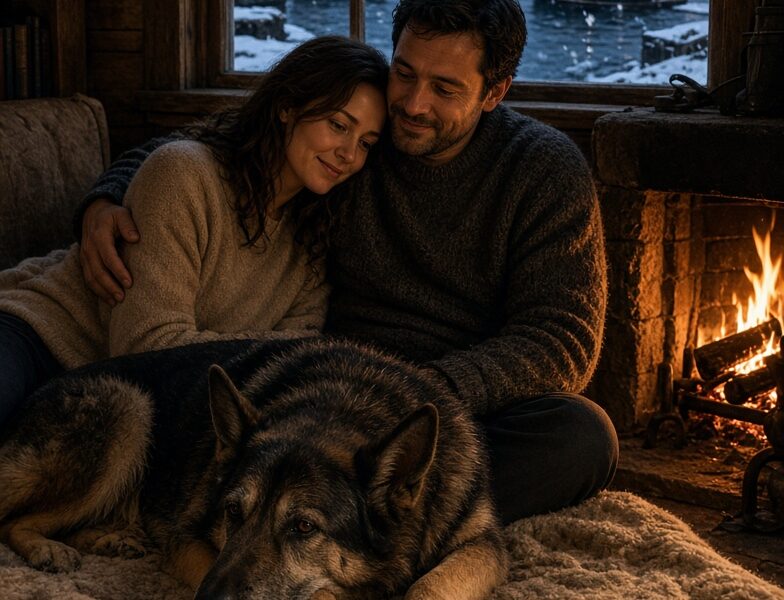
Flint lay comfortably on his thick rug by the fireplace, his old leather collar with its faded green stitching resting beside his blanket.
Miles greeted Tessa with a kiss and took the grocery bag from her hands.
“What are we making?”
“Vegetable soup.”
He raised an eyebrow.
“Should I warn the neighbors?”
“Only if you want to eat alone.”
Miles laughed and followed her into the kitchen.
They worked side by side, chopping vegetables, warming broth, and debating whether the soup needed another pinch of salt.
Tessa caught him reaching for the shaker before he’d even tasted it and gently pushed his hand away.
“Patience, sailor.”
“That’s never been my strongest quality.”
“You’re improving.”
Outside, snow drifted past the windows while the wind moved softly around the house.
Flint slept through most of the cooking, lifting his head only when something smelled especially interesting.
When dinner was ready, Miles set two bowls on the table and looked at Tessa with a familiar smile.
“So, can you cook now?”
She laughed, remembering the cold afternoon when she had first walked into the community hall with a suitcase and almost no confidence left.
“I’m still learning.”
Miles stepped closer and wrapped his arms around her.
“So am I.”
Tessa rested her head against his chest.
She could hear the steady ticking of his mother’s clock and the quiet breathing of Flint beside the fire.
They hadn’t promised each other a perfect future.
There would be hard days, uncertain decisions, and responsibilities neither of them could avoid.
But Tessa no longer believed she had to prove herself worthy of kindness, and Miles no longer believed love required carrying every burden alone.
When Flint stirred, Miles reached down and scratched behind his ears.
The old dog settled again, content to stay close.
Beyond the windows, Lubec Harbor lay quiet beneath the falling snow.
Inside the little house, three companions had found something neither money nor determination could provide on its own.
A home where no one had to earn the right to belong.
Sometimes the greatest kind of love isn’t about saving someone or carrying every burden for them.
It’s about believing in each other, sharing life’s struggles, and making room for someone to belong.
Miles learned that true strength doesn’t mean facing everything alone.
Tessa discovered that her worth was never measured by someone else’s approval.
And Flint, a faithful old German Shepherd, reminded them both that love often begins with the simplest act of trust.
Because sometimes all it takes to change a life is someone willing to say, “I can try.”
Thank you for spending your time with us and being part of this heartwarming journey.
If this story touched your heart, please give it a like, share it with someone you love, and subscribe to our channel for more inspiring stories of love, loyalty, and second chances.
Until next time, take care, and may kindness always find its way to you.









